Article

Cyclotron Production and Purification of 83Sr as a 90Sr Substitute for Positron Emission Tomography (PET)


1
Department of Reactive Transport, Institute for Resource Ecology, Research Site Leipzig, Helmholtz-Zentrum Dresden-Rossendorf e.V., Permoserstrasse 15, 04318 Leipzig, Germany
2
Nuclear Physics Institute CAS, Řež 292, 250 68 Husinec-Řež, Czech Republic
3
Department of Experimental Neurooncological Radiopharmacy, Institute of Radiopharmaceutical Cancer Research, Research Site Leipzig, Helmholtz-Zentrum Dresden-Rossendorf e.V., Permoserstrasse 15, 04318 Leipzig, Germany
*
Author to whom correspondence should be addressed.
Instruments 2026, 10(2), 20; https://doi.org/10.3390/instruments10020020
Submission received: 28 January 2026 / Revised: 20 February 2026 / Accepted: 6 March 2026 / Published: 30 March 2026

Abstract

Radioactive contaminations in soil, which originate from nuclear power production, nuclear weapon testing, or uncontrolled release, are of great environmental concern. One of the major fission product contaminants is 90Sr, whose high mobility demands a method to track contamination pathways and remediation processes. Positron emission tomography (PET) is a valuable tool for the required studies. As a β/γ-emitter, 90Sr is not suitable for PET, which requires β+-emitters. As an alternative, 83Sr, with a 12% intensity of β+-emission and a half-life of 32.4 h, is an appropriate PET substitute for 90Sr. We produced 83Sr with an enriched target of [85Rb]RbCl in a 85Rb(p,3n)83Sr reaction. The target material was bombarded with 36.22 MeV protons (ø 1.78 µA, 315 min), at a solid target station at the cyclotron U-120M (NPI CAS). The irradiated target (1.5 GBq) was dissolved in water, evaporated to dryness, redissolved in nitric acid, and transferred onto a Sr-selective cartridge (Sr-SpecTM, TRISKEM, France). Following target material wash out, 83Sr elution with water, solvent evaporation, and reformulation (in dilute nitric acid) yielded 1.2 GBq (82% radiochemical extraction efficiency, non-decay-corrected) of an 83Sr-solution. The easy and fast method is able to produce non-carrier-added 83Sr with high radionuclidic purity.

1. Introduction

The radionuclide 90Sr is a nuclear fission product, formed mainly in nuclear power plants. Almost all 90Sr detected in the environment originates from one of three primary man-made sources. These are (i) the operation of nuclear power plants, (ii) the global atmospheric fall-out of nuclear weapon tests, and (iii) nuclear accidents like those at the Chernobyl and Fukushima Daiichi nuclear power plants [1,2]. Due to its chemical similarity to calcium, incorporation into plants and animals is a major concern for human health. Therefore, decontamination of 90Sr-containing soils is of high relevance. An emerging approach is plant-based remediation/phytoremediation. Root exudates are supposed to extract the 90Sr, which will be transported into the plant matrix, where it can later be collected and separately disposed of [3,4].
The 90Sr itself has a half-life of 28.9 a [5]. For a three-dimensional understanding of the remediation behavior of 90Sr by plants, positron emission tomography (PET) is a promising technique. The decay mode of 90Sr itself is the only drawback; as a pure β-emitter, PET imaging with this isotope is not suitable. Checking the other isotopes of strontium from 80Sr to 90Sr, stated in Table 1, shows different options, with 80Sr, 81Sr, and 83Sr as partial β+-emitters with half-lives ranging from 22.3 min (81Sr) up to 32.4 h for 83Sr [5,6,7,8,9,10,11,12,13,14,15]. For imaging soil distribution and plant uptake, the half-life of 83Sr with 32.4 h provides an optimal time scale for our PET experiments for root exudate-based mobilization of strontium in soil. The β+-emission has an intensity of 12%, which is sufficient for PET imaging. Both β+-emission and electron capture (88%) result in the daughter nuclide 83Rb (t1/2 = 86.2 d), which in turn decays to stable 83Kr [9].
One route for the production of 83Sr could be the use of heavy ion bombardment via 65Cu(22Ne,5n)82Y → 83Sr or 75As(12C,4n)83Y → 83Sr reactions, as described by Broda et al. [16], as well as with the 82Kr(3He,2n)83Sr reaction, as described by Blessing et al. [17]. The availability of heavy ion beams and the separation of the 83Sr from the target and the matrix material have not been described. Instead, Kastleiner et al. [18] described the production via a nuclear proton reaction with a cyclotron. They used an [85Rb]RbCl isotopically enriched (99.4%) target irradiated by a proton beam. The determined cross-sections of the 85Rb(p,3n)83Sr reaction are shown in Figure 1. The optimal energy range for the preferred nuclear reaction can be achieved with proton energies of 30–40 MeV, in order to minimize the formation of unwanted side products as 85gSr (t1/2 = 64.8 d) and 85mSr (t1/2 = 67.6 min) [11,18,19]. In consideration of the cyclotron Cyclone 18/9 (IBA, Louvain-la-Neuve, Belgium) available at the research site in Leipzig, which offers a maximum proton beam energy of ≤18 MeV, the favorable nuclear reaction is not feasible. In addition, the TR-FLEX cyclotron (ACSI, Richmond, BC, Canada) at the research site in Dresden-Rossendorf offers a ≤30 MeV proton beam [20]. Due to its low proton energy range, an efficient production of 83Sr is not possible at our HZDR infrastructure. The Nuclear Physics Institute of the Czech Academy of Sciences in (Řež, Czech Republic) is offering proton energies up to 37 MeV with the U-120M cyclotron. This energy range is ideal for the production of 83Sr (see Figure 1) and minimizes the formation of 85g/mSr.
With the high energy proton beam of the U-120M cyclotron, we want to produce 83Sr with an enriched target of [85Rb]RbCl in an 85Rb(p,3n)83Sr reaction. The procedure for separation of the radiotracer from the target material and the recovery of it are adapted to the procedure of Mansel et al. [25]. The prepared 83Sr was used for further PET experiments [26].

2. Materials and Methods

2.1. General

2.1.1. Target Disks

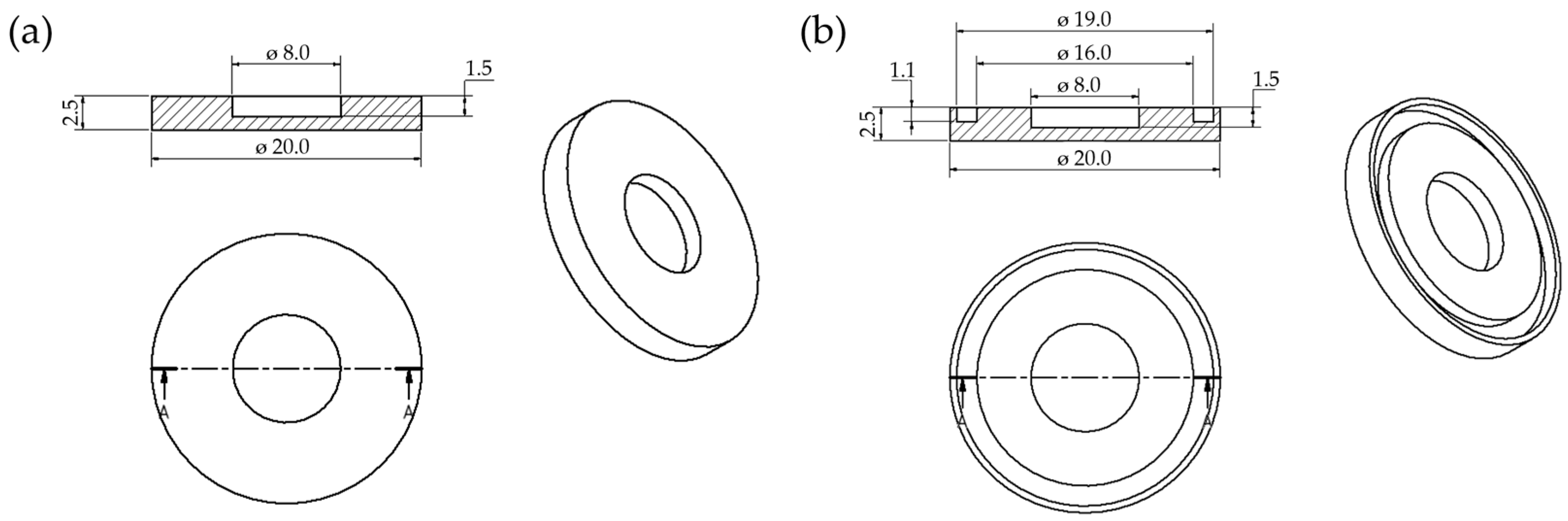
The target disks for the targets consist, in general, of an aluminum disk 20 mm in diameter and 2.5 mm thick, with a centered recess of 8 mm in diameter and depth of 1.5 mm (see Figure 2a). As cover, an aluminum foil 20 mm in diameter and 50 µm thick is used. For the final target disk (aluminum), a narrow channel, 1.1 mm deep, 1.5 mm thick, and 0.5 mm away from the edge of the target disk, was inserted. This allows for the placement of a rubber seal. For more details, see Figure 2b.

2.1.2. Ion Chromatography

An ion chromatography (IC) system, consisting of two ICS-1600 pump compartments with a column heater, suppressor system (CSRS 300, 4 mm, Dionex, Sunnyvale, CA, USA), and conductivity detector (DS6 heated conductivity cell, Dionex, Sunnyvale, CA, USA), in cat- and anion mode was used. For sample injection, an autosampler system Dionex PMC ICSP AS (ThermoFisher Scientific, Waltham, MA, USA) was used. All samples were injected onto the IC system with a volume of 25 µL.
For anion detection, an isocratic method with a mixture of a 4.5 mM aqueous sodium carbonate buffer and a 1.4 mM aqueous sodium hydrogen carbonate buffer was used, with a flow rate of 1.2 mL/min. The column system consists of a guard column IonPac AG22 (4 × 50 mm, Dionex, Sunnyvale, CA, USA) and an analytical column IonPac AS22 (4 × 250 mm, Dionex, Sunnyvale, CA, USA). The columns were equilibrated at 30 °C in the column oven system. The suppressor was operated at a current of 35 mA. The retention times were 4.22–4.29 min for chloride and 6.42–6.47 min for nitrate. The total method runtime was 14 min.
For cation detection, an isocratic method with an aqueous 18 mM methanesulfonic acid (MSA) buffer was used, with a flow rate of 1.0 mL/min. The column system consists of a guard column IonPac CG 12A (4 × 50 mm, Dionex, Sunnyvale, CA, USA) and an analytical column IonPac CS 12A (4 × 250 mm, Dionex, Sunnyvale, CA, USA). The columns were equilibrated at 30 °C in the column oven system. The suppressor was operated at a current of 60 mA. Retention times were 7.51–7.81 min for rubidium and 16.33–17.00 min for strontium. The total method runtime was 25 min.
Data evaluation was carried out with the chromatography software Chromeleon 7.2.10 (Thermo Fisher Scientific Inc., Waltham, MA, USA).

2.1.3. Activity Determination and γ-Spectrometry

Activity determinations for radiochemical procedures and sample preparation were performed using either an ISOMED 2010 dose calibrator (NuviaTech Healthcare, Rueil-Malmaison, France) or γ-spectrometry. For γ-spectrometry measurements, a GEM40P4-76 high-purity germanium (HPGe) detector equipped with a DSPEC 502 signal processing module (both ORTEC AMETEK, Oak Ridge, TN, USA) was utilized. The liquid nitrogen-cooled detector was oriented vertically within a lead-shielded chamber. Samples were positioned at distances of either 100 mm or 410 mm from the detector, depending on their radionuclide content. This configuration maintained measurement dead times between 1.1% and 14.8%. Measurement durations were set to either 2 h or 1 d. Energy and efficiency calibrations were performed using the NG3-234 geometry reference standard (Eckert & Ziegler, Berlin, Germany), which consists of a 14-nuclide mixture in a 1 mL volume with a density of 1 g/cm3. Spectra were recorded and analyzed using GammaVision software, version 8.00.03 (ORTEC AMETEK, Oak Ridge, TN, USA).

2.1.4. Chemicals and Materials

All chemicals used were suprapure grade. Deionized water (DI water) was supplied by a Milli-Q® IQ 7005 (Merck Millipore, Burlington, MS, USA) ultrapure water purification system.
The term “evaporated under reduced pressure” describes the removal of solvents under reduced pressure; a gentle stream of argon and elevated temperatures (115–130 °C) were applied too. All acid fumes formed during evaporation processes were trapped with an acid-air-washing system (0.1 M aqueous NaOH solution) to prevent them from entering the vacuum pump.
The Sr-SpecTM resin cartridge (SR RESIN FSRS180830; length 3 cm, diameter 1 cm) from TRISKEM Int. (Bruz, France) was pre-equilibrated with 30 mL of DI water and 30 mL of 8 M HNO3.

2.1.5. Irradiation Facility—Isochronous Cyclotron U-120M

The isochronous cyclotron U-120M was originally designed and manufactured at JINR Dubna as an accelerator for light positive ions (H+, D+, 3He2+, 4He2+), providing maximum energies of several tens of MeV (K = 40). The facility was commissioned in 1977 and has since been continuously operated and systematically upgraded. A major upgrade involved the conversion of the cyclotron to negative-ion (H, D) operation, enabling extraction of (H+, D+) beams using the stripping technique. This upgrade, completed between 1996 and 1998, resulted in an approximately one-order-of-magnitude increase in the extracted (H+, D+) beam currents. Currently, the cyclotron can deliver an external proton beam with a maximum energy of 36–37 MeV and a maximum beam current of approximately 30 µA.

2.2. Preparation of the RbCl Targets

The targets were prepared by pressing powdered natRbCl (FLUKA, Seelze, Germany) or [85Rb]RbCl (enrichment 99.5% 85Rb, STB Isotope Germany GmbH, Hamburg, Germany) into a target backing using a dedicated pressing tool. The backing had the shape of a disk with a diameter of 20 mm. The RbCl powder was compacted into a cavity with a diameter of 8 mm located at the center of the backing. The RbCl powder was pressed at pressures of 5.9 MPa or 9.8 MPa, resulting in a mechanically stable RbCl pellet. The pressing pressure was chosen experimentally to ensure that the prepared layer was sufficiently compact while avoiding undesirable extensive extrusion of parts of the periphery layer from the cavity and preventing mechanical deformation of the backing during pressing. The thickness of the RbCl layer and of the thickness of the backing was selected such that the beam energy loss in the layer was optimal and the major part of the beam was fully stopped in the cooling water.
Since the behavior of the RbCl layer under irradiation was not known in advance, several test irradiations were performed using targets with layers of commercially available and inexpensive natRbCl with various beam currents. Two types of targets were used:
Test targets (dimensions shown in Figure 2a) were used to determine beam parameters, in particular the proton current and thus the thermal power deposited in the layer and in the target itself. For one of the test irradiations, a natRbCl target with a mass of 172.9 mg was prepared. The target was pressed at a pressure of 9.81 MPa (see Figure 3a,b).
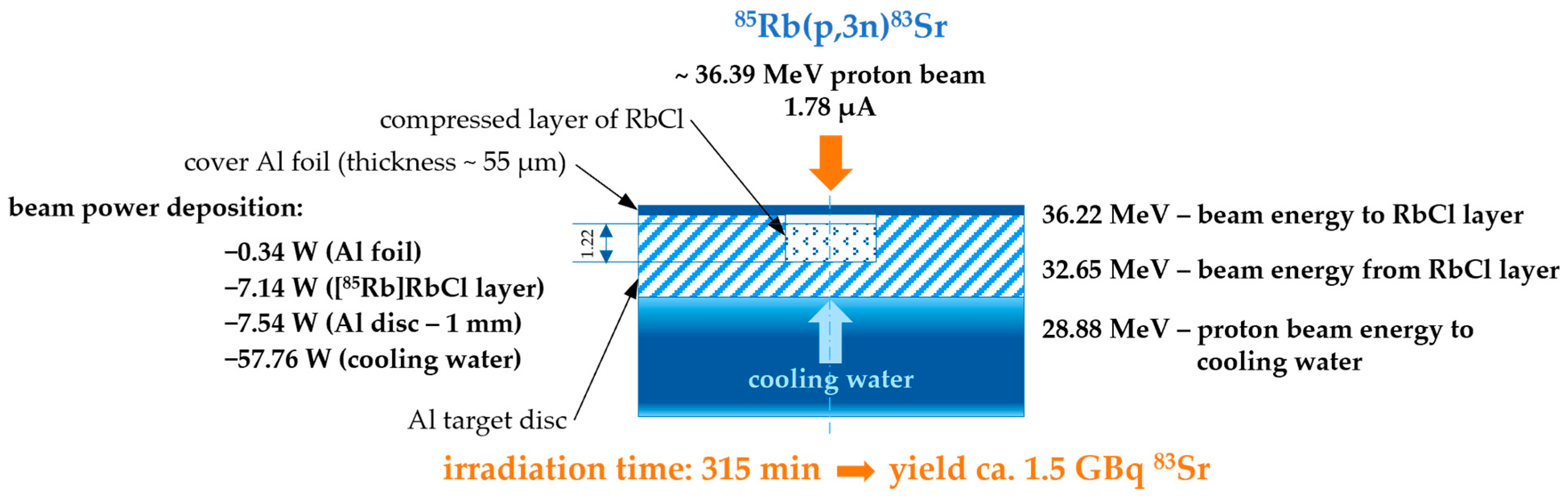
One enriched target (dimensions shown in Figure 2b) was supplemented with an Al foil of a thickness of 55 µm placed in front of the [85Rb]RbCl layer to prevent possible dispersion of the irradiated material into the target holder or to the ion-beam line. The Al foil was perforated with several small holes to allow for the release of gases, which is generated mainly at the beginning of irradiation. For 83Sr production, the target disk was filled with 171.9 mg of isotopically enriched [85Rb]RbCl (enrichment 99.5%), pressed with 1000 kg (see Figure 3d), and then irradiated.

2.3. Cyclotron Production of 83Sr

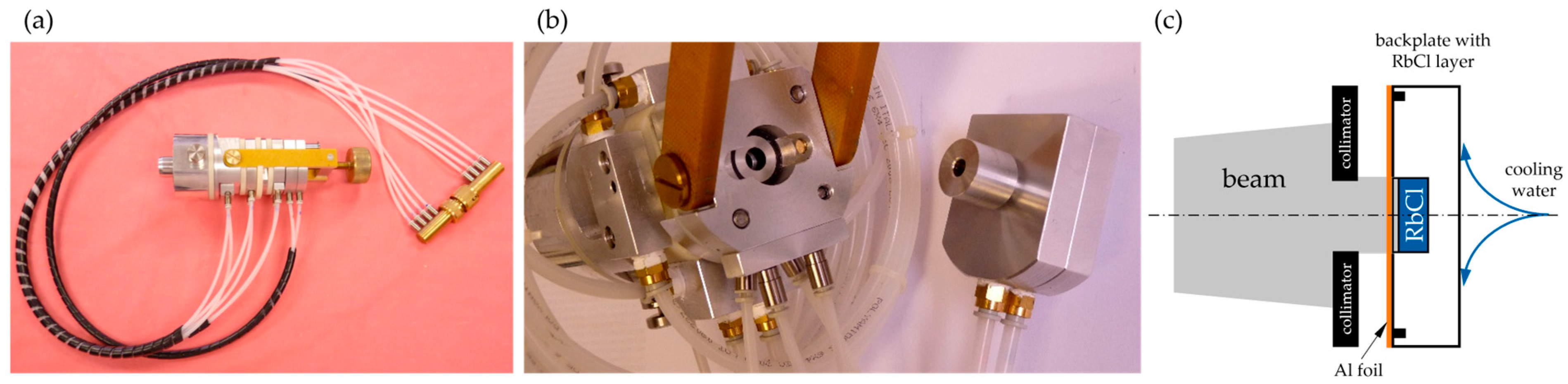
The target disk with pressed RbCl powder was placed into a target holder (see Figure 4a,b), which was installed directly on the cyclotron ion-beam line. The front, irradiated target site is in a vacuum, while the back site is cooled with water. In Figure 4c, a schematic overview of the target holder is shown. The proton beam was extracted from the cyclotron to the ion-beam line, focused or defocused by the quadrupoles and collimated into a shape that corresponds to the size of the target. The aluminum collimator is positioned in front of the target layer to ensure that only the area with target material is irradiated. The target was irradiated for 315 min with protons with a proton energy of 36.39 MeV and an average current of 1.78 µA (total charge: 33,660 µC).

2.4. Purification of 83Sr

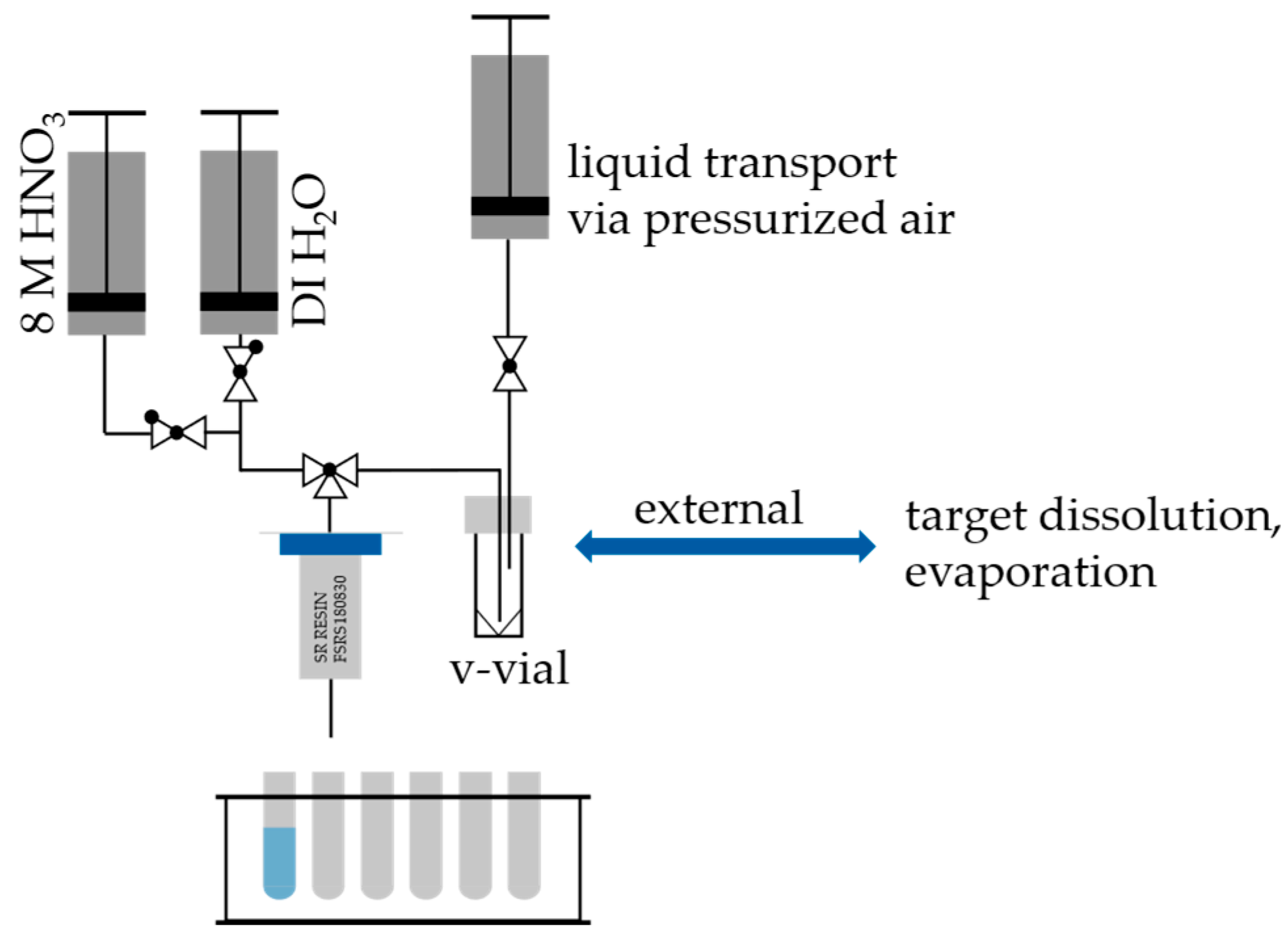
The bombarded target material (1.5 GBq, end-of-bombardment [EOB]) was dissolved in 1.5 mL of DI water, and the target holder was rinsed with 1.25 mL of DI water. The water fractions were combined and collected in a v-vial for evaporation under reduced pressure. The solid residue was redissolved in 1 mL of 8 M HNO3 and administered to the Sr-SpecTM resin cartridge. The setup consisted of a polytetrafluoroethylene (PTFE) tubing system which was connected to the Sr-selective cartridge via a three-way valve, and via another PTFE tubing to a syringe pump equipped with two syringes, filled with water and 8 M of HNO3, respectively. Both syringes were connected to non-return valves to prevent mixing of the different eluents (Figure 5), and they could be controlled individually via the syringe pump. The v-vial was washed with another 1 mL of 8 M HNO3, which was also transferred onto the cartridge. Both volumes were collected as fraction 1. Further, 2 mL of 8 M HNO3 aliquots was added onto the cartridge and eluted in fractions 2–6 (syringe pump, speed 0.25 mL/min). Switching to DI water, the 2 mL of fractions (syringe pump, speed 0.25 mL/min) 7–13 was collected. Fractions 9–11 contained the 83Sr-activity and were combined. The aqueous solvent was removed under reduced pressure. The dried residue was redissolved in 1 mL of 1 mM HNO3. This resulted in a final solution containing 1.2 GBq 83Sr (radiochemical extraction efficiency [RCEE] = 82% non-decay-corrected [ndc]), with a total extraction time of 194 min (start of the dissolution of the target material). The radionuclidic purity (RNP) was determined via γ-spectrometry as >99%.

2.5. Target Material Recovery

2.5.1. Non-Radioactive Test with natRbNO3

In a glass v-vial, 257 mg of natRbNO3 was dissolved in a mixture of 1 mL of conc. HCl and 100 µL of DI water. The liquid was evaporated under reduced pressure. The dry residue was dissolved in 1 mL of DI water, and a 10 µL sample was taken for ion chromatography analysis (10 µL sample diluted in 4.99 mL of DI water). To the dissolved salt, 1 mL of conc. HCl was added, and the solvent was evaporated under reduced pressure. The procedure of redissolving in DI water, sampling, addition of conc. hydrochloric acid, and evaporation was repeated seven times, to result in an off-white crystalline solid after eight repetitions. The IC analysis shows >99% of chloride content in the last samples.

2.5.2. Recovery of 85Rb Target Material

To recover isotopically enriched target material, fractions 1–3 from Sr-cartridge elution were combined, and the nitric acid was evaporated under reduced pressure until dryness was reached. The off-white solid was redissolved in 2 mL of conc. HCl, followed by the evaporation of it under reduced pressure. This process was repeated seven times to result in 165.4 mg of a colorless solid (total recovery = (165.4 mg/171.9 mg) · 100% = 96%). IC analysis of a sample shows >99% of chloride content.

2.6. Positron Emission Tomography—Phantom

The feasibility of 83Sr for positron emission tomography in materials science was quantified by utilizing a phantom. To mimic the attenuation properties of sands and soils, which are a major target for 83Sr PET experiments, a material with similar attenuation coefficients for the 511 keV annihilation radiation is required. From all readily available polymers, the mass attenuation coefficient for PTFE (0.179 1/cm, [27]) is the closest to that of silicate sand (0.229 1/cm at 20% porosity, [27]). The phantom is made up of a PTFE cylinder (50 mm diameter, 50 mm height), with blind holes of 1–5 mm diameter drilled to a depth of 30 mm.
An 83Sr-solution of 22.0 MBq/mL was injected into all holes. The phantom filled with a total activity of 16.5 MBq was inserted into a preclinical PET scanner (ClearPET/Elysia-Raytest, Straubenhardt, Germany; Sempere Roldan et al. [28]), which provides a voxel size of 1.15 × 1.15 × 1.15 mm3. Data acquisition was performed for 20 min. The tomograms were reconstructed using the OSMAP One-Step-Late reconstruction algorithm of the STIR library [29]. Corrections for decay, photon scattering, and random coincidence events were applied as described by Schöngart et al. [26]. To prevent artifacts due to different fill height of the bore holes, the resulting datasets were masked. Only the bottom voxel layer (1.15 mm) of the tracer-filled bore holes is used for analysis.

3. Results and Discussion

For the first test of the target setup, a natural RbCl target is prepared by pressing natRbCl powder into an aluminum holder, as shown in Figure 3a,b. The irradiation was performed for 10 min with 36.22 MeV protons at 5 µA current, resulting in a dark blue natRbCl target pellet. No signs of melting or sublimation of the target material are observed, as shown in Figure 3c.
With a modified target disk (shown in Figure 2b), the enriched target material of [85Rb]RbCl was prepared in a similar manner to the previously described test target. The enriched [85Rb]RbCl target was irradiated with protons on the ion-optical beam line of the cyclotron at a maximum achievable energy of approximately 37 MeV and an average beam current of 1.78 µA.
The power losses in the individual layers were as follows: Al foil: −0.34 W, [85Rb]RbCl layer: −7.14 W, Al backing with a thickness of 1 mm: −7.54 W, and beam stopping in water: −57.76 W [30]. The irradiation time was 315 min, corresponding to a total collected charge of 33 660 µC. A schematic overview of the target assembly with the relevant beam parameters is shown in Figure 6.
After irradiation, the target was left in the target holder for 12 h to allow for the decay of short-lived radionuclides, before it was packed and shipped to the research site in Leipzig, Germany.
After the bombardment, a melting effect of the bulk target material was visible to some extent, seen as colorless spots in Figure 3e. In addition, sublimation of target material took place, which was clearly visible as target residue on the target cover, as shown in Figure 3f.
For the separation and purification of the produced 83Sr, the method described by Mansel et al. [25] was adapted. The procedure was first tested with non-radioactive (natural) rubidium/strontium mixtures. The preliminary separation experiment showed good separation for both elements.
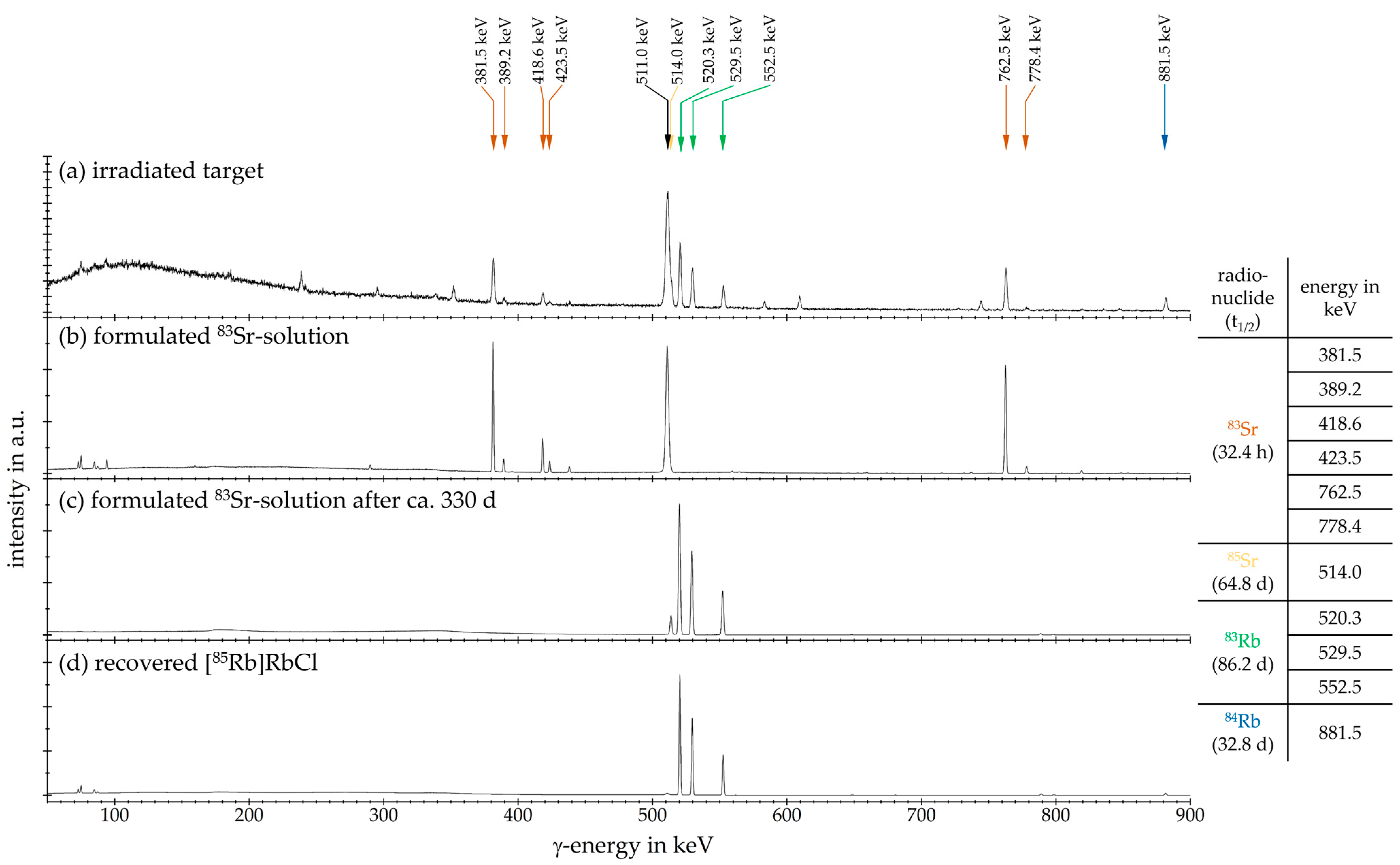
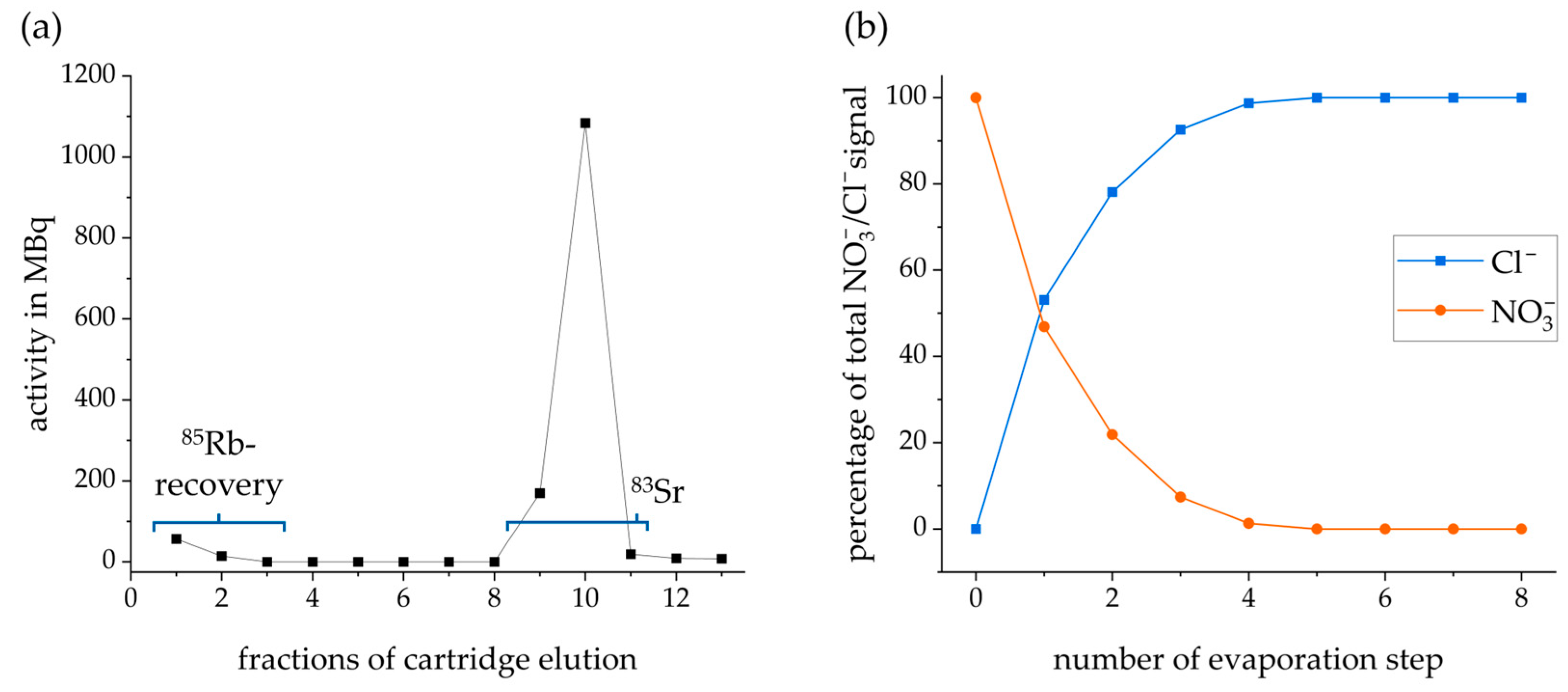
The adapted method was also used for the irradiated target material. After bombardment and transport, the activity was determined with γ-spectrometry to be 1.5 GBq of 83Sr (Figure 7a). Besides the main product, some radiometal impurities could be detected in the γ-spectra, as shown in Figure 7a. These impurities were determined as 83Rb, 84Rb, and 85Sr. The dissolution of the target material was easy to perform, due to the excellent water solubility of RbCl and SrCl2. The water was evaporated, and the residue redissolved in nitric acid (8 M), which was necessary for the separation on the Sr-selective cartridge. Compared to strontium, rubidium has a high retention under these strong acidic conditions. Horwitz et al. [31] showed the high affinity of strontium towards the resin with a determined capacity factor k’ of ~90 compared to all other alkali metals, with k’ < 10. The rubidium was eluted in the first fractions. After washing of the cartridge, the elution of the 83Sr was performed by changing the eluent from nitric acid to water. The 83Sr was contained in fractions 9–11 (see Figure 8a), which were combined. The 83Sr fractions were evaporated to dryness, and the residue was then redissolved in diluted nitric acid. The resulting solution contained a final activity of 1.2 GBq (RCEE of 82%) of [83Sr]Sr(NO3)2. The 83Sr-solution was then used for various PET experiments [26].
The complete separation was performed in 194 min, where the solvent evaporations were the most time-consuming steps. In future purifications, the aqueous target solution should only be diluted with conc. nitric acid, to avoid one of the two evaporation steps.
An aliquot of the 83Sr-solution analyzed via γ-spectrometry showed an RNP > 99% 83Sr and minor impurities of 85Sr (see Figure 7b). After decay of the 83Sr (ca. 330 d), an additional γ-spectrum (Figure 7c) was recorded in order to resolve spectral signals which were hidden by strong 83Sr-signals. Only very minor impurities of 83Rb and 85Sr, less then <1% decay corrected to the total activity of the 83Sr at the end of synthesis, are detected. These impurities are the results of either the incomplete separation during the purification, or, especially in the case of 83Rb, being formed by 83Sr as a decay product.
Furthermore, the enriched target material was recovered from the cartridge fractions and transformed into the chloride-form. To determine the efficiency of the nitrate–chloride exchange process, a sample of natRbNO3 was used in the first approach. The solid residue was dissolved in conc. hydrochloric acid and then evaporated under reduced pressure. This process was repeated with the residues for a total of eight cycles. After every evaporation step, a sample was taken to determine the chloride–nitrate ratio with ion chromatography. These experimental results are shown in Figure 8b and suggested a minimum of six evaporation steps, to ensure the absence of nitrate in the rubidium salt. For the recovery of the enriched target material, seven evaporation steps with conc. hydrochloric acid were performed. The [85Rb]RbCl was obtained as a colorless powder with 96% (165.4 mg) recovery (see Figure 3g). Ion chromatography showed an >99% content of rubidium chloride. Via γ-spectrometry, <1% (from total activity) of impurities were detected in the recovered [85Rb]RbCl. The main radioactive impurity was 84Rb (881.5 keV [10]) (see Figure 7d).
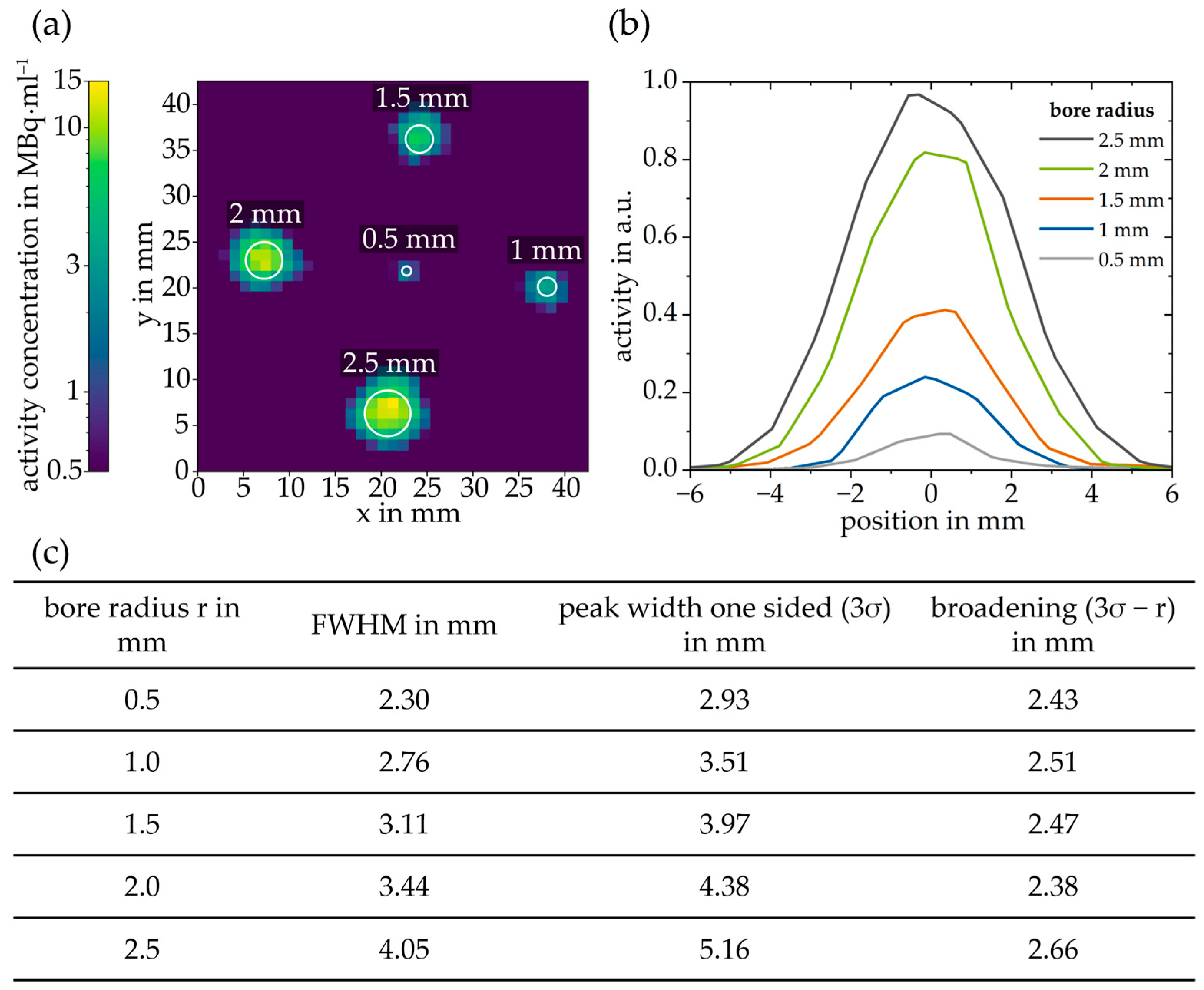
To assess the achievable resolution in PET, a PTFE phantom was used. The measured activity distribution in the tomogram is shown in Figure 9a as a projection along the length of the 83Sr-filled holes. The PET acquisition yielded 2.4 × 10⁶ total counts, of which 1.8 × 10⁶ were so-called “true events” and contributed to the reconstruction of the tomogram [26]. Figure 9b shows line profiles across the 83Sr-filled holes. To estimate the spatial resolution achievable with 83Sr, the line profiles were fitted a gaussian functions. The results are presented in Figure 9c. For 99.7% confidence intervals, all bore holes showed a one-sided peak broadening between 2.38 mm and 2.66 mm with respect to the bore radius.

4. Conclusions

In an international collaboration between the German Helmholtz-Zentrum Dresden-Rossendorf research site in Leipzig and the Czech Institute of Nuclear Physics CAS, a fast and high-purity method was established to produce non-carrier-added 83Sr. With the isotopically enriched [85Rb]RbCl target, we successfully produced 83Sr in a 85Rb(p,3n)83Sr reaction. The target material and 83Sr were separated utilizing a Sr-selective resin, and formulated as [83Sr]Sr(NO3)2 solution with an 82% radiochemical extraction efficiency and with >99% radionuclidic purity. The produced 83Sr was used in PET experiments, serving as a 90Sr analog to quantify both phytomobilization and abiotic remediation of contaminated soils.

Author Contributions

K.F., J.S., J.Š., and M.L. conceived and designed the experiments. K.F. and J.Š. performed the target preparation and irradiation. M.L. and J.S. performed the separation of radiotracer and target material. J.S. performed the PET image acquisition and the image analysis. All authors wrote, reviewed, and revised the manuscript/publication. All authors have read and agreed to the published version of the manuscript.

Funding

This research was funded by the German Federal Ministry of Research, Technology and Space (BMFTR), grant number 02NUK066A.

Data Availability Statement

The original contributions presented in the study are included in the article; further inquiries can be directed to the corresponding author.

Acknowledgments

We are thankful for the technical and laboratory support received from D. Lösel, C. Schössler, and S. Draeger. The 83Sr production and measurements were performed on CANAM infrastructure at NPI CAS–90056 (Nuclear Physics Institute of the Czech Academy of Sciences).

Conflicts of Interest

The authors declare no conflicts of interest. The founding sponsors had no role in the design of the study; in the collection, analyses, or interpretation of the data; in the writing of the manuscript; or in the decision to publish the results.

References

  1. Robinson, C.; Shaw, S.; Lloyd, J.R.; Graham, J.; Morris, K. Phosphate (Bio)mineralization Remediation of 90Sr-Contaminated Groundwaters. ACS ES&T Water 2023, 3, 3223–3234. [Google Scholar] [CrossRef]
  2. Zhou, Z.; Ren, H.; Zhou, L.; Wang, P.; Lou, X.; Zou, H.; Cao, Y. Recent Development on Determination of Low-Level 90Sr in Environmental and Biological Samples: A Review. Molecules 2023, 28, 90. [Google Scholar] [CrossRef]
  3. Tamma, A.A.; Lejcuś, K.; Fiałkiewicz, W.; Marczak, D. Advancing Phytoremediation: A Review of Soil Amendments for Heavy Metal Contamination Management. Sustainability 2025, 17, 5688. [Google Scholar] [CrossRef]
  4. Yan, A.; Wang, Y.; Tan, S.N.; Yusof, M.L.M.; Ghosh, S.; Chen, Z. Phytoremediation: A Promising Approach for Revegetation of Heavy Metal-Polluted Land. Front. Plant Sci. 2020, 11, 359. [Google Scholar] [CrossRef] [PubMed]
  5. Basu, S.; Mccutchan, E. Nuclear Data Sheets for A = 90. Nucl. Data Sheets 2020, 165, 1–329. [Google Scholar] [CrossRef]
  6. Singh, B. Nuclear Data Sheets for A = 80. Nucl. Data Sheets 2005, 105, 223–418. [Google Scholar] [CrossRef]
  7. Shamsuzzoha Basunia, M. Nuclear Data Sheets for A = 81. Nucl. Data Sheets 2025, 199, 271–612. [Google Scholar] [CrossRef]
  8. Tuli, J.; Browne, E. Nuclear Data Sheets for A = 82. Nucl. Data Sheets 2019, 157, 260–494. [Google Scholar] [CrossRef]
  9. McCutchan, E.A. Nuclear Data Sheets for A = 83. Nucl. Data Sheets 2015, 125, 201–394. [Google Scholar] [CrossRef]
  10. Abriola, D.; Bostan, M.; Erturk, S.; Fadil, M.; Galan, M.; Juutinen, S.; Kibédi, T.; Kondev, F.; Luca, A.; Negret, A.; et al. Nuclear Data Sheets for A = 84. Nucl. Data Sheets 2009, 110, 2815–2944. [Google Scholar] [CrossRef]
  11. Singh, B.; Chen, J. Nuclear Data Sheets for A = 85. Nucl. Data Sheets 2014, 116, 1–162. [Google Scholar] [CrossRef]
  12. Negret, A.; Singh, B. Nuclear Data Sheets for A = 86. Nucl. Data Sheets 2015, 124, 1–156. [Google Scholar] [CrossRef]
  13. Johnson, T.D.; Kulp, W.D. Nuclear Data Sheets for A = 87. Nucl. Data Sheets 2015, 129, 1–190. [Google Scholar] [CrossRef]
  14. McCutchan, E.A.; Sonzogni, A.A. Nuclear Data Sheets for A = 88. Nucl. Data Sheets 2014, 115, 135–304. [Google Scholar] [CrossRef]
  15. Singh, B. Nuclear Data Sheets for A = 89. Nucl. Data Sheets 2013, 114, 1–208. [Google Scholar] [CrossRef]
  16. Broda, R.; Hrynkiewicz, A.; Styczeń, J.; Waluś, W. The excited states of Kr and Rb isotopes in the 78 ≦ A ≦ 85 mass region. Nucl. Phys. A 1973, 216, 493–518. [Google Scholar] [CrossRef]
  17. Blessing, G.; Tárkányi, F.; Qaim, S. Production of 82mRb via the 82Kr(p,n)-process on highly enriched 82Kr: A remotely controlled compact system for irradiation, safe handling and recovery of the target gas and isolation of the radioactive product. Appl. Radiat. Isot. 1997, 48, 37–43. [Google Scholar] [CrossRef]
  18. Kastleiner, S.; Qaim, S.; Nortier, F.; Blessing, G.; van der Walt, T.; Coenen, H. Excitation functions of 85Rb(p,xn)85m,g,83,82,81Sr reactions up to 100 MeV: Integral tests of cross section data, comparison of production routes of 83Sr and thick target yield of 82Sr. Appl. Radiat. Isot. 2002, 56, 685–695. [Google Scholar] [CrossRef]
  19. Horiguchi, T.; Noma, H.; Yoshizawa, Y.; Takemi, H.; Hasai, H.; Kiso, Y. Excitation functions of proton induced nuclear reactions on 85Rb. Int. J. Appl. Radiat. Isot. 1980, 31, 141–151. [Google Scholar] [CrossRef]
  20. Kreller, M.; Pietzsch, H.J.; Walther, M.; Tietze, H.; Kaever, P.; Knieß, T.; Füchtner, F.; Steinbach, J.; Preusche, S. Introduction of the New Center for Radiopharmaceutical Cancer Research at Helmholtz-Zentrum Dresden-Rossendorf. Instruments 2019, 3, 9. [Google Scholar] [CrossRef]
  21. Ido, T.; Hermanne, A.; Ditrói, F.; Szűcs, Z.; Mahunka, I.; Tárkányi, F. Excitation functions of proton induced nuclear reactions on natRb from 30 to 70 MeV. Implication for the production of 82Sr and other medically important Rb and Sr radioisotopes. Nucl. Instrum. Methods Phys. Res. B 2002, 194, 369–388. [Google Scholar] [CrossRef]
  22. Matlocha, T.; Štursa, J.; Běhal, R.; Zach, V.; Čihák, M. Enhanced beam extraction system at the U-120M cyclotron. Nucl. Instrum. Methods Phys. Res. A 2024, 1064, 169335. [Google Scholar] [CrossRef]
  23. Künzelmann, A. Zyklotron an der Leipziger Forschungsstelle. 2026. Available online: https://www.hzdr.de/db/PicUser?pOid=54397&pWidth=1920 (accessed on 15 January 2026).
  24. CAS, NPI Cyklotron 01. 2026. Available online: https://www.ujf.cas.cz/export/sites/ujf/.content/galerie-obrazky/fotogalerie/Pro-verejnost-a-media/Urychlovac-cyklotron/_X5A1745_LOW.jpg (accessed on 15 January 2026).
  25. Mansel, A.; Gruhne, S.; Franke, K.; Fischer, S. Production of 85Sr at a 18 MeV-cyclotron and purification for geochemical investigations. Appl. Radiat. Isot. 2014, 92, 22–24. [Google Scholar] [CrossRef]
  26. Schöngart, J.; Lindemann, M.; Klotzsche, M.; Franke, K.; Fischer, C. Quantitative tomography of contaminant phytomobilization: β+ emitters 83Sr and 86Y as tracers of fission-product analog mobility. J. Hazard. Mater. Adv. 2026, 21, 100952. [Google Scholar] [CrossRef]
  27. Berger, M.J.; Hubbell, J.H.; Seltzer, S.M.; Chang, J.; Coursey, J.S.; Sukumar, R.; Zucker, D.S.; Olsen, K. XCOM: Photon Cross Sections Database—NIST Standard Reference Database 8 (XGAM); National Institute of Standards and Technology: Gaithersburg, MD, USA, 2010. [CrossRef]
  28. Roldan, P.S.; Chereul, E.; Dietzel, O.; Magnier, L.; Pautrot, C.; Rbah, L.; Sappey-Marinier, D.; Wagner, A.; Zimmer, L.; Janier, M.; et al. Raytest ClearPET™, a new generation small animal PET scanner. Nucl. Instrum. Methods Phys. Res. A 2007, 571, 498–501. [Google Scholar] [CrossRef]
  29. Thielemans, K.; Tsoumpas, C.; Mustafovic, S.; Beisel, T.; Aguiar, P.; Dikaios, N.; Jacobson, M.W. STIR: Software for tomographic image reconstruction release 2. Phys. Med. Biol. 2012, 57, 867. [Google Scholar] [CrossRef]
  30. Ziegler, J.F.; Ziegler, M.D.; Biersack, J.P. SRIM—The Stopping and Range of Ions in Matter - SRIM2008 Code. Available online: http://www.srim.org/ (accessed on 15 January 2026).
  31. Horwitz, E.P.; Chiarizia, R.; Dietz, M.L. A novel strontium-selective extraction chromatoghraphic resin. Solvent Extr. Ion Exch. 1992, 10, 313–336. [Google Scholar] [CrossRef]
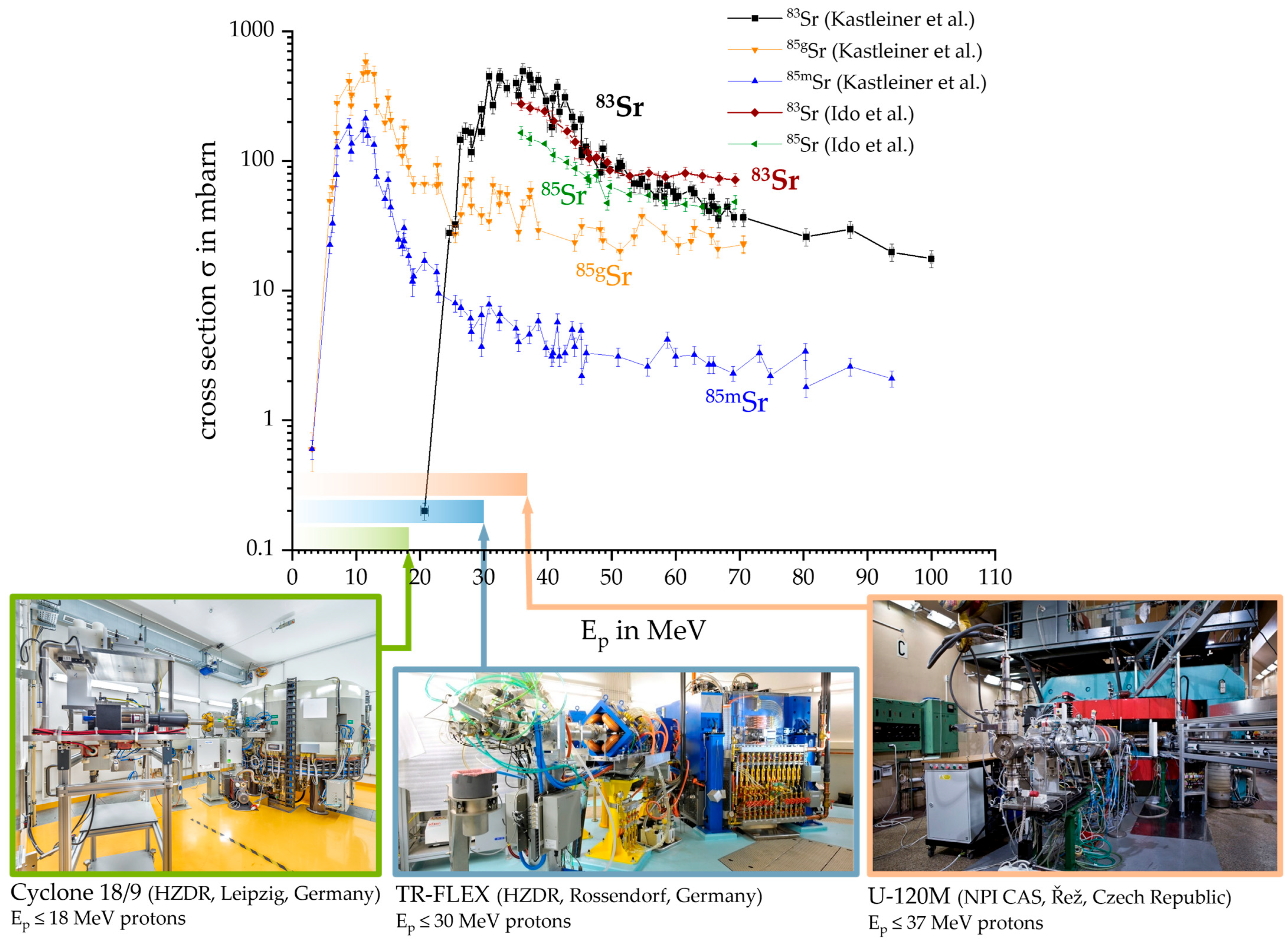
Figure 1. Reaction cross-sections σ (85Rb(p,xn)83/85Sr) for the formation of 83Sr, 85gSr, and 85mSr (data from Kastleiner et al. [18] and Ido et al. [21]). Proton energy ranges of the cyclotrons from the Cyclone 18/9 [IBA, Louvain-la-Neuve, Belgium] (HZDR Leipzig, Ep ≤ 18 MeV), TR-FLEX [ACS Inc., Richmond, BC, Canada] (Rossendorf HZDR, Ep ≤ 30 MeV, Germany) [20] and of the U-120M cyclotron (Ep ≤ 37 MeV) from NPI CAS (Řež, Czech Republic) [22] are shown in the different colored bars at the bottom left. [Left image reprinted with permission from A. Künzelmann/HZDR (2017) [23]. Middle image reprinted from Kreller et al. (2019) [20]. Right image reprinted from NPI CAS (2026) [24]].
Instruments 10 00020 g001
Figure 2. Technical details and dimensions for the (a) test target disk and (b) target disk (not a true-to-scale representation; all measurements are given in mm).
Instruments 10 00020 g002
Figure 3. (a) Filled recess of test target with natRbCl, (b) compressed natRbCl test target, (c) irradiated natRbCl test target, (d) target disk with [85Rb]RbCl target, (e) irradiated [85Rb]RbCl target with signs of partial melting and sublimation, (f) target cover with sublimated and partially melted [85Rb]RbCl target material, (g) recovered target material [85Rb]RbCl.
Instruments 10 00020 g003
Figure 4. (a,b) Perpendicular solid state target holder (overall assembly and in detail). (c) Schematic overview of the target holder for the U-120M cyclotron.
Instruments 10 00020 g004
Figure 5. Laboratory setup for the separation of 83Sr from the target material.
Instruments 10 00020 g005
Figure 6. Schematic overview of the irradiated enriched [85Rb]RbCl target assembly with relevant beam parameters (not a true-to-scale representation; measurements are given in mm).
Instruments 10 00020 g006
Figure 7. Spectra and summary of radionuclide γ-signals. (a) Irradiated target material, (b) formulated 83Sr-solution, (c) 83Sr-solution after ca. 330 days, and (d) recovered [85Rb]RbCl target material [9,10,11].
Instruments 10 00020 g007
Figure 8. (a) Activity of the Sr-resin elution fractions for the 83Sr purification. (b) Test of the transformation of nitrate- into chloride-form starting from natRbNO3 by evaporation with conc. hydrochloric acid.
Instruments 10 00020 g008
Figure 9. (a) Projected activity of the PET-phantom with 83Sr. The outline of the phantom and its drill holes are outlined in white and radii mentioned above each drill hole. (b) Line profiles across the different drill holes. (c) Full widths at half maximum (FWHM) were determined for all bore holes in the PTFE phantom. The corresponding one-sided widths at a 99.7% confidence interval are given as standalone values (3σ) and in relation to the bore hole radius (3σ − r). The results indicate a broadening of the measured activity distribution between 2.38 mm and 2.66 mm.
Instruments 10 00020 g009
Table 1. Overview of the strontium isotopes, with the corresponding half-lives and their main decay modes (EC, electron capture; nuclear data [5,6,7,8,9,10,11,12,13,14,15]).
IsotopeHalf-Life t1/2Decay Modes (β+-Intensity)
80Sr106.3 minEC, β+ (9.2%)
81Sr22.3 minEC, β+ (29%)
82Sr25.3 dEC
83Sr32.4 hEC, β+ (12%)
84Srstable
85Sr64.8 dEC
86Srstable
87Srstable
88Srstable
89Sr50.6 dβ
90Sr28.9 aβ
Disclaimer/Publisher’s Note: The statements, opinions and data contained in all publications are solely those of the individual author(s) and contributor(s) and not of MDPI and/or the editor(s). MDPI and/or the editor(s) disclaim responsibility for any injury to people or property resulting from any ideas, methods, instructions or products referred to in the content.