5. Possible Microscopic Origins of Coordination
5.1. Effective Internal Degrees of Freedom
The internal variable introduced in the minimal model should be interpreted as a coarse-grained representation of local electronic structure rather than as a single microscopic degree of freedom. Its purpose is to encode, at an effective level, whether neighboring local electronic environments are mutually compatible for coherent transport.
Depending on the material, the relevant internal variables may originate from:
spin correlations, such as short-range antiferromagnetic order;
orbital configurations and orbital-selective correlations;
charge-transfer states and local valence fluctuations;
lattice-coupled electronic configurations, such as Jahn–Teller distortions;
nematic or pseudospin-like collective degrees of freedom;
or other low-energy collective modes generated by strong electronic correlations.
Such internal degrees of freedom are common in strongly correlated electron systems, where local electronic structure can strongly influence macroscopic transport and ordering phenomena [
5,
16,
19]. The essential requirement for the present framework is not the identification of a unique microscopic variable, but the existence of local configurations whose compatibility across neighboring sites modifies coherent charge motion.
In this sense, should be viewed as an effective low-energy descriptor of correlated local environments. Different materials may realize this descriptor through different microscopic channels.
5.2. Connection to Microscopic Hamiltonians
The coordination functional introduced in
Section 2 may arise as an effective description of short-range correlations in strongly interacting electron models. In single-band systems, for example, short-range spin correlations generated by Hubbard or
t–
J physics can favor locally compatible configurations between neighboring sites [
5,
19]. In multi-orbital systems, orbital-dependent hopping, Hund’s coupling, and spin-orbital correlations can favor compatible orbital or spin-orbital arrangements, as discussed in the context of iron-based superconductors and transition-metal compounds [
24].
More generally, effective coordination terms may emerge after coarse-graining or integrating out high-energy degrees of freedom in models such as:
Hubbard and t–J models;
spin-fermion models;
multi-orbital Hubbard models;
electron-lattice coupled models;
effective theories with local spin, orbital, nematic, or valence degrees of freedom.
At the level of the present model, such effects are represented schematically by an interaction favoring compatibility between internal variables,
or, in the simplified classical representation,
The coupling between internal structure and transport arises because the effective hopping amplitude, local phase coherence, or superfluid stiffness can depend on the compatibility of neighboring electronic environments. This is a standard feature of correlated systems, in which charge motion is strongly renormalized by spin, orbital, lattice, or other local degrees of freedom [
5,
16]. At the coarse-grained level, this dependence is represented by the coupling
which links internal coordination to phase stiffness.
Thus, the minimal model should be understood as a phenomenological low-energy representation of correlated transport modulated by local electronic structure. A controlled derivation of the parameters , , and from a microscopic Hamiltonian remains an important task for future work.
5.3. Material-Specific Realizations
The microscopic content of the coordination variable is expected to be material-dependent.
In cuprates, short-range antiferromagnetic correlations, charge-transfer physics, local inhomogeneity, and other forms of electronic organization may contribute to an effective internal coordination sector. The persistence of local correlations into the pseudogap regime suggests that such coordination can develop without immediately producing global superconducting coherence [
4,
6].
In iron-based superconductors, orbital and nematic degrees of freedom play an important role. In such systems, coordination among orbital or spin-orbital configurations may influence coherent transport by modifying anisotropic stiffness, scattering, or the compatibility of neighboring electronic environments [
24].
In heavy-fermion materials, transition-metal oxides, and other correlated systems, hybridization effects, multiplet structure, valence fluctuations, and electron-lattice coupling may generate analogous effective variables [
25]. These examples are not meant to imply that the same coordination field applies universally. Rather, they illustrate that many correlated materials contain local internal structures capable of influencing phase coherence.
5.4. Experimental Signatures of Coordination
Within this framework, superconducting properties may be sensitive not only to carrier density or pairing strength, but also to perturbations that modify local electronic organization. Relevant experimental probes include:
neutron and resonant X-ray scattering, which detect spin, charge, and orbital correlations;
angle-resolved photoemission spectroscopy (ARPES), which probes quasiparticle coherence and spectral weight [
7];
scanning tunneling microscopy/spectroscopy (STM/STS), which reveals spatial inhomogeneity and local gap structure [
11];
nuclear magnetic resonance (NMR), Raman spectroscopy, and related probes of local electronic order;
strain, pressure, disorder, and doping studies, which can modify orbital, lattice, or spin correlations;
pump–probe measurements, which can transiently alter local correlations and coherence.
A testable implication of the coordination mechanism is that, in regimes where phase stiffness is limiting, perturbations that enhance internal compatibility may increase the effective phase stiffness and raise the superconducting coherence temperature. Conversely, perturbations that disrupt compatible coordination patterns may reduce stiffness even if local gap-like correlations remain present.
This implication should be understood as a correlation test rather than as a unique signature. To support the coordination mechanism in a specific material, one would need to show that changes in superconducting stiffness or track independent measures of internal coordination more closely than they track pairing strength alone.
5.5. Interpretive Remarks on Microscopic Origins
The discussion above is not intended to identify a unique microscopic origin of coordination, nor to claim that all correlated superconductors share the same internal variable. The aim is more limited: to show that the effective mechanism proposed in this work is compatible with several classes of local electronic structure already known to be important in strongly correlated systems.
The minimal model therefore provides a common effective language in which different microscopic interactions may contribute to coordination-enhanced superconducting coherence. Establishing the material-specific form of the coordination variable, and deriving the effective parameters from microscopic models, are left for future work.
6. Role of Quasi-Two-Dimensionality
6.1. Why Quasi-Two-Dimensional Carrier Geometry Matters
A defining feature of many high-
superconductors is their quasi-two-dimensional structure, with electronic motion primarily confined to weakly coupled conducting layers [
4]. This geometry is not a secondary detail, but is central to the distinction between local electronic organization and global superconducting coherence.
In layered superconductors, the relevant charge carriers move most coherently within the conducting planes, while the interlayer coupling is comparatively weak. As a result, the superconducting transition is not controlled only by the formation of local pairing or local electronic correlations. It also depends on whether the in-plane phase stiffness, together with weak interlayer coupling, is sufficient to establish system-spanning phase coherence.
This point is important for the present coordination framework. Internal coordination may develop locally or mesoscopically within the conducting planes at temperatures above
. However, such coordination does not by itself imply global superconductivity. The superconducting transition requires that the coordination-enhanced phase stiffness become large enough to suppress phase disorder, bind vortices, and connect coherent regions across the sample. Thus, quasi-two-dimensional carrier geometry naturally separates two processes that are more closely tied together in ordinary three-dimensional weak-coupling superconductors:
This separation is one reason why quasi-two-dimensional correlated materials are especially suitable for the mechanism proposed here. The coordination mechanism is not merely a generic consequence of reduced dimensionality; rather, it becomes physically relevant because the carrier dynamics is largely confined to planes in which local electronic correlations can form without immediately producing global phase rigidity.
6.2. Suppression of Long-Range Coherence in Reduced Dimensions
In two-dimensional systems, long-range phase coherence is strongly affected by fluctuations. In particular, continuous symmetries cannot be spontaneously broken at finite temperature in strictly two dimensions [
14]. Consequently, the temperature scale at which local correlations develop can be significantly higher than the temperature at which global superconducting coherence is established.
Within the present framework, this implies that the onset of internal coordination and the onset of global phase coherence are distinct processes. The internal coordination sector may acquire local or mesoscopic structure first, while the transport phase remains globally incoherent. This is consistent with phase-fluctuation scenarios in underdoped superconductors, where the superconducting transition is controlled not only by the gap scale but also by the available phase stiffness [
12].
This separation is much less pronounced in conventional three-dimensional superconductors, where stronger connectivity and larger phase stiffness tend to make pairing and coherence occur at approximately the same transition scale. In quasi-two-dimensional materials, by contrast, weak stiffness and enhanced fluctuations make the system highly sensitive to any mechanism that increases the effective phase rigidity.
6.3. Separation of Coordination and Coherence
The minimal model naturally leads to a regime in which internal coordination develops without global phase coherence. At the coarse-grained level, this corresponds to
where
measures internal coordination and
measures global phase coherence.
This regime may be interpreted as a pseudogap-like state: local or mesoscopic electronic organization is present, but it does not yet support system-spanning coherent transport [
6,
7]. The emergence of global superconductivity requires not only the presence of coordinated regions, but also sufficient phase stiffness and spatial connectivity to establish macroscopic coherence.
In this sense, the coordination framework does not identify the pseudogap directly with superconductivity. Rather, it interprets the pseudogap-like regime as a state in which internal coordination has developed but the phase sector has not yet acquired sufficient stiffness to produce global superconducting order. The superconducting transition then occurs when the coordination-enhanced stiffness crosses the threshold needed for macroscopic phase coherence.
6.4. Berezinskii–Kosterlitz–Thouless Physics
In strictly two-dimensional systems, the superconducting transition is not a conventional symmetry-breaking transition, but is governed by vortex unbinding [
15]. The relevant quantity is the superfluid stiffness
, which controls the energy cost of phase twists. The transition temperature is approximately determined by the Berezinskii–Kosterlitz–Thouless (BKT) relation
where
is the effective phase stiffness [
21].
Within the present framework, internal coordination modifies this stiffness. At the coarse-grained level one may write
where
is the bare stiffness,
m is the internal coordination amplitude, and
measures the coupling between internal coordination and phase transport.
This relation should not be interpreted as a complete microscopic theory of the BKT transition. Rather, it expresses the central physical effect: coordination increases the stiffness entering the vortex-unbinding criterion. Therefore, in a quasi-two-dimensional system, internal coordination can raise the temperature at which vortices bind and global phase coherence becomes possible. This connects the microscopic coordination mechanism to the macroscopic superconducting transition, consistent with empirical correlations between superfluid density and
in correlated superconductors [
13].
6.5. Connection to the Lattice Model
The stiffness renormalization described above follows directly from the minimal Hamiltonian in Equation (
11). For a fixed configuration of the internal variables, the phase sector can be written in terms of an effective bond stiffness,
When neighboring internal configurations are aligned, the scalar product is positive and the effective phase coupling is enhanced. When internal configurations are disordered or frustrated, this enhancement is reduced. Thus, the local electronic environment directly modulates the ability of the carrier phase to remain coherent across bonds.
Upon coarse-graining, this microscopic relation gives an enhancement of the effective superfluid stiffness proportional to the degree of internal coordination. The Landau coupling
derived in
Section 3 is the corresponding macroscopic expression of the same effect. The lattice model therefore provides a concrete realization of the mechanism:
6.6. Comparison with Other Two-Dimensional Correlation-Induced Conducting States
The present framework should also be distinguished from other forms of low-dissipation or dissipationless transport in two-dimensional systems. Two-dimensional electronic systems can exhibit strongly suppressed longitudinal resistance for reasons that are not superconducting in origin. For example, quantum Hall systems exhibit vanishing longitudinal resistance through topological order and protected edge transport rather than through spontaneous electromagnetic
symmetry breaking [
16]. Similarly, ballistic or hydrodynamic transport regimes may display reduced scattering without forming a superconducting condensate.
This distinction is essential. The mechanism proposed here is not a general explanation of all correlation-induced low-resistance phenomena in two dimensions. It is specifically a mechanism for enhancing superconducting phase coherence in a charge-carrying sector. The relevant physical quantity is therefore not merely conductivity, but phase stiffness. The relevant experimental signatures are not only low resistance, but superconducting properties such as phase rigidity, flux quantization, Josephson response, vortex physics, and Meissner screening.
From this perspective, other two-dimensional correlated conducting states provide useful comparisons but not direct equivalents. In quantum Hall systems, dissipationless transport is associated with topological edge modes. In ballistic systems, it reflects reduced scattering over mesoscopic length scales. In hydrodynamic electron fluids, it arises from collective momentum-conserving flow. In contrast, the present framework concerns the onset of macroscopic superconducting coherence through a coordination-enhanced superfluid stiffness.
Thus, the coordination mechanism should be understood as a specific route to superconductivity in quasi-two-dimensional correlated materials, not as a universal mechanism for all two-dimensional dissipationless or collisionless conductance phenomena.
6.7. Relation to Other Correlated Phases
The same quasi-two-dimensional setting can also support competing or intertwined correlated states, including charge order, spin order, nematicity, and other forms of electronic organization. These states may affect superconductivity in different ways depending on how they modify the effective phase stiffness.
Some forms of internal order may enhance coherent transport by improving local compatibility between neighboring regions. Other forms may suppress superconductivity by introducing spatial modulation, frustration, anisotropy, or fragmentation of coherent paths. In the language of the present model, the distinction is whether the resulting coordination pattern increases or decreases the effective bond stiffness .
This observation also limits the scope of the framework. The model does not claim that all competing orders are beneficial for superconductivity, nor that all correlated phases can be reduced to a single coordination variable. Rather, it provides a minimal effective description of one possible mechanism by which internal electronic organization can enhance phase stiffness and promote superconducting coherence.
6.8. Summary of Quasi-Two-Dimensional Effects
Quasi-two-dimensionality plays a central role in the coordination framework because it separates local electronic organization from global superconducting coherence. In layered correlated materials, internal coordination can develop within conducting planes above , while global phase coherence remains suppressed by fluctuations, vortex physics, weak interlayer coupling, and insufficient stiffness.
The proposed mechanism addresses this separation by showing how internal coordination can enhance the effective phase stiffness. In a quasi-two-dimensional system, this enhancement can raise the coherence temperature by increasing the stiffness that controls vortex binding and macroscopic phase rigidity. This provides a specific superconducting mechanism, distinct from other two-dimensional low-dissipation transport phenomena such as quantum Hall edge conduction, ballistic transport, or hydrodynamic electron flow.
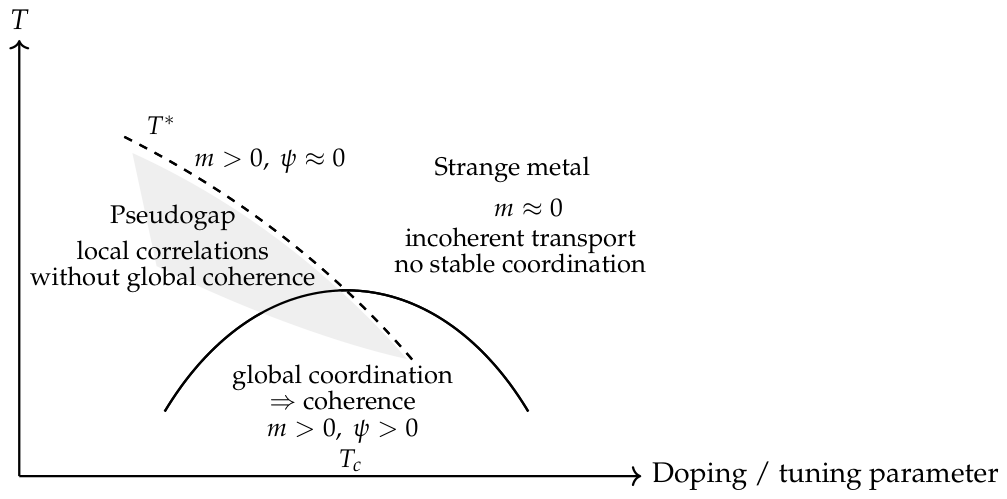
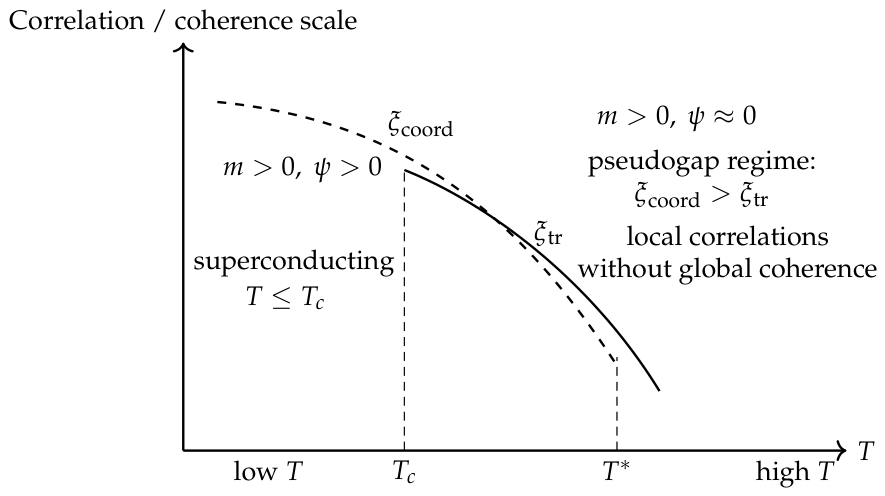
A schematic illustration of the separation between coordination and transport coherence scales is shown in
Figure 5. The coordination coherence scale may remain large above
, while the transport coherence scale becomes large only near the superconducting transition. The figure is intended as a qualitative guide rather than a quantitative phase diagram.
7. Pseudogap, Strange Metal, and Competing Orders
The coordination framework developed above is intended primarily as a minimal mechanism for enhancing phase stiffness in quasi-two-dimensional correlated superconductors. It is not a complete microscopic theory of the cuprate phase diagram, strange-metal transport, or competing orders. Nevertheless, the framework provides a useful phenomenological language for organizing several features commonly observed in strongly correlated superconductors. In this section, these applications are presented as possible interpretations and experimentally testable correlations, rather than as definitive explanations.
7.1. Pseudogap as Local Coordination Without Global Coherence
Within the present framework, a pseudogap-like regime may be interpreted as a state in which local or mesoscopic internal coordination is present, while global superconducting phase coherence remains absent. In terms of the coarse-grained variables introduced in
Section 3, such a regime is characterized by
This interpretation is consistent with the separation between local correlations and global coherence discussed in
Section 6. In quasi-two-dimensional superconductors, local electronic organization can develop within the conducting planes at temperatures above
, while phase fluctuations, vortex proliferation, weak interlayer coupling, or insufficient stiffness prevent the establishment of macroscopic superconductivity.
This provides a possible way to organize several observations in underdoped cuprates, including gap-like suppression of low-energy spectral weight above
observed in ARPES and tunneling [
6,
7], finite resistivity despite local pairing-like correlations [
12], and nanoscale electronic inhomogeneity observed in STM/STS studies [
11]. The framework does not require that all pseudogap phenomena have a single origin. Rather, it identifies one possible contribution: local internal coordination may increase local coherence tendencies without producing sufficient global phase stiffness.
In this picture, the temperature may be associated with the onset or strengthening of local coordination, while is determined by the condition that the coordination-enhanced stiffness becomes large enough to support global phase coherence. The separation is therefore not interpreted as direct evidence for superconductivity above , but as evidence for a separation between local electronic organization and macroscopic phase rigidity.
7.2. Strange Metal as a Weakly Coordinated Fluctuation Regime
The strange-metal regime is more difficult to interpret within any single phenomenological framework, and the present model is not intended to provide a microscopic theory of strange-metal transport. However, it suggests a possible qualitative interpretation. In the language of the coordination framework, a strange-metal-like regime corresponds to a state in which the internal sector remains strongly fluctuating and does not settle into a persistent coordination pattern capable of enhancing phase stiffness. Schematically,
In such a regime, the local electronic environment may strongly affect transport while failing to generate stable phase rigidity. This is compatible with the absence of well-defined quasiparticles, anomalous scattering rates, and approximately linear-in-
T resistivity observed in strange metals [
8,
9,
10,
25]. However, these phenomena may also arise from quantum criticality, Planckian dissipation, disorder, or other microscopic mechanisms. The present framework should therefore be understood only as a possible coarse-grained interpretation: strange-metal behavior corresponds to a regime in which internal electronic degrees of freedom remain active and strongly fluctuating, but do not yet generate the coordination-enhanced stiffness needed for superconducting coherence.
This more limited interpretation avoids identifying the strange metal as a direct precursor of superconductivity. Instead, the strange metal is viewed as a regime from which superconductivity may emerge only if local coordination becomes sufficiently stable and connected to enhance the effective phase stiffness.
7.3. Competing Orders as Alternative Coordination Patterns
Charge density waves, spin density waves, nematicity, and related correlated phases may be viewed, at a phenomenological level, as alternative patterns of internal electronic organization. In the language of the present model, they correspond to different possible structures of the internal coordination sector, represented schematically by or .
This interpretation is deliberately broad. The model does not claim that all competing orders can be reduced to a single classical coordination field, nor that all such orders affect superconductivity in the same way. Rather, it provides a minimal way to express how internal electronic organization can influence the effective phase stiffness. The key question is whether a given coordination pattern enhances or suppresses the bond-level phase coupling,
Orders that improve compatibility along transport pathways may increase the effective stiffness and assist superconducting coherence. By contrast, orders that introduce spatial modulation, frustration, anisotropy, or fragmentation may reduce phase connectivity and suppress global coherence. This distinction provides a possible explanation for why competing or intertwined orders can have different effects in different materials and doping regimes [
4,
5].
For example, stripe-like charge order can divide the system into weakly coupled regions and reduce effective phase stiffness, whereas some forms of nematicity may enhance coherence along preferred directions while suppressing it along others. In this sense, competing orders are not classified simply as helpful or harmful; their effect depends on how they reshape the spatial structure of phase stiffness.
7.4. A Phenomenological Phase Hierarchy
With these qualifications, the coordination framework suggests a phenomenological hierarchy:
Equivalently, in terms of the coarse-grained variables,
This sequence should not be read as a universal phase diagram. Different materials may follow different routes depending on doping, disorder, dimensionality, competing orders, and microscopic interactions. The value of the hierarchy is more limited but useful: it separates three physical questions that are often intertwined in strongly correlated superconductors:
- 1.
whether local electronic correlations or internal coordination exist,
- 2.
whether those correlations enhance the effective phase stiffness,
- 3.
whether the enhanced stiffness is sufficient to establish global superconducting coherence.
This distinction is especially important in quasi-two-dimensional materials, where local correlations and global coherence can occur at different temperature scales.
7.5. Testable Implications and Experimental Signatures
The coordination framework leads to several testable implications, but these should be understood as correlation tests rather than as unique signatures. The central prediction is that, in regimes where phase stiffness limits superconductivity, changes in superconducting coherence should correlate not only with pairing strength or gap magnitude, but also with independent measures of internal coordination.
7.5.1. Correlation Between and Coordination Strength
If the coordination mechanism is active in a given material, then changes in should correlate with changes in internal coordination through their common effect on effective phase stiffness. Depending on the material, possible measures of coordination include spin correlation lengths, nematic order parameters, orbital polarization, local spectroscopic inhomogeneity, or other probes of local electronic compatibility.
In the simplest coarse-grained description, the stiffness enhancement scales with the square of the coordination amplitude, as in
. Therefore, across doping, strain, pressure, disorder, or other tuning parameters, one expects enhanced local coordination to increase the effective phase stiffness in regimes where the coordination pattern is compatible with coherent transport. This is consistent with the broader empirical connection between superfluid stiffness and
in underdoped superconductors [
12,
13].
A useful experimental test would be to compare and superfluid stiffness with independent probes of internal coordination across a controlled tuning series. Agreement would support the idea that coordination contributes to phase stiffness; disagreement would help identify regimes where other mechanisms dominate.
7.5.2. Vortex-Core Structure and Multiple Length Scales
A second implication concerns vortex-core structure. If the phase coherence scale and the coordination scale are distinct, then the region where superconducting phase coherence is suppressed need not coincide with the region where local electronic coordination disappears.
This suggests that the apparent vortex-core size inferred from phase-sensitive probes may differ from the length scale inferred from spectroscopic probes such as STM. In particular, gap-like or pseudogap-like features may persist inside vortex cores even where global phase coherence is locally suppressed. Such behavior has been reported in correlated superconductors [
26,
27]. Within the present framework, it is interpreted as evidence for a separation between local coordination and superconducting phase coherence, not necessarily as evidence for a conventional superconducting condensate inside the core.
Systematic measurements of vortex-core spectra, phase stiffness, and local ordering tendencies as functions of doping, temperature, and disorder would provide a direct way to test this interpretation.
7.5.3. Gap– Decoupling
A further implication concerns the relationship between spectroscopic gap scales and the superconducting transition temperature. In the coordination framework, gap-like features may reflect local correlations or internal coordination, whereas is controlled by global phase stiffness. Therefore, the magnitude of a spectroscopic gap need not scale directly with .
This type of gap–
decoupling is widely observed in strongly correlated superconductors and is often associated with pseudogap physics and phase fluctuations [
6,
7,
12]. The present framework offers one possible interpretation: the gap scale may track local coordination, while
tracks the point at which coordination-enhanced stiffness becomes sufficient for global coherence.
Quantitative comparisons among gap magnitude, superfluid stiffness, coordination measures, and would therefore provide a stringent test of whether coordination effects play a significant role in a given material.
7.6. Remarks
The purpose of this section is not to claim that the coordination model solves the full phenomenology of high-
superconductivity. Rather, the aim is to show that the minimal mechanism developed in
Section 3 and
Section 6 has plausible phenomenological consequences. It provides a way to organize the separation between local correlations, effective phase stiffness, and global superconducting coherence.
More detailed comparisons with experiment require material-specific models, larger-scale simulations, and independent measurements of the relevant coordination variables. These developments are left for future work.
8. Pairing, Phase Stiffness, and Coordination
8.1. Charge- Collective Field
Let
denote a local fermionic electronic operator. In conventional superconductivity, the relevant bosonic collective degree of freedom is the charge-
pair field
which transforms under the electromagnetic U(1) symmetry as
This transformation property underlies the standard description of superconductivity in terms of a complex charge-
order parameter [
1,
2,
28]. In weak-coupling BCS theory, the formation of the pair amplitude and the establishment of global phase coherence occur at the same transition scale, so that pairing and superconducting order are effectively inseparable.
In strongly correlated and quasi-two-dimensional superconductors, however, these two aspects can be partially separated. Local pairing-like correlations or gap-like spectral features may appear above , while global superconducting coherence remains absent. This motivates a description in which the amplitude associated with local correlations and the phase stiffness required for macroscopic coherence are treated as distinct, though coupled, physical ingredients.
8.2. Relation to the Coordination Framework
Within the present framework, the complex field
introduced in
Section 3 should be understood as the coarse-grained phase-coherent component of the superconducting charge sector, consistent with effective field-theoretic descriptions of superconductivity [
20]. The minimal model does not attempt to derive the pairing interaction microscopically. Instead, it focuses on the separate question of how global phase coherence becomes established once local charge-carrying correlations are present.
This distinction is important. The existence of a charge- collective field, or of local pairing-like correlations, does not by itself guarantee macroscopic superconductivity. A superconducting state also requires sufficient phase stiffness to establish long-range coherence, support phase rigidity, and produce standard superconducting responses such as flux quantization, Josephson coherence, and Meissner screening.
The coordination mechanism proposed here acts on this phase-stiffness side of the problem. Internal electronic coordination modifies the effective phase coupling between neighboring regions. In the minimal lattice model this appears through the bond stiffness
while in the coarse-grained description it appears as an enhancement of the effective stiffness entering the superconducting transition. Thus, coordination does not replace pairing; rather, it provides an additional mechanism by which local correlated states may acquire macroscopic phase coherence.
8.3. Pairing as Necessary but Not Sufficient
The coordination framework therefore refines, rather than rejects, the standard pairing-based picture. Pairing remains necessary for superconductivity in the usual sense: the superconducting condensate carries charge and is described by a phase-coherent collective field. However, in phase-fluctuation-dominated systems, pairing may not be sufficient to determine . The transition temperature can instead be limited by the effective phase stiffness.
In this regime, the relevant hierarchy may be written schematically as
This expression is not meant to imply that coordination is more fundamental than pairing. Rather, it emphasizes that superconductivity in strongly correlated quasi-two-dimensional systems may depend on how local correlations are organized into a globally coherent state.
This perspective is consistent with phase-fluctuation scenarios in which gap-like features can survive above
, while global coherence is lost because the stiffness is insufficient [
12]. It also provides a natural connection to pseudogap phenomenology, where spectroscopic signatures associated with local correlations need not coincide with the onset of macroscopic superconductivity [
6,
7].
8.4. Scope of the Interpretation
The purpose of this section is to clarify the relationship between the coordination framework and conventional pairing-based descriptions. The minimal model introduced in this work is not a microscopic pairing theory, nor does it claim to derive the charge- condensate from first principles. It assumes that a charge-carrying phase sector is relevant and asks how internal electronic coordination can enhance the stiffness of that sector.
Accordingly, the framework should be viewed as complementary to BCS and other pairing-based approaches. In weak-coupling superconductors, where pair formation and phase coherence occur together, the coordination mechanism may play little role. Its relevance is expected to be greatest in strongly correlated, low-stiffness, quasi-two-dimensional materials, where local correlations, pairing signatures, and global phase coherence can occur at distinct temperature scales.
Thus, the central claim is limited: coordination is proposed as a mechanism for enhancing phase stiffness and promoting global coherence in regimes where pairing alone does not determine the superconducting transition.
9. Vortex Structure and Experimental Tests
9.1. Vortices in a Coupled Phase–Coordination System
In conventional superconductors, vortices are topological defects of the U(1) phase, characterized by a
winding of the superconducting phase and by suppression of the order parameter amplitude within a core whose size is set by the coherence length [
28,
29]. In weakly correlated superconductors, the recovery of the pairing amplitude and the recovery of phase coherence are often closely related, so that a single vortex-core length scale provides a useful description.
In strongly correlated quasi-two-dimensional superconductors, however, the situation can be more complicated. If local electronic coordination and global phase coherence are partially separated, then a vortex need not suppress all local correlations in the same way. The phase winding primarily disrupts the superconducting phase sector, while the internal coordination field may be suppressed, reorganized, or partially preserved inside and around the vortex core.
At the coarse-grained level, this can be represented schematically by an energy functional of the form
where
is the superconducting phase,
denotes the local coordination amplitude, and
is the coordination-enhanced phase stiffness. This expression is not intended as a complete microscopic vortex theory. Rather, it summarizes the effective coupling already introduced in earlier sections: the internal coordination field modifies the local stiffness that determines the energetic cost of phase gradients.
Because
depends on
m, vortex structure may reflect both phase disorder and changes in the internal coordination field. This is analogous to coupled-order-parameter descriptions in correlated systems, where suppression of one order may coexist with persistence, competition, or enhancement of another [
18].
9.2. Two Characteristic Length Scales
A direct consequence of the separation between phase coherence and internal coordination is the possible appearance of two characteristic length scales:
a phase-coherence length, associated with the recovery of superconducting phase rigidity and superfluid stiffness;
a coordination length, associated with the recovery or reorganization of the internal coordination field.
These two length scales need not coincide. In a conventional weak-coupling superconductor, the vortex core is often described mainly in terms of the suppression and recovery of the superconducting order parameter. In a strongly correlated material, by contrast, the phase coherence may be strongly suppressed in the core while local electronic correlations remain partially intact.
In the language of the present framework, this corresponds to a region in which the phase-coherent component is suppressed,
while the internal coordination amplitude may remain nonzero,
This possibility is consistent with phase-fluctuation scenarios in which local correlations survive even when global superconducting coherence is lost [
12]. It also connects naturally to the pseudogap-like interpretation discussed in
Section 7.
9.3. Possible Vortex-Core Signatures
The coordination framework suggests several experimentally testable vortex-core signatures. These should be understood as possible indicators of coordination–phase separation, not as unique or exclusive signatures of the present model.
Residual gap-like features in vortex cores. If internal coordination remains partially intact where phase coherence is suppressed, spectroscopic probes may observe gap-like or pseudogap-like features inside vortex cores. Such behavior has been reported in cuprate superconductors [
11,
26] and is often interpreted as evidence that local correlations persist after global superconducting coherence is locally destroyed.
Different apparent core sizes from different probes. Phase-sensitive probes and spectroscopic probes may extract different characteristic core sizes. The former are more directly sensitive to the recovery of superconducting stiffness, while the latter may also detect local coordination, pseudogap features, or other correlated electronic structure.
Dependence on tuning parameters that affect coordination. If the vortex-core structure is influenced by internal coordination, then changes in doping, disorder, strain, pressure, or magnetic field may alter not only the superconducting coherence length but also the spatial profile of local gap-like features.
Deviation from simple weak-coupling vortex spectra. In conventional superconductors, vortex cores can exhibit Caroli–de Gennes–Matricon bound states [
29]. In strongly correlated superconductors, such states may be broadened, suppressed, or accompanied by pseudogap-like spectra. Within the present framework, this reflects the fact that the vortex core probes both the phase sector and the internal coordination sector.
These signatures are not intended to replace existing interpretations of vortex-core experiments. Rather, they provide a specific way to connect vortex-core phenomenology with the central mechanism of the paper: internal coordination can survive on length scales different from those associated with superconducting phase coherence.
9.4. Relation to Existing Experiments
Scanning tunneling microscopy studies of cuprate superconductors have reported suppressed coherence peaks and pseudogap-like spectra inside vortex cores [
11,
26,
27]. Such observations suggest that the electronic structure inside a vortex core is not simply that of a normal metal. Instead, local correlations can persist even where superconducting coherence is strongly suppressed.
Within the present framework, this behavior can be interpreted as a manifestation of residual internal coordination in and around the vortex core. The vortex disrupts the U(1) phase coherence, but it need not fully destroy the local electronic organization that contributes to the pseudogap-like spectral structure. This interpretation is consistent with the broader distinction between local coordination and global phase coherence developed in
Section 6 and
Section 7.
At the same time, the framework does not claim that all observed vortex-core anomalies have a single origin. Competing orders, disorder, strong coupling, quasiparticle reconstruction, and material-specific effects may all contribute. The role of the coordination framework is to identify one possible organizing mechanism: vortex cores can expose the difference between the length scale of superconducting phase coherence and the length scale of local internal coordination.
9.5. Experimental Probes
The coordination-based interpretation of vortex structure can be tested by comparing phase-sensitive and spectroscopic measurements under controlled tuning conditions. Relevant probes include:
STM/STS imaging of vortex cores and spatially resolved gap structure [
11];
magnetic-field-dependent spectroscopy to track the evolution of coherence peaks, pseudogap features, and local density of states;
measurements of superfluid stiffness or penetration depth to determine the phase-coherence scale independently of spectroscopic gap features;
strain, pressure, disorder, or doping studies that modify internal coordination and test whether vortex-core spectra and length scales change accordingly;
comparisons between vortex-core length scales and independent measures of pseudogap or local-order correlation lengths in zero field.
A particularly direct test would be to determine whether the length scale associated with spectroscopic gap recovery differs systematically from the phase-coherence length, and whether this difference correlates with independent measures of internal coordination. Such a result would support the idea that vortex cores in strongly correlated superconductors probe more than the suppression of a single superconducting order parameter.
9.6. Summary of Vortex-Based Experimental Tests
The coordination framework suggests that vortices in strongly correlated quasi-two-dimensional superconductors may involve two coupled but distinct structures: the U(1) phase-coherence sector and the internal coordination sector. This can lead to multiple apparent core length scales, residual gap-like features inside vortex cores, and sensitivity of vortex-core spectra to parameters that modify local electronic coordination.
These consequences are presented as experimentally testable implications of the framework, not as a complete microscopic theory of vortex cores. They provide one route by which the proposed coordination mechanism can be compared with existing and future experiments in strongly correlated superconductors.
10. Relation to BCS Theory and Crossover Regimes
10.1. BCS Limit
The coordination framework is intended to be compatible with the conventional BCS description in the appropriate limit. In weakly correlated superconductors, the formation of the pair amplitude and the onset of global phase coherence occur at the same transition scale. In such systems, the superconducting instability is well described by the BCS mechanism, and no additional coordination channel is required [
1,
2,
3].
In the language of the present framework, this corresponds to a regime in which the internal coordination sector is either absent, weak, or effectively locked to the pairing channel. The internal variable
m then does not represent an independent fluctuating degree of freedom that can separate local correlations from global coherence. At the level of the minimal model, this limit can be represented schematically as
so that the effective phase stiffness reduces to
In this limit, the coordination mechanism does not introduce new observable structure. Pairing, gap formation, and macroscopic phase coherence are governed primarily by the conventional superconducting order parameter. Thus, the present framework reduces to the standard phase-coherent description of superconductivity when internal coordination does not provide an independent stiffness-enhancing channel.
10.2. Phase-Stiffness-Limited Correlated Regime
The coordination mechanism becomes relevant in a different regime: strongly correlated, low-stiffness, and often quasi-two-dimensional superconductors, where local pairing-like correlations or gap-like features may exist without immediate global superconducting coherence. In such systems, the transition temperature may be limited not only by the formation of local pairs or local correlations, but also by the available phase stiffness.
Within the coarse-grained description of
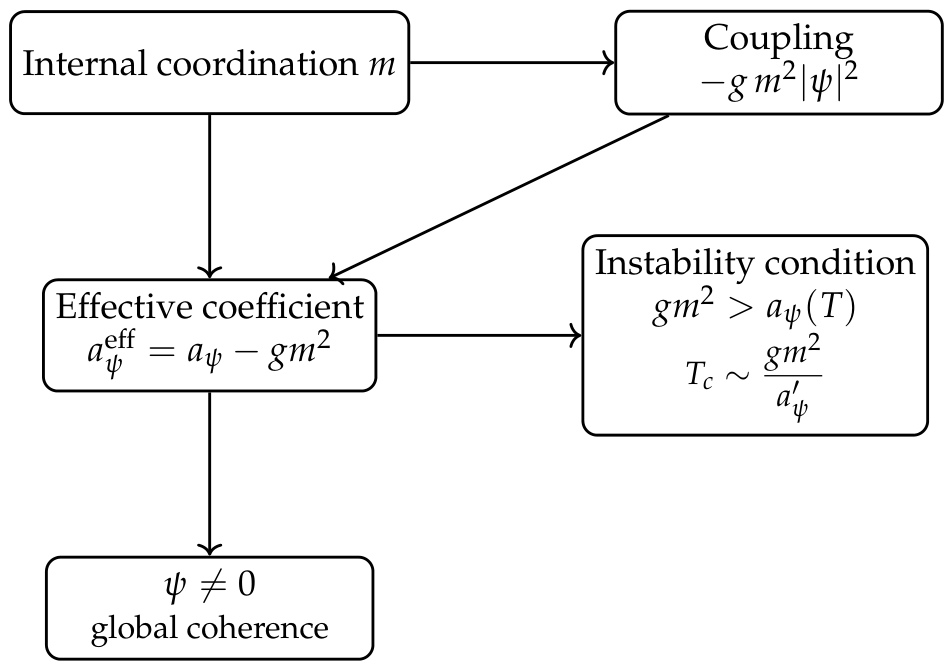
Section 3, the coordination field modifies the effective quadratic coefficient of the phase-coherent sector. The incoherent state becomes unstable when
This condition should be interpreted as an effective stiffness criterion, not as a replacement for microscopic pairing physics. It states that global coherence becomes possible only when internal coordination has enhanced the phase sector sufficiently to overcome phase disorder and fluctuations.
In this regime,
is not determined solely by the pairing scale. It also depends on how local electronic correlations are organized into a state with sufficient phase rigidity. This is consistent with phase-fluctuation scenarios in underdoped superconductors, where superfluid stiffness and global coherence can be suppressed even when gap-like features persist above
[
12,
13].
10.3. Crossover Between Limiting Regimes
The present framework therefore suggests a crossover between two limiting descriptions rather than a sharp dichotomy.
In the BCS-like regime, pairing and phase coherence occur at essentially the same temperature scale. The superconducting transition is controlled mainly by the pairing instability, fluctuations are relatively weak, and a single order-parameter description is usually sufficient.
In the coordination-enhanced regime, local correlations, internal coordination, and global phase coherence may occur at distinct temperature scales. The superconducting transition is then controlled by the emergence of sufficient effective phase stiffness. The relevant question is not only whether local pairing or gap-like correlations exist, but whether they are embedded in an internally coordinated electronic environment capable of supporting macroscopic phase rigidity.
This crossover may be controlled by several material-dependent parameters, including the bare phase stiffness, dimensionality, interlayer coupling, carrier density, disorder, and the strength of the coupling between internal coordination and transport. It is conceptually related to broader distinctions between amplitude-dominated and phase-dominated superconductivity, including discussions of the BCS–BEC crossover [
30,
31]. However, the present framework is not identical to the BCS–BEC crossover. Its focus is on how internal electronic organization modifies phase stiffness in correlated materials.
10.4. Experimental Indicators of the Crossover
The crossover from BCS-like behavior to a phase-stiffness-limited, coordination-sensitive regime may be indicated by several experimental trends. These trends are not unique signatures of the present model, but they provide useful tests of whether coordination effects are relevant in a given material:
increasing separation between the onset of gap-like features or pseudogap behavior and the superconducting transition temperature ;
reduced superfluid stiffness and enhanced phase fluctuations;
stronger sensitivity of superconducting coherence to disorder, strain, pressure, doping, or other perturbations that modify local electronic organization;
separation between spectroscopic gap signatures measured by ARPES or STM and transport or magnetic signatures of global superconductivity;
vortex-core behavior involving residual gap-like features or multiple apparent length scales, as discussed in
Section 9.
Such trends are broadly observed in cuprates and related strongly correlated superconductors [
4,
5,
7]. The coordination framework does not claim that these observations have a single universal origin. Rather, it proposes that one contributing factor may be the ability, or failure, of internal electronic coordination to enhance the effective phase stiffness.
10.5. Scope and Limitations
The purpose of this section is to clarify how the coordination framework relates to BCS theory. The framework is not intended to replace the BCS mechanism or to provide a complete microscopic theory of pairing. In the weak-coupling limit, where pair formation and phase coherence are not meaningfully separated, the standard BCS description remains the appropriate theory.
The added value of the present framework lies in regimes where this separation becomes important. In strongly correlated quasi-two-dimensional systems, pairing signatures, local correlations, internal coordination, and global phase coherence may occur at different scales. The coordination mechanism provides a minimal effective description of how internal electronic organization can enhance phase stiffness and thereby promote superconducting coherence.
Thus, the central claim is limited but testable: coordination is proposed as an additional stiffness-enhancing channel that becomes relevant when superconductivity is limited by phase coherence rather than by the existence of local pairing alone.
11. Scope, Limitations, and Future Work
11.1. Scope of the Framework
The present work introduces a minimal effective framework in which superconducting coherence is influenced by the interplay between a charge-carrying phase sector and an internal coordination sector. The goal is not to derive high- superconductivity from a fully specified microscopic Hamiltonian, nor to provide a complete theory of the cuprate phase diagram. Rather, the aim is more limited: to identify and analyze one possible mechanism by which local electronic organization can enhance phase stiffness and thereby promote global superconducting coherence.
Within this scope, the framework provides:
a minimal lattice model in which internal coordination renormalizes the effective phase stiffness;
a coarse-grained Landau description showing how coordination can destabilize the incoherent phase sector;
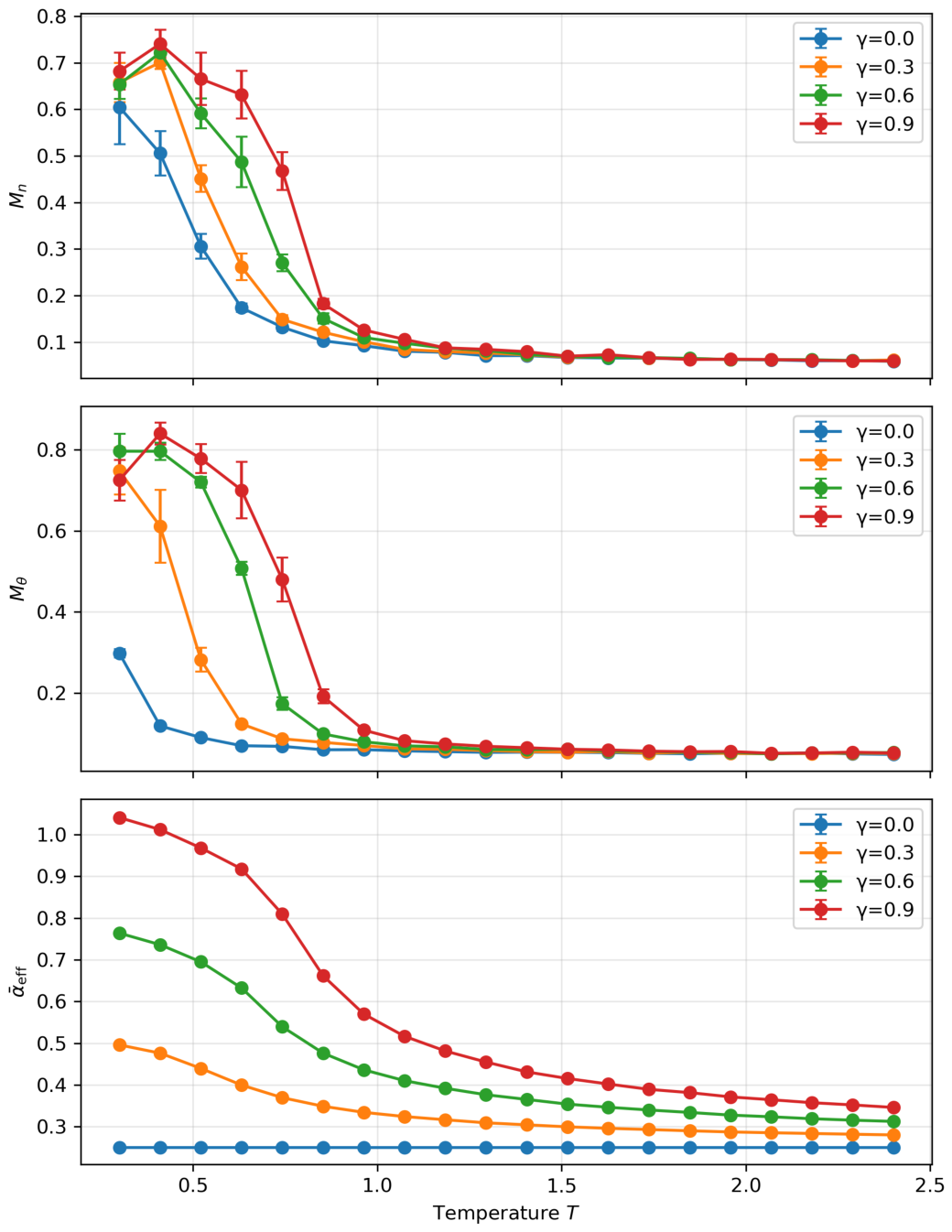
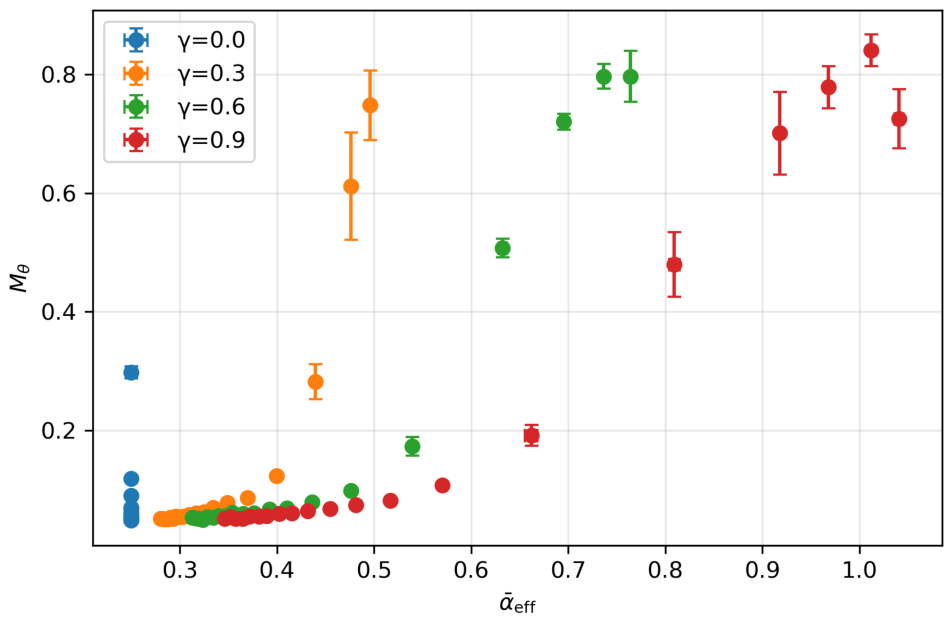
numerical evidence, from finite-size Monte Carlo simulations, that increasing coordination strength enhances phase coherence in the model;
a phenomenological interpretation of why this mechanism may be especially relevant in quasi-two-dimensional correlated superconductors.
The framework should therefore be understood as an effective-theory construction. It isolates a specific physical mechanism rather than claiming to capture all microscopic details of a given material. This is consistent with standard approaches in condensed matter physics, where minimal models are often used to clarify how a particular interaction or collective variable can influence macroscopic behavior [
18,
20].
11.2. Scope and Limitations of the Effective Framework
Several limitations should be emphasized.
First, the internal coordination variable is introduced at an effective level. It may represent spin correlations, orbital organization, nematicity, local valence configurations, or other material-dependent electronic structures. The present work does not derive this variable from first principles. Although plausible connections to Hubbard,
t–
J, spin-fermion, and multi-orbital models exist [
5,
19], a controlled derivation of the effective parameters remains an important open problem.
Second, the numerical simulations are finite-size proof-of-principle calculations. They demonstrate that the proposed coordination mechanism can enhance phase stiffness and shift the onset of phase coherence in a concrete lattice model. However, they do not determine thermodynamic-limit critical behavior, universal exponents, or a precise transition temperature. More systematic simulations, including larger lattices, longer equilibration, improved sampling, and finite-size scaling, are needed for quantitative conclusions [
23].
Third, the Landau analysis is a coarse-grained instability argument. It captures the way internal coordination lowers the effective quadratic coefficient of the phase-coherent sector, but it does not fully describe the strong fluctuations expected in quasi-two-dimensional systems. In strictly two-dimensional or weakly coupled layered systems, the actual transition may be governed by Berezinskii–Kosterlitz–Thouless physics or by crossover behavior associated with weak interlayer coupling [
15,
21]. The Landau criterion should therefore be understood as a stiffness-enhancement criterion rather than as a complete description of the transition.
Fourth, the phenomenological discussions of pseudogap behavior, strange-metal transport, competing orders, and vortex-core structure are qualitative. They are intended to show how the coordination mechanism could organize several observed trends, not to claim that these phenomena have a single universal origin. In real materials, these regimes may also involve quantum criticality, disorder, competing orders, strong coupling, electron–phonon effects, and material-specific band structure. Detailed comparison with experiment requires models adapted to particular materials and parameter regimes [
4,
5].
Finally, the framework is not intended to replace BCS theory. In weak-coupling superconductors, where pairing and phase coherence occur at the same scale, the conventional BCS description remains appropriate [
1,
2,
3]. The proposed mechanism is expected to be most relevant in strongly correlated, low-stiffness, quasi-two-dimensional systems where local correlations and global phase coherence are separated.
11.3. Future Directions
The framework suggests several directions for further work.
On the numerical side, larger-scale simulations of Equation (
11) could be used to:
perform finite-size scaling of the phase and coordination sectors;
distinguish crossover behavior from genuine thermodynamic transitions;
extract phase and coordination correlation lengths;
analyze vortex configurations and defect dynamics;
test whether the stiffness enhancement survives under more realistic disorder, anisotropy, and interlayer coupling.
On the theoretical side, an important next step is to connect the effective coordination model to microscopic Hamiltonians. This would require deriving, even approximately, the parameters
,
, and
from Hubbard,
t–
J, spin-fermion, or multi-orbital models [
5,
19]. Such a derivation would clarify what specific forms of spin, orbital, nematic, or charge organization enhance the effective phase stiffness, and which forms suppress it.
A second theoretical direction is to incorporate quasi-two-dimensional geometry more explicitly. This includes weak interlayer coupling, anisotropic stiffness, vortex unbinding, and possible crossover from two-dimensional BKT-like behavior to three-dimensional coherence. Such an extension would allow the model to address more directly the layered carrier dynamics emphasized in high- materials.
On the experimental side, the coordination mechanism can be tested by correlating superconducting properties with independent measurements of local electronic organization. Relevant probes include STM/STS, ARPES, neutron scattering, resonant X-ray scattering, Raman spectroscopy, NMR, penetration-depth measurements, and pump–probe techniques. Particularly useful tests would compare:
superfluid stiffness and with spin, orbital, or nematic correlation measures;
spectroscopic gap scales with phase-coherence scales;
vortex-core length scales with independent measures of local coordination;
the response of superconductivity to strain, disorder, pressure, doping, or magnetic field.
Such studies would help determine whether coordination-enhanced stiffness is a significant mechanism in specific materials, or whether other mechanisms dominate.
11.4. Summary of Scope and Future Directions
The central result of this work is limited but concrete: internal coordination can enhance the effective phase stiffness of a charge-carrying U(1) sector and thereby promote global superconducting coherence in a minimal effective model. This mechanism is especially relevant to quasi-two-dimensional correlated systems, where local electronic organization and macroscopic phase coherence can occur at different temperature and length scales.
Further work is required to establish material-specific realizations, derive the effective parameters from microscopic models, and perform quantitative comparisons with experiments. Nevertheless, the present analysis shows that coordination-enhanced phase stiffness can be formulated consistently, studied analytically, and realized numerically within a minimal model. It therefore provides a useful effective mechanism for connecting local correlations to global superconducting coherence in strongly correlated materials.
12. Conclusions
We have formulated a coordination-based effective framework for superconductivity in strongly correlated systems. The central idea is that global superconducting coherence may depend not only on local pairing or gap formation, but also on how internal electronic degrees of freedom are organized so as to enhance the effective phase stiffness. Within this framework, internal coordination acts as an additional stiffness-enhancing channel for the charge-carrying U(1) phase sector.
At the coarse-grained level, the mechanism is expressed by the coupling between the internal coordination amplitude
m and the phase-coherent field
. This coupling reduces the effective quadratic coefficient of the phase sector and yields the instability criterion
Equivalently, when the bare phase sector is weak, the transition scale is raised by the coordination contribution,
These expressions should be understood as effective stiffness criteria, not as replacements for microscopic pairing theory.
A minimal lattice model provides a concrete realization of this mechanism. In the model, internal coordination renormalizes the local phase stiffness through the effective bond coupling
Finite-size Monte Carlo simulations show that increasing the coordination coupling enhances the effective stiffness and shifts the onset of phase coherence to higher temperature. These results do not establish a complete theory of high-
superconductivity, but they do demonstrate that the proposed mechanism is internally consistent and can be realized within a controlled effective model, following standard approaches to collective phenomena in condensed matter physics [
18].
The framework is especially relevant to quasi-two-dimensional correlated materials, where local electronic organization and global phase coherence can occur at different temperature and length scales. In such systems, strong phase fluctuations, vortex physics, weak interlayer coupling, and reduced superfluid stiffness can prevent local correlations from immediately producing macroscopic superconductivity. The coordination mechanism provides one possible route by which local electronic organization can enhance phase stiffness and thereby promote global coherence.
This perspective is complementary to BCS theory rather than a replacement for it. In weak-coupling superconductors, where pair formation and phase coherence occur together, the conventional BCS description remains appropriate [
1,
2,
3]. The added value of the present framework lies in regimes where pairing signatures, local correlations, internal coordination, and global phase coherence are partially separated. In such regimes, superconductivity may be limited by phase stiffness rather than by the existence of local pairing alone, consistent with phase-fluctuation scenarios in strongly correlated superconductors [
12,
13].
The phenomenological implications discussed in this work should be understood as possible tests of the mechanism, not as unique explanations of all correlated-superconductor behavior. In particular, the framework suggests that, in materials where phase stiffness is limiting, and superfluid stiffness should correlate with independent measures of internal coordination. It also suggests that vortex cores may exhibit more than one characteristic length scale, and that spectroscopic gap scales may decouple from when local coordination persists without global coherence. These implications can be tested through systematic comparisons among STM/STS, ARPES, scattering probes, penetration-depth measurements, strain or pressure tuning, disorder studies, and magnetic-field-dependent spectroscopy.
Several important questions remain open. The internal coordination variable used here is effective and material-dependent. Future work should derive the parameters of the model from microscopic Hamiltonians, such as Hubbard, t–J, spin-fermion, or multi-orbital models. Larger simulations with finite-size scaling are also needed to distinguish crossovers from thermodynamic transitions and to characterize vortex physics more quantitatively. Finally, material-specific studies are required to determine whether coordination-enhanced stiffness is a dominant mechanism in any particular family of superconductors.
In summary, the present work identifies coordination-enhanced phase stiffness as a concrete and testable effective mechanism for connecting local electronic organization to global superconducting coherence. While it does not provide a complete microscopic theory, it offers a well-defined extension of phase-stiffness-based approaches to strongly correlated quasi-two-dimensional superconductors and provides a basis for future theoretical, numerical, and experimental investigation.