Article

First-Principles Study of the Formation and Stability of the Interstitial and Substitutional Hydrogen Impurity in Magnesium Oxide


by
A. G. Marinopoulos
CFisUC, Department of Physics, University of Coimbra, Rua Larga, 3004-516 Coimbra, Portugal
Condens. Matter 2026, 11(1), 2; https://doi.org/10.3390/condmat11010002
Submission received: 20 November 2025 / Revised: 25 December 2025 / Accepted: 6 January 2026 / Published: 9 January 2026
(This article belongs to the Section Condensed Matter Theory)

Abstract

Hydrogen is frequently incorporated in alkaline-earth oxides during crystal growth or post-deposition annealing. For MgO, several studies in the past showed that interstitial monatomic hydrogen can also favourably bind with oxygen vacancies to form stable substitutional defect complexes (substitutional hydrogen or U-defect centers). The present study reports first-principles density-functional calculations of the formation energies of both interstitial and substitutional forms of the hydrogen impurity in MgO. Determination of the site-resolved densities of electronic states allowed for a detailed identification of the nature of the impurity-induced levels, both in the valence-energy region and inside the band gap of the host. The stability and diffusion mechanisms of both hydrogen defects was also studied with the aid of nudged elastic-band (NEB) calculations. Interstitial hydrogen was found to be an amphoteric defect with the lower formation energy for any realistic environment conditions (temperature and oxygen partial pressure). The NEB calculations showed that it is a fast-diffusing species when it is thermodynamically stable as a positively-charged state (bare proton). In contrast, the hydrogen-vacancy complex is a shallow donor, extremely stable against dissociation and virtually immobile as an isolated defect. Its formation is found to be favoured for a range of mid-gap Fermi-level positions where positively-charged interstitial hydrogen and neutral oxygen vacancies (F centers) are both thermodynamically stable low-energy defects. The present findings are consistent with the established consensus on the electrical activity of hydrogen in MgO as well as with experimental observations reporting the remarkable thermal stability of substitutional hydrogen defects and their ability to act as electron traps.

1. Introduction

Hydrogen is a ubiquitous impurity in oxides, since it is commonly introduced in the host lattice during crystal growth, atomic-layer deposition of thin films, or post-deposition annealing [1,2]. Its electrical behavior has been the subject of scrutiny, especially since earlier studies demonstrated that hydrogen can be the source of n-type doping in ZnO [3] and other oxides [4]. Alternatively, hydrogen is known to act as an amphoteric impurity by counteracting the dominant conductivity of the host material, with the charge-transition (pinning) level, (+/−), lying inside the fundamental band gap of the host.
Monatomic hydrogen in MgO was recognized to exist not just as an interstitial defect (Hi) but also in substitutional form (Hs) where the hydrogen nucleus resides at an oxygen-vacancy site [5]. This vacancy-hydrogen defect complex is also known as the U center. Experimentally, substitutional hydrogen can be formed in MgO after thermochemical reduction of crystalline samples at high temperatures [5,6,7]. The Hs defects carry a net positive charge and their presence was inferred from their characteristic infrared-absorption local modes (≈1000 cm−1) [5,6] and from optical-absorption measurements [8]. These defects were found to influence the luminescence properties of thermochemically reduced MgO and to act as electron traps during the photoconversion of oxygen vacancies [7,8,9,10]. Interstitial hydrogen was also detected from its characteristic infrared-absorption lines (at ≈3300 cm−1) [6,11] and also studied experimentally in MgO through the muonium analogue, a lighter hydrogenic isotope that can be formed in materials after muon implantation [12,13].
The presence of hydrogen defects in MgO, furthermore, represents an essential problem of charge (hole or electron) localization in this material either due to self trapping or impurity induced. Earlier theoretical studies have already shown localization tendencies at intrinsic defects in bulk-crystalline MgO, affecting the overall defect energetics [14,15].
First-principles calculations based on density-functional theory (DFT) [16,17] have contributed essential information on the electrical behavior of monatomic hydrogen in MgO. Robertson and Peacock [1,18] performed a band alignment of several oxides with respect to the vacuum level by means of DFT calculations and using the experimental electron affinities. Assessing the energy level of interstitial hydrogen atom in the MgO gap, they concluded that hydrogen is a deep impurity in MgO and cannot be the source of conductivity. Similar conclusions were also drawn in other studies [4,19]. It was also shown that substitutional hydrogen in MgO forms multicenter bonds with the surrounding metal atoms and acts as a shallow donor with very low formation energies in the oxygen-poor limit [19]. Such defects were also proposed in other binary [19,20] and ternary oxides [21]. Defect association of hydrogen with oxygen vacancies was also studied computationally in MgO by means of an embedded cluster approach with the b3lyp hybrid functional [22]. More recent work based on DFT calculations and magnetic measurements showed that hydrogen doping can affect the macroscopic magnetic properties of MgO samples [23].
Critical issues, however, regarding the formation, stability and migration mechanisms of the hydrogen defects in MgO remain unresolved. The basic diffusion modes of monatomic hydrogen are still not fully known, and neither is the principal mechanism responsible for the formation of the vacancy-hydrogen defect complex. These issues were the subject of the present study. For this purpose, first-principles calculations were carried out using both a conventional semilocal density functional [24] and a hybrid-functional approach [25,26]. This allowed us to attain higher precision with respect to what has been achieved until now, since hybrid functionals correct the self-interaction error and lead to very reliable band gaps and formation enthalpies of semiconductors and oxides [27]. Their limitation of not accounting for long-range dispersion forces (Van der Waals interactions) is not expected to have an effect on the behavior of impurities dissolved in the bulk lattice of close-packed oxides with weak correlations, such as MgO. Using these approaches, the electronic structure and formation energetics of interstitial and substitutional hydrogen defects were determined, also explicitly considering the dependence of the elemental chemical potentials on temperature and gas partial pressure.
Calculations based on the nudged elastic-band (NEB) method [28] were also performed and led to a precise examination of the diffusion behavior of both interstitial and substitutional forms of hydrogen providing the specific migration mechanisms of these defects in the lattice with the corresponding energy barriers. The final results are discussed in connection with the existing experimental observations and previous calculations.

2. Theoretical Background and Methodology

The first-principles calculations in the present study were performed with the ab initio vasp code [29,30,31] and were based on a representation of the valence crystalline wavefunctions by a plane-wave basis limited by a kinetic energy cutoff of 440 eV. The valence–core interaction was described by ab initio pseudopotentials constructed within the projector augmented-wave approach [32,33]. The valence shells of Mg, O and H were taken as follows: Mg[3 s 2 ], O[2 s 2 , 2 p 4 ] and H[1 s 1 ]. Two different functionals were chosen to represent exchange and correlation effects between the electrons. First, the hybrid HSE06 functional [25,26] was used for the calculation of the electronic density of states (DOS) and the defect-formation energies. A fraction of 0.35 of exact non-local exchange was found to reproduce the experimental MgO band gap (≈7.8 eV) [34]. Instead, migration calculations and calculations of the energy landscape and stability were performed by means of the semilocal PBE density functional [24].
For all defect calculations a supercell approach was adopted where the hydrogen impurity and the oxygen vacancy were embedded in 2 × 2 × 2 bulk 64-atom periodic supercells. Structural relaxation was based on conjugate-gradient minimization of the total supercell internal energies. A Γ -centered 2 × 2 × 2 k-point mesh was employed for the Brillouin-zone integrations. The DOS calculations, instead, were performed with a finer 3 × 3 × 3 mesh giving a total of 14 k points in the irreducible wedge. Site-resolved DOS were also obtained by a projection of the valence electronic states onto spheres of variable radii centered on specific atoms. The following projection radii were chosen for the different elements: rO = 1.40 Å, rMg = 0.66 Å and rH = 0.529 Å.
The defect formation energies, Δ E D form . , of the hydrogen defects were determined according to a standard thermodynamics approach (see Ref. [35]) as a function of the electron chemical potential (Fermi-level energy, E F ), and the chemical potentials of hydrogen ( μ H ) and oxygen ( μ O ):
Δ E D form . ( q D , E F ) = E D tot . ( q D ) E bulk tot . + Δ n μ O μ H + q D ( E F + E VBM + E corr . )
where E D tot . ( q D ) and E bulk tot . represent the total energies of the defect and bulk-crystalline supercells, respectively. q D is the defect excess charge. Δ n is an integer parameter that takes the value of +1 for the substitutional hydrogen defect (or an oxygen vacancy) and 0 for interstitial hydrogen. The term E corr . represents a correction of electrostatic origin which is added to the formation energies of the charged (finite q) defect states. This correction accounts for the spurious interactions of the defect with its periodically generated images. The specific term suggested by Makov and Payne [36] was employed, scaled by the dielectric constant of the MgO crystal [37]. The corresponding corrections were equal to 0.25 eV and 1.00 eV for singly and doubly charged defect states, respectively.
The magnitudes of the elemental chemical potentials in Equation (1) are expressed with respect to the chemical potentials of hydrogen and oxygen in their reference states: the hydrogen gas H2(g) and oxygen gas O2(g), respectively, at standard pressure and temperature conditions (usually at 1 atm and 298.15 K).
Both elemental chemical potentials have an explicit dependence upon temperature (T) and their respective partial gas pressures (P). For oxygen, the corresponding expression is given as follows:
μ O T , P O 2 = μ O 0 + Δ μ O T + 1 2 k B T log P O 2 P O 2 0
where μ O 0 is the reference chemical potential and P O 2 0 the reference partial pressure of 1 atm. k B is Boltzmann’s constant. Δ μ O T is the temperature-dependent part of the chemical potential. It can be obtained from thermochemical data of the oxygen gas but can also be approximated by the expression of the free energy of an ideal gas of rigid dumbbells [38]. The second option was used in the present study.
The reference chemical potential μ O 0 was obtained from the equilibrium condition that links the formation enthalpy of the MgO compound, Δ H form [ MgO ] , and the chemical potentials of MgO, Mg and O, namely:
Δ H form ( exp . ) [ MgO ] = μ MgO μ Mg μ O 0
The quantities μ MgO and μ Mg represent the enthalpies of solid phases (MgO compound and Mg metal, respectively) and were calculated here by the HSE06 functional as total energies per respective formula unit at T = 0 K. The experimental formation enthalpy of the MgO compound was used (–6.235 eV per formula unit [39]) in Equation (3).
The chemical potential of hydrogen can be evaluated as a function of temperature accounting for the translational and internal (rotational and vibrational) degrees of freedom of the hydrogen gas [40,41]:
μ H T , P H 2 = μ H 0 + Δ μ H T , P H 2
where P H 2 is the hydrogen partial pressure. The reference part, μ H 0 , was obtained as half the total HSE06 energy of a hydrogen molecule at T = 0 K.
The minimum-energy paths and associated migration barriers of both interstitial and substitutional hydrogen were determined by transition-state theory [42] as implemented in the NEB method [28]. The NEB approach allows a precise determination of diffusion mechanisms by an optimization of a number of intermediate system replicas connecting initial and final minimum-energy configurations. The total migration barrier, E barr , for a specific path is given as the sum of the classical activation energy (obtained from the NEB optimization) and a zero-point energy (ZPE) correction, according to:
E barr = E NEB + δ E ZPE
The quantity E NEB is obtained as the DFT total-energy difference between the initial (ini) lower-energy and the higher-energy saddle-point (SP) configurations for each individual path, namely:
E NEB = E tot ( SP ) E tot ( ini )
The ZPE correction term is quantum mechanical in origin and can be approximated by the following local expression [43]:
δ E ZPE = i h ν i SP 2 i h ν i ini 2
The vibrational frequencies ν i ini and ν i SP correspond to the normal modes of vibration of hydrogen and were determined from the diagonalization of the local dynamical matrices of the respective systems with the hydrogen occupying its initial and saddle-point position along the path, respectively.

3. Results and Discussion

3.1. Formation Energies and Electronic Structure

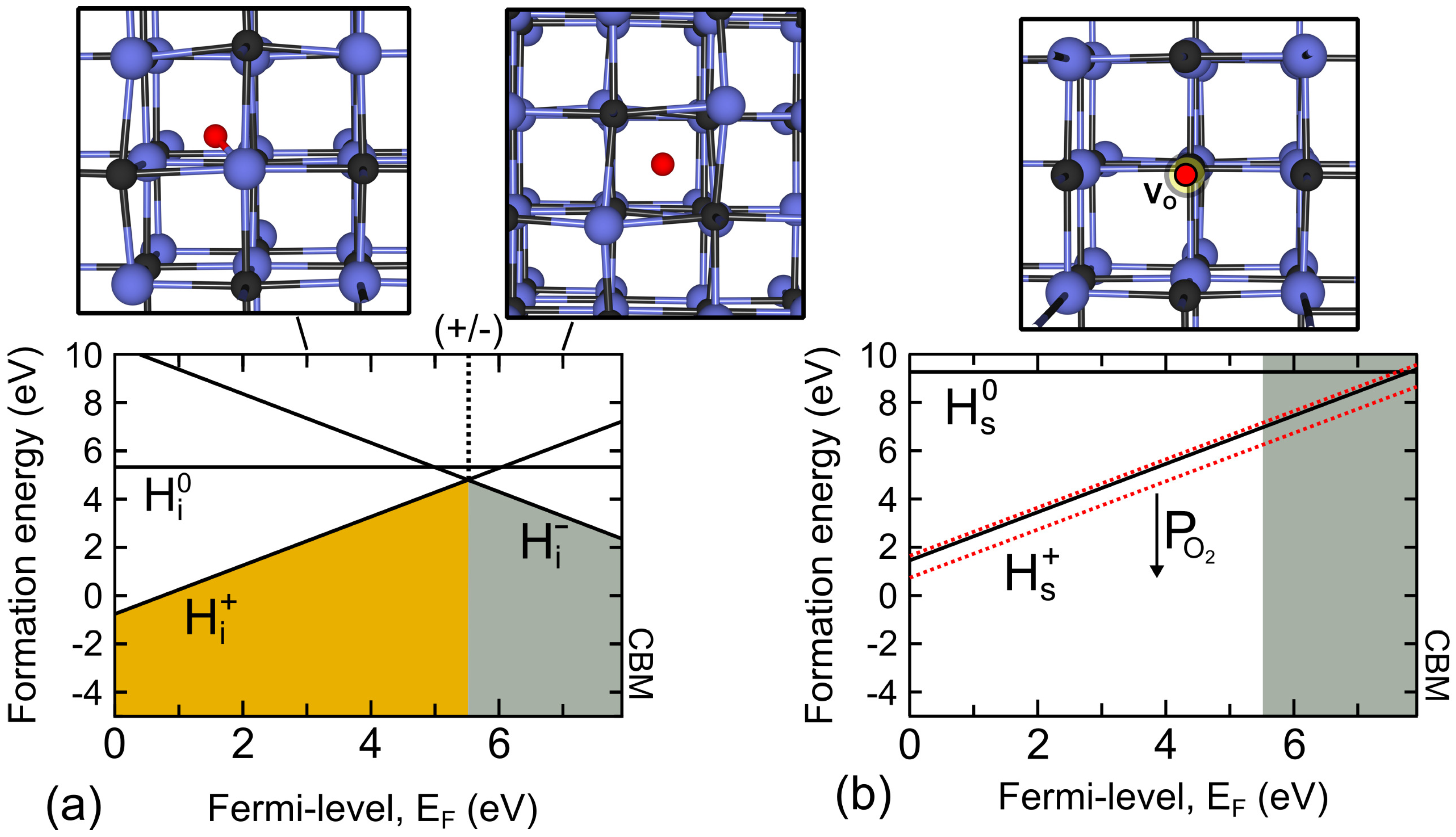
The calculations for the minimum-energy charge states of the interstitial hydrogen impurity ( H i ) led to results in agreement with earlier DFT-based calculations [4,44]; the atomistic structures of the minimum-energy configurations are displayed in the upper panel of Figure 1a. These structures (as well as all others presented here) are ball-and-stick models created by the vesta visualization program [45]. Hydrogen in its positively-charged state formed short dative-type covalent O-H bonds with the ions of the anion sublattice. In these configurations, the corresponding O-H bondlength is equal to 0.98 Å and the bond axis points towards the lattice [111] directions. In contrast, both neutral and negatively-charged hydrogen were found to occupy the high-symmetry cube-center positions in the lattice. In these sites, hydrogen attains a high coordination number with four magnesium and four oxygen neighbors. In the neutral state, the former are at 1.82 Å and the latter at 1.88 Å, whereas in the negative state the four magnesiums draw closer at 1.73 Å and the oxygens are displaced further away at 2.03 Å.
In the substitutional hydrogen defect ( H s ), the hydrogen atom was found to occupy an oxygen-vacancy site (see Figure 1b). In this case, however, only the singly positively-charged and neutral configurations were energy minima. Other charge states were not stable, with the hydrogen nucleus diffusing away from the oxygen-vacancy site.
The charge-dependent formation energies of both interstitial and substitutional hydrogen defects were determined as a function of the Fermi-level position in the theoretical band gap. The latter was found equal to 7.92 eV by the HSE06 hybrid functional. The results are plotted in Figure 1, with the Fermi level ranging from the valence-band maximum (VBM) to the conduction-band minimum (CBM) and for a set of environmental conditions which more closely match the experimental observations of either of these defects [5,6]. These are a temperature of 1200 K and a range of oxygen partial pressures from a typical atmospheric pressure (1 atm) to highly reducing conditions of P O 2 equal to 10 15 atm representing an oxygen-poor environment. The hydrogen chemical potential was evaluated for a hydrogen partial pressure, P H 2 , equal to 1 atm. Lower P H 2 values would lead to more hydrogen-poor conditions; nonetheless, since μ H contributes equally to the energy of both H i and H s defects (see Equation (1)), the exact value of P H 2 does not influence their energy difference nor the position of the charge-transition levels of either defect.
In agreement with earlier DFT calculations [4,19,44] the interstitial hydrogen impurity in MgO is an amphoteric defect, with the pinning level, (+/−), lying deep inside the band gap (see Figure 1a). Thus, positively-charged H i is the stable state from VBM to the (+/−) level, and negatively-charged H i from (+/−) to the CBM. In the present study, the (+/−) transition level is found at 5.52 eV above the VBM, a result which agrees very well with the HSE06 calculations of Li and and Robertson [44]. In contrast, earlier band-corrected DFT-LDA calculations placed the (+/−) level either much lower (≈4.0 eV above VBM) [19] or much higher (≈6.7 eV above VBM) [4] in the MgO gap. The neutral state (q = 0) of H i , on the other hand, is never thermodynamically stable for any Fermi-level position in the gap. Short-lived neutral muonium states, however, have been observed to form in MgO after muon implantation [13].
Substitutional hydrogen is predicted to be a shallow donor (see Figure 1b). This defect is thermodynamically stable in the singly positively-charged state for most Fermi-level positions in the band gap. The (+/0) ionization level lies very close to the CBM: (+/0) = E CBM − 112 meV. This fact, however, does not reflect to the macroscopic conductivity of MgO, since H s is a higher-energy defect with respect to H i even for the oxygen-poor conditions depicted in Figure 1: namely, for a high temperature and highly-reducing conditions with an oxygen partial pressure as low as 10 15 atm. Furthermore, for Fermi-level positions in the upper part of the gap, hydrogen is thermodynamically stable as a negatively-charged defect in the lower-energy interstitial configuration. These results confirm the existing consensus that hydrogen cannot be the source of n-type conductivity in MgO.
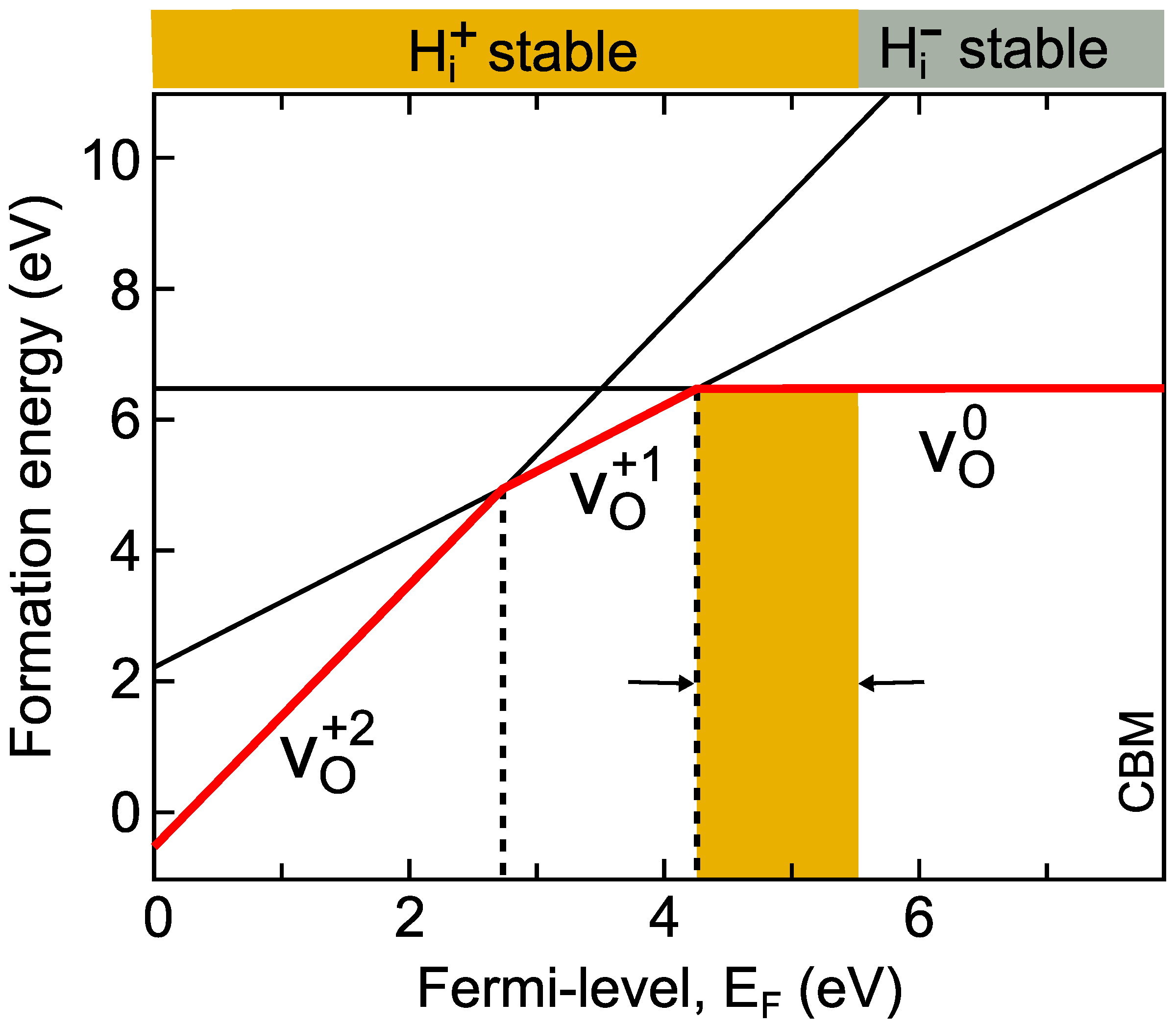
The formation-energy plot of the oxygen monovacancy, V O q , is displayed in Figure 2 for relatively oxygen-poor conditions: a temperature of 1200 K and slightly-reducing conditions of P O 2 equal to 10 2 atm. It can be inferred that the oxygen vacancy is a double-donor defect in MgO with two positive-charge states (q = +1 and +2) thermodynamically stable at different parts in the lower half of the band gap. The charge-transition levels (+2/+1) and (1+/0) are deep levels at 2.74 and 4.26 eV, respectively, with respect to the VBM. Beyond 4.26 eV, the oxygen monovacancy is electrically neutral up to the CBM (see Figure 2). These results disagree with recent calculations which predict that the oxygen vacancy is solely a doubly positively-charged defect throughout the gap [23]. The present findings are consistent with previous hybrid-functional calculations of this defect in MgO, where the (+2/0) level was calculated to lie at ≈3.0 eV above the VBM [46]. Likewise, the donor levels of the oxygen monovacancy in most wide-gap oxides are predicted to lie deep within their corresponding gaps [46,47]. The relevance of the oxygen vacancy in the formation and diffusion of the substitutional hydrogen defect will be discussed in the next subsection.
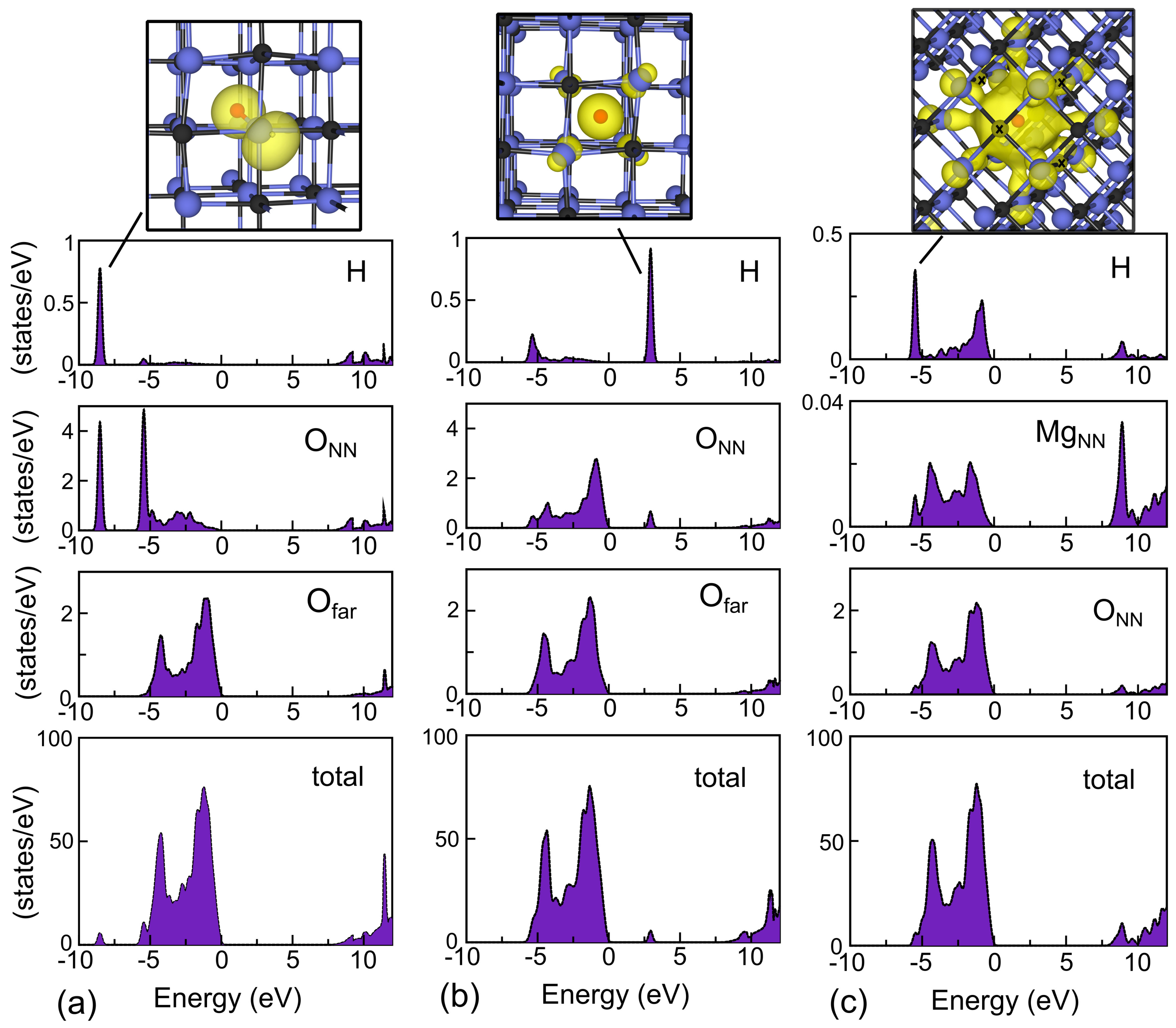
The electronic structure of the thermodynamically stable interstitial hydrogen (q = +1 and –1) and substitutional hydrogen (q = +1) states was studied by calculating the total and site-resolved DOS for the respective supercells. The final results are displayed in Figure 3. These plots contain the hydrogen-induced peaks, superimposed into the bulk total DOS of the host lattice. The latter is displayed at the lower panel of Figure 3 for each different defect and state. The main feature of the host total DOS in the displayed energy range is the upper valence band (from about −6 eV to the VBM). This band is dominated by oxygen 2p orbitals. Its width (≈6 eV) agrees very well with the existing experimental observations (with a reported width from 5 to 6 eV) obtained by X-ray photoemission spectroscopy [48].
In the DOS plots of the positively-charged, q = +1, state of interstitial hydrogen it can be seen that a filled energy level is observed inside the heteropolar gap in the valence-energy region, at ≈−8 eV with respect to the VBM. The corresponding peak has strong weights in both the hydrogen-projected local DOS as well as its nearest-neighbor oxygen (ONN) DOS. The partial valence charge density for this state is also depicted in the upper panel of Figure 3. It can be seen that it possesses a strong bonding character with a large localization at the oxygen and hydrogen atoms that form the O-H bond. Thus, this peak is a bonding state and is a signature of the covalent-type O-H bond formed for this hydrogen configuration.
It can also be seen that the DOS of the nearest oxygen neighbor exhibits strong perturbations with the emergence of another peak lying near the lower edge of the upper valence band, at ≈−6 eV.
The corresponding DOS plots for the q = −1 state of interstitial hydrogen ( H i ) contain a doubly-filled level which appears as a strong peak inside the fundamental band gap of MgO, at ≈3 eV above the VBM. From the site-resolved DOS plots, it can be seen that the largest contribution of this level originates from the hydrogen atom. From the plotted partial charge density for this peak, it can be surmised that it mainly originates from a strongly localized electron density centered at the hydrogen atom, with only a small residual weight at the nearest oxygen neighbors. These findings suggest that this localized state for the H i defect is of nonbonding nature.
The DOS plots for the positively-charged substitutional hydrogen defect show the emergence of a filled level positioned at the lower edge of the upper valence band, at ≈−6 eV with respect to the VBM. From the plotted partial density it can be inferred that this level is of bonding nature, originating from the bonding combinations of the hydrogen 1s orbital with the vacancy dangling-bond states of the nearest neighbors (both Mg and O). A strong unoccupied band mainly composed of cation (Mg) orbitals also appears near the conduction-band edge as a broadened resonance. These unoccupied states may act as electron traps under certain circumstances. Indeed, substitutional hydrogen was proposed to act as a trap of released electrons generated from the photoconversion of F centers in MgO [7,8].
The present DOS calculations agree qualitatively with earlier results obtained by an LDA density functional [49] and a Hartree–Fock cluster approach [50]. Quantitatively, however, both of these studies exhibited severe differences with respect to experiments by underestimating the band gap and valence-band width of MgO, respectively.

3.2. Migration Paths and Energy Landscape

Existing migration calculations of interstitial and substitutional monatomic hydrogen in MgO have been rare. For the interstitial hydrogen, previous DFT calculations focused solely on the neutral charge state [13,51], and not on the thermodynamically stable positive and negative charge states. The main aim in the study in Ref. [13] has been to model the migration of neutral muonium, a lighter hydrogenic particle formed in MgO after the implantation of positively-charged muons. The migration of the positively-charged interstitial hydrogen was determined by empirical calculations yielding an activation energy of migration equal to 0.74 eV [15]. The path considered was from one face-centered position to another face-centered position of the lattice. Certain diffusion mechanisms of substitutional hydrogen were also studied by a Hartree–Fock cluster approach using an embedded molecular cluster model [50]; these will be discussed here.
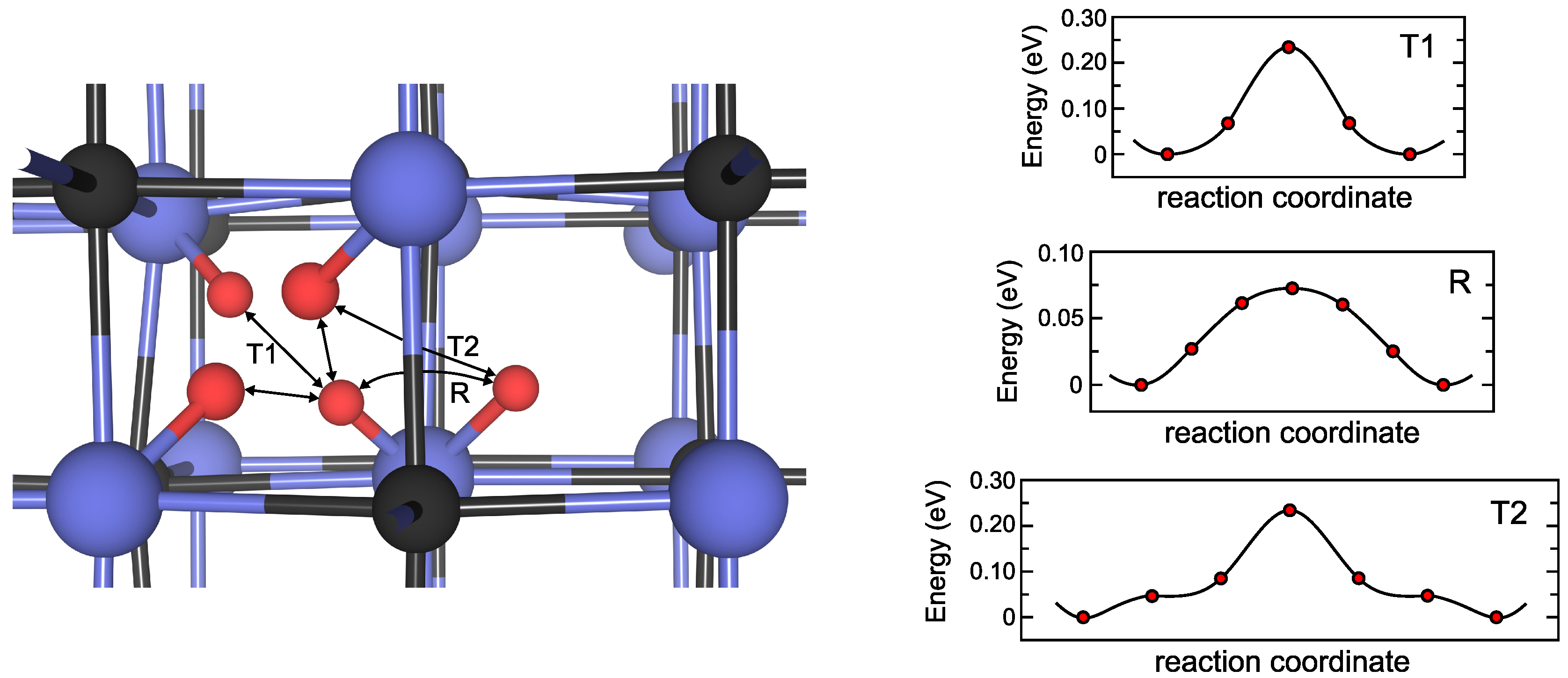
The basic diffusion paths of interstitial hydrogen should be expected to depend upon its charge state. Protons (the H i + species) would diffuse by hopping between oxygen ions. There are four distinct equilibrium sites for H i + per Mg4O4 cube unit in the lattice and this leads to several distinct pathways for the H i + defect (see Figure 4). These can be grouped into intracube (T1) and intercube (T2) diffusion modes. The former are short range (≈1.12 Å) and link the four H i + sites within a single Mg4O4 unit. The latter are longer range (≈1.71 Å); they connect two neighboring H i + sites from two adjacent Mg4O4 units. Thus, the intercube diffusion mode is essential in order to accommodate long-range (macroscopic) diffusion. The calculated NEB-PBE energy profiles for the intracube and intercube paths of the H i + defect are displayed in Figure 4. The corresponding migration barriers for either of these paths were found to be equal to 0.23 eV. These were corrected by performing single HSE06 calculations of the saddle-point configurations; the resulting barriers were found to be moderately higher, equal to 0.34 eV. The calculated ZPE corrections by means of the HSE06 functional led to a reduction in the activation energies by ≈140 meV for either path.
Additional NEB-PBE calculations were also performed for the bond-OH re-orientation (R) diffusion mode (see Figure 4). In this case both, PBE and HSE06 calculations provided an energy barrier equal to ≈0.07 eV. On account of the rather small energy barriers obtained, it can be concluded that the H i + defect in MgO should be a fast diffusing species in the host lattice even at room temperature.
Experimentally, the diffusion rates of interstitial protons in MgO were studied through measurements of the infrared absorption in undoped and doped MgO [11]. Hydrogen was eventually swept away from the material at relatively high temperatures: complete removal of soluble protons from the MgO crystals was possible at temperatures of 1300 K with the introduction of a low electric field [11]. This suggests that the present NEB results may underestimate the actual diffusion barriers of protons in the lattice. An issue that needs to be considered, however, is that the experimental measurements were performed for MgO powder samples; thus, the internal structure and polycrystallinity may lead to proton diffusion properties which are not comparable with the present calculations.
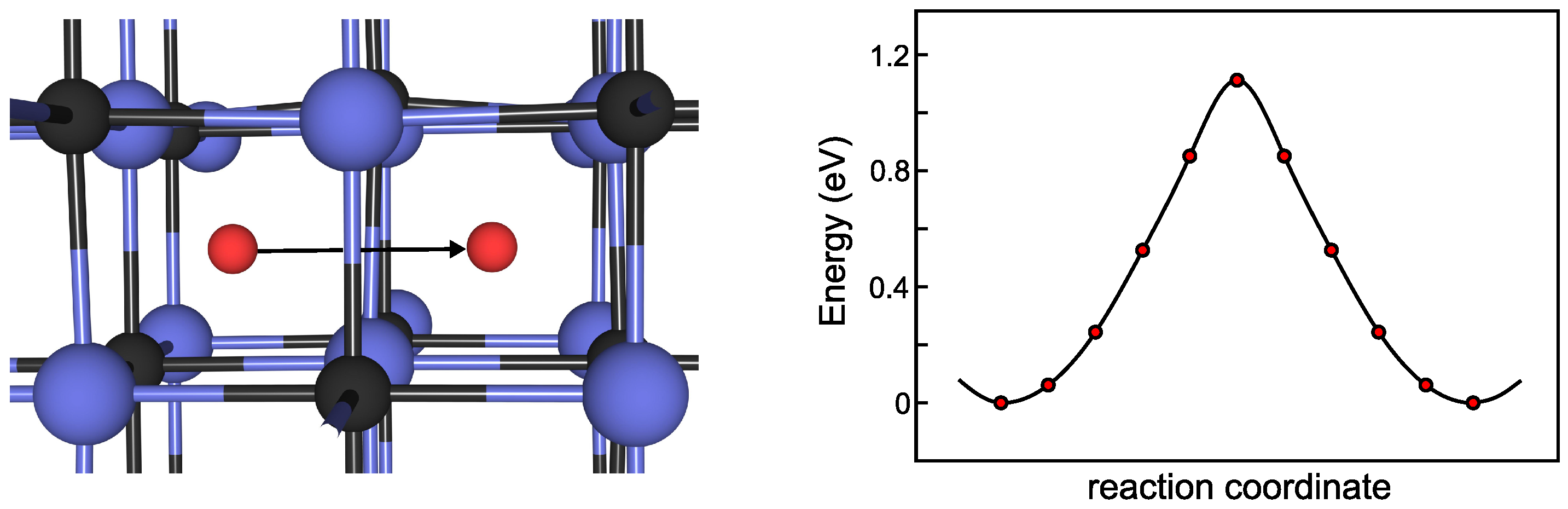
In contrast, H i occupies a single site per Mg4O4 cube, the cube-center (cc) position; thus, the expected migration path of H i should involve a linear trajectory along the cube 〈001〉 directions that link two cc sites from adjacent Mg4O4 units (see Figure 5). The NEB energy profile for this pathway is shown in Figure 5. The saddle point is directly in the middle of the path when H i is at the face center position. It can be seen that the corresponding barrier is rather high, equal to 1.11 eV. A calculated ZPE correction of −150 meV reduces its magnitude, but still it remains considerably higher with respect to the migration barriers of the H i + defect.
This strong dependence of the migration barriers of the H i defect on its charge state has important implications on its stability. For a large range of Fermi-level positions in the gap, the protons (the H i + species) are thermodynamically stable and can diffuse rapidly in the lattice owing to their low migration barriers. It is very probable, therefore, that they can associate and eventually be trapped at native defects. Association of H i + with an oxygen vacancy can lead to the formation of a stable vacancy-hydrogen defect complex (substitutional hydrogen). This situation was verified experimentally to take place after thermochemical reduction of MgO samples at high temperatures and high pressures of the magnesium vapor that led to a stoichiometric imbalance in the material with the removal of oxygen ions from the crystals [5,8].
Despite the fact that the formation energies of substitutional hydrogen have been presented already (see Figure 1), these results do not provide any information on how this vacancy-hydrogen complex forms. The fact, however, that it is a shallow donor means that it is positively charged for most Fermi-level positions within the gap. Thus, the candidate defect that the fast-diffusing H i + defect will interact with to form such a complex is a neutral oxygen vacancy, a defect which should be considerably less mobile with respect to H i + . The calculated migration barrier of the neutral oxygen vacancy in MgO is reported to be 4.2 eV by DFT calculations [52], with experimental estimates being higher than 2.2 eV [52].
From the formation-energy plot of the oxygen vacancy in MgO (see Figure 2) it can be inferred that the neutral state (q = 0) is the thermodynamically stable charge state of this defect in the upper half of the band gap, starting from EVBM + 4.26 eV up to the CBM. Thus, in a range of mid-gap Fermi-level positions (4.26 eV to 5.52 eV), the H i + and V O 0 defects are both thermodynamically stable, low-energy defects and their association can lead to a defect complex with an effective charge of +1. It can be argued that such a defect can also be formed by association between a negatively-charged interstitial hydrogen, H i , and a doubly-ionized oxygen vacancy, V O + 2 . Nonetheless, the large migration barriers of the H i defect would hinder such associations, making them less probable.
The proposed defect association can be expressed by the following reaction, namely:
V O 0 + H i + 1 H s + 1 + Δ H
where Δ H represents the enthalpy of the reaction. From the balance of the formation energies of the reactants and products in Equation (8), a negative reaction enthalpy of –4.28 eV is obtained. Therefore, as expected, this reaction is exothermic, leading to a sizeable energy gain from the association of the H i + defect and a neutral oxygen vacancy and the eventual formation of the H s + defect.
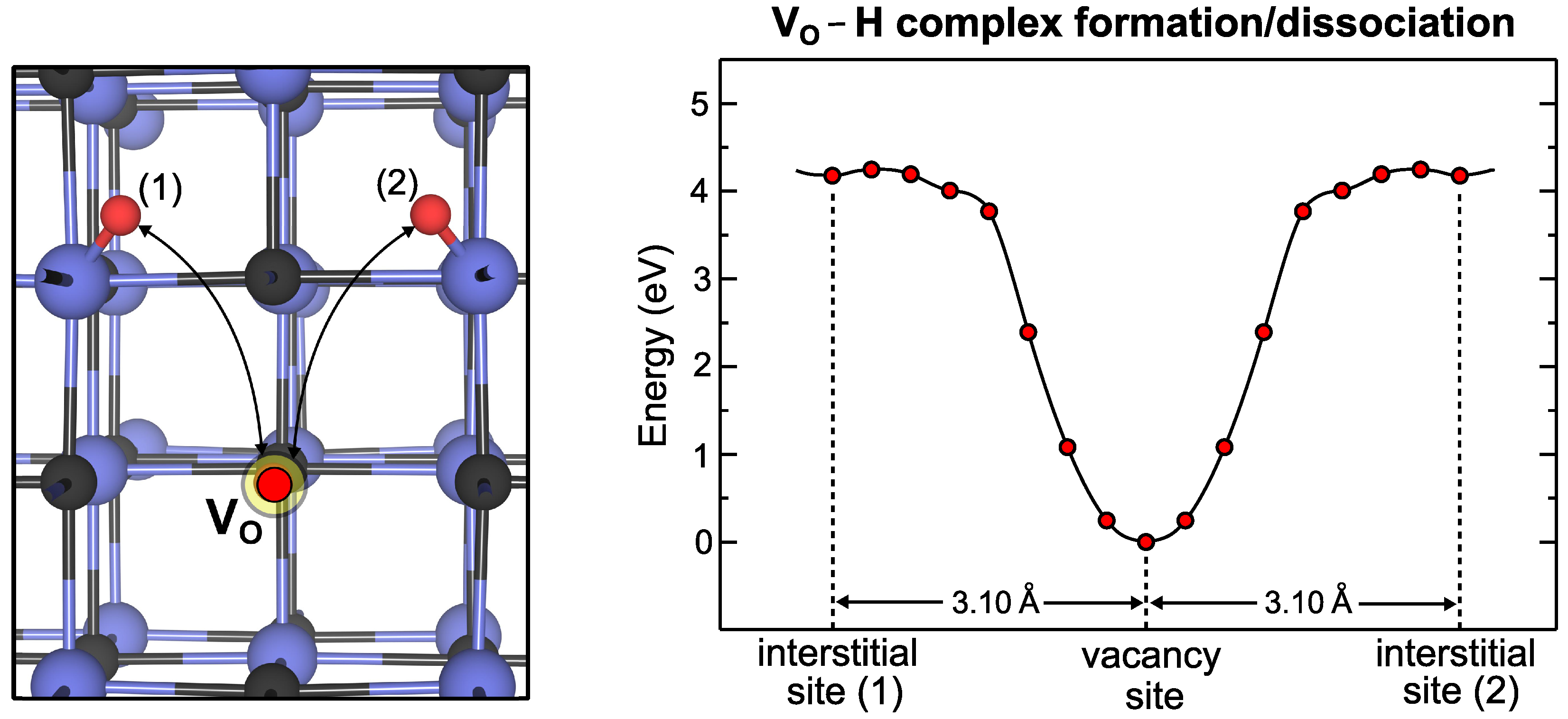
NEB-PBE calculations were undertaken in order to examine the energy landscape of the interaction of hydrogen with the oxygen vacancy. This will help us to understand the formation as well as the stability of the H s defect against dissociation. These results are plotted in Figure 6. It can be seen that the oxygen vacancy creates a strong trapping site for hydrogen, with a very deep potential well of ≈4.2 eV. This potential well is also characterized by a long range which extends even up to next-neighbor Mg4O4 units. PBE calculations showed that interstitial hydrogen atoms residing in any of the eight nearest Mg4O4 units containing the oxygen vacancy site are destabilized and spontaneously displace towards the vacancy site. Interstitial hydrogen residing at more distant Mg4O4 units (sites 1 and 2 in Figure 6 are more than 3 Å away from the vacancy site) were found to barely form stable O-H configurations with very shallow energy minima (see Figure 6).
From the NEB-PBE energy diagram in Figure 6, it can be inferred that a vacancy-hydrogen defect complex would have a high binding energy (of ≈4.2 eV). Thus, it is a very stable defect against dissociation. A very large detrapping energy (surpassing the binding energy) would be needed for a trapped hydrogen to escape from the strongly negative vacancy potential and attach to oxygen ions further away forming O-H configurations sites (1) and (2) in Figure 6. Earlier calculations based on a Hartree–Fock cluster approach studied such a dissociation and a smaller barrier of 3 eV was instead found for hydrogen to escape towards interstitial positions in the lattice [50]. The present findings are consistent with existing experimental observations where substitutional hydrogen defects were reported to remain stable in MgO crystals during high-temperature annealing treatments for temperatures even up to 1900 K, without loss of concentration [6,9]. In contrast, isolated oxygen vacancies were eliminated from the MgO samples.
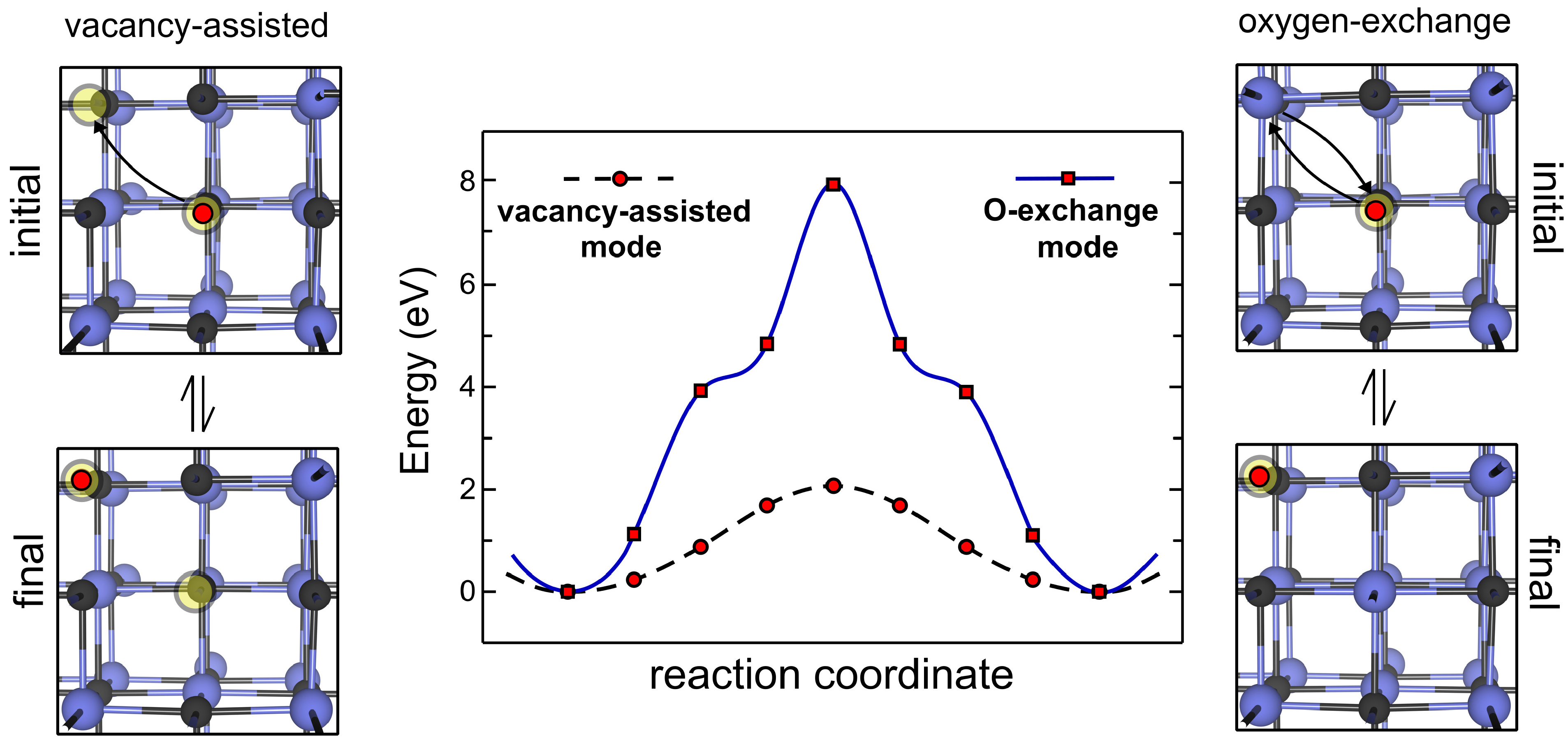
NEB-PBE calculations were further carried out to examine the diffusion mechanisms of the H s defect. An isolated substitutional hydrogen defect can diffuse in the lattice by means of an oxygen-exchange mechanism, where a neighboring lattice oxygen atom exchanges its place with the hydrogen nucleus (see Figure 7, right panel). This diffusion mode involves a concerted motion of these species, and in the final state hydrogen occupies a neighboring vacant site along the face diagonal, defined by the 〈110〉 lattice direction. The obtained energy barrier for this diffusion mode is found to be extremely high (7.98 eV), very likely due to the fact that both the motion of the hydrogen nucleus away from the vacancy site as well as the simultaneous removal of the lattice oxygen from its original lattice site are energetically costly events. The large magnitude of this barrier suggests that an isolated substitutional hydrogen defect is effectively immobile.
A second mechanism was also examined. The underlying assumption is that a neutral oxygen vacancy is near to the H s defect (see Figure 7, left panel). The diffusion mechanism in this case is a vacancy-assisted mechanism whereby hydrogen leaves its original site and through a displacement along the cube diagonal finally occupies the neighboring empty oxygen site. The full energy profile in this case is notably different and is characterized by a much lower migration barrier of 2.07 eV (see Figure 7). This shows that the availability of neutral oxygen vacancies in the immediate neighborhood is a crucial condition to achieve a certain mobility for the H s defect. Such a condition can be met in an oxygen-poor environment (higher temperatures and lower partial pressure) and also when the Fermi-level lies in the upper half of the gap where neutral vacancies are thermodynamically stable. Earlier studies showed that thermochemical reduction of MgO crystals at high temperatures can create high concentrations of oxygen vacancies [6].

4. Summary

Calculations based on a semilocal density functional and a hybrid-functional approach were carried out in order to determine and analyze the formation energies, electronic structure, stability and diffusion behavior of monatomic hydrogen in MgO. Interstitial hydrogen was found to be the lower-energy defect even for the oxygen-poor conditions of high temperature and low oxygen partial pressure. This defect exhibits a strong anisotropy in its migration behavior with a considerably higher energy barrier as a negatively-charged species. Instead, it is highly mobile in its positively-charged state, namely as an interstitial proton. This property favours long diffusion distances in the lattice and eventual association with neutral oxygen vacancies which are found to be efficient traps for hydrogen. The formation of the positively-charged substitutional hydrogen-vacancy complex leads to a large energy gain. Substitutional hydrogen was found to be a highly stable defect complex against dissociation with a detrapping energy barrier of ≈4.2 eV. Examination of its migration behavior showed that it is virtually immobile as an isolated defect, requiring oxygen vacancies in its immediate neighborhood in order to diffuse. The present findings are consistent: (a) with existing experimental observations regarding the thermal stability of vacancy-hydrogen complexes in MgO at high annealing temperatures, and (b) their ability to act as effective electron traps in F-center photoconversion experiments.

Funding

This work was supported by FCT—Fundação para a Ciência e Tecnologia, I.P. through the projects UIDB/04564/2020 and UIDP/04564/2020, with DOI identifiers 10.54499/UIDB/04564/2020 and 10.54499/UIDP/04564/2020, respectively.

Data Availability Statement

The main data presented in the paper are reported. Additional data are available upon reasonable request from the corresponding author.

Acknowledgments

The use of the computing facilities of CFisUC and the Department of Physics of the University of Coimbra is acknowledged.

Conflicts of Interest

The author declares no conflicts of interest.

References

  1. Robertson, J.; Peacock, P.W. Doping and hydrogen in wide gap oxides. Thin Solid Films 2003, 445, 155–160. [Google Scholar] [CrossRef]
  2. Van de Walle, C.G.; Neugebauer, J. Hydrogen in Semiconductors. Annu. Rev. Mater. Res. 2006, 36, 179–198. [Google Scholar] [CrossRef]
  3. Van de Walle, C.G. Hydrogen as a Cause of Doping in Zinc Oxide. Phys. Rev. Lett. 2000, 85, 1012–1015. [Google Scholar] [CrossRef] [PubMed]
  4. Kılıç, Ç.; Zunger, A. n-type doping of oxides by hydrogen. Appl. Phys. Lett. 2002, 81, 73–75. [Google Scholar] [CrossRef]
  5. González, R.; Chen, Y.; Mostoller, M. Substitutional H–ion vibrations in the alkaline-earth oxides reduced at high temperatures. Phys. Rev. B 1981, 24, 6862–6869. [Google Scholar] [CrossRef]
  6. Chen, Y.; Gonzalez, R.; Schow, O.E.; Summers, G.P. Charge and mass transfer involving hydrogen in MgO crystals thermochemically reduced at high temperatures. Phys. Rev. B 1983, 27, 1276–1282. [Google Scholar] [CrossRef]
  7. Tombrello, J.; Tohver, H.T.; Chen, Y.; Wilson, T.M. EPR detection of the substitutional H2− ion in magnesium oxide. Phys. Rev. B 1984, 30, 7374–7376. [Google Scholar] [CrossRef]
  8. Orera, V.M.; Chen, Y. Optical detection of a hydrogen complex responsible for the F phosphorescence in thermochemically reduced MgO crystals. Phys. Rev. B 1987, 36, 6120–6124. [Google Scholar] [CrossRef]
  9. Summers, G.P.; Wilson, T.M.; Jeffries, B.T.; Tohver, H.T.; Chen, Y.; Abraham, M.M. Luminescence from oxygen vacancies in MgO crystals thermochemically reduced at high temperatures. Phys. Rev. B 1983, 27, 1283–1291. [Google Scholar] [CrossRef]
  10. González, R.; Monge, M.A.; Munoz Santiuste, J.E.; Pareja, R.; Chen, Y.; Kotomin, E.; Kukla, M.M.; Popov, A.I. Photoconversion of F-type centers in thermochemically reduced MgO single crystals. Phys. Rev. B 1999, 59, 4786–4790. [Google Scholar] [CrossRef]
  11. Gonzalez, R.; Chen, Y.; Chang, K.L. Diffusion of deuterium and hydrogen in doped and undoped MgO crystals. Phys. Rev. B 1982, 26, 4637–4645. [Google Scholar] [CrossRef]
  12. Cox, S.F.J.; Gavartin, J.L.; Lord, J.S.; Cottrell, S.P.; Gil, J.M.; Alberto, H.V.; Piroto Duarte, J.; Vilão, R.C.; Ayres de Campos, N.; Keeble, D.J.; et al. Oxide muonics: II. Modelling the electrical activity of hydrogen in wide-gap and high-permittivity dielectrics. J. Phys. Condens. Matter. 2006, 18, 1079–1119. [Google Scholar] [CrossRef]
  13. Vilão, R.C.; Roonkiani, A.; Marinopoulos, A.G.; Alberto, H.V.; Gil, J.M.; Vieira, R.B.L.; Scheuermann, R.; Weidinger, A. Muonium reaction in MgO: A showcase for the final steps of ion implantation. Scipost Phys. Core 2025, 8, 056. [Google Scholar] [CrossRef]
  14. Norgett, M.J.; Stoneham, A.M.; Pathak, A.P. Electronic structure of the V centre in MgO. J. Phys. C Solid State Phys. 1977, 10, 555–565. [Google Scholar] [CrossRef]
  15. Mackrodt, W.C.; Stewart, R.F. Defect properties of ionic solids. III. The calculation of the point-defect structure of the alkaline-earth oxides and CdO. J. Phys. C Solid State Phys. 1979, 12, 5015–5036. [Google Scholar] [CrossRef]
  16. Hohenberg, P.; Kohn, W. Inhomogeneous Electron Gas. Phys. Rev. 1964, 136, B864–B871. [Google Scholar] [CrossRef]
  17. Kohn, W.; Sham, L.J. Self-Consistent Equations Including Exchange and Correlation Effects. Phys. Rev. 1965, 140, A1133–A1138. [Google Scholar] [CrossRef]
  18. Peacock, P.W.; Robertson, J. Behavior of hydrogen in high dielectric constant oxide gate insulators. Appl. Phys. Lett. 2003, 83, 2025–2027. [Google Scholar] [CrossRef]
  19. Janotti, A.; Van de Walle, C.G. Hydrogen multicentre bonds. Nat. Mater. 2007, 6, 44–47. [Google Scholar] [CrossRef]
  20. Lyons, J.L.; Janotti, A.; Van de Walle, C.G. The role of oxygen-related defects and hydrogen impurities in HfO2 and ZrO2. Microelectron. Eng. 2011, 88, 1452–1456. [Google Scholar] [CrossRef]
  21. Choi, A.R.; Lim, D.H.; Shin, S.Y.; Kang, H.J.; Kim, D.; Kim, J.Y.; Ahn, Y.; Ryu, S.W.; Oh, I.K. Review of Material Properties of Oxide Semiconductor Thin Films Grown by Atomic Layer Deposition for Next-Generation 3D Dynamic Random-Access Memory Devices. Chem. Mater. 2024, 36, 2194–2219. [Google Scholar] [CrossRef]
  22. McKenna, K.P.; Shluger, A.L. First-principles calculations of defects near a grain boundary in MgO. Phys. Rev. B 2009, 79, 224116. [Google Scholar] [CrossRef]
  23. Fongkaew, I.; Yotburut, B.; Sailuam, W.; Jindata, W.; Thiwatwaranikul, T.; Khamkongkaeo, A.; Chuewangkam, N.; Tanapongpisit, N.; Saenrang, W.; Utke, R.; et al. Effect of hydrogen on magnetic properties in MgO studied by first-principles calculations and experiments. Sci. Rep. 2022, 12, 10063. [Google Scholar] [CrossRef]
  24. Perdew, J.P.; Burke, K.; Ernzerhof, M. Generalized Gradient Approximation Made Simple. Phys. Rev. Lett. 1996, 77, 3865–3868. [Google Scholar] [CrossRef]
  25. Heyd, J.; Scuseria, G.E.; Ernzerhof, M. Hybrid functionals based on a screened Coulomb potential. J. Chem. Phys. 2003, 118, 8207. [Google Scholar] [CrossRef]
  26. Heyd, J.; Scuseria, G.E. Efficient hybrid density functional calculations in solids: Assessment of the Heyd–Scuseria–Ernzerhof screened Coulomb hybrid functional. J. Chem. Phys. 2004, 121, 1187–1192. [Google Scholar] [CrossRef]
  27. Marsman, M.; Paier, J.; Stroppa, A.; Kresse, G. Hybrid functionals applied to extended systems. J. Phys. Condens. Matter. 2008, 20, 064201. [Google Scholar] [CrossRef] [PubMed]
  28. Jónsson, H.; Mills, G.; Jacobsen, K.W. Nudged Elastic Band Method for Finding Minimum Energy Paths of Transitions. In Classical and Quantum Dynamics in Condensed Phase Simulations; Berne, B., Ciccotti, G., Coker, D.F., Eds.; World Scientific: Singapore, 1998; pp. 385–404. [Google Scholar]
  29. Kresse, G.; Hafner, J. Ab initio molecular dynamics for liquid metals. Phys. Rev. B 1993, 47, 558–561. [Google Scholar] [CrossRef]
  30. Kresse, G.; Hafner, J. Ab initio molecular-dynamics simulation of the liquid-metal–amorphous-semiconductor transition in germanium. Phys. Rev. B 1994, 49, 14251–14269. [Google Scholar] [CrossRef]
  31. Kresse, G.; Furthmüller, J. Efficient iterative schemes for ab initio total-energy calculations using a plane-wave basis set. Phys. Rev. B 1996, 54, 11169–11186. [Google Scholar] [CrossRef] [PubMed]
  32. Blöchl, P.E. Projector augmented-wave method. Phys. Rev. B 1994, 50, 17953–17979. [Google Scholar] [CrossRef]
  33. Kresse, G.; Joubert, D. From ultrasoft pseudopotentials to the projector augmented-wave method. Phys. Rev. B 1999, 59, 1758–1775. [Google Scholar] [CrossRef]
  34. Whited, R.C.; Flaten, C.J.; Walker, W.C. Exciton thermoreflectance of MgO and CaO. Solid State Commun. 1973, 13, 1903–1905. [Google Scholar] [CrossRef]
  35. Zhang, S.B.; Northrup, J.E. Chemical potential dependence of defect formation energies in GaAs: Application to Ga self-diffusion. Phys. Rev. Lett. 1991, 67, 2339. [Google Scholar] [CrossRef]
  36. Makov, G.; Payne, M.C. Periodic boundary conditions in ab initio calculations. Phys. Rev. B 1995, 51, 4014. [Google Scholar] [CrossRef]
  37. Subramanian, M.A.; Shannon, R.D.; Chai, B.H.T.; Abraham, M.M.; Wintersgill, M.C. Dielectric Constants of BeO, MgO, and CaO Using the Two-Terminal Method. Phys. Chem. Miner. 1989, 16, 741–746. [Google Scholar] [CrossRef]
  38. Finnis, M.W.; Lozovoi, A.Y.; Alavi, A. THE OXIDATION OF NiAl: What Can We Learn from Ab Initio Calculations? Annu. Rev. Mater. Res. 2005, 35, 167–207. [Google Scholar] [CrossRef]
  39. Haynes, W.M. (Ed.) CRC Handbook of Chemistry and Physics, 92nd ed.; CRC Press: Boca Raton, FL, USA, 2011. [Google Scholar]
  40. Northrup, J.E.; Felice, R.D.; Neugebauer, J. Energetics of H and NH2 on GaN(1010) and implications for the origin of nanopipe defects. Phys. Rev. B 1997, 56, R4325. [Google Scholar] [CrossRef]
  41. Han, M.; Deák, P.; Zeng, Z.; Frauenheim, T. Possibility of Doping CuGaSe2 n-Type by Hydrogen. Phys. Rev. Appl. 2021, 15, 044021. [Google Scholar] [CrossRef]
  42. Vineyard, G.H. Frequency Factors and Isotope Effects in Solid State Rate Processes. J. Phys. Chem. Solids 1957, 3, 121–127. [Google Scholar] [CrossRef]
  43. Henkelman, G.; Arnaldsson, A.; Jónsson, H. Theoretical calculations of CH4 and H2 associative desorption from Ni(111): Could subsurface hydrogen play an important role? J. Chem. Phys. 2006, 124, 044706. [Google Scholar] [CrossRef]
  44. Li, H.; Robertson, J. Behaviour of hydrogen in wide band gap oxides. J. Appl. Phys. 2014, 115, 203708. [Google Scholar] [CrossRef]
  45. Momma, K.; Izumi, F. VESTA 3 for three-dimensional visualization of crystal, volumetric and morphology data. J. Appl. Crystallogr. 2011, 44, 1272–1276. [Google Scholar] [CrossRef]
  46. Linderälv, C.; Lindman, A.; Erhart, P. A Unifying Perspective on Oxygen Vacancies in Wide Band Gap Oxides. J. Phys. Chem. Lett. 2018, 9, 222–228. [Google Scholar] [CrossRef]
  47. Marinopoulos, A.G. Band offsets and point-defect charges of the aluminum and hafnium oxides in contact with the Cu(In,Ga)Se2 chalcopyrite. J. Phys. Condens. Matter. 2024, 36, 035702. [Google Scholar] [CrossRef]
  48. Fiermans, L.; Hoogewijs, R.; de Meyer, G.; Vennik, J. On X-ray photoelectron spectroscopy of alkaline-earth oxides. Phys. Status Solidi A 1980, 59, 569–574. [Google Scholar] [CrossRef]
  49. Wang, Q.S.; Holzwarth, N.A.W. Electronic structure of vacancy defects in MgO crystals. Phys. Rev. B 1990, 41, 3211–3225. [Google Scholar] [CrossRef] [PubMed]
  50. Kuklja, M.M.; Stefanovich, E.V.; Kotomin, E.A.; Popov, A.I.; González, R.; Chen, Y. Ab initio and semiempirical calculations of H centers in MgO crystals. Phys. Rev. B 1999, 59, 1885–1890. [Google Scholar] [CrossRef]
  51. Yang, K.; Tao, X.; Zeng, Z.; Wang, X. Effects of pressure on hydrogen diffusion behaviors in MgO. Phys. Chem. Chem. Phys. 2023, 25, 19824. [Google Scholar] [CrossRef]
  52. Carrasco, J.; Lopez, N.; Illas, F. First Principles Analysis of the Stability and Diffusion of Oxygen Vacancies in Metal Oxides. Phys. Rev. Lett. 2004, 93, 225502. [Google Scholar] [CrossRef]
Figure 1. Atomistic structures and formation energies of the interstitial (a) and substitutional (b) hydrogen states in MgO. O: larger blue spheres. Mg: smaller black spheres. H: small red sphere. VO: oxygen-vacancy site (large haloed circle). The formation energies are plotted as a function of the Fermi-level position in the HSE06 gap (7.92 eV). The corresponding chemical potentials were obtained for T = 1200 K, P H 2 = 1 atm, and P O 2 = 10 2 atm. The dotted red lines for the substitutional-hydrogen state, H s + , mark the corresponding energies for P O 2 equal to 1 atm and 10−15 atm (higher and lower energy, respectively). The charge-transition (pinning) level (+/−) is depicted by the vertical dotted line. The reference (zero) value for the Fermi level is set by the energy of the valence-band maximum (VBM), EVBM, of the bulk MgO supercell.
Condensedmatter 11 00002 g001
Figure 2. Formation-energy plot of the oxygen monovacancy, V O q , as a function of the Fermi-level position in the HSE06 gap. The thick red lines designate the thermodynamically-stable charge states. The charge-transition levels, (+2/+1) and (+1/0) are depicted by the vertical dashed lines. The arrows indicate the range of Fermi-level positions where the V O 0 and H i + states are both thermodynamically stable. The zero-value for the Fermi level is set by the VBM, EVBM, of the bulk MgO supercell. The regions of thermodynamic stability of the positively- and negatively-charged interstitial hydrogen are designated with different colors just above the formation-energy plot.
Condensedmatter 11 00002 g002
Figure 3. Site-projected and total DOS of the thermodynamically-stable states of interstitial and substitutional hydrogen. (a) Positively-charged interstitial state, q = +1. (b) Negatively-charged interstitial state, q = −1. (c) Positively-charged substitutional state, q = +1. The nearest magnesium atoms, MgNN, are marked with X. The zero-value for the Fermi level is the energy of the VBM, EVBM, of the bulk MgO supercell. Upper-panel graphs show the partial charge density (in yellow color) for specific peaks of the DOS plots of each configuration.
Condensedmatter 11 00002 g003
Figure 4. Distinct migration pathways and corresponding NEB-energy profiles of the positively-charged interstitial hydrogen configuration. Filled circles in the curves denote exact NEB results. The lines in the energy profiles serve as guidelines connecting the exact results.
Condensedmatter 11 00002 g004
Figure 5. Migration pathway and corresponding NEB-energy profile of the negatively-charged interstitial hydrogen configuration. Filled circles in the curve denote exact NEB results. The line in the energy profile serves as a guideline connecting the exact results.
Condensedmatter 11 00002 g005
Figure 6. Energy landscape of the vacancy-hydrogen complex formation. The energy profile was obtained by NEB calculations as a function of the displacement of the hydrogen nucleus with respect to the oxygen-vacancy site. Filled circles denote exact NEB results. The line in the energy profile serves as guideline connecting the exact results.
Condensedmatter 11 00002 g006
Figure 7. Migration modes and corresponding NEB-energy profiles of the vacancy-hydrogen defect complex. Filled symbols (circles and squares) in the curves denote exact NEB results. The lines in the energy profiles serve as guidelines connecting the exact results.
Condensedmatter 11 00002 g007
Disclaimer/Publisher’s Note: The statements, opinions and data contained in all publications are solely those of the individual author(s) and contributor(s) and not of MDPI and/or the editor(s). MDPI and/or the editor(s) disclaim responsibility for any injury to people or property resulting from any ideas, methods, instructions or products referred to in the content.