
Why Rules Fail: Institutional Roots of Non-Compliance in Mexico’s Small-Scale Shark Fishery
 , ,
, ,
Abstract
1. Introduction
1.1. Problem Statement
1.2. Theoretical Framework
2. Materials and Methods
2.1. Study Design and Analytical Rationale
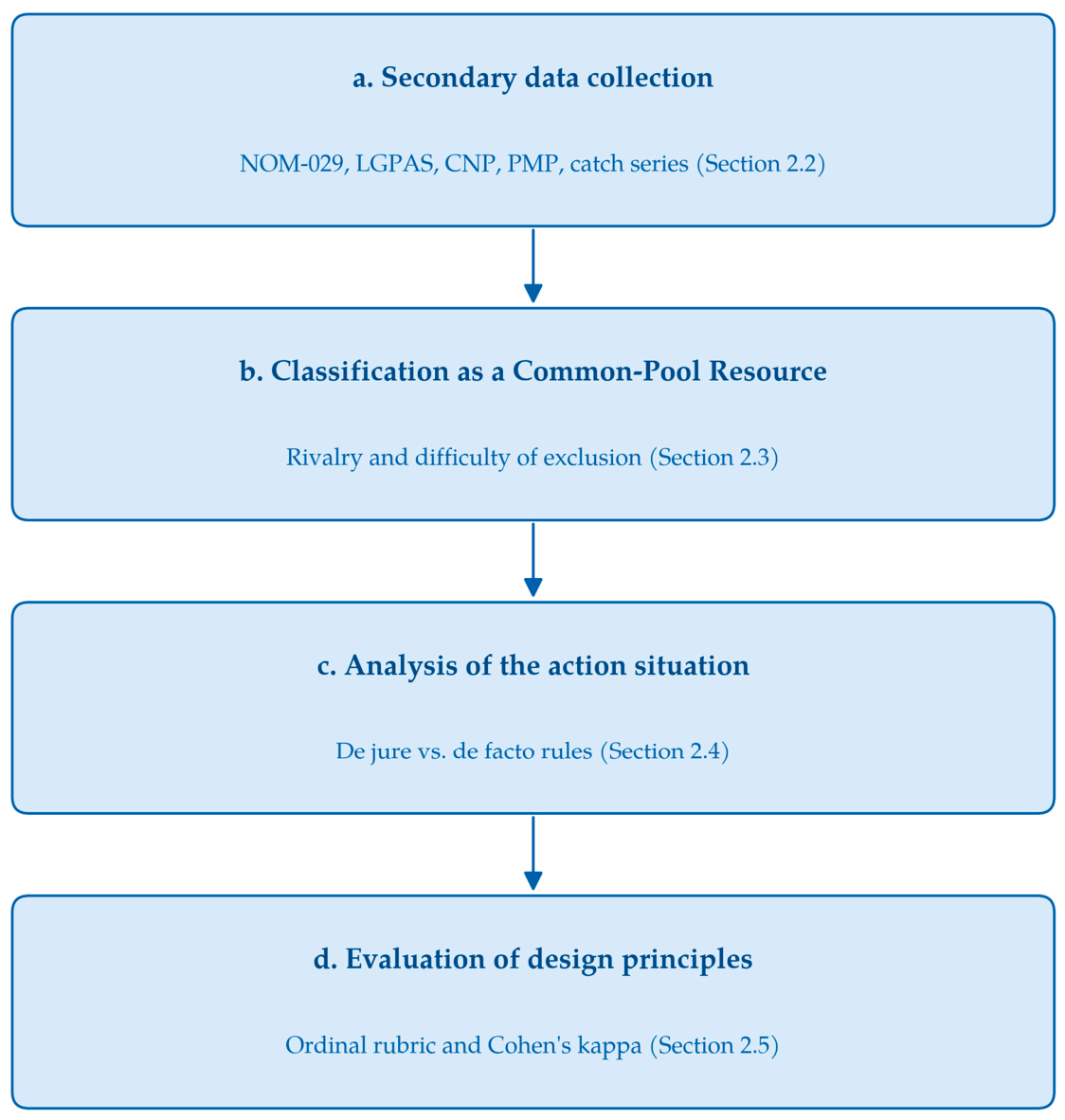
2.2. Data Collection and Information Sources
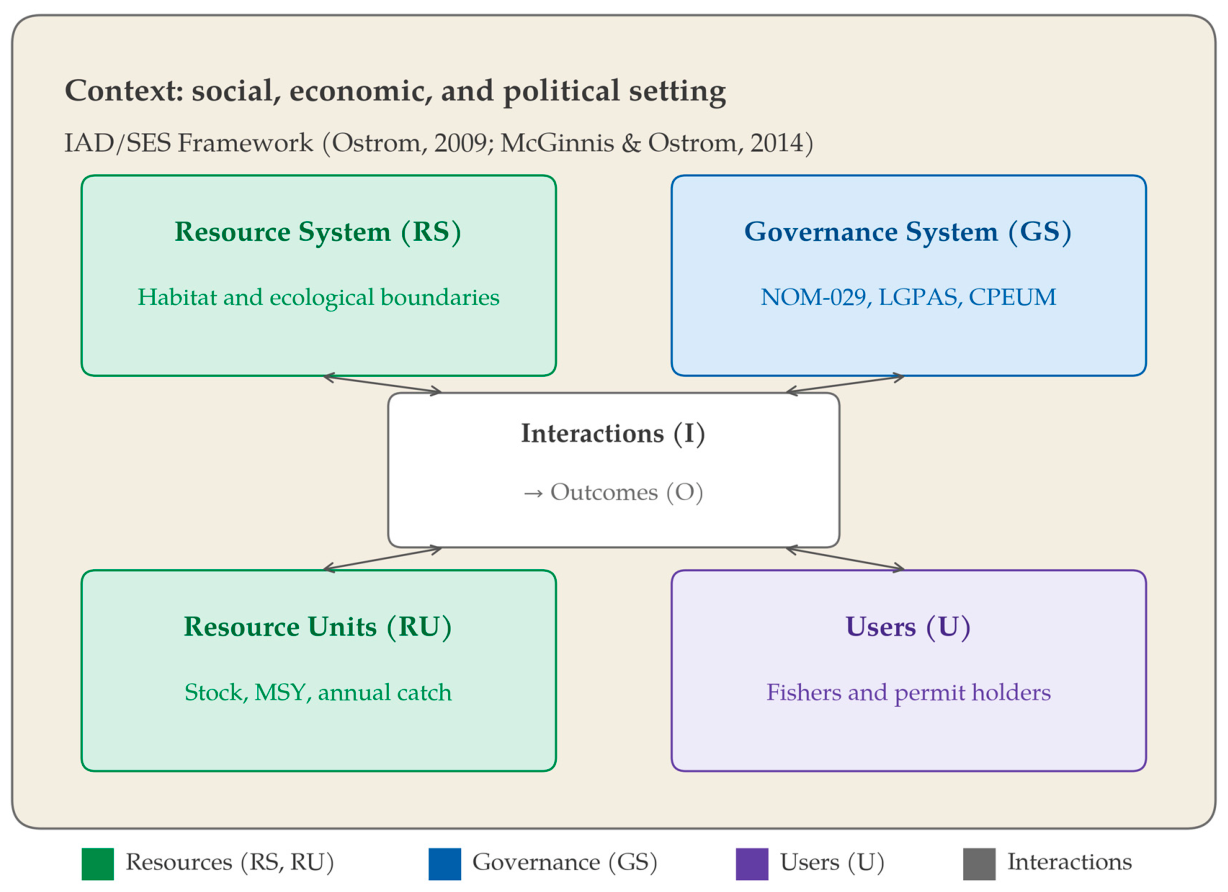
2.3. Operationalizing the IAD and SES Frameworks: Classification as a Common-Pool Resource
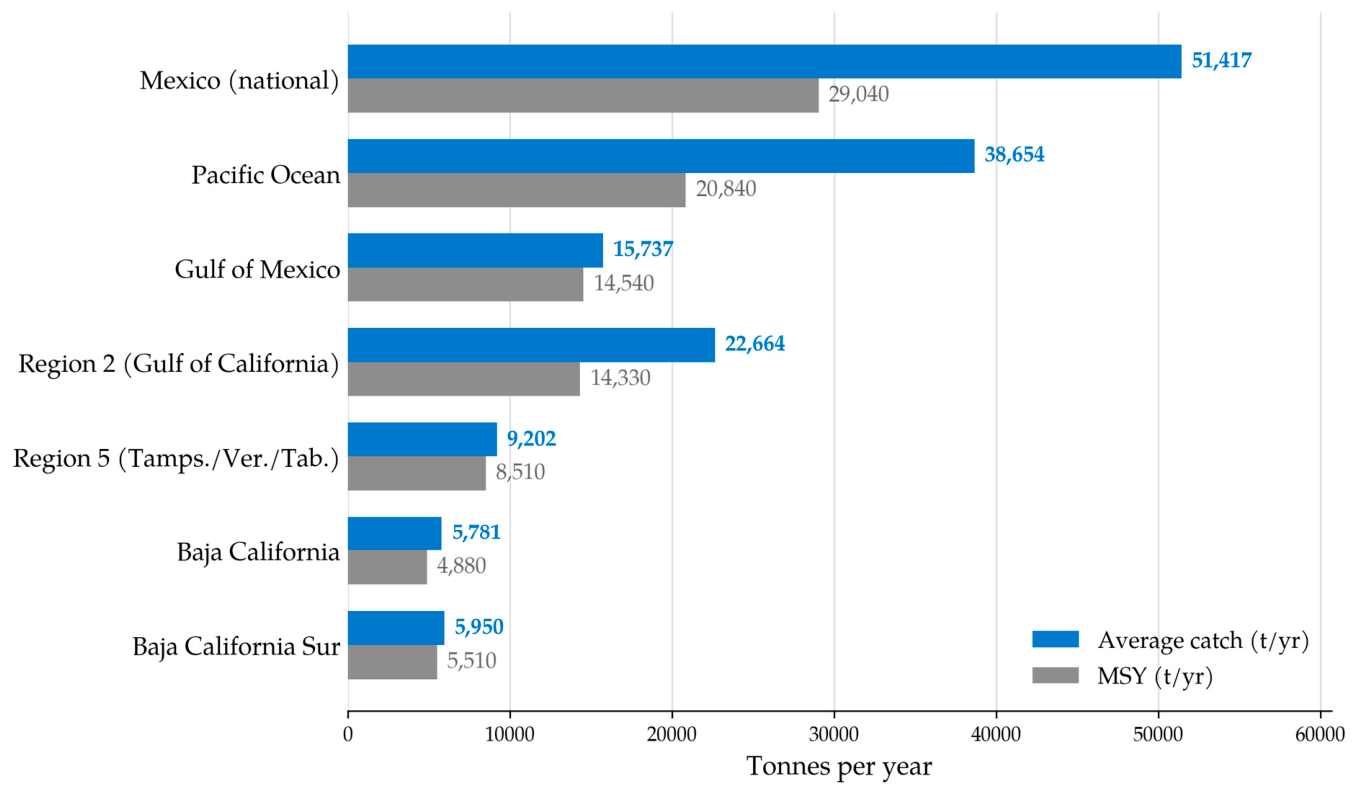
- Resource Units (RU): quantifies available stock, landing volume, and the economic value of the annual catch. This component incorporates Rodríguez-Castro’s [13] MSY estimates.
- Governance System (GS): analyzes the legal structure and levels of decision-making. This covers the de jure operating rules established in NOM-029-PESC-2006 (temporary closures, minimum catch sizes, and fishing-gear restrictions), collective-choice rules (permit- and concession-allocation mechanisms, and the National Fisheries and Aquaculture Council as a national-level consultative forum, Art. 22, [39]), and the constitutional rules derived from Article 27 of the Constitución Política de los Estados Unidos Mexicanos (CPEUM), which grants the Nation original ownership of waters and the right to regulate, for the public benefit, the use of natural resources [43]—the direct foundation of the command-and-control paradigm operationalized by the LGPAS [7,22].
- Users (U): characterizes the behavior of the fishery’s key actors, including small-scale coastal and medium-offshore fishers, formally organized into cooperatives or dependent on independent permit holders.
2.4. Diagnosis of the Action Situation and Regulatory Misfit
- Analysis of rules on paper (de jure) vs. rules in use (de facto): the formal mandates of NOM-029-PESC-2006 (fishing-gear restrictions, refuge zones, and closure periods) were contrasted with the actual coastal practices documented along the coastline.
- Assessment of the command-and-control mechanism: we examined the fishery’s structural dependence on external State surveillance (the National Aquaculture and Fisheries Commission [CONAPESCA] and the Secretariat of the Navy [SEMAR]), measuring the asymmetry between official inspection capacity and actual fishing effort.
- Identification of perverse incentives: we characterized the adaptive behaviors of users who, in seeking to formally comply with regulations or evade them owing to a lack of local rule legitimacy, accelerate stock degradation (e.g., “fishing derbies” before a closure begins, or catch underreporting).
Classification of Compliance Mechanisms Following Hønneland’s Model
2.5. Assessing Institutional Robustness: Compliance with Ostrom’s Design Principles
3. Results
3.1. Biophysical Status of the Resource and Catch Surplus
3.2. Characterizing the Shark-Cazón Fishery as a Common-Pool Resource (CPR)
3.3. Diagnosis of the Action Situation and Rules in Use
3.4. Assessment of Ostrom’s Design Principles
3.5. Synthesis of the Institutional Diagnosis
4. Discussion
4.1. Interpretation in the Context of Prior Studies
4.2. Implications for Compliance Theory and Polycentric Governance
4.3. Implications for Fisheries Policy in Mexico
4.4. Study Limitations
4.5. Future Research Lines
5. Conclusions
5.1. Answer to the Research Question and Hypothesis Contrast
5.2. Return to the Theoretical Framework: The IAD/SES Framework and Hønneland’s Compliance Model
5.3. Implications for Fisheries Policy in Mexico
5.4. Final Reflection
Author Contributions
Funding
Institutional Review Board Statement
Informed Consent Statement
Data Availability Statement
Conflicts of Interest
References
- Hønneland, G. A model of compliance in fisheries: Theoretical foundations and practical application. Ocean Coast. Manag. 1999, 42, 699–716. [Google Scholar] [CrossRef] [Scilit]
- Hønneland, G. Compliance in the Barents Sea fisheries: How fishermen account for conformity with rules. Mar. Policy 2000, 24, 11–19. [Google Scholar] [CrossRef] [Scilit]
- Kuperan, K.; Sutinen, J.G. Blue water crime: Deterrence, legitimacy, and compliance in fisheries. Law Soc. Rev. 1998, 32, 309–338. [Google Scholar] [CrossRef] [Scilit]
- Hatcher, A.; Jaffry, S.; Thébaud, O.; Bennett, E. Normative and social influences affecting compliance with fishery regulations. Land Econ. 2000, 76, 348–365. [Google Scholar] [CrossRef] [Scilit]
- Nielsen, J.R. An analytical framework for studying compliance and legitimacy in fisheries management. Mar. Policy 2003, 27, 425–432. [Google Scholar] [CrossRef] [Scilit]
- Dulvy, N.K.; Pacoureau, N.; Rigby, C.L.; Pollom, R.A.; Jabado, R.W.; Kim, D.A.; Finucci, B.; Cheok, J.S.; Derrick, D.H.; Forrest, A.K.H.; et al. Overfishing drives over one-third of all sharks and rays toward a global extinction crisis. Curr. Biol. 2021, 31, 4773–4787. [Google Scholar] [CrossRef] [Scilit] [PubMed]
- Deepananda, K.H.M.A.; Amarasinghe, U.S.; Jayasinghe-Mudalige, U.K. Neither bust nor boom: Institutional robustness in the beach seine fishery of southern Sri Lanka. Ocean Coast. Manag. 2016, 128, 61–73. [Google Scholar] [CrossRef] [Scilit]
- Mpomwenda, V.; Tómasson, T.; Pétursson, J.G.; Kristófersson, D.M. From co-operation to coercion in fisheries management: The effects of military intervention on the Nile perch fishery on Lake Victoria in Uganda. Fishes 2023, 8, 563. [Google Scholar] [CrossRef] [Scilit]
- CONAPESCA/SAGARPA. Anuario Estadístico de Acuacultura y Pesca 2017; Comisión Nacional de Acuacultura y Pesca: Mazatlán, Mexico, 2017. [Google Scholar]
- Rodríguez-Castro, J.H.; Olmeda-de-la-Fuente, S.E.; Correa-Sandoval, A.; Venegas-Barrera, C.S. Estimación del rendimiento máximo sostenible del recurso tiburón-cazón en México. CienciaUAT 2020, 15, 6–23. [Google Scholar] [CrossRef] [Scilit]
- DOF. Norma Oficial Mexicana NOM-029-PESC-2006, Pesca responsable de tiburones y rayas. Especificaciones para su aprovechamiento. Diario Oficial de la Federación, 14 February 2007.
- DOF. Acuerdo por el que se da a conocer la actualización de la Carta Nacional Pesquera (Tiburones del Golfo de México y Mar Caribe). Diario Oficial de la Federación, 26 July 2022.
- DOF. Acuerdo por el que se da a conocer la actualización de la Carta Nacional Pesquera (Tiburones del Pacífico). Diario Oficial de la Federación, 26 June 2023.
- Cisneros-Montemayor, A.M.; Cisneros-Mata, M.A.; Harper, S.; Pauly, D. Extent and implications of IUU catch in Mexico’s marine fisheries. Mar. Policy 2013, 39, 283–288. [Google Scholar] [CrossRef] [Scilit]
- DOF. Acuerdo por el que se da a conocer el Plan de Manejo Pesquero de Tiburones y Rayas del Golfo de México y Mar Caribe. Diario Oficial de la Federación, 9 June 2022.
- Ostrom, E. Governing the Commons: The Evolution of Institutions for Collective Action; Cambridge University Press: Cambridge, UK, 1990. [Google Scholar]
- Cox, M.; Arnold, G.; Villamayor-Tomás, S. A review of design principles for community-based natural resource management. Ecol. Soc. 2010, 15, 38. [Google Scholar] [CrossRef] [Scilit]
- Trimble, M.; Berkes, F. Towards adaptive co-management of small-scale fisheries in Uruguay and Brazil: Lessons from using Ostrom’s design principles. Marit. Stud. 2015, 14, 14. [Google Scholar] [CrossRef] [Scilit]
- Cox, M. Boundaries. In Common Boundaries: The Theory and Practice of Environmental Property; Agenda Publishing: Newcastle upon Tyne, UK, 2024; pp. 23–42. [Google Scholar]
- Hardin, G. The tragedy of the commons. Science 1968, 162, 1243–1248. [Google Scholar] [CrossRef] [Scilit] [PubMed]
- Holling, C.S.; Meffe, G.K. Command and control and the pathology of natural resource management. Conserv. Biol. 1996, 10, 328–337. [Google Scholar] [CrossRef] [Scilit]
- Ostrom, E. Understanding Institutional Diversity; Princeton University Press: Princeton, NJ, USA, 2005. [Google Scholar]
- Ostrom, E. Background on the Institutional Analysis and Development Framework. Policy Stud. J. 2011, 39, 7–27. [Google Scholar] [CrossRef] [Scilit]
- Ostrom, E. A general framework for analyzing sustainability of social-ecological systems. Science 2009, 325, 419–422. [Google Scholar] [CrossRef] [Scilit] [PubMed]
- McGinnis, M.D.; Ostrom, E. Social-ecological system framework: Initial changes and continuing challenges. Ecol. Soc. 2014, 19, 30. [Google Scholar] [CrossRef] [Scilit]
- Creswell, J.W. Research Design: Qualitative, Quantitative, and Mixed Methods Approaches, 4th ed.; Sage: Thousand Oaks, CA, USA, 2014. [Google Scholar]
- Anfara, V.A.; Mertz, N.T. (Eds.) Theoretical Frameworks in Qualitative Research; Sage: Thousand Oaks, CA, USA, 2006. [Google Scholar]
- Creswell, J.W.; Plano Clark, V.L. Designing and Conducting Mixed Methods Research, 2nd ed.; Sage: Thousand Oaks, CA, USA, 2011. [Google Scholar]
- McGinnis, M.D. An introduction to IAD and the language of the Ostrom workshop: A simple guide to a complex framework. Policy Stud. J. 2011, 39, 169–183. [Google Scholar] [CrossRef] [Scilit]
- McGinnis, M.D. Networks of adjacent action situations in polycentric governance. Policy Stud. J. 2011, 39, 51–78. [Google Scholar] [CrossRef] [Scilit]
- Merton, R.K. Social Theory and Social Structure; The Free Press: Glencoe, IL, USA, 1949. [Google Scholar]
- Morse, J.M. Approaches to qualitative-quantitative methodological triangulation. Nurs. Res. 1991, 40, 120–123. [Google Scholar] [CrossRef] [Scilit]
- Poteete, A.R.; Janssen, M.A.; Ostrom, E. Working Together: Collective Action, the Commons, and Multiple Methods in Practice; Princeton University Press: Princeton, NJ, USA, 2010. [Google Scholar]
- Partelow, S. A review of the social-ecological systems framework: Applications, methods, modifications, and challenges. Ecol. Soc. 2018, 23, 36. [Google Scholar] [CrossRef] [Scilit]
- Partelow, S.; Glaser, M.; Solano Arce, S.; Barboza, R.S.L.; Schlüter, A. Mangroves, fishers, and the struggle for adaptive comanagement: Applying the social-ecological systems framework to a marine extractive reserve (RESEX) in Brazil. Ecol. Soc. 2018, 23, 19. [Google Scholar] [CrossRef] [Scilit]
- Denzin, N.K. The Research Act: A Theoretical Introduction to Sociological Methods, 2nd ed.; McGraw-Hill: New York, NY, USA, 1978. [Google Scholar]
- Patton, M.Q. Enhancing the quality and credibility of qualitative analysis. Health Serv. Res. 1999, 34, 1189–1208. [Google Scholar] [PubMed]
- DOF. Ley General de Pesca y Acuacultura Sustentables. Diario Oficial de la Federación, 24 July 2007.
- Srinivasan, U.; Cheung, W.; Watson, R.; Sumaila, U.R. Food security implications of global marine catch losses due to overfishing. J. Bioecon. 2010, 12, 183–200. [Google Scholar] [CrossRef] [Scilit]
- Nagel, B.; Partelow, S. A methodological guide for applying the social-ecological system (SES) framework: A review of quantitative approaches. Ecol. Soc. 2022, 27, 39. [Google Scholar] [CrossRef] [Scilit]
- Partelow, S.; Nagel, B.; Boscarino-Gaetano, R. A meta-analysis of SES framework case studies: Identifying dyad and triad archetypes. People Nat. 2022, 4, 1466–1485. [Google Scholar]
- DOF. Constitución Política de los Estados Unidos Mexicanos. Diario Oficial de la Federación, 5 February 1917.
- Ostrom, E.; Gardner, R.; Walker, J. Rules, Games, and Common-Pool Resources; University of Michigan Press: Ann Arbor, MI, USA, 1994. [Google Scholar]
- Agnew, D.J.; Pearce, J.; Pramod, G.; Peatman, T.; Watson, R.; Beddington, J.R.; Pitcher, T.J. Estimating the worldwide extent of illegal fishing. PLoS ONE 2009, 4, e4570. [Google Scholar] [CrossRef] [Scilit] [PubMed]
- Krippendorff, K. Content Analysis: An Introduction to Its Methodology, 2nd ed.; Sage: Thousand Oaks, CA, USA, 2004. [Google Scholar]
- Hsieh, H.-F.; Shannon, S.E. Three approaches to qualitative content analysis. Qual. Health Res. 2005, 15, 1277–1288. [Google Scholar] [CrossRef] [Scilit] [PubMed]
- Cohen, J. A coefficient of agreement for nominal scales. Educ. Psychol. Meas. 1960, 20, 37–46. [Google Scholar] [CrossRef] [Scilit]
- Landis, J.R.; Koch, G.G. The measurement of observer agreement for categorical data. Biometrics 1977, 33, 159–174. [Google Scholar] [CrossRef] [Scilit]
- Lombard, M.; Snyder-Duch, J.; Bracken, C.C. Content analysis in mass communication: Assessment and reporting of intercoder reliability. Hum. Commun. Res. 2002, 28, 587–604. [Google Scholar] [CrossRef] [Scilit]
- O’Connor, C.; Joffe, H. Intercoder reliability in qualitative research: Debates and practical guidelines. Int. J. Qual. Methods 2020, 19, 1–13. [Google Scholar] [CrossRef] [Scilit]
- Hobday, A.J.; Smith, A.D.M.; Stobutzki, I.C.; Bulman, C.; Daley, R.; Dambacher, J.M.; Deng, R.A.; Dowdney, J.; Fuller, M.; Furlani, D.; et al. Ecological risk assessment for the effects of fishing. Fish. Res. 2011, 108, 372–384. [Google Scholar] [CrossRef] [Scilit]
- Saldaña-Ruiz, L.E.; Flores-Guzmán, A.; Cisneros-Soberanis, F.; Cuevas-Gómez, G.A.; Gastélum-Nava, E.; Rocha-Tejeda, L.; Chavez, J.F.; Hernandez-Pimienta, R.E.; Fernández-Rivera Melo, F.J. A risk-based assessment to advise the responsible consumption of invertebrates, elasmobranch, and fishes of commercial interest in Mexico. Front. Mar. Sci. 2022, 9, 866135. [Google Scholar] [CrossRef] [Scilit]
- MacNeil, M.A.; Chapman, D.D.; Heupel, M.; Simpfendorfer, C.A.; Heithaus, M.; Meekan, M.; Harvey, E.; Goetze, J.; Kiszka, J.; Bond, M.E.; et al. Global status and conservation potential of reef sharks. Nature 2020, 583, 801–806. [Google Scholar] [CrossRef] [Scilit] [PubMed]
- Ostrom, E. Polycentric systems for coping with collective action and global environmental change. Glob. Environ. Change 2010, 20, 550–557. [Google Scholar] [CrossRef] [Scilit]




| Design Principle | Value 0: Not Met | Value 1: Partially Met | Value 2: Met |
|---|---|---|---|
| P1. Defined boundaries (1A: resource boundaries; 1B: user boundaries) | De facto open access; no boundaries for users or the resource. | Federal permits exist, but there are no clear territorial boundaries or effective exclusion. | Geographic and user boundaries are clearly defined and respected. |
| P2. Local congruence (2A: congruence with local conditions; 2B: congruence between appropriation and provision) | Rules imposed externally without regard for local biology or culture. | Closures and minimum sizes exist, but do not match regional biological cycles. | Appropriation rules are strictly adjusted to local biophysical conditions. |
| P3. Collective choice (collective-choice arrangements) | No formal mechanisms exist through which users can participate in modifying operating rules. | Consultative or limited-participation mechanisms exist, with no binding authority over management decisions. | Most users affected by operating rules can participate directly, with binding authority, in modifying them. |
| P4. Monitoring (4A: monitoring by users; 4B: monitoring by parties accountable to users) | Total absence of surveillance or catch recording. | Sporadic monitoring carried out solely by external state agents. | Systematic monitoring carried out by the State and/or by users themselves. |
| P5. Graduated sanctions | No consequences for rule non-compliance. | A graduated sanctions scheme exists in general legislation, but is not operationalized in the fishery-specific standard nor applied participatorily; or sanctions are fixed and extreme and rarely applied. | Sanctions increase according to the severity and recurrence of the infraction. |
| P6. Conflict resolution | No mechanisms exist for settling disputes between users. | Conflicts are resolved through lengthy or costly administrative processes. | Local, rapid, low-cost mechanisms exist for resolving disputes. |
| Area | Average Catch (t/yr) | MSY (t/yr) | Absolute Difference (t/yr) | Surplus (%) |
|---|---|---|---|---|
| Mexico (national) | 51,417 | 29,040 | −22,377 | −77% |
| Pacific Ocean | 38,654 | 20,840 | −17,814 | −85% |
| Gulf of Mexico | 15,737 | 14,540 | −1197 | −8% |
| Region 2 (Gulf of California) | 22,664 | 14,330 | −8334 | −58% |
| Region 5 (Tamps./Ver./Tab.) | 9202 | 8510 | −692 | −8% |
| Baja California | 5781 | 4880 | −901 | −18% |
| Baja California Sur | 5950 | 5510 | −440 | −8% |
| Design Principle | Score (0–2) | Justification |
|---|---|---|
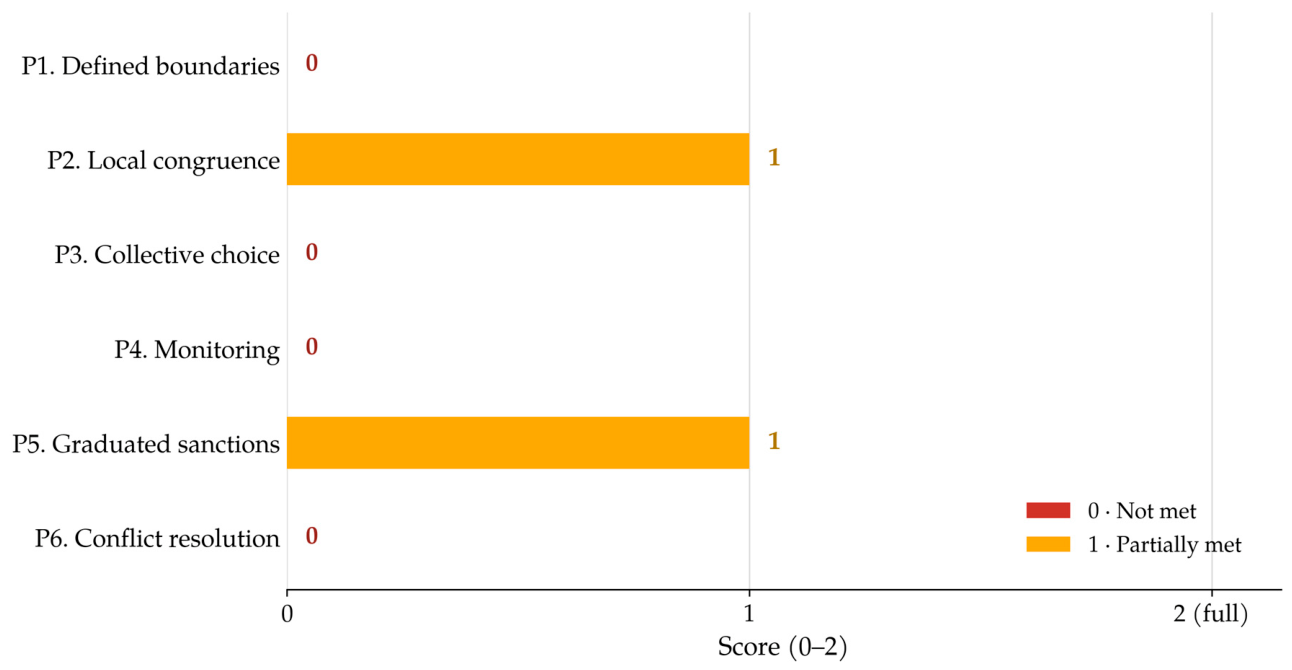
| P1. Defined boundaries | 0 | De facto open access. No clear territorial boundaries exist (permits are individual, non-territorial), nor are there mechanisms for effectively excluding unauthorized users. |
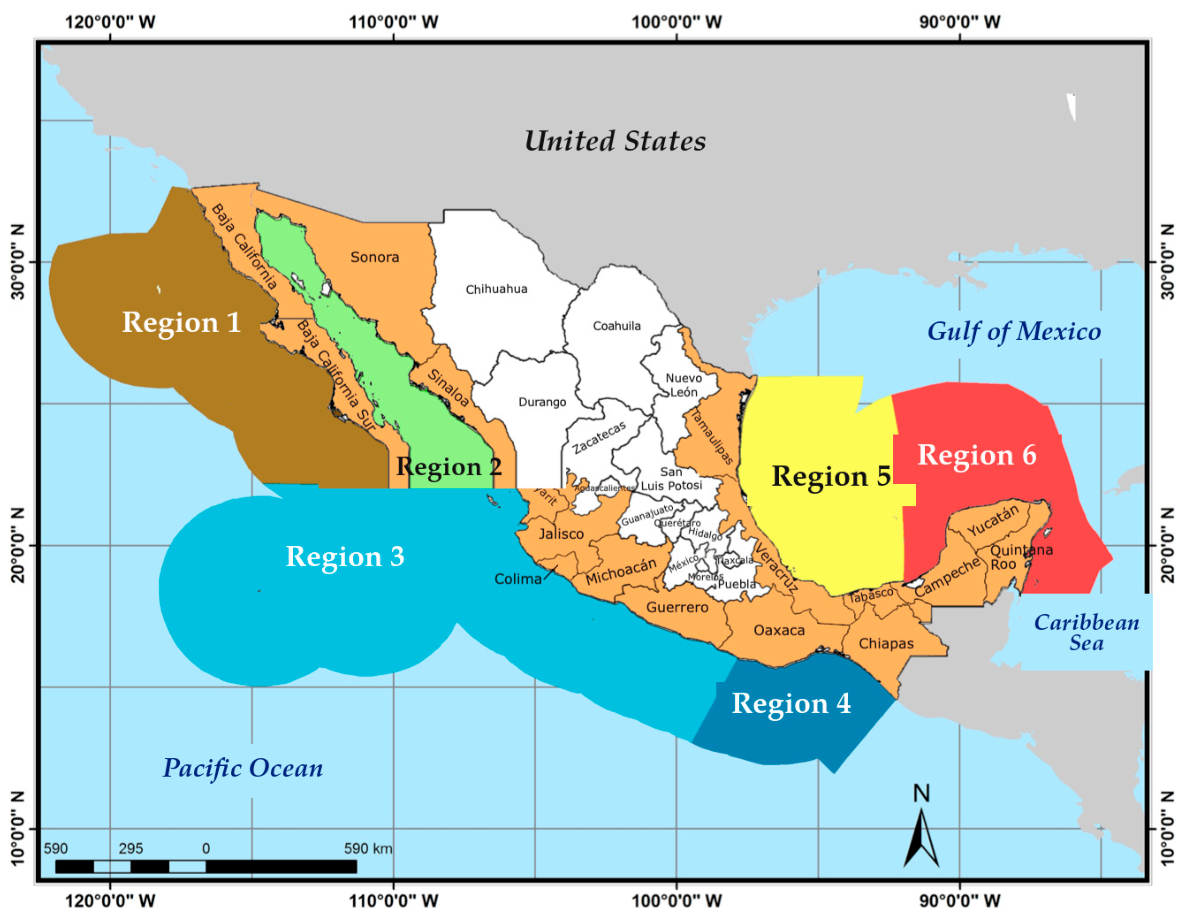
| P2. Local congruence | 1 | Temporary closures and minimum sizes are established under NOM-029, but they do not fully match regional biological cycles or account for variations in traditional fishing practices across the six regions defined in Article 0.17 of the standard. |
| P3. Collective choice | 0 | No formal mechanisms were identified through which SSSF users can participate in modifying operating rules. Article 4.10 of NOM-029 states that the Secretariat “may”—not “shall”—establish Regional Management Committees; in practice, 16 years after publication, these committees do not operate in most fishing regions (Section 3.3). At the national level, the LGPAS (Art. 22) creates the National Fisheries and Aquaculture Council, but limits it to a consultative role with no binding authority and a minimum annual meeting requirement. |
| P4. Monitoring | 0 | Monitoring is carried out exclusively by external agents (CONAPESCA/SEMAR), with limited coverage. Article 8.1 of NOM-029 assigns surveillance exclusively to federal authorities. No community or peer monitoring exists. |
| P5. Graduated sanctions | 1 | The LGPAS ([38], Arts. 132–138) does provide for a graduated sanctions scheme (fines across four levels indexed to the Unit of Measure and Update [UMA] according to infraction severity, doubling upon recurrence). However, this scheme (a) is not specifically operationalized in NOM-029-PESC-2006 for the SSSF; (b) is designed and administered unilaterally by the Secretariat, with no user participation in its graduation or application, as Ostrom’s Principle 5 requires; and (c) shows no evidence of systematic application to the SSSF, with permit suspension or revocation—the catalog’s most extreme sanction under Art. 133—being the one documented in practice, generating de facto impunity. The system therefore exists in the general legal design but not in its fishery-specific implementation. |
| P6. Conflict resolution | 0 | No local, rapid, low-cost institutional spaces were identified for resolving disputes between users (e.g., between small-scale fishers and the medium-offshore fleet). NOM-029 makes no provision for conflict-resolution mechanisms. |
| Total | 2/12 (17%) |
Disclaimer/Publisher’s Note: The statements, opinions and data contained in all publications are solely those of the individual author(s) and contributor(s) and not of MDPI and/or the editor(s). MDPI and/or the editor(s) disclaim responsibility for any injury to people or property resulting from any ideas, methods, instructions or products referred to in the content. |
© 2026 by the authors. Licensee MDPI, Basel, Switzerland. This article is an open access article distributed under the terms and conditions of the Creative Commons Attribution (CC BY) license.
Share and Cite
Olmeda-de la Fuente, S.E.; Rodríguez-Castro, J.H.; Rodríguez-Olmeda, J.A.; Toledano-Toledano, F.; Caballero-Rico, F.C.; Ramírez-de León, J.A.; Hernández Ibarra, G. Why Rules Fail: Institutional Roots of Non-Compliance in Mexico’s Small-Scale Shark Fishery. Fishes 2026, 11, 507. https://doi.org/10.3390/fishes11090507
Olmeda-de la Fuente SE, Rodríguez-Castro JH, Rodríguez-Olmeda JA, Toledano-Toledano F, Caballero-Rico FC, Ramírez-de León JA, Hernández Ibarra G. Why Rules Fail: Institutional Roots of Non-Compliance in Mexico’s Small-Scale Shark Fishery. Fishes. 2026; 11(9):507. https://doi.org/10.3390/fishes11090507
Chicago/Turabian StyleOlmeda-de la Fuente, Sandra Edith, Jorge Homero Rodríguez-Castro, Jorge Alejandro Rodríguez-Olmeda, Filiberto Toledano-Toledano, Frida Carmina Caballero-Rico, José Alberto Ramírez-de León, and Gonzalo Hernández Ibarra. 2026. "Why Rules Fail: Institutional Roots of Non-Compliance in Mexico’s Small-Scale Shark Fishery" Fishes 11, no. 9: 507. https://doi.org/10.3390/fishes11090507
APA StyleOlmeda-de la Fuente, S. E., Rodríguez-Castro, J. H., Rodríguez-Olmeda, J. A., Toledano-Toledano, F., Caballero-Rico, F. C., Ramírez-de León, J. A., & Hernández Ibarra, G. (2026). Why Rules Fail: Institutional Roots of Non-Compliance in Mexico’s Small-Scale Shark Fishery. Fishes, 11(9), 507. https://doi.org/10.3390/fishes11090507