4.1. Relating E2 Concentrations in Feed to the Hormone Bioaccumulation
A notable finding of this study is the transient nature of E2 bioaccumulation in
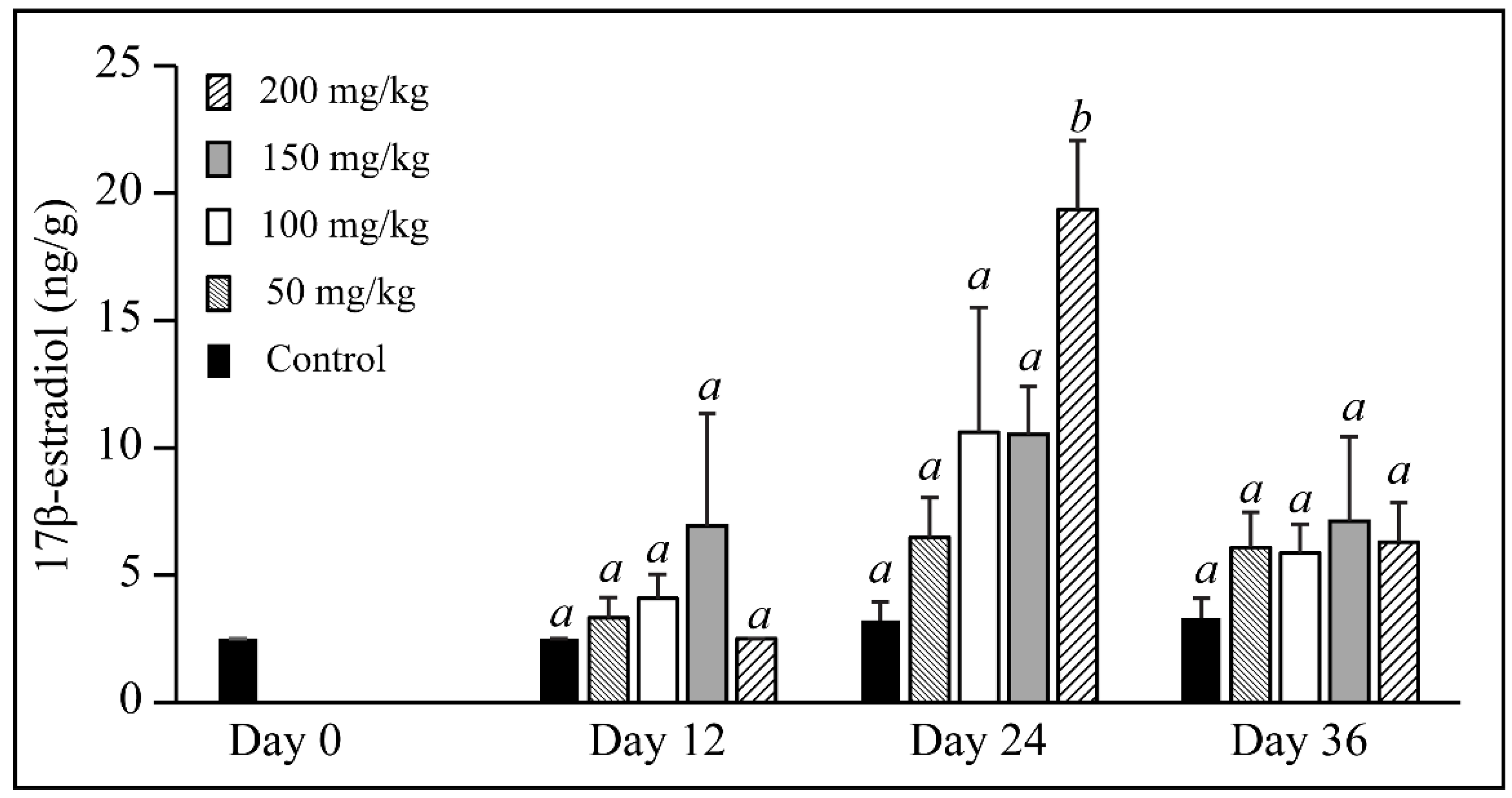
M. rosenbergii PL during continuous dietary exposure. LC–MS/MS feed analysis confirmed that the juveniles were consistently exposed to elevated exogenous steroid levels, though formulation efficiency plateaued at approximately 150 mg/kg; the nominal 200 mg/kg diet averaged 148.4 ± 40.0 mg/kg. Interestingly, despite the comparable actual mean hormone concentrations between the 150 mg/kg and 200 mg/kg diets, only the nominal 200 mg/kg group exhibited a significant accumulation peak at Day 24 (19.4 ± 5.4 ng/g) (
Figure 1). This unexpected pharmacokinetic response is directly driven by the high variance (±40.0 mg/kg) observed in the 200 mg/kg feed samples, indicating a heterogeneous distribution of the hormone within the feed matrix. Consequently, PL in the 200 mg/kg group might be exposed to highly concentrated E2 at a specific time point. From a physiological standpoint, while the crustacean hepatopancreas can efficiently metabolize a continuous, uniform steroidal load, as demonstrated by the tightly distributed 150 mg/kg diet (±21.7 mg/kg), ingesting an acute, highly concentrated exogenous steroid temporarily overcomes the organ’s metabolic capacity. This sudden influx saturates the primary enzymatic detoxification pathways, such as sulfonation [
45], creating a transient metabolic bottleneck. This bottleneck manifests as a significant spike in systemic bioaccumulation observed at Day 24, which only subsides by Day 36, once the organism’s compensatory clearance mechanisms have fully upregulated to manage the extreme localized doses [
30].
A trace concentration of E2 (1.39 ± 1.03 mg/kg) was detected in the unsupplemented control feed, likely due to minor analytical cross-reactivity and the natural endogenous steroid hormones present in animal-based basal ingredients such as fish meal [
46]. Importantly, this background level was biologically negligible; it did not lead to significant tissue accumulation relative to Day 0 baselines, nor did it induce any feminization in the control group (
Figure 1,
Table 5).
Most notably, the tissue accumulation observed at Day 24 was not sustained. By Day 36, E2 concentrations across all treatment groups had declined sharply, with no statistically significant differences relative to the control group. This uniform reduction, occurring concurrently with continuous dietary E2 intake, strongly indicates that
M. rosenbergii initiates a compensatory physiological response, likely upregulating hepatic or comparable metabolic pathways to degrade and excrete excess steroidal loads. Similarly, there was negligible or no bioaccumulation of E2 hormone in the muscle of juvenile prawns fed diets supplemented with 25, 50, and 100 mg/kg [
5]. Recent toxicological, pharmacokinetic, and transcriptomic studies in crustaceans corroborate this mechanism, demonstrating that aquatic invertebrates possess highly efficient steroidal biotransformation networks. Wang et al. [
47] reported that the E2 levels in most tissues at late premolt significantly decreased compared to those at early premolt. Specifically, exogenous steroid hormones such as E2 are rapidly metabolized via sulfonation, primarily in the hepatopancreas, leading to rapid excretion [
45]. Furthermore, transcriptomic analysis of
Macrobrachium species exposed to E2 reveals significant upregulation of specific metabolic and clearance pathways (such as retinol metabolism) once a saturation threshold is exceeded, thereby preventing long-term steroidal retention [
30]. Moreover, the literature demonstrates that any trace levels of 17β-estradiol present in crustaceans are quickly biotransformed into estrone. This intermediate is then hydroxylated to yield either 16α-hydroxyestrone or estriol [
48]. From an aquaculture and consumer safety perspective, this rapid clearance is highly advantageous. It demonstrates that dietary administration of E2 for feminization does not result in permanent hormonal bioaccumulation in juvenile tissues, significantly mitigating the risk of residual hormone following the treatment period.
4.2. Efficacy of Dietary E2 on Growth Performance, Feed Efficiency, and Feminization Rate
During the 36-day treatment period, E2 supplementation significantly improved FBW, SGR, and SR, while concurrently decreasing FCR compared with the control group. Importantly, these different growth, survival, and feed efficiency metrics were transient, disappearing entirely by the 150-day post-treatment period. The initial enhancement of FBW and SR in E2-treated groups aligns with findings that estrogenic steroids can exert anabolic effects and promote growth in many decapod species [
5,
22,
27,
28]. Jin et al. [
49] demonstrated that dietary E2 supplementation dramatically promotes the SGR of juvenile
M. nipponense by stimulating appetite and food utilization. However, these results contrast with studies in other
Penaeus species, in which E2 treatment has been shown to inhibit growth [
22,
45]. The impact of E2 on survival is also dose-dependent, with lower doses sometimes reducing viability while higher doses enhance it [
45]. The temporary nature of these physiological alterations in the present study, evidenced by the equalization of growth and FCR during the 150-day post-treatment period, mirrors the compensatory growth phenomena observed in shrimp after the cessation of exogenous steroid administration [
45]. Dietary E2 has also been hypothesized to function as an appetite stimulant [
15]. Enhanced feed consumption and increased physical activity have been observed in E2-fortified groups, ultimately reducing FCR. These findings align with previous studies demonstrating the anabolic effects of E2 in
M. rosenbergii [
5] and
P. monodon [
27].
The observed feminization rates closely match the E2 concentrations quantified in the experimental diets. LC–MS/MS analysis revealed that dietary hormone incorporation plateaued at 150 mg/kg (actual concentration: 153.5 ± 21.7 mg/kg). The 200 mg/kg diet failed to retain additional hormone, resulting in a slightly lower actual concentration of 148.4 ± 40.0 mg/kg. Consequently, the lack of a significant increase in the feminization rate between the 150 mg/kg and 200 mg/kg groups reflects the actual hormone dosage ingested by the PLs rather than a physiological limitation. These data indicate that 150 mg/kg represents the practical saturation point for dietary E2 preparation, and formulations exceeding this threshold offer no further advantage in M. rosenbergii feminization protocols. The control group, which received no hormone, consisted entirely of males (0% females), confirming the all-male status of the initial population.
The present study confirms that dietary supplementation with 150 mg/kg E2 effectively induces gonadal feminization in juvenile
M. rosenbergii. These findings partially align with those of Rasheed, Tiwari, Reddy, Gupta and Rani [
5], who observed feminization rates of 26.7% and 32.0% at E2 dietary concentrations of 25 and 50 mg/kg, respectively. However, our outcomes contrast with their higher-dose results, in which 100 mg/kg yielded 45.8% females. Furthermore, previous studies on mixed-sex decapod populations have reported substantially higher conversion rates, such as 68.9% in
M. nipponense fed 200 mg/kg E2 [
30] and 71.9% in
P. vannamei subjected to 2 mg/L E2 immersion [
45]. This discrepancy is likely due to the use of an all-male postlarval cohort in the present experiment. Previous trials achieving high feminization rates predominantly utilized mixed-sex PLs. Because a baseline sex ratio at stocking is not feasible, it ranges widely from 26% to 65% female [
5,
14]. In contrast, the present study employed an exclusively all-male postlarval population, presenting a more rigorous biological barrier to complete feminization. Additionally, dietary E2 levels were deliberately kept low to minimize physiological and reproductive stress. As demonstrated by Hafiz, Hidayah, Yusdianatu, Ambak, Abol-Munafi and Ikhwanuddin [
27] in
P. monodon, steroid efficacy eventually reaches a biological plateau: increasing E2 levels from 200 to 400 mg/kg yielded an 8.8% increase in feminization, whereas increasing it from 800 to 1000 mg/kg yielded only a marginal 3.3% improvement. While complete (100%) feminization has been achieved in other species via high-dose immersion (1 mg/L in
L. vannamei; Sugestya, Widodo and Soeprijanto [
28]) or extreme dietary inclusion (1600 mg/kg in
P. merguiensis; Ikhwanuddin, Bahar, Ma and Manan [
22]), such aggressive treatments were avoided to preserve postlarval health. Furthermore, the 36-day experimental period may have been insufficient to fully maximize the sex reversal effects of E2. Consistent with Macintosh et al. [
50], who established that the anabolic and sex reversal impacts of steroidal treatments are highly proportional to exposure time, a prolonged treatment duration may be necessary to overcome the androgenic pathways in an all-male
M. rosenbergii population. Further investigations are therefore warranted to improve these protocols, specifically by evaluating prolonged dietary exposure periods, increased hormone inclusion levels, and external environmental parameters.
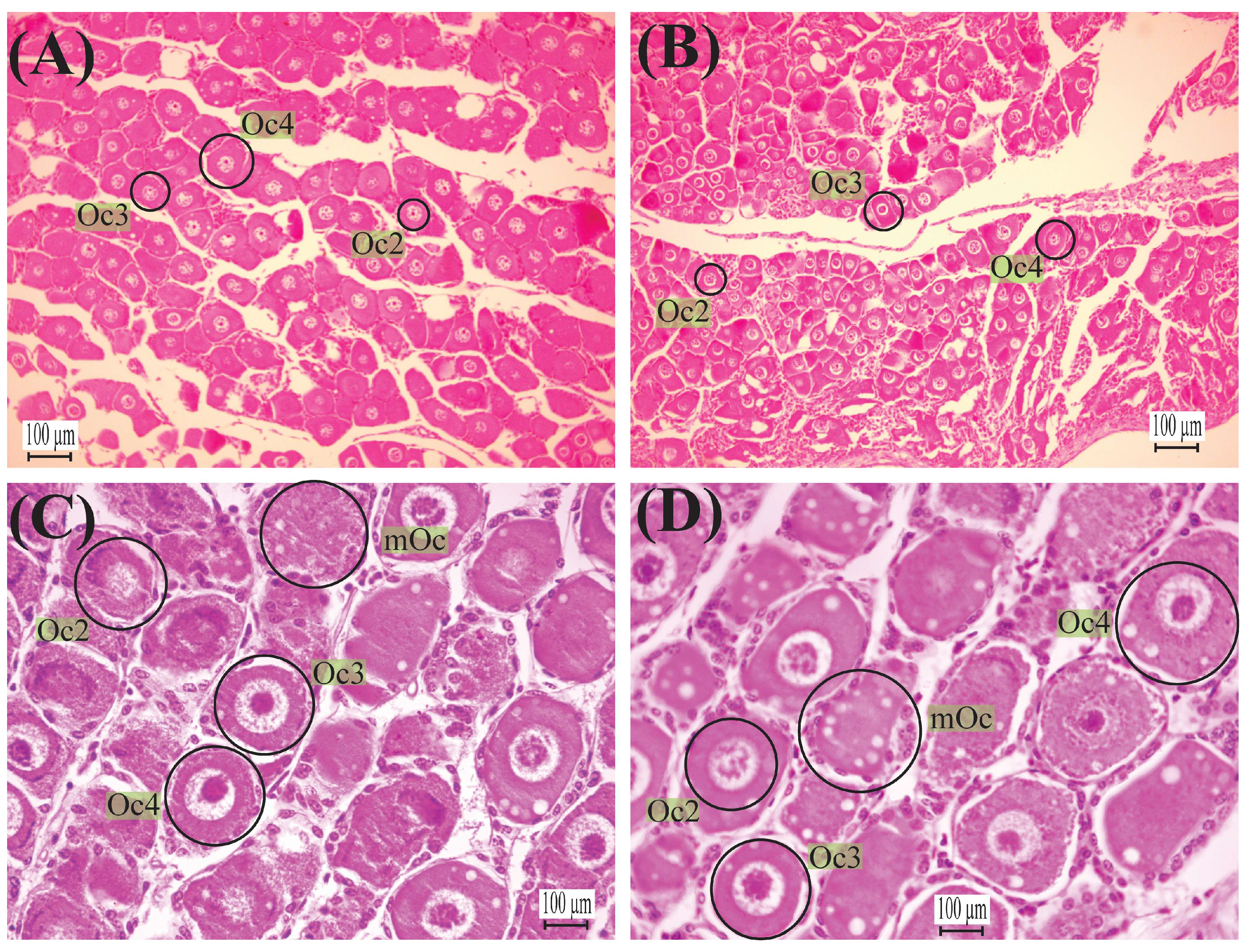
Dietary supplementation with E2 proved to be an effective strategy for inducing functional gonadal development in neo-female
M. rosenbergii. The histological progression of oogenesis in E2-treated individuals closely paralleled the developmental milestones typical of natural females, aligning with previous observations of hormone-induced gonadal maturation [
15,
30]. Specifically, the cellular structure of the ovaries, marked by the typical transition from previtellogenic to vitellogenic oocytes, demonstrates that exogenous E2 facilitates the formation of fully functional, rather than sterile or rudimentary, female gonads [
15,
51]. Furthermore, quantitative assessments of ovarian development, including GSI and oocyte diameter, revealed no significant deviations from wild-type females in this study or normal females from published data. During a normal reproductive cycle, the average GSI indices at ovarian stages III and IV in
M. rosenbergii were 2.41% and 5.77%, respectively, while the oocyte diameters measured 250 µm and 360 µm, respectively [
52]. Sagi, Soroka, Snir, Chomsky, Calderon and Milner [
9] reported that oocytes typically expand from 20 to 650 µm in diameter, with GSI values concomitantly rising from approximately 0.2 to 8.0. In the present study, oocyte morphometrics across the five identified developmental stages mirrored the established baseline characteristics of natural females [
36]. These results confirmed that the E2 dietary intervention induced normal ovarian differentiation without introducing histological abnormalities, as indicated by Dokkaew, Songdum, Prachom, Boonyung, Kitikiew, Khamphet, Waicharoen, Na-Nakorn, Paankhao, Uchuwittayakul and Kantha [
51]. Ultimately, achieving a GSI and oocyte developmental profile comparable to that of wild or normal females confirms the reproductive viability of these neo-females. Recent molecular research on sex reversal provides a robust explanation for these histological observations. In decapods, male sexual differentiation is strictly controlled by the insulin-like androgenic gland (IAG) hormone, which acts as the primary “masculinization switch” [
19,
20]. Exogenous E2 administration has been shown to effectively suppress the expression of the IAG gene and its downstream endocrine cascade [
45,
49]. These findings substantiate the applicability of E2-mediated sex reversal for generating neo-female broodstock, representing a critical step forward in the sustainable production of all-male monosex populations and high-quality seedstock for the aquaculture industry.
It is also worth noting that while successful feminization resulted in normal oogenesis, some macroscopic abnormalities in gonadal maturity were observed in a small subset of neo-females, particularly those indicative of incomplete sex reversal or hormonal deficiency at lower E2 concentrations. Detailed histological evaluations of these specific abnormalities were outside the scope of the current functional validation but represent an important area of ongoing research. These individuals are currently being monitored in a longitudinal study to thoroughly evaluate the histological and physiological characteristics of these developmental anomalies.
Furthermore, while these histological findings definitively establish the functional viability and structural normality of the E2-induced ovaries, we acknowledge that the relatively small sample size utilized for this specific analysis (n = 1 per tank; n = 4 per treatment) primarily serves as a qualitative confirmation. This represents a minor limitation in the current study; future studies employing larger histological cohorts would be beneficial for more robust quantification of individual morphological variation and developmental synchrony across the broader neo-female population.
Finally, these findings highlight the critical importance of providing an adequate, finely tuned E2 concentration to balance reproductive manipulation with overall physiological health. By identifying 150 mg E2/kg as the practical saturation point for dietary incorporation, our protocol demonstrates that this specific concentration is optimal. It is crucial not only because it maximizes the feminization rate but also because it provides a transient anabolic advantage, improving early growth and feed efficiency without inducing toxicity or long-term growth suppression often associated with inappropriate hormone dosing.
Moreover, to fully evaluate the practical implications of these findings, it is crucial to compare this E2-supplemented dietary protocol with the traditional AG ablation method that was used to generate the baseline population in this study. Mechanistically, AG ablation relies on the physical microsurgical removal of the endocrine organ responsible for masculinization, thereby directly halting IAG secretion [
10,
11,
12]. In contrast, dietary E2 administration acts at the molecular level by suppressing IAG gene expression and counteracting its downstream endocrine cascade [
45,
49]. Regarding efficiency and limitations, AG ablation is highly effective at inducing complete sex reversal at the individual level; however, it presents severe logistical bottlenecks. The procedure is extremely labor-intensive, requires highly specialized microsurgical expertise, and subjects the juvenile prawns to significant surgical stress and potential mortality [
12]. Conversely, while the E2 dietary approach presented here yielded a moderate overall feminization rate (up to 35.5%), it offers better commercial scalability. Administering the hormone via feed is entirely non-invasive, minimizes handling stress, and enables simultaneous treatment of thousands of PL. Therefore, while AG ablation remains a precise tool for generating foundational broodstock in a laboratory setting, the E2 dietary method represents a far more viable, scalable, and welfare-conscious technology for the mass-production of neo-females in commercial aquaculture facilities.




 ,
,