Article

Earthen Pond Grow-Out of Chinese Mitten Crab Eriocheir sinensis: All-Female Culture Is Superior to Mixed-Sex and All-Male Alternatives

1
Centre for Research on Environmental Ecology and Fish Nutrition, Ministry of Agriculture and Rural Affairs, Shanghai Ocean University, Shanghai 201306, China
2
Fisheries Technical Extension Centre of Jintan District, Jintan 213200, China
3
Fisheries Technical Extension Station of Shanghai Chongming District, Shanghai 202150, China
4
Centre for Sustainable Tropical Fisheries and Aquaculture and College of Sciences and Engineering, James Cook University, James Cook Drive, Townsville, QLD 4811, Australia
*
Author to whom correspondence should be addressed.
Fishes 2026, 11(4), 248; https://doi.org/10.3390/fishes11040248
Submission received: 20 March 2026 / Revised: 16 April 2026 / Accepted: 17 April 2026 / Published: 18 April 2026
(This article belongs to the Section Sustainable Aquaculture)

Abstract

Monosex culture has been shown to enhance farming productivity in several decapod crustaceans, and it has also been suggested that this approach holds high potential for the sustainable aquaculture of the Chinese mitten crab, Eriocheir sinensis. Pronounced sexual dimorphism in E. sinensis facilitates the implementation of a monosex culture. This study aimed to compare the growth, gonadal development, culture performance, and economic outcomes of two monosex culture modes, i.e., an all-female culture and an all-male culture, as well as a mixed-sex culture (males: females = 1:1) during an 8-month growth period in earthen ponds. The results showed that: (1) Throughout the grow-out period, the average body weight in both monosex culture treatments was consistently higher than in the mixed-sex treatment, with a significantly greater body weight in the all-female and all-male treatments than that of males and females in the mixed-sex treatment being detected during mid-June and October, respectively (p < 0.05). (2) The percentages of both sexes that had finished puberty molting were mostly similar between the monosex and mixed-sex treatments between July 20th to October 10th, although the all-female treatment had a significantly lower puberty molting percentage than the mixed-sex treatment on August 10th (p < 0.05). Gonadosomatic index (GSI) values were similar between the monosex and mixed-sex treatments for both males and females (p > 0.05). (3) At harvest period, the final body weight in the all-male treatment was significantly higher than that of the mixed-sex treatment (p < 0.05). In contrast, the all-female treatment exhibited a significantly higher survival rate and a lower limb injury rate compared with the mixed-sex treatment (p < 0.05). As a result, the yield of the all-male and all-female treatments exceeded that of the males and females in the mixed-sex treatment by 24% and 13%, respectively. Additionally, the mixed-sex treatment also had a significantly higher feed conversion ratio (p < 0.05). Finally, the monosex treatments had a higher proportion of large crabs (males ≥ 200 g, females ≥ 175 g) and a lower proportion of small crabs (males ≤ 150 g, females ≤ 100 g) compared to the mixed-sex treatment. (4) In terms of economic benefits, net profit and return on investment (ROI) were highest under the all-female treatment, while the mixed-sex treatment recorded the lowest total return, net profit, and ROI (p < 0.05). In conclusion, an all-female culture is recommended for the grow-out culture period of E. sinensis, as it led to a higher survival rate, produced larger-sized crabs and generated greater overall economic benefit.
Key Contribution: An all-female culture is recommended due to the culture mode producing larger crabs, a higher survival rate and greater economic benefits.

1. Introduction

Over the past several decades, crustacean aquaculture has grown rapidly worldwide, providing a vital source of high-quality animal protein and income, and particularly benefiting coastal and rural communities by supporting food security and creating employment [1]. The total crustacean aquaculture production reportedly reached 13.7 million tonnes in 2023, valued at over US$90 billion [2]. Many commercially important crustaceans, including the giant freshwater prawn Macrobrachium rosenbergii [3], mud crab Scylla spp. [4], the swimming crab Portunus trituberculatus [5], and the red swamp crayfish Procambarus clarkii [6], exhibit sexual dimorphism. In these species, growth rates, body size and color, aggressive behavior, secondary sexual characteristics and even feeding behavior can be quite different between males and females, which make monosex (i.e., all-male or all-female) culture a potential avenue to increase culture productivity and profit from their aquaculture [7,8].
Monosex culture could potentially generate a range of advantages, such as higher growth rates, reduced energy channeled for gonadal development, and more uniform end products that represent a marketing advantage [9]. Additionally, aquaculture management strategies and gender-specific diets can be developed and optimized to better meet the requirements of a particular gender in monosex populations [10]. Furthermore, some cultured decapods (e.g., P. clarkii) exhibit high invasion risk, which can be largely mitigated through monosex culture [11]. Successful monosex culture has been practiced recently on a commercial scale in several fish species, such as tilapia and the yellowhead catfish Tachysurus fulvidraco [12,13], which has proven to yield significant economic benefits. In crustaceans, the development of reliable monosex seedling production in M. rosenbergii by AG/iag manipulation has increased interest toward adopting a monosex culture in other crustacean species [14].
The Chinese mitten crab Eriocheir sinensis is an economically valuable crustacean with high aquaculture production and market value [15,16]. Generally, E. sinensis males exhibit a larger size than females, which starts to occur when a juvenile crab reaches 40–60 g during the grow-out culture period [17]. Considering this, farmers could potentially achieve higher yield by culturing all-male populations, similar to what has been developed successfully for freshwater prawn M. rosenbergii cultures [18]. In addition, mature female E. sinensis have a higher gonadosomatic index value, and their ovaries possess an exquisite flavor preferred by consumers—hence, females with well-developed gonads typically fetch higher prices compared to males [19]. Traditionally, mixed-sex pond production has been the dominant culture mode for E. sinensis; however, this approach faces several challenges including aggressive behavior, low survival rates, and inferior feed conversion ratios [20]. Ge et al. [21] reported that in an indoor recirculating aquaculture system, a monosex culture of pre-adult E. sinensis induced earlier female puberty molting, while improving male survival rates, compared to a mixed-sex culture. These findings have prompted the necessity of assessing whether a monosex culture (all-male or all-female) could similarly lead to improved yields and profitability in large-scale pond production systems. Therefore, the present study aimed to compare growth performance, survival, size distribution, gonad development and economic efficiency between monosex and mixed-sex cultures of adult E. sinensis in commercial-scale earthen ponds.

2. Materials and Methods

2.1. Experimental Design and Ponds

The study was performed in 12 commercial-scale earthen ponds (534 m2) at Jintan Digital Fishery, Jiangsu province, China, from March to November 2020. There were three treatments and each treatment was quadruplicated: an all-male culture, all-female culture, and a mixed-sex (males:females = 1:1) culture. Healthy and appendage-intact crabs (initial average body weight: 11.19 ± 1.22 g for males, and 10.88 ± 1.10 g for females) from a juvenile culture pond were manually sexed and randomly stocked into the respective experimental ponds at a widely adopted density of two crabs per m−2. The sex of E. sinensis was identified based on a well-established, distinct, dimorphic abdominal morphology (i.e., narrow triangular abdomen for males and broader rounded abdomen for females) according to Zhang et al. [22]. To prevent crab escape, 60 cm high plastic boards were installed around the perimeter of each pond. In early February 2020, all ponds were disinfected with calcium hypochlorite (1200 kg/ha; Nantong Gaoyang Bleaching Powder Co., Ltd., Nantong, China). Following a two-week period, common waterweed Elodea canadensis was implanted on the pond bottom to provide shelter and improve water quality.

2.2. Grow-Out Management

Feeding commenced once the average water temperature rose above 12 °C. Crabs were provided with formulated feed (Jiangsu Mingzhi Biotechnology Co., Ltd., Yancheng, China) every one to two days at 17:00, with daily rations ranging from 0.4% to 3% of the total biomass. An appropriate density of E. canadensis was maintained throughout the culture duration, and excessive E. canadensis was removed from ponds when vegetative over-growth was observed. Water depth gradually increased from the initial level of 0.5 m, reaching its maximum during summer, when it was maintained between 1.0 and 1.2 m. As a general rule, the distance between the water surface and the top of the pondweed was maintained between 0.1 and 0.2 m, which facilitated proper photosynthesis of the pondweed.
During the grow-out culture period, water temperature fluctuated seasonally (spring: 12–20 °C; summer and autumn: 20–31 °C), and water parameters were maintained at: pH: 7.0–9.0, dissolved oxygen: >4 mg/L, ammonia nitrogen: <0.5 mg/L and nitrite: <0.15 mg/L [23].

2.3. Data and Sample Collection

2.3.1. Growth Performance

Growth data was evaluated by bimonthly sampling. Eighty crabs were weighed individually from each experiment pond using a digital electronic scale (precision: 0.001 g; Huizhou Yingheng Electronic Technology Co., Ltd., Huizhou, China), while carapace length and carapace width were measured using a digital caliper (accuracy: 0.01 mm; Deqing Shengtai Core Electronic Technology Co., Ltd., Deqing, China). The sampled crabs were returned to their respective ponds immediately after measurement. The growth indices were calculated using the following formulas:
Weight gain rate (WGR,%) = (Wt – Wt−2)/W × 100,
Specific growth rate (SGR,%/day) = (LnWt – LnWt−2)/TI × 100,
where Wt and Wt−2 are the mean body weight (g) at t month and t−2 month, respectively, and TI is the time interval (days).

2.3.2. The Percent at Puberty Molting, GSI, and HSI

During sampling in July and October, sixty crabs were randomly collected from each pond and examined individually for the completion of puberty molting. The percentage of crabs that had completed puberty molting in each treatment was subsequently calculated. The examination was based on morphological changes associated with puberty molting as described by Zhang et al. [22]; briefly, for females, the abdominal flaps of individuals that had completed puberty molting became oval shaped, while in males, their claws became covered by long thick hairs. Additionally, between September and November, twelve crabs that had finished puberty molting were sampled monthly from each treatment to assess the advance of their gonadal development. The sampled crabs were first weighed, and their gonads and hepatopancreas were subsequently dissected and weighed for calculation of the gonadosomatic index (GSI) and hepatosomatic index (HSI):
GSI (%) = Gonad wet weight/Body weight × 100,
HSI (%) = Hepatopancreas/Body weight × 100.

2.3.3. Final Culture Performance and Economic Analysis

At the end of the experiment, all surviving individuals were counted and weighed. The survival rate, yield, feed conversion ratio (FCR) and limb injury rate were subsequently calculated using the following equations [24]:
Survival (%) = Nf/Ni × 100,
Yield (g/m2) = Yt/Sa,
Limb injury rate (%) = CI/Nf × 100,
FCR = Total weight of feed dispensed/(Final crab biomass − Initial crab biomass),
where Nf is the final count of surviving crabs, Ni is the initial number of crabs, Yt is the total weight of harvested crabs in each pond, Sa is the area of the experimental pond, and CI is the number of harvested crabs with missing appendages (chelipeds or walking legs).
To evaluate the size-distribution at the end of study, the surviving individuals in each pond were randomly selected and weighed. Female and male crabs were respectively classed into seven different weight intervals (Table 1), and the percentage of crabs belonging to each weight interval was calculated for each pond. The costs of the grow-out mainly included pond rental, crab seeds, feeds, labor, fertilizer, electricity and submerged hydrophyte, etc. Market prices for crabs of different weight intervals are presented in Table 1, while the recent market prices from 2025 are provided in Supplementary Table S1. Total return, net profit and return on investment (ROI) were assessed based on the following formulas:
T o t a l   r e t u r n   =   i = 1 7 ( Q i × W i × P i / 1000 ) ,
Net profit = Total return − Total cost,
ROI (%) = Net profit/Total cost × 100,
where for each weight interval i, Qi is the quantity of harvested crabs, Wi is the average crab weight (g), and Pi is the market price in US dollars (in 2020, 1 dollar = 6.70 CNY).

2.4. Statistical Analysis

Data are presented as mean ± SD. Due to the obvious sexual dimorphism in E. sinensis, growth performance, gonadal development, final body weight and limb injury rate were compared between monoculture and mixed-sex cultures for each sex separately using independent sample t-test (SPSS 24.0). Differences in economic benefits, FCR and total yield among the three treatments were analyzed using one-way ANOVA, followed by Duncan’s multiple range test (p < 0.05). All data were checked for normality and homogeneity of variance. The GraphPad Prism 10.0 was used for plotting.

3. Results

3.1. Growth Performance

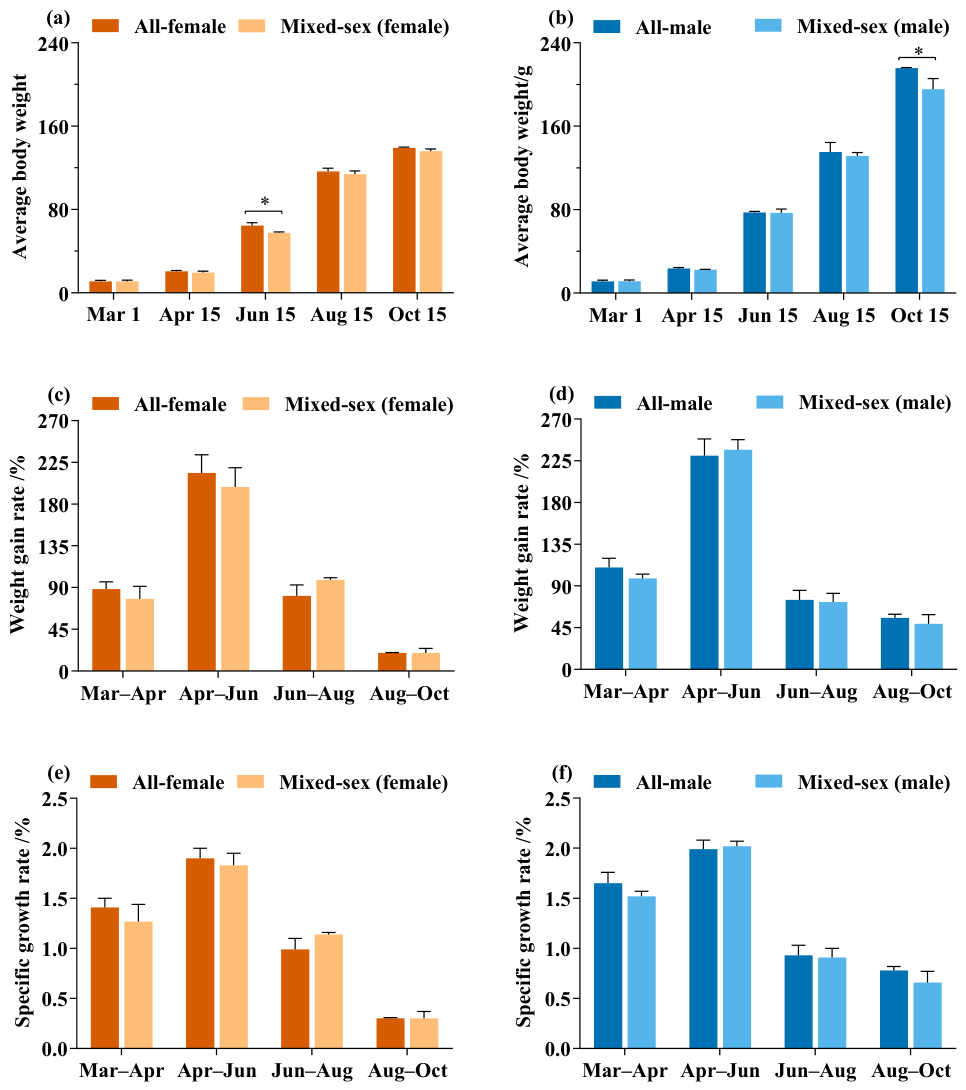
Crabs in all treatments exhibited consistent growth during the overall culture stage (Figure 1). The average individual body weight of both sexes in monosex culture treatments generally demonstrated higher body weight than the mixed-sex treatment at each sampling time during the study. In particular, the all-female treatment had a significantly higher body weight than that of females from the mixed-sex treatment on June 15th, and a significantly higher body weight of males was observed in the all-male treatment than that of males from the mixed-sex treatment on the 15th October. Consistent with the change in body weight, both carapace length and carapace width exhibited similar trends throughout the culture period, the details of which are provided in Supplementary Table S2. However, at all sampling points, WGR was not significantly different between monosex and mixed-sex treatments (p > 0.05). Generally, the WGR initially increased and then decreased, and reached the highest during the period from April to June. The lowest WGR was obtained during August–October. The same trend was observed for the SGR.

3.2. Gonadal Development

The percentage of crabs that had undergone puberty molting at each sampling point is reported in Table 2. In general, female crabs showed a pattern of beginning their puberty molting in mid-July, subsequently peaking in late August, before the number dropped but continued until late September. For males, despite puberty molting occurring later, more than 93% of crabs in all treatments had completed molting by September 20th. The percentages of puberty molting for both males and females were mostly the same between the monosex and mixed-sex treatments between July 20th to October 10th, except on August 10th when the all-female treatment showed a significantly lower puberty molting percentage than that of the mixed-sex culture (p < 0.05). The difference in GSI and HSI between the monosex and mixed-sex cultures at all sampling points was also not statistically significant (Table 3). After puberty molting was completed, the GSI increased significantly while HSI decreased during September–November. Moreover, regardless of sex, the GSI values of the all-female and all-male treatments were generally slightly higher than that of the mixed-sex treatment.

3.3. Production Performance

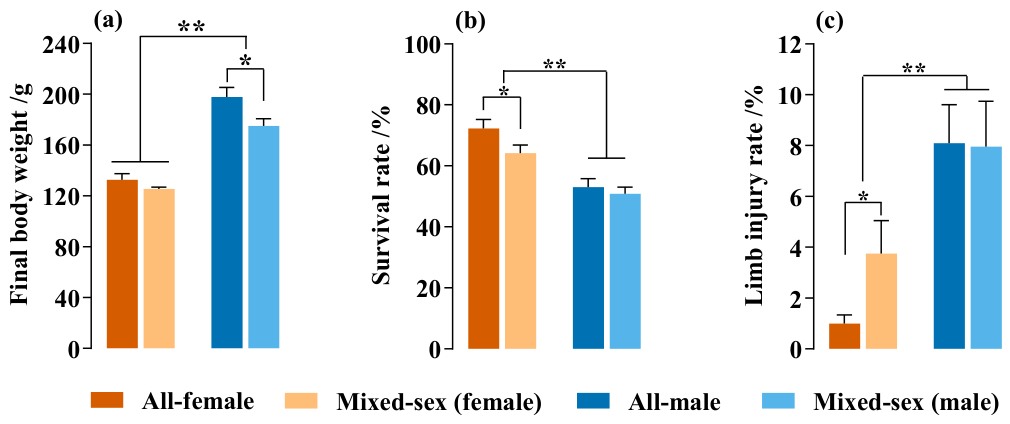
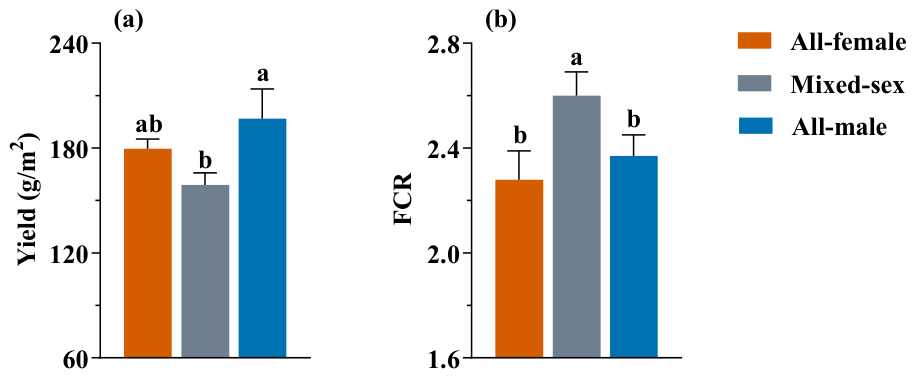
Figure 2 compares final culture performance between the monosex and mixed-sex treatment of E. sinensis. Final average body weight was higher in monosex culture treatments compared to the mixed-sex culture, particularly the all-male culture (Figure 2a). Survival and limb injury rate of males were similar between all-male and mixed-sex treatments, whereas the highest survival rate and lowest limb injury rate were observed in the all-female culture (Figure 2b,c). Production performance was significantly affected by sex; the final weight and limb injury rate of males were 44% and 241% higher than that of females, respectively (p < 0.01), while the survival rate of females was 30% higher relative to males (p < 0.01). Overall, the yield of different treatments showed the following order: all-male > all-female > mixed-sex culture (Figure 3). In addition, FCR was significantly lower in the all-female and all-male monosex treatments compared to the mixed-sex culture treatment (p < 0.05).
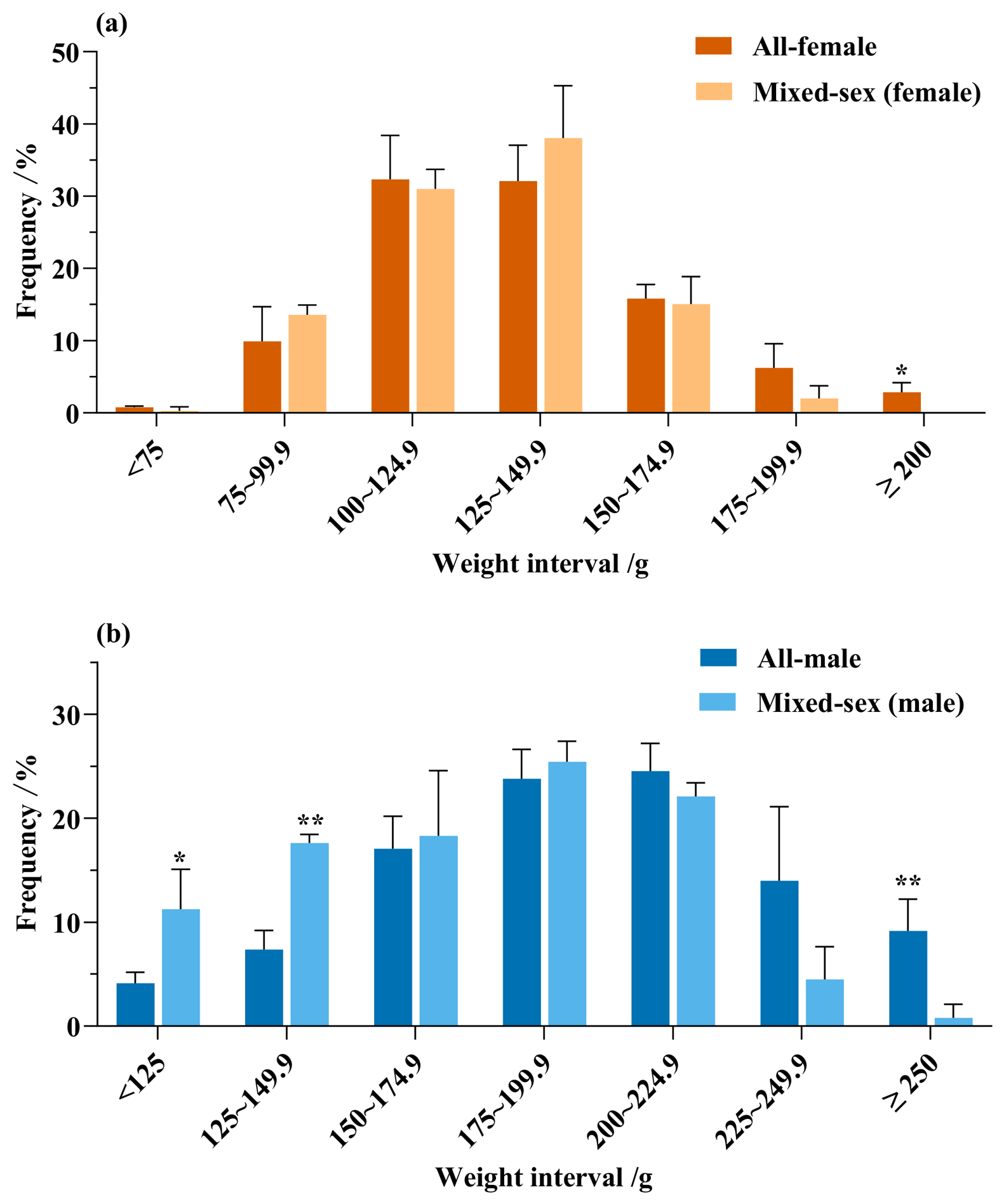
The body weight of surviving crabs of both sexes showed a normal distribution for all culture modes (Figure 4). For females, the highest proportion of individuals were in the 100–124.9 g and 125–149.5 g weight intervals. The mixed-sex treatment exhibited a higher proportion in both the 75–99.9 g and 125–149.5 g weight intervals than those from the all-female treatment, while the all-female treatment obtained higher proportions than the mixed-sex treatment for the two largest weight intervals of 175–199.9 g and ≥200 g. The difference in the ≥200 g weight interval was significant (p < 0.05). For males, compared to the mixed-sex treatment, the all-male culture exhibited a significantly higher proportion in the largest size interval, and lower proportions in the <125 and 125–149.9 g interval (p < 0.05).

3.4. Economic Analysis

Economic evaluation of the three culture modes is presented in Table 4. Total costs were the highest for the all-male treatment, followed by the mixed-sex and all-female treatment. Male crab seeds were cheaper than females, but crab seed costs only represented 3.8–6.0% of total costs. In contrast, feed costs in the pond grow-out of E. sinensis represented ≥30% of total costs. When comparing the total return and net profit among the three treatments, the all-female and all-male treatments were significantly higher than the mixed-sex treatment (p < 0.05). The benefit–cost evaluation also showed a significantly higher return on investment (ROI) for the all-female (141.96 ± 28.78) and all-male (114.00 ± 29.56) treatments when compared to the mixed-sex culture (59.70 ± 9.98) (p < 0.05).

4. Discussion

Size dimorphism between male and female E. sinensis under mixed-sex aquaculture conditions has been widely documented [25]. However, no published account is currently available for monosex culture situations. In the present study, male E. sinensis exhibited a superior growth compared to females in both mixed-sex and monosex culture modes. Similar disparities in growth associated with sex are also found among other crustaceans, such as M. rosenbergii [26], P. trituberculatus [5], and S. paramamosain [8]. For instance, it has been shown that sexually mature M. rosenbergii males exhibit an average body weight approximately twice that of females under mixed-sex culture modes, which has been attributed to the fact that females close to sexual maturity allocate substantial obtained nutrients/energy to ovarian development, resulting in a marked decline in their growth rate. In contrast, the development of the spermatophore in males demands fewer nutrients/energy, allowing them to sustain a relatively faster growth rate [27]. Indeed, He et al. [17] found that male and female E. sinensis had similar body weights during the juvenal culture period; however, after being stocked in the adult culture stage, male crabs exhibited a greater average body weight than females from June onward.
In this study, a better growth rate was observed in E. sinensis reared in monosex cultures compared to a mixed-sex culture. The final body weight of females and males from monosex culture modes was 5.77% and 13.09% higher, respectively, than those observed in the mixed-sex culture. The results suggest that under the traditional mixed-sex culture mode, growth is somewhat inhibited due to interactions between male and female E. sinensis. Agonistic behaviors are common and often significantly intensified among crustaceans under aquaculture settings, as the animals must compete for limited resources, including food and shelter, under dramatically increased population densities compared to those in natural habitats [23,28,29]. Crustacean agonistic behavior is influenced by various biological factors, and size and sex are among the most important [28]. For instance, it was reported that during competitive interactions between two shore crab Carcinus maenas males, individuals with larger claws often dominate [30]. In the case of E. sinensis, males possess larger and more powerful claws, making them more aggressive than females [31]. Indeed, female E. sinensis were found to allocate less time to feeding in order to avoid similar-sized male crabs, which could negatively impact their growth [32].
It is known that E. sinensis start developing gonads soon after puberty molting, and the time required to reach gonadal maturation is dependent on a range of factors, including genetic factors and culture environment [33]. Interestingly, the puberty molting of female E. sinensis usually occurs earlier than that of males within the same cohort [34]. Guzzo et al. [35] have reported a phenomenon known as the Vandenberg effect, i.e., when males and females are placed together in the same environment, females will typically mature earlier. In crustaceans, sex hormones, such as estradiol and testosterone, are known to play pivotal roles in oocyte development and ovary maturation [36]. However, Duan et al. [5] found no significant difference in the serum sex hormone levels for both male and female swimming crab P. trituberculatus when they were cultured under monosex and mixed-sex modes. In this study, the GSI under monosex culture modes was slightly higher than that of the mixed-sex culture; such a result is similar to what was found in an indoor tank culture system [21]. It indicates that a monosex culture does not negatively affect the gonadal development of E. sinensis. Clearly, future studies comparing the relationships between sex hormones and gonadal development of E. sinensis under monosex and mixed-sex culture modes are warranted.
Our results showed that a monosex culture significantly improved survival, reduced limb injury rates, and increased overall yield of E. sinensis when compared to the traditional mixed-sex culture mode. Indeed, the all-female treatment was found to have the highest survival rate as well as the lowest limb injury rate among all treatments. Importantly, these advantages were not an indirect consequence of reduced late-stage densities. Rather, a monosex culture appears to effectively reduce typical density-dependent growth suppression, as the crabs in the all-female treatment maintained better individual size despite having the highest actual density. Crustaceans undergo stepwise growth with regular molting to increase body size. However, molting is generally considered a highly challenging event, during which crustaceans become temporarily defenseless and highly susceptible to cannibalism and predation [37]. Traditional mixed-sex pond culture often results in varying degrees of injury or sometimes even death in E. sinensis. This risk is particularly pronounced during mid-to-late grow-out stages. Females generally molt about 15–20 days earlier than males [33], leaving them vulnerable due to their soft new exoskeletons, while later-molting males may prey upon these compromised females. In this study, significantly higher mortality and limb injury rates were shown in females in the mixed-sex treatment, which may suggest that the presence of males is detrimental to the survival of females in the mixed-sex culture. While the all-male treatment achieved the highest yield, the lowest yield was observed in the mixed-sex culture treatment. A similar result was reported by Siddiqui et al. [38] for Litopenaeus vannamei. In M. rosenbergii, Mohanakumaran Nair et al. [3] and Kunda et al. [18] also reported higher yields of all-male culture populations.
Commercial aquaculture farms aim to improve farming efficiency and produce high-quality products to maximize profits. In this study, the all-female treatment achieved the highest net profit and ROI, followed by the all-male treatment, while the lowest returns were generated by the mixed-sex culture treatment. Larger-sized crabs with intact limbs typically command higher market prices; meanwhile, female E. sinensis with mature ovaries can fetch prices up to twice those of males at the same weight. The findings show that a monosex culture produced more large-sized crabs and less small individuals compared to a mixed-sex culture. In addition, the higher limb injury rates observed in both the mixed-sex and the all-male treatments significantly affected crab selling prices and consequently reduced income. Regarding production costs, while the all-female treatment had the highest expenditure on crab seedlings, it demonstrated a lower FCR compared to the other two treatments, which substantially reduced feed costs. Finally, a major limitation in current E. sinensis monosex cultures is the need for manual sex separation of juveniles prior to stocking—a method that is not only labor-intensive [39], but one that could also cause mechanical damage and stress to juvenile crabs. Consequently, there is a clear necessity to develop a sex manipulation technology to produce monosex seedlings for carrying out monosex culture, thereby promoting sustainable further development of E. sinensis aquaculture.

5. Conclusions

The present study compared the effect of monosex cultures vs. mixed-sex culture on the growth, gonadal development, final culture effect and economic benefits of E. sinensis in commercial-scale earthen ponds. The all-female culture exhibited a higher survival rate, feed conversion efficiency and overall economic benefit compared to both the all-male culture and the mixed-sex culture. Therefore, adopting an all-female culture is recommended for the adult E. sinensis in earthen ponds. On the other hand, an all-male culture has good potential as a promising culture model for producing more larger-sized E. sinensis which fetch larger prices. Despite this, an all-male culture generally leads to lower survival rates as well as requiring higher feed expenses.

Supplementary Materials

The following supporting information can be downloaded at: https://www.mdpi.com/article/10.3390/fishes11040248/s1, Table S1: Market prices for adult male and female Chinese mitten crab E. sinensis of various sizes in Jiangsu province, China in 2025; Table S2: The change of carapace length and carapace width of E. sinensis from different culture modes during grow-out. Data are presented as mean ± SD. * p < 0.05.

Author Contributions

Conceptualization, X.W.; methodology, X.W.; software, G.Z.; validation, G.Z.; formal analysis, G.Z. and W.Z.; investigation, G.Z.; resources, W.Z.; data curation, G.Z., Z.Z. and C.Z.; writing—original draft preparation, G.Z.; writing—review and editing, A.M.K., C.Z. and X.W.; visualization, G.Z.; supervision, X.W.; project administration, X.W.; funding acquisition, W.C. and Y.J. All authors have read and agreed to the published version of the manuscript.

Funding

This research was funded by a National Key R&D Program (No. 2022YFD2400700) from the Ministry of Science and Technology of China, an Agricultural Science and Innovation Project (No2022CNKC-01-05) from Shanghai Chongming District, and an open competition project (No. JBGS [2021]127) from the Department of Agriculture and Rural Affairs of Jiangsu province. Infrastructure costs were partially supported by the project (No. 2021-KJ-02-12) for Shanghai Collaborative Innovation Center for Cultivating Elite Breeds and Green-culture of Aquaculture animals from Shanghai Education Committee and a R&D project (No. XZNK2023001) from the Agriculture and Rural Bureau of Xuanzhou district of Anhui Province. XGW was supported by a Talent Cultivation Project (No. T2024104) from Shanghai Municipal Agricultural Commission and a Leading Talent Project (No. DYRC202100215) in Yellow River Delta from Dongying Municipal Government of Shandong Province.

Institutional Review Board Statement

All sampling procedures adhered to the ethical guidelines established by the Committee on Experimental Animal Management at Shanghai Ocean University (Approval Code: SHOU-DW-2018-033; Approval Date: 26 January 2018).

Informed Consent Statement

Not applicable.

Data Availability Statement

The data used to generate the results in this manuscript can be made available upon request from the corresponding author.

Conflicts of Interest

The authors declare no conflicts of interest.

Abbreviations

The following abbreviations are used in this manuscript:
GSIGonadosomatic index
HSIHepatosomatic index
FCRFeed conversion ratio
ROIReturn on investment
WGRWeight gain rate
SGRSpecific growth rate

References

  1. Harlioglu, M.M.; Farhadi, A. Feminization strategies in crustacean aquaculture. Aquac. Int. 2017, 25, 1453–1468. [Google Scholar] [CrossRef]
  2. Tacon, A.G.J.; Metian, M.; Parsons, G.J.; Shumway, S.E. A global aquaculture and aquafeed production update: 2010 to 2023. Rev. Fish. Sci. Aquac. 2025, 1–21. [Google Scholar] [CrossRef]
  3. Mohanakumaran Nair, C.; Salin, K.R.; Raju, M.S.; Sebastian, M. Economic analysis of monosex culture of giant freshwater prawn (Macrobrachium rosenbergii De Man): A case study. Aquac. Res. 2006, 37, 949–954. [Google Scholar] [CrossRef]
  4. Shi, X.; Lu, J.; Wu, Q.; Waiho, K.; Aweya, J.J.; Fazhan, H.; Zhang, Y.; Li, S.; Zheng, H.; Lin, F.; et al. Comparative analysis of growth performance between female and male mud crab Scylla paramamosain crablets: Evidences from a four-month successive growth experiment. Aquaculture 2019, 505, 351–362. [Google Scholar] [CrossRef]
  5. Duan, H.B.; Mao, S.; Xia, Q.; Ge, H.X.; Liu, M.M.; Li, W.Q.; Feng, S.L.; Wu, X.G.; Dong, Z.G. Comparisons of growth performance, gonadal development and nutritional composition among monosex and mixed-sex culture modes in the swimming crab (Portunus trituberculatus). Aquac. Res. 2021, 52, 3403–3414. [Google Scholar] [CrossRef]
  6. Wang, Q.; Jiang, Q.-C.; Yang, J.-X.; Zhu, H.-X.; Zhou, G.-Q. A comparison of gender growth performance of Procambarus clarkii (Girard, 1852) under aquaculture conditions. J. Crustac. Biol. 2014, 34, 717–721. [Google Scholar] [CrossRef][Green Version]
  7. Bardera, G.; Owen, M.A.G.; Façanha, F.N.; Sloman, K.A.; Alexander, M.E. The influence of sex on feeding behaviour in Pacific white shrimp (Litopenaeus vannamei). Appl. Anim. Behav. Sci. 2020, 224, 104946. [Google Scholar] [CrossRef]
  8. Hidir, A.; Aaqillah-Amr, M.A.; Azra, M.N.; Shahreza, M.S.; Abualreesh, M.H.; Peng, T.H.; Ma, H.; Waiho, K.; Fazhan, H.; Ikhwanuddin, M. Sexual dimorphism of mud crab, genus Scylla between sexes based on morphological and physiological characteristics. Aquac. Res. 2021, 52, 5943–5961. [Google Scholar] [CrossRef]
  9. Ventura, T. Monosex in Aquaculture. In Marine Organisms as Model Systems in Biology and Medicine. Results and Problems in Cell Differentiation; Kloc, M., Kubiak, J., Eds.; Springer: Cham, Switzerland, 2018; Volume 65, pp. 91–101. [Google Scholar] [CrossRef]
  10. Zhu, S.C.; Long, X.W.; Turchini, G.M.; Francis, D.S.; Deng, D.; Cheng, Y.X.; Wu, X.G. Dietary fishmeal replacement with a mixed-blend protein evokes sex-specific differences on culture performance and physiological effects on Chinese mitten crab. Aquac. Nutr. 2020, 26, 2043–2058. [Google Scholar] [CrossRef]
  11. Savaya, A.; De Leo, G.; Aalto, E.; Levy, T.; Rosen, O.; Manor, R.; Aflalo, E.; Tricarico, E.; Sagi, A. The IAG gene in the invasive crayfish Procambarus clarkii—Towards sex manipulations for biocontrol and aquaculture. Manag. Biol. Invasions 2020, 11, 237–258. [Google Scholar] [CrossRef]
  12. Kembenya, E.M.; Ondiba, R.N. Growth performance of male monosex and mixed sex Nile tilapia (Oreochromis niloticus L.) reared in cages, Lake Victoria, Kenya. Int. Aquat. Res. 2021, 13, 227–232. [Google Scholar] [CrossRef]
  13. Yu, Y.; Chen, M.; Qi, P.P.; Chang, L.Y.; Wang, T.; Hu, C.H.; Lu, Z.Y.; Fan, Q.X.; Shen, Z.G. High temperature-induced masculinization in yellow catfish Tachysurus fulvidraco: A potential approach for environmental-friendly mono-sex production. Aquaculture 2021, 534, 736263. [Google Scholar] [CrossRef]
  14. Levy, T.; Rosen, O.; Eilam, B.; Azulay, D.; Aflalo, E.D.; Manor, R.; Shechter, A.; Sagi, A. A single injection of hypertrophied androgenic gland cells produces all-female aquaculture. Mar. Biotechnol. 2016, 18, 554–563. [Google Scholar] [CrossRef] [PubMed]
  15. Cui, W.N.; Ning, B. Development and application of crab culture in the development of Chinese mitten crab industry of Shanghai. Aquac. Res. 2018, 50, 367–375. [Google Scholar] [CrossRef]
  16. Wang, J.; Xu, P.; Zhou, G.; Li, X.D.; Lu, Q.P.; Liu, X.; Zhou, J.; Wang, C.H. Genetic improvement and breeding practices for Chinese mitten crab, Eriocheir sinensis. J. World Aquac. Soc. 2018, 49, 292–301. [Google Scholar] [CrossRef]
  17. He, J.; Wu, X.G.; Zhao, H.L.; Jiang, X.D.; Ge, Y.C.; Wang, Y.P.; Cheng, Y.X. Growth performance and gonadal development of pond-reared Chinese mitten crab (Eriocheir sinensis) fed formulated diets during the whole culture process. J. Fish. Sci. China 2016, 23, 606–618. [Google Scholar]
  18. Kunda, M.; Wahab, M.A.; Dewan, S.; Asaduzzaman, M.; Thilsted, S.H. Effects of all-male, mixed-sex and all-female freshwater prawn in polyculture with major carps and molas in the fallow rice fields. Aquac. Res. 2009, 41, 103–110. [Google Scholar] [CrossRef]
  19. He, J.; Wu, X.G.; Li, J.Y.; Huang, Q.; Huang, Z.F.; Cheng, Y.X. Comparison of the culture performance and profitability of wild-caught and captive pond-reared Chinese mitten crab (Eriocheir sinensis) juveniles reared in grow-out ponds: Implications for seed selection and genetic selection programs. Aquaculture 2014, 434, 48–56. [Google Scholar] [CrossRef]
  20. Cheng, Y.X.; Wu, X.G.; Li, J.Y. Chinese mitten crab culture: Current status and recent progress towards sustainable development. In Aquaculture in China: Success Stories Modern Trends; Gui, J., Tang, Q., Li, Z., Liu, J., De Silva, S.S., Eds.; Wiley: Hoboken, NJ, USA, 2018; pp. 197–217. [Google Scholar] [CrossRef]
  21. Ge, Y.C.; Wu, X.G.; Jiang, X.D.; Ma, T.L.; Cheng, Y.X. Effects of mono-sex culture on the culture performance and gonad development of pre-adult Eriocheir sinensis. J. Shanghai Ocean Univ. 2017, 26, 221–226. (In Chinese) [Google Scholar]
  22. Zhang, G.B.; Fan, C.W.; Hou, V.; Zhou, Z.J.; Kong, D.; Zhao, D.W.; Wu, X.G. Optimal stocking density enhances culture performance for all-male culture of Chinese mitten crab Eriocheir sinensis. Aquac. Int. 2025, 33, 574. [Google Scholar] [CrossRef]
  23. He, J.; Gao, Y.; Wang, W.; Xie, J.J.; Shi, H.; Wang, G.S.; Xu, W.J. Limb autotomy patterns in the juvenile swimming crab (Portunus trituberculatus) in earth ponds. Aquaculture 2016, 463, 189–192. [Google Scholar] [CrossRef]
  24. Zhang, G.B.; Jiang, X.D.; Zhou, W.Q.; Chen, W.B.; Levy, T.; Wu, X.G. Stocking density affects culture performance and economic profit of adult all-female Chinese mitten crabs (Eriocheir sinensis) reared in earthen ponds. Aquaculture 2024, 581, 740352. [Google Scholar] [CrossRef]
  25. Jiang, X.D.; Wang, H.N.; Cheng, Y.X.; Wu, X.G. Growth performance, gonad development and nutritional composition of Chinese mitten crab Eriocheir sinensis selected for growth and different maturity time. Aquaculture 2020, 523, 735194. [Google Scholar] [CrossRef]
  26. Priyadarshi, H.; Das, R.; Pavan-Kumar, A.; Gireesh-Babu, P.; Javed, H.; Kumar, S.; Marappan, M.; Somdutt; Krishna, G.; Chaudhari, A. Silencing and augmentation of IAG hormone transcripts in adult Macrobrachium rosenbergii males affects morphotype transformation. J. Exp. Biol. 2017, 220, 4101–4108. [Google Scholar] [CrossRef]
  27. Yu, Y.Q.; Ma, W.M.; Zeng, Q.G.; Qian, Y.Q.; Yang, J.S.; Yang, W.J. Molecular cloning and sexually dimorphic expression of two Dmrt genes in the giant freshwater prawn, Macrobrachium rosenbergii. Agric. Res. 2014, 3, 181–191. [Google Scholar] [CrossRef]
  28. Romano, N.; Zeng, C. Cannibalism of decapod crustaceans and implications for their aquaculture: A review of its prevalence, influencing factors, and mitigating methods. Rev. Fish. Sci. Aquac. 2016, 25, 42–69. [Google Scholar] [CrossRef]
  29. Zeng, Q.F.; Jeppesen, E.; Gu, X.H.; Mao, Z.G.; Chen, H.H. Cannibalism and habitat selection of cultured Chinese mitten crab: Effects of submerged aquatic vegetation with different nutritional and refuge values. Water 2018, 10, 1542. [Google Scholar] [CrossRef]
  30. Smallegange, I.M.; van der Meer, J. Interference from a game theoretical perspective: Shore crabs suffer most from equal competitors. Behav. Ecol. 2007, 18, 215–221. [Google Scholar] [CrossRef]
  31. De Giosa, M.; Czerniejewski, P.; Tanski, A. Sexual dimorphism in the relative growth of the claw weight of adult Chinese mitten crab (Eriocheir sinensis). A generalized least squares approach. Ital. J. Zool. 2013, 80, 222–226. [Google Scholar] [CrossRef]
  32. Beattie, C.L.; Pitt, K.A.; Connolly, R.M. Both size and gender of mud crabs influence the outcomes of interference interactions. J. Exp. Mar. Biol. Ecol. 2012, 434, 1–6. [Google Scholar] [CrossRef]
  33. Wu, X.G.; Liu, M.M.; Pan, J.; Chen, H.; Zeng, C.S.; Cheng, Y.X. The ovarian development pattern of pond-reared Chinese mitten crab, Eriocheir sinensis H. Milne-Edwards, 1853. Crustaceana 2017, 90, 449–470. [Google Scholar] [CrossRef]
  34. Wu, X.G.; Zhao, H.L.; Jiang, X.D.; He, J.; Liu, N.G.; Cheng, Y.X. Comparison of culture performance and gonadal development of wild-caught Chinese mitten crab Eriocheir sinensis juveniles from three major river populations. Fish. Sci. 2018, 84, 929–937. [Google Scholar] [CrossRef]
  35. Guzzo, A.C.; Jheon, J.; Imtiaz, F.; Decatanzaro, D. Oestradiol transmission from males to females in the context of the Bruce and Vandenbergh effects in mice (Mus musculus). Reproduction 2012, 143, 539–548. [Google Scholar] [CrossRef] [PubMed]
  36. Martins, J.; Ribeiro, K.; Rangel-Figueiredo, T.; Coimbra, J. Reproductive cycle, ovarian development, and vertebrate-type steroids profile in the freshwater prawn Macrobrachium rosenbergii. J. Crustac. Biol. 2009, 27, 220–228. [Google Scholar] [CrossRef]
  37. Shi, L.L.; Tian, T.; Shen, M.X.; Jin, M.J.; Zhang, Q.; Zhang, W.Y.; Lu, C.Y. Estimation of the lower practical limit of aquatic plant coverage in intensive Chinese mitten crab (Eriocheir sinensis) rearing ponds using an unmanned aerial vehicle. Aquac. Res. 2019, 50, 2316–2325. [Google Scholar] [CrossRef]
  38. Siddiqui, A.Q.; Al-Hafedh, Y.S.; Al-Harbi, A.H.; Ali, S.A. Effects of stocking density and monosex culture of freshwater prawn Macrobrachium rosenbergii on growth and production in concrete tanks in Saudi Arabia. J. World Aquac. Soc. 1997, 28, 106–112. [Google Scholar] [CrossRef]
  39. Nguyen, A.H.T.; Glendinning, S.; Ventura, T. A refined roadmap to decapod sexual manipulation. Rev. Aquac. 2023, 15, 1654–1663. [Google Scholar] [CrossRef]
Figure 1. Growth performance of E. sinensis from different culture modes during grow-out. Data are presented as mean ± SD. * p < 0.05. (a,b) Average body weight; (c,d) weight gain rate; (e,f) specific growth rate.
Fishes 11 00248 g001
Figure 2. Average body weight (a), survival rate (b), and limb injury rate (c) of E. sinensis from different culture modes at the end of grow-out. Data are presented as mean ± SD. * p < 0.05, ** p < 0.01.
Fishes 11 00248 g002
Figure 3. Yield (a) and FCR (b) of E. sinensis for different culture modes at the end of grow-out. Data are presented as mean ± SD. Bars with different lowercase letters indicate significant differences (p < 0.05).
Fishes 11 00248 g003
Figure 4. Weight distribution of monosex and mixed-sex female (a) and male (b) E. sinensis at the end of grow-out. * p < 0.05, ** p < 0.01.
Fishes 11 00248 g004
Table 1. Market prices for adult male and female Chinese mitten crab E. sinensis of various sizes in Jiangsu province, China, in 2020.
Weight IntervalFemale
(US$ kg−1)
Male
(US$ kg−1)
<757.46
75–99.910.45
100–124.914.937.46
125–149.520.908.96
150–174.926.8711.94
175–199.935.8215.67
200–224.944.7820.15
225–249.926.87
≥25035.82
Table 2. Proportions of E. sinensis that had completed puberty molting across different culture modes throughout the grow-out period.
DateFemaleMale
All-FemaleMixed-Sexp ValueAll-MaleMixed-Sexp Value
20 July7.50 ± 2.505.00 ± 5.000.4680.00 ± 0.000.00 ± 0.00
10 August34.17 ± 9.2455.00 ± 3.54 *0.01133.33 ± 4.0835.00 ± 3.540.613
30 August86.46 ± 4.3584.58 ± 2.730.55056.67 ± 5.2766.67 ± 4.710.050
20 September96.25 ± 1.2596.25 ± 4.151.00094.79 ± 2.9193.75 ± 4.150.734
10 October100.00 ± 0.00100.00 ± 0.00100.00 ± 0.00100.00 ± 0.00
Note: Values are shown as mean ± standard deviation (SD). * p < 0.05.
Table 3. Mean monthly gonadosomatic index (GSI) and the hepatosomatic index (HSI) of E. sinensis from different culture modes during late stage grow-out (September to November).
DateFemaleMale
All-FemaleMixed-Sexp ValueAll-MaleMixed-Sexp Value
GSI (%)
10 September0.93 ± 0.480.73 ± 0.370.5441.09 ± 0.131.11 ± 0.130.819
10 October6.55 ± 0.756.01 ± 0.560.2892.38 ± 0.222.24 ± 0.210.371
10 November10.22 ± 0.6510.07 ± 1.250.8363.46 ± 0.373.15 ± 0.340.255
HSI (%)
10 September11.20 ± 0.7610.14 ± 1.080.1558.22 ± 0.328.18 ± 0.380.855
10 October9.55 ± 0.439.89 ± 0.650.4188.08 ± 0.508.48 ± 0.270.213
10 November7.39 ± 0.367.00 ± 0.610.3126.75 ± 1.447.05 ± 0.430.704
Note: Values are shown as mean ± standard deviation (SD).
Table 4. Economic analysis of E. sinensis production from different culture modes in a commercial scale grow-out trial in earthen ponds.
ItemsTreatmentsF Value p Value
All-FemaleAll-MaleMixed-Sex
Fixed costs (103 US$ ha−1)
   Land rental3.363.363.36
Variable costs (103 US$ ha−1)
   Crab seedlings1.000.720.81
   Feed5.05 ± 0.36 b7.15 ± 1.30 a6.30 ± 0.12 ab4.9090.047
   Submerged hydrophyte0.841.400.84
   Electric1.121.121.12
   Fertilizer and Drugs 11.681.681.68
   Labor2.242.242.24
   Pond maintenance and others 21.341.341.34
Total cost (103 US$ ha−1)16.62 ± 0.36 b19.01 ± 1.30 a17.69 ± 0.12 ab6.2330.028
Total return (103 US$ ha−1)40.15 ± 3.95 a40.72 ± 6.40 a28.26 ± 1.93 b6.7980.023
Net profit (103 US$ ha−1)23.53 ± 4.31 a21.71 ± 5.84 a10.57 ± 1.81 b7.4680.018
ROI (%)141.96 ± 28.78 a114.00 ± 29.56 a59.70 ± 9.98 b8.1240.013
Note: Data are presented as mean ± standard deviation (SD). Values in the same row with different lowercase letters are significantly different at p < 0.05. 1 Including costs for fertilizer, probiotics for water quality control, chlorinated lime for pond cleaning and chemical agents for disease prevention. 2 Including costs of depreciation and repair of the pond facility and culture equipment.
Disclaimer/Publisher’s Note: The statements, opinions and data contained in all publications are solely those of the individual author(s) and contributor(s) and not of MDPI and/or the editor(s). MDPI and/or the editor(s) disclaim responsibility for any injury to people or property resulting from any ideas, methods, instructions or products referred to in the content.