Article

Identification of Yellowfin seabream (Acanthopagrus latus) Gcga and Gcgb Genes and Effects of Fasting Strategies on Their Expression


1
Key Laboratory of South China Sea Fishery Resources Exploitation and Utilization, Ministry of Agriculture and Rural Affairs, South China Sea Fisheries Research Institute, Chinese Academy of Fishery Sciences, Guangzhou 510300, China
2
Guangxi Key Laboratory for Polysaccharide Materials and Modifications, Guangxi Marine Microbial Resources Industrialization Engineering Technology Research Center, School of Marine Sciences and Biotechnology, Guangxi Minzu University, 158 University Road, Nanning 530008, China
3
Guangdong Engineering Research Center of Key Technologies and Equipment R&D on Modern Marine Ranching, South China Sea Fisheries Research Institute, Chinese Academy of Fishery Sciences, No. 231 Xingang West Road, Haizhu District, Guangzhou 510300, China
4
Guangdong Provincial Engineer Technology Research Center of Marine Biological Seed Industry, Guangzhou 510300, China
5
Sanya Tropical Fisheries Research Institute, Sanya 572018, China
*
Authors to whom correspondence should be addressed.
Fishes 2026, 11(4), 205; https://doi.org/10.3390/fishes11040205
Submission received: 29 January 2026 / Revised: 27 March 2026 / Accepted: 27 March 2026 / Published: 28 March 2026
(This article belongs to the Section Genetics and Biotechnology)

Abstract

The yellowfin seabream (Acanthopagrus latus) is an important aquaculture species, yet endocrine gene regulation during practical fasting and feeding schedules remains poorly understood. Here, we identified and characterized two duplicated proglucagon genes (Gcga and Gcgb) and examined tissue distribution of expression and transcriptional responses to feeding-related challenges. Sequence and phylogenetic analyses confirmed that Gcga and Gcgb cluster with teleost proglucagon paralogs and contain conserved peptide domains. Both genes were broadly expressed, with the strongest relative qRT-PCR signal detected in brain and fin, while other tissues (including intestine, gill, stomach, and liver) showed comparatively low but detectable expression. Because the liver is a central metabolic organ and displayed reproducible feeding-dependent regulation, we further quantified hepatic transcription under two paradigms. In a short-term starvation–refeeding trial, hepatic Gcga was significantly suppressed during fasting and rebounded after refeeding, whereas Gcgb showed a distinct, weaker response. In an acute peri-feeding assay, hepatic Gcga and Gcgb displayed rapid but differential regulation around meal time, and Gcgb expression differed between feeding and non-feeding groups. Together, these results support transcriptional divergence between the two proglucagon paralogs in nutritional regulation within a liver-focused metabolic-response model. Our findings provide baseline molecular information for A. latus and offer endocrine insights relevant to evaluating feeding strategies in aquaculture.
Key Contribution: This study identifies and molecularly characterizes two proglucagon genes (AlGcga and AlGcgb) in yellowfin seabream, revealing their divergent evolutionary features and tissue-specific expression patterns. Moreover, we demonstrate that acute peri-feeding and short-term/periodic fasting–refeeding regimens differentially modulate hepatic AlGcga/AlGcgb transcription, providing mechanistic insights for optimizing feeding strategies in aquaculture.

1. Introduction

In aquaculture, feeding schedules are frequently adjusted in response to environmental conditions, reproductive cycles, and management practices [1,2]. As a result, short-term feed withdrawal and longer fasting periods are commonly applied [3]. Previous studies have examined fasting and refeeding responses in fish using a wide range of indicators, including digestive enzyme activity and oxidative status [4], plasma biochemical parameters and endocrine-related indicators [5], and gut physiology [6]. However, direct evidence on endocrine-related gene regulation under practical fasting and refeeding strategies remains limited. Environmental stressors, such as hypoxia, can also reshape endocrine–metabolic regulation in teleosts [7]. At the gene level, studies under fasting and refeeding have often focused on growth- and lipid-metabolism-related endocrine markers, such as leptin/IGF pathways and other metabolic genes [8,9,10,11].
From a production perspective, intermittent feeding is often used to address operational constraints and may improve feed utilization under specific conditions [3]. In several cultured species, short-term feed deprivation followed by refeeding has been associated with accelerated growth during recovery and changes in physiological indices, and intermittent feeding strategies have been evaluated as potential management tools [5,12]. Baseline endocrine information under these feeding patterns can therefore support evidence-based evaluation of feeding regimes in aquaculture settings. Considerations of fish welfare during fasting and the economics of feed inputs further motivate optimization of feeding schedules in aquaculture [13,14].
Proglucagon is a multifunctional precursor that yields several bioactive peptides, including glucagon gcg, glucagon-like peptide 1 (GLP-1), and glucagon-like peptide 2 (GLP-2), which collectively link nutrient intake to glucose homeostasis, appetite regulation, and gut function [15]. Unlike mammals, which typically possess a single Gcg gene [16], many teleost fishes carry duplicated proglucagon genes (commonly referred to as Gcga and Gcgb) following lineage-specific genome duplication events [17,18]. Multiple proglucagon-related transcripts and peptide forms have been reported in fishes [19]. In teleosts, GLP-1 has been implicated in feeding-related neuroendocrine control [20], while GLP-2 has been linked to intestinal physiology and immune-related functions [21]. In addition to proglucagon-derived peptides, other neuropeptides, such as neuropeptide Y (NPY) and peptide YY (PYY), are also key regulators of food intake in teleosts [22].
Yellowfin seabream (Acanthopagrus latus) is an economically important euryhaline species widely cultured along the southern coast of China. A chromosome-level genome assembly is available for this species [23], and starvation has been reported to induce broad transcriptomic and DNA methylation responses in the liver [24]. Despite these resources, the molecular characteristics and nutritional regulation of duplicated proglucagon genes in A. latus have not been systematically characterized. Recent studies have also reported molecular characterizations of immune and reproductive traits in A. latus, supporting expanding molecular resources for this species [25,26].
Therefore, the present study aimed to identify Gcga and Gcgb in A. latus and to characterize their evolutionary relationships, tissue expression patterns, and transcriptional responses to starvation and refeeding strategies. By providing baseline information on proglucagon paralog regulation across tissues and under practical feeding manipulations, this study contributes to the understanding of teleost endocrine physiology and offers molecular insights relevant to feeding strategy evaluation in aquaculture. We hypothesized that the two paralogs exhibit divergent tissue transcription signatures and differential hepatic transcriptional responsiveness to feeding status; notably, the liver experiments were designed as a tissue-restricted metabolic-response model rather than an expression-priority assessment of the whole-body proglucagon system.

2. Materials and Methods

2.1. Identification of Two Gcg Genes of A. latus

The gene sequences and transcript sequences of AlGcga and AlGcgb were identified in the yellowfin seabream genome by blast against the Gcga and Gcgb protein sequences of closely related species. The chromosomal-level genome of A. latus of our team was used (PRJNA566024) [23]. The ORF region and amino acid sequence of AlGcga and AlGcgb were obtained using the ORF finder (https://www.ncbi.nlm.nih.gov/orffinder, accessed on 20 March 2024) (Table 1). The molecular weight (MW), isoelectric point (Pi) and signal peptide of AlGcga and AlGcgb were predicted and analyzed by Expasy (https://web.expasy.org/compute_pi/, accessed on 21 March 2024) and SignalP 5.0 (http://www.cbs.dtu.dk/services/SignalP/, accessed on 25 March 2024). Gene structure was displayed using GSDS (https://gsds.gao-lab.org/, accessed on 28 March 2024). Smart (https://smart.embl.de/, accessed on 25 March 2024) was used to predict the conserved domain of AlGcga and AlGcgb proteins.

2.2. Sequence Alignment and Evolutionary Relationship Analysis of Two AlGcgs

The Gcga and Gcgb amino acid sequences of Amphiprion clarkii, Oplegnathus fasciatus, Sparus aurata, Sebastes schlegelii, Seriola dumerili, Oreochromis niloticus, Dicentrarchus labrax, Mus musculus, Homo sapiens, Pan troglodytes, Xenopus tropicalis, Scophthalmus maximus, and Balaenoptera musculus were downloaded from NCBI (https://www.ncbi.nlm.nih.gov/protein/, accessed on 26 March 2024) and aligned using Clustal Omega v1.2.4 (https://www.ebi.ac.uk/jdispatcher/msa/clustalo, accessed on 30 March 2024) (Table 2), followed by visualization in Jalview v2.11.4.1. Afterwards, a Maximum Likelihood (ML) tree of AlGcga and AlGcgb and other animals was constructed by FASTREE v2.1.11for Linux. Visualization was performed using the online software ChiPlot 2.6.

2.3. Fish Source and Collection of Healthy Tissues

All of the yellowfin seabream used in this experiment came from marine cages in DaPeng Bay, Shenzhen, China, and were moved to an experimental concrete pond with a pH of 8.0 ± 0.2, salinity of 30 ± 0.5 ppt, and water temperature of 28 ± 1 °C for acclimatization for half a month before the experiment. The fish weighed 613 ± 120 g when wet. AlGcga and AlGcgb expression distributions in different healthy yellowfin seabream tissues were measured. We selected three healthy individuals from the concrete pond, and dissected to collect ten tissues including liver, spleen, kidney, brain, muscle, intestine, gills, stomach, skin, and heart. The collected tissue samples were each placed in cryovials containing RNAlater and stored at −80 °C. Tissue distribution expression sampling was conducted upon fish from this pond; the subsequent fasting/refeeding and peri-feeding experiments were carried out using fish in indoor tanks supplied with full-strength seawater. Water quality was kept stable within each experiment.

2.4. Short-Term Starvation–Refeeding Experiment

After acclimation, 270 healthy yellowfin seabream were randomly allocated to three treatments: control (C; continuously fed for 9 days), non-feeding (NF; deprived of food for 9 days), and starvation–refeeding (R; deprived of food for 7 days followed by refeeding for 2 days). Each treatment had three replicate tanks with 30 fish per tank. During feeding periods, fish were fed twice daily (07:00 and 17:00) with a commercial diet (crude protein 45%, crude lipid 12%) at a feeding rate of 3% of total body weight per tank per feeding. Residual feed and fecal matter were removed daily to maintain water quality. Water quality parameters, including dissolved oxygen (6.5 ± 0.2 mg/L), temperature (28 °C), and salinity (30 ppt), were monitored daily at 09:00 using a multiparameter water quality meter. Liver tissues were sampled on days 3, 5, and 7 from C and NF groups. For the R group, liver tissues were sampled at day 7 (end of starvation) and day 9 (after 2 days of refeeding). At each sampling time point, liver tissues were collected from three randomly selected fish per tank, pooled by tank, immediately preserved in RNAlater, and stored at −80 °C. Although the baseline tissue survey showed comparatively monotonic low hepatic transcription, the liver was selected for fasting-related analyses as a metabolically relevant organ to evaluate transcriptional responsiveness to feeding manipulation in teleosts.

2.5. Acute Peri-Feeding Response Experiment

Fish were analyzed per tank, pooled by tank, immediately preserved in RNAlater, and stored at −80 °C. Ninety healthy yellowfin seabream were used to examine acute expression changes around a feeding event. Water temperature, salinity, and dissolved oxygen were maintained as described in Section 2.4. Fish were assigned to feeding and non-feeding treatments with three replicate tanks (30 fish per tank). Feeding was conducted at 12:00, and liver samples were collected at five time points: 3 h before feeding (−3 h), 1 h before feeding (−1 h), immediately after feeding (0 h), 1 h after feeding (+1 h), and 3 h after feeding (+3 h). At each time point, liver tissues were collected from three randomly selected fish.

2.6. Nucleic Acid Extraction and qPCR

Total RNA from all tissue samples was extracted using the HiPure Universal RNA Mini Kit (Tsingke Biotechnology Co., Ltd., Beijing, China). The extracted RNA was then reverse-transcribed into cDNA using a commercial reverse transcription kit according to the manufacturer’s instructions and stored at −20 °C. The relative expression levels of target genes were evaluated in tissue samples collected from healthy fish (Section 2.3) as well as liver samples from experimental groups described in Section 2.4 and Section 2.5. qRT-PCR was performed using EF-1α as the internal reference gene. Primers were designed with Primer Premier 5.0 (Table 1), and amplification was carried out on a LightCycler® 480 system (Roche, Basel, Switzerland). Primer specificity was verified by melting-curve analysis (single peak), and no-template controls were included; amplification efficiencies were evaluated using cDNA dilution series and were within acceptable limits. Relative gene expression was calculated using the 2−ΔΔCt method.

2.7. Statistical Analysis

SPSS 25.0 was used for statistical analysis. Tests for homogeneity of normality and variance were performed between different groups. One-way analysis of variance (ANOVA) was used to assess significance, and the Tukey test was used to determine whether there were significant differences between the tested parameters. All data are presented as Mean ± SD.

3. Results

3.1. Chromosomal Localization of AlGcga and AlGcgb

Based on the chromosome-level genome assembly of A. latus (PRJNA566024), AlGcga and AlGcgb were mapped to two distinct chromosomes.

3.2. Sequence Alignment and Phylogenetic Analysis of AlGcga and AlGcgb

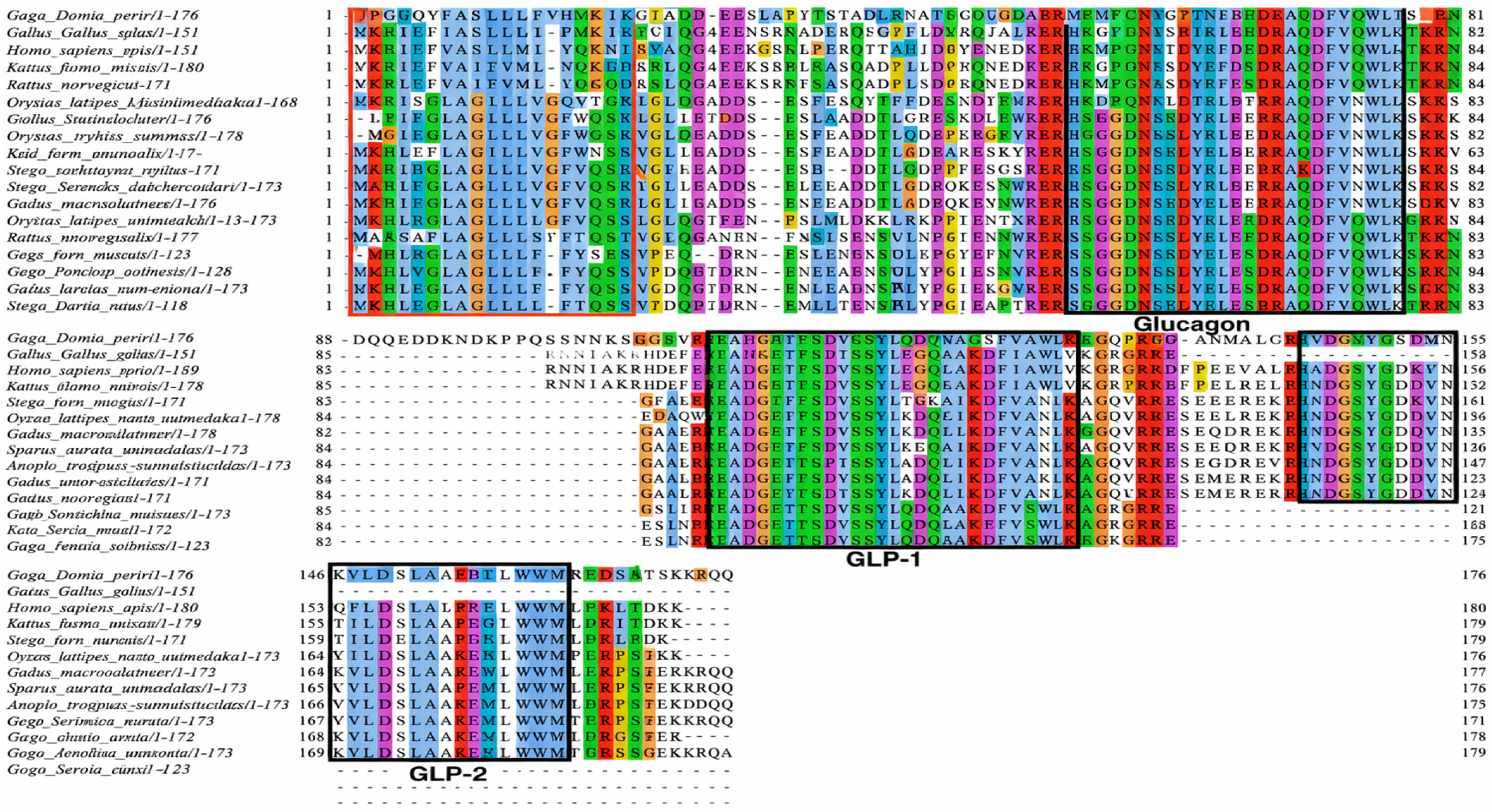
Multiple sequence alignment of vertebrate proglucagon proteins showed that conserved regions corresponding to glucagon and GLP-1 were present across the analyzed sequences (Figure 1). In the sequences classified as teleost Gcgb in this study, the region corresponding to GLP-2 was not observed, whereas it was present in the Gcga sequences (Figure 1).
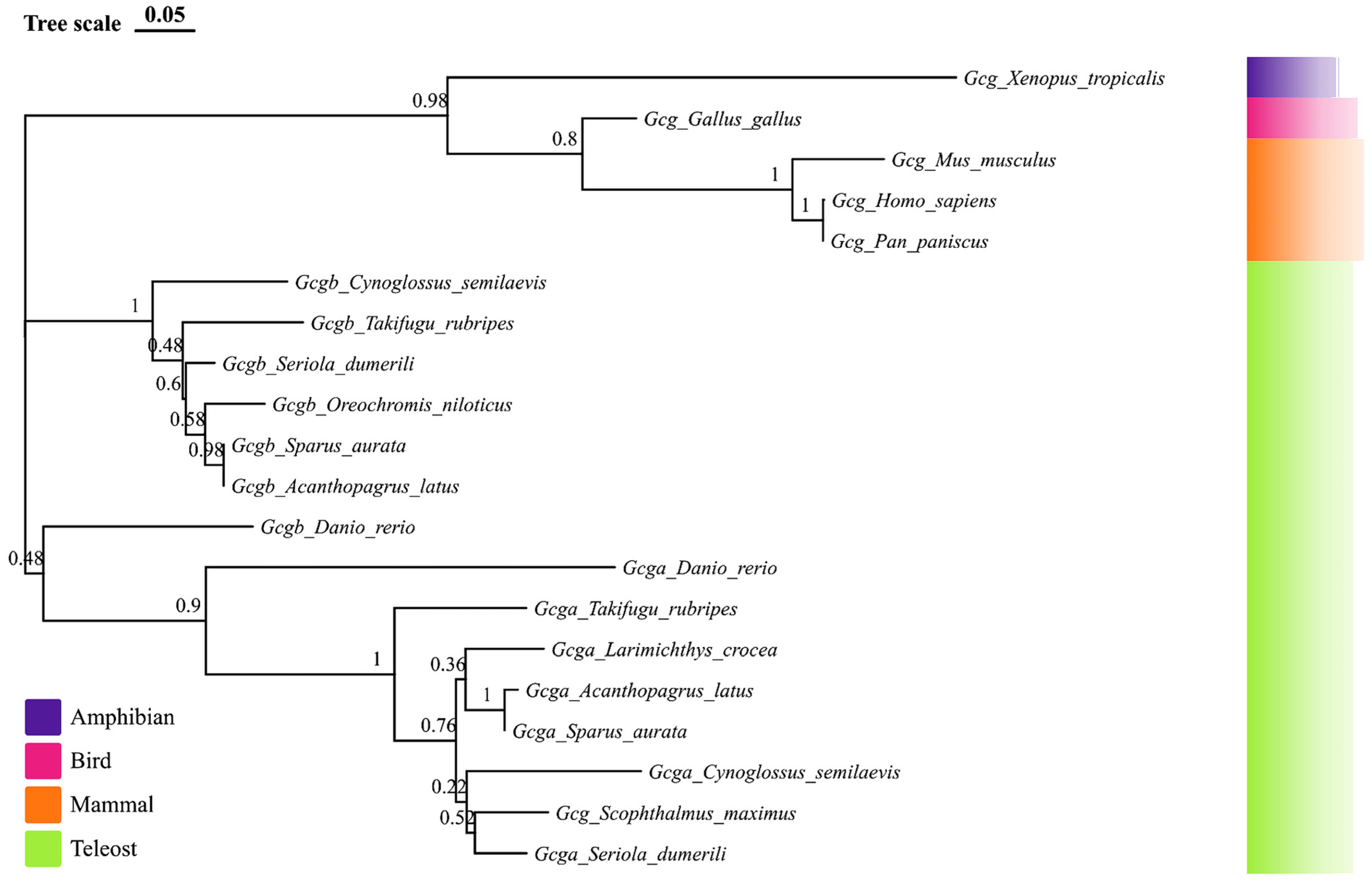
A maximum-likelihood phylogenetic tree was constructed based on the aligned amino acid sequences (Figure 2). Mammalian Gcg sequences formed a distinct clade, while teleost sequences separated into two clades corresponding to Gcga and Gcgb. Within the teleost Gcga clade, AlGcga clustered with the Gcga sequence from Sparus aurata. Bootstrap values are shown at the corresponding nodes (Figure 2).

3.3. Tissue Distribution of AlGcga and AlGcgb in Healthy Yellowfin Seabream

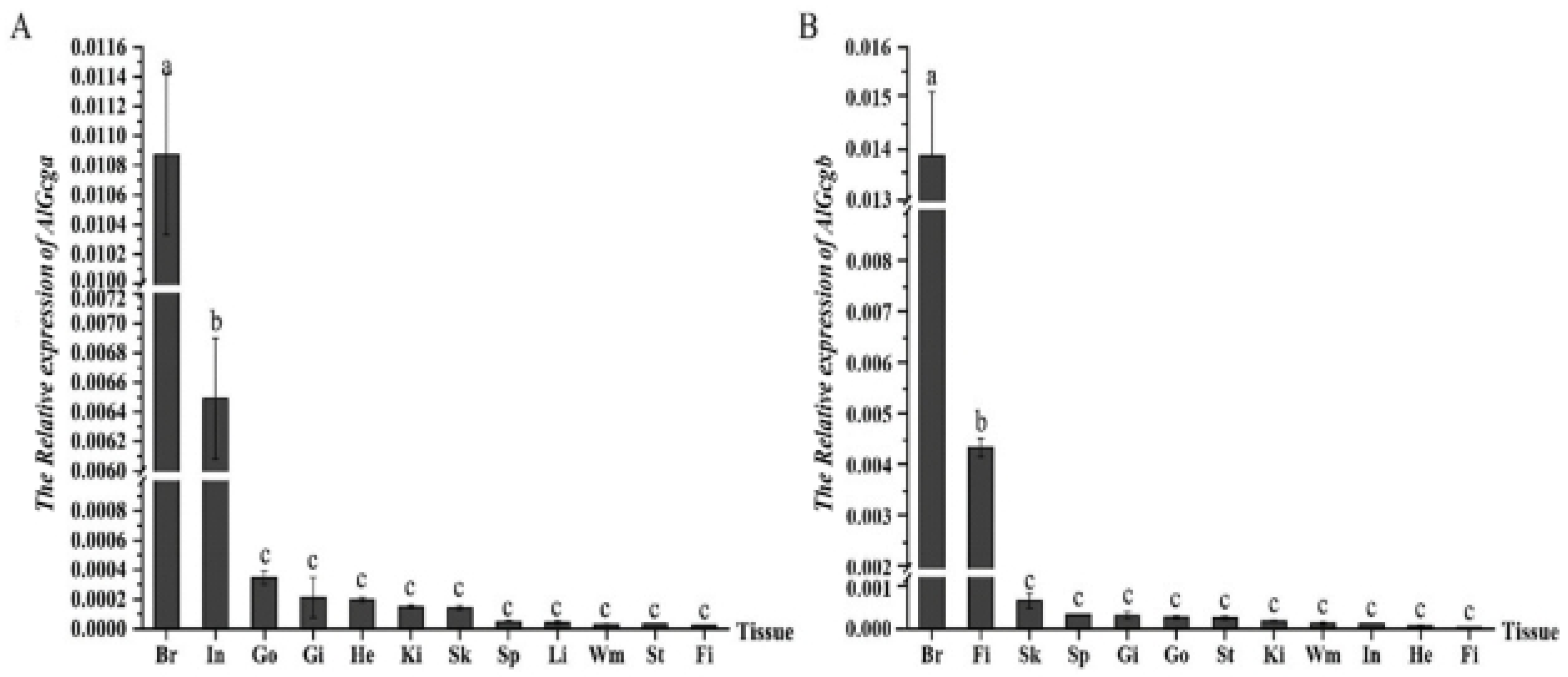
The mRNA expression of AlGcga and AlGcgb was examined across multiple tissues from healthy yellowfin seabream (Figure 3). AlGcga showed high expression in the liver, with detectable expression also observed in the intestine and brain; lower expression levels were detected in the other examined tissues (Figure 3A). In contrast, AlGcgb showed the highest expression in the gills, with relatively higher expression also detected in intestine and brain, and low expression in liver and other tissues (Figure 3B). Data are presented as mean ± SD (n = 3).

3.4. Acute Peri-Feeding Responses of AlGcga and AlGcgb in Liver

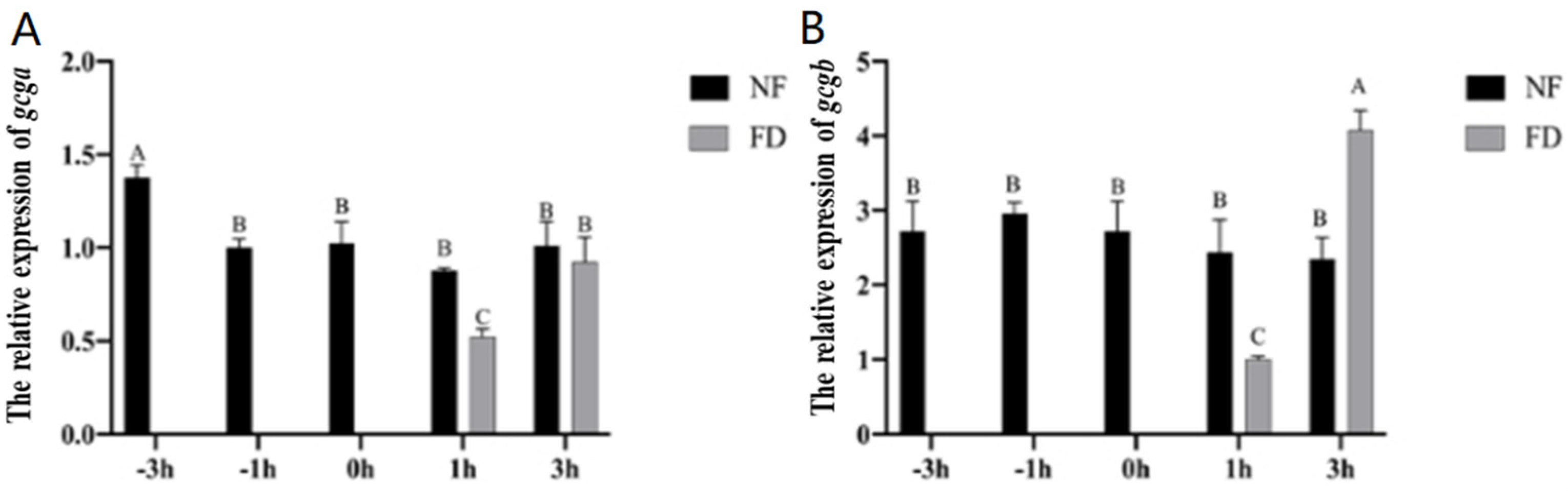
Acute changes in hepatic AlGcga and AlGcgb expression were examined at multiple time points around a feeding event (Figure 4). For AlGcga, expression levels in the feeding group differed among time points (p < 0.05; Figure 4A). In the feeding group, AlGcga expression at 1 h after feeding differed from the level immediately after feeding (0 h) (p < 0.05; Figure 4A). In the non-feeding group, no significant differences in AlGcga expression were detected among time points (p > 0.05; Figure 4A).
For AlGcgb, no significant differences among time points were detected in the non-feeding group (p > 0.05; Figure 4B). In the feeding group, AlGcgb expression differed at 1 h and 3 h after feeding compared with 0 h (p < 0.05; Figure 4B). At 3 h after feeding, AlGcgb expression in the feeding group differed from that in the non-feeding group (p < 0.05; Figure 4B). Data are presented as mean ± SD (n = 3).

3.5. Short-Term Starvation–Refeeding Experiment: Hepatic Expression Dynamics of AlGcga and AlGcgb

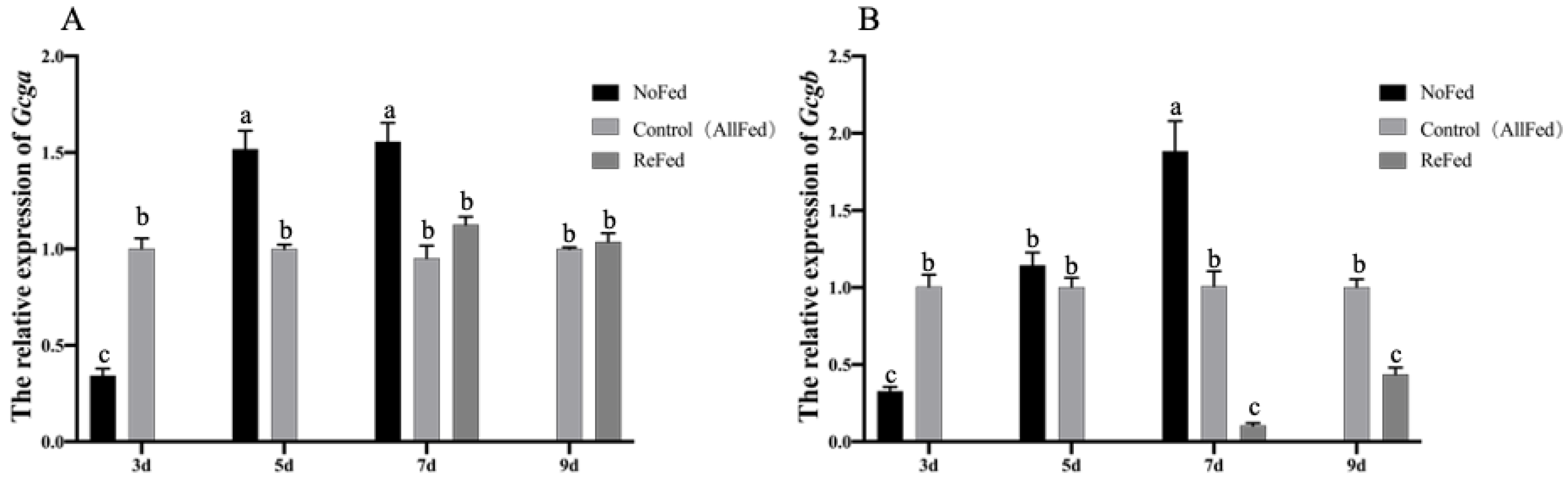
Hepatic expression levels of AlGcga and AlGcgb were evaluated in the control group (C), non-feeding group (NF), and starvation–refeeding group (R) at multiple sampling days (Figure 5). In the control group, AlGcga and AlGcgb expression levels showed no significant differences among sampling days (p > 0.05; Figure 5).
In the NF group, AlGcga expression differed among sampling days (p < 0.05; Figure 5A). AlGcga expression at day 5 was higher than that at day 3 (p < 0.05), and the values at subsequent sampling days are shown in Figure 5A. In the NF group, AlGcgb expression also differed among sampling days (p < 0.05; Figure 5B). The pattern across days was non-monotonic, with a decrease at day 3, a return toward the control level at day 5, and a higher value at day 7; the values at each sampling day are shown in Figure 5B.
In the R group, expression levels of AlGcga and AlGcgb at each sampling day are shown in Figure 5. Significant differences among sampling days within the same group are indicated by different letters (p < 0.05; Figure 5).

4. Discussion

In this study, two proglucagon genes (Gcga and Gcgb) were identified and characterized in yellowfin seabream. The presence of duplicated endocrine-related genes in teleosts is consistent with lineage-specific genome duplication events that facilitated diversification and adaptation [17]. Comparative analyses of proglucagon and related endocrine systems have also highlighted diversification of glucagon-related genes and signaling pathways among fish lineages [18].
Tissue distribution analysis showed distinct expression profiles for the two paralogs. Gcga exhibited relatively higher expression in liver, whereas Gcgb showed higher expression in gills and detectable expression in intestine and brain. In euryhaline species, gill-biased expression of endocrine- and stress-related genes has been reported in association with salinity acclimation and osmoregulatory processes [27,28]. The tissue distribution patterns reported here provide baseline information for A. latus and can be used to guide future sampling strategies in nutritional and environmental challenge experiments. Endocrine–stress pathways, including cortisol signaling and glucocorticoid receptor regulation, are widely linked to metabolic and osmoregulatory processes in teleosts [28,29,30,31,32,33].
The tissue survey in this study did not identify the liver as the highest-expression tissue for either paralog; instead, the strongest relative qRT-PCR signals were detected in the brain and fin. Importantly, our downstream design was not based on basal expression ranking. The liver was selected as a metabolically relevant organ to evaluate transcriptional responsiveness to starvation/refeeding and peri-feeding manipulation, because it integrates nutritional, endocrine, and metabolic cues in teleosts [34]. Accordingly, even comparatively low basal hepatic transcription can be informative when it shows reproducible, feeding-dependent regulation, as observed in our fasting/refeeding and peri-feeding datasets [35]. The relatively high fin signal is reported here as a novel observation in A. latus; however, we interpret it cautiously and do not base functional inference on fin transcription in the present work. Therefore, the conclusions drawn from the feeding-manipulation experiments are explicitly restricted to hepatic transcriptional responses within this tissue-specific metabolic-response model, and do not imply the principal endocrine source tissues or whole-body proglucagon system function [36].
Under starvation and refeeding, hepatic AlGcga expression differed across nutritional states, with significant changes detected during fasting and recovery periods (Figure 4 and Figure 5). In contrast, AlGcgb expression showed a different response pattern, including a non-monotonic trajectory in the non-feeding group in the periodic fasting experiment (Figure 5). These results indicate distinct expression dynamics between the two genes during nutritional transitions in A. latus. Because proglucagon-derived peptides are involved in appetite- and nutrient-related signaling, it is relevant that both genes showed detectable expression in the intestine and brain [37,38]. Reviews of teleost appetite control summarize coordinated endocrine and neuropeptide signaling across central and peripheral tissues, including gut-derived factors and brain circuits [36,39]. Experimental work has reported anorexigenic effects of centrally administered GLP-1 in fish under specific conditions [40], providing context for interpreting proglucagon gene expression in tissues associated with appetite regulation.
From an aquaculture perspective, intermittent feeding regimes have been investigated as management tools to balance labor and environmental constraints while maintaining growth performance [12]. Compensatory growth following feed restriction or fasting has been reviewed across fishes and is often linked to shifts in feeding rate, metabolism, and energy allocation during recovery [41]. Recent syntheses also emphasize that compensatory growth can be context-dependent and may involve trade-offs [42]. Empirical studies in different cultured species have evaluated intermittent fasting or feed restriction protocols and reported variable outcomes in growth and physiological responses [43,44,45,46]. Short-term fasting has also been examined in applied contexts such as transportation management and muscle quality [47].
Feeding strategies are closely linked to production economics and operational implementation. Feed is widely recognized as a dominant component of aquaculture production costs, motivating interest in feeding optimization and schedule design [14]. Reviews of feeder technologies and strategic implementation highlight how automated and demand feeding systems can support controlled regimen delivery and reduce waste in different farming systems [48].
This study is limited to transcriptional analyses and does not provide direct functional validation of the identified genes. In addition, detailed primer validation and transparent reporting standards are increasingly emphasized for qPCR-based studies. The MIQE guidelines and their updated revision provide widely used recommendations for qPCR assay design, validation, and reporting [49,50]. Future studies integrating hormone measurements, broader tissue panels (e.g., intestine and brain), and functional assays will be necessary to clarify the physiological significance of duplicated proglucagon genes in A. latus. Dietary macronutrient composition has been reported to influence endocrine receptor activity in salmonids, underscoring the importance of diet context when interpreting endocrine transcriptional responses [51]. Studies on transcriptional regulation and epigenetic mechanisms provide additional frameworks for investigating nutritional regulation of endocrine genes [52,53]. Metabolomic profiling under fasting has also been used to characterize nutrient-state shifts in teleost models and could complement future functional studies [54].

5. Conclusions

Two proglucagon genes, Gcga and Gcgb, were identified in yellowfin seabream and exhibited distinct tissue distribution patterns and expression responses to fasting and refeeding. Gcga expression in the liver was sensitive to nutritional status, whereas Gcgb showed relatively stable expression dynamics. These results provide baseline information on the nutritional regulation of proglucagon genes in A. latus and contribute to a better understanding of endocrine responses relevant to feeding management in aquaculture.

Author Contributions

J.Z.: investigation, formal analysis, writing—review and editing, data curation. B.L.: conceptualization, supervision. H.G.: validation, visualization. N.Z.: software, data curation, visualization. L.X.: resources, investigation. Q.Z.: validation, resources. K.Z.: resources, conceptualization, funding acquisition, supervision. D.Z.: conceptualization, funding acquisition, supervision, project administration. All authors have read and agreed to the published version of the manuscript.

Funding

This work was supported by the Seed Industry Revitalization Project of Special Fund for Rural Revitalization Strategy in Guangdong Province (2024SPY00009), the project of Guangzhou Science and Technology Plan (2023B03J1261), and the Central Public-Interest Scientific Institution Basal Research Fund, CAFS (No. 2023TD33).

Institutional Review Board Statement

All animal procedures were conducted according to relevant guidelines and were authorized by the Committee of the South China Sea Fisheries Research Institute, Chinese Academy of Fishery Sciences (No. SCSFRI96-254). Approval date: 30 April 2022.

Data Availability Statement

The original contributions presented in this study are included in the article. Further inquiries can be directed to the corresponding authors.

Conflicts of Interest

The authors declare no conflicts of interest.

References

  1. Mehar, M.; Mekkawy, W.; McDougall, C.; Benzie, J.A. Fish trait preferences: A review of existing knowledge and implications for breeding programmes. Rev. Aquac. 2019, 12, 1273–1296. [Google Scholar] [CrossRef]
  2. Servili, A.; Canario, A.V.; Mouchel, O.; Muñoz-Cueto, J.A. Climate change impacts on fish reproduction are mediated at multiple levels of the brain-pituitary-gonad axis. Gen. Comp. Endocrinol. 2020, 291, 113439. [Google Scholar] [CrossRef]
  3. Mattson, M.P.; Longo, V.D.; Harvie, M. Impact of intermittent fasting on health and disease processes. Ageing Res. Rev. 2017, 39, 46–58. [Google Scholar] [CrossRef]
  4. Yang, G.; Liang, X.; Jiang, Y.; Li, C.; Zhang, Y.; Zhang, X.; Chang, X.; Shen, Y.; Meng, X. Molecular Characterization of Grass Carp GIPR and Effect of Nutrition States, Insulin, and Glucagon on Its Expression. Aquac. Nutr. 2022, 2022, 330251. [Google Scholar] [CrossRef]
  5. Gaylord, T.; MacKenzie, D.; Gatlin, D. Growth performance, body composition and plasma thyroid hormone status of channel catfish (Ictalurus punctatus) in response to short-term feed deprivation and refeeding. Fish Physiol. Biochem. 2001, 24, 73–79. [Google Scholar] [CrossRef]
  6. Frohn, L.; Peixoto, D.; Terrier, F.; Costas, B.; Bugeon, J.; Cartier, C.; Richard, N.; Pinel, K.; Skiba-Cassy, S. Gut physiology of rainbow trout (Oncorhynchus mykiss) is influenced more by short-term fasting followed by refeeding than by feeding fishmeal-free diets. Fish Physiol. Biochem. 2024, 50, 1281–1303. [Google Scholar] [CrossRef] [PubMed]
  7. Yang, G.; Li, C.; Wang, S.; Liang, X.; Yang, B.; Zhang, Y.; Zhang, X.; Chang, X.; Meng, X. Molecular characterization of the grass carp bscl2 gene and its expression response to lipid accumulation, nutritional status, insulin and glucagon. Comp. Biochem. Physiol. Part B Biochem. Mol. Biol. 2023, 270, 110931. [Google Scholar] [CrossRef] [PubMed]
  8. Yuan, X.; Li, A.; Liang, X.-F.; Huang, W.; Song, Y.; He, S.; Cai, W.; Tao, Y.-X. Leptin expression in mandarin fish Siniperca chuatsi (Basilewsky): Regulation by postprandial and short-term fasting treatment. Comp. Biochem. Physiol. Part A Mol. Integr. Physiol. 2016, 194, 8–18. [Google Scholar] [CrossRef]
  9. Hack, N.L.; Cordova, K.L.; Glaser, F.L.; Journey, M.L.; Resner, E.J.; Hardy, K.M.; Beckman, B.R.; Lema, S.C. Interactions of long-term food ration variation and short-term fasting on insulin-like growth factor-1 (IGF-1) pathways in copper rockfish (Sebastes caurinus). Gen. Comp. Endocrinol. 2019, 280, 168–184. [Google Scholar] [CrossRef]
  10. Hao, S.; Han, K.; Meng, L.; Huang, X.; Cao, W.; Shi, C.; Zhang, M.; Wang, Y.; Liu, Q.; Zhang, Y.; et al. African Arowana Genome Provides Insights on Ancient Teleost Evolution. iScience 2020, 23, 101662. [Google Scholar] [CrossRef]
  11. Irwin, D.M.; Mojsov, S. Diversification of the functions of proglucagon and glucagon receptor genes in fish. Gen. Comp. Endocrinol. 2018, 261, 148–165. [Google Scholar] [CrossRef]
  12. Lund, P.K.; Goodman, R.H.; Montminy, M.R.; Dee, P.C.; Habener, J.F. Anglerfish islet pre-proglucagon II. Nucleotide and corresponding amino acid sequence of the cDNA. J. Biol. Chem. 1983, 258, 3280–3284. [Google Scholar] [CrossRef]
  13. Bell, G.I.; Santerre, R.F.; Mullenbach, G.T. Hamster preproglucagon contains the sequence of glucagon and two related peptides. Nature 1983, 302, 716–718. [Google Scholar] [CrossRef]
  14. Moon, T.W. Hormones and fish hepatocyte metabolism: “the good, the bad and the ugly!”. Comp. Biochem. Physiol. Part B Biochem. Mol. Biol. 2004, 139, 335–345. [Google Scholar] [CrossRef]
  15. Li, J.; Chen, T.; Rao, Y.; Chen, S.; Wang, B.; Chen, R.; Ren, C.; Liu, L.; Yang, Y.; Yu, H.; et al. Suppression of leptin-AI/AII transcripts by insulin in goldfish liver: A fish specific response of leptin under food deprivation. Gen. Comp. Endocrinol. 2019, 283, 113240. [Google Scholar] [CrossRef]
  16. Tang, Y.; Feng, M.; Zhu, X.; Long, J.; Zhou, Z.; Liu, S. WR-GLP2, a glucagon-like peptide 2 from hybrid crucian carp that protects intestinal mucosal barrier and inhibits bacterial infection. Fish Shellfish Immunol. 2022, 122, 29–37. [Google Scholar] [CrossRef] [PubMed]
  17. Liang, Y.; Zhu, K.-C.; You, Y.-Z.; Guo, H.-Y.; Chen, H.-D.; Liu, B.-S.; Zhang, N.; Dai, Y.-B.; Zeng, F.-R.; Lin, H.-Y.; et al. Molecular characterization of TNF-β and IFN-γ in yellowfin seabream (Acanthopagrus latus, Hottuyn, 1782) and their immune responses to density stress during transport. Dev. Comp. Immunol. 2023, 147, 104747. [Google Scholar] [CrossRef]
  18. Pan, J.-M.; Zhu, K.-C.; Liu, J.; Guo, H.-Y.; Liu, B.-S.; Zhang, N.; Xian, L.; Sun, J.-H.; Zhang, D.-C. Cryopreservation of Goldlined seabream Rhabdosargus sarba (Forsskål, 1775) sperm: CASA observation and enzyme activity evaluation. Aquaculture 2023, 582, 740494. [Google Scholar] [CrossRef]
  19. Lin, Y.L.; Zhu, Z.X.; Ai, C.H.; Xiong, Y.Y.; De Liu, T.; Lin, H.R.; Xia, J.H. Transcriptome and DNA Methylation Responses in the Liver of Yellowfin Seabream Under Starvation Stress. Mar. Biotechnol. 2022, 25, 150–160. [Google Scholar] [CrossRef]
  20. Campbell, J.E.; Drucker, D.J. Pharmacology, Physiology, and Mechanisms of Incretin Hormone Action. Cell Metab. 2013, 17, 819–837. [Google Scholar] [CrossRef] [PubMed]
  21. Assan, D.; Mustapha, U.F.; Chen, H.; Li, Z.; Peng, Y.; Li, G. The Roles of Neuropeptide Y (Npy) and Peptide YY (Pyy) in Teleost Food Intake: A Mini Review. Life 2021, 11, 547. [Google Scholar] [CrossRef]
  22. Gattuso, A.; Garofalo, F.; Cerra, M.C.; Imbrogno, S. Hypoxia Tolerance in Teleosts: Implications of Cardiac Nitrosative Signals. Front. Physiol. 2018, 9, 366. [Google Scholar] [CrossRef]
  23. Volkoff, H. The Neuroendocrine Regulation of Food Intake in Fish: A Review of Current Knowledge. Front. Neurosci. 2016, 10, 540. [Google Scholar] [CrossRef]
  24. Zhu, K.-C.; Zhang, N.; Liu, B.-S.; Guo, L.; Guo, H.-Y.; Jiang, S.-G.; Zhang, D.-C. A chromosome-level genome assembly of the yellowfin seabream (Acanthopagrus latus; Hottuyn, 1782) provides insights into its osmoregulation and sex reversal. Genomics 2021, 113, 1617–1627. [Google Scholar] [CrossRef] [PubMed]
  25. Nilsson, C.; Swolin-Eide, D.; Ohlsson, C.; Eriksson, E.; Ho, H.; Bjorntorp, P.; Holmang, A. Reductions in adipose tissue and skeletal growth in rat adult offspring after prenatal leptin exposure. J. Endocrinol. 2003, 176, 13–21. [Google Scholar] [CrossRef] [PubMed]
  26. Schaaf, M.J.M.; Champagne, D.; van Laanen, I.H.C.; van Wijk, D.C.W.A.; Meijer, A.H.; Meijer, O.C.; Spaink, H.P.; Richardson, M.K. Discovery of a Functional Glucocorticoid Receptor β-Isoform in Zebrafish. Endocrinology 2007, 149, 1591–1599. [Google Scholar] [CrossRef] [PubMed]
  27. Dou, C.; Cao, Z.; Yang, B.; Ding, N.; Hou, T.; Luo, F.; Kang, F.; Li, J.; Yang, X.; Jiang, H.; et al. Changing expression profiles of lncRNAs, mRNAs, circRNAs and miRNAs during osteoclastogenesis. Sci. Rep. 2016, 6, 21499. [Google Scholar] [CrossRef]
  28. Pan, L.-Q.; Xiao, G.-Q.; Zhang, H.-X.; Luan, Z.-H. Effects of different dietary protein content on growth and protease activity of Eriocheir sinensis larvae. Aquaculture 2005, 246, 313–319. [Google Scholar] [CrossRef]
  29. Mommsen, T.P.; Vijayan, M.M.; Moon, T.W. Cortisol in teleosts: Dynamics, mechanisms of action, and metabolic regulation. Rev. Fish Biol. Fish. 1999, 9, 211–268. [Google Scholar] [CrossRef]
  30. Vargas-Chacoff, L.; Muñoz, J.; Saravia, J.; Oyarzún, R.; Pontigo, J.; González, M.; Mardones, O.; Hawes, C.; Pino, J.; Wadsworth, S.; et al. Neuroendocrine stress response in Atlantic salmon (Salmo salar) and Coho salmon (Oncorynchus kisutch) during sea lice infestation. Aquaculture 2019, 507, 329–340. [Google Scholar] [CrossRef]
  31. Foss, A.; Imsland, A.K.; Roth, B.; Schram, E.; Stefansson, S.O. Effects of chronic and periodic exposure to ammonia on growth and blood physiology in juvenile turbot (Scophthalmus maximus). Aquaculture 2009, 296, 45–50. [Google Scholar] [CrossRef]
  32. Cruz, S.A.; Lin, C.-H.; Chao, P.-L.; Hwang, P.-P. Glucocorticoid Receptor, but Not Mineralocorticoid Receptor, Mediates Cortisol Regulation of Epidermal Ionocyte Development and Ion Transport in Zebrafish (Danio rerio). PLoS ONE 2013, 8, e77997. [Google Scholar] [CrossRef]
  33. Gao, T.; Xu, Y.; Wang, K.; Deng, Y.; Yang, Y.; Lu, Q.; Pan, J.; Xu, Z. Comparative LC-MS based non-targeted metabolite profiling of the Chinese mitten crab Eriocheir sinensis suffering from hepatopancreatic necrosis disease (HPND). Aquaculture 2018, 491, 338–345. [Google Scholar] [CrossRef]
  34. Brown, A.B.; Whyte, S.K.; Braden, L.M.; Groman, D.B.; Purcell, S.L.; Fast, M.D. Vaccination strategy is an important determinant in immunological outcome and survival in Arctic charr (Salvelinus alpinus) when challenged with atypical Aeromonas salmonicida. Aquaculture 2020, 518, 734838. [Google Scholar] [CrossRef]
  35. Choi, J.; Kim, N.K.; Lee, J.H.; Park, H.C.; Kim, H.S. Metabolomic profiling reveals fasting-induced metabolic shifts in medaka (Oryzias latipes). Comp. Biochem. Physiol. Part D Genom. Proteom. 2021, 38, 100806. [Google Scholar]
  36. Rønnestad, I.; Gomes, A.S.; Murashita, K.; Angotzi, R.; Jönsson, E.; Volkoff, H. Appetite-Controlling Endocrine Systems in Teleosts. Front. Endocrinol. 2017, 8, 73. [Google Scholar] [CrossRef]
  37. Dostert, A.; Heinzel, T. Negative Glucocorticoid Receptor Response Elements and their Role in Glucocorticoid Action. Curr. Pharm. Des. 2004, 10, 2807–2816. [Google Scholar] [CrossRef]
  38. Daston, G.P.; Naciff, J.M. Predicting developmental toxicity through toxicogenomics. Birth Defects Res. Part C Embryo Today Rev. 2010, 90, 110–117. [Google Scholar] [CrossRef] [PubMed]
  39. Volkoff, H.; Canosa, L.; Unniappan, S.; Cerdá-Reverter, J.; Bernier, N.; Kelly, S.; Peter, R. Neuropeptides and the control of food intake in fish. Gen. Comp. Endocrinol. 2005, 142, 3–19. [Google Scholar] [CrossRef] [PubMed]
  40. Silverstein, J.T.; Bondareva, V.M.; Leonard, J.B.; Plisetskaya, E.M. Neuropeptide regulation of feeding in catfish, Lctalurus punctatus: A role for glucagon-like peptide-1 (GLP-1)? Comp. Biochem. Physiol. Part B Biochem. Mol. Biol. 2001, 129, 623–631. [Google Scholar] [CrossRef] [PubMed]
  41. Ali, M.; Nicieza, A.; Wootton, R.J. Compensatory growth in fishes: A response to growth depression. Fish Fish. 2003, 4, 147–190. [Google Scholar] [CrossRef]
  42. Py, C.; Elizondo-González, R.; Peña-Rodríguez, A. Compensatory growth: Fitness cost in farmed fish and crustaceans. Rev. Aquac. 2022, 14, 1389–1417. [Google Scholar] [CrossRef]
  43. Ntantali, O.; Malandrakis, E.E.; Abbink, W.; Bastiaansen, J.; Chatzoglou, E.; Karapanagiotidis, I.T.; Golomazou, E.; Panagiotaki, P. Effects of Short-Term Intermittent Fasting on Growth Performance, Fatty Acids Profile, Glycolysis and Cholesterol Synthesis Gene Expression in European Seabass Dicentrarchus labrax. Fishes 2023, 8, 582. [Google Scholar] [CrossRef]
  44. Kim, Y.-O.; Oh, S.-Y.; Kim, T. Effect of Fasting and Refeeding on Juvenile Leopard Mandarin Fish Siniperca scherzeri. Animals 2022, 12, 889. [Google Scholar] [CrossRef]
  45. Abdel-Aziz, M.F.; Hamza, D.S.; Elwazer, T.A.; Mohamed, A.S.; El-Dakar, A.Y. Short-term starvation at different feeding regimes on appetite responses, feeding utilization and physiological indices, of red hybrid tilapia (Oreochromis mossambicus × Oreochromis niloticus) fingerlings reared in brackish water. Heliyon 2024, 10, e25208. [Google Scholar] [CrossRef]
  46. Hvas, M.; Nilsson, J.; Vågseth, T.; Nola, V.; Fjelldal, P.G.; Hansen, T.J.; Oppedal, F.; Stien, L.H.; Folkedal, O. Full compensatory growth before harvest and no impact on fish welfare in Atlantic salmon after an 8-week fasting period. Aquaculture 2022, 546, 737415. [Google Scholar] [CrossRef]
  47. Peng, L.; You, J.; Liu, R.; Long, Y.; Song, G.; Benjakul, S.; Xiong, S.; Rahman, Z.; Huang, Q.; Chen, S.; et al. Fasting influences the muscle quality of fish during transportation by regulating the balance between energy metabolism and ammonia nitrogen stress. J. Adv. Res. 2025, 79, 75–88. [Google Scholar] [CrossRef]
  48. Thornburg, J. Feed the fish: A review of aquaculture feeders and their strategic implementation. J. World Aquac. Soc. 2025, 56, e70016. [Google Scholar] [CrossRef]
  49. Bustin, S.A.; Benes, V.; Garson, J.A.; Hellemans, J.; Huggett, J.; Kubista, M.; Mueller, R.; Nolan, T.; Pfaffl, M.W.; Shipley, G.L.; et al. The MIQE Guidelines: Minimum Information for Publication of Quantitative Real-Time PCR Experiments. Clin. Chem. 2009, 55, 611–622. [Google Scholar] [CrossRef]
  50. Bustin, S.A.; Ruijter, J.M.; Hoff, M.J.B.v.D.; Kubista, M.; Pfaffl, M.W.; Shipley, G.L.; Tran, N.; Rödiger, S.; Untergasser, A.; Mueller, R.; et al. MIQE 2.0: Revision of the Minimum Information for Publication of Quantitative Real-Time PCR Experiments Guidelines. Clin. Chem. 2025, 71, 634–651. [Google Scholar] [CrossRef]
  51. Braden, L.M.; Whyte, S.K.; Brown, A.B.; Groman, D.B.; Fast, M.D. Vaccine-induced protection against furunculosis involves pre-emptive priming of humoral immunity in Arctic charr. Front. Immunol. 2019, 10, 120. [Google Scholar] [CrossRef]
  52. De Bosscher, K.; Vanden Berghe, W.; Haegeman, G. Mechanisms of anti-inflammatory action and of immunosuppression by glucocorticoids: Negative interference of activated glucocorticoid receptor with transcription factors. J. Neuroimmunol. 2000, 109, 16–22. [Google Scholar] [CrossRef] [PubMed]
  53. Aedo, J.E.; Zuloaga, R.; Aravena-Canales, D.; Molina, A.; Valdés, J.A. Role of glucocorticoid and mineralocorticoid receptors in rainbow trout (Oncorhynchus mykiss) skeletal muscle: A transcriptomic perspective of cortisol action. Front. Physiol. 2023, 13, 1048008. [Google Scholar] [CrossRef] [PubMed]
  54. Ikeda, T.; Ishikawa, T.; Ninagawa, S.; Okada, T.; Ono, M.; Mori, K. Proteomic analysis of fatty liver induced by starvation of medaka fish larvae. Cell Struct. Funct. 2023, 48, 123–133. [Google Scholar] [CrossRef] [PubMed]
Figure 1. Sequence alignment analysis of two Gcg genes. Multiple sequence alignment of Gcga and Gcgb protein sequences from various vertebrate species. Conserved domains corresponding to glucagon, GLP-1, and GLP-2 are indicated.
Fishes 11 00205 g001
Figure 2. Evolutionary relationship analysis of two Gcgs genes. Maximum likelihood phylogenetic tree of Gcga and Gcgb amino acid sequences from selected vertebrates.
Fishes 11 00205 g002
Figure 3. Expression in healthy tissues of two AlGcgs. Tissue distribution of Gcga (A) and Gcgb (B) mRNA expression in yellowfin seabream (Acanthopagrus latus). Tissue abbreviations are as follows: liver (Li), spleen (Sp), kidney (Ki), brain (Br), muscle (Mu), intestine (In), gills (Gi), stomach (St), skin (Sk), and heart (He). Values represent mean ± SD (n = 3). Different letters indicate significant differences among tissues (p < 0.05).
Fishes 11 00205 g003
Figure 4. Acute peri-feeding responses of two Gcgs. Relative mRNA expression of Gcga (A) and Gcgb (B) in the liver around a feeding event in feeding and non-feeding groups at −3 h, −1 h, 0 h, +1 h, and +3 h. Data are presented as mean ± SD (n = 3). Different letters indicate significant differences among time points within the same treatment (p < 0.05). Different letters indicate significant differences between feeding and non-feeding treatments at the same time point (p < 0.05).
Fishes 11 00205 g004
Figure 5. Short-term starvation–refeeding experiment. Relative mRNA expression levels of Gcga (A) and Gcgb (B) in the liver of Acanthopagrus latus subjected to continuous feeding (C), non-feeding (NF), and starvation–refeeding (R). Data are presented as mean ± SD (n = 3). Different letters indicate significant differences among sampling days within the same group (p < 0.05).
Fishes 11 00205 g005
Table 1. Primers used for the amplification of the open reading frames (ORFs) and qRT-PCR of AlGcga and AlGcgb.
PrimersNucleotide Sequence
AlGcga-ORF-FATGAAAAGCATCCACTCC
AlGcga-ORF-RTTACCTCTCCCCTGAAGG
AlGcgb-ORF-FATGAAACAGCTTCAGAAGCC
AlGcgb-ORF-RTCAGTCTCTTCTGCCTCG
AlGcga-qRT-FGAGAGGCGGGGTGAGTC
AlGcga-qRT-RCCAGAAGGCTTGGAGGTC
AlGcgb-qRT-FCGCTTTACAGTCCCTCCTCT
AlGcgb-qRT-RGCTCAATGGGTTCCGTCA
EF1α- qRT-FCTGCAGGACACCAGTCTCAA
EF1α- qRT-RGAAAAGATGGGCTGGTTCAA
Table 2. Species proglucagon protein sequence information for evolutionary analysis. List of species, gene nomenclature, and NCBI accession numbers for the proglucagon protein sequences used in the evolutionary analysis.
SpeciesGeneNo.
Homo sapiensGcgKAI4036670.1
Mus musculusGcgAAH12975.1
Gallus gallusGcgCAA68827.1
Acipenser ruthenusGcgaXP_033863151.3
Salvelinus fontinalisGcgaXP_055784063.1
Nothobranchius furzeriGcgaXP_015807880.2
Pleuronectes platessaGcgaXP_053273533.1
Oncorhynchus ketaGcgaXP_035599731.1
Lates calcariferGcgaXP_018557218.1
Anolis carolinensisGcgaXP_008111709.1
Ictalurus furcatusGcgbXP_053483888.1
Pelmatolapia mariaeGcgbXP_063354794.1
Engraulis encrasicolusGcgbXP_063070735.1
Sardina pilchardusGcgbXP_062389382.1
Scomber scombrusGcgbXP_062288322.1
Platichthys flesusGcgbXP_062257972.1
Labrus mixtusGcgbXP_060910355.1
Gadus macrocephalusGcgbXP_059895185.1
Onychostoma macrolepisGcgbXP_058643687.1
Solea soleaGcgbXP_058478608.1
Nerophis lumbriciformisGcgbXP_061799874.1
Alosa alosaGcgbXP_048094624.1
Disclaimer/Publisher’s Note: The statements, opinions and data contained in all publications are solely those of the individual author(s) and contributor(s) and not of MDPI and/or the editor(s). MDPI and/or the editor(s) disclaim responsibility for any injury to people or property resulting from any ideas, methods, instructions or products referred to in the content.