2. Bacteriocins: Almost a Century of History
In 1925, Gratia observed, described, and introduced the scientific community to the beneficial role of antimicrobial peptides (bacteriocins) of
Escherichia coli as potential antimicrobials [
6]. In 1933, the first bacteriocin from LABs was reported, marking the beginning of application of bacteriocins as valuable contributors to the biopreservation of food products. Although colicin was the first bacteriocin reported in the literature [
6], nisin, the second bacteriocin reported, attracted greater scientific attention, likely because it was produced by
Lactococcus lactis, an LAB, which is considered a safe microbial species. Its discovery was significant because it is one of the earliest examples of a naturally occurring antimicrobial peptide reported, predating widespread antibiotic use.
Initial studies with nisin focused on its specific antibacterial spectrum, which was particularly effective against Gram-positive bacteria such as those from the genera
Clostridium and
Listeria, which are both considered relevant to spoilage in the food industry [
7]. Bacteriocins are antimicrobial peptides that are produced through ribosomal synthesis by various microorganisms, including Gram-positive and Gram-negative bacteria, as well as
Archaea and some eukaryotes. Early studies on bacteriocins centered on their use in food biopreservation [
8]. However, later investigations found that the application of bacteriocins, including nisin, can extend beyond food additives contributing to food safety to pharmaceutically active metabolites that play an essential role in controlling antibiotic-resistant pathogens [
6], whether used as individual agents or in synergistic interactions with antibiotics [
9,
10]. Moreover, modifications in the primary structure of nisin showed the potential to improve its spectrum of activity and even its potential use in the treatment of
Mycobacterium tuberculosis [
11,
12].
It is relevant to emphasize that, along with nisin, a subject of early research on bacteriocins, later, several other bacteriocins were characterized as antimicrobials with impressive heat stability and activity at very low concentrations, characteristics that distinguished them from many other natural antimicrobials [
6]. These properties can be attributed to their reasonably low molecular mass, which is normally below 5 kDa [
8]. By the 1950s, commercial production of nisin began under the name Nisaplin
®, and nisin was soon recognized as a safe food preservative by the EFSA and the FDA [
13].
Nisin’s ability to extend shelf life without altering flavor or texture made it invaluable in the production of dairy, canned foods, and meat products [
13]. Its low cytotoxicity, reported to be approximately the same as sodium chloride (NaCl), with an estimated lethal dose (LD50) of 6950 mg/kg [
14], was an additional argument for the food industry to explore nisin as an effective biopreservative in processed food products. It was the first bacteriocin widely applied in the food industry, and by the late 1960s, it had been approved as a food additive in multiple countries.
Beyond its use in the food industry as a biopreservative, nisin served as a model system for lantibiotics, a class of antimicrobial peptides characterized by unusual amino acids and extensive post-translational modifications [
6]. Initial genetic and biochemical investigations into nisin biosynthesis have advanced our understanding of gene regulation and peptide engineering within prokaryotic systems [
15]. This research laid the foundation for exploring other bacteriocins and understanding microbial competition at the molecular level. The pioneering work on nisin demonstrated that naturally occurring peptides could be harnessed for both practical applications and advancing fundamental science. Its discovery and early characterization not only safeguarded food supplies but also opened new avenues in microbiology, biotechnology, and antimicrobial research [
6,
7,
8].
The biological benefit of bacteriocins is primarily due to the fact that they provide better chances for the host to gain a competitive advantage in their ecological niche over other microorganisms. Thus, according to Chikindas et al. [
16], that their primary targets are closely related to the producer microbial group is because they have same requirements for environmental and nutritional conditions. Unlike broad-spectrum antibiotics, bacteriocins typically exhibit narrow-spectrum activity, targeting strains that are genetically similar to the producer organism [
17]. This specificity allows bacteria to suppress competitors without disrupting entire microbial communities; as a result, bacteriocins are promising candidates for precise antimicrobial interactions with high specificity [
6]. In addition to having a very specific antimicrobial spectrum of activity, in recent decades, some evidence has emerged for an unspecific spectrum of activity. For example, some bacteriocins produced by LABs (Gram-positive producers) expressing activity against Gram-negative bacteria, viruses, yeasts, and even mycobacteria [
18]. Furthermore, Chikindas et al. [
16] suggested that the antimicrobial properties of bacteriocins should be regarded as secondary assets for these peptides, as their primary biological role likely relates to
quorum sensing and other interactions between microbial cells.
Tagg et al. [
19] provided one of the earliest definitions and classifications of bacteriocins, recognizing them as a group with significant structural and functional diversity. Over time, various classifications of bacteriocins have been suggested. However, it is generally agreed that bacteriocins are small peptides produced by the cell’s ribosomal machinery. Some may also be larger protein complexes or include non-protein compounds that contribute to their activity [
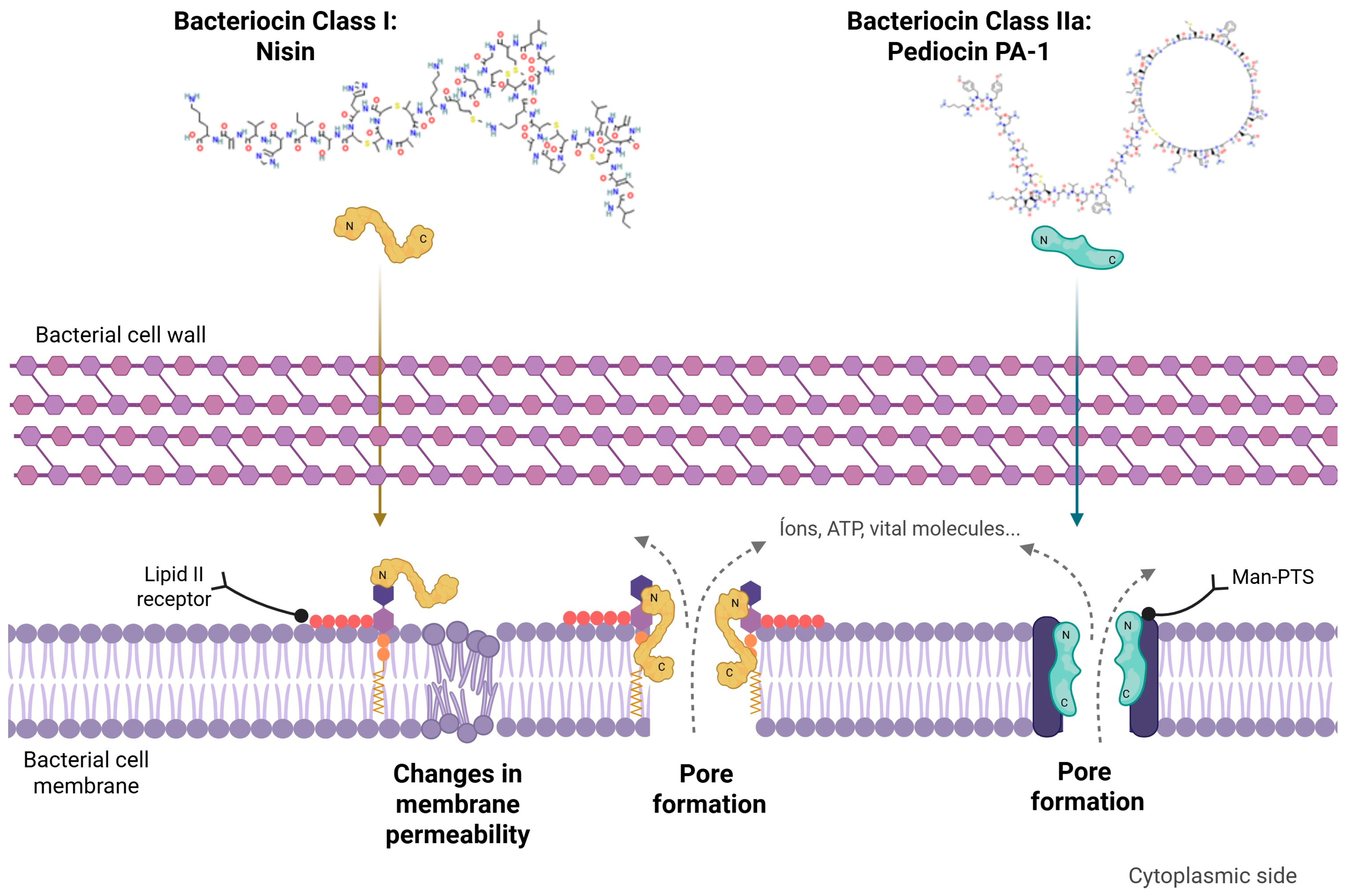
19]. The mechanisms by which bacteriocins exert their effects are diverse; however, principal strategies encompass membrane pore formation, inhibition of cell wall synthesis, and disruption of critical enzymatic processes [
8] (see
Figure 1).
In Tagg et al.’s broadly accepted classification [
19], LAB bacteriocins are divided into three major classes based on their biochemical properties, molecular weight, and mode of action. This framework, which groups bacteriocins into broad classes that reflect their structural and functional characteristics, has remained fundamental in bacteriocin systematics, even though later refinements expanded the categories and some other classifications have been proposed. Class I is dedicated to the group of lantibiotics described as small peptides (<5 kDa), which undergo extensive post-translational modifications and contain some unusual amino acids such as lanthionine and methyllanthionine. An iconic representative from this group is nisin, the first and most studied lantibiotic, which binds to the lipid II of target cells and disrupts cell wall synthesis through modes of action including pore formation and the inhibition of peptidoglycan biosynthesis.
In Tagg et al.’s framework, Class II bacteriocins [
19] are small, heat-stable, non-lantibiotic peptides, usually smaller than 10 kDa, without extensive modifications. This group is subdivided into Class IIa, which comprise Pediocin-like bacteriocins with specific strong activity against
Listeria. These bacteriocins have a specific conservative amino acid fragment (YGNGV/L) ‘pediocin box’ motif, which is responsible for their specific anti-
Listeria activity [
20].
In the same class of bacteriocins, subclass IIb comprises two-peptide bacteriocins that are involved in synergistic interactions. These bacteriocins require both components for functional activity [
7]. Subclass IIc bacteriocins have a circular molecular structure and enhanced stability. The most known representative of this group is enterocin AS48, a well-studied bacteriocin with membrane permeabilization and pore formation modes of action [
21].
Class III bacteriocins are large, heat-labile proteins which typically have a high molecular weight (>30 kDa). Taking their molecular weight into consideration, it is not surprising that they are often sensitive to heat and proteolytic enzymes. Helveticin J is one of the most extensively studied Class III bacteriocins. Notably, helveticin J demonstrates a unique mode of action that involves the enzymatic degradation of components within the target cell. This specific activity contributes to its ability to disrupt essential cellular functions in susceptible microorganisms, ultimately leading to cell death [
22,
23].
Most bacteriocins, such as nisin, interact with and disrupt the cell membrane, causing leakage of essential intracellular components and resulting in cell death. Moreover, the majority of bacteriocins are characterized as cationic and amphipathic polypeptides, characteristics that allow them to bind to negatively charged bacterial membranes [
20] (
Figure 1). Evaluating the mode of action of nisin shows that its bacteriocins use lipid II as a receptor via their N-terminus, followed by insertion of their C-terminus into the cell membrane. Ones inserted into the lipid bilayer, the bacteriocin causes the formation of pores that cause leakage of ions, ATP, and other vital molecules [
20]. Certain bacteriocins, particularly pediocin-like bacteriocins (Class II), target the mannose phosphotransferase system (Man-PTS) associated with the cell envelope, similarly creating pores in the cell membrane [
22], as illustrated in
Figure 1. The formation of such as channels leads to rapid depolarization and cell death. Additionally, it was shown that certain bacteriocins may interfere with cell wall precursor molecules, such as lipid II, preventing proper peptidoglycan synthesis, which weakens the bacterial cell wall [
24] (
Figure 1).
Figure 1.
Mode of action of bacteriocins in Gram-positive bacteria. Bacteriocins, such as nisin (class I bacteriocin) and pediocin (class IIa bacteriocin), target the cell wall. Nisin primarily binds to Lipid II, which inhibits cell wall biosynthesis, facilitating membrane insertion and pore formation. Pediocin-like bacteriocins often use specific membrane receptors (Man-PTS components) to induce pore formation. This process causes the efflux of vital intracellular molecules, leading to cell death. (Figure created in BioRender. Lima, E. (2026)
https://BioRender.com/q0n0mfg, accessed on 5 January 2026). Based on studies by Aguirre-Garcia et al. [
22] and Rani et al. [
25]. Arrows present way of bacteriocins via cell wall.
Figure 1.
Mode of action of bacteriocins in Gram-positive bacteria. Bacteriocins, such as nisin (class I bacteriocin) and pediocin (class IIa bacteriocin), target the cell wall. Nisin primarily binds to Lipid II, which inhibits cell wall biosynthesis, facilitating membrane insertion and pore formation. Pediocin-like bacteriocins often use specific membrane receptors (Man-PTS components) to induce pore formation. This process causes the efflux of vital intracellular molecules, leading to cell death. (Figure created in BioRender. Lima, E. (2026)
https://BioRender.com/q0n0mfg, accessed on 5 January 2026). Based on studies by Aguirre-Garcia et al. [
22] and Rani et al. [
25]. Arrows present way of bacteriocins via cell wall.
Some bacteriocins may use already existing channels in the cell wall to penetrate the target cell and interact with/interrupt certain essential enzyme or nucleic acid functions. These processes can block DNA replication or RNA transcription, consequently halting the growth and division of microbial cells [
26,
27].
It is important to emphasize that most bacteriocin-producing microorganisms are immune to their own bacteriocins, as the producing bacteria carry immunity proteins that protect them. This specificity ensures a competitive advantage without self-damage [
24].
3. Listeria monocytogenes: Built to Survive
Research on
L. monocytogenes has a fairly short scientific history. The earliest reports date back to 1924, when Gram-positive rods isolated from the blood of laboratory rabbits that had died suddenly were reported by E.G.D. Murray, a bacteriologist from Cambridge [
28]. This new species was initially named
Bacterium monocytogenes, but in 1940, it was renamed
L. monocytogenes by Harvey Pirie in honor of Joseph Lister [
28].
L. monocytogenes received scientific attention as cases of listeriosis have been reported worldwide, in association with different food products, including cheese, meat, seafood, vegetables, and fruits [
28]. It is interesting to note that
L. monocytogenes has a unique physiology making it a resilient foodborne pathogen that is highly adaptable to different environmental conditions. Some of its physiological characteristics include growth in a wide temperature range (from −0.4 °C to 45 °C, with an optimal temperature of 37 °C), resistance to a wide range of pH levels (from 4.5 to 9.5), and the ability to tolerate salt concentrations of up to 20%. Compared to other foodborne pathogens, it is relatively unaffected by reductions in water activity (aW < 0.90) [
29]. Moreover,
L. monocytogenes has the ability to form biofilms and can move intracellularly in host cells by utilizing actin filaments [
28,
29].
In 2016, Orsi and Wiedmann suggested a reclassification of the genus
Listeria, defining four new genera: genus
Listeria, harboring
L. monocytogenes;
Listeria mathii;
Listeria innocua;
Listeria welshmerii;
Listeria ivanovii; and
Listeria seelgery. Among these genera, only
L. monocytogenes is considered a human pathogen, while
L. ivanovii is a pathogen for animals [
28]. In Orsi and Wiedmann’s proposal [
30],
Listeria grayi was reclassified as
Murraya grayi, while
Listeria fleischmannii,
Listeria floridensis, and
Listeria aquatica were reclassified as
Mesolisteria. Other previously reported representatives from the genus
Listeria (
Listeria newyorkensis,
Listeria cornellensis,
Listeria rocoutiae,
Listeria weihenstephanensis,
Listeria grandensis,
Listeria riparia, and
Listeria booriae) were re-classified as genus
Paenilisteria [
30].
L. monocytogenes in particular has been the subject of extensive research. Based on whole-genome single nucleotide polymorphism (SNP) genotyping, the species was grouped into the four divergent evolutionary lineages (I to IV) and can be further subdivided into sub-lineages (SLs), 14 serotypes (i.e., 1/2a, 1/2b, 1/2c, 3a, 3b, 3c, 4a, 4ab, 4b, 4c, 4d, 4e, 4h and 7), and sequence types (STs), which are then grouped into clonal complexes (CCs) and classified using core-genome multi-locus sequence typing (cgMLST or CT) [
28]. It is noteworthy that even if all
L. monocytogenes strains are considered potentially pathogenic, detailed investigations based on epidemiological and experimental evidence indicate that three specific serotypes (1/2a-lineage II, 1/2b, and 4b-lineage I) are associated with 92% to 95% of human clinical isolates. Interestingly, Lineage II isolates are mostly associated with food, whereas lineage I isolates are predominantly linked to clinical cases in Western countries. Data from China and Taiwan show that 1/2b is the most prevalent serotype in both food and clinical cases [
28].
L. monocytogenes is clearly associated with foodborne infections. Preventing contamination involves disconnecting its natural reservoirs from the food supply and using multiple interventions during production. Strict hygiene; proper handling, storage, and cooking; and regular sanitization are vital to preventing external and cross-contamination, especially after processing. Maintaining high standards reduces risks introduced by raw ingredients, equipment, and personnel. Different governmental and international agencies have established regulations and standards for the presence of L. monocytogenes in the food industry.
The World Health Organization (WHO), the Food and Agriculture Organization (FAO), and Codex Alimentarius Commission (CAC) developed “Guidelines on the Application of General Principles of Food Hygiene to the Control of
L. monocytogenes in Foods”. These guidelines offer informed recommendations for governments worldwide for controlling
L. monocytogenes in ready-to-eat products, with the objective of safeguarding public health and upholding equitable food trade practices [
31,
32].
The CAC recommendations categorize ready-to-eat foods into two groups, in which growth conditions for
L. monocytogenes are the primary factor when evaluating risk. For food products in which growth can occur, the microbiological criterion is absence in 25 g (<0.04 CFU/g). In this scenario, the relevant food products are defined as at risk for a greater average increase of 0.5 log Colony-Forming Units (CFU)/g of
L. monocytogenes over the course of their expected shelf life, distribution, and storage. Moreover, for ready-to-eat foods in which growth will not occur, the microbiological criteria is set at 100 CFU/g, since there is no evidence that
L. monocytogenes can multiply during the products’ shelf lives [
32].
The FDA previously (2008–2017) had a limit of 100 CFU/g in ready-to-eat (RTE) food that did not support the growth of
L. monocytogenes. However, after some outbreaks of listeriosis in 2015 were attributed to ice cream, which is considered an RTE food that does not support growth of this pathogen, and considering the low contamination level of
L. monocytogenes (0.15–7.1 MNP/g), the agency decided to reinstate a zero-tolerance policy for all RTE foods [
33,
34,
35]. Similarly, the European Union enforces a zero-tolerance policy for the presence of
L. monocytogenes in dairy and ready-to-eat products before foods leave the immediate control of the establishment that produced them (Commission regulation (EC) N° 2073/2005, amended in 2020). It is important to note that EU regulations tolerate levels below 100 CFU/g for foods other than those intended for infants and special medical purposes [
36,
37].
4. Smoked Salmon Production: Economic and Production Perspectives
The practice of processing food is as old as human civilization. Preserving excess food by processing was necessary to prepare for periods of insufficient food supply. Thus, different fermentation methods were developed empirically and incorporated into food preparation processes. Smoking is perhaps one of the oldest known preservation processes. The history of smoking meat and fish, including salmon, for preservation stretches back thousands of years. Civilizations were settled and developed near sources of water, and fish was one of the proteins regularly consumed by humans. Ancient civilizations appreciated smoked fish as a preserved food. During the middle ages, smoked fish was integrated into European diets, often as an accessible protein source. However, during the Victorian era, smoked products transitioned from survival foods to luxury items served at royal meals and elite gatherings. This shift marked the beginning of smoked salmon’s association with prestige and fine dining [
38].
In this period (19th century and beginning of 20th century), the sale of smoked salmon expanded significantly in parallel with improved smoking techniques and cold chain logistics that enabled salmon to be traded across borders. During this time, Scotland and Norway emerged as major centers of smoked salmon production, exporting the product that become to a symbol of wellbeing and luxury in Europe and North America [
38].
The development of aquaculture as a form of sustainable fish production in the late 20th century and beginning of the 21st century has further transformed the industrial production of smoked salmon, enabling consistent supply and global distribution. In the last century, genetically modified salmon were introduced into industrial salmon production. The predominant genetically engineered salmon was AquAdvantage Salmon, developed by AquaBounty Technologies (Maynard, MA, USA) in 1989, which marked a significant milestone in biotechnology and aquaculture (
https://www.fda.gov/animal-veterinary/aquadvantage-salmon/aquadvantage-salmon-fact-sheet, accessed on 5 January 2026). This salmon was developed by AquaBounty Technologies by inserting a growth hormone gene from Pacific Chinook salmon and a promoter sequence from ocean pout into the Atlantic salmon’s DNA. The intent of the modification was to ensure the salmon could produce growth hormone throughout the year rather than only seasonally, allowing it to reach market size in about half the time required by conventional farmed salmon. While traditional Atlantic salmon typically require close to thirty months to mature, AquAdvantage salmon can be harvested in sixteen to eighteen months, offering substantial economic advantages by reducing feed costs and shortening production cycles [
39,
40].
The U.S. FDA approved AquAdvantage Salmon in 2015 after evaluating its safety for human consumption, its environmental impact, and the health impact on the fish itself. To reduce ecological risks, the fish need to be raised on land-based controlled farms. Moreover, it was engineered to be sterile, minimizing the possibility of interbreeding with wild populations. These measures were implemented as preventative actions to ensure that genetically modified salmon do not disrupt natural ecosystems.
From an economical perspective, the faster growth rate and reduced resource requirements make genetically modified salmon attractive for aquaculture at industrial scales, where feed represents the largest cost driver. Although genetically modified salmon has been recognized for its economic efficiency, it remains the subject of significant debate. Opponents raise concerns about the risk of ecological safety should containment measures fail. Moreover, consumer acceptance remains mixed regarding genetically modified products. Importantly, the European Union has not approved genetically modified salmon for sale, citing ethical and environmental reservations. Although the engineered fish has been approved by the FDA, its distribution in North America remains limited due to regulatory hurdles and consumer skepticism.
Smoked salmon is both an emblem of culinary sophistication and a multi-billion-Euro global trade commodity, illustrating its evolution from a traditional preserved food to a contemporary luxury item. Over the last century, smoked salmon production has represented one of the most dynamic segments of the global seafood industry, incorporating traditional culinary practices and modern aquaculture and processing technologies.
The global smoked salmon market was estimated at around 5.0 billion Euro in 2023 and is projected to reach around 8.0 billion Euro by 2032, a projected annual growth rate of nearly six percent (
https://www.businessresearchinsights.com/market-reports/smoked-salmon-market-120069, accessed on 5 January 2026). The consumption of smoked salmon is clearly related to shifting dietary preferences, specifically associated with the health benefits of its omega-3 content.
Europe remains one of the largest consumer markets for smoked salmon, where the United Kingdom, France, and Germany consume the most of both cold- and hot-smoked varieties. Smoked salmon consumption is steady in North America, particularly in food service and premium retail channels. The Asia-Pacific region is one of the fastest-growing regions for smoked salmon consumption, which is clearly associated with rising middle-class incomes and expanding retail distribution networks.
Retail-available salmon, including smoked salmon, comes from two primary sources—farmed and wild salmon. In the last 50 years, due to concern for environmental protection and sustainability, farmed salmon accounts for the majority of the supply, offering stability, consistency in quality, and volume while reducing costs compared to wild-caught alternatives. However, the previously noted concern over the use of genetically modified salmon in farming is the subject of consumer complaints. Wild salmon, which has a smaller share from the commercial point of view, is marketed as a premium product, often commanding higher prices due to its perceived natural origin and seasonal availability. Transformation of the raw fish material to the final smoked product can be achieved with different processing methods, with cold smoking and hot smoking representing the two dominant techniques applied in the food industry. Cold smoking preparation involves curing and smoking at a temperature of 20–30 °C and results in a more delicate texture and flavor in the final product. In contrast “hot smoking”, is performed at 50–80 °C and yields a firmer product, which looks like it has been cooked [
41]. In both production approaches, it is crucial to control the salting, brining, and smoking environments to ensure food safety, flavor consistency, and compliance with regulatory standards [
41].
6. Use of Bacteriocins in Biopreservation of Smoked Salmon
Since their discovery, bacteriocins have been suggested as tools for increasing food safety and reducing/eliminating of food spoilage and foodborne pathogens [
6]. Specifically, bacteriocins have received scientific attention as attractive tools for the biopreservation of smoked salmon [
45]. Smoked salmon offers ideal environmental conditions for the bacterial growth—it has relatively high moisture content, moderate salt levels, and chilled storage conditions that prevent mesophilic bacterial spoilage but are excellent for the psychrotolerant
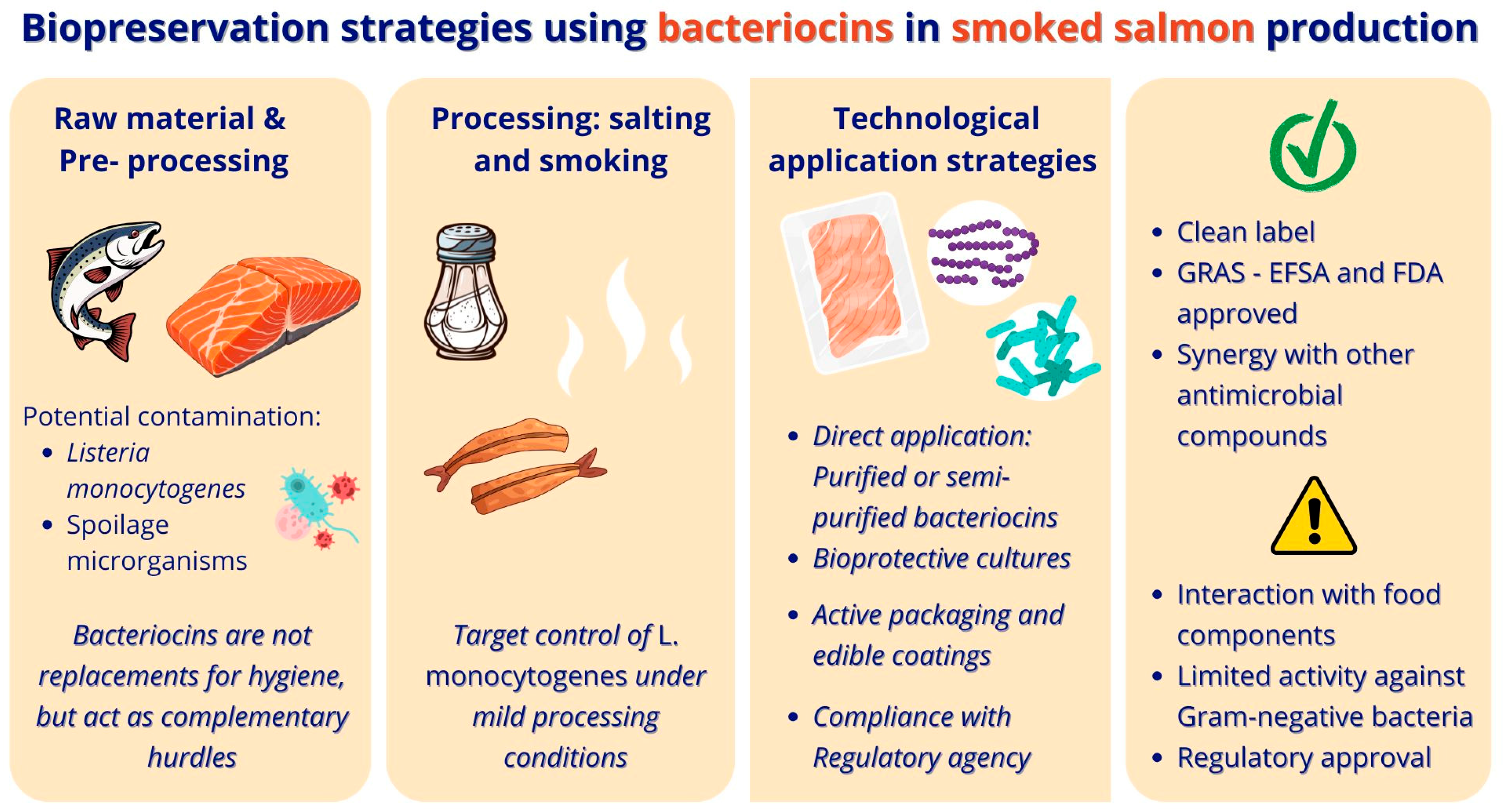
L. monocytogenes. As it is considered a luxury food commodity, smoked salmon has received criticism for its content of chemical preservatives, with the potential application of healthier biopreservatives evaluated positively by consumers. This scientific and industrial challenge served as the initial point for evaluating alternatives for the conservation of smoked salmon, including the possibility of applying different natural antimicrobial strategies, including bacteriocins, particularly those produced by LABs, which are one of the most promising options (
Figure 2).
According to the broadly accepted definition, bacteriocins are antimicrobial peptides that inhibit closely related bacteria. Since
L. monocytogenes, a principle spoilage organism, was targeted by developing new preservation alternatives, bacteriocins from LABs have been studied as promising alternatives [
8]. Nisin, the first LAB-produced bacteriocin described in literature and industrially produced under commercial name Nisaplin, was widely evaluated as biopreservative in the preservation of seafood, including smoked salmon [
45]. Considering that nisin is able to interfere with integrity of the bacterial cell membranes, it is a good candidate for effectively combating Gram-positive organisms, including
L. monocytogenes, which is a major concern in ready-to-eat fish products [
29,
45]. When applied to smoked salmon (whether directly, integrated into brine during processing, or incorporated on packaging materials) nisin can effectively reduce the growth of
L. monocytogenes during refrigerated storage. Beyond nisin, other bacteriocins such as pediocin PA 1, sakacin, enterocins, piscicollin, and carnobacteriocins (variations in the name can be observed in the literature) have shown strong potential for smoked salmon preservation (
Figure 2).
Some experimental studies showed that nisin and pediocin PA-1, both of which are commercially available and permitted by the EFSA and FDA (under the commercial names Nisaplin and Microgart) for application in food biopreservation, can be effectively applied to control
L. monocytogenes. Zuckerman and Avraham [
46] applied a combination of nisin and pediocin PA-1 and reduced the total aerobic bacterial population (initial load: 4.7 log) in fresh chilled salmon by 2 log, which increased the shelf-life by 3–4 days when stored at 6 °C. They found that the application of a combination of nisin and pediocin PA-1 effectively reduced the growth of
L. monocytogenes added to salmon filets, increasing the estimated shelf life of thawed salmon from 5 to 10 d when stored at 6 °C. Interestingly, they observed that the addition of the nisin and pediocin PA-1 combination did not influence the surface pH value or color of the fish [
46].
Other studies have also examined genetic differences in
L. monocytogenes, and Chen et al. [
47] designed experiments in which different serotypes of
L. monocytogenes were used as model microorganisms. They [
47] evaluated influence of nisin concentration (0, 25, or 250 ppm) and storage temperature (4 or 7 °C) on the inhibition of
L. monocytogenes (1/2a, 1/2b and 4b serotypes) inoculated into salmon at ~10
2 CFU/g, a typical contamination level for 30 days. Authors showed that the effectiveness of nisin was dose-dependent and presented similar results when applied at 4 or 7 °C. Moreover, it was found that the serotype 1/2b strain was more sensitive to nisin than the serotype 1/2a and 4b strains in samples incubated at 7 °C or treated with 25 ppm of nisin [
47].
NaCl application is one of the oldest and most common ways to reduce water activity and prevent bacterial growth (
Figure 2). Smoking and salting is a traditional approach to controlling spoilage and the growth of pathogenic bacterial species in salmon; however, increasing the levels of NaCl in preserved salmon is not a solution. It is recognized that excess dietary intake of NaCl is associated with serious health complications. Heir et al. [
48] explored combinations of different strategies for the control of
L. monocytogenes in smoked salmon: nisin and P100 bacteriophages (Phageguard L, PGL) and fermentates (Verdad N6, P-NDV) in standard (with NaCl) and sodium-reduced (NaCl partially replaced with KCl) cold-smoked salmon. The application of 1 ppm of nisin in the preservation of cold-smoked salmon and PGL (5 × 10
7 Plaque Forming Units (PFU)/cm
2) applied individually yielded reductions in
L. monocytogenes (up to 0.7 log) compared to untreated samples. It is important to note that in all experiments, the initial contamination with
L. monocytogenes was controlled at 4.0 log CFU/g, and the combination of nisin and PGL showed a synergistic effect of inhibiting
L. monocytogenes in these experiments. When fermentates were applied for the control of
L. monocytogenes in cold-smoked salmon, a positive effect was observed, but it was not eradicated. Moreover, the lowest levels of
L. monocytogenes were recorded when combinations of nisin and PGL were applied during the preservation process and preservative fermentates were included in an experimental set-up at 4 °C, while enhanced growth was observed during storage at a harmful temperature of 8 °C [
48]. Moreover, the authors reported that when compared to standard industry-processed and sodium-replaced cold-smoked salmon (combination of nisin, PGL, and containing fermentates), their method achieved as much as 1.7 log reductions in
L. monocytogenes for a storage period of 34 days. It is important to point out the specific inactivation of
Listeria’s effects in this experimental set-up, since no differences in total aerobic plate counts were observed between treated and non-treated standard and sodium-reduced cold-smoked salmon at the end of storage. In conclusion, the authors suggested that similarly robust reductions in
L. monocytogenes counts can be achieved in both standard and sodium-replaced cold-smoked salmon using the biopreservation strategy of combined nisin, PGL and fermentates [
48].
Duffes et al. [
49] evaluated possible applications of bacteriocins produced by
Carnobacterium piscicola V1 and
Carnobacterium divergens V41, arguing that both bacteriocins’ producers were isolated from smoked fish and that the bacteriocins themselves presented very strong anti-
Listeria activity in preliminary experiments. In an experimental set-up for the evaluation of activity in silico, the authors applied crude bacteriocins (cell-free supernatant (CFS) containing bacteriocins) on sterile and commercial vacuum-packed cold-smoked salmon under experimental conditions of 4 °C and 8 °C. The bacteriocin produced by
C. piscicola V1 exhibited bactericidal effects against
L. monocytogenes at both temperatures tested, whereas the bacteriocin produced by
C. divergens V41 had a bacteriostatic effect on
L. monocytogenes. The experiments were performed with an initial load of
L. monocytogenes of 4.0 log CFU/g. The bacteriocins produced by
C. piscicola SF668 delayed the growth of
L. monocytogenes at 8 °C and had a bacteriostatic effect at 4 °C. As a control, a non–bacteriocin-producing
C. piscicola strain was used; as anticipated, it showed no inhibitory effect on
L. monocytogenes. Moreover, while bacteriocins from
C. piscicola were bactericidal at both evaluated temperatures (4 °C and 8 °C),
L. monocytogenes growth was only delayed after the application of bacteriocins produced by
C. divergens V41 [
49]. Nisin was also investigated as control, and it delayed
L. monocytogenes growth at 8 °C and was bacteriostatic at 4 °C. In conclusion, the authors emphasized that
L. monocytogenes growth could be prevented on vacuum-packed cold-smoked salmon by bacteriocins produced by
C. piscicola V41 or
C. divergens V41 at chilled temperatures [
49].
As previously shown by Duffes et al. [
49], bacteriocins can be an effective solution for controlling
L. monocytogenes in cold-smoked salmon. The next challenge was to explore bacteriocin production
in silico and determine the bioprotective properties of the bacteriocin producers [
50]. In the experimental set-up, the bacteriocin producer
C. divergens V41 was incorporated into a polypropylene film and evaluated for the inhibition of
L. monocytogenes growth in culture media and in cold-smoked salmon at refrigerated temperatures. When its inhibitory properties were evaluated on semi-solid Brain Heart Infusion (BHI) agar, the bioprotective plastic membrane resulted in a 3-log reduction in the
L. monocytogenes count compared to the control in an experiment conducted over 14 days at an aerobic incubation temperature of 8 °C. In the experiment, the initial load of
L. monocytogenes was around 4.0 log. When the experiment was conducted with vacuum-packed cold-smoked salmon,
L. monocytogenes growth was inhibited by the bioprotective plastic membrane for 7 days when stored at 4 °C and for 21 days when stored at 8 °C. Nguyen et al. [
50] assessed the stability and viability of
C. divergens incorporated into the protective packaging and estimated that even after 42 days at 4 °C, anti-
Listeria activity was 2 log when tested on BHI agar compared to the control. Although this research is still in its early stages, the referenced study highlights the potential for developing bio-protective plastic membranes that can be used to control pathogenic bacteria in food products, with promising prospects for industrial application [
50].
In exploring alternatives for bioconservation, the anti-
Listeria property of bacteriocins produced by
Latilactobacillus curvatus CWBI-B28 was investigated in cold-smoked salmon during storage at 4 °C by Ghalfi et al. [
51]. These authors experimentally evaluated three bacteriocin-based strategies—producing bacteriocin in situ, spraying with partially purified bacteriocin, and packaging in bacteriocin-coated plastic film. Moreover, they [
51] suggested an experimental procedure that optimized bacteriocin adsorption to the cell surface of the producer by adjusting the pH. Notably, all their experiments demonstrated inactivation of
L. monocytogenes in cold-smoked salmon, although the degree of efficacy varied among set-ups. The inhibitory profile of
L. monocytogenes was similar in samples treated with either partially purified bacteriocins or bacteriocins produced
in situ. To some extent, this result is surprising, since the experiments were performed at 4 °C and at this temperature does not support growth of
Ltb. curvatus, or any LABs [
52]. Most had probably already produced bacteriocins, and those absorbed to the cell surface were actually desorbed and responsible for the antimicrobial properties. However, this hypothesis merits additional investigation. In both cases described by Ghalfi et al. [
51], the
Listeria count was reduced to below the detectable limit of 0.7 log CFU/cm
2 within the first week. However, some recovery of
L. monocytogenes was observed after 14 days and 0.95-log and 1.3-log increases were recorded with either partially purified bacteriocin or in situ bacteriocin production, respectively. In the experiment where bioactive packaging film was applied, a slower
L. monocytogenes inactivation was recorded, however, preventing any subsequent increase in the CFU throughout 22 days of storage at 4 °C. Overall, the innovative application of cell-adsorbed bacteriocins presented the most promising results, as it lead to complete inactivation of the pathogen within 3 days, and no recovery of
L. monocytogenes was recorded for up to 22 days [
51].
Bacteriocins produced by
Lactiplantibacillus pentosus 39 were shown to be effective against
Aeromonas hydrophila ATCC 14715 and
L. monocytogenes ATCC 19117 when added to fresh salmon filets at refrigeration temperatures and under simulated cold-chain break conditions [
53]. In an experimental set-up, an
Lpb. pentosus 39 protective culture and its bacteriocins effectively reduced
A. hydrophila ATCC 14715 counts compared with the control (0.7 log CFU/g reductions), while for
L. monocytogenes ATCC 19117, the reduction was from 3.6 to 1.3 log CFU/g. When the temperature increased to 30 °C for 12 h, the metabolite activity of
Lpb. pentosus 39 activated, including a consequent increase in bacteriocin production. This resulted in a greater reduction in both pathogens compared with samples stored at 4 °C throughout the experiment—a 2.8 log CFU/g reduction for
A. hydrophila ATCC 14715 and a 5.8 log CFU/g reduction for
L. monocytogenes ATCC 19117. However, when experiments were performed with only the studied bacteriocin and without
Lpb. pentosus 39, a less effective decrease in the counts of both pathogens was observed [
53].
In a similar set of experiments, Tome et al. [
54] explored the bioprotective properties of
Enterococcus faecium ET05,
Ltb. curvatus ET06,
Ltb. curvatus ET30,
Lactobacillus delbrueckii ET32, and
Pediococcus acidilactici ET34, which they used to produce bacteriocins against
Listeria innocua 2030c in vitro under conditions simulating cold-smoked salmon processing and storage at 5 °C. Tome et al. [
54] compared biopreservative properties of the above-mentioned five strains and identified
E. faecium ET05 as the most effective at controlling
L. innocua. Other evaluated strains,
Ltb. curvatus ET30 and
Lab. delbrueckii ET32, also showed good biopreservation potential; however,
Ltb. curvatus ET06 and
P. acidilactici ET34 had only a bacteriostatic effect on
L. innocua in in vitro experiments [
54].
Katla et al. [
55] explored the application of sakacin P and nisin as individual conservation agents and/or one of two
Latilactobacillus sakei strains evaluated in this study. One is a producer of sakacin P, and the other served as a control in a culture without bacteriocin production. The experiments were conducted over a period of four weeks at a temperature of 10 °C. In the experiment, both bacteriocins (sakacin P and nisin) presented an initial inhibiting effect on growth of
L. monocytogenes in smoked salmon. However, supplementation with live cultures of
Ltb. Sakei, which produces sakacin P, and not a bacteriocin had a clear bacteriostatic effect on
L. monocytogenes during the investigated storage period. Notably, the addition of the
Ltb. sakei strain that produces sakacin P, together with sakacin P itself, to vacuum-packed cold-smoked salmon resulted in a pronounced bactericidal effect against
L. monocytogenes [
55].
The effect of
C. divergens M35, the producer of divercin M35, and
C. divergens ATCC 35677, which does not produce a bacteriocin, and purified divercin M35 or supernatants of
C. divergens M35 against
L. monocytogenes (up to 10
3 CFU/g) was explored in a smoked salmon preservation strategy [
56]. The experiments were conducted at 4 °C for up to 28 days. As
C. divergens can produce biogenic amines, the authors not only evaluated the inhibition of
L. monocytogenes but also considered the subsequent formation of biogenic amines and changes in the organoleptic properties of smoked salmon, including texture, color, and odor. An experiment with a live
C. diverganece M35 culture showed a reduction of 2.6 log CFU/g for
L. monocytogenes in the first 10 days of storage. However, the application of purified divercin M35 at 50 mg/g of bacteriocin-containing CFS resulted in a reduction of 1 log CFU/g at the beginning of storage. Moreover, the anti-
Listeria activity of the CFS lasted for 15 days compared to 3 days for purified divercin M35. It is relevant to mention that the authors noted that color and texture were affected only slightly in samples containing
C. divergens M35 compared to un-inoculated samples. Moreover, production of biogenic amines, particularly tyramine, remained below the maximum acceptable level in fish [
56].
The bacteriocin EFL4, produced by
E. faecalis L04 [
57], was evaluated for its ability to inhibit the growth of
L. monocytogenes and other fish-spoilage bacteria and foodborne pathogens, including
Staphylococcus aureus,
E. coli,
Shewanella putrefaciens, and
Pseudomonas fluorescens. The beneficial properties of bacteriocin EFL4 in the preservation of smoked salmon were validated at 4 °C, where microbiological and physicochemical properties, including organoleptic evaluations, were taken into account by the authors. Based on the organoleptic evaluation results, only 0.64 μg/mL of bacteriocin EFL4 was sufficient to reduce the total viable count and total volatile basic nitrogen and to maintain the quality of smoked salmon for 8 days of storage [
57].
A bacteriocin produced by
C. piscicola L103 was shown to be effective against
L. monocytogenes in an experiment reported by Schöbitz et al. [
58] in vacuum-packaged salmon. The authors supplemented salmon filets with bacteriocin at 200 Arbitrary Units (AU)/mL and 800 AU/mL, inoculated them with 8.0 × 10
1 CFU/cm
2 of
L. monocytogenes, and stored them at 4 °C for 15 days. Both experimental concentrations of bacteriocins had a bacteriostatic effect on
L. monocytogenes when inoculated in salmon, with differences of almost 3 logs between the control and experimental set-ups (6.0 × 10
3 cfu/cm
2 for the bacteriocin treated salmon and 1.0 × 10
6 CFU/cm
2 for the control after 15 days of storage) [
58].
Researchers have also investigated the development of multi-functional packaging materials with preservation properties. In the study by Li et al. [
59], nanofiber films with antimicrobial and antioxidant activity containing PCL/lecithin/bacteriocin CAMT6, produced by
Enterococcus durans YQ-6, were prepared using the emulsion electrostatic spinning approach and used as a packaging material for smoked salmon, achieving effective control of
L. monocytogenes [
59].
In a similar work, piscicolin CM22, produced by
Carnobacterium maltaromaticum CM22, was incorporated into two types of edible coatings—chitosan-based and fish gelatin-based [
60]. The efficacy of the edible bacteriocin-containing coatings was evaluated through shelf-life and challenge tests with
L. monocytogenes in raw and smoked fish products. The results showed that incorporating piscicolin CM22 provided additional bioprotective properties not only in smoked salmon but also in fresh salmon and tuna. The designed coating with piscicolin CM22 was able to reduce
L. monocytogenes counts by up to 4 log CFU/g in raw and smoked refrigerated fish samples for 15 days [
60].
One of the greatest advantages of applying bacteriocins in smoked salmon preservation is that they align with consumer demand for “clean label” foods. Several research projects also highlight that bacteriocins do not interfere with flavor or the other organoleptic properties of food [
6]; thus, these natural antimicrobials can provide a way to maintain safety and shelf life without compromising product specificity. Moreover, bacteriocins are generally recognized as safe, and nisin and pediocin PA-1 are industrially produced and marked and permitted by the EFSA and FDA. They degrade naturally and do not significantly alter the sensory qualities of smoked salmon [
37].
However, the use and effectiveness of bacteriocins can be associated with some technological challenges (
Figure 2). As they are proteinaceous by nature, their antimicrobial activity can be influenced by the composition of the salmon matrix, including the fat content, salt concentration, and the presence of smoke compounds or other permitted additives. Bacteriocins, including nisin, have a strong affiliation for lipid II, using it as receptor for initial recognition and subsequent killing of target cells [
8]. Because bacteriocins can bind to food components, especially those rich in fat, through nonspecific interactions with lipids, their availability to act on target bacteria may be reduced [
37]. Additionally, LAB bacteriocins, which have received the most attention as candidates for the biopreservation of smoked salmon, are most effective against other Gram-positive organisms [
8,
16]. However,
L. monocytogenes (Gram-positive species) is not the only bacterium related to smoked salmon spoilage. Other microbial species, including several Gram-negative bacteria, may be present in fish products [
61], meaning that preservation strategies must be combined with other approaches, such as modified-atmosphere packaging, low storage temperatures, and mild organic acids, to achieve broad protection and effective biopreservation. Moreover, there is also ongoing discussion about the potential for resistance development, though this risk appears lower than with traditional antibiotics [
62].
It is clear that the application of bacteriocins is not a panacea that resolves all spoilage problems in smoked salmon production. However, the integration of bacteriocins into smoked salmon preservation strategies is a significant step toward safer, clean-label, and more natural seafood products. There is still room to explore novel technologies and researchers’ hypotheses as to whether bacteriocins can be applied directly, as part of active packaging, or via in situ production by bioprotective cultures. Future research may even consider the use of probiotics in smoked salmon, through which biopreservation and the provision of beneficial microbial cultures can be combined. It is clear that bacteriocins offer an effective means of controlling spoilage and pathogenic bacteria in food products; the challenge remaining is for the researchers to provide appropriate technological solutions for effective bioconservation.




 ,
,