Article

Comparative Effects of Untreated and High-Solid Loading Pre-Treated Codium tomentosum on Oxidative and Immune Responses in European Seabass (Dicentrarchus labrax)


1
CIMAR/CIIMAR-Centro Interdisciplinar Marinha e Ambiental, Universidade do Porto, Terminal de Cruzeiros do Porto de Leixões, Av. General Norton de Matos, 4450-208 Matosinhos, Portugal
2
Departamento de Biologia, Faculdade de Ciências, Universidade do Porto, Rua do Campo Alegre Ed. FC4, 4169-007 Porto, Portugal
3
Centre of Biological Engineering, University of Minho, Campus de Gualtar, 4710-057 Braga, Portugal
4
LABBELS—Laboratory in Biotechnology and Bioengineering and Microelectromechanical Systems—Associate Laboratory, 470-057 Braga, Guimarães, Portugal
*
Author to whom correspondence should be addressed.
Fishes 2026, 11(3), 151; https://doi.org/10.3390/fishes11030151

Submission received: 28 January 2026 / Revised: 27 February 2026 / Accepted: 3 March 2026 / Published: 6 March 2026
(This article belongs to the Special Issue Pivotal Roles of Feed Additives for Fish)

Abstract

The effects of dietary inclusion of the macroalgae Codium tomentosum, either untreated or pre-treated with high-solid-loading alkaline hydrolysis, on the oxidative status, intestinal immune responses, and gut microbiota was evaluated in European seabass juveniles. Four diets, a control diet (CTR) and three diets containing 7.5% C. tomentosum, either untreated (COD) or pre-treated for 30 min (COD30) or 60 min (COD60), were formulated and fed for 11 weeks. Fish fed the COD30 diet showed increased intestinal lipid peroxidation, higher plasma lysozyme activity, and reduced total glutathione, compared with CTR and COD. In parallel, distal intestine inflammatory (TNF-α, IL-10, IL-1β) and apoptotic (CASP3, CASP9) gene expression was downregulated relative to COD diet, suggesting a dissociation between oxidative damage and inflammatory activation. In fish fed COD60, intestinal lipid peroxidation plasma lysozyme activity were reduced and distal intestine inflammatory and apoptotic gene expression was lower than in COD diet. Hepatic oxidative stress markers were not affected by dietary treatment. DGGE analysis revealed no significant changes in microbial richness or diversity, although COD30 increased digesta community similarity. Overall, high-solid-loading alkaline pre-treatment of C. tomentosum for 60 min mitigated the oxidative and inflammatory/apoptotic impacts associated with dietary inclusion of the untreated macroalga, supporting ingredient processing as a strategy to improve the functional value of macroalgal aquafeeds.
Key Contribution: Untreated Codium tomentosum increases intestinal oxidative stress and inflammatory responses in European seabass juveniles. High-solid-loading alkaline pretreatment mitigates these effects, restoring these parameters to levels comparable to or better than the control diet, without significantly affecting gut microbiota diversity.

1. Introduction

Aquaculture has expanded substantially over the past decade. However, this growth continues to be hindered by persistent challenges, particularly related to increased stress and the incidence of infectious diseases, which reduce productivity and increase economic losses [1,2]. As a result, there is an urgent need for strategies that enhance fish well-being and production efficiency. Research has increasingly focused on sustainable, health-promoting ingredients, particularly natural bioactive compounds, that may support or improve the overall performance and resilience of farmed fish while maintaining nutritional quality [3,4,5].
In this context, macroalgae have emerged as promising feed ingredients for aquaculture, driven by their nutrient-rich composition and sustainable biomass production, which require neither arable land, fertilizers, or freshwater, and by their functional properties [5,6]. Extensive research has shown that dietary macroalgae can enhance fish antioxidant status, immune response, and overall stress resilience [7]. Their richness in bioactive molecules contributes to improved antioxidant capacity, which is directly linked to enhanced physiological homeostasis under stress [3,8,9]. As a result, dietary macroalgae inclusion has been associated with increased disease resistance and survival in response to pathogenic or environmental challenges, and may reduce disease-related losses [10]. Additionally, macroalgae supplementation can modulate the gut microbiota by promoting beneficial bacterial communities and suppressing harmful ones, ultimately supporting gut integrity and improving nutrient assimilation [7]. Given these functional properties, macroalgae represent a promising ingredient for improving fish health in farming environments where stress is common and can compromise immune performance [7,11].
Green macroalgae exhibit a diverse antioxidant bioactive profile, including sulfated polysaccharides, pigments, peptides, and vitamins [12]. Pigments represent a major antioxidant category in green algae, containing chlorophylls and carotenoids with strong free-radical-scavenging activity, which contributes to reduced lipid peroxidation and enhanced cellular protection [12,13]. In addition, vitamins present in green macroalgae exhibit notable antioxidant activity, supporting cellular defenses against oxidative damage [12,14]. The green macroalga Codium tomentosum, native to European and North African coastal waters, is increasingly recognized for its rich profile of bioactive compounds and exhibits a low seasonal variability in cultivated specimens compared with wild populations, which is an important advantage for ensuring consistent antioxidant quality in industrial applications [15]. Extracts of C. tomentosum have shown significant free-radical scavenging capacity [16]. The species also contains sulfated polysaccharides with documented anti-inflammatory effects, as shown by reductions in edema and leukocyte migration, and by modulation of the redox balance, thereby supporting the stability of key antioxidant system markers [16]. In addition, C. tomentosum exhibits antimicrobial properties against multiple bacterial strains, further highlighting its multifunctional bioactive potential [16].
The recovery of antioxidant and bioactive compounds from macroalgae requires targeted pre-treatment and extraction strategies, as their complex, polysaccharide-rich cell walls limit natural bioavailability. Fish lack the specific enzymes needed to degrade cell wall polysaccharides, thus restricting access to macroalgae’s intracellular antioxidants [17]. To enhance cell wall disruption and improve the release of phenolics, polysaccharides, and other bioactive compounds, mechanical (bead-beating, milling, ultrasonication, high-pressure homogenization), thermal (microwave, autoclaving, freezing), chemical (organic solvents, osmotic shock, acid–alkali treatments), and biological (microbial and enzymatic hydrolysis) treatments can be applied [18,19,20].
These pre-treatments are commonly followed by extraction methods designed to maximize yield and antioxidant capacity, ranging from conventional solid–liquid extraction to advanced technologies such as ultrasound-assisted extraction, subcritical water extraction, supercritical fluid extraction, and pressurized liquid extraction, with the latter consistently achieving higher phenolic and antioxidant yields than conventional approaches [21].
Among the diverse treatment strategies, alkaline treatment has emerged as particularly effective for macroalgae. For instance, it markedly reduced the complex polysaccharides of U. rigida while increasing soluble proteins, phenolic compounds, and antioxidant activity [17] and increased the recovery of bound polyphenols and improved their antioxidant performance in Macrocystis pyrifera [22].
Conventional low-solid loading extraction treatments typically yield two distinct fractions: a liquid phase enriched in antioxidant compounds and a solid phase, thereby separating active molecules from other valuable biomass components [23,24,25]. In contrast, high-solid-loading hydrolysis offers several advantages, including the generation of only a single phase, which simplifies downstream processing and enables the direct utilization of the hydrolyzed biomass. This approach enhances nutrient bioavailability, thereby increasing the overall nutritional value of the biomass, reduces processing and solvent-related costs, and is considered more environmentally sustainable than low-solid-loading hydrolysis strategies [26,27,28,29].
Previously, we showed that high-solid-loading alkaline hydrolysis of C. tomentosum reduced acid- and neutral-detergent fiber and crude protein content, while increasing soluble protein and phenolic content [29]. When included at 7.5% of the diet (DM basis), 30 min pre-treated C. tomentosum improved apparent digestibility of protein and amino acids, as well as growth performance, feed efficiency, and protein utilization in European seabass (Dicentrarchus labrax), compared with diets without C. tomentosum or with untreated C. tomentosum (submitted for publication). Therefore, the present study aims to evaluate the effects of dietary inclusion of high-solid-loading, alkaline-treated C. tomentosum on antioxidant responses, immune status, and microbiota diversity in European seabass juveniles.

2. Materials and Methods

2.1. Experimental Diets

Four experimental diets were formulated to meet the nutritional requirements of European sea bass, containing 44% crude protein and 18% lipids. Fishmeal (20%) and a mixture of plant feedstuffs (corn gluten, wheat gluten, soybean meal, pea protein concentrate, and wheat meal) were used as protein sources, while fish oil served as the lipid source. The control diet (CTR) did not include C. tomentosum. Three additional experimental diets were formulated, including 7.5% C. tomentosum, either untreated (COD diet) or subjected to high-solid-loading alkaline autoclave hydrolysis for 30 min (COD30 diet) or 60 min (COD60 diet), performed as described by Ramos-Oliveira et al. (2025) [29]. All dietary ingredients were thoroughly mixed and cold-pelleted using a laboratory pellet mill (California Pellet Mill, Crawfordsville, IN, USA) equipped with a 3 mm die. Pellets were dried at 60 °C for 24 h, stored in plastic bags, and maintained at −4 °C until use. Dietary ingredients and proximate composition of the experimental diets are presented in Table 1. The proximate composition and pH of the untreated and pre-treated C. tomentosum used in the experimental diets are provided in Table S1.

2.2. Feeding Trial

This study was approved by the ORBEA Animal Welfare Committee at CIIMAR (reference ORBEA_CIIMAR_27_2019), and all procedures complied with the ARRIVE guidelines and European and national legislation (European Directive 2010/63/EU; Portuguese Decree-Law 113/2013).
European seabass juveniles were obtained from Atlantik Fish (Algarve, Portugal), quarantined at CIIMAR, and acclimated to the experimental system for more than 15 days before the feeding trial. The feeding trial was conducted in a recirculating aquaculture system (RAS) equipped with twelve 500 L cylindrical fiberglass tanks supplied with filtered seawater and aerated through air stones. The system included mechanical and biological filtration systems, UV sterilization, and ozone treatment, ensuring strict control of water quality parameters through continuous recirculation and daily monitoring. At the beginning of the trial, 12 groups of 16 European sea bass juveniles (initial body weight of 38 ± 1 g, initial body length 16.0 ± 0.1 cm) were randomly distributed among the tanks, and the four experimental diets were randomly assigned to triplicate tanks. Fish were hand-fed twice daily, six days a week, until apparent satiation, for 11 weeks. Fish were monitored daily for health and behavior, and no mortality was observed. Husbandry and routine fish handling were performed by a person blinded to dietary treatment.
The photoperiod was maintained at a 12 h light:12 h dark cycle using artificial illumination. Water quality parameters were monitored daily and maintained as follows: temperature, 22.4 ± 1 °C; salinity, 20 ± 2.0‰; pH, 7.1 ± 0.2; and dissolved oxygen, 7.8 ± 0.3 mg/L. Ammonia and nitrite concentrations were maintained below 0.05 and 0.2 mg/L, respectively. Water temperature, salinity, pH, and dissolved oxygen were daily measured with a multiparameter probe (HACH, HQ40d, multi), whereas ammonia and nitrite concentrations were determined using commercial colorimetric kits (PA-AP152 and PA-AP109) according to the manufacturers’ instructions.

2.3. Sampling

At the end of the trial, three fish per tank were randomly sampled for blood collection at four hours after the first meal. Blood was drawn from the caudal vein using heparinized syringes, transferred into heparinized tubes, and centrifuged (10,000× g for 10 min) to obtain plasma, which was stored at −20 °C until further analysis. Subsequently, fish were killed by spinal cord section, and the liver and the intestine were dissected and stored at −80 °C. The distal portion of the intestine was separated, preserved in TRIzol reagent (Direct-zol™ RNA Miniprep, Zymo Research, R2050, Tustin, CA, USA), and stored at −80 °C for gene expression analysis.
To characterize the allochthonous (digesta) and autochthonous (mucosa) microbiota, two fish per tank were sampled under sterile conditions using sterilized instruments and solutions, working near an open flame to maintain asepsis, as previously described [30]. The intestinal contents were gently squeezed into sterile tubes for digesta sampling, while mucosal samples were obtained by longitudinally opening the intestine and scraping the inner surface. All microbiota samples were immediately frozen and kept at −80 °C until analysis.
The sample size was defined based on previous feeding trials under similar conditions. No inclusion or exclusion criteria were applied, and no animals or data points were excluded. All the procedures were conducted in accordance with the CIIMAR Standard Operating Procedures (SOP) for fish sampling, which aim to minimize stress while preventing bias in sensitive biochemical parameters.

2.4. Chemical Analysis

Chemical analyses of experimental diets were performed according to standard methods described by the Association of Official Analytical Chemists (AOAC, 1980). The dry matter content was determined by drying the samples at 105 °C until a constant weight was achieved, and the ash content was determined by incinerating the samples in a muffle furnace at 550 °C for 24 h. Crude protein content (N × 6.25) was determined after acid digestion using the Kjeldahl method, employing Kjeltec digestion and distillation units (models 1015 and 1026, respectively; Tecator Systems, Höganäs, Sweden). Crude lipid content was analyzed by petroleum ether extraction using a SoxTec apparatus (extraction unit model 1043 and service unit model 1046; Tecator Systems, Höganäs, Sweden). Gross energy was determined by direct combustion in an adiabatic bomb calorimeter (Parr model 6200; Parr Instruments, Moline, IL, USA). Neutral detergent fiber (NDF) and acid detergent fiber (ADF) were determined according to [31], using a FIBRETHERM FT12 automatic system (13-0026, 12-place).

2.5. Oxidative Stress Analysis

Liver and intestine samples (n = 9 per diet) were diluted at a 1:9 ratio and homogenized in an ice-cold buffer containing 0.1 M K2HPO4 and 0.1 M KH2PO4 (pH 7.4). Homogenates were centrifuged at 10,000× g for 20 min at 4 °C, and the resulting supernatants were aliquoted and stored at −80 °C until analysis. All homogenization procedures were performed on ice to minimize enzymatic degradation and glutathione oxidation. All analyses were performed at room temperature using a Multiskan GO microplate reader (Model 5111 9200; Thermo Scientific, Nanjing, China).
The activities of glucose-6-phosphate dehydrogenase (G6PDH; EC 1.1.1.49), superoxide dismutase (SOD; EC 1.15.1.1), catalase (CAT; EC 1.11.1.6), glutathione peroxidase (GPX; EC 1.11.1.9), and glutathione reductase (GR; EC 1.6.4.2) were determined as described by Ferreira et al. (2025) [2]. One unit of CAT, GPX, GR, and G6PDH activity was defined as the amount of enzyme that catalyzes the conversion of 1 μmol of substrate per minute under the assay conditions. For SOD, one unit of activity was defined as the enzyme quantity needed to achieve 50% inhibition of ferricytochrome C reduction. Enzymatic activities were expressed as units (CAT) or milliunits (G6PDH, GPX, and GR) per mg of soluble hepatic protein. Soluble protein concentration in the homogenates was determined by the [32] method, using a commercial kit (Sigma-Aldrich, St. Louis, MO, USA; B6916) with bovine serum albumin as the standard.
Total glutathione (tGSH) and oxidized glutathione (GSSG) were quantified following the method described by [33]. Standard curves of reduced glutathione (GSH) and GSSG were used for calibration, and GSH content was calculated by subtracting GSSG from tGSH values. The oxidative stress index (OSI) was calculated as 100 × (2 × GSSG/tGSH).
Lipid peroxidation (LPO) was assessed in intestine, and liver by quantifying malondialdehyde (MDA) concentration, as described by [34]. For the intestine and liver, LPO was determined using the respective tissue homogenates. An aliquot of 300 μL of supernatant was mixed with 5 μL of 4% butylated hydroxytoluene (BHT) and incubated at 100 °C for 15 min. Samples were then cooled to room temperature, centrifuged at 1500× g for 10 min, and the absorbance of the supernatant was measured at 545 nm. LPO was calculated using a standard curve and expressed as nmol MDA per gram of tissue.

2.6. Innate Immune Indicators

Plasma innate immune humoral parameters (antiproteases, proteases, peroxidase activity, and lysozyme) were measured as described by [35]. Antiprotease activity was assessed by measuring its ability to inhibit trypsin, expressed as a percentage of inhibition. Protease activity was quantified by azocasein hydrolysis and calculated relative to trypsin as the reference standard, which was assigned 100% protease activity. Peroxidase activity was assessed by incubating the sample with 10 mM TMB and H2O2 and stopping the reaction with H2SO4. The activity was quantified by equating a 1 OD absorbance change to 1 unit of peroxidase activity (units mL 1 of plasma). Lysozyme was measured using a turbidimetric assay that relies on the lysis of Micrococcus lysodeikticus, with hen egg white lysozyme (Sigma-Aldrich, St. Louis, MO, USA) serving as the standard [36].

2.7. Gene Expression Analysis

Total RNA was extracted from distal intestine samples using TRIzol reagent (Direct-zol™ RNA Miniprep, Zymo Research, Irvine, CA, USA) and processed with a Precellys Evolution homogenizer (Bertin Instruments, Montigny-le-Bretonneux, France), following the manufacturer’s instructions. The homogenization was performed in four cycles at 7200 rpm for 10 s, with 30 s intervals on ice. RNA quantity was determined using a µDrop™ plate (Thermo Scientific), and the concentration was adjusted to 0.5 µg in 8 µL of DNase/RNase/Protease-free water for cDNA synthesis using the NZY First-Strand cDNA Synthesis Kit (NZYTech, MB12502, Lisbon, Portugal).
Gene expression analysis was conducted by real-time quantitative PCR on a Bio-Rad CFX Connect™ Real-Time System (Hercules, CA, USA). Each 10 µL PCR reaction contained 0.4 µL of diluted cDNA (1:1), 0.2 µL of each primer (10 µM), 5 µL of SsoAdvanced Universal SYBR® Green Supermix (Bio-Rad Laboratories, Hercules, CA, USA), and 4.2 µL of DNase/RNase/Protease-free water. Primer sequences and annealing temperatures are listed in Table 2. Primer efficiency was validated by serial two-fold dilutions of cDNA, and calculated from the slope of the standard curve plotting Ct values against relative cDNA concentrations: Only primers with efficiencies between 90–110% (slope −3.5 to −3.1, r2 = 0.99) were accepted.
The thermal cycling protocol included an initial activation step at 95 °C for 30 s, followed by 40 cycles of denaturation at 95 °C for 15 s and annealing/extension at the appropriate temperature for 30 s. Melting curve analysis was performed by increasing the temperature from 60 °C to 95 °C at 0.5 °C intervals every 10 s. Each PCR run included duplicate reverse-transcription reactions per sample and negative controls (no-RT and no-template controls).
To ensure accurate normalization, reference gene stability was assessed using the RefFinder tool [37]. Gene expression data were normalized using elongation factor 1α (ef1α) and 40S ribosomal RNA (40S) as reference genes. Results are presented as mean normalized values ± standard error (SE), representing the ratio of target gene transcripts to the geometric mean of the reference gene copy numbers [38].

2.8. Microbial Diversity

Bacterial DNA from the digesta and mucosa was extracted using the DNeasy® PowerSoil® Pro Kit (QIAGEN, Hilden, Germany) according to the manufacturer’s instructions. To minimize variability, samples from 2 fish per tank were combined.
The bacterial 16S rRNA gene fragments were amplified through touchdown PCR on a T100 Thermal Cycler (Biorad Laboratories Lda., Amadora, Portugal) using the oligonucleotide primers 16S-358F (with a GC clamp at the 5′ end) and 16S-517R [39]. PCR products (300 ng each) were separated on an 8% polyacrylamide gel with a denaturing gradient of 40–60% 7 M urea/40% formamide. Denaturing Gradient Gel Electrophoresis (DGGE) was performed using a DCode universal mutation detection system (Bio-Rad Laboratories Lda.) for 16 h at 60 °C and 65 V in 1× TAE buffer. The gel was stained with SYBR Gold Nucleic Acid Gel Stain (Thermo Fisher Scientific, Waltham, MA, USA) for 1 h and then visualized using a Gel Doc EZ System (Bio-Rad Laboratories Lda., Amadora, Portugal).
DGGE banding patterns were analyzed to estimate bacterial community structure. The average number of operational taxonomic units (OTUs) was determined from the total number of bands. Margalef species richness was calculated as d = (S − 1)/log(N), where S is the number of species (bands), and N is the total number of individuals (band intensity). Shannon’s diversity index was calculated as H′ = −Σ(pi ln pi), where pi is the proportion of individuals belonging to the ith species. A Similarity Percentage (SIMPER) analysis was used to assess average within-group similarity across replicates.

2.9. Statistical Analysis

All data are presented as mean and standard error of the mean (SEM). Data were assessed for homogeneity and normal distribution, and a log transformation was applied when necessary. The data were analyzed by one-way ANOVA, followed by Tukey’s multiple-range test (p < 0.05). All statistical analyses were performed using the IBM SPSS Statistics software version 26 (IBM, Armonk, NY, USA).
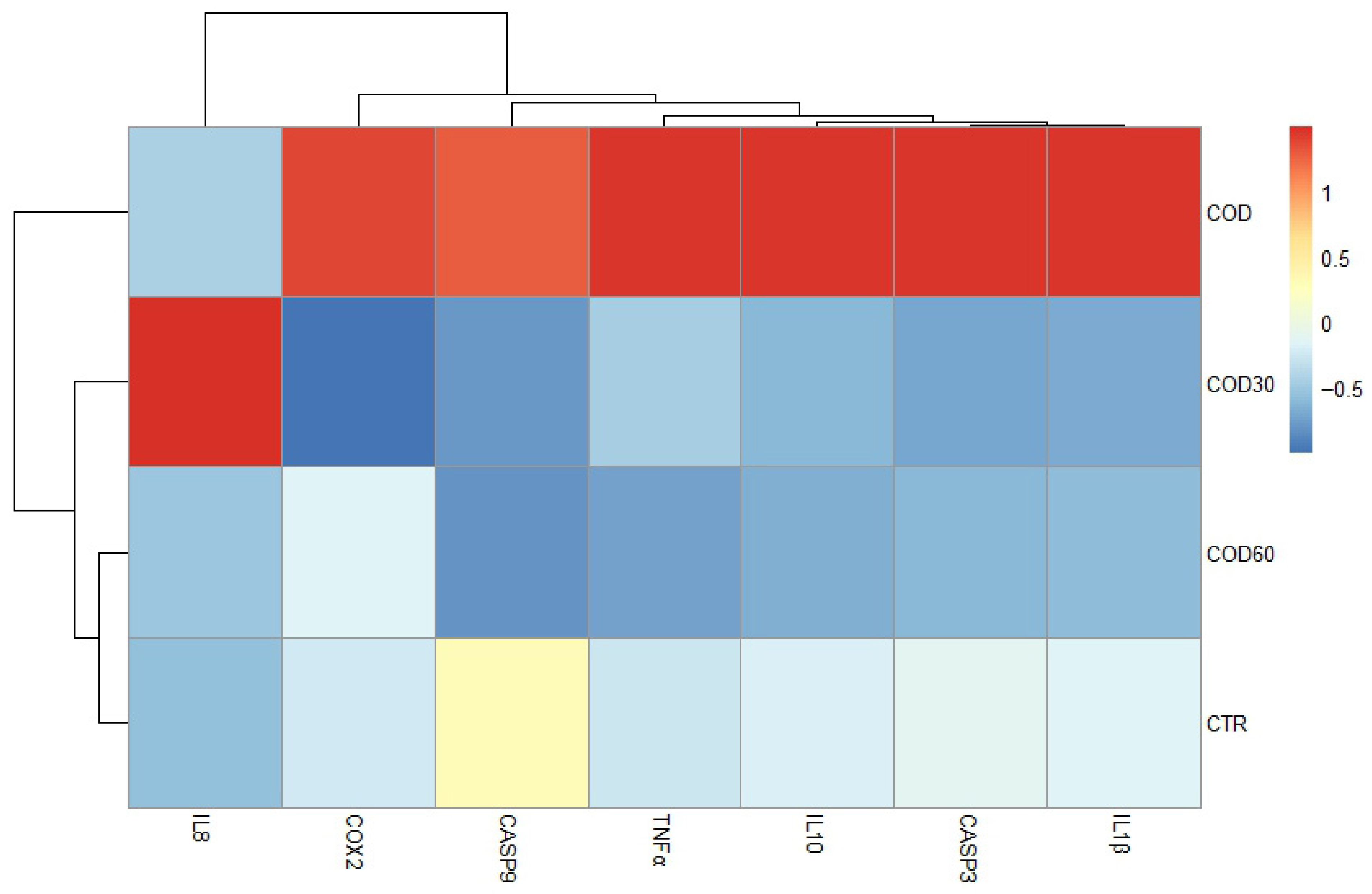
Gene expression data were further analyzed to generate a heatmap using RStudio software (version 4.4.2). To allow comparison of relative response patterns across immune markers, data were normalized by gene using z-score transformation. A heatmap was generated using the “pheatmap” package (version 1.0.12), applying hierarchical clustering to both diets and immune markers using Euclidean distance and complete linkage. This approach enabled visualization of global immune response patterns and the identification of clustering trends among diets.
Microbiota data analysis was made following [40] using the DGGE banding patterns. Band intensity was measured using Quantity One 1-D Analysis Software v4.6.9 (Bio-Rad Laboratories, Amadora, Portugal) and then converted into presence/absence matrices. Primer 7.0.5.5 (Primer-E, Ivybridge, UK) was used to calculate relative similarities between experimental groups and replicates. Non-metric multidimensional scaling (MDS) was performed using Bray–Curtis similarities, accounting for band relative abundances. The MDS representation was deemed reliable, as indicated by a Kruskal stress value below 0.2 [41]. Species diversity was determined using the Shannon-Weaver index; species richness was assessed using Margalef’s diversity index; and relative similarities between groups were depicted using similarity percentages (SIMPER).

3. Results

Previous feeding-trial data in European seabass (Dicentrarchus labrax) fed for 11 weeks showed that dietary inclusion of 7.5% (DM basis) of high-solid loading alkaline autoclave pre-treated C. tomentosum for 30 min improved protein and amino acid digestibility, growth performance, feed efficiency, and protein utilization compared to both control and untreated C. tomentosum diets. In contrast, extending the pre-treatment to 60 min did not provide additional benefits and was associated with reduced digestibility, feed intake, and growth performance.

3.1. Dietary Effects on Oxidative Stress

The intestinal activity of G6PDH, CAT, and GPX was not affected by dietary treatments (Table 3). In contrast, SOD activity was higher in fish fed the COD diet than in those fed the COD60 diet, while GR activity was higher in fish fed the COD30 diet than in those fed the COD60 diet. LPO levels were higher in fish fed the COD30 diets than in those fed the CTR and COD60 diets. tGSH levels were higher in fish fed the COD diet than in those fed the COD30 and COD60 diets, whereas GSH levels were higher in fish fed the COD diet than in all other dietary groups. GSSG levels were higher in fish fed the CTR and COD diets than those fed the COD60 diet, and oxidative stress index (OSI) levels were higher in fish fed the CTR diet than those fed the COD and COD60 diets.
Hepatic activities of G6PDH, CAT, GPX, and GR, as well as LPO and GSSG levels, and OSI, were not affected by dietary treatments (Table 4). Conversely, SOD activity was higher in fish fed the COD diet than in those fed the COD60 diet. Hepatic tGSH level was higher in fish fed the COD30 diet than in those fed the CTR and COD60 diets, while GSH levels were higher in fish fed the COD and COD30 diets than in those fed the COD60 diet.

3.2. Dietary Effects on Innate Immune Parameters

Plasma peroxidase, antiprotease, and protease activities were not affected by dietary treatments (Table 5). In contrast, lysozyme activity was higher in fish fed the COD30 diet than in those fed the COD60 diet.

3.3. Dietary Effects on Immune-Related Gene Expression

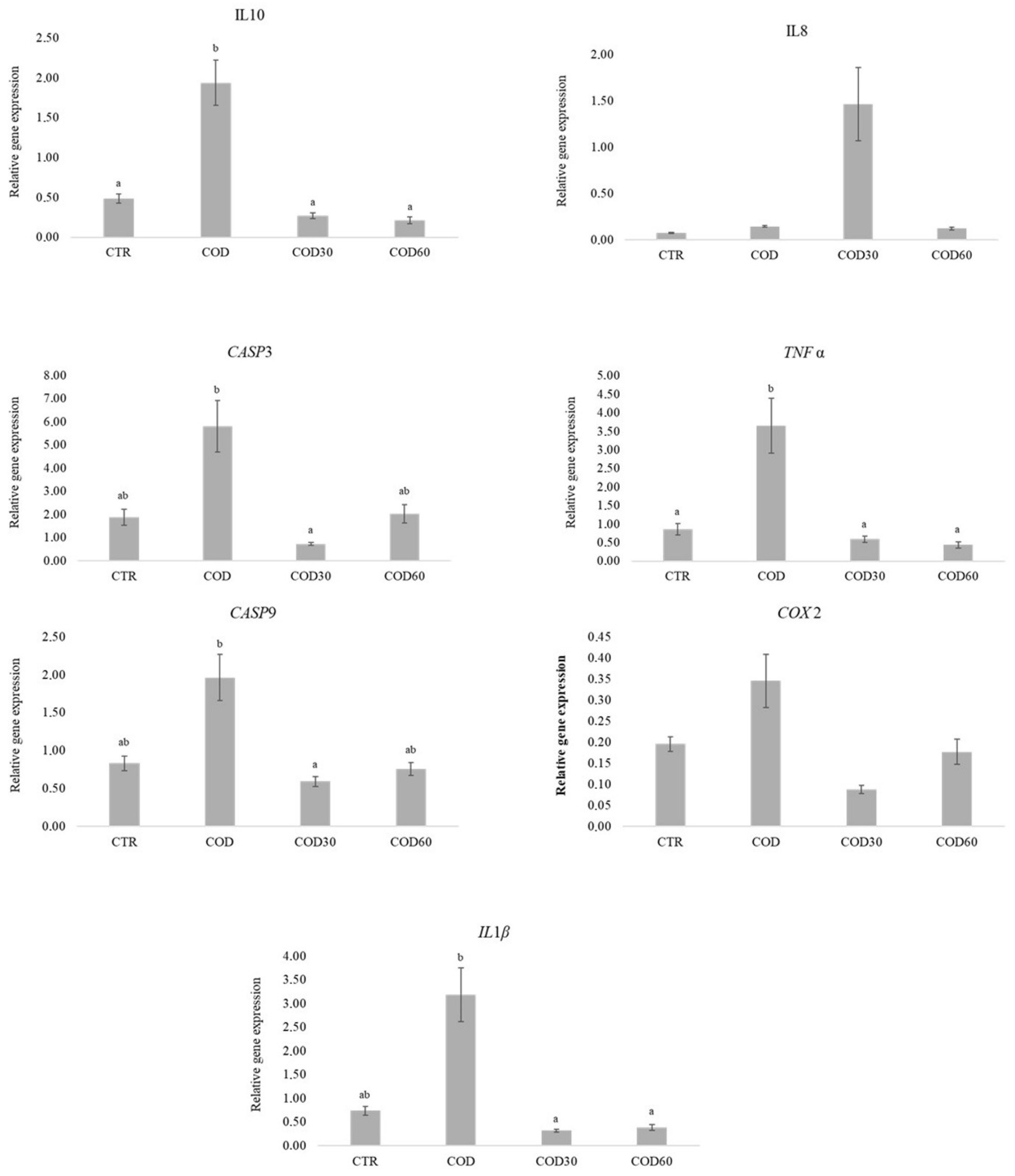
In the distal intestine, dietary treatments did not affect interleukin-8 (IL8) or cyclooxygenase-2 (COX2) gene expression (Figure 1). In contrast, tumor necrosis factor α (TNFα) and interleukin 10 (IL10) expression were higher in fish fed the COD diet than in those fed the other diets, while interleukin-1-beta (IL1β) expression was higher in fish fed the COD diet than in those fed the COD30 and COD60 diets. Caspase 3 (CASP3) and caspase 9 (CASP9) expression were higher in fish fed the COD diet than in those fed the COD30 diet.
The heatmap analysis identified distinct clustering patterns among the diets (Figure 2). European seabass fed the COD diet had high expression levels of most genes, particularly IL8, TNFα, IL10, CASP3, and IL1β, indicated by red colors. In contrast, European seabass fed the COD30 diet showed a marked decrease in gene expression, particularly COX2, CASP9, TNFα, IL10, CASP3, and IL1β, as indicated by blue colors. Fish fed the COD60 diet generally had lower gene expression levels, as indicated by light to medium blue colors, suggesting a moderate downregulation compared to the COD diets. The CTR diet clustered separately, showing consistently low expression levels across all genes, as indicated by very light blue colors, reflecting baseline gene activity. Overall, two main clusters were identified: one grouping the untreated COD diet with high expression, and another grouping all treated (COD30 and COD60) and CTR diets with lower expression profiles.

3.4. Dietary Effects on Microbial Diversity

The number of OTUs, species richness, and species diversity in the intestinal digesta were not significantly affected by dietary treatments (Table 6). However, the similarity percentage was higher in digesta samples from fish fed the COD30 diet than those fed the COD diet. The number of OTUs, species richness, species diversity, and the percentage of similarity in the intestinal mucosa were not significantly affected by dietary treatments.

4. Discussion

Macroalgae are widely recognized as a valuable source of antioxidant compounds [42]. In fish nutrition, dietary inclusion of macroalgae or macroalgae-derived metabolites has been shown to enhance antioxidant status, suggesting a functional role in mitigating oxidative stress [7]. The antioxidant capacity of macroalgae has been associated with the presence of bioactive compounds, including carotenoids, phenolic compounds, and specific polysaccharides [43]. These molecules are highly reactive toward reactive oxygen species (ROS), enabling their neutralization via oxidation and radical scavenging [43].
For C. tomentosum, antioxidant potential has been assessed mainly by using extracts as functional additives rather than by incorporating macroalgal biomass as a functional ingredient. These extracts have shown antioxidant activity in vitro and antiproliferative effects in human Caco-2 cell lines, which may contribute to the prevention or attenuation of oxidative stress-associated conditions [42,44].

4.1. Dietary Effects on Oxidative Stress

In fish, as in other animals, redox homeostasis is maintained by a coordinated antioxidant system comprising enzymatic and non-enzymatic components that mitigate ROS-induced cellular damage [45]. Superoxide dismutase catalyzes the conversion of superoxide radicals into hydrogen peroxide, which is subsequently detoxified by catalase and glutathione peroxidase [46]. Glutathione functions as a key non-enzymatic antioxidant, with its redox balance regulated by glutathione reductase, which requires NADPH primarily supplied by the pentose phosphate pathway via glucose-6-phosphate dehydrogenase [46,47]. In this context, dietary-derived exogenous antioxidants can interact synergistically with endogenous defense mechanisms, helping control excessive ROS generation and reinforcing intestinal redox homeostasis [48,49].
In the present study, dietary inclusion of either untreated or pre-treated C. tomentosum modulated oxidative status in European seabass, particularly in the intestine. Previous work has focused on Codium sp. [50] or Codium sp. polysaccharides [51,52,53]. Consequently, direct comparisons with previous work are limited.
Overall, intestinal LPO in fish fed the COD60 diet was similar to that in fish fed the CTR, but lower than in those fed the COD and COD30 diets, indicating that a 60 min pre-treatment reduced the oxidative stress induced by the dietary inclusion of the macroalgae. However, fish fed the COD30 diet had higher intestinal LPO than those fed the CTR and COD60 diets. This increase may indicate a temporary rise in oxidative activity, potentially associated with enhanced metabolic or immune responses at this inclusion level. In line with this, SOD and GR activities trended to increase, likely as a compensatory response to higher ROS production. Still, this upregulation was not sufficient to prevent the rise in LPO. Notably, the higher intestinal LPO in the COD30 group was accompanied by lower inflammatory gene expression compared to the untreated COD diet. This may indicate that oxidative status and immune modulation were not strictly coupled under these conditions and warrant further study. In contrast, this dissociation was not observed in fish fed the COD60 diet, suggesting that a 60 min rather than a 30 min prolonged alkaline pretreatment may mitigate oxidative imbalance. Under most physiological and pathological conditions, oxidative stress and inflammation are interconnected, as increased ROS production typically promotes inflammatory responses [54].
On the other hand, OSI was higher in fish fed the CTR than in those fed the macroalgae diets, suggesting that dietary macroalgae inclusion reduced chronic stress associated with the CTR. While not statistically significant, in absolute terms, SOD and GR activities were lower in fish fed the COD60 diet than in those fed the CTR, suggesting reduced requirements for ROS detoxification under lower oxidative challenge conditions, as previously observed in fish fed antioxidant-supplemented diets [7]. Both in the liver and intestine, fish fed the COD60 diet exhibited lower SOD activity and GSH and tGSH levels than fish fed the COD diet, suggesting lower oxidative stress in fish fed the pre-treated than the untreated macroalgae.
Previously, we showed that high-solid-loading alkaline treatment of C. tomentosum reduced fiber content and increased soluble protein and phenolic compound concentration [29]. This may have contributed to the lower intestinal oxidative pressure observed in fish fed the COD60 diet compared to the other diets. Indeed, excessive dietary fiber has been associated with increased intestinal oxidative stress in fish, as observed in European seabass [55], carp [56], and gilthead sea bream [55]. Moreover, increased levels of bioactive compounds in macroalgae have also been associated with reduced oxidative stress [57], further supporting the potential role of processing in modulating redox responses.
The intestine shows a greater susceptibility to oxidative imbalance than the liver, consistent with its high epithelial turnover rate and continuous exposure to dietary pro- and antioxidant components [58,59]. This is well reflected in the LPO and OSI levels, which were higher in the intestine than in the liver.
Moreover, antioxidant defense mechanisms in European seabass exhibit tissue-specific responses, with distinct regulatory patterns in the liver and intestine [58,60]. In the present study, SOD, CAT, and GR activities were higher in the intestine than in the liver. In contrast, GSSG, tGSH, and GSH levels were higher in the liver. The higher hepatic GSH concentrations likely reflect the liver’s central function in glutathione synthesis and distribution [47]. The observed response patterns indicate that these two tissues use different central mechanisms (enzymatic in the intestine and non-enzymatic in the liver) to respond to oxidative stress. Comparable patterns of oxidative stress and LPO susceptibility have been previously observed in European seabass [60] and gilthead seabream [61].

4.2. Dietary Effects on Innate Immune Parameters

Macroalgae and their bioactive compounds have been reported to modulate both humoral immune parameters and immune-related gene expression in fish [48]. Dietary oligosaccharides and macroalgal polysaccharides have been linked to enhancing lysozyme activity in aquatic species [62], including polysaccharides from Codium fragile in olive flounder (Paralichthys olivaceus), and from Ulva lactuca, Ulva ohnoi, or Padina boergesenii in Nile tilapia (Oreochromis niloticus) and Senegalese sole (Solea senegalensis) [52,63,64,65].
In the present study, only lysozyme activity was affected by dietary macroalgae inclusion, being higher in fish fed the COD30 diet than in those fed the other diets. Increases in lysozyme activity have also been reported in European seabass fed moderate levels of U. intestinalis and U. ohnoi [66,67] as well as in rainbow trout fed G. persica, Hypnea flagelliformis, or S. boveanum [68].

4.3. Dietary Effects on Immune-Related Gene Expression

Fish fed the COD diet showed higher intestinal expression of immune-related genes, particularly TNF-α and IL-10, than fish fed the other diets. In addition, IL1β expression was higher in fish fed the COD than in those fed the diets including the pre-treated macroalgae, in which cytokine expression remained at comparatively lower levels. In absolute values, the expression of the apoptotic markers CASP3 and CASP9 was also higher in fish fed the COD diet than in those fed the other diets, although the difference was only statistically significant compared to that in fish fed the COD30 diet. Notably, although fish fed the COD30 diet exhibited increased oxidative damage, this was not accompanied by upregulation of pro-inflammatory cytokines, suggesting a contradictory pattern between oxidative and immune responses in fish fed the COD30 diet, which was not observed in fish fed the COD60 diet, where both oxidative damage and intestinal inflammatory responses were reduced compared to the untreated C. tomentosum diet.
These expression patterns are consistently reflected in the hierarchical clustering heatmap (Figure 2), which highlights the overall downregulation and clustering of immune- and apoptotic-related markers in fish fed pre-treated macroalgae diets, likely associated with altered structural or chemical profiles of bioactive compounds in the macroalgae.
The upregulation of pro-inflammatory cytokines and apoptotic markers in fish fed the untreated macroalgae is consistent with previous reports. Diets containing G. persica, H. flagelliformis, and S. boveanum upregulated TNF-α and IL1β expression in rainbow trout [68], and Halopithys incurva induced an upregulation of TNF-α and IL1β expression in zebrafish [48]. Conversely, diets including fermented Rugulopteryx okamurae or fermented G. corneum did not affect intestinal expression of IL8, IL10, TNF-α, or CASP3 expression in European seabass [2,69].

4.4. Dietary Effects on Microbial Diversity

The gut microbiota plays a central role in fish growth, nutrition, immune function, and protection against pathogens [70,71]. Comprising diverse microbial communities, the fish gastrointestinal tract modulates key physiological processes and overall host health [72]. Diet is a significant factor shaping the composition and activity of these communities, and dietary interventions can have significant effects on performance and welfare [30]. Among potential dietary modulators, macroalgae have attracted attention for their ability to influence gut microbiota and host physiology [73]. However, in the present study, dietary treatments did not significantly affect OTUs, species richness, or diversity in either the digesta- or mucosa-associated microbiota of European seabass. Nonetheless, the within-group similarity of the digesta-associated microbiota was higher in fish fed the COD30 diet than in those fed the COD diet.
In European seabass, dietary incorporation of unfermented and fermented G. corneum induced changes in intestinal microbiota. Fish fed the unfermented macroalgae showed increased microbial OTUs and richness [2]. Also, diets containing 5% untreated or fermented R. okamurae with S. cerevisiae and B. subtilis increased diversity and richness indices, with the crude macroalgae diet showing a stronger effect than the fermented macroalgae diet [69]. In other marine species, the inclusion of 5% U. ohnoi in diets for Senegalese sole did not markedly affect gut microbial diversity [73]. In another study, however, a lower dietary inclusion (<3%) of U. ohnoi significantly increased gut microbiota diversity in Senegalese sole [74].

5. Conclusions

Dietary inclusion of C. tomentosum induced pre-treatment dependent responses in European seabass. Compared with the untreated macroalga diet (COD), the 60 min high-solid-loading alkaline pre-treatment (COD60) significantly reduced intestinal oxidative damage and attenuated distal intestine inflammatory and apoptotic gene expression. In contrast, the 30 min pre-treatment (COD30) increased oxidative damage without upregulating pro-inflammatory cytokines, suggesting a dissociation between oxidative and immune responses. Plasma lysozyme activity increased in COD30, whereas in COD60 it returned to levels comparable to those in COD. Overall, these results support 60 min pre-treatment as a beneficial processing strategy to improve the intestinal response to dietary C. tomentosum. Future studies combining next-generation sequencing of the gut microbiota with targeted mechanistic analyses are needed to clarify how high-solid-loading alkaline pre-treatment of C. tomentosum modulates the link between oxidative stress and immune responses.

Supplementary Materials

The following supporting information can be downloaded at: https://www.mdpi.com/article/10.3390/fishes11030151/s1, Table S1: Proximate analysis and pH of the untreated and pre-treated C. tomentosum used in the diets for European seabass.

Author Contributions

Conceptualization, C.R.-O., I.B., A.O.-T. and H.P.; Methodology, C.R.-O., I.B., A.O.-T. and H.P.; Validation, I.B., A.O.-T. and H.P.; Formal analysis, C.R.-O., R.M. and C.S.; Investigation, C.R.-O.; Resources, H.P.; Writing—original draft, C.R.-O.; Writing—review & editing, R.M., C.S., I.B., A.O.-T. and H.P.; Visualization, H.P.; Supervision, I.B., A.O.-T. and H.P.; Project administration, H.P.; Funding acquisition, H.P. All authors have read and agreed to the published version of the manuscript.

Funding

This work was funding by the project “MB4Aqua: Macroalgae biorefinery: a novel approach to produce sustainable feedstuffs and functional additives towards low carbon footprint aquafeeds”, reference 2022.06587.PTDC, funded by Fundação para a Ciência e Tecnologia (FCT). Ramos-Oliveira C. was supported by an FCT grant (2021.04809.BD).

Institutional Review Board Statement

The Portuguese National Authority for Animal Health (DGAV), along with the ORBEA Animal Welfare Committee of CIIMAR, under the reference ORBEA_CIIMAR_27_2019, approved this study (Approval date: 22 April 2020). Animal handling and experimental protocols complied with the recommendations of the Federation of Laboratory Animal Science Associations (FELASA), the EU Directive (2010/63/EU), and Portuguese Decree Law 113/2013. This manuscript was prepared in accordance with the ARRIVE 2.0 reporting guidelines.

Informed Consent Statement

Not applicable.

Data Availability Statement

The original contributions presented in this study are included in the article and Supplementary Materials. Further inquiries can be directed to the corresponding author.

Conflicts of Interest

The authors declare no conflicts of interest.

References

  1. Harikrishnan, R.; Devi, G.; Van Doan, H.; Balasundaram, C.; Arockiaraj, J.; Jagruthi, C. Efficacy of Ulvan on Immune Response and Immuno-Antioxidant Gene Modulation in Labeo Rohita against Columnaris Disease. Fish Shellfish Immunol. 2021, 117, 262–273. [Google Scholar] [CrossRef]
  2. Ferreira, M.; Ramos-Oliveira, C.; Magalhães, R.; Martins, N.; Serra, C.R.; Salgado, J.M.; Belo, I.; Oliva-Teles, A.; Peres, H. Effects of Solid-State Fermentation of Gelidium Corneum by-Product on Immune Status and Gut Microbiota in European Seabass. Anim. Feed Sci. Technol. 2025, 324, 116332. [Google Scholar] [CrossRef]
  3. Galindo, A.; Pérez, J.A.; Martín, V.; Acosta, N.G.; Reis, D.B.; Jiménez, I.A.; Rosa, G.; Venuleo, M.; Marrero, M.; Rodríguez, C. Effect of Feed Supplementation with Seaweed Wracks on Performance, Muscle Lipid Composition, Antioxidant Status, Digestive Enzyme Activities, and Plasma Biochemistry of Gilthead Seabream (Sparus aurata) Juveniles. Aquac. Rep. 2023, 31, 101673. [Google Scholar] [CrossRef]
  4. Norambuena, F.; Hermon, K.; Skrzypczyk, V.; Emery, J.A.; Sharon, Y.; Beard, A.; Turchini, G.M. Algae in Fish Feed: Performances and Fatty Acid Metabolism in Juvenile Atlantic Salmon. PLoS ONE 2015, 10, e0124042. [Google Scholar] [CrossRef]
  5. Rouhani, E.; Safari, R.; Imanpour, M.R.; Hoseinifar, S.H.; Yazici, M.; El-Haroun, E. Effect of Dietary Administration of Green Macroalgae (Ulva intestinalis) on Mucosal and Systemic Immune Parameters, Antioxidant Defence, and Related Gene Expression in Zebrafish (Danio rerio). Aquac. Nutr. 2022, 2022, 7693468. [Google Scholar] [CrossRef] [PubMed]
  6. Kostas, E.T.; White, D.A.; Cook, D.J. Development of a Bio-Refinery Process for the Production of Speciality Chemical, Biofuel and Bioactive Compounds from Laminaria Digitata. Algal Res. 2017, 28, 211–219. [Google Scholar] [CrossRef]
  7. Siddik, M.A.B.; Francis, P.; Rohani, M.F.; Azam, M.S.; Mock, T.S.; Francis, D.S. Seaweed and Seaweed-Based Functional Metabolites as Potential Modulators of Growth, Immune and Antioxidant Responses, and Gut Microbiota in Fish. Antioxidants 2023, 12, 2066. [Google Scholar] [CrossRef] [PubMed]
  8. Xuan, X.; Wen, X.; Li, S.; Zhu, D.; Li, Y. Potential Use of Macro-Algae Gracilaria lemaneiformis in Diets for the Black Sea Bream, Acanthopagrus schlegelii, Juvenile. Aquaculture 2013, 412–413, 167–172. [Google Scholar] [CrossRef]
  9. Ferreira, M.; Ribeiro, P.C.; Ribeiro, L.; Barata, M.; Domingues, V.F.; Sousa, S.; Soares, C.; Marques, A.; Pousão-Ferreira, P.; Dias, J.; et al. Biofortified Diets Containing Algae and Selenised Yeast: Effects on Growth Performance, Nutrient Utilization, and Tissue Composition of Gilthead seabream (Sparus aurata). Front. Physiol. 2022, 12, 812884. [Google Scholar] [CrossRef]
  10. Thépot, V.; Campbell, A.H.; Rimmer, M.A.; Paul, N.A. Meta-Analysis of the Use of Seaweeds and Their Extracts as Immunostimulants for Fish: A Systematic Review. Rev. Aquac. 2021, 13, 907–933. [Google Scholar] [CrossRef]
  11. Scapigliati, G.; Romano, N.; Buonocore, F.; Picchietti, S.; Baldassini, M.R.; Prugnoli, D.; Galice, A.; Meloni, S.; Secombes, C.J.; Mazzini, M.; et al. The Immune System of Sea Bass, Dicentrarchus Labrax, Reared in Aquaculture. Dev. Comp. Immunol. 2002, 26, 151–160. [Google Scholar] [CrossRef]
  12. Cadar, E.; Popescu, A.; Dragan, A.M.L.; Pesterau, A.M.; Pascale, C.; Anuta, V.; Prasacu, I.; Velescu, B.S.; Tomescu, C.L.; Bogdan-Andreescu, C.F.; et al. Bioactive Compounds of Marine Algae and Their Potential Health and Nutraceutical Applications: A Review. Mar. Drugs 2025, 23, 152. [Google Scholar] [CrossRef] [PubMed]
  13. Cadar, E.; Negreanu-Pirjol, T.; Sirbu, R.; Dragan, A.M.L.; Negreanu-Pirjol, B.S.; Axente, E.R.; Ionescu, A.M. Biocompounds from Green Algae of Romanian Black Sea Coast as Potential Nutraceuticals. Processes 2023, 11, 1750. [Google Scholar] [CrossRef]
  14. Subramoni, M.; Kumar, S.; Abraham, J.P. Nutritional Content of Selected Macroalgae of the South-West Coast of India. Egypt. J. Phycol. 2023, 24, 161–193. [Google Scholar] [CrossRef]
  15. Moreira, A.; Cruz, S.; Marques, R.; Cartaxana, P. The Underexplored Potential of Green Macroalgae in Aquaculture. Rev. Aquac. 2022, 14, 5–26. [Google Scholar] [CrossRef]
  16. Kalavathy, G.; Baskar, G.; Phoebe, M.G.L.; Muthaszeer, A.M.; Subashini, S.; Chang, S.K. Formulation of Topical Ointment Using Seaweed Extracts of Ulva Lactuca and Codium tomentosum and Their Physicochemical, Antioxidant, Antiinflammatory, Antibacterial and Wound Healing Properties. Waste Biomass Valorization 2025, 16, 6133–6144. [Google Scholar] [CrossRef]
  17. Fernandes, H.; Martins, N.; Vieira, L.; Salgado, J.M.; Castro, C.; Oliva-Teles, A.; Belo, I.; Peres, H. Pre-Treatment of Ulva Rigida Improves Its Nutritional Value for European Seabass (Dicentrarchus labrax) Juveniles. Algal Res. 2022, 66, 102803. [Google Scholar] [CrossRef]
  18. Pandey, D.; Næss, G.; Fonseca, A.J.M.; Maia, M.R.G.; Cabrita, A.R.J.; Khanal, P. Differential Impacts of Post-Harvest Hydrothermal Treatments on Chemical Composition and in Vitro Digestibility of Two Brown Macroalgae (Fucales, Phaeophyceae), Ascophyllum nodosum and Fucus vesiculosus, for Animal Feed Applications. J. Appl. Phycol. 2023, 35, 2511–2529. [Google Scholar] [CrossRef]
  19. Agboola, J.O.; Teuling, E.; Wierenga, P.A.; Gruppen, H.; Schrama, J.W. Cell Wall Disruption: An Effective Strategy to Improve the Nutritive Quality of Microalgae in African catfish (Clarias gariepinus). Aquac. Nutr. 2019, 25, 783–797. [Google Scholar] [CrossRef]
  20. Ometto, F.; Quiroga, G.; Pšenička, P.; Whitton, R.; Jefferson, B.; Villa, R. Impacts of Microalgae Pre-Treatments for Improved Anaerobic Digestion: Thermal Treatment, Thermal Hydrolysis, Ultrasound and Enzymatic Hydrolysis. Water Res. 2014, 65, 350–361. [Google Scholar] [CrossRef]
  21. Santos, F.; Soares, C.; Morais, S.L.; Neves, C.; Grosso, C.; Ramalhosa, M.J.; Vieira, M.; Delerue-Matos, C.; Domingues, V.F. Optimized Extraction Protocols for Bioactive Antioxidants from Commercial Seaweeds in Portugal: A Comparative Study of Techniques. Foods 2025, 14, 453. [Google Scholar] [CrossRef] [PubMed]
  22. Luo, X.; Chen, H.; Mi, J.; Li, X.; Wu, Z.; Jiang, Y.; Dong, X. Process Optimization for Polyphenol Extraction from Macroalgae Residues and Assessment of Their Compositions, Antioxidant Activities, and Glycosidase Inhibition. Foods 2025, 14, 3055. [Google Scholar] [CrossRef] [PubMed]
  23. Ghadiryanfar, M.; Rosentrater, K.A.; Keyhani, A.; Omid, M. A Review of Macroalgae Production, with Potential Applications in Biofuels and Bioenergy. Renew. Sustain. Energy Rev. 2016, 54, 473–481. [Google Scholar] [CrossRef]
  24. Arias, A.; Feijoo, G.; Moreira, M.T. Macroalgae Biorefineries as a Sustainable Resource in the Extraction of Value-Added Compounds. Algal Res. 2023, 69, 102954. [Google Scholar] [CrossRef]
  25. Quitério, E.; Grosso, C.; Ferraz, R.; Delerue-Matos, C.; Soares, C. A Critical Comparison of the Advanced Extraction Techniques Applied to Obtain Health-Promoting Compounds from Seaweeds. Mar. Drugs 2022, 20, 677. [Google Scholar] [CrossRef]
  26. Shiva; Climent Barba, F.; Rodríguez-Jasso, R.M.; Sukumaran, R.K.; Ruiz, H.A. High-Solids Loading Processing for an Integrated Lignocellulosic Biorefinery: Effects of Transport Phenomena and Rheology—A Review. Bioresour. Technol. 2022, 351, 127044. [Google Scholar] [CrossRef]
  27. Modenbach, A.A.; Nokes, S.E. Enzymatic Hydrolysis of Biomass at High-Solids Loadings—A Review. Biomass Bioenergy 2013, 56, 526–544. [Google Scholar] [CrossRef]
  28. Zhang, B.; Liu, X.; Bao, J. High Solids Loading Pretreatment: The Core of Lignocellulose Biorefinery as an Industrial Technology—An Overview. Bioresour. Technol. 2023, 369, 128334. [Google Scholar] [CrossRef]
  29. Ramos-Oliveira, C.; Ferreira, M.; Belo, I.; Oliva-Teles, A.; Peres, H. Effectiveness of High-Solid Loading Treatments to Enhance Nutrient and Antioxidant Bioavailability in Codium tomentosum. Phycology 2025, 5, 69. [Google Scholar] [CrossRef]
  30. Serra, C.R.; Oliva-Teles, A.; Enes, P.; Tavares, F. Gut Microbiota Dynamics in Carnivorous European Seabass (Dicentrarchus labrax) Fed Plant-Based Diets. Sci. Rep. 2021, 11, 447. [Google Scholar] [CrossRef]
  31. Van Soest, P.J.; Robertson, J.B.; Lewis, B.A. Methods for Dietary Fiber, Neutral Detergent Fiber, and Nonstarch Polysaccharides in Relation to Animal Nutrition. J. Dairy Sci. 1991, 74, 3583–3597. [Google Scholar] [CrossRef]
  32. Bradford, M.M. A Rapid and Sensitive Method for the Quantitation of Microgram Quantities of Protein Utilizing the Principle of Protein-Dye Binding. Anal. Biochem. 1976, 72, 248–254. [Google Scholar] [CrossRef] [PubMed]
  33. Pérez-Ruzafa, A.; Marcos, C. Fisheries in Coastal Lagoons: An Assumed but Poorly Researched Aspect of the Ecology and Functioning of Coastal Lagoons. Estuar. Coast. Shelf Sci. 2012, 110, 15–31. [Google Scholar] [CrossRef]
  34. Buege, J.A.; Aust, S.D. Microsomal Lipid Peroxidation. Methods Enzymol. 1978, 52, 302–310. [Google Scholar] [CrossRef] [PubMed]
  35. Magalhães, R.; Guardiola, F.A.; Guerreiro, I.; Fontinha, F.; Moutinho, S.; Olsen, R.E.; Peres, H.; Oliva-Teles, A. Effect of Different Dietary Arachidonic, Eicosapentaenoic, and Docosahexaenoic Acid Content on Selected Immune Parameters in Gilthead Sea Bream (Sparus aurata). Fish Shellfish Immunol. Rep. 2021, 2, 100014. [Google Scholar] [CrossRef] [PubMed]
  36. Valero, Y.; García-Alcázar, A.; Esteban, M.Á.; Cuesta, A.; Chaves-Pozo, E. Seasonal Variations of the Humoral Immune Parameters of European Sea Bass (Dicentrarchus labrax L.). Fish Shellfish Immunol. 2014, 39, 185–187. [Google Scholar] [CrossRef]
  37. Xie, F.; Wang, J.; Zhang, B. RefFinder: A Web-Based Tool for Comprehensively Analyzing and Identifying Reference Genes. Funct. Integr. Genom. 2023, 23, 125. [Google Scholar] [CrossRef]
  38. Vandesompele, J.; De Preter, K.; Pattyn, F.; Poppe, B.; Van Roy, N.; De Paepe, A.; Speleman, F. Accurate Normalization of Real-Time Quantitative RT-PCR Data by Geometric Averaging of Multiple Internal Control Genes. Genome Biol. 2002, 3, research0034.1. [Google Scholar] [CrossRef]
  39. Muyzer, G.; De Waal, E.C.; Uitterlinden, A.G. Profiling of Complex Microbial Populations by Denaturing Gradient Gel Electrophoresis Analysis of Polymerase Chain Reaction-Amplified Genes Coding for 16S RRNA. Appl. Environ. Microbiol. 1993, 59, 695–700. [Google Scholar] [CrossRef]
  40. Serra, C.R.; Magalhães Júnior, F.; Couto, A.; Oliva-Teles, A.; Enes, P. Gut Microbiota and Gut Morphology of Gilthead Sea Bream (Sparus aurata) Juveniles Are Not Affected by Chromic Oxide as Digestibility Marker. Aquac. Res. 2018, 49, 1347–1356. [Google Scholar] [CrossRef]
  41. Clarke, K.; Gorley, R.; Somerfield, P.; Warwick, R. Change in Marine Communities: An Approach to Statistical Analysis and Interpretation, 3rd ed.; Primer-E Ltd.: Plymouth, UK, 2014. [Google Scholar]
  42. El Hafez, M.S.M.A.; Rashedy, S.H.; Abdelmotilib, N.M.; El-Hassayeb, H.E.A.; Cotas, J.; Pereira, L. Fillet Fish Fortified with Algal Extracts of Codium tomentosum and Actinotrichia fragilis, as a Potential Antibacterial and Antioxidant Food Supplement. Mar. Drugs 2022, 20, 785. [Google Scholar] [CrossRef] [PubMed]
  43. Gómez-Guzmán, M.; Rodríguez-Nogales, A.; Algieri, F.; Gálvez, J. Potential Role of Seaweed Polyphenols in Cardiovascular-Associated Disorders. Mar. Drugs 2018, 16, 250. [Google Scholar] [CrossRef]
  44. Alghazeer, R.; Ibrahim, A.; Abdulaziz, A.; Abouamer, K. In-Vitro Antioxidant Activity of Five Selected Species of Libyan Algae. Int. J. Med. Pharm. Res. 2016, 4, 1–9. [Google Scholar]
  45. Regoli, F.; Giuliani, M.E. Oxidative Pathways of Chemical Toxicity and Oxidative Stress Biomarkers in Marine Organisms. Mar. Environ. Res. 2014, 93, 106–117. [Google Scholar] [CrossRef] [PubMed]
  46. El-Aal, H.A.H.M.A. Lipid Peroxidation End-Products as a Key of Oxidative Stress: Effect of Antioxidant on Their Production and Transfer of Free Radicals. In Lipid Peroxidation; Intechopen: London, UK, 2012. [Google Scholar] [CrossRef]
  47. Wu, G.; Fang, Y.Z.; Yang, S.; Lupton, J.R.; Turner, N.D. Glutathione Metabolism and Its Implications for Health. J. Nutr. 2004, 134, 489–492. [Google Scholar] [CrossRef]
  48. Hoseinifar, S.H.; Fazelan, Z.; Bayani, M.; Yousefi, M.; Van Doan, H.; Yazici, M. Dietary Red Macroalgae (Halopithys incurva) Improved Systemic an Mucosal Immune and Antioxidant Parameters and Modulated Related Gene Expression in Zebrafish (Danio rerio). Fish Shellfish Immunol. 2022, 123, 164–171. [Google Scholar] [CrossRef]
  49. Rufchaei, R.; Nedaei, S.; Hoseinifar, S.H.; Hassanpour, S.; Golshan, M.; Sayad Bourani, M. Improved Growth Performance, Serum and Mucosal Immunity, Haematology and Antioxidant Capacity in Pikeperch (Sander lucioperca) Using Dietary Water Hyacinth (Eichhornia crassipes) Leaf Powder. Aquac. Res. 2021, 52, 2194–2204. [Google Scholar] [CrossRef]
  50. Guerreiro, I.; Fontinha, F.; Monteiro, M.; Oliveira, J.; Marçal, R.; Magalhães, R.; Pacheco, M.; Soula, M.; Oliva-Teles, A.; Enes, P.; et al. Towards Sustainable Aquafeeds: Valorization of Codium Sp. and Osmundea Sp. as Functional Ingredients to Enhance Nutrient and Bioactive Compounds in European Seabass. J. Mar. Sci. Eng. 2025, 13, 1884. [Google Scholar] [CrossRef]
  51. Wang, L.; Oh, J.Y.; Je, J.G.; Jayawardena, T.U.; Kim, Y.S.; Ko, J.Y.; Fu, X.; Jeon, Y.J. Protective Effects of Sulfated Polysaccharides Isolated from the Enzymatic Digest of Codium Fragile against Hydrogen Peroxide-Induced Oxidative Stress in in Vitro and in Vivo Models. Algal Res. 2020, 48, 101891. [Google Scholar] [CrossRef]
  52. Yang, Y.; Park, J.; You, S.G.; Hong, S. Immuno-Stimulatory Effects of Sulfated Polysaccharides Isolated from Codium Fragile in Olive Flounder, Paralichthys Olivaceus. Fish Shellfish Immunol. 2019, 87, 609–614. [Google Scholar] [CrossRef]
  53. Yang, Y.; Lim, J.; Li, C.; Lee, S.; Hong, S. Effects of Sulfated Polysaccharides Isolated from Codium Fragile on Inflammatory Cytokine Gene Expression and Edwardsiella Tarda Infection in Rockfish, Sebastes Schlegelii. Fish Shellfish Immunol. 2021, 112, 125–134. [Google Scholar] [CrossRef] [PubMed]
  54. Biller-Takahashi, J.D.; Takahashi, L.S.; Mingatto, F.E.; Urbinati, E.C. The Immune System Is Limited by Oxidative Stress: Dietary Selenium Promotes Optimal Antioxidative Status and Greatest Immune Defense in Pacu Piaractus Mesopotamicus. Fish Shellfish Immunol. 2015, 47, 360–367. [Google Scholar] [CrossRef] [PubMed]
  55. Ayhan, V.; Diler, I.; Arabaci, M.; Sevgili, H. Enzyme Supplementation to Soybean Based Diet in Gilthead Sea Bream (Sparus aurata): Effects on Growth Parameters and Nitrogen and Phosphorus Excretion. Kafkas Univ. Vet. Fak. Derg. 2008, 14, 161–168. [Google Scholar] [CrossRef]
  56. Monier, M.N. Efficacy of Dietary Exogenous Enzyme Supplementation on Growth Performance, Antioxidant Activity, and Digestive Enzymes of Common Carp (Cyprinus carpio) Fry. Fish Physiol. Biochem. 2020, 46, 713–723. [Google Scholar] [CrossRef]
  57. Pezeshk, F.; Babaei, S.; Abedian Kenari, A.; Hedayati, M.; Naseri, M. The Effect of Supplementing Diets with Extracts Derived from Three Different Species of Macroalgae on Growth, Thermal Stress Resistance, Antioxidant Enzyme Activities and Skin Colour of Electric Yellow Cichlid (Labidochromis caeruleus). Aquac. Nutr. 2019, 25, 436–443. [Google Scholar] [CrossRef]
  58. Castro, C.; Coutinho, F.; Iglesias, P.; Oliva-Teles, A.; Couto, A. Chlorella Sp. and Nannochloropsis Sp. Inclusion in Plant-Based Diets Modulate the Intestine and Liver Antioxidant Mechanisms of European Sea Bass Juveniles. Front. Vet. Sci. 2020, 7, 607575. [Google Scholar] [CrossRef]
  59. Halliwell, B.; Zhao, K.; Whiteman, M. The Gastrointestinal Tract: A Major Site of Antioxidant Action? Free Radic. Res. 2000, 33, 819–830. [Google Scholar] [CrossRef]
  60. Castro, C.; Peréz-Jiménez, A.; Coutinho, F.; Díaz-Rosales, P.; Serra, C.A.D.R.; Panserat, S.; Corraze, G.; Peres, H.; Oliva-Teles, A. Dietary Carbohydrate and Lipid Sources Affect Differently the Oxidative Status of European Sea Bass (Dicentrarchus labrax) Juveniles. Br. J. Nutr. 2015, 114, 1584–1593. [Google Scholar] [CrossRef]
  61. Coutinho, F.; Castro, C.; Rufino-Palomares, E.; Ordóñez-Grande, B.; Gallardo, M.A.; Oliva-Teles, A.; Peres, H. Dietary Glutamine Supplementation Effects on Amino Acid Metabolism, Intestinal Nutrient Absorption Capacity and Antioxidant Response of Gilthead Sea Bream (Sparus aurata) Juveniles. Comp. Biochem. Physiol. A Mol. Integr. Physiol. 2016, 191, 9–17. [Google Scholar] [CrossRef]
  62. Bakky, M.A.H.; Yi, P.; Tran, N.T.; Sun, Q.; Zhang, M.; Zhang, Y.; Li, S. Polysaccharide-Induced Immunoregulation, Signaling Pathways, and Stress Mitigation in Aquaculture Animals: A Review. Rev. Aquac. 2025, 17, e70008. [Google Scholar] [CrossRef]
  63. Ashour, M.; Mabrouk, M.M.; Ayoub, H.F.; El-Feky, M.M.M.M.; Zaki, S.Z.; Hoseinifar, S.H.; Rossi, W.; Van Doan, H.; El-Haroun, E.; Goda, A.M.A.S. Effect of Dietary Seaweed Extract Supplementation on Growth, Feed Utilization, Hematological Indices, and Non-Specific Immunity of Nile Tilapia, Oreochromis Niloticus Challenged with Aeromonas Hydrophila. J. Appl. Phycol. 2020, 32, 3467–3479. [Google Scholar] [CrossRef]
  64. Cholaraj, R.; Venkatachalam, R. The Effect of Polysaccharide from Padina Boergesenii on Aeromonas Hydrophila Resistance and Growth, Biochemical, Digestive Enzymes, Non-Specific Immune Response in Oreochromis Niloticus. Bioact. Carbohydr. Diet. Fibre 2023, 30, 100357. [Google Scholar] [CrossRef]
  65. Ponce, M.; Anguís, V.; Fernández-Díaz, C. Assessing the Role of Ulvan as Immunonutrient in Solea Senegalensis. Fish Shellfish Immunol. 2024, 146, 109399. [Google Scholar] [CrossRef] [PubMed]
  66. Martínez-Antequera, F.P.; Martos-Sitcha, J.A.; Reyna, J.M.; Moyano, F.J. Evaluation of the Inclusion of the Green Seaweed Ulva Ohnoi as an Ingredient in Feeds for Gilthead Sea Bream (Sparus aurata) and European Sea Bass (Dicentrarchus labrax). Animals 2021, 11, 1684. [Google Scholar] [CrossRef] [PubMed]
  67. Peixoto, M.J.; Svendsen, J.C.; Malte, H.; Pereira, L.F.; Carvalho, P.; Pereira, R.; Gonçalves, J.F.M.; Ozório, R.O.A. Diets Supplemented with Seaweed Affect Metabolic Rate, Innate Immune, and Antioxidant Responses, but Not Individual Growth Rate in European Seabass (Dicentrarchus labrax). J. Appl. Phycol. 2016, 28, 2061–2071. [Google Scholar] [CrossRef]
  68. Vazirzadeh, A.; Marhamati, A.; Rabiee, R.; Faggio, C. Immunomodulation, Antioxidant Enhancement and Immune Genes up-Regulation in Rainbow Trout (Oncorhynchus mykiss) Fed on Seaweeds Included Diets. Fish Shellfish Immunol. 2020, 106, 852–858. [Google Scholar] [CrossRef]
  69. Fonseca, F.; Fuentes, J.; Vizcaíno, A.J.; Alarcón, F.J.; Mancera, J.M.; Martínez-Rodríguez, G.; Martos-Sitcha, J.A. From Invasion to Fish Fodder: Inclusion of the Brown Algae Rugulopteryx Okamurae in Aquafeeds for European Sea Bass Dicentrarchus labrax (L., 1758). Aquaculture 2023, 568, 739318. [Google Scholar] [CrossRef]
  70. Wan, A.H.L.; Davies, S.J.; Soler-Vila, A.; Fitzgerald, R.; Johnson, M.P. Macroalgae as a Sustainable Aquafeed Ingredient. Rev. Aquac. 2019, 11, 458–492. [Google Scholar] [CrossRef]
  71. Llewellyn, M.S.; Boutin, S.; Hoseinifar, S.H.; Derome, N. Teleost Microbiomes: The State of the Art in Their Characterization, Manipulation and Importance in Aquaculture and Fisheries. Front. Microbiol. 2014, 5, 207. [Google Scholar] [CrossRef]
  72. Egerton, S.; Culloty, S.; Whooley, J.; Stanton, C.; Ross, R.P. The Gut Microbiota of Marine Fish. Front. Microbiol. 2018, 9, 343795. [Google Scholar] [CrossRef]
  73. Cerezo, I.M.; Fumanal, M.; Tapia-Paniagua, S.T.; Bautista, R.; Anguís, V.; Fernández-Díaz, C.; Alarcón, F.J.; Moriñigo, M.A.; Balebona, M.C. Solea Senegalensis Bacterial Intestinal Microbiota Is Affected by Low Dietary Inclusion of Ulva Ohnoi. Front. Microbiol. 2022, 12, 801744. [Google Scholar] [CrossRef]
  74. Tapia-Paniagua, S.T.; Fumanal, M.; Anguís, V.; Fernández-DÍaz, C.; Alarcón, F.J.; Moriñigo, M.A.; Balebona, M.C. Modulation of Intestinal Microbiota in Solea Senegalensis Fed Low Dietary Level of Ulva Ohnoi. Front. Microbiol. 2019, 10, 171. [Google Scholar] [CrossRef]
Figure 1. Gene expression in the distal intestine of European seabass fed the experimental diets (CTR, COD, COD30, and COD60) after 11 weeks. Immune-related gene expression was detected by RT-PCR and normalized to housekeeping genes elongation factor 1-alpha (EF1α) and 40 s ribosomal protein (40S). Results are presented as the mean (n = 9) ± standard error. The absence of superscript letters indicates no significant differences between diets (one-way ANOVA, p < 0.05).
Fishes 11 00151 g001
Figure 2. Heatmap showing the hierarchical clustering of gene expression (columns) in fish fed the control diet (CTR) and untreated and pre-treated Codium tomentosum diets (COD, COD30, and COD60) (rows). The color scale represents normalized expression values ranging from −0.5 to 1, with dark blue indicating lower expression and dark red indicating higher expression.
Fishes 11 00151 g002
Table 1. Ingredients and proximate composition (% dry matter) of the experimental diets.
Diets
CTRCODCOD30COD60
Ingredients (% dry matter)
Untreated C. tomentosum 17.5
30 min treated C. tomentosum 27.5
60 min treated C. tomentosum 27.5
Wheat gluten 35.55.85.85.8
Soybean meal 418.216.916.916.9
Wheat meal 5158.18.18.1
Fish oil13.713.913.913.9
Dicalcium phosphate0.20.20.2
Constant components 647.647.647.647.6
Proximate analysis (% dry matter) and pH
Dry matter92.488.494.192.3
Protein43.544.944.145.4
Lipid16.417.017.816.9
Energy (kJ/g)23.624.321.223.4
Ash5.88.810.79.4
Acid detergent fiber3.443.892.963.56
Neutral detergent fiber17.218.215.715.9
pH5.825.546.266.29
1 AlgaPlus Lda. Aveiro, Portugal (CP: 14.5%; CL: 1.4%). 2 High-solid loading alkaline pre-treatment of C. tomentosum was performed using 1 N NaOH at a solid-to-liquid ratio of 25:75 (w/w), followed by autoclaving for either 30 min (COD30) or 60 min (COD60) (CP: 14.5%; CL: 1.4%). 3 Sorgal, S.A. Ovar, Portugal (CP: 54.9%; CL: 2.2%). 4 Non-GMO; Cargill France SAS, St. Germain-en-Laye, France (CP: 43.5%; CL:2.0%). 5 Sorgal, S.A. Ovar, Portugal (CP: 13.2%; CL: 2.4%). 6 Constant components (% of the diet): fish meal, 20; corn gluten, 12.5; pea protein concentrate meal, 10; shrimp hydrolysate, 1.2; vitamin premix, 1; choline chloride, 0.5; mineral premix, 1; binder, 1; methionine, 0.1; taurine, 0.3.
Table 2. Sequences of the primer pairs used to determine the transcript level of immune-related genes in the distal intestine of European seabass.
Gene AbbreviationPrime Sequences (5′→3′)Primer EfficiencyAnel. TemperatureAccession Number
Pro-inflammatory
TNF-αF: AGCCACAGGATCTGGAGCTA
R: GTCCGCTTCTGTAGCTGTCC
1.960 °CDQ200910
il-8F: GTCTGAGAAGCCTGGGAGTG
R: GCAATGGGAGTTAGCAGGAA
1.960 °CAM490063
il-1βF: GGGCTGAACAACAGCACTCTC
R: AAGCTTGCCATCCTTGAAGA
2.060 °CAJ630649
Anti-inflammatory
il-10F: CGACCAGCTCAAGAGTGATG
R: AGAGGCTGCATGGTTTCTGT
2.060 °CDQ821114
cox2F: GAGTACTGGAAGCCGAGCAC
R: GATATCACTGCCGCCTGAGT
1.960 °CAM296029
Apoptotic
casp3F: CTGATTTGGATCCAGGCATT
R: CGGTCGTAGTGTTCCTCCAT
1.960 °CDQ345773
casp9F: GGCAGGACTCGACGAGATAG
R: CTCGCTCTGAGGAGCAAACT
1.960 °CDQ345775
Housekeeping
EF1αF: GCTTCGAGGAAATCACCAAG
R: CAACCTTCCATCCCTTGAAC
1.960 °CAJ866727
40SF: TGATTGTGACAGACCCTCGTG
R: CACAGAGCAATGGTGGGGAT
2.060 °CHE978789.1
TNF-α: tumor necrosis factor alpha; IL-8: interleukin-8; IL-10: interleukin-10; Casp3: caspase 3; Casp9: caspase 9; COX2: cyclooxygenase-2; IL-1β: interleukin-1-beta; Ef1α: elongation factor 1-alpha; 40S: ribossomal protein.
Table 3. Intestine specific activities of glucose-6-phosphate dehydrogenase (G6PDH), superoxide dismutase (SOD), catalase (CAT), glutathione peroxidase (GPX), and glutathione reductase (GR), and lipid peroxidation (LPO), total glutathione (tGSH), reduced glutathione (GSH), oxidized glutathione (GSSG) levels, and oxidative stress index (OSI) in European seabass fed the experimental diets.
DietsSEMANOVA
p-Value
CTRCODCOD30COD60
G6PDH1.501.691.090.970.0630.052
SOD686.9 ab968.5 b856.8 ab570.7 a28.0780.013
CAT550.1563.4566.2522.99.8280.812
GPX13.312.914.113.60.2330.777
GR0.92 ab0.89 ab1.03 b0.85 a0.0130.021
LPO73.4 ab95.7 bc102.7 c68.1 a2.3050.001
tGSH87.7 bc111.3 c76.0 ab56.7 a2.806<0.001
GSH32.3 a62.4 b37.4 a42.4 a1.704<0.001
GSSG64.6 b48.9 b38.5 ab18.1 a2.7360.002
OSI143.0 b85.4 a94.2 ab62.9 a4.9190.004
Values are presented as means (n = 9) and pooled standard error of the mean (SEM). Different letters in the same row indicate significant differences between diets (one-way ANOVA, p < 0.05).
Table 4. Hepatic specific activities of glucose-6-phosphate dehydrogenase (G6PDH), superoxide dismutase (SOD), catalase (CAT), glutathione peroxidase (GPX), and glutathione reductase (GR); lipid peroxidation (LPO), total glutathione (tGSH), reduced glutathione (GSH), oxidized glutathione (GSSG), and oxidative stress index (OSI) of European seabass fed the experimental diets.
DietsSEMANOVA
p-Value
CTRCODCOD30COD60
G6PDH110.088.274.088.73.0170.104
SOD292.0 ab394.9 b309.8 ab247.1 a9.7390.012
CAT105.888.090.084.22.0530.146
GPX12.08.959.838.290.6600.209
GR0.160.180.150.170.0050.598
LPO48.751.353.252.91.0280.477
tGSH1585.5 ab1789.9 bc2011.2 c1268.0 a40.57<0.001
GSH1385.3 ab1645.6 b1726.0 b1113.9 a38.700.002
GSSG183.6138.3285.2168.213.570.139
OSI26.115.029.225.21.8090.417
Values are presented as means (n = 9) and pooled standard error of the mean (SEM). Different letters in the same row indicate significant differences between diets (one-way ANOVA, p < 0.05).
Table 5. Plasma immune parameters of European seabass fed the experimental diets.
DietsSEMANOVA
p-Value
CTRCODCOD30COD60
Peroxidase activity (U mL−1)51.457.945.954.82.6200.855
Antiprotease activity (%)70.771.268.368.90.2910.105
Protease activity (%)22.324.823.224.10.2670.290
Lysozyme (U mL−1)2.03 a2.15 a5.19 b3.14 a0.2570.010
Values are presented as means (n = 9) and pooled standard error of the mean (SEM). Different letters in the same row indicate significant differences between diets (one-way ANOVA, p < 0.05).
Table 6. Ecological parameters of the intestinal allochthonous (digesta) and autochthonous (mucosa) microbiota of European seabass fed experimental diets.
DietsSEMANOVA
p-Value
CTRCODCOD30COD60
Digesta
OTUs14.312.311.313.00.4090.349
Richness1.511.341.241.430.0410.426
Diversity2.572.372.282.440.0370.273
Similarity (%)61.4 ab56.2 a81.1 b74.2 ab2.6590.039
Mucosa
OTUs4.003.334.334.000.1050.085
Richness0.370.290.410.370.0130.081
Diversity1.251.091.321.270.0240.073
Similarity (%)97.892.990.195.50.8220.069
Values are presented as means (n = 6) and pooled standard error of the mean (SEM). Different letters in the same row indicate significant differences between diets (one-way ANOVA, p < 0.05).
Disclaimer/Publisher’s Note: The statements, opinions and data contained in all publications are solely those of the individual author(s) and contributor(s) and not of MDPI and/or the editor(s). MDPI and/or the editor(s) disclaim responsibility for any injury to people or property resulting from any ideas, methods, instructions or products referred to in the content.