Article

Manipulation of Graded Levels of Jack Mackerel Meal in Diets Replacing Fish Meal with Corn Protein Concentrate in the Diets of Rockfish (Sebastes schlegeli): Effects on Growth Performance, Feed Utilization, and Economic Analysis


by
Md. Farid Uz Zaman
1 and
Sung Hwoan Cho
2,*
1
Department of Convergence Study on the Ocean Science and Technology, Korea Maritime and Ocean University, Busan 49112, Republic of Korea
2
Division of Convergence on Marine Science, Korea Maritime and Ocean University, Busan 49112, Republic of Korea
*
Author to whom correspondence should be addressed.
Fishes 2026, 11(2), 99; https://doi.org/10.3390/fishes11020099
Submission received: 26 November 2025 / Revised: 27 January 2026 / Accepted: 29 January 2026 / Published: 6 February 2026
(This article belongs to the Section Nutrition and Feeding)

Abstract

Incorporating protein feed ingredients that exhibit strong attractiveness to the target fish species is an effective and sustainable feeding strategy to improve feed intake and enhance growth performance. An 8-week feeding experiment was performed to elucidate the manipulation impact of graded levels of jack mackerel meal (JMM) in diets replacing 10% fish meal (FM) with corn protein concentrate (CPC) on the growth, feed utilization, and blood chemistry of rockfish (Sebastes schlegeli), as well as to perform an economic analysis. A total of 450 fish were randomly assigned to 15 plastic tanks (30 juveniles/tank). Five experimental diets were formulated to be isoproteic (50.0% crude protein) and isolipidic (15.5% crude lipid). The control (Con) diet contained 55% FM. In the Con diet, 10% of the FM was substituted with CPC, and graded levels of JMM at 0%, 20%, 40%, and 60% were subsequently incorporated instead of the FM, referred to as CPCJ0, CPCJ20, CPCJ40, and CPCJ60, respectively. Triplicate groups of rockfish were carefully hand-fed the diets to satiation throughout the feeding experiment. The rockfish fed the CPCJ60 diet produced significantly higher weight gain (WG) (p < 0.002) and specific growth rate (SGR) (p < 0.003) than those fed the Con, CPCJ0, and CPCJ20 diets but showed no significant (p > 0.05) differences compared to those fed the CPCJ40 diet. Both the WG (Y = 0.9367X + 17.0500, p < 0.0001, Adjusted R2 = 0.8468) and SGR (Y = 0.0005X + 0.0165, p < 0.0001, Adjusted R2 = 0.8580) of the rockfish increased linearly with increased dietary JMM inclusion levels when 10% of the FM was replaced by CPC. The rockfish fed the CPCJ60 diet showed a significantly higher feed consumption (FC) (p < 0.03) compared to those fed the CPCJ0 diet. Among the dietary treatments, however, no significant (p > 0.05) differences were found in the feed utilization, proximate composition, amino and fatty acid profiles, and blood chemistry of the rockfish. The CPCJ60 diet resulted in the highest economic profit index (EPI) among the dietary treatments. Conclusively, JMM was found to be effective in improving the FC of rockfish fed the diets replacing 10% of the FM with CPC. Furthermore, the WG and SGR of the rockfish fed the diets replacing 10% of the FM with CPC improved linearly with elevated JMM inclusion. Thus, incorporating 60% of JMM into the diets substituting 10% of the FM with CPC was the most recommended strategy according to the growth performance and FC of the rockfish, providing the highest EPI for fish farmers.
Key Contribution: Incorporating fish meal (FM) as the primary protein ingredient in fish feed involves considerable economic costs and ecological concerns. Therefore, finding a cost-effective and ecologically sustainable substitute for fish meal in fish feed is crucial. However, using an alternative to fish meal in fish feed often results in less palatable diets, reduced feed consumption, and diminished growth performance. The present study aimed to assess the impact of graded levels of jack mackerel meal (JMM) replacing 10% of the FM with corn protein concentrate (CPC) on the growth performance of rockfish (Sebastes schlegeli). In this study, the rockfish fed the CPCJ60 diet demonstrated superior weight gain, specific growth rate (SGR), and feed consumption. Both the weight gain and SGR of rockfish improved linearly with increased dietary JMM inclusion levels. The CPCJ60 diet yielded the highest economic profit index (EPI) among the dietary treatments. Therefore, this study suggests that incorporating 60% JMM in a diet replacing 10% of the FM with CPC is the most promising strategy for maximizing rockfish growth, feed consumption, and economic profitability in aquaculture.

1. Introduction

In aquafeed formulations, fish meal (FM) is traditionally used as the main protein source due to its rich protein content, well-balanced essential amino acids (EAAs) and fatty acids (EFAs), high digestibility, and abundant minerals and certain vitamins [1,2]. However, the rising global demand for FM, combined with its limited supply, has resulted in elevated prices, thereby constraining its use as the sole protein source in aquafeeds [3]. Therefore, feed nutritionists have been actively exploring cost-effective and year-round available alternatives to FM.
Over the last few decades, substantial research efforts have focused on substituting FM with plant-derived protein sources in aquafeeds [4,5,6] because of their wide availability, low cost, and environmental sustainability. Nevertheless, the application of plant-derived proteins in aquafeeds is often limited by nutritional drawbacks, including imbalanced AA profiles, the presence of non-starch polysaccharides, and anti-nutritional factors (ANFs), all of which can impair nutrient availability and digestibility [2,7]. To address these issues, several innovative processing techniques have been introduced in recent years to enhance the nutritional quality of plant-derived ingredients by reducing ANFs and increasing protein concentration, resulting in products commonly referred to as plant protein concentrates [8,9].
Corn protein concentrate (CPC), an innovative protein extract from corn, is produced by enzymatically extracting non-protein elements from the by-product of corn wet milling, which is used to produce corn starch, syrup, and oil [6,10]. Upon refinement, CPC’s dry weight can predominantly comprise 80% crude protein (CP) and a minimal starch content of less than 1% [11]. Unlike soybean-derived feedstuffs, CPC is deficient in lysine content [2]. Specifically, Shekarabi et al. [12] highlighted that substituting 25.2% of FM with CPC resulted in comparable growth performance and feed utilization of rainbow trout (Oncorhynchus mykiss) to fish fed a 45.2% FM-based diet. Our earlier study [13] revealed that 10% of FM could be substituted with CPC without significantly impairing weight gain (WG) and feed intake (FI) of rockfish. However, the substitutability of CPC for FM in some fish diets has been reported to improve with AA supplementation [8,14,15]. For example, Minjarez-Osorio et al. [14] demonstrated that AA supplementation allowed FM to be substituted by up to 50% in diets for red drum (Sciaenops ocellatus) and up to 75% in diets for shortfin corvina (Cynoscion parvipinnis), without adversely affecting WG.
Reduced feed palatability is a major challenge associated with high levels of FM replacement by alternative protein sources, particularly plant-based ingredients, in aquafeeds. This can result in poor FI, which may eventually lead to stunted growth, increased feed waste, and deteriorated water quality [16,17]. In response to this issue, feed attractants and stimulants have been effectively incorporated into fish diets to enhance feed palatability, thereby increasing FI, particularly when plant-based proteins constitute the primary dietary ingredients [17,18]. For instance, Blaufuss and Trushenski [19] demonstrated that inclusion of feed attractants and stimulants could elucidate the palatability of low-FM diets for hybrid striped bass (Morone chrysops × M. saxatilis). Furthermore, betaine, taurine, inosine, nucleotides, and nucleosides are among the synthetic substances typically used to elevate the taste appeal (palatability) of feeds for a variety of fish species [20,21]. Nevertheless, the extent to which fish are attracted to these synthetic chemicals varies considerably depending on the fish species, feeding behavior, and the type and amount of feed attractants or stimulants [20,22]. The effectiveness of the synthetic feed attractants and stimulants in enhancing FI and promoting fish growth in practical feeding contexts remains a contentious issue [18,23]. In contrast, natural marine ingredients such as jack mackerel meal (JMM) not only enhance feed palatability, but also provide functional nutrients, including EAAs and nucleotides [24], which are often limited in plant-origin protein sources such as CPC, thereby conferring both sensory and nutritional benefits in fish diets.
Several marine-based ingredients have been reported to possess feed attractant and/or stimulant properties that enhance diet palatability and, consequently, improve FI and growth performance in various fish species. According to Takakuwa et al. [24], AA and nucleotides, especially inosine monophosphate (IMP), are abundant in jack mackerel (Trachurus japonicus) muscle extracts, which showed the highest efficacy in stimulating feeding behavior in greater amberjack (Seriola dumerili). Chotikachinda et al. [16] demonstrated that the inclusion of 3–4% tuna viscera hydrolysates in a diet containing 54% poultry by-product meal effectively improved feed palatability, resulting in increased FI and enhanced growth performance in Asian sea bass (Lates calcarifer). It has been reported that JMM acts as a potent protein feed ingredient, exhibiting effective feed attractant and stimulant responses in various marine fish species, including rockfish [25], olive flounder (Paralichthys olivaceus) [26], and yellowtail (Seriola quinqueradiata) [27]. Additionally, Choi et al. [28] revealed that grower walleye pollock (Gadus chalcogrammus) fed diets with JMM as a main protein source exhibited markedly enhanced WG and FI compared to those fed diets containing pollock meal or anchovy meal as a main protein source.
Rockfish (Sebastes schlegeli) is commonly considered to be the second-most farmed and economically important marine finfish species in the Republic of Korea (hereafter, Korea) after olive flounder. In 2024, annual production of rockfish reached 14,463 metric tons (MT), accounting for a substantial proportion of the total marine finfish aquaculture production of 81,911 MT in Korea [29]. Rockfish require high dietary protein [30], and FM is therefore commonly used as the primary protein source in rockfish diets [31], which contributes to elevated feed costs. Exploring alternatives to FM in rockfish diets is essential for promoting sustainable and economically viable rockfish production. To date, considerable efforts have been made to improve the nutritional quality and enhance the productivity of rockfish [25,32,33,34,35,36,37].
Manipulating feed ingredients to effectively enhance the attractiveness of low-FM diets for target fish species can be a viable and sustainable strategy for promoting fish growth through improvements in FI [9,35]. Given the attractiveness of JMM and the suitability of CPC as a replacer for FM, this experiment aimed to examine the impacts of manipulating graded levels of JMM in diets that substitute 10% of FM with CPC on growth, feed utilization, and biochemical composition of juvenile rockfish, and perform an economic analysis.

2. Materials and Methods

2.1. Formulation of the Experimental Feeds

Five diets were prepared to be isoproteic (CP; 50.0%) and isolipidic (crude lipid, CL; 15.5%) (Table 1). The control (Con) diet was prepared to contain 55% FM and 12% fermented soybean meal as the main protein sources, complemented by 21.5% wheat flour for the carbohydrate source and 4.5% each of fish and soybean oils as the lipid sources. In the Con diet, 10% of the FM was substituted with CPC based on our earlier study [13], in which FM up to 10% could be replaced with CPC without significantly impairing the WG and FI of rockfish. Subsequently, graded levels of JMM at 0%, 20%, 40%, and 60% were incorporated instead of FM in the Con diet, named as the CPCJ0, CPCJ20, CPCJ40, and CPCJ60 diets, respectively.
The experimental feeds were prepared to satisfy the protein and lipid needs for supporting rockfish growth [32,38]. Using an SMC-32 pellet extruder (SL Company, Incheon, Republic of Korea), the experimental feed ingredients were processed into pellets after being thoroughly mixed with water at a 3:1 ratio. The experimental feed batches underwent drying at 40 °C for 24 h using an SI-2400 electronic drying apparatus (SIN IL Drying Machine Co. Ltd., Daegu, Republic of Korea) and were subsequently preserved in a freezer at −20 °C until further use.

2.2. Rearing Conditions of the Feeding Experiment

Healthy juvenile rockfish were procured from a commercial hatchery and acclimated for 10 days before initiating the feeding trial. A commercially available extruded feed (50% CP and 13% CL) was provided to the rockfish twice daily throughout this period. A total of 450 juvenile rockfish, with an average weight of 11.3 g, were randomly allocated into 15 50 L plastic tanks (30 juveniles/tank). Throughout the experimental period, a 1:1 blend of underground seawater and sand-filtered seawater was continuously provided to all the fish tanks at a flow rate of 4.2 L/min, ensuring adequate aeration. The AZ-8603 digital multi-meter (AZ Instrument, Taichung, Taiwan) was employed to assess water quality on a daily basis. The recorded water temperature ranged between 17.2 and 23.1 °C (20.7 ± 1.52 °C; mean ± SD), dissolved oxygen ranged between 7.3 and 7.8 mg/L (7.5 ± 0.12 mg/L), salinity ranged between 30.8 and 32.5 g/L (30.5 ± 0.41 g/L), and pH ranged between 7.4 and 7.7 (7.5 ± 0.07). Rockfish in triplicate groups were carefully hand-fed the experimental diets to achieve visible satiation twice daily (08:30 and 17:30) throughout the 8-week feeding study. To avoid deterioration in water quality, siphon-cleaning was performed daily, and dead fish were promptly eliminated from the tanks upon detection.

2.3. Sampling Procedures and Evaluation of Growth Performance

The live rockfish underwent a 24 h fasting period following the feeding trial, after which they were anesthetized with 100 mg/L tricaine methanesulfonate (MS-222). The anesthetized fish from each tank were subsequently counted and weighed collectively to ascertain both survival and WG. Ten rockfish were randomly selected, and their individual total lengths and weights were measured to assess the condition factor (K). The viscerosomatic index (VSI) and hepatosomatic index (HSI) were determined by extracting, isolating, and weighing the visceral organs and liver of the ten dissected fish. The parameters, including specific growth rate (SGR), feed efficiency (FE), protein efficiency ratio (PER), protein retention (PR), condition factor (K), VSI, and HSI, were determined according to the same methods and formulas detailed in our earlier study [13].

2.4. Assessment of Biochemical Composition of the Samples

The whole-body biochemical composition of the rockfish was assessed by sampling and homogenizing 10 fish at the onset of the feeding trial and all the remaining (≥10) rockfish from individual tanks upon the completion of the feeding trial. Following the AOAC standard methods [39], analyses were conducted to measure moisture, CP, CL, and ash content in the formulated diets and whole-body rockfish. A Hitachi L-8800 Auto-analyzer (Tokyo, Japan) was used to determine the AA profiles of the feed ingredients (FM, CPC, and JMM) and the experimental diets used in this study, as well as whole-body rockfish. These analyses were performed in our laboratory, and no database values were used. Prior to analysis, the samples underwent hydrolysis in 6N HCl at 110 °C for 24 h, followed by ion-exchange chromatography. The FA profiles of the formulated diets and whole-body rockfish were assessed by extracting the FAs using a 2:1 (v/v) chloroform and methanol mixture, based on the protocol of Folch et al. [40], and then converting them to methyl esters through transesterification with 14% BF3-MeOH (Sigma, St. Louis, MO, USA). The same techniques and protocols outlined in Lee et al. [37] were employed to determine the AA and FA profiles of the formulated diets and whole-body rockfish.

2.5. Assessment of Blood Chemistry of Rockfish

At the termination of the experimental trial, blood collection from the caudal vein of six rockfish per tank was performed using both heparinized and non-heparinized syringes (three for each) to assess plasma and serum biochemical parameters. Plasma and serum were separated by centrifuging the blood samples at 2716× g for 10 min at 4 °C and subsequently placed in a deep freezer at −70 °C for later analysis. An automatic chemistry system (Fuji Dri-Chem NX500i, Fujifilm, Tokyo, Japan) was employed to measure various blood plasma parameters, including aspartate aminotransferase (AST), alanine aminotransferase (ALT), alkaline phosphatase (ALP), total bilirubin (T-BIL), total cholesterol (T-CHO), triglyceride (TG), total protein and albumin (ALB). To evaluate immune-related parameters, serum was used to measure the activity of lysozyme and superoxide dismutase (SOD). The serum SOD was assessed using a commercially available ELISA kit (Cat. No. MBS705758; MyBioSource, Inc., San Diego, CA, USA) in accordance with the supplier’s recommended procedures. A turbidimetric assay to evaluate lysozyme activity was conducted following the standard procedures and methods of Ellis (1990) [41].

2.6. Analysis of the Economic Parameters

The economic analysis of the study was determined using the following formulas outlined in Martínez-Llorens et al. (2007) [42]’s study. The economic parameters were determined as follows: economic conversion ratio (ECR, USD/kg fish) = feed consumption (kg/fish)/weight gain of fish (kg/fish) × diet price (USD/kg), and economic profit index (EPI, USD/fish) = [final weight (kg/fish) × selling price of fish (USD/kg)] − [feed consumption (kg/fish) × diet price (USD/kg)]. Taking into account the Korean market prices during the fourth quarter (4Q) of 2025 from Daehan Feed Co. (Incheon, Republic of Korea), the costs (USD/kg) of the individual feed ingredients were as follows: FM (USD 2.02), CPC (USD 1.20), JMM (USD 2.37), fermented soybean meal (USD 0.66), wheat flour (USD 0.52), fish oil (USD 2.59), soybean oil (USD 1.68), vitamin mix (USD 7.76), mineral mix (USD 6.24), and choline (USD 1.22). The selling price of rockfish was estimated at USD 9.53/kg. The feed ingredients and fish prices were calculated based on an exchange rate of USD 1 = 1304 KRW.

2.7. Statistical Analysis

Following analyses of normality (Shapiro–Wilk) and homogeneity (Levene’s test), a one-way ANOVA and Tukey’s HSD multiple range test were employed to detect differences in group means at a p < 0.05 significance level. Preceding the statistical analysis, all the percentage values were subjected to arcsine conversion. An evaluation using the orthogonal polynomial contrast analysis was performed to ascertain if the effects on WG, SGR, and feed consumption (FC) of rockfish versus JMM incorporation levels in the diets replacing 10% of the FM with CPC were linear, quadratic, and cubic. Further regression analysis was applied to statistically significant data to fit the most appropriate model. IBM SPSS Statistics version 25.0 (IBM Corp., Armonk, NY, USA) was used to carry out all the statistical analyses. Principal component analysis (PCA) was performed using OriginPro 2025 (OriginLab Corporation, Northampton, MA, USA), and the resulting PCA biplot and variable contribution plot were generated to visualize the relationships among the experimental diets and the contributions of the measured variables.

3. Results

3.1. AA and FA Profiles of the Experimental Diets

Leucine and phenylalanine, among the EAAs, as well as all non-essential AAs (NEAAs) except aspartic acid and glycine, were present at higher levels in CPC than in FM (Table 2). JMM was richer in arginine and histidine among the EAAs than FM, and all NEAAs, except aspartic acid and tyrosine, were present at relatively higher levels than in FM. Among EAAs, arginine, histidine, leucine, phenylalanine, and tryptophan increased with increasing inclusion levels of JMM in the diets, replacing 10% of FM with CPC. Notably, histidine content increased from 1.34% to 1.58% with higher JMM inclusion levels in diets replacing 10% of FM with CPC
Total saturated FA (∑SFA), monounsaturated FA (∑MUFA), and n-3 highly unsaturated FA (∑n-3 HUFA), including eicosapentaenoic acid (EPA, C20:5n-3) and docosahexaenoic acid (DHA, C22:6n-3) in CPC were lower than in FM, whereas oleic acid (C18:1n-9) and linoleic acid (C18:2n-6) were higher (Table 3). The ∑MUFA, EPA, and ∑n-3 HUFA in JMM were relatively higher than those in FM, whereas ∑SFA and DHA were lower. The ∑MUFA, EPA, and ∑n-3 HUFA tended to increase with increasing inclusion levels of JMM in the diets, substituting 10% of FM with CPC, while ∑SFA and DHA tended to decrease.

3.2. Performance, Feed Utilization and Biological Measurements of Rockfish

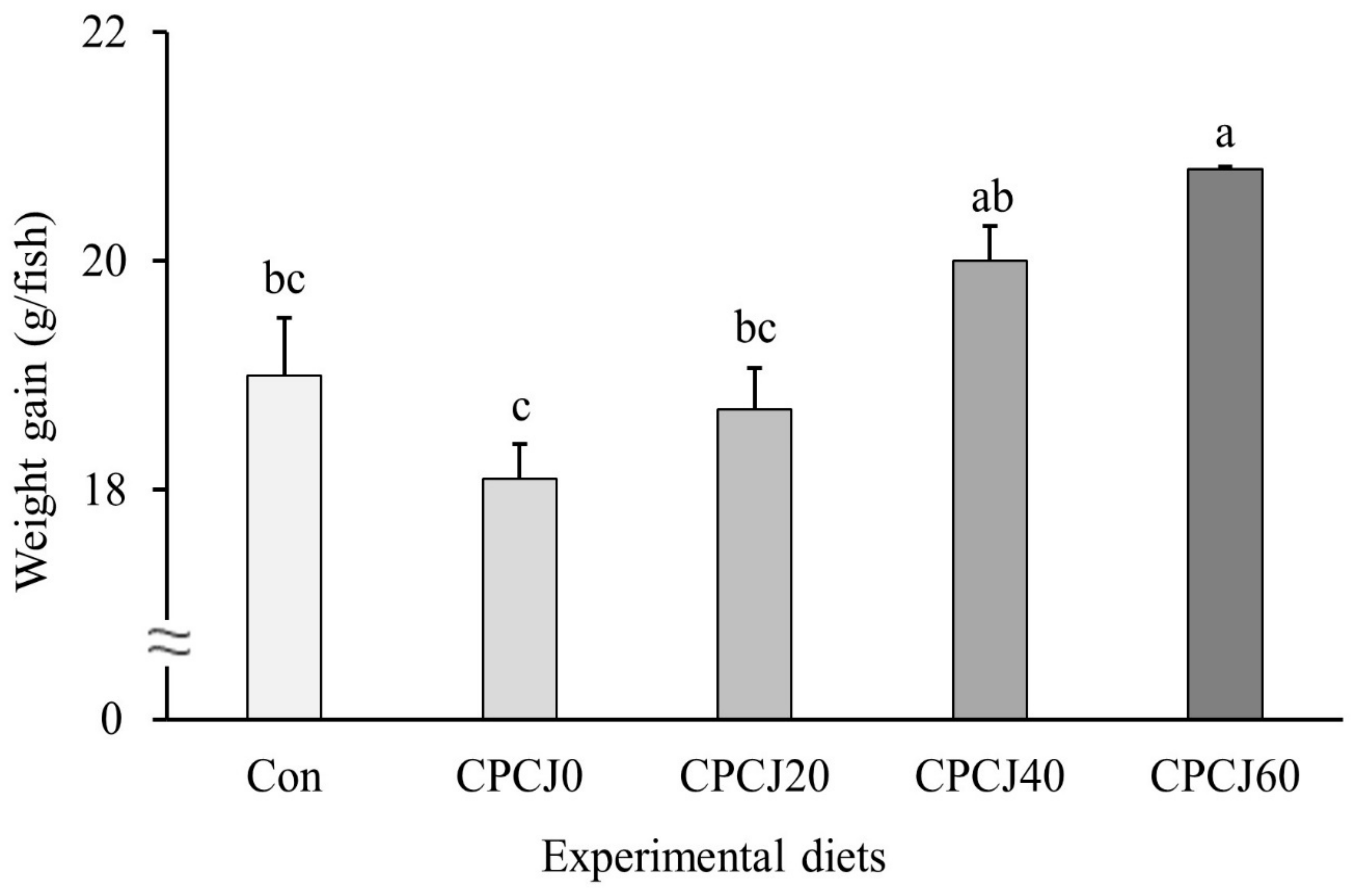
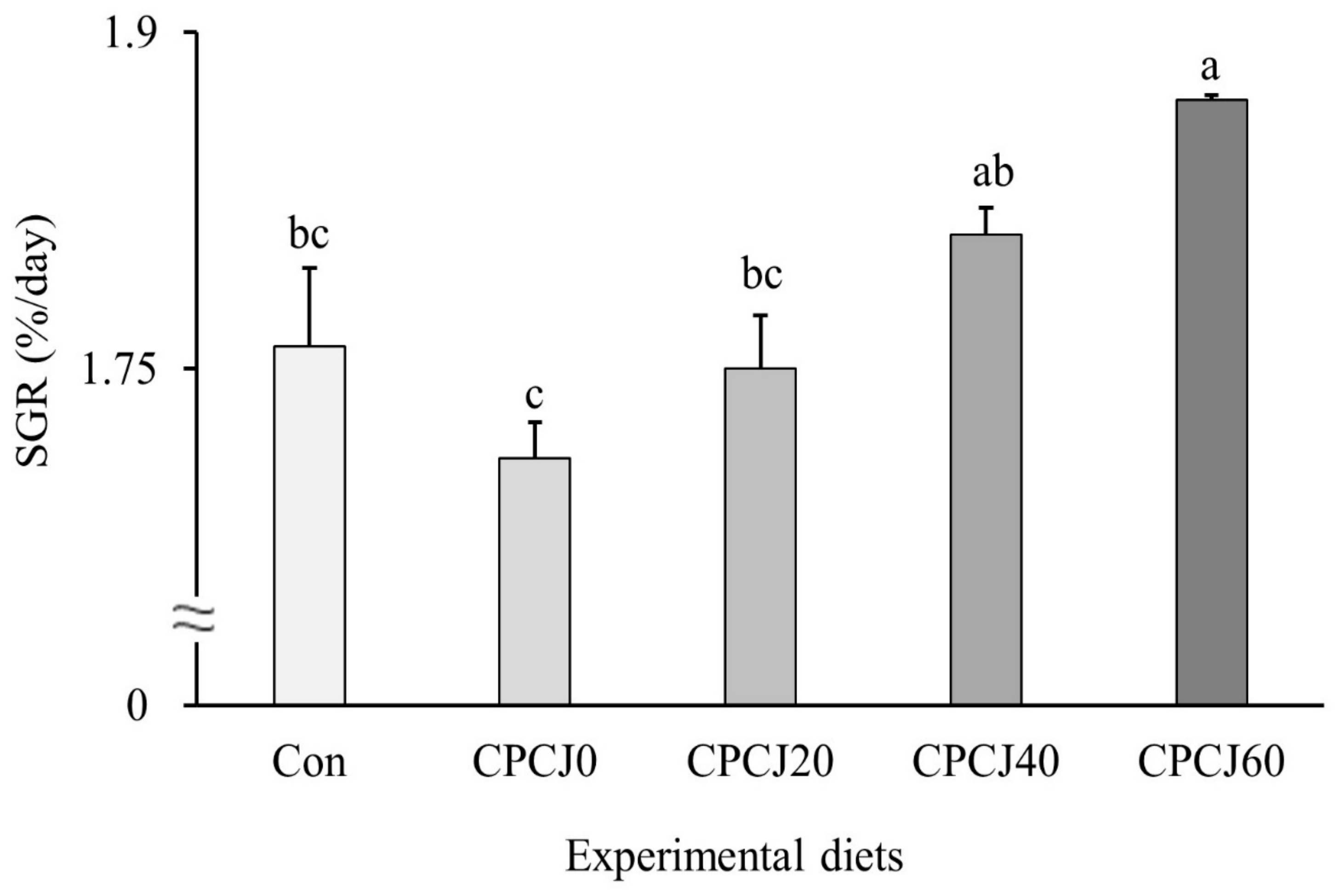
The survival rate of rockfish ranged from 91.1% to 96.7%, with no significant difference (p > 0.5) among the dietary treatments (Table 4). Rockfish fed the CPCJ60 diet (20.8 ± 0.02 g and 1.87 ± 0.002%/day) exhibited significantly higher WG and SGR (p < 0.002 and p < 0.003, respectively) than those fed the Con (19.0 ± 0.50 g and 1.76 ± 0.035%/day), CPCJ0 (18.1 ± 0.30 g and 1.71 ± 0.016%/day), and CPCJ20 (18.7 ± 0.36 g and 1.75 ± 0.024%/day) diets, but were alike to rockfish fed the CPCJ40 diet (20.0 ± 0.30 g and 1.81 ± 0.012%/day) (Figure 1 and Figure 2). As the level of JMM incorporated into the diets replacing 10% of FM with CPC increased, orthogonal polynomial contrast analysis revealed significant linear relationships for both WG and SGR (p = 0.0016 for both parameters). The regression analysis revealed that linear models best described the relationship between the level of JMM included in the diets replacing 10% of the FM with CPC and both WG (Y = 0.9367X + 17.0500, p < 0.0001, adjusted R2 = 0.8468) and SGR (Y = 0.0005X + 0.0165, p < 0.0001, adjusted R2 = 0.8580) in rockfish.
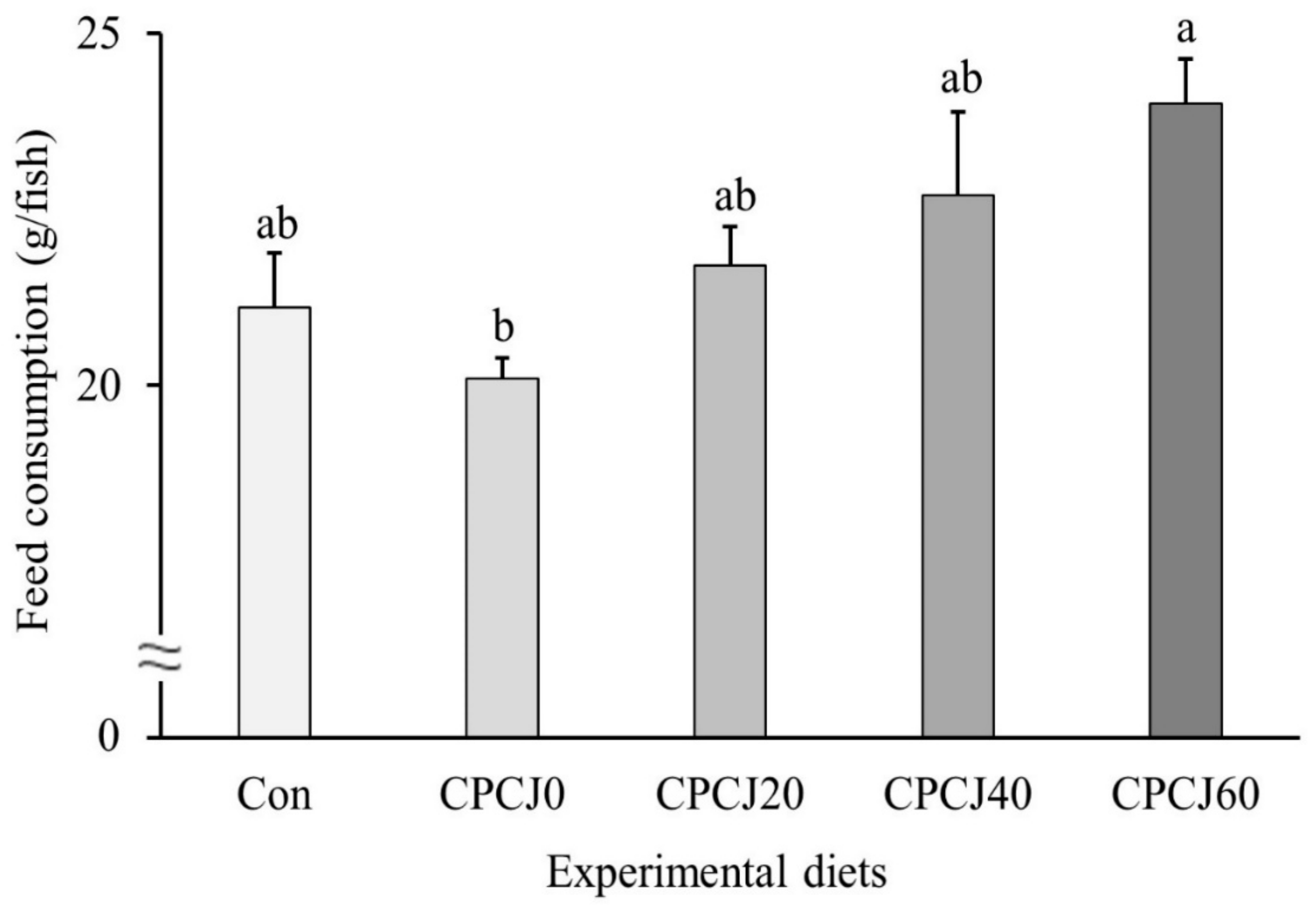
The FC of rockfish fed the CPCJ60 diet (24.0 ± 0.63 g) was significantly higher (p < 0.03) than that of rockfish fed the CPCJ0 diet (20.1 ± 0.29 g), but comparable to those fed the Con (21.1 ± 0.78 g), CPCJ20 (21.7 ± 0.55 g), and CPCJ40 (22.7 ± 1.19 g) diets (Figure 3). According to the orthogonal polynomial contrast analysis, a significant linear relationship (p = 0.0045) was observed between the FC of rockfish and increasing levels of JMM incorporation in diets in which 10% of FM was replaced with CPC. A linear regression model that best fits the JMM incorporation levels in diets replacing 10% FM with CPC and FC (Y= 1.2537X + 19.0450, p < 0.002, adjusted R2 = 0.5965) was identified. However, FE, PER, and PR of rockfish varied from 0.83 to 0.85, 1.72 to 1.79, and 28.88% to 30.35%, respectively, but did not differ among diets. The biological indices of K, VSI, and HSI did not differ among dietary treatments.
The biological indices of K, VSI, and HSI did not differ between the treatments.

3.3. Biochemical Composition of the Whole Body of Rockfish

The dietary treatments did not influence whole-body proximate composition (Table 5), amino acid (Table 6) or fatty acid (Table 7) profiles.

3.4. Blood Chemistry of Rockfish

The blood chemistry of the rockfish remained unaffected by the dietary treatments (Table 8).

3.5. Economic Analysis of the Study

There were no significant differences in ECR among diets, although the EPI of the CPCJ60 was significantly higher (p < 0.03) than that of the CPCJ0 diet (Table 9). The orthogonal polynomial contrast analysis revealed that the EPI exhibited a significant linear relationship (p = 0.0001) with JMM inclusion levels in diets replacing 10% FM with CPC. The best-fitting model between JMM incorporation levels in diets replacing 10% of FM with CPC and EPI (Y = 0.005667X + 0.2412, p < 0.0001, adjusted R2 = 0.7455) was identified.

3.6. Principal Component Analysis

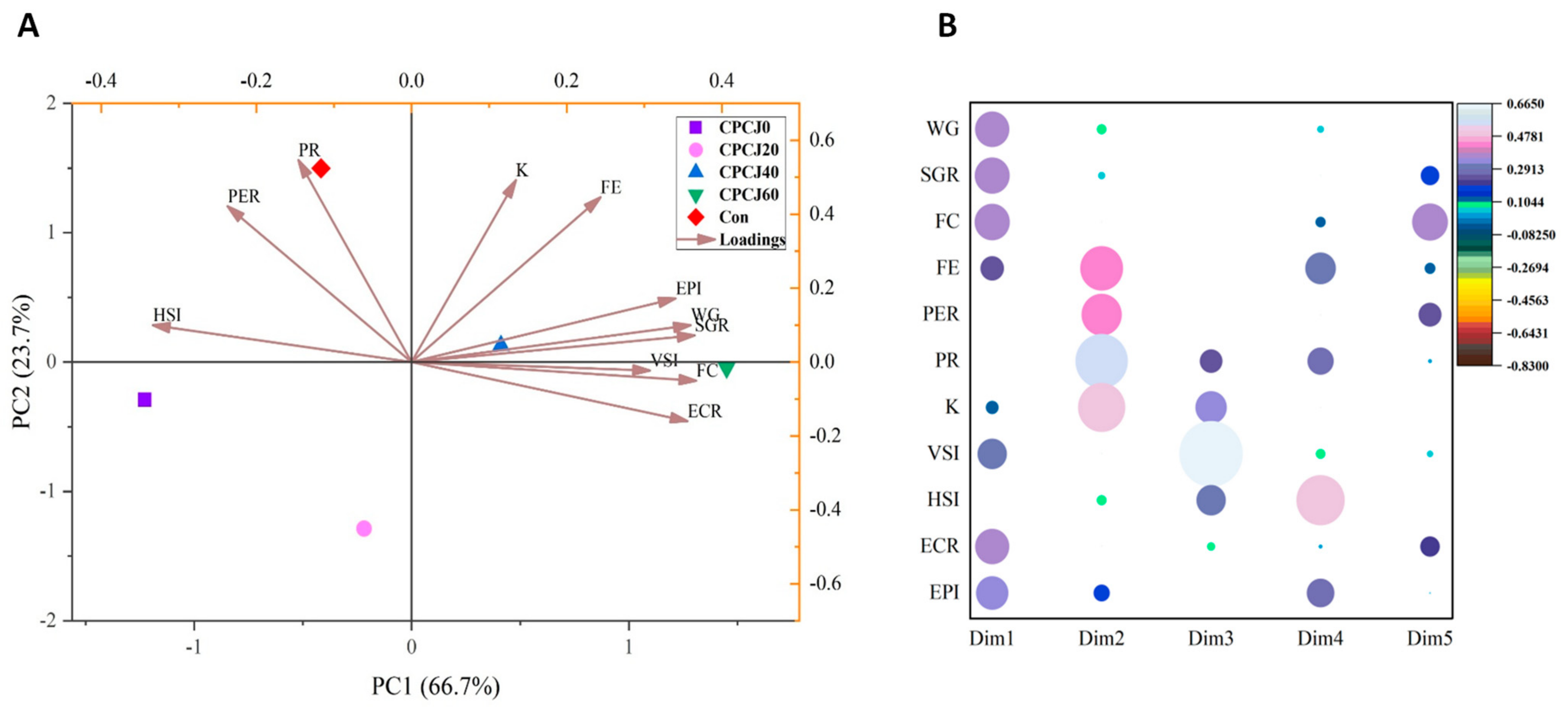
The PCA biplot of growth performance, feed utilization, biological indices, and economic parameters showed distinct separation among the dietary treatments (Figure 4A). PC1 and PC2 explained 66.7% and 23.7% of the total variation, respectively, accounting for 90.4% cumulatively. The CPCJ60 diet was positioned on the positive side of PC1, closely associated with WG, SGR, FC, and the EPI, whereas the CPCJ0 and CPCJ20 diets were located on the negative side, and the CPCJ40 diet occupied an intermediate position. The variable contribution plot indicated that WG, SGR, FC, and the EPI contributed strongly and positively to Dim1, consistent with the positioning of the CPCJ60 diet (Figure 4B).

4. Discussion

To foster sustainable aquaculture and reduce dependence on increasingly scarce and expensive FM, numerous studies have investigated plant-derived protein alternatives [4], including CPC [6,12,13,14]. However, despite their potential, the use of plant protein as FM replacers at higher inclusion levels in fish diets has often been associated with reduced FI, which in turn leads to impaired growth performance in fish [9,12,36,44] Rockfish fed the Con and CPCJ0 diets showed no remarkable differences in WG, SGR, and FC in this study, confirming the results of our earlier findings [13] in which up to 10% of the FM could be replaced with CPC in a 55% FM-based diet without negatively lowering the WG and FC of rockfish. However, in the present study, linear improvements in WG, SGR, and FC of rockfish fed the series of CPCJ diets indicate that inclusion of JMM in diets replacing 10% of FM with CPC could effectively enhance growth performance. The observed enhanced WG and SGR of rockfish seemed to be a direct reflection of the improved FC. Considering the highest WG, SGR, and FC observed in the rockfish, the CPCJ60 diet emerges as the most desirable dietary treatment in the current study.
Similarly, Li and Cho [45] demonstrated that increasing the inclusion levels of JMM into low-FM diets, where 20% of FM was replaced with chicken by-product meal (CBM), led to a linear improvement in the growth performance of rockfish along with enhanced FC when juvenile rockfish were fed with a 55% FM-based diet or one of diets replacing 20% of FM with CBM with 0, 20, 40, 60, and 80% JMM inclusion. Islam et al. [46] also revealed that the inclusion of JMM in low-FM diets, in which 50% of FM was replaced with corn gluten meal (CGM), resulted in a linear enhancement in growth performance and FI in olive flounder. Furthermore, Kader et al. [47] reported that complete replacement of FM with dehulled soybean meal (DSM) supplemented with a blend of feed attractants, including 10% fish soluble (FS), 5% krill meal (KM), and 5% squid meal (SM), resulted in red sea bream (Pagrus major) exhibiting growth and FI comparable to those of fish fed a 60% FM-based diet.
Addressing reduced FC is one of the major challenges when substituting FM beyond the optimum level with dehulled soybean meal in fish diets [47]. The incorporation of feed stimulants and/or feed enhancers in low-FM diets has proven to be an effective strategy for improving FI and growth performance in fish, particularly when FM is partially replaced with plant-derived protein sources [47,48]. JMM has been reported as one of the most potent attractants and/or stimulants among 16 commonly used protein sources in fish feeds, effectively improving feed palatability and FC in rockfish [25]. The presence of feeding attractants, including AAs, IMP, and nucleotides, in jack mackerel tissue, as reported by Ikeda et al. [49], might have triggered increased FC in rockfish fed the CPCJ60 diets, leading to the greatest growth performance in this experiment. The findings of Ikeda et al. [50] indicated that among the constituents of the synthetic jack mackerel muscle extracts, AA, particularly histidine, was the most potent in stimulating feeding behavior in olive flounder. Similarly, another study performed by Kim and Cho [34] found that the dietary content of AAs, including alanine, glycine, and histidine, exhibited a correlation with the growth performance of rockfish. In this study, incorporating JMM in diets replacing 10% of FM with CPC resulted in elevated levels of AAs, including alanine, glycine, and notably histidine. These changes may have indirectly enhanced feed palatability and acceptance, thereby contributing to the observed increase in FI and growth performance in rockfish.
Beyond its role in improving palatability, JMM also provides balanced nutrition, highly digestible proteins, abundant EAAs, and bioactive compounds [25,35,50], which may have further supported protein synthesis and feed utilization efficiency. These nutritional attributes, together with enhanced FC, likely acted synergistically to contribute to the superior growth observed in fish fed the CPCJ60 diet.
No remarkable differences were observed in feed utilization (FE, PER, and PR) of rockfish in the present study. Similarly, Baek et al. [9] reported that feed utilization of olive flounder was not significantly altered by the inclusion of 12% JMM in diets substituting 25% and 50% of FM with diverse plant protein sources, including CGM, soy protein concentrate (SPC) and CPC. Furthermore, incorporating various levels of JMM in diets substituting 20% and 50% of FM with CBM and CGM had no significant effect on the feed utilization of rockfish [45] and olive flounder [46], respectively. However, in contrast to the present study, replacement of 25% and 50% of FM with various plant protein sources, including CGM, SPC, and CPC, in diets supplemented with 22% JMM affected feed utilization of rockfish [36]. According to Hancz [51], the inconsistency in results could be attributed to the use of various types and dosages of feed attractants and/or stimulants.
The deficiency of EAAs is commonly considered to be a major bottleneck when formulating low-FM feeds [52]. Since deficiencies in some EAAs can often hinder fish growth, it is crucial to carefully assess the AA profiles in low-FM diets for fish [33,53,54]. Lysine is commonly considered as one of the most limiting AAs in plant-derived protein sources [55]. As JMM was found to be rich in arginine and histidine among EAAs, increased JMM inclusion in diets substituting 10% of the FM with CPC resulted in increased arginine and histidine content. The lysine content (3.23–3.73% of the diet) in all the diets in the current study met the lysine requirement (2.99% of the diet) for rockfish [43]. Although sulfur amino acids, such as methionine and cysteine, were not quantified in the present study, this is acknowledged as a limitation. Methionine is generally a limiting EAA in low-FM diets; its evaluation is warranted in future needed in future study.
In the nutritional profiles of many marine fish, ∑n-3 HUFAs, especially EPAs and DHAs, are EFAs that are known to be critical for ensuring proper growth and survival [56,57,58]. EPAs and DHAs play a crucial role in numerous physiological processes in fish, such as preserving cellular membrane stability, modulating immune and inflammatory pathways, and aiding carbohydrate and lipid metabolic processes [59]. In general, marine fish exhibit a limited or non-existent ability to biosynthesize adequate levels of EPA, DHA, and arachidonic acid (ARA, 20:4n-6) to support their physiological functions, requiring them to obtain these essential FAs through dietary sources [59,60]. In this experiment, due to the very low level of ∑n-3 HUFAs in CPC, the CPCJ0 diet was found to have the lowest ∑n-3 HUFAs. This might be one of the reasons why those fish fed the CPC0 diet achieved the poorest growth among the rockfish. However, increasing the inclusion levels of JMM in diets substituting 10% of the FM with CPC appeared to increase the ∑MUFAs and ∑n-3 HUFAs, including EPAs, but decrease the ∑SFAs and DHAs.
The biological indices of fish are commonly used as reliable markers to determine the nutritional and physiological well-being of fish [61]. No marked changes in K, VSI, and HSI of rockfish were noticed in the present experiment. Similarly, the findings of our recent study [45] demonstrated that incorporating various levels of JMM into rockfish diets, replacing 20% of FM with CBM, had no significant effects on the biometric indices. Likewise, several studies have shown that substituting FM with various plant and animal protein sources in diets supplemented with JMM as feed attractants or stimulants did not significantly influence the biological indices of rockfish [36], red sea bream [62], and olive flounder [9,63].
The biochemical composition of the whole-body rockfish, including proximate composition and AA and FA profiles, was unaffected by the dietary treatments in the present study, suggesting that inclusion of JMM in the diets replacing 10% FM with CPC did not detrimentally alter the biochemical composition of the whole-body fish. Similarly, no alterations were observed in the whole-body proximate composition, AA profiles, and FA profiles of olive flounder when FM was replaced with various plant-derived protein sources supplemented with JMM as a feeding stimulant [9]. Likewise, Kim and Cho [36] found that the whole-body proximate composition and AA profiles in rockfish were unaffected when FM was substituted with diverse plant-based protein sources in diets supplemented with JMM. Contrary to these studies, the substitution of FM with various plant-derived protein sources in fish diets has been reported to markedly alter the whole-body proximate composition [6,8,64], and AA profiles [53,65] in several fish species, including red hybrid tilapia, olive flounder, Asian seabass, and pearl gentian grouper (Epinephelus lanceolatus ♂ × E. fuscoguttatus ♀). The discrepancies among these findings may be attributed to various factors, including species-specific differences, developmental stages of the fish, the source and quality of the feed ingredients used, and experimental conditions [33].
Plasma parameters are commonly used as standard biomarkers for assessing fish health and evaluating the physiological effects of dietary nutrients and their interactions on overall well-being [66,67,68]. No marked differences in the plasma parameters of rockfish were found among dietary treatments in this study, indicating that incorporating JMM into the diets, replacing 10% of FM with CPC, appears to have no detrimental effect on these parameters. This finding is consistent with the earlier studies [9,36,45,62,63], in which incorporation of JMM in diets replacing FM with various animal and plant-derived protein sources did not markedly alter the plasma chemistry of rockfish, red sea bream, and olive flounder. Contrary to the findings of this study, however, Kader et al. [69] found that plasma parameters of red sea bream, such as AST, ALT, total cholesterol, and total bilirubin, were markedly affected when 60% of FM was substituted with SPC in diets supplemented with 10% FS, KM, or SM. Further study on plasma parameters is needed to gain a better understanding of the possible changes that may arise when fish are supplied with low-FM diets.
The serum lysozyme activity and SOD are considered innate immune markers that provide reliable insights into the effects of dietary interventions on the immunological state of fish [70]. Lysozyme, a mucolytic enzyme, assists in safeguarding fish from harmful microorganisms [71], while SOD functions as an antioxidant enzyme, defending fish against oxidative substances that could potentially harm or damage their cells [72]. This study found no significant differences in lysozyme activity and SOD level in rockfish among dietary treatments, suggesting that incorporating JMM in diets replacing 10% FM with CPC did not impair the innate immunity of rockfish. Likewise, Jeong and Cho [63] unveiled that inclusion of JMM in low-FM diets, substituting 25% and 50% of FM with diverse animal-based protein sources, did not distinctively alter the plasma and serum parameters in olive flounder. Contrary to these results, Khosravi et al. [73] reported that incorporating shrimp, tilapia, or krill hydrolysate into low-FM diets had a marked effect on SOD and lysozyme activity in red sea bream.
In aquaculture, fish feed represents a major component of operational expenses, typically accounting for 50%–70% of total production costs [61,74]. Accordingly, a key objective of feeding strategies is to minimize feed costs while enhancing overall economic returns for fish farmers. From an economic standpoint, the EPI is widely recognized as an appropriate metric for evaluating feed profitability [42]. The CPCJ60 diet led to the highest EPI among all the experimental diets in the current study, which strongly supports the findings of superior WG and SGR in rockfish fed the CPCJ60 diet. Moreover, the CPCJ60 diet seems to be the most promising dietary approach for enabling farmers to achieve high economic returns in the context of practical aquaculture. It should be noted, however, that the economic outcomes presented here are influenced by fluctuations in the relative market prices of ingredients, such as FM, CPC, and JMM, which may vary by year and region.
The PCA revealed that the CPCJ60 diet is closely linked to improved growth performance, feed utilization, and economic returns in rockfish. The strong contributions of WG, SGR, FC, and the EPI to the principal components highlight the superiority of the CPCJ60 diet over others, and the multivariate findings further confirm that incorporating 60% JMM in diets replacing 10% of the FM with CPC represents the most effective feeding strategy for rockfish farming.

5. Conclusions

The inclusion of JMM was found to be effective in improving the FC of fish fed diets replacing 10% of the FM with CPC. Furthermore, the WG and SGR of the rockfish fed diets substituting 10% of the FM with CPC improved linearly with increased JMM inclusion levels. However, the feed utilization, proximate composition, AA and FA profiles, and blood chemistry of the rockfish were unaffected by the dietary treatments. The EPI tended to increase linearly with dietary inclusion levels of JMM. Conclusively, incorporating 60% of JMM in the rockfish diets replacing 10% of the FM with CPC was the most recommended strategy based on the WG, SGR, and FC of the rockfish, and this provided the highest EPI for rockfish farmers.

Author Contributions

M.F.U.Z.: Conceptualization, Methodology, Data Curation, Formal Analysis, Visualization, Investigation, Writing—Original Draft; S.H.C.: Conceptualization, Methodology, Funding Acquisition, Supervision, Writing—Review and Editing. All authors have read and agreed to the published version of the manuscript.

Funding

This work was supported by the National Research Foundation of Korea (NRF) grant funded by the Korean government (MSIT) (No. 2020R1A2C1009903).

Institutional Review Board Statement

All experimental procedures were carried out in line with institutional and ethical standards and were approved by the Institutional Animal Care and Use Committee (IACUC) of Korea Maritime and Ocean University, Busan, Republic of Korea (KMOU IACUC 2022-04), approval date: 26 May 2022.

Data Availability Statement

The raw data supporting the conclusions of this article will be made available by the authors on request.

Acknowledgments

The authors gratefully acknowledge the support and assistance provided by the lab members of the Feed Nutrition and Engineering Lab at Korea Maritime and Ocean University during the course of this study.

Conflicts of Interest

The authors declare no conflict of interest.

References

  1. Tacon, A.G.J.; Metian, M.; Hasan, M.R. Feed Ingredients and Fertilizers for Farmed Aquatic Animals: Sources and Composition; Fisheries and Aquaculture Technical Paper. No. 540; FAO: Rome, Italy, 2009; p. 209. [Google Scholar]
  2. Hardy, R.W. Utilization of plant proteins in fish diets: Effects of global demand and supplies of fishmeal. Aquac. Res. 2010, 41, 770–776. [Google Scholar] [CrossRef]
  3. Hossain, M.S.; Small, B.C.; Kumar, V.; Hardy, R. Utilization of functional feed additives to produce cost-effective, ecofriendly aquafeeds high in plant-based ingredients. Rev. Aquac. 2024, 16, 121–153. [Google Scholar] [CrossRef]
  4. Gatlin, D.M., III; Barrows, F.T.; Brown, P.; Dabrowski, K.; Gaylord, T.G.; Hardy, R.W.; Herman, E.; Hu, G.; Krogdahl, Å.; Nelson, R.; et al. Expanding the utilization of sustainable plant products in aquafeeds: A review. Aquac. Res. 2007, 38, 551–579. [Google Scholar] [CrossRef]
  5. Egerton, S.; Wan, A.; Murphy, K.; Collins, F.; Ahern, G.; Sugrue, I.; Busca, K.; Egan, F.; Muller, N.; Whooley, J.; et al. Replacing fishmeal with plant protein in Atlantic salmon (Salmo salar) diets by supplementation with fish protein hydrolysate. Sci. Rep. 2020, 10, 4194. [Google Scholar] [CrossRef]
  6. Ng, W.; Leow, T.; Yossa, R. Enhancing replacement of fishmeal with corn protein concentrate by blending with soy protein concentrate and supplementing attractants in the diets of red hybrid tilapia. Aquac. Res. 2022, 53, 5171–5183. [Google Scholar] [CrossRef]
  7. Glencross, B.D.; Baily, J.; Berntssen, M.H.G.; Hardy, R.; MacKenzie, S.; Tocher, D.R. Risk assessment of the use of alternative animal and plant raw material resources in aquaculture feeds. Rev. Aquac. 2020, 12, 703–758. [Google Scholar] [CrossRef]
  8. Ng, W.; Leow, T.; Yossa, R. Effect of substituting fishmeal with corn protein concentrate on growth performance, nutrient utilization and skin coloration in red hybrid tilapia, Oreochromis sp. Aquac. Nutr. 2019, 25, 1006–1016. [Google Scholar] [CrossRef]
  9. Baek, S.I.; Jeong, H.S.; Cho, S.H. Replacement effect of fish meal by plant protein sources in olive flounder (Paralichthys olivaceus) feeds with an addition of jack mackerel meal on growth, feed availability, and biochemical composition. Aquac. Nutr. 2023, 2023, 7965258. [Google Scholar] [CrossRef]
  10. Galkanda-Arachchige, H.S.; Hussain, A.S.; Davis, D.A. Fermented corn protein concentrate to replace fishmeal in practical diets for Pacific white shrimp Litopenaeus vannamei. Aquac. Nutr. 2021, 27, 1640–1649. [Google Scholar] [CrossRef]
  11. AAFCO. Report of Ingredient Definitions Committee on Corn Protein Concentrate; Association of American Feed Control Officials, INC.: Rockville, MD, USA, 2007; p. 4. [Google Scholar]
  12. Shekarabi, S.P.H.; Mehrgan, M.S.; Banavreh, A.; Foroudi, F. Partial replacement of fishmeal with corn protein concentrate in diets for rainbow trout (Oncorhynchus mykiss): Effects on growth performance, physiometabolic responses, and fillet quality. Aquac. Res. 2021, 52, 249–259. [Google Scholar] [CrossRef]
  13. Zaman, M.F.U.; Cho, S.H. Replacement impacts of fish meal with corn protein concentrate in diets on growth, feed availability, and biochemical composition of rockfish (Sebastes schlegeli). PLoS ONE 2025, 20, e0322103. [Google Scholar] [CrossRef]
  14. Minjarez-Osorio, C.; Castillo-Alvarado, S.; Gatlin, D.M., III; González-Félix, M.L.; Perez-Velazquez, M.; Rossi, W., Jr. Plant protein sources in the diets of the sciaenids red drum (Sciaenops ocellatus) and shortfin corvina (Cynoscion parvipinnis): A comparative study. Aquaculture 2016, 453, 122–129. [Google Scholar] [CrossRef]
  15. Khalifa, N.S.A.; Belal, I.E.H.; El-Tarabily, K.A.; Tariq, S.; Kassab, A.A. Evaluation of replacing fish meal with corn protein concentrate in Nile tilapia Oreochromis niloticus fingerlings commercial diet. Aquac. Nutr. 2018, 24, 143–152. [Google Scholar] [CrossRef]
  16. Chotikachinda, R.; Tantikitti, C.; Benjakul, S.; Rustad, T.; Kumarnsit, E. Production of protein hydrolysates from skipjack tuna (Katsuwonus pelamis) viscera as feeding attractants for Asian sea-bass (Lates calcarifer). Aquac. Nutr. 2013, 19, 773–784. [Google Scholar] [CrossRef]
  17. Zou, Q.; Huang, Y.; Cao, J.; Zhao, H.; Wang, G.; Li, Y.; Pan, Q. Effects of four feeding stimulants in high plant-based diets on feed intake, growth performance, serum biochemical parameters, digestive enzyme activities and appetite-related genes expression of juvenile GIFT tilapia (Oreochromis sp.). Aquac. Nutr. 2017, 24, 1076–1085. [Google Scholar] [CrossRef]
  18. Morais, S. The physiology of taste in fish: Potential implications for feeding stimulation and gut chemical sensing. Rev. Fish. Sci. Aquac. 2017, 25, 133–149. [Google Scholar] [CrossRef]
  19. Blaufuss, P.; Trushenski, J. Exploring soy-derived alternatives to fish meal: Using soy protein concentrate and soy protein isolate in hybrid striped bass feeds. N. Am. J. Aquac. 2012, 74, 8–19. [Google Scholar] [CrossRef]
  20. Kasumyan, A.O.; Døving, K.B. Taste preferences in fishes. Fish Fish. 2003, 4, 289–347. [Google Scholar] [CrossRef]
  21. Lim, L.S.; Lai, S.K.J.; Yong, A.S.K.; Shapawi, R.; Kawamura, G. Evaluation on the potential of betaine, taurine, nucleotide and nucleoside as feeding stimulant for juvenile marble goby Oxyeleotris marmoratus through behavioural assays. Int. Aquat. Res. 2016, 8, 161–167. [Google Scholar] [CrossRef]
  22. Jeong, H.S.; Kim, J.; Olowe, O.S.; Cho, S.H. Dietary optimum inclusion level of jack mackerel meal for olive flounder (Paralichthys olivaceus, Temminck & Schlegel, 1846). Aquaculture 2022, 559, 738432. [Google Scholar] [CrossRef]
  23. de la Higuerra, M. Effects of nutritional factor and feed characteristics on feed intake. In Food Intake in Fish; Wiley: Hoboken, NJ, USA, 2001; pp. 250–268. [Google Scholar] [CrossRef]
  24. Takakuwa, F.; Masumoto; Fukada, T.H. Identification of feeding stimulants for greater amberjack Seriola dumerili in muscle tissue of jack mackerel Trachurus japonicus. Fish. Sci. 2019, 85, 387–395. [Google Scholar] [CrossRef]
  25. Kim, H.S.; Baek, S.I.; Lee, K.W.; Jeong, H.S.; Cho, S.H. Attractiveness of various protein sources to juvenile rockfish (Sebastes schlegeli, Hilgendorf 1880). J. Appl. Aquac. 2020, 32, 205–220. [Google Scholar] [CrossRef]
  26. Jeong, H.S.; Choi, D.G.; Lee, K.W.; Cho, S.H.; Lim, S.G.; Lee, B.J.; Hur, S.W.; Son, M.H.; Lee, S.H.; Kim, K.W. Attractiveness of various crude feed ingredients to juvenile olive flounder (Paralichthys olivaceus, Temminck & Schlegel) and its application to aquaculture. Aquac. Res. 2020, 51, 4517–4532. [Google Scholar] [CrossRef]
  27. Hosokawa, H.; Takii, K.; Shimeno, S.; Takeda, M. Identification of feeding stimulants for yellowtail in muscle extract of jack mackerel. Aquac. Sci. 2001, 49, 225–229. [Google Scholar] [CrossRef]
  28. Choi, J.; Lee, K.W.; Han, G.S.; Byun, S.G.; Lim, H.J.; Kim, H.S. Dietary inclusion effect of krill meal and various fish meal sources on growth performance, feed utilization, and plasma chemistry of grower walleye pollock (Gadus chalcogrammus, Pallas 1811). Aquac. Rep. 2020, 17, 100331. [Google Scholar] [CrossRef]
  29. KOSIS (Korean Statistical Information Service), Korea. 2025. Available online: https://kosis.kr/eng/statisticsList/statisticsListIndex.do (accessed on 24 November 2025).
  30. Lee, S.; Jeon, I.G.; Lee, J.Y. Effects of digestible protein and lipid levels in practical diets on growth, protein utilization and body composition of juvenile rockfish (Sebastes schlegeli). Aquaculture 2002, 211, 227–239. [Google Scholar] [CrossRef]
  31. Lim, S.R.; Choi, S.M.; Wang, X.J.; Kim, K.W.; Shin, I.S.; Min, T.S.; Bai, S.C. Effects of dehulled soybean meal as a fish meal replacer in diets for fingerling and growing Korean rockfish Sebastes schlegeli. Aquaculture 2004, 231, 457–468. [Google Scholar] [CrossRef]
  32. Cho, S.H.; Kim, H.S.; Myung, S.H.; Jung, W.; Choi, J.; Lee, S. Optimum dietary protein and lipid levels for juvenile rockfish (Sebastes schlegeli, Hilgendorf 1880). Aquac. Res. 2015, 46, 2954–2961. [Google Scholar] [CrossRef]
  33. Lee, S.; Azarm, H.M.; Chang, K.H. Effects of dietary inclusion of fermented soybean meal on growth, body composition, antioxidant enzyme activity and disease resistance of rockfish (Sebastes schlegeli). Aquaculture 2016, 459, 110–116. [Google Scholar] [CrossRef]
  34. Kim, H.S.; Cho, S.H. Dietary inclusion effect of feed ingredients showing high feeding attractiveness to rockfish (Sebastes schlegeli Hilgendorf 1880) on the growth performance, feed utilization, condition factor and whole body composition of fish (II). Comp. Biochem. Physiol. A. Mol. Integr. Physiol. 2019, 231, 66–73. [Google Scholar] [CrossRef]
  35. Kim, J.; Cho, S.H. Inclusion effect of jack mackerel, Trachurus japonicus, meal in the diet of rockfish, Sebastes schlegeli, on growth, feed utilization, biochemical composition, and innate immune responses. J. World Aquac. Soc 2023, 54, 1137–1161. [Google Scholar] [CrossRef]
  36. Kim, J.; Cho, S.H. Substitution effect of fish meal with various plant protein sources on growth performance and feed utilization in rockfish (Sebastes schlegeli) diets including jack mackerel meal used as feed stimulants. Front. Mar. Sci. 2024, 11, 1339471. [Google Scholar] [CrossRef]
  37. Lee, M.J.; Kim, J.; Baek, S.I.; Cho, S.H. Substitution effect of fish meal with meat meal in diet on growth performance, feed consumption, feed utilization, chemical composition, hematology, and innate immune responses of rockfish (Sebastes schlegeli). Aquaculture 2023, 571, 739467. [Google Scholar] [CrossRef]
  38. Kim, K.; Wang, X.; Han, K.; Bai, S.C.; Kang, J. Optimum dietary protein level and protein-to-energy ratio for growth of juvenile Korean rockfish Sebastes schlegeli. J. World Aquac. Soc. 2004, 35, 305–314. [Google Scholar] [CrossRef]
  39. AOAC. Official Methods of Analysis, 15th ed.; Association of Official Analytical Chemists Inc.: Arlington, VA, USA, 1990. [Google Scholar]
  40. Folch, J.; Lees, M.; Stanley, G.H.S. A simple method for the isolation and purification of total lipids from animal tissues. J. Biol. Chem. 1957, 226, 497–509. [Google Scholar] [CrossRef]
  41. Ellis, A.E. Lysozyme assays. In Techniques in Fish Immunology; Stolen., J.S., Fletcher., T.C., Anderson, D.P., Roberson, B.S., van Muiswinkel, W.B., Eds.; SOS Publications: Fair Haven, NJ, 1990; pp. 101–103. [Google Scholar]
  42. Martínez-Llorens, S.; Moñino, A.V.; Tomás Vidal, A.; Salvador, V.J.M.; Pla Torres, M.; Jover Cerdá, M. Soybean meal as a protein source in gilthead sea bream (Sparus aurata L.) diets: Effects on growth and nutrient utilization. Aquac. Res. 2007, 38, 82–90. [Google Scholar] [CrossRef]
  43. Yan, Q.; Xie, S.; Zhu, X.; Lei, W.; Yang, Y. Dietary lysine requirement for Sebastes schlegeli. Acta Hydrobiol. Sin. 2006, 30, 459–465, (In Chinese with English abstract). [Google Scholar] [CrossRef]
  44. Hien, T.T.T.; Phu, T.M.; Tu, T.L.C.; Tien, N.V.; Duc, P.M.; Bengtson, D.A. Effects of replacing fish meal with soya protein concentrate on growth, feed efficiency and digestibility in diets for snakehead Channa striata. Aquac. Res. 2017, 48, 3174–3181. [Google Scholar] [CrossRef]
  45. Li, R.; Cho, S.H. Impact on growth and feed availability from including jack mackerel (Trachurus japonicas) meal in rockfish (Sebastes schlegeli) feeds which otherwise replace fish meal with chicken by-product meal. Animals 2024, 14, 1203. [Google Scholar] [CrossRef]
  46. Islam, M.R.; Cho, S.H.; Kim, T. Inclusion effect of jack mackerel meal in diets substituting fish meal with corn gluten meal on growth and feed utilization of olive flounder (Paralichthys olivaceus). Front. Sustain. Food Syst. 2024, 8, 1414574. [Google Scholar] [CrossRef]
  47. Kader, M.A.; Bulbul, M.; Koshio, S.; Ishikawa, M.; Yokoyama, S.; Nguyen, B.T.; Komilus, C.F. Effect of complete replacement of fishmeal by dehulled soybean meal with crude attractants supplementation in diets for red sea bream Pagrus major. Aquaculture 2012, 350–353, 109–116. [Google Scholar] [CrossRef]
  48. Papatryphon, E.; Soares, J.H. The effect of dietary feeding stimulants on growth performance of striped bass, Morone saxatilis, fed-a-plant feedstuff-based diet. Aquaculture 2000, 185, 329–338. [Google Scholar] [CrossRef]
  49. Ikeda, I.; Hosokawa, H.; Shimeno, S.; Takeda, M. Studies on feeding stimulants for jack mackerel-I. identification of feeding stimulant for jack mackerel in its muscle extract. Nip. Sui. Gakk 1988, 54, 229–233. [Google Scholar] [CrossRef][Green Version]
  50. Ikeda, I.; Okamoto, Y.; Oda, K. Identification of feeding stimulants for Japanese flounder in muscle extract of jack mackerel. Aquac. Sci. 2012, 60, 195–198. [Google Scholar] [CrossRef]
  51. Hancz, C. Feed efficiency, nutrient sensing and feeding stimulation in aquaculture: A review. Acta Agraria Kaposváriensis 2020, 24, 35–54. [Google Scholar] [CrossRef]
  52. Glencross, B.D.; Booth, M.; Allan, G.L. A feed is only as good as its ingredients -A review of ingredient evaluation strategies for aquaculture feeds. Aquac. Nutr. 2007, 13, 17–34. [Google Scholar] [CrossRef]
  53. Deng, J.; Mai, K.; Ai, Q.; Zhang, W.; Wang, X.; Xu, W.; Liufu, Z. Effects of replacing fish meal with soy protein concentrate on feed intake and growth of juvenile Japanese flounder, Paralichthys olivaceus. Aquaculture 2006, 258, 503–513. [Google Scholar] [CrossRef]
  54. Ahmed, M.; Liang, H.; Chisomo Kasiya, H.; Ji, K.; Ge, X.; Ren, M.; Liu, B.; Zhu, X.; Sun, A. Complete replacement of fish meal by plant protein ingredients with dietary essential amino acids supplementation for juvenile blunt snout bream (Megalobrama amblycephala). Aquac. Nutr. 2019, 25, 205–214. [Google Scholar] [CrossRef]
  55. Cheng, Z.J.; Hardy, R.W.; Usry, J.L. Effects of lysine supplementation in plant protein-based diets on the performance of rainbow trout (Oncorhynchus mykiss) and apparent digestibility coefficients of nutrients. Aquaculture 2003, 215, 255–265. [Google Scholar] [CrossRef]
  56. Lee, S.; Lee, J.Y.; Bum; Hur, S.B. Essentiality of dietary eicosapentaenoic acid and docosahexaenoic acid in Korean rockfish, Sebastes schlegeli. Korean J. Fish. Aquat. Sci. 1994, 27, 712–726. [Google Scholar]
  57. Furuita, H.; Tanaka, H.; Yamamoto, T.; Suzuki, N.; Takeuchi, T. Effects of high levels of n-3 HUFA in broodstock diet on egg quality and egg fatty acid composition of Japanese flounder, Paralichthys olivaceus. Aquaculture 2002, 210, 323–333. [Google Scholar] [CrossRef]
  58. Bell, M.V.; Dick, J.R. Changes in capacity to synthesise 22:6n-3 during early development in rainbow trout (Oncorhynchus mykiss). Aquaculture 2004, 235, 393–409. [Google Scholar] [CrossRef]
  59. Glencross, B.D. Exploring the nutritional demand for essential fatty acids by aquaculture species. Rev. Aquac. 2009, 1, 71–124. [Google Scholar] [CrossRef]
  60. Carr, I.; Glencross, B.; Santigosa, E. The importance of essential fatty acids and their ratios in aquafeeds to enhance salmonid production, welfare, and human health. Front. Anim. Sci. 2023, 4, 1147081. [Google Scholar] [CrossRef]
  61. Ng, W.; Lu, K.; Hashim, R.; Ali, A. Effects of feeding rate on growth, feed utilization and body composition of a tropical bagrid catfish. Aquac. Int. 2000, 8, 19–29. [Google Scholar] [CrossRef]
  62. Kwon, T.W.; Baek, S.I.; Cho, S.H. Inclusion impact of jack mackerel meal in the red sea bream (Pagrus major) feeds replacing various animal protein sources for fish meal. Aquac. Nutr. 2024, 4134106. [Google Scholar] [CrossRef]
  63. Jeong, H.S.; Cho, S.H. Inclusion effect of jack mackerel meal as feed stimulants in diets replacing different levels of fish meal with various animal protein sources on growth performance of olive flounder (Paralichthys olivaceus). Aquac. Rep. 2023, 28, 101450. [Google Scholar] [CrossRef]
  64. Nandakumar, S.; Ambasankar, K.; Ali, S.S.R.; Syamadayal, J.; Vasagam, K. Replacement of fish meal with corn gluten meal in feeds for Asian seabass (Lates calcarifer). Aquac. Int. 2017, 25, 1495–1505. [Google Scholar] [CrossRef]
  65. Chen, Y.; Ma, J.; Huang, H.; Zhong, H. Effects of the replacement of fishmeal by soy protein concentrate on growth performance, apparent digestibility, and retention of protein and amino acid in juvenile pearl gentian grouper. PLoS ONE 2019, 14, e0222780. [Google Scholar] [CrossRef]
  66. Peres, H.; Costas, B.; Perez-Jimenez, A.; Guerreiro, I.; Oliva-Teles, A. Reference values for selected hematological and serum biochemical parameters of Senegalese sole (Solea senegalensis Kaup, 1858) juveniles under intensive aquaculture conditions. J. Appl. Ichthyol. 2015, 31, 65–71. [Google Scholar] [CrossRef]
  67. Khosravi, S.; Bui, H.T.D.; Herault, M.; Fournier, V.; Kim, K.; Lee, B.; Kim, K.; Lee, K. Supplementation of protein hydrolysates to a low-fishmeal diet improves growth and health status of juvenile olive flounder, Paralichthys olivaceus. J. World Aquac. Soc. 2018, 49, 897–911. [Google Scholar] [CrossRef]
  68. Fazio, F. Fish hematology analysis as an important tool of aquaculture: A review. Aquaculture 2019, 500, 237–242. [Google Scholar] [CrossRef]
  69. Kader, M.A.; Koshio, S.; Ishikawa, M.; Yokoyama, S.; Bulbul, M. Supplemental effects of some crude ingredients in improving nutritive values of low fishmeal diets for red sea bream, Pagrus major. Aquaculture 2010, 308, 136–144. [Google Scholar] [CrossRef]
  70. Seong, M.; Lee, S.; Lee, S.; Song, Y.; Bae, J.; Chang, K.; Bai, S.C. The effects of different levels of dietary fermented plant-based protein concentrate on growth, hematology and non-specific immune responses in juvenile olive flounder, Paralichthys olivaceus. Aquaculture 2018, 483, 196–202. [Google Scholar] [CrossRef]
  71. Saurabh, S.; Sahoo, P.K. Lysozyme: An important defence molecule of fish innate immune system. Aquac. Res. 2008, 39, 223–239. [Google Scholar] [CrossRef]
  72. Dröge, W. Free radicals in the physiological control of cell function. Physiol. Rev. 2002, 82, 47–95. [Google Scholar] [CrossRef]
  73. Khosravi, S.; Rahimnejad, S.; Herault, M.; Fournier, V.; Lee, C.R.; Bui, H.T.D.; Jeong, J.B.; Lee, K.J. Effects of protein hydrolysates supplementation in low fish meal diets on growth performance, innate immunity and disease resistance of red sea bream Pagrus major. Fish Shellfish Immunol. 2015, 45, 858–868. [Google Scholar] [CrossRef]
  74. Rana, K.J.; Siriwardadera, S.; Hasan, M.R. Impact of Rising Feed Ingredient Prices on Aquafeeds and Aquaculture Production; Fisheries and Aquaculture Technical Paper. No. 541; FAO: Rome, Italy, 2009; p. 63. [Google Scholar]
Figure 1. Weight gain (WG, g/fish) of rockfish fed the experimental diets replacing FM with CPC for 8 weeks (means of triplicate ± SE) (p < 0.002). Orthogonal polynomial contrast (linear, p = 0.0016; quadratic, p = 0.8663; cubic, p = 0.4996) and the best-fitting model exhibited a significant linear (Y = 0.9367X + 17.0500, p < 0.0001, Adjusted R2 = 0.8468) relationship between WG of rockfish and dietary incorporation levels of jack mackerel meal (JMM) in replacing FM. Different letters indicate statistically significant differences (p < 0.05).
Fishes 11 00099 g001
Figure 2. Specific growth rate (SGR, %/day) of rockfish fed the experimental diets for 8 weeks (means of triplicate ± SE) (p < 0.003). Orthogonal polynomial contrast (linear, p = 0.0016; quadratic, p = 0.4841; cubic, p = 0.7289) and the best-fitting model exhibited a significant linear (Y = 0.0005X + 0.0165, p < 0.0001, Adjusted R2 = 0.8580) relationship between SGR of rockfish and dietary incorporation levels of jack mackerel meal (JMM) in replacing FM. SGR (%/day) = [ln final body weight of fish (g) − ln initial body weight of fish (g)] × 100/days of feeding. Different letters indicate statistically significant differences (p < 0.05).
Fishes 11 00099 g002
Figure 3. Feed consumption (FC, g/fish) of rockfish fed the experimental diets for 8 weeks (means of triplicate ± SE) (p < 0.03). Orthogonal polynomial contrast (linear, p = 0.0045; quadratic, p = 0.8291; cubic, p = 0.8335) and the best-fitting model exhibited a significant linear (Y = 1.2537X + 19.0450, p < 0.002, Adjusted R2 = 0.5965) relationship between FC of rockfish and dietary incorporation levels of jack mackerel meal (JMM) in replacing FM. Different letters indicate statistically significant differences (p < 0.05).
Fishes 11 00099 g003
Figure 4. Principal component analysis (PCA) of rockfish fed the experimental diets for 8 weeks on studied variables, including growth, feed utilization, biological indices, and economic analysis. PCA biplot of first two principal components (A) and contribution plot of studied parameters on each extracted dimension of principal components (B). Parameters include growth (WG: weight gain and SGR: specific growth rate), feed utilization (FC: feed consumption, FE: feed efficiency, PER: protein efficiency ratio, and PR: protein retention), biological indices (VSI: viscerosomatic index, HSI: hepatosomatic index, and CF: condition factor), and economic analysis (ECR: economic conversion ratio and EPI: economic profitability index). Bubble size represents the magnitude of contribution, and color indicates the direction.
Fishes 11 00099 g004
Table 1. Ingredients and chemical composition of the experimental diets (%, dry matter basis).
Experimental Diets
ConCPCJ0CPCJ20CPCJ40CPCJ60
Ingredients (%, DM)
Fish meal (FM) 155.049.538.527.516.5
Corn protein concentrate (CPC) 2 5.25.25.25.2
Jack mackerel meal (JMM) 3 11.022.333.6
Fermented soybean meal12.012.012.012.012.0
Wheat flour21.521.421.320.920.5
Fish oil4.54.95.05.15.2
Soybean oil4.54.54.54.54.5
Vitamin premix 41.01.01.01.01.0
Mineral premix 51.01.01.01.01.0
Choline0.50.50.50.50.5
Nutrients (%, DM)
Dry matter94.496.896.396.196.5
Crude protein (CP)50.450.450.150.450.0
Crude lipid (CL)15.515.515.415.115.2
Ash9.18.89.18.98.7
1 Fish meal (FM, anchovy meal) (CP: 73.4%, CL: 10.7%, ash: 14.0%) was imported from Chile. 2 Corn protein concentrate (CPC) (CP: 79.5%, CL: 3.3%, ash: 1.0%) was imported from Cargill (Minneapolis, MN, USA). 3 Jack mackerel meal (JMM) (CP: 72.2%, CL: 9.9%, ash: 14.3%) was imported from Chile. 4 Mineral premix contained the following ingredients (g/kg mix): MgSO4·7H2O, 80.0; NaH2PO4·2H2O, 370.0; KCl, 130.0; ferric citrate, 40.0; ZnSO4·7H2O, 20.0; Ca-lactate, 356.5; CuCl, 0.2; AlCl3·6H2O, 0.15; KI, 0.15; Na2Se2O3, 0.01; MnSO4·H2O, 2.0; CoCl2·6H2O, 1.0. 5 Vitamin premix contained the following amounts, which were diluted in cellulose (g/kg mix): L-ascorbic acid, 121.2; DL-α-tocopheryl acetate, 18.8; thiamin hydrochloride, 2.7; riboflavin, 9.1; pyridoxine hydrochloride, 1.8; niacin, 36.4; Ca-D-pantothenate, 12.7; myo-inositol, 181.8; D-biotin, 0.27; folic acid, 0.68; p-aminobenzoic acid, 18.2; menadione, 1.8; retinyl acetate, 0.73; cholecalciferol, 0.003; cyanocobalamin, 0.003.
Table 2. AA profiles (% of the diet) of the feed ingredients and experimental diets.
IngredientsExperimental Diets
FMCPCJMMRequirementConCPCJ0CPCJ20CPCJ40CPCJ60
Essential amino acids (EAAs, %)
Arginine3.871.923.90 2.972.682.712.742.77
Histidine1.891.262.83 1.411.341.431.511.58
Isoleucine2.892.552.76 2.191.901.871.952.00
Leucine5.0310.894.83 3.874.154.164.204.24
Lysine5.361.005.312.99 13.733.293.233.333.44
Phenylalanine2.644.022.60 2.142.272.282.302.33
Threonine2.952.152.88 2.252.162.132.162.22
Tryptophan0.690.320.57 0.270.180.200.220.24
Valine3.342.763.22 2.462.362.352.412.44
∑EAA 228.6626.8728.90 21.2920.3320.3620.8221.26
Non-essential amino acids (NEAAs, %)
Alanine4.165.674.29 2.993.093.113.173.23
Aspartic acid6.073.745.91 4.754.384.414.514.52
Glutamic acid8.3413.808.34 7.287.387.387.417.45
Glycine3.761.684.29 2.782.512.642.692.78
Proline2.746.472.98 2.492.582.562.602.63
Serine2.583.262.59 2.122.182.182.232.26
Tyrosine1.822.841.71 1.331.491.441.471.49
∑NEAA 329.4737.4630.11 23.7423.6123.7224.0824.36
1 Data were obtained from Yan et al. [43]’s study. 2 ∑EAAs: Total essential amino acids. 3 ∑NEAAs: Total non-essential amino acids.
Table 3. FA profiles (% of total fatty acids) of the feed ingredients and experimental diets.
IngredientsExperimental Diets
FMCPCJMMConCPCJ0CPCJ20CPCJ40CPCJ60
C12:00.080.000.060.030.020.030.030.03
C14:04.200.004.291.911.601.701.781.84
C16:022.2214.4719.9715.0314.8514.4314.3414.20
C18:08.052.267.584.964.814.784.704.66
C20:00.100.140.100.200.250.220.220.21
C22:00.300.000.160.360.330.330.310.30
C24:00.680.000.500.560.500.490.480.46
∑SFAs 135.6316.8732.6623.1622.4322.0621.9421.76
C14:1n-50.230.000.150.090.090.080.070.07
C15:1n-50.150.000.340.110.030.100.100.12
C16:1n-75.470.176.503.042.933.043.103.16
C17:1n-70.780.001.120.420.380.400.430.45
C18:1n-923.3025.7923.2131.8932.2032.1332.0732.01
C20:1n-91.010.261.541.150.870.981.041.18
C22:1n-90.190.490.160.410.470.460.440.43
C24:1n-92.690.004.001.200.890.991.151.25
∑MUFAs 233.8226.7137.0238.3137.8638.1838.4038.67
C18:2n-61.8953.561.3323.0525.9025.4824.9924.68
C18:3n-30.702.000.513.473.613.573.503.48
C18:3n-60.300.520.160.580.630.600.570.55
C20:2n-60.070.000.240.110.070.110.120.14
C20.3n-30.170.000.090.060.010.020.020.03
C20.3n-60.080.000.000.030.010.010.020.02
C20:4n-62.440.001.740.980.870.830.800.77
C20:5n-3 7.060.0010.982.792.612.913.253.37
C22:2n-60.600.180.700.370.320.340.370.39
C22:6n-3 14.710.1612.184.684.454.394.314.28
∑n-3 HUFAs 321.940.1623.257.537.077.327.587.68
Unknown2.530.002.392.411.231.501.711.86
1 ∑SFAs: Total saturated fatty acids. 2 ∑MUFAs: Total monounsaturated fatty acids. 3 ∑n-3 HUFAs: Total n-3 highly unsaturated fatty acids.
Table 4. Survival (%), feed efficiency (FE), protein efficiency ratio (PER), protein retention (PR), condition factor (K), viscerosomatic index (VSI) and hepatosomatic index (HSI) of rockfish fed the experimental diets for 8 weeks.
Experimental DietsInitial Weight
(g/Fish)
Final Weight
(g/Fish)
Survival
(%)
FE 1PER 2PR 3
(%)
K 4
(g/cm3)
VSI 5
(%)
HSI 6
(%)
Con11.3 ± 0.0830.3 ± 0.4691.1 ± 2.940.85 ± 0.0761.79 ± 0.11730.35 ± 1.8191.64 ± 0.05610.36 ± 0.2263.22 ± 0.078
CPCJ011.2 ± 0.0229.3 ± 0.3290.0 ± 3.330.83 ± 0.0241.79 ± 0.00329.30 ± 0.3391.59 ± 0.0789.90 ± 0.0783.20 ± 0.243
CPCJ2011.3 ± 0.0430.0 ± 0.3494.4 ± 1.110.83 ± 0.0011.72 ± 0.01328.91 ± 0.7421.58 ± 0.03110.48 ± 0.4213.19 ± 0.122
CPCJ4011.4 ± 0.1531.4 ± 0.4194.4 ± 2.940.85 ± 0.0181.76 ± 0.06929.35 ± 0.9191.59 ± 0.03610.30 ± 0.2763.15 ± 0.049
CPCJ6011.2 ± 0.0232.0 ± 0.0496.7 ± 3.330.85 ± 0.0111.73 ± 0.04628.88 ± 0.6181.63 ± 0.04110.64 ± 0.1953.05 ± 0.027
p-value p > 0.5p > 0.9p > 0.9p > 0.8p > 0.8p > 0.4p > 0.8
Orthogonal polynomial contrast
Linear 0.35480.56500.79850.54940.13130.4185
Quadratic 0.98390.59570.95420.57830.67310.7441
Cubic 0.54630.42150.58560.91770.32450.9333
Values (means of triplicate ± SE) in the same column sharing the same superscript letter are not significantly different (p > 0.05). 1 Feed efficiency (FE) = weight gain of fish/feed consumption. 2 Protein efficiency ratio (PER) = weight gain of fish/protein consumption. 3 Protein retention (PR, %) = protein gain of fish × 100/protein consumption. 4 Condition factor (K, g/cm3) = fish weight (g) × 100/total length of fish (cm)3. 5 Viscerosomatic index (VSI, %) = viscera weight × 100/fish weight. 6 Hepatosomatic index (HSI, %) = liver weight × 100/fish weight.
Table 5. Proximate composition (% of wet weight) of rockfish fed the experimental diets for 8 weeks.
Experimental DietsMoistureCrude ProteinCrude LipidAsh
Con70.36 ± 0.15216.72 ± 0.0638.00 ± 0.1063.96 ± 0.091
CPCJ070.30 ± 0.29216.35 ± 0.1338.13 ± 0.0693.98 ± 0.129
CPCJ2070.28 ± 0.18816.62 ± 0.1908.09 ± 0.1814.06 ± 0.049
CPCJ4070.44 ± 0.26916.57 ± 0.2428.02 ± 0.2694.03 ± 0.097
CPCJ6070.60 ± 0.28716.54 ± 0.0648.00 ± 0.1603.87 ± 0.098
p-valuep > 0.8p > 0.5p > 0.9p > 0.7
Orthogonal polynomial contrast
Linear0.39080.51310.59910.4571
Quadratic0.74480.41100.96490.2755
Cubic0.87520.67750.92170.9355
Values are presented as means of triplicate ± SE.
Table 6. AA profiles (% of wet weight) of the whole body of rockfish fed the experimental diets for 8 weeks.
Experimental DietsOrthogonal Polynomial Contrast
ConCPCJ0CPCJ20CPCJ40CPCJ60p-ValueLinearQuadraticCubic
EAAs (%)
Arginine1.00 ± 0.0250.98 ± 0.0201.00 ± 0.0261.01 ± 0.0231.03 ± 0.029p > 0.60.16850.89960.9101
Histidine0.35 ± 0.0250.34 ± 0.0150.35 ± 0.0170.35 ± 0.0150.36 ± 0.020p > 0.90.62270.89880.8688
Isoleucine0.69 ± 0.0550.61 ± 0.0400.60 ± 0.0520.59 ± 0.0380.57 ± 0.049p > 0.50.56890.97220.9876
Leucine1.02 ± 0.0281.11 ± 0.0351.10 ± 0.0461.12 ± 0.0131.14 ± 0.020p > 0.10.40420.64470.8001
Lysine0.75 ± 0.0500.70 ± 0.0580.68 ± 0.0580.65 ± 0.0500.61 ± 0.066p > 0.50.28150.85070.9904
Phenylalanine0.58 ± 0.0250.65 ± 0.0200.64 ± 0.0320.63 ± 0.0180.61 ± 0.020p > 0.30.17740.83810.9757
Threonine 0.70 ± 0.0280.69 ± 0.0150.68 ± 0.0180.65 ± 0.0180.68 ± 0.020p > 0.50.48520.18390.3578
Tryptophan0.09 ± 0.0150.08 ± 0.0090.07 ± 0.0210.06± 0.0130.05 ± 0.009p > 0.30.10230.90910.7988
Valine0.69 ± 0.0200.68 ± 0.0200.66 ± 0.0230.65 ± 0.0200.64 ± 0.017p > 0.40.17590.75990.8910
NEAAs (%)
Alanine1.07 ± 0.0231.08 ± 0.0351.10 ± 0.0291.12 ± 0.0331.13 ± 0.029p > 0.50.29030.92180.9881
Aspartic acid1.25 ± 0.0751.23 ± 0.0921.22 ± 0.1011.18 ± 0.0751.15 ± 0.087p > 0.90.51990.93000.9436
Glutamic acid2.05 ± 0.0252.13 ± 0.0172.12 ± 0.0152.11 ± 0.0182.10 ± 0.020p > 0.10.30230.92950.9684
Glycine1.25 ± 0.0231.15 ± 0.0581.18 ± 0.0401.21 ± 0.0281.24 ± 0.032p > 0.30.13950.93830.9449
Proline0.75 ± 0.0230.77 ± 0.0120.79 ± 0.0200.79 ± 0.0180.80 ± 0.017p > 0.50.28890.92730.7148
Serine0.69 ± 0.0200.71 ± 0.0170.72 ± 0.0170.74 ± 0.0230.76 ± 0.026p > 0.20.13720.94180.8194
Tyrosine0.42 ± 0.0230.47 ± 0.0230.45 ± 0.0290.44 ± 0.0200.43 ± 0.020p > 0.50.22010.94650.9760
Values are presented as means of triplicate ± SE.
Table 7. FA profiles (% of total fatty acids) of the whole body of rockfish fed the experimental diets for 8 weeks.
Experimental DietsOrthogonal Polynomial Contrast
ConCPCJ0CPCJ20CPCJ40CPCJ60p-ValueLinearQuadraticCubic
C12:00.03 ± 0.0060.02 ± 0.0030.03 ± 0.0030.03 ± 0.0030.03 ± 0.003p > 0.10.05850.03690.5328
C14:02.27 ± 0.0752.17 ± 0.0582.25 ± 0.0612.25 ± 0.0582.28 ± 0.058p > 0.70.24690.66050.65853
C16:014.95 ± 0.32614.53 ± 0.17014.71 ± 0.32314.62 ± 0.32914.58 ± 0.344p > 0.80.96350.71140.8230
C18:04.37 ± 0.0444.37 ± 0.1364.34 ± 0.1364.30 ± 0.1334.21 ± 0.139p > 0.80.41070.84910.9321
C20:00.16 ± 0.0150.18 ± 0.0150.17 ± 0.0150.17 ± 0.0120.16 ± 0.009p > 0.90.46340.89790.9542
C22:00.42 ± 0.0090.40 ± 0.0090.40 ± 0.0150.40 ± 0.0120.38 ± 0.012p > 0.10.20160.42080.8066
C24:00.52 ± 0.0150.51 ± 0.0090.49 ± 0.0170.49 ± 0.0090.47 ± 0.015p > 0.10.06520.70860.6174
∑SFAs 122.73 ± 0.25022.18 ± 0.28522.39 ± 0.26822.26 ± 0.14622.11 ± 0.231p > 0.40.75810.46430.7719
C14:1n-50.10 ± 0.0060.09 ± 0.0150.08 ± 0.0120.07 ± 0.0090.06 ± 0.012p > 0.70.13870.78450.9025
C15:1n-50.07 ± 0.0120.06 ± 0.0170.06 ± 0.0170.05 ± 0.0200.06 ± 0.017p > 0.90.93640.85850.8111
C16:1n-74.27 ± 0.0154.25 ± 0.0584.28 ± 0.0244.29 ± 0.0524.29 ± 0.040p > 0.90.56060.74970.8863
C17:1n-70.60 ± 0.0090.55 ± 0.0170.56 ± 0.0150.57 ± 0.0120.58 ± 0.017p > 0.10.19720.91630.8879
C18:1n-931.87 ± 0.02632.31 ± 0.17332.27 ± 0.18832.22 ± 0.05032.18 ± 0.098p > 0.10.49320.98150.9917
C20:1n-91.80 ± 0.1301.63 ± 0.1361.70 ± 0.1391.75 ± 0.0951.82 ± 0.133p > 0.80.30860.98980.9773
C22:1n-90.25 ± 0.0060.28 ± 0.0090.26 ± 0.0150.26 ± 0.0150.25 ± 0.015p > 0.50.27420.90360.7058
C24:1n-91.41 ± 0.1471.19 ± 0.1271.26 ± 0.1301.35 ± 0.1701.42 ± 0.141p > 0.70.26360.97300.9478
∑MUFAs 240.38 ± 0.24540.36 ± 0.02640.48 ± 0.24840.58 ± 0.06240.66 ± 0.069p > 0.50.13310.87490.9870
C18:2n-618.27 ± 0.19820.39 ± 0.18120.12 ± 1.20719.66 ± 1.00519.61 ± 1.181p > 0.70.64100.99460.9831
C18:3n-32.75 ± 0.0232.89 ± 0.0552.84 ± 0.0322.79 ± 0.0322.74 ± 0.058p > 0.10.03730.97180.9874
C18:3n-60.51 ± 0.0170.57 ± 0.0320.55 ±0.0290.52 ± 0.0290.49 ± 0.012p > 0.20.05110.80890.8709
C20:2n-60.20 ± 0.0090.18 ± 0.0170.19 ± 0.0200.20 ± 0.0090.20 ± 0.017p > 0.70.32920.76960.6949
C20:3n-30.04 ± 0.0090.01 ± 0.0030.02 ± 0.0030.02 ± 0.0030.03 ± 0.006p > 0.60.05600.69380.0795
C20:3n-60.03 ± 0.0120.03 ± 0.0120.03 ± 0.0030.04 ± 0.0030.04 ± 0.003p > 0.90.44230.80280.9705
C20:4n-61.45 ± 0.0151.43 ± 0.0201.41 ± 0.0231.40 ± 0.0231.37 ± 0.017p > 0.10.09260.75990.7844
C20:5n-3 4.00 ± 0.3153.77 ± 0.3094.09 ± 0.3154.30 ± 0.3154.46 ± 0.320p > 0.50.14340.80970.9725
C22:2n-6 0.40 ± 0.0150.37 ± 0.0150.41 ± 0.0230.42 ± 0.0320.45 ± 0.026p > 0.20.05670.89580.7263
C22:6n-3 5.01 ± 0.3124.89 ± 0.3204.77 ± 0.3354.72 ± 0.3464.65 ± 0.329p > 0.90.61590.93420.9463
∑n-3 HUFAs 39.05 ± 0.0068.68 ± 0.6268.88 ± 0.0259.04 ± 0.6589.14 ± 0.644p > 0.90.55100.93290.9948
Unknown4.22 ± 1.1302.92 ± 0.3682.69 ± 1.2653.08 ± 1.4653.19 ± 0.288p > 0.80.82810.81530.9353
Values are presented as means of triplicate ± SE. 1 ∑SFAs: Total saturated fatty acids. 2 ∑MUFAs: Total monounsaturated fatty acids. 3 ∑n-3 HUFAs: Total n-3 highly unsaturated fatty acids.
Table 8. Blood chemistry of rockfish fed the experimental diets for 8 weeks.
Experimental DietsOrthogonal Polynomial Contrast
ConCPCJ0CPCJ20CPCJ40CPCJ60p-ValueLinearQuadraticCubic
Plasma parameters
AST (IU/L)80.1 ± 0.9380.2 ± 1.3681.4 ± 3.9080.7 ± 1.9682.9 ± 2.46p > 0.90.76350.92320.8361
ALT (IU/L)26.1 ± 0.6527.3 ± 1.6132.7 ± 2.5932.4 ± 1.2528.6 ± 1.15p > 0.50.82820.21960.9094
ALP (IU/L)139.1 ± 1.78165.2 ± 10.72174.6 ± 14.28149.9 ± 5.63150.1 ± 7.60p > 0.60.46090.82690.5322
T-BIL (mg/dL)0.4 ± 0.020.5 ± 0.090.4 ± 0.020.5 ± 0.050.5 ± 0.07p > 0.80.71150.58340.6231
T-CHO (mg/dL)246.7 ± 1.55244.0 ± 5.87251.7 ± 1.59251.3 ± 6.96242.8 ± 7.86p > 0.90.94260.52270.9967
TG (mg/dL)442.4 ± 4.42441.5 ± 2.41439.0 ± 0.68442.3 ± 4.23444.3 ± 4.78p > 0.90.71190.74950.8203
TP (g/dL)3.9 ± 0.034.2 ± 0.094.3 ± 0.044.5 ± 0.134.1 ± 0.06p > 0.20.29070.22060.4206
ALB (g/dL)0.9 ± 0.010.9 ± 0.030.9 ± 0.030.9 ± 0.010.9 ± 0.01p > 0.80.62570.71530.8699
Serum parameters
Lysozyme activity (U/mL)301.1 ± 36.57207.8 ± 48.39230.6 ± 10.52263.6 ± 25.20232.1 ± 8.81p > 0.80.68520.64250.7743
SOD (ng/mL)4.0 ± 0.223.7 ± 0.194.1 ± 0.333.8 ± 0.204.0 ± 0.46p > 0.90.81670.89630.6407
Values are presented as means of triplicate ± SE.
Table 9. Economic parameters [diet price, economic conversion ratio (ECR), and economic profit index (EPI)] of the experimental diets for rockfish.
Experimental DietsOrthogonal Polynomial Contrast
ConCPCJ0CPCJ20CPCJ40CPCJ60p-ValueLinearQuadraticCubic
Diet price (USD/kg)1.641.601.641.691.73
ECR a (USD/kg)1.83 ± 0.1131.79 ± 0.0031.91 ± 0.0161.92 ± 0.0772.01 ± 0.054p > 0.2420.05760.74740.4852
EPI b (USD/kg)0.254 ± 0.0057 ab0.247 ± 0.0026 b0.250 ± 0.0022 ab0.261 ± 0.0021 ab0.263 ± 0.0015 ap < 0.0320.00010.88420.2157
Values (mean of triplicate ± SE) in the same row sharing the same superscript letter are not significantly different (p > 0.05). a Economic conversion ratio (ECR, USD/kg fish) = feed consumption (kg/fish)/weight gain of fish (kg/fish) × diet price (USD/kg). b Economic profit index (EPI, USD/fish) = [final weight (kg/fish) × selling price of fish (USD/kg)] − [feed consumption (kg/fish) × diet price (USD/kg)].
Disclaimer/Publisher’s Note: The statements, opinions and data contained in all publications are solely those of the individual author(s) and contributor(s) and not of MDPI and/or the editor(s). MDPI and/or the editor(s) disclaim responsibility for any injury to people or property resulting from any ideas, methods, instructions or products referred to in the content.