


Abstract
Annual killifishes of the genus Nothobranchius live in seasonal water bodies in Eastern Africa. Adults die at the end of the rainy season when seasonal pools desiccate but diapaused embryos persist in the sediments and hatch in subsequent rainy seasons. Embryos use environmental cues to determine optimal hatching conditions to begin a new generation. We simulated a predation event by crushing Nothobranchius embryos and tested if embryos of N. eggersi and N. foerschi adjust time of hatching in response to these chemical cues. We placed individual diapause III embryos in cups of dechlorinated water dosed with either (1) blank water, (2) odor of crushed chironomids, or (3) odor of crushed Nothobranchius embryos. Although N. eggersi Red embryos hatched at a significantly faster rate than embryos from N. eggersi Solid blue or N. foerschi, the effect of the cue was consistent for all three types of Nothobranchius embryos used in this study. The odor of crushed Nothobranchius embryos caused a significant delay in time to hatch relative to the two control treatments. These data suggest that Nothobranchius embryos attend to chemical alarm cues derived from crushed conspecific embryos and delay hatching as a bet-hedging strategy to avoid hatching when they detect risk of predation.
Key Contribution:
This is the first study to test the effect of embryo alarm cue on embryos of an annual killifish. Annual killifishes (Nothobranchius) respond to injury-released chemical alarm cues from conspecific embryos by delaying hatching.
1. Introduction
Predation and risk of predation shape the evolution of prey behavior, morphology and life history [1,2,3]. Such changes can occur across generations as well as in ontogenetic shifts in vulnerability. For example, guppies (Poecilia reticulata) from high-predation sites reach sexual maturity at an earlier age and have more, smaller offspring than guppies from low-predation sites [2]. Similarly, another live-bearing fish Brachyraphis rhabdophora reach sexual maturity at smaller sizes when they co-occur with predators relative to when they live in predator-free environments [4]. On the other hand, bluegill sunfish (Lepomis macrochirus) delay time to sexual maturation when in the presence of predatory largemouth bass (Micropterus nigricans) [5]. Shifts in size at sexual maturity are likely derived from size-selective predation on either small sizes (delay maturation) or adults (accelerated maturation) [6]. Convict cichlids (Amatitlania nigrofasciata) from a site with intense predation on their free-swimming young have heritable differences in the timing of larval skeletal ossification, larval ontogeny of swimming performance and parental brood defense relative to convict cichlids from a relatively low-predation site [7]. In this example, high predation on larvae selected for delayed maturation of skeletal ossification (linked to swimming performance), decreased diameter occupied by the brood being defended by parents, and longer duration of the period of parental brood defense [7].
Chemosensory cues mediate predator-prey interactions in many aquatic taxa [8,9]. For example, chemical cues are released by prey when they are startled by the presence of a predator (disturbance cues) [10], by the predator odor (kairomone) [11], chemical cues released by damaged tissues when conspecifics are attacked by a predator (chemical alarm cues) [12], and from dietary alarm cues contained within the kairomones and released from feces of predators [13].
Assessment of predation risk is particularly important as prey undergo ontogenetic shifts from one set of predators to another. For example, when pelagic larvae of whitetail damselfish (Pomacentrus chrysurus) settle onto a coral reef they are faced with variable and unpredictable risk from ambush- and pursuit-style predators [14]. In that study, larvae exposed to conspecific alarm cues prior to experimental predation encounters had higher survival rates compared to control larvae [14]. Similarly, embryonic fathead minnows can be induced to become predator-wary phenotypes that fare relatively well in post-hatch encounters with predators [15].
A major ontogenetic niche shift in habitat and predation risk is the transition from embryo to hatchling. Antipredator responses by embryos are subtle because embryos lack the ability to engage in overt antipredator behavioral responses. Despite this limitation, fish and amphibian embryos have demonstrated the ability to detect external cues and respond adaptively to predation risk. One option available to embryos is altered timing of hatching. Hatching prematurely allows an embryo to escape imminent danger of a nearby embryo-eating predator. However, hatchlings from embryos that hatch prematurely are underdeveloped and more vulnerable to predators that prey on hatchlings. For example, egg masses of red-eyed tree frogs Agalychnis callidryas glued to leaves of riparian vegetation hatch immediately when their egg mass is attacked by a cat-eyed snake Leptodeira septentrionalis [16,17]. Similarly, Pacific tree frogs Hyla regilla and Cascades frogs Rana cascadae hatch prematurely when directly contacted by predatory leeches or non-predatory earthworms [18]. Moreover, embryos can be induced to hatch early indirectly simply from contact with chemical cues from leeches [18].
Premature hatching of underdeveloped larvae occurs in several fish species in response to chemical alarm cues derived from crushed embryos or chemical cues of a predator feeding on conspecific embryos (e.g., brook charr Salvelinus fontinalis [19], fathead minnows Pimephales promelas [20], zebrafish Danio rerio [21]). Zebrafish larvae that hatch prematurely have poorly differentiated fins and trunk musculature and thus are relatively weak swimmers and presumably more vulnerable to predators of larvae [21]. Interestingly, there was no response by fathead minnow embryos to chemical alarm cues derived from conspecific adults, suggesting that embryos can discern between alarm cues of embryos and adults and respond only to relevant risk information [22].
Alternatively, embryos may delay hatching as a bet-hedging strategy if embryos are relatively safe until they hatch, and risk to hatchlings may be lower in the future. For example, streamside salamanders (Ambystoma barbouri) delayed hatching when they detected chemical cues of flatworms (Phagocotus gracilis) or green sunfish (Lepomis cyanellus) because both predators prey heavily on newly hatched larvae [23,24]. Similarly, embryonic wood frogs (Lithobates sylvaticus) exposed to alarm cues derived from conspecific embryos delayed hatching, and decreased size of hatchling tadpoles [25].
Responses to predation risk may be particularly challenging for species that have complex life cycles, such as annual killifishes (Cyprinodontiformes) that live in ephemeral water bodies that fill in the rainy season and desiccate completely during the dry season [26,27,28,29]. Adults die when the water body desiccates at the end of each wet season, but embryos persist through the dry season by pausing development at the dispersed cell stage (diapause I), the 38-somite stage (diapause II), and when development is complete (diapause III). External environmental cues such as temperature and anoxia trigger the timing of when to enter diapause and when to transition from one diapause to the next [26,27,28,29]. At diapause III, embryos await inundation from seasonal rains to cue hatching. However, many diapause III embryos bet-hedge and do not hatch on the first inundation of the wet season to guard against the risk of a false start to the rainy season. Thus, time to hatch is highly variable and linked to environmental variables and diapause dynamics [26,27,29,30,31].
We hypothesized that annual killifish embryos may detect and respond to cues about predation risk. This has been confirmed in a New World annual killifish species, Austrolebias botocudo, and an Old World species Nothobranchius steinforti, in which both species delayed time to hatch when incubated with kairomones of a fish predator [32,33]. It is unknown if Nothobranchius embryos would delay or accelerate hatching in response to chemical alarm cues from conspecific embryos that indicate risk to embryos [19,20,21]. Because diapause III embryos are fully developed, Nothobranchius embryos cannot hatch at a premature stage of development.
Here, we exposed diapause III embryos of Old World annual killifish Nothobranchius eggersi and N. foerschi to cues derived from crushed conspecific embryos to test if they respond to this cue with alter time of hatching.
2. Materials and Methods
2.1. Source Materials
We purchased embryos of two color variants of N. eggersi, “Red” (n = 60 embryos) and Solid Blue (n = 60 embryos), and N. foerschi (n = 60 embryos) from a commercial supplier (Green Water Farm, Arima Onsen, Thailand). We were provided the expected hatch date (i.e., when embryos would be in diapause III) of 21 October 2025. Nothobranchius eggersi and N. foerschi are annual killifish endemic to the Pwani region of Tanzania, near Dar es Salaam (https://nothos.org/), and therefore share similar environmental selection pressures. Because closely related species share biochemistry and respond behaviorally to each other’s alarm cues [9], we combined all three sources to increase sample size.
2.2. Cue Preparation
We prepared embryo alarm cue by placing 15 embryos from each of the three types of Nothobranchius into a mortar and crushing them to a fine paste with a pestle. Thus, the alarm cue included compounds released by the embryo and associated egg membranes. We diluted this paste to a volume of 45 mL with dechlorinated tap water and aliquoted 1 mL doses to each of the 45 cups designated for the embryo alarm cue treatment. Thus, each dose of chemical alarm cue represented the equivalent of one crushed embryo (diameter ~1 mm) being added to a cup containing 100 mL of dechlorinated water and one embryo. This concentration is 2.5 more diluted than the potency of cues used to induce morphological and hatching responses in zebrafish [21].
To control for any potential effect of general compounds released from damaged tissues, we prepared cues from crushed chironomid larvae. Chironomid larvae are the aquatic stage of small dipterans (midges) that occur in ephemeral water bodies in Africa and are a food item for adult Nothobranchius but not hatchling young [34]. To prepare crushed chironomid cue, we thawed chironomid larvae (Jumbo Blood Worms, Hikari Sales USA. Inc., Hayward, CA, USA) and blotted away excess water to produce a small amount of material that approximated the same volume as 45 killifish embryos. The mass of chironomid larvae used to produce the chironomid cue was 0.01 g. The chironomid material was ground to a paste using a mortar and pestle, diluted to 45 mL with dechlorinated tap water, and then aliquoted in 1 mL doses to the 45 cups assigned to the chironomid treatment. We pipetted 1 mL of dechlorinated tap water into the 45 cups assigned to the control treatment.
2.3. Incubation Protocol
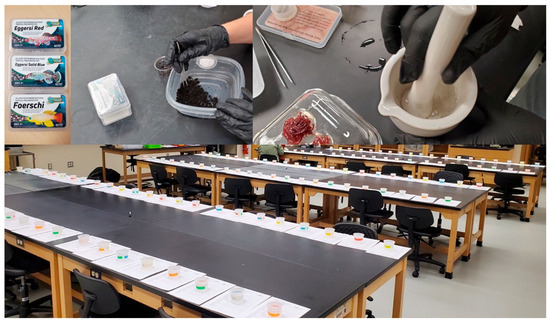
On 7 November 2025, 17 days after the embryos of each species were predicted to be in diapause III and ready to hatch, 135 small plastic cups were each filled with 100 mL of dechlorinated tap water and placed in long rows on lab benches (Figure 1). The water temperature was 19.5 °C. To control for potential spatial effects of heterogeneity in lighting, air currents and other factors that may affect hatching, treatment assignments were interspersed systematically [35] in blocks of nine cups, repeated 15 times (Table 1). Sample sizes were n = 15 for each embryo x cue combination, i.e., n = 45 embryos (15 from each embryo source) exposed to crushed embryo cue, n = 45 embryos exposed to crushed chironomid cue, and n = 45 embryos exposed to water. After all cups had been dosed with their respective cue treatments, we immediately added one embryo per cup as designated (Table 1) and began monitoring time to hatch. Embryos were checked at 3, 4, 5, 6, 9, 12, 15, 18, 21, 24, 27, 30, 33, and 42 h. No new hatches occurred over the 24 h preceding 42 h, therefore the experiment was terminated at 42 h. Kaplan–Meier survival analyses were performed on time-to-hatch data using IBM SPSS v 20.0.2.0 to test the effect of cue treatments and to test for differences among the species/egg batches.
Figure 1.
L-R upper row: Nothobranchius embryo kits from greenwaterfarmthailand.com; picking embryos out of the peat moss; preparing crushed chironomid cue with mortar and pestle. Lower row: arrangement of labeled cups and data recording sheets.
Table 1.
All nine combinations of cue x embryo type constituted one block of nine cups. Blocks were repeated sequentially 15 times throughout the room to randomize the effects, if any, of spatial position in the laboratory. n = 3 × 15 = 45 per cue treatment and n = 3 × 15 = 45 per embryo type.
3. Results
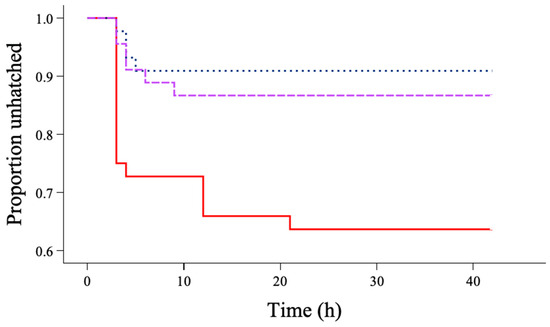
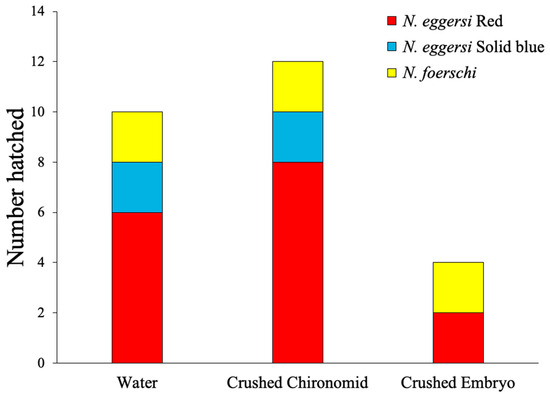
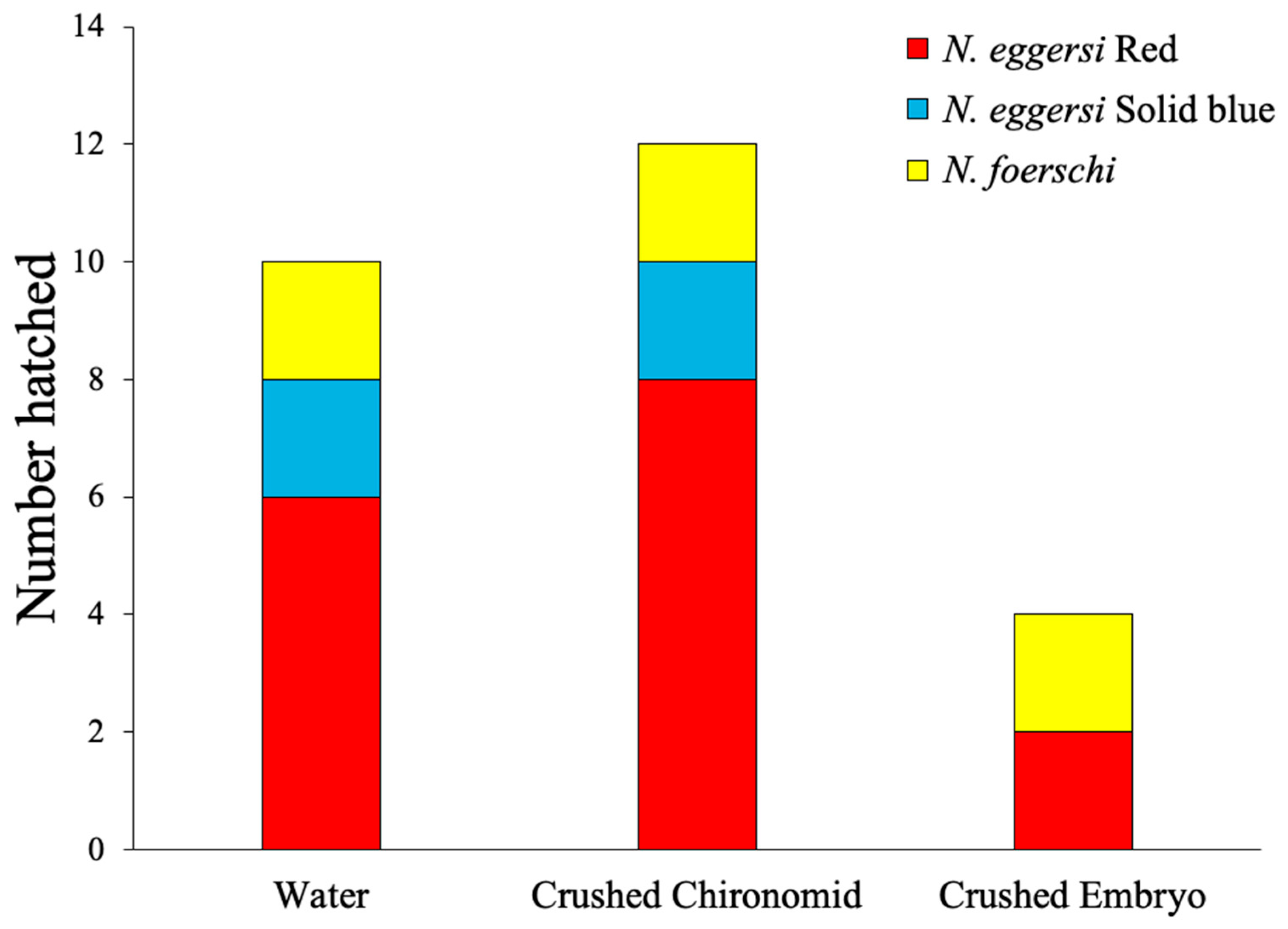
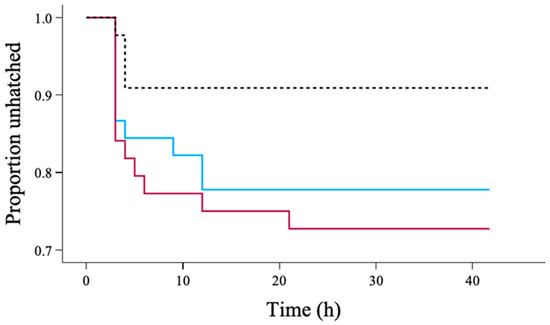
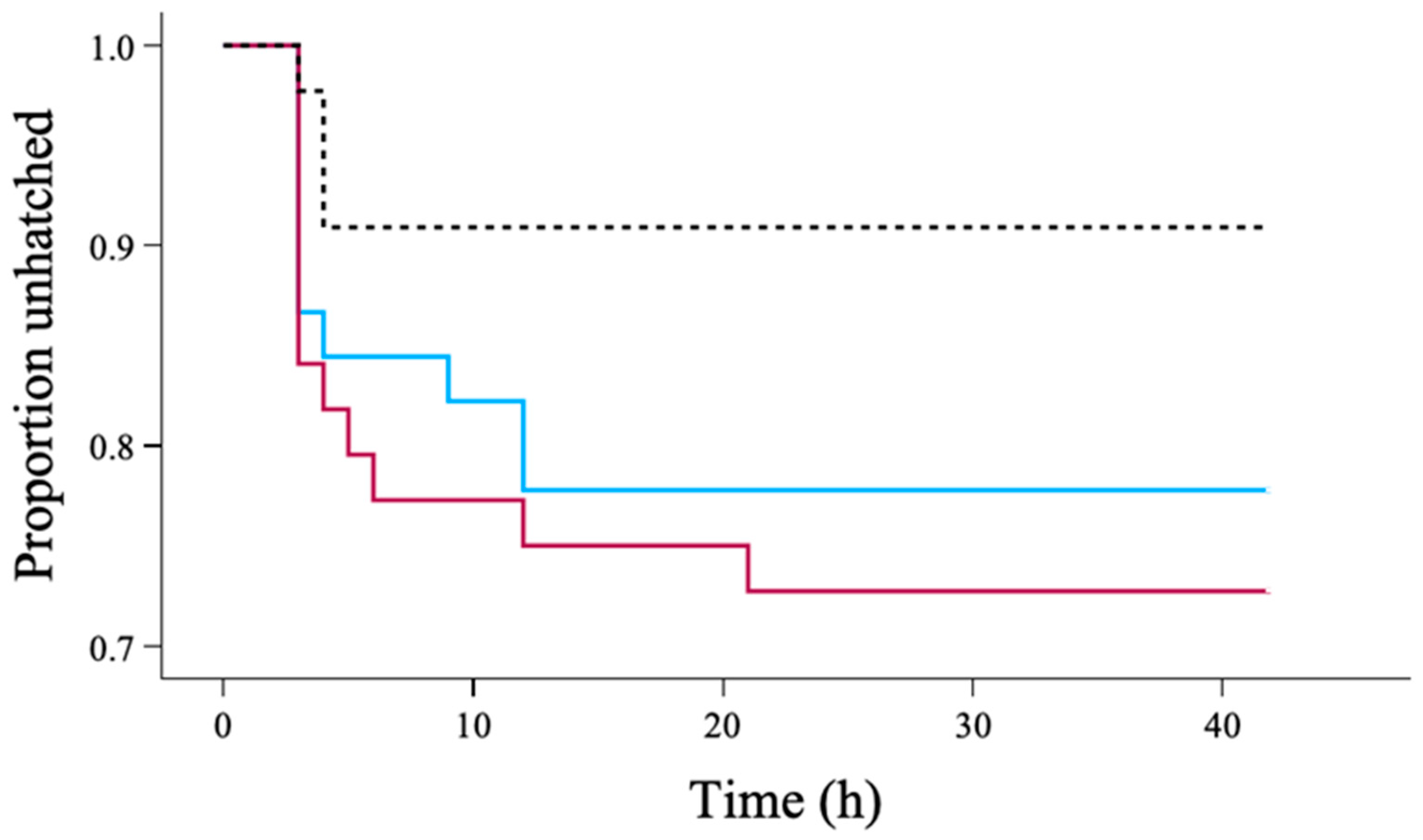
Overall, 19.3% of embryos hatched within the first 21 h. Embryos of N. eggersi Red (35.5% hatched) hatched significantly faster than N. eggersi Blue (8.9% hatched) or N. foerschi (13.3% hatched) (Kaplan–Meier, log-rank, Mantel–Cox: χ2 = 12.297, df = 2, p = 0.002; Figure 2). The effect of cue was broadly similar for both strains of N. eggersi and for N. foerschi (Figure 3). Thus, data from all three embryo types were combined to examine the effect of cue type on time to hatch. Initial analysis of the effect of cue treatment on time to hatch did not surpass the threshold of statistical significance (Kaplan–Meier, log-rank, Mantel–Cox: χ2 = 4.854, df = 2, p = 0.088; Figure 4). When time to hatch was compared between embryos incubated with the odor of crushed embryos versus the two control treatments combined (i.e., crushed-chironomid control and the water negative control) there was a significant delay in time to hatch for embryos exposed to the odor of crushed embryos (Kaplan–Meier, log-rank, Mantel–Cox: χ2 = 4.548, df = 1, p = 0.033; Figure 4). The biologically motivated hypothesis in this study was a planned contrast between embryos exposed to conspecific embryo alarm cues versus embryos exposed to non-alarm conditions. Both water and crushed-chironomid treatments were included a priori to establish baseline hatching behavior and to control for nonspecific effects of damaged tissue. The initial three-level comparison was used to describe overall treatment patterns; however, the primary hypothesis test focused on whether crushed embryo cues delayed hatching relative to control cues. Because this contrast was defined by biological rationale rather than selected post hoc, we did not apply a Bonferroni correction.
Figure 2.
Cumulative proportion of unhatched Nothobranchius embryos that were N. eggersi Red (red line), N. eggersi Blue (short dashes, blue line) or N. foerschi (long dashes, purple line).
Figure 3.
Distribution of hatched embryos for each species of Nothobranchius (batch of embryos) within cue treatments of water, crushed chironomids, and crushed embryos.
Figure 4.
Cumulative proportion of unhatched embryos exposed to blank water (blue line), crushed chironomid bloodworms (red line), or odor of crushed Nothobranchius embryos (dashed black line).
4. Discussion
Nothobranchius embryos delayed time to hatch when in the presence of crushed embryo odor compared to the two control treatments of the odor of crushed chironomids or blank water. Injury-released cues from crushed chironomids, which would include generic amino acids, polypeptides and lipids common to any aquatic organism, did not affect time to hatch. Thus, the response by Nothobranchius embryos was specific to the chemical components in crushed conspecific embryos. Taken together, these data indicate that (1) Nothobranchius embryos likely possess an alarm cue, (2) embryos have receptors to detect chemical cues from damaged conspecific embryos, and (3) embryos respond to this public information about risk of predation by delaying time to hatch.
Alarm cues have also been reported for adults of numerous species within Cyprinodontiformes, including western mosquitofish (Gambusia affinis), Moapa White River springfish (Crenichthys baileyi moapae) and numerous pupfish species (Cyprinodon sp.) [36,37,38]. Detection of damage-released conspecific alarm cues by Nothobranchius embryos is consistent with earlier work that showed developing embryos respond to alarm cues. For example, embryo alarm cues have been reported for fathead minnows [20], zebrafish [21], convict cichlids [39], rainbow trout (Onchorhynchus mykiss) [40,41], Nile tilapia (Oreochromis niloticus) [42], clownfish (Amphiprion melanophus) [43], and mangrove rivulus (Kryptolebias marmoratus) [44]. However, this is the first report of the presence of a putative alarm cue within diapause III killifish embryos.
The antipredator response of delayed hatching in this study is similar to antipredator responses of streamside salamander embryos [23,24] and wood frog embryos [25]. In these examples, embryos were safer remaining as embryos than by being exposed to predators as vulnerable hatchlings. Delayed time to hatch allows embryos to continue the musculoskeletal development needed to evade predators in post-hatch encounters. Importantly, our results concur with the response of Austrolebias botocudo, an annual killifish from highland grasslands in Brazil [32]. In that study, embryos delayed hatching in response to kairomones of an allopatric Brazilian fish predator species but not when incubated with kairomones from a non-native African cichlid or when incubated with odonate predator kairomones, suggesting differential recognition of risk [32]. This finding is consistent with a bet-hedging strategy for A. botocudo aligning with unpredictable predation risk for this habitat that is only periodically invaded by fish predators. In fact, the same study showed that the congener A. lourenciano, from lowland areas with a longer hydroperiod and intermittent connection to a permanent stream supporting a diverse complement of predators, did not alter hatching in response to test cues [32]. In another study, N. steinforti embryos delayed hatching when exposed to kairomones of non-native pumpkinseed sunfish Lepomis gibbosus, suggesting a generic response to fish kairomones [29]. To our knowledge, our experiment with N. eggersi and N. foerschi is the first to demonstrate a hatching response in an annual killifish in response to conspecific embryo alarm cues.
Our report of delayed hatching by N. eggersi and N. foerschi is consistent with the risk-spreading, bet-hedging strategy that selected for diapaused embryos in annual killifishes [26,29,32,45]. Fish embryos in other species typically hatch early in response to the perception of predation risk to embryos [19,20,21]. Because diapause III embryos are fully developed, they do not have a trade-off between early hatching and compromised antipredator competence due to underdevelopment [16,21]. Therefore, they could hatch immediately at the first indication of risk, e.g., A. lourenciano [32]. The decision to delay hatching by Nothobranchius suggests that the perception of risk may extend equally to both embryos and hatchling larvae. This may be a default response to risk because selection for diapaused development in annual killifishes is thought to be a response to environmental parameters that predict the probability of a water body of sufficient longevity to complete a life cycle [26,29]. Predation risk, indicated by external cues such as alarm cues or kairomones, may be similar to environmental risk related to not completing a life cycle, with the same response of delaying hatching. The opposite argument may be made for fish species with embryos that hatch early in response to indicators of risk. Embryos of brown trout (Salmo trutta), arctic charr (Salvelinus alpinus) and whitefish (Coregonus spp.) embryos exposed to risk of desiccation hatch early [46], while embryos of fathead minnows [20] and zebrafish [21] hatch early in response to risk of predation.
The crushed embryo cue used in this experiment was an amalgam of 45 embryos, with 15 from each of the three embryo sources in the study. This solution was applied to all 45 individual embryos in the crushed-embryo cue treatment. Although we took steps to ensure the statistical independence of test subjects, the use of a single stock solution for the entire treatment group could be construed as a form of pseudoreplication. However, the use of 45 embryos combined provides a consistent treatment that captures the range of alarm cue concentrations. An alternative experimental design would have been to crush individual embryos in one mL of water and apply each crushed embryo solution to only one test subject. Future studies should consider this approach.
The overall hatch rate of 19.3% is at the low end of hatch rates reported in other studies. For example, hatching rate of Nothobranchius guentheri ranged of 28% to 77% [47] and 10.4 to 97.2% [48]. Two factors may have contributed to our relatively low rate of hatching. Firstly, we removed the embryos from the peat moss substrate when we transferred individual embryos to experimental cups. Inundating embryos while still embedded in peat moss leads to higher hatching rates than when embryos are isolated from that medium. Secondly, the room temperature in the lab was 19.5 °C, slightly cooler than the ideal temperatures of 24–30 °C. Inter-species and inter-strain differences in sensitivity to these effects may have contributed to variation in hatch rates among embryo types. However, the effects of handling and temperature, if any, were balanced among cue treatments and had no effect on the conclusions of this study.
Embryos used in this study were from a commercial breeder for the ornamental fish trade. The original collection sites for the commercial breeder are not known; however, N. eggersi and N. foerschi occur in allopatry from other fish species other than lungfishes and experience brief hydroperiods and long periods without rain [29,49]. African lungfish Protopterus annectens co-occur in many of the same water bodies where Nothobranchius are found, however the dominant predators of adult Nothobranchius are wading birds and belastomatid hemipterans [50,51]. Invertebrate predators, such as freshwater Potamonautes crabs, are likely predators of killifish embryos [50]. Our findings suggest that predation pressure on newly hatched killifish embryos may be sufficient to select for changes in hatching as an antipredator strategy.
Nothobranchius embryos responded to the odor of crushed conspecific embryos but not to generic damage-released compounds from crushed chironomid larvae. This suggests that embryos are sensitive to predation on conspecifics but not sensitive to the presence of predation per se. We did not quantify the constituent biochemical components of crushed Nothobranchius embryos and crushed chironomid; therefore, crushed insect larvae may not have been a perfect control for crushed fish larvae. The biochemistry of the active component (or components) in alarm cues in fishes, and the olfactory receptors that detect them, lags far behind the behavioral responses and ecological effects of these cues. Early work on fishes in the superorder Ostariophysi suggested that the biologically active component in the skin of adults is a small molecule < 500 Da [52], perhaps with a polypeptide carrier [53,54]. Hypoxanthine-3N-oxide emerged as a candidate molecule [55,56,57,58,59]. Subsequent work found no support for biological activity by hypoxanthine 3N oxide and instead suggested that chondroitin sulfate was a component of a multi-component alarm cue in zebrafish [60] and fathead minnows [61]. A recent study concludes that there are two compounds, one a pterin and the other a sulfated bile alcohol “daniol sulfate”, which induce behavioral alarm reactions in adult zebrafish [62]. None of these candidate compounds have been tested on fish embryos and there has been no attempt to date to extend this work to species within the Cyprinodontiformes. In the current study, we tested a generalized alarm cue made from the combination of all three sources of Nothobranchius embryos. Thus, this mixture contained conspecific alarm cues in addition to alarm cues from another strain and species of Nothobranchius. Nothing is known about the biochemistry of the alarm cue in Nothobranchius embryos or if biochemical differences between strains and species are greater than differences that may exist among individuals or among populations within a species. Future work on this system could be directed at biochemical characterization of the active ingredients in crushed Nothobranchius embryos that elicit the response of delayed hatching.
5. Conclusions
This is the first study to test for the presence of an embryo alarm cue in annual killifish. We showed that embryos delay hatch when they detect the odor of crushed conspecific embryos relative to generic biological macromolecules released by crushed chironomids or blank water. Embryos may have a generic response to risk, be it environmental conditions or the presence of predators, which is to hedge their bets and delay hatching until a time in the future when conditions for survival may be more favorable.
Author Contributions
Conceptualization, B.D.W. and C.A.S.; methodology, B.D.W.; validation, B.D.W.; formal analysis, B.D.W.; investigation, B.D.W., K.M.E., O.A.K., D.J.F., J.A.B., B.J.S., M.M.L., M.A.S., M.I.M.J., A.M.J., K.B., S.M.T., R.L.A., K.A.H., P.E.L., J.C.V. and C.A.S.; resources, B.D.W.; data curation, B.D.W.; writing—original draft preparation, B.D.W., K.M.E., P.E.L., K.A.H. and J.C.V.; writing—review and editing, B.D.W. and C.A.S.; visualization, B.D.W.; supervision, B.D.W.; project administration, B.D.W.; finding acquisition, B.D.W. All authors have read and agreed to the published version of the manuscript.
Funding
This research was funded by a faculty research grant to B.D.W. from the College of Science, Health and the Environment, Minnesota State University Moorhead.
Institutional Review Board Statement
Experimental protocols for this study were reviewed and approved by the Minnesota State University Moorhead Institutional Animal Care and Use Committee under permit number 25-R/T-BIO-018-N-Y-C (Approval date: 14 October 2025).
Data Availability Statement
Data are available upon request to the corresponding author.
Acknowledgments
We are grateful for constructive criticism provided by three anonymous reviewers and the Academic Editor.
Conflicts of Interest
The authors declare no conflicts of interest.
References
- Lima, S.L.; Dill, L.M. Behavioral decisions made under the risk of predation: A review and prospectus. Can. J. Zool. 1990, 68, 619–640. [Google Scholar] [CrossRef] [Scilit]
- Reznick, D.N.; Butler IV, M.J.; Rodd, F.H.; Ross, P. Life-history evolution in guppies (Poecilia reticulata) 6. Differential mortality as a mechanism for natural selection. Evolution 1996, 50, 1651–1660. [Google Scholar] [CrossRef] [Scilit]
- Sih, A.; Ziemba, R.; Harding, K.C. New insights on how temporal variation in predation risk shapes prey behavior. Trends Ecol. Evol. 2000, 15, 3–4. [Google Scholar] [CrossRef] [Scilit]
- Johnson, J.B. Adaptive life-history evolution in the livebearing fish Brachyrhaphis rhabdophora: Genetic basis for parallel divergence in age and size at maturity and a test of predator-induced plasticity. Evolution 2001, 55, 1486–1491. [Google Scholar] [CrossRef] [Scilit]
- Belk, M.C. Predator-induced delayed maturity in bluegill sunfish (Lepomis macrochirus): Variation among populations. Oecologia 1998, 113, 203–209. [Google Scholar] [CrossRef] [Scilit]
- Gosline, A.K.; Rodd, F.H. Predator-induced plasticity in guppy (Poecilia reticulata) life history traits. Aquat. Ecol. 2008, 42, 693–699. [Google Scholar] [CrossRef] [Scilit]
- Wisenden, B.D. Effect of predation on shaping parental brood defense and larval ontogeny of convict cichlids leading to population divergence. Diversity 2020, 12, 136. [Google Scholar] [CrossRef] [Scilit]
- Ferrari, M.C.O.; Wisenden, B.D.; Chivers, D.P. Chemical ecology of predator–prey interactions in aquatic ecosystems: A review and prospectus. Can. J. Zool. 2010, 88, 698–724. [Google Scholar] [CrossRef] [Scilit]
- Wisenden, B.D. Chemical cues that indicate risk of predation. In Fish Pheromones and Related Cues; Sorensen, P.W., Wisenden, B.D., Eds.; Wiley-Blackwell Press: New York, NY, USA, 2014; pp. 131–148. [Google Scholar] [CrossRef] [Scilit]
- Crane, A.L.; Bairos-Novak, K.R.; Goldman, J.A.; Brown, G.E. Chemical disturbance cues in aquatic systems: A review and prospectus. Ecol. Monogr. 2022, 92, e01487. [Google Scholar] [CrossRef] [Scilit]
- Kasumyan, A.O. Fish as sources of kairomones–chemical signals for aquatic animals. J. Ichthyol. 2022, 62, 289–315. [Google Scholar] [CrossRef] [Scilit]
- Wisenden, B.D.; Vollbrecht, K.A.; Brown, J.L. Is there a fish alarm cue? Affirming evidence from a wild study. Anim. Behav. 2004, 67, 59–67. [Google Scholar] [CrossRef] [Scilit]
- Mirza, R.S.; Chivers, D.P. Learned recognition of heterospecific alarm signals: The importance of a mixed predator diet. Ethology 2001, 107, 1007–1018. [Google Scholar] [CrossRef] [Scilit]
- Ferrari, M.C.O.; McCormick, M.I.; Allan, B.J.M.; Choi, R.; Ramasamy, R.A.; Johansen, J.L.; Mitchell, M.D.; Chivers, D.P. Living in a risky world: The onset and ontogeny of an integrated antipredator phenotype in a coral reef fish. Sci. Rep. 2015, 5, 15537. [Google Scholar] [CrossRef] [Scilit]
- Crowder, C.; Ward, J. Embryonic antipredator defenses and behavioral carryover effects in the fathead minnow (Pimephales promelas). Behav. Ecol. Sociobiol. 2022, 76, 27. [Google Scholar] [CrossRef] [Scilit]
- Warkentin, K.M. Adaptive plasticity in hatching age: A response to predation risk trade-offs. Proc. Nat. Acad. Sci. USA 1995, 92, 3507–3510. [Google Scholar] [CrossRef] [Scilit] [PubMed]
- Warkentin, K.M. Environmentally cued hatching across taxa: Embryos respond to risk and opportunity. Integr. Comp. Biol. 2011, 51, 14–25. [Google Scholar] [CrossRef] [Scilit]
- Chivers, D.P.; Kiesecker, J.M.; Marco, A.; Devito, J.; Anderson, M.T.; Blaustein, A.R. Predator-induced life history changes in amphibians: Egg predation induces hatching. Oikos 2001, 92, 135–142. [Google Scholar] [CrossRef] [Scilit]
- Mirza, R.S.; Chivers, D.P.; Godin, J.-G.J. Brook charr alevins alter timing of nest emergence in response to chemical cues from fish predators. J. Chem. Ecol. 2001, 27, 1775–1785. [Google Scholar] [CrossRef] [Scilit]
- Kusch, R.C.; Chivers, D.P. The effects of crayfish predation on phenotypic and life-history variation in fathead minnows. Can. J. Zool. 2004, 82, 917–921. [Google Scholar] [CrossRef] [Scilit]
- Wisenden, B.D.; Paulson, D.C.; Orr, M. Zebrafish embryos hatch early in response to chemical and mechanical indicators of predation risk, resulting in under-developed swimming ability of hatchling larvae. Biol. Open 2022, 11, bio059229. [Google Scholar] [CrossRef] [Scilit] [PubMed]
- Horn, M.E.; Chivers, D.P. Embryonic exposure to predation risk and hatch time variation in fathead minnows. PLoS ONE 2021, 16, e0255961. [Google Scholar] [CrossRef] [Scilit] [PubMed]
- Sih, A.; Moore, R.D. Delayed hatching of salamander eggs in response to enhanced larval predation risk. Am. Nat. 1993, 142, 947–960. [Google Scholar] [CrossRef] [Scilit]
- Moore, R.D.; Newton, B.; Sih, A. Delayed hatching as a response of streamside salamander eggs to chemical cues from predatory sunfish. Oikos 1996, 77, 331–335. [Google Scholar] [CrossRef] [Scilit]
- Rivera-Hernández, I.A.; Preagola, A.A.; Ferrari, M.C.O. Embryonic risk cues in wood frog: Effect in hatching time, morphology and behaviour. Behav. Ecol. Sociobiol. 2025, 79, 57. [Google Scholar] [CrossRef] [Scilit]
- Wourms, J.P. The developmental biology of annual fishes. III. Pre-embryonic and embryonic diapause of variable duration in the eggs of annual fishes. J. Exp. Zool. 1972, 182, 389–414. [Google Scholar] [CrossRef] [Scilit]
- Furness, A.I.; Reznick, D.N.; Springer, M.S.; Meredith, R.W. Convergent evolution of alternative developmental trajectories associated with diapause in African and South American killifish. Proc. R. Soc. B Biol. Sci. 2015, 282, 20142189. [Google Scholar] [CrossRef] [Scilit]
- Furness, A.I.; Lee, K.; Reznick, D.N. Adaptation in a variable environment: Phenotypic plasticity and bet-hedging during egg diapause and hatching in an annual killifish. Evolution 2015, 69, 1461–1475. [Google Scholar] [CrossRef] [Scilit] [PubMed]
- Furness, A.I. The evolution of an annual life cycle in killifish: Adaptation to ephemeral aquatic environments through embryonic diapause. Biol. Rev. 2016, 91, 796–812. [Google Scholar] [CrossRef] [Scilit]
- Reichard, M.; Blažek, R.; Polačik, M.; Vrtílek, M. Hatching date variability in wild populations of four coexisting species of African annual fishes. Dev. Dyn. 2017, 246, 827–837. [Google Scholar] [CrossRef] [Scilit] [PubMed]
- Polačik, M.; Reichard, M.; Vrtílek, M. Local variation in embryo development rate in annual fish. J. Fish Biol. 2018, 92, 1359–1370. [Google Scholar] [CrossRef] [Scilit]
- Godoy, R.S.; Weber, V.; Lanés, L.E.; Reichard, M.; Gemelli, T.; Hohendorff, R.V.; Maltchik, L. Recognizing the enemy: Do predator cues influence hatching in Neotropical annual killifish? J. Fish Biol. 2021, 99, 1476–1484. [Google Scholar] [CrossRef] [Scilit]
- Pinceel, T.; Vanschoenwinkel, B.; Deckers, P.; Grégoir, A.; Ver Eecke, T.; Brendonck, L. Early and late developmental arrest as complementary embryonic bet-hedging strategies in African killifish. Biol. J. Linn. Soc. 2015, 114, 941–948. [Google Scholar] [CrossRef] [Scilit]
- Polačik, M.; Reichard, M. Diet overlap among three sympatric African annual killifish species Nothobranchius spp. from Mozambique. J. Fish Biol. 2010, 77, 754–768. [Google Scholar] [CrossRef] [Scilit]
- Hurlbert, S.H. Pseudoreplication and the design of ecological field experiments. Ecol. Monogr. 1984, 54, 187–211. [Google Scholar] [CrossRef] [Scilit]
- Pandey, S.; Stockwell, C.A.; Snider, M.R.; Wisenden, B.D. Epidermal club cells in fishes: A case for ecoimmunological analysis. Int. J. Mol. Sci. 2021, 22, 1440. [Google Scholar] [CrossRef] [Scilit]
- Anderson, C.M.; Wisenden, B.D.; Craig, C.A.; Stockwell, C.A. Consistent antipredator behavioral responses among populations of Red River pupfish with disparate predator communities. Fishes 2023, 8, 315. [Google Scholar] [CrossRef] [Scilit]
- Wisenden, B.D.; Anderson, C.M.; Hanson, K.A.; Johnson, M.I.; Stockwell, C.A. Acquired predator recognition via epidermal alarm cues but not dietary alarm cues by isolated pupfish. R. Soc. Open Sci. 2023, 10, 230444. [Google Scholar] [CrossRef] [Scilit]
- Nelson, A.B.; Alemadi, S.D.; Wisenden, B.D. Learned recognition of novel predator odour by convict cichlid embryos. Behav. Ecol. Sociobiol. 2013, 67, 1269–1273. [Google Scholar] [CrossRef] [Scilit]
- Poisson, A.; Valotaire, C.; Borel, F.; Bertin, A.; Darmaillacq, A.S.; Dickel, L.; Colson, V. Embryonic exposure to a conspecific alarm cue triggers behavioural plasticity in juvenile rainbow trout. Anim. Behav. 2017, 133, 35–45. [Google Scholar] [CrossRef] [Scilit]
- Horn, M.E.; Ferrari, M.C.; Chivers, D.P. Retention of learned predator recognition in embryonic and juvenile rainbow trout. Behav. Ecol. 2019, 30, 1575–1582. [Google Scholar] [CrossRef] [Scilit]
- Zhang, N.; Li, Q.; Li, M.; Elvidge, C.K.; Deng, C.; Wang, D.; Fu, S.; Xia, J. Divergent embryo responses to chemical cues in two freshwater fishes with different parental care strategies. Animals 2025, 15, 3511. [Google Scholar] [CrossRef] [Scilit]
- Atherton, J.A.; McCormick, M.I. Active in the sac: Damselfish embryos use innate recognition of odours to learn predation risk before hatching. Anim. Behav. 2015, 103, 1–6. [Google Scholar] [CrossRef] [Scilit]
- Nunley, K.; McGhee, K.E. Detection of relatedness in chemical alarm cues by a selfing vertebrate depends on population and the life stage producing the alarm cue. Behav. Proc. 2024, 219, 105056. [Google Scholar] [CrossRef] [Scilit]
- Podrabsky, J.E.; Riggs, C.L.; Romney, A.L.; Woll, S.C.; Wagner, J.T.; Culpepper, K.M.; Cleaver, T.G. Embryonic development of the annual killifish Austrofundulus limnaeus: An emerging model for ecological and evolutionary developmental biology research and instruction. Dev. Dyn. 2017, 246, 779–801. [Google Scholar] [CrossRef] [Scilit] [PubMed]
- Wedekind, C.; Müller, R. Risk-induced early hatching in salmonids. Ecology 2005, 86, 2525–2529. [Google Scholar] [CrossRef] [Scilit]
- Nguyen, L.T.H.; Persoone, G. Controlled storage and hatching of eggs of the annual fish Nothobranchius guentheri for toxicity testing. In New Microbiotests for Routine Toxicity Screening and Biomonitoring; Jannsen, C., Persoone, G., Eds.; Kluwer Academic/Plenum Press: Boston, MA, USA, 2000; pp. 155–162. [Google Scholar]
- Guo, M.; Zheng, L.; Lin, G.; Zhong, J.; Yang, H.; Zheng, Y. Hatching rate and growth rate of Nothobranchius guentheri fertilized eggs after space flight. J. Nucl. Agric. Sci. 2012, 26, 1132–1136. [Google Scholar]
- Nagy, B. Life history and reproduction of Nothobranchius fishes. J. Am. Killifish Assoc. 2015, 47, 182–192. [Google Scholar]
- Reichard, M.; Polačik, M.; Blažek, R.; Vrtílek, M. Female bias in the adult sex ratio of African annual fishes: Interspecific differences, seasonal trends and environmental predictors. Evol. Ecol. 2014, 28, 1105–1120. [Google Scholar] [CrossRef] [Scilit]
- Reichard, M.; Lanes, L.E.; Polačik, M.; Blažek, R.; Vrtilek, M.; Godoy, R.S.; Maltchik, L. Avian predation mediates size-specific survival in a Neotropical annual fish: A field experiment. Biol. J. Linn. Soc. 2018, 124, 56–66. [Google Scholar] [CrossRef] [Scilit]
- Døving, K.B.; Lastein, S. The alarm reaction in fishes—Odorants, modulations of responses, neural pathways. Ann. N. Y. Acad. Sci. 2009, 1170, 413–423. [Google Scholar] [CrossRef] [Scilit]
- Lebedeva, N.Y.; Malyukina, G.A.; Kasumyan, A.O. The natural repellent in the skin of cyprinids. J. Ichthyol. 1975, 15, 472–480. [Google Scholar]
- Kasumyan, A.O.; Ponomarev, V.Y. Biochemical features of alarm pheromone in fish of the order Cypriniformes. J. Evol. Biochem. Physiol. 1987, 23, 20–24. [Google Scholar]
- Pfeiffer, W.; Riegelbauer, G.; Meier, G.; Scheibler, B. Effect of hypoxanthine-3(N)-oxide and hypoxanthine-1(N)-oxide on central nervous excitation of the black tetra Gymnocorymbus ternetzi (Characidae, Ostariophysi, Pisces) indicated by dorsal light response. J. Chem. Ecol. 1985, 11, 507–523. [Google Scholar] [CrossRef] [Scilit]
- Brown, G.E.; Adrian, J.C., Jr.; Smyth, E.; Leet, H.; Brennan, S. Ostariophysan alarm pheromones: Laboratory and field tests of the functional significance of nitrogen-oxides. J. Chem. Ecol. 2000, 26, 139–154. [Google Scholar] [CrossRef] [Scilit]
- Brown, G.E.; Adrian, J.C., Jr.; Shih, M. Behavioural responses of fathead minnows (Pimephales promelas) to hypoxanthine-3-N-oxide at varying concentrations. J. Fish Biol. 2001, 58, 1465–1470. [Google Scholar] [CrossRef] [Scilit]
- Brown, G.E.; Adrian, J.C., Jr.; Naderi, N.T.; Harvey, M.C.; Kelly, J.M. Nitrogen-oxides elicit antipredator responses in juvenile channel catfish, but not convict cichlids or rainbow trout: Conservation of the Ostariophysan alarm pheromone. J. Chem. Ecol. 2003, 29, 1781–1796. [Google Scholar] [CrossRef] [Scilit] [PubMed]
- Speedie, N.; Gerlai, R. Alarm substance induced behavioral responses in zebrafish (Danio rerio). Behav. Brain Res. 2008, 188, 168–177. [Google Scholar] [CrossRef] [Scilit] [PubMed]
- Mathuru, A.S.; Kibat, C.; Cheong, W.F.; Shui, G.; Wenk, M.R.; Friedrich, R.W.; Jesuthasan, S. Chondroitin fragments are odorants that trigger fear behavior in fish. Curr. Biol. 2012, 22, 538–544. [Google Scholar] [CrossRef] [Scilit]
- Faulkner, A.E.; Holstrom, I.E.; Molitor, S.A.; Hanson, M.E.; Shegrud, W.R.; Gillen, J.C.; Willard, S.J.; Wisenden, B.D. Field verification of chondroitin sulfate as a putative component of chemical alarm cue in wild populations of fathead minnows (Pimephales promelas). Chemoecology 2017, 27, 233–238. [Google Scholar] [CrossRef] [Scilit]
- Masuda, M.; Ihara, S.; Mori, N.; Koide, T.; Miyasaka, N.; Wakisaka, N.; Yoshikawa, K.; Watanabe, H.; Touhara, K.; Yoshihara, Y. Identification of olfactory alarm substances in zebrafish. Curr. Biol. 2024, 34, 1377–1389. [Google Scholar] [CrossRef] [Scilit]

Disclaimer/Publisher’s Note: The statements, opinions and data contained in all publications are solely those of the individual author(s) and contributor(s) and not of MDPI and/or the editor(s). MDPI and/or the editor(s) disclaim responsibility for any injury to people or property resulting from any ideas, methods, instructions or products referred to in the content. |
© 2026 by the authors. Licensee MDPI, Basel, Switzerland. This article is an open access article distributed under the terms and conditions of the Creative Commons Attribution (CC BY) license.