Article

Right-Biassed Crystalline Lens Asymmetry in the Thornback Ray (Rajiformes: Rajidae: Raja clavata): Implications for Ocular Lateralisation in Cartilaginous Fish


1
Department of Biology, Ecology and Earth Sciences, University of Calabria, 87036 Rende, Italy
2
Department of Veterinary Medical Sciences, University of Bologna, 47032 Bologna, Italy
3
National Research Council−Institute of Marine Biological Resources and Biotechnologies (CNR IRBIM), 91026 Mazara del Vallo, Italy
*
Author to whom correspondence should be addressed.
Fishes 2026, 11(1), 9; https://doi.org/10.3390/fishes11010009 (registering DOI)
Submission received: 21 November 2025 / Revised: 22 December 2025 / Accepted: 24 December 2025 / Published: 25 December 2025
(This article belongs to the Section Biology and Ecology)

Abstract

Directional asymmetry (DA) is a widespread yet often overlooked feature of animal morphology. Here, we report a consistent right-biassed asymmetry in the crystalline lenses of the thornback ray Raja clavata. Across 71 individuals sampled from the Strait of Sicily, 24% exhibited lens asymmetry, and in all cases, the right lens was larger. This pattern, supported by binomial and distributional tests, represents the first evidence of ocular DA in this species. Body size and age emerged as the primary correlates of asymmetry: the odds of exhibiting DA increased significantly with body weight, whereas the effects of sex and sampling site were not significant. The prevalence of asymmetry thus appears to rise with age and ontogenetic growth. Two non-exclusive mechanisms may account for this pattern. First, the association with positive allometry (b = 3.33) suggests that right-lens enlargement could reflect a functional or developmental lateralisation, potentially conferring a visual or ecological advantage to larger individuals. Alternatively, the same right-lens bias could arise through an age-related pathological process, such as oxidative or osmotic lens swelling preceding cataract formation, consistent with asymmetric physiological wear. These findings reveal a novel case of morphological lateralisation in an elasmobranch and highlight the need for comparative, histological, and functional approaches to disentangle adaptive asymmetry from lateralised senescence in the visual system of R. clavata.
Key Contribution: A consistent right-biassed asymmetry of the crystalline lens is documented in Raja clavata. Its prevalence, directionality, and association with body size are quantified, and potential functional, developmental, and pathological explanations for this directional lateralisation are evaluated.

1. Introduction

Symmetry is a pervasive pattern in nature, often associated with beauty and a fundamental hallmark of animal body organisation [1]. Bilateral symmetry, the most common form, involves a reflection across the left–right axis [2]. Departures from this ideal plan are termed asymmetry. They are typically grouped into three categories: fluctuating asymmetry (small, random deviations with a mean of approximately zero), antisymmetry (bimodal variation centred around zero), and directional asymmetry (DA; a systematic mean shift away from zero) [2,3]. This tripartite scheme carries distinct developmental and evolutionary implications and motivates explicit tests for both direction and shape of variation [4]. Increasing evidence highlights how widespread asymmetries are actually across animals and the importance of distinguishing their causes and consequences [5].
Laterality frameworks further clarify that directional asymmetry represents population-level alignment rather than individual noise [4,6,7,8]. This population-level alignment of biases poses an evolutionary question that individual efficiency alone cannot fully resolve. Game-theoretic treatments demonstrate that shared directionality can arise as an evolutionarily stable strategy under social or coordination pressures, with frequency-dependent selection helping to maintain consistent bias within populations [4,9]. In fishes, for instance, structural laterality can be biologically informative: directional bilateral asymmetry in otolith shape has been documented across large samples and proposed as a tool for stock discrimination [10]. In vertebrates, the assumption of strict bilateral symmetry is particularly strong in sensory systems, where structural equivalence is thought to ensure balanced perception and function. Consequently, departures from this balance are of special interest, as they may reveal developmental instability, functional lateralisation, or pathological degeneration [5,11]. However, while ocular structures are generally assumed to be bilaterally symmetric in position and morphology in most species, notable exceptions exist. The most extreme examples are found in flatfish (Pleuronectiformes), where one eye physically migrates to the other side of the head during development as an adaptation to a benthic lifestyle, resulting in inherent, massive skeletal and positional asymmetry [12]. Similarly, some deep-sea molluscs, such as cock-eyed squids (Histioteuthidae), exhibit a significant morphological size difference between their two eyes, an adaptation for asymmetric visual fields in low light [13,14]. Despite these specialised, adaptive cases, for the vast majority of bilaterally symmetrical animals, including rays, the eyes themselves are expected to be morphologically similar. The crystalline lens, in particular, is among the most geometrically conservative components of the vertebrate eye, as even minor deviations in curvature or volume can disrupt refractive balance and binocular alignment [15]. Yet, despite this presumed equivalence, many vertebrates exhibit pronounced functional visual lateralisation, asymmetries in eye use or neural processing that enhance behavioural efficiency [6,7,16]. This functional laterality is well-documented in fish [17,18], but it has rarely been linked to consistent morphological correlates within ocular anatomy.
During routine dissections for ocular ectoparasite inspection in the thornback ray (Raja clavata), a consistent right-biassed difference in crystalline-lens size was serendipitously observed. To date, crystalline lens asymmetry has not been reported in this species, within the genus Raja, or more broadly in elasmobranchs, and the present study therefore represents the first systematic description of this phenomenon.
Because such observations may arise from individual anomalies, sampling artefacts, or measurement bias, a formal evaluation was required to determine whether the observed lens difference was statistically supported and biologically meaningful. Accordingly, lens variation was first examined to assess whether asymmetry departed from random variation and, if so, to determine its distributional form. Distinguishing directional asymmetry from fluctuating asymmetry or antisymmetry is essential, as these patterns reflect distinct developmental and evolutionary processes and constrain subsequent interpretation [2,3,4,5,9,19,20].
In addition, predictors of asymmetry were examined exploratorily, with basic biological and sampling-related variables (e.g., body size, sex, and sampling site) evaluated as plausible correlates of the observed variation.
Finally, guided by the most informative predictors, volumetric measurements were used to assess how asymmetry was expressed morphologically, specifically whether lens size differences were driven by enlargement of one lens rather than by reduction in the other. Establishing this structural manifestation provides a basis for subsequent consideration of alternative functional or pathological interpretations [6,21,22].
Overall, the study tested the hypothesis that apparent crystalline lens size differences represent a genuine biological asymmetry rather than random variation, and that any such asymmetry would exhibit a structured form with a consistent morphological basis.

2. Materials and Methods

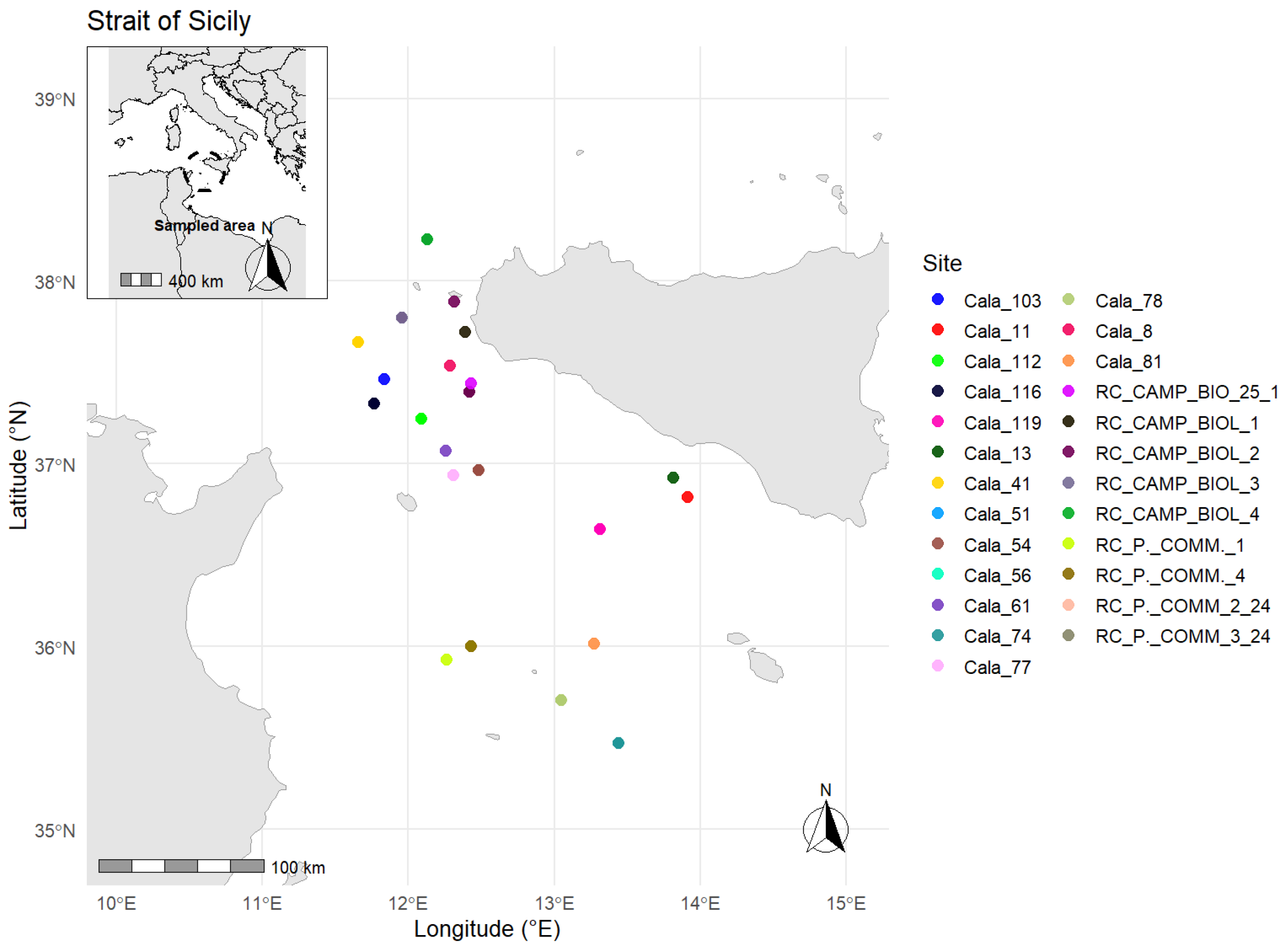
Study species, sampling, and morphometrics. Thornback rays (Raja clavata) individuals were sampled in the Central Mediterranean (Strait of Sicily and adjacent coasts; Figure 1), using standard commercial trawling gear deployed at depths typical of local demersal fisheries [23]. Specimens were obtained as by-catch of the scientific trawling operations and were not alive upon retrieval, with mortality occurring during the fishing process. Following collection, individuals were maintained under a continuous cold chain until laboratory processing. For each, the date/time, capture site (GPS coordinates), and sex were recorded. Body weight (W) was measured to the nearest gram, and total length (TL) to the nearest millimetre; missing weights were estimated from the pooled length–weight relationship (Equation (2)). The dataset comprised 71 individuals.
Georeferencing and mapping. Geographic coordinates provided as packed DMS integers were converted to decimal degrees. Sampling locations were stored as WGS84 (EPSG:4326) sf geometries. To visualise the sampling footprint, the centroid of all points was computed, buffered by 250 km in Web Mercator (EPSG:3857), and re-projected to WGS84 for plotting. Basemaps were sourced from Natural Earth [24].
Estimated age Based on [25] age of the specimen was back-calculated using the three-parameter von Bertalanffy growth function (3VBGF, [26]):
L = L   1   e K t t 0
Dissection Specimens previously stored at −20 °C were thawed at room temperature for approximately 24 h prior to dissection. Each specimen was dissected under laboratory conditions using surgical stainless-steel scissors, tweezers, and disposable scalpels (number 22). A dorsal incision was made above the optic capsule, after which the optic nerves were severed and the entire capsule carefully excised. The capsule was then transferred to a Petri dish containing sterile physiological saline (0.9% NaCl, Galenica Senese, Monteroni D’Arbia, Siena Italy) and opened to expose the crystalline lenses. Both lenses were visually inspected and compared for relative size (left vs. right). When possible, extracted lenses were placed in 1.5 mL cryogenic vials filled with physiological solution and stored at 4 °C until volumetric measurements were performed.
Volumetric calculation of the lens. A randomly selected subset (n = 29 out of the total 71) of crystalline lenses was volumetrically measured. The small sample size reflects logistical constraints during dissection, which prevented measurements from being taken on all specimens. Each lens was immersed in a 5 mL graduated cylinder containing 4 mL of physiological solution (0.9% NaCl). Following submersion, the displaced solution was withdrawn with a handheld pipette (LLG Labware, Meckenheim, Germany) until the meniscus returned to the 4 mL mark. The aspirated volume was recorded as the volumetric measure of the lens (in µL).
Lens asymmetry scoring. Binary lens asymmetry was scored from field notes as: “DX” (right lens larger), “SX” (left lens larger), or “n.a” (no difference). These were recoded as a three-level factor (R > L, L > R, R = L) and as a binary outcome (1 for any asymmetry; 0 for R = L). For the volumetric subset (n = 29), the laterality index (D) was defined as [27]:
D = V R V L V R + V L
where VR is the volume of the right lens and VL is the volume of the left. Such that positive values indicate a larger right lens.
Paired right–left differences in lens volume were assessed separately for symmetric and asymmetric individuals using Wilcoxon signed-rank tests, given their non-normal distribution of the data. Mean lens volume was analysed using analysis of covariance (ANCOVA) with asymmetry status and body weight as fixed effects. Separate linear models were fitted for right and left lenses to test whether asymmetry was associated with changes in a specific eye while controlling for weight. All variables were inspected for normality and homoscedasticity prior to analysis.
Length–weight relationship. The relationship between body weight (W) and total length (TL) was described using the allometric growth equation [28]:
W = a   ×   T L b
where a is the intercept (coefficient) and b is the allometric exponent. The parameter b indicates the type of growth, with b = 3 corresponding to isometric growth, b < 3 to negative allometric growth (slimmer with size), and b > 3 to positive allometric growth (stouter with size). The coefficients a and b of the allometric weight-length equation were estimated by log-transforming the measurements to linearise the exponential relationship, followed by fitting the data using simple linear regression [29]:
log 10 W = log 10 a +   b log 10 ( L )
Prevalence and direction of asymmetry. Counts across R = L, R > L, and L > R were summarised, and the overall proportion asymmetric was estimated. Observed counts of asymmetric individuals were compared with null expectations of 5%, 10%, 15% and 20% using one-sided exact binomial tests (H0: observed ≤ null). For presentation, Clopper–Pearson 95% confidence intervals for the observed proportion were reported from a two-sided exact binomial calculation. For the volumetric subset (n = 29), departures of D (Equation (2)) from zero were assessed using a two-sided one-sample t-test and a two-sided Wilcoxon signed-rank test. Distributional shape was evaluated by comparing univariate Gaussian mixtures via BIC, and by Hartigan’s dip test for unimodality. A single shifted normal with non-zero mean was interpreted as directional asymmetry (DA); a symmetric bimodal mixture centred on zero as antisymmetry (AS); and a zero-mean unimodal distribution with excess variance as fluctuating asymmetry (FA, [19,20]).
Predictors of asymmetry (regression modelling). The binary outcome of presence/absence of asymmetry was modelled using Firth logistic regression (bias-reduced penalised likelihood) to mitigate small-sample bias and potential (quasi)-separation. Candidate models included:
  • Single-predictor models: W, Age, TL, Sex, and Site (fixed factor).
  • Additive two-predictor models: W + TL, W + Sex, TL + Sex.
  • Full additive: W + TL + Sex.
  • Interaction: W × TL,
Where W is total weight, TL is total length.
Models were ranked by Akaike Information Criterion (AIC) computed from the (penalised) log-likelihood, and Akaike weights were used to quantify relative support. Odds ratios (OR) and 95% CIs were obtained by exponentiation of coefficient estimates and their profile (or Wald) intervals.
Software. All analyses were conducted in R (version 4.2). Key packages included sf, ggplot2, ggpubr, ggspatial, rnaturalearth, mclust, diptest, logistf, pROC, and flextable.

3. Results

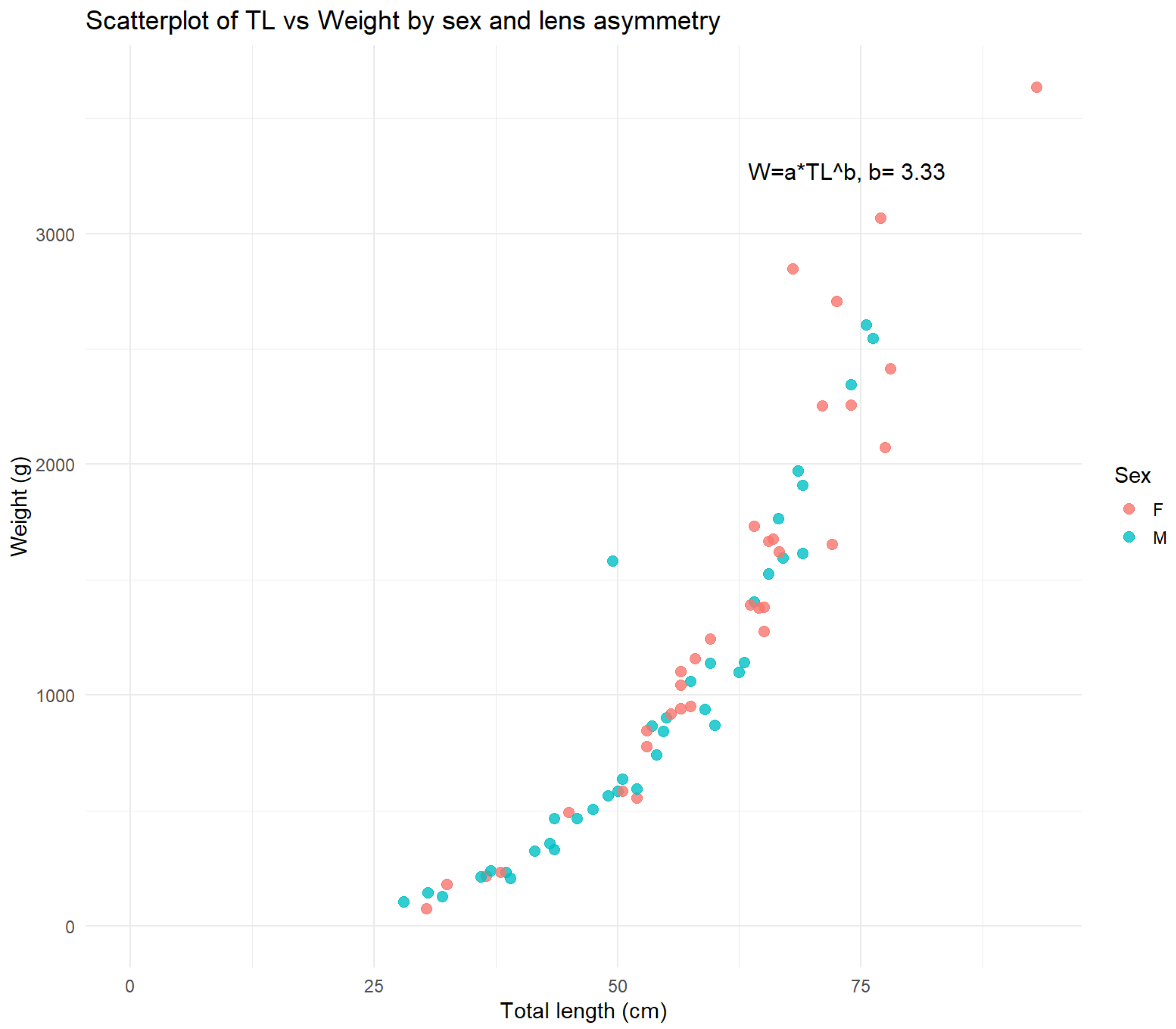
Seventy-one Raja clavata individuals were examined from the Central Mediterranean (Figure 1). The relationship between total length (TL) and body weight (W) in Raja clavata followed the expected allometric growth function (Equation (3)). The fitted exponent was b = 3.33, indicating positive allometric growth (fish becoming proportionally heavier with increasing size). No significant differences were observed between sexes in the TL–weight relationship (Figure 2).

3.1. Prevalence of Lens Asymmetry

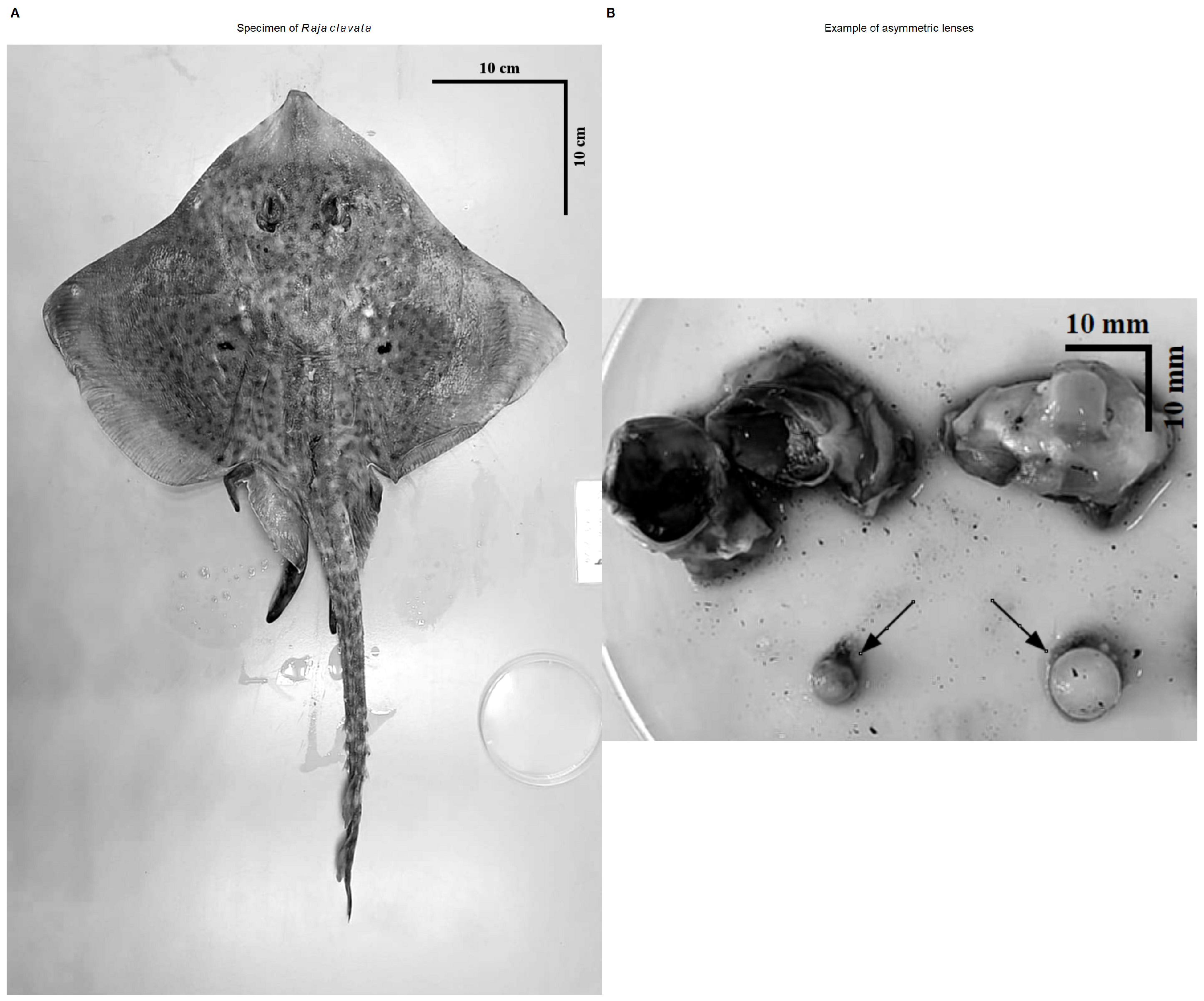
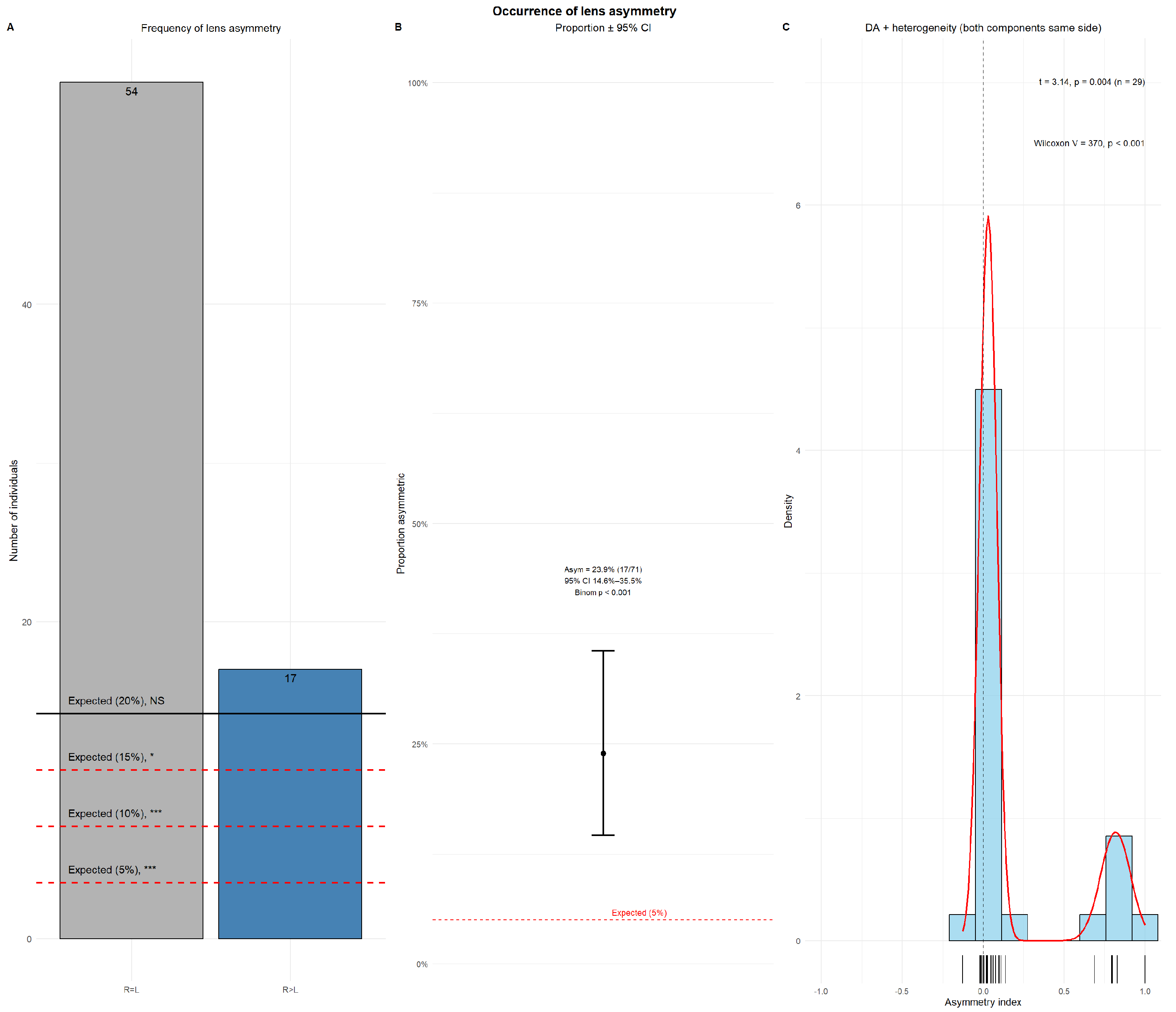
During gross examination and dissection of the eyes, an asymmetry in crystalline lens size was noted (Figure 3). This observation motivated a focused assessment of its prevalence, direction, and potential correlates. Of the 71 specimens examined, 54 (76%) were bilaterally symmetric in crystalline lens size, while 17 (24%) showed asymmetry. Binomial tests showed that this prevalence was significantly greater than rare-asymmetry expectations of 5% (p < 5.867 × 10⁻⁸), 10% (p < 5.174 × 10⁻⁴), and 15% (p = 0.0314), but not significantly greater than 20% (p = 0.242, Figure 4A). Yet, asymmetry was clearly present within the cohort at a non-trivial frequency.

3.2. Directionality of Asymmetry

All asymmetric cases had the right lens larger than the left (17/17; p < 0.001 vs. 50:50), indicating strong directional asymmetry rather than fluctuating asymmetry or antisymmetry. The estimated prevalence and its Clopper–Pearson 95% CI are shown in Figure 4B To further corroborate these results, a subset of specimens underwent volumetric analysis. This subset of lenses was randomly selected from the full sample of 71 individuals. It included both specimens classified as symmetric and a subset of those classified as asymmetric based on gross inspection (n = 29). The normalised asymmetry index Directional asymmetry was evident: the normalised asymmetry index (D, Equation (2)) showed a positive central tendency (mean = 0.19, SD = 0.33; median = 0.02; range = −0.12 to 1), indicating a rightward bias in the cohort. One-sample tests against zero confirmed a non-zero central tendency (t-test and Wilcoxon signed-rank, both p < 0.05), and a sign test indicated universal right bias (23/29, p = 0.002). Gaussian mixture modelling occasionally supported a two-component fit; however, both component means were greater than zero, and Hartigan’s dip test indicated non-unimodality (D = 0.068, p = 0.334). Taken together, these results point towards directional asymmetry with heterogeneous magnitude rather than antisymmetry (Figure 4C).

3.3. Predictors of Asymmetry

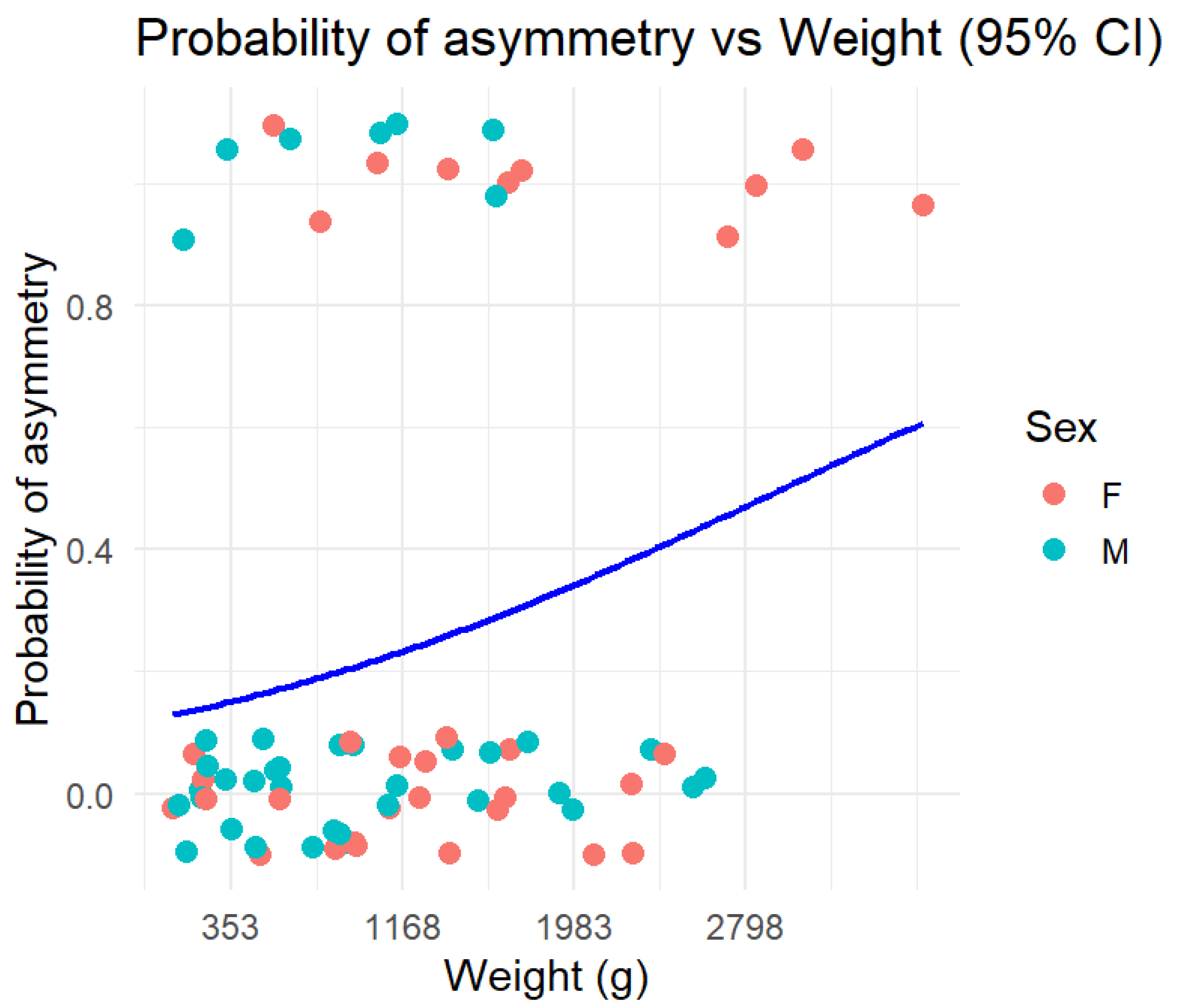
Given these results, we next investigated which potential drivers could account for the asymmetry. Across the Firth logistic candidate set (Table 1), model selection identified age as the best single predictor of crystalline lens asymmetry (AIC = 72.37), with body weight providing nearly equivalent support (ΔAIC = 0.55; weight = 0.15). Both predictors showed a positive association with the likelihood of asymmetry; the odds of asymmetry increased by approximately 1.2-fold per year of age (p = 0.08) and 1.7-fold per standard deviation in weight (W, p = 0.043). Because age and body weight are highly correlated and describe the same growth trajectory, capturing ontogenetic development, making their effects statistically redundant, the simpler W-only model was retained for interpretation (Figure 5). Body weight is a direct, easily measurable proxy of somatic development and condition, avoiding uncertainties associated with age estimation from von Bertalanffy growth parameters. Among multi-term models, only W + Sex, W + TL, and the interaction model W × TL achieved ΔAIC ≤ 2 (≤1.67); however, additional coefficients were non-significant and did not improve interpretability, so single-predictor models were favoured by parsimony. Total length alone sat right at the conventional threshold (ΔAIC = 2.00), while full and TL + sex models were clearly worse (ΔAIC ≥ 2.20). Sex, the null, and especially site performed poorly (ΔAIC ≥ 4.72 and >>2 for site). Taken together, the evidence suggests that ontogenetic scaling, captured by age (best AIC) or body weight (near-tie), explains asymmetry, whereas TL, sex, and site do not significantly improve the fit.
It is worth noting that the same models were also fitted on the subset of 56 rays for which trawl depth was recorded. In this reduced dataset, depth emerged as the strongest single predictor of asymmetry: the depth-only model (m_depth) was overwhelmingly supported (AIC = 42.05; ΔAIC = 0; Akaike weight = 0.94), far outperforming all other predictors (all ΔAIC > 8, model weights < 0.02). The estimated effect size was small (OR = 1.00, 95% CI: 1.00–1.01) and not statistically significant (p = 0.145), yet depth nonetheless provided the most important explanatory power within this restricted dataset. However, because depth was unavailable for many individuals and reflects trawl deployment location rather than actual individual habitat use, this effect is interpreted cautiously, and depth was not included in the final model comparison.

3.4. Lens Size Differences in Function of Body Weight

Among the 29 individuals for which both crystalline lenses were measured (n = 29; 15 symmetric, 14 asymmetric), paired right–left differences in lens volume were first examined separately for symmetric and asymmetric individuals. In both groups, paired differences deviated significantly from normality (Shapiro–Wilk tests; symmetric: n = 15, W = 0.88, p = 0.049; asymmetric: n = 14, W = 0.84, p = 0.017).
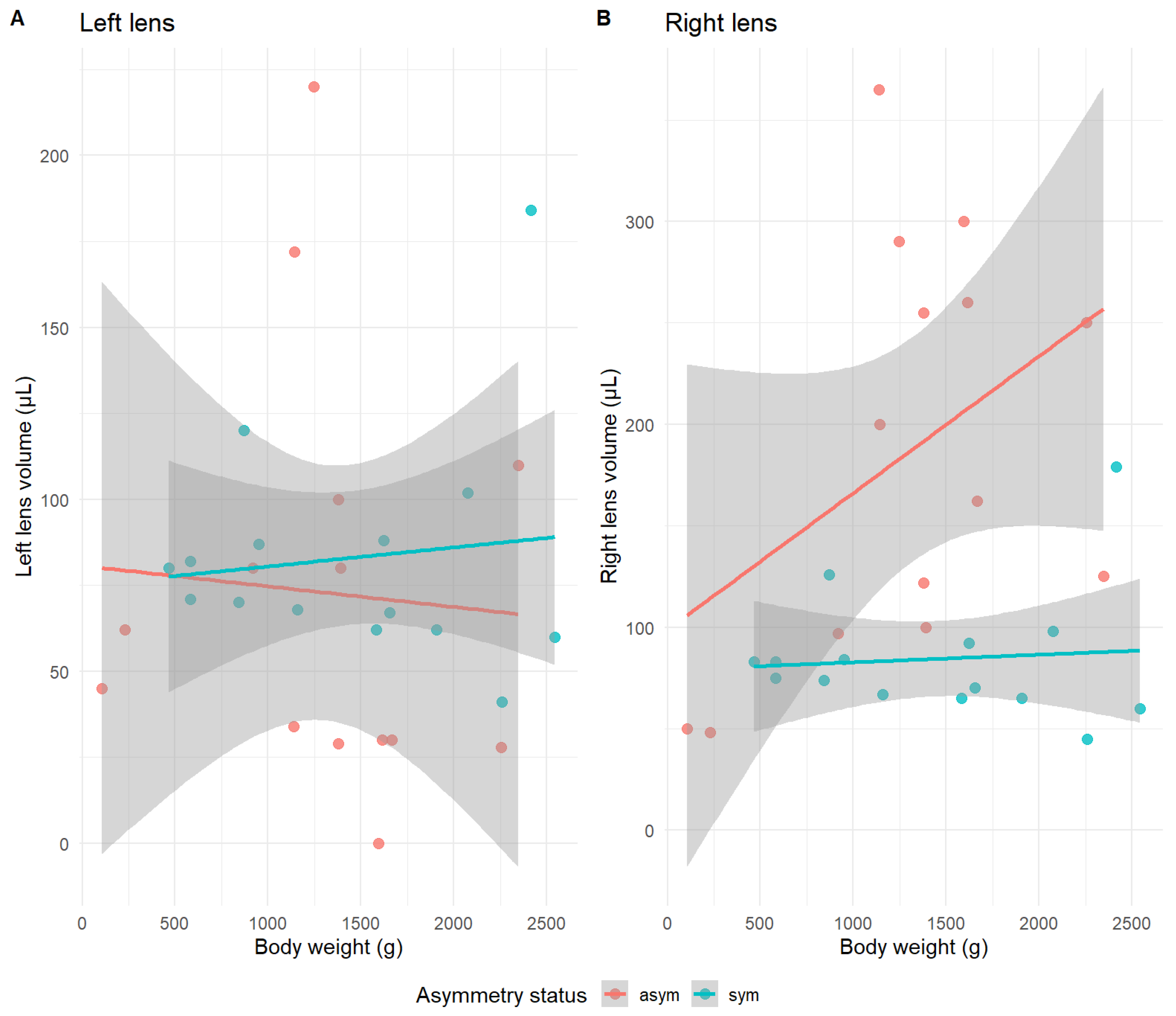
Accordingly, paired comparisons were conducted using Wilcoxon signed-rank tests. In symmetric individuals, no significant difference between right and left lenses was detected (Wilcoxon signed-rank test: n = 15, V = 75.5, p = 0.15), whereas asymmetric individuals showed a pronounced right–left difference, with the right lens significantly larger than the left (Wilcoxon signed-rank test: n = 14, V = 103, p = 0.0017). Mean lens volume scaled weakly with body weight but differed significantly between symmetric and asymmetric rays (ANCOVA, F1,26 = 8.06, p = 0.0087). The interaction between weight and asymmetry status was non-significant (p = 0.34), indicating that the relationship between lens size and body weight did not differ between groups. hen analysed separately, the right lens was markedly larger in asymmetric individuals, even after accounting for body weight (difference ≈ 107 µL, p = 0.0005). In contrast, the left lens showed no detectable difference between groups (p = 0.60, Figure 6). Given the weak scaling of lens volume with body weight, the observed asymmetry primarily reflects right-lens enlargement rather than left-lens reduction.
Such consistent, unidirectional bias further strengthens the hypothesis of a directional asymmetry rather than random or fluctuating variation, possibly reflecting lateralised developmental processes or functional visual specialisation.

4. Discussion

This study provides the first evidence of a consistent, right-biassed crystalline lens asymmetry in Raja clavata. Multiple analytical approaches—prevalence tests, distributional analyses, volumetric measurements, and regression modelling—were used to evaluate its occurrence, directionality, and structural basis. To our knowledge, no published studies have reported consistent left–right morphological asymmetries in the crystalline lens of elasmobranchs. While functional visual lateralisation is well documented in fishes and other vertebrates, corresponding structural asymmetries within ocular components such as the lens appear to be rare or undocumented. This contrast underscores the novelty of the present findings.

4.1. Characterisation of Crystalline Lens Asymmetry

A consistent directional asymmetry (DA) of crystalline lens size, a previously unreported morphological feature, was observed. Lens asymmetry occurred in 24% of individuals (17/71), all of which had a larger right lens. Together with the right-shifted distribution of volumetric differences in the measured subset, these patterns are consistent with directional asymmetry rather than fluctuating asymmetry or antisymmetry [19,20]. This interpretation is further supported by exact binomial tests of prevalence and by concordant one-sample parametric and nonparametric tests of the volumetric data, while acknowledging the limited size of the measured subset.

4.2. Structural and Directional Constraints on Possible Mechanisms

The strong right-biassed direction of crystalline lens asymmetry argues against purely random developmental variation and is difficult to reconcile with simple mechanical or exposure-based explanations. In this dorsoventrally flattened species with apical eye placement, both eyes are similarly exposed during both resting and swimming, reducing the plausibility that unilateral abrasion or contact alone could account for the observed pattern.
The apparent bimodality of the normalised index (D) is more parsimoniously interpreted as heterogeneity in the magnitude of a shared right-biassed lateralisation (i.e., milder vs. more pronounced DA) rather than the presence of opposing morphs. The distribution of D was overall shifted towards positive values, with a positive mean, including contributions from individuals classified as symmetric by gross inspection, indicating that variation reflects differences in effect size within a single directional process rather than left–right reversals. Importantly, this does not imply that all individuals exhibited macroscopic asymmetry, as D captures continuous variation, including minor right-biassed deviations that remain below the threshold of macroscopic detection in otherwise symmetric individuals. The departure of D from zero is therefore primarily driven by the subgroup exhibiting larger asymmetries, whereas the remaining individuals cluster close to zero but retain a consistent rightward bias. This pattern is consistent with a single directional asymmetry expressed with variable intensity across individuals [5,30].

4.3. Predictors of Asymmetry and Ontogenetic Scaling

Body weight (and age) emerged as the primary correlate of asymmetry. In the best-supported Firth logistic model, the odds of asymmetry increased with weight, whereas sex effects were non-significant. Models incorporating spatial structure (sampling site) performed poorly, likely due to over-parameterisation relative to sample size. Together, these results indicate that asymmetry becomes more likely as individuals grow, although additional intrinsic or environmental factors could be implicated. No latitudinal or longitudinal clines were detected.
Bathymetric variation emerged as a predictor only for a restricted subset of individuals with depth data. However, because trawl depth reflects sampling location rather than the actual depth occupied by individuals, and because depth data were incomplete across the dataset, this association must be interpreted with caution. Depth likely serves as a proxy for body size or age, with larger individuals more frequently occurring at greater depths, so the observed relationship reflects size-structured stratification rather than a direct causal effect of depth on crystalline lens morphology [31].
Moreover, the length–weight relationship exhibited positive allometry (b = 3.33), indicating that larger individuals are proportionally heavier, matching similar reported data [32]. The co-occurrence of both positive allometry and the size-dependence of asymmetry prevalence suggests that the trait is unlikely to be deleterious and may reflect neutral or advantageous allometric scaling [33]. However, these patterns alone do not discriminate between adaptive and non-adaptive processes [34].

4.4. Functional Lateralisation Versus Asymmetric Degeneration

After accounting for body weight, asymmetric individuals showed a significant enlargement of the right crystalline lens rather than a reduction in the left. In contrast, no right–left difference was detected in symmetric individuals.
One interpretation is functional or developmental lateralisation of the visual system. Functional visual lateralisation is widespread across vertebrates, including fishes, and is often associated with consistent eye preferences, hemispheric specialisation, or asymmetric processing of visual information. In this context, enlargement of the right crystalline lens could enhance visual sensitivity or performance along a preferred sensory axis, potentially conferring advantages in tasks such as prey detection, spatial orientation, or habitat use [5,7,11,15,16,35]. The association with larger bodies is compatible with such a fitness benefit [33]. Testing this hypothesis will require targeted behavioural assays, optical modelling, and neuroanatomical investigations to determine whether right-lens enlargement translates into asymmetric visual performance.
An alternative, but equally plausible, explanation is that the right-lens enlargement reflects a pathological or degenerative process, such as incipient cataract formation or localised osmotic lens swelling. Cataractogenesis often follows oxidative stress, protein oxidation, and osmotic dysregulation of lens fibres, leading to fluid retention and lens hypertrophy before opacity develops [21,22,36,37]. Such mechanisms align well with the observed increase in asymmetry prevalence with age and body mass, since oxidative load and metabolic wear accumulate over time, particularly in larger, older individuals [38]. The phenomenon’s directionality, consistently affecting the right lens, could arise if systemic ageing processes interact with subtle lateral differences in ocular physiology or use. For instance, anatomical or neurovascular asymmetries in ocular perfusion, microcirculatory resistance, or antioxidant capacity could render one eye more prone to metabolic stress. Similarly, behavioural asymmetries might expose the right eye to marginally greater oxidative demand over extensive use [17]. Under this view, the observed pattern would represent a lateralised, age-related pathology, in which degeneration follows an asymmetric physiological bias. This scenario is not mutually exclusive with adaptive interpretations: a pre-existing functional lateralisation could predispose the right eye to greater metabolic demand, thereby coupling a functional asymmetry with asymmetric senescence.
Parasitic infection represents an additional, non-exclusive possibility. Ocular parasites have been shown to cause localised damage in elasmobranchs, occasionally resulting in lateralised impairment. For example, the copepod Ommatokoita elongata causes corneal lesions and blindness in Greenland sharks, although no consistent eye preference has been reported [39,40]. By analogy, the right-lens enlargement observed in Raja clavata could similarly result from a localised parasitic process that disproportionately affects one eye while being tolerated at the organismal level. Ongoing parasitological and trace-element analyses may help determine whether asymmetry covaries with infection intensity or contaminant load; such associations would support environmental or health-related drivers, whereas their absence would favour a more stable lateralised trait [19,41,42]. Disentangling these overlapping possibilities will require targeted histological, optical, and molecular analyses of lens integrity and composition.

4.5. Limitations and Future Directions

In addition to the considerations discussed above, several further limitations of the present study warrant explicit mention and help define priorities for future work. First, volumetric confirmation was available for a limited subset of specimens, and larger, more balanced samples will be required to refine effect sizes and distributional assumptions. Second, model selection indicated some uncertainty, with multiple candidate models receiving comparable support, suggesting that unmeasured factors likely contribute to asymmetry expression. Third, inferences regarding sex differences remain tentative due to limited statistical power. Finally, measurement protocols and potential subtle handling artefacts should be evaluated systematically in future work.
Several lines of follow-up appear particularly informative. Mechanistic studies integrating histological, optical, and neuroanatomical approaches could test whether right-lens enlargement has functional consequences. Comparative and ontogenetic surveys across size classes, seasons, and related rajid species would help establish generality and identify when asymmetry emerges. Finally, investigations of heritability and developmental pathways underlying directional asymmetry may clarify whether genetic or epigenetic mechanisms contribute to the observed pattern. In this context, recent evidence for genetically structured populations of Raja clavata across the Mediterranean [43] provides a valuable framework for future comparative studies integrating population genetics or genomics with morphological analyses to test whether patterns of ocular asymmetry covary with population genetic structure.

5. Conclusions

This study identifies a previously undocumented, right-biassed directional asymmetry of the crystalline lens in Raja clavata. The prevalence, consistent direction, and size dependence of the trait indicate that it is a genuine biological feature rather than random developmental noise. Volumetric evidence shows that asymmetry arises through enlargement of the right lens, pointing to an organised morphological process. Its association with body size is compatible with either an ontogenetically strengthening lateralisation or an age-related physiological change. Distinguishing between functional lateralisation and asymmetric degeneration will require targeted anatomical and physiological work. These findings suggest that directional asymmetry in ocular structures may have evolved repeatedly across vertebrates, offering a potential model for the study of lateralised sensory systems. More broadly, the results suggest that subtle ocular asymmetries may occur in elasmobranchs and warrant further investigation.

Author Contributions

Conceptualization, G.F., P.C.R., S.G. and C.C.; methodology, G.F., P.C.R., S.G., C.C. and C.V.; software, G.F.; validation, G.F.; formal analysis, G.F.; investigation, G.F., P.C.R., S.G., C.C. and C.V.; resources, C.M., L.P., A.Z., G.S., S.V., V.G. and E.S.; data curation, P.C.R., G.S., V.G.; writing—original draft preparation, G.F.; writing—review and editing, G.F., P.C.R., S.G., C.C., C.V., G.G., F.L.L., C.M., L.P., A.Z., G.S., S.V., V.G. and E.S.; visualization, G.F.; supervision, G.F., C.M., A.Z., S.V., V.G. and E.S.; project administration, C.M., A.Z., S.V., V.G. and E.S.; funding acquisition, G.F., C.M., A.Z., S.V., V.G. and E.S. All authors have read and agreed to the published version of the manuscript.

Funding

This work was supported by the Italian Ministry of University and Research (MUR) Young Researchers—Se al of Excellence fellowship under grant number SOE_0000169, awarded to G.F. P.C.R., C.M., L.P., A.Z., G.S., S.V., V.G. and E.S. were supported by the project PRIN 2022 D.D.104 (02/02/2022)—“Deep-sea Elasmobranchs as Environmental Pollution sentinels in the MEDiterranean (DEEP-MED)”, (2022BZJY8J-CUP H53D23003250006)-Piano Nazionale Di Ripresa E Resilienza (Pnrr)—Missione 4 Componente 2 Investimento 1.1—“Fondo per il Programma Nazionale della Ricerca (PNR) e Progetti di Ricerca di Rilevante Interesse Nazionale (PRIN)”. The funders had no role in the study design, data collection and analysis, the decision to publish, or the preparation of the manuscript.

Institutional Review Board Statement

The specimens of the were collected during the international bottom trawl survey in the Mediterranean (MEDITS), and were collected following the Italian law “Decreto Legislativo 4 marzo 2014, n. 26”, which implemented the “European Directive 2010/63/UE” and is recognized as using the guidelines described in [44]. Additionally, the samples involved in the experiment were deceased prior to collection.

Informed Consent Statement

Not applicable.

Data Availability Statement

Data and script for the analysis will be made available upon reasonable request.

Conflicts of Interest

The authors declare no conflicts of interest.

Abbreviations

The following abbreviations are used in this manuscript:
DADirectional asymmetry
TLTotal length
WWeight
3VBGFVon Bertalanffy Growth Equation

References

  1. Holló, G. Demystification of Animal Symmetry: Symmetry Is a Response to Mechanical Forces. Biol. Direct 2017, 12, 11. [Google Scholar] [CrossRef]
  2. Graham, J.H.; Raz, S.; Hel-Or, H.; Nevo, E. Fluctuating Asymmetry: Methods, Theory, and Applications. Symmetry 2010, 2, 466–540. [Google Scholar] [CrossRef]
  3. Dongen, S.V. Fluctuating Asymmetry and Developmental Instability in Evolutionary Biology: Past, Present and Future. J. Evol. Biol. 2006, 19, 1727–1743. [Google Scholar] [CrossRef] [PubMed]
  4. Wiper, M.L. Evolutionary and Mechanistic Drivers of Laterality: A Review and New Synthesis. Laterality 2017, 22, 740–770. [Google Scholar] [CrossRef]
  5. Palmer, A.R. Animal Asymmetry. Curr. Biol. 2009, 19, R473–R477. [Google Scholar] [CrossRef] [PubMed]
  6. Sovrano, V.A. Visual Lateralization in Response to Familiar and Unfamiliar Stimuli in Fish. Behav. Brain Res. 2004, 152, 385–391. [Google Scholar] [CrossRef]
  7. Vallortigara, G.; Chiandetti, C.; Sovrano, V.A. Brain Asymmetry (Animal). Wiley Interdiscip. Rev. Cogn. Sci. 2011, 2, 146–157. [Google Scholar] [CrossRef]
  8. Lin, Y.-J.; Chen, H.-M. Directional Asymmetry in Gonad Length Indicates Moray Eels (Teleostei, Anguilliformes, Muraenidae) Are “Right-Gonadal”. Sci. Rep. 2023, 13, 2963. [Google Scholar] [CrossRef]
  9. Ghirlanda, S.; Vallortigara, G. The Evolution of Brain Lateralization: A Game-Theoretical Analysis of Population Structure. Proc. Biol. Sci. 2004, 271, 853–857. [Google Scholar] [CrossRef]
  10. Mahé, K.; MacKenzie, K.; Ider, D.; Massaro, A.; Hamed, O.; Jurado-Ruzafa, A.; Gonçalves, P.; Anastasopoulou, A.; Jadaud, A.; Mytilineou, C.; et al. Directional Bilateral Asymmetry in Fish Otolith: A Potential Tool to Evaluate Stock Boundaries? Symmetry 2021, 13, 987. [Google Scholar] [CrossRef]
  11. Lisney, T.J.; Collin, S.P. Retinal Ganglion Cell Distribution and Spatial Resolving Power in Elasmobranchs. Brain Behav. Evol. 2008, 72, 59–77. [Google Scholar] [CrossRef]
  12. Bao, B. Flatfish Metamorphosis, 1st ed.; Springer: Singapore, 2023; ISBN 9789811978586. [Google Scholar]
  13. Steffen, J.E. The Optics of Life: A Biologist’s Guide to Light in Nature. Sonke Johnsen. Integr. Comp. Biol. 2012, 52, 331. [Google Scholar] [CrossRef]
  14. Thomas, K.N. Vision and Bioluminescence in Cephalopods. Ph.D. Thesis, Duke University, Durham, NC, USA, 2018. [Google Scholar]
  15. Fernandes, V.F.L.; Glaser, Y.; Iwashita, M.; Yoshizawa, M. Evolution of Left-Right Asymmetry in the Sensory System and Foraging Behavior during Adaptation to Food-Sparse Cave Environments. BMC Biol. 2022, 20, 295. [Google Scholar] [CrossRef] [PubMed]
  16. Kendall-Bar, J.M.; Vyssotski, A.L.; Mukhametov, L.M.; Siegel, J.M.; Lyamin, O.I. Eye State Asymmetry during Aquatic Unihemispheric Slow Wave Sleep in Northern Fur Seals (Callorhinus ursinus). PLoS ONE 2019, 14, e0217025. [Google Scholar] [CrossRef] [PubMed]
  17. De Russi, G.; Bertolucci, C.; Lucon-Xiccato, T. Artificial Light at Night Impairs Visual Lateralisation in a Fish. J. Exp. Biol. 2025, 228, JEB249272. [Google Scholar] [CrossRef]
  18. Takeuchi, Y.; Higuchi, Y.; Watanabe, T.; Oda, Y. Dominant Eye-Dependent Lateralized Behavior in the Scale-Eating Cichlid Fish, Perissodus microlepis. Sci. Rep. 2025, 15, 24725. [Google Scholar] [CrossRef]
  19. Allenbach, D.M. Fluctuating Asymmetry and Exogenous Stress in Fishes: A Review. Rev. Fish Biol. Fish. 2011, 21, 355–376. [Google Scholar] [CrossRef]
  20. Dongen, V.; Lens; Molenberghs. Mixture Analysis of Asymmetry: Modelling Directional Asymmetry, Antisymmetry and Heterogeneity in Fluctuating Asymmetry. Ecol. Lett. 1999, 2, 387–396. [Google Scholar] [CrossRef]
  21. Kulbay, M.; Wu, K.Y.; Nirwal, G.K.; Bélanger, P.; Tran, S.D. Oxidative Stress and Cataract Formation: Evaluating the Efficacy of Antioxidant Therapies. Biomolecules 2024, 14, 1055. [Google Scholar] [CrossRef]
  22. Zhang, X.; Liu, B.; Lal, K.; Liu, H.; Tran, M.; Zhou, M.; Ezugwu, C.; Gao, X.; Dang, T.; Au, M.-L.; et al. Antioxidant System and Endoplasmic Reticulum Stress in Cataracts. Cell. Mol. Neurobiol. 2023, 43, 4041–4058. [Google Scholar] [CrossRef]
  23. Gallo, S.; Nania, G.; Caruso, V.; Zicarelli, G.; Leonetti, F.L.; Giglio, G.; Fedele, G.; Romano, C.; Bottaro, M.; Mangoni, O.; et al. Bioaccumulation of Trace Elements in the Muscle of the Blackmouth Catshark Galeus melastomus from Mediterranean Waters. Biology 2023, 12, 951. [Google Scholar] [CrossRef]
  24. Massicotte, P.; South, A. Rnaturalearth: World Map Data from Natural Earth, CRAN[Code]. 2025. Available online: https://github.com/ropensci/rnaturalearth (accessed on 1 November 2025).
  25. Carbonara, P.; Bellodi, A.; Palmisano, M.; Mulas, A.; Porcu, C.; Zupa, W.; Donnaloia, M.; Carlucci, R.; Sion, L.; Follesa, M.C. Growth and Age Validation of the Thornback Ray (Raja clavata Linnaeus, 1758) in the South Adriatic Sea (Central Mediterranean). Front. Mar. Sci. 2020, 7, 586094. [Google Scholar] [CrossRef]
  26. Von Bertalanffy, L. A Quantitative Theory of Organic Growth (Inquiries on Growth Laws. Ii). Hum. Biol. 1938, 10, 181–213. [Google Scholar]
  27. Dale Broder, E.; Angeloni, L.M. Predator-Induced Phenotypic Plasticity of Laterality. Anim. Behav. 2014, 98, 125–130. [Google Scholar] [CrossRef]
  28. Gayon, J. History of the Concept of Allometry. Am. Zool. 2000, 40, 748–758. [Google Scholar] [CrossRef]
  29. De Robertis, A.; Williams, K. Weight-length Relationships in Fisheries Studies: The Standard Allometric Model Should Be Applied with Caution. Trans. Am. Fish. Soc. 2008, 137, 707–719. [Google Scholar] [CrossRef]
  30. Palmer, A.R. Symmetry Breaking and the Evolution of Development. Science 2004, 306, 828–833. [Google Scholar] [CrossRef]
  31. Staeudle, T.M.; Parmentier, B.; Poos, J.J. Accounting for Spatio-Temporal Distribution Changes in Size-Structured Abundance Estimates for a Data-Limited Stock of Raja clavata. ICES J. Mar. Sci. 2024, 81, 1607–1619. [Google Scholar] [CrossRef]
  32. Krstulović Šifner, S.; Vrgoč, N.; Dadić, V.; Isajlović, I.; Peharda, M.; Piccinetti, C. Long-Term Changes in Distribution and Demographic Composition of Thornback Ray, Raja clavata, in the Northern and Central Adriatic Sea. J. Appl. Ichthyol. 2009, 25, 40–46. [Google Scholar] [CrossRef]
  33. Ahti, P.A.; Kuparinen, A.; Uusi-Heikkilä, S. Size Does Matter—The Eco-Evolutionary Effects of Changing Body Size in Fish. Environ. Rev. 2020, 28, 311–324. [Google Scholar] [CrossRef]
  34. Lahti, D.C.; Johnson, N.A.; Ajie, B.C.; Otto, S.P.; Hendry, A.P.; Blumstein, D.T.; Coss, R.G.; Donohue, K.; Foster, S.A. Relaxed Selection in the Wild. Trends Ecol. Evol. 2009, 24, 487–496. [Google Scholar] [CrossRef]
  35. Mascetti, G.G. Unihemispheric Sleep and Asymmetrical Sleep: Behavioral, Neurophysiological, and Functional Perspectives. Nat. Sci. Sleep 2016, 8, 221–238. [Google Scholar] [CrossRef] [PubMed]
  36. Hsueh, Y.-J.; Chen, Y.-N.; Tsao, Y.-T.; Cheng, C.-M.; Wu, W.-C.; Chen, H.-C. The Pathomechanism, Antioxidant Biomarkers, and Treatment of Oxidative Stress-Related Eye Diseases. Int. J. Mol. Sci. 2022, 23, 1255. [Google Scholar] [CrossRef] [PubMed]
  37. Rodella, U.; Honisch, C.; Gatto, C.; Ruzza, P.; D’Amato Tóthová, J. Antioxidant Nutraceutical Strategies in the Prevention of Oxidative Stress Related Eye Diseases. Nutrients 2023, 15, 2283. [Google Scholar] [CrossRef] [PubMed]
  38. Leyane, T.S.; Jere, S.W.; Houreld, N.N. Oxidative Stress in Ageing and Chronic Degenerative Pathologies: Molecular Mechanisms Involved in Counteracting Oxidative Stress and Chronic Inflammation. Int. J. Mol. Sci. 2022, 23, 7273. [Google Scholar] [CrossRef]
  39. Borucinska, J.D.; Benz, G.W.; Whiteley, H.E. Ocular Lesions Associated with Attachment of the Parasitic Copepod Ommatokoita elongata (Grant) to Corneas of Greenland Sharks, Somniosus microcephalus (Bloch & Schneider): Ocular Lesions Associated with Parasitic Copepods. J. Fish Dis. 1998, 21, 415–422. [Google Scholar]
  40. Williams, D. Ophthalmology of Cartilaginous Fish: Skates, Rays, and Sharks. In Wild and Exotic Animal Ophthalmology; Springer International Publishing: Cham, Switzerlands, 2022; pp. 47–59. ISBN 9783030713010. [Google Scholar]
  41. Fazio, G.; Lecomte-Finiger, R.; Bartrina, J.; Moné, H.; Sasal, P. Macroparasite Community and Asymmetry of the Yellow Eel Anguilla anguilla in Salses-Leucate Lagoon, Southern France. Bull. Fr. Peche Piscicult. 2005, 378–379, 99–113. [Google Scholar] [CrossRef]
  42. Pečínková, M.; Vøllestad, L.A.; Koubková, B.; Huml, J.; Jurajda, P.; Gelnar, M. The Relationship between Developmental Instability of Gudgeon Gobio gobio and Abundance or Morphology of Its Ectoparasite Paradiplozoon homoion (Monogenea). J. Fish Biol. 2007, 71, 1358–1370. [Google Scholar] [CrossRef]
  43. Melis, R.; Vacca, L.; Cariani, A.; Carugati, L.; Charilaou, C.; Di Crescenzo, S.; Ferrari, A.; Follesa, M.C.; Mancusi, C.; Pinna, V.; et al. Baseline Genetic Distinctiveness Supports Structured Populations of Thornback Ray in the Mediterranean Sea. Aquat. Conserv. 2023, 33, 458–471. [Google Scholar] [CrossRef]
  44. Ebert, D.A.; Dando, M.; Fowler, S. Sharks of the World: A Complete Guide; Princeton University Press: Princeton, NJ, USA, 2021. [Google Scholar]
Figure 1. Sampling locations of Raja clavata in the Central Mediterranean Sea. (Inset) Overview map showing the position of the sampled area within the Central Mediterranean. (Large map) Zoomed map of the Strait of Sicily with capture sites obtained by bottom trawling. Colours indicate sampling sites.
Fishes 11 00009 g001
Figure 2. Relationship between total length (TL) and body weight (W) in Raja clavata. Scatterplot of TL (cm) versus W (g) for males (blue) and females (red). The fitted length–weight relationship is W = aTLb, with b > 3, consistent with positive allometric growth.
Fishes 11 00009 g002
Figure 3. Example of Raja clavata male specimen (A) and its asymmetric crystalline lenses (arrows, (B)).
Fishes 11 00009 g003
Figure 4. Evidence for directional asymmetry in crystalline lens volume of Raja clavata. (A) Frequency of asymmetry in the full sample (n = 71). Seventeen fish (24%) were asymmetric, all R > L. Horizontal dashed lines indicate reference prevalences (5–25%). Exact binomial tests: observed prevalence > 5% and >10% (both p < 0.001), >15% (p < 0.05), but not >20% (ns). Statistical significance is denoted as * p < 0.05, *** p < 0.001. (B) Proportion asymmetric with Clopper–Pearson 95% CI (point = 17/54). The dashed red line marks the 5% expectation used for the one-sided test. (C) Normalised volumetric asymmetry index (D) for the measured subset (n = 29). The distribution of D is shifted towards positive values, indicating a rightward bias. One-sample tests confirmed a shift > 0 (t = 3.14, p = 0.004; Wilcoxon, V = 370, p < 0.001). Red curve: best-fitting Gaussian density over the histogram; vertical dashed line: symmetry reference at D = 0; rug ticks: individual observed.
Fishes 11 00009 g004
Figure 5. Predicted probability of directional asymmetry (DA) in crystalline lens size of Raja clavata as a function of body size, using Weight (g) as a predictor. Blue line shows fitted probabilities from Firth logistic regression. Points represent individual observations (pink = females, blue = males), jittered vertically for clarity (0 = symmetric, 1 = asymmetric).
Fishes 11 00009 g005
Figure 6. Relationship between body weight and crystalline lens volume in Raja clavata. (A) Left and (B) right lenses are shown for individuals classified as symmetric (blue) or asymmetric (red). Points represent individual rays, and shaded ribbons indicate 95% confidence intervals around fitted linear regressions. Left-lens volume did not differ between groups, whereas right-lens volume was significantly larger in asymmetric individuals after accounting for body weight (ANCOVA, p = 0.0005). This pattern suggests that asymmetry primarily arises through right-lens enlargement rather than left-lens reduction.
Fishes 11 00009 g006
Table 1. Candidate Firth logistic regression models for the presence of crystalline lens asymmetry in Raja clavata (outcome: asymmetric = 1, symmetric = 0). Predictors include body weight (W), total length (TL), Age (A), sex (Sex), and their combinations; “INT” includes the W × TL interaction; “SITE” is a fixed-effect site model. Effect sizes are reported as odds ratios (OR) with 95% confidence intervals for each predictor (ORs for continuous predictors are per 1-SD increase). Models are ranked by Akaike Information Criterion (AIC); ΔAIC is relative to the best model; Akaike weights quantify relative support.
ModelPredictorEffect Sizep-ValueAICΔAICAkaike Weight
AAge1.23 [0.98, 1.59]0.080372.370.000.201
WWeight 1.71 [1.02, 2.99]0.042572.920.550.153
INTWeight 2.46 [0.47, 13.02]0.273073.431.060.118
Total length 0.64 [0.13, 3.15]0.569073.431.060.118
Weight × Total length 1.00 [0.63, 1.71]0.996073.431.060.118
WSWeight1.62 [0.95, 2.87]0.077373.461.090.117
Sex: male vs. female0.69 [0.22, 2.16]0.524073.461.090.117
WTLWeight2.47 [0.64, 10.02]0.188074.031.670.087
Total length0.65 [0.16, 2.81]0.550074.031.670.087
TLTotal length1.59 [0.91, 2.94]0.102074.372.000.074
FULLWeight2.35 [0.6, 9.61]0.216074.562.200.067
Total length0.64 [0.16, 2.79]0.546074.562.200.067
Sex: male vs. female0.69 [0.22, 2.15]0.521074.562.200.067
TLSTotal length 1.49 [0.85, 2.79]0.169074.702.340.063
Sex: male vs. female0.65 [0.21, 1.99]0.447074.702.340.063
SSex: male vs. female0.53 [0.18, 1.55]0.249077.094.720.019
NULL 77.605.230.015
SITECala_111.00 [0, 257.8]1.0000139.8367.460.000
Cala_1121.29 [0.04, 234.63]0.8940139.8367.460.000
Cala_1160.27 [0, 61.13]0.5620139.8367.460.000
Cala_1193.00 [0.07, 612.54]0.5700139.8367.460.000
Cala_131.00 [0, 257.8]1.0000139.8367.460.000
Cala_411.80 [0.05, 339.13]0.7560139.8367.460.000
Cala_511.00 [0, 257.8]1.0000139.8367.460.000
Cala_540.23 [0, 51.35]0.5130139.8367.460.000
Cala_560.60 [0, 142.76]0.8210139.8367.460.000
Cala_611.00 [0, 257.8]1.0000139.8367.460.000
Cala_741.59 [0.07, 251.77]0.7840139.8367.460.000
Cala_779.00 [0.15, 3674.77]0.3060139.8367.460.000
Cala_780.88 [0.03, 145.57]0.9440139.8367.460.000
Cala_81.00 [0, 257.8]1.0000139.8367.460.000
Cala_811.00 [0, 257.8]1.0000139.8367.460.000
RC_CAMP_BIO_25_11.00 [0, 257.8]1.0000139.8367.460.000
RC_CAMP_BIOL_12.14 [0.07, 369.65]0.6670139.8367.460.000
RC_CAMP_BIOL_23.00 [0.1, 534.3]0.5380139.8367.460.000
RC_CAMP_BIOL_33.00 [0.07, 612.54]0.5700139.8367.460.000
RC_CAMP_BIOL_49.00 [0.15, 3674.77]0.3060139.8367.460.000
RC_P._COMM._13.00 [0.07, 612.54]0.5700139.8367.460.000
RC_P._COMM._41.00 [0, 257.8]1.0000139.8367.460.000
SiteRC_P._COMM_2_240.60 [0, 142.76]0.8210139.8367.460.000
SiteRC_P._COMM_3_241.00 [0, 257.8]1.0000139.8367.460.000
Disclaimer/Publisher’s Note: The statements, opinions and data contained in all publications are solely those of the individual author(s) and contributor(s) and not of MDPI and/or the editor(s). MDPI and/or the editor(s) disclaim responsibility for any injury to people or property resulting from any ideas, methods, instructions or products referred to in the content.