Article

Habitat-Selecting Life History

1
Department of Biology, Lakehead University, Thunder Bay, ON P7B 5E1, Canada
2
Department of Biology, Lund University, Sölvegatan 37, SE-223 62 Lund, Sweden
*
Author to whom correspondence should be addressed.
Fishes 2026, 11(1), 55; https://doi.org/10.3390/fishes11010055
Submission received: 21 November 2025 / Revised: 30 December 2025 / Accepted: 11 January 2026 / Published: 15 January 2026
(This article belongs to the Special Issue Habitat as a Template for Life Histories of Fish)

Abstract

Adaptive life histories emerge through their environmentally dependent effects on fitness. Those effects are consequences of habitat quality and the density-dependent decisions that organisms make on habitat choice. Density dependence for ideal organisms maximizing fitness through habitat selection is uniquely revealed by their habitat isodars, lines in the state space of species’ densities that confer equal fitness between habitats coupled by dispersal. We use isodars to structure simple simulations of habitat selection in stable and stochastic environments. The simulations demonstrate an indirect effect of ideal habitat selection that can dampen otherwise wide fluctuations in abundance and their impact on pace-of-life strategies. The ability of habitat selection to equalize fitness between habitats also has a direct effect on life history evolution. Habitat selection can promote phenotypically plastic life histories between habitats that might otherwise convey divergent genetically fixed strategies. The direct and indirect effects on life history demonstrate that it is not just habitat that requires our concern in managing and conserving nature, but how those activities are likely to impinge on habitat selection.
Key Contribution: This contribution demonstrates how relatively simple theories on habitat selection and fitness can profoundly alter our understanding of life history evolution and its implications for habitat management and conservation.

1. Introduction

All organisms require habitats to meet their various demands for food, safety, and reproduction. The amounts, availability, and quality of those requirements determine likelihoods of age and stage-specific survival and reproduction, and thus the environmental context underlying the evolution and feedback of life history. Given the vagaries of time and place, populations can persist only if their members possess, at one or more times in their life cycle, the ability to move from the current location to another. It is not just habitat that serves as the template for life history evolution, but rather how adaptive habitat selection alters the mix of habitats occupied by individuals over their lifetime.
The degree of mixing habitats’ schedules of survival and reproduction depends on, and interacts with, population density and the frequencies and characteristics of resident and dispersing individuals. Life history thus emerges as a collection of evolutionary games (e.g., [1,2,3]) played out through the density- and frequency-dependent choices and consequences of habitat selection. Understanding those consequences is relatively straightforward in many terrestrial vertebrates in which parents care for their offspring until the age of independence. Viable habitat options of dispersing animals in these taxa are likely to mimic those in which they are born and reproduce. But for many other organisms, including most fishes, habitat choices vary with ontogeny and life stage and represent a significant challenge in deciphering the separate and joint contributions of habitat to life history evolution [4]. Cogent examples include divergent requirements associated with foraging, survival, and growth versus spawning and nursery habitat for young age and size classes [5], trade offs between habitats offering safety versus food [6], and the oftentimes extraordinary migrations associated with fish life cycles [7]. A tantalizing and hopeful hypothesis is that the scales and magnitudes of such effects can be encapsulated in the interactions among life history, habitat, population dynamics, and habitat selection.
An interesting point of departure is the recurrent theme of a dominant role for density-dependent selection in the evolution of life history [8,9,10]. More recent treatments merge density dependence with pace-of-life syndromes [11,12,13] in numerous taxa including marine populations exploited by commercial fisheries [14]. Fish stocks with high lifetime survival to older age classes (spawners per recruit, SPRF=0) attained stable population sizes with bet-hedging strategies that traded off low annual reproduction in favor of longer iteroparous life spans; stocks with low adult survival comprised smaller fish species with high reproductive rates that typify fluctuating population densities [14]. These and similar trade offs, such as the trade off between the size and number of offspring, as well as the survival costs of reproduction, account for much of the incredible variation observed in fish life history [15]. The general argument is that intra-specific competition is lowest when populations are small; fitness is thus maximized by high intrinsic growth rates. In large populations, however, maximum population growth rates are traded off for traits that reduce intense competition on reproduction. Population size undoubtedly influences, and is influenced by, life history but its underlying mechanisms, their roles in the evolution of myriad fish life histories, and the consequences of habitat selection, remain mostly elusive.
We address these significant omissions in three ways. First, we derive a simple two-habitat model and analyze it with computer simulations. We demonstrate how evolutionary strategies of habitat selection can alter the dynamics of populations. The model has profound consequences for our interpretations of density-dependent evolution, but it lacks the underlying mechanics required for explicit predictions on life history. It is nevertheless clear that habitat selection can ameliorate the effects of each separate habitat’s age- and stage-dependent schedules of reproduction and survival. Second, we emphasize this point by merging ideal habitat selection with other simple models of trait evolution. An intriguing result is that strategies of habitat selection are likely to play a significant role in the evolution of phenotypic plasticity that emerge through bidirectional dispersal as populations wax and wane. Third, we include a few putative examples from the oftentimes overwhelming literature on fish life history and remind readers that habitat selection itself is also a crucial component of life history [16].

2. Caveats and Applicability

The models we use here, typically a binary choice between two alternatives, grossly oversimplify fish life histories and habitat selection. We use them for three reasons: 1, they are general and applicable to any motile organism with sensory abilities; 2, the mathematics are easily solved and tractable; 3, we aim to evaluate the generality of habitat-selecting life history rather than to burden interpretation with complex natural history. Although lacking detail, the assumptions capture the essence of the trade offs, constraints, and costs of reproduction and survival in the adaptive evolution of life histories as well as their potential dependence on habitat choice.
A weakness and strength of our approach is the absence of scale. Decisions on foraging and breeding sites involve different feedback, motivations, and neural-physiological mechanisms compared to those on dispersal and migration. Each decision is nevertheless guided by the outstretched hand of natural selection that simultaneously resolves the density and frequency dependence associated with life histories and habitat selection.
Despite the obvious weaknesses, the models would seem to capture the essence of many fish life histories. Juveniles and adults are separated in time and space at the large scales of diadromous and other migratory fishes, but also at the somewhat smaller scales associated with coastal nursery habitats versus offshore adult habitats (e.g., [17]), and much smaller scales of stream-resident fishes (e.g., [18]). Density-dependent habitat selection is common in both marine [19] and freshwater fishes, often in general agreement with ideal habitat selection ([20,21,22,23,24,25,26], and many others) but it should not be assumed without evidence [27].

3. A Note on Strategies

Habitat influences life history directly through varying time-dependent provisioning of individuals with food, safety, and breeding opportunities. Each aspect of a habitat’s quality can be expected to decline, usually in different ways, with population density. It is the variation in these forms of density dependence that leads to strategies such as pace-of-life.
Density-dependent habitat selection also acts indirectly. Its influences on density arise through individual choices, and so too does the density dependence of life history strategies. The resultant strategies can be pure such that each habitat possesses a unique strategy or mixed with different frequencies of strategies occurring in each habitat.
Habitat-selection’s influence on pure strategies is straightforward: variation in density is the template for each strategy’s density-dependent evolution. Habitat selection’s effect on mixed strategies is more complicated because the mixture can arise either among individuals, each of which has but a single strategy, or within individuals that alter their strategy according to changing conditions in time and space. The complication is reduced for mixed strategies at equilibrium: the fitness of any strategy is equal to all others. Natural selection operating on all strategies simultaneously maintains their equilibrium, but not necessarily their frequencies.
The various weightings of survival and fecundity that define an individual’s density-dependent life history strategy determine its fitness and thus, for ideal organisms, habitat choice. The interdependence can be reversed. An individual’s habitat-selection strategy determines its density-dependent life history. It is in this sense that habitat selection can itself be viewed as a life history strategy [16].
Understanding the importance of habitat selection is arguably most valuable when life history research concentrates on one or a few characters influencing fitness. Measuring only one or a few relevant characters eliminates the lock-step connection between the observed life history trait and ideal habitat selection. Imagine, for example, that the density-dependent size and number of eggs that an individual produces are equivalent between two habitats, but density-independent survival is greater in one habitat than it is in the other. The life histories and contributions to fitness differ between the two habitats even though the strategy of egg number and egg size is constant. Ideal habitat selection equalizes the fitness differences between the two habitats (density is higher in the habitat with lower mortality). Both studies conclude that fitness is equalized between the two habitats, but it is only habitat selection that reveals, indirectly, the life history differences between them. We return to this point in Section 7.

4. Methods: A Simple Model of Density-Dependent Habitat Selection

We begin by assuming a population with discrete intervals of growth and dispersal between two habitats, A and B. Dispersal is free of costs and populations in each habitat grow according to a habitat-specific Ricker equation (e.g., [28])
N i ( t + 1 ) = R i N i ( t ) e x p β i N i ( t )
where N is the population size in habitat i, R represents maximum per capita (density-independent) recruitment, β corresponds to the degree of density-dependent feedback on population growth (carrying capacity decreases with smaller values of β), and t represents discrete intervals of time from the current (t) to next generation (t + 1). If individuals choose habitat to maximize fitness, then an ideal free distribution [29,30] will emerge when the expectations of fitness (per capita population growth rate) are equal in each habitat, i.e., ( l n N A t + 1 l n N A t = l n N B t + 1 l n N B t ).
Solving for the number in habitat B reveals the habitat isodar [31].
N B = l n R B l n R A β B + β A β B N A ,
the numbers of individuals in each habitat such that fitness is equal in each. We wish to iteratively use Equations (1) and (2) to explore the influence of habitat selection on total population size. A difficulty arises because the population’s growth phase determines the total number of recruited individuals, but not necessarily the number in each habitat that fit the isodar. Our solution to this dilemma is to calculate total population size
T o t = N B + N A = l n R B l n R A β B + β A β B N A + N A ,
solve for the number in habitat A
N A = T o t l n R B l n R A β B 1 + β A β B ,
and substitute the new value for N A into isodar Equation (2)
N B = l n R B l n R A β B + β A β B T o t l n R B l n R A β B 1 + β A β B .
Substituting α = l n R B l n R A β B and γ = β A β B , this ugly expression can be rewritten as follows:
N B = α + γ T o t α 1 + γ ,
N A = T o t α 1 + γ .

5. Effects on Population Size

We apply the model to simulated populations by seeding each habitat with a given number of individuals (generation 0). We iterate repeated generations by first moving individuals between habitats in accordance with ideal free isodars (Equations (6) and (7)), that then represent the number of individuals for the next cycle of population growth (generation 1, Equation (1); all code written in R). We assume that partial individuals are inviable and thus round calculated population sizes down to the nearest integer. Models can either exclude or include stochastic variation in Rs drawn from separate (here uniform) distributions in each habitat. We assume a trade off between recruitment potential and density-dependent survival such that an increase in R necessarily increases β (e.g., as in [28]). For typical values of β that we include here ( 0.001     R ), populations are stable with integer values 1 > R < 5 ; sinks occur when R 1 . Pairing occupation of a habitat that has low recruitment and survival with one in which the values are higher must inexorably compromise the life history that would occur in either one alone.
We explore conditions under which habitat selection can, or cannot, quelch dramatic fluctuations in abundance. We choose values of R B R A such that a population restricted to only habitat B exhibits cyclic dynamics, then compare the dynamics of these models with those that include ideal habitat selection. Models that eliminate or dampen population cycles document the ability of habitat selection to influence density-dependent selection. We consider two scenarios: 1, the dynamics in habitat A yield stable dynamics, 2, habitat A is a sink; its population can persist only by immigration from habitat B. We use extreme values of population growth to reveal large effects and explore models with and without annually stochastic variation (modeled as a uniform distribution) in population growth.

6. Results: Insights from the Simple Model

It is obvious that a population occupying two habitats with different population growth rates will attain a weighted-mean growth rate part-way between them. Whether the weighting reduces or accentuates population fluctuations depends on each habitat’s growth rate, and on the relative abundances of individuals occupying each one. Both are captured by the isodar that, for ideal habitat selectors, represents the evolutionarily stable weighting [32].
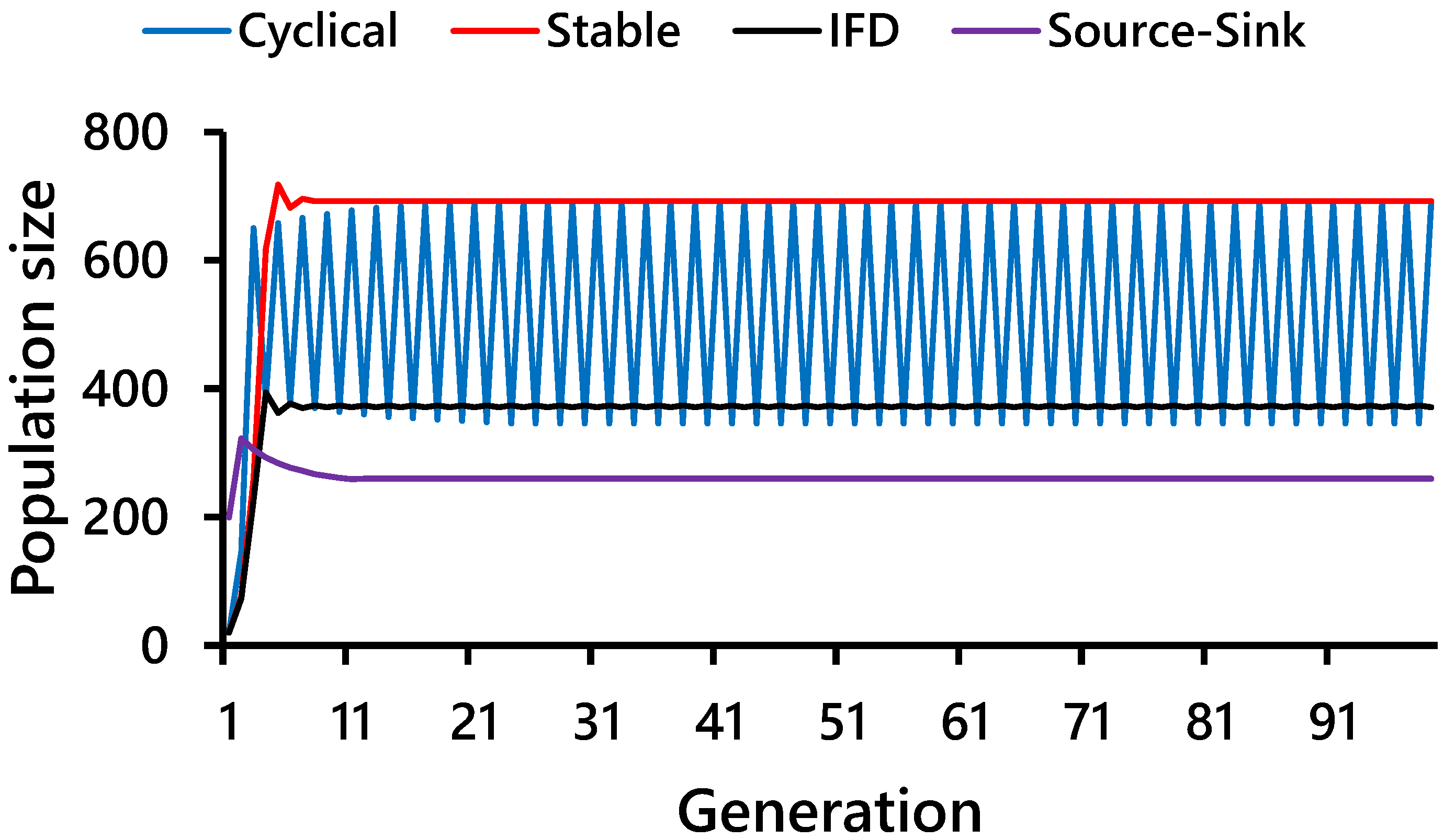
Figure 1 illustrates how, in the absence of stochasticity, habitat selection between high and low growth-rate habitats can stabilize two-point cycles. Source–sink dynamics ( R A = 1 ; Figure 2) maintain stability even though individuals in the sink habitat are incapable of replacing themselves. Low fitness in the sink enables a greater flow of recruits from the source, and thus a lower total population size. In both examples, the life history of a population restricted to habitat B would be subjected to regular cycles of density-dependent boom or bust natural selection. Natural selection on life history is far more constant when ideal habitat selection reduces temporal variation in abundance. Other simulations (not illustrated) with even more extreme values yield similar outcomes—populations exhibit complex 16-pt cycles when occupying only the best habitat ( R B = 20 ) and exhibit 4-pt cycles on the two-habitat isodar ( R A = 4 ) .
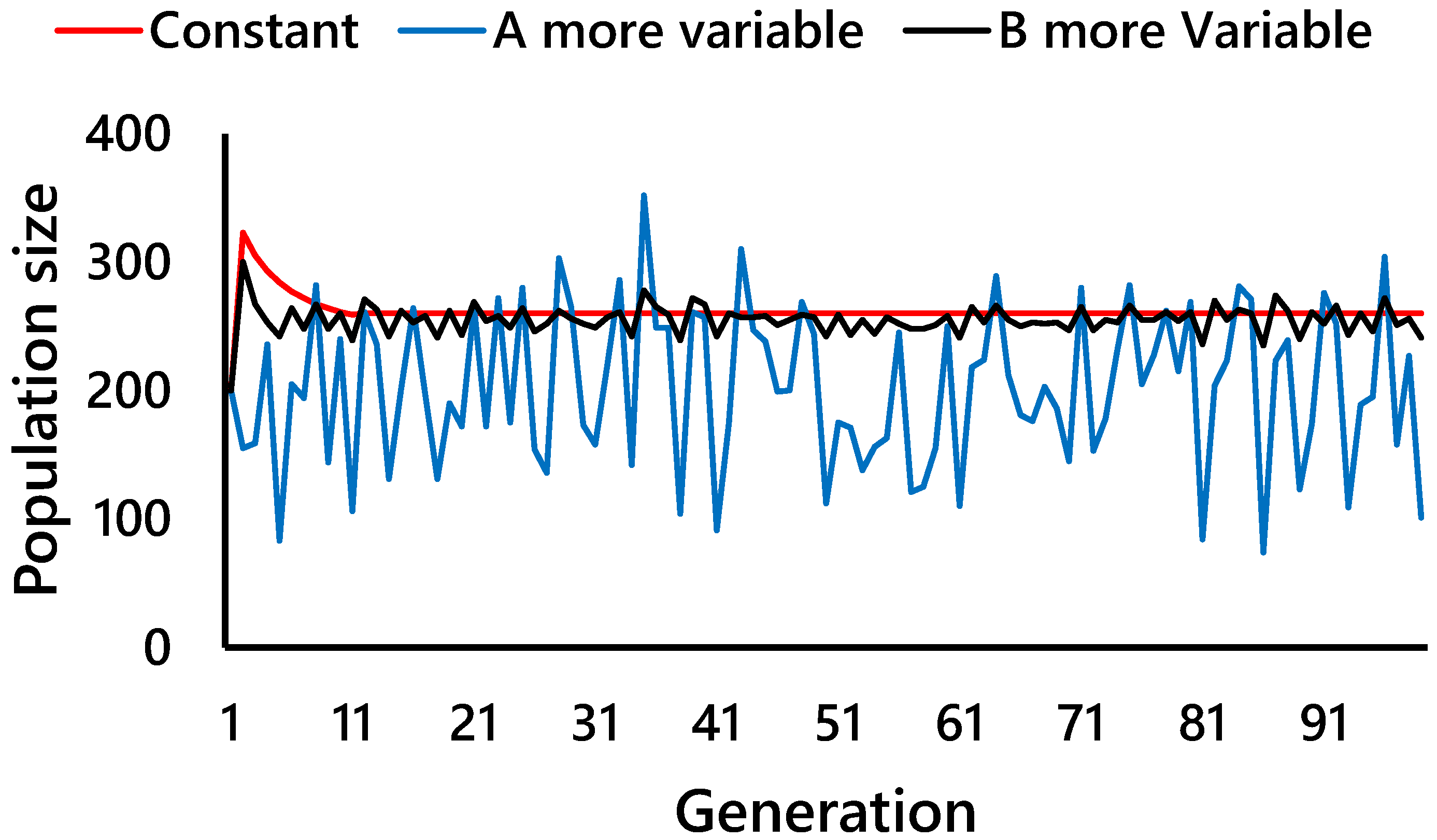
Stochastic variation in fecundity yields complex dynamics even in the presence of ideal free habitat selection (Figure 2, source–sink dynamics). The effect of stochasticity is unequal between habitats. Stochastic variation in habitat B yields more variable dynamics (blue line) than does the same degree of stochasticity in habitat A (black line). High stochasticity in habitat A occasionally enables successful recruitment in what is otherwise sink habitat. An equally high stochastic effect in habitat B has potential for much larger increases in abundance, and less population stability.
The central point is that ideal free habitat selection dampens otherwise fluctuating population densities and their potential impact on density-dependent life histories. The outcome has an important corollary for conservation actions that prioritize preserving and restoring high-quality or ‘critical’ habitats. Removing sink habitat can destabilize otherwise stable systems, alter processes of density-dependent selection, and produce dynamics that are more susceptible to the vagaries, including extinction risk, of occasionally low abundance. Similar effects can emerge through habitat restoration and enhancement projects [33,34] that might unwittingly alter dynamics associated with habitat selection. All habitat is critical [35].

7. Habitat Selection and the Evolution of Life History

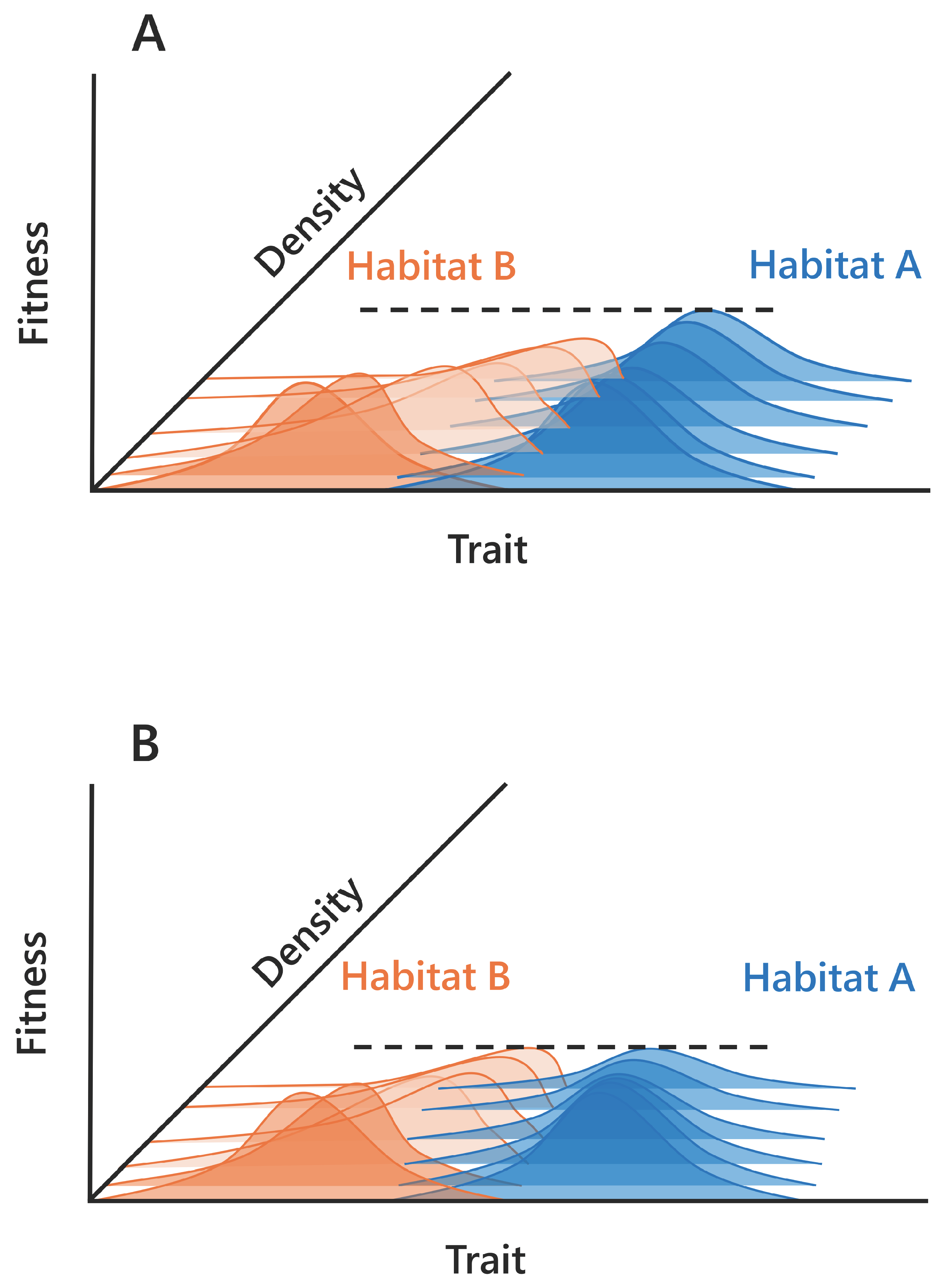
Habitat selection has far more effect on life history than just its indirect influences on population size. Direct effects emerge through the densities and movements of individuals between one habitat opportunity and others. A simple way to explore the effect is through fitness sets that map strategic surfaces onto their adaptive expectations (Figure 3) [36,37].
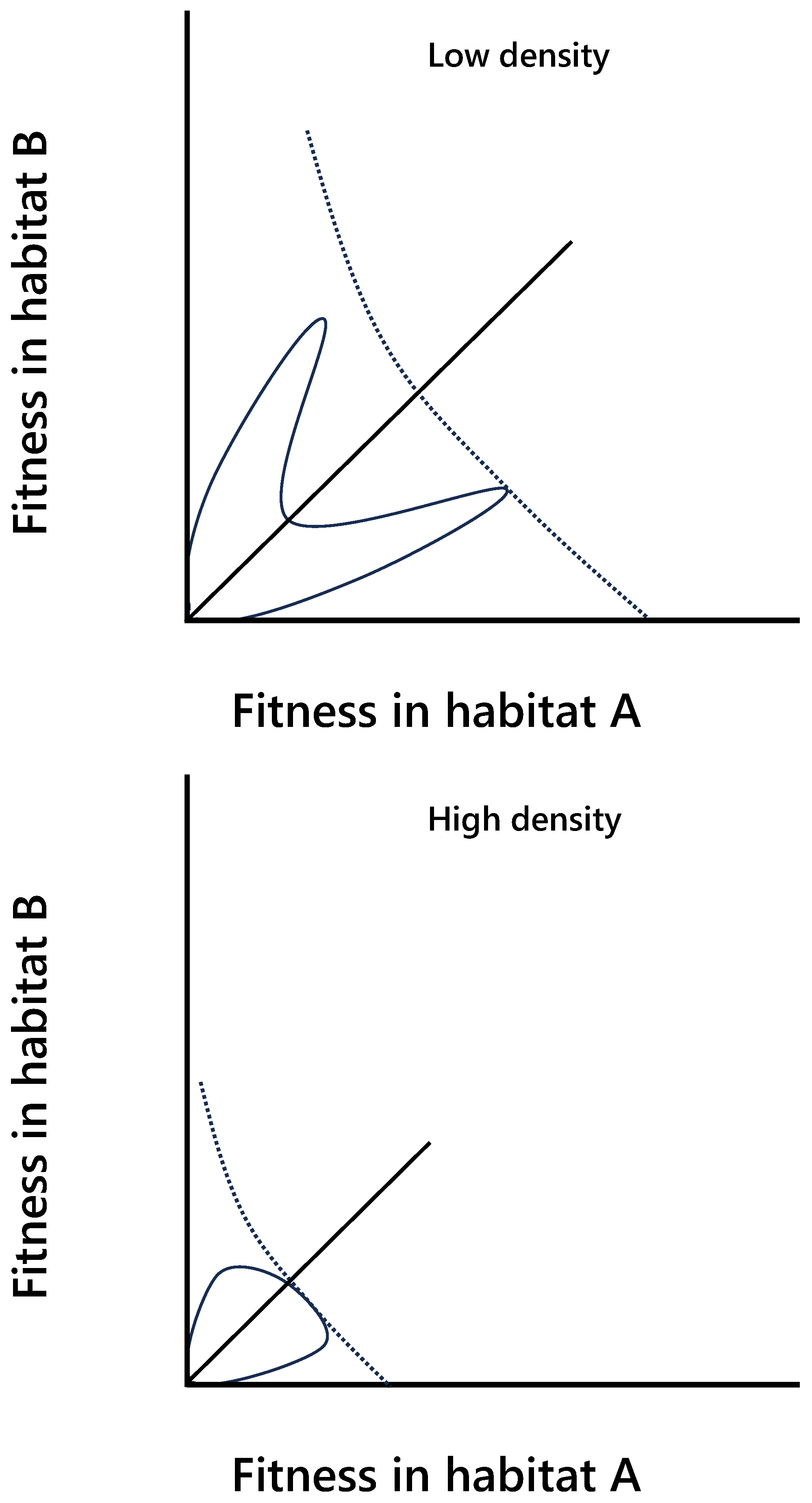
To create two habitats’ fitness set, begin by plotting the distributions of the maximum fitness that individuals bearing all possible trait (or strategy) values can achieve in each habitat (e.g., Figure 3). Beginning with the lowest value, draw the fitness set by transcribing the fitness expected from individuals with that value onto a graph of fitness achieved in each habitat (e.g., Figure 4). The outer boundary of the fitness set corresponds to the highest achievable fitness that can be attained by individuals with a given trait (strategy) value in one habitat given its highest value in the other habitat.
We retain our assumption of discrete intervals for reproduction and dispersal and consider the case of a population inhabiting a coarse-grained two-habitat environment. The model gains traction in reality by considering individuals that either remain in their natal habitat or move to another. If the two habitats are dissimilar, then their combined fitness set will be concave away from the origin. If the two habitats are relatively similar, then their optimal life histories will lie close to one another in trait space and their fitness set will be concave toward the origin.
The life history that maximizes fitness lies on the fitness set’s outer surface tangent to the strategies’ adaptive function, the accounting of fitness that corresponds to the relative use of the two habitats (Figure 4). Population dynamics are implicit in the calculation of adaptive functions and thus enable fitness set analyses to serve as a reliable and heuristic platform to explore general features and concepts of adaptive evolution in heterogeneous environments.
We can approximate the fitness accrued from a habitat as the number of future descendants arising there. In our example of two coarse-grained habitats, the adaptive function corresponds to their geometric mean fitness:
A = w A p w B q
ref. [36,37] where A is the hyperbola-like adaptive function, w is the fitness in either habitat A or B, and p and q ( p + q = 1 ) are the respective frequencies of individuals in habitats A and B, respectively. We note as an aside that if the environment is fine grained such that each individual uses habitat in proportion to its abundance, the adaptive function is a simple linear average, A = w A p + w B q [36,37].
Ideal habitat selection has three pervasive impacts on the fitness set solution. 1. It determines p and q (they fall along the habitat isodar). 2. It equalizes fitness. 3. By equalizing fitness, ideal habitat selection converts the adaptive function from its former hyperbolic shape to the habitats’ shared ideal free fitness (w).
Consider the case of a linear isodar passing through the origin N B = b N A . Letting p represent the proportion of the population occupying habitat B N B N B + N A and substituting for the isodar,   p =   b N A N A b + 1 , we quickly see that the proportion b b + 1 is invariant with population size. But if the linear isodar N B = C + b N A has a positive intercept ( C > 0 ) , then the proportion, and adaptive evolution, varies with the density in habitat A p = c + b N A c + N A ( b + 1 ) even though fitness is equal (but density dependent) in both habitats. In Levins’ original model [36,37], fitness emerges as the weighted average use of the two habitats; the outcome of adaptive evolution responds to the relative values of p and q. Ideal habitat selection operates differently, it ‘weights’ the values of p and q such that fitness is equal in both habitats. Converting Equation (8) to logarithms,
l o g   A = p l o g   w A + q l o g   w B
where the prime indicates frequencies adjusted by ideal habitat selection. Fitness in each habitat is equal to that in the other w A = w B . Noting that p + q = 1 , then A =   w A , and similarly A = w B . Substituting one equation into the other recapitulates the equality as the simple habitat-selecting adaptive function (linear line through the origin with slope 1, w B = w A , Figure 4 [3]). It is easily shown that an identical solution emerges from the fine-grained adaptive function A = w A p + w B q .
The utility of including habitat selection is most dramatic when trait values converge or diverge with density. When they do, the shape of the fitness set will also vary with density (e.g., Figure 4). At low density with no habitat selection, the ‘hyperbolic’ adaptive function intercepts only one of the two fitness maxima. Adaptive evolution favors specialization (illustrated in Figure 4 towards traits with high fitness in habitat A). Trait convergence at high density changes the fitness set from concave outward to concave downward: a generalist phenotype has greater fitness than any other. Density-dependent evolution thus transits between a low-density single-habitat specialist and a high density two-habitat generalist.
Habitat selectors experience a unique and paradoxical evolutionary transition. Whenever both habitats are occupied, adaptive evolution favors the same habitat generalist at all densities, and for all shapes of fitness sets, even though specialists, in the absence of habitat selection, might possess higher fitness (Figure 4).
The paradox of ‘selection toward the minimum’ in outwardly concave fitness sets can be resolved in two different ways. I. If an individual’s trait values are fixed, then active habitat selection is a sub-optimal strategy easily replaced by non-habitat selectors. Dispersal to the alternative habitat is non-adaptive, so each habitat will harbor a different specialist. II. But if traits are plastic, then the apparently low fitness of the generalist represents a reaction norm enabling specialization to whichever habitat the individual occupies. The low fitness generalist’s trait values are never realized by adaptive individuals because their reaction norm matches trait values with habitat. Individuals retain their specialization within a habitat even though they might disperse between them.
We can visualize the consequences of these general predictions on life history by imagining that the habitats differ in one or more key processes associated with density- and size-dependent juvenile survival. Examples could include differences in predation risk, differences in the availability of spawning habitat, or the amount and quality of nursery habitat. The habitat induced differences in survival also feed back onto adaptive habitat selection with downstream effects on maturity and body size [38]. Even so, evolution in a low juvenile survival habitat should lead to a life history with lower reproductive effort (e.g., fewer smaller eggs) at older ages than in a habitat with higher juvenile survival (e.g., [39]). We wish to know whether ideal habitat selection will alter that prediction.
We address the issue by comparing density-dependent habitat selection with two extreme alternative strategies—I, there is no dispersal between habitats and II, within each habitat there is a passive or conditional propensity to disperse (e.g., [40]). The effect on trait evolution, including those responsible for or related to life history, depends on density, population regulation, and whether different traits maximize fitness at different population sizes.
Consider first a population so well-regulated that it remains at or very near to its habitat-dependent carrying capacities. Alternative I (no dispersal) enables rapid divergence in traits and life history similar to that observed in brook trout (Salvelinus fontinalis), restricted to small, isolated rivers in Newfoundland [41]. The same outcome is expected with ideal free habitat selection; fitness is equal in both habitats so there is no fitness gain through dispersal. Alternative II (passive or conditional dispersal) is characterized by a balance between the number of individuals dispersing into a habitat and the number exiting [40]. Dispersal rates are inversely proportional to the habitats’ carrying capacities, the dispersal rate from a habitat with a low carrying capacity is greater than the rate from a habitat with a high carrying capacity. The resulting directional migration suggests a long-term diminution of traits associated with the low-density habitat. The same outcome is expected from ‘fitness climbing’ models of habitat selection that assume individuals sample both habitats (e.g., [42]).
Predictions change in temporally variable environments. If there is no dispersal between habitats, then the sub-populations in each habitat continue to evolve independently with trait distributions that reflect each habitat’s density dependence. The outcome from passive dispersal depends on whether the habitats’ carrying capacities (Ks) are correlated. In the extreme case where the means and variances in K are equal but uncorrelated, dispersal rates between habitats are equal. Neither habitat has an advantage in influencing trait evolution in the alternative habitat other than reducing selection gradients through migration. Balanced dispersal, such that the ratio of the propensity to disperse is inversely proportional to the ratio of mean carrying capacities, re-emerges if the means or variances of carrying capacities vary in time [40]. Varying carrying capacities over time creates larger mean differences in carrying capacities, and thus a greater difference in dispersal rates, than do variable carrying capacities (that yield a smaller mean difference in Ks). The ability of the habitat with the larger long-term population size to dominate gene flow will thus be greater if mean carrying capacity varies than if only the variance in carrying capacities change through time.
The consequences of ideal habitat selection are again dramatically different. Fluctuations in population size alter the courses of density dependence and habitat selection. Periods of population growth result in directional migration from high density to lower density habitats. During periods of population decline, the opposite occurs (reciprocating dispersal [16,43]). The net flow of individuals from one habitat to another, and thus which habitat is a ‘donor’ of migrants, and which is a ‘receiver’, depends on the habitats’ relative maximum growth rates and their respective rates of density-dependent decline in fitness [43]. It is even possible, under somewhat limited circumstances when dominant individuals interfere with the habitat choices of subordinates, to achieve a net balance of migration between habitats [43]. In this instance, however, the balance emerges through habitat selection rather than through the competitive advantages and invasion likelihoods of genotypes exhibiting a wide range of dispersal propensities as in the numerical models of McPeek and Holt [40].
The to-and-fro of dispersal between habitats means that adaptive advantages of directional migration vary with the dynamics of population size. A habitat receiving immigrants during population decline will export emigrants during periods of population growth. It is not the migration that is important but rather its effect on trait evolution.
A primary motivation for studying the evolution of life histories lies in their close association with fitness [44]. The ability of habitat selection to equalize fitness between habitats thus implies that it can also alter expectations of fitness among spatially distinct life history strategies. The implications are rather profound. If the habitats are similar to one another, then the resultant fitness set is concave downward, and a single generalist strategy can maximize fitness (Figure 4). But if the habitats are quite different from one another, then the fitness set is concave upward and each habitat can evolve its separate equally fit non habitat-selecting strategy. The problem, in the case of habitat selectors, is that the equilibration occurs through the back-and-forth movement of individuals between habitats with changes in population size. How can a divergent strategy in one habitat, say copious production of small offspring, achieve equal fitness with an alternative strategy (e.g., fewer larger offspring) adapted to the second habitat? The parsimonious answer is the evolution of a reaction norm that enables individuals to express the appropriate habitat-dependent life history. The important point is that ideal habitat selection creates the exposure to different selection regimes that can promote phenotypically plastic life histories.
The evolution of plasticity also hinges on the likelihoods that adaptive traits converge or diverge with population size. If populations with convergent traits remain at high density, habitat selection yields a single generalist strategy (Figure 4). Alternative strategies would emerge if traits in well-regulated populations diverge with population size. Habitat isodars provide a ready-made solution to differentiate between these sorts of alternatives. The intercept in Equation (2) is the relative difference in fitness between habitats. The isodar slope is the ratio of negative density-dependent fitnesses. Converging fitness functions yield isodars with positive intercepts and slopes less than unity. Diverging functions yield isodars with slopes greater than unity.

8. Discussion

Although ideal free and fitness set models are highly oversimplified caricatures of nature, they convey crucial lessons about habitat-selecting life histories. Habitat selection will alter the dynamics of populations and resultant density-dependent selection whenever individuals select between habitats with different degrees or forms of density dependence. In most cases habitat selection will also yield frequency-dependent selection on life history and other eco-evolutionary strategies. The models also inform pragmatic decisions on habitat management and conservation. Any action that modifies a habitat’s occurrence, size, and density-dependent qualities will create a new selective milieu not just for the individuals inhabiting it, but also for those individuals living elsewhere who are connected by the ebb and flow of dispersal. This is especially relevant for anadromous fishes [45]. Bioenergetic models parameterized on Atlantic salmon demonstrate how environmental changes in density-dependent habitat-linked growth rates impact life histories of both presmolt and postsmolt age classes as well as their population dynamics [45].
Global habitat loss and degradation are particularly concerning because they alter both the distribution and abundance of their occupants. A recent example is the choice of apparently degraded coral habitats in Papua New Guinea by a small-bodied reef fish, Pomacentrus moluccensis. Coral death associated with an outbreak of the crown-of-thorns starfish, Acanthaster solaris, caused a rapid shift in habitat choice in the most severely affected reefs [46]. Despite a preference for live coral when abundant, adult fish increasingly occupied degraded dead corals. The presence of adults acted as a social attractant to naïve juveniles that otherwise risked being caught in an ecological trap [47,48]. While there is broad recognition that ecological traps can cause extinction (e.g., [49]), simple models of habitat selection warn us that even if organisms make adaptive choices, habitat loss and degradation can have major impacts on population dynamics and life history that can feed back onto future dynamics and habitat choice. Similar concerns arise from models of dispersal where the adaptive strategy of individual migrants fails to correspond with the strategy that maximizes population persistence [50].
The potential for habitat selection to create or reinforce adaptively plastic life histories suggests an additional behavioral route by which populations can quickly exploit new or alternative fitness opportunities [51]. As intriguing as this possibility may be, the models are absent of genetics and assume discrete habitats with simplified age and density dependence. It is thus impossible to extract specific predictions on how habitat selection can alter life history and vice versa. Some readers may suspect that these concerns invalidate the models’ utility in furthering our understanding of life history and its evolution, and particularly so if life histories generally represent mosaics of genetic and environmentally controlled traits such as those that underlie ecotypic variation in Trinidadian guppies [52]. That skepticism must be balanced by the results of a two-locus two-deme population genetics model in which phenotypically plastic traits evolve by reciprocal migration between populations [53]. Reciprocating dispersal embedded in ideal density-dependent habitat selection provides exactly that sort of bidirectional migration.
The potentially countervailing effects of habitat selection’s ability to dampen population dynamics through time versus its roles in gene flow and subsequent evolution should provide fertile ground for future theoretical exploration. Might any ability of habitat selection to modulate density-dependent evolution along ‘pace-of-life’ axes be subsidiary to its influence on phenotypic plasticity? No matter the answer, the take-away message is that studies of ecological and evolutionary dynamics are incomplete if absent of adaptive habitat selection.
We certainly agree that habitat quality and its impact on fitness interact with genetics and do so across scales in time and space. A particular concern is that some habitats grade into one another more-or-less imperceptibly along environmental gradients. Such gradients might suggest that habitat is an artificial construct residing more in the imagination and equations of theorists than in the distribution, abundance, and fitness of real organisms. However, our use of ‘habitat’, and particularly the emphasis on habitat isodars, includes an implicit dispersal scale such that the collections of individuals in one area (or volume) express a different pattern of fitness accrual than do individuals living elsewhere [16]. The patterns are reflected in the density dependence of fitness that embodies decisions on habitat choice and its implications on spatio-temporal abundance and evolution.
Ideal free models carry several well-documented ancillary assumptions, many of which are overcome with more advanced models (e.g., [54]). The trick is to evaluate the effects of different assumptions on the density dependence of fitness. When one can do so each is likely to leave its signature firmly inscribed in the habitat isodar as shown for assumptions on dominance, patch pre-emption, dispersal costs, and Allee effects (e.g., [55,56,57]).
Criticisms on the ideal free assumption of perfect information are somewhat more difficult to dispel. The acquisition of knowledge about alternative habitat opportunities is not only likely to be imperfect but the required sampling might also cause densities to depart from their ideal free isodar. That may not be the case, however, if organisms possess reliable cues on habitat quality such as many of the chemical signals used by aquatic organisms (e.g., [58]). Our focus is more on whether organisms are ‘ideal’ than whether they are ‘free’. Ideal organisms choose habitat to maximize their expectation of fitness, not necessarily the population mean. Such migrants’ expectations will equalize between habitats, and their adaptive functions will also be linear with a positive slope at 45 degrees.
Even when its assumptions are not met, relatively simple patch leaving [59] and fitness climbing rules (always moving to the better patch, [42]) yield distributions approaching that of the IFD. When they do, habitat isodars reliably portray the equilibrium solutions as population size changes (e.g., [56]) and can help us further understand adaptive evolution and solve critical problems in conservation and management [57].

9. Conclusions

Age- and stage-based schedules of reproduction and survival, and the traits that determine them, are inextricably linked to density-dependent habitat selection. Habitat selection, even in cases of source–sink dynamics, can stabilize otherwise fluctuating populations and alter their impact on pace-of-life and other life histories. Adaptive dispersal practiced by habitat selectors can equalize the fitness of alternative life histories, thereby shifting selection gradients towards generalist strategies. Fitness equalization in temporally varying environments motivates gene flow through alternating periods of forward and backward dispersal. If habitats are similar, adaptive evolution converges on a single generalist life history. But if habitats are sufficiently dissimilar, such that each habitat favors a different specialist strategy, then phenotypically plastic migrants can overcome their maladapted natal specialization. Support for the hypothesis comes from the habitat-dependent reaction norms that typify the life histories of numerous fish species. Habitat loss, whether of high or low quality, will thus impact habitat selection’s role in population dynamics and the course of adaptive life history evolution. These manifold effects of habitat selection suggest that it is much more than a mechanism influencing life history. Like any other trait influencing age- and stage-specific reproduction and survival, habitat selection is life history.

Author Contributions

Conceptualization, D.W.M. and P.L.; methodology, D.W.M.; software, D.W.M.; validation, D.W.M. and P.L.; formal analysis, D.W.M.; investigation, D.W.M. and P.L.; resources, D.W.M.; writing—original draft preparation, D.W.M.; writing—review and editing, D.W.M. and P.L.; visualization, D.W.M.; supervision, D.W.M.; project administration, D.W.M.; funding acquisition, D.W.M. All authors have read and agreed to the published version of the manuscript.

Funding

This research was funded by the Natural Sciences and Enginerring Research Council of Canada, grant number RGPIN-2018-03707.

Institutional Review Board Statement

Not applicable.

Data Availability Statement

Acknowledgments

We thank B. Jonsson for kindly inviting us to contribute to this special issue. D.M. gratefully acknowledges the Natural Sciences and Engineering Research Council of Canada for its ongoing support of his research efforts in evolutionary ecology, R. Tarjuelo for advice on coding in R, and is especially thankful to K. Morris for many decades of unwavering support and assistance in research, administration, and the oftentimes demanding logistics of field biology.

Conflicts of Interest

The authors declare no conflicts of interest.

References

  1. Smith, J.M. Evolution and the theory of games. In Am. Sci.; 1988; Volume 64, pp. 41–45. [Google Scholar]
  2. Vincent, T.L.; Brown, J.S. Evolutionary Game Theory, Natural Selection, and Darwinian Dynamics; Cambridge University Press: Cambridge, UK, 2009. [Google Scholar]
  3. Morris, D.W.; Lundberg, P. Pillars of Evolution: Fundamental Principles of the Eco-Evolutionary Process; Oxford University Press: Oxford, UK, 2011. [Google Scholar]
  4. Jonsson, B. Stunted versus normally growing fish: Adapted to different niches. Fishes 2025, 10, 376. [Google Scholar] [CrossRef]
  5. Grol, M.G.G.; Nagelkerken, I.; Rypel, A.L.; Layman, C.A. Simple ecological trade-offs give rise to emergent cross-ecosystem distributions of a coral reef fish. Oecologia 2011, 165, 79–88. [Google Scholar] [CrossRef]
  6. Balaban-Feld, J.; Mitchell, W.A.; Kotler, B.P.; Vijayn, S.; Tov Elem, L.T.; Rosenzweig, M.L.; Abramsky, Z. Individual willingness to leave a safe refuge and the trade-off between food and safety: A test with social fish. Proc. R. Soc. B 2019, 286, 20190826. [Google Scholar] [CrossRef]
  7. Metcalfe, J.; Arnold, G.; McDowall, R. Migration. In Handbook of Fish Biology and Fisheries; Hart, P.J.B., Reynolds, J.D., Eds.; Blackwell Science: Oxford, UK, 2002; pp. 175–199. [Google Scholar]
  8. MacArthur, R.H. Some generalized theorems of natural selection. Proc. Natl. Acad. Sci. USA 1962, 48, 1893–1897. [Google Scholar] [CrossRef]
  9. MacArthur, R.H.; Wilson, E.O. The Theory of Island Biogeography; Princeton University Press: Princeton, NJ, USA, 1967. [Google Scholar]
  10. Pianka, E.R. On r- and K-selection. Am. Nat. 1970, 104, 592–597. [Google Scholar] [CrossRef]
  11. Ricklefs, R.E.; Wikelski, M. The physiology/life history nexus. Trends Ecol. Evol. 2002, 17, 462–468. [Google Scholar] [CrossRef]
  12. Réale, D.; Garant, D.; Humphries, M.M.; Careau, V.; Montiglio, P.-O. Personality and the emergence of the pace-of-life syndrome concept at the population level. Phil. Trans. R. Soc. Lond. B 2010, 365, 4051–4063. [Google Scholar] [CrossRef]
  13. Wright, J.; Bolstad, G.H.; Araya-Ajoy, Y.G.; Dingemanse, N.J. Life-history evolution under fluctuating density-dependent selection and the adaptive alignment of pace-of-life syndromes. Biol. Rev. 2019, 94, 230–247. [Google Scholar] [CrossRef]
  14. Goodwin, N.B.; Grant, A.; Perry, A.L.; Dulvy, N.K.; Reynolds, J.D. Life history correlates of density-dependent recruitment in marine fishes. Can. J. Fish. Aquat. Sci. 2006, 63, 494–509. [Google Scholar] [CrossRef]
  15. Hutchings, J.A. Life histories of fish. In Handbook of Fish Biology and Fisheries; Hart, P.J.B., Reynolds, J.D., Eds.; Blackwell Science: Oxford, UK, 2002; pp. 149–174. [Google Scholar]
  16. Morris, D.W. Habitat dependent life history. Can. J. Fish. Aquat. Sci. 2025, 82, 1–14. [Google Scholar] [CrossRef]
  17. Beck, M.W.; Heck, K.L.; Able, K.W.; Childers, D.L.; Eggleston, D.B.; Gillanders, B.M.; Halpern, B.; Hays, D.G.; Hoshino, K.; Minello, T.J.; et al. The identification, conservation, and management of estuarine and marine nurseries for fish and invertebrates. Bioscience 2001, 51, 633–641. [Google Scholar] [CrossRef]
  18. Brewer, S.K.; Papoulias, D.M.; Rabeni, C.F. Spawning habitat associations and selection by fishes in a flow-regulated prairie river. Trans. Am. Fish. Soc. 2006, 135, 763–778. [Google Scholar] [CrossRef]
  19. Laurel, B.J.; Stoner, A.W.; Hurst, T.P. Density-dependent habitat selection in marine flatfish: The dynamic role of ontogeny and temperature. Mar. Ecol. Prog. Ser. 2007, 338, 183–192. [Google Scholar] [CrossRef]
  20. Rodríguez, M.A. Habitat-specific estimates of competition in stream salmonids: A field test of the isodar model of habitat selection. Evol. Ecol. 1995, 2, 169–184. [Google Scholar] [CrossRef]
  21. Haugen, T.O.; Winfield, I.J.; Vøllestad, L.A.; Fletcher, J.M.; James, J.B.; Stenseth, N.C. The ideal free pike: 50 years of fitness-maximizing dispersal in Windermere. Proc. R. Soc. B 2006, 273, 2917–2924. [Google Scholar] [CrossRef]
  22. Knight, T.W. Habitat Selection in Brook Trout (Salvelinus fontinalis). Ph.D. Thesis, Memorial University of Newfoundland, St. John’s, NL, Canada, 2000. [Google Scholar]
  23. Hedger, R.D.; Dodson, J.J.; Bergeron, N.E.; Caron, F. Habitat selection by juvenile Atlantic salmon: The interaction between physical habitat and abundance. J. Fish. Biol. 2005, 67, 1054–1071. [Google Scholar] [CrossRef]
  24. Knight, T.W.; Morris, D.W.; Haedrich, R.L. Inferring competitive behavior from population census data: Site pre-emption by brook trout (Salvelinus fontinalis). Isr. J. Ecol. Evol. 2008, 54, 345–360. [Google Scholar] [CrossRef]
  25. Falcy, M.R. Density-dependent habitat selection of spawning Chinook salmon: Broad-scale evidence and implications. J. Anim. Ecol. 2015, 84, 545–553. [Google Scholar] [CrossRef]
  26. Höjesjö, J.; Kaspersson, R.; Armstrong, J.D. Size-related habitat use in juvenile Atlantic salmon: The importance of intercohort competition. Can. J. Fish. Aquat. Sci. 2016, 73, 1182–1189. [Google Scholar] [CrossRef]
  27. Shepherd, T.D.; Litvak, M.K. Density-dependent habitat selection and the ideal free distribution in marine fish spatial dynamics: Considerations and cautions. Fish Fish. 2004, 5, 141–152. [Google Scholar] [CrossRef]
  28. Roff, D.A. Modeling Evolution: An Introduction to Numerical Methods; Oxford University Press: Oxford, UK, 2010. [Google Scholar]
  29. Fretwell, S.D.; Lucas, H.L., Jr. On territorial behavior and other factors influencing habitat distribution in birds. I. Theoretical development. Acta Biotheor. 1969, 19, 16–36. [Google Scholar] [CrossRef]
  30. Fretwell, S.D. Populations in a Seasonal Environment; Princeton University Press: Princeton, NJ, USA, 1972. [Google Scholar]
  31. Morris, D.W. Habitat-dependent population regulation and community structure. Evol. Ecol. 1988, 2, 253–269. [Google Scholar] [CrossRef]
  32. Křivan, V.; Cressman, R.; Schneider, C. The ideal free distribution: A review and synthesis of the game-theoretic perspective. Theor. Pop. Biol. 2008, 73, 403–425. [Google Scholar] [CrossRef]
  33. Tickner, D.; Opperman, J.J.; Abell, R.; Acreman, M.; Arthington, A.H.; Bunn, S.E.; Cooke, S.J.; Dalton, J.; Darwall, W.; Edwards, G.; et al. Bending the curve of global freshwater biodiversity loss: An emergency recovery plan. Bioscience 2020, 70, 330–342. [Google Scholar] [CrossRef]
  34. Piczak, M.L.; Perry, D.; Cooke, S.J.; Harrison, I.; Benitez, S.; Koning, A.; Peng, L.; Limbu, P.; Smokorowski, K.E.; Salinas-Rodriguez, S.; et al. Protecting and restoring habitats to benefit freshwater biodiversity. Envir. Rev. 2024, 32, 438–456. [Google Scholar] [CrossRef]
  35. Morris, D.W. Source-sink dynamics emerging from unstable ideal-free habitat selection. In Sources, Sinks, and Sustainability; Liu, J., Hull, V., Morzillo, A., Wiens, J.A., Eds.; Cambridge University Press: Cambridge, UK, 2011; pp. 58–81. [Google Scholar]
  36. Levins, R. Theory of fitness in a heterogeneous environment. I. The fitness set and adaptive function. Am. Nat. 1962, 96, 361–378. [Google Scholar] [CrossRef]
  37. Levins, R. Evolution in Changing Environments; Princeton University Press: Princeton, NJ, USA, 1968. [Google Scholar]
  38. Chaparro-Pedraza, P.C.; de Roos, A.M. Density-dependent effects of morality on the optimal body size to shift habitat: Why smaller is better despite increased mortality risk. Evolution 2020, 74, 831–841. [Google Scholar] [CrossRef]
  39. Gadgil, M.; Bossert, W.H. Life historical consequences of natural selection. Am. Nat. 1970, 104, 1–24. [Google Scholar] [CrossRef]
  40. McPeek, M.A.; Holt, R.D. The evolution of dispersal in spatially and temporally varying environments. Am. Nat. 1992, 140, 1010–1027. [Google Scholar] [CrossRef]
  41. Hutchings, J.A. Adaptive life histories effected by age-specific survival and growth rate. Ecology 1993, 74, 673–684. [Google Scholar] [CrossRef]
  42. Cressman, R.; Křivan, V. Migration dynamics for the ideal free distribution. Am. Nat. 2006, 168, 384–397. [Google Scholar] [CrossRef]
  43. Morris, D.W.; Diffendorfer, J.E.; Lundberg, P. Dispersal among habitats varying in fitness: Reciprocating migration through ideal habitat selection. Oikos 2004, 107, 559–575. [Google Scholar] [CrossRef]
  44. Hutchings, J.A. A primer of Life Histories: Ecology, Evolution, and Application; Oxford University Press: Oxford, UK, 2021. [Google Scholar]
  45. Chaparro-Pedraza, P.C.; de Roos, A.M. Environmental change effects on life-history traits and population dynamics of anadromous fishes. J. Anim. Ecol. 2019, 88, 1178–1190. [Google Scholar] [CrossRef]
  46. Boström-Einarsson, L.; Bonin, M.C.; Munday, P.L.; Jones, G.P.; Keith, S.A. Density dependent habitat selection in response to habitat loss in a coral reef fish. J. Anim. Ecol. 2025, 94, 2421–2430. [Google Scholar] [CrossRef]
  47. Schlaepfer, M.A.; Runge, M.; Sherman, P.W. Ecological and evolutionary traps. Trends Ecol. Evol. 2002, 17, 474–480. [Google Scholar] [CrossRef]
  48. Robertson, B.A.; Hutto, R.L. A framework for understanding ecological traps and an evaluation of existing evidence. Ecology 2006, 87, 1075–1085. [Google Scholar] [CrossRef]
  49. Robertson, B.A.; Chalfoun, A.D. Evolutionary traps as keys to understanding behavioral maladaptation. Curr. Opin. Behav. Sci. 2016, 12, 12–17. [Google Scholar] [CrossRef]
  50. Delgado, M.d.M.; Ratikainen, I.I.; Kokko, H. Inertia: The discrepancy between individual and common good in dispersal and prospecting behaviour. Biol. Rev. 2011, 86, 717–732. [Google Scholar] [CrossRef]
  51. Price, T.D.; Qvarnström, A.; Irwin, D.E. The role of phenotypic plasticity in driving genetic evolution. Proc. R. Soc. B 2003, 270, 1433–1440. [Google Scholar] [CrossRef]
  52. Felmy, A.; Reznick, D.N.; Travis, J.; Potter, T.; Coulson, T. Life histories as mosaics: Plastic and genetic components differ among traits that underpin life-history strategies. Evolution 2002, 76, 585–604. [Google Scholar] [CrossRef]
  53. Gulisija, D.; Newberry, M. Evolution of phenotypic plasticity owing to migration. Evol. Lett. 2025, qraf040. [Google Scholar] [CrossRef]
  54. Tregenza, T. Building on the ideal free distribution. Adv. Ecol. Res. 1995, 26, 253–302. [Google Scholar]
  55. Morris, D.W. Scales and costs of habitat selection in heterogeneous landscapes. Evol. Ecol. 1992, 6, 412–432. [Google Scholar] [CrossRef]
  56. Morris, D.W. Toward an ecological synthesis: A case for habitat selection. Oecologia 2003, 136, 1–13. [Google Scholar] [CrossRef]
  57. Morris, D.W. How can we apply theories of habitat selection to wildlife conservation and management. Wildl. Res. 2003, 30, 303–319. [Google Scholar] [CrossRef]
  58. Bilodeau, S.M.; Hay, M.E. Chemical cues affecting recruitment and juvenile habitat selection in marine versus freshwater systems. Aquat. Ecol. 2021, 56, 339–360. [Google Scholar] [CrossRef]
  59. Griffen, B.D. Consumers that are not ‘ideal’ or ‘free’ can still approach the ideal free distribution using simple patch-leaving rules. J. Anim. Ecol. 2009, 78, 919–927. [Google Scholar] [CrossRef]
Figure 1. An example of how cyclical dynamics of a population living only in ‘best’ habitat (blue line) can be stabilized when individuals follow an ideal free distribution (black) between that habitat and another with stable dynamics (red). A source–sink IFD yields a lower equilibrium (purple line). Parameter values: cyclical habitat R B = 8 ,   β B = 0.001 R B ; stable habitat R A = 4 ,   β A = 0.001 R A ; IFD R B = 8 ,     β B = 0.001 R B ;   R A = 4 ,     β A = 0.001 R A   ; sink R B = 8 ,     β B = 0.001 R B ;   R A = 1 ,     β A = 0.001 R A   ; initial population sizes, N B = N A = 10 except for sink ( N B = N A = 100 ); time = 99 generations; random seed = 100.
Fishes 11 00055 g001
Figure 2. An example of ideal habitat selection when habitat B (cyclical) is a source while habitat A is a sink. Sink habitat can completely stabilize an otherwise cyclical population in constant (red line) environments. Stability deteriorates in stochastic environments, but less so when stochastic variation in R is greater in sink habitat (black line) than when it is greater in source habitat (blue line). Parameter values: source habitat R B = 8 , sink habitat R A = 1 , stochastic effects when habitat A is more variable β A = 0.01 R A , and   β B = 0.001 R B , when habitat B is more variable β A = 0.001 R A , and   β B = 0.01 R B ; initial population sizes, N B = N A = 100 ; time = 99 generations; random seed = 100.
Fishes 11 00055 g002
Figure 3. A hypothetical example of density-dependent fitness and trait distributions in two habitats. Fitness (height of the distribution) declines more with density in habitat B than it does in habitat A. The trait value that maximizes fitness in habitat B shifts to the right as density increases whereas the relative fitness of each trait value is constant with density in habitat A. Selection at different densities and acting independently in each habitat would cause a shift in trait values in habitat B but not in habitat A. The dashed horizontal line equals the maximum fitness in Habitat A at high density. (Panel A): Fitness in habitat A exceeds that in habitat B at most densities. (Panel B): Ideal habitat selection equalizes fitness at all population sizes.
Fishes 11 00055 g003
Figure 4. Fitness sets for two habitats at low (=high fitness) and high (=low fitness) density whose fitness functions lie far apart at low population size (concave outward fitness set) but converge at high density (concave downward) similar to the example illustrated in Figure 3. The thin dotted lines represent a hyperbola-like adaptive function. The linear adaptive functions with slope +1 illustrate expected outcomes of adaptive evolution under ideal habitat selection. Maximum fitness in this figure is the same in both habitats, but the frequency of habitat B is less than that of habitat A.
Fishes 11 00055 g004
Disclaimer/Publisher’s Note: The statements, opinions and data contained in all publications are solely those of the individual author(s) and contributor(s) and not of MDPI and/or the editor(s). MDPI and/or the editor(s) disclaim responsibility for any injury to people or property resulting from any ideas, methods, instructions or products referred to in the content.