Brief Report

Functional Convergence and Taxonomic Divergence in the Anchoveta (Engraulis ringens) Microbiome

by
Sebastian A. Klarian
1,2,*,
Carolina Cárcamo
1,3,
Francisco Leiva
4,
Francisco Fernandoy
5 and
Héctor A. Levipan
6,*
1
Centro de Investigación Marina Quintay CIMARQ, Facultad de Ciencias de La Vida, Universidad Andres Bello, Viña del Mar 2520000, Chile
2
Department of Ecology and Evolutionary Biology, University of Connecticut, U-3043, Storrs, CT 06269, USA
3
Universidad de Antofagasta Stable Isotope Facility, Instituto Antofagasta de Recursos Naturales Renovables, Universidad de Antofagasta, Antofagasta 1240000, Chile
4
Instituto de Fomento Pesquero, Valparaíso 2370554, Chile
5
Laboratorio de Análisis Isotópico, Facultad de Ingeniería, Universidad Andres Bello, Av. Quillota 980, Viña del Mar 2520000, Chile
6
Laboratorio de Ecopatología y Nanobiomateriales, Departamento de Ciencias y Geografía, Facultad de Ciencias Naturales y Exactas, Universidad de Playa Ancha, Valparaíso 2340000, Chile
*
Authors to whom correspondence should be addressed.
Fishes 2026, 11(1), 35; https://doi.org/10.3390/fishes11010035
Submission received: 9 December 2025 / Revised: 28 December 2025 / Accepted: 6 January 2026 / Published: 8 January 2026
(This article belongs to the Section Biology and Ecology)

Abstract

Gut microbial community assembly involves a critical bioenergetic trade-off, yet the gut microbes with roles in influencing intestinal metabolic homeostasis remain poorly understood in pelagic ecosystems. A central unresolved question is whether microbiome structure is primarily governed by stochastic geographic drift or by deterministic metabolic filters imposed by diet. Here, we test the metabolic release hypothesis, which posits that access to high-quality prey physiologically “releases” the host from obligate dependence on diverse fermentative symbionts. By integrating δ15N analysis with 16S rRNA metabarcoding in the anchoveta from the South Pacific waters (Engraulis ringens), we reveal a profound, diet-induced restructuring of the gut ecosystem. We demonstrate that trophic ascent triggers a deterministic collapse in microbial alpha diversity (rs = −0.683), driven by the near-complete competitive exclusion of fermentative bacteria (rs = −0.874) and the resulting dominance of a specialized proteolytic core. Mechanistically, the bioavailability of zooplankton-derived protein favors efficient endogenous hydrolysis over costly microbial fermentation, rendering functional redundancy obsolete. Crucially, we find that while metabolic function converges, taxonomic identity remains geographically structured (r = 0.532), suggesting that local environments supply the specific taxa to fulfill universal metabolic roles. These findings establish a link between δ15N as a nutritional physiology proxy of anchoveta and its gut for microbial functional state, bridging the gap between nutritional physiology and ecosystem modeling to better inform the management of global forage fish stocks.
Key Contribution: This study validates the metabolic release hypothesis in Engraulis ringens, demonstrating that trophic ascent—as indicated by δ15N—triggers a deterministic collapse in microbial diversity. Specifically, this process competitively excludes fermentative bacteria in favor of proteolytic specialization. Furthermore, our results reveal that while the microbiome’s metabolic function converges due to diet, bacterial taxonomic identity remains structured by local geography. These findings establish stable isotopes as a powerful predictive tool for pelagic microbial ecology.

1. Introduction

Microbial community assembly in the fish gut represents an ecological battleground where deterministic and stochastic forces vie for supremacy. A central debate in the field is whether this structure is primarily governed by immediate environmental filters—such as diet and trophic niche—or by biogeographic history, which encompasses dispersal limitations and isolation [1,2,3]. Substantial evidence demonstrates that trophic plasticity and feeding habits exert robust selective pressure, dictating bacterial composition in response to specific resources [4,5,6]. Simultaneously, the aquatic environment functions as a dynamic reservoir, where habitat characteristics and water quality drive initial colonization and succession [7,8,9]. However, this environmental influence is modulated by host selection, a process in which intrinsic factors like genotype and physiology impose strict biological filters that favor specific symbionts over transient colonizers [10,11]. This interplay between deterministic selection and the ecological drift resulting from geographic barriers [12] underscores the critical need to integrate community ecology with biogeography to fully understand holobiont resilience in changing aquatic ecosystems.
The persistence of a diverse gut microbial community is governed by a strict bioenergetic trade-off, a dynamic underpinned by metabolic cost theory. Maintaining a complex microbiota imposes a significant energetic burden on the host; evolutionarily, this cost is only justified if symbionts confer critical metabolic functions that the host genome lacks, such as the fermentation of recalcitrant polysaccharides [1,2]. Physiological evidence corroborates this tension: while herbivorous fish rely obligatorily on high fermentative diversity to hydrolyze plant matter, carnivores and higher-trophic-level species employ efficient endogenous proteolytic enzymes, frequently resulting in less diverse microbiomes and reduced functional dependence on bacteria [13]. In this context, the anchoveta (Engraulis ringens) serves as a compelling study model due to its trophic plasticity and central role in upwelling system food webs. Related Engraulis species dynamically adjust their diet between phytoplankton and zooplankton based on resource availability [14], making it crucial to establish the metabolic cost and microbial dependence in E. ringens. Determining whether this keystone species maximizes energy assimilation through specific microbial alliances during phytoplankton consumption will reveal hidden mechanisms of ecological resilience, facilitating the integration of microbial digestive physiology into fisheries productivity models [15].
Building on the premise of energetic cost, we propose the metabolic release hypothesis as a unifying framework to explain microbiome dynamics in pelagic fish. This hypothesis posits that the anchoveta’s trophic ascent toward zooplankton—a protein-rich, highly digestible prey [14,16]—physiologically releases the host from its obligate dependence on fermentative microbial consortia. Unlike herbivory, which demands diverse and metabolically costly microbial machinery to hydrolyze complex carbohydrates, predation on high-quality prey allows endogenous proteolytic enzymes to assume the primary digestive role [11]. Consequently, we predict a structural simplification of the microbiome during zooplanktivorous feeding, challenging the classical ecological notion that a broader diet necessarily increases associated biodiversity. Rather than diversification, access to high-quality resources should precipitate a controlled collapse of alpha diversity by eliminating functionally redundant symbionts [3]. This ecological pruning signals a transition toward functional specialization, where the remnant microbiota likely pivots from digestive competition to immunological or pathogen exclusion roles, thereby optimizing the anchoveta’s energy budget in a variable environment [15].
We propose reconceptualizing the use of stable nitrogen isotopes δ15N in the microbial ecology of pelagic fish. Beyond its traditional role as a discrete indicator of trophic position (who eats whom) [17], δ15N functions as a continuous, robust proxy for the biochemical complexity of the digestive substrate available to the microbiota [18]. This isotopic value integrates the history of nutrient assimilation, signaling the specific metabolic gradient encountered by symbionts—ranging from the high fermentative demand imposed by phytoplankton-derived complex carbohydrates to the readily available amino acids characteristic of zooplanktivorous diets [19]. Consequently, this chemical gradient acts as a determinant stabilizing filter within the digestive tract. The selective pressure exerted by substrate quality, quantitatively inferred via δ15N, is of sufficient magnitude to override stochastic signals from local geographic variability or passive dispersal [8,10]. Thus, nutritional physiology—dictated by trophic level—homogenizes the functional structure of the anchoveta microbiome, relegating geographic location to a secondary driver of community assembly [20].
We present this study as a functional dissection of the microbial ecology of the gut anchoveta (Engraulis ringens), designed to unravel the mechanisms governing bacterial community assembly in dynamic pelagic systems. We postulate that trophic ascent is the primary determinant of gut microbiome architecture. Specifically, the shift toward a zooplankton-rich diet—evidenced by elevated values δ15N [14]—imposes strong stabilizing selection that overrides geographic stochasticity [21]. Mechanistically, we propose that this metabolic filter decouples the host from the fermentative microbial dependence required at basal trophic levels. This decoupling precipitates a deterministic collapse of alpha diversity, driving the community toward a core functionally optimized for proteolysis, independent of host genotype or latitudinal location. Under this conceptual framework, our objective was to evaluate the role of δ15N values as the governing driver of gut microbiome complexity in E. ringens. To this end, we analyzed the covariation among isotopic signals of δ15N, nutrient bioavailability, and bacterial diversity to determine whether dietary specialization imposes a functional convergence that supersedes local phylogeographic signals. Therefore, we tested three specific predictions: (1) Specialization on zooplankton will induce a metabolic release, where the abundance of bioavailable substrates favors endogenous enzymatic digestion over microbial fermentation, thereby eliminating functional redundancy and simplifying the community. (2) The latitudinal divergence observed between the catch zones stems not from geographic isolation, but from distinct local oceanographic forcing on prey fields. (3) Fermentative and proteolytic guilds of gut microbiome are fundamentally plastic and predictable; specifically, environmental conditions that increase the relative abundance of zooplankton will consistently drive microbiome simplification.

2. Materials and Methods

2.1. Sampling Collection

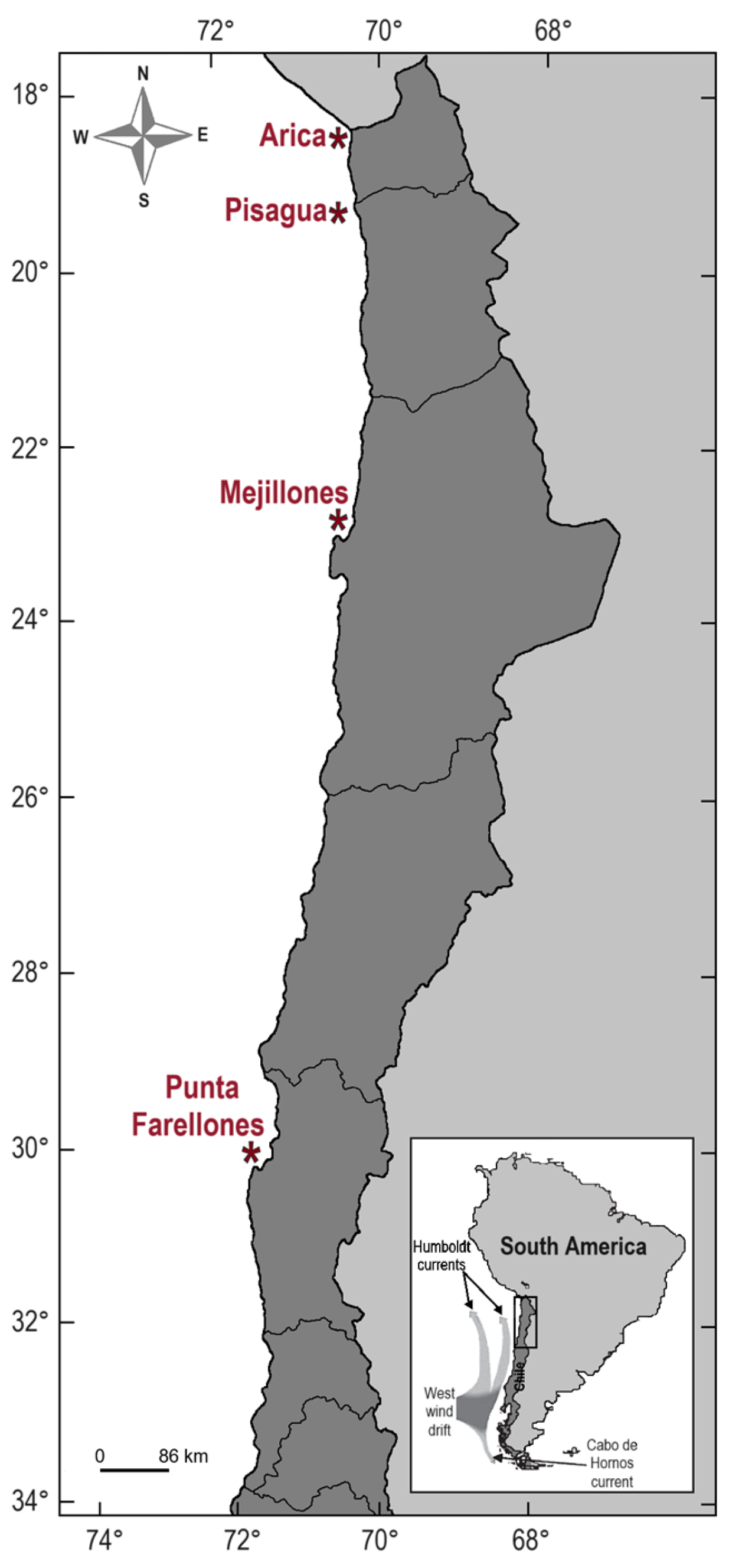
We analyzed 8 individuals, averaging 11.8 cm in total length, captured during a fisheries-independent research survey in 2020 aboard the B/C “Abate Molina” from the Instituto de Fomento Pesquero (IFOP) (Table 1). The survey collected specimens for this study in four regions: Arica (n = 2; ~12.9 cm), Pisagua (n = 3; ~11.4 cm), Mejillones (n = 2; ~11.6 cm) and Punta Farellones (n = 1; 11.2 cm) in South Pacific waters (Figure 1). All fish were captured from a depth range of 5 to 50 m using a midwater trawl. After capture, specimens were frozen at −20 °C. Coinciding with each fish sample, we collected 20 L of surface water and zooplankton using a Bongo plankton net with a ring diameter of 57 cm, length of 2.6 m, and mesh of 180 µm. The water was stored in total darkness, while the zooplankton was filtered, separated, dehydrated, and then stored under vacuum.

2.2. Lab Workup

2.2.1. Stable Isotopes

In the laboratory, we filtered seawater samples and divided them into two fiberglass filters (GFF WhatmanTM 1.5 µm, 4.7 cm (Whatman, Marlborough, MA, USA)). The filter for δ13C was placed in a desiccator with 20 mL of 37% HCl to remove inorganic carbon, and the filter for δ15N was stored in aluminum foil at −80 °C [22]. The zooplankton was separated by size fraction into mesozooplankton (0.2–2 mm) and macrozooplankton (>2.0 mm). All tissues were analyzed for δ15N and δ13C at the Universidad Andres Bello, Stable Isotope Facility (LAI) using a continuous flow mode (CF) “Nu-Instruments” mass spectrometer, coupled with a Eurovector EA-3024 elemental analyzer (Eurovector, Pavia, Italy). Isotope ratios are reported in δ notation, using standard Pee Dee Belemnite for δ13C and Atmospheric Nitrogen for δ15N. Thus, δ13C or δ15N = [(R sample/R standard) − 1], where R is 13C/14C or 15N/14N, respectively. This analysis had an accuracy of ±0.1‰ for δ15N and δ13C.

2.2.2. DNA Extraction, 16S Amplicon-Based Sequencing, and Taxonomic Assignment

DNA Extraction: DNA was extracted from 25–30 mg of stomach-intestine tissue using the PowerSoilTM DNA Isolation Kit (MoBio Laboratories, Solana Beach, CA, USA), following the manufacturer’s protocol. Homogenization was performed on a TissueLyser II (Qiagen, Hilden, Germany) with two 1-min cycles at 30 Hz, separated by a 1-min pause. DNA concentration was quantified using a Qubit 4 fluorometer with the QubitTM dsDNA BR Assay (Thermo Fisher Scientific, Waltham, MA, USA). Extracts were stored at −20 °C until further processing.
16S rRNA gene amplification and sequencing: Prokaryotic amplicon libraries were constructed by Genoma Mayor SpA (Santiago, Chile) (http://www.genomamayor.com/ (accessed on 1 March 2021)). The V4 hypervariable region of the 16S rRNA gene was amplified using the primer pair 515F-Y (5′-GTGYCAGCMGCCGCGGTAA) and 806RB (5′-GGACTACNVGGGTWTCTAAT), modified with Illumina-specific adapters and barcodes according to the Earth Microbiome Project protocols (https://earthmicrobiome.ucsd.edu/protocols-and-standards/16s/ (accessed on 14 April 2021)). PCR amplification was performed using 2X KAPA HiFi HotStart Ready Mix (KAPA Biosystems, Cape Town, South Africa). Products were purified with AMPure XP beads (Beckman Coulter, CA, USA), quantified via the Quant-iT PicoGreen dsDNA Assay Kit (Invitrogen, Waltham, MA, USA) on a HOEFER DQ300 fluorometer, and sized using a DNF-900 Kit (Advanced Analytical Technologies, Inc., Ames, IA, USA) on a Fragment Bioanalyzer. Libraries were pooled and prepared following the Illumina Denature and Dilute Libraries Guide, then sequenced on an Illumina HiSeq 2500 platform (2 × 250 bp) (Illumina, San Diego, CA, USA) targeting 100,000 reads per library. Raw sequence data are available in the NCBI SRA database under BioProject ID PRJNA1043743.
Bioinformatics: Sequence data were processed using the DADA2 v1.26.0 R package [23]. Low-quality sequences were filtered and trimmed, and paired-end reads were merged and denoised to generate Amplicon Sequence Variants (ASVs). Taxonomy was assigned to each ASV using the Ribosomal Database Project (RDP) Naive Bayesian Classifier, trained specifically for the V4 region of the 16S rRNA gene [24].

2.3. Data Analysis

To test our first prediction, we calculated the alpha-Shannon microbial diversity (H’) as follows:
H = p i   L N   p i
where pi represents the relative abundance of each amplicon sequence variant (ASV) within an individual anchoveta gut.
For our second prediction, ASVs were categorized by putative metabolic function. We distinguished between a proteolytic microbiome, associated with zooplankton digestion in marine fish (e.g., Vibrio, Photobacterium, Pseudoalteromonas, Shewanella), and a fermentative microbiome, linked to the digestion of detritus or complex carbohydrates (e.g., Clostridia, Bacteroides, Cetobacterium, and certain Enterobacteriaceae). We removed chloroplasts and cyanobacteria from the analysis. To mitigate compositional bias, we quantified the balance between these functional groups using a log-ratio metric, termed the Y-score:
Y s c o r e = L N ( p r o t e o l y t i c   a b u n d a n c e f e r m e n t a t i v e   a b u n d a n c e )
A positive Y-score indicates a microbiome dominated by proteolytic bacteria, while a negative value signifies dominance by fermentative taxa; a score of zero reflects functional equilibrium. The relationships between these microbial metrics (H’ and Y-score) and trophic indicators were assessed using Spearman’s rank correlation (rs), chosen for its robustness with small sample sizes and its ability to detect monotonic relationships without assuming linearity. To test our third prediction regarding functional convergence versus geographic influence, we employed Mantel tests. We hypothesized that microbial community dissimilarity would correlate more strongly with trophic distance δ15N than with geographic distance. Consequently, we correlated the microbiome dissimilarity matrix (Bray–Curtis) against the δ15N Euclidean distance matrix and, separately, against the geographic distance matrix (km) between capture zones. Finally, to visualize these relationships, we performed a Principal Coordinate Analysis (PCoA) based on Bray–Curtis distances, overlaying vectors for the fishing zone and δ15N. Statistical analyses were performed using Python 3.x [25] with the following packages: “pandas” for data manipulation [26], “NumPy” for numerical computing [27], “SciPy” for statistical tests, and stats models for post hoc analyses [27].

3. Results

We identified a total of 2669 prokaryotic ASV across 93 orders in anchoveta stomach samples collected from the study area. The microbial community was dominated by the orders: Alteromonadales, Cellvibrionales, Chitinophagales, Oxyphotobacteria, Flavobacteriales, Lactobacillales, Rhodobacterales, Synechococcales, Verrucomicrobiales, and Vibrionales. Analysis of alpha diversity revealed spatial heterogeneity. Mean Shannon diversity indices were comparable between the Pisagua (5.7 ± 0.55) and Mejillones (4.96 ± 0.19) fishing zones. However, diversity in these areas was markedly higher than in the Arica (3.76 ± 0.12) and Punta Farellones (3.54) zones (Table 1).
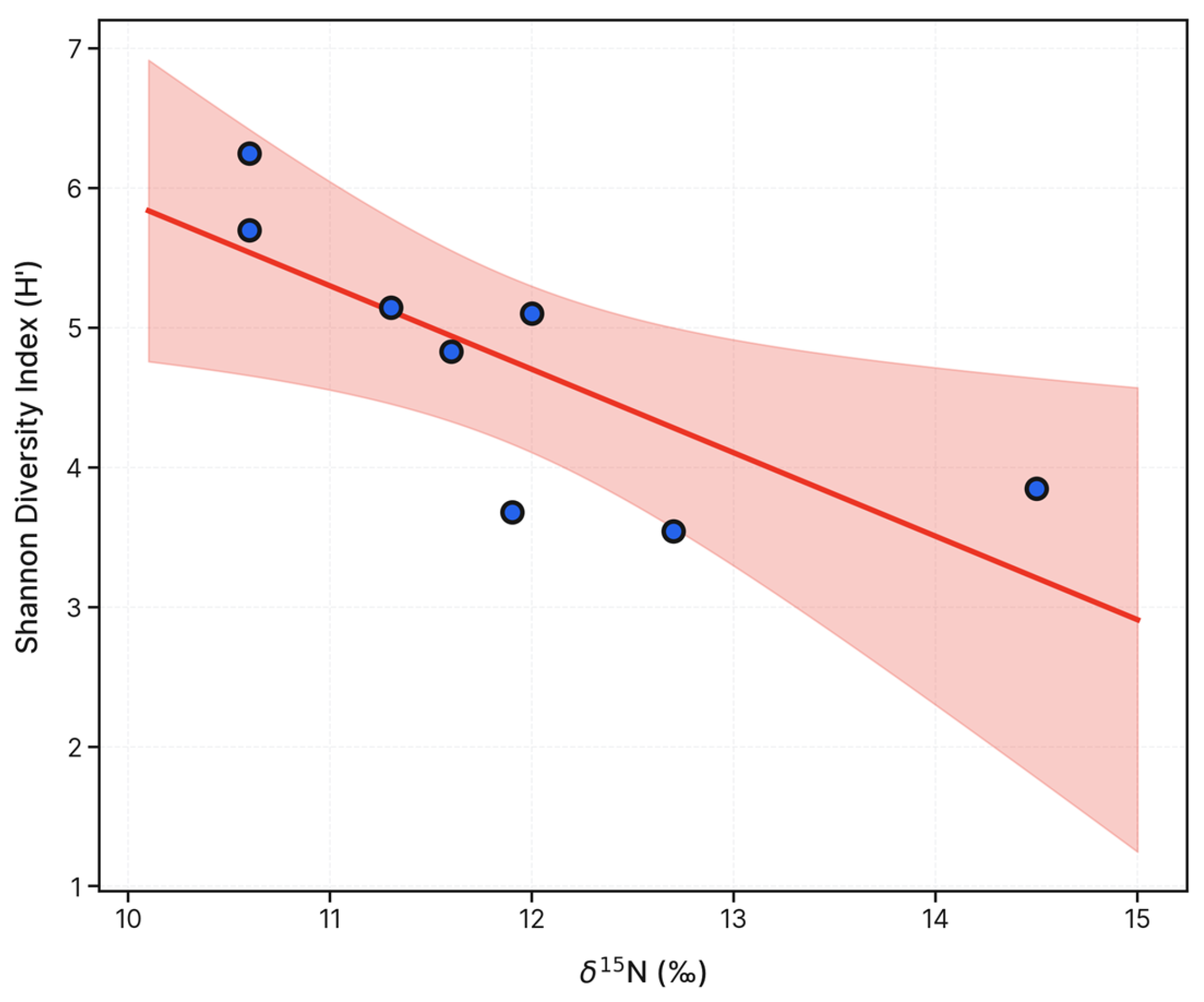
Our analysis revealed a strong, statistically significant negative correlation between stable nitrogen isotopes and the alpha diversity of the anchoveta gut microbiome (rs = −0.587, p = 0.027) (Figure 2). Anchoveta with lower isotopic values, indicative of a mixed phytoplankton-zooplankton diet (see Supplementary Materials), harbored highly diverse microbial communities (H’~6.0). Conversely, trophic ascent toward a strictly zooplanktivorous diet (δ15N > 14‰) was associated with a marked collapse in microbial diversity (H’ < 5.0) (Table 1). These data support the existence of a diet-dependent metabolic filter: the availability of highly digestible substrates in zooplankton favors endogenous enzymatic digestion over microbial fermentation. This shift reduces the necessity for functional redundancy, precipitating an ecological simplification of the microbiota toward a specialized core, a pattern consistent with metabolic release theory in dynamic pelagic systems. Thus, dietary specialization on zooplankton (high δ15N) drives a significant reduction in gut microbiome diversity. This validates our prediction that trophic ascent induces a metabolic release, wherein endogenous digestion displaces microbial fermentation, eliminating redundancy and simplifying community structure.
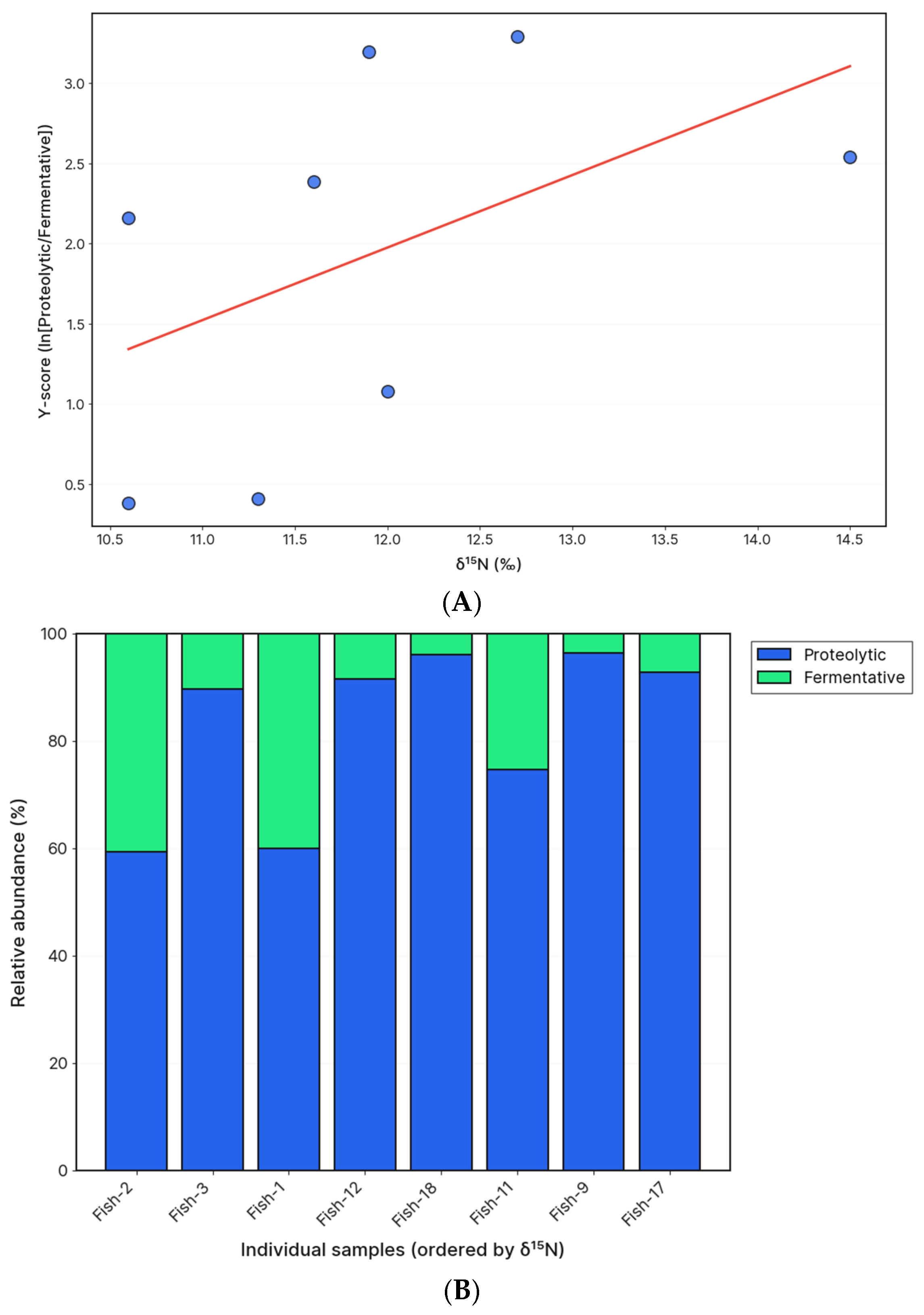
Our functional analysis of the anchoveta gut microbiome reveals a profound restructuring of the bacterial community, predictably driven by the host’s trophic position (Table 2). By integrating δ15N data with bacterial functional profiles, we demonstrate that dietary variation acts as a determinant ecological filter shaping microbial guild composition. The data show an overall dominance of the proteolytic guild (>90% relative abundance), consistent with the physiology of a carnivorous fish. However, a critical dynamic exists within the minority component: a strong, statistically significant negative correlation (rs = −0.874, p < 0.05) (Figure 3) links trophic level to the abundance of fermentative bacteria. In individuals at lower trophic levels (δ15N~10.5), fermentative bacteria maintain a modest but detectable presence (~10%), likely sustained by the ingestion of phytoplankton-derived carbohydrates. As the anchoveta ascends trophically (δ15N > 12.5), driven by oceanographic conditions favoring zooplankton consumption, we observe a virtual collapse of the fermentative guild. This is illustrated by a linear increase in the proteolytic-to-fermentative log-ratio (Figure 3A), indicating that specialization on a protein-rich diet actively eliminates the ecological niche for fermenters. This pattern supports the hypothesis that regional differences in anchoveta microbiomes stem not from geographic isolation, but from local functional responses to distinct prey fields (phytoplankton vs. zooplankton), validating the substrate-driven assembly model. We conclude that microbiome assembly in anchoveta is a functionally deterministic process: trophic ascent forces a metabolic specialization that maximizes the proteolytic guild while competitively excluding fermenters, confirming that observed microbiome variability is a plastic response to local prey availability.
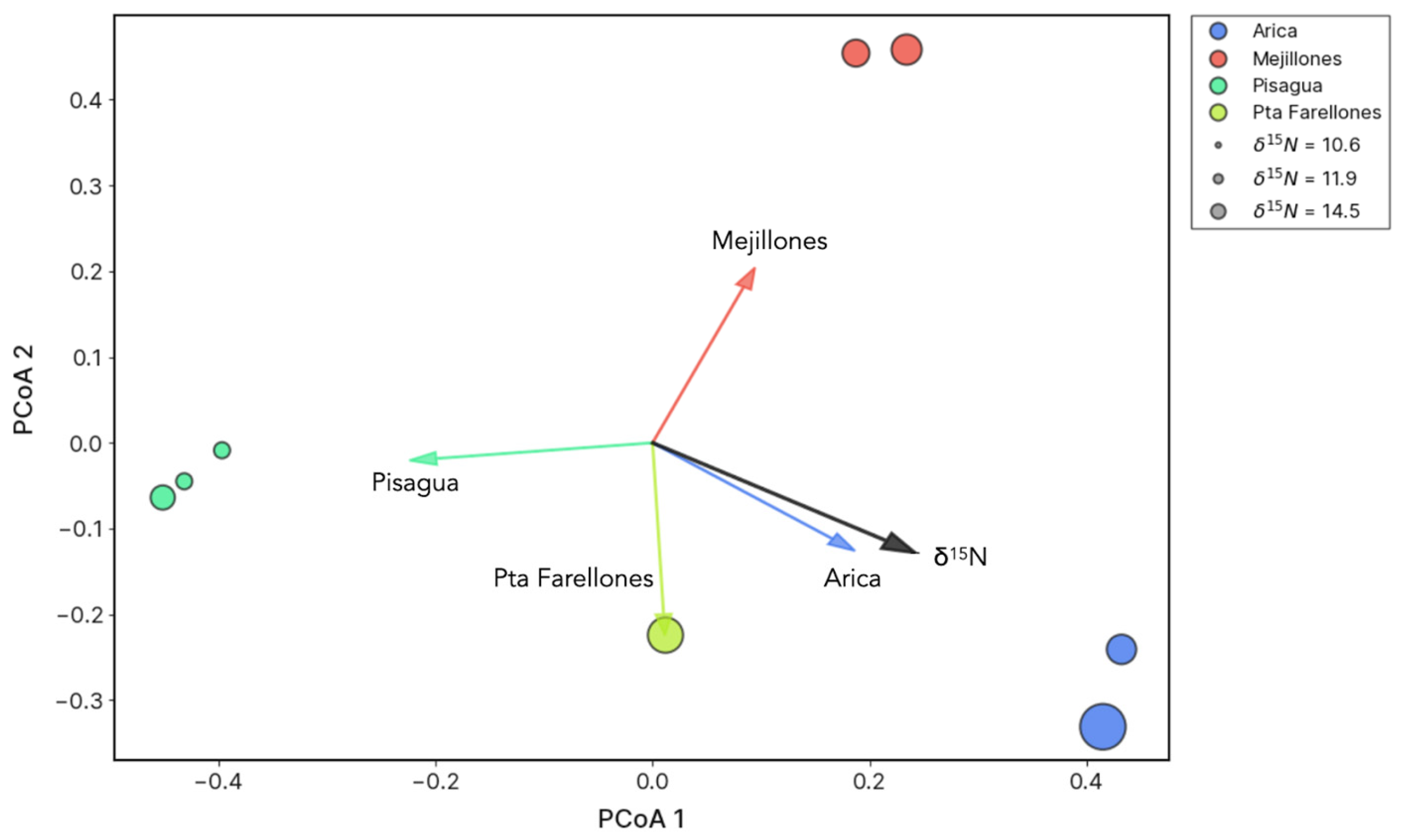
We used a PCoA based on Bray–Curtis distances to evaluate the microbial community structure of the anchoveta in relation to geographic location and δ15N values. Visually, Figure 4 reveals strong spatial structuring, with samples clearly segregated by their location of origin (Arica, Mejillones, Pisagua, Punta Farellones). This observation is robustly validated by a Mantel test, which confirmed a significant correlation between microbiome dissimilarity and geographic distance (r = 0.532, p = 0.002). This result indicates that local environmental conditions or regional microbial biogeography exert a primary influence on the taxonomic identity of gut symbionts. In contrast, the influence of δ15N on community structure was statistically non-significant (r = 0.272, p = 0.124), despite an apparent visual association in the Arica vector. This indicates that while diet modulates alpha diversity and functional potential (as demonstrated by the proteolytic/fermentative ratio), it does not drive a strict taxonomic convergence across distant regions. Different anchoveta populations likely assemble their microbiomes using locally available bacterial taxa to fulfill similar metabolic roles, thereby maintaining high regional beta diversity. Hence, the taxonomic identity of the anchoveta microbiome is primarily structured by local geography, not by δ15N. This finding adds a crucial nuance to the predictable plasticity hypothesis: while microbiome function converges metabolically (e.g., proteolysis) in response to zooplankton consumption, the specific species composition remains divergent and site-dependent. This refutes the idea that dietary forcing homogenizes microbial taxonomy at a regional scale, highlighting the importance of priority effects or local biogeography in community assembly.

4. Discussion

This study functionally dissects the assembly rules governing the gut microbiome of the anchoveta (Engraulis ringens), demonstrating that trophic ascent acts as a potent metabolic filter that predictably simplifies bacterial community structure [13]. We reveal a deterministic collapse of microbial alpha diversity and a near-complete competitive exclusion of fermentative bacteria with increasing reliance on a zooplankton diet. Our data provide robust mechanistic support for the concept of metabolic release in pelagic fishes [1,5]. The significant negative correlation between δ15N and microbial diversity validates our central prediction: as anchoveta ascend trophically, the shift toward a highly digestible, protein- and lipid-rich zooplankton diet [14] reduces the energetic necessity for microbial pre-digestion. This shift favors endogenous enzymatic processing, eliminating the niche space required for the functional redundancy observed in lower-trophic-level feeders [13]. This simplification is driven by a stark restructuring of functional guilds. While the community remains dominated by proteolytic bacteria—consistent with carnivorous physiology [28]—the near-perfect negative correlation between δ15N and fermentative bacteria offers novel insight. This indicates that the high load of bioavailable protein actively eliminates the ecological niche for carbohydrate fermenters, driving the community toward a core optimized for proteolysis. The significant increase in the proteolytic-to-fermentative log-ratio provides a quantitative metric for this specialization, confirming patterns observed in other fish species where diet dictates gut microbiota composition [4,29].
Our results paint a nuanced picture of microbiome assembly, challenging the prediction of complete taxonomic convergence. The collapse of fermentative bacteria with increasing δ15N confirms that assembly is functionally plastic and predictable: environmental conditions favoring zooplankton consistently drive functional simplification, prevailing over priority effects [6]. However, the significant correlation between microbiome dissimilarity and geographic distance refutes the idea of taxonomic homogenization. While diet forces function to converge (e.g., toward proteolysis), the specific bacterial species fulfilling this role vary geographically. This highlights the crucial role of local microbial biogeography: different anchoveta populations recruit locally available taxa (e.g., from the water column; [30]) to fulfill the same core metabolic demand. Thus, while the host determines what metabolic roles are required, the environment dictates who fills them.
The ability to link the fish’s trophic position (via δ15N) to the functional simplicity of its microbiome is a major step toward predictive ecology. For the anchoveta fishery, our model suggests that tracking δ15N may provide a proxy for monitoring the functional state of the stock’s health. While our reliance on 16S rRNA gene sequencing provides strong correlative support for these functional conclusions, direct validation is needed. Future research should prioritize three key areas: use metagenomic sequencing to directly measure functional gene capacity (e.g., specific protease pathways) in order to conclusively confirm the competitive exclusion mechanism, conduct controlled feeding experiments across varying diets to measure the causality and metabolic cost of maintaining a diverse versus simplified microbiome, and combine stable isotopes, DNA metabarcoding, and bio-logging [18] to resolve the fine-scale temporal dynamics of this diet–microbiome coupling in the wild.

Supplementary Materials

The following supporting information can be downloaded at: https://www.mdpi.com/article/10.3390/fishes11010035/s1, Table S1 Biometric characteristics and estimated dietary contributions from stable isotopes mixing models. The table summarizes the collection zone, size, and weight for each analyzed anchoveta specimen. The estimated proportional contribution of three prey guilds—phytoplankton, mesozooplankton, and macrozooplankton—is presented as the mean value followed by the standard deviation (s.d.); Table S2: Isotopic signatures of potential prey sources. Mean stable carbon (δ13C) and nitrogen (δ15N) isotope values for the three primary prey guilds (phytoplankton, mesozooplankton, and macrozooplankton). Data are presented as the mean followed by the standard deviation (s.d.) in parentheses; Table S3: Data.

Author Contributions

Conceptualization, S.A.K., H.A.L. and C.C.; methodology, S.A.K., H.A.L., C.C., F.F. and F.L.; software, S.A.K. and H.A.L.; validation, S.A.K. and H.A.L.; formal analysis, S.A.K., C.C. and H.A.L.; investigation, S.A.K., C.C. and H.A.L.; resources; S.A.K., H.A.L. and F.L.; data curation, S.A.K., C.C. and H.A.L.; writing—original draft preparation, S.A.K., C.C. and H.A.L.; writing—review and editing, S.A.K., H.A.L., C.C., F.F. and F.L.; visualization, S.A.K., H.A.L., C.C., F.F. and F.L.; project administration, S.A.K., H.A.L., C.C., F.F. and F.L.; funding acquisition, S.A.K., C.C. and H.A.L. All authors have read and agreed to the published version of the manuscript.

Funding

S.K. and F.L. were supported by “Subsecretaria de Pesca y Acuicultura” ASIPA program—Fishing season 2020—under Grant RECLAN 152: “Evaluación hidroacústica del reclutamiento de anchoveta entre Arica y Antofagasta, año 2020” and RECLAN 34: “Evaluación hidroacústica del reclutamiento de anchoveta entre Atacama y Coquimbo, año 2020”. C.C. was supported by the “Agencia Nacional de Investigación y Desarrollo ANID” PhD scholarship under Grant 21210274, Chile. H.A.L. was supported by the Grant FONDECYT Iniciación 11200708. The APC was partially funded by Programa de Apoyo para el pago de Procesamiento de Artículos 2026, Dirección General de Investigación, Universidad de Playa Ancha, Chile.

Institutional Review Board Statement

Ethical approval is not applicable. We had no contact with live animals in the performance of this research.

Informed Consent Statement

Not applicable.

Data Availability Statement

All fishery data related to this project are available through the digital platforms of the Government of Chile, https://www.portaltransparencia.cl/PortalPdT/, and/or by telephone at +569-7691-9106; +569-7685-5761, and/or via email at: oirs@subpesca.cl.

Acknowledgments

We wish to express our gratitude to all the crew aboard the IFOP Research Vessel “B/C Abate Molina”.

Conflicts of Interest

The authors declare no conflicts of interest.

References

  1. Clements, K.D.; Angert, E.R.; Montgomery, W.L.; Choat, J.H. Intestinal Microbiota in Fishes: What’s Known and What’s Not. Mol. Ecol. 2014, 23, 1891–1898. [Google Scholar] [CrossRef] [PubMed]
  2. Talwar, C.; Nagar, S.; Lal, R.; Negi, R.K. Fish Gut Microbiome: Current Approaches and Future Perspectives. Indian J. Microbiol. 2018, 58, 397–414. [Google Scholar] [CrossRef] [PubMed]
  3. Gallo, B.D.; Farrell, J.M.; Leydet, B.F. Fish Gut Microbiome: A Primer to an Emerging Discipline in the Fisheries Sciences. Fisheries 2020, 45, 271–282. [Google Scholar] [CrossRef]
  4. Ingerslev, H.-C.; Strube, M.L.; von Gersdorff Jørgensen, L.; Dalsgaard, I.; Boye, M.; Madsen, L. Diet Type Dictates the Gut Microbiota and the Immune Response against Yersinia Ruckeri in Rainbow Trout (Oncorhynchus mykiss). Fish Shellfish Immunol. 2014, 40, 624–633. [Google Scholar]
  5. Li, J.; Ni, J.; Li, J.; Wang, C.; Li, X.; Wu, S.; Zhang, T.; Yu, Y.; Yan, Q. Comparative Study on Gastrointestinal Microbiota of Eight Fish Species with Different Feeding Habits. J. Appl. Microbiol. 2014, 117, 1750–1760. [Google Scholar] [CrossRef]
  6. Gallo, B.D.; Farrell, J.M.; Leydet, B.F. Initial Diet Influences Future Development Paths of Gut Microbiota in Larval Northern Pike (Esox lucius). Hydrobiologia 2023, 850, 3743–3762. [Google Scholar] [CrossRef]
  7. Dulski, T.; Kozłowski, K.; Ciesielski, S. Habitat and Seasonality Shape the Structure of Tench (Tinca tinca L.) Gut Microbiome. Sci. Rep. 2020, 10, 4460. [Google Scholar] [CrossRef]
  8. Wu, P.; Liu, Y.; Li, C.; Xiao, Y.; Wang, T.; Lin, L.; Xie, Y. The Composition of Intestinal Microbiota from Collichthys Lucidus and Its Interaction with Microbiota from Waters along the Pearl River Estuary in China. Front. Environ. Sci. 2021, 9, 675856. [Google Scholar] [CrossRef]
  9. Gallo, B.D.; Farrell, J.M.; Leydet, B.F. Northern Pike (Esox lucius) Young-of-year Gut Microbiota and Associations with Wetland Nursery Water Microbial Communities in the St. Lawrence River. Aquac. Fish Fish. 2022, 2, 384–401. [Google Scholar] [CrossRef]
  10. Huang, Q.; Sham, R.C.; Deng, Y.; Mao, Y.; Wang, C.; Zhang, T.; Leung, K.M.Y. Diversity of Gut Microbiomes in Marine Fishes Is Shaped by Host-Related Factors. Mol. Ecol. 2020, 29, 5019–5034. [Google Scholar] [CrossRef]
  11. Li, J.J.; Ni, J.J.; Wang, C.; Yu, Y.H.; Zhang, T.L. Different Response Patterns of Fish Foregut and Hindgut Microbiota to Host Habitats and Genotypes. Appl. Ecol. Environ. Res. 2020, 18, 7369–7378. [Google Scholar] [CrossRef]
  12. Song, D.; Wang, T.; Cheng, Q.; Liu, B.; Peng, D.; Lou, Z. Spatial Dietary Differentiation and Trophic Variation in Gymnocypris Chilianensis across Three Watersheds of the Hexi Corridor. J. Freshw. Ecol. 2025, 40, 2564999. [Google Scholar] [CrossRef]
  13. Liu, H.; Guo, X.; Gooneratne, R.; Lai, R.; Zeng, C.; Zhan, F.; Wang, W. The Gut Microbiome and Degradation Enzyme Activity of Wild Freshwater Fishes Influenced by Their Trophic Levels. Sci. Rep. 2016, 6, 24340. [Google Scholar] [CrossRef] [PubMed]
  14. Cárcamo, C.; Schultz, E.T.; Leiva, F.; Saavedra, A.; Klarian, S.A. A Deep Dive into the Trophic Ecology of Engraulis Ringens: Assessing Diet through Stomach Content and Stable Isotope Analysis. Fishes 2024, 9, 475. [Google Scholar] [CrossRef]
  15. Panteli, N.; Mastoraki, M.; Nikouli, E.; Lazarina, M.; Antonopoulou, E.; Kormas, K.A. Imprinting Statistically Sound Conclusions for Gut Microbiota in Comparative Animal Studies: A Case Study with Diet and Teleost Fishes. Comp. Biochem. Physiol. Part D Genom. Proteom. 2020, 36, 100738. [Google Scholar] [CrossRef]
  16. Bachiller, E.; Albo-Puigserver, M.; Giménez, J.; Pennino, M.G.; Marí-Mena, N.; Esteban, A.; Lloret-Lloret, E.; Jadaud, A.; Carro, B.; Bellido, J.M.; et al. A Trophic Latitudinal Gradient Revealed in Anchovy and Sardine from the Western Mediterranean Sea Using a Multi-Proxy Approach. Sci. Rep. 2020, 10, 17598. [Google Scholar] [CrossRef]
  17. Nielsen, J.M.; Clare, E.L.; Hayden, B.; Brett, M.T.; Kratina, P. Diet Tracing in Ecology: Method Comparison and Selection. Methods Ecol. Evol. 2018, 9, 278–291. [Google Scholar] [CrossRef]
  18. Campioni, L.; Ventura, F.; Granadeiro, J.P.; Madeiros, J.; Gjerdrum, C.; Silva, M.C. Combining Bio-Logging, Stable Isotopes and DNA Metabarcoding to Reveal the Foraging Ecology and Diet of the Endangered Bermuda Petrel Pterodroma Cahow. Mar. Ecol. Prog. Ser. 2023, 723, 151–170. [Google Scholar] [CrossRef]
  19. Marcuk, V.; Piña-Ortiz, A.; Castillo-Guerrero, J.A.; Masello, J.F.; Bustamante, P.; Griep, S.; Quillfeldt, P. Trophic Plasticity of a Tropical Seabird Revealed through DNA Metabarcoding and Stable Isotope Analyses. Mar. Environ. Res. 2024, 199, 106627. [Google Scholar] [CrossRef]
  20. Huyghe, C.E.T.; Aerts, D.N.; Heindler, F.M.; Kmentová, N.; Mushagalusa Cirhuza, D.; Hellemans, B.; Chocha Manda, A.; Vanhove, M.P.M.; Mulimbwa N’Sibula, T.; Volckaert, F.A.M.; et al. Opportunistic Feeding Habits of Two African Freshwater Clupeid Fishes: DNA Metabarcoding Unravels Spatial Differences in Diet and Microbiome, and Identifies New Prey Taxa. Hydrobiologia 2023, 850, 3777–3796. [Google Scholar] [CrossRef]
  21. Wei, D.; Guo, Z.; Chen, F.; Su, H.; Wang, Y.; Deng, L.; Huang, J.; Huang, L.; Ling, F.; Wang, G.; et al. Gut Microbiota of Largemouth Bass in Response to Temperature Stress. Aquac. Rep. 2025, 43, 102912. [Google Scholar] [CrossRef]
  22. Feuchtmayr, H.; Grey, J. Effect of Preparation and Preservation Procedures on Carbon and Nitrogen Stable Isotope Determinations from Zooplankton. Rapid Commun. Mass Spectrom. 2003, 17, 2605–2610. [Google Scholar] [CrossRef]
  23. Callahan, B.J.; McMurdie, P.J.; Rosen, M.J.; Han, A.W.; Johnson, A.J.A.; Holmes, S.P. DADA2: High-Resolution Sample Inference from Illumina Amplicon Data. Nat. Methods 2016, 13, 581–583. [Google Scholar] [CrossRef]
  24. Wang, Q.; Garrity, G.M.; Tiedje, J.M.; Cole, J.R. Naïve Bayesian Classifier for Rapid Assignment of rRNA Sequences into the New Bacterial Taxonomy. Appl. Environ. Microbiol. 2007, 73, 5261–5267. [Google Scholar] [CrossRef]
  25. Van Rossum, G.; Drake, F.L. Python 3 Reference Manual; CreateSpace: Scotts Valley, CA, USA, 2009. [Google Scholar]
  26. McKinney, W. Data Structures for Statistical Computing in Python. In Proceedings of the Python in Science Conference, SciPy, Austin, TX, USA, 28 June–3 July 2010; pp. 56–61. [Google Scholar]
  27. Harris, C.R.; Millman, K.J.; van der Walt, S.J.; Gommers, R.; Virtanen, P.; Cournapeau, D.; Wieser, E.; Taylor, J.; Berg, S.; Smith, N.J.; et al. Array Programming with NumPy. Nature 2020, 585, 357–362. [Google Scholar] [CrossRef]
  28. Givens, C.E.; Ransom, B.; Bano, N.; Hollibaugh, J.T. Comparison of the Gut Microbiomes of 12 Bony Fish and 3 Shark Species. Mar. Ecol. Prog. Ser. 2015, 518, 209–223. [Google Scholar] [CrossRef]
  29. Terova, G.; Rimoldi, S.; Ascione, C.; Gini, E.; Ceccotti, C.; Gasco, L. Rainbow Trout (Oncorhynchus mykiss) Gut Microbiota Is Modulated by Insect Meal from Hermetia Illucens Prepupae in the Diet. Rev. Fish Biol. Fish. 2019, 29, 465–486. [Google Scholar] [CrossRef]
  30. Burtseva, O.; Kublanovskaya, A.; Fedorenko, T.; Lobakova, E.; Chekanov, K. Gut Microbiome of the White Sea Fish Revealed by 16S rRNA Metabarcoding. Aquaculture 2021, 533, 736175. [Google Scholar] [CrossRef]
Figure 1. Location of catch zones of water samples and anchovetas along the Chilean coast and associated oceanographic context. The main map displays the four principal collection localities: Arica, Pisagua, Mejillones, and Punta Farellones, spanning the northern and central regions of Chile. (Inset) The geographical context of the study area in South America, illustrating its position relative to the major cold-water systems, the Humboldt Current and the West Wind Drift.
Fishes 11 00035 g001
Figure 2. δ15N drives gut microbiome simplification. The scatter plot illustrates the relationship between the Shannon Diversity Index of the gut/intestine microbiome and nitrogen stable isotope values δ15N in individual anchovies. A negative trend is observed, indicating that individuals feeding at enriched δ15N exhibit lower microbiome alpha diversity. The solid red line represents the linear regression fit, bounded by the 95% confidence interval.
Fishes 11 00035 g002
Figure 3. Trophic modulation of microbiome functional guilds. (A) Linear relationship between δ15N values and the metabolic guild index (Yscore), defined as the natural logarithm of the ratio of proteolytic to fermentative bacterial abundance. The positive trend indicates a functional shift toward proteolytic dominance in individuals feeding at higher trophic levels. (B) Stacked bar chart displaying the relative abundance (%) of proteolytic (blue) and fermentative (green) guilds in individual anchoveta samples, ordered by increasing δ15N. Proteolytic taxa consistently dominate the gut community, with their prevalence increasing further in isotopically enriched anchoveta.
Fishes 11 00035 g003
Figure 4. Geographic and trophic drivers of gut microbiome beta diversity. Principal Coordinate Analysis (PCoA) ordination illustrating variation in anchoveta microbial community structure. Samples are color-coded by collection site and sized proportionally to the host nitrogen stable isotope δ15N value. Vectors indicate the direction and magnitude of the correlation between the ordination axes and the explanatory variables, revealing distinct clustering by geography and a strong association between elevated δ15N values and the microbial assemblage in Arica.
Fishes 11 00035 g004
Table 1. Summary of anchoveta stable isotopes and microbiome metrics. Catch zone (Zone), bulk tissue stable isotope signatures (δ13C, δ15N) and elemental C:N ratios, alongside gut/intestine microbial alpha diversity indices (ASV richness and Shannon index) for each individual anchoveta specimen analyzed. ASV: Amplicon Sequence Variant.
Fish IDZoneδ13Cδ15NC:N RatioASV RichnessShannon Index
Fish-1Pisagua−17.5811.306.812895.14
Fish-2Pisagua−19.2810.607.508905.69
Fish-3Pisagua−19.6610.604.9110336.24
Fish-9Pta Farellones−17.7412.705.791583.54
Fish-11Mejillones−17.8612.005.534155.10
Fish-12Mejillones−18.0511.604.582284.82
Fish-17Arica−16.5814.504.33553.84
Fish-18Arica−15.7611.903.61873.67
Table 2. Metabolic guild abundance and derived functional index. The abundance (sequence counts) of proteolytic and fermentative bacterial guilds detected in each anchoveta specimen. The Yscore quantifies the functional balance of the gut community, calculated as the natural logarithm of the ratio of proteolytic to fermentative abundance.
Fish IDProteolytic AbundanceFermentative AbundanceYscore
Fish-1982165490.405
Fish-216,27811,1410.379
Fish-317,26019882.161
Fish-917,81264333.291
Fish-1118,65663541.077
Fish-1210,7789912.387
Fish-171055832.542
Fish-1896003933.196
Disclaimer/Publisher’s Note: The statements, opinions and data contained in all publications are solely those of the individual author(s) and contributor(s) and not of MDPI and/or the editor(s). MDPI and/or the editor(s) disclaim responsibility for any injury to people or property resulting from any ideas, methods, instructions or products referred to in the content.