
Article

Zebrafish Girella zebra (Richardson 1846): Biological Characteristics of an Unexploited Fish Population

by
Peter Graham Coulson
Centre for Sustainable Aquatic Ecosystems, Murdoch University, 90 South Street, Murdoch, WA 6150, Australia
Current address: Institute for Marine and Antarctic Studies, College of Science and Engineering, University of Tasmania, Private Bag 49, Hobart, TAS 7001, Australia.
Fishes 2026, 11(1), 24; https://doi.org/10.3390/fishes11010024 (registering DOI)

Submission received: 27 November 2025 / Revised: 24 December 2025 / Accepted: 29 December 2025 / Published: 1 January 2026

Abstract

Kyphosids are prominent members of temperate and subtropical reef fish communities, though many species are not targeted due to their poor eating qualities. This study investigated the biology of the non-targeted zebrafish, Girella zebra, from waters off southern Western Australia. Frequent captures of small juveniles enabled confirmation of the formation of the first otolith zone, and marginal increment analysis verified the annual formation of opaque zones. Female G. zebra reached a maximum total length and age of 399 mm and 45 years, while males attained 431 mm and 36 years. Girella zebra exhibits a “square” form of growth, as do other Kyphosids, whereby rapid growth occurs during the first 6–8 years, followed by minimal growth throughout a long adult lifespan. Length and age at maturity were 290 mm and 6.7 years for females and 269 mm and 4.9 years for males. Spawning occurs from August to December, and large gonads in both sexes are indicative of spawning in large schools. Natural mortality (M) estimates (females: 0.10–0.15 year−1; males: 0.12–0.18 year−1) exceeded total mortality from catch curves, reflecting that commonly used M estimators are based on heavily fished stocks. This study provides rare biological data for a species unaffected by fishing.
Key Contribution: Populations of almost all targeted fish species display some effect of fishing. The biological data collected for Girella zebra (Kyphosidae) in this study provides the opportunity to observe the biological characteristics of a fish population in its virgin state, providing an unfished baseline for the biological characteristics of girellids and kyphosids, more broadly, but also for temperate, moderately long-lived reef fishes in general.

1. Introduction

The Kyphosidae, or sea chubbs, consists of four subfamilies, 14 genera and 53 species, and are typically, large-bodied fishes characterised by having a large, strong caudal fin and can grow to lengths of ~900 mm and attain weights of at least 14 kg [1,2]. The Girellinae is the most speciose subfamily of the Kyphosidae, consisting of two genera and 19 species, with 18 species belonging in the Girella genus. The majority of the girellids are found in subtropical to temperate coastal waters of the Western Pacific and South-eastern Indian Oceans, although two species, Girella opaleye and Girella zonata, are found in the Eastern Pacific and Western Atlantic oceans [3,4]. The zebrafish, Girella zebra, is one of four girellids found in southern Australian waters, occurring from Port Denison, Western Australia, to the Clarence River, New South Wales, and also in north-eastern Tasmania [2,5]. Like most other kyphosids, such as Scorpis lineolata, Scorpis aequipinnis and its congener Girella trucuspidata, G. zebra exhibits schooling behaviour [6], one of the characteristics thought to make kyphosids highly vulnerable to overfishing [7,8,9]. Although omnivorous during their juvenile stages, the diet of girellids and kyphosids, once maturity is attained, primarily consists of algae [10,11]. With a shift toward a diet dominated by algae, and thus a role as primary consumers, herbivorous fish serve as a key pathway for energy between primary producers (algae) and higher trophic levels [12].
Members of the Kyphosidae, such as Kyphosus bigibbus, K. sydneyanus and K. gladius, and Girellidae, such as Girella tricuspidata and G. elevata, comprise a significant component of shallow temperate reef fish communities in Australia, contributing > 80% of the fish biomass in some cases [13,14,15,16], and are thus likely to be ecologically important. However, the biological characteristics of only those few commercially and/or recreationally important species have been well-documented [6,8,17,18]. These studies highlight that some kyphosids are long-lived, attaining maximum ages > 50 years, e.g., [7,9], and as high as 93 years for a single Kyphosus sydneyanus [19]. These studies have also shown that some species are susceptible to overfishing [7,8,9]. However, many studies have been undertaken on populations that have been exploited by commercial fisheries, and thus the biological parameters have been influenced by the effects of fishing, i.e., removal of the largest/oldest individuals [20]. Very few studies on the biological characteristics of teleosts have been undertaken on unfished or very lightly fished species or populations, with the exception of refs. [21,22].
The primary aim of this study was to provide a comprehensive description of the biology of G. zebra from the southern coast of Western Australia and thus determine the length and age compositions, growth, mortality, timing and duration of spawning and length and age at maturity of this unfished species. Previous biological studies of kyphosids have demonstrated that species in this family are long-lived and typically grow rapidly to their asymptotic length, e.g., [7,9,17,18]. Considering that the maximum ages of two lightly fished girellids, e.g., G. elevata and G. cyanea, are >40 years [23,24], it is hypothesised that the unfished G. zebra attains a similar, if not greater, maximum age. It is also hypothesised that, like other kyphosids, G. zebra will exhibit a “square form of growth” [25], whereby a large proportion of growth is undertaken early in life, after which very little growth occurs for the remainder of their extended lives.

2. Materials and Methods

2.1. Sampling Regime and Length and Weight Measurements

Girella zebra were collected between October 2014 and October 2015 from coastal waters in Albany (~35° S, 118° E) and Bremer Bay (~34° S, 119° E) on the south coast of Western Australia. Fish were sampled by spearfishing, while snorkelling, over granite-based reefs along rocky shorelines in water depths < 15 m, which represents much of their reported 20 m depth range [26]. Samples were collected under the Murdoch University animal ethics permit R2535/12 and Western Australian Department of Fisheries exemption permit 2525.
For each of the 757 G. zebra collected, the total length (TL) and fork length (FL) were recorded to the nearest 1 mm and their total weight (TW) recorded to the nearest 0.1 g. A two-way Analysis of covariance (ANCOVA), employing total weight (TW) as the dependent variable and TL or FL as the independent variables and sex as the fixed factor, showed that the relationships between TW and both TL and FL did not differ significantly between sexes (p > 0.05). The linear relationships between TW and TL and between TW and FL were
l n T W = 3.02 ( l n T L ) 11.02 ( r 2 = 0.99 , P < 0.001 , n = 757 )
l n T W = 3.11 ( l n F L ) 11.32 ( r 2 = 0.99 , P < 0.001 , n = 757 )
The relationship between TL and FL did not differ significantly between the sexes (p > 0.05) and was
T L = 1.09 ( F L ) 5.73 ( r 2 = 0.99 , P < 0.001 , n = 757 ) .
In order to determine if there were differences in the length and age distribution of female and male G. zebra, Kolmogorov–Smirnov (K-S) tests were performed.

2.2. Age Determination and Validation

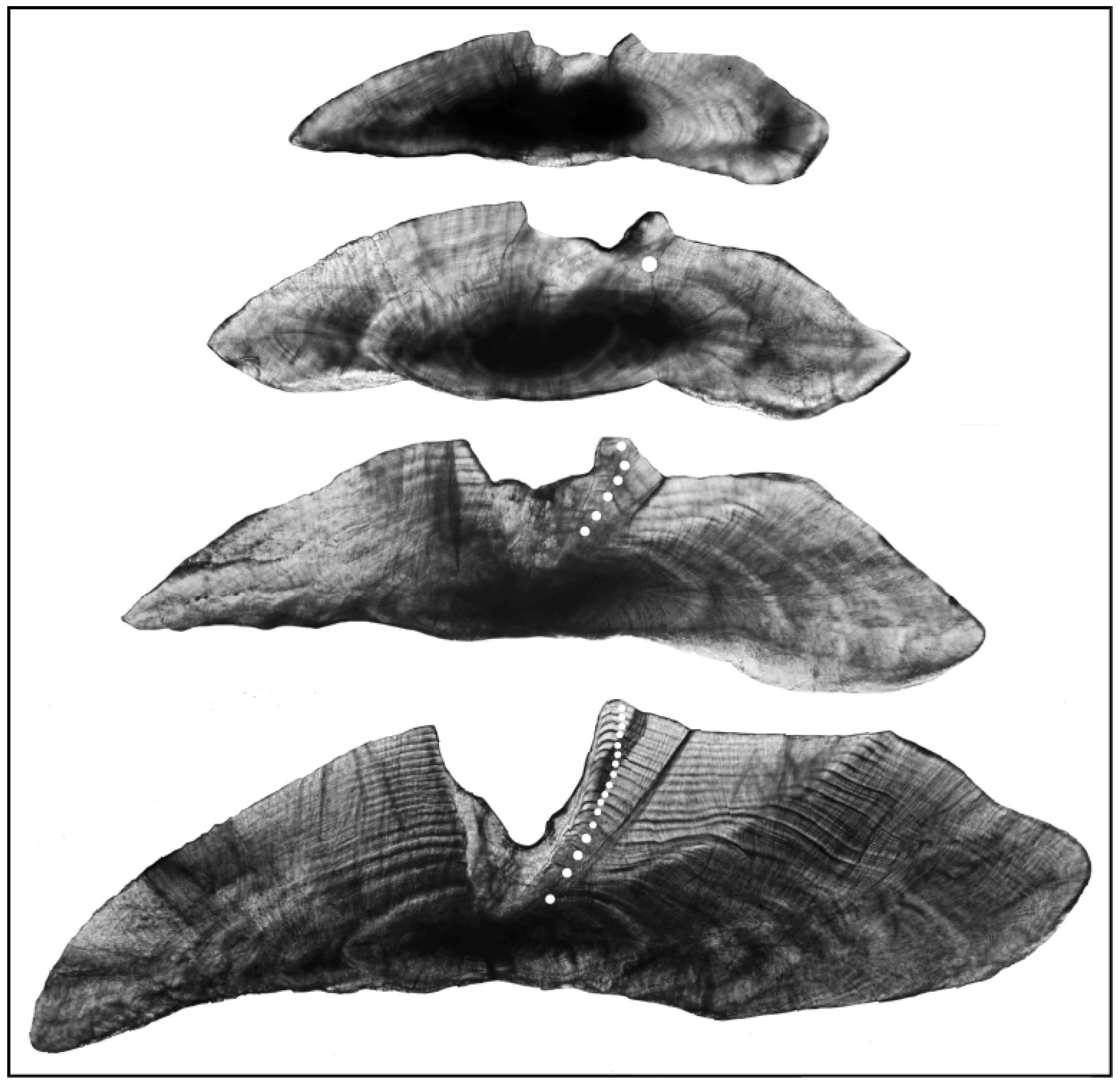
The otoliths of all G. zebra collected, except 10 individuals whose otoliths were damaged during capture by spear fishing, were sectioned in order to clearly reveal all opaque zones, as was the case in previous ageing studies of kyphosids, e.g., [17,18,19]. The methods for the preparation, sectioning and reading of otoliths follows that described in Coulson et al. [9] for another kyphosid, S. aequippinis. All counts and measurements were made on the dorsal side of the otolith (Figure 1). Analyses of the trends exhibited throughout the year by the marginal increments on otoliths, i.e., the distance between the outer edge of the single or outermost opaque zone and the otolith periphery, were used to validate that a single opaque zone is formed annually in the otoliths of G. zebra. The marginal increment (MI) was expressed as a proportion of either the distance between the primordium and the outer edge of the single opaque zone, when one such zone was present, or of the distance between the outer edges of the two outermost opaque zones, when two or more such zones were present. All distances were measured to the nearest 0.01 mm and along the same perpendicular axis to the opaque zones.
In order to assess the accuracy in obtaining counts of opaque zones from the otoliths of G. zebra, the number of opaque zones counted in each sectioned otolith by the author were compared to those obtained independently by another experienced reader of otoliths (E. C. Ashworth, Murdoch University) for a subsample of 100 G. zebra otoliths, covering a wide size range. The level of precision was assessed using the coefficient of variation (CV),
C V j = 100 % × i = 1 R ( X i j X j ) 2 / ( R 1 ) X j
where C V j is the age precision estimate for the jth fish, X i j is the ith opaque zone count of the jth fish, X j is the mean age estimate of the jth fish and R is the number of times each fish is aged [27,28]. The resultant CV of 1.6%, well within the accepted reference level of <5% [28], demonstrates that there was strong agreement between the counts of the two readers.

2.3. Growth and Mortality

Each fish was assigned an age, based on the number of opaque zones in the otolith examined, but taking into account the time when the single or outermost of those zones become delineated, the date of capture of the fish and the “average” birth date (approximate mid-point of the spawning period) of 1 October (see Section 3). von Bertalanffy growth curves (vBGCs) were then fitted to the total lengths at age of the females and males of G. zebra, employing the non-linear regression routine in R [29]. In the von Bertalanffy growth equation,
T L = T L ( 1 e x p ( k ( t t 0 ) ) )
TL is the total length (mm) at age t (years), TL is the asymptotic total length (mm) predicted by the equation, k is the growth coefficient (year−1) and t0 is the hypothetical age (years) at which fish would have zero length. The length at age data for 60 fish whose sex was unknown, that ranged in TL from 30 to 185 mm, were added to the datasets for females and males randomly and alternately.
A likelihood ratio test was used to compare the vBGCs for females and males. The test statistic was determined as twice the difference between the log-likelihoods obtained by fitting separate growth curves to the TL at age for each sex and by fitting a common growth curve to the TL at age for females and males collectively [28]. The hypothesis that the growth of the two groups could appropriately be represented by a single growth curve was rejected at the α   =   0.05 level of significance if the above test statistic exceeded χ α 2 ( q ) , where q is the difference between the numbers of parameters in the two approaches, i.e., 3 [30]. The log-likelihood, λ, for each curve, ignoring constants, was calculated as follows:
λ   = ( n / 2 ) l n ( s s / n ) ,
where n is sample size and ss refers to the sum of the squared residuals between the observed and expected lengths at age.
Five common methods employed to estimate the natural mortality (M) from maximum age (Amax), Quinn and Deriso [31], Hoenig [32], Then et al. [33], Hamel and Cope [34] and Alverson and Carney [35], were used to estimate M for female and male G. zebra:
M   = l o g e ( 0.01 ) / A m a x
M = e x p ( 1.44 ) A m a x 0.984
M = 4.899 A m a x 0.916
M = 4.5 × A m a x 0.8
M = 3.0 / A m a x
Total mortality (Z) for G. zebra was estimated from the age composition by using catch curve analysis in R [29], restricted to the descending limb of the catch curve [36], and thus data for those ages ≥ 6 years.

2.4. Duration and Prevalence of Spawning and Maturation

The gonads of each individual were removed and weighed to the nearest 0.01 g and the sex of all fish were identified macroscopically, except for 60 individuals with TLs between 30 and 185 mm that had been eviscerated when caught by spearfishing. On the basis of their macroscopic characteristics, the ovaries or testes were assigned to one of the following four maturity stages adapted from the criteria used by Laevastu [37]: I/II, immature/resting; III/IV, developing/maturing; V/VI, prespawning/spawning; VII/VIII, spent/recovering. Individuals with stages III–VIII gonads in each year were considered likely to become mature (stages III–V) or to have matured (VI–VIII) during the spawning period and have thus been classified as mature for the purpose of determining size and age at maturity (see later).
Mean monthly gonadosomatic indices (GSIs) were determined for female and male G. zebra with lengths ≥ their corresponding TL50 at maturity (see below), using the following equation:
G S I =   W 1 / W 2 × 100 ,
where W1 = gonad mass and W2 = body mass. The prevalence of the females and males with gonads at each developmental stage in each month was used in conjunction with monthly trends exhibited by the GSIs, to define the timing and duration of spawning of G. zebra.
The TLs at which 50 and 95% of both the females and males of G. zebra (TL50 and TL95, respectively) were mature, together with their 95% confidence limits, were determined by logistic regression analysis. Logistic regression analyses for each sex were restricted to data obtained during the main part of the spawning period (i.e., August to December). The form of the logistic model relating the probability that a female or male G. zebra is mature to its TL was
P =   1 / { 1 = exp [ l o g e ( 19 ) ( T L   T L 50 ) / ( T L 95 T L 50 ) ] } 1
where P = proportion mature, TL = total length (mm) and TL50 and TL95 = the total lengths (mm) at which 50% and 95% of fish were mature, respectively. The ages at which 50 and 95% of both the females and males of G. zebra were mature (A50 and A95, respectively), together with their 95% confidence limits, were also determined by the same logistic regression analysis. A likelihood ratio test was used to determine whether the TL50 and A50 for female G. zebra exceeded that of males, assuming a common value of for each sex.

3. Results

3.1. Interpretation of Otoliths and Age Validation

The otoliths of very small G. zebra caught in February (30–54 mm TL), March (58–70 mm TL) and April (64–93 mm TL) possessed an opaque nucleus surrounded by a thin translucent margin (Figure 1). While the otoliths of small G. zebra caught in August (81–87 mm TL) and September (83–101 mm TL) also possessed an opaque nucleus, the translucent margin was wider. In the otoliths of small G. zebra caught in October (70–106 mm TL), the wide translucent zone surrounding the opaque nucleus was bounded by a faint opaque zone. In the otoliths of G. zebra caught in January (105–128 mm TL), February (102–127 mm TL), March (105–182 mm TL) and April (109–190 mm TL), that outer opaque zone had become delineated from the edge of the otolith and the new (second) translucent zone became progressively wider. As the proposed birth date for G. zebra is October 1, i.e., mid-spring (see later), the very small individuals caught in the initial February, March and April were ∼4, 5 and 6 months old, respectively, while those caught in August, September and October possessing otoliths with an opaque edge were ∼10, 11 and 12 months old, respectively. The G. zebra caught in January, February, March and April, in the following year, with a delineated opaque zone in their otoliths were ∼15, 16, 17 and 18 months old, respectively. Therefore, the first opaque zone is laid down in the otoliths of G. zebra during the first winter (June–July) of life and becomes delineated from the edge of the otolith during the first full spring (September–November) of life, when fish are ∼12 months old.
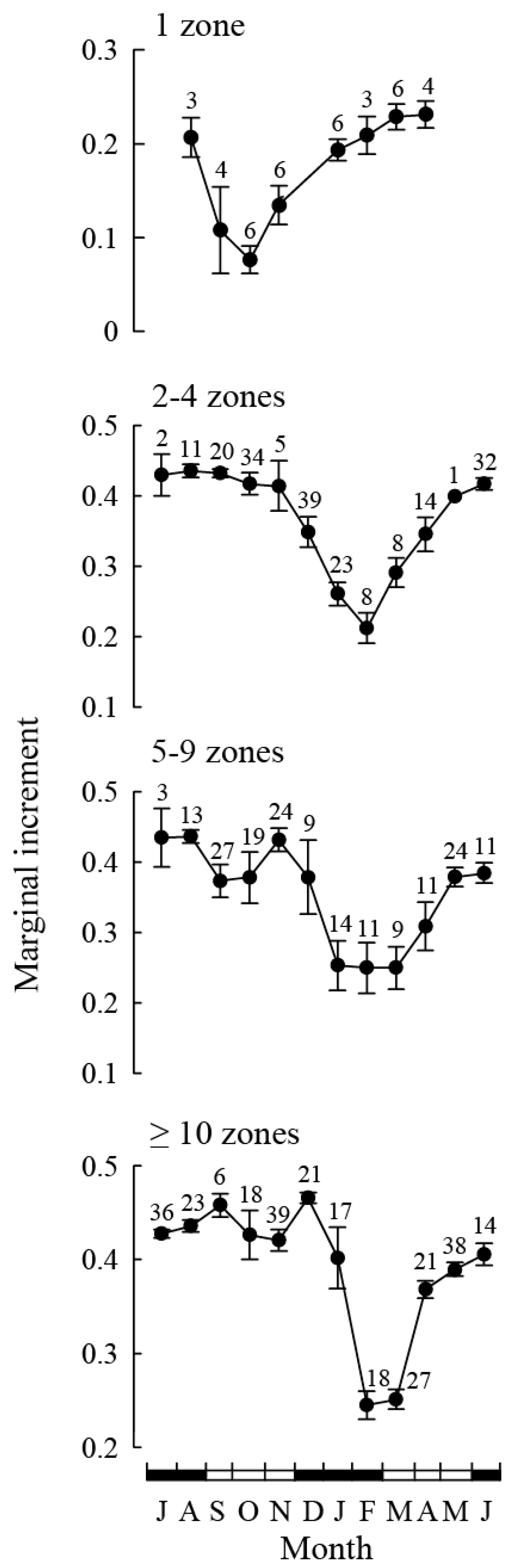
The mean monthly marginal increments (MIs) for otoliths of G. zebra with one opaque zone increased from 0.19 in January to elevated levels ≥ 0.21 in between February and April and in August before declining to 0.11, 0.08 and 0.13 in September, October and November, respectively, (Figure 2). The mean monthly MIs for otoliths with 2–4, 5–9 and ≥10 opaque zones all declined from high levels (≥0.41) in those months between June and November to minima ≤ 0.25 between January and March (Figure 2). The progressive rise in the mean monthly MI values followed by a single, sharp decline in those values after the outermost opaque zone has become fully formed indicates that a single opaque zone is formed in the otoliths each year, and the number of those zones can thus be used for ageing individuals of G. zebra.

3.2. Length and Age Composition, Growth and Mortality

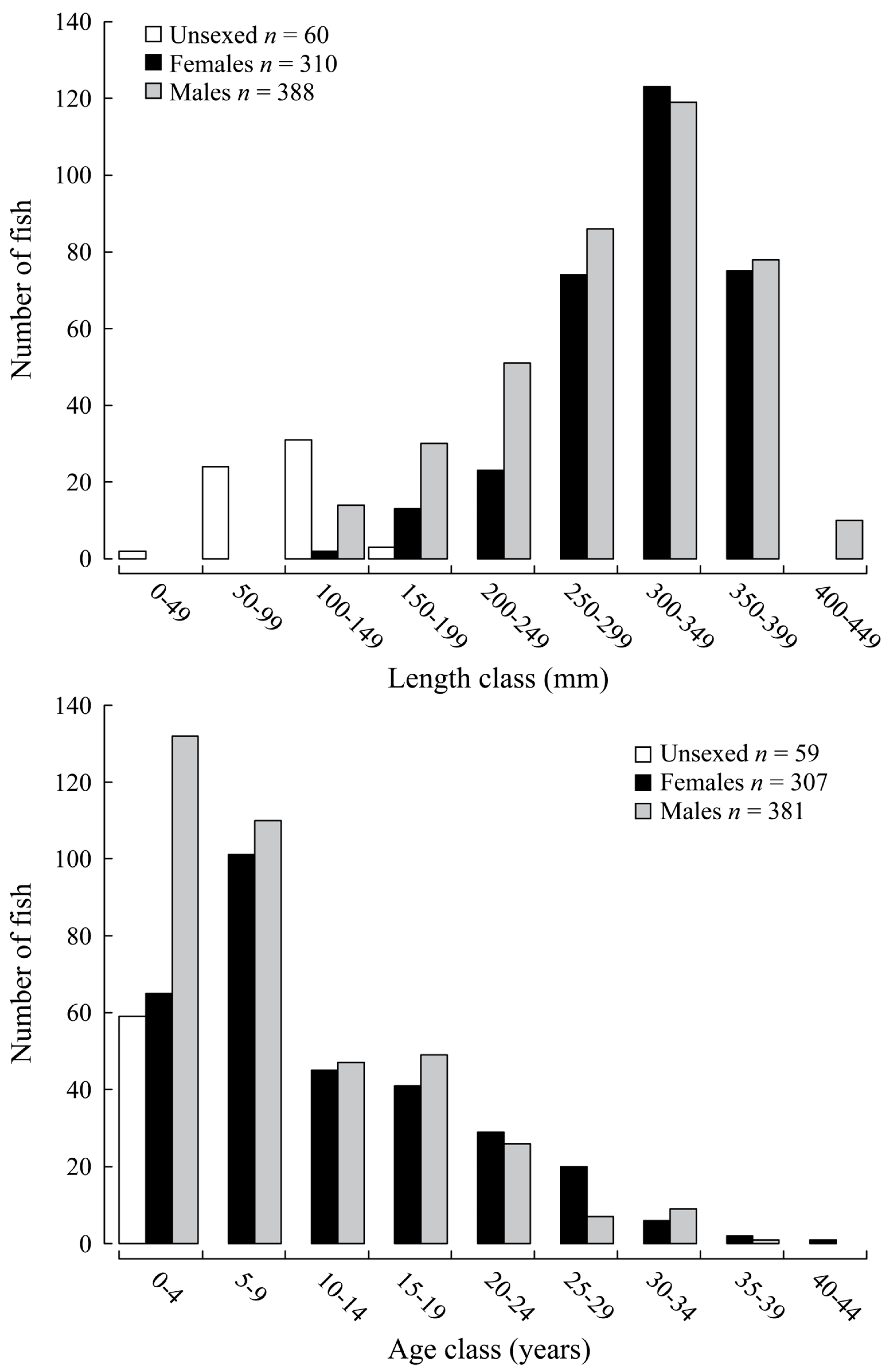
The TL of the smallest G. zebra collected was 30 mm, whose estimated age was 0.4 years. Female and male G. zebra ranged in TL from 140–399 mm and 102–431 mm, respectively, and the modal length class for both sexes was 300–349 mm (Figure 3). Female and male G. zebra ranged in age from 1.5–45.3 and 0.5–36.5 years, respectively, (Figure 3). K-S tests indicated that both the length and age distributions of female and male G. zebra were significantly different (both p < 0.01).
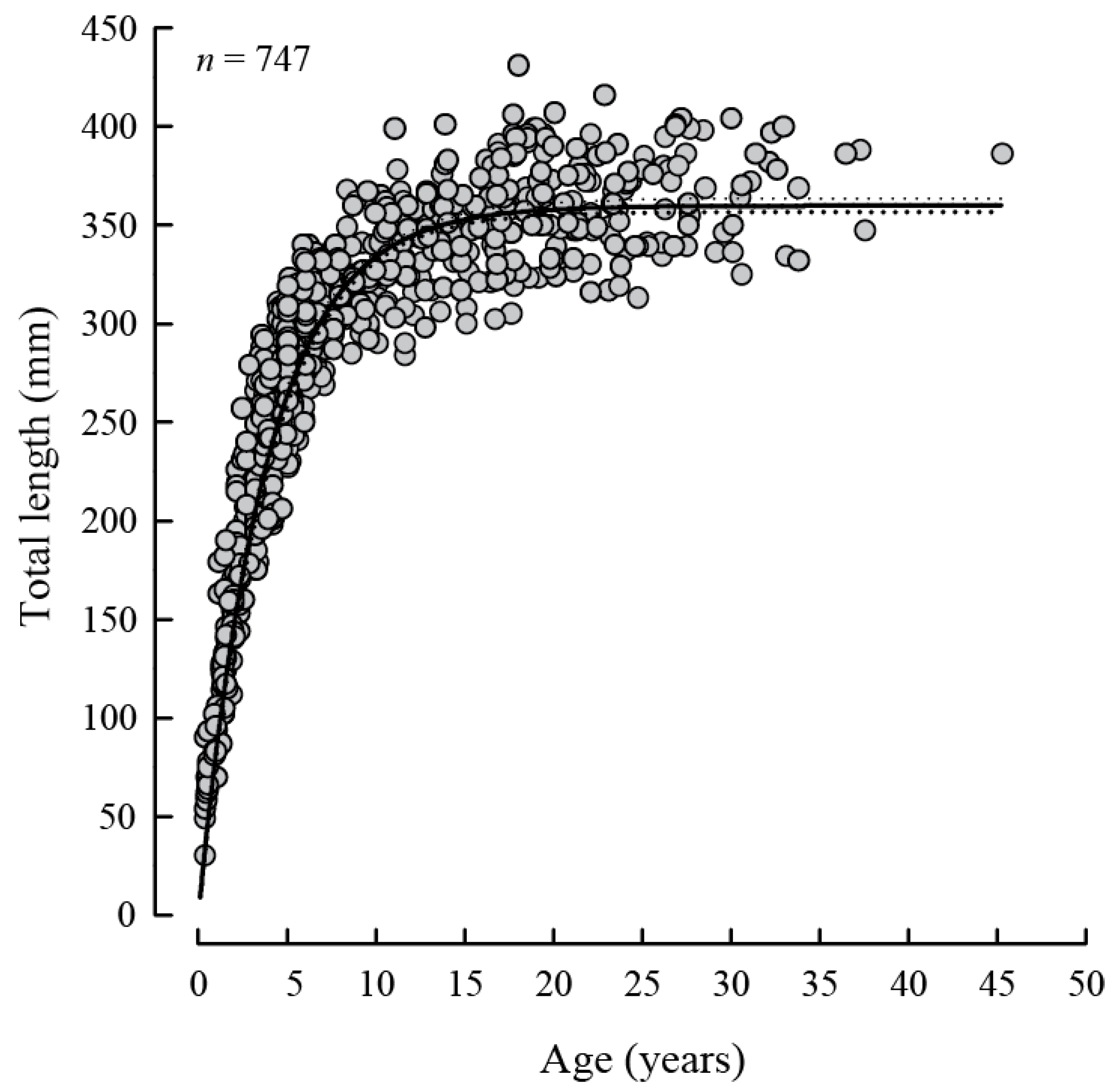
The von Bertalanffy growth curves (vBGC) for female and male G. zebra were significantly different (p < 0.01, test statistic = 5.8; DF = 3), with males, on average, attaining a larger size at age than their females. However, the difference in the TL at age of females and males between ages of 1 and 36 years, as determined from their vBGCs, was always <3%. As these differences are very small and vBGCs will almost inevitably tend to differ significantly when based on large sample sizes [28], the differences were assumed to be of little or no biological significance. Thus, the TLs at age for female and male G. zebra were combined to derive a single growth curve, with estimates of L = 360 mm, k = 0.26 years−1 and t0 = −0.35 years (Table 1; Figure 4). The vBGC provided an excellent fit to the TLs at age of G. zebra over the age range sampled, as demonstrated visually by the tight grouping of the majority of the length at age points around the vBGC, the constrained 95% confidence limits and the high r2 value (Figure 4; Table 1). Based on the vBGC, the estimated TLs attained at ages 2, 5, 10, 20 and 30 years were 147, 264, 334, 358 and 360 mm.
Natural mortality (M) estimates based on maximum ages of 44 and 36 years for female and male G. zebra, respectively, resulted in very similar values of 0.10 and 0.13 year−1, respectively, from the Quinn and Deriso [31] equation and 0.15 and 0.18 year−1, respectively, from the Hoenig [32] equation. While estimates of M for females and males using the Then et al. [33] equation were higher (0.15 and 0.18 year−1, respectively), those derived from the Hamel and Cope [34] equation were far higher (i.e., 0.22 and 0.26 year−1, respectively). The Alverson and Carney [35] method produce the lowest estimates of M of 0.07 and 0.08 year−1 for females and males, respectively, which were identical or very similar) to those estimates of total mortality (Z) obtained from catch curve analysis (i.e., 0.07 and 0.09 year−1 (both p < 0.001), respectively).

3.3. Evidence of Spawning Time and Duration

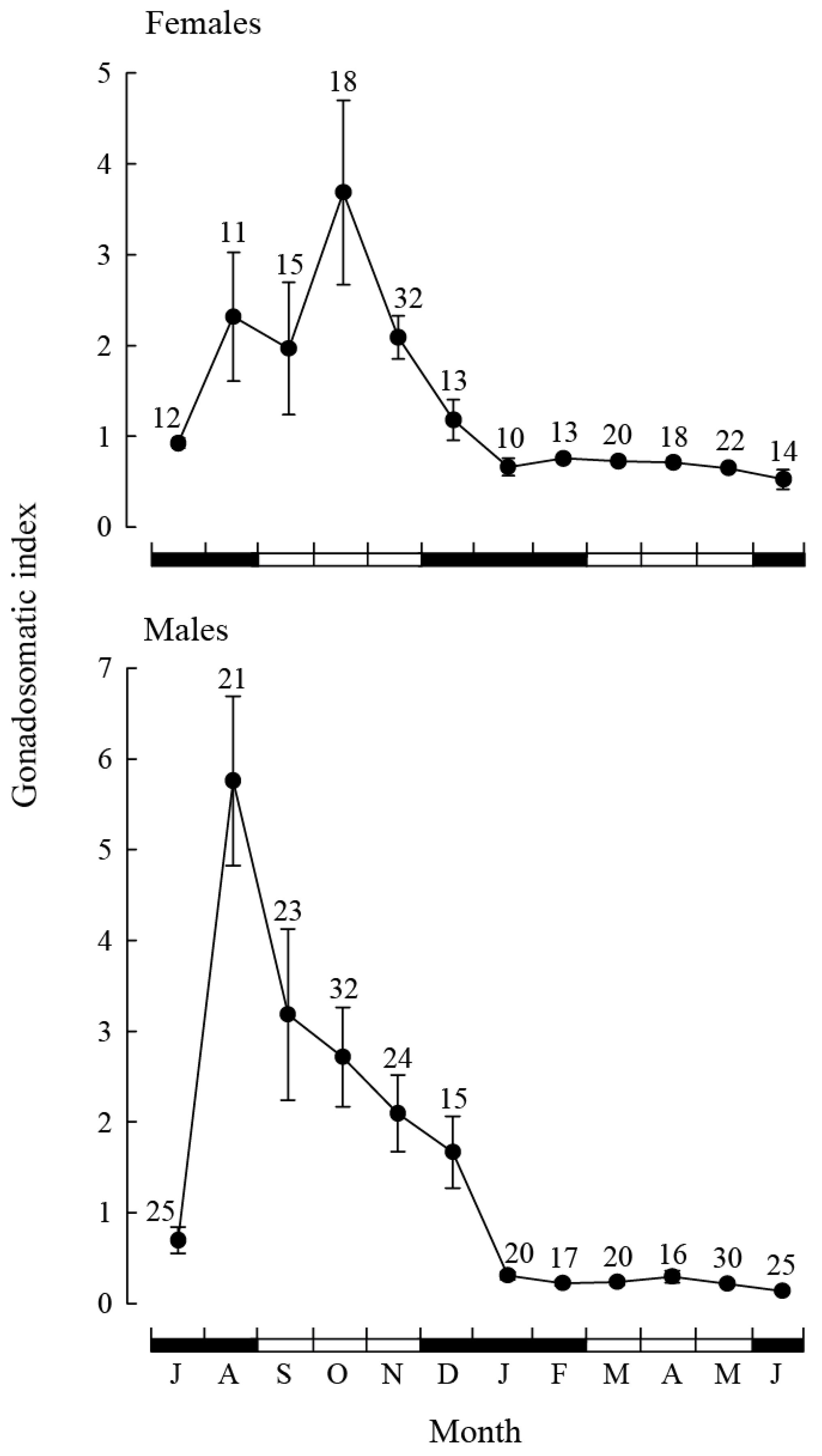
The mean monthly gonadosomatic index (GSI) for female G. zebra ≥ the estimated TL50 increased from 0.9 in July to a maximum of 3.7 in October, after which it declined to 0.7 in January and remained <0.8 through to June (Figure 5). Although the mean monthly GSI for male G. zebra ≥ their TL50 peaked earlier in August and attained a higher maximum (5.7), it was elevated over the same five-month period (i.e., August to December) as it was for females (Figure 5).
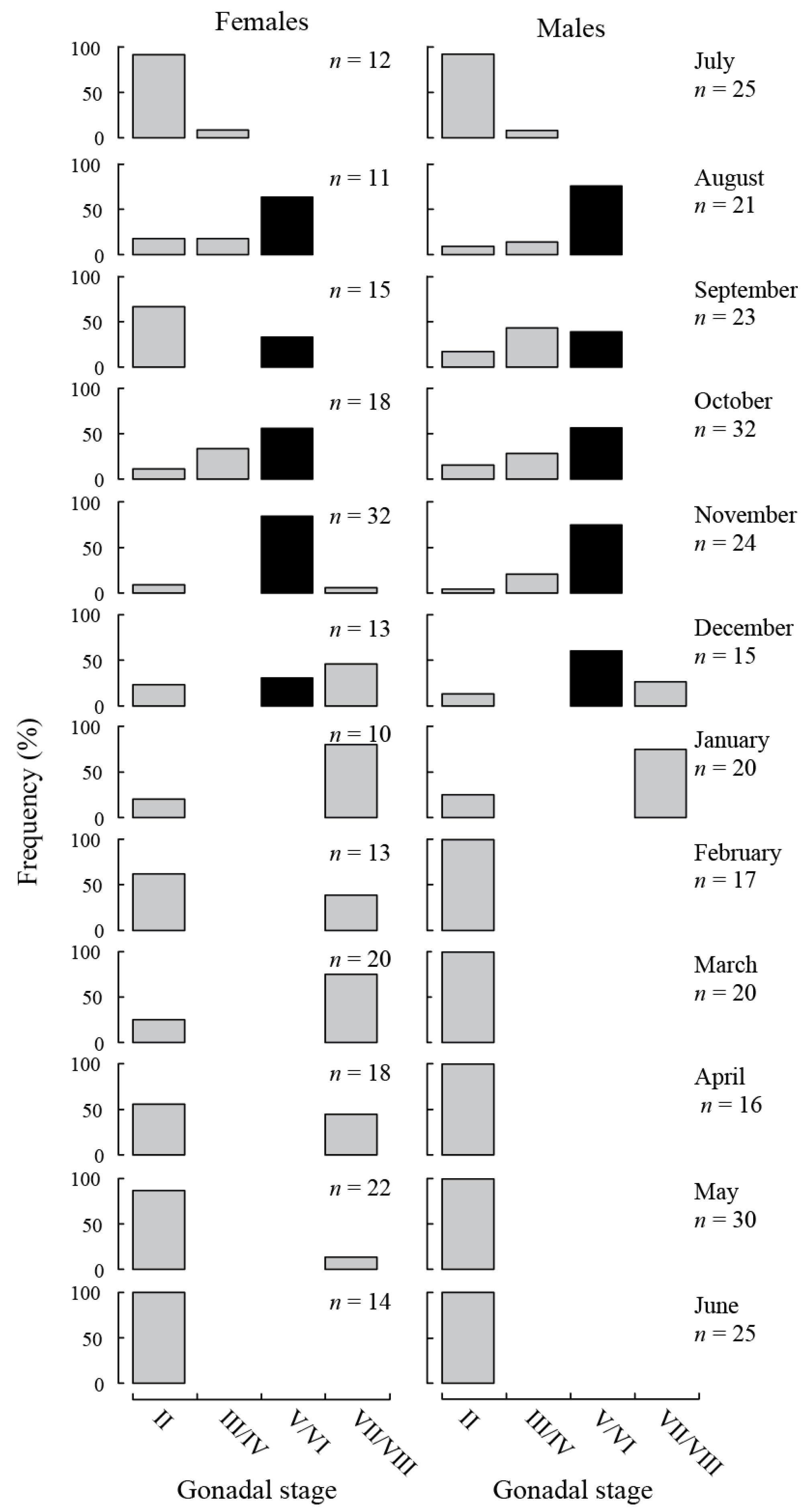
In July, female and male G. zebra ≥ their TL50s mostly possessed immature ovaries and testes (stage II), respectively, although a small proportion possessed maturing (stage III/IV) gonads (Figure 6). However, in August, the proportion of fish possessing stage II and stage III//IV gonads declined markedly, with a large proportion of fish possessing mature/spawning (stage V/VI) gonads. Although the prevalence of G. zebra with stage V/VI gonads declined in September, fish with such gonads were prevalent in each month to December (Figure 6). While a few females possessed spent (stage VII) ovaries in November, the prevalence of such females, and also males with stage VII testes, increased in December, and it was the most prevalent stage of gonad found in those fish caught in January. Female and male G. zebra with stage VII gonads were found in each month up to May and January, respectively.
The trends exhibited by the mean monthly GSIs for females and males and the months when females and males with gonads at stage V/VI were present demonstrate that G. zebra spawns between August (late winter) and December (early summer). As October 1st represents the approximate mid-point of the spawning period, it was chosen as the birth date for G. zebra.

3.4. Lengths and Ages at Maturity

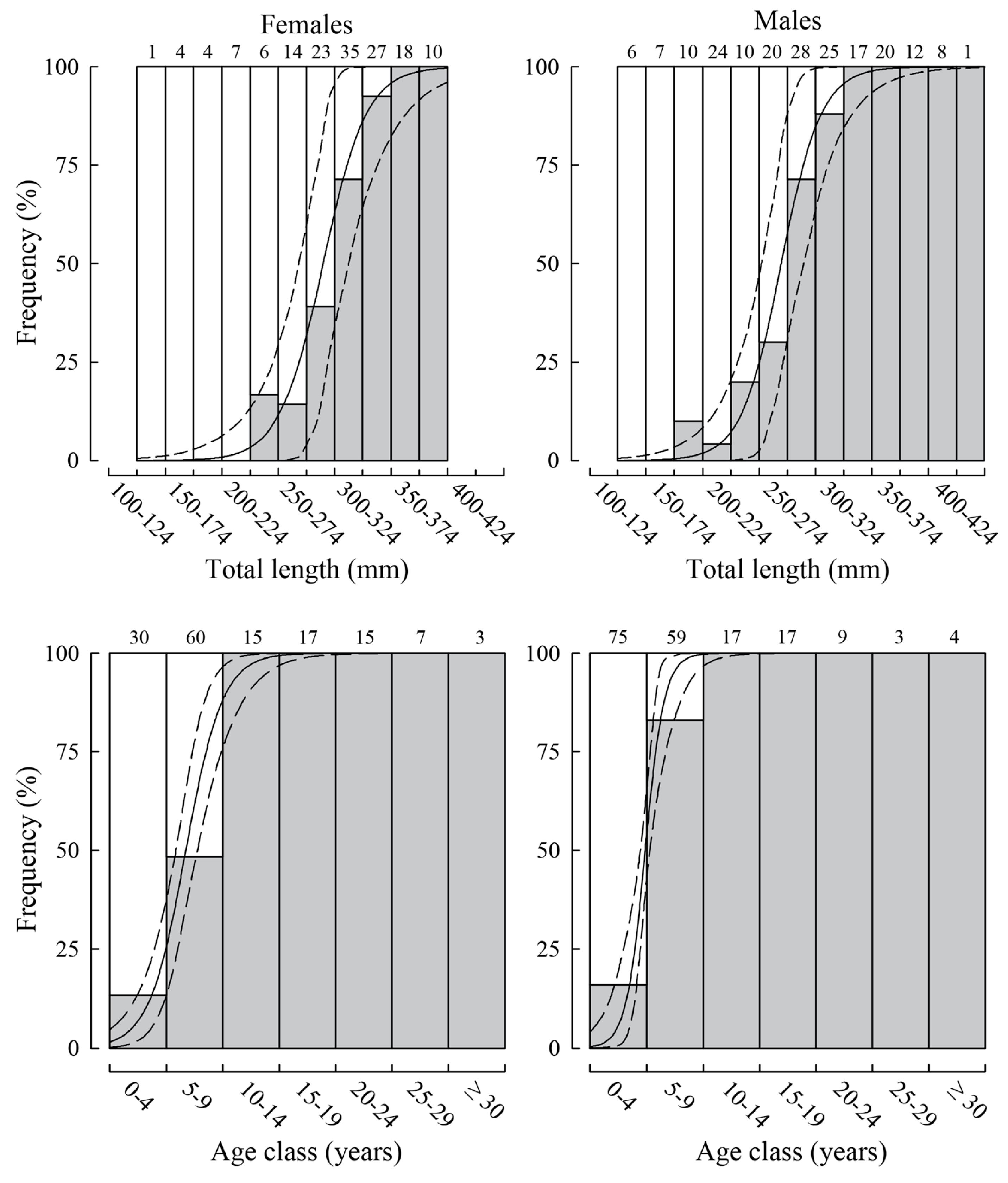
All female and male G. zebra < 225 and <175 mm, respectively, caught during the spawning period were immature. The prevalence of mature females increased to 17 and 92% in the 225–249 and 325–349 mm TL classes, with all females ≥ 350 mm being mature (Figure 7). The prevalence of mature males increased with increasing length class, from 10% of fish in the 175–199 mm class to 88% in the 300–324 mm class. All male G. zebra ≥ 325 mm were mature (Figure 7). The likelihood ratio test demonstrated that the estimated TL50s for female and male G. zebra were significantly different (p < 0.001, test statistic = 6.0; DF = 2). The TL50s for females and males were 290 and 269 mm, respectively, and the estimated TL95s were 346 and 322 mm, respectively, (Table 2).
During the spawning period, only 13 and 16% of female and male G. zebra < 5 years old possessed mature gonads, respectively. The prevalence of females and males with such gonads increased to 48% and 83% in the 5–9-year age class, respectively, with all fish of both sexes ≥ 10 years being mature (Figure 7). The likelihood ratio test demonstrated that the A50s for female and male G. zebra were significantly different (p < 0.001). The A50s for female and males were 6.7 and 4.9 years, respectively, and the A95s were 11.5 and 7.4 years, respectively, (Table 2).

4. Discussion

4.1. Age, Growth and Mortality

Understanding when the first growth zone is formed in the otoliths is a vital step in fish ageing. However, in many studies this step is often not achievable due to the difficulty in not only obtaining samples of very small, young fish, e.g., [38], but also obtaining samples of such individuals at regular intervals throughout the year to observe changes in otolith microstructure. In those cases, however, where the juveniles of a species use shallow, accessible waters that can be sampled on a regular basis, or are caught in commercial fisheries throughout the year, it is possible to demonstrate the formation of the first growth zone, e.g., [21,39]. The use of shallow rockpools as nursery areas by G. zebra allowed for samples of new recruits to be collected easily and for their otoliths to be used to establish when the first growth zone is formed in those otoliths. The formation of the first growth zone in the otoliths of G. zebra at the end of the first full spring of life when fish are ∼1 year old parallels that of another kyphosid S. aequippinis in the same region [9]. The completion of the opaque growth zone at that time of year is consistent with increasing in water temperature during spring (see Figure 1 in Coulson et al. [9]) and thus the commencement of the new translucent zone.
As G. zebra is not targeted by recreational or commercial fishers, the maximum age of 44 years is suggested to be a true reflection of this species’ longevity. This maximum age is nearly identical to that of G. elevata [24] (i.e., 45 years), which inhabits rocky reefs and is taken in small quantities by recreational anglers and spear fishers [40]. For example, G. elevata has historically constituted as little as 9% of catches at spearfishing competitions [41]. While G. tricuspidata occurs along the same coast in south-eastern Australia as another girellid, G. elevata, the former species inhabits shallow coastal lagoons and estuaries, where they are caught in large numbers by commercial fishers using gillnets and beach seines [8]. Therefore, the far lower known maximum age (26 years) for G. tricuspidata likely reflects the long history of exploitation of this species, as indicated by the heavily truncated age composition of commercial catches, with very few individuals > 10 years of age [8]. The example of G. tricuspidata, demonstrates the vulnerability of kyphosids to capture due to the schooling nature when spawning and/or migrating [6,8].
The extended lifespan exhibited by G. zebra, and indeed G. elevata, is consistent with that of other kyphosid species, including K. bigibbus, S. lineolatus, S. aequippinis and K. sydneyanus, that have maximum ages of 46, 54, 68 and 93 years, respectively, [7,9,18,19]. In G. zebra, as is also the case in other kyphosids K. bigibbus, S. lineolatus and S. aequippinis, and other species in southern Australian waters, e.g., [38,42,43,44], longevity is also accompanied by a “square” form of growth [25]. This form occurs when a large portion of growth is undertaken in the first 5–8 years of life, after which little growth occurs throughout their extended adult lives. Such a life history strategy implies that there have been strong selection pressures to rapidly achieve maturity at a relatively large body size and young age, indicating susceptibility to mortality from extreme predation or limited resources (food) during early life [9,45]. A “square” form of growth adopted by some species is proposed to lead to the accumulation of multiple similarly sized adult cohorts, enabling the retention of individuals within stable, low-turnover populations that persist in nutrient-sparse environments [25]. It is thus relevant that coastal waters off the south coast of Western Australia, and indeed the west coast of that state, are known to be oligotrophic as a result of the poleward-flowing Leeuwin Current, the dominant oceanographic feature that delivers warm, low-nutrient water from tropical regions to temperate regions further south [46,47].
In the case of G. zebra, as there is no fishing-induced mortality, estimates of natural mortality (M) essentially represent total mortality (Z). Four widely used equations employed to provide point estimates for M, built using published data for fished stocks, were far higher than the catch curve-based Z estimate, indicating, as expected, that G. zebra has better survival than the average fish species. However, the M estimate from the Alverson–Carney [35] method was remarkably similar to Z. Since the Alverson–Carney [35] method relies on observed longevity and assumes a consistent ratio between age at maximum biomass and maximum age, it tends to produce realistic mortality estimates when age structure reflects natural conditions. In contrast, other methods such as Hoenig [32], Then et al. [33] and Hamel and Cope [34], based on data for heavily fished stocks, may overestimate the value of M for unfished or lightly fished populations. It is thus recommended that the Alverson–Carney [35] equations provide a better estimate of M for pristine or baseline scenarios.

4.2. Spawning

The trends in the mean monthly GSIs and monthly percentage frequencies of occurrence of sequential gonadal stages demonstrate that G. zebra spawns between August (late winter) and December (early summer). The commencement of spawning by G. zebra in late winter coincides with water temperatures being at close to their minima, but also when day length is starting to increase (see Figure 1 in [9]). This strategy is consistent with those of temperate species whose spawning activity is stimulated by long photoperiods and increasing water temperatures [48]. The spawning period of G. zebra is similar to many other temperate species in south-western Australia, including Pentaceros recurvirostris [38], Neosebastes pandus [49], Othos dentex [50], Chrysophrys auratus [51], Achoerodus gouldii [52] and Bodianus frenchii [53]. The timing of the spawning period of G. zebra at ~35° S on the south coast of Western Australia is also similar to that of G. tricuspidata in the Tuross River, which is located at a similar latitude (i.e., ~36° S) on the south-east coast of the continent [17], but earlier than G. elevata, which spawns between late November and mid-January [54].
The comparative size of the gonads of females and males of dioecious, broadcast spawning fish species provide an indication of the reproductive mode expressed by that species. For example, the disparity in gonad size of the females and males of the three pentacerotid species is thought to be associated with spawning in pairs, or at least spawning in small groups [38]. While spawning in Glaucosoma hebraicum is thought to be socially controlled and males compete directly for spawning opportunities [55], spawning events also occur in pairs or small groups, negating the need for big gonads and large quantities of sperm. The mean monthly gonadosomatic indices of female and male Chirodactylus spectabilis indicate a similar scenario, which was confirmed by visual observations [56]. In contrast, the equally large size of the gonads of males and females of C. auratus is likely driven by competition when spawning in large aggregations, as has been confirmed in several marine embayments [51,57,58]. The similar size of the gonads of female and male G. zebra suggests that this species spawns in schools or large groups, which is consistent with their observed schooling nature [6]. This is also likely to be the case for congeners G. tricuspidata and G. elevata, whose males also possess gonads of a similar size, or larger, than that of their females during the spawning period [17,54].

5. Conclusions

Populations of almost all targeted fish species display some effect of fishing. There are several instances where the size at sex change in hermaphroditic species has declined due to sustained fishing pressure on fish populations, e.g., [59,60]. But perhaps the most obvious sign of fishing pressure is the truncation of the length and age structure, e.g., [8,61,62,63] and changes in growth, e.g., [64]. The biological data collected for G. zebra in this study provides the opportunity to observe the biological characteristics of a fish population in its virgin state, providing an unfished baseline for the biological characteristics of girellids and kyphosids, more broadly, but also for temperate, moderately long-lived reef fishes in general.

Funding

This research was funded by Murdoch University.

Institutional Review Board Statement

Samples were collected under the Murdoch University animal ethics permit R2535/12 (Approval Date: 23 June 2024) and Western Australian Department of Fisheries exemption permit 2525.

Data Availability Statement

The raw data supporting the conclusions of this article will be made available by the authors on request.

Acknowledgments

I would like to thank M. Taylor, J. Poad, D. Yeoh, D. Maschette and T. Bateman for their generous assistance in collecting samples and E. Ashworth for reading a subsample of otoliths. Comments made by N. Loneragan on an earlier draft were greatly appreciated, as was discussion on mortality results with R. Sharples.

Conflicts of Interest

The author declare no conflicts of interest. The funders had no role in the design of the study; in the collection, analyses, or interpretation of data; in the writing of the manuscript; or in the decision to publish the results.

Abbreviations

The following abbreviations are used in this manuscript:
TLTotal length
GSIGonadosomatic indices
vBGCvon Bertalanffy growth curves
CVcoefficient of variation
MNatural mortality
ZTotal mortality
MImarginal increments

References

  1. Hutchins, B.; Swainston, R. Sea Fishes of Southern Australia; Swainston Publishing: New South Wales, Australia, 1986; p. 180. [Google Scholar]
  2. Bray, D.J. Kyphosus vaigiensis in Fishes of Australia. 2018. Available online: https://fishesofaustralia.net.au/home/genus/751 (accessed on 4 January 2024).
  3. Yagishita, N.; Nakabo, T. Revision of the genus Girella (Girellidae) from East Asia. Ichthyol. Res. 2000, 47, 119–135. [Google Scholar] [CrossRef]
  4. Nelson, J.S.; Grande, T.C.; Wilson, M.V.H. Fishes of the World, 5th ed.; John Wiley: Hoboken, NJ, USA, 2016; p. 651. [Google Scholar]
  5. Swainston, R. Swainston’s Fishes of Australia: The Complete Illustrated Guide; Penguin Australia Pty Ltd.: Melbourne, Australia, 2020; p. 832. [Google Scholar]
  6. Shepherd, S.; Edgar, G. (Eds.) Chapter 16: Bottom-feeding fishes. In Ecology of Australian Temperate Reefs: The Unique South; CSIRO Publishing: Collingwood, Australia, 2013; pp. 395–418. [Google Scholar]
  7. Stewart, J.; Hughes, J.M. Longevity, growth, reproduction and a description of the fishery for silver sweep Scorpis lineolatus off New South Wales, Australia. N. Z. Mar. Freshw. Res. 2005, 39, 827–838. [Google Scholar] [CrossRef]
  8. Gray, C.A.; Ives, M.C.; Macbeth, W.G.; Kendall, B.W. Variation in growth, mortality, length and age compositions of harvested populations of the herbivorous fish Girella tricuspidata. J. Fish Biol. 2010, 76, 880–899. [Google Scholar] [CrossRef]
  9. Coulson, P.G.; Potter, I.C.; Hall, N.G. The biological characteristics of Scorpis aequipinnis (Kyphosidae), including relevant comparisons with those of other species and particularly of a heavily exploited congener. Fish. Res. 2012, 125, 272–282. [Google Scholar] [CrossRef]
  10. Clements, K.D.; Choat, J.H. Comparison of herbivory in the closely-related marine fish genera Girella and Kyphosus. Mar. Biol. 1997, 127, 579–586. [Google Scholar] [CrossRef]
  11. Jones, G. Herbivorous fishes. In Under Southern Seas: The Ecology of Australia’s Rocky Reefs; Andrew, N., Ed.; UNSW Press: Sydney, Australia, 1999; pp. 202–209. [Google Scholar]
  12. Ferguson, A.M.; Harvey, E.S.; Knott, N.A. Herbivore abundance, grazing rates and feeding pathways on Australian temperate reefs inside and outside marine reserves: How are things on the west coast? J. Exp. Mar. Biol. Ecol. 2017, 493, 49–56. [Google Scholar] [CrossRef]
  13. Russell, B.C. Population and standing crop estimates for rocky reef fishes of North-Eastern New Zealand. N. Z. Mar. Freshw. Res. 1977, 11, 23–36. [Google Scholar] [CrossRef]
  14. Jones, G.P. Ecology of rocky reef fish of north-eastern New Zealand: A review. N. Z. Mar. Freshw. Res. 1998, 22, 445–462. [Google Scholar] [CrossRef]
  15. Kingsford, M. The distribution patterns of exploited girellid, kyphosid and sparid fishes on temperate rocky reefs in New South Wales, Australia. Fish. Sci. 2002, 68, 131–134. [Google Scholar] [CrossRef]
  16. Bennett, S.; Wernberg, T.; Harvey, E.S.; Santana-Garcon, J.; Saunders, B.J. Tropical herbivores provide resilience to a climate-mediated phase shift on temperate reefs. Ecol. Lett. 2015, 18, 714–723. [Google Scholar] [CrossRef]
  17. Gray, C.A.; Haddy, J.A.; Fearman, J.; Barnes, L.M.; Macbeth, W.G.; Kendall, B.W. Reproduction, growth and connectivity among populations of Girella tricuspidata (Pisces: Girellidae). Aquat. Biol. 2012, 16, 53–68. [Google Scholar] [CrossRef]
  18. Ogino, Y.; Furumitsu, K.; Kiriyama, T.; Yamaguchi, A. Using optimised otolith sectioning to determine the age, growth and age at sexual maturity of the herbivorous fish Kyphosus bigibbus: With a comparison to using scales. Mar. Freshw. Res 2019, 71, 855–867. [Google Scholar] [CrossRef]
  19. Coulson, P.G. The age estimation of an extremely old Silver Drummer Kyphosus sydneyanus (Günther 1886) from southern Western Australia. Pac. Conserv. Biol. 2023, 29, 456–460. [Google Scholar] [CrossRef]
  20. Barnett, L.A.; Branch, T.A.; Ranasinghe, R.A.; Essington, T.E. Old-growth fishes become scarce under fishing. Curr. Biol. 2017, 27, 2843–2848. [Google Scholar] [CrossRef]
  21. Coulson, P.G. The life-history of Cheilodactylus rubrolabiatus from south-western Australia and comparison of biological characteristics of the Cheilodactylidae and Latridae: Support for an amalgamation of families. J. Fish Biol. 2019, 94, 374–390. [Google Scholar] [CrossRef]
  22. Trip, E.D.L.; Raubenheimer, D.; Clements, K.D.; Choat, J.H. Reproductive demography of a temperate protogynous and herbivorous fish, Odax pullus (Labridae, Odacini). Mar. Freshwat. Res. 2011, 62, 176–186. [Google Scholar] [CrossRef]
  23. Lewis, M.A. The Life History and Ecology of Bluefish, Girella cyanea, at Lord Howe Island. Master’s Thesis, University of Technology Sydney, Sydney, Australia, 2012. [Google Scholar]
  24. Stocks, J.R.; Gray, C.A.; Taylor, M.D. Synchrony and variation across latitudinal gradients: The role of climate and oceanographic processes in the growth of a herbivorous fish. J. Sea Res. 2014, 90, 23–32. [Google Scholar] [CrossRef]
  25. Prince, J.D.; Wilcox, C.; Hall, N. How to estimate life history ratios to simplify data-poor fisheries assessment. ICES J. Mar. Sci. 2023, 80, 2619–2629. [Google Scholar] [CrossRef]
  26. Bray, D.J. Girella zebra in Fishes of Australia. 2023. Available online: https://fishesofaustralia.net.au/home/species/470 (accessed on 5 April 2025).
  27. Chang, W.Y.B. A statistical method for evaluating the reproducibility of age determination. Can. J. Fish. Aquat. Sci. 1982, 39, 1208–1210. [Google Scholar] [CrossRef]
  28. Campana, S.E. Accuracy, precision and quality control in age determination, including a review of the use and abuse of age validation methods. J. Fish Biol. 2001, 59, 197–242. [Google Scholar] [CrossRef]
  29. R Core Team. R: A Language and Environment for Statistical Computing; R Foundation for Statistical Computing: Vienna, Austria, 2024; Available online: https://www.R-project.org/ (accessed on 6 June 2024).
  30. Cerrato, R.M. Interpretable statistical tests for growth comparisons using parameters in the von Bertalanffy equation. Can. J. Fish. Aquat. Sci. 1990, 47, 1416–1426. [Google Scholar] [CrossRef]
  31. Quinn, T.J.; Deriso, R.B. Quantitative Fish Dynamics; Oxford University Press: New York, NY, USA, 1999; p. 517. [Google Scholar]
  32. Hoenig, J.M. Empirical use of longevity data to estimate mortality. Fish. Bull. 1983, 82, 898–903. [Google Scholar]
  33. Then, A.Y.; Hoenig, J.M.; Hall, N.G.; Hewitt, D.A. Evaluating empirical estimators of natural mortality. ICES J. Mar. Sci. 2015, 72, 82–92. [Google Scholar] [CrossRef]
  34. Hamel, O.S.; Cope, J.M. Development and considerations for application of a longevity-based prior for the natural mortality rate. Fish. Res. 2022, 256, 106477. [Google Scholar] [CrossRef]
  35. Alverson, D.L.; Carney, M.J. A graphic review of the growth and decay of population cohorts. J. Cons. Int. Explor. Mer. 1975, 36, 133–143. [Google Scholar] [CrossRef]
  36. Ricker, W.E. Computation and interpretation of biological statistics of fish populations. Bull. Fish. Res. Board Can. 1975, 191, 1–382. [Google Scholar]
  37. Laevastu, T. Manual of Methods in Fisheries Biology; Food and Agriculture Organization of the United Nations: Rome, Italy, 1965. [Google Scholar]
  38. Coulson, P.G.; Hall, N.G.; Potter, I.C. Biological characteristics of three co-occurring species of armorhead from different genera vary markedly from previous results for the Pentacerotidae. J. Fish Biol. 2016, 89, 1393–1418. [Google Scholar] [CrossRef]
  39. Fairclough, D.V.; Dimmlich, W.F.; Potter, I.C. Length and age compositions and growth rates of the Australian herring Arripis georgiana in different regions. Mar. Freshw. Res 2000, 51, 631–640. [Google Scholar] [CrossRef]
  40. Kingsford, M.J.; Underwood, A.J.; Kennelly, S.J. Humans as predators on rocky reefs in New South Wales, Australia. Mar. Ecol. Prog. Ser. 1991, 72, 1–14. [Google Scholar] [CrossRef]
  41. Smith, M.L.; Bell, J.D.; Pollard, D.A.; Russell, B.C. Catch and effort of competition spearfishermen in southeastern Australia. Fish. Res. 1989, 8, 45–61. [Google Scholar] [CrossRef]
  42. Tzioumis, V.; Kingsford, M.J. Reproductive biology and growth of the temperate damselfish Parma microlepis. Copeia 1999, 1999, 348–361. [Google Scholar] [CrossRef]
  43. Jordan, A.R. Age, growth and spatial and interannual trends in age composition of jackass morwong, Nemadactylus macropterus, in Tasmania. Mar. Freshw. Res. 2001, 52, 641–660. [Google Scholar] [CrossRef]
  44. Ewing, G.P.; Lyle, J.M.; Murphy, R.J.; Kalish, J.M.; Ziegler, P.E. Validation of age and growth in a long-lived temperate reef fish using otolith structure, oxytetracycline and bomb radiocarbon methods. Mar. Freshw. Res. 2007, 58, 944–955. [Google Scholar] [CrossRef]
  45. Le Pape, O.; Bonhommeau, S. The food limitation hypothesis for juvenile marine fish. Fish Fish. 2015, 16, 373–398. [Google Scholar] [CrossRef]
  46. Caputi, N.; Fletcher, W.J.; Pearce, A.; Chubb, C.F. Effect of the Leeuwin Current on the recruitment of fish and invertebrates along the Western Australian coast. Mar. Freshw. Res. 1996, 47, 147–155. [Google Scholar] [CrossRef]
  47. Molony, B.W.; Newman, S.J.; Loll, L.; Lenanton, R.C.J.; Wise, B. Are Western Australian waters the least productive waters for finfish across two oceans? A review with a focus on finfish resources in the Kimberley region and North Coast Bioregion. J. R. Soc. West. Aust. 2011, 94, 323–332. [Google Scholar]
  48. Lam, T.M. Fish Physiology: Environmental Influences on Gonadal Activity in Fish; Hoar, W.S., Randall, D.J., Eds.; Academic Press: London, UK, 1983; pp. 65–116. [Google Scholar]
  49. Coulson, P.G. The life history characteristics of Neosebastes pandus and the relationship between sexually dimorphic growth and reproductive strategy among Scorpaeniformes. J. Fish Biol. 2021, 98, 50–63. [Google Scholar] [CrossRef]
  50. French, B.; Potter, I.C.; Hesp, S.A.; Coulson, P.G.; Hall, N.G. Biology of the harlequin fish Othos dentex (Serranidae), with particular emphasis on sexual pattern and other reproductive characteristics. J. Fish Biol. 2014, 84, 106–132. [Google Scholar] [CrossRef]
  51. Wakefield, C.B.; Potter, I.C.; Hall, N.G.; Lenanton, R.C.J.; Hesp, S.A. Marked variations in reproductive characteristics of snapper (Chrysophrys auratus, Sparidae) and their relationship with temperature over a wide latitudinal range. ICES J. Mar. Sci. 2015, 72, 2341–2349. [Google Scholar] [CrossRef]
  52. Coulson, P.G.; Hesp, S.A.; Hall, N.G.; Potter, I.C. The western blue groper (Achoerodus gouldii), a protogynous hermaphroditic labrid with exceptional longevity, late maturity, slow growth, and both late maturation and sex change. Fish. Bull. 2009, 107, 57–75. [Google Scholar]
  53. Cossington, S.; Hesp, S.A.; Hall, N.G.; Potter, I.C. Growth and reproductive biology of the foxfish Bodianus frenchii, a very long-lived and monandric protogynous hermaphroditic labrid. J. Fish Biol. 2010, 77, 600–626. [Google Scholar] [CrossRef] [PubMed]
  54. Stocks, J.R.; Gray, C.A.; Taylor, M.D. Intra-population trends in the maturation and reproduction of a temperate marine herbivore Girella elevata across latitudinal clines. J. Fish Biol. 2015, 86, 463–483. [Google Scholar] [CrossRef] [PubMed]
  55. Lenanton, R.; StJohn, J.; Keay, I.; Wakefield, C.; Jackson, G.; Wise, B.; Gaughan, D. Fisheries Research Report No. 174. Spatial Scales of Exploitation Among Populations of Demersal Scalefish: Implications for Management, Part 2: Stock Structure and Biology of Two Indicator Species, West Australian Dhufish (Glaucosoma hebraicum) and Pink Snapper (Pagrus auratus), in the West Coast Bioregion; Fisheries Research and Development Corporation on Project Number 2003/052, Final Report; Department of Fisheries: Perth, Australia, 2009; p. 189.
  56. McCormick, M.I. Reproductive ecology of the temperature reef fish Cheilodactylus spectabilis (Pisces: Cheilodactylidae). Mar. Ecol. Prog. Ser. 1989, 55, 113–120. [Google Scholar] [CrossRef]
  57. Jackson, G.; Norriss, J.V.; Mackie, M.C.; Hall, N.G. Spatial variation in life history characteristics of snapper (Pagrus auratus) within Shark Bay, Western Australia. N. Z. J. Mar. Freshw. Res. 2010, 44, 1–15. [Google Scholar] [CrossRef]
  58. Wakefield, C.B. Annual, lunar and diel reproductive periodicity of a spawning aggregation of snapper Pagrus auratus (Sparidae) in a marine embayment on the lower west coast of Australia. J. Fish Biol. 2010, 77, 1359–1378. [Google Scholar] [CrossRef]
  59. Platten, J.R.; Tibbetts, I.R.; Sheaves, M.J. The influence of increased line-fishing mortality on the sex ratio and age of sex reversal of the venus tusk fish. J. Fish Biol. 2002, 60, 301–318. [Google Scholar] [CrossRef]
  60. Hamilton, S.L.; Caselle, J.E.; Standish, J.D.; Schroeder, D.M.; Love, M.S.; Rosales-Casian, J.A.; Sosa-Nishizaki, O. Size-selective harvesting alters life histories of a temperate sex-changing fish. Ecol. Appl. 2007, 17, 2268–2280. [Google Scholar] [CrossRef]
  61. Krueck, N.; Marshell, A.; Coulson, P.G.; Sharples, R.; Cresswell, K.; Tracey, S. Southern Sand Flathead Assessment 2023; Institute for Marine and Antarctic Studies, University of Tasmania: Hobart, Australia, 2023; p. 31. [Google Scholar]
  62. Chong-Montenegro, C.; Craig, M.T.; Castellanos-Galindo, G.A.; Erisman, B.; Coulson, P.G.; Krumme, U.; Baos, R.; Zapata, L.; Vega, A.; Robertson, D.R. Age and growth of the Pacific goliath grouper (Epinephelus quinquefasciatus), the largest bony reef fish of the Tropical Eastern Pacific. J. Fish Biol. 2025, 107, 1045–1050. [Google Scholar] [CrossRef]
  63. Stewart, J. Evidence of age-class truncation in some exploited marine fish populations in New South Wales, Australia. Fish. Res. 2011, 108, 209–213. [Google Scholar] [CrossRef]
  64. Moore, B.R.; Simpfendorfer, C.A.; Newman, S.J.; Stapley, J.M.; Allsop, Q.; Sellin, M.J.; Welch, D.J. Spatial variation in life history reveals insight into connectivity and geographic population structure of a tropical estuarine teleost: King threadfin, Polydactylus macrochir. Fish. Res. 2012, 125, 214–224. [Google Scholar] [CrossRef]
Figure 1. The sectioned otoliths of four individual Girella zebra with 0, 1, 6 and 17 opaque zones (O). Scale bars 0.5 mm.
Fishes 11 00024 g001
Figure 2. Monthly marginal increments (mean ± 1 SE) on sectioned sagittal otoliths of Girella zebra with different numbers of opaque zones. Sample sizes are given above each mean. On the x-axis, closed rectangles refer to summer and winter months and the open rectangles to autumn and spring months.
Fishes 11 00024 g002
Figure 3. Length frequency and age frequency distributions for unsexed, female and male Girella zebra on the south coast of Western Australia. n = sample size.
Fishes 11 00024 g003
Figure 4. Von Bertalanffy growth curve (solid line), and its 95% confidence limits (dotted lines), fitted to the total lengths at age of female and male (combined) Girella zebra from the south coast of Western Australia. n = sample size.
Fishes 11 00024 g004
Figure 5. Monthly gonadosomatic indices (±SE) of female and male Girella zebra, ≥respective lengths at 50% maturity (TL50), on the south coast of Western Australia. Sample sizes are given above each month.
Fishes 11 00024 g005
Figure 6. Monthly percentage frequencies of occurrence of sequential stages in the gonadal development for female and male Girella zebra, ≥ their respective length at 50% maturity on the south coast of Western Australia. Black bars highlight values for fish with gonads at stages V/VI. n = sample size.
Fishes 11 00024 g006
Figure 7. Percentage frequencies of occurrence of female and male Girella zebra with immature (stages I–II) gonads (white histograms) and mature (stages III–VIII) gonads (grey histograms) in sequential 25 mm length classes and 5-year age classes in samples obtained during the spawning period, i.e., August to December. Logistic curves (solid lines) and their 95% confidence limits (dashed lines) were derived from the probability that a fish at a given length or age is mature. Sample sizes for each length and age class are shown above each column.
Fishes 11 00024 g007
Table 1. Estimates of the von Bertalanffy growth curve parameters TL, k and t0, and their upper and lower 95% confidence limits for Girella zebra derived from the lengths at age of all individuals collected during the present study. r2 = coefficient of determination; n = sample size.
TLkt0r2n
CombinedEstimate3600.26−0.350.91747
Upper3640.28−0.25
Lower3570.25−0.48
FemalesEstimate3540.27−0.260.91337
Upper3590.29−0.10
Lower3500.25−0.44
MalesEstimate3650.26−0.410.91410
Upper3700.27−0.26
Lower3600.24−0.60
Table 2. Estimates of the total lengths and ages at which 50 and 95% of female and male Girella zebra (TL50 and TL95 and A50 and A95, respectively) are mature and their upper and lower 95% confidence limits.
TL50TL95A50A95
FemalesEstimate2903466.711.5
Upper3123927.713.9
Lower2682995.89.5
MalesEstimate2693224.97.4
Upper2893585.39.4
Lower2522834.46.2
Disclaimer/Publisher’s Note: The statements, opinions and data contained in all publications are solely those of the individual author(s) and contributor(s) and not of MDPI and/or the editor(s). MDPI and/or the editor(s) disclaim responsibility for any injury to people or property resulting from any ideas, methods, instructions or products referred to in the content.