Article

Tracking the Transmission Pathway of Rhadinorhynchus lintoni (Echinorhynchida: Rhadinorhynchidae) in Temperate NE Atlantic


1
Instituto de Investigaciones Marinas, Consejo Superior de Investigaciones Científicas, IIM—CSIC, 36208 Vigo, Spain
2
Marine Zoology Unit, Cavanilles Institute of Biodiversity and Evolutionary Biology, University of Valencia, 46071 Paterna, Spain
*
Author to whom correspondence should be addressed.
Fishes 2026, 11(1), 14; https://doi.org/10.3390/fishes11010014

Submission received: 1 December 2025 / Revised: 22 December 2025 / Accepted: 25 December 2025 / Published: 27 December 2025
(This article belongs to the Section Fish Pathology and Parasitology)

Abstract

Rhadinorhynchus is a parasitic genus within the order Echinorhynchida (family Rhadinorhynchidae), comprising over 50 species found in marine ecosystems. The life cycle of Rhadinorhynchus species generally includes marine fish as definitive hosts and zooplankton as intermediate hosts. During a routine marine parasitological survey carried out in temperate waters off the NE Atlantic, we recorded adults (from fish) and cystacanths (from mesozooplankton) of an acanthocephalan morphologically corresponding to the genus Rhadinorhynchus. Species identification as R. lintoni was confirmed based on morphological features. Additionally, new genetic data were added for this species based on several molecular markers, including 18S-ITS1-5.8S-ITS2-28S region of the rRNA gene and cytochrome c oxidase subunit 1 gene. Molecular data also provide evidence of a key trophic transmission involving the primary intermediate host—the euphausiid Nyctiphanes couchii—and higher-level consumers (definitive hosts), including the pelagic fish Sardina pilchardus, Scomber scombrus, and Trachurus trachurus. Genetic matching of different life cycle stages of R. lintoni across these host–parasite assemblages underscores the complexity of transmission dynamics within this ecoregion. These findings are discussed in relation to the growing interest of integrating genetic profiles of host–parasite assemblages to understand the life-cycle of marine parasites, especially for those having seafood security and safety concerns.
Key Contribution: An acanthocephalan parasite collected from pelagic fish in European waters was identified as Rhadinorhynchus lintoni based on morphological features. The first genetic identification of R. lintoni was performed. The trophic transmission of the parasite between Nyctiphanes couchii and pelagic fish was confirmed.

1. Introduction

Members of the genus Rhadinorhynchus Lühe, 1911 (Acanthocephala, Rhadinorhynchidae) are parasites with a worldwide distribution in several families of marine fish (Carangidae, Salmonidae, Scombridae, Xiphidae, Terapontidae, Tetradontidae or Trichuridae) [1,2,3]. Currently, the number of species within the Rhadinorhynchus still remains unclear. Amin et al., [4] included 43 valid species, but the WoRMS database contains 47 species [5]. Most of these species have been described to be parasitizing fish from the Indo-West Pacific [1,4,6,7,8,9,10,11,12], and a few others were recorded from the Eastern Atlantic (both European and North African waters): R. saltatrix Troncy and Vassiliades, 1973 [13,14], R. pristis (Rudolphi, 1802) Lühe, 1911 [15,16,17,18,19,20,21,22,23], R. lintoni Cable and Linderoth, 1963 [13,24] and R. cadenati (Golvan and Houin, 1964) Golvan, 1969 [25,26,27,28]. Unidentified species of Rhadinorhynchus were also reported off the Portuguese coast [29,30,31]. All the above species have been identified and/or characterized based on morphological features, but genetic data are currently available only for 12 of these species. This shortage of molecular evidence has been suggested to make the assignment of species within Rhadinorhynchus inaccurate and unreliable, which eventually leads to a continuous review of its taxonomic position [4,32].
Adults of Rhadinorhynchus spp. are obligate endoparasites of the intestine of marine fishes [33,34,35,36,37], which acquire the infective stage (i.e., the cystacanth) by feeding on a considerable diversity of infected zooplankton organisms [34]. Among the latter, euphausiids (krill) are an essential and predominant component in the epipelagic marine food web, acting as a nexus between the mesozooplankton and nekton. It is precisely due to their high abundance and ability to form vast and dense swarms that they have been suggested to play a prominent role as vectors for the transmission of parasites through the food chain [38,39,40,41,42,43,44]. In fact, several helminths as cestodes [39,41,45], trematodes [38], nematodes [44,46] or acanthocephalans [40,42,43,47] have been commonly described parasitizing different krill species around the world. Surprisingly, despite their role in the transmission of parasites up to the marine food chain, very few studies have previously recorded the presence of Rhadinorhynchus species in the zooplankton community [43,48].
During a routine survey to monitor mesozooplankton in the Galician coast (NW Iberian Peninsula) an exceptional swarm of euphausiids was sampled. This finding provided the opportunity to simultaneously implement a parasitological survey on both the euphausiids and those sympatric pelagic fish species caught in the same area by commercial fisheries. The specific objective was to strengthen our understanding of the taxonomy and life cycle of Rhadinorhynchus by (1) clarifying the taxonomic affiliation of Rhadinorhynchus sp., an integrated approach combining morphological and genetic analyses; (2) providing robust molecular data to assess the population genetic diversity and structure of this species of Rhadinorhynchus, with a focus on the ecological links between its life cycle stages across the marine trophic web.

2. Materials and Methods

2.1. Sampling

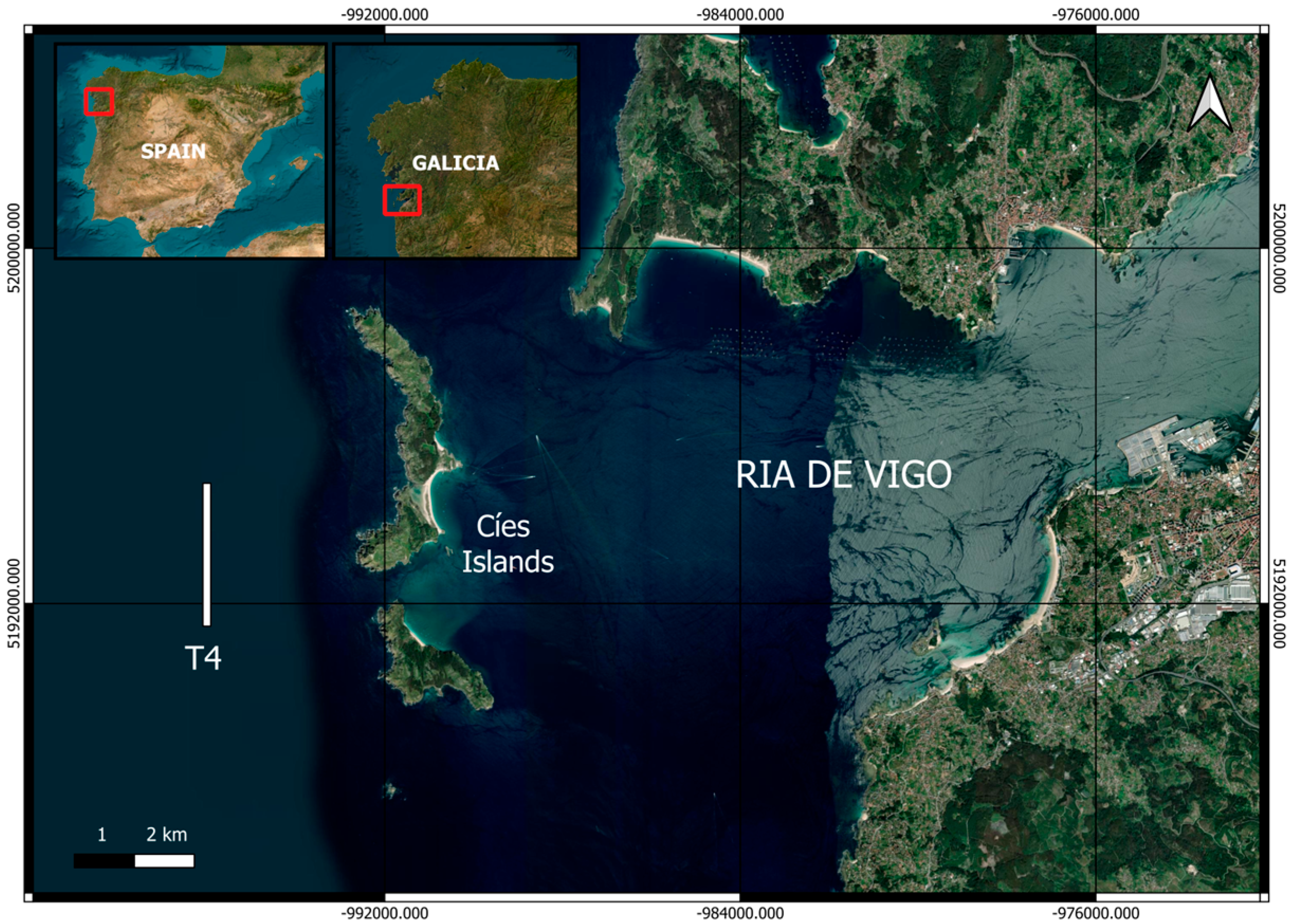
Mesozooplankton was caught in the waters off southern Galicia (NW Iberian Peninsula) (Figure 1) during the summer of 2017, throughout the sampling plan of a National Research Project (CALECO-CTM2015-69519-R). A 250 μm mesh size multinet Hydrobios Mammoth was used to collect zooplankton on board the R/V Mytilus.
A total of 200 m3 of seawater was filtered at six different depth ranges (85–55, 55–35, 35–20, 20–10, 10–5 and 5–0 m), and the resulting samples were fixed in 96% molecular-grade ethanol. At the laboratory the samples were sub-sampled using a Folsom splitter [49] to obtain about 500 zooplankton organisms per sample. These specimens were morphologically identified under a stereomicroscopy Leica M205C (Wetzlar, Germany) equipped with MC170 HD camera, and both the abundance for each taxon and depth strata calculated. All euphausiids were then microscopically examined for parasite detection, and carapace length (CL) of infected euphausiids was measured as defined by Nickol [35]. Endoparasites were separated from the hemocoel of euphausiids using dissection material and the prevalence and mean intensity of infection were calculated for each depth range as defined in Bush et al. [50]. Both euphausiids and cystacanths were preserved in 70% ethanol for further genetic and morphological analysis.
Two days after sampling the swarm of euphausiids, small pelagic fishes were also obtained from domestic commercial fishing in the same study area. The viscera and stomach contents of Sardina pilchardus Walbaum, 1792 (n = 16), Scomber scombrus Linnaeus, 1758 (n = 16) and Trachurus trachurus Linnaeus, 1758 (n = 10) were dissected to detect and further identify endoparasites and euphausiids remains.

2.2. Morphological Characterization of Parasites

Description of the trunk spine distribution of parasites was based on 7 adult males and 13 adult females; other measurements were obtained from 5 specimens of each sex. The trunk, neck and proboscis were measured, and trunk spine distribution determined using whole worms conserved in ethanol 70%; for other measurements, specimens were first cleared in glycerin or lactic acid. Depending on the size of the structure, specimens were examined under a stereomicroscope (up to 80×) or a light microscope (up to 400×) and features were drawn with the aid of a camera lucida. Although the proboscis was fully everted in only 1 male and 2 females, the number of hooks per row in the invaginated part could be determined by transparency. The blades of ventral and dorsal hooks were measured in the basal circle, at the middle of proboscis, and at the distal side when possible.

2.3. Molecular Characterization of Intermediate Host and Parasite

Intermediate host: DNA extractions were carried out on 11 parasitized euphausiids, 2 non-parasitized euphausiids, and 8 euphausiid samples obtained from the stomach contents of S. pilchardus, S. scombrus and T. trachurus. DNA purifications were performed employing the NucleoSpin Tissue Kit (Macherey-Nagel, Easton, PA, USA), according to the manufacturer’s protocol for isolating genomic DNA from human or animal tissue and cultured cells. The DNA quality and quantity of each sample were assessed in a spectrophotometer Nanodrop® ND-2000 (Thermo Scientific, Waltham, MA, USA). To identify the euphausiids specimens, mitochondrial 16S region was amplified by PCR assay using the universal primers 16Sar (5-CGCCTGTTTATCAAAAACAT-3) and 16Sbr (5-CCGGTCTGAACTCAGATCACGT-3) [51]. PCR reactions were performed in a total volume of 25 mL containing 1 µL of genomic DNA (100 ng), PCR buffer at 1× concentration, 0.3 µM primers, 0.2 mM nucleotides and 0.025 U. µL−1 Dream Taq DNA polymerase (Thermo Scientific). PCR assays were carried out in a Tgradient thermocycler (Biometra, Milano, Italy), under the following reaction conditions: 3 min at 95 °C, 35 cycles of 1 min at 95 °C, 45 s at 50 °C, and 45 s at 72 °C, followed by 7 min at 72 °C. A negative control (no DNA) was included in all PCR amplifications. PCR products were separated on a 2% agarose gel in Tris acetate EDTA buffer, stained with Red Safe and scanned in a GelDoc XR documentation system (Bio-Rad Laboratories, Hercules, CA, USA). PCR products were cleaned for sequencing using ExoProStarTM 1 Step (GE Healthcare, Piscataway, NJ, USA) for 15 min at 37 °C, followed by inactivation for 15 min at 80 °C and sequenced in a specialized service (STAB Vida, Caparica-Portugal). All PCR products were sequenced in both directions using the primers forward and reverse. The chromatograms obtained were analyzed using ChromasPro v.1.41 Technelysium Pty Ltd. (Tewantin, Australia). All generated sequences were searched for identity using BLAST (Basic Local Alignment Search Tool) through the web servers of the National Center for Biotechnology Information (USA) (http://www.ncbi.nlm.nih.gov/BLAST, accessed on 5 January 2025).
Parasite: genetic identification was conducted on 20 cystacanths collected from euphausiids and 42 adults collected from S. pilchardus (n = 4), S. scombrus (n = 20) and T. trachurus (n = 18). Genomic DNA isolation and PCR assays were carried out as described above and several genetic markers were amplified: 18S rRNA gene, using the primers 18SU467F/18SL1310R [52] and mitochondrial cytochrome c oxidase subunit I (COI) gene using the primers LCO1490/HCO 2198 [53] (Table 1). The 28S rRNA genes were also obtained from 6 cystacanths and 6 adults from Atlantic mackerel, using the primers LSU5/1500R [54]. Moreover, a complete molecular characterization of the 18S-ITS1-5.8S-ITS2-28S region of the rRNA gene of one cystacanth and of one adult parasite from each host fish was performed. Near-complete 18S rRNA gene of parasites was amplified using primers fw.18IB/rev. lg18IB [55] and 18S467F/1310R; entire internal transcribed spacers regions (ITS1-5.8S-ITS2) were obtained using primers RhadinoITSF/RhadinoITSR, designed in this study. Partial 28S rRNA gene fragments were amplified using the primer pair LSU5/1500R [54] and an additional set of primers described by Braicovich et al. [55]: fw2_28SIB/rv2_28SIB, fw3_28IB/rev3_28S and fw28SIB/rv4_28SIB (Table 1).
All PCR reactions were performed as described above, under the following reaction conditions: 3 min at 95 °C, 35 cycles of 1 min at 95 °C, 45 s at 50°/55 °C (COI/rRNA genes, respectively), and 1 min at 72 °C, followed by 7 min at 72 °C. PCR products were cleaned and sequenced as described above. All generated sequences were aligned and overlapped using the Clustal W multiple alignment [56] included in MEGA 12 software [57] to exclude the homologous regions and to produce the entire 18S-ITS1-5.8S-ITS2-28S region of the rRNA gene of the parasites.

2.4. Phylogenetic Analysis

The taxonomic affiliation of parasites recovered from euphausiids and fish was determined by phylogenetic analysis of SSU rDNA, LSU rDNA and COI gene regions. The 18S, 28S and COI sequences obtained were aligned with sequences of the families Rhadinorhynchidae and Transvenidae available in GenBank (Table 2), using Clustal W included in MEGA 12 [57]. Sequences of Macracanthorhynchus ingens von Linstow, 1879 (Oligocanthorhynchidae), Neoechinorhynchus saginata Van Cleave and Bangham, 1949 (Neoechinorhynchidae) and Koronacantha mexicana Monks and Ponce de León, 1996 and Dolfusentis bravoae Salgado-Maldonado, 1976 (Illiosentidae) were used as outgroup. The optimal DNA substitution model for each maximum likelihood (ML) tree was inferred in MEGA 12 under the Bayesian Information Criterion (BIC) scores. Kimura 2-parameter model was the most appropriate evolutionary model for the SSU tree. The rate model allowed for 62.92% of sites to be evolutionarily invariable (I).
The analysis involved 32 nucleotide sequences with a total of 609 positions in the final dataset. In case of the LSU tree, the Tamura model was the best. A discrete Gamma distribution was used to model evolutionary rate differences among sites (5 categories (+G, parameter = 2.0286)). The rate variation model allowed for some sites to be evolutionarily invariable ([+I], 18.51% sites). The analysis involved 19 nucleotide sequences with a total of 589 positions in the final dataset. The General Time Reversible model was found to be the most appropriate evolutionary model for the COI tree. Discrete Gamma distribution was used to model evolutionary rate differences among sites (5 categories (+G, parameter = 0.9185)). The analysis involved 70 nucleotide sequences with a total of 456 positions in the final dataset. All ML trees were assessed by bootstrap analysis with 500 replicates. Evolutionary divergence was calculated by pairwise distance estimation using the maximum composite likelihood method in MEGA 12 software.

2.5. Genetic Diversity and Haplotype Analysis

The genetic diversity of parasites (both cystacanths and adults) from the three fish species was analyzed by multiple alignments of the COI sequences using MEGA 12 [57] and DnaSP v6 [63]. The number of haplotypes (Nh), the haplotype diversity (Hd), nucleotide diversity (π), number of segregating sites (S) and the average number of nucleotide differences (K) were calculated for all defined sets. Median-joining haplotype networks [64] were constructed using PopART (http://popart.otago.ac.nz, accessed on 1 May 2025). A neutrality test, Tajima’s D [65] and Fu’s Fs [66] were performed in Arlequin v3.5.2. software [67] with 1000 simulations to analyze the randomness of the DNA sequence evolution by the verification of the null hypothesis of selective neutrality (expected with population expansion). Pairwise comparisons of Fst values [68] between populations were calculated with 1000 permutations.

3. Results

3.1. Host Specificity

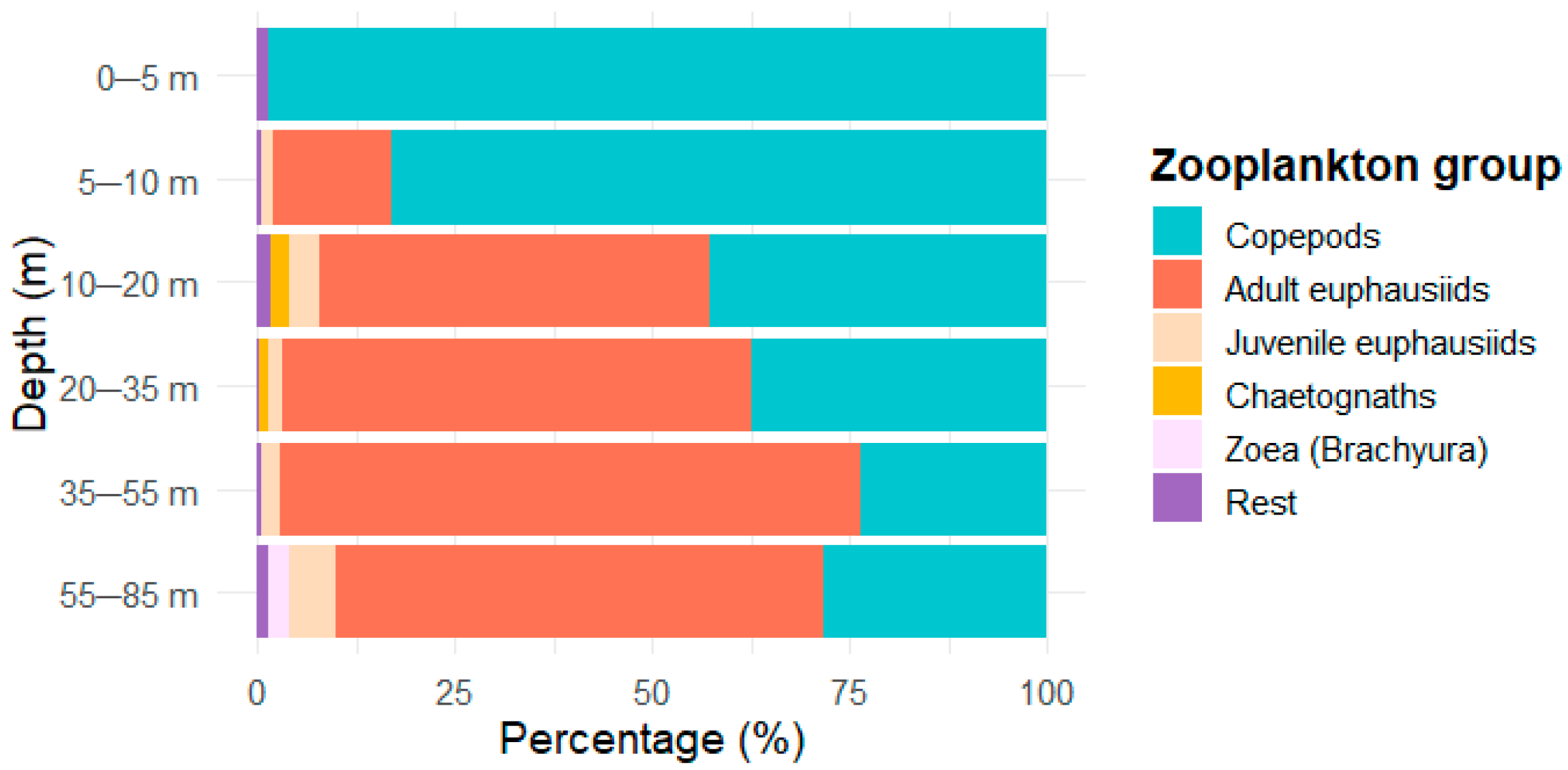
The analysis of the structure of the zooplankton community showed that the adult euphausiids represented about 15% of the whole zooplankton sample in superficial layers (up to 10 m). From 10 m euphausiids began to be dominant (49%) while in deep layers (up to 85 m) they increased to up to 60% of the zooplankton community (Figure 2).
The presence of a swarm of euphausiids had the effect of less diversity of taxa observed in the zooplankton community. The taxonomic groups identified in the swarm samples (namely copepods, chaetognaths, brachyurans, stomatopods, isopods, amphipods, cumaceans, mysids, and galatheid crustaceans) did not represent more than 3% in the zooplankton community. In the stratified sampling, a greater abundance of euphausiids (90 ind/m3) was observed in the layer from 10 to 20 m deep (Table 3).
The lowest abundances were observed in the most superficial layer (0–5 m) with 5.78 ind/m3, dominated by copepods, and in the deeper layer (55–85 m) with 33.74 ind/m3 where despite the dominance of euphausiids (61%), total abundance of zooplankton was minimal (54.57 ind/m3). Euphausiids from the swarming accounted for a total of 83,102 specimens, which morphologically were assigned to Nyctiphanes couchii Bell, 1853. Meganyctiphanes norvegica M. Sars, 1857 was also present but accounted for less than 1% of the specimens.
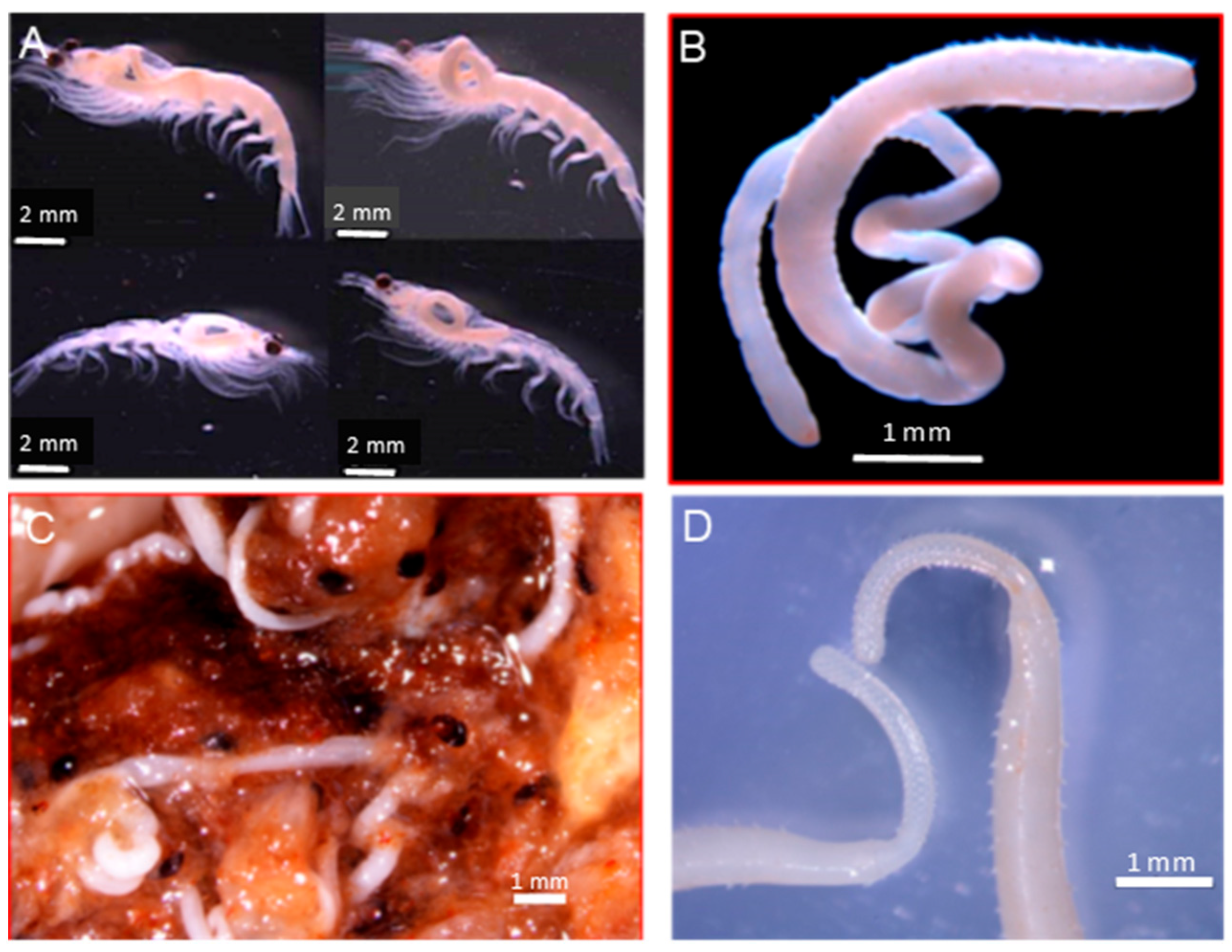
A total of 414 cystacanths of Rhadinorhynchus sp. infected the thoracic organs of N. couchii (Figure 3A,B), with the majority of infected individuals (75.6%) exhibiting carapace lengths between 3.75 mm and 4.45 mm.
M. norvegica individuals were not parasitized. Infected N. couchii were distributed throughout the water column from 0 to 85 m depth, with the highest cystacanth prevalence (0.86%) recorded in the 20–35 m layer (Table 3). Despite a low euphausiid abundance in the uppermost layer, a relatively high prevalence of 0.65% was observed. In contrast, the lowest prevalence (0.22%) was recorded in the deepest layer. A total of 420 adult specimens of Rhadinorhynchus sp. were collected from the intestine of S. pilchardus (n = 5), S. scombrus (n = 399) and T. trachurus (n = 16) (Figure 3C,D). The prevalence of infection was 100% in S. scomber, 70% in T. trachurus and 31.3% in S. pilchardus.

3.2. Description

Rhadinorhynchus lintoni Cable et Linderoth [69] (Figure 4; measurements in Table 4).
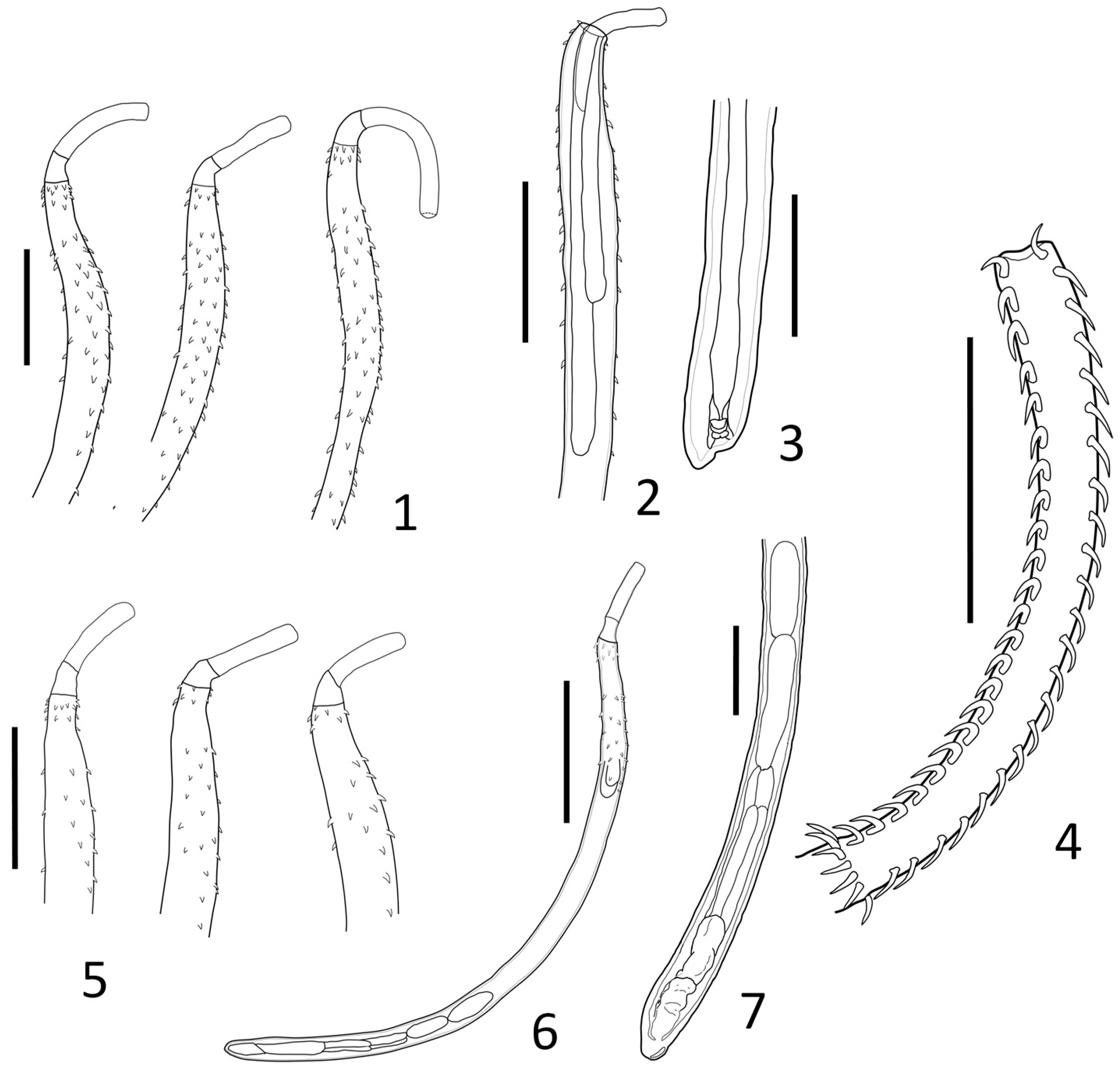
Description: With characters of the genus Rhadinorhynchus. Shared structures larger in adult females than in males. Trunk slender, usually bent dorsally, more frequently so in males, roughly cylindrical but widest at its first anterior fifth, spinose anteriorly in 2 fields separated by bare small area; spines wide, basally rounded with pointed tips. First field adjacent to neck with 2–4 irregular rings of spines; second field roughly reaching the level of the end of proboscis receptacle in both sexes and harboring the largest spines, with 7–10 irregular rings of spines in males, and 17–22 (rarely 29) in females; maximum length 99 µm (males), 130 µm (females). Proboscis long, cylindrical or slightly widened anteriorly, usually curved ventrally, with 13–14 longitudinal rows of 24–26 hooks each; dorsal hooks slenderer, ventral hooks more robust; hook roots well-developed in ventral hooks, more discoid in dorsal hooks; maximum blade length, 109 µm (males) and 127 µm (females). Basal hooks larger than penultimate hooks, similar to dorsal hooks in appearance, arranged in a complete ring projecting laterally. Proboscis receptacle 1.25 mm (males) and 2.2 mm (females) the length of proboscis, with cephalic ganglion near its middle. Lemnisci digitiform, clearly (females) or slightly (males) shorter than receptacle.
Males. Anterior field of spines with 2–4 irregular rings of spines, 1–2 complete and 2–3 incomplete on ventral side. Posterior field with 7–10 rings; some specimens only with ventrolateral spines, or having single spines on dorsal side; other specimens with 1–4 complete rings of spines and 3–9 incomplete dorsally; rings with only ventral spines typically on the posterior part of the field. Testes oblong, contiguous, situated just to the posterior half to posterior fourth of trunk. Cement glands 4, tubular. Gonopore slightly subterminal.
Females. Anterior field of spines with 3–4 irregular rings of spines, 1–3 complete and 1–3 incomplete on ventral side. Posterior field with 17–22 (rarely 29) rings; all specimens with a rather variable number of dorsal rings, typically 11–19, but two females with 2–5 and another with 23; 3–15 rings incomplete on dorsal side. Area devoid of dorsal spines in posterior region, sometimes on a small field in anteriormost area. Eggs fusiform with rounded tips, without evident polar prolongation of fertilization membrane. Gonopore subterminal.
  • Remarks:
Out of the 43 valid species of Rhadinorhynchus, only 4, namely R. cadenati Golvan [24], R. dorsoventrospinosus Amin, Heckmann and Nguyen Van Ha [1], R. erumei Gupta and Fatima [70], and R. lintoni Cable and Linderoth [69] have both dorsal and ventral trunk spines in the posterior field [1,2,7,11]. However, compared with the specimens here examined, R. cadenati has a higher number of hook rows in the proboscis (16) and the posterior field of spines just reaches the middle of the receptacle [24]; R. dorsoventrospinosus has a lower number of hook rows (11–12) but a much longer extension of trunk spines up to midtrunk [1]; and, in R. erumei, the number of hook rows is just 10 and anterior field contains as many as 8–9 rings of spines and the posterior field just 5–6 [70]. The specimens here described are most similar to R. lintoni based on the two detailed descriptions available from this species [24,69]. The number of spine rings reported [24] or figured [69] in the anterior field (3–4) is compatible with observations from the present study (2–4). Both Cable and Linderoth [69] and Golvan [24] indicated that trunk spines in the posterior field typically reach the end of the proboscis receptacle, although some specimens may have spines below this level, just as we observed in our specimens (Table 4). Golvan [24] also pointed out that spine arrangement is highly irregular, with some specimens having a variable number of dorsal spines on the anterior part of the posterior field (Figure 4). There are discrepancies between the published descriptions regarding some morphological features. Cable and Linderoth [69] indicated that the proboscis of R. lintoni bears 14 rows of 18–22 hooks each, whereas Golvan [24] reported 14–16 rows of 28–32 hooks. Our specimens have 13–14 rows of 24–26 hooks, thus showing an intermediate condition. Likewise, the size of eggs is clearly dissimilar between descriptions (72 × 15 vs. 102 × 22 µm), but still higher than in the present study (58 × 15 µm). Other morphometric traits of our specimens are within the ranges provided by Cable and Linderoth [69] or Golvan [24], except the dimensions of hooks, which apparently are the largest in the present material (Table 4).

3.3. Genetic Signatures for Host–Parasite Assembly

Euphausiids and stomach contents. PCR amplification of mitochondrial 16S rDNA from euphausiids, obtained from mesozooplankton samples and fish stomach contents, produced amplicons ranging in size from 336 to 364 base pairs. The obtained sequences from the 11 parasitized euphausiids and eight stomach contents shared 99–100% nucleotide identity (97–100% query coverage) with sequences of N. couchii (GenBank accession numbers FR682469, AY574932). In contrast, sequences from other Nyctiphanes species showed less than 97% identity. BLAST analysis of two sequences from non-parasitized euphausiids revealed 99% and 100% similarity to M. norvegica (GenBank accession numbers Z73803, AY744910, MG677875), with 100% query coverage (QC).
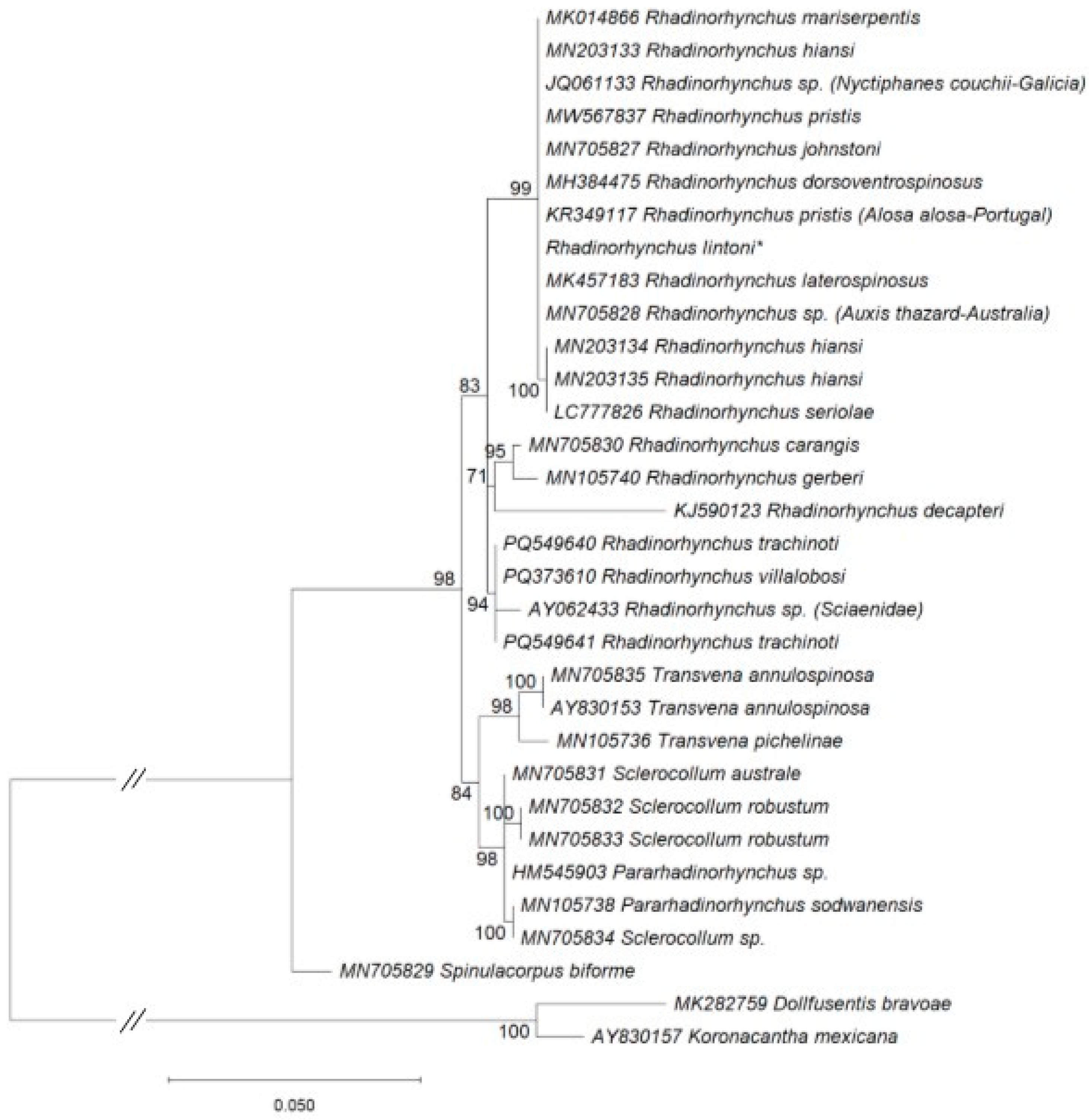
Parasites. The 18S sequences obtained (805 bp) for all 20 cystacanths and 25 adult specimens of acantocephalan were identical to each other. The 18S ML phylogenetic tree revealed that the R. lintoni sequence obtained in this study clustered with other Rhadinorhynchus species, with a bootstrap support of 83%, which was further subdivided into three subclades (Figure 5).
In the first subclade, 10 Rhadinorhynchus species, including R. lintoni, were grouped together with strong support (99% bootstrap): R. dorsoventrospinosus, R. hiansi Soota and Bhattacharya, 1981, R. johnstoni Golvan, 1969, R. laterospinosus Amin, Heckmann and Nguyen Van Ha, 2011, R. mariserpentis Huston, Cribb and Smales, 2020, R. pristis, and R. seriolae (Yamaguti, 1963) Golvan, 1969, as well as Rhadinorhynchus sp. collected from N. couchii in Galicia and Rhadinorhynchus sp. collected from Auxis thazard Lacèpede, 1800 in Australia. The second subclade included three species: R. carangis Yamaguti, 1939, R. gerberi Lisitsyna, Kudlai, Cribb and Smit, 2019 and R. decapteri Paruchin and Kovalenki, 1976 (71% bootstrap), whereas R. trachinoti Grano-Maldonado, Sereno-Uribe, Hernández-Payán, Pérez-Ponce de León and García Varela, 2024, R. villalobosi Martínez-Flores, García-Prieto, and Oceguera-Figueroa, 2025 and Rhadinorhynchus sp. collected from sciaenid fish were clustered together (94% bootstrap). The species Spinulacorpus biforme (syn. R. biformis) (Smales, 2014) Huston and Smales, 2020 was found in a basal position to Rhadinorhynchidae and Transvenidae, the two sister clades included in the phylogenetic analysis. The 18S pairwise distance analysis involved 605 positions. Interspecific distance between R. lintoni from Galicia and the species included in the same subclade in the phylogenetic tree was as low as 0–0.003 and highest for the species grouped in the other subclades (Supplementary Table S1).
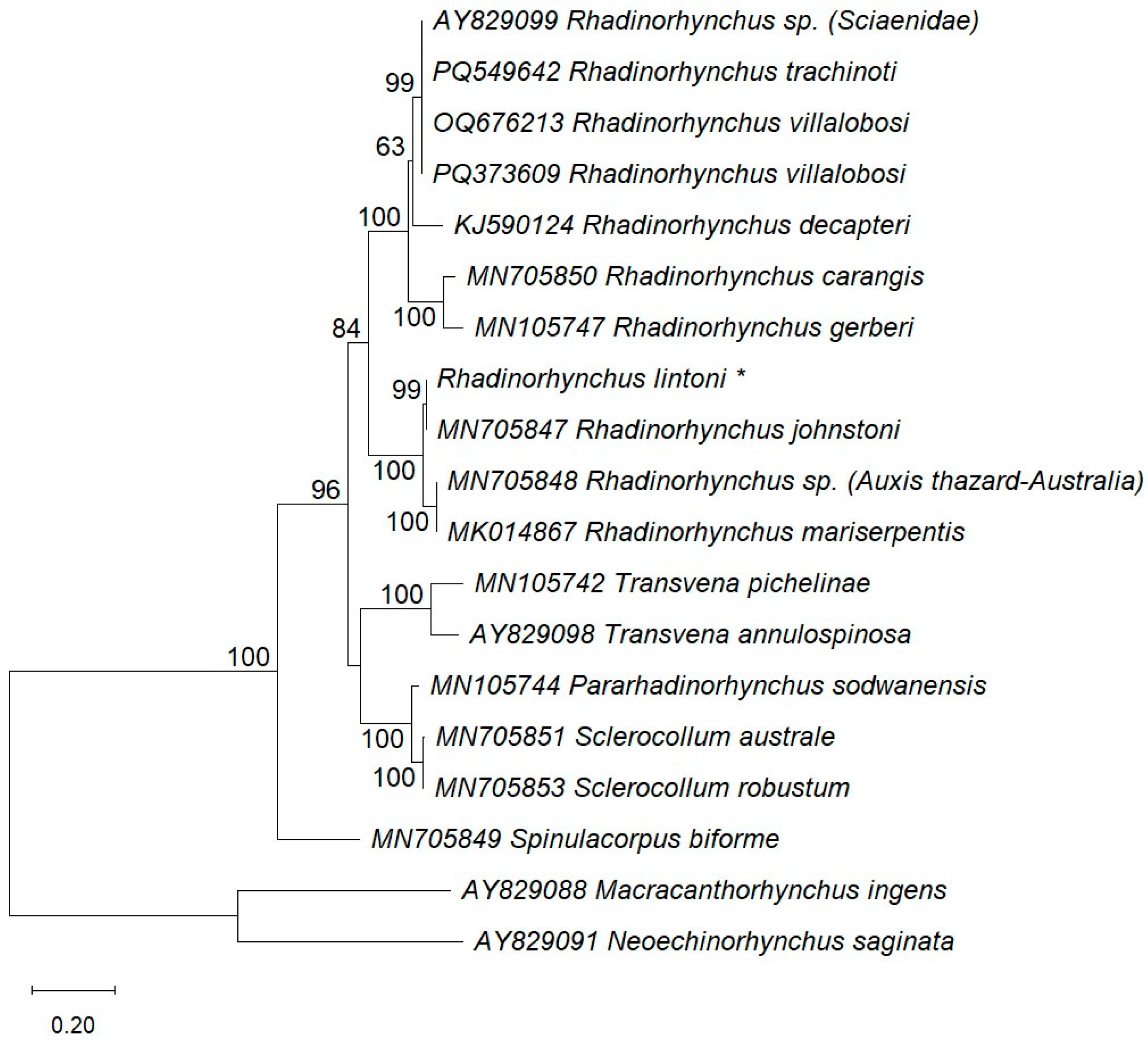
The 28S rDNA sequences obtained (976 bp) of six cystacanths and six adult specimens were also identical to each other. The phylogeny inferred from the 28S rDNA gene showed a similar topology to that of the 18S tree, with Rhadinorhynchus species forming a well-supported clade (84% bootstrap values) (Figure 6), that was subdivided into two subclades.
In this analysis, R. lintoni from Galicia clustered within a subclade with strong support (100% bootstrap), together with R. johnstoni, R. mariserpentis and Rhadinorhynchus sp. collected from Auxis thazard in Australia. The remaining Rhadinorhynchus species were included in the other subclade supported by 100% bootstrap value. The 28S pairwise distance analysis, based on 547 positions, revealed no interspecific divergence between R. lintoni from Galicia and R. johnstoni and low genetic distances with Rhadinorhynchus sp. from Auxis thazard (Australia) and R. mariserpentis (0.045) (Supplementary Table S2). Other Rhadinorhynchus species showed higher interspecific distances, ranging from 0.300 to 0.388.
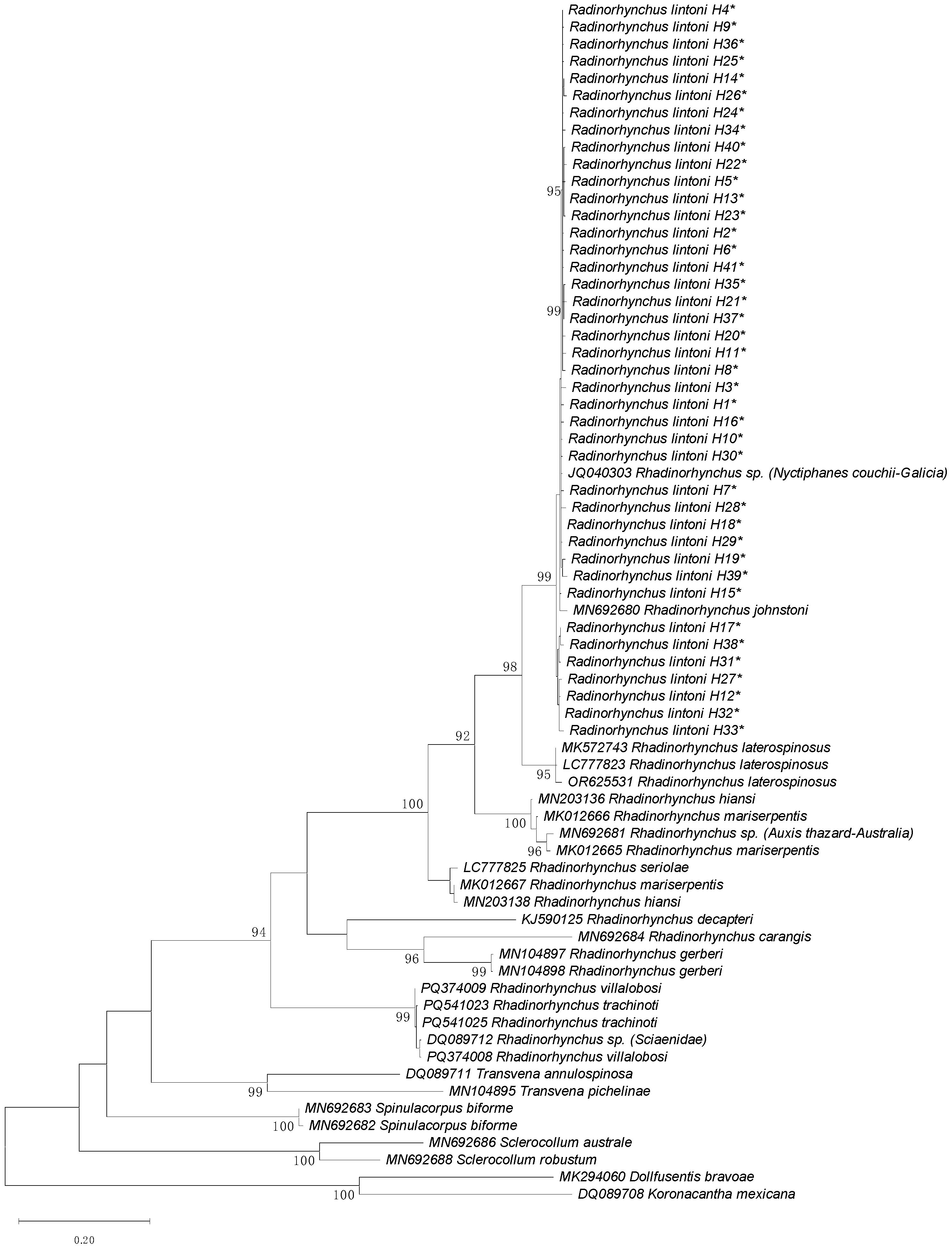
A 647 bp fragment of the COI region was successfully amplified from 20 cystacanths and 42 adult specimens. Alignment of the resulting 62 sequences revealed 41 different haplotypes, shared between both life stages. Within this group, all Rhadinorhynchus species formed a monophyletic group with 94% bootstrap support. All haplotypes clustered in the same clade together to Rhadinorhynchus sp. from N. couchii in Galicia and R. johnstoni, with strong bootstrap support (99%). This clade was nested to the clade containing R. laterospinosus (Figure 7). The COI pairwise distance analysis, based on 456 positions, revealed that intraspecific distances among Rhadinorhynchus sequences obtained in this study ranged from 0.0036 to 0.0370. This range included both Rhadinorhynchus sp. from N. couchii (Galicia) and R. johnstoni (Australia). Interspecific distance confirmed that Rhadinorhynchus from Galicia is most closely related to R. laterospinosus with divergence values of 0.160–0.186. Genetic distances with other Rhadinorhynchus species were substantially higher, ranging from 0.272 to 1.381 (Supplementary Table S3).
The molecular characterization of the 18S-ITS1-5.8S-ITS2-28S rRNA gene region was performed of one cystacanth and of one adult specimen from each fish host species (S. pilchardus, S. scombrus and T. trachurus), allowed obtaining a consensus sequence of 5203 bp for each individual, which were identical across all four hosts. The consensus sequence included 1687 bp of the 18S rRNA gene, the complete ITS1–5.8S–ITS2 region (525 bp), and 2991 bp of the partial 28S rRNA gene. Due to the absence of similarly long sequences for Rhadinorhynchus species, direct comparison of overall sequence identity was not possible. However, partial ITS1–5.8S–ITS2 sequences are available in GenBank for R. mariserpentis (MK014834) and R. dorsoventrospinosus (MH384822), which showed 90% identity (99% QC) and 84% identity (100% QC).
The sequences of R. lintoni obtained in this study have been deposited in GenBank under accession numbers PX482543 (18S rRNA gene), PX529822 (28S), PX482556-PX482596 (COI), and PX556771-PX556774 (consensus sequences).

3.4. Genetic Diversity and Population Structure of R. lintoni

The alignment of 62 COI sequences (456 sites) revealed 48 variable sites (S) and resulted in 41 haplotypes (Table 5). The overall value of haplotype diversity (Hd) was 0.932, the value of nucleotide diversity (π) was 0.00811, and the value of the average number of nucleotide differences (K) was 3.69751. The genetic indices calculated from each fish host showed a similar Hd value, ranging between 0.926 for S. scombrus and 1.000 for S. pilchardus, but the cystacanths showed lower Hd values (0.853). Different π values were also obtained from different hosts, ranging between 0.00138 for S. scombrus and 0.01389 for S. pilchardus. Tajima’s D neutrality test showed statistically significant negative values (p < 0.05) for all hosts, except for T. trachurus, whereas the values of Fu’s were only statistically significant for S. pilchardus (p < 0.02) (Table 5).
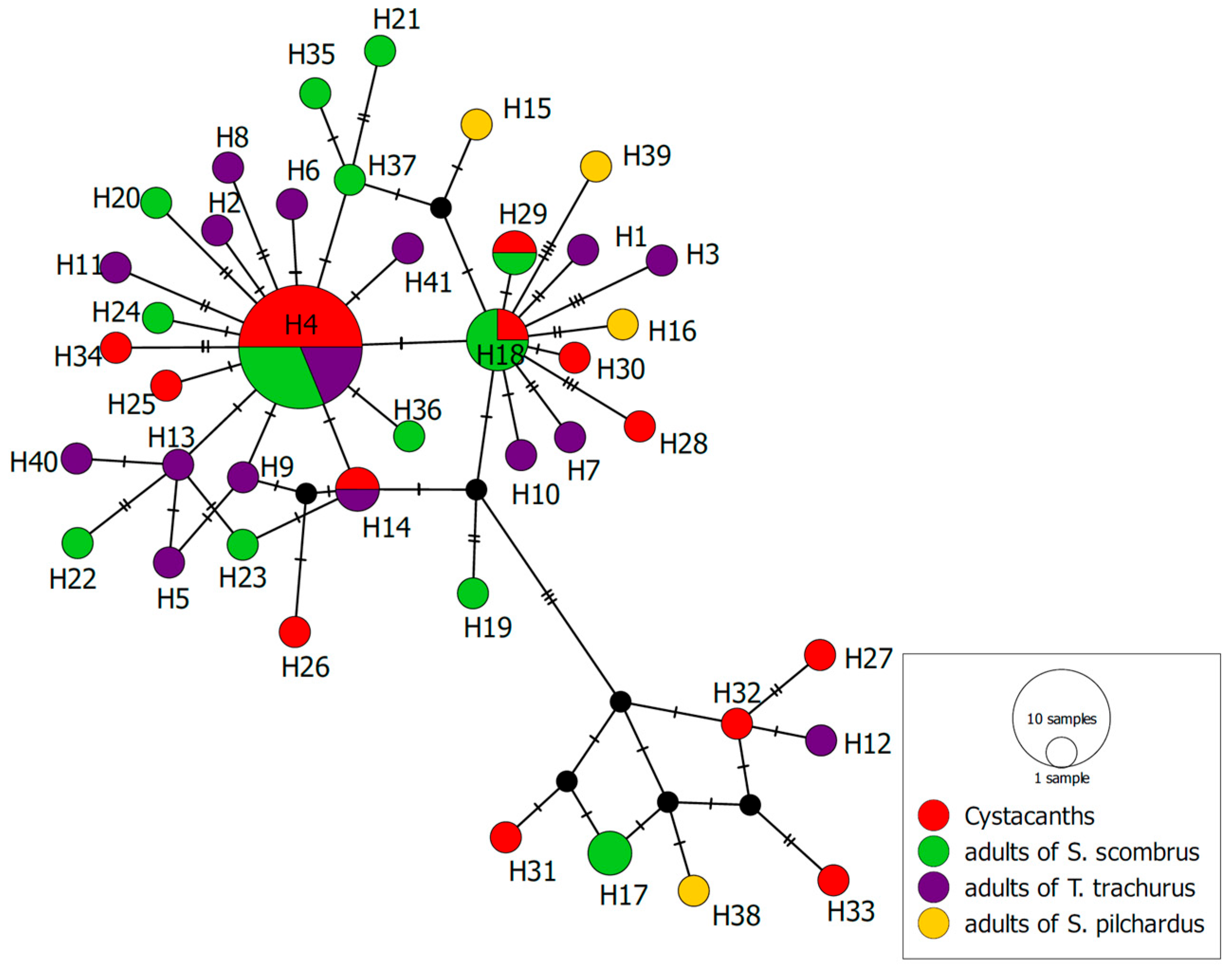
The median-joining haplotype network based on 62 mitochondrial COI sequences of R. lintoni displays the 41 haplotypes identified using DNAsp (Figure 8). Their structure showed the haplotype H4 was predominant, represented by 16 sequences (25.80% of the total) and it was shared by cystacanths and adults from T. trachurus and S. scombrus.
The relative frequency of occurrence for this haplotype was 0.167 for T. trachurus, 0.25 for S. scomber and 0.4 for cystacanths. Other three haplotypes were shared between the two host species (H18, H29 and H14) but with a lower number of sequences (4 for H18 and 2 for H29 and H14). Moreover, the median-joining haplotype network showed a high number of unique haplotypes (37 haplotypes, 90% of the total) and, in all cases, represented by one or two sequences.
Thus, S. pilchardus was the species with the highest number of unique haplotypes (100% of the total haplotypes for this species), although only four sequences were compared, followed by T. trachurus (88%), S. scomber (77%) and cystacanths (69%). Pairwise genetic differentiation among R. lintoni sequences was very low: Fst values ranged between 0.00059 and 0.09263, with no statistically significant differences between hosts.

4. Discussion

4.1. Parasite Identity

Acanthocephalans of the genus Rhadinorhynchus have scarcely been studied in European waters. To date, three valid species have been morphologically described infecting different fish species: R. pristis parasitizing members of the families Scombridae, Carangidae, Sparidae, Xiphiidae or Congridae from the North Atlantic, Portugal coast, Madeira and Azores Islands [16,17,18,19,20,21,22,23,71]; R. lintoni infecting Scombridae and Sparidae from the Mediterranean and Atlantic coast [13,24]; and R. cadenati infecting species of the genus Trachurus from the Portugal coast and Madeira Islands [25,28,71]. Additional records of unidentified species of Rhadinorhynchus have been documented in Citharus linguatula Linnaeus, 1758, Microchirus azevia de Brito Capello, 1867, Pegusa lascaris Risso, 1810 or Trachurus picturatus Bowdich, 1825 from the Portuguese coast [29,30,31].
In the present study, we provided a detailed morphological description of both males and females of Rhadinorhynchus sp. parasitizing pelagic fish from NW Iberian Peninsula waters, which enabled identification as R. lintoni. The diagnostic morphological characters, definitive host range and geographic distribution of our specimens correspond well with those previously described for R. lintoni [24,69]. Furthermore, molecular analysis based on 18S, 28S and COI gene sequences from several adult specimens and cystacanths confirmed the taxonomic affiliation of Rhadinorhynchus sp. specimens from Galician waters. Gregori et al. [43] first described Rhadinorhynchus sp. infecting N. couchii in the Galician coast, providing morphological descriptions of cystacanths and establishing a phylogenetic relationship with other Palaeacanthocephala using 18S rRNA sequences. Based on cysthacant morphology, phylogenetic analysis and geographic range, the authors suggested this parasite could be the species type R. pristis. However, due to the absence of adult specimens and limited genetic data for Rhadinorhynchus species at the time, a definitive taxonomic identification was not possible. Our new morphological and genetic data now support that the Rhadinorhynchus sp. from N. couchii described by Gregori et al. [43] corresponds to R. lintoni. Likewise, Bao et al. [15] also reported R. pristis in allis shad Alosa alosa Linnaeus, 1758 from Portugal and Galician rivers based on the 18S sequence comparisons (KR349116- KR349117) with sequences deposited by Gregori et al. [43] (JQ061133- JQ061136). The presence of R. pristis in A. alosa was also previously recorded in the Rhine River by Golvan [24] and also by Mota et al. [72] in the Miño River (Galicia). Our genetic analyses suggest that sequences identified as R. pristis from A. alosa in Iberian Peninsula waters, as well as other reports based on morphological identifications of the genus Rhadinorhynchys from Portuguese waters, warrant taxonomic re-examination.
Although molecular phylogenies of most Rhadinorhynchidae currently rely on 18S, 28S and COI gene sequences [3,4,8,9,10,32,43,48,55,58,61], genetic data are available only for 12 of the 43 described Rhadinorhynchus species. Our phylogenetic analyses based on 18S, 28S, and COI sequences placed R. lintoni within a well-supported monophyletic clade of Rhadinorhynchus, sister to members of the family Transvenidae (Transvena, Sclerocollum and Pararhadinorhynchus). These results align with previous studies supporting the monophyly of Rhadinorhynchus [3,4,58,59]. Rhadinorhynchidae was considered, for a time, a paraphylectic group since it included species of the genus Rhadinorhynchus but also the species of the genus Gymnorhadinorhynchus (e.g., G. mariserpentis and G. decapteri) [55], and with R. biformis [11] occupying a basal position relative to Rhadinorhynchidae and Transvenidae [8,12,61]. However, recent phylogenetic evidence supports transferring the species G. mariserpentis and G. decapteri to the genus Rhadinorhynchus [4,32,58], and assigning R. biformis to the newly erected genus Spinulacorpus [59].
Analysis of 18S and 28S sequences showed no intraspecific variability between adults and cystacanths of R. lintoni, whereas the COI region exhibited the highest variability showing 41 different haplotypes with pairwise distances ranging between 0.0036 and 0.0370. Pairwise distances based on 18S between R. lintoni and other Rhadinorhynchus species were minimal (0–0.03%), indicating limited resolution of this marker for species discrimination. These results are consistent with those described by Kita et al. [9], who reported similar 18S distances among R. mariserpentis, R. hiansi, R. johnstoni, R. seriolae and R. laterospinosus. The 28S pairwise distances suggested that R. lintoni and R. johnstoni are conspecific, although data for all first subclade species are not yet available. Similar results were obtained with COI sequences, since the genetic distances pointed out both R. johnstoni and Rhadinorhynchus sp. previously identified in Galician waters included within the intraspecific variability of R. lintoni (0.0036 to 0.0370), but clearly separated from other species. R. johnstoni has been described in Pacific waters parasitizing Auxis thazard (Scombridae) from Australia [32] and Cypselurus hexazona Bleeker, 1853 (Exocoetidae) from Vietnam [6], all those outside the geographic range in which R. lintoni has been described. However, based on the morphological descriptions, we ruled out that R. lintoni and R. johnstoni are the same species.
Pairwise distances for the COI gene also revealed close relationships among R. seriolae, R. hiansi, R. mariserpentis and Rhadinorhynchus sp. from A. thazard (0.0072–0.053), while R. trachinoti, R. villalobosi and Rhadinorhynchus sp. from Sciaenidae were even closer (0.0036–0.014). These results are consistent with previous reports by Kita et al. [9] and Martínez-Flores et al. [3], indicating low interspecific variability in the COI region among Rhadinorhynchus species. As a whole, our results suggest that the COI region should be used with caution for the identification of Rhadinorhynchus species. Comprehensive morphological and molecular studies remain necessary to elucidate both inter- and intraspecific variability in Rhadinorhynchus to enable unequivocal identification. For this reason, a key pending task to clarify the phylogenetic relationship within the acanthocephalans, especially Rhadinorhynchus, is to expand molecular characterization of morphologically described and newly identified species [32]. These authors have suggested that 28S rDNA sequences could be a robust marker to achieve it. However, recently deposited 28S sequences in GenBank for newly described species, along with our sequences for R. lintoni, indicate that this marker alone may be insufficient to resolve species boundaries within the genus. Here, we also provide a long rDNA fragment comprising the 18S-ITS1-5.8S-ITS2-28S region, including the internal transcribed spacers of the rRNA and 5.8S gene that could be evaluated as a promising candidate for DNA barcoding and phylogenetic analysis of Rhadinorhynchus species. In recent years, several studies have provided sequences of the ITS region for various acanthocephalan taxa [73,74,75,76]. However, within the genus Rhadinorhynchus, ITS data are currently limited to only two species, R. mariserpentis [12] and R. dorsoventrospinosus [8]. Our results highlighted the need for broader molecular characterization in conjunction with detailed morphological analyses to clarify species diversity and systematics within Rhadinorhynchus on a global scale.

4.2. Host–Parasite Assembly

The consensus genetic sequences obtained from both cystacants and adults of R. lintoni provided clear evidence on the transmission of R. lintoni between N. couchii and the Atlantic mackerel, the horse mackerel and the European pilchard. Sequences from both (cystacanths and adults) were identical, or within the expected level of intraspecific genetic divergence. Moreover, the genetic diversity and population structure of R. lintoni showed a high haplotype diversity and low nucleotide diversity for all groups studied. The highly negative values of neutrality tests, Tajima’s D and Fu’s Fs, for R. lintoni from all hosts along the Galician coast can suggest a recent population expansion, possibly associated with changes in host availability or environmental conditions, leading to rapid population growth. Likewise, population pairwise Fst values showed a lack of population genetic structuring, which confirms that there is no genetic differentiation between R. lintoni parasitizing different host species (intermediate or definitive). The 41 haplotypes obtained for R. lintoni showed a high percentage of unique haplotypes (90%), with very low relative frequency. A single haplotype (H4) was clearly predominant, being shared by cystacanths and adults, except for those of S. pilchardus (although only four specimens were analyzed), which indicate a clear population connection of R. lintoni through the trophic web.
Studies which evaluate the genetic diversity and population structure of acanthocephalans are scarce from marine and freshwater ecosystems [77,78,79]. Nevertheless, a high gene flow and a slight population genetic structure is generally accepted for most marine fish parasites, mainly nematodes [80,81,82]. This is likely due to the result of several factors acting together: a complex parasite life cycle with high host range and low host specificity, highly migratory definitive and intermediate hosts, and high intensity of infection in the definitive host [83,84,85].
Another convincing argument which supports the genetic match between life cycle stages of R. lintoni comes from the analysis of host feeding interactions in the sampling area. The Galician coast is a highly productive ecosystem [86], with one of the biggest concentrations of N. couchii from European waters [87,88]. This species shows a seasonal dynamic, since this area is influenced by the Canary Upwelling System. The swarm of euphausiids found in summer agreed with those seasonally described in the northwest Iberian shelf [43,89]), where N. couchii is considered the main prey of small pelagic fishes [90]. In this study a total of 83,102 euphausiids have been studied, with highest abundance values in the surface layer (10–55 m depth) where most pelagic fish feed.
Although Rhadinorhynchus spp. is well-known as generalists with respect to their definitive hosts, some studies have suggested that a certain degree of specificity may exist toward the intermediate host. This could be due to the large size of cystacanths, which could be harbored in the cephalothorax of adult euphausiids or mysids but not in smaller organisms like copepods [42,43]. In fact, R. lintoni cystacanths were found parasitizing adults of N. couchii, with no infections detected in earlier larval stages. Furthermore, no cystacanths were observed in adult M. norvegica, reinforcing the hypothesis of a degree of host specificity in R. lintoni at the intermediate host level. Additionally, with some exceptions as we record in this study, the large size of cystacanths clearly limits the mean intensity of infection to a single cystacanth per host individual, as it has been previously found parasitizing for any species of Nyctiphanes [40,43].
The prevalence of cystacanths of R. lintoni infecting N. couchii ranged between 0.22 and 0.86%, depending on the depth. These low values agree with those obtained for other acantocephalans infecting different euphasiids species [38,40,43,47,48]. This seems a feature for invertebrate intermediate hosts, especially in zooplankton communities, since the effect of dilution in the pelagic realm makes it difficult to find the appropriate intermediary host [34,91]. Planktivorous fish usually exhibit opportunistic feeding behavior on zooplankton, but even they may present a particulate-feeding behavior, prey size selectivity or seasonal diet composition; they always show high daily consumption rates [92]. This voracious foraging behavior through predator–prey “infected” interactions provokes fish to accumulate high parasite burdens at the final host.
Another interesting aspect of genetically matching parasite life stages through trophic routes is identifying transmission networks which can be simultaneously used by several parasite groups. This is specially the case of generalist helminth parasites like nematodes and acantocephalans that despite being phylogenetically distant may share transmission routes for their larval stages encountering the final host. In the Galician coast, N. couchi can be identified as a stable trophic connector maintaining an important transmission parasite network spreading Anisakis spp. and R. lintoni from mesozoooplankton to pelagic fish populations, and from that to demersal fish and cetaceans [93].
Overall, our data show how integrating comprehensive data on parasite morphology and genetics across different host trophic levels may help to understand the trophodynamic of host–parasite matching [94]. This will be meaningful by filling the gaps in parasite transmission routes, which significantly improve our depauperate knowledge of marine helminth life cycles.

5. Conclusions

Adults of R. lintoni, a poorly studied parasite of pelagic fishes in the NE Atlantic, were identified based on morphological features. Our study provided the first genetic data for this species, using several molecular markers, including the 18S–ITS1–5.8S–ITS2–28S region of the rRNA gene and the cytochrome c oxidase subunit I gene, which allowed us to assess the diversity and systematics of R. lintoni within its genus. These genetic data also provide evidence of a key trophic transmission route involving the primary intermediate host—the euphausiid N. couchii—and higher-level consumers (definitive hosts), including pelagic fishes. Overall, our results show how integrating comprehensive data on parasite morphology and genetics across different host trophic levels may help us to understand the trophodynamic of host–parasite matching. This will be meaningful by filling the gaps in parasite transmission routes, which significantly improve our depauperate knowledge of marine helminth life cycles.

Supplementary Materials

The following supporting information can be downloaded at: https://www.mdpi.com/article/10.3390/fishes11010014/s1, Table S1: Genetic divergence between 18S rDNA sequences of Rhadinorhynchus lintoni from Galicia and sequences of other Rhadinorhynchus species deposited in GenBank; Table S2: Genetic divergence between 28S rDNA sequences of Rhadinorhynchus lintoni from Galicia and sequences of other Rhadinorhynchus species deposited in GenBank; Table S3: Genetic divergence between COI sequences of Rhadinorhynchus lintoni from Galicia and sequences of other Rhadinorhynchus species deposited in GenBank.

Author Contributions

Conceptualization, A.R., E.A. and S.P.; methodology, A.R., L.G.-A., F.J.A. and H.R.; formal analysis, A.R., L.G.-A. and F.J.A.; writing—original draft preparation, A.R.; writing—review and editing, F.J.A., E.A. and S.P. All authors have read and agreed to the published version of the manuscript.

Funding

The authors acknowledge the support of the Galicia Marine Science Programme, part of the Complementary Science Plans for Marine Science of Ministerio de Ciencia, Innovación y Universidades included in the Recovery, Transformation and Resilience Plan (PRTR-C17.I1).

Institutional Review Board Statement

Not applicable.

Data Availability Statement

The molecular data presented in this study are available in the National Center for Biotechnology Information under the GenBank Accession numbers PX482543, PX529822, PX482556-PX482596 and PX556771-PX556774.

Acknowledgments

The authors are grateful to Javier Tamame and José Antonio Durán for their technical assistance and to Jorge Hernández-Urcera for his help in creating Figure 1. A. Ramilo and H. Rodríguez have been supported by a Technical Support Personnel (PTA) contract by the State Programme for the Promotion of Talent and its Employability in R&D from the Spanish Government (PTA2021-021206-I and PTA2019-017082-I, respectively).

Conflicts of Interest

The authors declare no conflicts of interest.

References

  1. Amin, O.M.; Heckmann, R.A.; Van Ha, N. Description of two new species of Rhadinorhynchus (Acanthocephala: Rhadinorhynchidae) from marine fish in Halong Bay, Vietnam, with a key to species. Acta Parasitol. 2011, 56, 67–77. [Google Scholar] [CrossRef]
  2. Amin, O.M.; Heckmann, R.A.; Dallarés, S.; Constenla, M.; Van Ha, N. Morphological and Molecular Description of Rhadinorhynchus hiansi Soota and Bhattacharya, 1981 (Acanthocephala: Rhadinorhynchidae) from Marine Fish off the Pacific Coast of Vietnam. J. Parasitol. 2020, 106, 56–70. [Google Scholar] [CrossRef] [PubMed]
  3. Martinez-Flores, G.; Garcia-Prieto, L.; Oceguera-Figueroa, A. Rhadinorhynchus villalobosi sp. n. (Acanthocephala: Rhadinorhynchidae) from the gafftopsail pompano Trachinotus rhodopus (Carangiformes: Carangidae) from the Pacific coast in Mexico. Folia Parasitol. 2025, 72, 007. [Google Scholar] [CrossRef] [PubMed]
  4. Amin, O.M.; Heckmann, R.A.; Dallarés, S.; Constenla, M.; Van Ha, N. Morphological and molecular description of Rhadinorhynchus laterospinosus Amin, Heckmann & Ha, 2011 (Acanthocephala, Rhadinorhynchidae) from marine fish off the Pacific coast of Vietnam. Parasite 2019, 26, 14. [Google Scholar] [CrossRef]
  5. Gibson, D.; Wayland, M. World List of Marine Acanthocephala. Rhadinorhynchus Lühe, 1911. Available online: https://www.marinespecies.org/aphia.php?p=taxdetails&id=20399 (accessed on 10 May 2025).
  6. Amin, O.M.; Heckmann, R.A.; Van Ha, N. Acanthocephalans from fishes and amphibians in Vietnam, with descriptions of five new species. Parasite 2014, 21, 53. [Google Scholar] [CrossRef]
  7. Amin, O.M.; Heckmann, R.A. Rhadinorhynchus oligospinosus n. sp. (Acanthocephala, Rhadinorhynchidae) from mackerels in the Pacific Ocean off Peru and related rhadinorhynchids in the Pacific, with notes on metal analysis. Parasite 2017, 24, 19. [Google Scholar] [CrossRef]
  8. Chaudhary, A.; Amin, O.M.; Heckmann, R.; Singh, H.S. The Molecular Profile of Rhadinorhynchus dorsoventrospinosus Amin, Heckmann, and Ha 2011 (Acanthocephala: Rhadinorhynchidae) from Vietnam. J. Parasitol. 2020, 106, 418–427. [Google Scholar] [CrossRef]
  9. Kita, Y.; Nitta, M.; Kajihara, H. Morphological and Molecular Characteristics of Two Species of the Genus Rhadinorhynchus (Palaeacanthocephala: Echinorhynchida) from the Western Pacific. Species Divers. 2024, 29, 171–178. [Google Scholar] [CrossRef]
  10. Lisitsyna, O.; Barcak, D.; Orosova, M.; Fan, C.K.; Oros, M. Acanthocephalans of marine and freshwater fishes from Taiwan with description of a new species. Folia Parasitol. 2023, 70, 021. [Google Scholar] [CrossRef]
  11. Smales, L.R. The genus Rhadinorhynchus (Acanthocephala: Rhadinorhynchidae) from marine fish in Australia with description of four new species. Acta Parasitol. 2014, 59, 721–736. [Google Scholar] [CrossRef]
  12. Steinauer, M.L.; Garcia-Vedrenne, A.E.; Weinstein, S.B.; Kuris, A.M. Acanthocephalan Parasites of the Oarfish, Regalecus russelii (Regalecidae), with a Description of a New Species of Gymnorhadinorhynchus (Acanthocephala: Gymnorhadinorhynchidae). J. Parasitol. 2019, 105, 124–132. [Google Scholar] [CrossRef] [PubMed]
  13. Gibson, D.I. Acanthocephala. In European Register of Marine Species: A Check-List of the Marine Species in Europe and a Bibliography of Guides to Their Identification; Costello, M.J., Emblow, C., White, R.J., Eds.; Collection Patrimoines Naturels: Paris, France, 2001; Volume 50, pp. 176–177. [Google Scholar]
  14. Troncy, P.M.; Vassiliadés, G. Acanthocéphales parasites de poissons d’ Afrique. Bull. Lust. Fond Afr. Noire 1973, 35, 522–553. [Google Scholar]
  15. Bao, M.; Roura, A.; Mota, M.; Nachón, D.J.; Antunes, C.; Cobo, F.; MacKenzie, K.; Pascual, S. Macroparasites of allis shad (Alosa alosa) and twaite shad (Alosa fallax) of the Western Iberian Peninsula Rivers: Ecological, phylogenetic and zoonotic insights. Parasitol Res. 2015, 114, 3721–3739. [Google Scholar] [CrossRef]
  16. Costa, G.; Pontes, T.; Rego, A.A. Prevalence, intensity and abundance of Rhadinorhynchus pristis (Acanthocephala, Rhadinorhynchidae) in chub mackerel, Scomber japonicus (Pisces, Scombridae) from Madeira Island. Acta Parasitol. 2004, 49, 41–44. [Google Scholar]
  17. Costa, G.; Santos, M.J.; Costa, L.; Biscoito, M.; de Carvalho, M.A.A.P.; Melo-Moreira, E. Helminth parasites from the stomach of conger eel, Conger conger, from Madeira Island, Atlantic Ocean. J. Parasitol. 2009, 95, 1013–1015. [Google Scholar] [CrossRef]
  18. Hermida, M.; Cruz, C.; Saraiva, A. Parasites as biological tags for stock identification of blackspot seabream, Pagellus bogaraveo, in Portuguese northeast Atlantic waters. Sci. Mar. 2013, 77, 607–615. [Google Scholar] [CrossRef]
  19. Hermida, M.; Cruz, C.; Saraiva, A. Gastrointestinal helminth communities of the blackspot seabream Pagellus bogaraveo (Teleostei: Sparidae) from Portuguese north-east Atlantic waters. J. Helminthol. 2014, 88, 129–138. [Google Scholar] [CrossRef]
  20. Hogans, W.E.; Brattey, J.; Uhazy, L.S.; Hurley, P.C. Helminth parasites of swordfish Xiphias gladius L. from the northwest Atlantic Ocean. J. Parasitol. 1983, 69, 1178–1179. [Google Scholar] [CrossRef]
  21. Oliva, M.E.; Valdivia, I.M.; Costa, G.; Freitas, N.; Carvalho, M.A.P.; Sánchez, L.; Luque, J.L. What can metazoan parasites reveal about the taxonomy of Scomber japonicus Houttuyn in the coast of South America and Madeira Islands? J. Fish Biol. 2008, 72, 545–554. [Google Scholar] [CrossRef]
  22. Rego, A.A. Rhadinorhynchus pristis (Rudolphi, 1802) Acanthocephalan parasite of fishes, Scomber scombrus and S. japonicus. Some observations on the scanning electron microscope. Mem. Inst. Oswaldo Cruz 1987, 82, 287–288. [Google Scholar] [CrossRef]
  23. Rodrigues, H.O.; Noronha, D.; Varela, M.C. Alguns acantocéfalos de peixes do Oceano Atlântico, costa continental portuguesa e do norte da África. Mem. Inst. Oswaldo Cruz 1975, 73, 209–214. [Google Scholar] [CrossRef]
  24. Golvan, Y.J. Systematique des Acanthocephales (Acanthocephala rudolphi, 1801). L’ordre des Palaeacanthocephala Meyer 1931. I. La super-famille des Echinorhynchoidea (Cobbold, 1876) Golvan et Houin 1963. Mem. Mus. Natl. D’histoire Nat. Sér. A—Zool. 1969, 57, 1–373. [Google Scholar]
  25. Costa, G.; Garcia Santamaria, M.T.; Vasconcelos, J.; Perera, C.B.; Melo-Moreira, E. Endoparasites of Trachurus picturatus (Pisces: Carangidae) from the Madeira and Canary Islands: Selecting parasites for use as tags. Sci. Mar. 2013, 77, 61–68. [Google Scholar] [CrossRef]
  26. Gargouri, L.; Antar, R.; Zarrouk, F.; Maamouri, F. The occurrence of acanthocephalans in teleost fish from the Bizerte lagoon, Tunisia. J. Helminthol. 2016, 90, 96–101. [Google Scholar] [CrossRef]
  27. Mackenzie, K.; Campbell, N.; Mattiucci, S.; Ramos, P.; Pereira, A.; Abaunza, P. A checklist of the protozoan and metazoan parasites reported from the Atlantic horse mackerel, Trachurus trachurus (L.). Bull. Eur. Assoc. Fish Pathol. 2004, 24, 180. [Google Scholar]
  28. Mackenzie, K.; Campbell, N.; Mattiucci, S.; Ramos, P.; Pinto, A.L.; Abaunza, P. Parasites as biological tags for stock identification of Atlantic horse mackerel Trachurus trachurus L. Fish. Res. 2008, 89, 136–145. [Google Scholar] [CrossRef]
  29. Hermida, M.; Pereira, A.; Correia, A.T.; Cruz, C.; Saraiva, A. Metazoan parasites of blue jack mackerel Trachurus picturatus (Perciformes: Carangidae) from Portuguese mainland waters. J. Helminthol. 2016, 90, 410–416. [Google Scholar] [CrossRef]
  30. Marques, J.F.; Santos, M.J.; Nogueira Cabral, H. Zoogeographical patterns of flatfish (Pleuronectiformes) parasites in the Northeast Atlantic and the importance of the Portuguese coast as a transitional area. Sci. Mar. 2009, 73, 461–467. [Google Scholar] [CrossRef][Green Version]
  31. Marques, J.F.; Santos, M.J.; Teixeira, C.M.; Batista, M.I.; Cabral, H.N. Host-parasite relationships in flatfish (Pleuronectiformes)-the relative importance of host biology, ecology and phylogeny. Parasitology 2011, 138, 107–121. [Google Scholar] [CrossRef]
  32. Huston, D.C.; Cribb, T.H.; Smales, L.R. Molecular characterisation of acanthocephalans from Australian marine teleosts: Proposal of a new family, synonymy of another and transfer of taxa between orders. Syst. Parasitol. 2020, 97, 859–861. [Google Scholar] [CrossRef]
  33. Garey, J.R.; Near, T.J.; Nonnemacher, M.R.; Nadler, S.A. Molecular evidence for Acanthocephala as a subtaxon of Rotifera. J. Mol. Evol. 1996, 43, 287–292. [Google Scholar] [CrossRef]
  34. Marcogliese, D.J. The role of zooplankton in the transmission of helminth parasites to fish. Rev. Fish Biol. Fish 1995, 5, 336–371. [Google Scholar] [CrossRef]
  35. Nickol, B.B. Epizootiology. In Biology of the Acanthocephala; Crompton, D.W.T., Nickol, B.B., Eds.; Cambridge University Press: Cambridge, UK, 1985; pp. 307–347. [Google Scholar]
  36. Nickol, B.B.; Heard, R.W., Jr.; Smith, N.F. Acanthocephalans from crabs in the southeastern US, with the first intermediate hosts known for Arhythmorhynchus frassoni and Hexaglandula corynosoma. J. Parasitol. 2002, 88, 79–83. [Google Scholar] [CrossRef] [PubMed]
  37. Taraschewski, H. Acanthocephala (thorny or spiny-headed worms). In Marine Parasitology; Rohde, K., Ed.; CABI Publishing: Wallingford, UK, 2005; pp. 116–121. [Google Scholar]
  38. Morales-Ávila, J.R.; Gómez-Gutiérrez, J.; del Carmen Gómez del Prado-Rosas, M.; Robinson, C.J. Larval trematodes Paronatrema mantae and Copiatestes sp. parasitize Gulf of California krill (Nyctiphanes simplex, Nematoscelis difficilis). Dis. Aquat. Org. 2015, 116, 23–35. [Google Scholar] [CrossRef] [PubMed]
  39. Morales-Ávila, J.R.; Gómez-Gutiérrez, J.; Hernandez-Saavedra, N.Y.; Robinson, C.J.; Palm, H.W. Phylogenetic placement and microthrix pattern of Paranybelinia otobothrioides Dollfus, 1966 (Trypanorhyncha) from krill Nyctiphanes simplex Hansen, 1911. Int. J. Parasitol. Parasites Wildl. 2019, 10, 138–148. [Google Scholar] [CrossRef] [PubMed]
  40. Gómez-Gutiérrez, J.; Robinson, C.J.; Kawaguchi, S.; Nicol, S. Parasite diversity of Nyctiphanes simplex and Nematoscelis difficilis (Crustacea: Euphausiacea) along the northwestern coast of Mexico. Dis. Aquat. Org. 2010, 88, 249–266. [Google Scholar] [CrossRef]
  41. González-Solís, D.; Castellanos-Osorio, I.; Beveridge, I. Larval trypanorhynch (Cestoda) infecting Euphausia americana (Euphausiacea) collected in the Mexican Caribbean Sea. Rev. Mex. Biodivers. 2013, 84, 664–667. [Google Scholar] [CrossRef]
  42. Gregori, M.; Aznar, F.J.; Abollo, E.; Roura, Á.; González, Á.F.; Pascual, S. Nyctiphanes couchii as intermediate host for the acanthocephalan Bolbosoma balaenae in temperate waters of the NE Atlantic. Dis. Aquat. Organ. 2012, 99, 37–47. [Google Scholar] [CrossRef]
  43. Gregori, M.; Aznar, F.J.; Abollo, E.; Roura, A.; González, A.F.; Pascual, S. Nyctiphanes couchii as intermediate host for Rhadinorhynchus sp. (Acanthocephala, Echinorhynchidae) from NW Iberian Peninsula waters. Dis. Aquat. Organ. 2013, 105, 9–20. [Google Scholar] [CrossRef]
  44. Gregori, M.; Roura, A.; Abollo, E.; González, A.F.; Pascual, S. Anisakis simplex complex (Nematoda: Anisakidae) in zooplankton communities from temperate NE Atlantic waters. J. Nat. Hist. 2015, 49, 755–773. [Google Scholar] [CrossRef]
  45. Morales-Ávila, J.R.; Gómez-Gutiérrez, J.; Robinson, C.J. Krill Nyctiphanes simplex gonad affection associated with acute-intensity phyllobothriid plerocercoid infection. Parasitol. Res. 2020, 119, 1155–1160. [Google Scholar] [CrossRef] [PubMed]
  46. Smith, J.W. Larval Anisakis simplex (Rudolphi, 1809, det. Krabbe, 1878) and larval Hysterothylacium sp. (Nematoda: Ascaridoidea) in euphausiids (Crustacea: Malacostraca) in the North-East Atlantic and northern North Sea. J. Helminthol. 1983, 57, 167–177. [Google Scholar] [CrossRef]
  47. Shimazu, T. Some cestode and acanthocephalan larvae from euphausiid crustaceans collected in the northern North Pacific Ocean. Bull. Jpn. Soc. Sci. Fish. 1975, 41, 813–821. [Google Scholar] [CrossRef]
  48. Grano-Maldonado, M.I.; Sereno-Uribe, A.L.; Payán, J.C.H.; de León, G.P.; García-Varela, M. Linking adults and cystacanths of a new species of Rhadinorhynchus Lühe, 1911 (Acanthocephala: Rhadinorhynchidae) from the Pacific coast of Mexico by using morphological and molecular data. Syst. Parasitol. 2025, 102, 10. [Google Scholar] [CrossRef]
  49. Omori, M.; Ikeda, T. Methods in Marine Zooplankton. Ecology; John–Willy and Sons Publication: New York, NY, USA, 1984; p. 332. [Google Scholar]
  50. Bush, A.O.; Lafferty, K.D.; Lotz, J.M.; Shostak, A.W. Parasitology meets ecology on its own terms: Margolis et al. revisited. J. Parasitol. 1997, 83, 575–583. [Google Scholar] [CrossRef]
  51. Simon, C.; Frati, F.; Beckenbach, A.; Crespi, B.; Liu, H.; Flook, P. Evolution, weighting, and phylogenetic utility of mitochondrial gene sequences and a compilation of conserved polymerase chain reaction primers. Ann. Entomol. Soc. Am. 1994, 87, 651–701. [Google Scholar] [CrossRef]
  52. Suzuki, N.; Murakami, K.; Takeyama, H.; Chow, S. Molecular attempt to identify prey organisms of lobster phyllosoma larvae. Fish. Sci. 2006, 72, 342–349. [Google Scholar] [CrossRef]
  53. Folmer, O.; Black, M.; Hoeh, W.; Lutz, R.; Vrijenhoek, R. DNA primers for amplification of mitochondrial cytochrome c oxidase subunit I from diverse metazoan invertebrates. Mol. Mar. Biol. Biotechnol. 1994, 3, 294–299. [Google Scholar]
  54. Olson, P.D.; Cribb, T.H.; Tkach, V.V.; Bray, R.A.; Littlewood, D.T. Phylogeny and classification of the digenea (Platyhelminthes: Trematoda). Int. J. Parasitol. 2003, 33, 733–755. [Google Scholar] [CrossRef]
  55. Braicovich, P.E.; Lanfranchi, A.L.; Farber, M.D.; Marvaldi, A.E.; Luque, J.L.; Timi, J.T. Genetic and morphological evidence reveals the existence of a new family, genus and species of Echinorhynchida (Acanthocephala). Folia Parasitol. 2014, 61, 377–384. [Google Scholar] [CrossRef]
  56. Thompson, J.D.; Higgins, D.G.; Gibson, T.J. CLUSTAL W: Improving the sensitivity of progressive multiple sequence alignment through sequence weighting, position-specific gap penalties and weight matrix choice. Nucleic Acids Res. 1994, 22, 4673–4680. [Google Scholar] [CrossRef] [PubMed]
  57. Kumar, S.; Stecher, G.; Suleski, M.; Sanderford, M.; Sharma, S.; Tamura, K. Molecular Evolutionary Genetics Analysis Version 12 for Adaptive and Green Computing. Mol. Biol. Evol. 2024, 41, msae263. [Google Scholar] [CrossRef] [PubMed]
  58. Lisitsyna, O.I.; Kudlai, O.; Cribb, T.H.; Smit, N.J. Three new species of acanthocephalans (Palaeacanthocephala) from marine fishes collected off the East Coast of South Africa. Folia Parasitol. 2019, 66, 012. [Google Scholar] [CrossRef] [PubMed]
  59. Huston, D.C.; Smales, L.R. Proposal of Spinulacorpus biforme (Smales, 2014) n. g., n. comb. and the Spinulacorpidae n. fam. to resolve paraphyly of the acanthocephalan family Rhadinorhynchidae Lühe, 1912. Syst. Parasitol. 2020, 97, 477–490. [Google Scholar] [CrossRef]
  60. García-Varela, M.; Cummings, M.P.; Pérez-Ponce de León, G.; Gardner, S.L.; Laclette, J.P. Phylogenetic analysis based on 18S ribosomal RNA gene sequences supports the existence of class polyacanthocephala (acanthocephala). Mol. Phylogenetics Evol. 2002, 23, 288–292. [Google Scholar] [CrossRef]
  61. García-Varela, M.; Nadler, S.A. Phylogenetic relationships of Palaeacanthocephala (Acanthocephala) inferred from SSU and LSU rDNA gene sequences. J. Parasitol. 2005, 91, 1401–1409. [Google Scholar] [CrossRef]
  62. Keidel, L.; García-Varela, M.; Brener, B.; de León, G.P.; Santos, C.P. Integrative taxonomy reveals a new species of Dollfusentis (Acanthocephala: Illiosentidae), in Orthopristis ruber (Osteichthyes: Haemulidae) from Rio de Janeiro, Brazil. Parasitol. Int. 2019, 71, 132–142. [Google Scholar] [CrossRef]
  63. Rozas, J.; Ferrer-Mata, A.; Sánchez-Del Barrio, J.C.; Guirao-Rico, S.; Librado, P.; Ramos-Onsins, S.E.; Sánchez-Gracia, A. DnaSP 6: DNA Sequence Polymorphism Analysis of Large Datasets. Mol. Biol. Evol. 2017, 34, 3299–3302. [Google Scholar] [CrossRef]
  64. Bandelt, H.J.; Forster, P.; Röhl, A. Median-joining networks for inferring intraspecific phylogenies. Mol. Biol. Evol. 1999, 16, 37–48. [Google Scholar] [CrossRef]
  65. Tajima, F. Statistical Method for Testing the Neutral Mutation Hypothesis by DNA Polymorphism. Genetics 1989, 3, 607–612. [Google Scholar] [CrossRef]
  66. Fu, Y.X. Statistical Tests of Neutrality of Mutations against Population Growth, Hitchhiking and Background Selection. Genetics 1997, 147, 915–925. [Google Scholar] [CrossRef]
  67. Excoffier, L.; Lischer, H.E.L. Arlequin suite ver 3.5: A new series of programs to perform population genetics analyses under Linux and Windows. Mol. Ecol. Resour. 2010, 10, 564–567. [Google Scholar] [CrossRef] [PubMed]
  68. Slatkin, M. A measure of population subdivision based on microsatellite allele frequencies. Genetics 1995, 139, 457–462. [Google Scholar] [CrossRef] [PubMed]
  69. Cable, R.M.; Linderoth, J. Taxonomy of some Acanthocephala from marine fishes with reference to species from Curaçao, N.A., and Jamaica, W.I. J. Parasitol. 1963, 49, 706–716. [Google Scholar] [CrossRef]
  70. Gupta, V.; Fatima, S. On three acanthocephalan parasites of fishes. Riv. Parasitol. 1981, 42, 443–449. [Google Scholar]
  71. Eiras, L.d.C. Parasites of marine, freshwater and farmed fishes of Portugal: A review. Rev. Bras. Parasitol. Vet. 2016, 25, 259–278. [Google Scholar] [CrossRef]
  72. Mota, M.; Bio, A.; Bao, M.; Pascual, S.; Rochard, E.; Antunes, C. New insights into biology and ecology of the Minho River Allis shad Alosa alosa L.—Contribution to the conservation of one of the last European shad populations. Rev. Fish Biol. Fish. 2015, 25, 395–412. [Google Scholar] [CrossRef]
  73. Fernandes, V.S.C.; Amin, O.M.; Borges, J.N.; Santos, C.P. A new species of the acanthocephalan genus Filisoma (Cavisomidae) from perciform fishes in Rio de Janeiro, Brasil. Acta Parasitol. 2019, 64, 176–186. [Google Scholar] [CrossRef]
  74. García-Varela, M.; Pinacho-Pinacho, C.D. Molecular characterization of Neoechinorhynchus cylindratus Van Cleave, 1913 (Acanthocephala: Neoechinorhynchidae), a parasite of the largemouth bass (Micropterus salmoides) in northern Mexico. J. Helminthol. 2020, 94, e18. [Google Scholar] [CrossRef]
  75. Li, L.; Chen, H.X.; Amin, O.M.; Yang, Y. Morphological variability and molecular characterization of Pomphorhynchus zhoushanensis sp. nov. (Acanthocephala: Pomphorhynchidae), with comments on the systematic status of Pomphorhynchus Monticelli, 1905. Parasitol. Int. 2017, 66, 693–698. [Google Scholar] [CrossRef]
  76. Li, L.; Chen, H.X.; Yang, Y. Morphological and molecular study of Neorhadinorhynchus nudus (Harada, 1938) (Acanthocephala: Cavisomidae) from Auxis thazard Lace’pe‘de (Perciformes: Scombridae) in the South China Sea. Acta Parasitol. 2018, 63, 479–485. [Google Scholar] [CrossRef]
  77. Amin, O.M.; Chaudhary, A.; Sharifdini, M.; Singh, H.S. First molecular description of Neorhadinorhynchus nudus (Acanthocephala: Cavisomidae) from fish in the pacific coast of Vietnam, with notes on biogeography. Syst. Parasitol. 2024, 101, 23. [Google Scholar] [CrossRef] [PubMed]
  78. David, G.M.; Staentzel, C.; Schlumberger, O.; Perrot-Minnot, M.J.; Beisel, J.N.; Hardion, L. A minimalist macroparasite diversity in the round goby of the Upper Rhine reduced to an exotic acanthocephalan lineage. Parasitology 2017, 145, 1020–1026. [Google Scholar] [CrossRef] [PubMed]
  79. García-Varela, M.; Masper, A.; Crespo, E.A.; Hernández-Orts, J.S. Genetic diversity and phylogeography of Corynosoma australe Johnston, 1937 (Acanthocephala: Polymorphidae), an endoparasite of otariids from the Americas in the northern and southern hemispheres. Parasitol. Int. 2021, 80, 102205. [Google Scholar] [CrossRef] [PubMed]
  80. Cole, R.; Viney, M. The population genetics of parasitic nematodes of wild animals. Parasites Vectors 2018, 11, 590. [Google Scholar] [CrossRef]
  81. Ramilo, A.; Rodríguez, H.; Pascual, S.; González, A.F.; Abollo, E. Population Genetic Structure of Anisakis simplex Infecting the European Hake from North East Atlantic Fishing Grounds. Animals 2023, 13, 197. [Google Scholar] [CrossRef]
  82. Ramilo, A.; Rodríguez, H.; López, M.; González, A.F.; López, A.; Pierce, G.J.; Pascual, S.; Abollo, E. New Insights on the Diversity, Ecology and Genetic Population Structure of Anisakis spp. from Fish and Cetacean Hosts from Northeast Atlantic Waters. Animals 2024, 14, 3531. [Google Scholar] [CrossRef]
  83. Amor, N.; Farjallah, S.; Piras, M.C.; Burreddu, C.; Garippa, G.; Merella, P. New insights into the coexistence of Contracaecum rudolphii A and Contracaecum rudolphii B (Nematoda: Anisakidae) in Phalacrocorax carbo sinensis from Sardinia: Genetic variability and phylogenetic analysis. Parasitology 2020, 147, 1538–1551. [Google Scholar] [CrossRef]
  84. Irigoitia, M.M.; Palomba, M.; Braicovich, P.E.; Lanfranchi, A.L.; Denuncio, P.E.; Gana, J.C.M.; Mattiucci, S.; Timi, J.T. Genetic identification of Anisakis spp. (Nematoda: Anisakidae) from cetaceans of the Southwestern Atlantic Ocean: Ecological and zoogeographical implications. Parasitol. Res. 2021, 120, 1699–1711. [Google Scholar] [CrossRef]
  85. Ten, S.; Pool, R.V.; Raga, J.A.; Sweet, A.D.; Aznar, F.J. Phylogeography of Pennella (Copepoda: Siphonostomatoida: Pennellidae) indicates interoceanic dispersal mediated by cetacean and fish hosts. Parasitology 2025, 152, 195–204. [Google Scholar] [CrossRef]
  86. Álvarez-Salgado, X.A.; Rosón, G.; Pérez, F.F.; Pazos, Y. Hydrographic variability off the Rías Baixas (NW Spain) during the upwelling season. J. Geophys. Res. Ocean. 1993, 98, 14447–14455. [Google Scholar] [CrossRef]
  87. Lindley, J.A. Continuous plankton records: The distribution of the Euphausiacea (Crustacea: Malacostraca) in the North Atlantic and the North Sea, 1966–1967. J. Biogeogr. 1977, 4, 121–133. [Google Scholar] [CrossRef]
  88. Roura, A.; Álvarez-Salgado, X.A.; González, A.F.; Gregori, M.; Rosón, G.; Guerra, A. Short-term meso-scale variability of mesozooplankton communities in a coastal upwelling system (NW Spain). Prog. Oceanogr. 2013, 109, 18–32. [Google Scholar] [CrossRef]
  89. Buttay, L.; Miranda, A.; Casas, G.; González-Quirós, R.; Nogueira, E. Long-term and seasonal zooplankton dynamics in the northwest Iberian shelf and its relationship with meteo-climatic and hydrographic variability. J. Plankton Res. 2015, 38, 106–121. [Google Scholar] [CrossRef]
  90. Lopez-Lopez, L.; Preciado, I.; Muñoz, I.; Decima, M.; Molinero, J.C.; Tel, E. Does upwelling intensity influence feeding habits and trophic position of planktivorous fish? Deep Sea Res. Part I Oceanogr. Res. 2017, 122, 29–40. [Google Scholar] [CrossRef]
  91. Marcogliese, D.J. Food webs and the transmission of parasites to marine fish. Parasitology 2002, 124, 83–99. [Google Scholar] [CrossRef]
  92. Bachiller, E.; Utne, K.R.; Jansen, T.; Huse, G. Bioenergetics modeling of the annual consumption of zooplankton by pelagic fish feeding in the Northeast Atlantic. PLoS ONE 2018, 13, e0190345. [Google Scholar] [CrossRef]
  93. Corrales, X.; Preciado, I.; Gascuel, D.; de Gamiz-Zearra, A.L.; Hernvann, P.Y.; Mugerza, E.; Louzao, M.; Velasco, F.; Doray, M.; López-López, L.; et al. Structure and functioning of the Bay of Biscay ecosystem: A trophic modelling approach. Estuar. Coast. Shelf Sci. 2022, 264, 107658. [Google Scholar] [CrossRef]
  94. Blasco-Costa, I.; Poulin, R. Parasite life-cycle studies: A plea to resurrect an old parasitological tradition. J. Helminthol. 2017, 91, 647–656. [Google Scholar] [CrossRef]
Figure 1. Sampling area from mesozooplankton in Galician waters, NE Atlantic. T4: transect 4.
Fishes 11 00014 g001
Figure 2. Structure of the zooplankton community in the stratified sampling. Rest: Zooplankton taxa with relative abundance < 1%.
Fishes 11 00014 g002
Figure 3. Rhadinorhynchus lintoni from Galicia waters. (A) Cystacanths parasitizing the thoracic organs of Nyctiphanes couchii adults; (B) cystacanths isolated from N. couchii; (C) stomach contents of S. pilchardus showing remains of euphasiids and adult acanthocephalans; (D) adult specimens collected from fish hosts.
Fishes 11 00014 g003
Figure 4. Rhadinorhynchus lintoni Cable et Linderoth, 1963 from Atlantic mackerel, Scomber scombrus. 1. Variability of trunk spine distribution in females. 2 and 3. Anterior and posterior end of female. 4. Proboscis (female). 5. Variability of trunk spine distribution in males. 6. Male in toto. 7. Detail of posterior end of male. Note that proboscis is not fully everted in any of the pictured specimens except the rightmost female in 1. Scales: 2 mm (1, 2, 5, 6); 1 mm (3, 4, 7).
Fishes 11 00014 g004
Figure 5. Maximum-likelihood phylogenetic tree based on 18S rDNA sequences showing the taxonomic placement of Rhadinorhynchus lintoni from Galician waters. Numbers at branch nodes indicate bootstrap confidence values in percentage. (*) Sequence obtained in this study.
Fishes 11 00014 g005
Figure 6. Maximum-likelihood phylogenetic tree based on 28S rDNA sequences showing the taxonomic placement of Rhadinorhynchus lintoni from Galician waters. Numbers at branch nodes indicate bootstrap confidence values in percentage. (*) Sequence obtained in this study.
Fishes 11 00014 g006
Figure 7. Maximum-likelihood phylogenetic tree based on COI sequences showing the taxonomic placement of Rhadinorhynchus lintoni from Galician waters. Numbers at branch nodes indicate bootstrap confidence values in percent. (*) Haplotypic sequences obtained in this study.
Fishes 11 00014 g007
Figure 8. Median-joining haplotype network of Rhadinorhynchus lintoni mtDNA COI sequences obtained from cystacanths infecting Nyctiphanes couchii and adults from the three fish species studied. Circles’ size is proportional to haplotype frequencies. Hatch marks represent the number of mutational steps separating haplotypes. Shared haplotypes among all four host species are indicated. Black dots represent inferred unsampled haplotypes (median vectors).
Fishes 11 00014 g008
Table 1. Sequences of primers used in this study for the molecular characterization of Rhadinorhynchus sp. from Galicia.
LocusPrimerSequence (5′-3′)Reference
SSU rDNA18SU467F ATC CAA GGA AGG CAG CAG GC[52]
18SL1310R CTC CAC CAA CTA AGA ACG GC
fw.18IB AGA TTA AGC CAT GCA TG[55]
rev.lg18IB CAA AGG GGG ACT TAA TC
ITS rDNARhadinoITSF GGG GAG TAT GGT TGC AGA ATDesigned in this study
RhadinoITSR TGA CAA GTT GCA ATC AAT CAA A
LSU rDNALSU-5 TAG GTC GAC CCG CTG AAY TTA AGC A[54]
1500R GCT ATC CTG AGG GAA ACT TCG
fw2_28SIB ACC CGA AAG ATG GTG AAC TAT G[55]
rv2_28SIB CTT GGA GAC CTG TTG CGG
fw3_28SIB CCT GAA AAT GGA TGG CGC T
rv3_28S GAT GTA CCG CCC CAG TCA AAC T
fw28SIB GGA AAG AAG ACC CTG TTG
rv4_28SIB CCA GCC AGT TAT CCC TGT
COI mtDNALCO1490 GGT CAA CAA ATC ATA AAG ATA TTG[53]
HCO 2198 TAA ACT TCA GGG TGA CCA AAA AAT CA
Table 2. GenBank accession numbers for Acanthocephala species included in genetic analysis.
TaxonHost GenBank ID LocationReference
18S28SCOI
Radinorhynchus sp.Nyctiphanes couchiiJQ061133-JQ040303Galicia, NW Spain[43]
Radinorhynchus sp.Alosa alosaKR349117--Mondego River, Portugal[15]
Rhadinorhynchus pristisAuxis rocheiMW567837--TunisiaUnpublished
Rhadinorhynchus johnstoniAuxis thazardMN705827MN705847MN692680Australia[32]
Rhadinorhynchus laterospinosusAuxis rocheiMK457183-MK572743Vietnam[4]
Auxis thazard--LC777823Japan[9]
Scomber australasicus OR625531Taiwan[10]
Rhadinorhynchus hiansiSarda orientalisMN203133-MN203135-MN203136, MN203138Vietnam[2]
Rhadinorhynchus mariserpentisRegalecus russeliiMK014866MK014867MK012665-MK012667Japan[12]
Rhadinorhynchus seriolaeThunnus orientalisLC777826-LC777825Japan[9]
Rhadinorhynchus gerberaTrachinus botla MN104897South Africa[58]
Amblyrhynchotes honckeniiMN105740 MN104898South Africa[58]
Terapon jarbua MN105747 South Africa[58]
Rhadinorhynchus carangisTrachinotus coppingeriMN705830MN705850MN692684Australia[32]
Rhadinorhynchus dorsoventrospinosusDecapterus kurroidesMH384475 Vietnam[8]
Rhadinorhynchus sp.Auxis thazardMN705828MN705848MN692681Australia[59]
Rhadinorhynchus decapteriDecapterus punctatusKJ590123KJ590124KJ590125Brazil[55]
Rhadinorhynchus sp. SciaenidaeAY062433AY829099DQ089712Unknown[60]
Rhadinorhynchus trachinotiTrachinotus rhodopusPQ549640, PQ549641PQ549642PQ541023, PQ541025Sinaloa, Mexico[48]
Rhadinorhynchus villalobosiTrachinotus rhodopusPQ373610PQ373609PQ374008, PQ374009Oaxaca, Mexico[3]
Rhadinorhynchus villalobosiTrachinotus rhodopus OQ676213 Oaxaca, Mexico[3]
Spinulacorpus biformeHelotes sexlineatusMN705829MN705849MN692682, MN692683Australia[59]
Transvena annulospinosaThalassoma lunareMN705835--Australia[32]
Anampses neoguinaicusAY830153AY829098DQ089711Unknown[61]
Transvena pichelinaeThalassoma purpureum MN105736MN105742MN104895South Africa[58]
Sclerocollum robustumSiganus lineatusMN705832--Australia[32]
Acanthurus olivaceusMN705833MN705853MN692688Australia[32]
Sclerocollum australeSiganus argenteusMN705831MN705851MN692686Australia[32]
Sclerocollum sp.Zebrasoma veliferMN705834--Australia[32]
Pararhadinorhynchus sp. Siganus fuscescens HM545903--ChinaUnpublished
Pararhadinorhynchus sodwanensisPomadasys furcatusMN105738MN105744-South Africa[58]
Dollfusentis bravoaeEugerres plumieriMK282759- Mexico[62]
Koronacantha mexicanaPomadasys leuciscusAY830157-DQ089708Unknown[61]
Macracanthorhynchus ingensProcyon lotor AY829088 Unknown[61]
Neoechinorhynchus saginataUnknow AY829091 Unknown[61]
Table 3. Abundance of euphausiids (individuals m−3) from stratified sampling, alongside demographic data of Nyctiphanes couchii infected by Rhadinorhynchus lintoni cystacanths.
Sampling Depth (m) Abundance Euphausiids (ind/m3) Euphausiids Studied (N) Prevalence (%) Intensity
0–55.7815330.65231.10
5–1065.4310,8370.23991.04
10–2090.3623,0980.41991.01
20–3577.1720,4950.86361.00
35–5579.0921,3380.42651.00
55–8533.7458010.22411.00
Table 4. Morphometric measurements of specimens of Rhadinorhynchus lintoni collected from Atlantic mackerel, Scomber scombrus, in the NE Atlantic.
Male (n = 4)Female (n = 6)
LWLW
Trunk12,732 ± 1912552 ± 10331,737 ± 7936697 ± 51
(10,146–14,448)(447–641)(16,758–39,877)(654–788)
Spinous area2712 ± 516 5941 ± 975
(2056–3204) (4526–7370)
Anterior spine field288 ± 38 468 ± 75
(254–320) (383–586)
Posterior spine field1840 ± 540 4973 ± 1047
(1121–2270) (3711–6539)
Bare area584 ± 58 500 ± 223
(507–641) (334–937)
Trunk spine99 ± 1627 ± 4130 ± 3237 ± 12
(73–117)(21–33)(112–147)(30–52)
Neck406 ± 8279 ± 14467 ± 65328 ± 44
(399–412)(266–299)(353–533)(244–362)
Proboscis2228 ± 262266 ± 292664 ± 193303 ± 26
(1915–2554)(239–306)(2352–2890)(269–344)
Basal hook (D)109 ± 1326 ± 9123 ± 822 ± 3
(94–122)(17–38)(114–136)(18–25)
Basal hook (V)108 ± 1422 ± 3127 ± 826 ± 3
(93–124)(18–25)(115–136)(23–30)
Medial hook (D)107 ± 1523 ± 4125 ± 826 ± 4
(94–126)(20–28)(114–134)(22–33)
Medial hook (V)106 ± 826 ± 4114 ± 638 ± 5
(96–112)(24–31)(108–122)(33–45)
Apical hook (D) 119 ± 1625 ± 2
(108–130)(23–26)
Apical Hook (V) 103 ± 139 ± 2
(102–104)(37–40)
Receptacle2774 ± 785278 ± 604901 ± 509419 ± 67
(2087–3738)(193–330)(4234–5666)(302–487)
Lemniscus2752 ± 674192 ± 924400 ± 886176 ± 52
(2167–3578)(138–330)(3494–5880)(118–218)
Testes position (%)64.8 ± 8.4
(57.0–73.7)
Anterior testis994 ± 258358 ± 85
(731–1218)(256–454)
Posterior testis1080 ± 223351 ± 93
(823–1321)(277–470)
Cement gland1719 ± 283150 ± 41
(1327–1936)(101–192)
Saëfttingen pouch1110 ± 415318 ± 47
(605–1598)(252–360)
Egg 58 ± 515 ± 1
(51–68)(14–17)
Table 5. Genetic diversity indices and neutrality test based on mtDNA COI sequences of cystacanths and adults of Rhadinorhynchus lintoni. Number of sequences analyzed (N), number of haplotypes (Nh), number of unique haplotypes (Nuh), nucleotide diversity (π), haplotype diversity (Hd) with their relative standard deviation (SD), average number of nucleotide differences (K), number of variable sites (S), Tajima’s D (D) and Fu’s F (Fs) statistics with their p-values (D, significance level 0.05 and Fs, significance level 0.02). * Significant values.
Stage/HostNNhNuhπHd ± SDKSTajima’s DFu’s Fs
DpFsp
Larvae/N. couchii201390.007890.853 ± 0.080 3.6000020−1.373270.07600 *−5.588720.00300
Adult/S. scombrus2013100.001380.926 ± 0.0433.3578919−1.410640.06700 *−6.017850.00300
Adult/T. trachurus1816140.007610.980 ± 0.0283.4705925−2.073610.00500−13.347120.00000
Adult/S. pilchardus44 40.013891.000 ± 0.1776.3333312−0.326850.52300 *−0.219320.23300 *
Overall6241370.008110.932 ± 0.0273.6975148−1.296090.16775−6.293250.05975
Disclaimer/Publisher’s Note: The statements, opinions and data contained in all publications are solely those of the individual author(s) and contributor(s) and not of MDPI and/or the editor(s). MDPI and/or the editor(s) disclaim responsibility for any injury to people or property resulting from any ideas, methods, instructions or products referred to in the content.