
Article

Neurotransmitter and Gut–Brain Metabolic Signatures Underlying Individual Differences in Sociability in Large Yellow Croaker (Larimichthys crocea)

1
Fisheries Research Institute of Fujian, Xiamen 361013, China
2
Key Laboratory of Mariculture, Ministry of Education, Ocean University of China, Qingdao 266003, China
3
Qingdao Marine Science and Technology Museum, Qingdao 266100, China
*
Authors to whom correspondence should be addressed.
These authors contributed equally to this work.
Fishes 2025, 10(12), 654; https://doi.org/10.3390/fishes10120654
Submission received: 18 November 2025 / Revised: 5 December 2025 / Accepted: 6 December 2025 / Published: 17 December 2025
(This article belongs to the Special Issue Germplasm Resources and Genetic Breeding of Aquatic Animals)

Abstract

Teleost social behavior plays an important role in foraging, reproduction, and aquaculture management, yet its physiological basis remains poorly understood. This study investigated individual differences in sociability in the large yellow croaker (Larimichthys crocea) using behavioral assays and metabolomic profiling in the brain–intestine axis. Behavioral tests revealed that high-sociability (HS) fish spent significantly more time near conspecifics than low-sociability (LS) fish, indicating clear behavioral divergence between groups. Targeted metabolomics of brain tissue showed distinct neurotransmitter signatures between HS and LS individuals, including significant differences in acetylcholine, DOPAC, xanthurenic acid, and glutamine. Untargeted intestinal metabolomics identified 65 differential metabolites between groups. Intestinal metabolites such as LEA and CEA exhibited significant group-specific variation and were functionally associated with CB1 and CB2 cannabinoid receptors, suggesting a potential endocannabinoid-mediated contribution to sociability differences. Differential metabolites enriched in amino–sugar and nucleotide–sugar metabolic pathways. Integration of behavioral and metabolomic data suggests that neurotransmitter regulation and gut–brain metabolic signaling jointly contribute to sociability differences in large yellow croaker. These findings provide mechanistic insights into social behavior and offer potential biomarkers for welfare assessment and selective breeding in aquaculture.
Key Contribution: This study demonstrates that distinct neurochemical profiles in the brain and differential metabolic signatures in the intestine jointly shape sociability, providing mechanistic insights and potential biomarkers for aquaculture welfare and genetic breeding.

1. Introduction

Group living is a widespread phenomenon in the animal kingdom, giving rise to complex social behaviors such as cooperative interactions, division of labor, and collective decision making [1]. In teleost, schooling provides individuals with multiple survival advantages, including enhanced predator detection, the ability to disrupt predator attacks through confusion effects, and a reduced risk of predation for each member of the group [1,2]. Moreover, collective behavior can improve prey detection, increase feeding efficiency, and enhance the chances of individuals within the group to obtain mates [1,2]. In migratory fish, the high-density aggregation of individuals forms a large biological unit that enables rapid detection of environmental cues and precise determination of migratory routes and collective navigation [3].
Studies of animal behavior primarily focuses on the behavioral responses of organisms to external environmental stimuli and internal physiological states, as well as the underlying physiological regulatory mechanisms [4,5,6]. In fish, behaviors include foraging, learning and memory, and social interactions. Social behavior, which assesses the sociability of fish, is one of the key factors underlying the formation of group-living. Sociability refers to the tendency of individual fish to establish associations with conspecific and heterospecific species, representing a fundamental component of fish personality associated with social communication [7,8]. Sociability influences interactions among individuals within schools and is often subject to strong selective pressures [7,8]. For example, studies in zebrafish (Danio rerio) emphasize the pivotal role of environmental factors in shaping social behavior, indicating that therapeutic approaches for neurological and developmental disorder can be founded on the adaptation of environmental settings [9]. In mammals, a conserved finding indicates that enrichment of the social environment mitigates anxiety-like behaviors in mice via the dopamine system [10]. In teleost studies, an important approach to assessing sociality is to evaluate the behavioral characteristics of test fish in the presence or absence of conspecifics, under conditions where aggressive behaviors are excluded [11]. The aforementioned methodologies have been extensively utilized in the model organism zebrafish (Danio rerio), predominantly for investigations into neural function, pharmacological development, and the assessment of environmental toxicants; nevertheless, their implementation in economically important teleost species remains comparatively limited.
Animal behavior is primarily orchestrated by the nervous system, wherein neurotransmitters serve as pivotal modulators of diverse neural and physiological processes within the brain [12,13]. Dysregulation of these neurochemical pathways has been extensively associated with neuropathological conditions in humans and with behavioral modifications observed in teleost [12,13]. For example, prolonged administration of low doses of a 5-HT2A receptor agonist has been demonstrated to enhance social behavior in murine models, primarily through the synergistic enhancement of 5-HT2A- and AMPA receptor–mediated neurotransmission [14]. In cichlid (Neolamprologus pulcher), the 5-HT1A agonist 8-OH-DPAT promoted aggression and suppressed both submission and affiliation, while the 5-HT1A antagonist Way-100635 had the reverse impact, demonstrating that 5-HT1A receptor signaling is integral to the regulation of aggressive and social behavior [15]. In zebrafish, the 5-HT2C receptors agonist MK-212 elevated preference for an unfamiliar conspecific in the social investigation test, and also enhanced preference for the familiar individual in the social novelty test; conversely, the 5-HT2C receptors antagonist RS-102221 reduced preference in the social investigation test but augmented preference for the novel conspecific in the social novelty test, illustrating the complex role of 5-HT2C receptors in regulating social behavior [16]. In zebrafish, the 5-HT1A agonist 8-OH-DPAT reduced social approach in both the social investigation and novelty phases of the social preference test, indicating an involvement of 5-HT1A receptors in modulating sociality [17]. Concurrently, the intestine functions as a central organ for nutrient assimilation, immune modulation, and xenobiotic interaction, while maintaining intricate bidirectional neurohumoral communication with the central nervous system, thereby establishing a functional gut–brain axis [18,19,20,21].
Animal welfare represents a central concern in both aquaculture and food production, as well as in experimental research [22]. Under controlled laboratory conditions, welfare assessment primarily relies on endocrine indicators such as cortisol and sex steroid hormones. However, these measurements are often impractical for direct application in aquaculture environments. Given the intrinsic association between endocrine dynamics and social behavior, behavioral phenotypes constitute critical parameters for evaluating welfare status of teleost under controlled housing and aquaculture conditions [22]. Therefore, fish social behavior has been widely regarded as a key non-invasive metric for evaluating welfare status [22]. In both deep-sea and nearshore aquaculture, environmental and anthropogenic stressors-including high sea states, intensive rearing practices, and staged transportation-can elicit physiological and behavioral stress responses in fish, ultimately undermining their welfare. Studies have indicated that social support can mitigate the physiological impacts of stress on individuals, serving a protective function and thereby enhancing animal welfare [23]. In summary, fish social behavior not only serves as an effective non-invasive indicator for welfare assessment but also provides a buffering effect under stressful conditions through social support, highlighting its critical role in improving animal welfare in aquaculture environments.
The large yellow croaker (Larimichthys crocea), belonging to the order Perciformes, family Sciaenidae, and genus Larimichthys, is one of the most important economic fishes in China and East Asia, and is also well-known in European and North American markets [24]. The Food and Agriculture Organization (FAO) reported that the world production of large yellow croaker from marine areas was 281,000 tonnes in 2023 [25]. Zebrafish and medaka serve as model organisms for behavioral research, including numerous studies relevant to biomedical behavior [26,27]. In recent years, studies on economically important fish species have increased, with many experimental designs drawing inspiration from model organisms [28,29]. Understanding this individual variation in sociability could reveal its underlying regulatory mechanisms. Such knowledge may eventually allow fish farmers to modulate social behavior to increase production and fish welfare, which is the focus of our study. Therefore, this study employed the large yellow croaker (Larimichthys crocea) as the research model, integrating behavioral analyses to evaluate individual differences in sociability and leveraging gut–brain axis metabolomic profiling to elucidate the underlying physiological regulatory mechanisms. By identifying potential targets that modulate sociability, this work provides a foundational basis for the selective breeding of stress-resilient strains and the development of physiological regulation strategies in large yellow croaker.

2. Materials and Methods

2.1. Ethics Statement

All animal experiments in this study were performed in accordance with Guidelines of Animal Research and Ethics Committees of Ocean University of China and National Institutes of Health Guide for the Care and Use of Laboratory Animals (NIH Publications No. 8023, revised 1978). Endangered or protected animal species were not used in this study.

2.2. Social Preference Tests

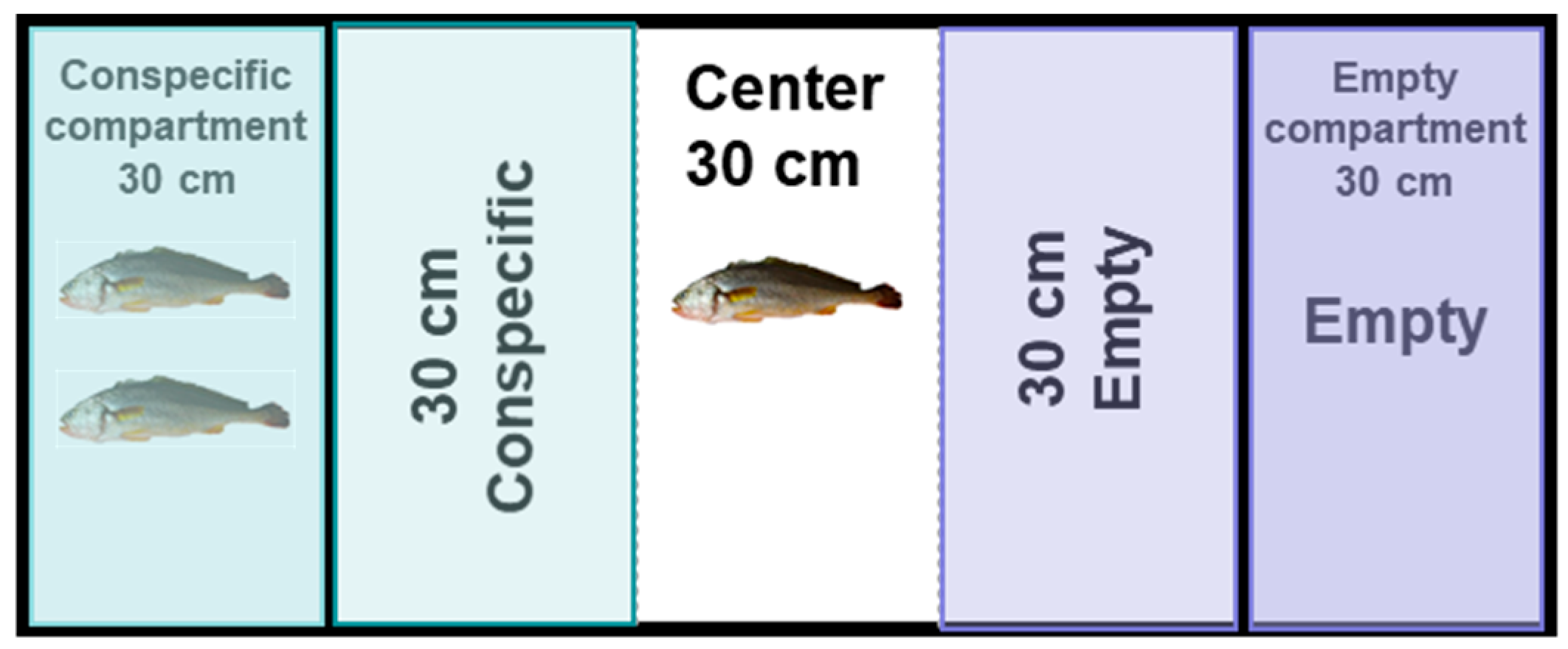
As an important model organism, zebrafish has established a canonical method for assessing social preference [26,27]. Since both zebrafish and the large yellow croaker are teleosts, and research on the latter’s social preference is limited, the zebrafish methodology serves as an excellent reference. Therefore, in this study social preference tests were performed based on zebrafish neurobehavioral analysis protocols [26,27]. The test tank was composed of five vertical portions (Figure 1): conspecific compartment (30 cm width, 2 fish), conspecific zone (30 cm width, between conspecific compartment and center zone), center zone (30 cm width, the middle zone of tank), empty zone (30 cm width, between center zone and empty compartment), and empty compartment (30 cm width, empty). The conspecific compartment and the conspecific zone were divided by a transparent partition, while the empty compartment and the empty zone were divided by another transparent partition. The center zone and the conspecific zone were divided by an opaque partition, while the center zone and the empty zone were divided by another opaque partition. The test fish was carefully placed in the center of a rectangular tank (150 × 75 × 60 cm, water depth 40 cm) and allowed to acclimate for 5 min. After that, the opaque partitions separating the center zone from both the conspecific zone and the empty zone were gently removed, and the social behavior of each fish was recorded for 15 min. Each behavioral test was performed 2 h after feeding under quiet conditions and in similar contexts. Video tracking and analysis were performed using EthoVision XT 18 (Noldus, Wageningen, The Netherlands). A total of 36 individuals were tested, and the nine individuals that spent the most time and the nine that spent the least time in the conspecific zone were selected. The nine individuals with the longest cumulative time were designated as the high-sociability (HS) group, and the nine individuals with the shortest cumulative time were designated as the low-sociability (LS) group. Fish body weight was measured with an electronic balance (precision: 0.01 g; Xiuilab, Shanghai, China) and behavior endpoints (including total distance traveled) were analyzed by the EthoVision XT 18 system (Noldus, Wageningen, The Netherlands).
The test tank was divided into five vertical sections: a conspecific compartment (30 cm wide, containing two fish), a conspecific zone (30 cm, adjacent to the conspecific compartment), a center zone (30 cm, located centrally), an empty zone (30 cm, positioned between the center zone and the empty compartment), and an empty compartment (30 cm, unoccupied). Transparent partitions separated the conspecific compartment from the conspecific zone and the empty compartment from the empty zone.

2.3. Neurotransmitter-Targeted Metabolomics Analysis

Neurotransmitter-targeted metabolomics analysis of brain tissue samples from large yellow croaker was performed using LC-ESI-MS/MS (UHPLC-Qtrap; AB Sciex, Marlborough, MA, USA) on a ExionLC AD system coupled with a QTRAP® 6500+ mass spectrometer (AB Sciex, Marlborough, MA, USA) at Majorbio Bio-Pharm Technology Co., Ltd. (Shanghai, China). The samples were separated via a Waters HSS T3 column (2.1 × 100 mm, 1.8 μm; Waters, Milford, MA, USA) with a column temperature of 35 °C, an injection volume of 1 μL and a flow rate of 0.3 mL/min. Mobile phase A consisted of water containing 0.1% formic acid, while mobile phase B comprised acetonitrile containing 0.1% formic acid. The solvent gradient followed this process: 0–1 min, 0% B; 1–3 min, from 0% to 5% B; 3–5 min, from 5% to 10% B; 5–6 min, from 10% to 15% B; 6–7 min, 15% B; 7–10 min, from 15% to 60% B; 10–11 min, from 60% to 100% B; 11–12 min, 100% B; 12–12.01 min, from 100% to 0% B; 12.01–15 min, 0% B. After chromatographic separation, mass spectrometry was performed using an AB SCIEX QTRAP® 6500+ (AB Sciex, Marlborough, MA, USA) operated in positive/negative mode with the following conditions: curtain gas (CUR) at 35 psi, collision gas (CAD) set to medium, ion spray voltage (IS) at +5500 V for positive mode and −4500 V for negative mode, temperature (TEM) at 550 °C, and ion source gas 1 (GS1) and ion source gas 2 (GS2) both at 55 psi.
A quality control (QC) sample was inserted after every five analyzed samples to determine and evaluate the stability and reproducibility of the entire analytical workflow, with the requirement that the relative standard deviation (RSD) for each target compound’s stability should remain below 15%. The LC-MS raw data were imported into AB Sciex quantitative software OS (Sciex OS 4.0.1, AB Sciex, Marlborough, MA, USA) using default parameters for automatic identification and integration of each ion fragment, with manual inspection. A linear regression standard curve was constructed by plotting the ratio of the mass spectrometric peak area of the analyte to that of the internal standard against the concentration of the analyte. The sample concentration was subsequently determined by substituting the ratio of the mass spectrometric peak area of the sample to that of the internal standard into the linear equation and deriving the concentration result.

2.4. Untargeted Metabolomics Analysis

Untargeted metabolomics analysis of intestine tissue samples from large yellow croaker was conducted using LC-ESI-MS/MS on a UHPLC-Q Exactive HF-X system equipped with an ACQUITY HSS T3 column (100 mm × 2.1 mm i.d., 1.8 μm; Waters, Milford, MA, USA) at Majorbio Bio-Pharm Technology Co., Ltd. (Shanghai, China). Mobile phase A consisted of water/acetonitrile (2:98, v/v) containing 0.1% formic acid, while mobile phase B comprised acetonitrile containing 0.1% formic acid. The flow rate was 0.4 mL/min and the column temperature was 40 °C. The injection volume was 5 μL. After chromatographic separation, mass spectrometry was performed using a UHPLC-Q Exactive HF-X system Mass Spectrometer (Thermo Fisher Scientific, Carlsbad, CA, USA) equipped with an electrospray ionization (ESI) source operating in positive/negative mode with the following conditions: sheath gas flow rate at 40 arb, auxiliary gas flow rate at 10 arb, ion spray voltage floating (ISVF) at −2800 V for negative mode and 3500 V for positive mode, source temperature at 400 °C, normalized collision energy at 20–40–60 V rolling for MS/MS, data acquisition performed with the Data Dependent Acquisition (DDA) mode, and detection carried out over a mass range of 70–1050 m/z.
As a part of the system conditioning and quality control process, a pooled Quality control (QC) sample was prepared by mixing equal volumes of all samples and inserted after every five analyzed samples to determine and evaluate the stability and reproducibility of the entire analytical workflow with the requirement that the relative standard deviation (RSD) should remain below 30%. The pretreatment of LC/MS raw data was performed by Progenesis QI (Waters Corporation, Milford, MA, USA) software v3.0, and a three-dimensional data matrix in CSV format was exported. Internal standard peaks, as well as any known false positive peaks (including noise, column bleed, and derivatized reagent peaks), were removed. At the same time, the metabolites were identified by searching database, and the main databases were the HMDB (http://www.hmdb.ca/, accessed on 25 October 2025), Metlin (https://metlin.scripps.edu/, accessed on 25 October 2025) and the self-compiled Majorbio Database (MJDB) of Majorbio Biotechnology Co., Ltd. (Shanghai, China). The data matrix obtained by database searching was uploaded to the Majorbio cloud platform (https://cloud.majorbio.com, accessed on 25 October 2025) for further analysis.

2.5. Statistical Analysis

Neurobehavioral data are presented as mean with standard deviation. Prior to statistical analyses, data distribution was assessed for normality using GraphPad Prism 8.0 (San Diego, CA, USA). Comparisons between two groups were conducted using Student’s t-test for normally distributed data or the nonparametric Mann–Whitney test when normality assumptions were not met.
MetaboAnalyst represents a comprehensive and widely utilized computational platform for metabolomic data interpretation [30,31]. In accordance with the online workflow provided by MetaboAnalyst (https://www.xialab.ca/tools.xhtml, accessed on 25 October 2025), targeted metabolomic profiles of brain neurotransmitters were subjected to multivariate statistical analyses, including principal component analysis (PCA), partial least squares discriminant analysis (PLS-DA), and hierarchical heatmap clustering to elucidate metabolic patterns and correlation structures. Both PCA and PLS-DA models delineated distinct 95% confidence ellipses, accompanied by loading plots to illustrate metabolite contributions to group separation. Univariate analysis of brain metabolites was analyzed by Student’s t-test or the Mann–Whitney nonparametric test between two groups with p < 0.05 indicating significant differences. For intestine metabolomic profiling, differential metabolites were identified with p value < 0.05 and OPLS-DA_VIP > 1. The Kyoto Encyclopedia of Genes and Genomes (KEGG) pathway enrichment analysis was performed to identify and characterize the biological pathways significantly associated with the differential metabolites.

3. Results

3.1. Social Preference Test

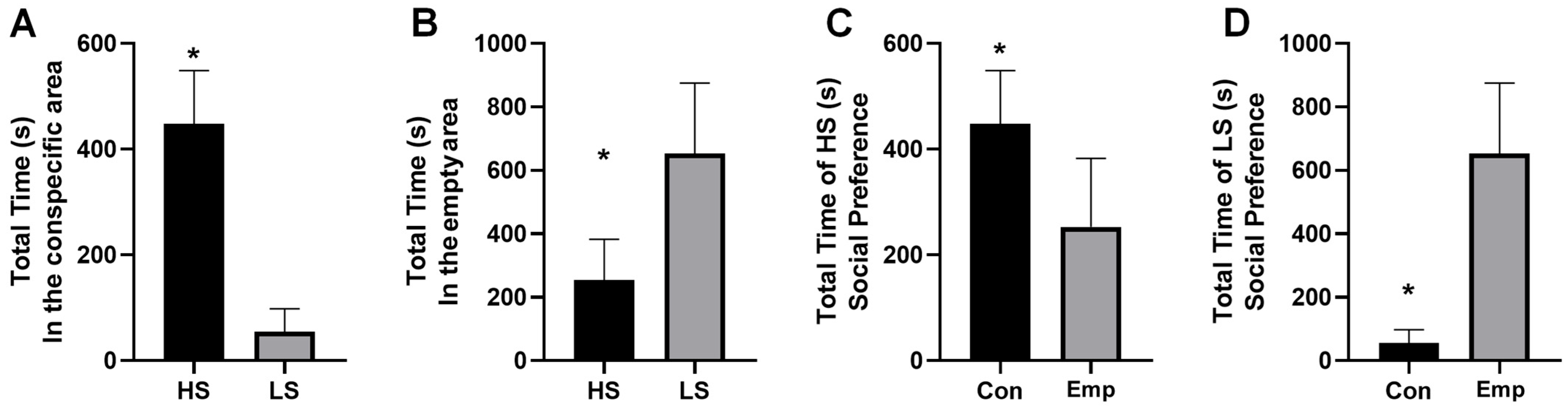
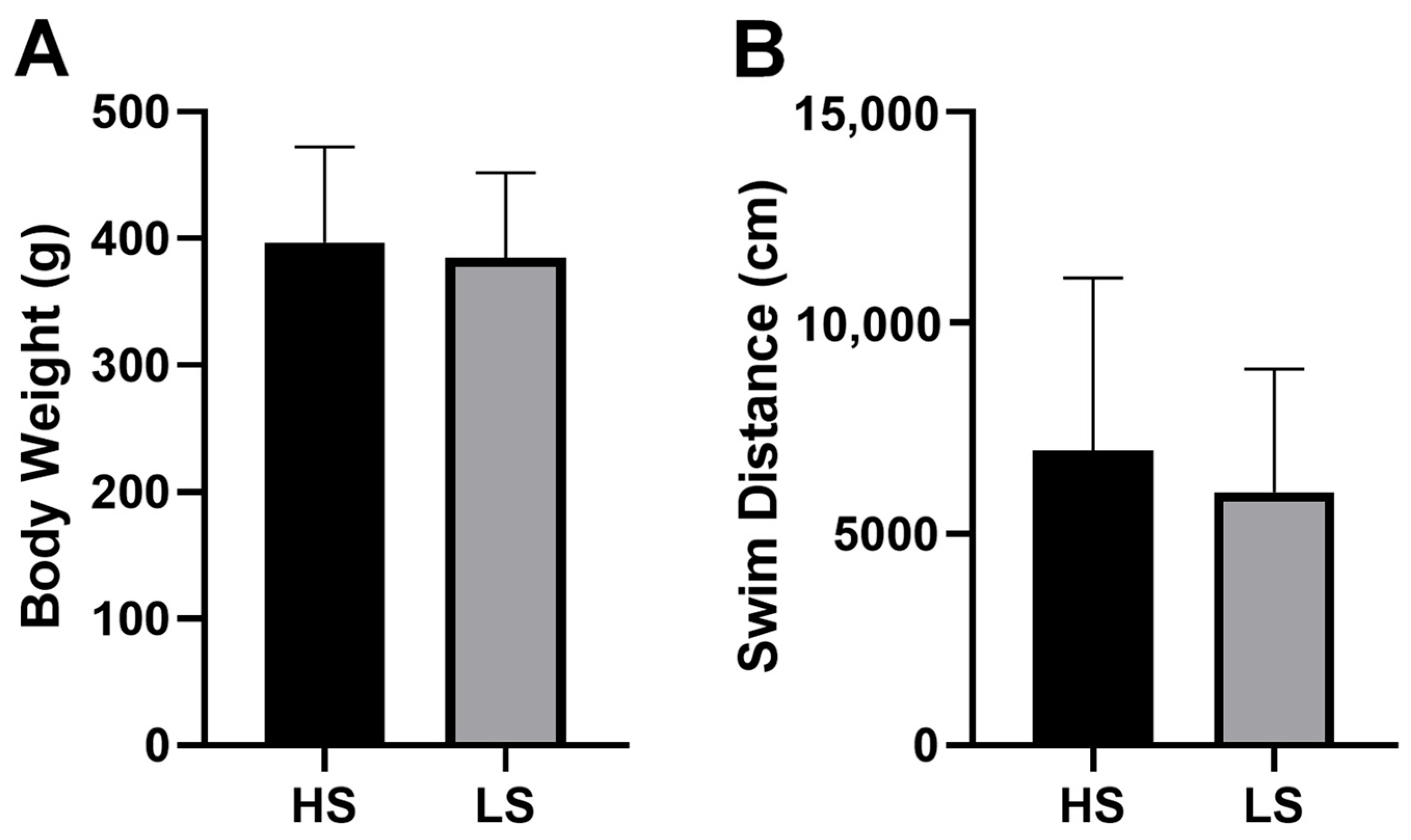
The social preference test revealed that the HS group spent significantly more total time in the conspecific area and less time in the empty area compared with the LS group (Figure 2A,B). Within-group comparisons further showed that the HS group spent markedly more time in the conspecific area than in the empty area, whereas the LS group displayed the opposite pattern, spending significantly more time in the empty area than with conspecifics (Figure 2C,D). No significant differences were observed between groups in body weight or total swimming distance (Figure 3A,B).

3.2. Brain Targeted Neurotransmitter Metabolomic Profiling Between the HS and LS Groups

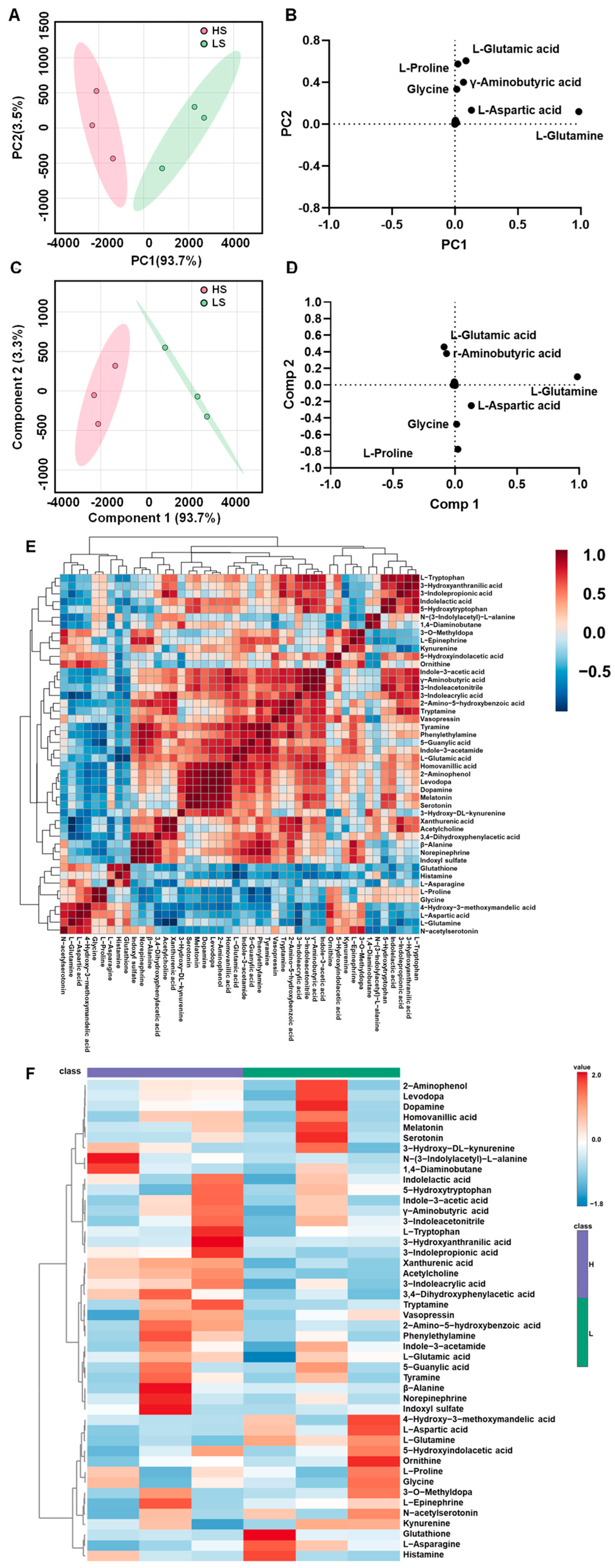
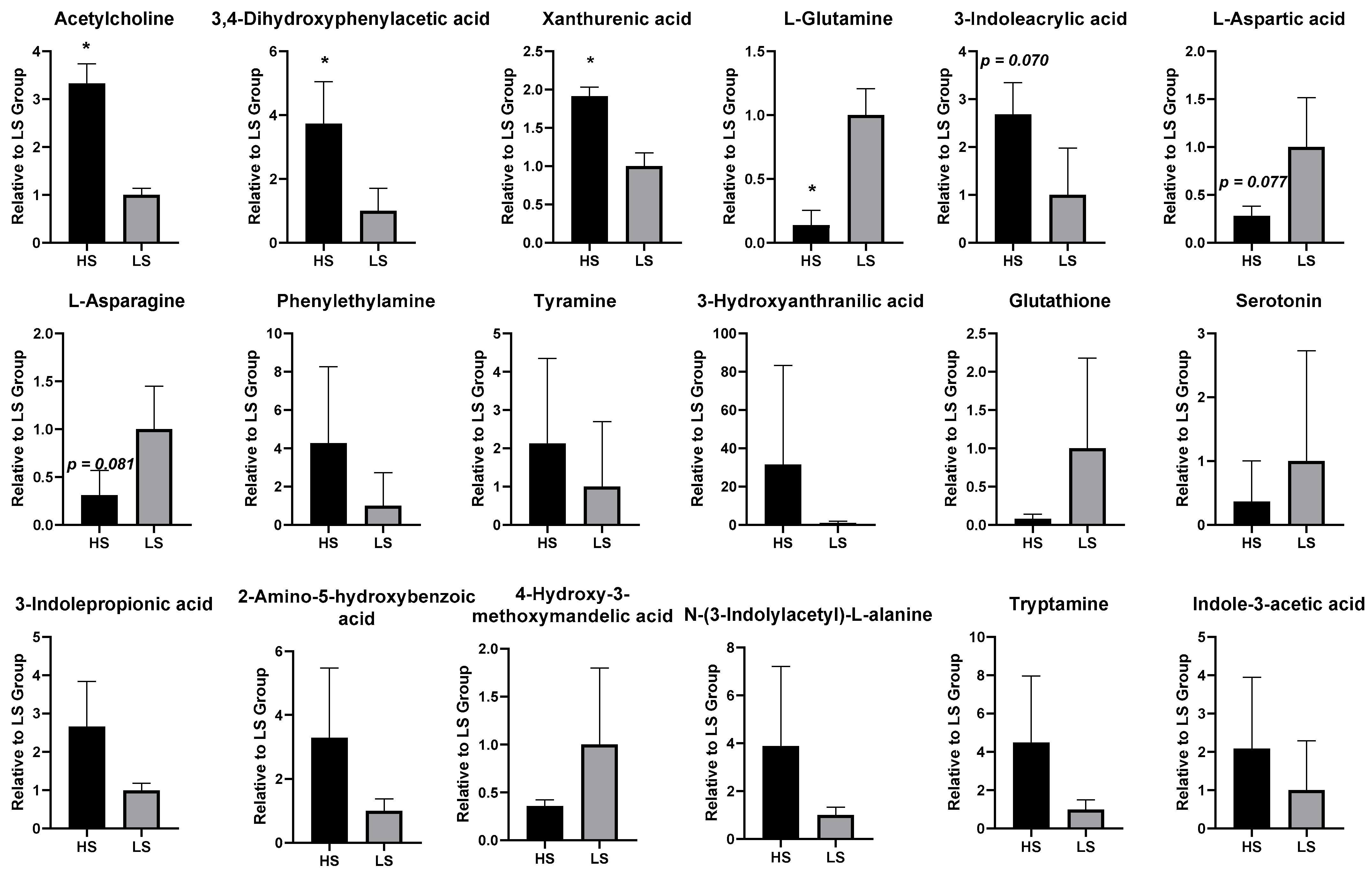
Principal component analysis (PCA) revealed a clear separation between the HS and LS groups (Figure 4A), with PC1 and PC2 explaining 93.7% and 3.5% of the total variance, respectively. Metabolites such as γ-aminobutyric acid, glycine, L-proline, L-aspartic acid, L-glutamic acid, and L-glutamine exhibited high loadings on PC1 or PC2 (Figure 4B). Partial least squares discriminant analysis (PLS-DA) further corroborated the distinct segregation between groups, with Component 1 and Component 2 accounting for 93.7% and 3.3% of the total variance, respectively (Figure 4C). The same metabolites contributed strongly to Component 1 and Component 2 (Figure 4D). The heatmap showed metabolite correlations and abundance levels (Figure 4E,F). HS group showed significantly changed levels of acetylcholine, 3,4-Dihydroxyphenylacetic acid, Xanthurenic acid, L-Glutamine but not dopamine compared to LS (Figure 5 and Figure S1). The 3-Indolepropionic acid, L-Aspartic acid and L-Asparagine showed a significant trend of change (Figure 5).

3.3. Intestine Metabolomic Profiling Between the HS and LS Groups

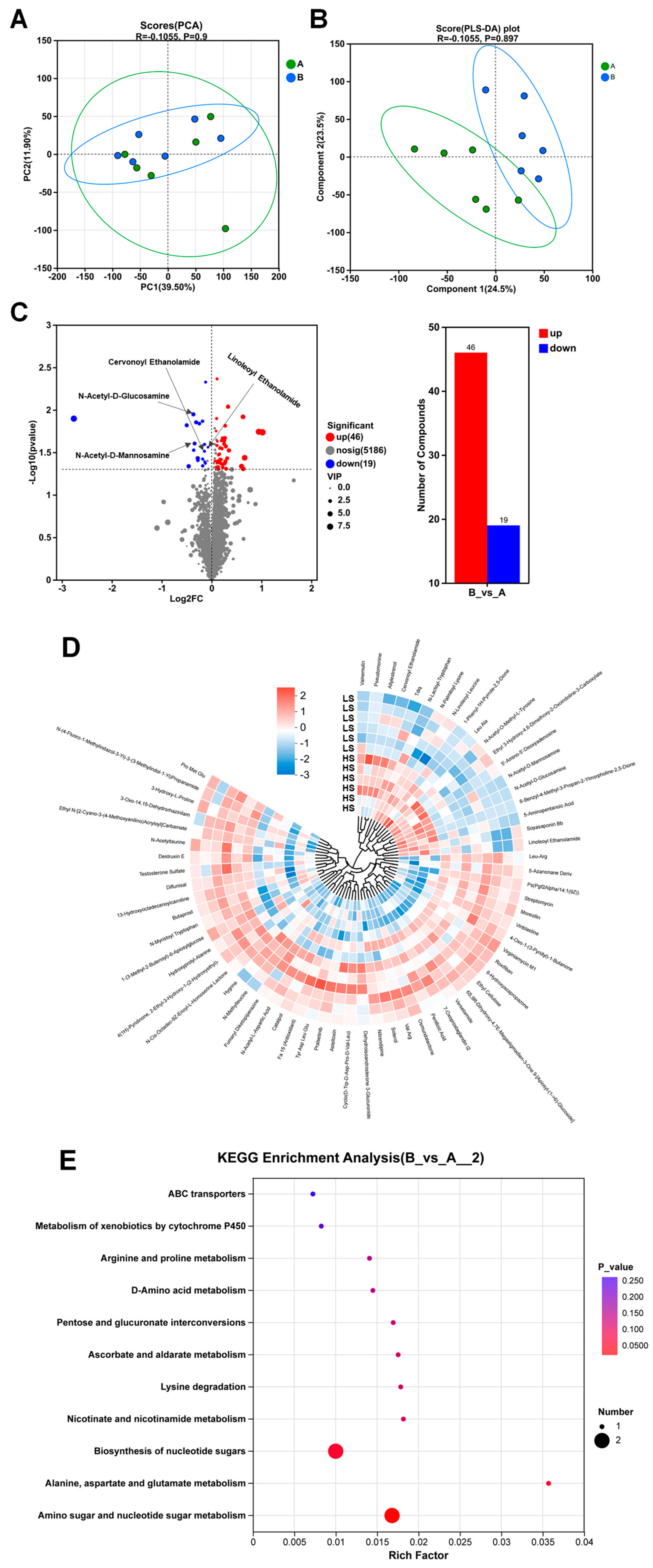
PCA analysis revealed that PC1 and PC2 accounted for 39.5% and 11.9% of the variance between the HS and LS groups, respectively (Figure 6A). Compared with PCA, PLS-DA analysis exhibited a clearer separation of metabolomic profiles between the two groups, with Component 1 and Component 2 explaining 24.5% and 23.5% of the variance, respectively (Figure 6B). A total of 65 differential metabolites were identified (with p value < 0.05 & OPLS-DA_VIP > 1), including 46 upregulated and 19 downregulated metabolites in the LS group relative to the HS group (Figure 6C,D). KEGG pathway enrichment analysis indicated that these metabolites were primarily involved in amino sugar and nucleotide sugar metabolism, alanine, aspartate and glutamate metabolism, biosynthesis of nucleotide sugars, and nicotinate and nicotinamide metabolism (Figure 6E).

4. Discussion

This study was designed to integrate behavioral phenotyping with multi-tissue metabolomics to uncover the physiological and metabolic underpinnings of sociability in the large yellow croaker. The rationale for employing a social preference test was to objectively classify individuals into distinct behavioral phenotypes (high- vs. low-sociability), thereby providing a robust behavioral foundation for subsequent metabolic investigations. Studies have demonstrated that neurotransmitters and metabolites within the gut–brain axis regulate behavioral endpoint in both mammals and teleosts [32,33,34,35]. However, given species-specific characteristics and the distinct regulatory mechanisms underlying different behaviors, we employed high-throughput omics approaches to broadly screen for candidate neurotransmitters and metabolites. By combining targeted neurotransmitter profiling in the brain with untargeted metabolomics in the intestine, we aimed to capture systemic interactions along the gut–brain axis that may collectively regulate social behavior. Our integrative approach not only reveals key neurochemical and metabolic signatures associated with sociability but also establishes a mechanistic framework that links behavioral variation to underlying physiological pathways, offering novel insights for welfare assessment and selective breeding in aquaculture.
The social preference test revealed a clear divergence between the HS and LS groups, with the former exhibiting a strong preference for the conspecific area, while the latter actively avoided it. This behavioral distinction underscores the critical role of sociability in mediating key ecological benefits associated with group living, such as enhanced foraging efficiency and collective anti-predator defense [36,37]. Furthermore, social interactions are integral to growth and reproductive success [38,39]. Notably, the observed differences in social tendency were not attributable to variations in body weight or general locomotor activity, suggesting that intrinsic neuroregulatory mechanisms underlie these behavioral phenotypes [40,41,42].
Targeted metabolomic profiling further revealed significant disparities in acetylcholine between the two groups, implicating neurochemical pathways in modulating social preference. Evidence from human and animal studies indicates that impairments in the cholinergic system may contribute to autism-related behavioral abnormalities [43]. Autism spectrum disorders (ASD) are characterized by deficits in social communication and interaction. In mouse models exhibiting core ASD-like traits and reduced cerebral acetylcholine levels, administration of an acetylcholinesterase inhibitor markedly alleviated autism-associated behaviors, reducing cognitive rigidity while enhancing social preference and interaction [43]. Nicotinic acetylcholine receptors (nAChRs) are crucial for the modulation of social behavior. Mice lacking the β4 subunit of nAChRs exhibit aberrant social responses characterized by social amnesia [44]. Consistently, acetylcholinesterase inhibitors have been shown to increase anxiety-like behavior and cortisol levels in teleost, suggesting a stress-induced physiological state [45]. These studies confirm that acetylcholine is a key neurotransmitter regulating stress responses and social behavior in teleost, and the development of analogs or acetylcholinesterase inhibitors might represent a potentially effective strategy for enhancing productivity in aquaculture.
Moreover, neurotransmitter-targeted metabolomics analysis of brain tissue samples from large yellow croaker demonstrated that, in the HS group, the levels of Xanthurenic acid (XA) and 3,4-Dihydroxyphenylacetic acid (DOPAC) were significantly increased, while the levels of L-Glutamine were significantly decreased, compared with the LS group. XA can promote the release of dopamine (DA) in the brain [46]. DOPAC is a dopamine metabolite [47], and a study demonstrated that DOPAC levels can serve as an indicator of dopamine release velocity in avian subjects [48]. Therefore, the increased levels of XA and DOPAC in the HS group might indicate elevated brain dopamine levels. Dopamine has been shown to promote social interactions in teleost. For example, social deficits in a valproic acid-based zebrafish autism model were rescued by treatment with the dopamine D3 receptor agonists pramipexole, piribedil, and 7-hydroxy-DPAT-HBr [49]. Therefore, the higher sociality in the HS group could be linked to elevated brain dopamine levels. This suggests that dopamine is a vital neurotransmitter in modulating social behavior. However, the oxidation of excess dopamine, whether through enzymatic reactions or auto-oxidation, generates reactive oxygen and nitrogen species, leading to oxidative stress, which is a key factor in dopaminergic neurotoxicity [50]. Furthermore, one study has found that Glutamine exhibits a protective effect against oxidative stress damage [51]. Consequently, in the HS group, the elevated levels of XA and DOPAC indicate heightened dopamine activity, which may contribute to oxidative stress, as evidenced by the reduction in L-Glutamine.
Untargeted metabolomics analysis of intestinal tissues from large yellow croaker revealed significantly higher levels of Linoleoyl ethanolamide (LEA) and Cervonoyl ethanolamide (CEA) in the HS group than in the LS group. Studies indicate that LEA acts as a weak binder of the cannabinoid receptors CB1 and CB2 [52], and CEA functions as an agonist for these same receptors [53]. Evidence suggests that activating cannabinoid receptors CB1 and CB2 can reduce aggressive behavior. For example, in zebrafish, treatment with the CB1 agonist ACEA consistently reduced strike and bite aggressive behavior more than the control or CB1 antagonist AM-251 groups [54]. In addition, group-housed CB2KO mice displayed heightened aggression compared to WT mice. Conversely, activating CB2 receptors with the agonist JWH133 significantly suppressed aggression in isolated Oncins France 1 (OF1) mice, whereas the CB2 antagonist AM630 prevented this effect [55]. However, relevant studies are lacking in teleost. Our future studies would investigate whether elevated LEA and CEA reduce aggressive behavior by activating CB1 and CB2 receptors, thus promoting calmer behavioral states and higher sociability.
Based on elevated intestinal LEA and CEA (cannabinoid receptor ligands) in the HS group, we propose endocannabinoid system mediation along the gut–brain axis. The endocannabinoid system bidirectionally links gut and brain, with intestinal endocannabinoids influencing central neurotransmission [56]. Critically, ECS activity directly intersects with the key neurochemical pathways identified in our brain metabolomics [57,58,59,60]. For example, CB1 receptors modulate dopamine (DA) release and DA-related behaviors, including social responses [57,58], which aligns with our findings of elevated DA turnover (increased DOPAC) in the HS group. Simultaneously, endocannabinoid system regulates cholinergic transmission [59,60], which is implicated in social behavior and stress response and showed disparities in acetylcholine in our study. Therefore, we hypothesize that higher intestinal LEA/CEA in HS fish may enhance ECS tone, thereby positively modulating brain DA activity and fine-tuning cholinergic function. This integrated neurochemical shift could promote a behavioral state of reduced aggression and enhanced social preference, consistent with known effects of cannabinoid receptor activation [54,55]. This pathway provides a plausible mechanism linking our intestinal and cerebral metabolomic profiles.
In addition, untargeted metabolomics of intestinal tissues from large yellow croaker revealed significantly higher levels of N-Acetyl-D-Glucosamine (NAG) and N-Acetyl-D-Mannosamine (ManNAc) in the HS group than in the LS group. Moreover, the KEGG pathway enrichment analysis showed that NAG and ManNAc were significantly enriched in the amino sugar and nucleotide sugar metabolism pathway. NAG and ManNAc likely underpin a gut–brain axis mechanism promoting sociality [61,62,63]. NAG is an amino sugar that is a component of the mucin produced by intestinal epithelial cells [64]. One study showed that fathead minnows (Pimephales promelas) were attracted to waterborne NAG, indicating it may act as a key chemosensory cue for fish [65]. Moreover, in mice, a 0.3% NAG-supplemented diet reduced populations of pathogenic bacteria like Betaproteobacteria, particularly Burkholderiales, which suggests that NAG alleviates inflammation by enhancing intestinal barrier function and maintaining gut microbiota homeostasis [64]. We therefore hypothesize that fish in the HS group synthesized more NAG, thus explaining their social preference for the conspecific area. Furthermore, higher intestinal NAG levels in the HS group might promote gut health, which may in turn be conducive to their higher sociability. This aligns with evidences that animal behaviors, such as social interactions and aggressive actions, are modulated by the health of the gut microbial ecosystem and metabolites like NAG [61,66]. In addition, ManNAc, an isomer of NAG, serves as a precursor for sialic acids [62], which are essential for brain development and cognitive function [63]. Administration of ManNAc in drinking water enhanced object recognition in middle-aged mice, as evidenced by an increased index score in the place recognition task [67]. In dogs, ManNAc administration led to the amelioration of age-related cognitive dysfunction [62]. The expression of social preferences requires individuals to distinguish conspecifics from blanks [68]. Therefore, in the HS group, higher intestinal ManNAc levels may enhance cognitive function, enabling fish to more accurately distinguish conspecifics from blanks and thus exhibit a stronger social preference for conspecifics. Collectively, the co-elevation of NAG and ManNAc suggests a synergistic gut–brain pathway: NAG may promote a healthier gut environment and reduce systemic inflammatory tone, while ManNAc may directly support the brain’s structural and functional needs for complex social cognition, together fostering a physiological state conducive to higher sociability.
In addition to intrinsic neurochemical and metabolic differences, environmental context may also play a critical role in modulating sociability and other behavior endpoints via gut–brain axis, as evidenced by studies in other species [9,10,35]. Social behavior is a vital component of fish welfare and is driven by endocrine factors [22]. Therefore, environmental enrichment, including improved social conditions, reduced stressors, or modified sensory cues that influence hypothalamus–pituitary–interrenal (HPI) and gut–brain axes, may enhance sociality in large yellow croaker and consequently improve both welfare and aquaculture productivity. Future studies could test whether environmental interventions and/or feed additives can shift metabolic profiles, gut microbiota and behavioral phenotypes toward higher sociability, offering practical strategies for aquaculture welfare and productivity.
One limitation of this study is that the omics findings require further validation. For future studies, we plan to perform qPCR and/or ELISA experiments to validate the key results. Furthermore, the social preference assay was conducted as a single replicate and thus appears to overlook potential spatial biases. We plan to perform an additional trial with reversed chamber orientation to validate the findings in the following studies. Additionally, our behavioral assessment was limited to a single social preference test without complementary assays for anxiety, stress response, or other behavioral phenotypes that are known to interact with sociability. As noted in previous studies, environmental factors, stress, and anxiety can significantly modulate social behavior in teleost and rodent models [9,10]. The absence of such behavioral data in our study limits our ability to disentangle whether the observed sociability differences in large yellow croaker are driven primarily by intrinsic neurochemical profiles or are also influenced by stress/anxiety states. Future studies should integrate multi-dimensional behavioral phenotyping (e.g., novel tank test, cortisol measurement) to provide a more holistic understanding of the behavioral and physiological underpinnings of sociability.
With the continued expansion and intensification of aquaculture, public awareness regarding the welfare of cultured fish has grown considerably. Stress responses, production-associated disorders, and inhibited growth represent key challenges within the industry, the impacts of which can be mitigated through timely detection of early indicators of compromised welfare [69]. Given that social behaviors serve as important indicators of welfare status in teleost fish [22], our study provides a potential non-invasive approach for assessing fish welfare.

5. Conclusions

In this study, social preference assay demonstrated pronounced differences in sociability between HS and LS fish, independent of locomotor activity or body size. Brain metabolomic profiling revealed group-specific neurochemical signatures, highlighting acetylcholine- and dopamine-related pathways as key regulators of social behavior. Intestinal metabolomics further indicated that amino–sugar metabolism and endocannabinoid-related metabolites may influence sociability through gut–brain interactions. Together, these results suggest that social behavior in large yellow croaker is shaped by coordinated neurochemical and intestinal metabolic processes. This work identifies potential physiological markers of fish sociability and provides a scientific basis for improving welfare evaluation and selective breeding strategies in aquaculture.

Supplementary Materials

The following supporting information can be downloaded at: https://www.mdpi.com/article/10.3390/fishes10120654/s1, Figure S1. Analysis of dopamine based on targeted metabolomics. HS: high-sociability, LS: low-sociability.

Author Contributions

Conceptualization, G.-Y.W., Z.-X.Z., H.-H.C., B.Q., Y.-Z.W., L.D. and P.J.; methodology, G.-Y.W., Z.-X.Z., H.-H.C., B.Q., Y.-Z.W., L.D. and P.J.; formal analysis, G.-Y.W., Z.-X.Z., H.-H.C. and B.Q.; data curation, G.-Y.W., Z.-X.Z., H.-H.C. and B.Q.; writing—original draft preparation, G.-Y.W., Z.-X.Z., X.-W.-J.C. and Z.-S.H.; writing—review and editing, G.-Y.W., Z.-X.Z., X.-W.-J.C. and Z.-S.H.; project administration, G.-Y.W., Z.-X.Z., X.-W.-J.C. and Z.-S.H.; funding acquisition, G.-Y.W., X.-W.-J.C. and Z.-S.H. All authors have read and agreed to the published version of the manuscript.

Funding

This research was funded by the National Key Research and Development Program of China (Project No. 2024YFD2400300), Development Plan of Youth innovation team in colleges and universities in Shandong Province (2023KJ031).

Institutional Review Board Statement

The research in this manuscript has been conducted under the Ethics Committees of Ocean University of China (approval code: OUC-AE-2025-303 and approval date: 30 March 2025).

Data Availability Statement

The original contributions presented in this study are included in the article/Supplementary Material. Further inquiries can be directed to the corresponding authors.

Conflicts of Interest

The authors declare no conflicts of interest.

References

  1. Krause, J.; Ruxton, G.D. Living in Groups; Oxford University Press: Oxford, UK, 2002. [Google Scholar]
  2. Peichel, C.L. Social behavior: How do fish find their shoal mate? Curr. Biol. 2004, 14, R503–R504. [Google Scholar] [CrossRef]
  3. Berdahl, A.M.; Kao, A.B.; Flack, A.; Westley, P.A.H.; Codling, E.A.; Couzin, I.D.; Dell, A.I.; Biro, D. Collective animal navigation and migratory culture: From theoretical models to empirical evidence. Philos. Trans. R. Soc. B-Biol. Sci. 2018, 373, 16. [Google Scholar] [CrossRef]
  4. Lin, X.W.; Volkoff, H.; Narnaware, Y.; Bernier, N.J.; Peyon, P.; Peter, R.E. Brain regulation of feeding behavior and food intake in fish. Comp. Biochem. Physiol. A-Mol. Integr. Physiol. 2000, 126, 415–434. [Google Scholar] [CrossRef]
  5. Fu, C.W.; Horng, J.L.; Chou, M.Y. Fish Behavior as a Neural Proxy to Reveal Physiological States. Front. Physiol. 2022, 13, 8. [Google Scholar] [CrossRef]
  6. Corral-Lopez, A.; Bloch, N.I.; van der Bijl, W.; Cortazar-Chinarro, M.; Szorkovszky, A.; Kotrschal, A.; Darolti, I.; Buechel, S.D.; Romenskyy, M.; Kolm, N.; et al. Functional convergence of genomic and transcriptomic architecture underlies schooling behaviour in a live-bearing fish. Nat. Ecol. Evol. 2024, 8, 17. [Google Scholar] [CrossRef] [PubMed]
  7. Réale, D.; Reader, S.M.; Sol, D.; McDougall, P.T.; Dingemanse, N.J. Integrating animal temperament within ecology and evolution. Biol. Rev. 2007, 82, 291–318. [Google Scholar] [CrossRef] [PubMed]
  8. Gartland, L.A.; Firth, J.A.; Laskowski, K.L.; Jeanson, R.; Ioannou, C.C. Sociability as a personality trait in animals: Methods, causes and consequences. Biol. Rev. 2022, 97, 802–816. [Google Scholar] [CrossRef] [PubMed]
  9. Dougnon, G.; Matsui, H. Environmental context modulates sociability in ube3a zebrafish mutants via alterations in sensory pathways. Mol. Psychiatr. 2025, 31, 15. [Google Scholar] [CrossRef]
  10. Wang, Q.; Wang, Y.Q.; Tian, Y.Y.; Li, Y.Y.; Han, J.; Tai, F.D.; Jia, R. Social environment enrichment alleviates anxiety-like behavior in mice: Involvement of the dopamine system. Behav. Brain Res. 2024, 456, 10. [Google Scholar] [CrossRef]
  11. Sumpter, D.J.T.; Szorkovszky, A.; Kotrschal, A.; Kolm, N.; Herbert-Read, J.E. Using activity and sociability to characterize collective motion. Philos. Trans. R. Soc. B-Biol. Sci. 2018, 373, 10. [Google Scholar] [CrossRef]
  12. Panula, P.; Sallinen, V.; Sundvik, M.; Kolehmainen, J.; Torkko, V.; Tiittula, A.; Moshnyakov, M.; Podlasz, P. Modulatory Neurotransmitter Systems and Behavior: Towards Zebrafish Models of Neurodegenerative Diseases. Zebrafish 2006, 3, 235–247. [Google Scholar] [CrossRef]
  13. Li, X.; Liu, H.S.; Li, D.; Lei, H.J.; Wei, X.R.; Schlenk, D.; Mu, J.L.; Chen, H.X.; Yan, B.; Xie, L.T. Dietary Seleno-L-Methionine Causes Alterations in Neurotransmitters, Ultrastructure of the Brain, and Behaviors in Zebrafish (Danio rerio). Environ. Sci. Technol. 2021, 55, 11894–11905. [Google Scholar] [CrossRef]
  14. De Gregorio, D.; Popic, J.; Enns, J.P.; Inserra, A.; Skalecka, A.; Markopoulos, A.; Posa, L.; Lopez-Canul, M.; Qianzi, H.; Lafferty, C.K.; et al. Lysergic acid diethylamide (LSD) promotes social behavior through mTORC1 in the excitatory neurotransmission. Proc. Natl. Acad. Sci. USA 2021, 118, 9. [Google Scholar] [CrossRef]
  15. Stettler, P.R.; Antunes, D.F.; Taborsky, B. The serotonin 1A receptor modulates the social behaviour within groups of a cooperatively-breeding cichlid. Horm. Behav. 2021, 129, 10. [Google Scholar] [CrossRef] [PubMed]
  16. Moura, L.A.D.; Pyterson, M.P.; Pimentel, A.F.N.; Araujo, F.; Souza, L.; Mendes, C.H.M.; Costa, B.P.D.; Siqueira-Silva, D.H.D.; Maximino, M.L.; Maximino, C. Roles of the 5-HT2C receptor on zebrafish sociality. Prog. Neuro-Psychopharmacol. Biol. Psychiatry 2023, 125, 10. [Google Scholar] [CrossRef]
  17. de Souza, L.; Oliveira, L.N.; Costa, B.P.D.; Lima-Maximino, M.; Veloso, V.; Maximino, C. Roles of the 5-HT1A receptor in zebrafish responses to potential threat and in sociality. J. Psychopharmacol. 2025, 39, 1476–1490. [Google Scholar] [CrossRef] [PubMed]
  18. Chang, X.L.; Wang, X.F.; Feng, J.C.; Su, X.; Liang, J.P.; Li, H.; Zhang, J.X. Impact of chronic exposure to trichlorfon on intestinal barrier, oxidative stress, inflammatory response and intestinal microbiome in common carp (Cyprinus carpio L.). Environ. Pollut. 2020, 259, 9. [Google Scholar] [CrossRef]
  19. Cryan, J.F.; O’Riordan, K.J.; Sandhu, K.; Peterson, V.; Dinan, T.G. The gut microbiome in neurological disorders. Lancet Neurol. 2020, 19, 179–194. [Google Scholar] [CrossRef] [PubMed]
  20. Gu, W.Q.; Liu, S.; Chen, L.; Liu, Y.X.; Gu, C.; Ren, H.Q.; Wu, B. Single-Cell RNA Sequencing Reveals Size-Dependent Effects of Polystyrene Microplastics on Immune and Secretory Cell Populations from Zebrafish Intestines. Environ. Sci. Technol. 2020, 54, 3417–3427. [Google Scholar] [CrossRef]
  21. Maares, M.; Haase, H. A Guide to Human Zinc Absorption: General Overview and Recent Advances of In Vitro Intestinal Models. Nutrients 2020, 12, 43. [Google Scholar] [CrossRef]
  22. Cavallino, L.; Rincón, L.; Scaia, M.F. Social behaviors as welfare indicators in teleost fish. Front. Vet. Sci. 2023, 10, 12. [Google Scholar] [CrossRef]
  23. Cohen, S.; McKay, G. Social support, stress and the buffering hypothesis: A theoretical analysis. In Handbook of Psychology and Health, Volume IV; Routledge: Oxfordshire, UK, 2020; pp. 253–267. [Google Scholar]
  24. Zhang, H.Y.; Wang, J.C.; Jing, Y. Larimichthys crocea (large yellow croaker): A bibliometric study. Heliyon 2024, 10, 17. [Google Scholar] [CrossRef]
  25. FAO. Fishery and Aquaculture Statistics—Yearbook 2023; FAO Yearbook of Fishery and Aquaculture Statistics: Rome, Italy, 2025. [Google Scholar]
  26. Kalueff, A.V.; Cachat, J.M. Zebrafish Neurobehavioral Protocols; Allan, V., Kalueff, J.M.C., Eds.; Humana Press: New York, NY, USA, 2011. [Google Scholar] [CrossRef]
  27. Kalueff, A.V.; Stewart, A.M. Zebrafish Protocols for Neurobehavioral Research; Allan, V., Kalueff, A.M.S., Eds.; Humana Press: New York, NY, USA, 2012. [Google Scholar] [CrossRef]
  28. Brown, C.; Laland, K. Social enhancement and social inhibition of foraging behaviour in hatchery-reared Atlantic salmon. J. Fish Biol. 2002, 61, 987–998. [Google Scholar] [CrossRef]
  29. Hu, X.; Zhang, Z.X.; Qian, M.Z.; Li, Z.; Feng, Z.H.; Luo, S.Y.; Gao, Q.F.; Hou, Z.S. Low light intensity dysregulated growth and behavior of juvenile rainbow trout (Oncorhynchus mykiss) via microbiota-gut-brain axis. Aquaculture 2025, 603, 13. [Google Scholar] [CrossRef]
  30. Ewald, J.D.; Zhou, G.Y.; Lu, Y.; Kolic, J.; Ellis, C.; Johnson, J.D.; Macdonald, P.E.; Xia, J.G. Web-based multi-omics integration using the Analyst software suite. Nat. Protoc. 2024, 19, 33. [Google Scholar] [CrossRef]
  31. Pang, Z.Q.; Lu, Y.; Zhou, G.Y.; Hui, F.A.; Xu, L.; Viau, C.; Spigelman, A.F.; Macdonald, P.E.; Wishart, D.S.; Li, S.Z.; et al. MetaboAnalyst 6.0: Towards a unified platform for metabolomics data processing, analysis and interpretation. Nucleic Acids Res. 2024, 52, W398–W406. [Google Scholar] [CrossRef]
  32. Manocha, G.D.; Floden, A.M.; Miller, N.M.; Smith, A.J.; Nagamoto-Combs, K.; Saito, T.; Saido, T.C.; Combs, C.K. Temporal progression of Alzheimer’s disease in brains and intestines of transgenic mice. Neurobiol. Aging 2019, 81, 166–176. [Google Scholar] [CrossRef] [PubMed]
  33. Morais, L.H.; Schreiber, H.L.; Mazmanian, S.K. The gut microbiota-brain axis in behaviour and brain disorders. Nat. Rev. Microbiol. 2021, 19, 241–255. [Google Scholar] [CrossRef] [PubMed]
  34. Yu, F.; Hou, Z.S.; Luo, H.R.; Cui, X.F.; Xiao, J.; Kim, Y.B.; Li, J.L.; Feng, W.R.; Tang, Y.K.; Li, H.X.; et al. Zinc alters behavioral phenotypes, neurotransmitter signatures, and immune homeostasis in male zebrafish (Danio rerio). Sci. Total Environ. 2022, 828, 13. [Google Scholar] [CrossRef] [PubMed]
  35. Yu, F.; Hou, Z.-S.; Luo, H.-R.; Li, H.-X.; Cui, X.-F.; Li, J.-L.; Feng, W.-R.; Tang, Y.-K.; Su, S.-Y.; Gao, Q.-F.; et al. Neurobehavioral disorders induced by environmental zinc in female zebrafish (Danio rerio): Insights from brain and intestine transcriptional and metabolic signatures. Chemosphere 2023, 335, 138962. [Google Scholar] [CrossRef]
  36. Magurran, A.E. The adaptive significance of schooling as an antipredator defense in fish. Ann. Zool. Fenn. 1990, 27, 51–66. [Google Scholar]
  37. Harpaz, R.; Schneidman, E. Social interactions drive efficient foraging and income equality in groups of fish. eLife 2020, 9, 25. [Google Scholar] [CrossRef]
  38. Volpato, G.L.; Fernandes, M.O. SOCIAL-CONTROL OF GROWTH IN FISH. Braz. J. Med. Biol. Res. 1994, 27, 797–810. [Google Scholar]
  39. Maruska, K.P. Social regulation of reproduction in male cichlid fishes. Gen. Comp. Endocrinol. 2014, 207, 2–12. [Google Scholar] [CrossRef]
  40. Otsuka, A.; Inahata, M.; Shimomura, Y.; Kagawa, N. Physiological changes in response to social isolation in male medaka fish. Fish. Sci. 2020, 86, 775–781. [Google Scholar] [CrossRef]
  41. Antunes, D.F.; Soares, M.C.; Taborsky, M. Dopamine modulates social behaviour in cooperatively breeding fish. Mol. Cell. Endocrinol. 2022, 550, 12. [Google Scholar] [CrossRef]
  42. Wang, J.; Zheng, F.; Yin, L.F.; Shi, S.N.; Hu, B.; Qu, H.; Zheng, L. Dopamine Level Affects Social Interaction and Color Preference Possibly Through Intestinal Microbiota in Zebrafish. Zebrafish 2022, 19, 81–93. [Google Scholar] [CrossRef]
  43. Karvat, G.; Kimchi, T. Acetylcholine Elevation Relieves Cognitive Rigidity and Social Deficiency in a Mouse Model of Autism. Neuropsychopharmacology 2014, 39, 831–840. [Google Scholar] [CrossRef]
  44. Salas, R.; Fung, B.; Sturm, R.; De Biasi, M. Abnormal Social Behavior in Nicotinic Acetylcholine Receptor β4 Subunit-Null Mice. Nicotine Tob. Res. 2013, 15, 983–986. [Google Scholar] [CrossRef] [PubMed]
  45. Giacomini, A.; Bueno, B.W.; Marcon, L.; Scolari, N.; Genario, R.; Demin, K.A.; Kolesnikova, T.O.; Kalueff, A.; de Abreu, M.S. An acetylcholinesterase inhibitor, donepezil, increases anxiety and cortisol levels in adult zebrafish. J. Psychopharmacol. 2020, 34, 1449–1456. [Google Scholar] [CrossRef] [PubMed]
  46. Maitre, M.; Taleb, O.; Jeltsch-David, H.; Klein, C.; Mensah-Nyagan, A.G. Xanthurenic acid: A role in brain intercellular signaling. J. Neurochem. 2024, 168, 2303–2315. [Google Scholar] [CrossRef]
  47. Sato, S.; Koitabashi, T.; Koshiro, A. Pharmacokinetic and pharmacodynamic studies of l-dopa in rats. II. effect of l-dopa on dopamine and dopamine metabolite concentration in rat striatum. Biol. Pharm. Bull. 1994, 17, 1622–1629. [Google Scholar] [CrossRef] [PubMed]
  48. Megaw, P.; Morgan, I.; Boelen, M. Vitreal dihydroxyphenylacetic acid (DOPAC) as an index of retinal dopamine release. J. Neurochem. 2001, 76, 1636–1644. [Google Scholar] [CrossRef] [PubMed]
  49. Geng, Y.J.; Yates, C.; Peterson, R.T. Social behavioral profiling by unsupervised deep learning reveals a stimulative effect of dopamine D3 agonists on zebrafish sociality. Cell Rep. Methods 2023, 3, 18. [Google Scholar] [CrossRef] [PubMed]
  50. Miyazaki, I.; Asanuma, M. Dopaminergic neuron-specific oxidative stress caused by dopamine itself. Acta Med. Okayama 2008, 62, 141–150. [Google Scholar]
  51. Zhao, Y.Q.; Wang, Q.; Wang, Y.; Li, J.; Lu, G.; Liu, Z.B. Glutamine protects against oxidative stress injury through inhibiting the activation of PI3K/Akt signaling pathway in parkinsonian cell model. Environ. Health Prev. 2019, 24, 7. [Google Scholar] [CrossRef]
  52. Ezzili, C.; Otrubova, K.; Boger, D.L. Fatty acid amide signaling molecules. Bioorganic Med. Chem. Lett. 2010, 20, 5959–5968. [Google Scholar] [CrossRef]
  53. Yu, J.; He, J.Q.; Chen, D.Y.; Pan, Q.L.; Yang, J.F.; Cao, H.C.; Li, L.J. Dynamic changes of key metabolites during liver fibrosis in rats. World J. Gastroenterol. 2019, 25, 941–954. [Google Scholar] [CrossRef]
  54. Pinheiro, E.F.; Cardoso, P.B.; Luz, W.L.; Assad, N.; Santos-Silva, M.; Leao, L.K.R.; de Moraes, S.A.S.; Passos, A.D.; Batista, E.D.O.; Oliveira, K.; et al. Putative Activation of Cannabinoid Receptor Type 1 Prevents Brain Oxidative Stress and Inhibits Aggressive-Like Behavior in Zebrafish. Cannabis Cannabinoid Res. 2024, 9, 65–73. [Google Scholar] [CrossRef]
  55. Rodríguez-Arias, M.; Navarrete, F.; Blanco-Gandia, M.C.; Arenas, M.C.; Aguilar, M.A.; Bartoll-Andrés, A.; Valverde, O.; Miñarro, J.; Manzanares, J. Role of CB2 receptors in social and aggressive behavior in male mice. Psychopharmacology 2015, 232, 3019–3031. [Google Scholar] [CrossRef]
  56. Sharkey, K.A.; Wiley, J.W. The Role of the Endocannabinoid System in the Brain-Gut Axis. Gastroenterology 2016, 151, 252–266. [Google Scholar] [CrossRef]
  57. Terzian, A.L.; Drago, F.; Wotjak, C.T.; Micale, V. The dopamine and cannabinoid interaction in the modulation of emotions and cognition: Assessing the role of cannabinoid CB1 receptor in neurons expressing dopamine D1 receptors. Front. Behav. Neurosci. 2011, 5, 10. [Google Scholar] [CrossRef]
  58. Han, X.; Liang, Y.; Hempel, B.; Jordan, C.J.; Shen, H.; Bi, G.H.; Li, J.; Xi, Z.X. Cannabinoid CB1 Receptors Are Expressed in a Subset of Dopamine Neurons and Underlie Cannabinoid-Induced Aversion, Hypoactivity, and Anxiolytic Effects in Mice. J. Neurosci. 2023, 43, 373–385. [Google Scholar] [CrossRef] [PubMed]
  59. Acquas, E.; Pisanu, A.; Marrocu, P.; Di Chiara, G. Cannabinoid CB1 receptor agonists increase rat cortical and hippocampal acetylcholine release in vivo. Eur. J. Pharmacol. 2000, 401, 179–185. [Google Scholar] [CrossRef]
  60. Kathmann, M.; Weber, B.; Zimmer, A.; Schlicker, E. Enhanced acetylcholine release in the hippocampus of cannabinoid CB1 receptor-deficient mice. Br. J. Pharmacol. 2001, 132, 1169–1173. [Google Scholar] [CrossRef] [PubMed]
  61. Sarkar, A.; Harty, S.; Johnson, K.V.A.; Moeller, A.H.; Carmody, R.N.; Lehto, S.M.; Erdman, S.E.; Dunbar, R.I.M.; Burnet, P.W.J. The role of the microbiome in the neurobiology of social behaviour. Biol. Rev. 2020, 95, 1131–1166. [Google Scholar] [CrossRef]
  62. Nagasawa, M.; Shimozawa, A.; Mogi, K.; Kikusui, T. N-Acetyl-D-Mannosamine Treatment Alleviates Age-Related Decline in Place-Learning Ability in Dogs. J. Vet. Med. Sci. 2014, 76, 757–761. [Google Scholar] [CrossRef]
  63. Wang, B. Sialic Acid Is an Essential Nutrient for Brain Development and Cognition. Annu. Rev. Nutr. 2009, 29, 177–222. [Google Scholar] [CrossRef] [PubMed]
  64. Choi, S.I.; Shin, Y.C.; Lee, J.S.; Yoon, Y.C.; Kim, J.M.; Sung, M.K. N-Acetylglucosamine and its dimer ameliorate inflammation in murine colitis by strengthening the gut barrier function. Food Funct. 2023, 14, 8533–8544. [Google Scholar] [CrossRef]
  65. Fischer, A.J.; Dew, W.A. Behavioural responses of fathead minnows to carbohydrates found in aquatic environments. J. Fish Biol. 2021, 99, 2040–2043. [Google Scholar] [CrossRef]
  66. Gao, J.; Cheng, X.X.; Wu, X.F.; Zou, C.Z.; He, B.; Ma, W.Q. Integrated Microbiome and Metabolomics Analysis Reveals Altered Aggressive Behaviors in Broiler Chickens Showing Different Tonic Immobility. Animals 2025, 15, 17. [Google Scholar] [CrossRef] [PubMed]
  67. Kikusui, T.; Shimozawa, A.; Kitagawa, A.; Nagasawa, M.; Mogi, K.; Yagi, S.; Shiota, K. N-Acetylmannosamine Improves Object Recognition and Hippocampal Cell Proliferation in Middle-Aged Mice. Biosci. Biotechnol. Biochem. 2012, 76, 2249–2254. [Google Scholar] [CrossRef]
  68. Oliveira, R.F. Mind the fish: Zebrafish as a model in cognitive social neuroscience. Front. Neural Circuits 2013, 7, 15. [Google Scholar] [CrossRef] [PubMed]
  69. Barreto, M.O.; Planellas, S.R.; Yang, Y.F.; Phillips, C.; Descovich, K. Emerging indicators of fish welfare in aquaculture. Rev. Aquac. 2022, 14, 343–361. [Google Scholar] [CrossRef]
Figure 1. Illustration of the experimental apparatus.
Fishes 10 00654 g001
Figure 2. Social preference test between conspecific species and empty boxes. (A) Total time in the conspecific area between HS and LS group. (B) Total time in the empty area between HS and LS group. (C) Total time in the conspecific and empty area within-group comparisons of HS group. (D) Total time in the conspecific and empty area within-group comparisons of LS group. The * indicates significant differences (p < 0.05, n = 9). The “Con” indicates conspecific area and the “Emp” indicates empty area.
Fishes 10 00654 g002
Figure 3. Body weight and swim distance between HS and LS group. (A) Body weight between HS and LS group. (B) Swim distance between HS and LS group.
Fishes 10 00654 g003
Figure 4. Multivariate analysis of brain metabolites based on targeted metabolomics. (A) Principal component analysis; (B) Loading plot of principal component analysis; (C) Partial least squares-discriminant analysis; (D) Loading plot of Partial least squares-discriminant analysis; (E) Correlation analyses of metabolites; (F) Heatmap analyses of metabolites. In the loading plot, metabolites positioned farther from the origin (0, 0) exerted greater influence on the outcomes of the principal component analysis and partial least squares discriminant analysis.
Fishes 10 00654 g004
Figure 5. Univariate analysis of metabolites based on targeted metabolomics. The * indicates p < 0.05.
Fishes 10 00654 g005
Figure 6. Intestine metabolomic profiling between the HS and LS groups. (A) Principal component analysis; (B) Partial least squares-discriminant analysis; (C,D): Differential metabolite analysis, p value < 0.05 & OPLS-DA_VIP > 1; (E) KEGG enrichment analysis of differential metabolites.
Fishes 10 00654 g006
Disclaimer/Publisher’s Note: The statements, opinions and data contained in all publications are solely those of the individual author(s) and contributor(s) and not of MDPI and/or the editor(s). MDPI and/or the editor(s) disclaim responsibility for any injury to people or property resulting from any ideas, methods, instructions or products referred to in the content.