
Article

Effects of Shifts in Bacterial Community on Improving Water Quality and Growth Performance of Pacific Whiteleg Shrimp (Litopenaeus vannamei) in Biofloc Systems

1
The Hunan Provincial Key Laboratory for Health Aquaculture and Product Processing in Dongting Lake Area, College of Life and Environmental Sciences, Hunan University of Arts and Science, Changde 415000, China
2
Mianyang Academy of Agricultural Sciences, Mianyang 621023, China
3
Department of Animal Science & Technology, Shandong Vocational Animal Science and Veterinary College, Weifang 261061, China
*
Author to whom correspondence should be addressed.
The authors contributed equally to this work.
Fishes 2025, 10(12), 626; https://doi.org/10.3390/fishes10120626
Submission received: 28 October 2025 / Revised: 23 November 2025 / Accepted: 28 November 2025 / Published: 6 December 2025

Abstract

This study aimed to induce a shift in a bacterial community by adding substrate into a biofloc system to characterize this shift and estimate its benefits in improving water quality and aquatic animal growth. We compared the bacterial communities between two biofloc systems, either with (sB treatment) or without (nB treatment) the addition of substrate (elastic solid packing filler), and we also analyzed the effects of the shift on the water quality and growth performance of shrimp (Litopenaeus vannamei). Beta diversity analysis indicated that the bacterial communities in the two treatments were significantly different (Jaccard index 0.94 ± 0.01, pseudo-F = 3.96, p = 0.001). The addition of substrate showed significant positive effects on bacterial alpha diversity indices (Shannon, Heip, Pielou, and Simpson; p < 0.05) and the abundances of beneficial genera (e.g., Arenimonas, Arthrobacter, Exiguobacterium, Leadbetterella, Luteolibacter, Marinobacter, Nitratireductor, Novosphingobium, Thermomonas, Plesiocystis, and Rubrivivax; p < 0.05). In addition, the substrate also showed significant positive effects on water quality parameters (TAN, TSS, turbidity, biofloc volume, pH, and carbonate alkalinity; p < 0.05), and it also significantly improved shrimp zootechnical performance indices (survival rate, feed conversion ratio, and productivity; p < 0.05). Redundancy analysis revealed that 94.25–98.58% of the variation in the water quality and the shrimp growth performance between the two treatments could be attributed to the shift in bacterial composition and diversity induced by the addition of substrate. These findings characterize the shift in the microbial community in the biofloc system induced by the substrate, and demonstrate how this shift could be beneficial to the water quality and the growth performance of shrimp.
Key Contribution: We successfully induced a beneficial shift in bacterial community in a biofloc system for rearing Litopenaeus vannamei by adding artificial substrate, and demonstrated that the increased bacterial diversity and changes in bacterial composition contributed to improvements in water quality and L. vannamei growth performance. The findings of this study provide new insights into beneficial shifts in bacterial communities, which will be helpful for optimizing biofloc technology in the future.

1. Introduction

Litopenaeus vannamei (Boone, 1931), the most important and valuable crustacean species worldwide [1], is a euryhaline species that can be cultured at salinities as low as 0.5‰ [2]. For this reason, along with its commercial value, this species is cultured in many inland areas of China [3]. Typically, such culturing involves the addition of artificial sea salt into freshwater ponds [4,5,6], which results in the salinization of receiving water bodies from the shrimp culture process [7].
Biofloc technology (BFT) is an innovative approach for raising Litopenaeus vannamei with minimal or zero water exchange [8]. This approach can reduce discharges of saline water from the shrimp culture process into inland zones [4]. In a system utilizing BFT (biofloc system), microorganisms are importance for maintaining good water quality and to promote the growth performance of cultured aquatic animals (e.g., tilapia, L. vannamei, Fenneropenaeus indicus, F. paulensis, Macrobrachium rosenbergii, common carp, African catfish, Goldern crucian carp, and Indian major carp) [9,10]. However, the bacterial community in a biofloc system is highly dynamic and vulnerable to culture operations. For example, manipulations of the carbon source [11,12,13,14,15,16,17,18,19] and the C:N ratio [20,21,22,23] change the bacterial communities in biofloc systems. Such a shift in a bacterial community has significant impacts on the water quality and growth performance of aquatic animals [21,22]. Therefore, identifying and characterizing the shift in bacterial communities beneficial to water quality and the growth of aquatic animals are helpful for the optimization of BFT [15,24,25,26]. Although bacterial roles in biofloc systems are well known [9,10,27], characterizations of shifts in bacterial communities towards beneficial outcomes in biofloc systems have not been well documented yet [28,29].
We hypothesized that an operation which improves water quality and/or animal growth performance does so by inducing a beneficial shift in the microbial community, given the community’s critical role in both aspects of biofloc systems. Therefore, in light of this hypothesis, it was assumed that a beneficial shift in the microbial community in a biofloc system could be induced by adding artificial substrate to the biofloc system [28,29]. This is because an artificial substrate can provide additional surface area and refuge, reducing cannibalism and competition for space and thereby mitigating water quality degradation and potentially improving animal growth [30,31,32,33,34,35,36]. Recently, studies have corroborated that artificial substrates change the structure of microbial composition and improve water quality in biofloc systems [28,29]. However, whether these effects are induced by the beneficial shift in bacterial community has not yet been documented. Therefore, further insights into the effects of such bacterial community shifts and their benefits are needed to characterize these beneficial shifts and establish a basis for community management in biofloc systems.
In this study, aiming to characterize the beneficial shift in the bacterial community of the biofloc system, we induced a shift in bacterial community by adding a substrate (elastic solid packing filler), and then characterized this shift. Furthermore, we analyzed, for the first time, the effects of a substrate-induced shift in bacterial community on water quality and shrimp growth during a nursery procedure (28 days) for L. vannamei postlarvae (PL) under a salinity condition of 5‰. The findings supplied deep insight on the beneficial shift in bacterial community which is helpful for the optimization of BFT.

2. Materials and Methods

2.1. Shrimp Acclimation, Experimental Design, Operation, and Management

The nursery experiment was conducted using the facilities of Hunan Bifuteng Eco-Agriculture Development Co., Ltd. (BEAD, Changde, China). L. vannamei (~PL10) stocked under a salinity condition of 5.0‰ was supplied by BEAD and acclimated for one week before the experiment.
Two biofloc systems were set up in the present study: one system adding substrate (sB treatment), and the other system without addition of substrate as the control (cB treatment). Each system was established in triplicated concrete tanks (width × length × depth = 2 × 2.5 × 1.3 m) aerated using a 3 kW Roots blower (Changsheng Mechanical and Electrical Equipment Co., Ltd., Zhangqiu, Shandong, China). In the sB treatment, the bottom and walls of each tank were fixed with elastic solid packing filler (nylon, 18 cm in diameter) as substrate, covering approximately 50.1% of the tank’s internal surface area below the water line (Figure 1). The elastic solid packing filler (Figure 1a), composed of nylon yarns radially fixed to a central rope forming an open space, has a low floc-capturing capacity similar to a large mesh (2.5 cm) fiber net [34]. This allows biofloc particles formed on the substrate to be released back into the water column, influencing the system’s bacterial community.
After substrate installation, each tank was filled with culture water (salinity 5.0‰, 5.0 m3 per tank, 1.0 m in depth, Figure 1) and prepared and sterilized according to a previous study [37], and then randomly assigned shrimp PL (0.0025 g) at a density of 4000 individuals m−3 for a 28-day nursery experiment. During the experimental period, PL were fed a commercial diet with a protein content of 40.0% (Alpha Group Co., Ltd, Shenzhen, China), at a frequency of four times a day (6:00, 12:00, 18:00, 24:00), based on the feeding table for shrimp raised under low-salinity conditions recommended by Van Wyk, Davishodgkins, Laramore, Main, Mountain, and Scarpa [2]. Glucose (food-grade, carbohydrate content 90.0%, Fufeng Biotechnology Co., Ltd., Hohhot, China) was applied as the exogenous carbon source to achieve an inputted carbon to nitrogen ratio (C:N) of 15:1, which was determined according to the procedure used in the previous study [37].
Throughout the whole experimental period, no water exchange was conducted, and only evaporative water loss was compensated with dechlorinated tap water (about 1% per week on average). Additionally, during the stage of 14–28 d of the experiment, partial biofloc was removed using a side-stream settling chamber equipped with a submersible pump (JGP-2500L, SENSEN Group Co., Ltd., Zhoushan, China), which operated for 6 h daily at a flow rate of 2.25 m3 h−1 in both treatments to maintain a biofloc volume < 15 mL L−1.

2.2. High-Throughput Sequencing and Data Processing

Throughout the 28-day nursery experiment, water (50 mL) from each tank was collected on a weekly basis, and pooled by treatment (4 samples per treatment). Then, the bacterial DNA genome was extracted and sequenced following the procedure described in our previous study [37]. Briefly, the V3-V4 region of the 16S rRNA gene of the bacterial DNA genome was amplified. Then, the product was purified, quantified, and normalized to construct a library for high-throughput sequencing on the Miseq platform (Sangon Biotech Co., Ltd., Shanghai, China). The data (58451-93572 reads per sample) were deposited to NCBI (PRJNA646765).
Sequencing reads were processed using the QIIME 2 platform (version 2019.10) as described previously [37]. Briefly, ambiguous, adapter, and primer nucleotides were discarded; bases with a quality score < 25 were trimmed; chimeras were filtered; and paired-end reads were merged and dereplicated. Thereafter, operational taxonomic units (OTUs) were constructed at the 0.97 level.

2.3. Determination of 16S rRNA Gene Copies

The 16S rRNA gene was counted using the quantitative real-time PCR method (qRT-PCR). In brief, the qRT-PCR was performed in a 10 μL reaction mixture with a LightCycler480 II Thermal Cycler (Roche, Rotkreuz, Switzerland), using extracted bacterial DNA from water samples as the template, and 341F: 5′-CCTACGGGNGGCWGCAG-3′ and 805R: 5′-GACTACHVGGGTATCTAATCC-3′ as the pair of primers (corresponding to the V3-V4 variable region of the 16S rRNA gene). The 10 μL qRT-PCR reaction mixture contained 5.0 μL 2× SybrGreen qPCR Master Mix (Roche, Rotkreuz, Switzerland), 0.2 μL of each of the 10 μM forward and reverse primers, and 1.0 μL template (extracted bacterial DNA). PCR was performed under the following thermocycler conditions: 95 °C for 3 min; then, 45 cycles of melting at 95 °C for 5 s; and finally, annealing/extending at 60 °C for 30 s, with a dissociation procedure according to instrument guidelines. All reactions were conducted in triplicate. The 16S rRNA gene concentration (copies per milliliter) of bacterial community in a sample was interpolatively calculated from the standard curves (R2 = 0.998) generated by 10-fold serial dilution of a plasmid containing the V3-V4 region of the 16S rRNA gene with the ∆Ct (cycle threshold) method.

2.4. Analysis of Bacterial Composition Profile

OTUs were annotated and collapsed at the phylum, class, order, family, and genus levels with the taxa plugin of QIIME 2 (version 2019.10), with reference to the GreenGene database (13.8). The preliminary abundance of a bacterium in a sample was determined based on its proportion obtained from the annotation process and the total 16S rRNA gene copies of the sample. Thereafter, the preliminary abundance of each bacterium was normalized using the rrnDB database (version 5.6), and the absolute abundance was expressed as bacterial genome copies (normalized 16S rRNA gene copies) per milliliter, on which the proportions of bacteria were recalculated.

2.5. Analysis of Bacterial Diversity

The Jaccard index between bacterial communities of both treatments was used to analyze the beta diversity, and was tested with PERMANOVA [38]. Measures of bacterial alpha diversity (Shannon, Margalef, Berger–Parker, Simpson, Heip, and Pielou) were computed with the diversity plugin prepackaged in QIIME 2 (version 2019.10).

2.6. Water Quality Parameters

Dissolved oxygen and temperature were measured daily with a YSI analyzer (YSI Inc., Yellow Springs, OH, USA). The pH was measured daily using a pH-100 m (LICHEN Sci-Tech, Co., Ltd., Hangzhou, China). Other water parameters (e.g., the three inorganic nitrogen compounds) were determined weekly. In brief, water was sampled and divided into two parts. One aliquot was passed through a pre-weighted 0.45 µm filter membrane (Whatman). The filtrate was used to determine dissolved total nitrogen in water (DTN), total ammonia nitrogen (TAN), nitrite, nitrate, and carbonate alkalinity [39]. At the same time, the membrane was dried to determine the total suspended solid (TSS) content [39]. The remaining aliquot was used to determine whole total nitrogen in the water body (WTN) [39]. Based on the difference between WTN and DTN, we determined total nitrogen contained in biofloc (BTN), which represents the total nitrogen content contained in biofloc per liter of water. Biofloc volume (BFV), representing the volume of settleable solids, was measured weekly using an Imhoff cone where the water sample (1 L) was settled for 15 min [40]. Then, the supernatant in the Imhoff cone was used to spectrophotometrically measure the turbidity [39], which represents the content of unsettleable or small-size particles in the water column.

2.7. Zootechnical Indices

PL weight was monitored on a weekly basis. At harvest, survival rate (SR), weekly increment in body weight (WIW), specific growth rate (SGR), feed conversion ratio (FCR), and productivity were analyzed [40,41].

2.8. Statistical Analyses

Statistical analysis was performed using SPSS 22.0 (IBM Corp, Armonk, NY, USA). Student’s t-test was performed for comparisons of growth parameters between both treatments, after checking data normality and homogeneity with the Shapiro–Wilk test and Levene’s test, respectively. Otherwise, the non-parametric Mann–Whitney U test was used. Percentage data were arcsine-transformed, and bacterial genome copies were log(x + 1)-transformed prior to statistical analysis. For water parameters, alpha diversity indices, and bacterial genome copies (absolute abundances), repeated-measures one-way ANOVA was used to test the significance of main effects and interactions of substrate and time. Differences with a p value of <0.05 were considered to be significant. Biomarkers of bacterial community were detected with LEfSe (linear discriminant analysis effect size) [42]. Redundancy analysis (RDA) was performed using CANOCO 5.0 to estimate the effects of explanatory variables (e.g., counts of bacterial genera) on response variables (e.g., water parameters and zootechnical indices).

3. Results

3.1. Bacterial Composition Profile

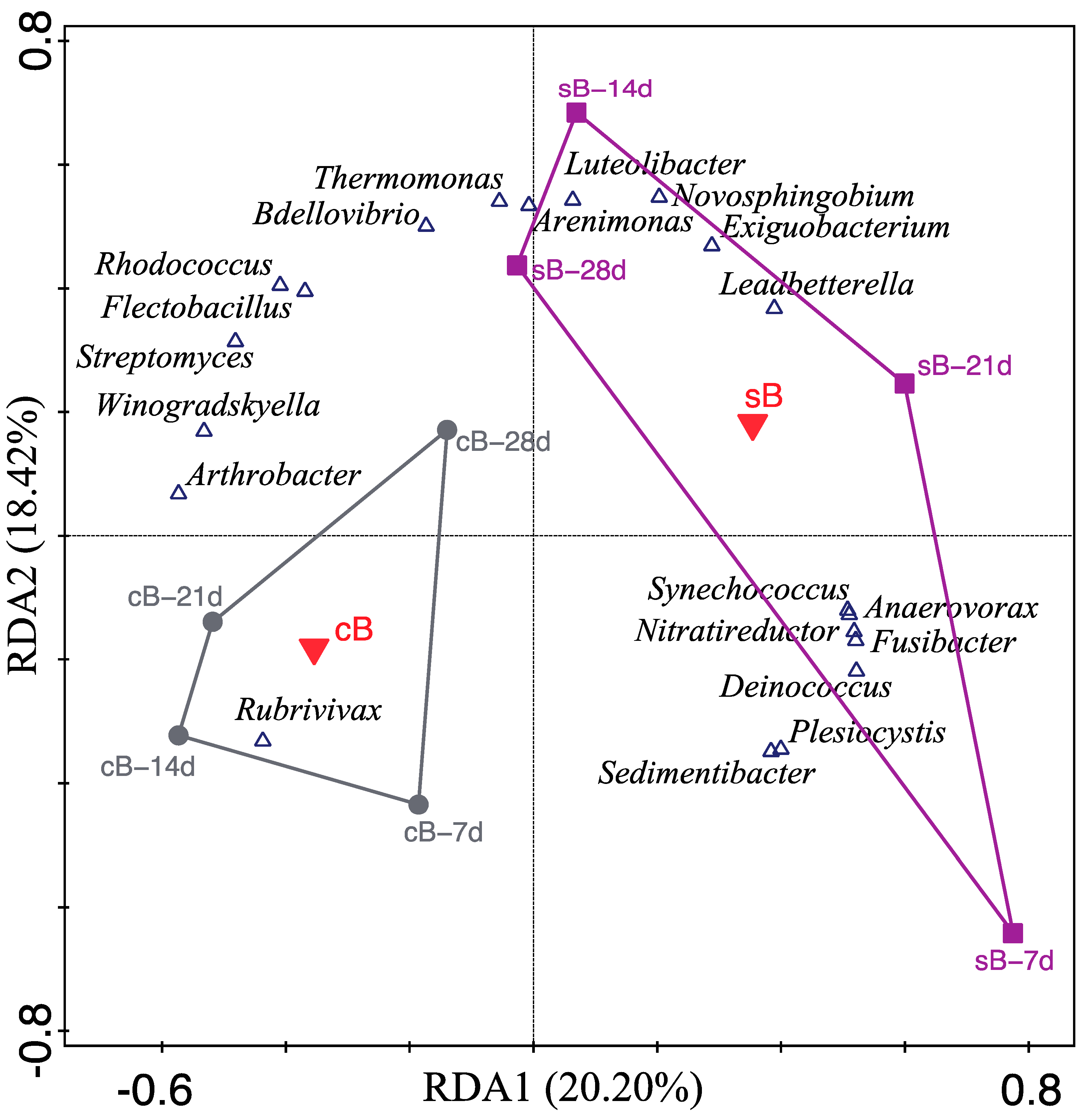
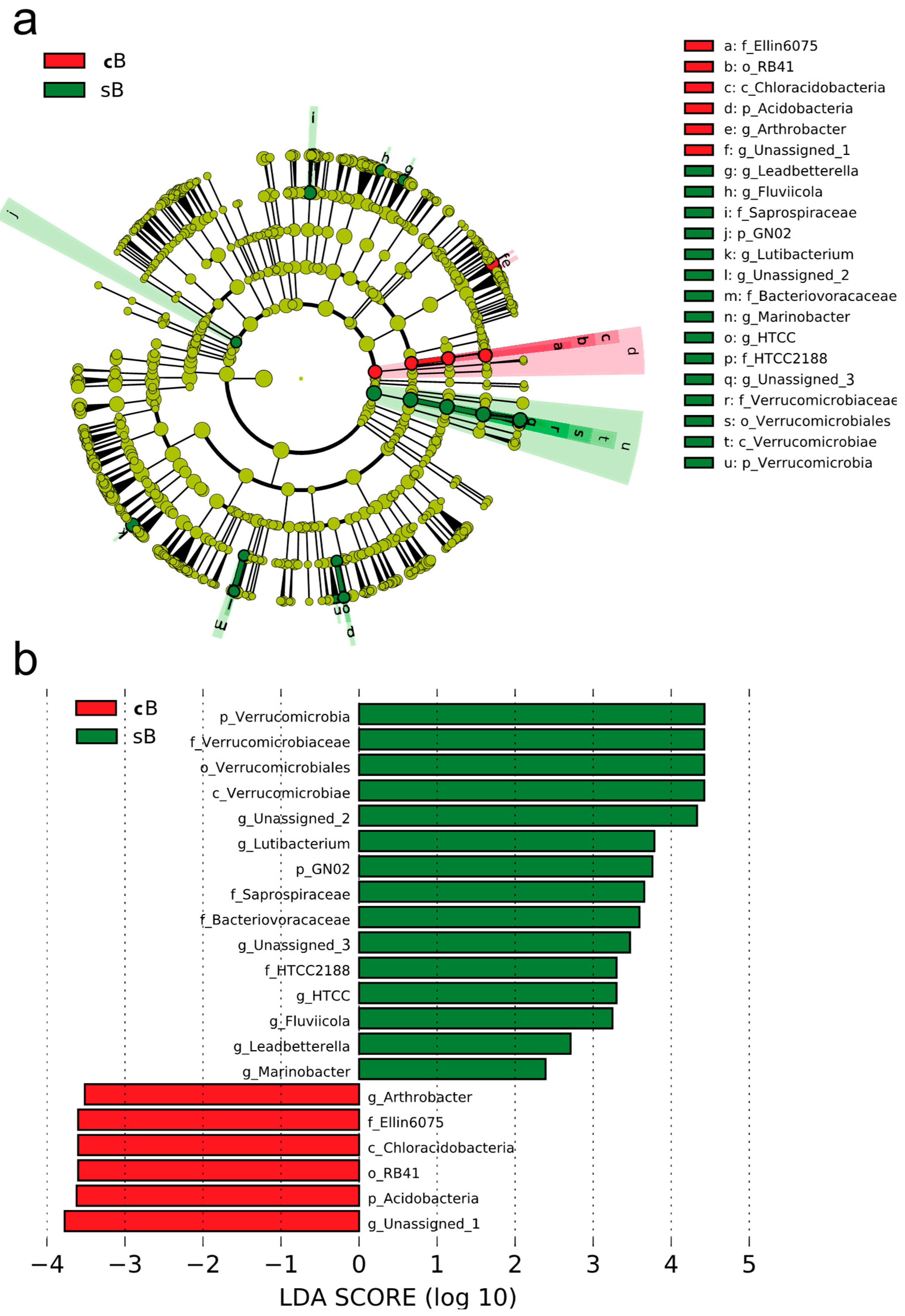
RDA showed that the addition of substrate changed bacterial composition at the genus level (Figure 2), as well as at the levels of phylum, class, order, and family (Figure S1). Genera such as Exiguobacterium, Leadbetterella, and Novosphingobium were more abundant in the sB treatment, but Arthrobacter and Rubrivivax were more abundant in the cB treatment (Figure 2). LEfSe analysis revealed that the most significant biomarkers at the genus level were Fluviicola, Leadbetterella, Lutibacterium, and Marinobacter for the sB treatment, and Arthrobacter for the cB treatment (Figure 3).
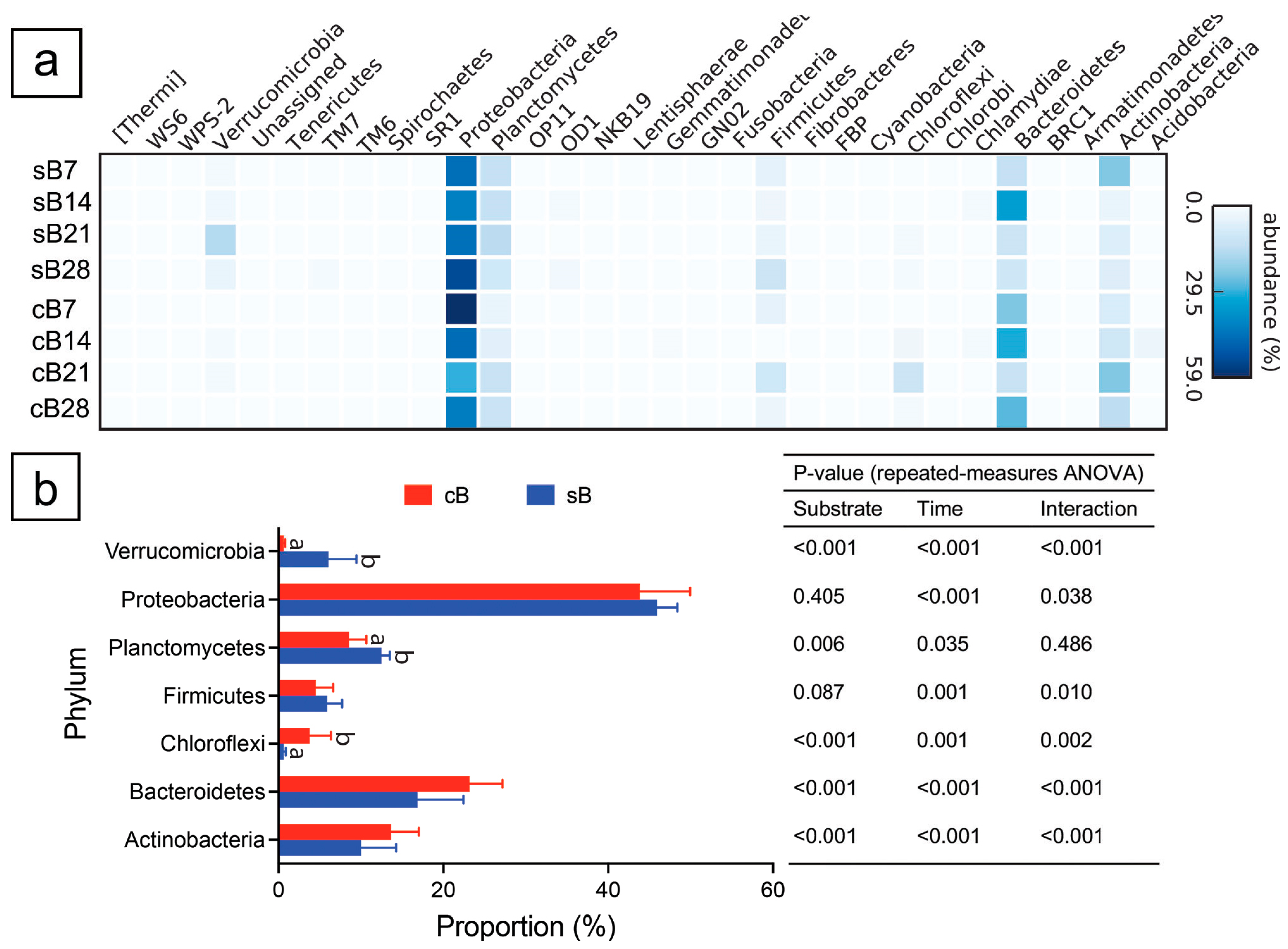
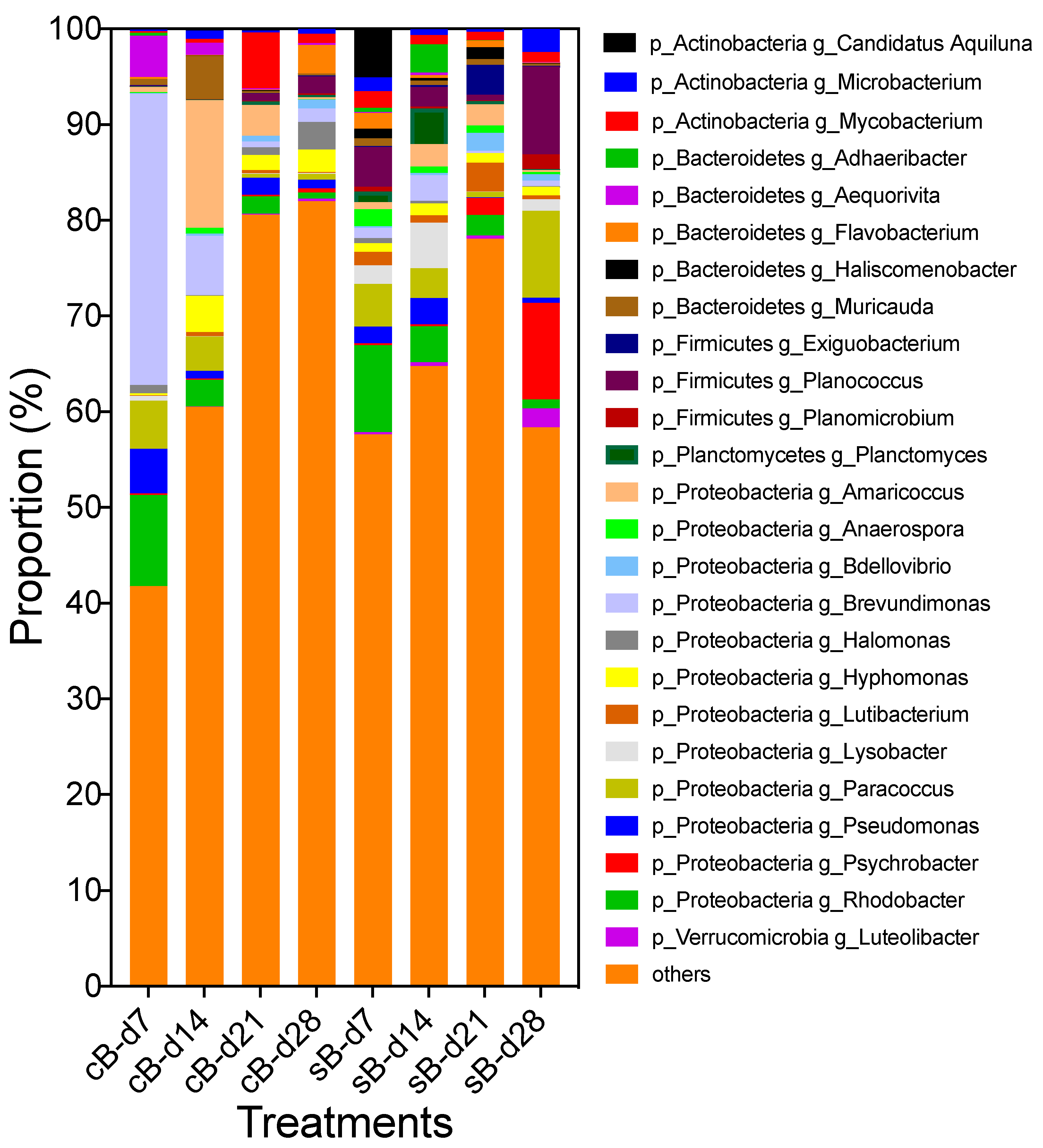
Regarding the bacterial composition profile, OTUs were assigned to 30 phyla in the present study. The most dominant phyla in both treatments were Actinobacteria (4.0–22.7%), Bacteroidetes (10.4–33.5%), Firmicutes (0.2–11.2%), Planctomycetes (4.0–14.9%), and Proteobacteria (29.4–59.0%) (Figure 4a). In addition, Chloroflexi and Verrucomicrobia were the dominant phyla in the cB treatment (0.1–11.4%) and the sB treatment (0.3–16.2%), respectively (Figure 4a). Significant effects of the substrate were observed on proportions of these seven phyla (p < 0.05), except Firmicutes and Proteobacteria (p > 0.05, Figure 4b). At the genus level, the most dominant ones, such as Paracoccus, Pseudomonas, Rhodobacter, Flavobacterium, and Planococcus, are species belonging to the phyla of Proteobacteria, Bacteroidetes, and Firmicutes (Figure 5).

3.2. Absolute Abundances of Bacterial Taxa

Substrate had a significant effect on the absolute abundances of the dominant phyla of Actinobacteria, Chloroflexi, Firmicutes, and Verrucomicrobia (p < 0.05, Table 1). Substrate also showed significant effects on absolute abundances of the 25 most dominant genera (p < 0.05), except for Bdellovibrio, Pseudomonas, and Rhodobacter (p > 0.05, Table 1).

3.3. Bacterial Diversity

The Jaccard index for bacterial beta diversity between treatments was 0.94 ± 0.01 (pseudo-F = 3.96, p = 0.001, PERMANOVA, Table 2), suggesting significant difference between the bacterial communities of the two treatments.
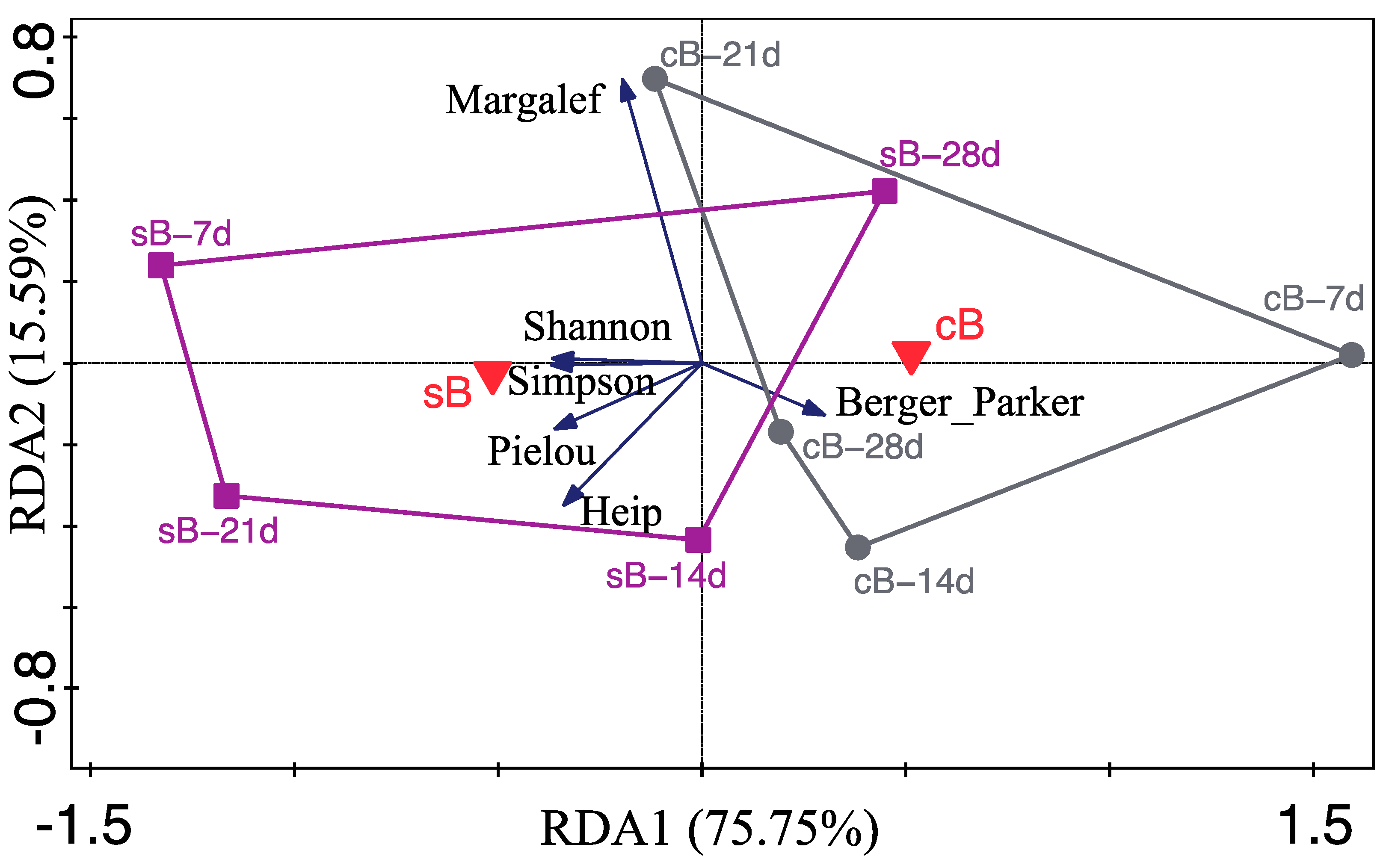
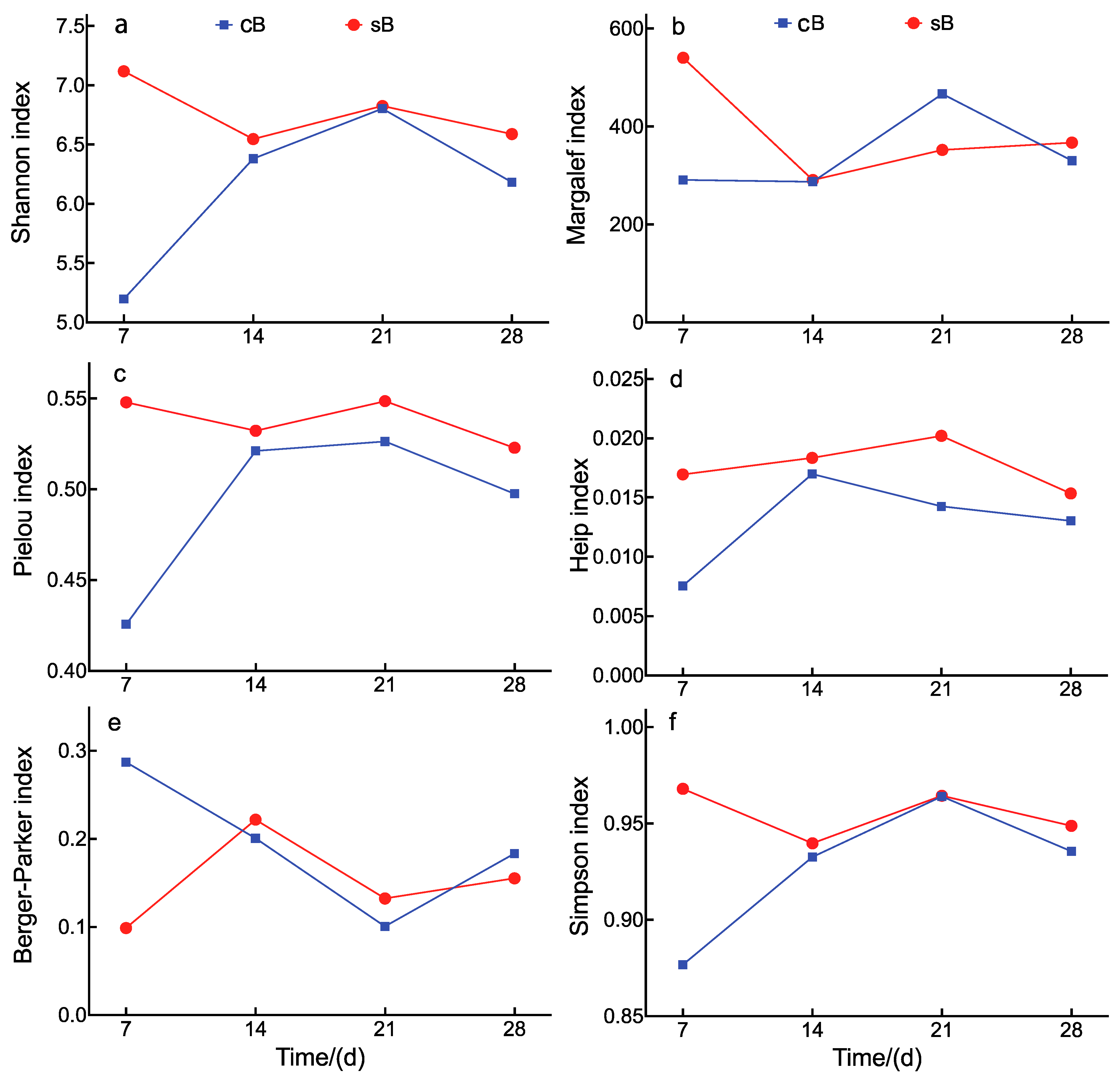
Regarding alpha diversity, substrate addition showed significant effects on the Shannon index, Heip index, Pielou index, and Simpson index (p < 0.05), all of which showed higher values in the sB treatment than the cB treatment (Table 3). Overall, the addition of substrate increased the diversity (Shannon index), evenness (Heip index and Pielou index) and richness (Margalef index) of the bacterial community, but decreased bacterial dominance (lower value of Berger–Parker index) in the sB treatment (Figure 6). The interaction of substrate and time was significant on the Shannon index and the Pielou index (p < 0.05, Table 3), indicating different temporal patterns for these indices between treatments (Figure 7). For instance, the Shannon index was highest on day 7 and then slightly decreased in the sB treatment, but it peaked on day 21 in the cB treatment (Figure 7a). The changing trend of the Pielou index was similar with that of the Shannon index in each treatment (Figure 7c).

3.4. Water Quality

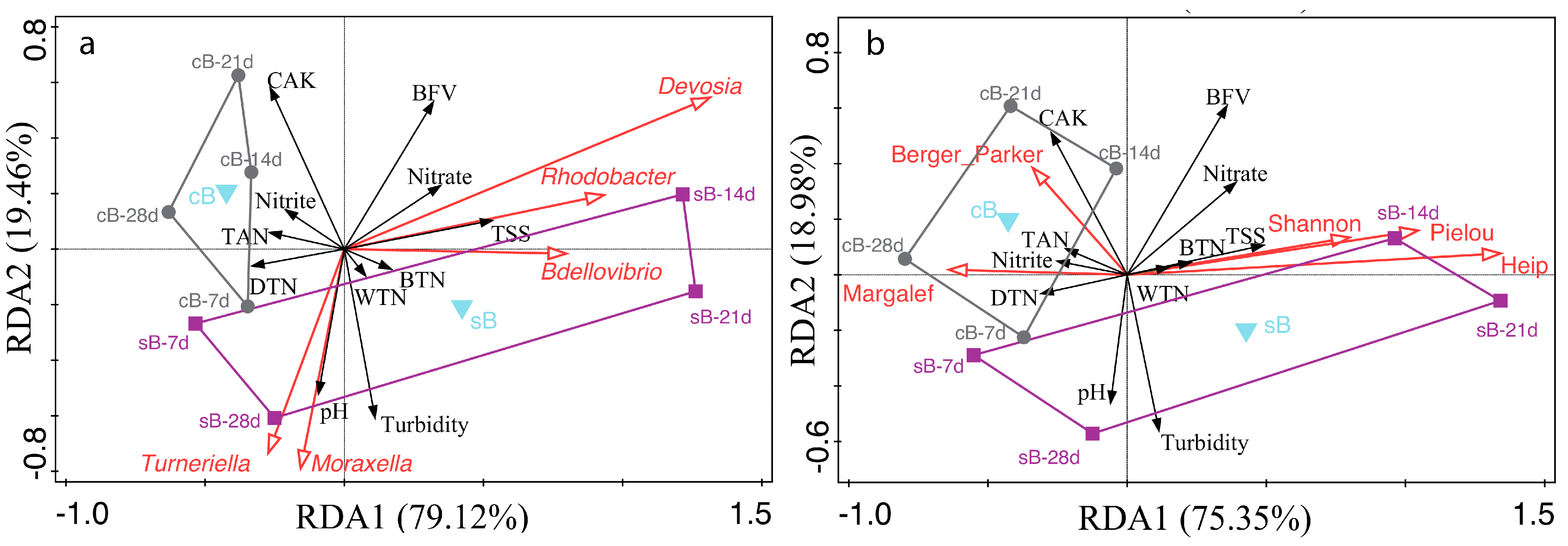
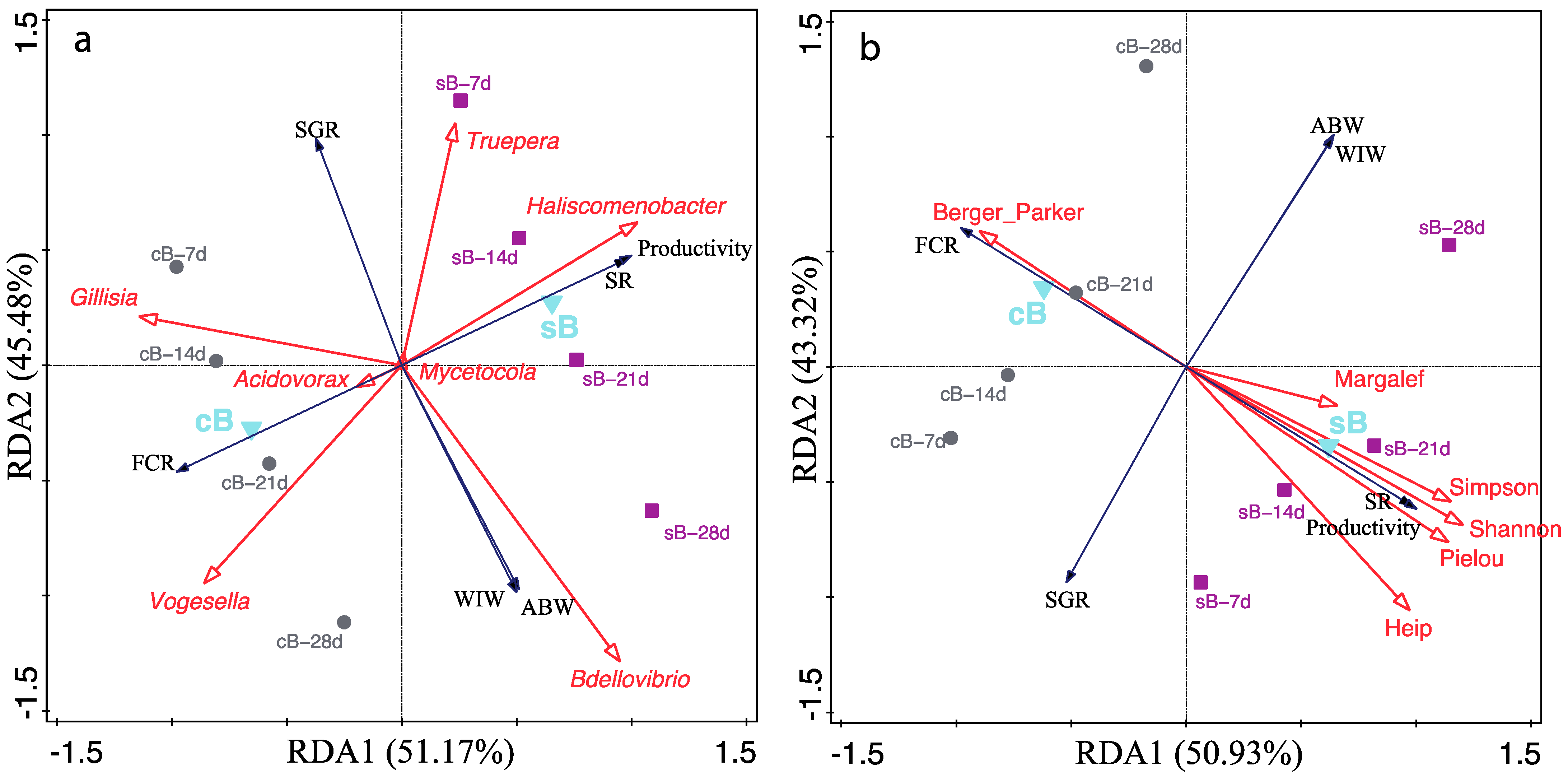
Substrate showed significant effects on carbonate alkalinity, pH, TAN, BFV, TSS, and turbidity (p < 0.05, Table 4). In addition, the interaction of substrate with time was significant for WTN and DTN (p < 0.05, Table 4). Overall, substrate explained 33.6% of variation in water quality between the sB and cB treatments (Figure S2). Furthermore, shifts in bacterial composition and diversity following substrate addition accounted for 98.58% (Figure 8a) and 94.33% (Figure 8b) of the variation in water quality, respectively.
The level of dissolved oxygen was above 5.0 mg L−1 and the recorded temperature was above 26.0 °C in both treatments without significant difference (p > 0.05, Table 4). Moreover, the concentrations of the three inorganic nitrogen compounds were at low levels in both treatments (<1.0 mg L−1, p > 0.05, Table 4). Carbonate alkalinity was significantly lower in the sB treatment compared to the cB treatment (p < 0.05, Table 4). In contrast, TSS was significantly higher in the sB treatment than in the cB treatment (p < 0.05, Table 4). Turbidity was also higher in the sB treatment, although this difference was not significant (p > 0.05, Table 4).

3.5. Growth Performance

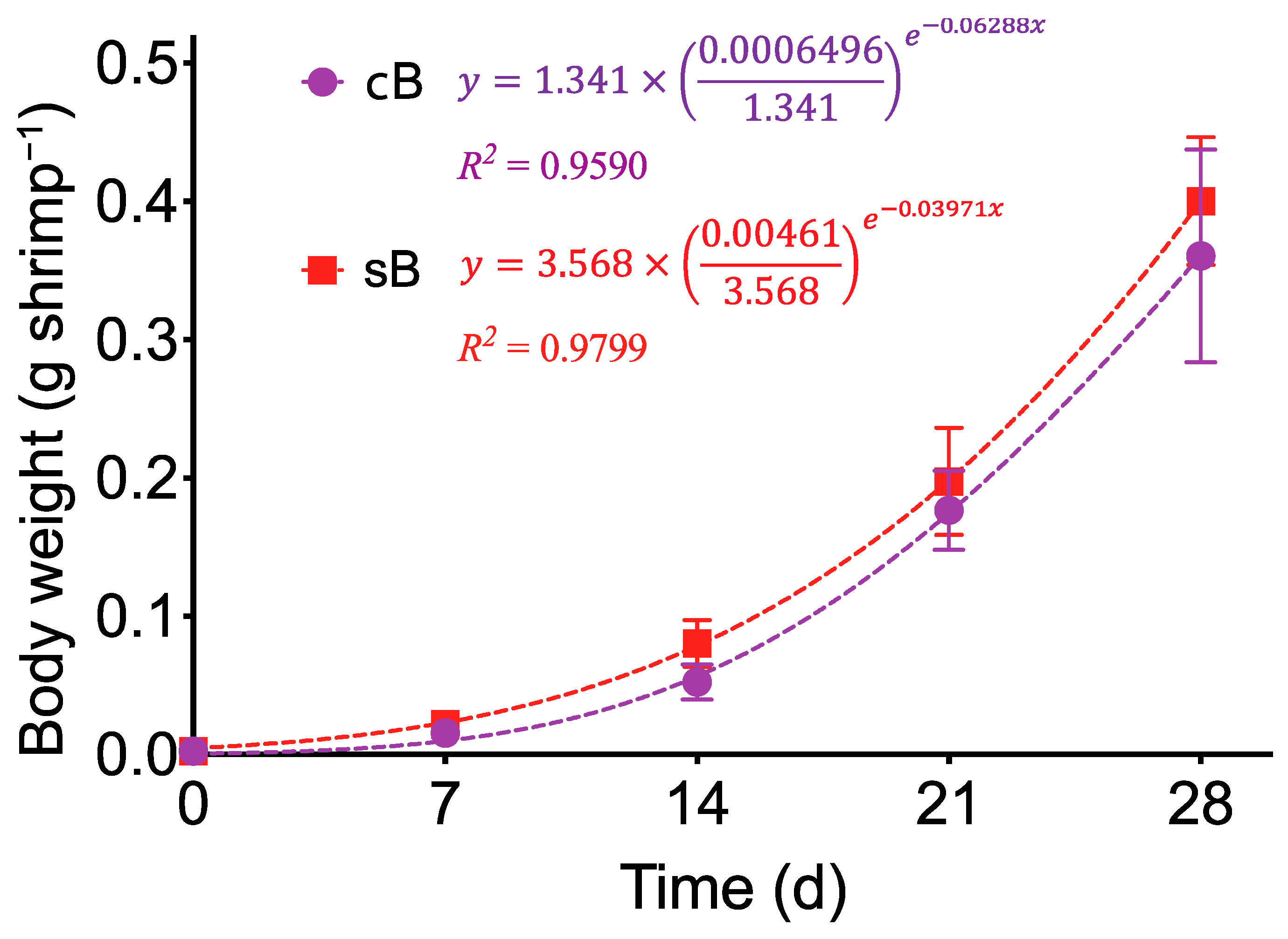
Shrimp survival rate and productivity were both significantly higher in the sB treatment compared to the cB treatment (p < 0.05, Table 5). FCR in the sB treatment was significantly lower than that in the cB treatment (p = 0.044, Table 5). Throughout the 28-day nursery experiment, the average body weight of shrimp in the sB treatment was higher than that of the cB treatment (Figure 9). Overall, substrate accounted for 41.9% of the variation in shrimp growth performance between the two treatments (Figure S3). Shifts in bacterial composition and diversity induced by substrate addition accounted for 96.65% (Figure 10a) and 94.25% (Figure 10b) of the total variation in shrimp growth performance between the two treatments, respectively.

4. Discussion

The results of the present study indicated that the addition of substrate successfully induced shifts in the bacterial composition and diversity in the biofloc system, which in turn was shown to be beneficial to the water quality and the growth performance of shrimp.

4.1. Bacterial Composition and Diversity of the Biofloc System Shifted After Addition of Substrate

A recent study found that the addition of substrates and carbon sources changes the bacterial community in a pond polyculture system [29]. Similarly, we also found that the bacterial composition profile in the biofloc system obviously changed after the addition of the substrate. In the sB treatment, the relative abundances of Planctomycetes and Bacteroidetes increased, while that of Actinobacteria decreased, when compared with the results in the cB treatment (Table 1). Chloroflexi, Bacteroidetes, and Planctomycetes contain attached-living species [43,44,45], whereas Actinobacteria and Firmicutes contain free-living or free-swimming species [45,46]. Substrates can provide surface area for attached-living species, potentially increasing their abundances [47], in agreement with the observations of the present study. However, we neither observed an increase in the abundance of the attached-living Chloroflexi nor found a decrease in the abundance of the free-living Firmicutes in the sB treatment (Table 1). One explanation for these discrepancies is that lifestyle is not the sole determinant of bacterial abundance, as substrate only explained 38.6% of the variation in bacterial composition (Figure 2). Other factors, such as water quality, could influence the bacterial composition [48,49,50], in line with the findings of the present study (Figure S4). It should be noted that the variation in water quality between both treatment is induced by adding substrate to the sB treatment in the present study (Figure 8). Overall, we can state that there was a shift in the bacterial community in the sB treatment regardless of direct or indirect effects of the addition of substrate, although we did not separate the effects of water quality on the shift in bacterial community from the effects of substrate.
At the genus level, substrate positively impacted abundances of Arenimonas, Bdellovibrio, Exiguobacterium, Fluviicola, Leadbetterella, Luteolibacter, Lutibacterium, Marinobacter, Nitratireductor, Novosphingobium, Plesiocystis, and Thermomonas (Figure 2 and Figure 3). These genera have potential positive implications for water quality, biofloc formation, and shrimp growth, due to their beneficial traits. For example, Arenimonas is involved in denitrification [10]. Bdellovibrio, a probiotic used in aquaculture, exhibits hydrolytic activity against pathogenic Aeromonas and Vibrio [51,52], leading to positive impact upon the survival and growth of aquatic animals [15,53]. Exiguobacterium, a dominant genus in biofloc systems [54,55,56], can potentially be used as a probiotic [26,57,58] due to its functions in nutrient metabolism and digestive enzyme secretion [59,60,61]. Novosphingobium, a common bacterium in biofloc systems [62], could be bioaugmented as a probiotic beneficial for the growth, survival, and immunological status of shrimp [63]. Thermomonas, a denitrifier [64,65] found in biofloc systems [11,66,67,68], has also been associated with trypsin, aminopeptidase, and alkaline protease activities [69]. Nitratireductor is capable of producing microbial flocculants in biofloc systems [9,70,71,72,73]. Similarly, Marinobacter is a biofloc-formation-related genus which is able to produce extracellular polymeric substances [74]. Leadbetterella, Plesiocystis, and Luteolibacter are all dominant bacterial genera in biofloc systems [75,76,77]. Little functional information is available for Fluviicola and Lutibacterium, which are reported here for the first time in a biofloc system. However, substrate showed negative effects on the abundances of the other two potential beneficial genera, Arthrobacter and Rubrivivax (Figure 2 and Figure 3). Arthrobacter is considered a probiotic in shrimp aquaculture [52,78,79,80], and Rubrivivax is a facultative anaerobic denitrifying bacterium commonly observed in biofloc systems [10,14,81].
Substrate addition also increased the bacterial alpha diversity (e.g., Shannon index, Margalef index, Heip index, Pielou index, and Simpson index) in the biofloc system (Table 3 and Figure 8b), leading to increases in bacterial diversity, evenness, and richness. The interactions of substrate and time on the Shannon index and Pielou index were also significant (p < 0.05, Table 3), indicating differences between the treatments in terms of changing patterns. The Shannon index peaked at day 7 in the sB treatment and day 21 in the cB treatment (Figure 7), suggesting that substrate accelerates the formation of a highly diverse bacterial community in the biofloc system. Furthermore, all alpha diversity indices were significantly affected by time (p < 0.05, Table 3), indicating a time-dependent succession pattern of bacterial diversity regardless of substrate addition, in line with the results of previous studies [49,50,82,83].
In terms of dominant bacteria, Actinobacteria, Bacteroidetes, Chloroflexi, Firmicutes, Planctomycetes, Proteobacteria, and Verrucomicrobia were the most abundant phyla in both treatments of the present study, in line with observations by researchers in other biofloc systems stocking whiteleg shrimp [12,37,49,84,85,86,87,88,89]. At the genus level, Amaricoccus, Paracoccus, Planococcus, Pseudomonas, and Rhodobacter were dominant in both treatments (Table 1), in line with the findings of previous studies [10,55,73,76,90,91]. Regarding bacterial diversity, the Shannon index in the present study (6.14-6.77) was within the range of 5.31–7.23 reported in previous studies [37,48,49,50,92,93,94].

4.2. Shift in Bacterial Community Induced by Adding Substrate Positively Affected Water Quality

The addition of substrate showed significant effects on water parameters (Table 4), and it was found to be responsible for 33.6% of the variation in water quality between the treatments in the present study (Figure S2). The effects may have contributed to the shift in bacterial community [21,95]. Shifts in bacterial community are known to significantly impact water quality in biofloc systems [20,21,22]. Previous studies have investigated the influence of water quality on bacterial composition. For example, salinity and electrical conductivity were the most significant environmental factors that influenced the microbial community, and nitrite, nitrate, and total organic carbon were positively correlated with the abundance of Paracoccus, but TAN was negatively correlated with the abundance of Leucothrix [48,49,50]. In the present study, we investigated the effects of the shift in bacterial composition on water quality, and found that the representative genera were Rhodobacter, Bdellovibrio, Devosia, Turneriella, and Moraxella (Figure 8a). We observed that the first three genera correlated positively with BFV, TSS, and nitrate but negatively with TAN and nitrite. In contrast, the remaining two genera correlated positively with pH and turbidity, but negatively with BFV and CAK, in line with the findings of previous studies. For example, Rhodobacter, a common genus in biofloc systems [20,69,96,97], has the ability to assimilate and dissimilate nitrate [65,98]. Devosia, a genus typically found in biofloc systems [69,73,75], is a nitrogen fixer [99]. As for Bdellovibrio, Turneriella, and Moraxella, though their effects on water quality are currently not clear, they are also dominant genera in biofloc systems [47,48,73,90,100,101].
We also found that the shift in the bacterial diversity in the biofloc system after the addition of substrate affected the water quality. The diversity (Shannon index) and the evenness (Pielou index and Heip index) of the bacterial community showed positive effects on BFV, TSS, and nitrate, but the richness index (Margalef) showed negative effects on those parameters (Figure 8b). The dominance of the bacterial community (Berger–Parker index) was positive to CAK, but negative for pH and turbidity (Figure 8b). To our knowledge, this is the first study to directly investigate the effects of bacterial diversity on water quality, although a diverse bacterial community has been qualitatively considered beneficial for maintaining good water quality in biofloc systems [24,25].

4.3. Shift in Bacterial Community Induced by Adding Substrate Improved the Growth Performance of Shrimp

The addition of substrate showed significant effects on SR, productivity, and FCR (Table 5), in line with the findings of the RDA that substrate contributed to 41.9% of the variation in zootechnical indices between the sB treatment and the cB treatment (Figure S3). Furthermore, shifts in bacterial genera following substrate addition accounted for 96.65% of the variation in shrimp growth performance between treatments (Figure 10a). Previous studies have recognized the important roles of microbial community on the survival and growth of cultured aquatic animals in biofloc systems [11,50,83,102]. Xu, Morris, and Samocha [21] and Panigrahi, Saranya, Sundaram, Vinoth Kannan, Das, Sathish, Rajesh, and Otta [22] observed that shifts in bacterial community impact shrimp growth in biofloc systems. Here, we further demonstrate a correlation between shifts in bacterial genus abundances and shrimp growth performance. We found that the most representative shifted bacterial genera were Haliscomenobacter, Truepera, Vogesella, Gillisia and Bdellovibrio. Haliscomenobacter, and Truepera, which showed positive effects on SR, productivity, and FCR (Figure 10a). Previous studies also found that Haliscomenobacter, found in biofloc systems [100], plays a central role in sludge bulking and grows on substrates [10]. Truepera is considered to be related to fish health [103]. However, Vogesella and Gillisia were found to negatively impact SR, productivity, and FCR in the present study (Figure 10a). Corroboratively, Vogesella has been reported to be pathogenic to fish [104,105], indicating harmful effects on growth. Gillisia is considered a producer of antimicrobial compounds and is involved in organic matter mineralization [106]. However, this is the first report of a negative effect of Gillisia on aquatic animal growth. Bdellovibrio was strongly correlated with ABW and WIW (Figure 10a), in line with previous findings that Bdellovibrio has a positive effect on the growth performance of aquatic animals [15,53].
It is generally considered that a diverse microbial community is important to the survival and growth of shrimp in a biofloc system [20,90]. In the present study, we further assessed the contributions of the shift in bacterial diversity to shrimp growth, and found that it accounted for 94.25% of variations in the zootechnical indices of shrimp between the sB treatment and the cB treatment (Figure 10b). We also observed that bacterial diversity (Shannon index), richness (Margalef index), and evenness (Heip index and Pielou index) showed positive effects on SR, productivity, and FCR, but the bacterial dominance was negative for those indices (Figure 10b).
In general, the growth performance of shrimp is usually considered to be most closely associated with water quality [50,102,107]. Corroboratively, in the present study, we found that changes in water quality affected the growth performance of shrimp (Figure S5), in line with the findings of a previous study [108]. Given the major contribution of bacterial community shifts to water quality variation (Figure 8), we propose that the effects on shrimp growth performance are likely indirect, mediated through changes in water quality.

4.4. Limitations and Future Directions

It should be noted that the 28-day trial period may be insufficient to fully validate the findings and hypothesis. Future studies should include a long-term grow-out period (e.g., at least 12 weeks) to obtain more robust insights into beneficial bacterial community shifts. Furthermore, biofloc removal may wash out bacteria, potentially biasing community analysis. Although the same removal procedure was applied to both treatments to mitigate this, future experiments should comprehensively integrate substrate and biofloc removal factors to fully account for such bias. Finally, the linkages between bacterial community shifts, water quality, and growth performance identified here are indirect. Future work should investigate gene expression related to nitrogen cycling (e.g., nirS/nirK) and host–microbe interactions (e.g., immune gene expression) to provide direct molecular insights into the mechanisms underlying beneficial bacterial community shifts in biofloc systems.

5. Conclusions

In the present study, we induced and characterized a shift in bacterial community by adding substrate, and verified the beneficial effects of this shift on the water quality and shrimp growth performance for the first time. This study provides significant insight into beneficial bacterial community shifts in biofloc systems, which will aid in the future management and optimization of BFT. However, long-term experiments and more precise analyses (e.g., variation partitioning, source tracking) are needed to directly link explanatory and response variables and reinforce these findings.

Supplementary Materials

The following supporting information can be downloaded at https://www.mdpi.com/article/10.3390/fishes10120626/s1: Figure S1, Redundancy analysis (RDA) biplot showing shifts in bacterial composition at the phylum (a), class (b), order (c), and family (d) levels in response to the presence (sB treatment) or absence (cB treatment) of an elastic solid packing filler (nylon) as substrate during the 28-day experiment nursing Litopenaeus vannamei postlarvae at a salinity of 5.0‰. Figure S2, RDA biplot illustrating changes in water parameters between biofloc systems with (sB treatment) and without (cB treatment) the addition of an elastic solid packing filler (nylon) as substrate during the 28-day experiment nursing Litopenaeus vannamei postlarvae at a salinity of 5.0‰. Figure S3, RDA biplot displaying changes in zootechnical indices between biofloc systems with (sB treatment) and without (cB treatment) the addition of an elastic solid packing filler (nylon) as substrate during the 28-day experiment nursing Litopenaeus vannamei postlarvae at a salinity of 5.0‰. Figure S4, RDA triplot showing the effects of water parameter changes on (a) shifts in bacterial composition at the genus level (only the top twenty best-fitted genera are shown) and (b) bacterial diversity between biofloc systems with (sB treatment) and without (cB treatment) the addition of an elastic solid packing filler (nylon) as substrate during the 28-day experiment nursing Litopenaeus vannamei postlarvae at a salinity of 5.0. Figure S5, RDA triplot illustrating the effects of water parameters on zootechnical indices in biofloc systems with (sB treatment) and without (cB treatment) the addition of an elastic solid packing filler (nylon) as substrate during the 28-day experiment nursing Litopenaeus vannamei postlarvae at a salinity of 5.0‰.

Author Contributions

Conceptualization, H.-H.H.; methodology, C.-Y.L.; formal analysis, H.-H.H. and C.C.; investigation, Y.-J.L., W.-Q.K., B.-L.Z., and P.-H.Y.; resources, L.-L.G.; data curation, L.-L.G.; writing—original draft preparation, H.-H.H.; writing—review and editing, C.C.; visualization, W.-S.Z.; supervision, H.-H.H.; project administration, C.-Y.L.; funding acquisition, H.-H.H., C.C., and C.-Y.L. All authors have read and agreed to the published version of the manuscript.

Funding

This research was funded by the scientific research program of the Education Department of Hunan province, grant number 22A0495; the open foundation of the Hunan Provincial Key Laboratory for Health Aquaculture and Product Processing in Dongting Lake Area (2025KF03); and the innovative scientific project of Mianyang Academy of Agricultural Sciences (Cxjj112-2025).

Institutional Review Board Statement

The experiment was carried out according to the national standard of China “Laboratory animal-Guideline for ethical review of animal welfare” (GB/T 35892–2018), with approval of the ethics committee of Hunan University of Arts and Science, approval code: JSDX-2021-007; approval date: 4 July 2021.

Data Availability Statement

The original contributions presented in this study are included in the article/supplementary material. Further inquiries can be directed to the corresponding author.

Acknowledgments

The authors thank the Innovation Team of Microbial Technology of Hunan University of Arts and Science for experimental support.

Conflicts of Interest

The authors declare no conflict of interest.

References

  1. FAO. The State of World Fisheries and Aquaculture: Towards Blue Transformation; FAO: Rome, Italy, 2022. [Google Scholar]
  2. Van Wyk, P.; Davishodgkins, M.; Laramore, R.; Main, K.L.; Mountain, J.; Scarpa, J. Farming Marine Shrimp in Recirculating Freshwater Systems; Florida Department of Agriculture and Consumer Services: Tallahassee, FL, USA, 1999; pp. 1–219.
  3. BFMA (Bureau of Fisheries of the Ministry of Agriculture of the People’s Republic of China). China Fishery Statistical Yearbook; China Agriculture Press: Beijing, China, 2025.
  4. Huang, H.-H.; Li, C.-Y.; Song, Y.; Lei, Y.-J.; Yang, P.-H. Growth performance of shrimp and water quality in a freshwater biofloc system with a salinity of 5.0‰: Effects on inputs, costs and wastes discharge during grow-out culture of Litopenaeus vannamei. Aquacult. Eng. 2022, 98, 102265. [Google Scholar] [CrossRef]
  5. Roy, L.A.; Davis, D.A.; Saoud, I.P.; Boyd, C.A.; Pine, H.J.; Boyd, C.E. Shrimp culture in inland low salinity waters. Rev. Aquac. 2010, 2, 191–208. [Google Scholar] [CrossRef]
  6. Ray, A.J.; Drury, T.H.; Cecil, A. Comparing clear-water RAS and biofloc systems: Shrimp (Litopenaeus vannamei) production, water quality, and biofloc nutritional contributions estimated using stable isotopes. Aquacult. Eng. 2017, 77, 9–14. [Google Scholar] [CrossRef]
  7. Krummenauer, D.; Abreu, P.C.; Poersch, L.; Paiva Reis, P.A.C.; Suita, S.M.; dos Reis, W.G.; Wasielesky Jr, W. The relationship between shrimp (Litopenaeus vannamei) size and biofloc consumption determined by the stable isotope technique. Aquaculture 2020, 529, 735635. [Google Scholar] [CrossRef]
  8. Avnimelech, Y. Biofloc Technology: A Practical Hand Book, 3rd ed.; The World Aquaculture Society: Baton Rouge, LA, USA, 2015. [Google Scholar]
  9. Khanjani, M.H.; Mohammadi, A.; Emerenciano, M.G.C. Microorganisms in biofloc aquaculture system. Aquacult. Rep. 2022, 26, 101300. [Google Scholar] [CrossRef]
  10. Abakari, G.; Wu, X.; He, X.; Fan, L.; Luo, G. Bacteria in biofloc technology aquaculture systems: Roles and mediating factors. Rev. Aquacult. 2022, 14, 1260–1284. [Google Scholar] [CrossRef]
  11. Abakari, G.; Luo, G.; Shao, L.; Abdullateef, Y.; Cobbina, S.J. Effects of biochar on microbial community in bioflocs and gut of Oreochromis niloticus reared in a biofloc system. Aquacult. Int. 2021, 29, 1295–1315. [Google Scholar] [CrossRef]
  12. Deng, M.; Chen, J.; Hou, J.; Li, D.; He, X. The effect of different carbon sources on water quality, microbial community and structure of biofloc systems. Aquaculture 2018, 482, 103–110. [Google Scholar] [CrossRef]
  13. Li, J.; Liu, G.; Li, C.; Deng, Y.; Abubakar, T.M.; Lan, L.; Zhu, S.; Liu, D. Effects of different solid carbon sources on water quality, biofloc quality and gut microbiota of Nile tilapia (Oreochromis niloticus) larvae. Aquaculture 2018, 495, 919–931. [Google Scholar] [CrossRef]
  14. Wei, Y.-f.; Wang, A.-l.; Liao, S.-a. Effect of different carbon sources on microbial community structure and composition of ex-situ biofloc formation. Aquaculture 2020, 515, 734492. [Google Scholar] [CrossRef]
  15. Luo, G.; Zhang, N.; Cai, S.; Tan, H.; Liu, Z. Nitrogen dynamics, bacterial community composition and biofloc quality in biofloc-based systems cultured Oreochromis niloticus with poly-β-hydroxybutyric and polycaprolactone as external carbohydrates. Aquaculture 2017, 479, 732–741. [Google Scholar] [CrossRef]
  16. Vinasyiam, A.; Verdegem, M.C.J.; Ekasari, J.; Schrama, J.W.; Kokou, F. Prokaryotic and eukaryotic microbial community dynamics in biofloc systems supplemented with non-starch polysaccharides. Aquaculture 2025, 594, 741396. [Google Scholar] [CrossRef]
  17. Li, J.; Zhu, Z.; Lv, X.; Tan, H.; Liu, W.; Luo, G. Optimizing carbon sources on performance for enhanced efficacy in single-stage aerobic simultaneous nitrogen and phosphorus removal via biofloc technology. Bioresour. Technol. 2024, 411, 131347. [Google Scholar] [CrossRef]
  18. Chen, S.; Li, L.; Dong, X.; Tian, X. Influence of carbon source supplementation on the development of autotrophic nitrification and microbial community composition in biofloc technology systems. J. Water Process Eng. 2025, 71, 107215. [Google Scholar] [CrossRef]
  19. Xu, W.; Huang, F.; Zhao, Y.; Su, H.; Hu, X.; Xu, Y.; Wen, G.; Cao, Y. Carbohydrate addition strategy affects nitrogen dynamics, budget and utilization, and its microbial mechanisms in biofloc-based Penaeus vannamei culture. Aquaculture 2024, 589, 740907. [Google Scholar] [CrossRef]
  20. Xu, W.; Wen, G.; Su, H.; Xu, Y.; Hu, X.; Cao, Y. Effect of input C/N ratio on bacterial community of water biofloc and shrimp gut in a commercial zero-exchange system with intensive production of Penaeus vannamei. Microorganisms 2022, 10, 1060. [Google Scholar] [CrossRef] [PubMed]
  21. Xu, W.-J.; Morris, T.C.; Samocha, T.M. Effects of C/N ratio on biofloc development, water quality, and performance of Litopenaeus vannamei juveniles in a biofloc-based, high-density, zero-exchange, outdoor tank system. Aquaculture 2016, 453, 169–175. [Google Scholar] [CrossRef]
  22. Panigrahi, A.; Saranya, C.; Sundaram, M.; Vinoth Kannan, S.R.; Das, R.R.; Sathish, S.; Rajesh, P.; Otta, S.K. Carbon: Nitrogen (C:N) ratio level variation influences microbial community of the system and growth as well as immunity of shrimp (Litopenaeus vannamei) in biofloc based culture system. Fish Shellfish Immunol. 2018, 81, 329–337. [Google Scholar] [CrossRef]
  23. Sun, Y.; Zhang, J.; Dong, D.; Li, M.; Yang, X.; Song, X.; Li, X. Effects of carbon source addition strategies on water quality, growth performance, and microbial community in shrimp BFT aquaculture systems. Aquaculture 2024, 578, 740027. [Google Scholar] [CrossRef]
  24. Kokkuar, N.; Li, L.; Srisapoome, P.; Dong, S.; Tian, X. Application of biodegradable polymers as carbon sources in ex situ biofloc systems: Water quality and shift of microbial community. Aquacult. Res. 2021, 52, 3570–3579. [Google Scholar] [CrossRef]
  25. Khanjani, M.H.; Sharifinia, M. Biofloc technology as a promising tool to improve aquaculture production. Rev. Aquacult. 2020, 12, 1836–1850. [Google Scholar] [CrossRef]
  26. Junior, C.C.d.M.; Owatari, M.S.; Schleder, D.D.; Poli, M.A.; Gelsleichter, Y.R.R.; Postai, M.; Kruger, K.E.; Carvalho, F.G.d.; Silva, B.P.P.; Teixeira, B.L.; et al. Identification and characterization of microorganisms potentially beneficial for intensive cultivation of Penaeus vannamei under biofloc conditions: Highlighting Exiguobacterium acetylicum. Aquacult. Res. 2021, 52, 3628–3638. [Google Scholar] [CrossRef]
  27. Wani, S.M.; Chesti, A.; Rehman, S.; Nautiyal, V.C.; Bhat, I.A.; Ahmad, I. Repurposing and reusing aquaculture wastes through a biosecure microfloc technology. Environ. Res. 2025, 274, 121214. [Google Scholar] [CrossRef] [PubMed]
  28. Ramiro, B.d.O.; Wasielesky, W.; Pimentel, O.A.L.F.; Martin, N.P.S.; Borges, L.d.V.; Krummenauer, D. Different management strategies for artificial substrates on nitrification, microbial composition, and growth of Penaeus vannamei in a super-intensive biofloc system. Aquaculture 2025, 596, 741853. [Google Scholar] [CrossRef]
  29. Guo, K.; Shi, M.; Huang, X.; Luo, L.; Wang, S.; Zhang, R.; Xu, W.; Ruan, G.; Zhao, Z. The Effect of Artificial Substrate and Carbon Source Addition on Bacterial Diversity and Community Composition in Water in a Pond Polyculture System. Fishes 2024, 9, 80. [Google Scholar] [CrossRef]
  30. Esparza-Leal, H.M.; Cardozo, A.P.; Wasielesky, W., Jr. Performance of Litopenaeus vannamei postlarvae reared in indoor nursery tanks at high stocking density in clear-water versus biofloc system. Aquacult. Eng. 2015, 68, 28–34. [Google Scholar] [CrossRef]
  31. Mishra, J.K.; Samocha, T.M.; Patnaik, S.; Speed, M.; Gandy, R.L.; Ali, A.-M. Performance of an intensive nursery system for the Pacific white shrimp, Litopenaeus vannamei, under limited discharge condition. Aquacult. Eng. 2008, 38, 2–15. [Google Scholar] [CrossRef]
  32. Rezende, P.C.; Schleder, D.D.; Silva, H.V.d.; Henriques, F.M.; Lorenzo, M.A.d.; Seiffert, W.Q.; Andreatta, E.R.; Vieira, F.d.N. Prenursery of the Pacific white shrimp in a biofloc system using different artificial substrates. Aquacult. Eng. 2018, 82, 25–30. [Google Scholar] [CrossRef]
  33. Schveitzer, R.; Lorenzo, M.A.D.; Felipe, D.N.V.; Pereira, S.A.; Mourino, J.L.P.; Seiffert, W.Q.; Andreatta, E.R. Nursery of young Litopenaeus vannamei post-larvae reared in biofloc- and microalgae-based systems. Aquacult. Eng. 2017, 78, 140–145. [Google Scholar] [CrossRef]
  34. Tierney, T.W.; Fleckenstein, L.J.; Ray, A.J. The effects of density and artificial substrate on intensive shrimp Litopenaeus vannamei nursery production. Aquacult. Eng. 2020, 89, 102063. [Google Scholar] [CrossRef]
  35. Lara, G.R.d.; Poersch, L.H.; Wasielesky, W., Jr. The quantity of artificial substrates influences the nitrogen cycle in the biofloc culture system of Litopenaeus vannamei. Aquacult. Eng. 2021, 94, 102171. [Google Scholar] [CrossRef]
  36. Peiro-Alcantar, C.; Rivas-Vega, M.E.; Martinez-Porchas, M.; Lizarraga-Armenta, J.A.; Miranda-Baeza, A.; Martinez-Cordova, L.R. Effect of adding vegetable substrates on Penaeus vannamei pre-grown in biofloc system on shrimp performance, water quality and biofloc composition. Lat. Am. J. Aquat. Res. 2019, 47, 784–790. [Google Scholar] [CrossRef]
  37. Huang, H.-H.; Luo, T.; Lei, Y.-J.; Kuang, W.-Q.; Zou, W.-S.; Yang, P.-H. Water quality, shrimp growth performance and bacterial community in a reusing-water biofloc system for nursery of Penaeus vananmei rearing under a low salinity condition. Aquacult. Rep. 2021, 21, 100894. [Google Scholar] [CrossRef]
  38. Anderson, M.J. A new method for non-parametric multivariate analysis of variance. Austral Ecol. 2001, 26, 32–46. [Google Scholar] [CrossRef]
  39. APHA. Standard Methods for the Examination of Water and Wastewater; American Public Health Association: Washington, DC, USA, 1995. [Google Scholar]
  40. Huang, H.-H.; Liao, H.-M.; Lei, Y.-J.; Yang, P.-H. Effects of different carbon sources on growth performance of Litopenaeus vannamei and water quality in the biofloc system in low salinity. Aquaculture 2022, 546, 737239. [Google Scholar] [CrossRef]
  41. Huang, H.-H.; Li, C.-Y.; Lei, Y.-J.; Zhou, B.-L.; Kuang, W.-Q.; Zou, W.-S.; Yang, P.-H. Effects of Bacillus strain added as initial indigenous species into the biofloc system rearing Litopenaeus vannamei juveniles on biofloc preformation, water quality and shrimp growth. Aquaculture 2023, 569, 739375. [Google Scholar] [CrossRef]
  42. Segata, N.; Izard, J.; Waldron, L.; Gevers, D.; Miropolsky, L.; Garrett, W.S.; Huttenhower, C. Metagenomic biomarker discovery and explanation. Genome Biol. 2011, 12, R60. [Google Scholar] [CrossRef]
  43. Miura, Y.; Hiraiwa, M.N.; Ito, T.; Itonaga, T.; Watanabe, Y.; Okabe, S. Bacterial community structures in MBRs treating municipal wastewater: Relationship between community stability and reactor performance. Water Res. 2007, 41, 627–637. [Google Scholar] [CrossRef]
  44. Kirchman, D.L. The ecology of Cytophaga–Flavobacteria in aquatic environments. FEMS Microbiol. Ecol. 2002, 39, 91–100. [Google Scholar] [CrossRef]
  45. Morgan-Sagastume, F.; Larsen, P.; Nielsen, J.L.; Nielsen, P.H. Characterization of the loosely attached fraction of activated sludge bacteria. Water Res. 2008, 42, 843–854. [Google Scholar] [CrossRef] [PubMed]
  46. Ghai, R.; Mizuno, C.M.; Picazo, A.; Camacho, A.; Rodriguez-Valera, F. Metagenomics uncovers a new group of low GC and ultra-small marine Actinobacteria. Sci. Rep. 2013, 3, 2471. [Google Scholar] [CrossRef]
  47. Huang, L.; Guo, H.; Chen, C.; Huang, X.; Chen, W.; Bao, F.; Liu, W.; Wang, S.; Zhang, D. The bacteria from large-sized bioflocs are more associated with the shrimp gut microbiota in culture system. Aquaculture 2020, 523, 735159. [Google Scholar] [CrossRef]
  48. Addo, F.G.; Zhang, S.; Manirakiza, B.; Ohore, O.E.; Shudong, Y. The impacts of straw substrate on biofloc formation, bacterial community and nutrient removal in shrimp ponds. Bioresour. Technol. 2021, 326, 124727. [Google Scholar] [CrossRef]
  49. Jiang, W.; Ren, W.; Li, L.; Dong, S.; Tian, X. Light and carbon sources addition alter microbial community in biofloc-based Litopenaeus vannamei culture systems. Aquaculture 2020, 515, 734572. [Google Scholar] [CrossRef]
  50. Kim, Y.-S.; Kim, S.-E.; Kim, S.-J.; Jung, H.-K.; Park, J.; Jeon, Y.J.; Kim, D.-H.; Kang, J.-H.; Kim, K.-H. Effects of wheat flour and culture period on bacterial community composition in digestive tracts of Litopenaeus vannamei and rearing water in biofloc aquaculture system. Aquaculture 2021, 531, 735908. [Google Scholar] [CrossRef]
  51. Kandel, P.P.; Pasternak, Z.; van Rijn, J.; Nahum, O.; Jurkevitch, E. Abundance, diversity and seasonal dynamics of predatory bacteria in aquaculture zero discharge systems. FEMS Microbiol. Ecol. 2014, 89, 149–161. [Google Scholar] [CrossRef]
  52. Hai, N.V. The use of probiotics in aquaculture. J. Appl. Microbiol. 2015, 119, 917–935. [Google Scholar] [CrossRef]
  53. Guo, F.; Zhang, S.-H.; Yu, X.; Wei, B. Variations of both bacterial community and extracellular polymers: The inducements of increase of cell hydrophobicity from biofloc to aerobic granule sludge. Bioresour. Technol. 2011, 102, 6421–6428. [Google Scholar] [CrossRef]
  54. Manan, H.; Rosland, N.A.; Mat Deris, Z.; Che Hashim, N.F.; Kasan, N.A.; Ikhwanuddin, M.; Fauzan, F.; Suloma, A. 16S rRNA sequences of Exiguobacterium spp. bacteria dominant in a biofloc pond cultured with whiteleg shrimp, Penaeus vannamei. Aquacult. Res. 2022, 53, 2029–2041. [Google Scholar] [CrossRef]
  55. Romano, N.; Surratt, A.; Renukdas, N.; Monico, J.; Egnew, N.; Sinha, A.K. Assessing the feasibility of biofloc technology to largemouth bass Micropterus salmoides juveniles: Insights into their welfare and physiology. Aquaculture 2020, 520, 735008. [Google Scholar] [CrossRef]
  56. Chakrapani, S.; Panigrahi, A.; Sundaresan, J.; Mani, S.; Palanichamy, E.; Rameshbabu, V.S.; Krishna, A. Utilization of Complex Carbon Sources on Biofloc System and Its Influence on the Microbial Composition, Growth, Digestive Enzyme Activity of Pacific White Shrimp, Penaeus vannamei Culture. Turk. J. Fish. Aquat. Sci. 2022, 22, trjfas18813. [Google Scholar] [CrossRef]
  57. Khanjani, M.H.; Mozanzadeh, M.T.; Sharifinia, M.; Emerenciano, M.G.C. Biofloc: A sustainable dietary supplement, nutritional value and functional properties. Aquaculture 2023, 562, 738757. [Google Scholar] [CrossRef]
  58. Jamal, M.T.; Broom, M.; Al-Mur, B.A.; Harbi, M.A.; Ghandourah, M.; Otaibi, A.A.; Haque, M.F. Biofloc technology: Emerging microbial biotechnology for the improvement of aquaculture productivity. Polish J. Microbiol. 2020, 69, 401–409. [Google Scholar] [CrossRef]
  59. Cong, M.; Jiang, Q.; Xu, X.; Huang, L.; Su, Y.; Yan, Q. The complete genome sequence of Exiguobacterium arabatum W-01 reveals potential probiotic functions. MicrobiologyOpen 2017, 6, e00496. [Google Scholar] [CrossRef]
  60. Sombatjinda, S.; Wantawin, C.; Techkarnjanaruk, S.; Withyachumnarnkul, B.; Ruengjitchatchawalya, M. Water quality control in a closed re-circulating system of Pacific white shrimp (Penaeus vannamei) postlarvae co-cultured with immobilized Spirulina mat. Aquacult. Int. 2014, 22, 1181–1195. [Google Scholar] [CrossRef]
  61. Panigrahi, A.; Esakkiraj, P.; Jayashree, S.; Saranya, C.; Das, R.R.; Sundaram, M. Colonization of enzymatic bacterial flora in biofloc grown shrimp Penaeus vannamei and evaluation of their beneficial effect. Aquacult. Int. 2019, 27, 1835–1846. [Google Scholar] [CrossRef]
  62. Kim, S.-K.; Song, J.; Rajeev, M.; Kim, S.K.; Kang, I.; Jang, I.-K.; Cho, J.-C. Exploring bacterioplankton communities and their temporal dynamics in the rearing water of a biofloc-based shrimp (Litopenaeus vannamei) aquaculture system. Front. Microbiol. 2022, 13, 995699. [Google Scholar] [CrossRef]
  63. Panigrahi, A.; Esakkiraj, P.; Das, R.R.; Saranya, C.; Vinay, T.N.; Otta, S.K.; Shekhar, M.S. Bioaugmentation of biofloc system with enzymatic bacterial strains for high health and production performance of Penaeus indicus. Sci. Rep. 2021, 11, 13633. [Google Scholar] [CrossRef] [PubMed]
  64. Chen, H.; Zhao, X.; Cheng, Y.; Jiang, M.; Li, X.; Xue, G. Iron Robustly Stimulates Simultaneous Nitrification and Denitrification Under Aerobic Conditions. Environ. Sci. Technol. 2018, 52, 1404–1412. [Google Scholar] [CrossRef] [PubMed]
  65. Xing, W.; Li, J.; Li, P.; Wang, C.; Cao, Y.; Li, D.; Yang, Y.; Zhou, J.; Zuo, J. Effects of residual organics in municipal wastewater on hydrogenotrophic denitrifying microbial communities. J. Environ. Sci. 2018, 65, 262–270. [Google Scholar] [CrossRef]
  66. Liu, W.; Xu, B.; Tan, H.; Zhu, S.; Luo, G.; Shitu, A.; Wan, Y. Investigating the conversion from nitrifying to denitrifying water-treatment efficiencies of the biofloc biofilter in a recirculating aquaculture system. Aquaculture 2022, 550, 737817. [Google Scholar] [CrossRef]
  67. Deng, M.; Li, L.; Dai, Z.; Senbati, Y.; Song, K.; He, X. Aerobic denitrification affects gaseous nitrogen loss in biofloc-based recirculating aquaculture system. Aquaculture 2020, 529, 735686. [Google Scholar] [CrossRef]
  68. Liu, W.; Ke, H.; Xie, J.; Tan, H.; Luo, G.; Xu, B.; Abakari, G. Characterizing the water quality and microbial communities in different zones of a recirculating aquaculture system using biofloc biofilters. Aquaculture 2020, 529, 735624. [Google Scholar] [CrossRef]
  69. Gullian-Klanian, M.; Quintanilla-Mena, M.; Hau, C.P. Influence of the biofloc bacterial community on the digestive activity of Nile tilapia (Oreochromis niloticus). Aquaculture 2023, 562, 738774. [Google Scholar] [CrossRef]
  70. Che, H.N.F.; Ayuni, G.N.; Mat, A.N.; Noraznawati, I.; Azman, K.N. Description of novel marine bioflocculant-producing bacteria isolated from biofloc of Pacific whiteleg shrimp, Litopenaeus vannamei culture ponds. bioRxiv 2018. [Google Scholar] [CrossRef]
  71. Chen, Z.; Chang, Z.; Wang, J.; Liu, Y.; Chen, S.; Li, J. Water quality, microbial community and shrimp growth performance of Litopenaeus vannamei culture systems based on biofloc or biofilters. Aquacult. Res. 2021, 52, 6656–6666. [Google Scholar] [CrossRef]
  72. Kumar, V.; Roy, S.; Behera, B.K.; Swain, H.S.; Das, B.K. Biofloc Microbiome with bioremediation and health benefits. Front. Microbiol. 2021, 12, 741164. [Google Scholar] [CrossRef]
  73. Qiu, M.; Liao, S.; Wang, B.; Zeng, J.; Fang, J.; Wang, A.; Ye, J. Effect of carbon source and C/N ratio on microbial community and function in ex situ biofloc system with inoculation of nitrifiers and aerobic denitrifying bacteria. Aquacult. Res. 2021, 52, 4498–4511. [Google Scholar] [CrossRef]
  74. Tansel, B. Morphology, composition and aggregation mechanisms of soft bioflocs in marine snow and activated sludge: A comparative review. J. Environ. Manag. 2018, 205, 231–243. [Google Scholar] [CrossRef] [PubMed]
  75. Liu, W.; Luo, G.; Chen, W.; Tan, H.; Wu, S.; Zhang, N.; Yu, Y. Effect of no carbohydrate addition on water quality, growth performance and microbial community in water-reusing biofloc systems for tilapia production under high-density cultivation. Aquacult. Res. 2018, 49, 2446–2454. [Google Scholar] [CrossRef]
  76. Valente, C.d.S.; Rodiles, A.; Marques, M.R.F.; Merrifield, D.L. White spot syndrome virus (WSSV) disturbs the intestinal microbiota of shrimp (Penaeus vannamei) reared in biofloc and clear seawater. Appl. Microbiol. Biotechnol. 2020, 104, 8007–8023. [Google Scholar] [CrossRef]
  77. Tabarrok, M.; Seyfabadi, J.; Salehi Jouzani, G.; Younesi, H. Comparison between recirculating aquaculture and biofloc systems for rearing juvenile common carp (Cyprinus carpio): Growth performance, haemato-immunological indices, water quality and microbial communities. Aquacult. Res. 2020, 51, 4881–4892. [Google Scholar] [CrossRef]
  78. Angahar, L.T. Applications of Probiotics in Aquaculture. Am. J. Curr. Microbiol. 2016, 4, 66–79. [Google Scholar]
  79. Ninawe, A.S.; Selvin, J. Probiotics in shrimp aquaculture: Avenues and challenges. Crit. Rev. Microbiol. 2009, 35, 43–66. [Google Scholar] [CrossRef] [PubMed]
  80. Newaj-Fyzul, A.; Al-Harbi, A.H.; Austin, B. Review: Developments in the use of probiotics for disease control in aquaculture. Aquaculture 2014, 431, 1–11. [Google Scholar] [CrossRef]
  81. Deng, M.; Dai, Z.; Senbati, Y.; Li, L.; Song, K.; He, X. Aerobic denitrification microbial community and function in zero-discharge recirculating aquaculture system using a single biofloc-based suspended growth reactor: Influence of the Carbon-to-Nitrogen Ratio. Front. Microbiol. 2020, 11, 652. [Google Scholar] [CrossRef]
  82. Wang, R.; Guo, Z.; Tang, Y.; Kuang, J.; Duan, Y.; Lin, H.; Jiang, S.; Shu, H.; Huang, J. Effects on development and microbial community of shrimp Litopenaeus vannamei larvae with probiotics treatment. AMB Express 2020, 10, 109. [Google Scholar] [CrossRef]
  83. Xu, W.; Xu, Y.; Huang, X.; Hu, X.; Xu, Y.; Su, H.; Li, Z.; Yang, K.; Wen, G.; Cao, Y. Addition of algicidal bacterium CZBC1 and molasses to inhibit cyanobacteria and improve microbial communities, water quality and shrimp performance in culture systems. Aquaculture 2019, 502, 303–311. [Google Scholar] [CrossRef]
  84. Luis-Villaseñor, I.E.; Voltolina, D.; Audelo-Naranjo, J.M.; Pacheco-Marges, M.R.; Herrera-Espericueta, V.E.; Romero-Beltrán, E. Effects of Biofloc Promotion on Water Quality, Growth, Biomass Yield and Heterotrophic Community in Litopenaeus vannamei (Boone, 1931) Experimental Intensive Culture. Science Ital. J. Anim. Sci. 2016, 14, 3726. [Google Scholar] [CrossRef]
  85. Ferreira, G.S.; Santos, D.; Schmachtl, F.; Machado, C.; Fernandes, V.; Boegner, M.; Schleder, D.D.; Seiffert, W.Q.; Vieira, F.N. Heterotrophic, chemoautotrophic and mature approaches in biofloc system for Pacific white shrimp. Aquaculture 2021, 533, 736099. [Google Scholar] [CrossRef]
  86. Huerta-Rabago, J.A.; Martinez-Porchas, M.; Miranda-Baeza, A.; Nieves-Soto, M.; Rivas-Vega, M.E.; Martinez-Cordova, L.R. Addition of commercial probiotic in a biofloc shrimp farm of Litopenaeus vannamei during the nursery phase: Effect on bacterial diversity using massive sequencing 16S rRNA. Aquaculture 2019, 502, 391–399. [Google Scholar] [CrossRef]
  87. Martínez-Córdova, L.R.; Francisco, V.A.; Estefanía, G.V.; Ortíz-Estrada, á.M.; Porchas-Cornejo, M.A.; Asunción, L.L.; Marcel, M.P. Amaranth and wheat grains tested as nucleation sites of microbial communities to produce bioflocs used for shrimp culture. Aquaculture 2018, 497, 503–509. [Google Scholar] [CrossRef]
  88. Martins, M.A.; Poli, M.A.; Legarda, E.C.; Pinheiro, I.C.; Siqueira Carneiro, R.F.; Pereira, S.A.; Martins, M.L.; Goncalves, P.; Schleder, D.D.; Vieira, F.d.N. Heterotrophic and mature biofloc systems in the integrated culture of Pacific white shrimp and Nile tilapia. Aquaculture 2020, 514, 734517. [Google Scholar] [CrossRef]
  89. Schveitzer, R.; Fonseca, G.; Orteney, N.; Temistocles Menezes, F.C.; Thompson, F.L.; Thompson, C.C.; Gregoracci, G.B. The role of sedimentation in the structuring of microbial communities in biofloc-dominated aquaculture tanks. Aquaculture 2020, 514, 734493. [Google Scholar] [CrossRef]
  90. Dong, S.; Li, Y.; Jiang, F.; Hu, Z.; Zheng, Y. Performance of Platymonas and microbial community analysis under different C/N ratio in biofloc technology aquaculture system. J. Water Process Eng. 2021, 43, 102257. [Google Scholar] [CrossRef]
  91. Krummenauer, D.; Poersch, L.; Romano, L.A.; Lara, G.R.; Encarnacao, P.; Wasielesky, W., Jr. The Effect of Probiotics in a Litopenaeus vannamei Biofloc Culture System Infected with Vibrio parahaemolyticus. J. Appl. Aquacult. 2014, 26, 370–379. [Google Scholar] [CrossRef]
  92. Chen, X.; Luo, G.-z.; Meng, H.; Tan, F.Y. Effect of the particle size on the ammonia removal rate and the bacterial community composition of bioflocs. Aquacult. Eng. 2019, 86, 102001. [Google Scholar] [CrossRef]
  93. Gao, F.; Liao, S.; Liu, D.; Bai, H.; Wang, A.; Ye, J. The combination use of Candida tropicalis HH8 and Pseudomonas stutzeri LZX301 on nitrogen removal, biofloc formation and microbial communities in aquaculture. Aquaculture 2019, 500, 50–56. [Google Scholar] [CrossRef]
  94. Mariana, P.; André, G.; Felipe, V.; Walter, S.; Evelyne, B.; Rafael, R.; Luciane, P. Exploring the Impact of the Biofloc Rearing System and an Oral WSSV Challenge on the Intestinal Bacteriome of Litopenaeus vannamei. Microorganisms 2018, 6, 83. [Google Scholar] [CrossRef]
  95. Liu, G.; Zhu, S.; Liu, D.; Ye, Z. Effect of the C/N ratio on inorganic nitrogen control and the growth and physiological parameters of tilapias fingerlings, Oreochromis niloticu reared in biofloc systems. Aquacult. Res. 2018, 49, 2429–2439. [Google Scholar] [CrossRef]
  96. Wei, G.; Shan, D.; Li, G.; Li, X.; Tian, R.; He, J.; Shao, Z. Prokaryotic communities vary with floc size in a biofloc-technology based aquaculture system. Aquaculture 2020, 529, 735632. [Google Scholar] [CrossRef]
  97. Cardona, E.; Gueguen, Y.; Magre, K.; Lorgeoux, B.; Piquemal, D.; Pierrat, F.; Noguier, F.; Saulnier, D. Bacterial community characterization of water and intestine of the shrimp Litopenaeus stylirostris in a biofloc system. BMC Microbiol. 2016, 16, 157. [Google Scholar] [CrossRef]
  98. Imhoff, J.F. Rhodobacter. In Bergey’s Manual of Systematics of Archaea and Bacteria; John Wiley & Sons, Inc.: Hoboken, NJ, USA, 2015; pp. 1–12. [Google Scholar]
  99. Rivas, R.; Velázquez, E.; Willems, A.; Vizcaíno, N.; Subba-Rao, N.S.; Mateos, P.F.; Gillis, M.; Dazzo, F.B.; Martínez-Molina, E. A new species of Devosia that forms a unique nitrogen-fixing root-nodule symbiosis with the aquatic legume Neptunia natans (L.f.) Druce. Appl. Environ. Microbiol. 2002, 68, 5217–5222. [Google Scholar] [CrossRef] [PubMed]
  100. Gou, J.; Hong, C.U.; Deng, M.; Chen, J.; Hou, J.; Li, D.; He, X. Effect of carbon to nitrogen ratio on water quality and community structure evolution in suspended growth bioreactors through biofloc technology. Water 2019, 11, 1640. [Google Scholar] [CrossRef]
  101. Zheng, X.; Zhang, D.; Qin, J.; Wang, Y. The effect of C/N ratio on bacterial community and water quality in a mussel-fish integrated system. Aquacult. Res. 2018, 49, 1699–1708. [Google Scholar] [CrossRef]
  102. Xu, W.; Xu, Y.; Su, H.; Hu, X.; Xu, Y.; Li, Z.; Wen, G.; Cao, Y. Production performance, inorganic nitrogen control and bacterial community characteristics in a controlled biofloc-based system for indoor and outdoor super-intensive culture of Litopenaeus vannamei. Aquaculture 2021, 531, 735749. [Google Scholar] [CrossRef]
  103. Wang, M.; Maixin, L.U.; Mengmeng, Y.I.; Jianmeng, C.; Fengying, G. The commensal microbiota structure of Nile tilapia(Oreochromis niloticus)skin and gill surfaces and preliminary study of their implications on tilapia health status. J. Fish. China. 2017, 41, 1148–1157. [Google Scholar]
  104. Li, Z.; Wang, G.; Zhang, K.; Gong, W.; Yu, E.; Tian, J.; Xie, J.; Yu, D. Epizootic ulcerative syndrome causes cutaneous dysbacteriosis in hybrid snakehead (Channa maculata ♀ × Channa argus ♂). PeerJ 2019, 7, e6674. [Google Scholar] [CrossRef]
  105. Preena, P.G.; Dharmaratnam, A.; Swaminathan, T.R. Antimicrobial Resistance analysis of Pathogenic Bacteria Isolated from Freshwater Nile Tilapia (Oreochromis niloticus) Cultured in Kerala, India. Curr. Microbiol. 2020, 77, 3278–3287. [Google Scholar] [CrossRef]
  106. Maida, I.; Fondi, M.; Papaleo, M.C.; Perrin, E.; Orlandini, V.; Emiliani, G.; de Pascale, D.; Parrilli, E.; Tutino, M.L.; Michaud, L.; et al. Phenotypic and genomic characterization of the Antarctic bacterium Gillisia sp. CAL575, a producer of antimicrobial compounds. Extremophiles 2014, 18, 35–49. [Google Scholar] [CrossRef]
  107. Kasan, N.A.; Yee, C.S.; Manan, H.; Ideris, A.R.A.; Kamaruzzan, A.S.; Waiho, K.; Lam, S.S.; Mahari, W.A.W.; Ikhwanuddin, M.; Suratman, S.; et al. Study on the implementation of different biofloc sedimentable solids in improving the water quality and survival rate of mud crab, Scylla paramamosain larvae culture. Aquacult. Res. 2021, 52, 4807–4815. [Google Scholar] [CrossRef]
  108. Huang, H.-H.; Li, C.-Y.; Liang, T.; Lei, Y.-J.; Yang, P.-H.; Wu, M.-X. Effects of carbon-to-nitrogen ratio (C:N) on water quality and growth performance of Litopenaeus vannamei (Boone, 1931) in the biofloc system with a salinity of 5‰. Aquacult. Res. 2022, 53, 5287–5299. [Google Scholar] [CrossRef]
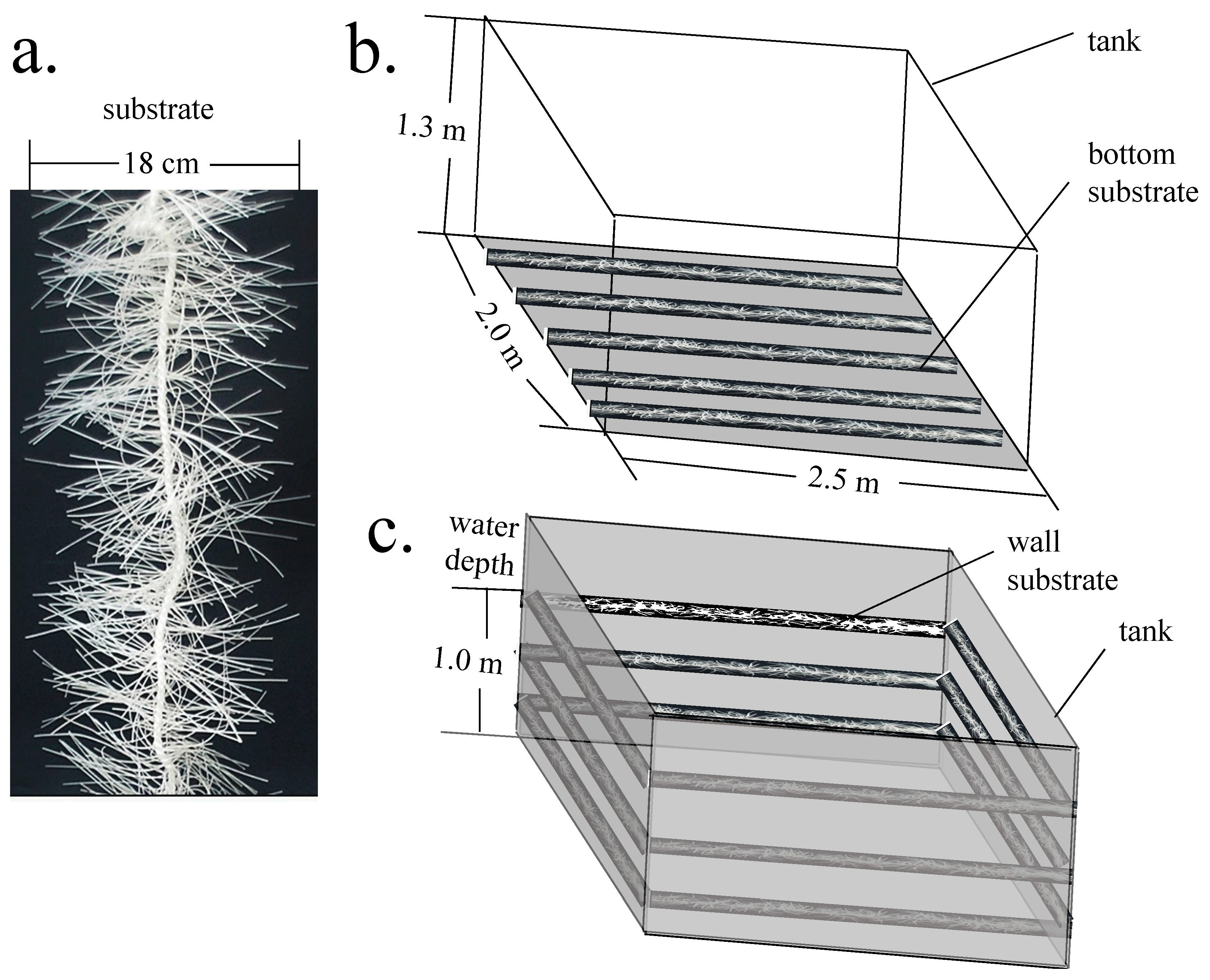
Figure 1. Elastic solid packing filler (nylon, 18 cm in diameter) used as substrate (a), coating 50.1% of the internal surface of the tank via being fixed at the bottom (b) and walls (c).
Fishes 10 00626 g001
Figure 2. Biplot of redundancy analysis (RDA) displaying the shift in bacterial community at the genus level between the biofloc systems with (sB treatment) and without (cB treatment) addition of an elastic solid packing filler (nylon) as the substrate during the 28-day experiment nursing Litopenaeus vannamei postlarvae at a salinity of 5.0‰. Fishes 10 00626 i002, response variables (bacterial genera); only the twenty best-fitted genera were shown due to the capacity limitation of the biplot. Fishes 10 00626 i003, factor explanatory variable (substrate), accounted for 18.00% of the total variation in genus composition. Fishes 10 00626 i004, water samples at 7 d, 14 d, 21 d, and 28 d from sB treatment. Fishes 10 00626 i001, water samples at 7 d, 14 d, 21 d, and 28 d from cB treatment.
Fishes 10 00626 g002
Figure 3. Cladogram (a) andlLinear discriminant analysis (LDA, b) scores of LEfSe (linear discriminant analysis effect size) showing biomarkers in the biofloc systems with (sB treatment) and without (cB treatment) the addition of an elastic solid packing filler (nylon) as the substrate during the 28-day experiment nursing Litopenaeus vannamei postlarvae at a salinity of 5.0‰.
Fishes 10 00626 g003
Figure 4. Heatmap (a) displaying bacterial composition profiles at the phylum level in the biofloc systems with (sB treatment) and without (cB treatment) addition of an elastic solid packing filler (nylon) as substrate during the 28-day experiment nursing Litopenaeus vannamei postlarvae at a salinity of 5.0‰, and bar chart (b) showing difference in proportions of dominant phyla (repeated-measures ANOVA) between both treatments (different letters on the top of bars for each phylum mean significant difference between treatments).
Fishes 10 00626 g004
Figure 5. Stacked bar chart displaying bacterial composition profiles at genus level in the biofloc systems with (sB treatment) and without (cB treatment) addition of an elastic solid packing filler (nylon) as substrate during the 28-day experiment nursing Litopenaeus vannamei postlarvae at a salinity of 5.0‰. Only the proportions of the twenty-five most dominant genera are shown.
Fishes 10 00626 g005
Figure 6. Biplot of redundancy analysis (RDA) showing changes in bacterial alpha diversity between the biofloc systems with (sB treatment) and without (cB treatment) addition of an elastic solid packing filler (nylon) as substrate during the 28-day experiment nursing Litopenaeus vannamei postlarvae at a salinity of 5.0‰. Fishes 10 00626 i005, response variables (alpha diversity indices). Fishes 10 00626 i003, factor explanatory variable (substrate), accounting for 26.50% of the total variation in alpha diversity. Fishes 10 00626 i004, water samples at 7 d, 14 d, 21 d, and 28 d from sB treatment. Fishes 10 00626 i001, water samples at 7 d, 14 d, 21 d, and 28d from cB treatment.
Fishes 10 00626 g006
Figure 7. Changes in bacterial alpha diversity indices along with time elapsing ((a) Shannon index; (b) Margalef index; (c) Pielou index; (d) Heip index; (e) Berger–Parker index; (f) Simpson index) in the biofloc systems with (sB treatment) and without (cB treatment) addition of an elastic solid packing filler (nylon) as substrate during the 28-day experiment nursing Litopenaeus vannamei postlarvae at a salinity of 5.0‰.
Fishes 10 00626 g007
Figure 8. Triplots of redundancy analysis (RDA) showing effects of shifts in bacterial composition at the genus level ((a), only the five representatives are shown) and bacterial diversity (b) on changes in water quality parameters between the biofloc systems with (sB treatment) and without (cB treatment) addition of an elastic solid packing filler (nylon) as substrate during the 28-day experiment nursing Litopenaeus vannamei postlarvae at a salinity of 5.0‰. Fishes 10 00626 i007, response variables (water parameters). Fishes 10 00626 i006, explanatory variables ((a), genus abundances; (b), bacterial alpha diversity indices). Fishes 10 00626 i008, supplementary factor explanatory variable (substrate). Fishes 10 00626 i004, water samples at 7 d, 14 d, 21 d, and 28 d from sB treatment. Fishes 10 00626 i001, water samples at 7 d, 14 d, 21 d, and 28 d from cB treatment. BFV, biofloc volume; BTN, total nitrogen contained in biofloc; CAK, carbonate alkalinity; DTN, dissolved total nitrogen in water; TAN, total ammonia nitrogen; TSS, total suspended solids; WTN, whole total nitrogen in water body.
Fishes 10 00626 g008
Figure 9. Fitted curves (Gompertz growth model) showing changes in average body weight of Litopenaeus vannamei postlarvae in the biofloc systems with (sB treatment) and without (cB treatment) addition of an elastic solid packing filler (nylon) as substrate throughout the 28-day experiment at a salinity of 5.0‰. Error bars represent ± standard deviation (SD).
Fishes 10 00626 g009
Figure 10. Triplots of redundancy analysis (RDA) showing effects of shifts in bacterial composition at the genus level ((a), only the seven most representative are shown) and bacterial diversity (b) on changes in zootechnical indices (response variables, solid black arrows) between the biofloc systems with (sB treatment) and without (cB treatment) addition of an elastic solid packing filler (nylon) as substrate during the 28-day experiment nursing Litopenaeus vannamei postlarvae at a salinity of 5.0‰. Fishes 10 00626 i005, response variables (zootechnical indices). Fishes 10 00626 i006, explanatory variables ((a), genera abundances; (b), bacterial alpha diversity indices). Fishes 10 00626 i008, supplementary factor explanatory variable (substrate). Fishes 10 00626 i004, water samples at 7 d, 14 d, 21 d, and 28 d from sB treatment. Fishes 10 00626 i001, water samples at 7 d, 14 d, 21 d, and 28 d from cB treatment. ABW, average body weight; FCR, feed conversion ratio; SGR, specific growth rate; SR, survival rate; WIW, weekly increment of body weight.

Fishes 10 00626 g010
Table 1. Absolute abundances of dominant phyla and genera in the biofloc systems with (sB treatment) and without (cB treatment) addition of an elastic solid packing filler (nylon) as substrate during the 28-day experiment nursing Litopenaeus vannamei postlarvae at a salinity of 5.0‰.
PhylumGenusAbsolute Abundance
(105 Copies of Genome mL−1)
p-Value
(Repeated-Measures ANOVA)
cBsBSubstrateTimeinteraction
Actinobacteria23.81 ± 7.1510.91 ± 3.74<0.0010.0270.008
Candidatus aquiluna0.19 ± 0.050.49 ± 0.22<0.001<0.001<0.001
Microbacterium0.85 ± 0.232.13 ± 0.690.0010.0190.038
Mycobacterium3.22 ± 1.251.85 ± 0.490.0210.0030.001
Bacteroidetes40.98 ± 12.8141.71 ± 34.450.9480.0290.183
Adhaeribacter0.10 ± 0.052.89 ± 1.680.0410.0410.038
Aequorivita2.14 ± 0.650.32 ± 0.16<0.0010.0120.016
Flavobacterium1.36 ± 0.630.59 ± 0.120.002<0.001<0.001
Haliscomenobacter0.07 ± 0.03 a0.65 ± 0.15 b0.0050.0460.085
Muricauda3.00 ± 1.430.71 ± 0.220.0270.0160.039
Chloroflexi 6.88 ± 5.111.15 ± 0.53<0.0010.0060.006
Firmicutes 7.18 ± 4.2110.93 ± 6.390.0120.009<0.001
Exiguobacterium0.08 ± 0.020.84 ± 0.30.0040.0030.002
Planococcus1.08 ± 0.367.73 ± 2.68<0.0010.0190.037
Planomicrobium0.11 ± 0.031.15 ± 0.450.0010.0130.021
Planctomycetes14.98 ± 4.3521.86 ± 11.380.0960.0710.100
Planctomyces0.35 ± 0.073.82 ± 2.110.0430.0430.040
Proteobacteria73.82 ± 13.0982.51 ± 39.860.3890.0640.209
Amaricoccus9.33 ± 4.172.88 ± 1.270.0310.0130.080
Anaerospora0.42 ± 0.19 a1.07 ± 0.31 b0.0330.0260.554
Bdellovibrio0.80 ± 0.171.01 ± 0.210.079<0.0010.566
Brevundimonas13.45 ± 4.413.02 ± 1.47<0.0010.0070.007
Halomonas1.85 ± 0.540.37 ± 0.15<0.001<0.001<0.001
Hyphomonas3.92 ± 1.062.01 ± 0.650.0340.0180.348
Lutibacterium0.44 ± 0.12 a1.66 ± 0.38 b0.0080.0380.249
Lysobacter0.27 ± 0.075.53 ± 2.650.0200.0510.049
Paracoccus3.98 ± 1.088.66 ± 2.77<0.0010.0380.031
Pseudomonas2.99 ± 0.513.16 ± 1.520.8340.0700.029
Psychrobacter0.40 ± 0.066.31 ± 3.070.0050.0070.009
Rhodobacter5.49 ± 1.265.39 ± 1.920.9310.0340.068
Verrucomicrobia1.15 ± 0.45 a7.61 ± 2.86 b0.0010.0070.072
Luteolibacter0.16 ± 0.051.59 ± 0.57<0.0010.0190.030
Note: different letters for each genus between treatments mean significant difference.
Table 2. Beta diversity (Jaccard index) between the bacterial communities of biofloc systems with (sB treatment) and without (cB treatment) addition of an elastic solid packing filler (nylon) as substrate during the 28-day experiment nursing Litopenaeus vannamei postlarvae at a salinity of 5.0‰.
Group 1Group 2Jaccard IndexPermutationsPseudo-Fp-Value
cBcB0.761 ± 0.208---
sBsB0.768 ± 0.211---
cBsB0.941 ± 0.0079993.960.001
Table 3. Bacterial alpha diversity indices in the biofloc systems with (sB treatment) and without (cB treatment) addition of an elastic solid packing filler (nylon) as substrate during the 28-day experiment nursing Litopenaeus vannamei postlarvae at a salinity of 5.0‰.
IndexTreatmentsp-Value (Repeated-Measures ANOVA)
cBsBSubstrateTimeInteraction
Shannon6.14 ± 0.186.77 ± 0.070.002<0.001<0.001
Margalef343.9 ± 22.0387.7 ± 28.00.3670.0070.471
Heip0.013 ± 0.0010.018 ± 0.0010.0260.0120.544
Pielou0.493 ± 0.0120.538 ± 0.0030.024<0.0010.016
Berger–Parker0.193 ± 0.0200.152 ± 0.0140.0980.0020.676
Simpson0.927 ± 0.0100.955 ± 0.0030.043<0.0010.127
Table 4. Water parameters in the biofloc systems with (sB treatment) and without (cB treatment) addition of an elastic solid packing filler (nylon) as substrate during the 28-day experiment nursing Litopenaeus vannamei postlarvae at a salinity of 5.0‰.
ParametersTreatmentsp-Value (Repeated-Measures ANOVA)
cBsBSubstrateTimeInteraction
TSS (mg L−1)148.5 ± 31.3 a491.3 ± 150.2 b0.0090.1160.594
WTN (mg L−1)76.8 ± 11.276.3 ± 9.60.057<0.0010.013
DTN (mg L−1)13.0 ± 2.614.7 ± 3.60.890<0.001<0.001
BTN (mg L−1)63.8 ± 9.361.6 ± 12.50.052<0.0010.085
TAN (mg L−1)0.55 ± 0.250.43 ± 0.060.0100.2270.002
Nitrite (mg L−1)0.37 ± 0.280.10 ± 0.030.3520.3480.342
Nitrate (mg L−1)0.51 ± 0.140.56 ± 0.080.9240.2740.252
BFV (mL L−1)8.8 ± 2.38.3 ± 2.30.044<0.001<0.001
Turbidity (NTU)111.9 ± 56.3299.5 ± 92.00.0020.0050.059
CAK (mg L−1 CaCO3)373.7 ± 12.4 b306.5 ± 51.7 a<0.001<0.001<0.001
Temperature (°C)26.9 ± 0.727.1 ± 0.60.656<0.0010.012
pH7.20 ± 0.147.11 ± 0.030.0010.001<0.001
Dissolved oxygen (mg L−1)5.85 ± 0.325.63 ± 0.590.215<0.0010.764
Note: BFV, biofloc volume; BTN, the total nitrogen contained in biofloc; CAK, carbonate alkalinity; DTN, the dissolved total nitrogen in water; NTU, nephelometric turbidity units; TAN, total ammonia nitrogen; TSS, total suspended solids; WTN, the whole total nitrogen in water. Different letters for each parameter between treatments mean significant difference.
Table 5. Zootechnical indices of Litopenaeus vannamei postlarvae nursed in the biofloc systems with (sB treatment) and without (cB treatment) addition of an elastic solid packing filler (nylon) as substrate after the 28-day experiment at a salinity of 5.0‰.
ParameterscBsBp-Value
Final ABW (g)0.36 ± 0.040.40 ± 0.030.596
SR (%)81.0 ± 7.196.3 ± 3.60.011
FCR0.98 ± 0.080.76 ± 0.060.044
WIW (g week−1)0.090 ± 0.0140.099 ± 0.0080.652
SGR (% d−1)17.7 ± 0.518.1 ± 0.40.581
Productivity (kg m−3)1.14 ± 0.091.54 ± 0.120.029
Note: ABW, average body weight; FCR, feed conversion rate; SGR, specific growth rate; SR, survival rate; WIW, weekly increment in body weight. SR (%) = [(survival shrimp counts)/stocked shrimp counts] × 100. WIW (g week−1) = (fbw − ibw)/culture weeks. SGR (%d−1) = [(ln fbw − ln ibw)/culture days] × 100. FCR = total mass of feed given/gained shrimp biomass. Productivity (kgm−3) = (harvested shrimp biomass)/(culture water volume). Here, fbw and ibw represent the final and initial mean body weight of PL, respectively.
Disclaimer/Publisher’s Note: The statements, opinions and data contained in all publications are solely those of the individual author(s) and contributor(s) and not of MDPI and/or the editor(s). MDPI and/or the editor(s) disclaim responsibility for any injury to people or property resulting from any ideas, methods, instructions or products referred to in the content.