Hypothesis

Mythos-Class Frontier Models and the Compression of Post-Quantum Cryptography Migration Timelines


by
Robert Campbell
Independent Researcher, Upper Marlboro, MD 20774, USA
Cryptography 2026, 10(3), 41; https://doi.org/10.3390/cryptography10030041

Submission received: 30 April 2026 / Revised: 12 June 2026 / Accepted: 15 June 2026 / Published: 18 June 2026

Abstract

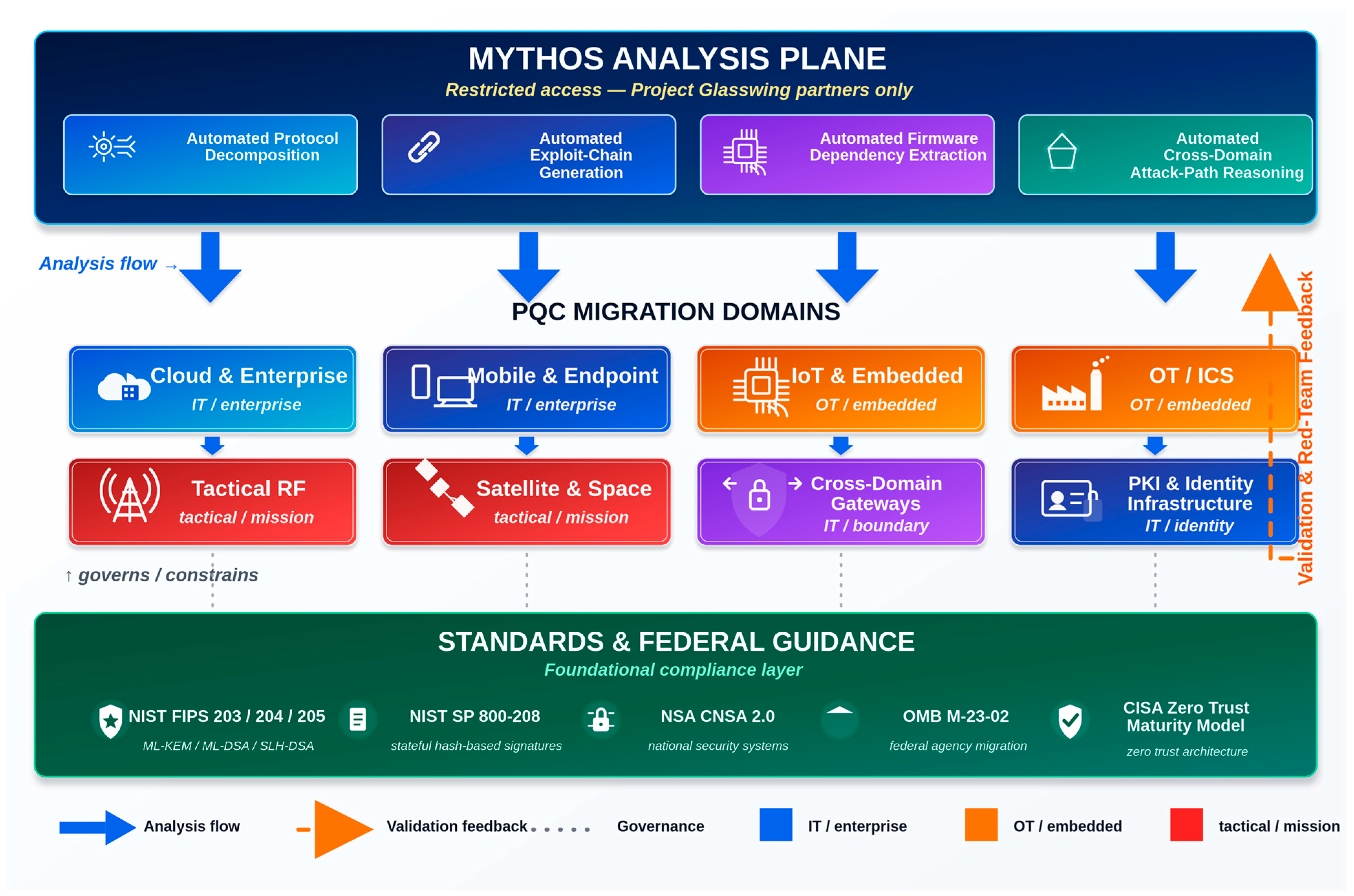
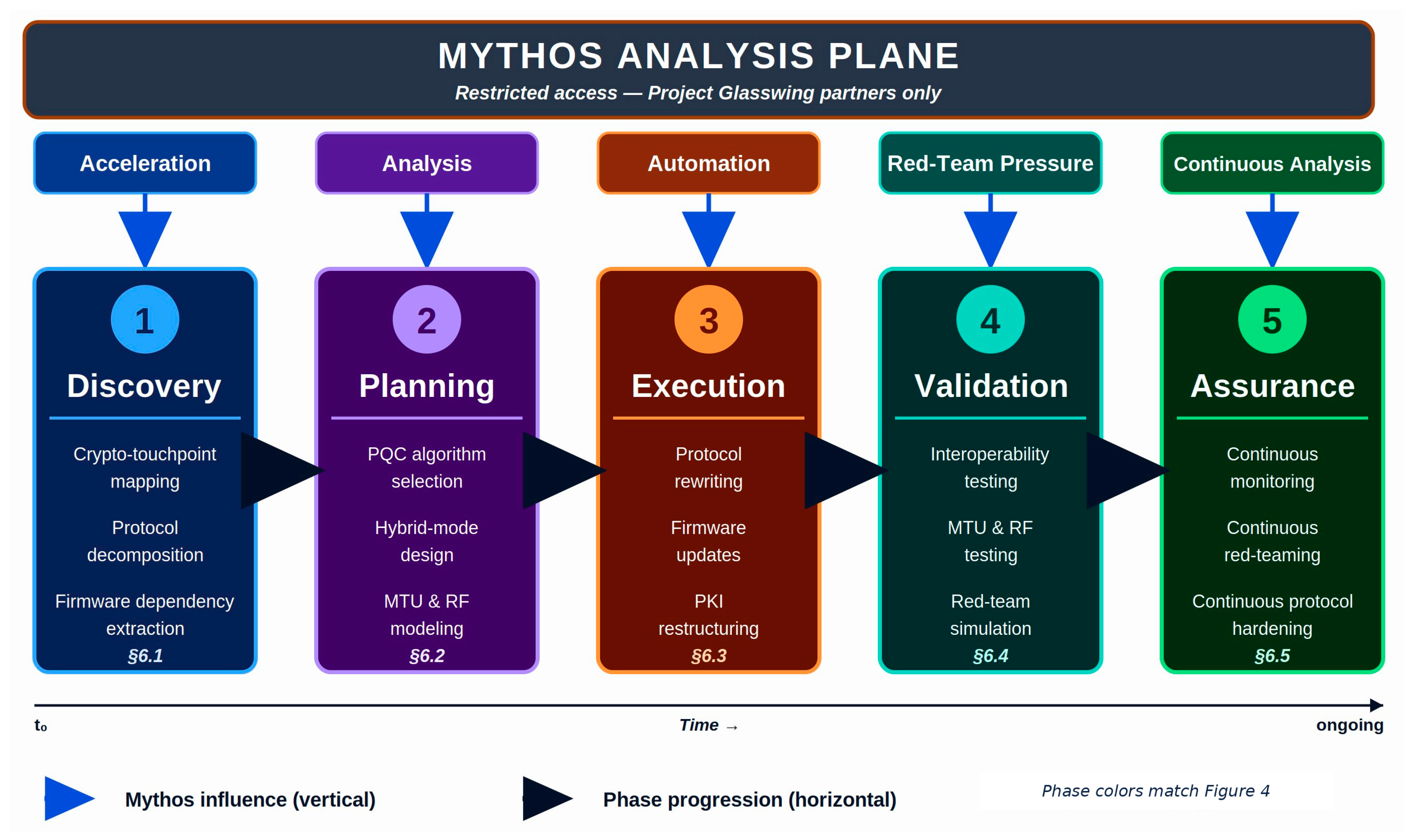
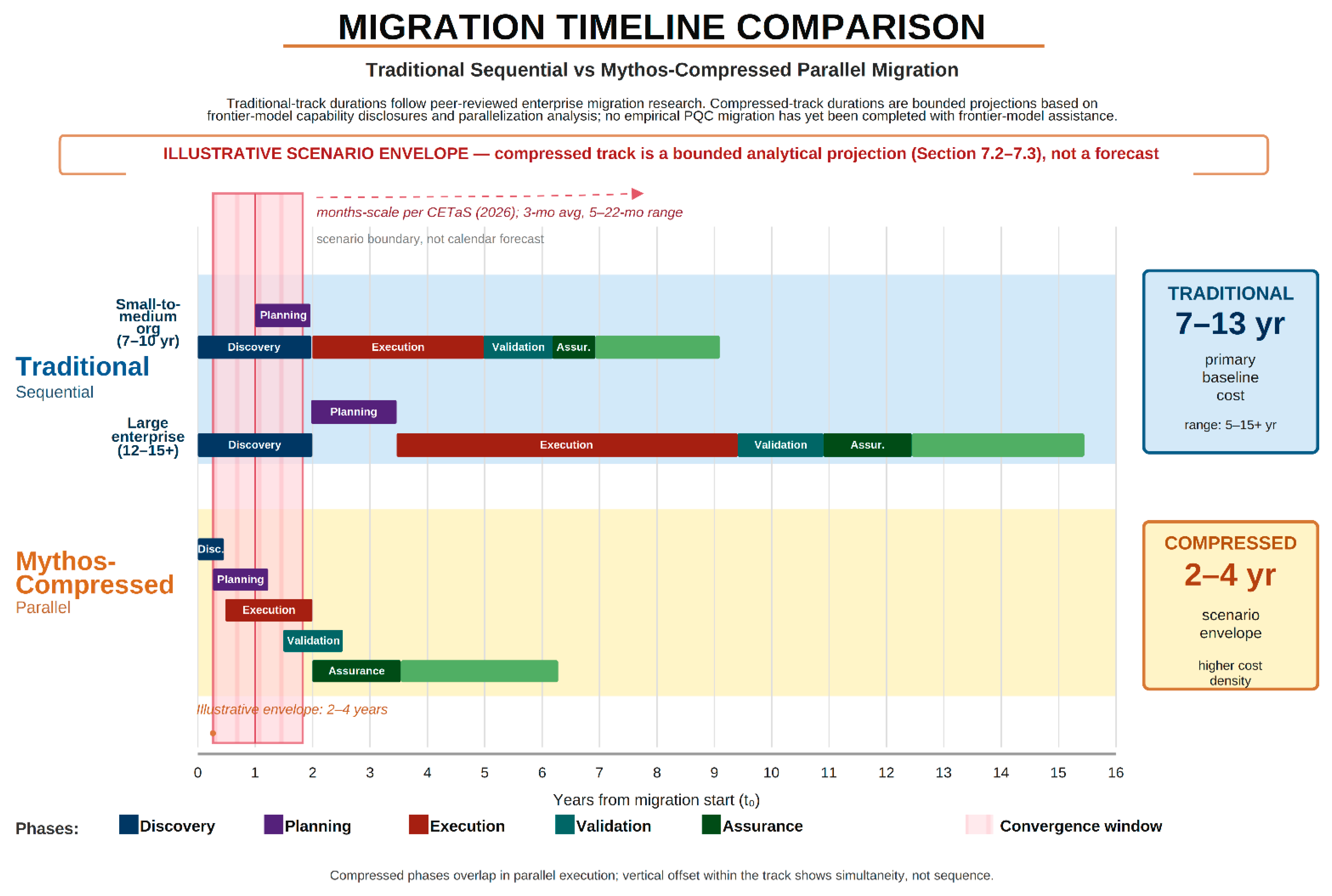
Post-Quantum Cryptography (PQC) migration to National Institute of Standards and Technology (NIST) Federal Information Processing Standards (FIPS) 203, 204, and 205 under the National Security Agency (NSA) Commercial National Security Algorithm Suite (CNSA) 2.0 is a multi-year, multi-domain transformation across cloud, enterprise, embedded, operational technology (OT), tactical, and national-security systems. Anthropic’s Claude Mythos Preview (April 2026) introduces artificial intelligence (AI)-accelerated cybersecurity capabilities that intersect this migration directly, performing autonomous reasoning against previously unknown vulnerabilities in production software—a qualitative departure from signature-based and static and dynamic application security testing (SAST/DAST) tooling. Drawing on federal guidance from NIST, NSA, the Office of Management and Budget (OMB), and the Cybersecurity and Infrastructure Security Agency (CISA), and on independent analyses from the Centre for Emerging Technology and Security (CETaS) and the UK AI Security Institute, we present a lifecycle and architecture analysis of how Mythos-class models alter PQC migration timelines, risk surfaces, lifecycle dependencies, and architectural constraints. Modeling Mythos as both accelerator and destabilizer, we derive an analytic projection of a compressed two-to-four-year migration window for highest-exposure systems, against traditional baselines of five-to-ten years for small organizations and twelve-to-fifteen-plus years for large enterprises. The compression collapses human-labor bottlenecks in discovery, planning, and code modification, not cryptography itself. We propose a lifecycle-aligned migration model, an updated cost model, and governance requirements for frontier-model access. The binding constraint shifts domain-conditionally: defender capacity at adversary tempo governs software-analytical phases, while non-compressible external cadence governs embedded and regulated domains.
Keywords: post-quantum cryptography; PQC migration; Claude Mythos; Project Glasswing; frontier models; cryptographic agility; quantum threat modeling; NIST PQC; CNSA 2.0; AI-accelerated cybersecurity post-quantum cryptography; PQC migration; Claude Mythos; Project Glasswing; frontier models; cryptographic agility; quantum threat modeling; NIST PQC; CNSA 2.0; AI-accelerated cybersecurity