
A Searchable Encryption Scheme Based on CRYSTALS-Dilithium


Abstract
1. Introduction
2. Design of Dilithium-PAEKS Scheme
2.1. Basic Concepts and Formal Definitions
2.2. Detailed Design of the Scheme
- (1)
- Initialization algorithm
- (2)
- Key generation for the recipient
- (3)
- Sender key generation
- (4)
- Keyword Encryption
- (5)
- Keyword trapdoor generation
- (6)
- Match test
2.3. Correctness Analysis of the Dilithium-PAEKS Scheme
3. Security Proof of the Scheme
3.1. Core Security Property Definitions
3.2. Security Assumptions
3.3. Security Proof
- (1)
- Initialization phase
- (2)
- Hash query phase
- (3)
- Inquiry stage
- (4)
- Challenging Phase
- (5)
- Output stage
- (1)
- Initialization phase
- (2)
- Hash query phase
- (3)
- Inquiry stage
- (4)
- Forgery stage
- (5)
- MSIS Reduction and Solution
3.4. Resistance to Keyword Guessing Attacks
- (1)
- Outside Keyword Guessing Attacks (OKGA)
- (2)
- Insider Keyword Guessing Attacks (IKGAs)
- a.
- Sender–Receiver Binding: Each ciphertext embeds both the sender’s private key and the receiver’s public key through the hash computation . Without knowing , even a malicious server holding a valid trapdoor cannot forge a matching ciphertext for keyword verification.
- b.
- Trapdoor Indistinguishability: As proven in Lemma 2, trapdoors leak no information about keywords beyond what is revealed during legitimate matching operations. The MSIS-hardness ensures that even computational adversaries cannot extract keyword information from trapdoor analysis.
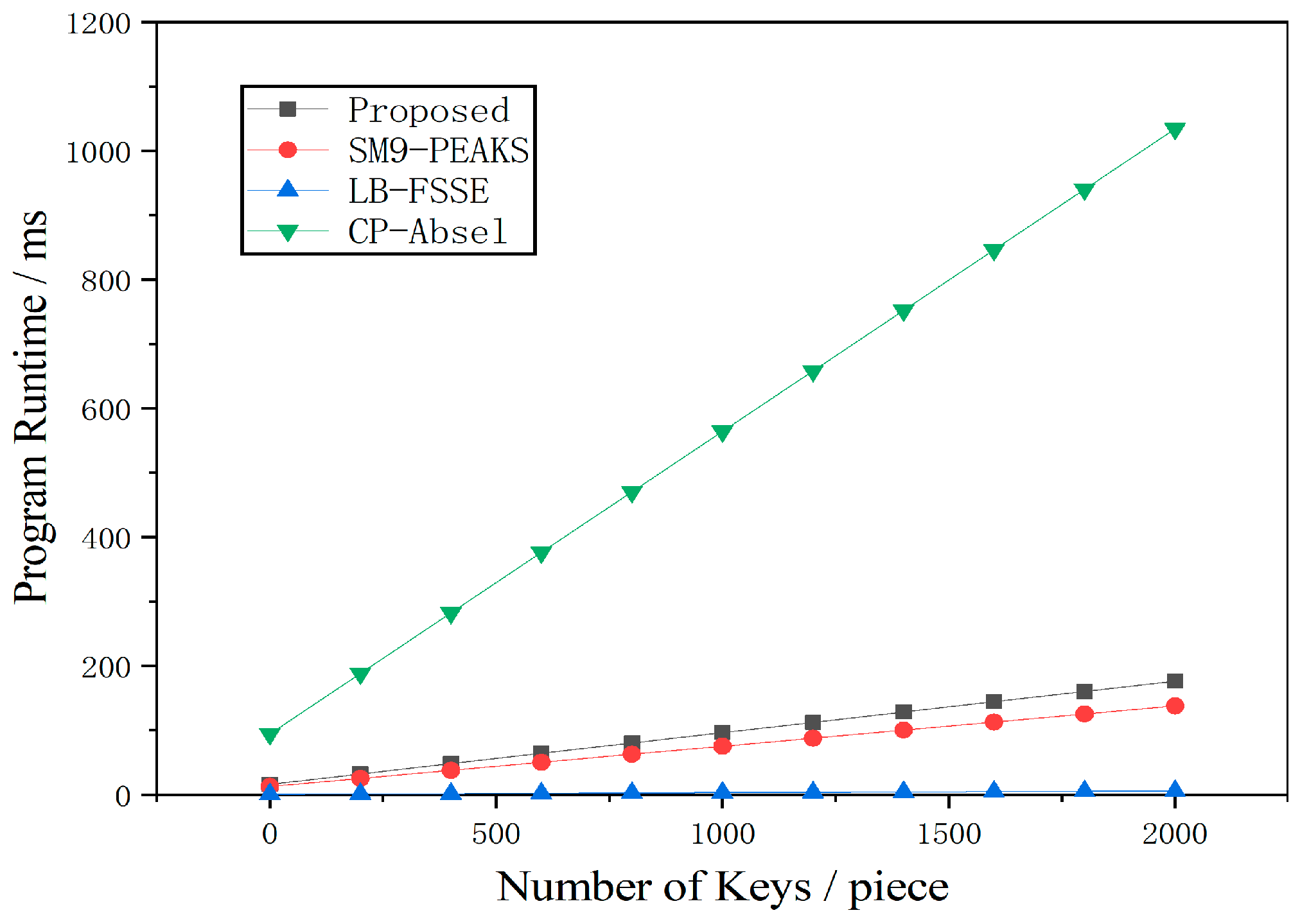
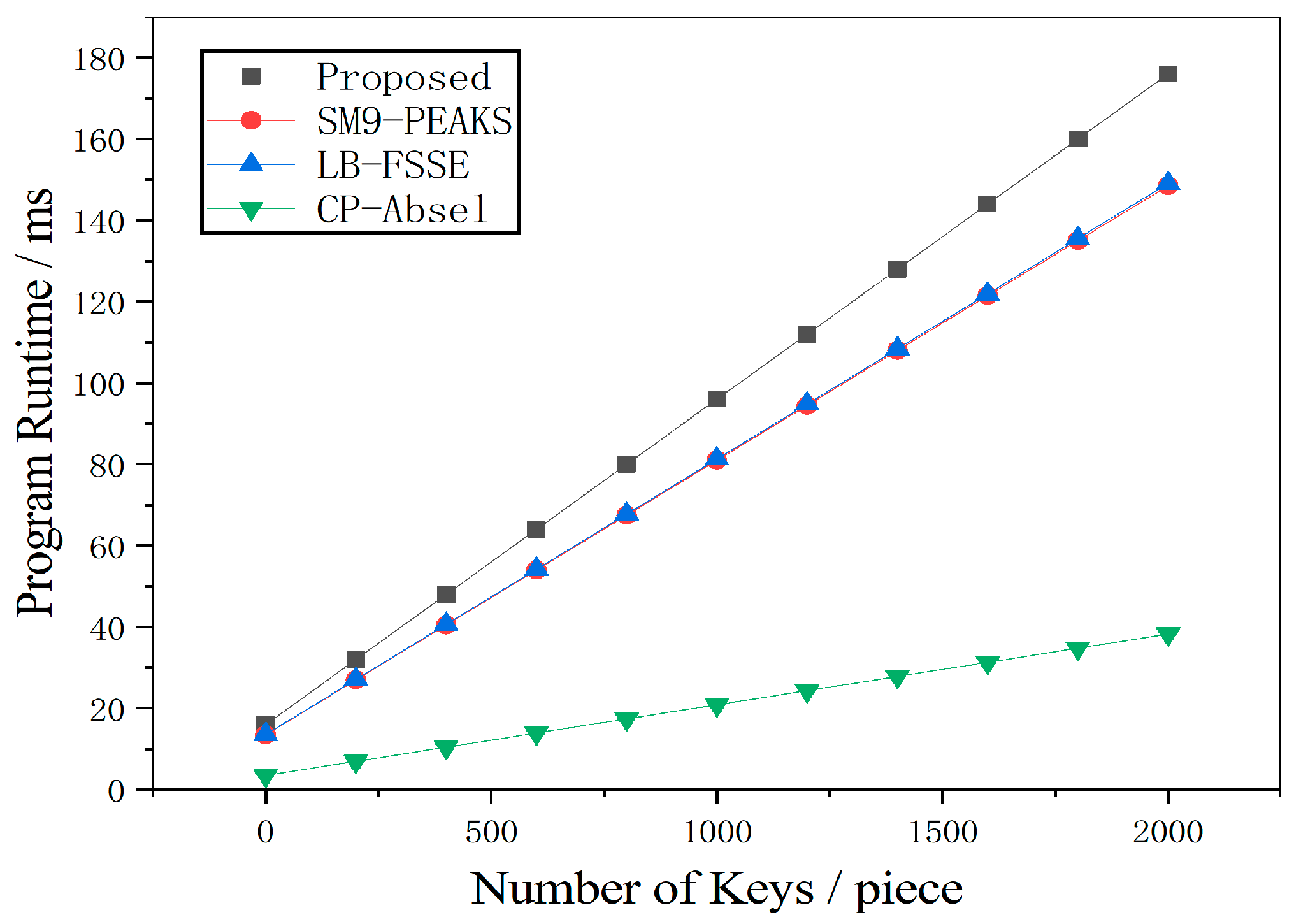
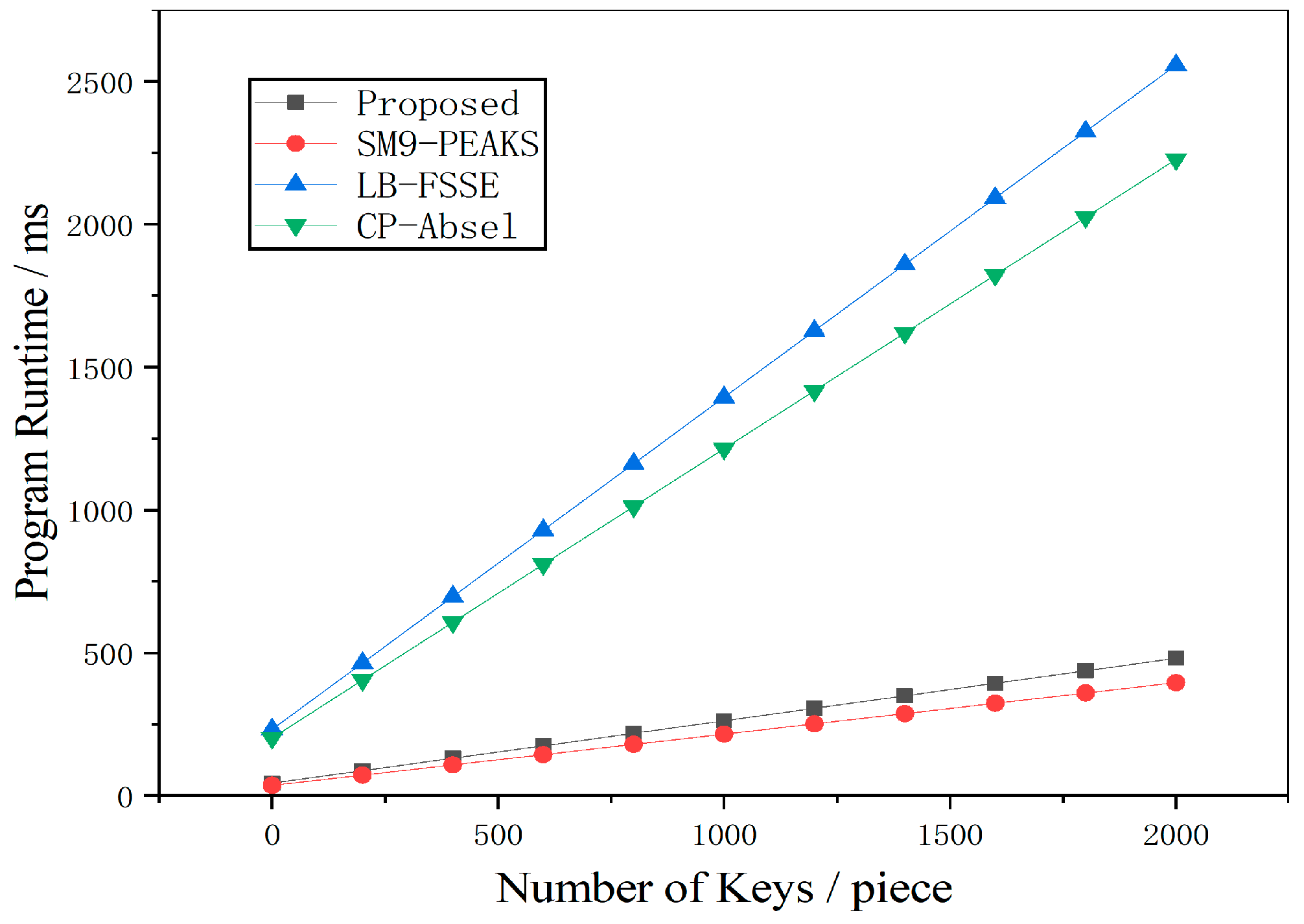
4. Experimental Analysis and Comparison
5. Conclusions
Author Contributions
Funding
Data Availability Statement
Conflicts of Interest
References
- Lanyon, B.P.; Weinhold, T.J.; Langford, N.K.; Barbieri, M.; James, D.F.; Gilchrist, A.; White, A.G. Experimental demonstration of a compiled version of Shor’s algorithm with quantum entanglement. Phys. Rev. Lett. 2007, 99, 250505. [Google Scholar] [CrossRef] [Scilit] [PubMed]
- Long, G.L. Grover algorithm with zero theoretical failure rate. Phys. Rev. A 2001, 64, 022307. [Google Scholar] [CrossRef] [Scilit]
- Fernandez-Carames, T.M.; Fraga-Lamas, P. Towards Post-Quantum Blockchain: A Review on Blockchain Cryptography Resistant to Quantum Computing Attacks. IEEE Access 2020, 8, 21091–21116. [Google Scholar] [CrossRef] [Scilit]
- Song, D.X.; Wagner, D.; Perrig, A. Practical techniques for searches on encrypted data. In Proceedings of the 2000 IEEE Symposium on Security and Privacy (S&P 2000), Berkeley, CA, USA, 14–17 May 2000; IEEE: Piscataway, NJ, USA, 2000; pp. 44–55. [Google Scholar]
- Boneh, D.; Di Crescenzo, G.; Ostrovsky, R.; Persiano, G. Public key encryption with keyword search. In Proceedings of the International Conference on the Theory and Applications of Cryptographic Techniques (EUROCRYPT 2004), Interlaken, Switzerland, 2–6 May 2004; Springer: Berlin, Germany, 2004; pp. 506–522. [Google Scholar]
- Xu, L.; Xu, C.G.; Yu, X.L. Secure and Efficient Data Retrieval Scheme Using Searchable Encryption in Cloud. J. Cryptolog. Res. 2016, 3, 330–339. [Google Scholar] [CrossRef]
- Li, S.Q.; Yang, B.; Wang, T.; Zhou, Y.W. Efficient Public Key Encryption with Keyword Search Without Using Secure Channel. J. Cryptolog. Res. 2019, 6, 283–292. [Google Scholar] [CrossRef]
- Deng, Z.H.; Wang, S.H.; Wang, P. Analysis and Improvement of Searchable Encryption Scheme Based on Composite-Order Bilinear Pair. Comput. Eng. 2020, 46, 123–128+135. [Google Scholar] [CrossRef]
- Cui, R.R.; Zhang, Y.S.; Wei, Y. Multiple Keywords Searchable Encryption Scheme Based on Elliptic Curve. J. Jinan Univ. 2019, 33, 353–360. [Google Scholar] [CrossRef]
- Zhang, C.; Peng, C.G.; Ding, H.F.; Xu, D.Q. Searchable Encryption Scheme Based on China State Cryptography Standard SM9. Comput. Eng. 2022, 48, 159–167. [Google Scholar] [CrossRef]
- Pu, L.; Lin, C.; Wu, W.; Gu, J.; He, D. Public-key Authenticated Encryption Scheme with Keyword Search from Chinese Cryptographic SM9. J. Softw. 2025, 36, 4271–4284. [Google Scholar] [CrossRef]
- Zhang, E.; Hou, Y.Y.; Li, G.L.; Li, H.M.; Li, Y. Adaptive hierarchical searchable encryption scheme based on learning with errors. Comput. Appl. 2020, 40, 148–156. [Google Scholar]
- Liu, Y.; Wang, L.C.; Zhou, Y.B. TTRC-ABE: A Traceable and Revocable Grid-Based Attribute Encryption Scheme Based on the CLWE Problem. J. Electron. Inf. Technol. 2025, 47, 1911–1926. [Google Scholar] [CrossRef]
- Yu, H.; Bai, X. Identity-based searchable attribute signcryption in lattice for a blockchain-based medical system. Front. Inf. Technol. Electron. Eng. 2024, 25, 461–472. [Google Scholar] [CrossRef] [Scilit]
- Varri, U.S.; Pasupuleti, S.K.; Kadambari, K.V. CP-ABSEL: Ciphertext-policy attribute-based searchable encryption from lattice in cloud storage. J. Cloud Comp. 2021, 10, 1290–1302. [Google Scholar] [CrossRef] [Scilit]
- Islam, S.H.; Mishra, N.; Biswas, S.; Keswani, B.; Zeadally, S. An efficient and forward-secure lattice-based searchable encryption scheme for the Big-data era. Comput. Electr. Eng. 2021, 96, 107533. [Google Scholar] [CrossRef] [Scilit]
- Ducas, L.; Kiltz, E.; Lepoint, T.; Lyubashevsky, V.; Schwabe, P.; Seiler, G.; Stehlé, D. CRYSTALS-Dilithium: A lattice-based digital signature scheme. IACR Trans. Cryptogr. Hardw. Embed. Syst. 2018, 2018, 238–268. [Google Scholar] [CrossRef] [Scilit]
- National Institute of Standards and Technology (NIST). FIPS 204: Module-Lattice-Based Digital Signature Standard; U.S. Department of Commerce: Gaithersburg, MD, USA, 2024. [Google Scholar]
- Bos, J.; Ducas, L.; Kiltz, E.; Lepoint, T.; Lyubashevsky, V.; Schanck, J.M.; Schwabe, P.; Seiler, G.; Stehlé, D. CRYSTALS–Kyber: A CCA-Secure Module-Lattice-Based KEM. In Proceedings of the IEEE European Symposium on Security and Privacy (EuroS&P 2018), London, UK, 24–26 April 2018; IEEE: Piscataway, NJ, USA, 2018; pp. 353–367. [Google Scholar]
- Lyubashevsky, V.; Seiler, G. Short, Invertible Elements in Partially Splitting Cyclotomic Rings and Applications to Lattice-Based Zero-Knowledge Proofs. In Proceedings of the Advances in Cryptology–EUROCRYPT 2018, Tel Aviv, Israel, 29 April–3 May 2018; Springer: Cham, Switzerland, 2018; pp. 204–224. [Google Scholar]

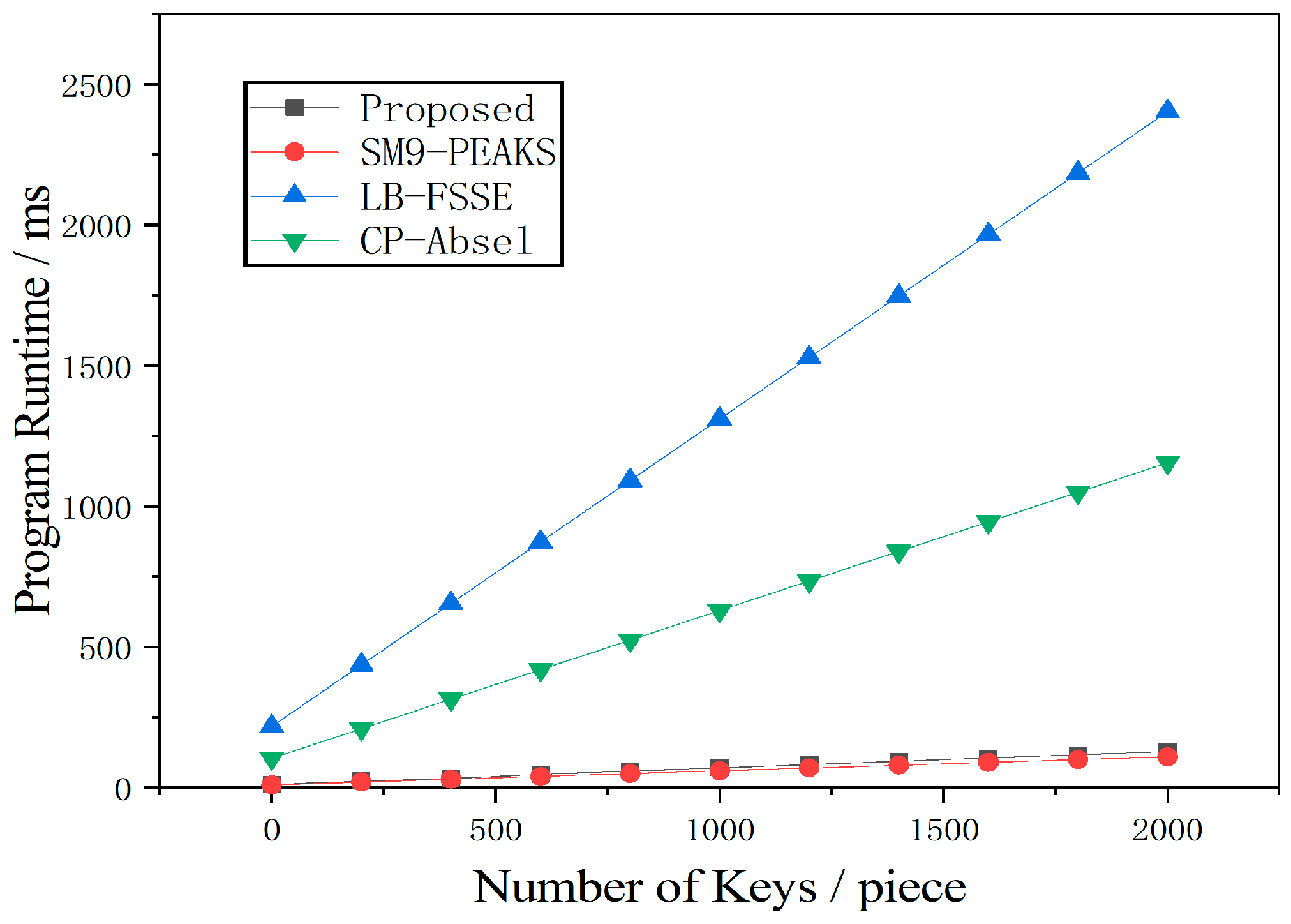



| Parameters and Functions | Meaning |
|---|---|
| security parameter, default value | |
| Vector dimension parameter, = 4, = 4 | |
| , (d = 13) | |
| Maximum absolute value of polynomial coefficients | |
| collision-resistant hash function | |
| Determines the random value for generating the signature scheme | |
| Expand the matrix and output it as an NTT field representation | |
| Separate high and low bits of data | |
| Different methods of high–low separation | |
| Show hint | |
| restoring the separated higher-order bit | |
| Extract the first part of the value in the higher-order bit | |
| Extract the second part of the value in the higher-order bit | |
| Sender’s public key and private key pair | |
| Receiver’s public key and private key pair | |
| Keyword ciphertext, consisting of | |
| Keyword trapdoor, consisting of | |
| Vectors used in ciphertext and trapdoor respectively, typically derived from random commitments in the signature process | |
| Challenge values used in ciphertext and trapdoor respectively, gener-ated by a hash function | |
| w1 | Part of the ciphertext, possibly obtained by extracting low bits from the intermediate variable w |
| µw, µw′ | Binding hash value ensuring keyword consistency, computed as µw = CRH (tr‖w‖ρr) = CRH (tr‖w‖ρs) |
| As | Sender’s public key matrix (in Dilithium, the public key includes matrix A and vector t) |
| t1 (S) | High bits of the sender’s public key, derived from the decomposition of t = As1 + s2 |
| s1 (S), s2 (S) | Two components of the sender’s private key, namely the main secret vector and the noise term |
Disclaimer/Publisher’s Note: The statements, opinions and data contained in all publications are solely those of the individual author(s) and contributor(s) and not of MDPI and/or the editor(s). MDPI and/or the editor(s) disclaim responsibility for any injury to people or property resulting from any ideas, methods, instructions or products referred to in the content. |
© 2026 by the authors. Licensee MDPI, Basel, Switzerland. This article is an open access article distributed under the terms and conditions of the Creative Commons Attribution (CC BY) license.
Share and Cite
Zheng, M.; Xiao, A.; Huang, S.; Kong, D. A Searchable Encryption Scheme Based on CRYSTALS-Dilithium. Cryptography 2026, 10, 22. https://doi.org/10.3390/cryptography10020022
Zheng M, Xiao A, Huang S, Kong D. A Searchable Encryption Scheme Based on CRYSTALS-Dilithium. Cryptography. 2026; 10(2):22. https://doi.org/10.3390/cryptography10020022
Chicago/Turabian StyleZheng, Minghui, Anqi Xiao, Shicheng Huang, and Deju Kong. 2026. "A Searchable Encryption Scheme Based on CRYSTALS-Dilithium" Cryptography 10, no. 2: 22. https://doi.org/10.3390/cryptography10020022
APA StyleZheng, M., Xiao, A., Huang, S., & Kong, D. (2026). A Searchable Encryption Scheme Based on CRYSTALS-Dilithium. Cryptography, 10(2), 22. https://doi.org/10.3390/cryptography10020022