

Aristotelian Presentism
Graduate School of Literature and Human Sciences, Osaka Metropolitan University, Osaka 558-8585, Japan
Philosophies 2026, 11(5), 167; https://doi.org/10.3390/philosophies11050167 (registering DOI)
Submission received: 28 July 2026
/
Revised: 14 September 2026
/
Accepted: 18 September 2026
/
Published: 20 September 2026
(This article belongs to the Special Issue Debating Temporal Ontology: The Existence of Yesterday and Tomorrow)
Abstract
Time is often treated by analogy with space and considered to be another dimension alongside the three spatial dimensions. I refer to this conception as the “spatialization of time.” This paper aims to offer a version of presentism that avoids such spatialization. Presentism is typically characterized as the thesis that everything is present, and it has given rise to numerous objections. I primarily address the challenges concerning change and persistence raised by Leininger and Tallant, respectively. These critics seem to presuppose that change involves a thing’s having different states at various times, and persistence requires its continuous existence across those times. To counter these presuppositions, I first reconsider what the presentist thesis amounts to and then integrate it with the Aristotelian claim that time is the number of motion or change. By scrutinizing this claim, I develop a dynamic model that quantifies the duration of change and persistence but does not regard times as temporal locations. Ultimately, I argue that things can exist and possess properties without being located at a specific time, thereby providing a robust defense of presentism against its spatializing alternatives.
1. Against Spatialization of Time
Time is often treated by analogy with space and considered to be another dimension alongside the three spatial dimensions (see, for example, Mellor [1] and Sider [2]). I refer to this conception as the “spatialization of time.” Although this term may have different implications in various fields, I consider any view that embodies the notion of a so-called four-dimensional block universe as spatializing time1. The view called eternalism typically posits a static block universe that encompasses everything in the past, present, and future; the moving spotlight theory holds that reality consists of an eternalist block universe plus the moving now; and the growing block theory contends that the block universe itself grows as time passes. Thus, each view (in its standard form) can be classified as the spatialization of time, regardless of whether it is static or dynamic2.
The aim of this paper is to suggest a way to avoid spatializing time by reconsidering the nature of temporal existence. Specifically, I offer a version of presentism that does not entail the spatialization of time. Presentism is typically characterized as the thesis that everything is present or that only the present exists, and it has given rise to numerous objections. In this paper, I primarily address the challenges concerning change and persistence raised by Leininger [3] and Tallant [4], respectively. I argue that their challenges (perhaps unwittingly) rely on a spatialized framework, where “change” refers to the different states of a thing at various times, and “persistence” means the continuous existence of that thing across those times. To counter these spatializing presuppositions, I reformulate the presentist thesis in terms of a non-locative notion of present existence and integrate it with the Aristotelian claim that time is the number of motion or change. By scrutinizing this claim, I argue that things can exist and have properties without being located at a time, treating times instead as mathematical indices on a scale of measurement generated through the dynamic process of recording (regular) changes in things.
In what follows, I first introduce the two main objections to presentism and suggest guidelines to respond to both cases (Section 2). Then, I propose a formulation of presentism as an antithesis to the spatialization of time by redefining present existence as existence with no qualification, that is, existence simpliciter (Section 3). To address these objections, I argue that presentists can deal with the duration of time quantitatively by consulting Aristotle’s relationalist view on time, where time functions as a derivative measurement rather than a temporal location at which things reside (Section 4). Based on these observations, I finally provide presentists with a robust response to the problems of change and persistence (Section 5)3.
2. Change and Persistence
It may appear that presentism is ill-suited to accommodate the fact that things change and persist, given its assertion that only the present exists. There are two notable objections: Leininger [3] contends that presentists cannot adequately account for change, while Tallant [4] highlights the challenge of persistence for presentists. In this section, I introduce these issues, clarify the matter at stake, and point to a way for presentists to respond.
2.1. Change: Leininger’s Objection
Presentists typically believe in the reality of change, but Leininger [3] attacks presentism as a dynamic theory of time by claiming that the following two theses are incompatible:
The Present Thesis:Only the present exists. Past and future moments do not exist.
Leininger questions how change is possible if there is only one moment in time. If the present thesis correctly expresses the essence of presentism, presentists who also believe in the reality of change must respond to this challenge.The Change Thesis:What is present changes: there is a difference in what exists from moment to moment.
Leininger anticipates one possible response: Presentists may rely on presently existing surrogates for non-present entities. A typical example of this approach is found in Bigelow’s [5] “Lucretian presentism,” where a truthmaker for a statement about the past is given as follows:
- It is true that Socrates has existed if and only if the world presently has the past-tensed property of having been a world where Socrates exists.
In general, according to Lucretian presentism, a past statement of the form “such-and-such was the case” is true if and only if the present world has the past-tensed property of having been a world where such-and-such is the case. Thus, all past truths can be grounded on the present object and the way it was (that is, its presently possessing certain past-tensed properties).
Lucretian presentists may say that the change thesis can be reinterpreted in terms of the difference between the world’s possessing the present-tensed property of being a world where Socrates no longer exists and the past-tensed property of having been a world where Socrates exists. However, Leininger dismisses this maneuver as hopeless, arguing that the property of the world having been one where Socrates exists might not correspond to any actual past moment. She claims that it is at least conceivable for God to create a “one-instant world” without any history, which looks exactly like the present world but has just come into existence with all the past- and present-tensed properties. Unless Lucretian presentists can disprove this one-instant world scenario, their attempt to explain the difference between the two moments remains inadequate.
Ingram [6] (pp. 162–164) proposes an alternative approach based on “thisness presentism.” Thisness refers to a unique property that only a specific individual can possess, namely, the property of being that particular individual. For example, only Socrates has the property of being Socrates. Ingram asserts that the thisness of any entity that has ever existed continues to exist even when the entity itself does not. Thus, the following must be true:
- Necessarily, for any entity x, if x’s thisness T exists, then x has existed.
Given this principle, T cannot exist without x having existed. Consequently, even an omnipotent being could not create a one-instant world containing thisness T for a past object x without it being the case that x truly existed in the past. Therefore, the thisness of any past object should reliably represent a past moment when the object existed.
There is nothing uniquely advantageous about thisness presentism, however. If Ingram’s response is deemed acceptable, Lucretian presentists could respond in exactly the same way:
- Necessarily, for any entity x, if the world has the past-tensed property of having been a world where x exists, then x has existed.
If the world has the past-tensed property of having been a world where x exists, the above conditional guarantees that x has existed. Consequently, it is not possible for a world that has all the relevant tensed properties to have just sprung into existence. While it is conceivable that God could create a world that is exactly like the present world but devoid of past-tensed properties, the fact that the present world has certain past-tensed properties ensures that it has existed4.
Is this the end of the story? Far from it. Leininger claims that change requires some difference in what exists from moment to moment. In the next subsection, I argue that this requirement is unfair to presentists because it is assumed that there are such things as moments prior to any change. Here I pose another problem for presentists: How can they make sense of and utilize moments in general? According to Lucretian presentism, the world has the present-tensed property of being a world where Socrates no longer exists and the past-tensed property of having been a world where Socrates exists. These tensed properties can certainly make some difference between the past and the present, but they fall short of representing these two moments. Both tensed properties are present properties (namely, the properties that the world presently has) and arguably such properties are not moments in themselves. The same point applies to thisness presentism. While the present surrogates of non-present entities can make some difference between moments, they do not serve as moments or times themselves. Nor do they define what moments or times are. Rather, moments are just assumed as a given throughout the discussion.
2.2. How Should Presentists Respond to Leininger?
In this section, I suggest how presentists should address Leininger’s challenge. (A more comprehensive solution will be presented in Section 5.) First, presentists who are realists about change should reject the change thesis as formulated by Leininger. The change thesis states that what is present changes, which seems like a harmless assertion of dynamic reality. It becomes problematic, however, when Leininger reframes it in terms of a difference in what exists from moment to moment and requires presentists to account for such differences. Suppose that presentists were to successfully establish, for instance, that Socrates exists around 450 B.C. but does not exist in 2025, rather than merely stating that Socrates existed in the past but does not now. This would indeed account for the requisite difference. Nonetheless, Socrates’ existence around 450 B.C. and his non-existence in 2025 are fixed facts. Consequently, a successful response to the change thesis along these lines would ultimately reduce change to changeless facts.
This point echoes a well-known historical debate between Russell and McTaggart. Russell [7] (p. 469) proposes that change occurs when the proposition “The object O is F at the time t1” is true and “The same object O is F at the time t2” is false. This falls under a classical version of the change thesis as it refers to the alethic difference between the two moments. McTaggart [8] (p. 14) replies that Russell’s analysis never succeeds in capturing the reality of change because the truth or falsity of these propositions remains constant over time. Although, in my view, McTaggart wrongly concludes that time is unreal thereafter, his critical point is quite correct. In general, realists about change should maintain that changes cannot be analyzed or explained in terms of differences between moments because doing so would negate a fundamental aspect of the world.
It is crucial to note that while I object to reductively explaining changes in terms of differences between moments, I do not oppose constructing a dynamic model that utilizes moments to represent real changes. As I suggested at the end of the previous section, presentists should be able to utilize moments or times, rather than merely expressing changes in tensed terms. Following Aristotle, I will later propose how presentists can employ moments as units of change and what form a non-reductive change thesis would take. At this stage, it would be helpful to adopt the following slogan for realism about change: Moments or times depend on changing things, but not vice versa. Prior to changing things, there are no moments. Hence, changes in things cannot be analyzed or explained in terms of differences between moments.
Second, presentists should also reject the present thesis as formulated by Leininger. It asserts that only the present exists. Immediately thereafter, she adds that past and future moments do not exist. This implies that Leininger equates presentism with the thesis that only the present moment exists. However, some presentists would insist that this formulation is based on a misconception of their position. Trenton Merricks describes the source of this misunderstanding in his book Truth and Ontology:
Merricks complains that presentism is often confused with a thesis that implies everything is instantaneous, and that such confusion is likely to arise from starting with the block universe. Presentists should eschew this starting point and instead strive for a more appropriate articulation of presentism that allows that many objects not only exist but also have existed or will exist.Now consider a view that starts with the eternalist’s picture of time and existence at a time, and then ‘shaves off’ the past and the future, leaving only a thin (instantaneous?) slice called ‘the present’. This view agrees with eternalism that existing at a time—at any time, past, present, or future—is like being located at a place. But, unlike eternalism, this view says that while objects exist at the present time, they exist at no other times, since there are no other times at which to be located. Such a view implies that everything is instantaneous.This view is not presentism. Presentists deny that everything is instantaneous; they think that many objects not only exist, but also have existed and will exist. But I can see why some might think this view is presentism. They think this view is presentism because they (wrongly) ascribe to presentists the eternalist’s claim that to exist at a time is to be located at some super-thin slice of being. … I think presentists should deny that there is anything at all—much less some super-thin slice of being—that is the present time, just as they should deny that there are past times or future times [9] (pp. 124–125).
In summary, the change thesis inaptly dismisses realism about change, and the present thesis is predicated on a misconception of presentism. Presentists who are realists about change should reject both theses and seek suitable replacements, which need to include (i) an adequate formulation of presentism that does not rest on the idea of the block universe, and (ii) a robust, realist version of the change thesis that views change as a fundamental, irreducible aspect of reality. I revisit this issue after introducing the problem of persistence, which, I argue, originates from the same misunderstanding of presentism.
2.3. Persistence: Tallant’s Worry
Tallant [4] argues that the persistence of a thing should pose an insurmountable difficulty for presentists. Persistence is typically defined in one of two ways:
Perdurance: x persists from t to t* by having a temporal part at each of t and t*.
Since the combination of perdurantism and presentism is relatively rare in the literature, it is safe to focus on the latter notion.Endurance: x persists from t to t* by being wholly present at each of t and t*.
Tallant claims that endurantism and presentism are incompatible, based on Lowe’s [10] conception of identity dependence:
Tallant argues that endurance and identity dependence jointly yield the following requirement:Identity Dependence:x depends for its identity upon y = df. There is a function f such that it is part of the essence of x that x is f(y).
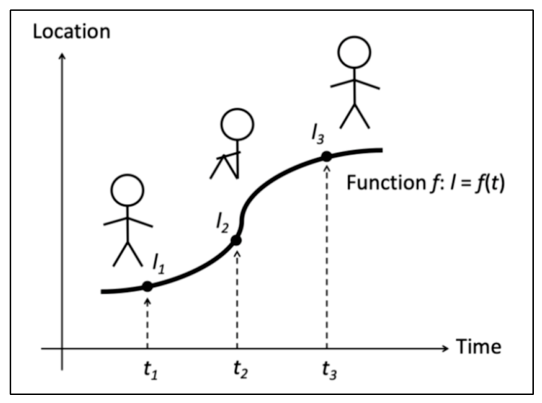
I do not discuss whether this basic framework for persistence is correct; rather, I focus on the resulting condition: For all times t, an enduring object O must saturate some function f such that the location where O is wholly present is determined by the function f at time t (see Figure 1).Endurance + Identity Dependence:O is an enduring object = df. There is a function f such that it is part of the essence of O that for all times t (present or non-present), the location where O is wholly present is determined by the function f at time t.
Given this framework and the standard formulation of presentism, the problem of persistence arises straightforwardly. Tallant argues that:
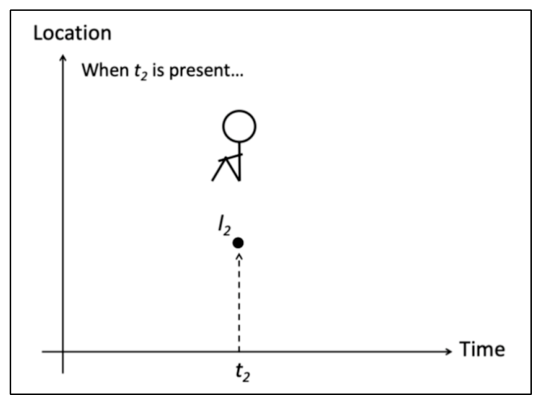
Because presentism implies that nothing exists at multiple times, it follows that no object can saturate the requisite function for multiple times. For instance, it may be said that when the time t2 is present, O is wholly located at l2, but O can saturate the function f for no other times (see Figure 2).In order for an object, O, to persist over time, as opposed to simply being an instantaneous object, O must itself be (wholly) located at more than one time. Thus, the identity of a persisting (enduring) object, as a persisting object, is identity dependent upon its existence at multiple times. There is a function, being an existent at times other than t, that O must saturate in order to be, at t, a persisting object. Since the existence of O at t and at t* is inconsistent with presentism, so O does not persist. There are no persisting objects if endurance is true [4] (p. 2213).
Before moving on, it should be noted that Tallant seems to assume the existence of non-present (past and future) times while claiming that no object can saturate the function for multiple times if presentism is true. Insofar as I can see, he provides no clear reason why presentists should accept the existence of such non-present times. Indeed, it would be more natural for presentists to say that only the present time exists (if times as temporal locations exist at all), whereas neither past nor future times do. I suspect that Tallant assumes the existence of both present and non-present times because he believes that those temporal locations exist prior to any particular occupant. Presentists should resist such an assumption. However, in doing so, they must also reinterpret these temporal indices in a radically different way, a task I address later in this paper5.
2.4. How Should Presentists Respond to Tallant?
Baron [12] rightly points out that Tallant relies on a particular notion of endurance that presentists need not accept. By employing tensed terms, presentists can adopt the following notion:
Because presentists believe that present things not only exist but also have existed or will exist, they should accept TLE. Baron then suggests combining TLE with identity dependence:Tensed Locative Endurance (TLE):An object O endures from the past to the present if and only if O is wholly located in the present and either O was wholly located at some time in the past when that time existed or O will be located at some time in the future when that time comes into existence.
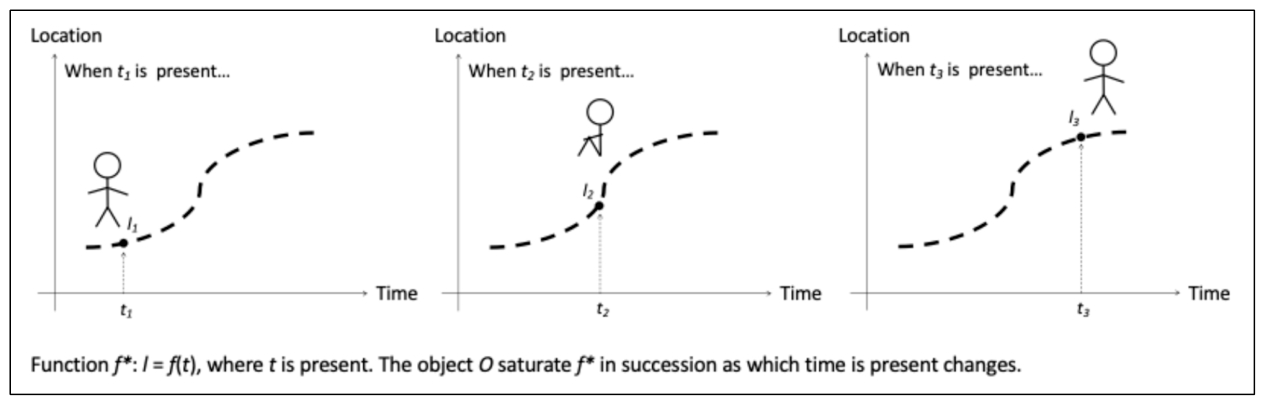
To recap, while Tallant assumes a function from all times (present or non-present) to locations where the object in question is wholly present, Baron replaces it with a function from whichever time is present to a location. Since the time that is present changes, the object saturates the function accordingly (see Figure 3).TLE + Identity Dependence:A persisting object O depends for its identity upon the fact that it is wholly located at the present time, and either it was wholly located at some past time or will be located at some future time = df. There is a function f* that takes, as input, whichever time is present, where which time is present changes. The function yields as output a location such that it is part of the essence of O’s identity as a persisting object that it is this function from whichever time is present to a location.
Baron’s solution to the problem of persistence in presentism comprises two key elements:
Tensed Persistence:A thing x persists (or endures) if and only if it exists presently and either it has existed or will exist.
The first element aligns with TLE, while the second aligns with TLE + identity dependence.The Function from the Present Time to a Location:An enduring thing x saturates some function from the present time to a location, where which time is present changes.
While I agree with Baron that presentists should accept the notion of tensed persistence6, it remains unclear whether they should additionally embrace the concept of a function mapping the present time to a location. Even if presentists can circumvent the problem of persistence by adopting this new function, they may encounter cases where Baron’s strategy is insufficient. For instance, solely referencing the present time does not address questions such as how long a given thing persists. If presentists have a means to deal with the duration of persistence, then they could retain something analogous to the original function rather than resorting to a function exclusively tailored to presentism.
Now it should be noted that the notion of persistence presupposes that of existence, but presentists and anti-presentists may disagree on what it means to exist. This disagreement explains why presentists struggle so acutely with the problem of persistence: The notion of persistence in this problem may rest on a concept of existence that they should reject. Presentists typically claim that to exist is to be present, whereas anti-presentists usually assume that to exist is to be located at some time. If existence means being located at some time, then it naturally follows that things persist if and only if they are located through the times when they exist. As Merricks notes, however, presentists should hold that things exist without being located at any point in time. Therefore, they should deny that persistence is a matter of being located at the multiple times when things exist. In my view, this fundamental disagreement concerning existence is the source of the trouble.
In summary, presentists have two unfinished tasks in dealing with the problem of persistence. The first is to further clarify how presentists should conceive of existence and persistence and thereby to provide an appropriate articulation of presentism; and the second is to develop a way to utilize time indices or moments in general without regarding them as temporal locations or places at which things exist. I undertake the first task in the next section and then proceed to address the second task. In Section 5, I offer solutions to the problem of change and persistence based on these observations.
3. Presentism Versus Spatialization of Time
Both Tallant and Leininger seem to assume that persistence and change involve things being located at multiple times and having different properties at those times. In other words, they apparently hold the following anti-presentist views on existence and property possession for any temporal and concrete thing7:
The Anti-Presentist Notion of Existence:To exist is to be located at some time.
However, some anti-presentists would reject these views because they are “perdurantists” who believe that things consist of their temporal parts, as opposed to “endurantists” who deny the idea of temporal parts. Perdurantists view existence and property possession as follows:The Anti-Presentist Notion of Property Possession:To have a property is to have it at some time8.
The Perdurantist Notion of Existence:To exist is to have a temporal part located at some time.
Whether perdurantism is correct is not our concern here. The important point is that anti-presentists, whether perdurantists or endurantists, conceive of times as temporal locations at which things exist and have certain properties.The Perdurantist Notion of Property Possession:To have a property is to have a temporal part which has that property simpliciter (that is, without any qualification or reference to any time).
This position is what I call the “spatialization of time.” If accepted, it implies either that nothing truly changes or that some strange kind of change may occur. Once something exists, it cannot cease to exist, with its temporal location fixed forever. This holds true not only for eternalism and the moving spotlight theory but also for the growing block theory. In the growing block theory, the sum total of existence incessantly increases according to time’s passage but never decreases: Ontological changes (constant creation ex nihilo, as it were) can only happen toward the future. Once an object has a property at a specific time, this fact remains unchanged: For instance, a teacup that is hot at time t is always hot at that specific time t. Although temporal parts may have properties simpliciter, it sounds nonsensical to say that a temporal part itself was in a certain state but is no longer in that state because each temporal part exists exactly as it is at the time when it does. If pastness, presentness, and futurity are introduced as special kinds of property, then each temporal part or event can (and must) change from being future through being present into being past. However, the acceptance of such a change is highly controversial among philosophers—with the exception of proponents of the moving spotlight theory and McTaggart.
Since the main objective of this paper is not to refute the spatialization of time but to propose a way to avoid it, I will not pursue that critique further. Instead, I suggest that presentism be regarded as the antithesis of this view. (My aim here is not to offer an exotic formulation of presentism but to show how a standard formulation of presentism follows from what I take to be the core notions of existence and property possession.) As a first step, presentists should deny that to exist presently is to exist at the present time: There is no such thing as the present time, just as there are no past or future times. The central claims of presentism should include the following:
It may be useful to restate this as follows:The Presentist Notion of Existence (1):To exist presently is to exist simpliciter9.
Once again, it is crucial not to interpret “being present” as synonymous with “being present at a certain time.” This makes explicit that to be present is not to be located at any time, but rather to exist (without any qualification), which stands in stark contrast to the anti-presentist notion of existence10.The Presentist Notion of Existence (2):To exist simpliciter is to be present.
Similarly, as for property possession:
These notions of present existence and property possession do not involve locating things at specific times. Moreover, present existence and property possession are simply existence and possession: Any reference to “present” or “presently” is redundant when discussing existence simpliciter or property possession simpliciter; conversely, every instance of existence simpliciter is implicitly present-tensed. In contrast, past and future existence and property possession must be qualified, as they are not existence simpliciter or property possession simpliciter: In the standard presentist framework, they are expressed using past and future tenses12. I believe that this constitutes the core of presentism13.The Presentist Notion of Property Possession:To have a property simpliciter is to have it presently11.
Turning to things that exist and have properties, a desirable presentist thesis would amount to something like the following:
This is because all and only things that are present exist simpliciter, and present things surely have properties presently and therefore have them simpliciter. Given a relatively uncontroversial assumption that to exist is to have some property, the presentist thesis can be rendered much simpler:The Presentist Thesis:All and only present things exist simpliciter and have properties simpliciter.
This simplified version aligns closely with the standard form of presentism.The Presentist Thesis Simplified:All and only present things exist simpliciter.
At this stage, I anticipate an objection: It is trivially true even from an eternalist perspective that all present things exist and that anything that exists now is present. In other words, it is simply a truism that anything present at some time exists at that time and vice versa14. However, this objection misses the point I have made so far. Even if the presentist thesis appears trivial from an eternalist viewpoint, such an interpretation does not accurately reflect what presentists aim to express. Presentists have a fundamentally different, even opposing, conception of existence and property possession from that of eternalists. As previously discussed, eternalists and presentists disagree not merely on what there is but on what it means to exist and to have properties. While eternalists generally hold that to exist is to be located at some point in time, presentists should maintain that to exist is to exist without reference to any time. This claim is neither trivially true nor obviously false.
It may be tempting to think that while both presentists and eternalists assume the same notion of existence simpliciter, the presentist ontology can be understood as involving a restricted domain of quantification. Eternalists encompass everything that exists at some time, whereas presentists consider only a subset of those entities15. This understanding of the dispute is flawed. Although both presentists and eternalists accept (or should accept) the notion of existence simpliciter, they profoundly disagree on what it means. Therefore, the dispute cannot be captured merely in terms of the domain restriction16. In a similar vein, Sider [25] has argued that the debate between proponents of restricted composition (such as Peter van Inwagen) and unrestricted composition (like David Lewis) cannot be understood simply in terms of a restriction of the domain of quantification, because their disagreement is so deep that no superficial translation can capture it. The same applies to the present discussion. When the presentist quantifier meaning is interpreted from an eternalist viewpoint, something is lost in translation, and I have attempted to clarify what is lost on behalf of presentists17.
One more step is needed to allow room for change and persistence in presentism. This step is crucial for addressing the problems raised by Leininger and Tallant. The question is what it is that persists and changes. While it may be said that events such as the Rugby World Cup 2023 extend over time, it is strange to claim that each moment or instance within the event persists (in the sense of “endure”) and changes. More generally, events, times, moments, temporal parts, or similar entities cannot be truly said to persist or change; rather, only things can: A tree grows, a bird flies, and so on. I suspect that the underlying assumption leading to McTaggart’s paradox or some alleged perplexing questions about time is that an event or a time can undergo some change. Presentists should follow Prior [27] and Tallant [28] in rejecting those mysterious kinds of changes and focusing instead on changes in things.
Combining the earlier discussion with the claim that things persist (or endure) and change, we arrive at the following presentist thesis:
Leininger’s present thesis asserts that only the present exists, while past and future moments do not. If there is no time other than the present, says Leininger, things cannot change. Tallant’s notion of persistence implies that things cannot persist in presentism because nothing can saturate the function for non-present times. In these views, it seems inevitable to conclude that nothing persists or changes in presentism. However, the presentist thesis+ does not preclude the possibility of persistence and change because it allows for the idea that things persist and change without being located at any moment or time. Indeed, presentists should believe that things do persist and change.The Presentist Thesis+:All and only present things exist (simpliciter), and they have been or will be in various ways.
If this articulation of presentism succeeds in capturing its essence, it offers a partial answer to the issues raised by Leininger and Tallant, thereby putting presentists in a much better position: Presentists can maintain that things truly persist and change without reducing their persistence and change to existence and property possession at different times. Both Leininger and Tallant seem to interpret existence and property possession (the terms in which persistence and change are defined) through the lens of the spatialization of time. This starting point is unfair to presentists because persistence and change should be regarded as more fundamental than time, a topic to which we will turn in the next section.
4. Presentists Meet Aristotle
For presentists, time should not be seen as the explanatory basis for analyzing persistence and change; rather, it depends on the very fact that things persist and change. At this point, presentists would benefit from turning to the history of the philosophy of time, which dates back to ancient Greece18. Aristotle famously declared that time is the “number of motion in respect of ‘before’ and ‘after’” [29] (Physics: 4.11 219b 1). (Hereafter, I assume that motion is a type of change and use the terms “motion” and “change” interchangeably.) This Aristotelian view considers time to be dependent on motion or change, allowing presentists to avoid discussing times or moments as temporal locations. Indeed, it would make no sense to say that things are literally located in a number19. Let us further explore Aristotle’s conception of time in his Physics20.
4.1. Aristotelian Relationism
In a passage of his Timaeus [33] (38B–39E), Plato suggests (through the character of Timaeus) that time should be identified with change; especially, with the motion of celestial bodies, which were widely thought to be the standard for measuring other changes due to their perfect cyclicity21. Aristotle agrees that time does not exist without change but contends that time and change are different in nature. Whereas the motion of each thing fluctuates (being “always faster or slower”) and is only found in the moving thing, the passage of time (however defined) must be constant (“fast and slow are defined by time”) and applicable to everything [29] (4. 10 218b 10–20). Aristotle then continues to argue that time should be identified with the number of motion, as follows:
Aristotle’s view is typically classified under the category of “relationism”22. Now I highlight some features of Aristotelian relationism.But we apprehend time only when we have marked motion, marking it by before and after; and it is only when we have perceived before and after in motion that we say that time has elapsed. Now we mark them by judging that one thing is different from another, and that some third thing is intermediate to them. When we think of the extremes as different from the middle and the mind pronounces that the ‘nows’ are two, one before and one after, it is then that we say that there is time, and this that we say is time. For what is bounded by the ‘now’ is thought to be time—we may assume this.When, therefore, we perceive the ‘now’ as one, and neither as before and after in a motion nor as the same element but in relation to a ‘before’ and an ‘after’, no time is thought to have elapsed, because there has been no motion either. On the other hand, when we do perceive a ‘before’ and an ‘after’, then we say that there is time. For time is just this—number of motion in respect of ‘before’ and ‘after’.Hence time is not movement, but only movement in so far as it admits of enumeration [29] (4. 11 219a 22–219b 3).
First, in Aristotle’s definition of time, time is dependent on motion: Time without change is impossible. This explicitly rejects the spatialization of time, wherein time is conceived as existing independently of motion. According to Aristotle, before something moves or changes, there is no such thing as time. Second, in the last line of the previous quotation, Aristotle emphasizes that time is not movement itself but the number of movement. (To the question of what sort of movement time is the number of, Aristotle answers “of any kind” and states that “it is simply the number of continuous movement, not of any particular kind of it” [29] (4. 14 223a 30–33).) This also reinforces the point that time is not akin to a place or location because nothing can be said to be located in a number.
What does it mean then to say that something is in time? For Aristotle, to say that something is in time is just to say that it is measurable by time. He says that “… to be in time means, for movement, that both it and its essence are measured by time … Clearly, then, to be in time has the same meaning for other things also, namely, that their being should be measured by time” [29] (4. 12 221a 2–10). Therefore, things that move and change are in time; so are things that are at rest. Only things that could not even move or change are not in time. Aristotle says that “none of the things which are neither moved nor at rest are in time; for to be in time is to be measured by time, while time is the measure of motion and rest” [29] (4. 12 221b 20–22).
From a modern perspective, some of Aristotle’s claims may seem implausible. For instance, his assertion that time is universally applicable and serves as the standard measure for all changes appears to contradict Einstein’s theory of relativity, which introduces the concept of time dilation: Time is relative to the observer’s frame of reference as well as to gravitational fields and acceleration23. Another controversial claim by Aristotle is that the totality of physical processes lacks both a beginning and an end; therefore, time has no beginning or end because it is intrinsically linked to motion [29] (8. 1). In my view, these bold claims can be mitigated by considering that Aristotle might have been referring primarily to the overarching transformations that the entire universe undergoes rather than to local changes. However, these contentious claims are not central to the ensuing discussion. I will now illustrate the lessons that can be learned from Aristotle and their relevance to the presentist conception of time24.
4.2. Clock Time for Presentists
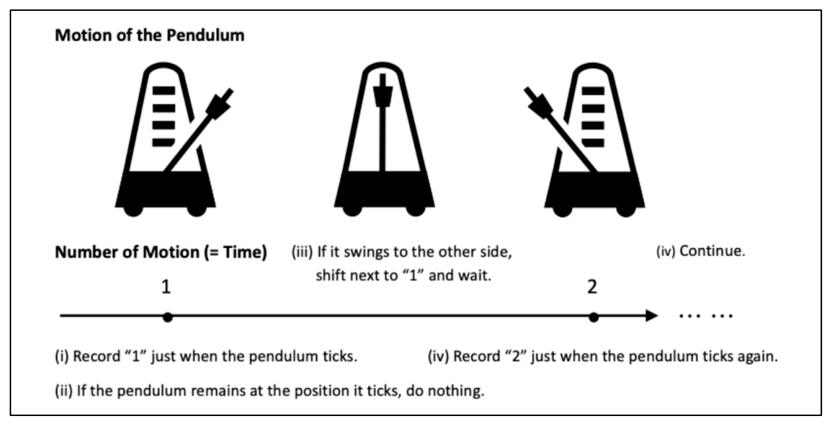
To reify the Aristotelian conception of time, take any physical object that exhibits regular motion, say, a metronome. (The choice of a changing object is a matter of stipulation and may depend on the level of temporal precision required for a particular purpose.) If the metronome functions well, its pendulum swings and ticks at regular intervals. A series of numbers can be generated by the following procedure: (i) Record “1” on a horizontal line just when the pendulum ticks for the first time; (ii) if the pendulum remains at the position it ticks, do nothing; (iii) if it swings to the other side, move to the next space after “1” and wait; (iv) record “2” just when the pendulum ticks again; (v) continue this procedure as long as necessary. The clause “just when the pendulum ticks” corresponds to what Aristotle calls the “now” in the quoted text, and the intermediate stage (iii) terminates at another “now” that appears in (iv). Although the first now and the second now are both indicated by the pendulum’s ticking, they are distinguished as a “before” and an “after” of the intermediate stage. This is roughly how time is apprehended according to Aristotle (see Figure 4). Let us call it “clock time.”
The notion of clock time incorporates important insights from Aristotle, but it differs from his original conception of time in several respects. First, although Aristotle suggests that time is applicable to anything either in motion or at rest, clock time may lack such universal applicability unless a clock is defined in terms of the change or motion of the entire universe. According to the theory of relativity, there is no absolute clock time other than cosmic time. Furthermore, time should be considered as having a beginning and an end if it is tied to a particular change (such as a metronome) rather than to universal change. This observation does not undermine cosmic time; nor do I claim that time should be synonymous with it. Indeed, cosmic time does not conflict with Aristotelian presentism; rather, it exemplifies presentism on a universal scale25.
Second, clock time may involve some conventional elements, like the choice of a standard cyclic change and the definition of a time unit, but the change or motion that results in clock time stems neither from human invention nor from a cognitive framework dependent on conscious beings. Aristotle states that “it is impossible for there to be time unless there is soul” [29] (4. 14 223a 26), yet I argue that clock time is real as long as there is something in which the change is countable. Even if no conscious being is counting, clock time can operate based on the procedure I have illustrated because it only involves recording the sequential count of cyclic changes. The occurrence of cyclic changes is undeniably objective, and their recording does not necessarily require a conscious being. Some natural recorders, such as the growth rings of a tree, indicate time’s passage without any need for a conscious observer26.
Third, although clock time does not require a conscious being who plays a counting role, I believe that counting or numbering itself is a dynamic process. More precisely, clock time consists of three dynamic components: cyclic changes, registration of these changes, and numbering in accordance with the registration. In some cases, these components are distinct from one another, functioning as separate modules that, when combined in a certain way, constitute clock time. For instance, it may be said that the growth rings of a tree do not fully function as clock time unless they involve a specific act of numbering. This does not show that counting or numbering must be a distinct process performed by another thing, whether conscious or not, but rather that it is a process that also involves changes. Clock time itself can manage the counting in accordance with the registration of its own change. Indeed, artificial clocks are typically designed such that the three components work together as a unified system within certain limits, regardless of whether they are analog or digital27.
Now it should be clear that presentists as well as eternalists face no obstacle in using clock time, as they can count changes in things. It might still be objected that to count anything, the entities being counted must exist. If this were true, presentists would be unable to count changes because those changes that have already occurred or will occur do not currently exist. This line of thought is misguided. Surely existing individual things are countable, but counting changes in things does not require counting already existent entities. I do not claim that non-existent things are countable, but rather that changes in things can be counted as they occur. Counting changes does not mean numbering them all at once but successively as they manifest.
Clock time is not a peculiar kind of time. Ordinary time units such as years, months, days, hours, and minutes should be taken as typical clock time. Depending on the accuracy required for temporal measurement, other time units defined by other regular processes may serve for various purposes. Notably, clock time is usually used to measure changes or motions that are distinct from the change or the motion of which the clock time is the number; for example, a dog runs eight meters per second on my wristwatch. In special cases, however, it is possible to compare the rate of a given change to itself. There is nothing contradictory in saying that the second hand of my wristwatch moves one notch per second, that I am ten years older than I was ten years ago, or that time passes one hour every hour, although such statements sound uninformative. As some philosophers like Prior [37] and Phillips [38] argue, no extra time (“super-time” or whatever) is needed to make sense of these statements. Clock time suffices.
Finally, some similarity may be found between the notion of clock time and the so-called “ersatzism about times” (see Bourne [39] and Crisp [40]). Ersatzists typically construct times as maximally consistent sets of propositions that represent the states of the world in the past, present, and future. While numbering change or motion partially represents what happened before, ersatz times do this too, presumably in more detail. However, there is a notable difference: Two ersatz times cannot be adequately distinguished if they represent qualitatively identical states, such as the second hand of a wristwatch pointing to the same numeral “5” on different occasions or indistinguishable states of the world in an eternal recurrence, because they are the same set of propositions. Theoretically, they could be distinguished by numbering them differently, but such a maneuver would appear arbitrary. In contrast, the numbering system of clock time exhibits no such arbitrariness, as it is rooted in actual changes in things. Thus, ersatzism is not an alternative to clock time but rather seems to require it in some way or other.
5. Solutions
The preceding considerations lead us to the final responses to Leininger and Tallant. First, note that only present things can truly undergo a change, as previously discussed. Consider a simple condition under which a change occurs:
- A present thing x has undergone, is undergoing, or will undergo a change if and only if x is F, and either x was non-F or x will be non-F.
This does not reduce the fact about a changing thing to a collection of changeless facts because what is presently F may not remain in that state. Importantly, any clock is an instance of such a changing thing. Suppose that L, M, and N are the numbers indicated successively by a clock C that is chosen as a standard temporal measurement. The sequence below illustrates how changes in C can be understood over time:
- C indicates L and will indicate M.
- C indicated L, now indicates M, and will indicate N.
- C indicated L and M and now indicates N.
Thus, the changes in C yield the numbers L, M, and N as time indices. This is what we refer to as clock time, which aligns with the Aristotelian idea that time is dependent on changes in things.
Clock time can be used to measure the duration of time itself and of other things. Rejecting Leininger’s change thesis, Aristotelian presentists can instead adopt a realist version that incorporates an interval during which a change has happened, is happening, or will happen. This can be accomplished by referencing clock time and associating it with a relevant fact about another changing thing in the following manner:
The theory of relativity requires that a clock C be in the vicinity of the object x28. Each number l, m, or n represents not a fixed point in time but a real change occurring in the clock. As the thing in question changes along with the clock, the two distinct numbers m and l (or n) reflect a substantial difference through time (that is, the interval m–l or n–m), which remains constant regardless of the passage of time. Thus, the realist thesis about change provides presentists with a dynamic model of change that quantifies the duration of time29.The Realist Thesis about Change:A present thing x has undergone, is undergoing, or will undergo a change during an interval if and only if, for some clock C in the vicinity of x, and for some numbers l, m, and n such that l < m < n, x is F and C indicates m, and either it was the case that x is non-F and C indicates l, or it will be the case that x is non-F and C indicates n.
Let us now turn to the problem of persistence. Assuming that for an object to persist over time, it must saturate a function from a time to a location, Tallant argues that no object can saturate such a function for multiple times if presentism is true. Baron responds that an enduring object can saturate a function from the present time to a location, with the caveat that what is considered the present changes over time. Both Tallant and Baron seem to be discussing the problem of persistence under the assumption that presentists cannot make use of non-present times in defining the function required for persistence. Aristotelian presentists may challenge this assumption and argue that for an object to persist over time, it only needs to saturate a function from a number provided by clock time to a location where it existed, exists or will exist. (The question of persistence in the future remains open. One option is to accept that if the function is undefined for numbers that have not yet been indicated by any clock, things can only be said to persist up to the present. Another option is to allow for references to future numbers in the form of a counterfactual: It makes sense to say, for instance, that a cat would persist until a clock indicated N30.)
Instead of defining persistence in terms of being located at multiple times, presentists should adopt a realist approach:
Note that change implies persistence: If x was, is, and will be in a certain state, then it follows that x existed, exists, and will exist. Therefore, the persistence of the clock C itself can be simply stated: C persists if and only if, for some numbers l, m, and n such that l < m < n, C indicates m, and either C indicated l or will indicate n. Importantly, merely stating that C presently displays the particular numbers L, M, and N does not necessarily mean that C indicated L, indicates M, and will indicate N. In a hypothetical one-instant world, L, M, and N might be displayed by a clock simultaneously, but it is not true to say that C indicated L, indicates M, and will indicate N in this sequence. Change and persistence can only be captured by counting different numbers that the clock indicated, indicates, and will indicate successively31. Finally, it is straightforward to answer the question of how long the clock persists: It persists for the duration M–L (or N–L if it continues to exist in the future). The same reasoning applies to anything that persists and changes over time32.The Realist Thesis about Persistence:A present thing x has persisted, is persisting, or will persist during an interval if and only if, for some clock C in the vicinity of x, and for some numbers l, m, and n such that l < m < n, x exists and C indicates m, and either it was the case that x exists and C indicates l, or it will be the case that x exists and C indicates n.
6. Conclusions
Aristotelian presentists can quantify the duration of time without being committed to the spatialization of time. While spatializing time is one way to treat change and persistence quantitatively, the Aristotelian approach offers presentists another realistic way to do so. It poses no problem for Aristotelian presentists to assert that a tree has stood on the hill for many years or that Bob Dylan was born in 1941 and has become one of the greatest singers in the history of music. All that is needed to make sense of such statements is reliance on clock time and the tensed notions of existence and property possession.
Funding
This research was funded by Japan Society for the Promotion of Science grant number [23K00012].
Institutional Review Board Statement
Not applicable.
Informed Consent Statement
Not applicable.
Data Availability Statement
No new data were created or analyzed in this study. Data sharing is not applicable to this article.
Acknowledgments
Earlier versions of this paper were presented at several philosophy meetings. I thank the audiences for their insightful feedback. I am also grateful to Thomas Hofweber for valuable comments in personal correspondence, and to Kristie Miller for inviting me to contribute to this special issue on temporal ontology. Finally, I thank the four anonymous referees, whose comments greatly improved this paper.
Conflicts of Interest
The author declares no conflict of interest.
| 1 | The term “spatialization of time” might remind physicists of Minkowski’s spacetime, while for others, it could evoke different traditions rooted in the work of philosophers such as Bergson, Husserl, and Heidegger. In this paper, I do not delve into these philosophical traditions. Instead, I associate the term with the concept of the block universe. |
| 2 | Arguably, few philosophers explicitly endorse the view that time is analogous to space. Even (static) eternalists may seek to distinguish time from space by saying, for example, “time is the causal dimension of spacetime” [1] (p. 117). Indeed, most philosophers of time, static eternalists or not, would hesitate to regard themselves as adhering to the analogy between time and space. Nonetheless, they work throughout under the assumption of the block universe, or spatialization of time in the sense I will clarify in Section 3. It seems to me that their frameworks still treat times as pre-existing, static temporal locations where objects and events reside. Roughly speaking, it is this analysis of temporal existence in terms of temporal locations that I target under the term “spatialization of time.” |
| 3 | In what follows, I choose to move from contemporary objections to an Aristotelian framework. Rather than presenting Aristotle’s historical view in isolation, I first identify the specific spatializing presuppositions that hamstring modern presentism, thereby showing exactly why an Aristotelian concept of time is required to resolve these puzzles. Note that Aristotle’s view is not merely cited as historical support for the idea I will defend but serves as the key to thinking of the discussion from a radically different perspective. In my view, contemporary debates on time almost always proceed within some framework that spatializes time, regardless of which position one takes. Aristotelian relationism is important because it begins with the reality of change and persistence, considering time as derivative from them. This is a view often neglected by contemporary philosophers of time. |
| 4 | Thisness presentists may emphasize that a thisness T necessitates the past existence of a specific object x without involving any existence-entailing causal relation. Ingram states this point: “a thisness T depends upon the initial existence of an object x for its existence; this non-rigid, temporal, asymmetric dependence is a central and important aspect of the ontology of thisness, already developed, and it is not considered as an existence-entailing relation that holds between x and T at all times” [6] (p. 164). In a similar vein, Lucretian presentists can argue that the past-tensed property of being a world where x exists depends on x’s initial existence without implying x’s current existence. Indeed, as Bigelow [5] originally intended, tensed properties serve to ground past truths without relying on existence-entailing relations. The only difference between thisness and Lucretian presentism is that a causal relation holds between tensed properties of thisnesses in the former, and between tensed properties in the latter. I see no advantageous point for one over the other in this respect, as Ingram himself acknowledges [6] (p. 172). |
| 5 | Recently, Hochstetter and Hess [11] have proposed a “presentist-friendly” definition of endurance, arguing that true endurance requires continuous existence without temporal gaps. Although their appeal to tense operators allows their notion of endurance, unlike Tallant’s notion of persistence, to avoid commitment to non-present (past and future) times, it seems that their definition of endurance still relies on the density or continuity of time. In my view, presentists should instead provide a concrete, physical grounding for this “no-gap” requirement by directly anchoring the duration of persistence to the continuous, successive measurement of physical clocks, as I argue later. |
| 6 | Noonan [13] also points out that Tallant misapplies Lowe’s notion of object-dependence in his argument and suggests that the problem can be easily resolved by framing persistence in tensed terms. The problem raised by Tallant and the subsequent discussion are somewhat reminiscent of the classic debate between Lewis [14] (pp. 202–204) and Zimmerman [15]. Lewis claimed that presentism offers no solution to the problem of temporary intrinsics because “[n]o man, unless it be at the moment of his execution, believes that he has no future; still less does anyone believe that he has no past” [14] (p. 204). Zimmerman replies that presentists may resort to tensed paraphrases of a thing’s persistence unless eternalist perdurantists give an independent reason why such a maneuver is illegitimate. |
| 7 | The treatment of atemporal or abstract entities, such as numbers and universals, is beyond the scope of this paper. These entities may pose additional issues for both presentists and anti-presentists when investigating their nature and existence. |
| 8 | Using the vocabulary of predicate logic, the spatialized view entails the following biconditional:
∃x∃t(Fx ∧ Lxt) ⇔ ∃xFx
|
| 9 | This non-locative formulation, in contrast with the Anti-Presentist Notion of Existence, resonates with the distinction drawn by Correia and Rosenkranz [16] between “being located at the present time” (temporal location) and “being something” simpliciter (temporal existence). As they argue, many confusions in temporal ontology arise from conflating these two tensed notions. For the purposes of the present paper, it is crucial to note that “it would be mistaken to suggest that whenever philosophers use the verb ‘to exist’ in a tensed way … they use it to inter alia indicate temporal location” (p. 2004). For presentists, I claim, the notion of existence simpliciter is itself present-tensed but does not indicate any temporal location. That said, I want to flag where we diverge: While Correia and Rosenkranz still allow for “at”-talk as a way of speaking about temporal existence, presentists may go a step further, doing away entirely with times as fundamental locations by treating “existence at a time” not as a primitive relation but as a derivative way of speaking about (a conjunction of) physical changes. See Section 5. |
| 10 | The central idea is that things are present simpliciter, meaning that their being present is not tied to any specific time. In this framework, the concept of being present only serves as an intermediary to establish that to exist presently is to exist without any temporal qualification. If this is accepted, there is no need to refine the notion of present existence in terms of being present. In his earlier work [17], Tallant argued that presentism is best understood as the thesis that “presence is existence.” However, if Tallant means that to be present (at a time) is to exist (at that time), this is not the claim I intend to support. On the other hand, if he asserts that to be present is simply to exist, I suspect there might be a tension in his arguments across the two papers. It seems that in the earlier paper, he suggests that things can exist without being located at any time, while in the later one [4], he argues under the opposite assumption, as discussed in the previous section. |
| 11 | Using the vocabulary of tense logic, presentism entails the following biconditional:
p ⇔ Np
|
| 12 | Presentists have several options for interpreting the truth or falsity of past- and future-tensed statements by adopting truthmakers they consider appropriate. One option is to adopt Lucretian tensed properties, while another is ersatzism about times, which is briefly mentioned later in Section 4. Other options may be available. |
| 13 | As Tallant and Ingram [19] point out, there are various theories proposed as “presentist” today. Some of these seem to me promising, while others do not. In any case, if a position rejects the fundamental notion of existence simpliciter and property possession simpliciter, I take it to be a flawed version of presentism. Even if “presentism” is merely an elastic label for different research programs, it remains open for discussion what presentism ought to be. Anything can be given a name, but that does not necessarily justify the designation. |
| 14 | This is the first horn of the so-called triviality argument against presentism. Relevant discussions include Crisp [20], Deasy [21], Meyer [22], Sakon [23] and many others. As I argue below, presentists need not contrive an exotic formulation of their thesis; rather, they should simply re-examine the notion of existence they are working with. Although I am not sure this provides presentists with a complete rebuttal to the triviality objection, it at least offers a way to avoid it. |
| 15 | For example, Mozersky [24] proposes an interpretation of presentism centered on a tenseless sense of “exists.” While I grant that such an interpretation has some plausibility from an eternalist perspective, I contend that it does not accurately reflect what presentists should claim. |
| 16 | Any talk of existence simpliciter may seem dubious, since such a notion of existence is ineffable in English and other tensed languages. This objection assumes that existence simpliciter is a tenseless notion. By “existence simpliciter,” I mean an absolute, non-relative mode of existence, and I claim that it is implicitly or explicitly present-tensed. Consequently, it cannot be assumed that there is always such a thing as the unrestricted constant domain of quantification. |
| 17 | Focusing on temporal ontology, Sider [26] argues that certain eternalist ontological claims cannot be translated into tensed sentences that presentists may accept, and therefore that their dispute is non-verbal and substantial. Granting this, there should also be something about presentism that cannot be translated into eternalist tenseless language. |
| 18 | Obviously, I cannot discuss all the relevant views in the history of the philosophy of time, among which Immanuel Kant’s view of time in the Critique of Pure Reason stands out. For Kant, time is not an objective, mind-independent entity or a container in which things are located, but rather the “pure form of sensible intuition.” Insofar as Kant rejects the view of time as an absolute arena that confers determinate “locations” on things, his view shares a non-locative spirit with the presentist notion of existence simpliciter advocated in the previous section. However, the Aristotelian presentism I develop in this section parts ways with Kantian transcendental idealism by insisting on the mind-independent reality of change and persistence, thereby avoiding both the spatialization of time and its reduction to mere subjectivity. |
| 19 | It might be tempting to treat these Aristotelian insights as a mere historical curiosity. However, turning to Aristotle is a systematic necessity for the present project: His concept of time as the “number of motion” provides the exact conceptual machinery needed to develop a non-locative, dynamic model of change that contemporary analytic metaphysics has failed to construct on its own. |
| 20 | I rely on the English translation edited by Jonathan Barnes. Aristotle’s philosophy of time is notoriously difficult to scrutinize, although his main points for establishing what is known as relationism are relatively straightforward. A standard interpretation of Aristotle’s relationism suffices for the purpose of the present paper. For a useful introduction to Aristotle’s philosophy of time, see Bardon [30] (pp. 12–17) and Turetzky [31] (pp. 18–29). In her book specifically addressing Aristotle’s philosophy of time, Coope [32] argues that his view is not presentist. I do not object to her interpretation, although I believe that Aristotelian relationism is at least presentist-friendly. My point in this section will remain intact even in light of Coope’s examination, provided I succeed in presenting an Aristotelian conception of time which is also available to presentists. |
| 21 | |
| 22 | Another prominent relationist is G. W. Leibniz, who, in his celebrated correspondence with S. Clarke, defended his position against Newtonian “absolutism” or “substantivalism.” See Leibniz and Clarke [34]. It is well known that Leibniz thinks of space as an order of coexistence and time as an order of succession, denying that either is a container existing independently of things or events. While Leibniz’s relationism may or may not be taken as an analysis of temporal facts in terms of (changeless) relations between events, my interpretation of Aristotle preserves the irreducibility of changes in persisting things, treating time as a derivative measure of dynamic motion rather than a static relational network. |
| 23 | Aristotle might have believed that time is universally applicable due to its quantitative nature. If Aristotle’s claim was limited to this, it would not directly contradict the theory of relativity. In relativity, there is no universally applicable clock independent of the observer’s frame of reference, with the exception of cosmic time used in cosmology. Importantly, it is possible to translate the time measured by one clock into that of another through the Lorentz transformation, which reflects the interrelation of time and space in different inertial frames. |
| 24 | Deasy [35] argues that time is change, rather than the number of change. While I am sympathetic to his realist conception of change (to the effect that something is sometimes but not always the case), I resist the simple identification of time with change itself because it is doubtful whether we would continue to speak of time in a situation devoid of regular changes. In what follows, I instead defend an Aristotelian view on which time is dependent on or derivative from real changes in things. This approach avoids positing anything like “some monstrous object called Time” [36] (p. 75) and accords better with temporal concepts in both physics and common discourse. |
| 25 | Cosmic time is not an independent, pre-existing temporal corridor in which the universe is located. Instead, it is derived from the global physical changes in the cosmos, namely the isotropic expansion of the universe. Thus, cosmic time is precisely the “number of universal motion” in a broadly Aristotelian sense, serving as a global measurement scale generated by cosmic-scale physical changes, rather than as a spatialized temporal location. |
| 26 | Lest there be any misunderstanding, this account of clock time is not a psychological explanation of how we perceive or experience time. Rather, it is a robustly realist, metaphysical thesis about what time is. Following Aristotle, presentists may say that time is the “number of motion.” Although “number” may be given differently relative to a chosen measurement, “motion” is an objective, mind-independent property of the physical universe. |
| 27 | Importantly, the occurrence of clock time may be partly a matter of physical, rather than logical, necessity. It is logically possible that there are no clock-like systems at all. In a logically possible world with chaotic, non-cyclic physical processes, clock time could not be generated. The applicability of the model I offer thus relies on the physical laws and contingent structures of our actual universe. Although clock time as we know it is dependent on cyclic physical processes, this does not negate the reality of changes in persisting things. It is admittedly less clear whether time in general could obtain in the absence of any regularity in change. For related discussion, see footnote 24. |
| 28 | If cosmic time, which is globally applicable, is adopted as clock time, this requirement can be omitted. I do not consider this option any further. |
| 29 | It might still be objected that change boils down to having different properties at different times. In response, compare the following two:
|
| 30 | Another potential problem for Aristotelian presentists is the possibility of time without change, as discussed by Shoemaker [41]. Presentists could respond to this issue in at least three ways: (i) They might challenge the possibility of time without change on some grounds; (ii) they might allow for the counterfactual use of clock time, suggesting that if a clock were operational during such a period, it would indicate different numbers; or (iii) they might argue that things can persist even in the absence of defined clock time, leaving it an open question how long they persist. Further discussion on this topic is beyond the scope of the present paper. |
| 31 | Like Lucretian presentism, the realist thesis of persistence developed here requires that the universe as a whole is an enduring entity. Surely, this assumption is contingent since there could be one-instant worlds (as Leininger contemplates) as well as many disconnected, non-enduring universes. I do not deny that such worlds and universes are at least logically possible but claim that in many worlds (perhaps including ours), something really endures. |
| 32 | I am grateful to a referee for pointing out an alternative model for discrete time. If time is fundamentally discrete, presentists could construct past times using nested tensed operators: the past, the “past past,” the “past past past,” and so on (an approach suggested by Joseph Jedwab, according to the referee). While such a model successfully avoids commitment to temporal locations by relying solely on primitive tensed operators, the clock-time approach proposed in this paper has the advantage of handling change and persistence of a given object in quantitative terms within a continuous physical framework. |
References
- Mellor, D.H. RealTime II; Routledge: London, UK, 1998. [Google Scholar]
- Sider, T. Four-Dimensionalism; Clarendon Press: Oxford, UK, 2001. [Google Scholar]
- Leininger, L. Presentism and the Myth of Passage. Australas. J. Philos. 2015, 93, 724–739. [Google Scholar] [CrossRef] [Scilit]
- Tallant, J. Presentism, Persistence and Trans-Temporal Dependence. Philos. Stud. 2018, 175, 2209–2220. [Google Scholar] [CrossRef] [Scilit]
- Bigelow, J. Presentism and Properties. Philos. Perspect. 1996, 10, 35–52. [Google Scholar]
- Ingram, D. Thisness Presentism; Routledge: New York, NY, USA, 2016. [Google Scholar]
- Russell, B. Principles of Mathematics; Routledge: London, UK, 1903. [Google Scholar]
- McTaggart, J.M.E. The Nature of Existence; Broad, C.D., Ed.; Cambridge University Press: Cambridge, UK, 1927; Volume 2. [Google Scholar]
- Merricks, T. Truth and Ontology; Oxford University Press: Oxford, UK, 2007. [Google Scholar]
- Lowe, E.J. Ontological Dependence. In The Stanford Encyclopedia of Philosophy; Spring 2010 Edition; Zalta, E.N., Ed.; Stanford University: Stanford, CA, USA, 2010; Available online: http://plato.stanford.edu/archives/spr2010/entries/dependence-ontological/ (accessed on 9 October 2024).
- Hochstetter, K.; Hess, K. A Presentist-Friendly Definition of “Endure”. Philosophia 2020, 48, 1837–1854. [Google Scholar] [CrossRef] [Scilit]
- Baron, S. How to Endure Presentism. Inquiry 2018, 62, 659–673. [Google Scholar] [CrossRef] [Scilit]
- Noonan, H.W. Presentism, Endurance and Object-Dependence. Inquiry 2019, 63, 1115–1122. [Google Scholar] [CrossRef] [Scilit]
- Lewis, D.K. On the Plurality of Worlds; Blackwell: Oxford, UK, 1986. [Google Scholar]
- Zimmerman, D.W. Temporary Intrinsics and Presentism. In Metaphysics: The Big Questions; van Lnwagen, P., Zimmerman, D., Eds.; Blackwell: Oxford, UK, 1998; pp. 206–219. [Google Scholar]
- Correia, F.; Rosenkranz, S. Temporal Existence and Temporal Location. Philos. Stud. 2020, 177, 1999–2011. [Google Scholar] [CrossRef] [Scilit]
- Tallant, J. Defining Existence Presentism. Erkenntnis 2014, 79, 479–501. [Google Scholar] [CrossRef] [Scilit]
- McArthuer, R.P. Tense Logic; D. Reidel Publishing Company: Dordrecht, The Netherlands, 1976. [Google Scholar]
- Tallant, J.; Ingram, D. The Rotten Core of Presentism. Synthese 2021, 199, 3969–3991. [Google Scholar] [CrossRef] [Scilit]
- Crisp, T.M. On Presentism and Triviality. In Oxford Studies in Metaphysics; Zimmerman, D.W., Ed.; Clarendon: Oxford, UK, 2004; Volume 1, pp. 15–20. [Google Scholar]
- Deasy, D. The Triviality Argument Against Presentism. Synthese 2019, 196, 3369–3388. [Google Scholar] [CrossRef] [Scilit]
- Meyer, U. The Presentist’s Dilemma. Philos. Stud. 2005, 122, 213–225. [Google Scholar] [CrossRef] [Scilit]
- Sakon, T. Presentism and the Triviality Objection. Philosophia 2015, 43, 1089–1109. [Google Scholar] [CrossRef] [Scilit]
- Mozersky, M.J. Presentism. In The Oxford Handbook of Philosophy of Time; Callender, C., Ed.; Oxford University Press: Oxford, UK, 2011; pp. 122–144. [Google Scholar]
- Sider, T. Ontological Realism. In Metametaphysics: New Essays on the Foundations of Ontology; Chalmers, D., Manley, D., Wasserman, R., Eds.; Oxford University Press: Oxford, UK, 2009; pp. 384–423. [Google Scholar]
- Sider, T. Quantifiers and Temporal Ontology. Mind 2006, 115, 75–97. [Google Scholar] [CrossRef] [Scilit]
- Prior, A.N. Changes in Events and Changes in Things. In Papers on Time and Tense; new Edition 2003; Hasle, P., Øhrstrøm, P., Braüner, T., Copeland, J., Eds.; Oxford University Press: Oxford, UK, 1968; pp. 7–19. [Google Scholar]
- Tallant, J. A Sketch of a Presentist Theory of Passage. Erkenntnis 2010, 73, 133–140. [Google Scholar] [CrossRef] [Scilit]
- Aristotle. The Complete Works of Aristotle: The Revised Oxford Translation; Barnes, J., Ed.; Princeton University Press: Princeton, NJ, USA, 1984; Volume 1. [Google Scholar]
- Bardon, A. A Brief History of the Philosophy of Time; Oxford University Press: Oxford, UK, 2013. [Google Scholar]
- Turetzky, P. Time; Routledge: London, UK, 1998. [Google Scholar]
- Coope, U. Time for Aristotle: Physics IV. 10–14; Oxford University Press: New York, NY, USA, 2005. [Google Scholar]
- Plato. The Collected Dialogues; Hamilton, E., Cairns, H., Eds.; Princeton University Press: Princeton, NJ, USA, 1961. [Google Scholar]
- Leibniz, G.W.; Clarke, S. Correspondence; Ariew, R., Ed.; Hackett Publishing Company, Inc.: Indianapolis, Indiana, 2000. [Google Scholar]
- Deasy, D. Time is Change. Philosophies 2026, 11, 67–81. [Google Scholar]
- Prior, A.N. Past, Present, and Future; Oxford University Press: Oxford, UK, 1967. [Google Scholar]
- Prior, A.N. Time after Time. Mind 1958, 67, 244–246. [Google Scholar] [CrossRef] [Scilit]
- Phillips, I. Rate Abuse: A Reply to Olson. Analysis 2009, 69, 503–505. [Google Scholar] [CrossRef] [Scilit]
- Bourne, C. A Future for Presentism; Clarendon: Oxford, UK, 2006. [Google Scholar]
- Crisp, T.M. Presentism and the Grounding Objection. Noûs 2007, 41, 90–109. [Google Scholar] [CrossRef] [Scilit]
- Shoemaker, S. Time without Change. J. Philos. 1969, 66, 363–381. [Google Scholar] [CrossRef] [Scilit]
Figure 1.
Endurance + Identity Dependence.

Figure 2.
Failure of Persistence in Presentism.

Figure 3.
Tensed Locative Endurance + Identity Dependence.

Figure 4.
Clock Time.

Disclaimer/Publisher’s Note: The statements, opinions and data contained in all publications are solely those of the individual author(s) and contributor(s) and not of MDPI and/or the editor(s). MDPI and/or the editor(s) disclaim responsibility for any injury to people or property resulting from any ideas, methods, instructions or products referred to in the content. |
© 2026 by the author. Licensee MDPI, Basel, Switzerland. This article is an open access article distributed under the terms and conditions of the Creative Commons Attribution (CC BY) license.
Share and Cite
MDPI and ACS Style
Sakon, T. Aristotelian Presentism. Philosophies 2026, 11, 167. https://doi.org/10.3390/philosophies11050167
AMA Style
Sakon T. Aristotelian Presentism. Philosophies. 2026; 11(5):167. https://doi.org/10.3390/philosophies11050167
Chicago/Turabian StyleSakon, Takeshi. 2026. "Aristotelian Presentism" Philosophies 11, no. 5: 167. https://doi.org/10.3390/philosophies11050167
APA StyleSakon, T. (2026). Aristotelian Presentism. Philosophies, 11(5), 167. https://doi.org/10.3390/philosophies11050167