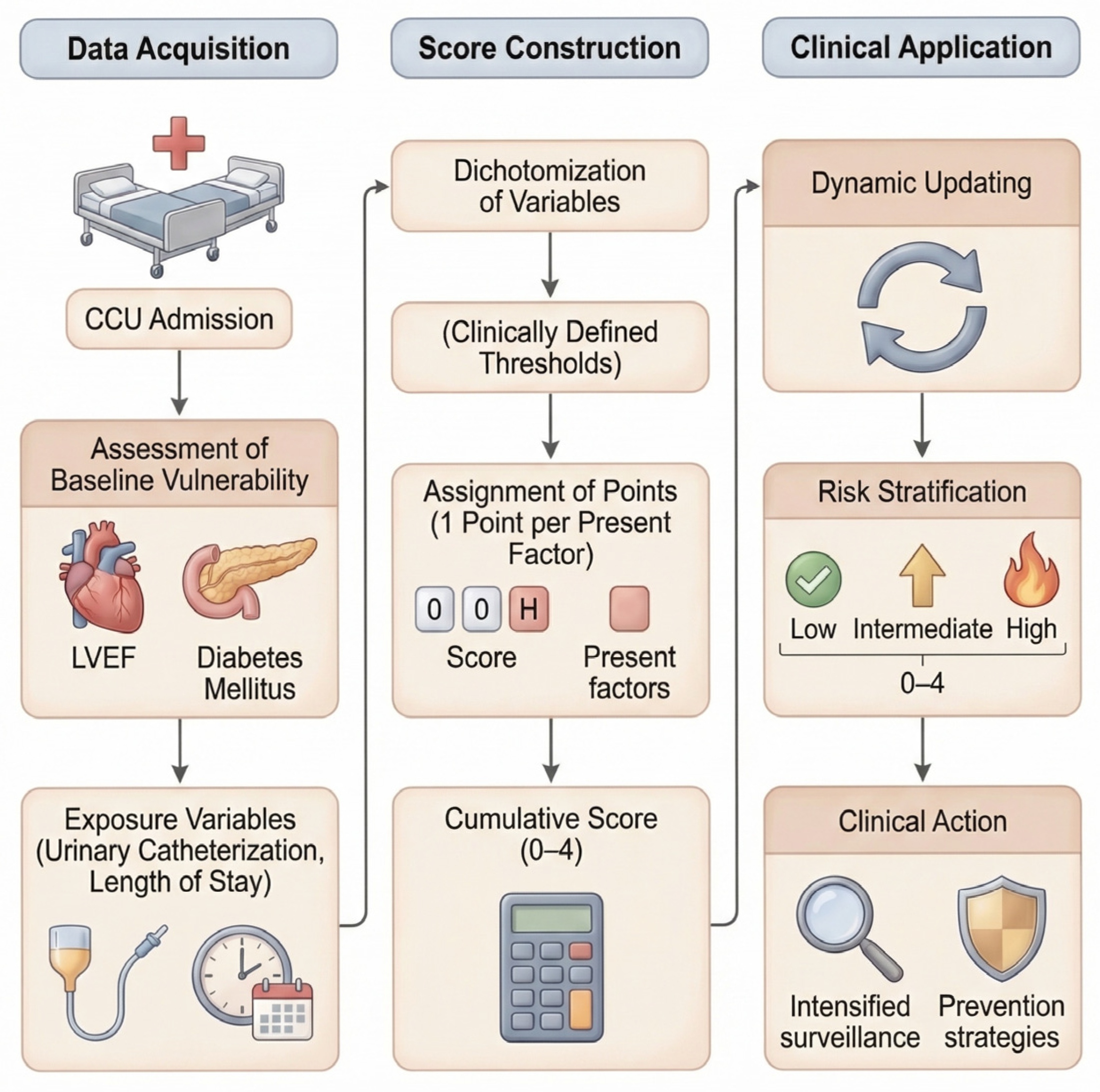

Cumulative Frameworks as a Pragmatic Alternative to Multivariable Modeling in Rare-Event Clinical Settings: A Coronary Care Unit Case Study

 , , , and
Abstract
1. Introduction
2. Methods
2.1. Study Context and Illustrative Dataset
2.2. Assessment of Modeling Feasibility Under Limited Event Conditions
2.3. Conceptualization of the Cumulative Additive Framework
2.4. Analytical Strategy
2.5. Implementation Protocol for Risk Stratification in the CCU Setting
2.5.1. Target Population and Timing of Assessment
2.5.2. Selection and Definition of Variables
2.5.3. Stepwise Implementation Procedure
2.5.4. Dynamic Updating of Cumulative Framework
2.5.5. Clinical Interpretation and Use
2.5.6. Scope and Limitations of the Protocol
3. The Challenge of Limited Event Counts in Clinical Risk Modeling
3.1. Events per Variable and Model Stability
3.2. Overfitting and Optimism in Small-Event Models
3.3. Rare-Event Regression and Penalization: Solutions and Limitations
3.4. Structural Simplicity as a Methodological Choice
3.5. When May a Cumulative Additive Framework Be Considered?
4. Case Example: Application in a CCU Cohort
4.1. Cohort Characteristics and Event Distribution
4.2. Hypothetical Multivariable Modeling Constraints
4.3. Adoption of a Cumulative Additive Framework
4.4. Illustrative Distribution of Cumulative Scores and Infection Events
5. Bias and Temporal Considerations in Exposure-Based Risk Models
5.1. Reverse Causality and LOS Circularity
5.2. Time-Dependent Bias in Exposure Accumulation
5.3. Immortal Time and Exposure Classification
5.4. Dichotomization: Trade-Off Between Information and Interpretability
5.5. Practical Strategies for Bias Mitigation
6. Interpretability Versus Predictive Performance in Rare-Event Contexts
6.1. The Pursuit of Discrimination
6.2. Transparency and Clinical Usability
6.3. Stability as a Methodological Priority
6.4. Aligning Modeling Strategy with Clinical Objectives
7. Practical Recommendations for Risk Modeling in Low-Event Clinical Cohorts
7.1. Evaluate Events per Variable Before Model Construction
7.2. Avoid Data-Driven Optimization in Small Datasets
7.3. Prioritize Structural Simplicity When Appropriate
7.4. Address Temporal Relationships Transparently
7.5. Distinguish Stratification from Prediction
7.6. Emphasize Reproducibility over Incremental Performance Gains
8. Conclusions
Author Contributions
Funding
Institutional Review Board Statement
Informed Consent Statement
Data Availability Statement
Acknowledgments
Conflicts of Interest
Abbreviations
| AUC | Area Under the Receiver Operating Characteristic Curve |
| CCU | Coronary Care Unit |
| EPV | Events per Variable |
| HAI | Healthcare-Associated Infection |
| ICU | Intensive Care Unit |
| LOS | Length of Stay |
| LVEF | Left Ventricular Ejection Fraction |
| LASSO | Least Absolute Shrinkage and Selection Operator |
| ROC | Receiver Operating Characteristic |
| TRIPOD | Transparent Reporting of a Multivariable Prediction Model for Individual Prognosis or Diagnosis |
References
- Ziegler, A. Clinical prediction models: A practical approach to development, validation, and updating—Ewout W. Steyerberg (2019). Biom. J. 2020, 62, 1122–1123. [Google Scholar] [CrossRef] [Scilit]
- Collins, G.S.; Reitsma, J.B.; Altman, D.G.; Moons, K.G.M. Transparent reporting of a multivariable prediction model for individual prognosis or diagnosis (TRIPOD): The TRIPOD statement. BMJ 2015, 350, g7594. [Google Scholar] [CrossRef] [Scilit] [PubMed]
- Vîrtosu, D.-M.; Munteanu Dragomir, A.; Crișan, S.; Luca, S.; Pătru, O.; Băghină, R.-M.; Lazăr, M.-A.; Cozlac, A.-R.; Iurciuc, S.; Luca, C.-T. Prevalence of healthcare-associated infections in patients with cardiovascular diseases: A literature review. J. Clin. Med. 2025, 14, 4941. [Google Scholar] [CrossRef] [Scilit] [PubMed]
- Babyak, M.A. What you see may not be what you get: A brief, nontechnical introduction to overfitting in regression-type models. Psychosom. Med. 2004, 66, 411–421. [Google Scholar] [CrossRef] [Scilit] [PubMed]
- Peduzzi, P.; Concato, J.; Kemper, E.; Holford, T.R.; Feinstein, A.R. A simulation study of the number of events per variable in logistic regression analysis. J. Clin. Epidemiol. 1996, 49, 1373–1379. [Google Scholar] [CrossRef] [Scilit] [PubMed]
- Vittinghoff, E.; McCulloch, C.E. Relaxing the rule of ten events per variable in logistic and Cox regression. Am. J. Epidemiol. 2007, 165, 710–718. [Google Scholar] [CrossRef] [Scilit] [PubMed]
- Riley, R.D.; Ensor, J.; Snell, K.I.E.; Harrell, F.E.; Martin, G.P.; Reitsma, J.B.; Moons, K.G.M.; Collins, G.S. Calculating the sample size required for developing a clinical prediction model. BMJ 2020, 368, m441. [Google Scholar] [CrossRef] [Scilit] [PubMed]
- Vîrtosu, D.-M.; Dragomir, A.; Crișan, S.; Luca, S.; Pătru, O.; Băghină, R.-M.; Lazăr, M.-A.; Cozlac, A.-R.; Iurciuc, S.; Luca, C.-T. Reduced left ventricular ejection fraction as a marker of vulnerability to healthcare-associated infections in coronary care unit patients: A single-centre cohort study. J. Clin. Med. 2026, 15, 1789. [Google Scholar] [CrossRef] [Scilit] [PubMed]
- Vîrtosu, D.M.; Dragomir, A.; Crișan, S.; Luca, S.; Pătru, O.; Băghină, R.-M.; Lazăr, M.-A.; Cozlac, A.-R.; Iurciuc, S.; Luca, C.T. Cumulative Vulnerability in Cardiac Critical Care: A Framework for Understanding Healthcare-Associated Infections and Their Progression to Severe Infection and Sepsis. Medicina 2026, 62, 908. [Google Scholar] [CrossRef] [Scilit] [PubMed]
- Harrell, F.E. Regression Modeling Strategies: With Applications to Linear Models, Logistic and Ordinal Regression, and Survival Analysis, 2nd ed.; Springer: Cham, Switzerland, 2015. [Google Scholar]
- Steyerberg, E.W. Clinical Prediction Models: A Practical Approach to Development, Validation, and Updating, 2nd ed.; Springer: Cham, Switzerland, 2019. [Google Scholar]
- Tibshirani, R. Regression shrinkage and selection via the LASSO. J. R. Stat. Soc. Ser. B 1996, 58, 267–288. [Google Scholar] [CrossRef] [Scilit]
- Firth, D. Bias reduction of maximum likelihood estimates. Biometrika 1993, 80, 27–38. [Google Scholar] [CrossRef]
- van de Schoot, R.; Kaplan, D.; Denissen, J.; Asendorpf, J.B.; Neyer, F.J.; van Aken, M.A.G. A gentle introduction to Bayesian analysis: Applications to developmental research. Child Dev. 2014, 85, 842–860. [Google Scholar] [CrossRef] [Scilit] [PubMed]
- Kenah, E. Rothman diagrams: The geometry of confounding and standardization. Int. J. Epidemiol. 2024, 53, dyae139. [Google Scholar] [CrossRef] [Scilit] [PubMed]
- Hernán, M.A.; Cole, S.R.; Margolick, J.; Cohen, M.; Robins, J.M. Structural accelerated failure time models for survival analysis in studies with time-varying treatments. Pharmacoepidemiol. Drug Saf. 2005, 14, 477–491. [Google Scholar] [CrossRef] [Scilit] [PubMed]
- Suissa, S. Immortal time bias in pharmaco-epidemiology. Am. J. Epidemiol. 2008, 167, 492–499. [Google Scholar] [CrossRef] [Scilit] [PubMed]
- Altman, D.G.; Royston, P. What do we mean by validating a prognostic model? Stat. Med. 2000, 19, 453–473. [Google Scholar] [CrossRef]
- Royston, P.; Altman, D.G. Visualizing and assessing discrimination in the logistic regression model. Stat. Med. 2010, 29, 2508–2520. [Google Scholar] [CrossRef] [Scilit] [PubMed]
- Vickers, A.J.; Elkin, E.B. Decision curve analysis: A novel method for evaluating prediction models. Med. Decis. Mak. 2006, 26, 565–574. [Google Scholar] [CrossRef] [Scilit] [PubMed]
- Efthimiou, O.; Seo, M.; Chalkou, K.; Debray, T.; Egger, M.; Salanti, G. Developing clinical prediction models: A step-by-step guide. BMJ 2024, 386, e078276. [Google Scholar] [CrossRef] [Scilit] [PubMed]
- Song, R.; Yin, X.; Zhu, M.; Chen, X.; Zhang, Z.; Lyu, X.; Jiang, S.; Liu, Z.; Li, Y.; Zhang, Z.; et al. Characterization and Differentiation of Myocardial Remodeling Using Artificial Intelligence-Assisted Confocal Raman Spectroscopy Imaging. VIEW 2025, 6, e20240146. [Google Scholar] [CrossRef] [Scilit]


| Cumulative Score | Patients (n) | HAI Events (n) | HAI Incidence (%) |
|---|---|---|---|
| 0 | 325 | 0 | 0.0 |
| 1 | 242 | 3 | 1.24 |
| 2 | 178 | 5 | 2.81 |
| 3 | 100 | 6 | 6.00 |
| 4 | 25 | 2 | 8.00 |
| Total | 870 | 16 | 1.8 |
| Feature | Multivariable Model | Additive Cumulative Framework |
|---|---|---|
| Coefficient assignment | Weighted regression coefficients | Equal points per factor |
| Model structure | Data-driven optimization | Prespecified structure |
| Complexity | Higher | Lower |
| Overfitting risk (low EPV) | Increased | Reduced through prespecification |
| Interpretability | Limited (requires model coefficients) | High (transparent scoring) |
| Stability under small-event conditions | Sensitive to data perturbation | Structurally robust |
| Threshold selection | Often data-driven | Clinically prespecified |
Disclaimer/Publisher’s Note: The statements, opinions and data contained in all publications are solely those of the individual author(s) and contributor(s) and not of MDPI and/or the editor(s). MDPI and/or the editor(s) disclaim responsibility for any injury to people or property resulting from any ideas, methods, instructions or products referred to in the content. |
© 2026 by the authors. Licensee MDPI, Basel, Switzerland. This article is an open access article distributed under the terms and conditions of the Creative Commons Attribution (CC BY) license.
Share and Cite
Vîrtosu, D.M.; Crișan, S.; Pătru, O.; Dragomir, A.; Luca, S.; Băghină, R.-M.; Lazăr, M.-A.; Cozlac, A.-R.; Iurciuc, S.; Luca, C.T. Cumulative Frameworks as a Pragmatic Alternative to Multivariable Modeling in Rare-Event Clinical Settings: A Coronary Care Unit Case Study. Methods Protoc. 2026, 9, 92. https://doi.org/10.3390/mps9030092
Vîrtosu DM, Crișan S, Pătru O, Dragomir A, Luca S, Băghină R-M, Lazăr M-A, Cozlac A-R, Iurciuc S, Luca CT. Cumulative Frameworks as a Pragmatic Alternative to Multivariable Modeling in Rare-Event Clinical Settings: A Coronary Care Unit Case Study. Methods and Protocols. 2026; 9(3):92. https://doi.org/10.3390/mps9030092
Chicago/Turabian StyleVîrtosu, Daniela Mirela, Simina Crișan, Oana Pătru, Angela Dragomir, Silvia Luca, Ruxandra-Maria Băghină, Mihai-Andrei Lazăr, Alina-Ramona Cozlac, Stela Iurciuc, and Constantin Tudor Luca. 2026. "Cumulative Frameworks as a Pragmatic Alternative to Multivariable Modeling in Rare-Event Clinical Settings: A Coronary Care Unit Case Study" Methods and Protocols 9, no. 3: 92. https://doi.org/10.3390/mps9030092
APA StyleVîrtosu, D. M., Crișan, S., Pătru, O., Dragomir, A., Luca, S., Băghină, R.-M., Lazăr, M.-A., Cozlac, A.-R., Iurciuc, S., & Luca, C. T. (2026). Cumulative Frameworks as a Pragmatic Alternative to Multivariable Modeling in Rare-Event Clinical Settings: A Coronary Care Unit Case Study. Methods and Protocols, 9(3), 92. https://doi.org/10.3390/mps9030092