


Abstract
Metabolic control is poor in East Africa for youth with type1 diabetes (T1D). Self-monitoring of blood glucose (SMBG) by fingerstick 2–3 times daily is routine care. This randomized controlled trial (RCT) will test the hypothesis that providing continuous glucose monitoring (CGM) to Ugandan youth with T1D will improve glucose time-in-range (TIR glucose 3.9–10.0 mmol/L) and be cost effective in this setting. Ugandan youth with T1D (n = 180, age 4–26 years) will be divided into four 12-month cohorts (August 2022–August 2027). Half will receive unblinded Freestyle Libre 2 Flash CGM for 12 months. For six months, control subjects received sufficient test strips for SMBG three times daily while wearing blinded Freestyle Libre Pro CGM (for endpoint assessment), and then they switch to unblinded CGM for six months. Everyone receives monthly diabetes education. The primary endpoints are as follows: (1) the six-month change from baseline in glucose TIR, unblinded CGM versus SMBG; (2) a cost analysis of CGM versus SMBG. The TIR hypothesis will be tested by linear mixed effects models. Cost analysis assumptions include direct material and indirect costs like hospitalizations, missed school/work, and diabetes complications. The study will inform T1D management guidelines in a low resource setting using evidence-based recommendations.
1. Introduction
Although the data are incomplete due to inconsistent reporting, the International Diabetes Federation (IDF) reported that in 2024 about 352,000 individuals with T1D were living in Africa, ~98,000 of whom (28%) were children [1]. The prevalence continues to rise as detection, reporting, and survival improve [1]. In Uganda, ~6000 children and young [1] adults now live with T1D [1].
Ugandan youth up to age 26 are followed monthly in dedicated diabetes clinics staffed by trained personnel, and receive adequate quantities of insulin, diabetes education, and 2–3 glucose test strips per day. This level of care is considered to be within the diabetes “intermediate care” tier [2]. Metabolic control is poor in this population, with extremes of both hypo- and hyperglycemia and average hemoglobin A1c (HbA1c) levels of ~11% (97 mmol/mol) [3]. Both acute and chronic life-threatening diabetes complications are common. Thus, the current level of T1D management is inadequate.
Glucose monitoring is an essential component of diabetes care, and more frequent monitoring is associated with lower HbA1c levels [4]. International T1D guidelines recommend SMBG at least 6–10 times per day [5,6]. GM is rapidly replacing SMBG as standard-of-care in high-resourced nations. It is associated with lower HbA1c levels, increased glucose TIR, and less hypoglycemia [7,8,9,10,11,12]. The American Diabetes Association recommends access to CGM from the outset of T1D diagnosis [6].
CGM is currently considered too expensive for low-resource settings. However, frequent glucose monitoring by any means is expensive, and CGM devices have been shown in high income countries to be cost effective compared to SMBG. A systematic review on the cost effectiveness of CGM in people with TID suggests CGM appears to be a cost-effective tool by reducing short- and long-term complications for individuals with type 1 diabetes [13]. Another study in Sweden showed benefit of Flash CGM over SMBG in hypoglycemia and health utility benefits, which may ultimately lead to economic benefit [14]. A 2020 US cost comparison found that flash glucose monitoring was equivalent in price to three times daily SMBG [15]. In addition to direct material costs, cost-benefit calculations consider avoidance of diabetic ketoacidosis (DKA) and severe hypoglycemia, preventing micro- and macrovascular complications, providing the opportunity to achieve normal life milestones (education, sports participation, employment, marriage, having children) and being able to expect normal longevity.
This protocol aims to determine whether CGM leads to significant improvement in diabetes metabolic control in Ugandan youth with T1D, and includes cost-benefit analysis by the Ugandan Ministry of Health since the economic realities of this technology may differ between low- and high-income settings. These data will help inform treatment decisions in Uganda and may be applicable to other low-resource countries. The study also provides an opportunity for the experienced Minnesota research team to train and mentor the Ugandan pediatric diabetes team in the conduct of RCTs, thus increasing local research capacity. The protocol follows the Standard Protocol Items Recommendations for Interventional Trials (SPIRIT) details in Table S1.
2. Methods
2.1. Study Methods Development
This study grew out of a long-standing clinical partnership between Dr. Antoinette Moran at the University of Minnesota and Dr. Theresa Piloya-Were at Mulago Hospital, the Ugandan national referral hospital and the teaching hospital of Makerere University. In preparation, they performed a pilot study of 78 East African youths using a single, blinded CGM wear, to assess feasibility and participant acceptance of this technology and to generate data for sample size estimation [3]. While planning the current RCT, they considered several challenges and potential limitations that informed the ultimate approach, as outlined in Table A1. Goals important to the investigators included ensuring there was a true control group receiving standard SMBG care (with simultaneous blinded sensor wear for endpoint assessment), allowing every participant to experience unblinded CGM use (the control group crosses over to unblinded CGM after the first six months), and assessing the durability of CGM benefits beyond the six-month primary endpoint (the CGM group continues until 12 months).
2.2. Objectives
The primary objectives of this study are outlined as follows:
- To determine if patients’ ability to continuously observe interstitial glucose levels for six months using the Freestyle Libre 2 flash CGM device (Abbott Diabetes Care, Alameda, CA, USA) improves glucose TIR from baseline assessment. The change in glucose TIR while wearing the unblinded CGM will be compared to change in TIR in patients performing three times daily SMBG.
- To perform a cost analysis on flash glucose monitoring compared to three times daily SMBG, to determine whether this technology is cost effective in the setting of a less-resourced nation.
Secondary objectives are as follows: to assess the change-from-baseline impact of unblinded CGM on percent TIR at 12 months; percent time with glucose in hyper- and hypoglycemic ranges; glucose variability (coefficient of variation, CV); HbA1c; patient satisfaction, quality of life, and fear of hypoglycemia. There are also training objectives for the Ugandan research team and the Kampala diabetes community.
2.3. Overview, Study Design
This randomized, non-blinded, phase 4 clinical trial is programmed as follows. Subjects are assigned 1:1 to the CGM Group or the Control Group. Randomization is stratified by clinic and by age group (4–11, 12–18, and 19–26 years) with approximately equal numbers in each age group and of the two clinic locations. The random numbers were generated by the statistician using a central computer. At baseline, a 1–2 weeks initial assessment is performed where the ability to wear and return the sensor can be demonstrated, as an entry criterion for randomization. After this, 180 children and young adults with T1D will be randomized into the clinical trial in four 12-month cohorts of 45 patients each.
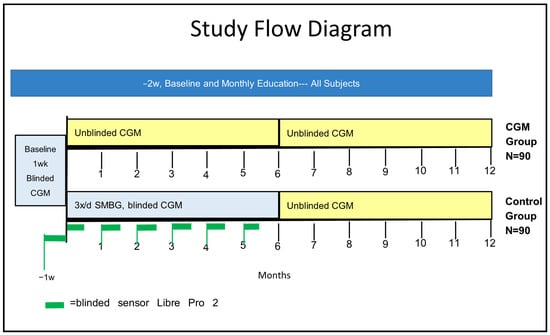
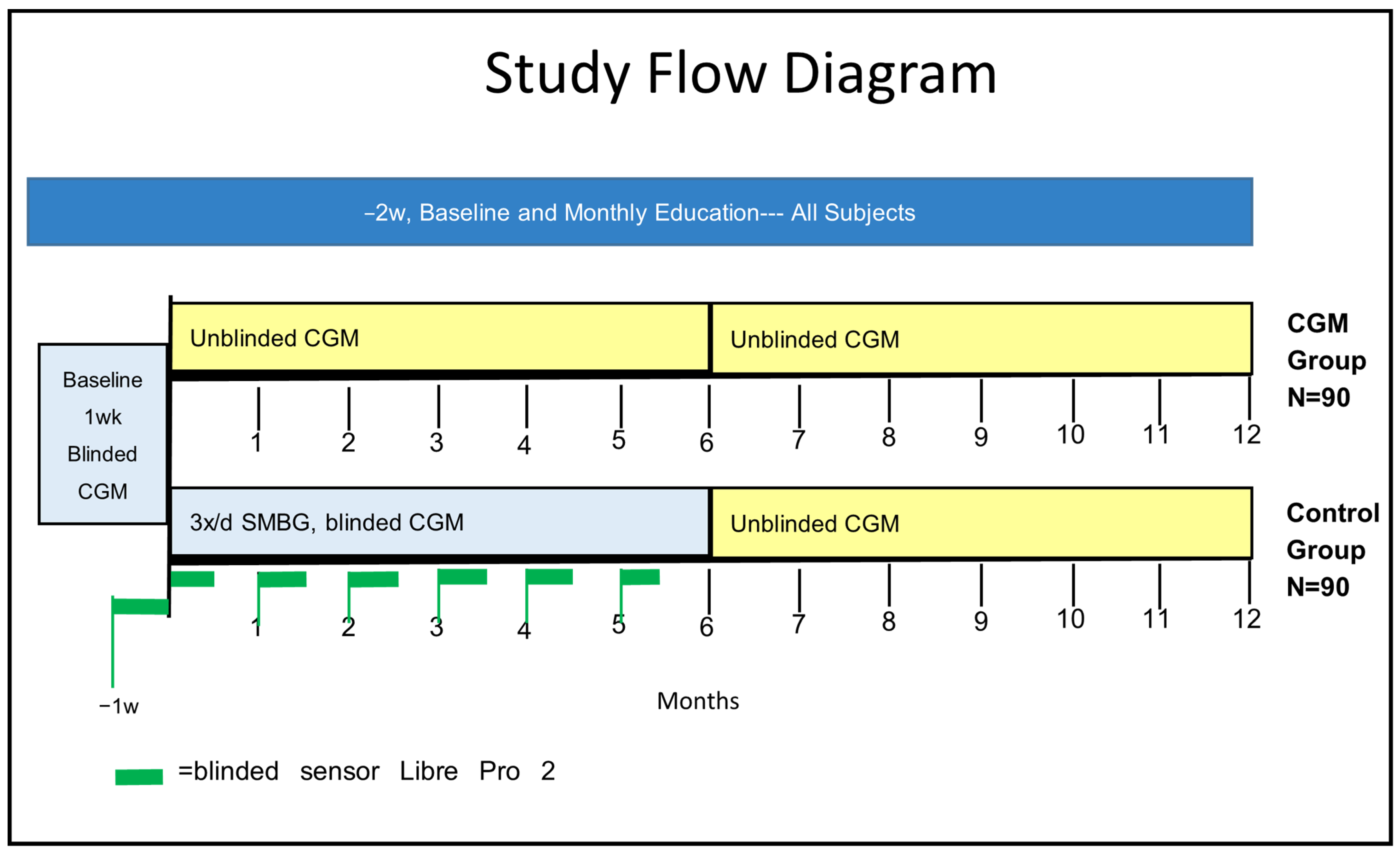
The study design is shown in Figure 1. Half of the subjects (n = 90, CGM Group) receive unblinded FreeStyle Libre 2 CGM for the entire 12 months. Half (n = 90, Control Group) are given sufficient test strips for three times daily SMBG months 1–6, while wearing blinded CGM for endpoint assessment. For months 7–12 they switch to unblinded CGM. The treatment group is expected to continuously modify their insulin dose and behaviors based on real-time, continuous availability of glucose data. The control group has no access to these data and will base their actions on SMBG measurement alone. For study data analysis, we will use unblinded sensor data from the treatment group and blinded sensor data from the control group that is obtained in the two weeks preceding each monthly visit; thus, the CGM data comparison period will be the same for both groups.
Figure 1.
Study flow diagram figure legend. Dark green color is librepro wear for 2wks, yellow is unblinded CGM wear, blue is for Blinded CGM wear.
The investigators and the patients are not blinded to treatment arm as there is no practical way to do this. But they are blinded to the comparison data for CGM versus SMBG use until the study is completed. Table 1 lists the schedule of study assessments.
Table 1.
Overview of patient schedule activities.
A baseline 1–2 weeks initial assessment will be performed where the ability to wear and return the CGM can be demonstrated as an entry criterion for study randomization. After this, 180 children and young adults with T1D will be randomized to a 12-month clinical trial stratified by age and clinics (Mulago or Nsambya) to determine if the availability to see continuous glucose levels by Freestyle Libre 2 CGM will improve glucose TIR compared to SMBG 3x/day. All subjects will receive intensive monthly diabetes self-management education. Half of the subjects (n = 90, “CGM Group”) will be given unblinded FreeStyle Libre 2 CGM for the entire 12 months. Half of the subjects (n = 90, “Control Group”) will be given sufficient test strips for 3x daily SMBG levels months 1–6. They will wear blinded CGM for endpoint assessment. For months 7–12 they will switch to unblinded CGM.
Primary endpoint assessment occurs after six months of unblinded CGM (months 1–6 for the CGM Group, and 6–12 for the Control Group). The first six months of the Control Group will serve as the control. The CGM Group will receive an additional six months (months 7–12) of unblinded CGM to determine the effects of longer use of CGM wear.
2.4. Study Setting, Recruitment and Consent
This study is being conducted in two urban hospital-based T1D clinics in Kampala, Uganda. Mulago Hospital (“Mulago”) is the national referral hospital and the teaching hospital for Makerere University. Nearby, St. Francis Hospital, Nsambya (“Nsambya”) is a teaching hospital for Mother Kevin Post Graduate Medical School, Uganda Martyrs University. These are the two largest pediatric diabetes clinics in Uganda. Patients are recruited through their pediatric diabetes clinics. At Mulago, T1D care is supported by a pediatric endocrinologist, residents, 2 nurses and a dietitian. At Nsambya, the diabetes team is headed by a pediatrician and is supported by 2–3 nurses plus residents. Each clinic follows about 300 children and young adults age 0–26 years. Nsambya is a private not-for-profit missionary hospital while Mulago is a public government hospital. The patients seen at Nsambya have a moderately higher socioeconomic status than those seen at Mulago, but only a few are able to afford better health care or insurance. Both clinics are supported by the CDiC® program (Changing Diabetes in Children, Novo Nordisk, Denmark), with patients receiving free insulin, 2–3 glucose strips per day for SMBG, measurement of HbA1c levels every three months, diabetes education, and an occasional diabetes camp for psychosocial support. Subjects are recruited by the local diabetes teams from their clinics. Patients are commonly seen in pediatric diabetes clinics up to age 26.
2.5. Eligibility Criteria
Eligibility criteria include living in the Kampala, Uganda area, age 4–26 years, T1D (determined by clinical criteria) of at least 12 months duration, receiving insulin therapy, and having access to a cell phone (nearly ubiquitous in Uganda).
Exclusion criteria include those unwilling or unable to be seen monthly at the clinic, pregnant or breast-feeding or likely to become pregnant in the next year, any condition which the investigator feels would interfere with study participation, that the patient already has CGM (very rare in Uganda), and inability to wear the sensor for at least 7 days or return it during the baseline assessment period.
2.6. Study Management
Both study groups receive intensive monthly diabetes self-management education, with a focus on pattern recognition and insulin adjustment to prevent hypo- and hyperglycemia. Between visits, they have unlimited availability to contact study personnel by telephone at all times. Participants return used sensors at each visit. All study procedures are performed by trained personnel. CGM is considered a low-risk medical intervention.
Participants wearing the unblinded FreeStyle Libre 2 CGM system are able to see their glucose levels at all times. The research team is able to use these data for insulin adjustment, and participants are taught how to interpret the data. Subjects in the control arm wear the blinded CGM Libre Pro while performing SMBG three times daily for six months. Patients are taught how to interpret SMBG data and the research team uses these data for insulin adjustment. Blinded FreeStyle Libre Pro CGM sensors, placed monthly, are used to provide control data. The study team uploads the de-identified data to a study website and neither participants nor the research teams have access to the blinded sensor data for clinical use until the end of months 0–6, to preserve the blinding.
Participants are prescribed insulin regimens as per the patient’s usual routine. This was generally human NPH and regular insulin. However, analog insulin, longacting Basaglar and Levemir and rapid novorapid are increasingly becoming widely available. No participants in the study will be on premixed insulin. The insulin pens are stored at room temperature for the majority of the participants.
2.7. Sample Size Determination
The sample size is determined based on hypothesis testing of the primary efficacy endpoint. The null hypothesis is that the two arms will demonstrate no significant differences in the six-month change in glucose TIR. The alternative hypothesis is that wearing unblinded CGM will have greater improvement in glucose TIR over six months compared to the control arm. We estimate a standard deviation of 16.6% for baseline TIR based on our pilot data [3] and assume a moderate correlation of 0.5 between baseline and 6-month TIR values. A sample size of 144 patients (72 per arm) will have over 90% power to detect a difference of 8.6% in 6-month TIR changes between the two arms at the one-sided significance level of 0.05. To allow a 20% dropout rate, a total of 180 patients will be randomized with planned study completion of at least 144 patients. The sample size will have over 90% power to detect a 5-percentage point difference in the 6-month change from baseline in percent time < 70 mg/dL (3.9 mmol/L) or a 3.5 percentage point difference in percent time < 54 mg/dL (3.0 mmol/L) at the one-sided significance level of 0.05.
2.8. Statistical Methods
2.8.1. Primary Efficacy Endpoint
The primary efficacy endpoint is the six-month change in percent TIR. A mixed effects model will be used, with a subject-level random intercept, with the fixed-effect predictors including the time of measurement (0, 6, or 12 month), time-dependent binary indicator for the type of CGM (SMBG with blinded CGM or unblinded CGM), and time-by-CGM-type interaction. Covariates such as age and gender will also included if tested as significant in univariate analysis.
2.8.2. Cost Analyses
- Primary cost analysis: material cost of the Libre CGM system vs. SMBG
We calculated the cost of three times daily SMBG per patient per 1 year. Assumptions to consider included provision of one glucometer per patient per year plus a replacement in up to 20% of patients in the second half of the year, batteries for the glucometer every 6 months, 3 test strips per day per patient plus 10% for supplementing those who might need additional support (such as during acute illness), 1 lancet device per patient per year with replacement of up to 50% in the second half of the year, and two packets of 200 lancets per patient per year. We also calculated the cost of SMBG six times daily per patient per 1 year, since international consensus standards state that SMBG should occur 6–10 times per day for optimum care.
We calculated the direct cost of the Freestyle Libre 2 CGM system per patient per 1 year. This model includes provision of 1 Freestyle Libre 2 CGM reader per patient including rechargeable batteries, 26 sensors per year (one every 14 days), glucose test strips for confirmation of readings four times per week (the CGM system has glucose monitoring capacity, so no separate meter is necessary), one lancet device, and 50 lancets. We assume 10% extra of these supplies for replacement or increased needs, except for sensors, where we assume 20% extra are needed.
2.8.3. Secondary Cost Analyses
For each patient in each group per year, we will calculate the cost of hospital admissions for severe hypoglycemia and DKA as well as days missed from school or work. We will also estimate future long-term costs to the healthcare system. Diabetes chronic complications occur after many years of poor diabetes control and are not likely to appear during this study, although they could develop earlier in African youth with T1D because of chronic poor control. We will calculate the average health care cost in Uganda for retinopathy, renal failure, foot ulcer care, and amputation. There are good data available documenting the specific risk reductions associated with specific improvements in glucose TIR, and we will use these in our calculations. The hazard rate of development of retinopathy progression is reduced by 64% and development of microalbuminuria is reduced by 40% for each 10-point increase in glucose time-in-range [16]. Based on the literature, we expecting to achieve at least a 10-point improvement in glucose time-in-range in patients using CGM [17] and at the end of the study we will use our actual rates of improvement to calculate anticipated future risk reduction for retinopathy and microalbuminuria using published data [16].
In a study in Northern Uganda looking at disability from limb loss [18], the economic burden of being disabled was twofold—inability to work and the extra costs associated with accessing disability services in distant places. This will be a dimension which we will explore and try to cost each aspect as it affects individual patients and their households.
Summary statistics will be calculated for each cost endpoint. The primary and secondary endpoints will be compared between the CGM and SMBG groups using 2-sample t-tests or the Wilcoxon rank-sum tests. Linear regression models will also be used for the group comparisons with adjustment for important covariates such as age, gender, and education levels.
2.8.4. Additional Analyses
Analysis of demographics and baseline characteristics will be descriptive with appropriate summary statistics calculated. Subgroup analyses for the primary endpoints for sensitivity analyses will be conducted. All primary analyses will follow the intent-to-treat principle. The maximum likelihood estimation method will be used to deal with any missing data, assuming that data are missing at random. Sensitivity analyses will be carried out with various assumptions of missing mechanisms. Unblinded CGM offers the prospect of direct benefit with the potential to reduce hyper- and hypoglycemia in the concerned population and has been shown to be safe and effective in children, and we want to collect data for other variables such as DKA and serious hypoglycemia even if the unblinded CGM has no efficacy on TIR; thus, no interim analysis is planned.
2.9. Study Administration
The UMN Coordinating Center is led by Dr. Antoinette Moran, who has overall responsibility for the study. The Coordinating Center is responsible for maintaining quality assurance and quality control systems to ensure that the trial is conducted and data generated, documented, and reported in compliance with the protocol, Good Clinical Practice and applicable regulatory requirements. Dr. Thereza Piloya-Were, the Ugandan PI, has responsibility for all study activities in that country. Mr. Expeditus Ahimbisibwe and Mr. Ezrah Trevor Rwakinanga from the Ugandan Ministry of Health (MOH) is performing the cost analyses and is responsible for presenting these findings to the MOH to assist in policy determination. A DSMB with two members from East Africa and one from the US met by conference call every 6 months. As this is a low-risk study, there is no external monitor, but the internal monitoring is done by the DSMB. Any protocol modifications are reported to both the local and Minnesota Research Ethic Committees. All records at UMN and in Uganda are kept in a secure location and will be kept for as long a period as dictated by local IRB and Institutional regulations.
If any serious unanticipated adverse device effect (UADE) occurs, the use of the study device may be suspended or stopped completely, pending DSMB review. Also, study activities could be suspended if the manufacturer of any constituent study agent requires stoppage of agent use for safety reasons (e.g., product recall). If any death occurs in the study and is assessed to be related to the study treatment device by the study site investigator, enrollment in the trial will be halted, pending DSMB review. A manuscript is to be published to share our work with the broader diabetes community globally.
3. Results and Progress
In August 2022, the Uganda study team was trained for five weeks on the protocol, CGM use, interpretation of CGM and SMBG data, and research principles by the Minnesota study team. Video calls every 2–4 weeks and in-person visits by the Minnesota team twice per year provide ongoing monitoring and mentorship. Recruitment began in August 2022. Two of the planned four cohorts have completed the study and the third cohort is in progress. As of August 2025, 136 participants had been enrolled, ~75.0% of the target sample size of 180 in Figure S1 [19]. We hope to complete the enrolment of participants by 31 March 2026 and complete the last patient follow up by 30 April 2027. The study will be completed in August 2027 with a manuscript preparation.
4. Discussion
This protocol describes the background, design, and organization of a randomized clinical trial to determine whether CGM wear improves glucose time-in-range (which could include reducing time in both hyper- and hypoglycemia) in children and youths with type 1 diabetes in Uganda. Importantly, it involves a cost-effectiveness analysis since the economics of CGM use in this region may be quite different from what has been found in the high-income countries where it has become standard-of-care. The study involves a large number and wide age range of children and young adults from a low-resource country, making the results potentially generalizable for wider applicability in sub-Saharan Africa. Involvement of the local Ministry of Health economists allows assessment of the real-world practicality of this intervention in improving diabetes care in a low-resource setting.
CGM has rapidly become standard-of-care in the US and Europe but is virtually unknown in resource-poor settings. A decade ago the most frequent cause of TID-related death in Africa was reported to be lack of insulin [20]. While insulin and diabetes test strips are still far from universally available worldwide, this is no longer the case for most children in Uganda and in much of the world where CDiC and Life for a Child have stepped in to provide basic diabetes therapies. When children were dying because insulin and test strips were not at all available, the goal was to provide a somewhat arbitrarily determined “minimal level of acceptable care”, which was primarily intended to keep them alive. However, marked improvements in insulin and test strip availability now challenge the assumption of what constitutes “acceptable care”, and raise questions about the quality of care. This is because diabetes metabolic control is still poor in these children, and they are regularly experiencing catastrophically high and low blood glucose levels [21,22,23,24,25].
All patients in this study, including those in the control group, will receive more intensive education, greater attention from the diabetes team, and more test strips than are commonly available today. If this approach results in similar levels of improvement in glucose TIR in control subjects using SMBG compared to patients who use unblinded CGM, this study will have performed an important service by demonstrating that there is no need for this expensive therapy and that, instead, more focus needs to be placed on patient education and interaction with the medical team. But if CGM leads to significantly greater improvement in diabetes metabolic control by reducing hyper- and hypoglycemia, then the ethical question is not whether to provide this therapy in resource poor settings but how to make it affordable. This is similar to the issue that arose when HIV/AIDS therapies first became available. Such decisions must be guided by data obtained in the specific and unique settings found in low, low-/middle income nations. The goal of this protocol is to obtain these data.
Supplementary Materials
The following supporting information can be downloaded at: https://www.mdpi.com/article/10.3390/mps9020043/s1, Figure S1: CONSORT 2025 Flow Diagram; Table S1: SPIRIT 2025 checklist of items to address in a randomized trial protocol*. References [19,26] are cited in the Supplementary Materials.
Author Contributions
T.P.-W. was involved in study conceptualization, study design, funding acquisition, data collection, study supervision and protocol preparation and editing. A.M. was involved in study conceptualization, study design, funding acquisition, data collection, study supervision and manuscript protocol preparation and editing. C.N. contributed to study design, data collection, study supervision and protocol preparation and editing. E.P. contributed to study design, data collection, project administration and manuscript protocol preparation and editing. E.A. contributed to study design, data collection and manuscript protocol preparation and editing. E.T.R. contributed to study design, data collection and manuscript protocol preparation and editing. L.Z. contributed to study design, data collection and manuscript protocol preparation and editing. S.B. contributed to study design, data collection and manuscript protocol preparation and editing. All authors have read and agreed to the published version of the manuscript.
Funding
This work is supported by the National Institutes of Health, Grant # R01DK126726 (USA PI-Moran, Uganda PI-Piloya-Were). Abbott Diabetes Care, Alameda, California, is donating the Freestyle Libre 2 and Libre Pro sensor systems; they were not involved in the design of the study and will not be involved in data interpretation or reporting.
Institutional Review Board Statement
The protocol is approved by the Mulago Hospital Research Ethical Committee (MHREC 2173), Uganda National Council of Science and Technology (HS2129ES) and the University of Minnesota IRB (STUDY00013430). A Data and Safety Monitoring Board (DSMB) consists of three physicians, none of whom are otherwise associated with the study. The DSMB includes representatives from the US, Uganda, and Tanzania.
Informed Consent Statement
Written informed consent is obtained from all participants age ≥ 18 years and/or parent/legal guardian for those age < 18 years to participate in the study. Written assent is obtained from those ages 8–17 years. All study procedures are performed by trained personnel, and all subjects have phone access to local study personnel 24/7.
Data Availability Statement
Data from this trial will be made available at completion of the study, upon reasonable request to the authors.
Acknowledgments
The authors sincerely thank all the participants enrolled in this DAYTime study and the staff at the study sites. We are especially grateful to the support from the Global Health Uganda team, the Mulago and Nsambya hospital Paediatric Diabetes teams, the staff at the Department of Paediatrics Makerere University, and the Paediatric Diabetes team at the University of Minnesota for their valuable guidance. Clinicaltrials.gov registration: NCT05454176. Version 5.1, Date: 6 June 2025.
Conflicts of Interest
Antoinette Moran and Thereza Piloya-Were received funding from Abbott Diabetes Care to perform a separate study of variability in the relation between CGM average glucose levels and HbA1c in Ugandan youth. The other authors report no relevant conflicts of interest.
Abbreviations
| CGM | Continuous glucose monitoring |
| HbA1c | Hemoglobin A1c |
| IDF | International Diabetes Federation |
| POC | Point of care |
| RCT | Randomized, controlled trial |
| SMBG | Self-monitoring of blood glucose (meter, test strips) |
| T1D | Type 1 diabetes |
| TIR | Time-in-range, glucose 70–180 mg/dL (3.9–10.0 mmol/L) |
| UADE | Unanticipated Adverse Device Effect |
Appendix A
Table A1.
Protocol development: challenges identified and the approaches to resolving them.
References
- International Diabetes Federation. Diabetes Atlas, 11th ed.; International Diabetes Federation: Brussels, Belgium, 2025; Available online: https://diabetesatlas.org (accessed on 11 December 2025).
- Ogle, G.D.; von Oettingen, J.E.; Middlehurst, A.C.; Hanas, R.; Orchard, T.J. Levels of type 1 diabetes care in children and adolescents for countries at varying resource levels. Pediatr. Diabetes 2019, 20, 93–98. [Google Scholar] [CrossRef] [Scilit]
- McClure Yauch, L.; Velazquez, E.; Piloya-Were, T.; Wainaina Mungai, L.; Omar, A.; Moran, A. Continuous glucose monitoring assessment of metabolic control in East African children and young adults with type 1 diabetes: A pilot and feasibility study. Endocrinol Diab Metab 2020, 3, e00135. [Google Scholar] [CrossRef] [Scilit]
- Miller, K.M.; Beck, R.W.; Bergenstal, R.M.; Goland, R.S.; Haller, M.J.; McGill, J.B.; Rodriguez, H.; Simmons, H.H.; Hirsch, I.R.; T1D Exchange Clinic Network. Evidence of a strong association between frequency of self-monitoring of blood glucose and hemoglobin A1c levels in T1D Exchange Clinic Registry participants. Diabetes Care 2013, 36, 2009–2014. [Google Scholar] [CrossRef] [Scilit]
- Tauschmann, M.; Cardona-Hernandez, R.; DeSalvo, D.J.; Hood, K.; Laptev, D.N.; Lindholm Olinder, A.; Wheeler, B.J.; Smart, C.E. International society for pediatric and adolescent diabetes clinical practice consensus guidelines 2024 diabetes technologies: Glucose monitoring. Horm. Res. Paediatr. 2025, 97, 615–635. [Google Scholar] [CrossRef] [Scilit] [PubMed]
- American Diabetes Association. Standards of Medical Care in Diabetes. Diabetes Care 2023, 46, S140–S157. [Google Scholar] [CrossRef] [Scilit] [PubMed]
- Dicembrini, I.; Cosentino, C.; Monami, M.; Mannucci, E.; Pala, L. Effects of real-time continuous glucose monitoring in type 1 diabetes: A meta-analysis of randomized controlled trials. Acta Diabetol. 2021, 58, 401–410. [Google Scholar] [CrossRef] [Scilit] [PubMed]
- Aljuhani, R.; Adas, M.; Alnaami, R.; Alshehri, R.; Alqarni, R.; NoorSaeed, S.; Al-Agha, A.; Aljuhani, R.; Alqarni, R.M.; NoorSaed, S. Comparing real-time continuous glucose monitoring to self-monitoring of blood glucose: Advantages and limitations for children and adolescents with type 1 diabetes. Cureus 2024, 16, e51496. [Google Scholar] [CrossRef] [Scilit]
- Oliver, N.; Gimenez, M.; Calhoun, P.; Cohen, N.; Moscardo, V.; Hermanns, N.; Freckmann, G.; Reddy, M.; Heinemann, L. Continuous glucose monitoring in people with type 1 diabetes on multiple-dose injection therapy: The relationship between glycemic control and hypoglycemia. Diabetes Care 2020, 43, 53–58. [Google Scholar] [CrossRef] [Scilit]
- Gordon, I.; Rutherford, C.; Makarounas-Kirchmann, K.; Kirchmann, M. Meta-analysis of average change in laboratory-measured HbA1c among people with type 1 diabetes mellitus using the 14 day Flash Glucose Monitoring System. Diabetes Res. Clin. Pract. 2020, 164, 108158. [Google Scholar] [CrossRef] [Scilit] [PubMed]
- Jeyam, A.; Gibb, F.W.; McKnight, J.A.; O’Reilly, J.E.; Caparrotta, T.M.; Höhn, A.; McGurnaghan, S.J.; Blackbourn, L.A.; Hatam, S.; Kennon, B. Flash monitor initiation is associated with improvements in HbA1c levels and DKA rates among people with type 1 diabetes in Scotland: A retrospective nationwide observational study. Diabetologia 2022, 65, 159–172. [Google Scholar] [CrossRef] [Scilit]
- Van Name, M.A.; Kanapka, L.G.; DiMeglio, L.A.; Miller, K.M.; Albanese-O’Neill, A.; Commissariat, P.; Corathers, S.D.; Harrington, K.R.; Hilliard, M.E.; Anderson, B.J. Long-term continuous glucose monitor use in very young children with type 1 diabetes: One-year results from the SENCE study. J. Diabetes Sci. Technol. 2023, 17, 976–987. [Google Scholar] [CrossRef] [Scilit]
- Jiao, Y.; Lin, R.; Hua, X.; Churilov, L.; Gaca, M.J.; James, S.; Clarke, P.M.; O’Neal, D.; Ekinci, E.I. A systematic review: Cost-effectiveness of continuous glucose monitoring compared to self-monitoring of blood glucose in type 1 diabetes. Endocrinol. Diabetes Metab. 2022, 5, e369. [Google Scholar] [CrossRef] [Scilit]
- Bilir, S.P.; Hellmund, R.; Wehler, B.; Li, H.; Munakata, J.; Lamotte, M. Cost-effectiveness analysis of a flash glucose monitoring system for patients with type 1 diabetes receiving intensive insulin treatment in Sweden. Eur. Endocrinol. 2018, 14, 73. [Google Scholar] [CrossRef] [Scilit] [PubMed]
- Shi, L.; Hellmund, R. Cost comparison of flash continuous glucose monitoring with self-monitoring of blood glucose in adults with type 1 or type 2 diabetes using intensive insulin—From a US private payer perspective. US Endocrinol 2020, 16, 24–30. [Google Scholar] [CrossRef] [Scilit]
- Beck, R.W.; Bergenstal, R.M.; Riddlesworth, T.D.; Kollman, C.; Li, Z.; Brown, A.S.; Close, K.L. Validation of time in range as an outcome measure for diabetes clinical trials. Diabetes Care 2019, 42, 400–405. [Google Scholar] [CrossRef] [Scilit] [PubMed]
- Beck, R.W.; Riddlesworth, T.; Ruedy, K.; Ahmann, A.; Bergenstal, R.; Haller, S.; Kollman, C.; Kruger, D.; McGill, J.B.; Polonsky, W. Effect of continuous glucose monitoring on glycemic control in adults with type 1 diabetes using insulin injections: The DIAMOND randomized clinical trial. JAMA 2017, 317, 371–378. [Google Scholar] [CrossRef] [Scilit]
- Okello, T.R.; Magada, S.M.; Atim, P.; Ezati, D.; Campion, A.; Moro, E.B.; Huch, J.; Byrne, G.; Redmond, A.; Nirmalan, M. Major limb loss: An overview of etiology, outcomes, experiences and challenges faced by amputees and service providers in the post-conflict period in Northern Uganda. J. Glob. Health Rep. 2019, 3, e2019028. [Google Scholar]
- Hopewell, S.; Chan, A.-W.; Collins, G.S.; Hróbjartsson, A.; Moher, D.; Schulz, K.F.; Tunn, R.; Aggarwal, R.; Berkwits, M.; Berlin, J.A.; et al. CONSORT 2025 statement: Updated guideline for reporting randomised trials. BMJ 2025, 388, e081123. [Google Scholar] [CrossRef] [Scilit]
- Beran, D.; Yudkin, J.S. Diabetes care in sub-Saharan Africa. Lancet 2006, 368, 1689–1695. [Google Scholar] [CrossRef] [Scilit]
- Mukama, L.J.; Moran, A.; Nyindo, M.; Philemon, R.; Msuya, L. Improved glycemic control and acute complications among children with type 1 diabetes mellitus in Moshi, Tanzania. Pediatr. Diabetes 2013, 14, 211–216. [Google Scholar] [CrossRef] [Scilit]
- Ngwiri, T.; Were, F.; Predieri, B.; Ngugi, P.; Iughetti, L. Glycemic control in Kenyan children and adolescents with type 1 diabetes mellitus. Int. J. Endocrinol. 2015, 2015, 761759. [Google Scholar] [CrossRef] [Scilit] [PubMed]
- Marshall, S.L.; Edidin, D.V.; Arena, V.C.; Becker, D.J.; Bunker, C.H.; Gishoma, C.; Gishoma, F.; LaPorte, R.E.; Kaberuka, V.; Ogle, G. Glucose control in Rwandan youth with type 1 diabetes following establishment of systematic, HbA1c based, care and education. Diabetes Res. Clin. Pract. 2015, 107, 113–122. [Google Scholar] [CrossRef] [Scilit]
- Bahendeka, S.; Mutungi, G.; Tugumisirize, F.; Kamugisha, A.; Nyangabyaki, C.; Wesonga, R.; Sseguya, W.; Mubangizi, D.; Nalunkuma, C.; Were, T.P. Healthcare delivery for paediatric and adolescent diabetes in low resource settings: Type 1 diabetes clinics in Uganda. Glob. Public Health 2019, 14, 1869–1883. [Google Scholar] [CrossRef] [Scilit]
- Noorani, M.; Ramaiya, K.; Manji, K. Glycaemic control in type 1 diabetes mellitus among children and adolescents in a resource limited setting in Dar es Salaam-Tanzania. BMC Endocr. Disord. 2016, 16, 29. [Google Scholar] [CrossRef] [Scilit] [PubMed]
- Chan, A.-W.; Boutron, I.; Hopewell, S.; Moher, D.; Schulz, K.F.; Collins, G.S.; Tunn, R.; Aggarwal, R.; Berkwits, M.; Berlin, J.A.; et al. SPIRIT 2025 statement: Updated guideline for protocols of randomised trials. BMJ 2025, 389, e081477. [Google Scholar] [CrossRef] [Scilit] [PubMed]

Disclaimer/Publisher’s Note: The statements, opinions and data contained in all publications are solely those of the individual author(s) and contributor(s) and not of MDPI and/or the editor(s). MDPI and/or the editor(s) disclaim responsibility for any injury to people or property resulting from any ideas, methods, instructions or products referred to in the content. |
© 2026 by the authors. Licensee MDPI, Basel, Switzerland. This article is an open access article distributed under the terms and conditions of the Creative Commons Attribution (CC BY) license.