
Methodologies of Care: A Multimodal, Participatory Research Approach with Vulnerable Families Among South African Communities

 , , ,
, , , 
Abstract
1. Introduction
2. Materials and Methods: A Careful Methodology
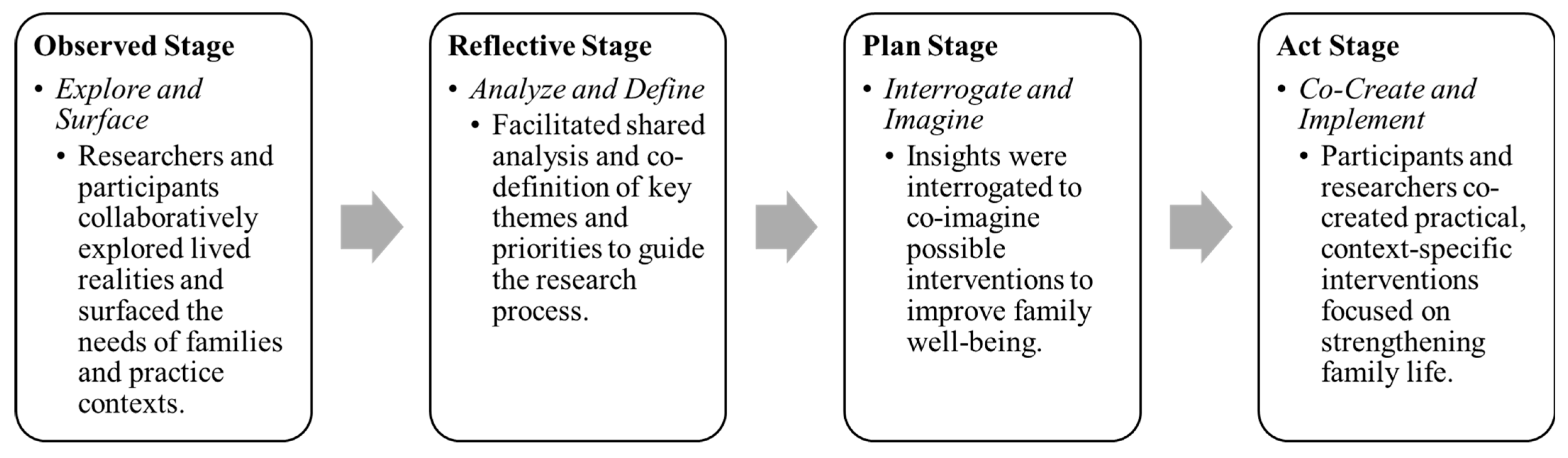
2.1. Study Design
2.2. Location
2.3. Participants and Sampling
2.4. Data Collection Procedure
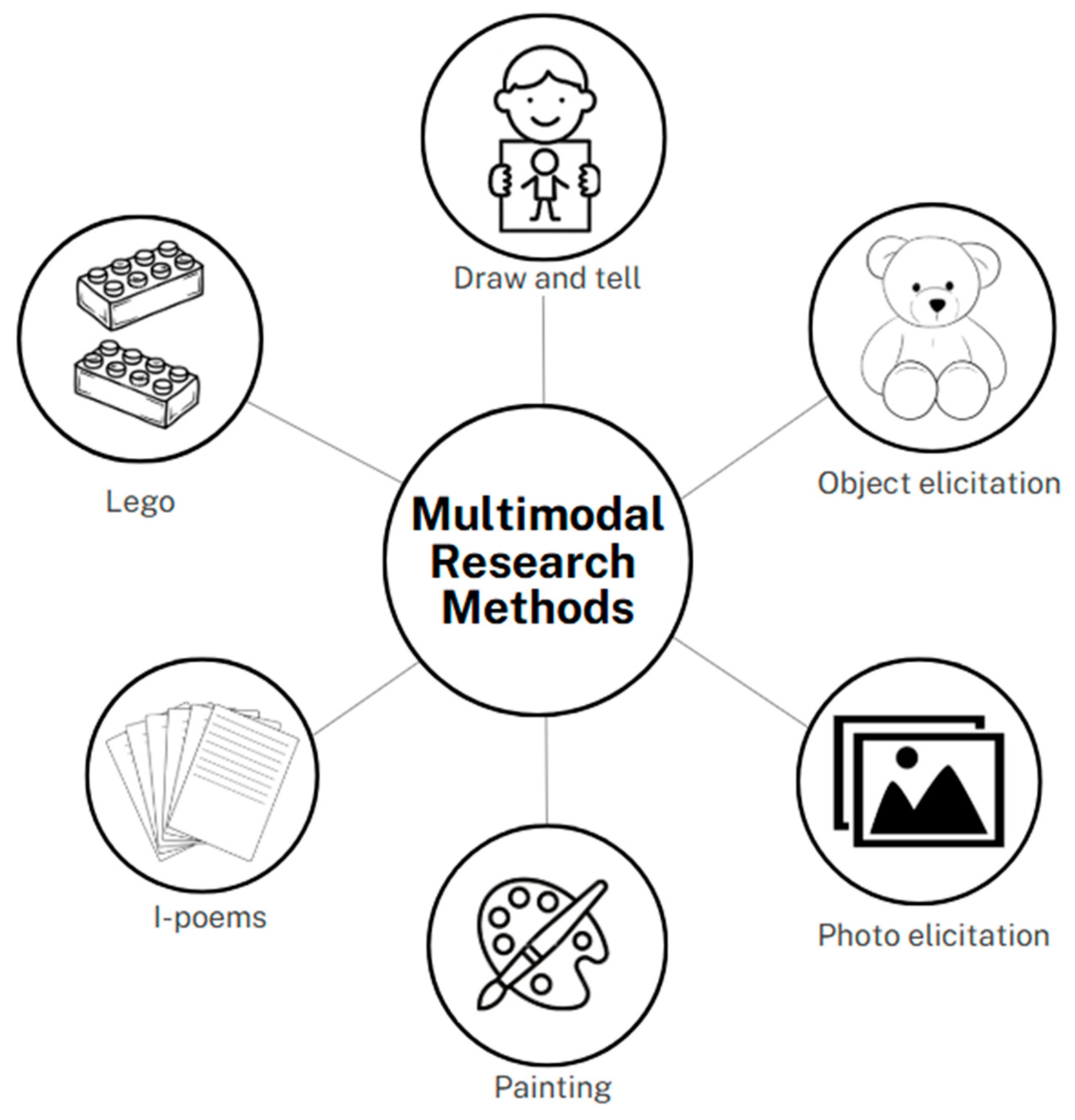
2.4.1. Draw-and-Tell
2.4.2. Painting
2.4.3. Object Elicitation
2.4.4. Photo Elicitation
2.4.5. I-Poems
2.4.6. LEGO®
2.5. Data Analysis
2.5.1. Draw-and-Tell
2.5.2. Painting
2.5.3. Object Elicitation
2.5.4. Photo Elicitation
2.5.5. I-Poems
2.5.6. LEGO
2.6. Trustworthiness
2.7. Ethical Considerations
3. Results
3.1. Draw-and-Tell
3.2. Photo Elicitation
3.3. Object Elicitation
3.4. Painting
3.5. LEGO®
3.6. I-Poems
4. Discussion
4.1. Credibility
4.2. Contributory
4.3. Communicable
4.4. Conforming
4.5. Strengths and Weaknesses
4.6. Future Research
5. Conclusions
Author Contributions
Funding
Institutional Review Board Statement
Informed Consent Statement
Data Availability Statement
Acknowledgments
Conflicts of Interest
Abbreviations
| HCD | Human Centred Design |
| LG | Listening Guide |
| LSP | LEGO® Serious Play |
| PAR | Participatory Action Research |
References
- Lewis, C.; Mehmet, M.; Quinton, S.; Reynolds, N. Methodologies for researching marginalised and/or potentially vulnerable groups. Int. J. Mark. Res. 2023, 65, 147–154. [Google Scholar] [CrossRef]
- Shevlin, M.; Rose, R. Respecting the voices of individuals from marginalised communities in research—“Who is listening and who isn’t?”. Educ. Sci. 2022, 12, 304. [Google Scholar] [CrossRef]
- Harasym, J.A.; Gross, D.P.; MacLeod, A.A.N.; Phelan, S.K. “This is a look into my life”: Enhancing qualitative inquiry into communication through arts-based research methods. Int. J. Qual. Methods 2024, 23, 1–16. [Google Scholar] [CrossRef]
- Boerner, K.E.; Pearl-Dowler, L.; Holsti, L.; Wharton, M.N.; Siden, H.; Oberlander, T.F. Family perspectives on in-home multimodal longitudinal data collection for children who function across the developmental spectrum. J. Dev. Behav. Pediatr. 2023, 44, e284–e291. [Google Scholar] [CrossRef]
- Zhu, Y.; Wu, Y.; Sebe, N.; Yan, Y. Vision + X: A survey on multimodal learning in the light of data. arXiv 2024. [Google Scholar] [CrossRef]
- Berejena, T.; Malongane, F.; Metsing, T.I. Social protection programs and their support for promoting access to nutrient-dense foods for vulnerable communities in South Africa. Curr. Dev. Nutr. 2025, 9, 107452. [Google Scholar] [CrossRef]
- Mdluli-Maziya, P.; Mncayi, P.; Sere, K. Poverty among youth-headed households in South Africa: Quo vadis. J. Poverty 2022, 28, 196–210. [Google Scholar] [CrossRef]
- Nyathi, L.; Khaile, F.T.; Balogun, T.V.; Roman, N.V.; October, K.; Human-Hendricks, A.R.; De Lange, J. Social issues affecting social cohesion in low-resource communities in South Africa. Afr. J. Gov. Dev. 2024, 13, 135–162. [Google Scholar] [CrossRef]
- The Lancet. South Africa sliding backwards. Lancet 2018, 391, 1456. [Google Scholar] [CrossRef] [PubMed]
- Dlamini, M.; Mbonigaba, J. Socio-economic-driven disparities in chronic illness and disability among the South African children: Exploring variations within the urban and rural areas. J. Dev. Areas 2024, 58, 41–72. [Google Scholar] [CrossRef]
- Chinyakata, R.; Msiza, F.B.; Du Plessis, B.; Roman, N.V. Factors inhibiting control over one’s environment: A human capabilities perspective. Cogent Soc. Sci. 2023, 10, 2292862. [Google Scholar] [CrossRef]
- Knappertsbusch, F.; Schreier, M.; Burzan, N.; Fielding, N. Innovative applications and future directions in mixed methods and multimethod social research. Forum Qual. Soc. Res. 2023, 24, 22. [Google Scholar] [CrossRef]
- Faluyi, O.T.; Olutola, A.A. Poverty in South Africa: Drivers of perpetuation. Afr. J. Inter/Multidiscip. Stud. 2024, 6, 1–13. [Google Scholar] [CrossRef]
- Fischer, M.S.; Loiselle, R.; Weber, D.M.; Highlander, A.; McCall, M.P.; Cain, G.H.; Forehand, R.; Jones, D.J. Parent-child emotion dynamics in families presenting for behavioral parent training: Is there a link with child behavior, parenting, and treatment outcome? J. Consult. Clin. Psychol. 2024, 92, 543–555. [Google Scholar] [CrossRef] [PubMed]
- Hicks, A.; Lloyd, A. Seeing information: Visual methods as entry points to information practices. J. Libr. Inf. Sci. 2018, 50, 229–238. [Google Scholar] [CrossRef]
- Stevenson, K.J.; Jayakumar, E.; See, H. The toy brick as a communicative device for amplifying children’s voices in research. M/C J. 2023, 26. [Google Scholar] [CrossRef]
- Bezemer, J.; Jewitt, C. Multimodal analysis: Key issues. In Research Methods in Linguistics; Litosseliti, L., Ed.; Continuum: London, UK, 2010; pp. 180–197. [Google Scholar]
- Jewitt, C. Multimodal methods for researching digital technologies. In The SAGE Handbook of Digital Technology Research; Price, S., Jewitt, C., Brown, B., Eds.; SAGE Publications: Dorchester, UK, 2013; pp. 250–265. [Google Scholar]
- Craig, S.L.; McInroy, L.B.; Goulden, A.; Eaton, A.D. Engaging the senses in qualitative research via multimodal coding: Triangulating transcript, audio, and video data in a study with sexual and gender minority youth. Int. J. Qual. Methods 2021, 20, 1–12. [Google Scholar] [CrossRef]
- Dicks, B. Action, experience, communication: Three methodological paradigms for researching multimodal and multisensory settings. Qual. Res. 2014, 14, 656–674. [Google Scholar] [CrossRef]
- Doak, L. Rethinking family (dis)engagement with augmentative & alternative communication. J. Res. Spec. Educ. Needs 2021, 21, 198–210. [Google Scholar] [CrossRef]
- Nienaber, B.; Kriszan, A. Thinking with the hands: LEGO® Serious Play® a game-based tool to empower young migrants integrating. Migr. Lett. 2023, 20, 443–452. [Google Scholar] [CrossRef]
- Vaughn, L.M. Participatory research methods. In Elgar Encyclopedia of Interdisciplinarity and Transdisciplinarity; Darbellay, F., Ed.; Edward Elgar Publishing: Cheltenham, UK, 2024; pp. 370–373. [Google Scholar] [CrossRef]
- Phoenix, A.; Brannen, J. Researching family practices in everyday life: Methodological reflections from two studies. Int. J. Soc. Res. Methodol. 2014, 17, 11–26. [Google Scholar] [CrossRef]
- Hine, C.M. Mixed methods and multimodal research and Internet technologies. In The Oxford Handbook of Multimethod and Mixed Methods Research Inquiry; Hesse-Biber, S., Johnson, R.B., Eds.; Oxford University Press: New York, NY, USA, 2015; pp. 503–521. [Google Scholar]
- O’Byrne, P. The advantages and disadvantages of mixing methods: An analysis of combining traditional and autoethnographic approaches. Qual. Health Res. 2007, 17, 1381–1391. [Google Scholar] [CrossRef]
- Hsieh, J.C. Multimodal digital storytelling presentations among middle-school learners of English as a foreign language: Emotions, grit and perceptions. RELC J. 2022, 55, 547–558. [Google Scholar] [CrossRef]
- Otenen, E. Towards designing for multimodal remembering: Findings from an interview study. In CHI EA ’24: Extended Abstracts of the CHI Conference on Human Factors in Computing Systems; Mueller, F.F., Kyburz, P., Williamson, J.R., Sas, C., Eds.; Association for Computing Machinery: New York, NY, USA, 2024; pp. 1–6. [Google Scholar] [CrossRef]
- Chasokela, D. Qualitative methodologies to understanding research. In Qualitative Approaches to Pedagogical Engineering; Elomari, D., Ed.; IGI Global: Hershey, PA, USA, 2024; pp. 321–340. [Google Scholar] [CrossRef]
- Frechette, J.; Bitzas, V.; Aubry, M.; Kilpatrick, K.; Lavoie-Tremblay, M. Capturing lived experience: Methodological considerations for interpretive phenomenological inquiry. Int. J. Qual. Methods 2020, 19, 1–12. [Google Scholar] [CrossRef]
- Brailas, A. Digital storytelling and the narrative turn in psychology: Creating spaces for collective empowerment. Glob. J. Community Psychol. Pract. 2021, 12, 1–19. [Google Scholar] [CrossRef]
- Virole, L.; Ricadat, E. Combining interviews and drawings: Methodological considerations. New Trends Qual Res. 2022, 11, e545. [Google Scholar] [CrossRef]
- Tronto, J.C. An ethic of care. Am. J. Med. 1998, 22, 15–20. [Google Scholar] [CrossRef]
- Drew, S.E.; Duncan, R.E.; Sawyer, S.M. Visual storytelling: A beneficial but challenging method for health research with young people. Qual. Health Res. 2010, 20, 1677–1688. [Google Scholar] [CrossRef] [PubMed]
- Li, B.; Jia, G.; Gao, X.; Ma, C. Multidimensional semantic augmented visual storytelling. In Proceedings of the 2024 4th International Conference on Neural Networks, Information and Communication Engineering [NNICE], Guangzhou, China, 19–21 January 2024; pp. 697–702. [Google Scholar] [CrossRef]
- Wadhawan, R.; Bansal, H.; Chang, K.W.; Peng, N. ConTextual: Evaluating context-sensitive text-rich visual reasoning in large multimodal models. arXiv 2024, arXiv:2401.13311v3. [Google Scholar]
- Bux, D.B.; van Schalkwyk, I. Creative arts interventions to enhance adolescent well-being in low-income communities: An integrative literature review. J. Child. Adolesc. Ment. Health 2022, 34, 1–29. [Google Scholar] [CrossRef]
- Woollett, N.; Christofides, N.; Franchino-Olsen, H.; Silima, M.; Fouche, A.; Meinck, F. “Through the drawings… they are able to tell you straight”: Using arts-based methods in violence research in South Africa. PLoS Glob. Public Health 2023, 3, e0002209. [Google Scholar] [CrossRef]
- Feekery, A. The 7 C’s framework for participatory action research: Inducting novice participant-researchers. Educ. Action Res. 2023, 32, 332–347. [Google Scholar] [CrossRef]
- Melles, M.; Albayrak, A.; Goossens, R. Innovating health care: Key characteristics of human-centered design. Int. J. Qual. Health Care 2021, 33, 37–44. [Google Scholar] [CrossRef]
- Giacomin, J. What is human centred design? Des. J. 2014, 17, 606–623. [Google Scholar] [CrossRef]
- Morgan, D.H.J. Framing relationships and families. In Researching Families and Relationships: Reflections on Process; Jamieson, L., Simpson, R., Lewis, R., Eds.; Palgrave Macmillan: Cham, Switzerland, 2011; pp. 19–45. [Google Scholar]
- Siouti, I.; Ruokonen-Engler, M.K. Emotions in the qualitative research process: Introduction to the Special Issue. Forum Qual. Sozialforsch/Forum Qual. Soc. Res. 2025, 26, 15. [Google Scholar] [CrossRef]
- Goodwin, J.; Savage, E.; O’Donovan, A. Using the Draw-and-Tell method with adolescents as part of an interpretive descriptive study. Qual. Res. J. 2023, 23, 273–286. [Google Scholar] [CrossRef]
- Ashton, M. Communicating through objects: Facilitating qualitative research in design. DESIGNABILITIES Des. Res. J. Soc. Cult. Political Discourse Transform. Act. 2018, 1–11. Available online: https://designabilities.wordpress.com/2018/07/31/communicating-through-objects-facilitating-qualitative-research-in-design/ (accessed on 20 May 2025).
- Driessnack, M. Draw-and-tell conversations with children about fear. Qual. Health Res. 2006, 16, 1414–1435. [Google Scholar] [CrossRef]
- Cox, S.; Guillemin, M. Enhancing meaning-making in research through sensory engagement with material objects. Qual. Rep. 2018, 23, 2754–2771. [Google Scholar] [CrossRef]
- Harrison, M.; Rhodes, T.; Lancaster, K. Object-oriented interviews in qualitative longitudinal research. Qual. Res. 2024, 25, 395–416. [Google Scholar] [CrossRef]
- Willig, C. Reflections on the use of object elicitation. Qual. Psychol. 2017, 4, 211–222. [Google Scholar] [CrossRef]
- O’Brien, C.; Charura, D. Object elicitation: A compassionate and culturally informed method for psychotherapy research. Couns. Psychother. Res. 2024, 24, 39–50. [Google Scholar] [CrossRef]
- Copes, H.; Tchoula, W.; Brookman, F.; Ragland, J. Photo-elicitation interviews with vulnerable populations: Practical and ethical considerations. Deviant Behav. 2018, 39, 475–494. [Google Scholar] [CrossRef]
- Gill, S.L. About research-qualitative data collection: Photo elicitation. J. Hum. Lact. 2024, 40, 503–505. [Google Scholar] [CrossRef] [PubMed]
- Glaw, X.; Inder, K.; Kable, A.; Hazelton, M. Visual methodologies in qualitative research: Autophotography and photo elicitation applied to mental health research. Int. J. Qual. Methods 2017, 16, 1–8. [Google Scholar] [CrossRef]
- Woodgate, R.L.; Zurba, M.; Tennent, P. A day in the life of a young person with anxiety: Arts-based boundary objects used to communicate the results of health research. Forum Qual. Soc. Res. 2017, 18, 17. [Google Scholar] [CrossRef]
- Hile, K.A.; Santos, R.M. “Would you like to hear a story?”: Collaborating with families using photo-elicitation. J. Early Interv. 2022, 44, 40–57. [Google Scholar] [CrossRef]
- Poku, B.A.; Caress, A.-L.; Kirk, S. The opportunities and challenges of using photo-elicitation in child-centered constructivist grounded theory research. Int. J. Qual. Methods 2019, 18, 1–7. [Google Scholar] [CrossRef]
- Reid, J.; Johannes, C.; Wareley, S.; Ngadhi, C.M.; Nginase, A.; Roman, N.V. A conceptual model for strengthening family capabilities through a process of care. Int. J. Environ. Res. Public Health 2025, 22, 1150. [Google Scholar] [CrossRef]
- Butschi, C.; Hedderich, I. How to involve young children in a photovoice project: Experiences and results. Forum Qual. Soc. Res. 2021, 22, 5. [Google Scholar] [CrossRef]
- Woodcock, C. The Listening Guide: A how-to approach on ways to promote educational democracy. Int. J. Qual. Methods. 2016, 15, 1–10. [Google Scholar] [CrossRef]
- Gilligan, C.; Eddy, J. Listening as a path to psychological discovery: An introduction to the Listening Guide. Perspect. Med. Educ. 2017, 6, 76–81. [Google Scholar] [CrossRef]
- Golding, B.; Hargreaves, J. Humanitarian nursing with Médecins Sans Frontières: Foregrounding the Listening Guide as a method for analysing oral history data. J. Adv. Nurs. 2018, 74, 1984–1992. [Google Scholar] [CrossRef]
- Edwards, R.; Weller, S. I-Poems as a method of qualitative interview data analysis: Young people’s sense of self. In Sage Research Methods Datasets Part 1; SAGE Publications, Ltd.: Thousand Oaks, CA, USA, 2015. [Google Scholar] [CrossRef][Green Version]
- Quinn, T.; Trinh, S.-H.; Passmore, J. LEGO® SERIOUS PLAY® (LSP) within a positive psychology framework in individual coaching: An interpretative phenomenological study. Coach. Int. J. Theory Res. Pract. 2021, 14. [Google Scholar] [CrossRef]
- McCusker, S. Lego®, Serious Play™: Thinking about teaching and learning. Int. J. Knowl. Innov. Entrep. 2014, 2, 27–37. Available online: https://ijkie.org/IJKIE_August2014_SEAN%20MCCUSKERv3.pdf (accessed on 20 May 2025).
- Rose, S.; Furness, P.J. Lego Serious Play in psychology: Exploring its use in qualitative interviews. Qual. Res. Psychol. 2024, 21, 578–609. [Google Scholar] [CrossRef]
- Wezyk, A.; Arden-Close, E.; Turner-Cobb, J.M. ‘Trapped under a tonne of rubble’: Using LEGO® to explore conceptual metaphors of psychological stress. Qual. Methods Psychol. Bull. 2020, 30, 40–50. [Google Scholar] [CrossRef]
- Braun, V.; Clarke, V. Using thematic analysis in psychology. Qual. Res. Psychol. 2006, 3, 77–101. [Google Scholar] [CrossRef]
- Creswell, J.W. Research Design: Qualitative, Quantitative, and Mixed Methods Approaches, 3rd ed.; Sage Publications: Thousand Oaks, CA, USA, 2009. [Google Scholar]
- Mårtensson, P.; Fors, U.; Wallin, S.-B.; Zander, U.; Nilsson, G.H. Evaluating research: A multidisciplinary approach to assessing research practice and quality. Res. Policy 2016, 45, 593–603. [Google Scholar] [CrossRef]
- Jackson Foster, L.J.; Deafenbaugh, L.; Miller, E. Group metaphor map making: Application to integrated arts-based focus groups. Qual. Soc. Work 2018, 17, 305–322. [Google Scholar] [CrossRef]
- Mooney, R.; Bhui, K. Analysing multimodal data that have been collected using photovoice as a research method. BMJ Open 2023, 13, e068289. [Google Scholar] [CrossRef]
- Rashid, N.A.; Omar, R.; Haron, Z. Qualitative approach in analyzing children’s psychological problems through the use of Kinetic Family Drawing [KFD]. Syst. Rev. Pharm. 2020, 11, 1334–1345. [Google Scholar]
- Berg, M.S.; Winther, H. How do children experience the embodied communication and leadership of teachers? Expressing the voices of children through artistic, sensual, and multimodal methods in educational research. Int. Rev. Qual. Res. 2021, 14, 444–462. [Google Scholar] [CrossRef]
- Efe, Y.S.; Söyünmez, S.; Zülkar, Y.; Başdaş; Ö. Determining family relations through drawing: Family relations in images drawn by immigrant children. J. Pediatr. Nurs. 2023, 72, e105–e113. [Google Scholar] [CrossRef]
- Lohmeier, C. Researching family secrets: Methodological approach, reflections and recommendations. Forum Qual. Soc. Res. 2020, 21, 2. [Google Scholar] [CrossRef]
- Elias, A.; Brown, A.D. The role of intergenerational family stories in mental health and wellbeing. Front. Psychol. 2022, 13, 927795. [Google Scholar] [CrossRef] [PubMed]
- Nielsen, C.S. Children’s embodied voices: Approaching children’s experiences through multi-modal interviewing. Phenomenol. Pract. 2009, 3, 80–93. [Google Scholar] [CrossRef]
- Nyirenda, L.; Kumar, M.B.; Theobald, S.; Sarker, M.; Simwinga, M.; Kumwenda, M.; Johnson, C.; Hatzold, K.; Corbett, E.L.; Sibanda, E.; et al. Using research networks to generate trustworthy qualitative public health research findings from multiple contexts. BMC Med. Res. Methodol. 2020, 20, 13. [Google Scholar] [CrossRef]
- DeValiant, G.; Kougiali, Z.; McGrath, L. Using multimodal methods to explore groups with multifaceted roles: The case of prison officers. QMiP Bull. 2021, 1, 5–13. [Google Scholar] [CrossRef]
- Çetin, Z.; Güneş, N. Drawing as a means of self-expression: A case study. Early Child Dev. Care 2021, 191, 136–147. [Google Scholar] [CrossRef]
- George, M.S.; Gaitonde, R.; Davey, R.; Mohanty, I.; Upton, P. Engaging participants with research findings: A rights-informed approach. Health Expect. 2023, 26, 765–773. [Google Scholar] [CrossRef] [PubMed]
- Howard, D.; Irani, L. Ways of knowing when research subjects care. In Proceedings of the 2019 CHI Conference on Human Factors in Computing Systems, Glasgow, UK, 4–9 May 2019; Paper 97. pp. 1–16. [Google Scholar] [CrossRef]
- Pérez-Rúa, J.-M.; Vielzeuf, V.; Pateux, S.; Baccouche, M.; Jurie, F. MFAS: Multimodal fusion architecture search. In Proceedings of the 2019 IEEE/CVF Conference on Computer Vision and Pattern Recognition (CVPR), Long Beach, CA, USA, 15–20 June 2019; pp. 6966–6975. [Google Scholar] [CrossRef]
- Wright, E. Exploring the affordances and propensities of multimodality in narrative pedagogies through multimodal ethnography. Malta J. Educ. 2024, 4, 165–197. [Google Scholar] [CrossRef]



| Multimodal Method | Instruction | Question | Probe Questions |
|---|---|---|---|
| Draw-and-Tell | Draw us your family household (your place and space). | Who occupies this place and space? |
|
| Object elicitation | Bring an object that means something to you regarding your family. | Tell us about your object. |
|
| Photo elicitation | Bring a photo that relates to family (it can be an image of your family, things, space and/or place). | Tell us your story and about your family. |
|
| Painting | Paint us a picture, starting from approximately 10 years old (as an adolescent) to where you are now (as an adult), of how your family has changed over time. | What does your family life look like? |
|
| I-poems | Read your I-poem and reflect on it for about 10 min. | Tell us what this poem means to you. |
|
| LEGO® |
|
|
|
| Multimodal Method | Research Quality Component | ||||
|---|---|---|---|---|---|
| Methods | Visual Example from Empirical Data | Credible | Contributory | Communicable | Conforming |
| Draw-and-Tell |  Parents’ depiction of household | Participants used drawings to represent family life, such as their household and the various sections that family members occupy. These visuals allowed not only us as researchers to understand their household, but also for other participants to relate to similar circumstances and to depict their story that was authentic and felt safe. | Revealed how families, practitioners, and children experience family life through symbolism and relational depictions, offering insight into real-life perspectives on structure, care, and belonging. | Highly engaging during dissemination; helped communicate complex ideas visually to both academics and practitioners, especially in the plenary feedback sessions. “I’ve tried to draw it because I can’t say a lot.” (Participant 1) | Provided autonomy over what was shared and respected participants’ agency in shaping the narrative. This method also allowed the adolescents to participate on their own terms. |
| Photo Elicitation |  Photo of a family. | Participants shared personal photos that grounded discussions in real-life experiences, such as family gatherings, special occasions, or recreational activities that individuals participated in. This showed the real-life moments and spaces in which family members found themselves. This reinforced the credibility and depth of the reflections by focusing on the subjective experiences narrated by the participants. “This photo elicitation is very dangerous [meaning thought-provoking] in the sense that it gets people to talk about their life.” (Participant 2) | Offered insight into the significance of routine, memory, traditions, culture, and identity through family photographs. | This approach enabled the data to be more tangible and engaging for both academic and non-academic audiences. This facilitated the process for participants to express their stories verbally and visually. | Participants retained control over what was shown and discussed, maintaining privacy and agency. The method aligned with respectful and ethical engagement. Having the independence to choose their own photo provided them with the opportunity to think about what they would like to share and how in-depth they were willing to discuss their family dynamics. |
| Object Elicitation |  Objects used to relate to family dynamics | The use of meaningful objects (for instance, a hairbrush, Bible, seashell, a medal) opened emotionally rich discussions about family roles and responsibilities, support, love, and struggle. Tangible items anchored the data in lived realities. “It just shows me where I was, and where I’m now, and that’s why I was going to bring [why he brought] the medal.” (Participant 3) | Helped unpack emotions and values in families, what is preserved, honored, or sacrificed, informing both theory and practice in a culturally embedded sense of belonging and care. | Enabled abstract family experiences and relationships to be communicated concretely and memorably to additional participants and researchers. | Participants chose their own objects and stories, allowing for a participant-led pace and depth. This encouraged reflective, personal sharing respectfully. The consent was ongoing and driven by participants. |
| Painting | 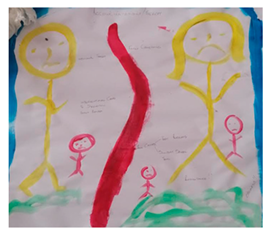 Painting of family household relationships | Enabled the expression of spiritual life, emotional bonds, and family unity. One participant painted hands holding each other to represent support. Another painted family members with a line down the middle, showcasing a broken household. Another painted ‘the change they would like to see’ within their family relations. These artworks offered credible emotional insight. | The paintings provided an opportunity to gain insight into understanding family functioning, with relevance to low-resource contexts where emotion often goes unspoken or ignored. Families were able to relate to one another in terms of hardship (i.e., abuse, neglect), relationships (between parents and parent-child), and communication (for instance, between siblings). “This was actually a therapeutic activity…” (Participant 4) | Emotionally powerful and visually resonant, particularly when showcased with narratives and annotations. For instance, each participant was able to voice their story while the others listened and were able to view their painting. | Provided a non-verbal outlet for reflection; for instance, painting about challenges and trauma was sensitive and self-directed. Participants retained control of meaning and sharing, and thus opted in voluntarily, promoting psychological safety and ethical practice. |
| LEGO® |  LEGO® interpretation of familial dynamics | Facilitated the construction of household 3D models and shared spaces. Participants’ verbal accounts of their builds revealed power dynamics, roles, and cooperation within families. Through this method, participants were able to externalize relationships and spaces. The act of building supported deeper reflection. “This LEGO® actually made me realize something that I didn’t acknowledge before.” (Participant 5) | Translated abstract family dynamics into visible, modifiable models, which were useful for understanding tensions, aspirations, and coping mechanisms (or the lack thereof) in family life. Common themes such as divorce, abuse, love and respect were heard across both Cape Town and Saldanha Bay Municipality area, ultimately indicating generalizability. “This exercise is to understand how we’re going to get people to think about things differently.” (Participant 6) | This approach was visually communicable among the participants. The models helped explain family structures and routines during dissemination to practitioners and community members. For example, one participant spoke about her house being a home for everyone besides herself and her immediate family. Once this comment was made, additional participants joined the conversation and shared similar sentiments. This ultimately indicates the relatability of the scenarios built with the LEGO® blocks. “These kinds of conversations are very important to stimulate the thinking beyond just our own narrow feelings or psyche.” (Participant 6) | Provided participants with an opportunity to express meaning through creation. This allowed participants to ‘play’ in a safe space using their hands, promoting ethical inclusivity and engagement. “You need to give the child something to play with that also stimulates and challenges their creative thinking.” (Participant 7) |
| I-Poems |  Adolescent I-poem | This approach was constructed directly from interview transcripts, preserving voice, cadence, and emotion. Offered a trustworthy representation of participants’ internal worlds and family relationships. Additionally, the I-poems were shared among the participants to view their read and ‘see’ their lived realities. “This poem, It makes me realize what I have achieved up till now.” (Participant 8) | The I-poems exposed emotional layers (such as hope, fear, respect, responsibility, and care) that often remained unspoken in standard interviews. Participants were able to view their life story in a manner that has never been captured through a poem format before. | The I-poems were lyrical and emotionally resonant, and particularly effective for the participant from which the poem was derived. “Wow, it’s like, when I read it, it’s like…is it really? Is it my life? Is it really me? It overwhelmed me. This poem, it’s like I saw myself in this poem. The life I’m living for my family [crying]. When I spoke about it, it didn’t feel so tough, but when I read it felt like [deep sigh of relief]” (Participant 5) | Participants’ words were used verbatim, maintaining authenticity. Poems were shared with participants for review and consent, respecting voice and ownership. “This helps us understand families, what they do… it’s complex work.” (Participant 9) |
Disclaimer/Publisher’s Note: The statements, opinions and data contained in all publications are solely those of the individual author(s) and contributor(s) and not of MDPI and/or the editor(s). MDPI and/or the editor(s) disclaim responsibility for any injury to people or property resulting from any ideas, methods, instructions or products referred to in the content. |
© 2026 by the authors. Licensee MDPI, Basel, Switzerland. This article is an open access article distributed under the terms and conditions of the Creative Commons Attribution (CC BY) license.
Share and Cite
Reid, J.; Johannes, C.; Wareley, S.; Ngadhi, C.; Nginase, A.; Demetriou, K.; Roman, N.V. Methodologies of Care: A Multimodal, Participatory Research Approach with Vulnerable Families Among South African Communities. Methods Protoc. 2026, 9, 11. https://doi.org/10.3390/mps9010011
Reid J, Johannes C, Wareley S, Ngadhi C, Nginase A, Demetriou K, Roman NV. Methodologies of Care: A Multimodal, Participatory Research Approach with Vulnerable Families Among South African Communities. Methods and Protocols. 2026; 9(1):11. https://doi.org/10.3390/mps9010011
Chicago/Turabian StyleReid, James, Chanté Johannes, Shenaaz Wareley, Collen Ngadhi, Avukonke Nginase, Katerina Demetriou, and Nicolette V. Roman. 2026. "Methodologies of Care: A Multimodal, Participatory Research Approach with Vulnerable Families Among South African Communities" Methods and Protocols 9, no. 1: 11. https://doi.org/10.3390/mps9010011
APA StyleReid, J., Johannes, C., Wareley, S., Ngadhi, C., Nginase, A., Demetriou, K., & Roman, N. V. (2026). Methodologies of Care: A Multimodal, Participatory Research Approach with Vulnerable Families Among South African Communities. Methods and Protocols, 9(1), 11. https://doi.org/10.3390/mps9010011