Review

A Brief History of Single-Particle Tracking of the Epidermal Growth Factor Receptor

by
David T. Clarke
and
Marisa L. Martin-Fernandez
*
STFC Central Laser Facility, Research Complex at Harwell, Rutherford Appleton Laboratory, Didcot OX11 0QX, UK
*
Author to whom correspondence should be addressed.
Methods Protoc. 2019, 2(1), 12; https://doi.org/10.3390/mps2010012
Submission received: 16 November 2018 / Revised: 21 January 2019 / Accepted: 21 January 2019 / Published: 30 January 2019
(This article belongs to the Special Issue Single-Molecule Techniques)

Abstract

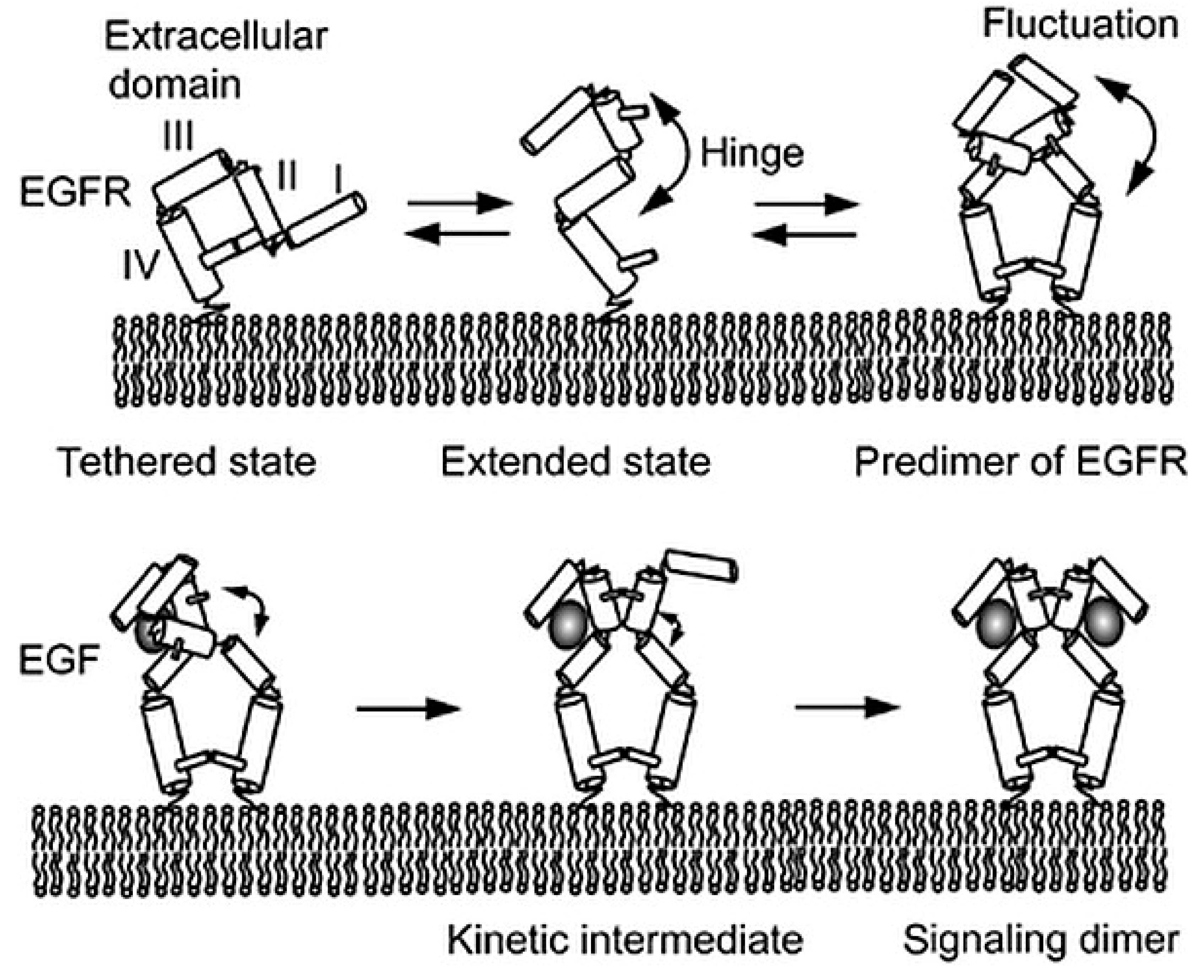
Single-particle tracking (SPT) has been used and developed over the last 25 years as a method to investigate molecular dynamics, structure, interactions, and function in the cellular context. SPT is able to show how fast and how far individual molecules move, identify different dynamic populations, measure the duration and strength of intermolecular interactions, and map out structures on the nanoscale in cells. In combination with other techniques such as macromolecular crystallography and molecular dynamics simulation, it allows us to build models of complex structures, and develop and test hypotheses of how these complexes perform their biological roles in health as well as in disease states. Here, we use the example of the epidermal growth factor receptor (EGFR), which has been studied extensively by SPT, demonstrating how the method has been used to increase our understanding of the receptor’s organization and function, including its interaction with the plasma membrane, its activation, clustering, and oligomerization, and the role of other receptors and endocytosis. The examples shown demonstrate how SPT might be employed in the investigation of other biomolecules and systems.
Keywords: single molecule tracking; epidermal growth factor receptor; cell signaling; protein–membrane interactions; oligomerization; endocytosis single molecule tracking; epidermal growth factor receptor; cell signaling; protein–membrane interactions; oligomerization; endocytosis