
Measuring Nuclear Democracy: A Large-Scale Analysis of German Nuclear Energy Discourse

Abstract
1. Introduction
2. Materials and Methods
2.1. Historical Material
2.2. Preprocessing
2.3. Stance Classification
2.3.1. Manual Annotation of Stance
2.3.2. Automatic Classification of Stance
2.4. Framing Analysis
2.4.1. Conceptualization of Framing Categories
- Alternatives: Sources of energy other than nuclear fission. In earlier texts mostly coal, later renewables.
- Costs: Costs of building and maintaining nuclear infrastructure and prices for nuclear energy.
- Environment: Effects of nuclear energy on the environment, for example through radiation or the avoidance of emissions.
- Innovation: Research and innovation in the realm of nuclear technology.
- Reactor safety: Safety of nuclear reactors for humans and the environment.
- Reliability: Reliability of nuclear fission as an energy source.
- Waste: Handling and depositing of nuclear waste.
- Weapons: Military applications of nuclear technology.
- Atomausstieg (nuclear phase-out): The phase-out of nuclear energy, both in Germany or any other jurisdiction.
- Economic effects: Effects of nuclear energy on the economy, especially on economic growth and unemployment.
- International relations: Diplomacy, international organizations, and international cooperation on questions of nuclear technology.
- Protest: Public protest against nuclear technology or its application.
- Uranium: Mining, trading, and processing of uranium.
2.4.2. Manual Framing Annotation
2.4.3. Automatic Annotation of Issue Frames
2.5. Large Scale Prediction of Issue Frames
3. Results
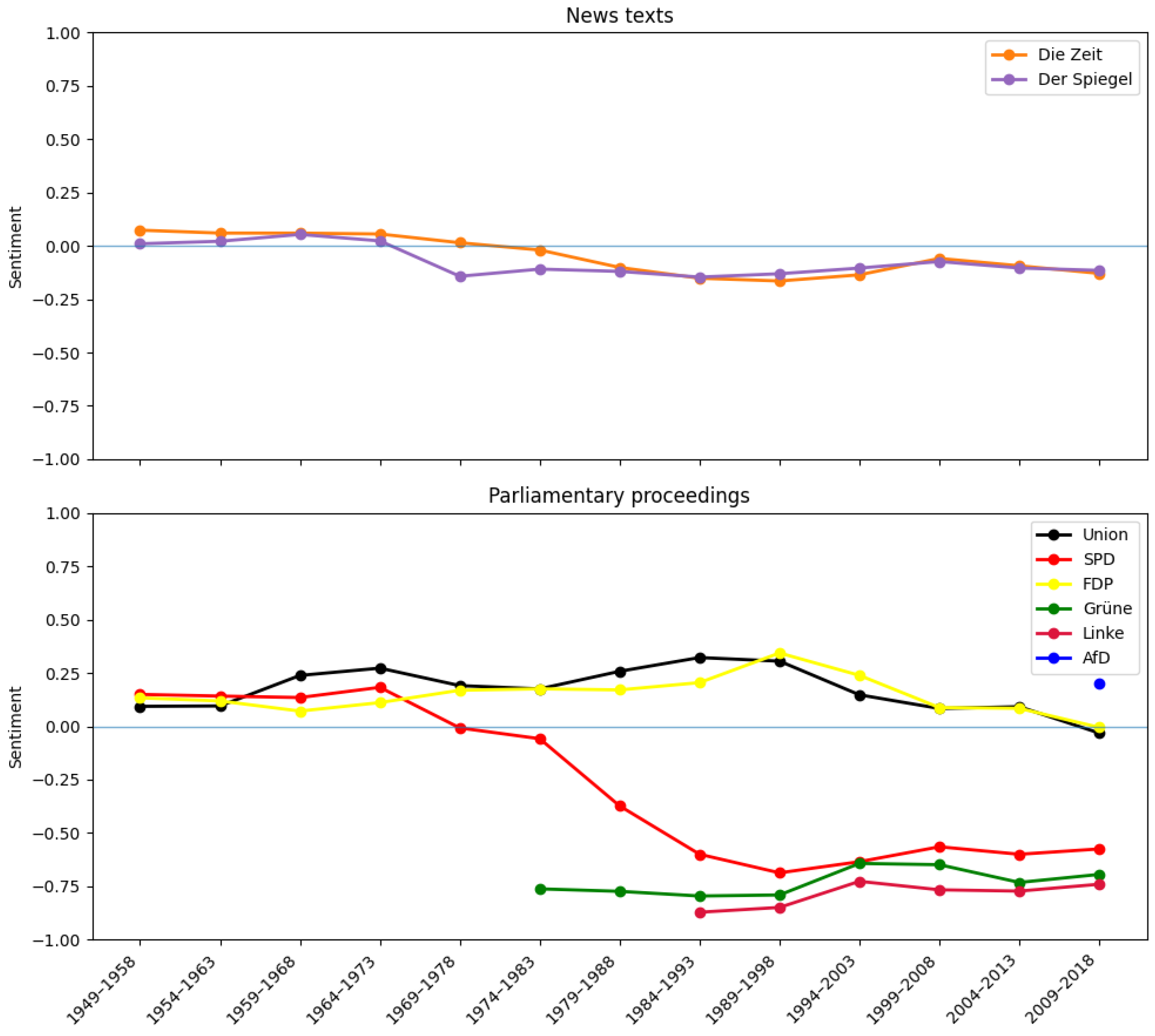
3.1. Stances
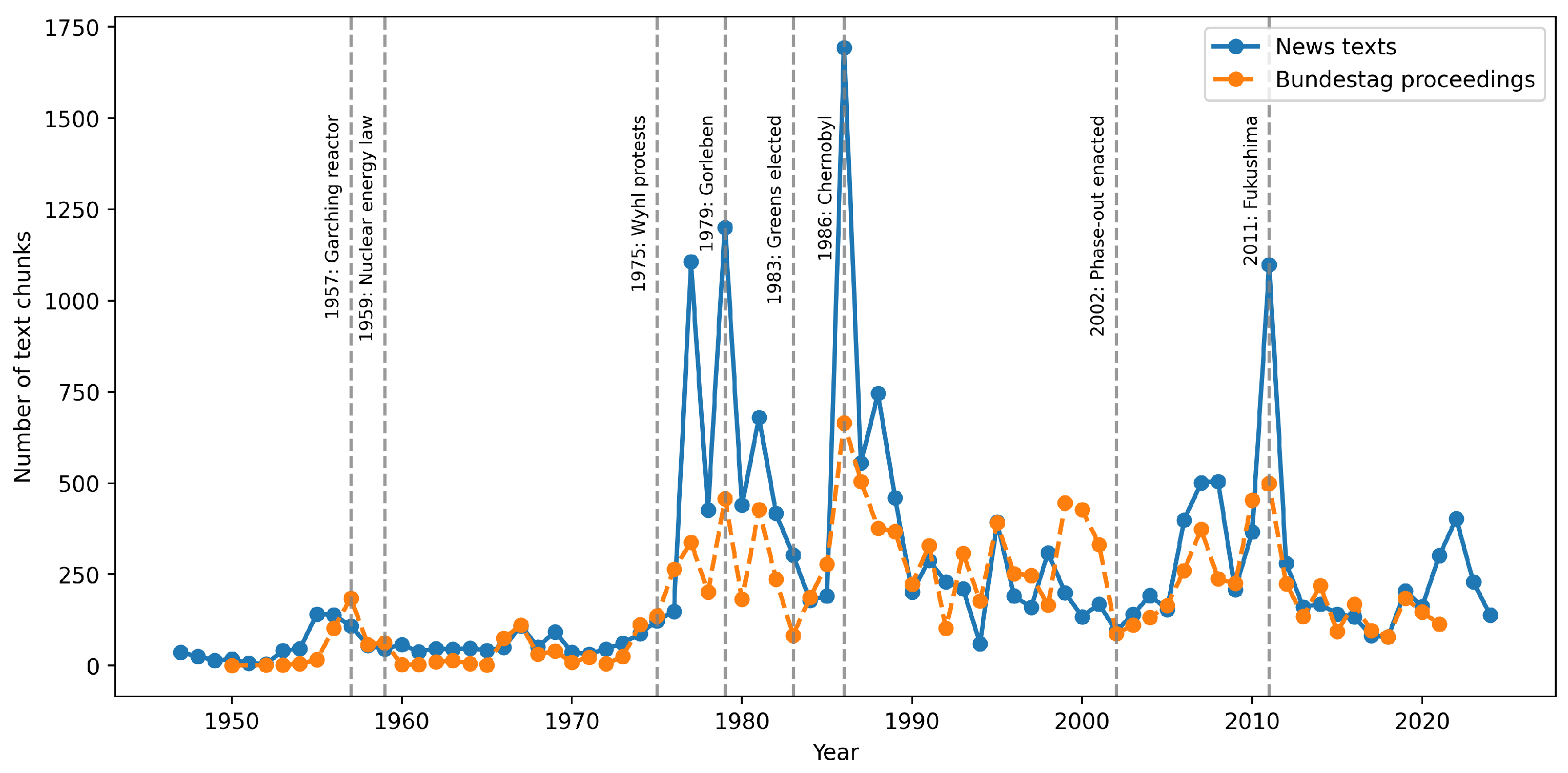
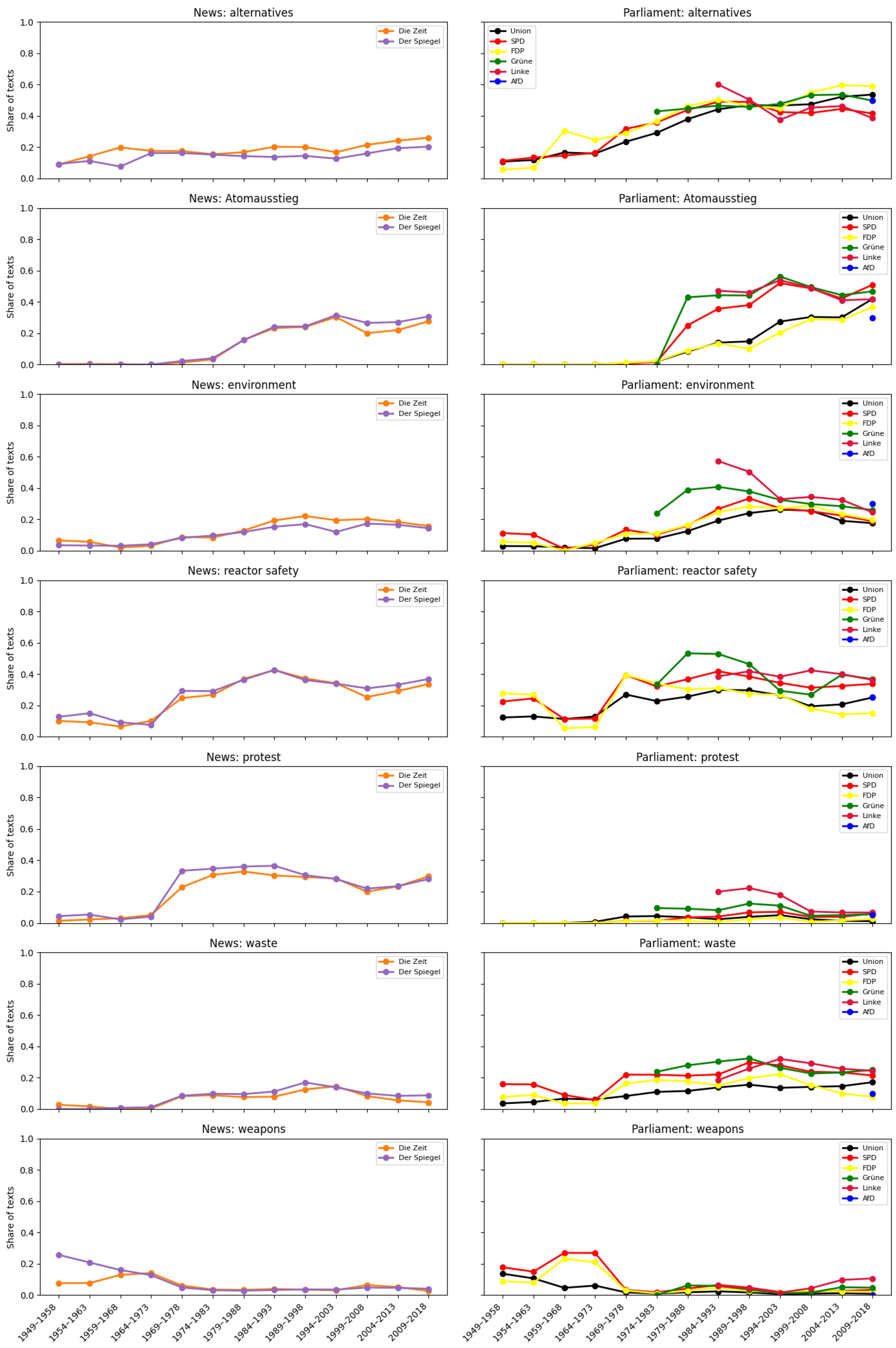
3.2. Frames
3.3. Interpretation
4. Discussion
4.1. Limitations
4.2. Future Work
Author Contributions
Funding
Data Availability Statement
Conflicts of Interest
References
- Agyemang, Jasmin. 2024. “Wer gegen Atomkraft ist, ist gegen Klimaschutz”: Eine Argumentationsanalyse der Debatte zur Laufzeitverlängerung der Atomkraft im deutschen Bundestag. In Exploring Eco-Discourses. Perspektiven - Ansätze - Methoden. Edited by Johanna Freudenberg, Lisa Rhein and Niklas Simon. Darmstadt: Universitäts- und Landesbibliothek Darmstadt, pp. 8–36. [Google Scholar] [CrossRef]
- Alturayeif, Nora, Hamzah Luqman, and Moataz Ahmed. 2023. A systematic review of machine learning techniques for stance detection and its applications. Neural Computing and Applications 35: 5113–44. [Google Scholar] [CrossRef]
- Amri-Henkel, Andrea. 2021. Die Energiewende im Bundestag: Ein politisches Transformationsprojekt?: Eine Diskursanalyse aus feministischer und sozial-ökologischer Perspektive. In Die Energiewende im Bundestag: Ein politisches Transformationsprojekt? Bielefeld: Transcript Verlag. [Google Scholar]
- Antoniak, Maria, Anjalie Field, Jimin Mun, Melanie Walsh, Lauren Klein, and Maarten Sap. 2023. Riveter: Measuring power and social dynamics between entities. In Proceedings of the 61st Annual Meeting of the Association for Computational Linguistics (Volume 3: System Demonstrations). Toronto: Association for Computational Linguistics, pp. 377–88. [Google Scholar]
- Balahur, Alexandra, Zornitsa Kozareva, and Andrés Montoyo. 2009. Determining the Polarity and Source of Opinions Expressed in Political Debates. In Computational Linguistics and Intelligent Text Processing. Edited by Alexander Gelbukh. Berlin/Heidelberg: Springer, pp. 468–80. [Google Scholar] [CrossRef]
- Bateson, Gregory. 1955. A theory of play and fantasy; a report on theoretical aspects of the project of study of the role of the paradoxes of abstraction in communication. Psychiatric Research Reports 1: 39–51. [Google Scholar]
- Bateson, Gregory. 1972. A Theory of Play and Fantasy. In Steps to an Ecology of the Mind. New York: Ballantine Books, pp. 177–93. [Google Scholar]
- Blaette, Andreas, Julia Rakers, and Christoph Leonhardt. 2022. How GermaParl Evolves: Improving Data Quality by Reproducible Corpus Preparation and User Involvement. In Proceedings of the Workshop ParlaCLARIN III Within the 13th Language Resources and Evaluation Conference. Edited by Darja Fišer, Maria Eskevich, Jakob Lenardič and Franciska de Jong. Marseille: European Language Resources Association, pp. 7–15. [Google Scholar]
- Blätte, Andreas, and Andre Blessing. 2018. The GermaParl Corpus of Parliamentary Protocols. In Proceedings of the Eleventh International Conference on Language Resources and Evaluation (LREC 2018). Edited by Nicoletta Calzolari, Khalid Choukri, Christopher Cieri, Thierry Declerck, Sara Goggi, Koiti Hasida, Hitoshi Isahara, Bente Maegaard, Joseph Mariani, Hélène Mazo and et al. Miyazaki: European Language Resources Association (ELRA). [Google Scholar]
- Boydstun, Amber E., Dallas Card, Justin H. Gross, Philip Resnik, and Noah A. Smith. 2014. Tracking the development of media frames within and across policy issues. In APSA 2014 Annual Meeting Paper. Washington, DC: APSA, pp. 1–25. [Google Scholar]
- Burscher, Björn, Daan Odijk, Rens Vliegenthart, Maarten de Rijke, and Claes H. de Vreese. 2014. Teaching the Computer to Code Frames in News: Comparing Two Supervised Machine Learning Approaches to Frame Analysis. Communication Methods and Measures 8: 190–206. [Google Scholar] [CrossRef]
- Card, Dallas, Amber Boydstun, Justin H. Gross, Philip Resnik, and Noah A. Smith. 2015. The media frames corpus: Annotations of frames across issues. In Proceedings of the 53rd Annual Meeting of the Association for Computational Linguistics and the 7th International Joint Conference on Natural Language Processing (Volume 2: Short Papers). Beijing: Association for Computational Linguistics, pp. 438–44. [Google Scholar]
- Card, Dallas, Serina Chang, Chris Becker, Julia Mendelsohn, Rob Voigt, Leah Boustan, Ran Abramitzky, and Dan Jurafsky. 2022. Computational analysis of 140 years of us political speeches reveals more positive but increasingly polarized framing of immigration. Proceedings of the National Academy of Sciences of the United States of America 119: e2120510119. [Google Scholar] [CrossRef]
- Cherukuri, Komala Subramanyam, Pranav Abishai Moses, Aisa Sakata, Jiangping Chen, and Haihua Chen. 2025. Large Language Models for Oral History Understanding with Text Classification and Sentiment Analysis. arXiv arXiv:2508.06729. [Google Scholar] [CrossRef]
- Cohen, Jacob. 1960. A Coefficient of Agreement for Nominal Scales. Educational and Psychological Measurement 20: 37–46. [Google Scholar] [CrossRef]
- Cruickshank, Iain J., and Lynnette Hui Xian Ng. 2024. Prompting and Fine-Tuning Open-Sourced Large Language Models for Stance Classification. arXiv arXiv:2309.13734. [Google Scholar] [CrossRef]
- DiMaggio, Paul, Manish Nag, and David Blei. 2013. Exploiting affinities between topic modeling and the sociological perspective on culture: Application to newspaper coverage of U.S. government arts funding. Poetics 41: 570–606. [Google Scholar] [CrossRef]
- Du Bois, John W. 2007. The stance triangle. In Stancetaking in Discourse: Subjectivity, Evaluation, Interaction. Pragmatics & Beyond New Series. Amsterdam: John Benjamins Publishing Company, pp. 139–82. [Google Scholar] [CrossRef]
- Entman, Robert M. 1993. Framing: Toward Clarification of a Fractured Paradigm. Journal of Communication 43: 51–58. [Google Scholar] [CrossRef]
- Feinstein, Alvan R., and Domenic V. Cicchetti. 1990. High agreement but low Kappa: I. the problems of two paradoxes. Journal of Clinical Epidemiology 43: 543–49. [Google Scholar] [CrossRef]
- Field, Anjalie, and Yulia Tsvetkov. 2019. Entity-centric contextual affective analysis. In Proceedings of the 57th Annual Meeting of the Association for Computational Linguistics. Florence: Association for Computational Linguistics, pp. 2550–60. [Google Scholar]
- Gantner, Manuela. 2023. Das “friedliche Atom” als Narrativ in Politik, Wissenschaft und Design. Ikonografie eines Diskurses zwischen 1953 und 1978. Karlsruhe: KIT Scientific Publishing. [Google Scholar] [CrossRef]
- Gleitsmann, Rolf-Jürgen. 2011. Der Vision atomtechnischer Verheißungen gefolgt: Von der Euphorie zu ersten Protesten—Die zivile Nutzung der Kernkraft in Deutschland seit den 1950er Jahren. Journal of New Frontiers in Spatial Concepts 3: 17–26. [Google Scholar] [CrossRef]
- Goffman, Erving. 1974. Frame Analysis: An Essay on the Organization of Experience. Cambridge: Harvard University Press, pp. ix, 586. [Google Scholar]
- Gwet, Kilem L. 2014. Handbook of Inter-Rater Reliability, 4th Edition: The Definitive Guide to Measuring the Extent of Agreement Among Raters. Columbus: Advanced Analytics, LLC. [Google Scholar]
- Hamborg, Felix, Karsten Donnay, and Bela Gipp. 2019. Automated identification of media bias in news articles: An interdisciplinary literature review. International Journal on Digital Libraries 20: 391–415. [Google Scholar] [CrossRef]
- Hartmann, Mareike, Tallulah Jansen, Isabelle Augenstein, and Anders Søgaard. 2019. Issue framing in online discussion fora. In Proceedings of the 2019 Conference of the North American Chapter of the Association for Computational Linguistics: Human Language Technologies, Volume 1 (Long and Short Papers). Edited by Jill Burstein, Christy Doran and Thamar Solorio. Minneapolis: Association for Computational Linguistics, pp. 1401–7. [Google Scholar] [CrossRef]
- Hasan, Kazi Saidul, and Vincent Ng. 2013. Stance Classification of Ideological Debates: Data, Models, Features, and Constraints. In Proceedings of the Sixth International Joint Conference on Natural Language Processing. Edited by Ruslan Mitkov and Jong C. Park. Nagoya: Asian Federation of Natural Language Processing, pp. 1348–56. [Google Scholar]
- Hofmann, Valentin, Xiaowen Dong, Janet Pierrehumbert, and Hinrich Schuetze. 2022. Modeling ideological salience and framing in polarized online groups with graph neural networks and structured sparsity. In Findings of the Association for Computational Linguistics: NAACL 2022. Seattle: Association for Computational Linguistics, pp. 536–50. [Google Scholar]
- Jing, Elise, and Yong-Yeol Ahn. 2021. Characterizing partisan political narrative frameworks about COVID-19 on twitter. EPJ Data Science 10: 53. [Google Scholar] [CrossRef]
- Jordan, Katrin. 2018. Ausgestrahlt: Die mediale Debatte um “Tschernobyl” in der Bundesrepublik und in Frankreich 1986/87. Medien und Gesellschaftswandel im 20. Jahrhundert. Göttingen: Wallstein Verlag. [Google Scholar]
- Jung, Matthias. 2013. Öffentlichkeit und Sprachwandel: Zur Geschichte des Diskurses über die Atomenergie. Berlin/Heidelberg: Springer. [Google Scholar]
- Jurkschat, Lena, Gregor Wiedemann, Maximilian Heinrich, Mattes Ruckdeschel, and Sunna Torge. 2022. Few-Shot Learning for Argument Aspects of the Nuclear Energy Debate. In Proceedings of the Thirteenth Language Resources and Evaluation Conference. Edited by Nicoletta Calzolari, Frédéric Béchet, Philippe Blache, Khalid Choukri, Christopher Cieri, Thierry Declerck, Sara Goggi, Hitoshi Isahara, Bente Maegaard, Joseph Mariani and et al. Marseille: European Language Resources Association, pp. 663–72. [Google Scholar]
- Kirchhof, Astrid Mignon. 2014. Spanning the Globe: West-German Support for the Australian Anti-Nuclear Movement. Historical Social Research/Historische Sozialforschung 39: 254–73. [Google Scholar]
- Klamm, Christopher, Ines Rehbein, and Simone Paolo Ponzetto. 2022. Frameast: A framework for second-level agenda setting in parliamentary debates through the lense of comparative agenda topics. In Proceedings of the Workshop ParlaCLARIN III Within the 13th Language Resources and Evaluation Conference. Marseille: European Language Resources Association, pp. 92–100. [Google Scholar]
- Kliment, Tibor. 1994. Kernkraftprotest und Medienreaktionen. Wiesbaden: Deutscher Universitätsverlag. [Google Scholar] [CrossRef]
- Kupietz, Marc, Harald Lüngen, Paweł Kamocki, and Andreas Witt. 2018. The German Reference Corpus DeReKo: New Developments—New Opportunities. In Proceedings of the Eleventh International Conference on Language Resources and Evaluation (LREC 2018). Edited by Nicoletta Calzolari, Khalid Choukri, Christopher Cieri, Thierry Declerck, Sara Goggi, Koiti Hasida, Hitoshi Isahara, Bente Maegaard, Joseph Mariani, Hélène Mazo and et al. Miyazaki: European Language Resources Association (ELRA). [Google Scholar]
- Küçük, Dilek, and Fazli Can. 2020. Stance Detection: A Survey. ACM Computing Surveys 53: 12:1–12:37. [Google Scholar] [CrossRef]
- Kwak, Haewoon, Jisun An, Elise Jing, and Yong-Yeol Ahn. 2021. Frameaxis: Characterizing microframe bias and intensity with word embedding. PeerJ Computer Science 7: e644. [Google Scholar] [CrossRef]
- Landis, J. Richard, and Gary G. Koch. 1977. The Measurement of Observer Agreement for Categorical Data. Biometrics 33: 159–74. [Google Scholar] [CrossRef]
- Lepsius, Oliver. 2025. Wandel der Protest-Kultur und “Brokdorf-Beschluss”. In Handbuch Bundesverfassungsgericht im Politischen System. Edited by Robert Chr. van Ooyen and Martin H. W. Möllers. Wiesbaden: Springer Fachmedien, pp. 539–61. [Google Scholar] [CrossRef]
- Lorenz, Robert. 2011. Protest der Physiker: Die »Göttinger Erklärung« von 1957 (1 ed.), Volume 3 of Studien des Göttinger Instituts für Demokratieforschung zur Geschichte politischer und gesellschaftlicher Kontroversen. Bielefeld: Transcript Verlag. [Google Scholar] [CrossRef]
- Luo, Yiwei, Kristina Gligorić, and Dan Jurafsky. 2024. Othering and low status framing of immigrant cuisines in us restaurant reviews and large language models. In Proceedings of the International AAAI Conference on Web and Social Media. Washington, DC: AAAI Press, vol. 18, pp. 985–98. [Google Scholar]
- Mendelsohn, Julia, and Ceren Budak. 2025. When people are floods: Analyzing dehumanizing metaphors in immigration discourse with large language models. In Proceedings of the 63rd Annual Meeting of the Association for Computational Linguistics (Volume 1: Long Papers). Vienna: Association for Computational Linguistics, pp. 8079–103. [Google Scholar]
- Mendelsohn, Julia, Yulia Tsvetkov, and Dan Jurafsky. 2020. A framework for the computational linguistic analysis of dehumanization. Frontiers in Artificial Intelligence 3: 55. [Google Scholar] [CrossRef]
- Meyer, Teva. 2024. Bordering Nuclearity: Very Low-level Radioactive Wastes’ Clearance and the Production of Spatial Nuclearities in Germany. Historical Social Reserach 49: 227–45. [Google Scholar]
- Mohammed Afzal, Osama, and Preslav Nakov. 2023. Team TheSyllogist at SemEval-2023 Task 3: Language-Agnostic Framing Detection in Multi-Lingual Online News: A Zero-Shot Transfer Approach. In Proceedings of the 17th International Workshop on Semantic Evaluation (SemEval-2023). Edited by Atul Kr. Ojha, A. Seza Doğruöz, Giovanni Da San Martino, Harish Tayyar Madabushi, Ritesh Kumar and Elisa Sartori. Toronto: Association for Computational Linguistics, pp. 2058–61. [Google Scholar] [CrossRef]
- Nguyen, Viet-An, Jordan Boyd-Graber, Philip Resnik, and Kristina Miler. 2015. Tea Party in the House: A Hierarchical Ideal Point Topic Model and Its Application to Republican Legislators in the 112th Congress. In Proceedings of the 53rd Annual Meeting of the Association for Computational Linguistics and the 7th International Joint Conference on Natural Language Processing (Volume 1: Long Papers). Edited by Chengqing Zong and Michael Strube. Beijing: Association for Computational Linguistics, pp. 1438–48. [Google Scholar] [CrossRef]
- Ogawa, Akihiro. 2023. Antinuclear Citizens: Sustainability Policy and Grassroots Activism in Post-Fukushima Japan. Anthropology of Policy. Stanford: Stanford University Press. [Google Scholar]
- Opp, Karl-Dieter, and Wolfgang Roehl. 1990. Der Tschernobyl-Effekt. Wiesbaden: VS Verlag für Sozialwissenschaften. [Google Scholar] [CrossRef]
- Otmakhova, Yulia, and Lea Frermann. 2025. Narrative Media Framing in Political Discourse. In Findings of the Association for Computational Linguistics: ACL 2025. Edited by Wanxiang Che, Joyce Nabende, Ekaterina Shutova and Mohammad Taher Pilehvar. Vienna: Association for Computational Linguistics, pp. 9167–96. [Google Scholar] [CrossRef]
- Otmakhova, Yulia, Shima Khanehzar, and Lea Frermann. 2024. Media Framing: A typology and Survey of Computational Approaches Across Disciplines. In Proceedings of the 62nd Annual Meeting of the Association for Computational Linguistics (Volume 1: Long Papers). Bangkok: Association for Computational Linguistics, pp. 15407–28. [Google Scholar] [CrossRef]
- Piskorski, Jakub, Nicolas Stefanovitch, Giovanni Da San Martino, and Preslav Nakov. 2023. Semeval-2023 task 3: Detecting the category, the framing, and the persuasion techniques in online news in a multi-lingual setup. In Proceedings of the 17th International Workshop on Semantic Evaluation (SemEval-2023). Toronto: Association for Computational Linguistics, pp. 2343–61. [Google Scholar]
- Rashkin, Hannah, Sameer Singh, and Yejin Choi. 2016. Connotation frames: A data-driven investigation. In Proceedings of the 54th Annual Meeting of the Association for Computational Linguistics (Volume 1: Long Papers). Berlin: Association for Computational Linguistics, pp. 311–21. [Google Scholar]
- Rauh, Christian, and Jan Schwalbach. 2020. The ParlSpeech V2 Data Set: Full-Text Corpora of 6.3 Million Parliamentary Speeches in the Key Legislative Chambers of Nine Representative Democracies. Harvard Dataverse. [Google Scholar] [CrossRef]
- Reiter-Haas, Markus, Alexander Ertl, Kevin Innerhofer, and Elisabeth Lex. 2023. mCPT at SemEval-2023 Task 3: Multilingual Label-Aware Contrastive Pre-Training of Transformers for Few- and Zero-shot Framing Detection. In Proceedings of the 17th International Workshop on Semantic Evaluation (SemEval-2023). Edited by Atul Kr. Ojha, A. Seza Doğruöz, Giovanni Da San Martino, Harish Tayyar Madabushi, Ritesh Kumar and Elisa Sartori. Toronto: Association for Computational Linguistics, pp. 941–49. [Google Scholar] [CrossRef]
- Richter, Florian, Philipp Koch, Oliver Franke, Jakob Kraus, Lukas Warode, Fabrizio Kuruc, Stella Heine, and Konstantin Schöps. 2023. Open Discourse: Towards the first fully Comprehensive and Annotated Corpus of the Parliamentary Protocols of the German Bundestag. Harvard Dataverse. [Google Scholar] [CrossRef]
- Roose, Jochen. 2010. Der endlose Streit um die Atomenergie. Konfliktsoziologische Untersuchung einer dauerhaften Auseinandersetzung. In Umwelt- und Technikkonflikte. Edited by Peter H. Feindt and Thomas Saretzki. Wiesbaden: VS Verlag für Sozialwissenschaften, pp. 79–103. [Google Scholar] [CrossRef]
- Sagi, Eyal, Daniel Diermeier, and Stefan Kaufmann. 2013. Identifying issue frames in text. PLoS ONE 8: e69185. [Google Scholar] [CrossRef]
- Sap, Maarten, Marcella Cindy Prasettio, Ari Holtzman, Hannah Rashkin, and Yejin Choi. 2017. Connotation frames of power and agency in modern films. In Proceedings of the 2017 Conference on Empirical Methods in Natural Language Processing. Copenhagen: Association for Computational Linguistics, pp. 2329–34. [Google Scholar]
- Sobhani, Parinaz, Diana Inkpen, and Xiaodan Zhu. 2017. A Dataset for Multi-Target Stance Detection. In Proceedings of the 15th Conference of the European Chapter of the Association for Computational Linguistics: Volume 2, Short Papers. Edited by Mirella Lapata, Phil Blunsom and Alexander Koller. Valencia: Association for Computational Linguistics, pp. 551–57. [Google Scholar]
- Staas, Christian. 2021. Die ZEIT und die NS-Zeit. Die Zeit, May 6, pp. 16–17.
- Stammbach, Dominik, Maria Antoniak, and Elliott Ash. 2022. Heroes, villains, and victims, and gpt-3: Automated extraction of character roles without training data. In Proceedings of the 4th Workshop of Narrative Understanding (WNU2022). Seattle: Association for Computational Linguistics, pp. 47–56. [Google Scholar]
- Steinbach, Hannah Mathilde, Imge Yüzüncüoglu, Raluca Rilla, and Manfred Stede. 2025. Heroes, villains, and victims: Character narratives in the WPS agenda of the UNSC. Paper presented at the 21st Conference on Natural Language Processing (KONVENS 2025): Workshops, Hildesheim, Germany, September 10–13; pp. 54–73. [Google Scholar]
- Sullivan, Karen. 2023. Three levels of framing. Wiley Interdisciplinary Reviews: Cognitive Science 14: e1651. [Google Scholar] [CrossRef] [PubMed]
- Taulé, Mariona, Maria Antònia Martí, Francisco Manuel Rangel Pardo, Paolo Rosso, Cristina Bosco, and Viviana Patti. 2017. Overview of the Task on Stance and Gender Detection in Tweets on Catalan Independence. Paper presented at the Second Workshop on Evaluation of Human Language Technologies for Iberian Languages (IberEval 2017), Berlin, Germany, September 12. [Google Scholar]
- Thomas, Matt, Bo Pang, and Lillian Lee. 2006. Get out the vote: Determining support or opposition from Congressional floor-debate transcripts. In Proceedings of the 2006 Conference on Empirical Methods in Natural Language Processing. Edited by Dan Jurafsky and Eric Gaussier. Sydney: Association for Computational Linguistics, pp. 327–35. [Google Scholar]
- Uekötter, Frank. 2022. Atomare Demokratie: Eine Geschichte der Kernenergie in Deutschland. Stuttgart: Franz Steiner Verlag. [Google Scholar]
- Upadhyaya, Apoorva, Wolfgang Nejdl, and Marco Fisichella. 2025. Interpretable zero-shot stance detection with proactive content intervention. Information Processing & Management 62: 104223. [Google Scholar] [CrossRef]
- van den Berg, Esther, Katharina Korfhage, Josef Ruppenhofer, Michael Wiegand, and Katja Markert. 2019. Not my president: How names and titles frame political figures. In Proceedings of the Third Workshop on Natural Language Processing and Computational Social Science. Minneapolis: Association for Computational Linguistics, pp. 1–6. [Google Scholar]
- Walter, Tobias, Celina Kirschner, Steffen Eger, Goran Glavaš, Anne Lauscher, and Simone Paolo Ponzetto. 2021. Diachronic Analysis of German Parliamentary Proceedings: Ideological Shifts through the Lens of Political Biases. Paper presented at the 2021 ACM/IEEE Joint Conference on Digital Libraries (JCDL), Champaign, IL, USA, September 27–30; pp. 51–60. [Google Scholar] [CrossRef]



| Text Chunk | Translation | Annotations | Interpretation |
|---|---|---|---|
| Mit dem Ausstieg aus der Kernenergie würde ein gigantischer Arbeitsplatzverlust einhergehen und auch eine Zunahme des CO2-Ausstoßes wäre zu befürchten. Es ist ein Märchen, zu glauben, dass Kernkraftwerke durch Energieeinsparung oder erneuerbare Energien kompensiert werden können. […] | With the phase-out of nuclear energy, a gigantic loss of jobs would occur, and an increase in CO2 emissions would also have to be feared. It is a myth to believe that nuclear power plants can be compensated for through energy savings or renewable energies. […] | Positive/Positive/Positive | All annotators agreed on the speaker’s positive stance, as indicated by his emphasis on the importance of nuclear plants for the energy supply, the job market, and the environment. |
| Gewalt gegen Sachen und Menschen ist ein Irrweg. Liebe Kolleginnen und Kollegen, gewalttätige Aktionen schaden den Gegnern der Kernenergie. […] | Violence against property and people is a misguided path. Dear colleagues, violent actions harm the opponents of nuclear energy. […] | Neutral/Negative/Negative | Annotators 2 and 3 judged that the speaker’s stance was negative because of his advice to protesters. Annotator 1 felt that the speaker’s own stance on nuclear energy could not be determined with certainty. |
| Welche Antwort haben Sie darauf, wie der Ausstieg aus der Atomenergie ohne den nötigen Netzausbau gelingen kann? Worum geht es hier eigentlich? Wir haben uns – mit breiter Zustimmung in der Bevölkerung – dazu entschieden, als erstes Industrieland aus der Atomenergie auszusteigen […] | What answer do you have to the question of how the phase-out of nuclear energy is supposed to succeed without the necessary expansion of the power grid? What is this really about? We decided—with broad support among the population—to be the first industrialized country to phase out nuclear energy. […] | Neutral/Negative/Positive | The questions raised by the speaker make it difficult to discern his stance on nuclear energy. Annotator 2 suspected that he was opposed to nuclear energy, while Annotator 3 felt that he criticized the mishandled phase-out from a positive stance. Given these uncertainties, a neutral label was ultimately assigned. |
| Bundestag Proceedings | Newspaper Articles | Label Frequency | |
|---|---|---|---|
| stance annotation | 0.62 | 0.66 | 1.00 |
| alternatives | 0.76 | 0.70 | 0.26 |
| Atomausstieg | 0.67 | 0.65 | 0.36 |
| costs | 0.45 | 0.77 | 0.11 |
| economic effects | 0.59 | 0.53 | 0.21 |
| environment | 0.96 | 0.73 | 0.17 |
| innovation | 0.50 | 0.36 | 0.14 |
| international relations | 0.50 | 0.60 | 0.12 |
| protest | 0.75 | 0.78 | 0.10 |
| reactor safety | 0.82 | 0.76 | 0.28 |
| reliability | 0.34 | 0.42 | 0.07 |
| uranium | 0.51 | 0.44 | 0.04 |
| waste | 0.65 | 0.48 | 0.14 |
| weapons | 0.87 | 0.79 | 0.06 |
| Gemma2 27B | GPT-5 | Llama3.1 70B | n | ||||
|---|---|---|---|---|---|---|---|
| Precision | Recall | Precision | Recall | Precision | Recall | ||
| stance annotation | 0.61 | 0.60 | 0.83 | 0.81 | 0.74 | 0.70 | 100 |
| alternatives | 0.84 | 0.87 | 0.94 | 0.95 | 0.81 | 0.74 | 35 |
| Atomausstieg | 0.85 | 0.86 | 0.93 | 0.93 | 0.79 | 0.77 | 42 |
| costs | 0.78 | 0.86 | 0.74 | 0.95 | 0.73 | 0.80 | 9 |
| economic effects | 0.80 | 0.80 | 0.81 | 0.85 | 0.74 | 0.58 | 22 |
| environment | 0.72 | 0.80 | 0.79 | 0.88 | 0.78 | 0.78 | 24 |
| innovation | 0.74 | 0.64 | 0.79 | 0.85 | 0.60 | 0.53 | 13 |
| international relations | 0.75 | 0.90 | 0.73 | 0.89 | 0.80 | 0.82 | 13 |
| protest | 0.55 | 0.91 | 1.00 | 1.00 | 0.75 | 0.99 | 2 |
| reactor safety | 0.79 | 0.88 | 0.84 | 0.94 | 0.72 | 0.72 | 20 |
| reliability | 0.54 | 0.61 | 0.67 | 0.72 | 0.53 | 0.60 | 6 |
| uranium | 1.00 | 1.00 | 0.69 | 0.82 | 0.99 | 0.83 | 3 |
| waste | 0.83 | 0.93 | 0.93 | 0.93 | 0.86 | 0.74 | 16 |
| weapons | 0.88 | 0.99 | 0.93 | 0.99 | 0.99 | 0.92 | 6 |
| Gemma2 27B | GPT-5 | Llama3.1 70B | n | ||||
|---|---|---|---|---|---|---|---|
| Precision | Recall | Precision | Recall | Precision | Recall | ||
| stance annotation | 0.52 | 0.74 | 0.59 | 0.89 | 0.54 | 0.65 | 200 |
| alternatives | 0.75 | 0.84 | 0.87 | 0.94 | 0.75 | 0.78 | 17 |
| Atomausstieg | 0.70 | 0.74 | 0.87 | 0.86 | 0.81 | 0.70 | 29 |
| costs | 0.77 | 0.83 | 0.81 | 0.88 | 0.80 | 0.80 | 11 |
| economic effects | 0.77 | 0.87 | 0.75 | 0.80 | 0.77 | 0.65 | 18 |
| environment | 0.56 | 0.66 | 0.66 | 0.88 | 0.63 | 0.66 | 10 |
| innovation | 0.88 | 0.72 | 0.77 | 0.83 | 0.79 | 0.59 | 11 |
| international relations | 0.69 | 0.88 | 0.70 | 0.92 | 0.73 | 0.75 | 9 |
| protest | 0.67 | 0.82 | 0.83 | 0.86 | 0.68 | 0.70 | 14 |
| reactor safety | 0.87 | 0.89 | 0.88 | 0.91 | 0.80 | 0.76 | 33 |
| reliability | 0.54 | 0.66 | 0.60 | 0.74 | 0.49 | 0.46 | 11 |
| uranium | 0.74 | 0.66 | 0.61 | 0.65 | 0.99 | 0.67 | 3 |
| waste | 0.75 | 0.87 | 0.92 | 0.95 | 0.96 | 0.69 | 13 |
| weapons | 0.81 | 0.90 | 0.88 | 0.99 | 0.86 | 0.74 | 6 |
Disclaimer/Publisher’s Note: The statements, opinions and data contained in all publications are solely those of the individual author(s) and contributor(s) and not of MDPI and/or the editor(s). MDPI and/or the editor(s) disclaim responsibility for any injury to people or property resulting from any ideas, methods, instructions or products referred to in the content. |
© 2026 by the authors. Licensee MDPI, Basel, Switzerland. This article is an open access article distributed under the terms and conditions of the Creative Commons Attribution (CC BY) license.
Share and Cite
Teich, M.; Cypionka, A.; Haider, T.; Rehbein, M. Measuring Nuclear Democracy: A Large-Scale Analysis of German Nuclear Energy Discourse. Histories 2026, 6, 34. https://doi.org/10.3390/histories6020034
Teich M, Cypionka A, Haider T, Rehbein M. Measuring Nuclear Democracy: A Large-Scale Analysis of German Nuclear Energy Discourse. Histories. 2026; 6(2):34. https://doi.org/10.3390/histories6020034
Chicago/Turabian StyleTeich, Maximilian, Arne Cypionka, Thomas Haider, and Malte Rehbein. 2026. "Measuring Nuclear Democracy: A Large-Scale Analysis of German Nuclear Energy Discourse" Histories 6, no. 2: 34. https://doi.org/10.3390/histories6020034
APA StyleTeich, M., Cypionka, A., Haider, T., & Rehbein, M. (2026). Measuring Nuclear Democracy: A Large-Scale Analysis of German Nuclear Energy Discourse. Histories, 6(2), 34. https://doi.org/10.3390/histories6020034