
Electron Density and Effective Atomic Number as Quantitative Biomarkers for Differentiating Malignant Brain Tumors: An Exploratory Study with Machine Learning


 , , , , , , , , , and
  add
Show full author list
add
Show full author list
Simple Summary
Abstract
1. Introduction
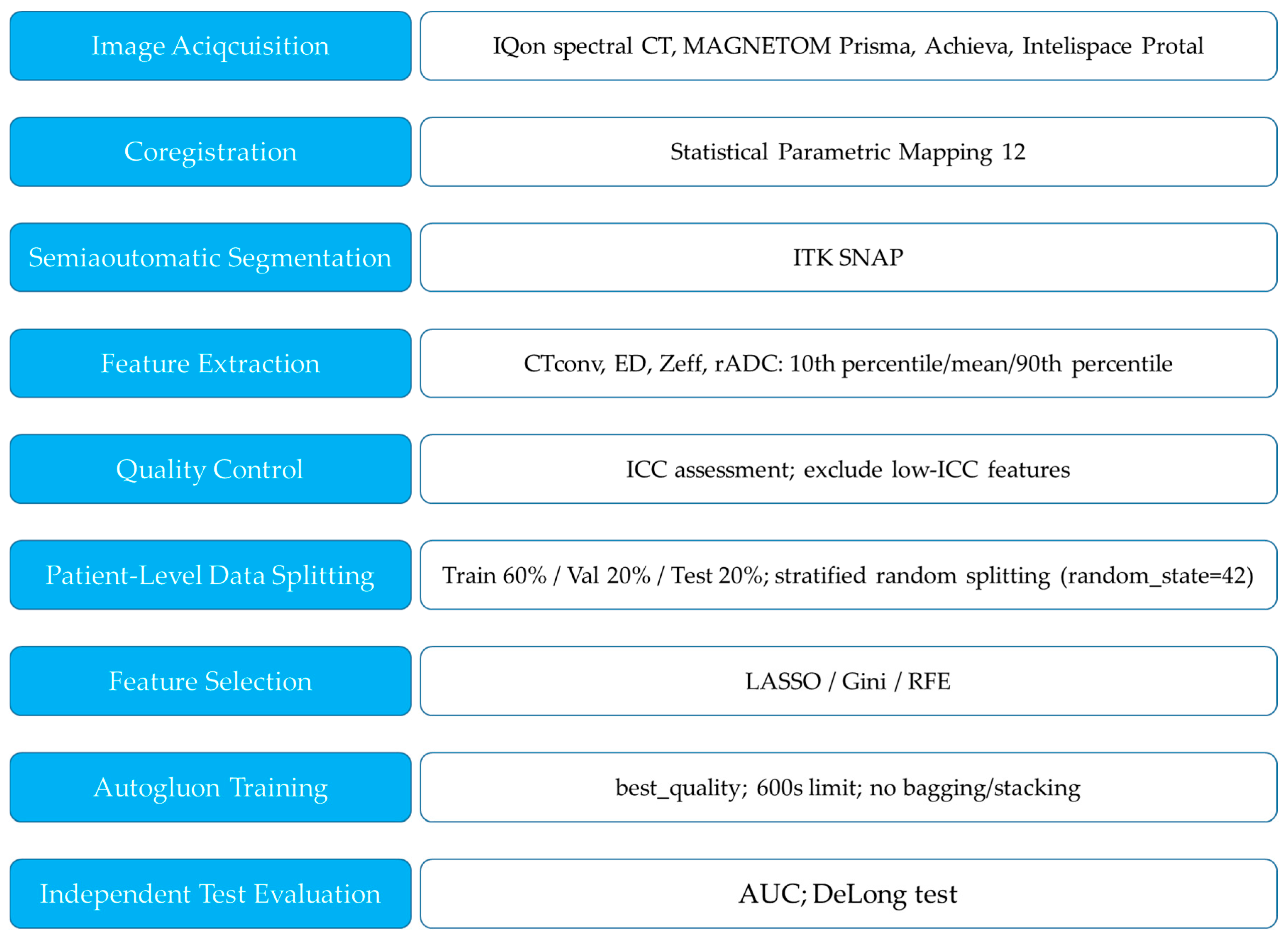
2. Materials and Methods
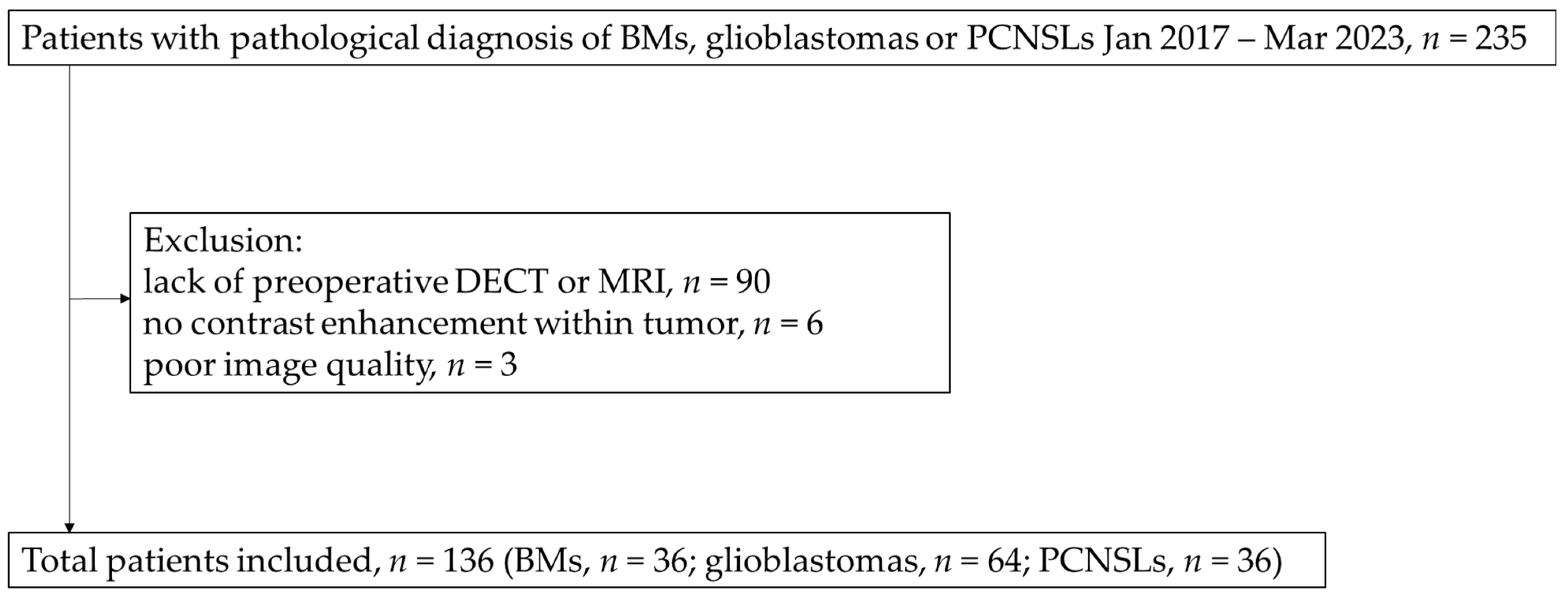
2.1. Study Population
2.2. Image Acquisition
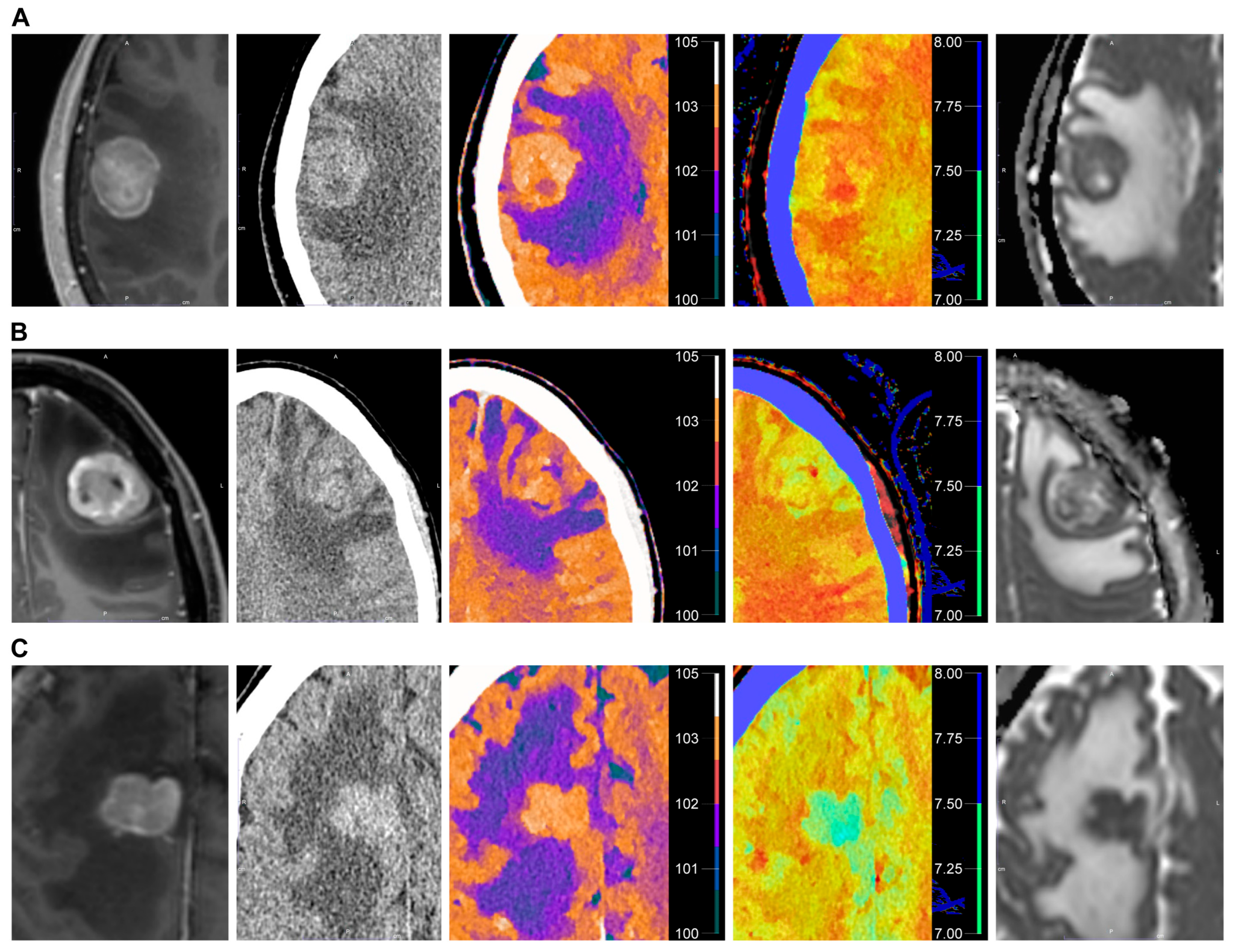
2.3. Image Analysis
2.4. ML Analysis
2.4.1. Computational Environment
2.4.2. Data Splitting Strategy
2.4.3. Feature Selection and Training
2.4.4. Independent Test Evaluation
2.5. Statistical Analysis
3. Results
3.1. Patient Characteristics
3.2. Interobserver Agreement
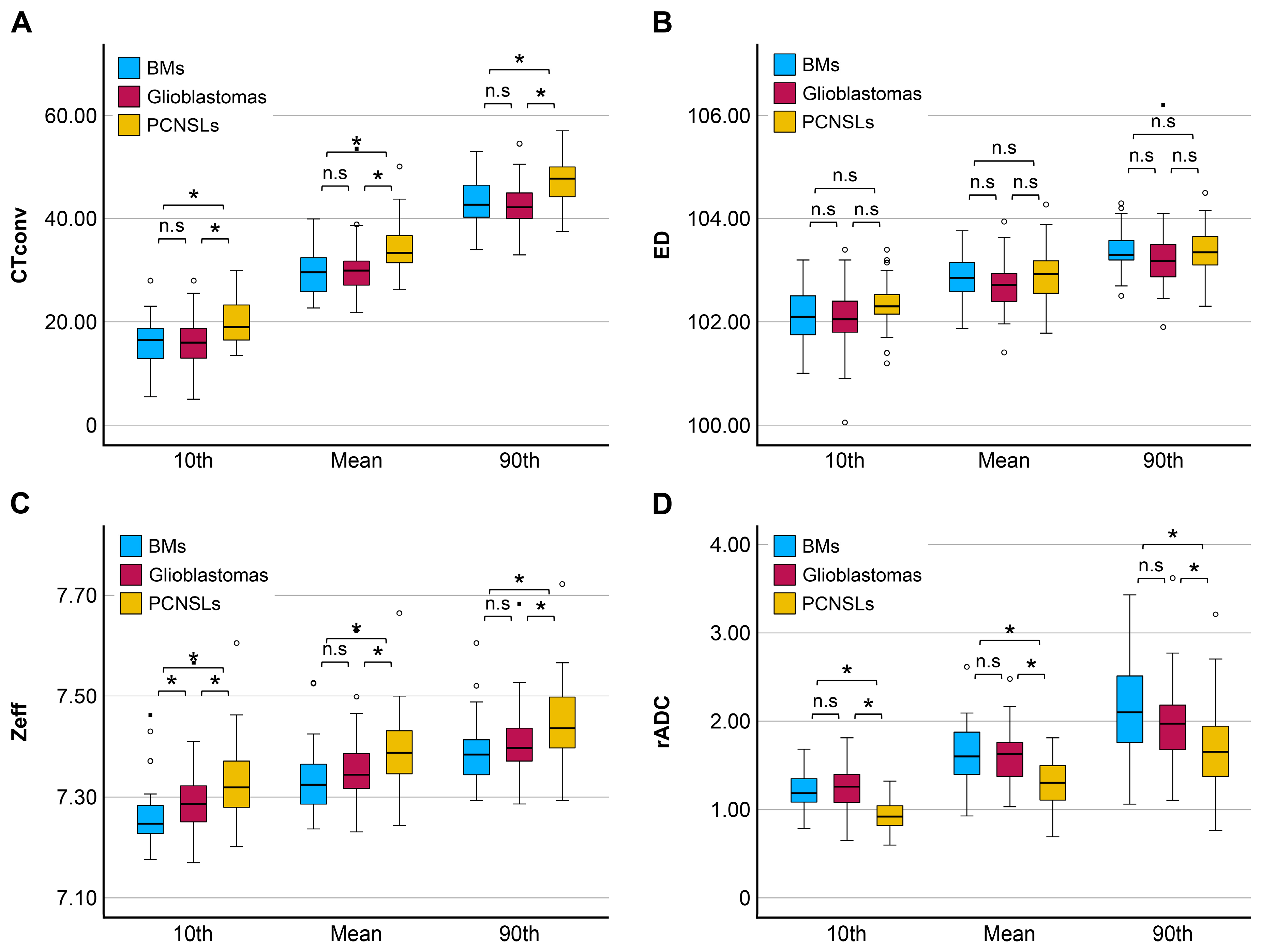
3.3. Data Comparisons
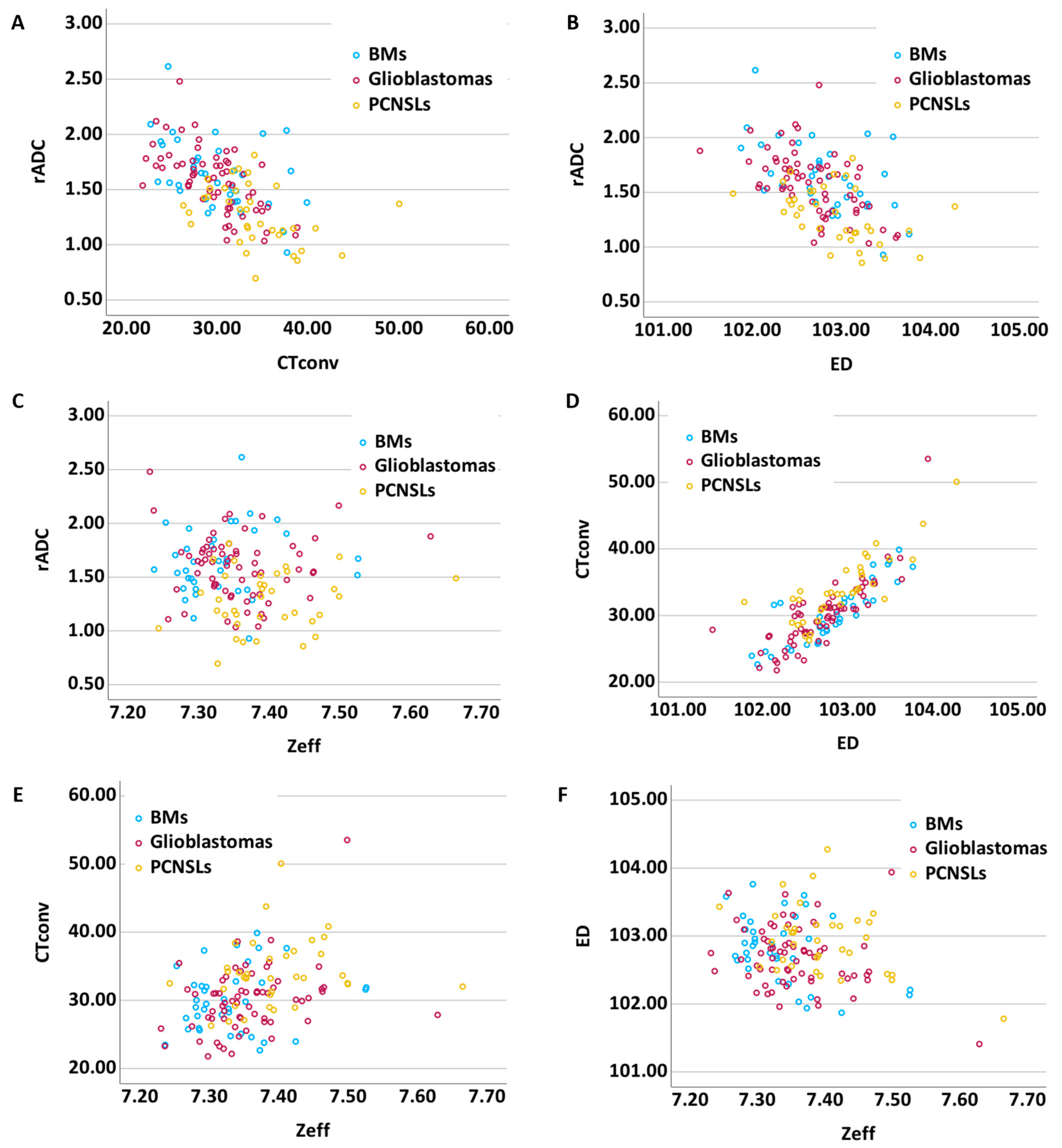
3.4. Correlation Analysis
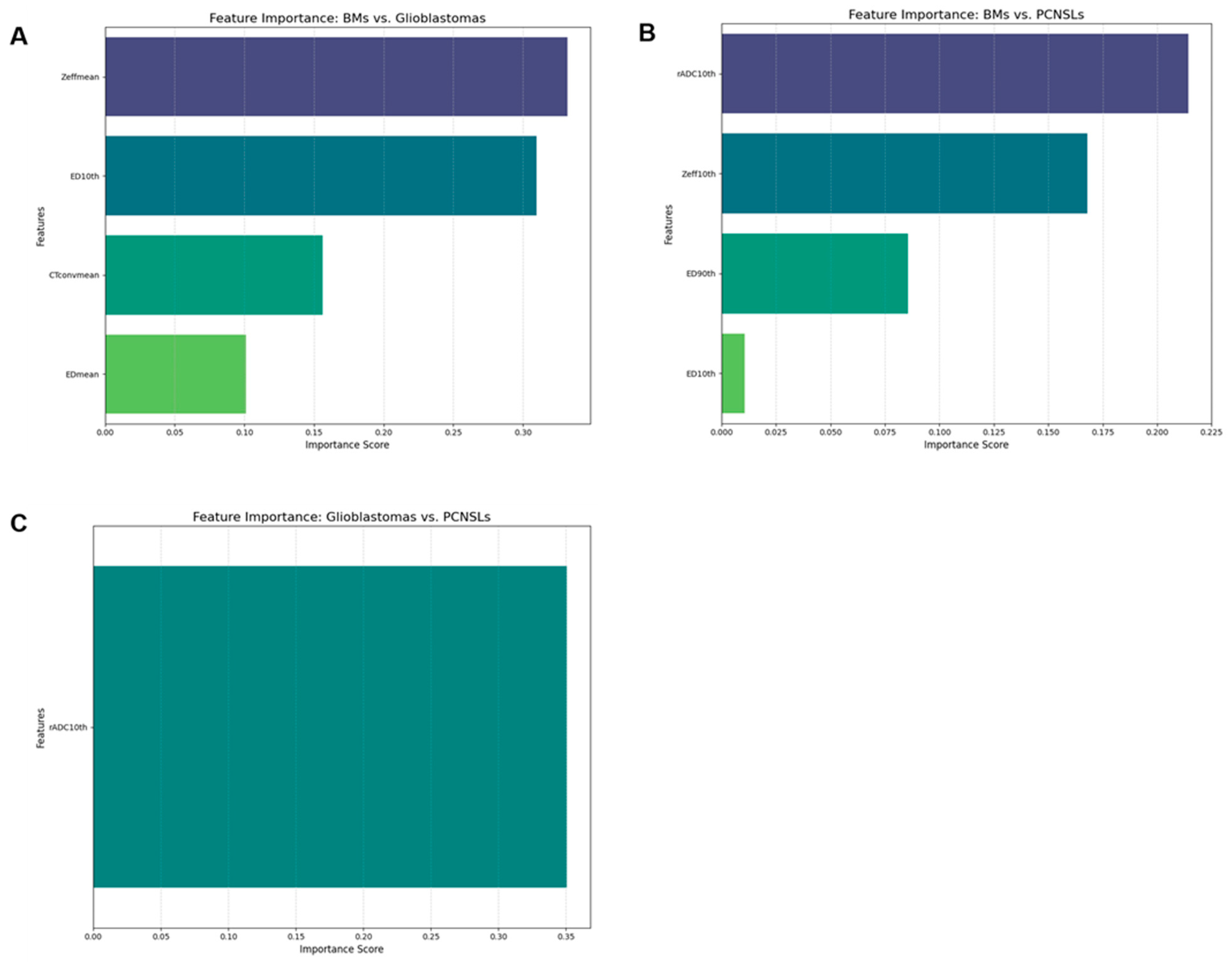
3.5. ML Analysis
4. Discussion
5. Conclusions
Supplementary Materials
Author Contributions
Funding
Institutional Review Board Statement
Informed Consent Statement
Data Availability Statement
Conflicts of Interest
Abbreviations
| ADC | Apparent diffusion coefficient |
| rADC | Relative apparent diffusion coefficient |
| AUC | Area under the receiver operating characteristic curve |
| BM | Brain metastasis |
| CTconv | Conventional 120-kVp CT |
| DECT | Dual-energy CT |
| DWI | Diffusion weighted imaging |
| ED | Electron density |
| ICC | Intraclass correlation coefficient |
| Lasso | Least absolute shrinkage and selection operator |
| ML | Machine learning |
| N:C ratio | Nucleus-to-cytoplasmic ratio |
| PCNSL | Primary central nervous system lymphoma |
| RFE | Recursive feature elimination |
| ROI | Region of interest |
| Zeff | Effective atomic number |
References
- Miller, K.D.; Ostrom, Q.T.; Kruchko, C.; Patil, N.; Tihan, T.; Cioffi, G.; Fuchs, H.E.; Waite, K.A.; Jemal, A.; Siegel, R.L.; et al. Brain and other central nervous system tumor statistics, 2021. CA Cancer J. Clin. 2021, 71, 381–406. [Google Scholar] [CrossRef]
- Fox, B.D.; Cheung, V.J.; Patel, A.J.; Suki, D.; Rao, G. Epidemiology of metastatic brain tumors. Neurosurg. Clin. N. Am. 2011, 22, 1–6. [Google Scholar] [CrossRef]
- Hung, N.D.; Anh, N.N.; Minh, N.D.; Huen, D.K.; Duc, N.M. Differentiation of glioblastoma and primary central nervous system lymphomas using multiparametric diffusion and perfusion magnetic resonance imaging. Biomed. Rep. 2023, 19, 82. [Google Scholar] [CrossRef] [PubMed]
- Yamasaki, F.; Takayasu, T.; Nosaka, R.; Amatya, V.J.; Doskaliyev, A.; Akiyama, Y.; Tominaga, A.; Takeshima, Y.; Sugiyama, K.; Kurisu, K. Magnetic resonance spectroscopy detection of high lipid levels in intraaxial tumors without central necrosis: A characteristic of malignant lymphoma. J. Neurosurg. 2015, 122, 1370–1379. [Google Scholar] [CrossRef]
- Hünemohr, N.; Paganetti, H.; Greilich, S.; Jäkel, O.; Seco, J. Tissue decomposition from dual energy CT data for MC based dose calculation in particle therapy. Med. Phys. 2014, 41, 061714. [Google Scholar] [CrossRef] [PubMed]
- Hua, C.; Shapira, N.; Merchant, T.E.; Klahr, P.; Yagil, Y. Accuracy of electron density, effective atomic number, and iodine concentration determination with a dual-layer dual-energy computed tomography system. Med. Phys. 2018, 45, 2486–2497. [Google Scholar] [CrossRef]
- Li, M.; Zheng, X.; Li, J.; Yang, Y.; Lu, C.; Xu, H.; Yu, B.; Xiao, L.; Zhang, G.; Hua, Y. Dual-energy computed tomography imaging of thyroid nodule specimens. Investig. Radiol. 2012, 47, 58–64. [Google Scholar] [CrossRef]
- Pérez, V.G.; Arana, E.; Barrios, M.; Bartrés, A.; Cruz, J.; Montero, R.; González, M.; Deltoro, C.; Martínez-Pérez, E.; De Aguiar-Quevedo, K.; et al. Differentiation of benign and malignant lung lesions: Dual-energy computed tomography findings. Eur. J. Radiol. 2016, 85, 1765–1772. [Google Scholar] [CrossRef] [PubMed]
- Jia, Y.; Xiao, X.; Sun, Q.; Jiang, H.C.T. spectral parameters and serum tumour markers to differentiate histological types of cancer histology. Clin. Radiol. 2018, 73, 1033–1040. [Google Scholar] [CrossRef]
- Kim, C.; Kim, W.; Park, S.J.; Lee, Y.H.; Hwang, S.H.; Yong, H.S.; Oh, Y.-W.; Kang, E.-Y.; Lee, K.Y. Application of dual-energy spectral computed tomography to thoracic oncology imaging. Korean J. Radiol. 2020, 21, 838–850. [Google Scholar] [CrossRef]
- Lv, Y.; Zhou, J.; Lv, X.; Tian, L.; He, H.; Liu, Z.; Wu, Y.; Han, L.; Sun, M.; Yang, Y.; et al. Dual-energy spectral CT quantitative parameters for the differentiation of Glioma recurrence from treatment-related changes: A preliminary study. BMC Med. Imaging 2020, 20, 5. [Google Scholar] [CrossRef]
- Zhang, Y.; Zhang, H.; Zhang, H.; Ouyang, Y.; Su, R.; Yang, W.; Huang, B. Glioblastoma and Solitary Brain Metastasis: Differentiation by integrating demographic-MRI and deep-learning radiomics signatures. J. Magn. Reson. Imaging 2024, 60, 909–920. [Google Scholar] [CrossRef]
- Swinburne, N.C.; Schefflein, J.; Sakai, Y.; Oermann, E.K.; Titano, J.J.; Chen, I.; Tadayon, S.; Aggarwal, A.; Doshi, A.; Nael, K. Machine learning for semi¬automated classification of glioblastoma, brain metastasis and central nervous system lymphoma using magnetic resonance advanced imaging. Ann. Transl. Med. 2019, 7, 232. [Google Scholar] [CrossRef]
- Priya, S.; Liu, Y.; Ward, C.; Le, N.H.; Soni, N.; Maheshwarappa, R.P.; Monga, V.; Zhang, H.; Sonka, M.; Bathla, G. Machine learning based differentiation of glioblastoma from brain metastasis using MRI derived radiomics. Sci. Rep. 2021, 11, 10478. [Google Scholar] [CrossRef]
- Tariciotti, L.; Caccavella, V.M.; Fiore, G.; Schisano, L.; Garrabba, G.; Borsa, S.; Giordano, M.; Palmisciano, P.; Remoli, G.; Remore, L.G.; et al. A deep learning model for preoperative differentiation of glioblastoma, brain metastasis and primary central nervous system lymphoma: A pilot study. Front. Oncol. 2022, 12, 816638. [Google Scholar] [CrossRef] [PubMed]
- Liu, Y.; Li, T.; Fan, Z.; Li, Y.; Sun, Z.; Li, S.; Liang, Y.; Zhou, C.; Zhu, Q.; Zhang, H.; et al. Image-based differentiation of intracranial metastasis from glioblastoma using automated machine learning. Front. Neurosci. 2022, 16, 855990. [Google Scholar] [CrossRef] [PubMed]
- Zhu, F.Y.; Sun, Y.F.; Yin, X.P.; Zhang, Y.; Xing, L.H.; Ma, Z.P.; Xue, L.-Y.; Wang, J.-N. Using machine learning-based radiomics to differentiate between glioma and solitary brain metastasis from lung cancer and its subtypes. Discov. Onc. 2023, 14, 224. [Google Scholar] [CrossRef] [PubMed]
- Jekel, L.; Brim, W.R.; Reppert, M.V.; Staib, L.; Petersen, G.C.; Merkai, S.; Subramanian, H.; Zeevi, T.; Payabvash, S.; Bousabarah, K.; et al. Machine learning applications for differentiation of glioma from brain metastasis—A systematic review. Cancers 2022, 14, 1369. [Google Scholar] [CrossRef]
- Petersen, G.C.; Shatalov, J.; Verma, T.; Brim, W.R.; Subramanian, H.; Brackett, A.; Bahar, R.; Merkaj, S.; Zeevi, T.; Staib, L.; et al. Machine Learning in Differentiating Gliomas from Primary CNS Lymphomas: A Systematic Review, Reporting Quality, and Risk of Bias Assessment. AJNR Am. J. Neuroradiol. 2022, 43, 526–533. [Google Scholar] [CrossRef]
- Mărginean, L.; Ștefan, P.A.; Lebovici, A.; Opincariu, I.; Csutak, C.; Lupean, R.A.; Coroian, P.A.; Suciu, B.A. CT in the differentiation of gliomas from brain metastases: The radiomics analysis of the peritumoral zone. Brain Sci. 2022, 12, 109. [Google Scholar] [CrossRef]
- Lu, G.; Zhang, Y.; Wang, W.; Miao, L.; Mou, W. Machine learning and deep learning ct-based models for predicting the primary central nervous system lymphoma and glioma types: A multicenter retrospective study. Front. Neurol. 2022, 13, 905227. [Google Scholar] [CrossRef]
- Higa, N.; Akahane, T.; Yokoyama, S.; Yonezawa, H.; Uchida, H.; Takajo, T.; Kirishima, M.; Hamada, T.; Matsuo, K.; Fujio, S.; et al. A tailored next-generation sequencing panel identified distinct subtypes of wildtype IDH and TERT promoter glioblastomas. Cancer Sci. 2020, 111, 3902–3911. [Google Scholar] [CrossRef]
- Louis, D.N.; Perry, A.; Wesseling, P.; Bart, D.J.; Cree, I.A.; Figarella-Branger, D.; Hawkins, C.; Ng, H.K.; Pfister, S.M.; Reifenberger, G.; et al. The 2021 WHO classification of tumors of the central nervous system: A summary. Neuro-Oncology 2021, 23, 1231–1251. [Google Scholar] [CrossRef]
- Yushkevich, P.A.; Piven, J.; Hazlett, H.C.; Smith, R.G.; Ho, S.; Gee, J.C.; Gerig, G. User-guided 3D active contour segmentation of anatomical structures: Significantly improved efficiency and reliability. NeuroImage 2006, 31, 1116–1128. [Google Scholar] [CrossRef]
- Erickson, N.; Mueller, J.; Shirkov, A.; Zhang, H.; Larroy, P.; Li, M.; Smola, A. AutoGluon-Tabular: Robust and Accurate AutoML for Structured Data. arXiv 2020, arXiv:2003.06505. [Google Scholar]
- Autogluon. Available online: https://auto.gluon.ai/ (accessed on 28 August 2025).
- Kaichi, Y.; Tatsugami, F.; Nakamura, Y.; Baba, Y.; Iida, M.; Higaki, T.; Kiguchi, M.; Tsushima, S.; Yamasaki, F.; Amatya, V.J.; et al. Improved differentiation between high- and low-grade gliomas by combining dual-energy CT analysis and perfusion CT. Medicine 2018, 97, e11670. [Google Scholar] [CrossRef] [PubMed]
- Chakrabarti, R.; Gupta, V.; Vyas, S.; Gupta, K.; Singh, V. Correlation of dual energy computed tomography electron density measurements with cerebral glioma grade. Neuroradiol. J. 2022, 35, 352–362. [Google Scholar] [CrossRef] [PubMed]
- Wang, P.; Xiao, Z.; Tang, Z.; Wang, J. Dual-energy CT in the differentiation of stage T1 nasopharyngeal carcinoma and lymphoid hyperplasia. Eur. J. Radiol. 2020, 124, 108824. [Google Scholar] [CrossRef]
- Luo, S.; Sha, Y.; Wu, J.; Lin, N.; Pan, Y.; Zhang, F.; Huang, W. Differentiation of malignant from benign orbital tumours using dual-energy CT. Clin. Radiol. 2022, 77, 307–313. [Google Scholar] [CrossRef]
- Wang, N.; Ju, Y.; Wu, J.; Liu, A.; Chen, A.; Liu, J.; Liu, Y.; Li, J. Differentiation of liver abscess from liver metastasis using dual-energy spectral CT quantitative parameters. Eur. J. Radiol. 2019, 113, 204–208. [Google Scholar] [CrossRef] [PubMed]
- Jiang, L.; Liu, D.; Long, L.; Chen, J.; Lan, X.; Zhang, J. Dual-source dual-energy computed tomography-derived quantitative parameters combined with machine learning for the differential diagnosis of benign and malignant thyroid nodules. Quant. Imaging Med. Surg. 2022, 12, 967–978. [Google Scholar] [CrossRef] [PubMed]
- Mileto, A.; Allen, B.C.; Pietryga, J.A.; Farjat, A.E.; Zarzour, J.G.; Bellini, L.; Ebner, L.; Morgan, D.E. Characterization of incidental renal mass with dual-energy CT: Diagnostic accuracy of effective atomic number maps for discriminating nonenhancing cysts from enhancing masses. Am. J. Roentgenol. 2017, 209, W221–W230. [Google Scholar] [CrossRef]
- Lin, X.; Lee, M.; Buck, O.; Woo, K.M.; Zhang, Z.; Hatzoglou, V.; Omuro, A.; Arevalo-Perez, J.; Thomas, A.; Huse, J.; et al. Diagnostic accuracy of T1-weighted dynamic contrast-enhanced–MRI and DWI-ADC for differentiation of glioblastoma and primary CNS lymphoma. Am. J. Neuroradiol. 2017, 38, 485–491. [Google Scholar] [CrossRef]
- Matuszewska, M.N.; Bladowska, J.; Sąsiadek, M.; Zimmy, A. Differentiation of glioblastoma multiforme, metastases and primary central nervous system lymphomas using multiparametric perfusion and diffusion MR imaging of a tumor core and a peritumoral zone—Searching for a practical approach. PLoS ONE 2018, 13, 191341. [Google Scholar] [CrossRef]
- Slone, H.W.; Blake, J.J.; Shah, R.; Guttikonda, S.; Bourekas, E.C. CT and MRI findings of intracranial lymphoma. Am. J. Roentgenol. 2005, 184, 1679–1685. [Google Scholar] [CrossRef]
- Fordham, A.J.; Hacherl, C.C.; Patel, N.; Jones, K.; Myers, B.; Abraham, M.; Gendreau, J. Differentiating glioblastomas from solitary brain metastases: An update on the current literature of advanced imaging modalities. Cancers 2021, 13, 2960. [Google Scholar] [CrossRef] [PubMed]
- Yu, S.; Hao, R.; Cui, J.; Yang, Y.; Wang, Z.; Zheng, H.; Li, M.; Li, X.; Chen, W.; Jia, W.; et al. Integration of radiomic and deep features to reliably differentiate benign renal lesions from renal cell carcinoma. Eur. J. Radiol. 2025, 184, 111989. [Google Scholar] [CrossRef] [PubMed]



| Characteristics | BMs (n = 36) | Glioblastomas (n = 64) | PCNSLs (n = 36) | p-Value |
|---|---|---|---|---|
| Age (y) | 65 ± 12 | 69 ± 14 | 70 ± 13 | 0.09 |
| Sex | 0.61 | |||
| Male | 26 | 40 | 24 | |
| Female | 10 | 24 | 12 | |
| Solitary/multiple | 0.08 | |||
| Solitary | 25 | 51 | 21 | |
| Multiple | 11 | 13 | 15 | |
| Primary site (metastases) | ||||
| Lung | 19 | N/A | N/A | |
| Breast | 5 | N/A | N/A | |
| Colon | 2 | N/A | N/A | |
| Stomach | 2 | N/A | N/A | |
| Uterus | 1 | N/A | N/A | |
| Bladder | 1 | N/A | N/A | |
| Ureter | 1 | N/A | N/A | |
| Soft tissue | 1 | N/A | N/A | |
| Skin | 1 | N/A | N/A | |
| Bone | 1 | N/A | N/A | |
| Unknown | 2 | N/A | N/A | |
| IDH-status (glioblastoma) | ||||
| Wild type | N/A | 64 | N/A | |
| Subtype (PCNSL) | ||||
| DLBCL | N/A | N/A | 36 |
| p-Value | |||||||
|---|---|---|---|---|---|---|---|
| BMs | Glioblastomas | PCNSLs | Kruskal–Wallis Test | BMs vs. Glioblastomas | BM vs. PCNSLs | Glioblastomas vs. PCNSLs | |
| CTconv (HU) | |||||||
| 10th | 15.83 ± 4.79 | 15.82 ± 4.83 | 19.93 ± 4.27 | <0.001 | >0.99 | 0.002 | <0.001 |
| Mean | 30.01 ± 4.66 | 29.98 ± 4.90 | 34.05 ± 4.84 | <0.001 | >0.99 | 0.002 | <0.001 |
| 90th | 43.11 ± 4.55 | 43.09 ± 7.89 | 47.00 ± 4.63 | <0.001 | >0.99 | 0.002 | <0.001 |
| ED (%EDW) | |||||||
| 10th | 102.11 ± 0.56 | 102.07 ± 0.52 | 102.37 ± 0.47 | 0.01 | >0.99 | 0.16 | 0.07 |
| Mean | 102.82 ± 0.50 | 102.70 ± 0.45 | 102.94 ± 0.50 | 0.06 | 0.62 | >0.99 | 0.06 |
| 90th | 103.38 ± 0.44 | 103.21 ± 0.57 | 103.38 ± 0.47 | 0.06 | 0.16 | >0.99 | 0.16 |
| Zeff | |||||||
| 10th | 7.26 ± 0.06 | 7.29 ± 0.07 | 7.33 ± 0.08 | <0.001 | 0.02 | <0.001 | 0.02 |
| Mean | 7.33 ± 0.06 | 7.36 ± 0.07 | 7.40 ± 0.07 | <0.001 | 0.08 | <0.001 | 0.01 |
| 90th | 7.39 ± 0.07 | 7.42 ± 0.10 | 7.45 ± 0.08 | <0.001 | 0.26 | <0.001 | 0.02 |
| rADC | |||||||
| 10th | 1.22 ± 0.21 | 1.26 ± 0.24 | 0.93 ± 0.16 | <0.001 | >0.99 | <0.001 | <0.001 |
| Mean | 1.64 ± 0.32 | 1.60 ± 0.30 | 1.28 ± 0.27 | <0.001 | >0.99 | <0.001 | <0.001 |
| 90th | 2.14 ± 0.51 | 1.96 ± 0.43 | 1.70 ± 0.50 | <0.001 | 0.20 | <0.001 | <0.001 |
| AUC (95% CI) | |||
|---|---|---|---|
| Parameter | BMs vs. Glioblastomas | BMs vs. PCNSLs | Glioblastomas vs. PCNSLs |
| CTconv | |||
| 10th | 0.49 (0.39–0.59) | 0.73 (0.61–0.83) | 0.73 (0.63–0.82) |
| Mean | 0.51 (0.41–0.62) | 0.74 (0.62–0.83) | 0.76 (0.66–0.84) |
| 90th | 0.54 (0.44–0.64) | 0.73 (0.61–0.83) | 0.76 (0.67–0.84) |
| Zeff | |||
| 10th | 0.66 (0.56–0.76) | 0.79 (0.68–0.88) | 0.66 (0.56–0.75) |
| Mean | 0.63 (0.53–0.73) | 0.77 (0.66–0.86) | 0.68 (0.58–0.77) |
| 90th | 0.60 (0.50–0.70) | 0.75 (0.63–0.84) | 0.67 (0.57–0.76) |
| rADC | |||
| 10th | 0.55 (0.45–0.65) | 0.88 (0.78–0.94) | 0.88 (0.80–0.94) |
| Mean | 0.53 (0.43–0.63) | 0.81 (0.69–0.89) | 0.78 (0.69–0.86) |
| 90th | 0.61 (0.51–0.71) | 0.74 (0.63–0.84) | 0.68 (0.57–0.77) |
| Test Set | ||||||
|---|---|---|---|---|---|---|
| Model | Accuracy | Precision | Recall | F1 | AUC | |
| BMs vs. Glioblastomas | ||||||
| DECT | Weighted ensemble | 0.65 | 0.5 | 1 | 0.67 | 0.83 |
| rADC | Weighted ensemble | 0.65 | 0 | 0 | 0 | 0.62 |
| DECT + rADC | Weighted ensemble | 0.65 | 0 | 0 | 0 | 0.76 |
| BM vs. PCNSLs | ||||||
| DECT | Weighted ensemble | 0.83 | 0.86 | 0.86 | 0.86 | 0.91 |
| rADC | Weighted ensemble | 0.92 | 1 | 0.88 | 0.93 | 1 |
| DECT + rADC | Weighted ensemble | 1 | 1 | 1 | 1 | 1 |
| Glioblastomas vs. PCNSLs | ||||||
| DECT | Weighted ensemble | 0.68 | 0.85 | 0.73 | 0.79 | 0.82 |
| rADC | Weighted ensemble | 0.84 | 1 | 0.8 | 0.89 | 0.94 |
| DECT + rADC | Weighted ensemble | 0.74 | 1 | 0.67 | 0.8 | 0.93 |
Disclaimer/Publisher’s Note: The statements, opinions and data contained in all publications are solely those of the individual author(s) and contributor(s) and not of MDPI and/or the editor(s). MDPI and/or the editor(s) disclaim responsibility for any injury to people or property resulting from any ideas, methods, instructions or products referred to in the content. |
© 2025 by the authors. Licensee MDPI, Basel, Switzerland. This article is an open access article distributed under the terms and conditions of the Creative Commons Attribution (CC BY) license (https://creativecommons.org/licenses/by/4.0/).
Share and Cite
Nakano, T.; Hirahara, D.; Hasegawa, T.; Kamimura, K.; Nakajo, M.; Kamizono, J.; Takumi, K.; Nakajo, M.; Ejima, F.; Nakanosono, R.; et al. Electron Density and Effective Atomic Number as Quantitative Biomarkers for Differentiating Malignant Brain Tumors: An Exploratory Study with Machine Learning. Tomography 2025, 11, 120. https://doi.org/10.3390/tomography11110120
Nakano T, Hirahara D, Hasegawa T, Kamimura K, Nakajo M, Kamizono J, Takumi K, Nakajo M, Ejima F, Nakanosono R, et al. Electron Density and Effective Atomic Number as Quantitative Biomarkers for Differentiating Malignant Brain Tumors: An Exploratory Study with Machine Learning. Tomography. 2025; 11(11):120. https://doi.org/10.3390/tomography11110120
Chicago/Turabian StyleNakano, Tsubasa, Daisuke Hirahara, Tomohito Hasegawa, Kiyohisa Kamimura, Masanori Nakajo, Junki Kamizono, Koji Takumi, Masatoyo Nakajo, Fumitaka Ejima, Ryota Nakanosono, and et al. 2025. "Electron Density and Effective Atomic Number as Quantitative Biomarkers for Differentiating Malignant Brain Tumors: An Exploratory Study with Machine Learning" Tomography 11, no. 11: 120. https://doi.org/10.3390/tomography11110120
APA StyleNakano, T., Hirahara, D., Hasegawa, T., Kamimura, K., Nakajo, M., Kamizono, J., Takumi, K., Nakajo, M., Ejima, F., Nakanosono, R., Yamagishi, R., Kanzaki, F., Muraoka, H., Higa, N., Yonezawa, H., Kitazono, I., Kwon, J., Pahn, G., Langzam, E., ... Yoshiura, T. (2025). Electron Density and Effective Atomic Number as Quantitative Biomarkers for Differentiating Malignant Brain Tumors: An Exploratory Study with Machine Learning. Tomography, 11(11), 120. https://doi.org/10.3390/tomography11110120