
Quantitative Consistency of Amide Proton Transfer-Weighted MRI for Brain Tumor Differentiation: Systematic Review of Clinical Evidence
 ,
,
Simple Summary
Abstract
1. Introduction
2. Materials and Methods
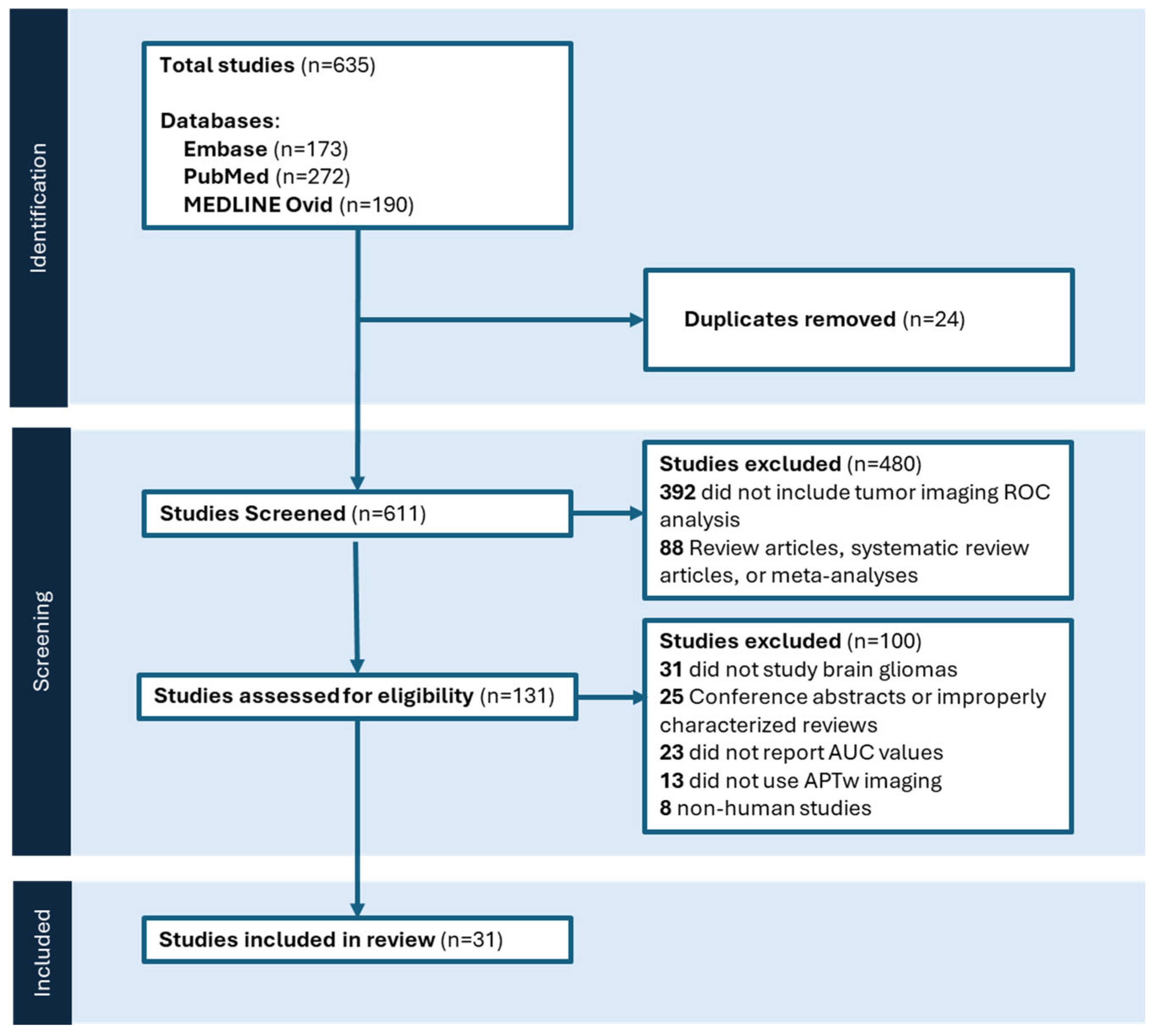
2.1. The Search Strategy
2.2. Inclusion Criteria
2.3. Data Extraction
2.4. Principal Component Analysis of Grouped Parameters
2.5. Statistical Analysis
3. Results
3.1. Covariate-Free Meta-Analysis
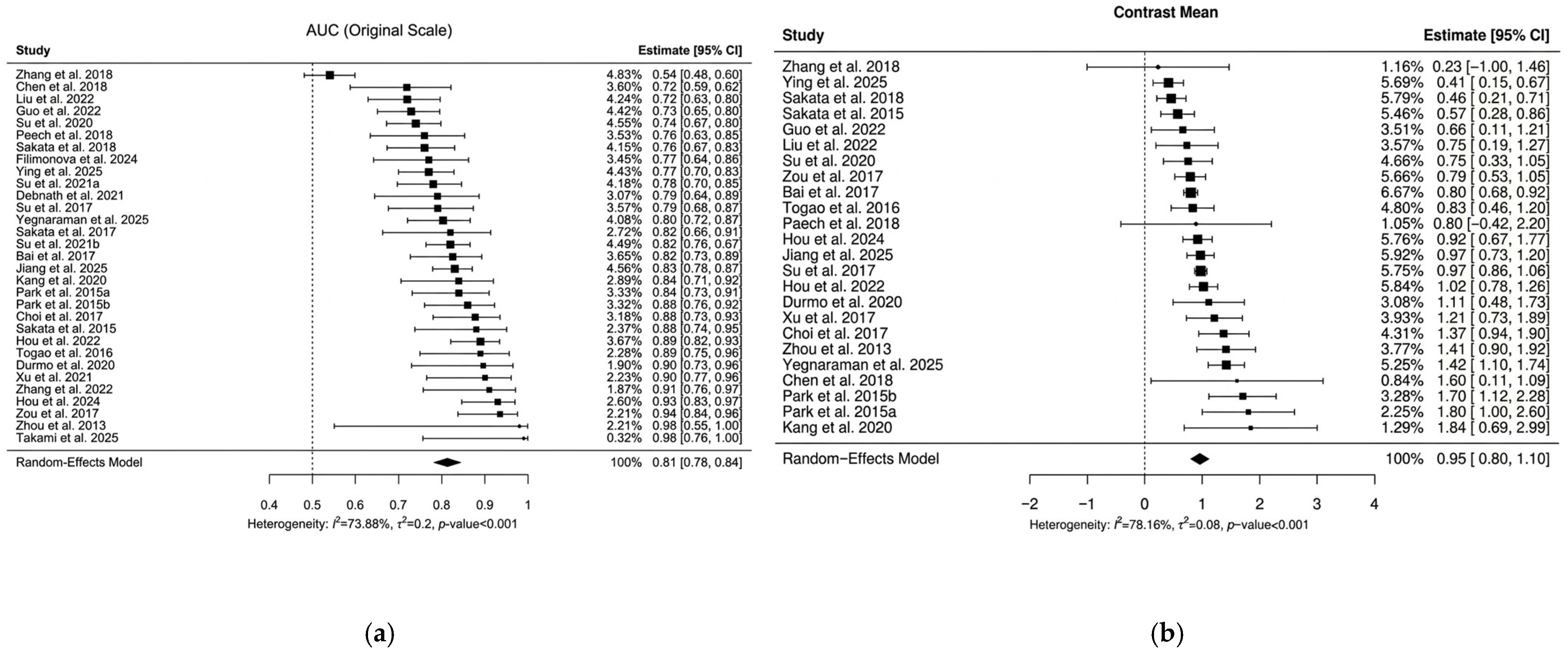
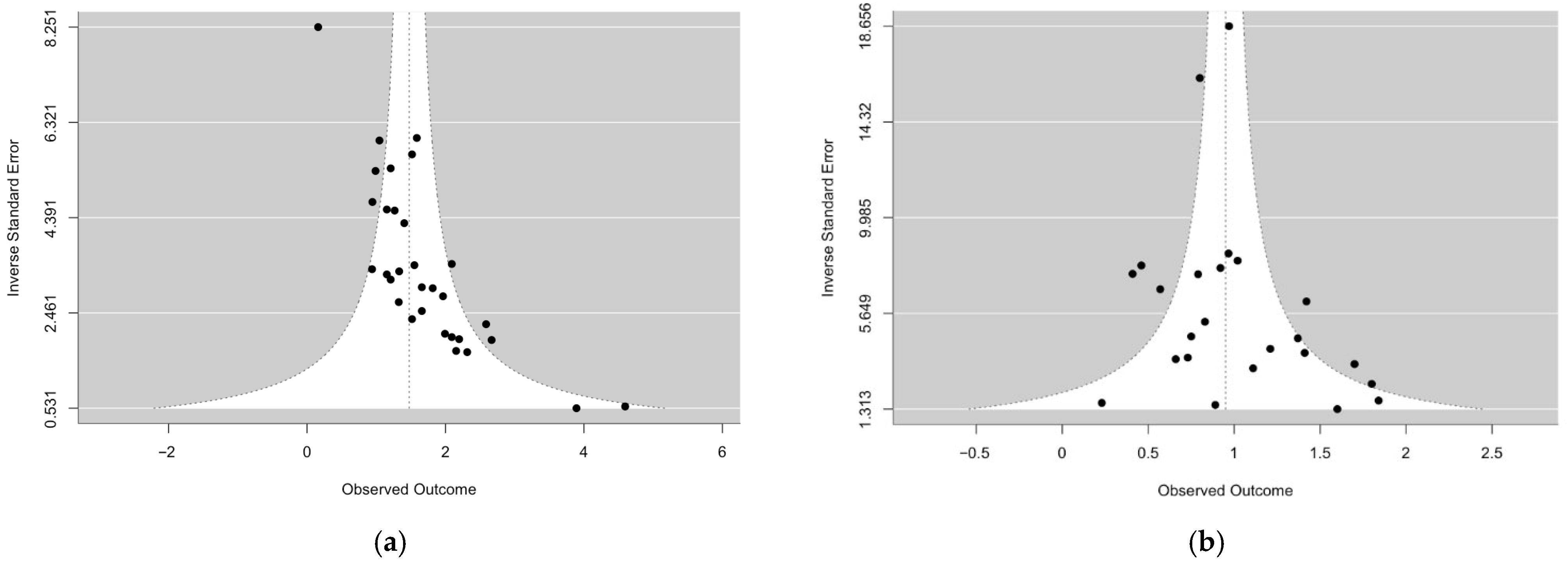
3.1.1. AUC
3.1.2. Mean Difference
3.2. Univariate Meta-Regression
3.2.1. AUC
3.2.2. Mean Difference
3.3. Outlier Evaluation Using Baujat Plots and LOOMA
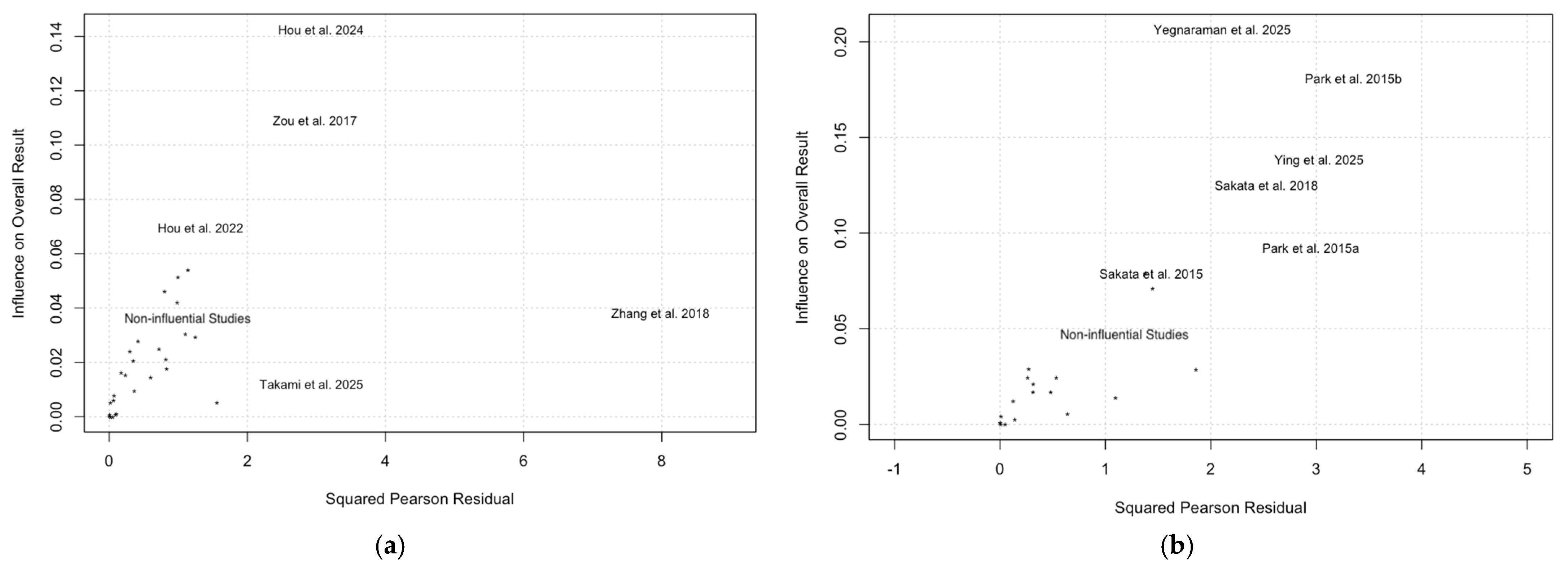
3.3.1. AUC
3.3.2. Mean Difference in Contrast Comparing LGG to HGG
4. Discussion
5. Conclusions
Supplementary Materials
Author Contributions
Funding
Institutional Review Board Statement
Informed Consent Statement
Data Availability Statement
Conflicts of Interest
Abbreviations
| APTw | Amide Proton Transfer-weighted |
| RF | Radio Frequency |
| SD | Standard Deviation |
| CI | Confidence Interval |
| Np | Number of Pulses |
| B1,avg | Average B1 |
| HGG | High-Grade Glioma |
| LGG | Low-Grade Glioma |
| PCA | Principal Component Analysis |
| CEST | Chemical Exchange Saturation Transfer |
| AUC | Area Under the Curve |
| ROC | Receiver Operating Characteristic |
| SE | Spin-Echo |
| TSE | Turbo Spin-Echo |
| FSE | Fast Spin-Echo |
| GRE | Gradient Echo |
| EPI | Echo-Planar Imaging |
| GRASE | Gradient and Spin Echo |
| SPACE | Sampling Perfection with Application optimized Contrasts using different flip angle Evolution |
References
- Law, M.; Yang, S.; Wang, H.; Babb, J.S.; Johnson, G.; Cha, S.; Knopp, E.A.; Zagzag, D. Glioma grading: Sensitivity, specificity, and predictive values of perfusion MR imaging and proton MR spectroscopic imaging compared with conventional MR imaging. AJNR Am. J. Neuroradiol. 2003, 24, 1989–1998. [Google Scholar] [PubMed]
- Weissleder, R.; Pittet, M.J. Imaging in the era of molecular oncology. Nature 2008, 452, 580–589. [Google Scholar] [CrossRef] [PubMed]
- Watanabe, M.; Tanaka, R.; Takeda, N. Magnetic resonance imaging and histopathology of cerebral gliomas. Neuroradiology 1992, 34, 463–469. [Google Scholar] [CrossRef]
- Miller, K.D.; Ostrom, Q.T.; Kruchko, C.; Patil, N.; Tihan, T.; Cioffi, G.; Fuchs, H.E.; Waite, K.A.; Jemal, A.; Siegel, R.L.; et al. Brain and other central nervous system tumor statistics, 2021. CA Cancer J. Clin. 2021, 71, 381–406. [Google Scholar] [CrossRef]
- Dean, B.L.; Drayer, B.P.; Bird, C.R.; Flom, R.A.; Hodak, J.A.; Coons, S.W.; Carey, R.G. Gliomas: Classification with MR imaging. Radiology 1990, 174, 411–415. [Google Scholar] [CrossRef]
- Louis, D.N.; Perry, A.; Burger, P.; Ellison, D.W.; Reifenberger, G.; von Deimling, A.; Aldape, K.; Brat, D.; Collins, V.P.; Eberhart, C.; et al. International Society Of Neuropathology-Haarlem consensus guidelines for nervous system tumor classification and grading. Brain Pathol. 2014, 24, 429–435. [Google Scholar] [CrossRef]
- Louis, D.N.; Perry, A.; Wesseling, P.; Brat, D.J.; Cree, I.A.; Figarella-Branger, D.; Hawkins, C.; Ng, H.K.; Pfister, S.M.; Reifenberger, G.; et al. The 2021 WHO Classification of Tumors of the Central Nervous System: A summary. Neuro-Oncology 2021, 23, 1231–1251. [Google Scholar] [CrossRef]
- Guo, Y.; Ma, Z.; Pei, D.; Duan, W.; Guo, Y.; Liu, Z.; Guan, F.; Wang, Z.; Xing, A.; Guo, Z.; et al. Improving Noninvasive Classification of Molecular Subtypes of Adult Gliomas With Diffusion-Weighted MR Imaging: An Externally Validated Machine Learning Algorithm. J. Magn. Reson. Imaging 2023, 58, 1234–1242. [Google Scholar] [CrossRef]
- Knopp, E.A.; Cha, S.; Johnson, G.; Mazumdar, A.; Golfinos, J.G.; Zagzag, D.; Miller, D.C.; Kelly, P.J.; Kricheff, I.I. Glial neoplasms: Dynamic contrast-enhanced T2*-weighted MR imaging. Radiology 1999, 211, 791–798. [Google Scholar] [CrossRef]
- Park, J.E.; Kim, H.S.; Park, K.J.; Kim, S.J.; Kim, J.H.; Smith, S.A. Pre- and Posttreatment Glioma: Comparison of Amide Proton Transfer Imaging with MR Spectroscopy for Biomarkers of Tumor Proliferation. Radiology 2016, 278, 514–523. [Google Scholar] [CrossRef] [PubMed]
- Sakata, A.; Fushimi, Y.; Okada, T.; Arakawa, Y.; Kunieda, T.; Minamiguchi, S.; Kido, A.; Sakashita, N.; Miyamoto, S.; Togashi, K. Diagnostic performance between contrast enhancement, proton MR spectroscopy, and amide proton transfer imaging in patients with brain tumors. J. Magn. Reson. Imaging 2017, 46, 732–739. [Google Scholar] [CrossRef]
- Eidel, O.; Burth, S.; Neumann, J.O.; Kieslich, P.J.; Sahm, F.; Jungk, C.; Kickingereder, P.; Bickelhaupt, S.; Mundiyanapurath, S.; Baumer, P.; et al. Tumor Infiltration in Enhancing and Non-Enhancing Parts of Glioblastoma: A Correlation with Histopathology. PLoS ONE 2017, 12, e0169292. [Google Scholar] [CrossRef]
- Kondziolka, D.; Lunsford, L.D.; Martinez, A.J. Unreliability of contemporary neurodiagnostic imaging in evaluating suspected adult supratentorial (low-grade) astrocytoma. J. Neurosurg. 1993, 79, 533–536. [Google Scholar] [CrossRef] [PubMed]
- Consolino, L.; Anemone, A.; Capozza, M.; Carella, A.; Irrera, P.; Corrado, A.; Dhakan, C.; Bracesco, M.; Longo, D.L. Non-invasive Investigation of Tumor Metabolism and Acidosis by MRI-CEST Imaging. Front. Oncol. 2020, 10, 161. [Google Scholar] [CrossRef]
- Jin, T.; Wang, P.; Hitchens, T.K.; Kim, S.G. Enhancing sensitivity of pH-weighted MRI with combination of amide and guanidyl CEST. Neuroimage 2017, 157, 341–350. [Google Scholar] [CrossRef] [PubMed]
- Jones, K.M.; Pollard, A.C.; Pagel, M.D. Clinical applications of chemical exchange saturation transfer (CEST) MRI. J. Magn. Reson. Imaging 2018, 47, 11–27. [Google Scholar] [CrossRef]
- Zhou, J.; Blakeley, J.O.; Hua, J.; Kim, M.; Laterra, J.; Pomper, M.G.; van Zijl, P.C. Practical data acquisition method for human brain tumor amide proton transfer (APT) imaging. Magn. Reson. Med. 2008, 60, 842–849. [Google Scholar] [CrossRef]
- Choi, Y.S.; Ahn, S.S.; Lee, S.K.; Chang, J.H.; Kang, S.G.; Kim, S.H.; Zhou, J. Amide proton transfer imaging to discriminate between low- and high-grade gliomas: Added value to apparent diffusion coefficient and relative cerebral blood volume. Eur. Radiol. 2017, 27, 3181–3189. [Google Scholar] [CrossRef]
- Togao, O.; Hiwatashi, A.; Yamashita, K.; Kikuchi, K.; Keupp, J.; Yoshimoto, K.; Kuga, D.; Yoneyama, M.; Suzuki, S.O.; Iwaki, T.; et al. Grading diffuse gliomas without intense contrast enhancement by amide proton transfer MR imaging: Comparisons with diffusion- and perfusion-weighted imaging. Eur. Radiol. 2017, 27, 578–588. [Google Scholar] [CrossRef] [PubMed]
- Park, K.J.; Kim, H.S.; Park, J.E.; Shim, W.H.; Kim, S.J.; Smith, S.A. Added value of amide proton transfer imaging to conventional and perfusion MR imaging for evaluating the treatment response of newly diagnosed glioblastoma. Eur. Radiol. 2016, 26, 4390–4403. [Google Scholar] [CrossRef]
- Essed, R.A.; Prysiazhniuk, Y.; Wamelink, I.J.; Azizova, A.; Keil, V.C. Performance of amide proton transfer imaging to differentiate true progression from therapy-related changes in gliomas and metastases. Eur. Radiol. 2025, 35, 580–591. [Google Scholar] [CrossRef] [PubMed]
- Guo, H.; Liu, J.; Hu, J.; Zhang, H.; Zhao, W.; Gao, M.; Zhang, Y.; Yang, G.; Cui, Y. Diagnostic performance of gliomas grading and IDH status decoding A comparison between 3D amide proton transfer APT and four diffusion-weighted MRI models. J. Magn. Reson. Imaging 2022, 56, 1834–1844. [Google Scholar] [CrossRef]
- Hou, H.; Yu, J.; Diao, Y.; Xu, M.; Li, Z.; Song, T.; Liu, Y.; Wang, L. Diagnostic performance of multiparametric nonenhanced magnetic resonance imaging (MRI) in grading glioma and correlating IDH mutation status. Clin. Radiol. 2025, 82, 106791. [Google Scholar] [CrossRef] [PubMed]
- Paech, D.; Windschuh, J.; Oberhollenzer, J.; Dreher, C.; Sahm, F.; Meissner, J.E.; Goerke, S.; Schuenke, P.; Zaiss, M.; Regnery, S.; et al. Assessing the predictability of IDH mutation and MGMT methylation status in glioma patients using relaxation-compensated multipool CEST MRI at 7.0 T. Neuro-Oncology 2018, 20, 1661–1671. [Google Scholar] [CrossRef]
- Xu, Z.; Ke, C.; Liu, J.; Xu, S.; Han, L.; Yang, Y.; Qian, L.; Liu, X.; Zheng, H.; Lv, X.; et al. Diagnostic performance between MR amide proton transfer (APT) and diffusion kurtosis imaging (DKI) in glioma grading and IDH mutation status prediction at 3 T. Eur. J. Radiol. 2021, 134, 109466. [Google Scholar] [CrossRef]
- Su, C.; Xu, S.; Lin, D.; He, H.; Chen, Z.; Damen, F.C.; Ke, C.; Lv, X.; Cai, K. Multi-parametric Z-spectral MRI may have a good performance for glioma stratification in clinical patients. Eur. Radiol. 2022, 32, 101–111. [Google Scholar] [CrossRef]
- Jiang, S.; Rui, Q.; Wang, Y.; Heo, H.Y.; Zou, T.; Yu, H.; Zhang, Y.; Wang, X.; Du, Y.; Wen, X.; et al. Discriminating MGMT promoter methylation status in patients with glioblastoma employing amide proton transfer-weighted MRI metrics. Eur. Radiol. 2018, 28, 2115–2123. [Google Scholar] [CrossRef] [PubMed]
- Jin, T.; Kim, S.G. Advantages of chemical exchange-sensitive spin-lock (CESL) over chemical exchange saturation transfer (CEST) for hydroxyl- and amine-water proton exchange studies. NMR Biomed. 2014, 27, 1313–1324. [Google Scholar] [CrossRef]
- Lankford, C.L.; Louie, E.A.; Zu, Z.; Does, M.D.; Gochberg, D.F. A hybrid numeric-analytic solution for pulsed CEST. NMR Biomed. 2022, 35, e4610. [Google Scholar] [CrossRef]
- Chung, J.J.; Jin, T. Low duty cycle pulse trains for exchange rate insensitive chemical exchange saturation transfer MRI. Magn. Reson. Med. 2021, 86, 2542–2551. [Google Scholar] [CrossRef]
- Jin, T.; Chung, J.J. Average saturation efficiency filter (ASEF) for CEST imaging. Magn. Reson. Med. 2022, 88, 254–265. [Google Scholar] [CrossRef]
- Chung, J.J.; Jin, T. Average saturation efficiency filter ASEF-CEST MRI of stroke rodents. Magn. Reson. Med. 2023, 89, 565–576. [Google Scholar] [CrossRef]
- Jin, T.; Wang, P.; Zong, X.; Kim, S.G. Magnetic resonance imaging of the Amine-Proton EXchange (APEX) dependent contrast. Neuroimage 2012, 59, 1218–1227. [Google Scholar] [CrossRef]
- Jiang, W.; Zhou, I.Y.; Wen, L.; Zhou, X.; Sun, P.Z. A theoretical analysis of chemical exchange saturation transfer echo planar imaging (CEST-EPI) steady state solution and the CEST sensitivity efficiency-based optimization approach. Contrast Media Mol. Imaging 2016, 11, 415–423. [Google Scholar] [CrossRef]
- Zhou, J.; Zaiss, M.; Knutsson, L.; Sun, P.Z.; Ahn, S.S.; Aime, S.; Bachert, P.; Blakeley, J.O.; Cai, K.; Chappell, M.A.; et al. Review and consensus recommendations on clinical APT-weighted imaging approaches at 3T: Application to brain tumors. Magn. Reson. Med. 2022, 88, 546–574. [Google Scholar] [CrossRef]
- Bai, Y.; Lin, Y.; Zhang, W.; Kong, L.; Wang, L.; Zuo, P.; Vallines, I.; Schmitt, B.; Tian, J.; Song, X.; et al. Noninvasive amide proton transfer magnetic resonance imaging in evaluating the grading and cellularity of gliomas. Oncotarget 2017, 8, 5834–5842. [Google Scholar] [CrossRef] [PubMed]
- Chen, Y.; Li, X.; Song, Y.; Zhu, X.; Zhao, J.; Yan, X.; Wang, J.; Fan, M.; Chu, J. The diagnostic efficacy of amide proton transfer imaging in grading gliomas and predicting tumor proliferation. Neuroreport 2019, 30, 139–144. [Google Scholar] [CrossRef]
- Debnath, A.; Gupta, R.K.; Reddy, R.; Singh, A. Effect of offset-frequency step size and interpolation methods on chemical exchange saturation transfer MRI computation in human brain. NMR Biomed. 2021, 34, e4468. [Google Scholar] [CrossRef] [PubMed]
- Durmo, F.; Rydhog, A.; Testud, F.; Latt, J.; Schmitt, B.; Rydelius, A.; Englund, E.; Bengzon, J.; van Zijl, P.; Knutsson, L.; et al. Assessment of Amide proton transfer weighted (APTw) MRI for pre-surgical prediction of final diagnosis in gliomas. PLoS ONE 2020, 15, e0244003. [Google Scholar] [CrossRef] [PubMed]
- Filimonova, E.; Pashkov, A.; Borisov, N.; Kalinovsky, A.; Rzaev, J. Utilizing the amide proton transfer technique to characterize diffuse gliomas based on the WHO 2021 classification of CNS tumors. Neuroradiol. J. 2024, 37, 490–499. [Google Scholar] [CrossRef]
- Hou, H.; Chen, W.; Diao, Y.; Wang, Y.; Zhang, L.; Wang, L.; Xu, M.; Yu, J.; Song, T.; Liu, Y.; et al. 3D Amide Proton Transfer-Weighted Imaging for Grading Glioma and Correlating IDH Mutation Status: Added Value to 3D Pseudocontinuous Arterial Spin Labelling Perfusion. Mol. Imaging Biol. 2023, 25, 343–352. [Google Scholar] [CrossRef] [PubMed]
- Kang, X.W.; Xi, Y.B.; Liu, T.T.; Wang, N.; Zhu, Y.Q.; Wang, X.R.; Guo, F. Grading of Glioma: Combined diagnostic value of amide proton transfer weighted, arterial spin labeling and diffusion weighted magnetic resonance imaging. BMC Med. Imaging 2020, 20, 50. [Google Scholar] [CrossRef]
- Liu, R.; Wang, X.; Zhao, Z.; Wen, Q.; Liu, T.; Wu, D.; Wen, Z.; Zhang, Y. A comparative study of quantitative metrics in chemical exchange saturation transfer imaging for grading gliomas in adults. Magn. Reson. Imaging 2023, 96, 50–59. [Google Scholar] [CrossRef]
- Park, J.E.; Kim, H.S.; Park, K.J.; Choi, C.G.; Kim, S.J. Histogram Analysis of Amide Proton Transfer Imaging to Identify Contrast-enhancing Low-Grade Brain Tumor That Mimics High-Grade Tumor: Increased Accuracy of MR Perfusion. Radiology 2015, 277, 151–161. [Google Scholar] [CrossRef]
- Sakata, A.; Okada, T.; Yamamoto, A.; Kanagaki, M.; Fushimi, Y.; Okada, T.; Dodo, T.; Arakawa, Y.; Schmitt, B.; Miyamoto, S.; et al. Grading glial tumors with amide proton transfer MR imaging: Different analytical approaches. J. Neurooncol. 2015, 122, 339–348. [Google Scholar] [CrossRef]
- Sakata, A.; Okada, T.; Yamamoto, Y.; Fushimi, Y.; Dodo, T.; Arakawa, Y.; Mineharu, Y.; Schmitt, B.; Miyamoto, S.; Togashi, K. Addition of Amide Proton Transfer Imaging to FDG-PET/CT Improves Diagnostic Accuracy in Glioma Grading: A Preliminary Study Using the Continuous Net Reclassification Analysis. AJNR Am. J. Neuroradiol. 2018, 39, 265–272. [Google Scholar] [CrossRef] [PubMed]
- Su, C.; Jiang, J.; Liu, C.; Shi, J.; Li, S.; Chen, X.; Ao, Q. Comparison of amide proton transfer imaging and magnetization transfer imaging in revealing glioma grades and proliferative activities: A histogram analysis. Neuroradiology 2021, 63, 685–693. [Google Scholar] [CrossRef] [PubMed]
- Su, C.; Li, S.; Chen, X.; Liu, C.; Shaghaghi, M.; Jiang, J.; Zhang, S.; Qin, Y.; Cai, K. Predicting cancer malignancy and proliferation in glioma patients: Intra-subject inter-metabolite correlation analyses using MRI and MRSI contrast scans. Quant. Imaging Med. Surg. 2021, 11, 2721–2732. [Google Scholar] [CrossRef]
- Su, C.; Liu, C.; Zhao, L.; Jiang, J.; Zhang, J.; Li, S.; Zhu, W.; Wang, J. Amide Proton Transfer Imaging Allows Detection of Glioma Grades and Tumor Proliferation: Comparison with Ki-67 Expression and Proton MR Spectroscopy Imaging. AJNR Am. J. Neuroradiol. 2017, 38, 1702–1709. [Google Scholar] [CrossRef]
- Zhang, H.W.; Liu, X.L.; Zhang, H.B.; Li, Y.Q.; Wang, Y.L.; Feng, Y.N.; Deng, K.; Lei, Y.; Huang, B.; Lin, F. Differentiation of Meningiomas and Gliomas by Amide Proton Transfer Imaging: A Preliminary Study of Brain Tumour Infiltration. Front. Oncol. 2022, 12, 886968. [Google Scholar] [CrossRef]
- Zhang, J.; Zhu, W.; Tain, R.; Zhou, X.J.; Cai, K. Improved Differentiation of Low-Grade and High-Grade Gliomas and Detection of Tumor Proliferation Using APT Contrast Fitted from Z-Spectrum. Mol. Imaging Biol. 2018, 20, 623–631. [Google Scholar] [CrossRef]
- Zhou, J.; Zhu, H.; Lim, M.; Blair, L.; Quinones-Hinojosa, A.; Messina, S.A.; Eberhart, C.G.; Pomper, M.G.; Laterra, J.; Barker, P.B.; et al. Three-dimensional amide proton transfer MR imaging of gliomas: Initial experience and comparison with gadolinium enhancement. J. Magn. Reson. Imaging 2013, 38, 1119–1128. [Google Scholar] [CrossRef]
- Zou, T.; Yu, H.; Jiang, C.; Wang, X.; Jiang, S.; Rui, Q.; Mei, Y.; Zhou, J.; Wen, Z. Differentiating the histologic grades of gliomas preoperatively using amide proton transfer-weighted (APTW) and intravoxel incoherent motion MRI. NMR Biomed. 2018, 31, e3850. [Google Scholar] [CrossRef] [PubMed]
- Ying, Y.; Wang, D.; Zhao, Y.; Quan, K.; Li, X.; Xie, Y.; Mei, N.; Chen, J.; Ruan, Z.; Xu, R.; et al. The Application of Quasi-Steady-State Chemical Exchange Saturation Transfer Imaging in the Visualization of Glioma Infiltration and the Optimal Extent of Resection Establishment. J. Magn. Reson. Imaging 2025, 62, 480–493. [Google Scholar] [CrossRef]
- Yegnaraman, L.; Chidambaranathan, N.; Rajendran, A. Preoperative Grading of WHO Grade 3 Gliomas and Comprehensive Glioma Assessment Using APTw MRI: Enhancing Diagnostic Thresholds and Noninvasive Tumor Characterization. NMR Biomed. 2025, 38, e70158. [Google Scholar] [CrossRef]
- Takami, Y.; Norikane, T.; Kimura, N.; Mitamura, K.; Manabe, Y.; Murao, M.; Yamamoto, Y.; Miyake, K.; Miyoshi, M.; Nishiyama, Y. Multi-pool model-based amide proton transfer imaging in grading of gliomas and evaluating tumor proliferation: Comparison to apparent diffusion coefficient and magnetization transfer ratio asymmetry. Magn. Reson. Imaging 2025, 123, 110488. [Google Scholar] [CrossRef] [PubMed]
- Jiang, T.; Wu, M.; Hu, J.; Guo, H.; Ma, X.; Liu, Y.; Zhang, Y. Multicenter validation of amide proton transfer imaging for the classification of adult-type diffuse gliomas. Magn. Reson. Imaging 2026, 127, 110599. [Google Scholar] [CrossRef] [PubMed]
- Page, M.J.; Moher, D.; Bossuyt, P.M.; Boutron, I.; Hoffmann, T.C.; Mulrow, C.D.; Shamseer, L.; Tetzlaff, J.M.; Akl, E.A.; Brennan, S.E.; et al. PRISMA 2020 explanation and elaboration: Updated guidance and exemplars for reporting systematic reviews. BMJ 2021, 372, n160. [Google Scholar] [CrossRef]
- Whiting, P.F.; Rutjes, A.W.; Westwood, M.E.; Mallett, S.; Deeks, J.J.; Reitsma, J.B.; Leeflang, M.M.; Sterne, J.A.; Bossuyt, P.M.; QUADAS-2 Group. QUADAS-2: A revised tool for the quality assessment of diagnostic accuracy studies. Ann. Intern. Med. 2011, 155, 529–536. [Google Scholar] [CrossRef]
- Hanley, J.A.; McNeil, B.J. The meaning and use of the area under a receiver operating characteristic (ROC) curve. Radiology 1982, 143, 29–36. [Google Scholar] [CrossRef]
- Higgins, J.P.; Thompson, S.G. Quantifying heterogeneity in a meta-analysis. Stat. Med. 2002, 21, 1539–1558. [Google Scholar] [CrossRef]
- Higgins, J.P.; Thompson, S.G.; Deeks, J.J.; Altman, D.G. Measuring inconsistency in meta-analyses. BMJ 2003, 327, 557–560. [Google Scholar] [CrossRef]
- Egger, M.; Davey Smith, G.; Schneider, M.; Minder, C. Bias in meta-analysis detected by a simple, graphical test. BMJ 1997, 315, 629–634. [Google Scholar] [CrossRef]
- R: A Language and Environment for Statistical Computing, Version 4.3.1; R Foundation for Statistical Computing: Vienna, Austria, 2021. Available online: https://www.R-project.org/ (accessed on 1 January 2013).
- Viechtbauer, W. Conducting Meta-Analyses in R with the metafor Package. J. Stat. Softw. 2010, 36, 1–48. [Google Scholar] [CrossRef]
- Sotirios, B.; Demetriou, E.; Topriceanu, C.C.; Zakrzewska, Z. The role of APT imaging in gliomas grading: A systematic review and meta-analysis. Eur. J. Radiol. 2020, 133, 109353. [Google Scholar] [CrossRef] [PubMed]
- Suh, C.H.; Park, J.E.; Jung, S.C.; Choi, C.G.; Kim, S.J.; Kim, H.S. Amide proton transfer-weighted MRI in distinguishing high- and low-grade gliomas: A systematic review and meta-analysis. Neuroradiology 2019, 61, 525–534. [Google Scholar] [CrossRef]
- Zhao, J.; Huang, S.; Xie, H.; Li, W. An evidence-based approach to evaluate the accuracy of amide proton transfer-weighted MRI in characterization of gliomas. Medicine 2019, 98, e14768. [Google Scholar] [CrossRef]
- Kim, H.; Krishnamurthy, L.C.; Sun, P.Z. Demonstration of fast multi-slice quasi-steady-state chemical exchange saturation transfer (QUASS CEST) human brain imaging at 3T. Magn. Reson. Med. 2022, 87, 810–819. [Google Scholar] [CrossRef] [PubMed]
- Sun, P.Z. Quasi-steady state chemical exchange saturation transfer (QUASS CEST) analysis-correction of the finite relaxation delay and saturation time for robust CEST measurement. Magn. Reson. Med. 2021, 85, 3281–3289. [Google Scholar] [CrossRef] [PubMed]
- Chung, J.J.; Kim, H.; Ji, Y.; Lu, D.; Zhou, I.Y.; Sun, P.Z. Improving standardization and accuracy of in vivo omega plot exchange parameter determination using rotating-frame model-based fitting of quasi-steady-state Z-spectra. Magn. Reson. Med. 2025, 93, 151–165. [Google Scholar] [CrossRef]
- Ji, Y.; Lu, D.; Sun, P.Z.; Zhou, I.Y. In vivo pH mapping with omega plot-based quantitative chemical exchange saturation transfer MRI. Magn. Reson. Med. 2023, 89, 299–307. [Google Scholar] [CrossRef] [PubMed]
- McInnes, M.D.F.; Moher, D.; Thombs, B.D.; McGrath, T.A.; Bossuyt, P.M.; The PRISMA-DTA Group. Preferred Reporting Items for a Systematic Review and Meta-analysis of Diagnostic Test Accuracy Studies: The PRISMA-DTA Statement. JAMA 2018, 319, 388–396. [Google Scholar] [CrossRef] [PubMed]



| Parameter | Effect | Description | |
|---|---|---|---|
| Saturation | B1 average | Exchange Rate Tuning | Average RF power during saturation increases sensitivity; increased B1,avg increases optimal exchange rate [15,28] |
| Duty Cycle (DC) | Exchange Rate Tuning | Proportion of time during which saturation is applied relative to the total saturation duration; reduced DC can suppress slow CEST compared to high DC [29,30,31,32] | |
| CEST RF Saturation Time | Exchange Rate Tuning/Steady-State | Total Saturation Duration; fast-exchanging protons maximize sensitivity at shorter Tsat, while slower exchanges maximize sensitivity closer to steady state [28,33] | |
| Image Readout | Repetition Time | Image Readout | Time between successive saturation–readout cycles; relaxation recovery and reproducibility of steady-state signal [34] |
| Dimension (2D/3D) | Image Readout | Sequence dimensionality affects timing, resolution and Signal-to-Noise Ratio (SNR) | |
| Echo (Gradient/Spin) | Image Readout | Type of sequence echo can affect sensitivity or timing | |
| Vendor (Scanner) | Image Readout | Scanner vendor affects access to pre-installed sequences | |
| Authors | AUC | Cut-Off | HGG | LGG | Mean Diff. | ||||
|---|---|---|---|---|---|---|---|---|---|
| n | Mean | SD | n | Mean | SD | ||||
| 1. Zhou et al. [52] 2013 | 0.98 | 1.92 | 8 | 2.5 | 0.55 | 6 | 1.09 | 0.42 | 1.41 |
| 2. Park et al. [44] 2015b | 0.86 | 3.7 | 26 | 4 | 1.2 | 19 | 2.3 | 0.8 | 1.7 |
| 3. Park et al. [10] 2015a | 0.84 | 1.72 | 30 | 2.9 | 1.6 | 10 | 1.1 | 0.9 | 1.8 |
| 4. Sakata et al. [45] 2015 | 0.88 | 1.21 | 18 | 1.35 | 0.44 | 8 | 0.78 | 0.3 | 0.57 |
| 5. Togao et al. [19] 2016 | 0.89 | 2.56 | 14 | 2.7 | 0.58 | 20 | 1.87 | 0.49 | 0.83 |
| 6. Bai et al. [36] 2017 | 0.83 | NaN | 26 | 2.1 | 0.2 | 18 | 1.3 | 0.2 | 0.8 |
| 7. Choi et al. [18] 2017 | 0.88 | 1.53 | 31 | 2.21 | 0.88 | 15 | 0.84 | 0.6 | 1.37 |
| 8. Sakata et al. [11] 2017 | 0.82 | 2.72 | 11 | NaN | NaN | 10 | NaN | NaN | NaN |
| 9. Su et al. [49] 2017 | 0.79 | 2.93 | 14 | 3.61 | 0.155 | 28 | 2.64 | 0.18 | 0.97 |
| 10. Zou et al. [53] 2017 | 0.94 | 2.34 | 26 | 2.77 | 0.35 | 25 | 1.98 | 0.58 | 0.79 |
| 11. Chen et al. [37] 2018 | 0.72 | NaN | 13 | 4.5 | 2.3 | 7 | 2.9 | 1.1 | 1.6 |
| 12. Paech et al. [24] 2018 | 0.76 | 3.66 | 25 | 3.96 | 1.32 | 6 | 3.07 | 1.5 | 0.89 |
| 13. Sakata et al. [46] 2018 | 0.76 | 1.26 | 34 | 1.33 | 0.46 | 15 | 0.87 | 0.39 | 0.46 |
| 14. Zhang et al. [51] 2018 | 0.54 | NaN | 16 | 4.46 | 1.44 | 16 | 4.23 | 2.06 | 0.23 |
| 15. Durmo et al. [39] 2020 | 0.90 | 2.38 | 13 | 2.6 | 0.97 | 9 | 1.49 | 0.5 | 1.11 |
| 16. Kang et al. [41] 2020 | 0.84 | 2.53 | 18 | 3.9 | 1.2 | 9 | 2.06 | 1.55 | 1.84 |
| 17. Su et al. [47] 2020 | 0.74 | 2.14 | 39 | 3.02 | 0.95 | 30 | 2.27 | 0.85 | 0.75 |
| 18. Debnath et al. [38] 2021 | 0.79 | 3.63 | 10 | NaN | NaN | 14 | NaN | NaN | NaN |
| 19. Su et al. [48] 2021a | 0.78 | NaN | 25 | NaN | NaN | 39 | NaN | NaN | NaN |
| 20. Su et al. [26] 2021b | 0.82 | NaN | 68 | NaN | NaN | 45 | NaN | NaN | NaN |
| 21. Xu et al. [25] 2021 | 0.9 | 1.55 | 17 | 2.25 | 0.86 | 13 | 1.04 | 0.48 | 1.21 |
| 22. Guo et al. [22] 2022 | 0.73 | NaN | 48 | 2.81 | 1.25 | 14 | 2.15 | 0.8 | 0.66 |
| 23. Hou et al. [41] 2022 | 0.89 | 2.72 | 48 | 3.27 | 0.65 | 33 | 2.25 | 0.47 | 1.02 |
| 24. Liu et al. [43] 2022 | 0.72 | NaN | 23 | 2.86 | 0.72 | 15 | 2.13 | 0.89 | 0.73 |
| 25. Zhang et al. [50] 2022 | 0.91 | 3.52 | 15 | NaN | NaN | 10 | NaN | NaN | NaN |
| 26. Filimonova et al. [40] 2024 | 0.77 | NaN | 37 | NaN | NaN | 5 | NaN | NaN | NaN |
| 27. Hou et al. [23] 2024 | 0.93 | 2.38 | 34 | 2.76 | 0.51 | 24 | 1.84 | 0.47 | 0.92 |
| 28. Ying et al. [54] 2025 | 0.77 | NaN | 49 | 1.87 | 0.62 | 23 | 1.46 | 0.49 | 0.41 |
| 29. Yegnaraman et al. [55] 2025 | 0.80 | 2.80 | 37 | 3.30 | 0.86 | 20 | 1.88 | 0.35 | 1.42 |
| 30. Takami et al. [56] 2025 | 0.99 | NaN | 19 | 2.91 | NaN | 6 | 0.44 | NaN | 2.47 |
| 31. Jiang et al. [57] 2025 | 0.83 | NaN | 83 | 2.90 | 0.82 | 54 | 1.93 | 0.58 | 0.97 |
| Authors | Readout Parameters | CEST Parameters | ||||||||
|---|---|---|---|---|---|---|---|---|---|---|
| Scanner | B0 | dim. | Protocol | Echo | TR | B1 | Tsat | DC | Np | |
| 1. Zhou et al. [52] 2013 | Philips | 3 | 3D | GRASE | Both | 3 | 0.5 | 0.83 | 0.96 | 4 |
| 2. Park et al. [44] 2015b | Philips | 3 | 3D | GRE | GRE | 0.14 | 0.42 | 0.07 | 1 | 1 |
| 3. Park et al. [10] 2015a | Philips | 3 | 3D | GRE | GRE | 0.14 | 0.42 | 0.07 | 1 | 1 |
| 4. Sakata et al. [45] 2015 | Siemens | 3 | 3D | GRE | GRE | NaN | 2 | 0.6 | 0.5 | 3 |
| 5. Togao et al. [19] 2016 | Philips | 3 | 2D | FSE | SE | 5 | 2 | 2 | 1 | 40 |
| 6. Bai et al. [36] 2017 | GE | 3 | 2D | GRE | GRE | 3.2 | 2 | 1 | 0.5 | 5 |
| 7. Choi et al. [18] 2017 | Philips | 3 | 3D | EPI | SE | 3 | 2 | 0.8 | 1 | 4 |
| 8. Sakata et al. [11] 2017 | Toshiba | 3 | 2D | FSE | SE | 9 | 1 | 0.83 | 0.97 | 25 |
| 9. Su et al. [49] 2017 | GE | 3 | NaN | NaN | NaN | 3 | 2 | 0.4 | 1 | 1 |
| 10. Zou et al. [53] 2017 | Philips | 3 | 2D | TSE | SE | 3 | 2 | 0.83 | 0.96 | 4 |
| 11. Chen et al. [37] 2018 | Siemens | 3 | 2D | GRE | GRE | 1.34 | 1.6 | 0.5 | 1 | 5 |
| 12. Paech et al. [24] 2018 | Siemens | 7 | 2D | GRE | GRE | NaN | 1 | 3.75 | 0.6 | 150 |
| 13. Sakata et al. [46] 2018 | Siemens | 3 | 2D | GRE | GRE | NaN | 2 | 0.6 | 0.5 | 3 |
| 14. Zhang et al. [51] 2018 | GE | 3 | 2D | EPI | SE | 3 | 2 | 0.4 | 1 | 1 |
| 15. Durmo et al. [39] 2020 | Siemens | 3 | 3D | GRE | GRE | NaN | 2 | 0.77 | 0.67 | 5 |
| 16. Kang et al. [41] 2020 | GE | 3 | 2D | SE | SE | 3 | 2 | 0.4 | 1 | 1 |
| 17. Su et al. [47] 2020 | GE | 3 | 3D | GRE | GRE | 3 | 2 | 0.6 | 1 | 3 |
| 18. Debnath et al. [38] 2021 | Philips | 3 | NaN | NaN | NaN | 3 | 2 | 0.8 | 1 | 4 |
| 19. Su et al. [48] 2021a | GE | 3 | 2D | GRE | GRE | 3 | 2 | 1.6 | 1 | 4 |
| 20. Su et al. [26] 2021b | GE | 3 | 2D | EPI | SE | 6.5 | 2 | 2 | 1 | 1 |
| 21. Xu et al. [25] 2021 | GE | 3 | 2D | GRE | GRE | 4 | 2 | 2 | 1 | 4 |
| 22. Guo et al. [22] 2022 | Siemens | 3 | 48 | SPACE | SE | 3 | 2.5 | 1 | 1 | 10 |
| 23. Hou et al. [41] 2022 | Philips | 3 | 3D | FSE | SE | 5.93 | 2 | 2 | 1 | 1 |
| 24. Liu et al. [43] 2022 | Philips | 3 | NaN | NaN | NaN | 3 | 2 | 0.8 | 1 | 4 |
| 25. Zhang et al. [50] 2022 | Philips | 3 | NaN | NaN | NaN | 6.3 | NaN | NaN | NaN | NaN |
| 26. Filimonova et al. [40] 2024 | Philips | 3 | 3D | EPI | SE | 5.93 | NaN | NaN | NaN | NaN |
| 27. Hou et al. [23] 2024 | Philips | 3 | 3D | TSE | SE | 5.93 | 2 | 2 | 1 | 1 |
| 28. Ying et al. [54] 2025 | United Imaging | 3 | 2D | FSE | SE | 2 | 0.75 | 1 | 1 | 1 |
| 29. Yegnaraman et al. [55] 2025 | Philips | 3 | 3D | TSE | SE | 6.31 | 2 | 2 | 1 | 40 |
| 30. Takami et al. [56] 2025 | GE | 3 | 2D | FSE | SE | 3.03 | 2 | 2 | 1 | 1 |
| 31. Jiang et al. [57] 2025 | Siemens | 3 | 3D | SPACE | SE | 3 | 2.5 | 1.1 | 0.91 | 10 |
| Covariate Name | Missing Value | I2 (%) | R2 (%) | τ2 | p-Value |
|---|---|---|---|---|---|
| Null * | 0 (12) | 73.9 (83.0) | / | 0.202 (0.330) | / |
| B0 ** | 0 (12) | 74.9 (83.0) | 0.0 (/) | 0.211 (0.330) | 0.55 (/) |
| Dim. [3D] | 3 (12) | 73.9 (82.1) | 1.8 (0.0) | 0.208 (0.337) | 0.33 (0.56) |
| Echo [Spin Echo] | 4 (12) | 76.8 (83.5) | 0.0 (0.0) | 0.236 (0.358) | 0.75 (0.75) |
| TR | 4 (12) | 75.8 (82.9) | 2.4 (0.7) | 0.216 (0.327) | 0.26 (0.27) |
| B1 | 2 (12) | 75.7 (83.6) | 0.0 (0.0) | 0.218 (0.356) | 0.81 (0.81) |
| Tsat | 2 (12) | 74.2 (79.2) | 2.5 (4.8) | 0.202 (0.267) | 0.27 (0.04) |
| PC-related Meta-Regression Analyses | |||||
| Exchange Rate Tuning | 2 (12) | 75.4 (83.2) | 0.0 (0.0) | 0.214 (0.341) | 0.56 (0.43) |
| Exchange Rate Tuning within 1 SD | 2 (12) | 75.8 (83.6) | 0.0 (0.0) | 0.218 (0.357) | 0.90 (0.93) |
| Read-out | 9 (12) | 80.2 (82.9) | 0.1 (0.2) | 0.263 (0.329) | 0.32 (0.25) |
| Read-out within 1 SD | 9 (12) | 79.6 (82.1) | 2.0 (4.6) | 0.258 (0.314) | 0.44 (0.34) |
| Steady State | 6 (12) | 76.1 (81.9) | 7.3 (6.8) | 0.212 (0.307) | 0.14 (0.14) |
| Steady State within 1 SD | 6 (12) | 75.0 (82.1) | 12.4 (4.6) | 0.201 (0.314) | 0.14 (0.34) |
| Total | 9 (12) | 80.6 (83.2) | 0.0 (0.0) | 0.272 (0.343) | 0.55 (0.67) |
| Total PC within 1 SD | 9 (12) | 79.7 (83.0) | 1.4 (1.0) | 0.260 (0.326) | 0.23 (0.23) |
| Protocol Time Shift (2015, 2021) | 0 (12) | 72.4 (82.6) | 5.4 (0.0) | 0.191 (0.342) | 0.23 (0.50) |
| Covariate Name | Missing Value | I2 (%) | R2 (%) | τ2 | p-Value |
|---|---|---|---|---|---|
| Null * | 7 (13) | 78.2 (75.5) | / | 0.079 (0.084) | / |
| B0 ** | 7 (13) | 79.2 (75.5) | 0.0 (/) | 0.080 (0.085) | 0.93 (/) |
| Dim. [3D] | 9 (13) | 74.1 (62.4) | 3.9 (39.0) | 0.09 (0.052) | 0.26 (0.031) |
| Echo [Spin Echo] | 9 (13) | 76.7 (73.3) | 0.0 (0.0) | 0.103 (0.093) | 0.89 (0.25) |
| TR | 11 (13) | 78.9 (77.9) | 0.0 (0.0) | 0.079 (0.099) | 0.70 (0.60) |
| B1 | 7 (13) | 79.3 (77.2) | 0.0 (0.0) | 0.084 (0.094) | 0.13 (0.20) |
| Tsat | 7 (13) | 78.0 (77.3) | 0.0 (0.0) | 0.085 (0.097) | 0.99 (0.51) |
| PC-related Meta-Regression Analyses | |||||
| Exchange Rate Tuning | 7 (13) | 75.6 (75.4) | 1.3 (0.0) | 0.078 (0.092) | 0.066 (0.17) |
| Exchange Rate Tuning within 1 SD | 7 (13) | 77.4 (75.0) | 0.0 (0.0) | 0.089 (0.098) | 0.51 (0.79) |
| Read-out | 13 (13) | 76.6 (76.6) | 0.0 (0.0) | 0.099 | 0.57 (0.57) |
| Read-out within 1 SD | 13 (13) | 68.9 (68.9) | 23.1 (23.1) | 0.065 (0.065) | 0.034 (0.034) |
| Steady State | 11 (13) | 78.4 (77.7) | 0.0 (0.0) | 0.079 (0.099) | 0.67 (0.56) |
| Steady State within 1 SD | 11 (13) | 72.5 (71.4) | 15.3 (12.9) | 0.057 (0.074) | 0.062 (0.094) |
| Total | 13 (13) | 67.1 (67.1) | 23.5 (23.5) | 0.065 (0.065) | 0.02 (0.02) |
| Total PC within 1 SD | 13 (13) | 71.1 (71.1) | 0.6 (0.6) | 0.084 (0.084) | 0.096 (0.096) |
| Protocol Time Shift (2015, 2021) | 7 (13) | 79.6 (72.7) | 0.0 (0.5) | 0.092 (0.084) | 0.50 (0.19) |
| Removed Study | AUC | CI Low | CI Upper | Q-Value | τ2 | I2 |
|---|---|---|---|---|---|---|
| Zhang et al. [51] 2018 | 0.82 | 0.79 | 0.84 | 60.29 | 0.08 | 51.07 |
| Chen et al. [37] 2018 | 0.82 | 0.78 | 0.85 | 147.98 | 0.21 | 74.37 |
| Liu et al. [43] 2022 | 0.82 | 0.78 | 0.85 | 147.17 | 0.2 | 73.71 |
| Guo et al. [22] 2022 | 0.82 | 0.78 | 0.85 | 147.34 | 0.21 | 73.57 |
| Su et al. [47] 2020 | 0.82 | 0.78 | 0.85 | 147.78 | 0.21 | 73.46 |
| Paech et al. [24] 2018 | 0.82 | 0.78 | 0.85 | 148.79 | 0.21 | 74.88 |
| Sakata et al. [46] 2018 | 0.82 | 0.78 | 0.85 | 148.75 | 0.21 | 74.47 |
| Filimonova et al. [40] 2024 | 0.82 | 0.78 | 0.85 | 148.83 | 0.21 | 74.97 |
| Ying et al. [54] 2025 | 0.82 | 0.78 | 0.85 | 148.83 | 0.21 | 74.23 |
| Su et al. [48] 2021a | 0.82 | 0.78 | 0.85 | 148.76 | 0.21 | 74.66 |
| Debnath et al. [38] 2021 | 0.82 | 0.78 | 0.84 | 148.73 | 0.21 | 75.07 |
| Su et al. 2017 | 0.82 | 0.78 | 0.84 | 148.66 | 0.21 | 75.02 |
| Yegnaraman et al. [55] 2025 | 0.82 | 0.78 | 0.84 | 148.11 | 0.21 | 74.82 |
| Sakata et al. [11] 2017 | 0.81 | 0.78 | 0.84 | 148.31 | 0.21 | 75 |
| Su et al. [26] 2021b | 0.81 | 0.78 | 0.84 | 145.59 | 0.22 | 74.21 |
| Bai et al. [36] 2017 | 0.81 | 0.78 | 0.84 | 147.43 | 0.21 | 74.9 |
| Jiang et al. [57] 2025 | 0.81 | 0.78 | 0.84 | 143.31 | 0.21 | 73.93 |
| Kang et al. [41] 2020 | 0.81 | 0.78 | 0.84 | 147.56 | 0.21 | 74.86 |
| Park et al. 2015a | 0.81 | 0.78 | 0.84 | 147.01 | 0.21 | 74.81 |
| Park et al. [44] 2015b | 0.81 | 0.78 | 0.84 | 145.55 | 0.21 | 74.46 |
| Choi et al. [18] 2017 | 0.81 | 0.78 | 0.84 | 144.3 | 0.2 | 74.06 |
| Sakata et al. [45] 2015 | 0.81 | 0.78 | 0.84 | 146.26 | 0.2 | 74.34 |
| Hou et al. [41] 2022 | 0.81 | 0.78 | 0.84 | 139.34 | 0.19 | 73.03 |
| Togao et al. [19] 2016 | 0.81 | 0.78 | 0.84 | 145.79 | 0.2 | 74.17 |
| Durmo et al. [39] 2020 | 0.81 | 0.78 | 0.84 | 146.26 | 0.2 | 74.23 |
| Xu et al. [25] 2021 | 0.81 | 0.78 | 0.84 | 145.17 | 0.2 | 73.95 |
| Zhang et al. [50] 2022 | 0.81 | 0.78 | 0.84 | 145.42 | 0.2 | 73.96 |
| Hou et al. [23] 2024 | 0.81 | 0.78 | 0.84 | 139.28 | 0.18 | 72.06 |
| Zou et al. [53] 2017 | 0.81 | 0.78 | 0.84 | 141.01 | 0.18 | 72.55 |
| Zhou et al. [52] 2013 | 0.81 | 0.78 | 0.84 | 146.79 | 0.2 | 74.35 |
| Takami et al. [56] 2025 | 0.81 | 0.78 | 0.84 | 145.15 | 0.2 | 74.17 |
| Removed Study | Mean Difference | CI Low | CI Upper | Q-Value | τ2 | I2 |
|---|---|---|---|---|---|---|
| Zhang et al. [51] 2018 | 0.96 | 0.81 | 1.11 | 74.24 | 0.08 | 79.05 |
| Ying et al. [54] 2025 | 0.98 | 0.84 | 1.12 | 61.98 | 0.06 | 73.82 |
| Sakata et al. [46] 2018 | 0.98 | 0.83 | 1.12 | 63.49 | 0.07 | 74.89 |
| Sakata et al. [45] 2015 | 0.97 | 0.82 | 1.12 | 70.53 | 0.08 | 77.68 |
| Guo et al. [22] 2022 | 0.96 | 0.81 | 1.11 | 74.66 | 0.08 | 79.41 |
| Liu et al. [43] 2022 | 0.96 | 0.81 | 1.11 | 75 | 0.08 | 79.59 |
| Su et al. [47] 2020 | 0.96 | 0.81 | 1.11 | 74.92 | 0.08 | 79.61 |
| Zou et al. [53] 2017 | 0.96 | 0.81 | 1.12 | 74.77 | 0.09 | 79.33 |
| Bai et al. [36] 2017 | 0.96 | 0.81 | 1.12 | 72.64 | 0.09 | 76 |
| Togao et al. [19] 2016 | 0.96 | 0.81 | 1.11 | 75.24 | 0.09 | 79.78 |
| Paech et al. [24] 2018 | 0.95 | 0.8 | 1.1 | 75.34 | 0.08 | 79.21 |
| Hou et al. [23] 2024 | 0.96 | 0.8 | 1.11 | 75.28 | 0.09 | 79.55 |
| Jiang et al. [57] 2025 | 0.95 | 0.8 | 1.11 | 74.89 | 0.09 | 79.36 |
| Su et al. [49] 2017 | 0.95 | 0.8 | 1.11 | 72.16 | 0.09 | 75.43 |
| Hou et al. [41] 2022 | 0.95 | 0.79 | 1.1 | 74.17 | 0.09 | 79.29 |
| Durmo et al. [39] 2020 | 0.95 | 0.8 | 1.1 | 74.85 | 0.08 | 79.43 |
| Xu et al. [25] 2021 | 0.94 | 0.79 | 1.09 | 73.63 | 0.08 | 78.99 |
| Choi et al. [18] 2017 | 0.93 | 0.78 | 1.07 | 70.54 | 0.07 | 77.43 |
| Zhou et al. [52] 2013 | 0.93 | 0.79 | 1.08 | 71.25 | 0.07 | 77.6 |
| Yegnaraman et al. [55] 2025 | 0.92 | 0.78 | 1.06 | 64.19 | 0.06 | 74.77 |
| Chen et al. [37] 2018 | 0.94 | 0.8 | 1.09 | 74.47 | 0.08 | 78.86 |
| Park et al. 2015b | 0.92 | 0.78 | 1.06 | 67.89 | 0.07 | 75.43 |
| Park et al. [10] 2015a | 0.93 | 0.79 | 1.07 | 70.33 | 0.07 | 77.01 |
| Kang et al. [41] 2020 | 0.94 | 0.79 | 1.08 | 72.73 | 0.08 | 78.29 |
Disclaimer/Publisher’s Note: The statements, opinions and data contained in all publications are solely those of the individual author(s) and contributor(s) and not of MDPI and/or the editor(s). MDPI and/or the editor(s) disclaim responsibility for any injury to people or property resulting from any ideas, methods, instructions or products referred to in the content. |
© 2026 by the authors. Licensee MDPI, Basel, Switzerland. This article is an open access article distributed under the terms and conditions of the Creative Commons Attribution (CC BY) license.
Share and Cite
Chung, J.J.; Ma, T.; Philbrook, P.; Zhou, T.; Goldman-Yassen, A.E.; Sun, P.Z. Quantitative Consistency of Amide Proton Transfer-Weighted MRI for Brain Tumor Differentiation: Systematic Review of Clinical Evidence. Tomography 2026, 12, 65. https://doi.org/10.3390/tomography12050065
Chung JJ, Ma T, Philbrook P, Zhou T, Goldman-Yassen AE, Sun PZ. Quantitative Consistency of Amide Proton Transfer-Weighted MRI for Brain Tumor Differentiation: Systematic Review of Clinical Evidence. Tomography. 2026; 12(5):65. https://doi.org/10.3390/tomography12050065
Chicago/Turabian StyleChung, Julius Juhyun, Tianwen Ma, Phaethon Philbrook, Toby Zhou, Adam Ezra Goldman-Yassen, and Phillip Zhe Sun. 2026. "Quantitative Consistency of Amide Proton Transfer-Weighted MRI for Brain Tumor Differentiation: Systematic Review of Clinical Evidence" Tomography 12, no. 5: 65. https://doi.org/10.3390/tomography12050065
APA StyleChung, J. J., Ma, T., Philbrook, P., Zhou, T., Goldman-Yassen, A. E., & Sun, P. Z. (2026). Quantitative Consistency of Amide Proton Transfer-Weighted MRI for Brain Tumor Differentiation: Systematic Review of Clinical Evidence. Tomography, 12(5), 65. https://doi.org/10.3390/tomography12050065