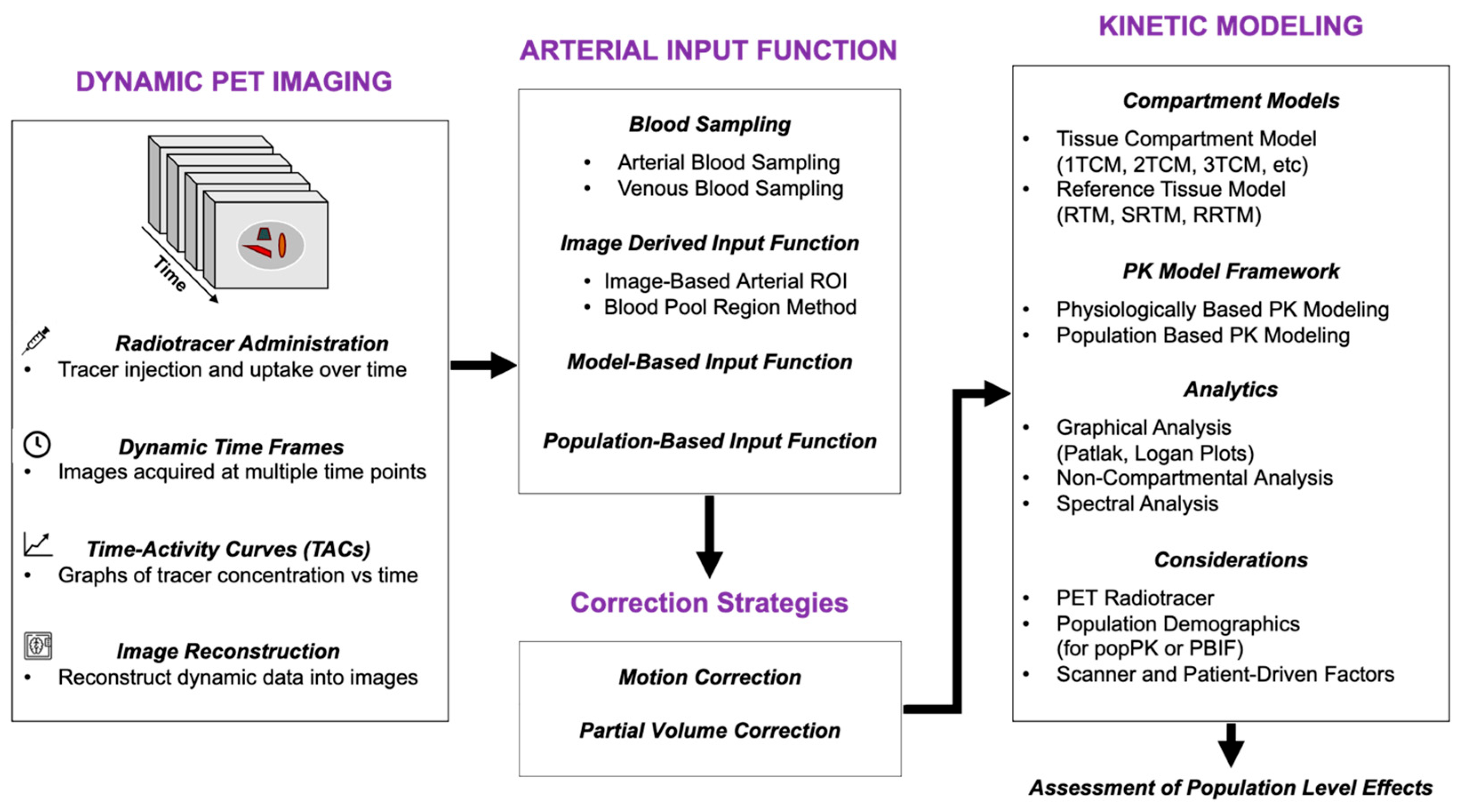

Advances and Challenges in Pharmacokinetic Modeling for PET Imaging: Compartment Models, Input Functions, and Quantitative Techniques

 , , ,
, , ,
Simple Summary
Abstract
1. Introduction
2. Foundation of Pharmacokinetic Modeling in PET
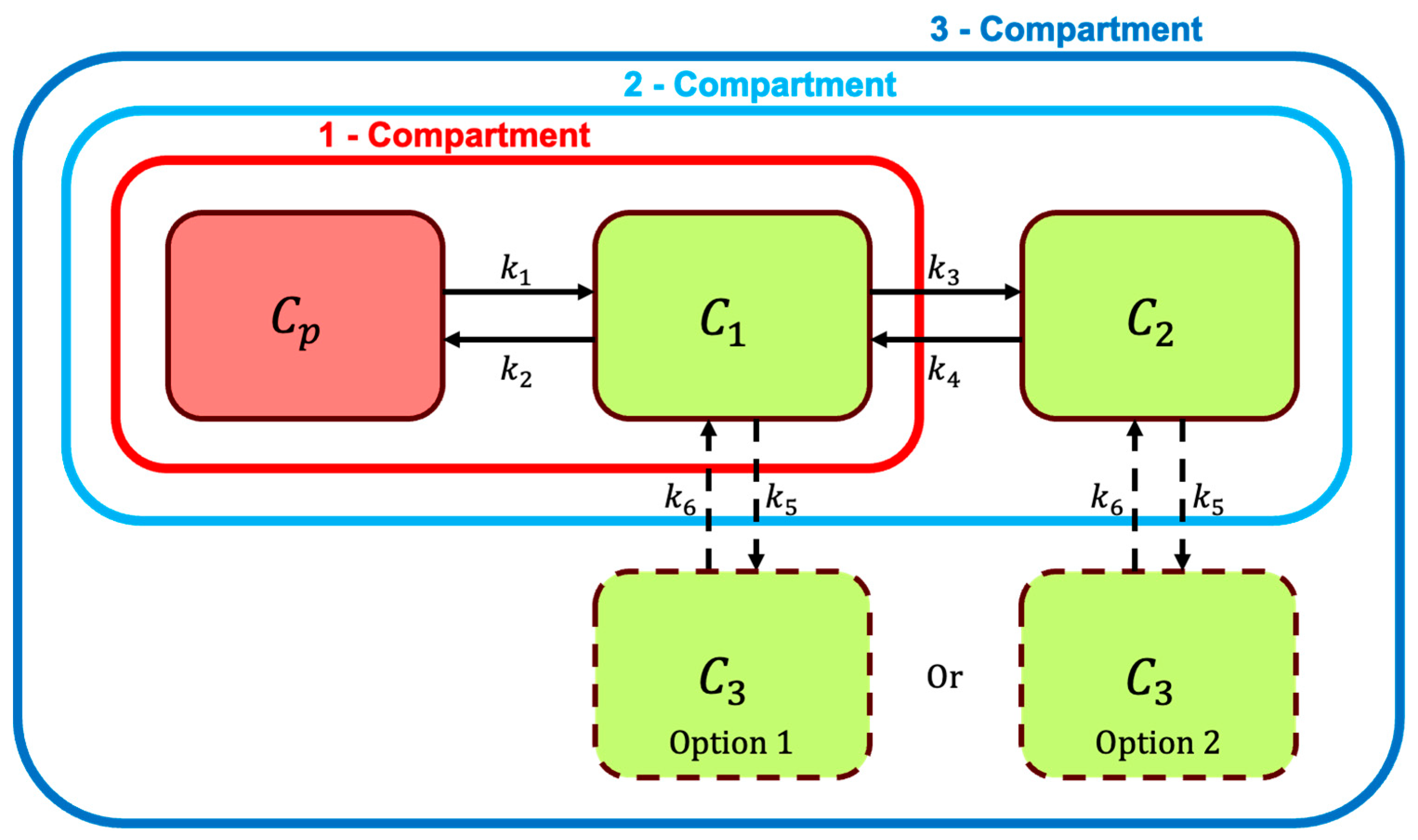
2.1. Classical Compartment Modeling
2.2. Reference Tissue Models
2.3. Defining Compartments in a Compartment Model
2.4. Reversible and Irreversible Binding
2.5. PK Compartment Summary
3. Input Functions
3.1. Blood Sampling-Based Input Functions
3.2. Image Derived Input Functions
3.3. Model-Based Input Functions
3.4. Population-Based Input Functions
4. Pharmacokinetic Analysis
4.1. Statistical Frameworks
4.2. Graphical Analysis
4.3. Non-Compartmental Analysis
4.4. Spectral Analysis
5. Recent Developments
6. General Considerations
6.1. Tracer Characteristics
6.2. Challenges
7. Conclusions
Author Contributions
Funding
Institutional Review Board Statement
Informed Consent Statement
Data Availability Statement
Conflicts of Interest
Abbreviations
| PET | Positron Emission Tomography |
| PK | Pharmacokinetic |
| ROI | Region of Interest |
| AIF | Arterial Input Function |
| TAC | Time–Activity Curve |
References
- Meibohm, B.; Derendorf, H. Basic Concepts of Pharmacokinetic/Pharmacodynamic (PK/PD) Modelling. Int. J. Clin. Pharmacol. Ther. 1997, 35, 401–413. [Google Scholar]
- Garralda, E.; Dienstmann, R.; Tabernero, J. Pharmacokinetic/Pharmacodynamic Modeling for Drug Development in Oncology. Am. Soc. Clin. Oncol. Educ. Book 2017, 37, 210–215. [Google Scholar] [CrossRef]
- Baud, F.J. Pharmacokinetic–Pharmacodynamic Relationships. How Are They Useful in Human Toxicology? Toxicol. Lett. 1998, 102–103, 643–648. [Google Scholar] [CrossRef]
- Gupta, N.; Price, P.M.; Aboagye, E.O. PET for in Vivo Pharmacokinetic and Pharmacodynamic Measurements. Eur. J. Cancer 2002, 38, 2094–2107. [Google Scholar] [CrossRef]
- Wang, G.; Rahmim, A.; Gunn, R.N. PET Parametric Imaging: Past, Present, and Future. IEEE Trans. Radiat. Plasma Med. Sci. 2020, 4, 663–675. [Google Scholar] [CrossRef]
- Nadav, G.; Liberman, G.; Artzi, M.; Kiryati, N.; Bashat, D.B. Optimization of Two-Compartment-Exchange-Model Analysis for Dynamic Contrast-Enhanced Mri Incorporating Bolus Arrival Time: Optimization of 2CXM DCE-MRI With BAT. J. Magn. Reson. Imaging 2017, 45, 237–249. [Google Scholar] [CrossRef] [PubMed]
- Debus, C.; Floca, R.; Ingrisch, M.; Kompan, I.; Maier-Hein, K.; Abdollahi, A.; Nolden, M. MITK-ModelFit: A Generic Open-Source Framework for Model Fits and Their Exploration in Medical Imaging—Design, Implementation and Application on the Example of DCE-MRI. BMC Bioinform. 2019, 20, 31. [Google Scholar] [CrossRef] [PubMed]
- TPC—Home. Available online: https://www.turkupetcentre.net/petanalysis/index.html (accessed on 25 December 2025).
- Gunn, R.N.; Gunn, S.R.; Cunningham, V.J. Positron Emission Tomography Compartmental Models. J. Cereb. Blood Flow Metab. 2001, 21, 635–652. [Google Scholar] [CrossRef] [PubMed]
- Hong, Y.T.; Fryer, T.D. Kinetic Modelling Using Basis Functions Derived from Two-Tissue Compartmental Models with a Plasma Input Function: General Principle and Application to [18F]Fluorodeoxyglucose Positron Emission Tomography. NeuroImage 2010, 51, 164–172. [Google Scholar] [CrossRef]
- Jones, H.; Rowland-Yeo, K. Basic Concepts in Physiologically Based Pharmacokinetic Modeling in Drug Discovery and Development. CPT Pharmacomet. Syst. Pharmacol. 2013, 2, 63. [Google Scholar] [CrossRef]
- Nguyen, D.; Shaik, J.S.; Tai, G.; Tiffany, C.; Perry, C.; Dumont, E.; Gardiner, D.; Barth, A.; Singh, R.; Hossain, M. Comparison between Physiologically Based Pharmacokinetic and Population Pharmacokinetic Modelling to Select Paediatric Doses of Gepotidacin in Plague. Br. J. Clin. Pharmacol. 2022, 88, 416–428. [Google Scholar] [CrossRef]
- Jaini, S.; Dadachova, E. FDG for Therapy of Metabolically Active Tumors. Semin. Nucl. Med. 2012, 42, 185–189. [Google Scholar] [CrossRef] [PubMed]
- Wong, K.P.; Feng, D.; Meikle, S.R.; Fulham, M.J. Simultaneous Estimation of Physiological Parameters and the Input Function—in Vivo PET Data. IEEE Trans. Inform. Technol. Biomed. 2001, 5, 67–76. [Google Scholar] [CrossRef] [PubMed]
- O’Hare, D.; Chilvers, R.J. Arterial Blood Sampling Practices in Intensive Care Units in England and Wales. Anaesthesia 2001, 56, 568–571. [Google Scholar] [CrossRef]
- Zanotti-Fregonara, P.; Chen, K.; Liow, J.-S.; Fujita, M.; Innis, R.B. Image-Derived Input Function for Brain PET Studies: Many Challenges and Few Opportunities. J. Cereb. Blood Flow Metab. 2011, 31, 1986–1998. [Google Scholar] [CrossRef]
- Shin, W.G.; Lee, M.G.; Lee, M.H. Arterial and Venous Blood Samplings in Pharmacokinetic Studies: Vancomycin in Rabbits. J. Clin. Pharm. Ther. 1993, 18, 115–122. [Google Scholar] [CrossRef]
- Chen, M.-L.; Lam, G.; Lee, M.G.; Chiou, W.L. Arterial and Venous Blood Sampling in Pharmacokinetic Studies: Griseofulvin. J. Pharm. Sci. 1982, 71, 1386–1389. [Google Scholar] [CrossRef]
- Bartlett, E.A.; Ananth, M.; Rossano, S.; Zhang, M.; Yang, J.; Lin, S.; Nabulsi, N.; Huang, Y.; Zanderigo, F.; Parsey, R.V.; et al. Quantification of Positron Emission Tomography Data Using Simultaneous Estimation of the Input Function: Validation with Venous Blood and Replication of Clinical Studies. Mol. Imaging Biol. 2019, 21, 926–934. [Google Scholar] [CrossRef]
- Fliervoet, L.A.L.; Tiel Groenestege, W.M.; Huisman, A. Comparison of Capillary and Venous Blood Sampling for Routine Coagulation Assays. Clin. Biochem. 2022, 104, 30–35. [Google Scholar] [CrossRef]
- Huang, W.; Isoherranen, N. Sampling Site Has a Critical Impact on Physiologically Based Pharmacokinetic Modeling. J. Pharmacol. Exp. Ther. 2020, 372, 30–45. [Google Scholar] [CrossRef] [PubMed]
- Nauck, M.A.; Ließ, H.; Siegel, E.G.; Niedmann, P.D.; Creutzfeldt, W. Critical Evaluation of the ‘Heated-hand-technique’ for Obtaining ‘Arterialized’ Venous Blood: Incomplete Arterialization and Alterations in Glucagon Responses. Clin. Physiol. 1992, 12, 537–552. [Google Scholar] [CrossRef]
- Sari, H.; Erlandsson, K.; Law, I.; Larsson, H.B.; Ourselin, S.; Arridge, S.; Atkinson, D.; Hutton, B.F. Estimation of an Image Derived Input Function with MR-Defined Carotid Arteries in FDG-PET Human Studies Using a Novel Partial Volume Correction Method. J. Cereb. Blood Flow Metab. 2017, 37, 1398–1409. [Google Scholar] [CrossRef]
- Holderman, N.; Carson, R.; Hillmer, A. Reference Model Based Estimation of Input Functions: Towards Volumes of Distribution Without Blood Sampling. J. Nucl. Med. 2023, 64, P1539. [Google Scholar]
- Narciso, L.; Deller, G.; Dassanayake, P.; Liu, L.; Pinto, S.; Anazodo, U.; Soddu, A.; Lawrence, K.S. Simultaneous Estimation of a Model-Derived Input Function for Quantifying Cerebral Glucose Metabolism with [18F]FDG PET. EJNMMI Phys. 2024, 11, 11. [Google Scholar] [CrossRef]
- Naganawa, M.; Gallezot, J.-D.; Shah, V.; Mulnix, T.; Young, C.; Dias, M.; Chen, M.-K.; Smith, A.M.; Carson, R.E. Assessment of Population-Based Input Functions for Patlak Imaging of Whole Body Dynamic 18F-FDG PET. EJNMMI Phys. 2020, 7, 67. [Google Scholar] [CrossRef] [PubMed]
- Zanotti-Fregonara, P.; Zoghbi, S.; Liow, J.-S.; Luong, E.; Boellaard, R.; Gladding, R.; Pike, V.; Innis, R.; Fujita, M. Population-Based Input Function Is an Accurate Alternative to Arterial Sampling in [11C](R)-Rolipram PET Brain Studies. J. Nucl. Med. 2011, 52, 548. [Google Scholar]
- Zanotti-Fregonara, P.; Hines, C.S.; Zoghbi, S.S.; Liow, J.-S.; Zhang, Y.; Pike, V.W.; Drevets, W.C.; Mallinger, A.G.; Zarate, C.A.; Fujita, M.; et al. Population-Based Input Function and Image-Derived Input Function for [11C](R)-Rolipram PET Imaging: Methodology, Validation and Application to the Study of Major Depressive Disorder. Neuroimage 2012, 63, 1532–1541. [Google Scholar] [CrossRef]
- Mould, D.R.; Upton, R.N. Basic Concepts in Population Modeling, Simulation, and Model-Based Drug Development-Part 2: Introduction to Pharmacokinetic Modeling Methods. CPT Pharmacomet. Syst. Pharmacol. 2013, 2, e38. [Google Scholar] [CrossRef] [PubMed]
- Tornøe, C.W.; Agersø, H.; Jonsson, E.N.; Madsen, H.; Nielsen, H.A. Non-Linear Mixed-Effects Pharmacokinetic/Pharmacodynamic Modelling in NLME Using Differential Equations. Comput. Methods Programs Biomed. 2004, 76, 31–40. [Google Scholar] [CrossRef]
- Lachos, V.H.; Castro, L.M.; Dey, D.K. Bayesian Inference in Nonlinear Mixed-Effects Models Using Normal Independent Distributions. Comput. Stat. Data Anal. 2013, 64, 237–252. [Google Scholar] [CrossRef]
- Zhou, Y.; Ye, W.; Brašić, J.R.; Wong, D.F. Multi-Graphical Analysis of Dynamic PET. Neuroimage 2010, 49, 2947–2957. [Google Scholar] [CrossRef]
- Mankoff, D.A.; Shields, A.F.; Graham, M.M.; Link, J.M.; Krohn, K.A. A Graphical Analysis Method to Estimate Blood-to-Tissue Transfer Constants for Tracers with Labeled Metabolites. J. Nucl. Med. 1996, 37, 2049–2057. [Google Scholar]
- Patlak, C.S.; Blasberg, R.G. Graphical Evaluation of Blood-to-Brain Transfer Constants from Multiple-Time Uptake Data. Generalizations. J. Cereb. Blood Flow Metab. 1985, 5, 584–590. [Google Scholar] [CrossRef] [PubMed]
- Logan, J. Graphical Analysis of PET Data Applied to Reversible and Irreversible Tracers. Nucl. Med. Biol. 2000, 27, 661–670. [Google Scholar] [CrossRef] [PubMed]
- Logan, J.; Fowler, J.S.; Volkow, N.D.; Wang, G.-J.; Ding, Y.-S.; Alexoff, D.L. Distribution Volume Ratios without Blood Sampling from Graphical Analysis of PET Data. J. Cereb. Blood Flow Metab. 1996, 16, 834–840. [Google Scholar] [CrossRef]
- Meikle, S.R.; Matthews, J.C.; Brock, C.S.; Wells, P.; Harte, R.J.A.; Cunningham, V.J.; Jones, T.; Price, P. Pharmacokinetic Assessment of Novel Anti-Cancer Drugs Using Spectral Analysis and Positron Emission Tomography: A Feasibility Study. Cancer Chemother. Pharmacol. 1998, 42, 183–193. [Google Scholar] [CrossRef]
- Giuliani, A. The Application of Principal Component Analysis to Drug Discovery and Biomedical Data. Drug Discov. Today 2017, 22, 1069–1076. [Google Scholar] [CrossRef] [PubMed]
- Dimitrakopoulou-Strauss, A.; Pan, L.; Sachpekidis, C. Kinetic Modeling and Parametric Imaging with Dynamic PET for Oncological Applications: General Considerations, Current Clinical Applications, and Future Perspectives. Eur. J. Nucl. Med. Mol. Imaging 2021, 48, 21–39. [Google Scholar] [CrossRef]
- Huang, Z.; Denti, P.; Mistry, H.; Kloprogge, F. Machine Learning and Artificial Intelligence in PK-PD Modeling: Fad, Friend, or Foe? Clin. Pharmacol. Ther. 2024, 115, 652–654. [Google Scholar] [CrossRef]
- Satheeskumar, R. Enhancing Drug Discovery with AI: Predictive Modeling of Pharmacokinetics Using Graph Neural Networks and Ensemble Learning. Intell. Pharm. 2025, 3, 127–140. [Google Scholar] [CrossRef]
- Xu, Z.; Gao, M.; Papadakis, G.Z.; Luna, B.; Jain, S.; Mollura, D.J.; Bagci, U. Joint Solution for PET Image Segmentation, Denoising, and Partial Volume Correction. Med. Image Anal. 2018, 46, 229–243. [Google Scholar] [CrossRef]
- Chen, J.; Jiang, Z.; Coughlin, J.M.; Cheong, I.; Mills, K.A.; Pomper, M.G.; Du, Y. Deep Learning-Derived Arterial Input Function for Dynamic Brain PET. NeuroImage 2025, 324, 121609. [Google Scholar] [CrossRef]
- Kuttner, S.; Luppino, L.T.; Convert, L.; Sarrhini, O.; Lecomte, R.; Kampffmeyer, M.C.; Sundset, R.; Jenssen, R. Deep-Learning-Derived Input Function in Dynamic [18F]FDG PET Imaging of Mice. Front. Nucl. Med. 2024, 4, 1372379. [Google Scholar] [CrossRef]
- Chen, R.; Yang, X.; Ng, Y.L.; Yu, X.; Huo, Y.; Xiao, X.; Zhang, C.; Chen, Y.; Zheng, C.; Li, L.; et al. First Total-Body Kinetic Modeling and Parametric Imaging of Dynamic68 Ga-FAPI-04 PET in Pancreatic and Gastric Cancer. J. Nucl. Med. 2023, 64, 960–967. [Google Scholar] [CrossRef]
- Stein, A.M.; Peletier, L.A. Predicting the Onset of Nonlinear Pharmacokinetics. CPT Pharmacomet. Syst. Pharmacol. 2018, 7, 670–677. [Google Scholar] [CrossRef] [PubMed]
- Mould, D.R.; Upton, R.N. Basic Concepts in Population Modeling, Simulation, and Model-Based Drug Development. CPT Pharmacomet. Syst. Pharmacol. 2012, 1, e6. [Google Scholar] [CrossRef] [PubMed]
- Morris, E.D.; Emvalomenos, G.M.; Hoye, J.; Meikle, S.R. Modeling PET Data Acquired During Nonsteady Conditions: What If Brain Conditions Change During the Scan? J. Nucl. Med. 2024, 65, 1824–1837. [Google Scholar] [CrossRef]
- Du, Y.; Madar, I.; Stumpf, M.J.; Rong, X.; Fung, G.S.K.; Frey, E.C. Compensation for Spill-in and Spill-out Partial Volume Effects in Cardiac PET Imaging. J. Nucl. Cardiol. 2013, 20, 84–98. [Google Scholar] [CrossRef]
- Wang, J.; Bermudez, D.; Chen, W.; Durgavarjhula, D.; Randell, C.; Uyanik, M.; McMillan, A. Motion-Correction Strategies for Enhancing Whole-Body PET Imaging. Front. Nucl. Med. 2024, 4, 1257880. [Google Scholar] [CrossRef] [PubMed]
- Keshavarz, M.; Huang, B. Bayesian and Expectation Maximization Methods for Multivariate Change Point Detection. Comput. Chem. Eng. 2014, 60, 339–353. [Google Scholar] [CrossRef]



| Input Function | Invasiveness | Accuracy | Complexity | Clinical Feasibility |
|---|---|---|---|---|
| AIF-Arterial | High: Requires arterial catheterization | Highest: Gold Standard | Moderate: Requires skilled personnel for catheterization | Low: Largely restricted to research settings due to invasiveness |
| AIF-Venous | Moderate: Samples drawn from peripheral vein | Low/Moderate: Arterial–venous differences | Low: More accessible to obtain blood sample | Moderate: Less invasive but also less accurate |
| IDIF | Low: Can require samples for calibration | Moderate: Susceptible to partial volume effects | Moderate: Requires precise image processing and correction algorithms | Low: limited implementation of PET radiopharmaceuticals |
| MBIF | Low: Can require samples for scaling | Moderate: Can be good with a good reference region | High: Requires mathematical modeling and validation | Low: limited implementation of PET radiopharmaceuticals |
| PBIF | Low: Can require samples for scaling | Moderate: Assumes patient matches population | Low: Once derived, it is simple to apply | High: Easily implemented |
Disclaimer/Publisher’s Note: The statements, opinions and data contained in all publications are solely those of the individual author(s) and contributor(s) and not of MDPI and/or the editor(s). MDPI and/or the editor(s) disclaim responsibility for any injury to people or property resulting from any ideas, methods, instructions or products referred to in the content. |
© 2026 by the authors. Licensee MDPI, Basel, Switzerland. This article is an open access article distributed under the terms and conditions of the Creative Commons Attribution (CC BY) license.
Share and Cite
Wang, J.H.; Uyanik, M.; Li, X.; Chen, W.; He, Z.; Randell, C.; McMillan, A. Advances and Challenges in Pharmacokinetic Modeling for PET Imaging: Compartment Models, Input Functions, and Quantitative Techniques. Tomography 2026, 12, 63. https://doi.org/10.3390/tomography12050063
Wang JH, Uyanik M, Li X, Chen W, He Z, Randell C, McMillan A. Advances and Challenges in Pharmacokinetic Modeling for PET Imaging: Compartment Models, Input Functions, and Quantitative Techniques. Tomography. 2026; 12(5):63. https://doi.org/10.3390/tomography12050063
Chicago/Turabian StyleWang, James Hao, Meltem Uyanik, Xue Li, Weijie Chen, Zhijin He, Caitlin Randell, and Alan McMillan. 2026. "Advances and Challenges in Pharmacokinetic Modeling for PET Imaging: Compartment Models, Input Functions, and Quantitative Techniques" Tomography 12, no. 5: 63. https://doi.org/10.3390/tomography12050063
APA StyleWang, J. H., Uyanik, M., Li, X., Chen, W., He, Z., Randell, C., & McMillan, A. (2026). Advances and Challenges in Pharmacokinetic Modeling for PET Imaging: Compartment Models, Input Functions, and Quantitative Techniques. Tomography, 12(5), 63. https://doi.org/10.3390/tomography12050063