
Enhanced LGMD Model with Adaptive Probabilistic Regulation for Compound Interference


Abstract
1. Introduction
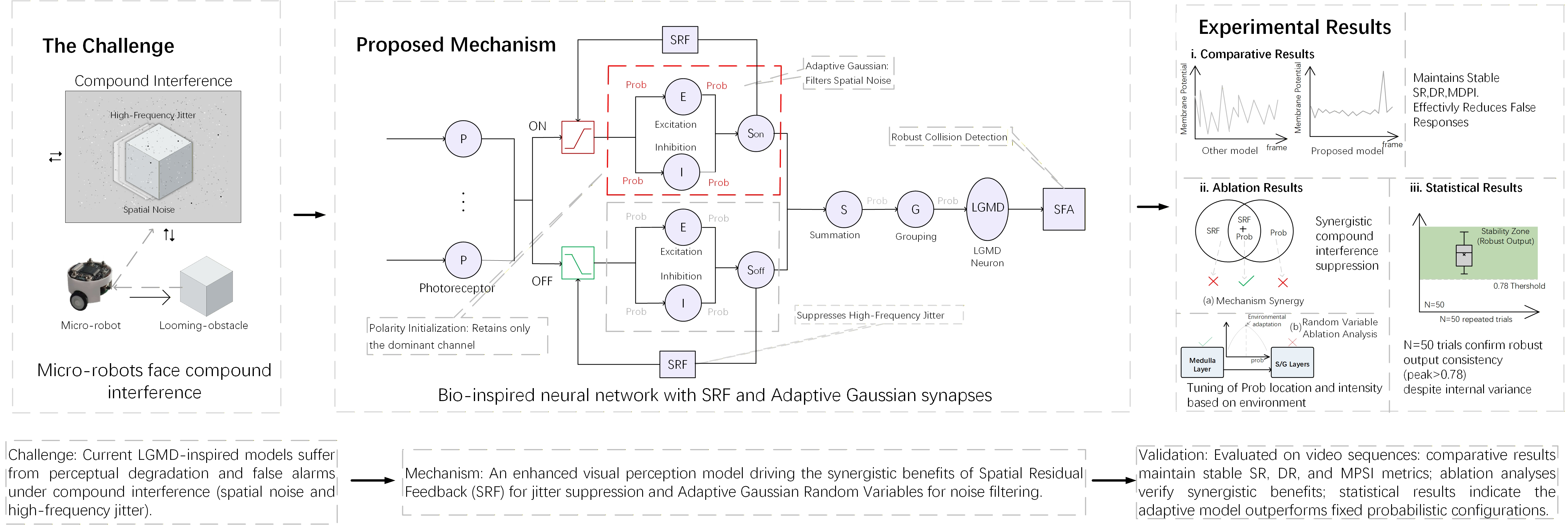
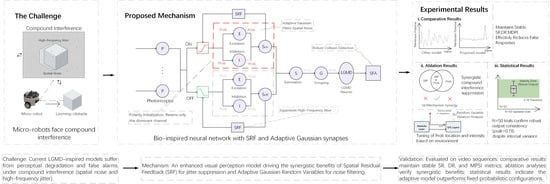
- We propose an enhanced LGMD-inspired visual perception model that resolves the vulnerability of existing architectures under compound interferences. By the structural synergy between SRF and adaptive Gaussian random variables. A spatial residual feedback mechanism is introduced in the early visual pathways to suppress high-frequency jitter, decoupling the compound interference into discrete spatial noise. Based on this decoupled visual signal, adaptive Gaussian random variables are employed to filter the residual noise, facilitating reliable collision detection.
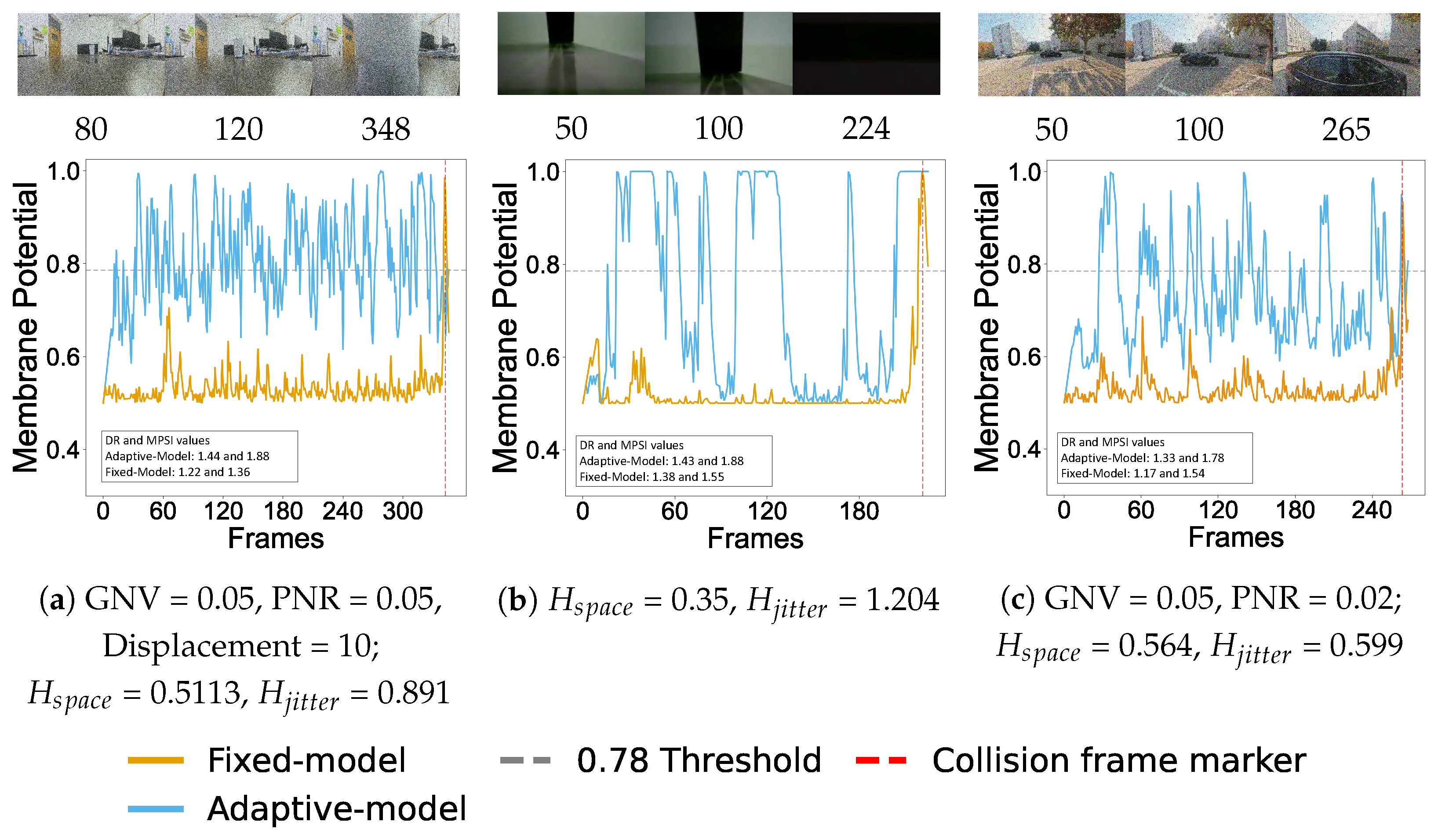
- We develop an environment-aware adaptive parameter tuning method to overcome the challenge of fixed probabilistic configurations in compound interference. Instead of relying on fixed probability that fail under varying noise levels, our approach extracts spatial noise intensity and jitter levels from initial environmental metrics. This allows the model to calculate and scale the optimal synaptic transmission probability through a predefined mapping function, enhancing tracking reliability under compound interference.
- Extensive experiments are conducted across various datasets to verify the effectiveness of the proposed model. The results demonstrate its robustness in preserving collision features while suppressing compound interference.
2. Related Work
2.1. Spatial Noise Suppression Methods of LGMD Visual Networks
2.2. High-Frequency Jitter Suppression Methods of LGMD Visual Networks
3. Formulation of the Proposed Model
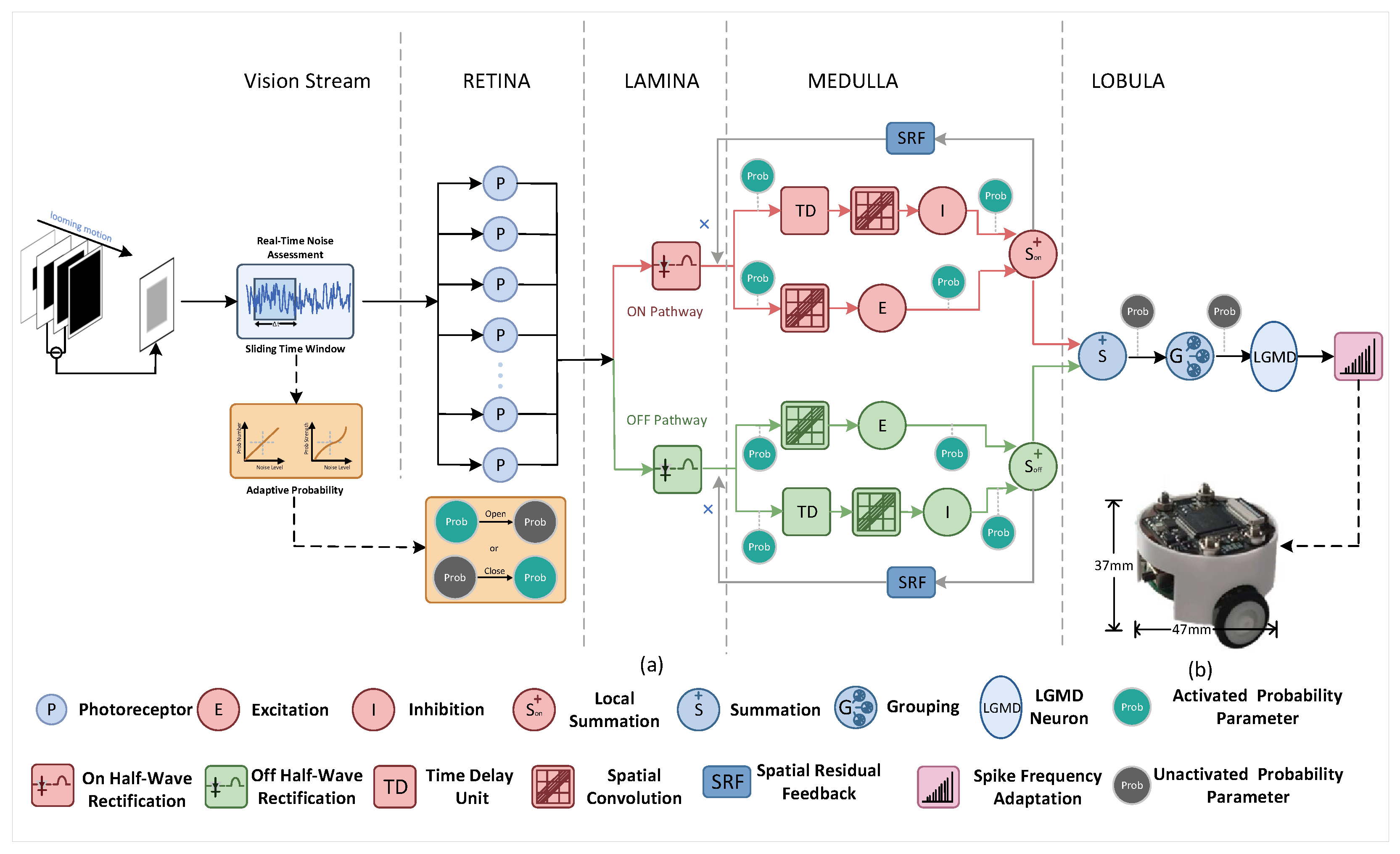
3.1. Computational Retina Layer
3.2. Computational Lamina Layer
3.3. Computational Medulla Layer
3.3.1. Excitation Layer
3.3.2. Inhibition Layer
3.3.3. Local Signal Integration
3.4. Computational Lobula Layer
3.4.1. Spatial Residual Feedback Pathway
3.4.2. Summation Layer
3.4.3. Grouping Layer
3.4.4. The LGMD Cell
3.4.5. Spike Frequency Adaptation
4. Experiments Setting
4.1. Parameters of the System
4.2. Datasets
4.3. Noise Simulation
4.3.1. Spatial Noise Injection
4.3.2. High-Frequency Jitter Injection
4.4. Performance Evaluation
4.4.1. Evaluation Metrics
4.4.2. Assessment of Spatial Noise
4.4.3. Assessment of High-Frequency Jitter
4.4.4. Contrast Polarity Initialization
4.4.5. Adaptive Probability Mapping Strategy
4.4.6. Statistical Reliability Metrics
5. Results and Analysis
5.1. Comparative Experiments
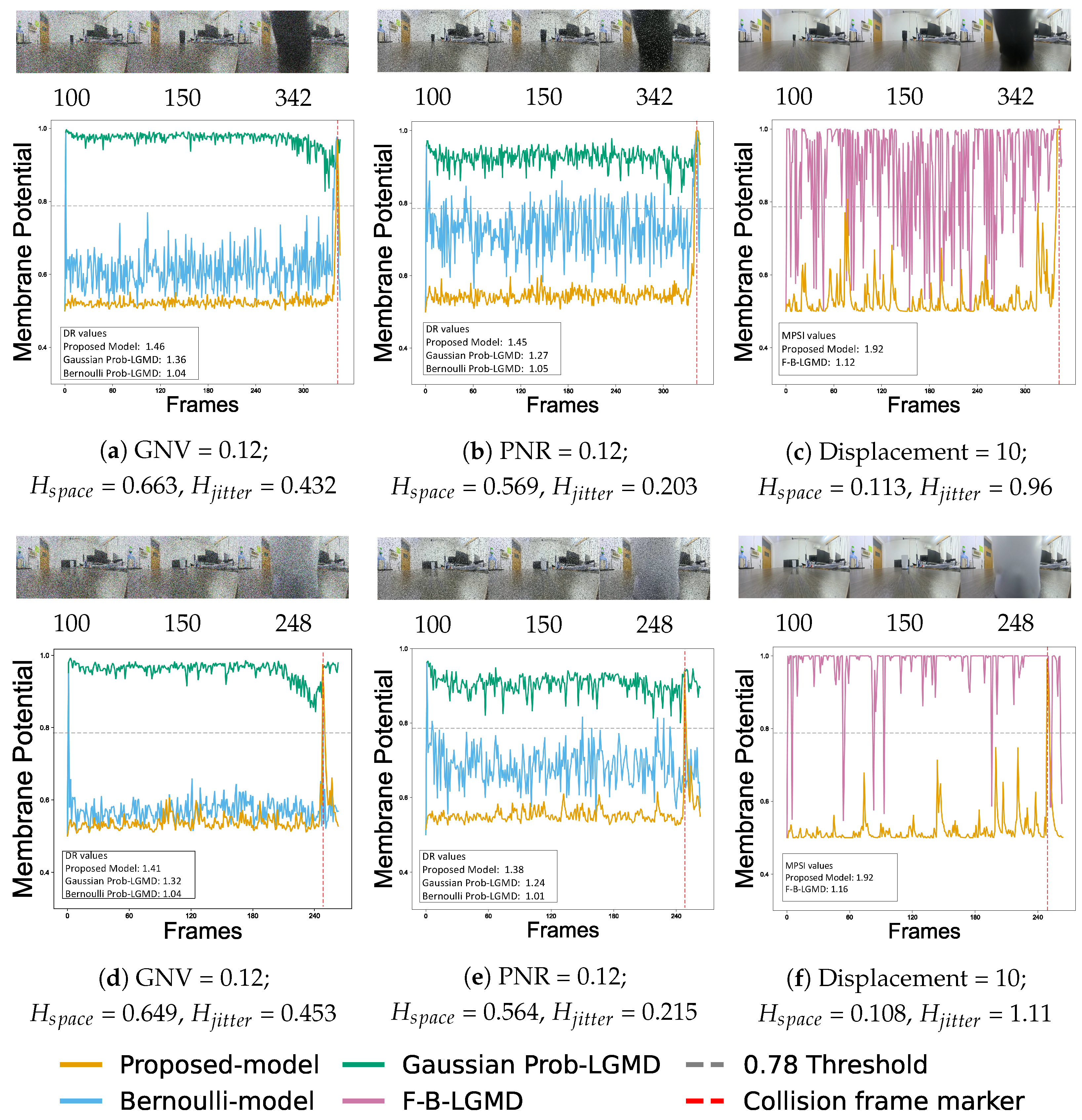
5.1.1. Performance Evaluation Under Individual Noise Sources
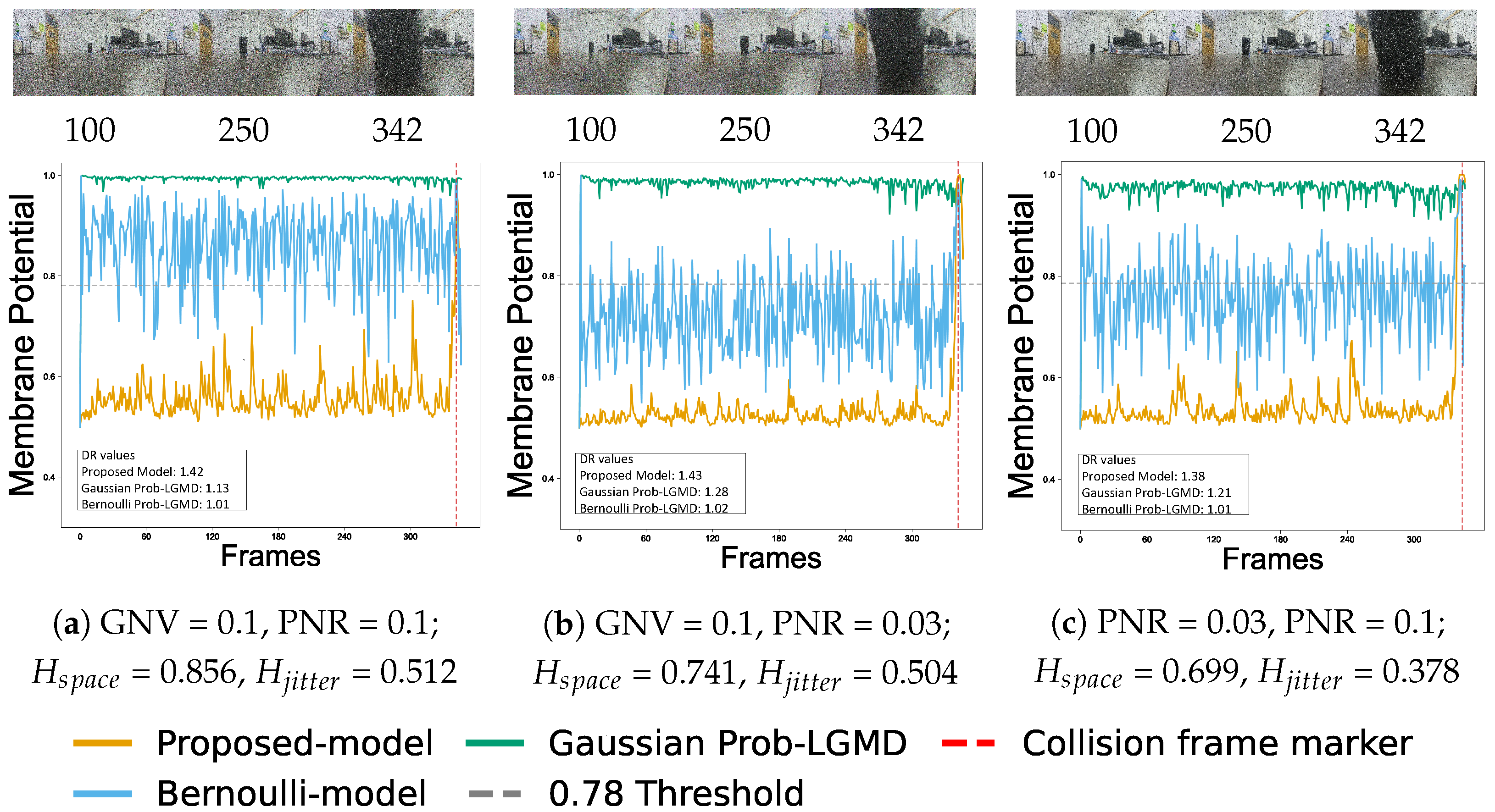
5.1.2. Robustness Assessment Under Compound Interference
5.2. Ablation Studies and Mechanism Analysis
5.2.1. Ablation Study of the Mechanisms
5.2.2. Parameter Optimization of the Random Variable

| Scenario | Bernoulli-Prob-LGMD | Gaussian-Prob-LGMD | F-B-LGMD | Proposed |
|---|---|---|---|---|
| Figure 2a | 67 | 78 | 72 | 83 |
| Figure 2b | 67 | 72 | 67 | 83 |
| Figure 2c | 62 | 71 | 76 | 86 |
| Figure 2d | 72 | 78 | 72 | 89 |
| Figure 2e | 67 | 78 | 72 | 83 |
| Figure 2f | 62 | 71 | 76 | 86 |
| Figure 3a | 64 | 72 | 68 | 87 |
| Figure 3b | 68 | 76 | 71 | 89 |
| Figure 3c | 65 | 73 | 68 | 88 |
| Figure 4a | 61 | 68 | 74 | 82 |
| Figure 4b | 57 | 67 | 73 | 80 |
| Figure 4c | 56 | 64 | 68 | 80 |
| Scenario | fixed-model | adaptive-model | — | — |
| Figure 8a | 60 | 80 | ||
| Figure 8b | 53 | 77 | ||
| Figure 8c | 50 | 73 |
| Scenario | Bernoulli-Prob-LGMD | Gaussian-Prob-LGMD | F-B-LGMD | Proposed |
|---|---|---|---|---|
| Figure 2a | – | |||
| Figure 2b | – | |||
| Figure 2d | – | |||
| Figure 2e | – | |||
| Figure 3a | – | |||
| Figure 3b | – | |||
| Figure 3c | – | |||
| Figure 4a | ||||
| Figure 4b | ||||
| Figure 4c | ||||
| Scenario | fixed-model | adaptive-model | — | — |
| Figure 8a | ||||
| Figure 8b | ||||
| Figure 8c |
| Scenario | Bernoulli-Prob-LGMD | Gaussian-Prob-LGMD | F-B-LGMD | Proposed |
|---|---|---|---|---|
| Figure 2c | – | – | ||
| Figure 2f | – | – | ||
| Figure 3a | ||||
| Figure 3b | ||||
| Figure 3c | ||||
| Figure 4a | ||||
| Figure 4b | ||||
| Figure 4c | ||||
| Scenario | fixed-model | adaptive-model | — | — |
| Figure 8a | ||||
| Figure 8b | ||||
| Figure 8c |
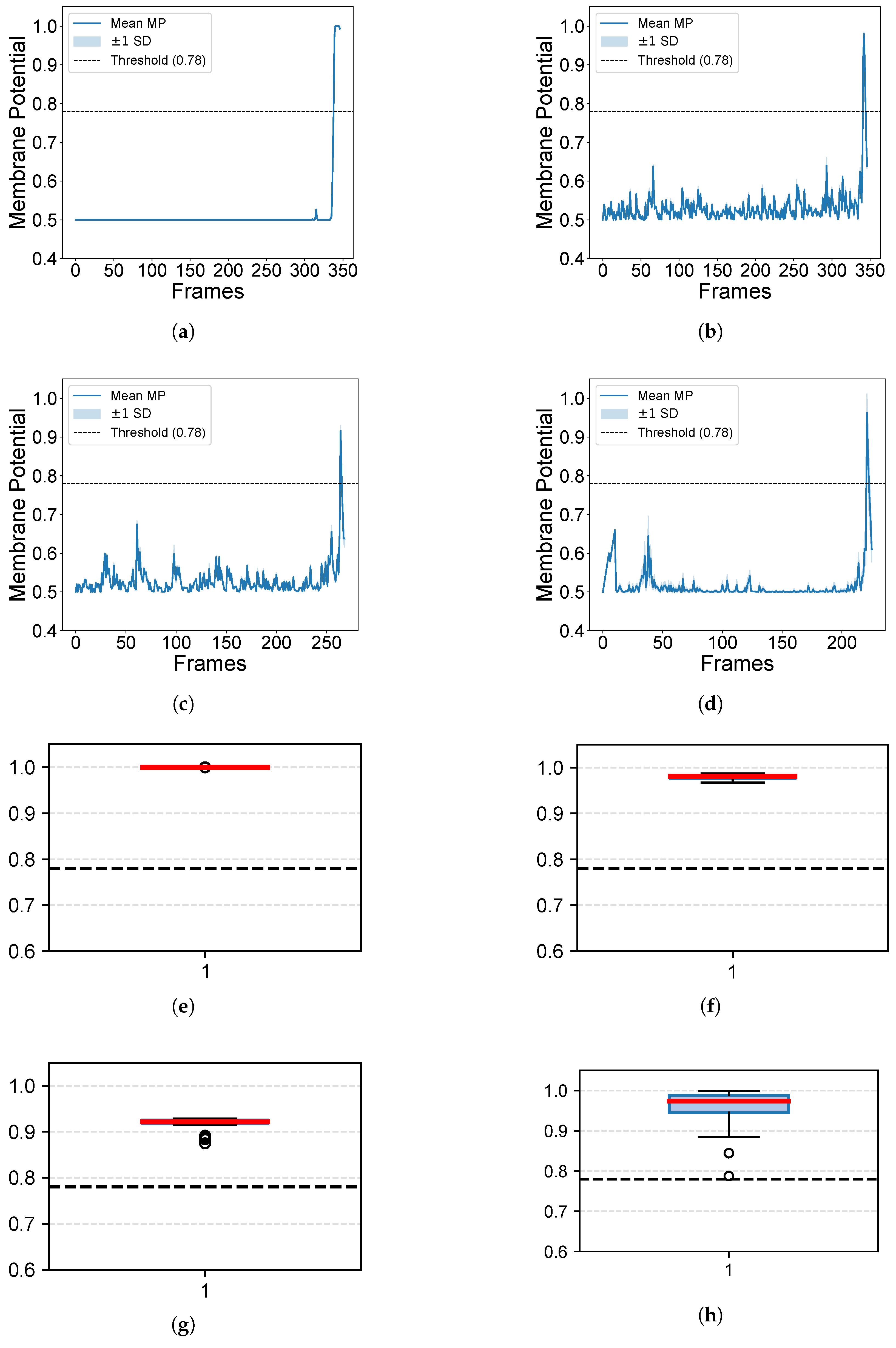
5.3. Statistical Stability Analysis
6. Further Discussion
7. Conclusions
Author Contributions
Funding
Institutional Review Board Statement
Informed Consent Statement
Data Availability Statement
Conflicts of Interest
References
- Fu, Q.; Hu, C.; Liu, T.; Yue, S. Collision selective LGMDs neuron models research benefits from a vision-based autonomous micro robot. In Proceedings of the 2017 IEEE/RSJ International Conference on Intelligent Robots and Systems (IROS); IEEE: Piscataway, NJ, USA, 2017; pp. 3996–4002. [Google Scholar]
- Zhao, J.; Ma, X.; Fu, Q.; Hu, C.; Yue, S. An LGMD based competitive collision avoidance strategy for UAV. In Proceedings of the IFIP International Conference on Artificial Intelligence Applications and Innovations; Springer: Berlin/Heidelberg, Germany, 2019; pp. 80–91. [Google Scholar]
- Sun, X.; Fu, Q.; Peng, J.; Yue, S. An insect-inspired model facilitating autonomous navigation by incorporating goal approaching and collision avoidance. Neural Netw. 2023, 165, 106–118. [Google Scholar] [CrossRef] [Scilit] [PubMed]
- Chen, C.; Zhang, P.; Zhang, H.; Dai, J.; Yi, Y.; Zhang, H.; Zhang, Y. Deep learning on computational-resource-limited platforms: A survey. Mob. Inf. Syst. 2020, 2020, 8454327. [Google Scholar] [CrossRef] [Scilit]
- Pleterski, J.; Puc, J.; Podržaj, P.; Škulj, G. Constraint-Driven Neural Network Architecture Adaptation for Image Localisation on a Miniature Mobile Robot. IEEE Sens. J. 2026, 26, 13497–13506. [Google Scholar] [CrossRef] [Scilit]
- Qin, Z.; Peng, J.; Yue, S.; Fu, Q. A bio-inspired research paradigm of collision perception neurons enabling neuro-robotic integration: The LGMD case. J. R. Soc. Interface 2025, 22, 20250433. [Google Scholar] [CrossRef] [Scilit] [PubMed]
- Fu, Q.; Hu, C.; Peng, J.; Rind, F.C.; Yue, S. A robust collision perception visual neural network with specific selectivity to darker objects. IEEE Trans. Cybern. 2020, 50, 5074–5088. [Google Scholar] [CrossRef] [Scilit] [PubMed]
- Xu, M.; Luan, H.; Hao, Z.D.; Peng, J.; Yue, S. STMDNet: A Lightweight Directional Framework for Motion Pattern Recognition of Tiny Targets. arXiv 2025, arXiv:2501.13054. [Google Scholar]
- Lei, F.; Peng, Z.; Liu, M.; Peng, J.; Cutsuridis, V.; Yue, S. A robust visual system for looming cue detection against translating motion. IEEE Trans. Neural Netw. Learn. Syst. 2023, 34, 8362–8376. [Google Scholar] [CrossRef] [Scilit] [PubMed]
- Fu, Q.; Sun, X.; Liu, T.; Hu, C.; Yue, S. Robustness of bio-inspired visual systems for collision prediction in critical robot traffic. Front. Robot. 2021, 8, 529872. [Google Scholar] [CrossRef] [Scilit]
- Wu, H.; Yue, S.; Hu, C. Re-framing bio-plausible collision detection: Identifying shared metaproperties through strategic prototyping. Front. Neurorobot. 2024, 18, 1349498. [Google Scholar] [CrossRef] [Scilit] [PubMed]
- Hong, J.; Sun, X.; Peng, J.; Fu, Q. A bio-inspired probabilistic neural network model for noise-resistant collision perception. Biomimetics 2024, 9, 136. [Google Scholar] [CrossRef] [Scilit] [PubMed]
- Faisal, A.A.; Selen, L.P.J.; Wolpert, D.M. Noise in the nervous system. Nat. Rev. Neurosci. 2008, 9, 292–303. [Google Scholar] [CrossRef] [Scilit] [PubMed]
- Abbott, L.F.; Regehr, W.G. Synaptic computation. Nature 2004, 431, 796–803. [Google Scholar] [CrossRef] [Scilit] [PubMed]
- Borst, A.; Euler, T. Seeing things in motion: Models, circuits, and mechanisms. Neuron 2011, 71, 974–994. [Google Scholar] [CrossRef] [Scilit] [PubMed]
- Zheng, L.; De Polavieja, G.G.; Wolfram, V.; Asyali, M.H.; Hardie, R.C.; Juusola, M. Feedback network controls photoreceptor output at the layer of first visual synapses in Drosophila. J. Gen. Physiol. 2006, 127, 495–510. [Google Scholar] [CrossRef] [Scilit] [PubMed]
- Nurminen, L.; Merlin, S.; Bijanzadeh, M.; Federer, F.; Angelucci, A. Top-down feedback controls spatial summation and response amplitude in primate visual cortex. Nat. Commun. 2018, 9, 2281. [Google Scholar] [CrossRef] [Scilit] [PubMed]
- Olson, E.G.; Wiens, T.K.; Gray, J.R. A model of feedforward, global, and lateral inhibition in the locust visual system predicts responses to looming stimuli. Biol. Cybern. 2021, 115, 245–265. [Google Scholar] [CrossRef] [Scilit] [PubMed]
- Fu, Q.; Peng, J.; Yue, S. Bioinspired contrast vision computation for robust motion estimation against natural signals. In Proceedings of the 2021 International Joint Conference on Neural Networks (IJCNN); IEEE: Piscataway, NJ, USA, 2021; pp. 1–8. [Google Scholar]
- Yue, S.; Rind, F.C. Collision detection in complex dynamic scenes using an LGMD-based visual neural network with feature enhancement. IEEE Trans. Neural Netw. 2006, 17, 705–716. [Google Scholar] [CrossRef] [Scilit] [PubMed]
- Wang, H.; Peng, J.; Zheng, X.; Yue, S. A robust visual system for small target motion detection against cluttered moving backgrounds. IEEE Trans. Neural Netw. Learn. Syst. 2020, 31, 839–853. [Google Scholar] [CrossRef] [Scilit] [PubMed]
- Jones, P.W.; Gabbiani, F. Impact of neural noise on a sensory-motor pathway signaling impending collision. J. Neurophysiol. 2012, 107, 1067–1079. [Google Scholar] [CrossRef] [Scilit] [PubMed]
- Cai, Y.; Fu, Q. Stochastic and evolutionary looming detection under visual noise. Bioinspir. Biomim. 2026, 21, 016003. [Google Scholar]
- Lin, C.Y.; Yao, W.S. Analysis and design multiple layer adaptive Kalman filter applied to electro-optical infrared payload vision system. Electronics 2022, 11, 677. [Google Scholar] [CrossRef] [Scilit]
- Shin, Y.H.; Kim, D.; Son, S.; Ham, J.W.; Oh, K.Y. Vibration isolation of a surveillance system equipped in a drone with mode decoupling. Appl. Sci. 2021, 11, 1961. [Google Scholar] [CrossRef] [Scilit]
- Deng, Z.; Yang, D.; Zhang, X.; Dong, Y.; Liu, C.; Shen, Q. Real-time image stabilization method based on optical flow and binary point feature matching. Electronics 2020, 9, 198. [Google Scholar] [CrossRef] [Scilit]
- Yu, J.; Zhang, T.; Shi, F.; He, L.; Liang, C.K. Sensorflow: Sensor and image fused video stabilization. In Proceedings of the Winter Conference on Applications of Computer Vision; IEEE: Piscataway, NJ, USA, 2025; pp. 8443–8452. [Google Scholar]
- Lee, Y.G. Low memory access video stabilization for low-cost camera SoC. Sensors 2022, 22, 2341. [Google Scholar] [CrossRef] [Scilit] [PubMed]
- Liu, T.; Ren, K.; Wan, G.; Wen, S. No Labels, No Look-Ahead: Unsupervised Online Video Stabilization with Classical Priors. In Proceedings of the IEEE/CVF Conference on Computer Vision and Pattern Recognition; IEEE: Piscataway, NJ, USA, 2026; pp. 6868–6877. [Google Scholar]
- Zhao, J.; Wang, H.; Bellotto, N.; Hu, C.; Peng, J.; Yue, S. Enhancing LGMD’s looming selectivity for UAV with spatial–temporal distributed presynaptic connections. IEEE Trans. Neural Netw. Learn. Syst. 2023, 34, 2539–2553. [Google Scholar] [CrossRef] [Scilit] [PubMed]
- Zhao, J.; Xie, Q.; Shuang, F.; Yue, S. An angular acceleration based looming detector for moving UAVs. Biomimetics 2024, 9, 22. [Google Scholar] [CrossRef] [Scilit] [PubMed]
- Chang, Z.; Fu, Q.; Chen, H.; Li, H.; Peng, J. A look into feedback neural computation upon collision selectivity. Neural Netw. 2023, 166, 22–37. [Google Scholar] [CrossRef] [Scilit] [PubMed]
- James, J.V.; Cazzolato, B.S.; Grainger, S.; Wiederman, S.D. Nonlinear, neuronal adaptation in insect vision models improves target discrimination within repetitively moving backgrounds. Bioinspir. Biomim. 2021, 16, 066015. [Google Scholar] [CrossRef] [Scilit]
- Peron, S.; Gabbiani, F. Spike frequency adaptation mediates looming stimulus selectivity in a collision-detecting neuron. Nat. Neurosci. 2009, 12, 318–326. [Google Scholar] [CrossRef] [Scilit] [PubMed]
- Li, Y.; Lin, Y.; Chen, W.; Yao, C.; Shi, P.; Luan, H. Bio-Plausible Collision Detection in MicroRobots: A Comparative Study of LGMD-Inspired Models. In Proceedings of the 2025 IEEE International Conference on Mechatronics and Automation (ICMA); IEEE: Piscataway, NJ, USA, 2025; pp. 634–639. [Google Scholar]


| Parameter | Description | Value |
|---|---|---|
| The control coefficient of inhibitory flow | and | |
| The Gaussian spatial convolution kernel | 0∼1 | |
| Threshold in G layer processing | 875 | |
| Coefficient in G layer processing | 70∼100 | |
| Probability parameter | adaptable | |
| The adaptation rate for the dynamic baseline | ||
| The momentum decay coefficient | ||
| g | Amplification gain parameter | 50∼70 |
| Spatial dimension of input stimuli | 320 × 240 |
| Subset | Environment | Experimental Conditions | Totals |
|---|---|---|---|
| I | Subset 1 | Synthetic Noise (Gaussian & salt-and-pepper: –; jitter: 1–10 px) | 4200 |
| II | Subset 2 | mechanical jitter (2–3 px, 4–6 px, 8–10 px) | 60 |
| III | Subset 3 | dynamic background + mixed Noise (–) | 76 |
| Test Scenario | Mean () | Std. Dev. () | IQR | 95% CI | p-Value |
|---|---|---|---|---|---|
| (a) Ideal Baseline Scenario | <0.001 | ||||
| (b) Synthetic Compound Interference | <0.001 | ||||
| (c) Real Micro-robot Locomotion | <0.001 | ||||
| (d) Real Handheld Outdoor Jitter | <0.001 |
Disclaimer/Publisher’s Note: The statements, opinions and data contained in all publications are solely those of the individual author(s) and contributor(s) and not of MDPI and/or the editor(s). MDPI and/or the editor(s) disclaim responsibility for any injury to people or property resulting from any ideas, methods, instructions or products referred to in the content. |
© 2026 by the authors. Licensee MDPI, Basel, Switzerland. This article is an open access article distributed under the terms and conditions of the Creative Commons Attribution (CC BY) license.
Share and Cite
Luan, H.; Nie, C.; Chen, W.; Yang, B.; Li, H.; Zhao, J. Enhanced LGMD Model with Adaptive Probabilistic Regulation for Compound Interference. Biomimetics 2026, 11, 488. https://doi.org/10.3390/biomimetics11070488
Luan H, Nie C, Chen W, Yang B, Li H, Zhao J. Enhanced LGMD Model with Adaptive Probabilistic Regulation for Compound Interference. Biomimetics. 2026; 11(7):488. https://doi.org/10.3390/biomimetics11070488
Chicago/Turabian StyleLuan, Hao, Changmiao Nie, Weikun Chen, Bin Yang, Hongwei Li, and Jintao Zhao. 2026. "Enhanced LGMD Model with Adaptive Probabilistic Regulation for Compound Interference" Biomimetics 11, no. 7: 488. https://doi.org/10.3390/biomimetics11070488
APA StyleLuan, H., Nie, C., Chen, W., Yang, B., Li, H., & Zhao, J. (2026). Enhanced LGMD Model with Adaptive Probabilistic Regulation for Compound Interference. Biomimetics, 11(7), 488. https://doi.org/10.3390/biomimetics11070488