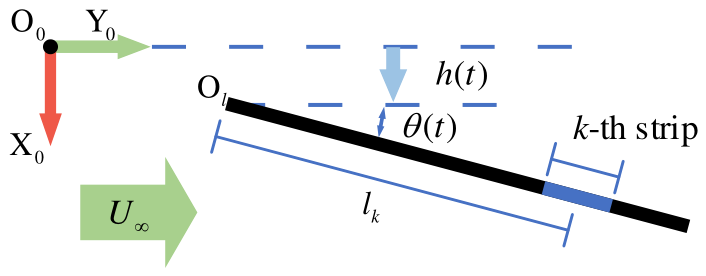
In this chapter, the parameter-identified Morison hydrodynamic model is first systematically compared with high-fidelity CFD simulations to validate the reliability of the low-order model in predicting thrust and input power under typical sinusoidal flapping motions. Based on this validation, the resulting kinematic optimization outcomes obtained via the discrete adjoint method are presented and subsequently back-tested using CFD simulations. By comparing propulsive performance and energy consumption before and after optimization, the consistency between the low-order model predictions and high-fidelity CFD results is analyzed.
4.1. Parameter Identification Results
To assess the applicability of the low-order hydrodynamic model based on the Morison equation proposed in
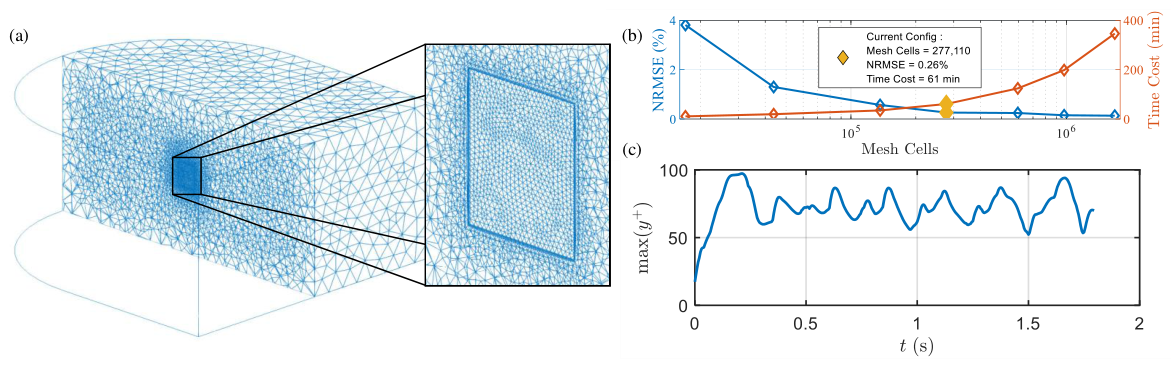
Section 2.2, high-fidelity CFD simulations are first employed for parameter identification and comparative analysis of the hydrodynamic forces acting on the flapping foil. All simulations and subsequent kinematic optimizations are conducted using a rectangular flat plate with a chord length of
, a span length of
, and a uniform thickness of
, ensuring that the obtained results possess clear engineering relevance and good comparability.
It should be noted that, for unsteady flapping-foil hydrodynamics, it is generally difficult for the Morison equation, as a low-order model, to accurately reproduce all motion regimes characterized by different combinations of frequency, amplitude, and phase using a single set of model parameters [
14,
15]. Moreover, numerous experimental and numerical studies based on kinematic optimization and brute-force parameter sweeps have demonstrated that, under sinusoidal heave and pitch kinematic constraints, the Pareto front formed by the mean thrust and the input power typically concentrates around a phase difference close to
[
4,
28]. This region is widely regarded as a compromise between propulsion efficiency and power utilization. Based on these considerations, the parameter ranges listed in
Table 1 are selected for the identification of the Morison hydrodynamic model, with a uniform inflow velocity of
. Accordingly, the Reynolds number defined as
remains constant at
for all CFD cases. The corresponding Strouhal number, defined as
, varies within the range of
= 0.01∼8.17, where
A denotes the maximum trailing-edge amplitude (i.e., half peak-to-peak displacement).
During the parameter-identification process, the Morison coefficients are determined using time-resolved hydrodynamic-force data rather than cycle-averaged quantities, such that the reduced-order model can better reproduce the instantaneous force evolution associated with the local velocity and acceleration states. In addition, sinusoidal kinematics with multiple frequencies, amplitudes, and phase differences are employed during calibration to improve the robustness of the identified coefficients over a broader range of unsteady motion conditions and temporal variations. The use of sinusoidal inputs also facilitates systematic traversal of the parameter space while maintaining physically interpretable excitation patterns for the reduced-order-model identification process.
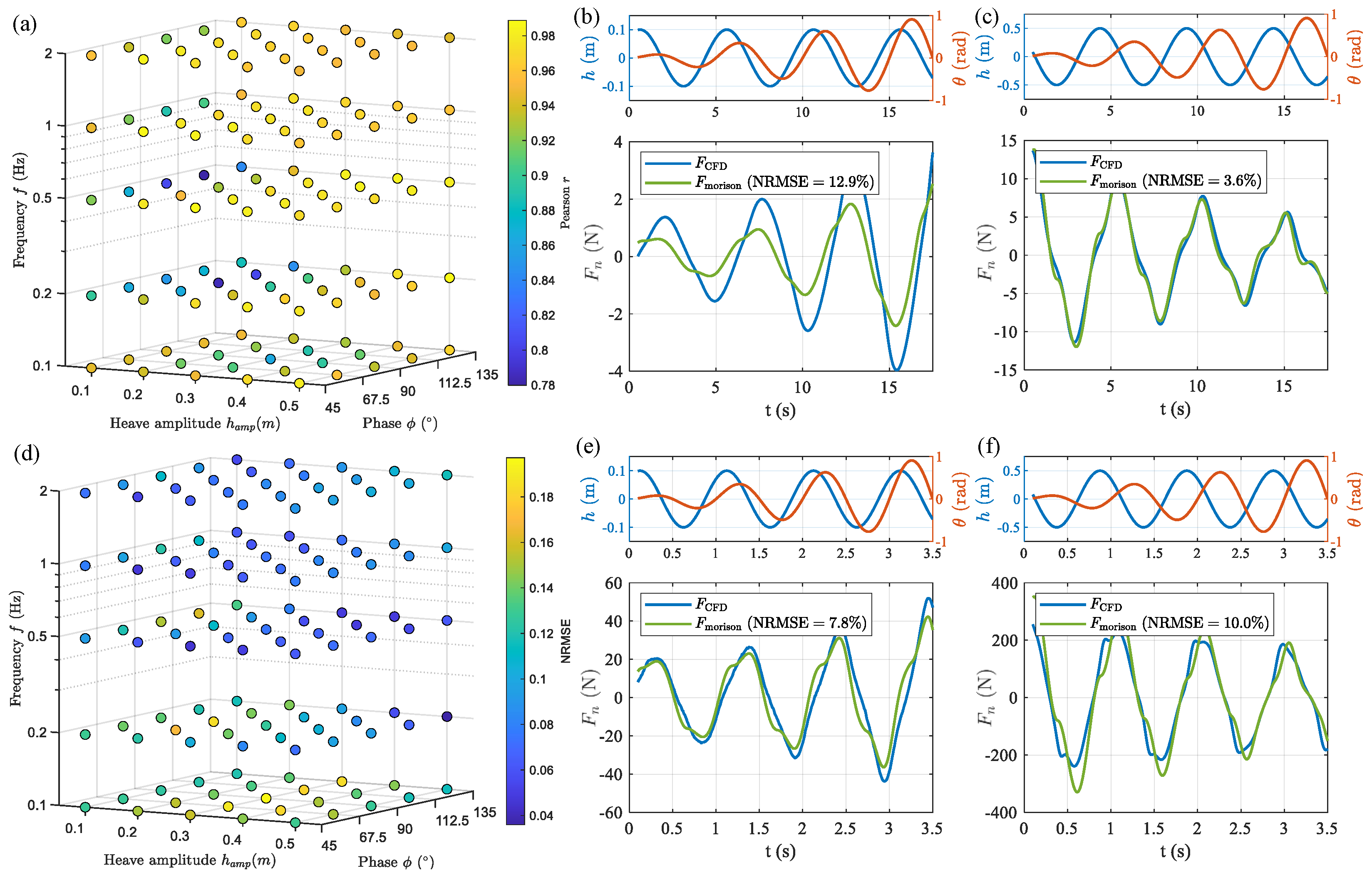
Figure 3a,d present the Pearson correlation coefficient and the normalized root mean square error (NRMSE) between the hydrodynamic forces predicted by the Morison model,
, and those obtained from CFD simulations,
, respectively. These two metrics are employed to evaluate the model performance from the perspectives of temporal trend consistency and force magnitude error.
The Pearson correlation coefficient is defined as
It can be observed that, for all tested parameter combinations, the Pearson correlation coefficient remains above 0.78, indicating that the identified Morison model is capable of capturing the overall temporal evolution and dominant frequency content of the flapping-foil hydrodynamic forces. However, relatively low NRMSE values are only obtained for cases with larger heave amplitudes and higher flapping frequencies, whereas the error increases significantly in low-amplitude and low-frequency regimes. This observation further confirms that the Morison model can only serve as an approximate representation of flapping-foil hydrodynamics within a limited parameter range.
To provide a more intuitive comparison of the fitting performance under different operating conditions,
Figure 3b,c,e,f show the time histories of the normal force
for four representative cases. Case 1 corresponds to
,
, and
; Case 2 to
,
, and
; Case 3 to
,
, and
; and Case 4 to
,
, and
.
In Case 1, a pronounced discrepancy in force amplitude can be observed between the Morison prediction and the CFD results, and the force signal obtained from the Morison model exhibits a noticeable phase lead. By contrast, in Cases 2–4, the two results show good agreement in terms of dominant amplitude and phase. Although local discrepancies still exist, the Morison model is able to reasonably reproduce the overall temporal evolution and oscillation trends observed in the CFD results, which is further reflected by the relatively lower NRMSE values and high Pearson correlation coefficients obtained in these cases. Nevertheless, the Morison-predicted force histories display several non-smooth turning points. This behavior primarily arises from the fact that the Morison equation represents the hydrodynamic force as a linear combination of an acceleration-dependent term (added-mass force) and a quadratic velocity-dependent term (drag force). The intrinsic phase difference between velocity and acceleration prevents a smooth force transition throughout the flapping cycle. Moreover, the underlying physical assumptions of the Morison model neglect unsteady flow mechanisms such as vortex shedding, vortex–vortex interactions, and flow-history effects. Consequently, the model is not derived from the evolution of the flow field but rather constitutes an equivalent parametric approximation of complex hydrodynamic behavior.
Based on the above analysis, it can be concluded that, within a certain range of kinematic parameters, after appropriate parameter identification, the Morison model is capable of reconstructing the flapping-foil hydrodynamic response in a statistical and trend-consistent sense. This property makes it particularly suitable for rapid hydrodynamic evaluation and relative performance comparison in kinematic optimization studies.
To further quantify its applicability, the NRMSE is employed as an empirical indicator to characterize the agreement level between the Morison-based predictions and CFD results, while the Pearson correlation coefficient is additionally used to evaluate waveform consistency and temporal trend similarity. Since the Morison formulation does not explicitly resolve vortex shedding and wake evolution, the present validation focuses primarily on trend-level consistency rather than strict pointwise agreement of instantaneous force amplitudes. In the present study, cases with are generally regarded as exhibiting reasonably consistent trend agreement between the reduced-order model and CFD results. Under this framework, the Morison model exhibits reasonably consistent trend prediction capability for with , for with , and generally for cases with . It should be noted that these bounds arise from a coupled multi-parameter effect, and therefore do not represent strict independent limits on individual parameters. In terms of the corresponding dimensionless characterization, these cases collectively correspond to a Strouhal number range of = 0.35∼8.17, representing the regime where the Morison-based model provides qualitatively reliable agreement and trend consistency with CFD results under the present formulation.
Moreover, for non-parameterized kinematic motions, the resulting trajectories may exhibit multiple inflection points in velocity and acceleration profiles, which fall outside the smooth harmonic patterns considered here. As such, the above applicability range cannot be directly used as a strict constraint in non-parameterized optimization, and the optimized results should still be validated using high-fidelity CFD simulations.
The identified model parameters are , , , . which will be employed in the subsequent section for flapping-foil kinematic optimization and propulsion performance assessment.
4.2. Adjoint-Based Optimization Results
This section presents the flapping-foil kinematic optimization results obtained using the discrete adjoint method. All optimization results are based on the Morison hydrodynamic model identified in the previous section and are obtained under a prescribed instantaneous input power constraint of .
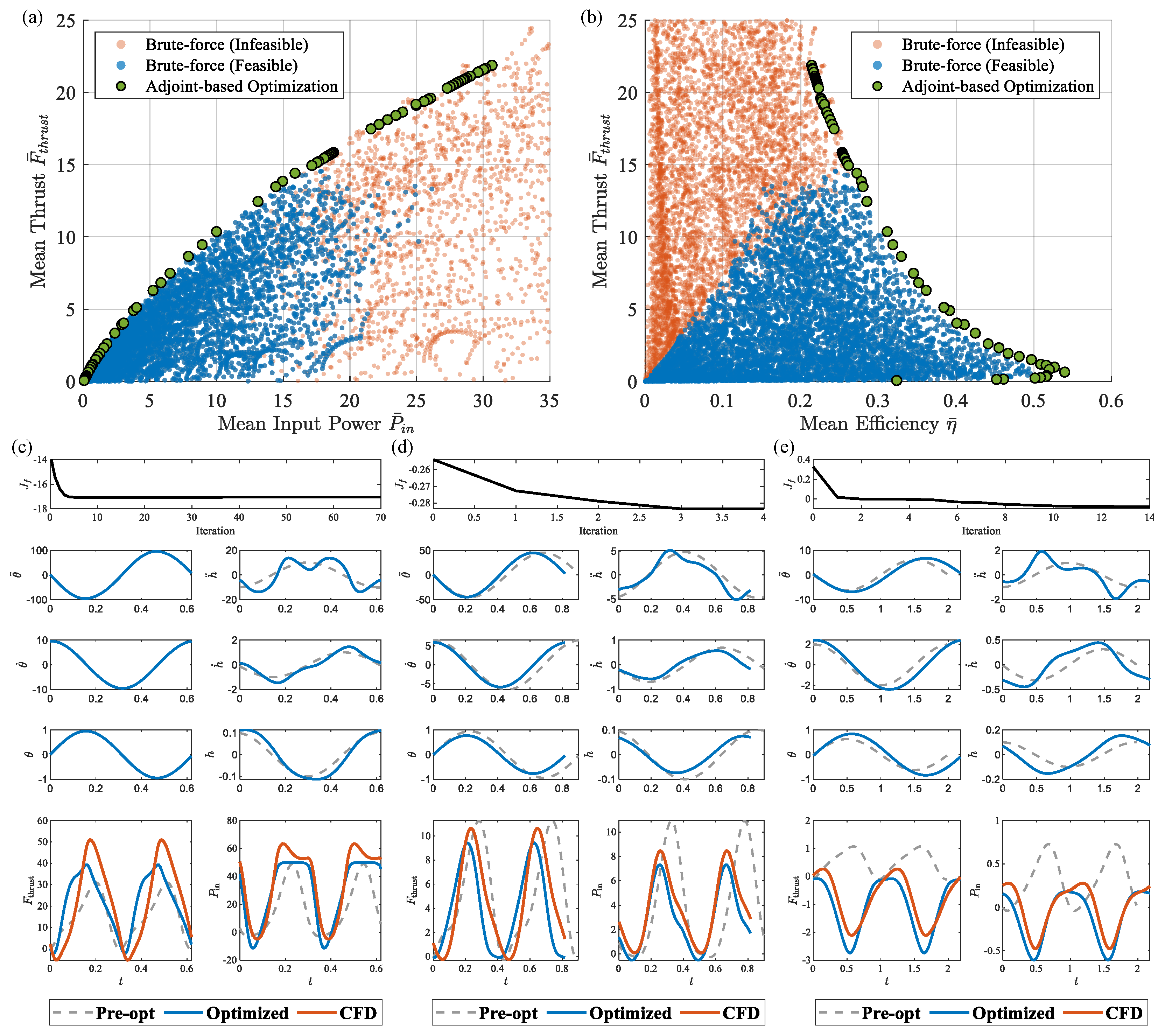
We first employ the identified Morison model to perform a brute-force parameter sweep over sinusoidal kinematics, evaluating the flapping-foil propulsion performance in terms of the cycle-averaged thrust, cycle-averaged input power, and cycle-averaged propulsive efficiency. The resulting thrust–input power and thrust–efficiency relationships are shown in
Figure 4a,b, respectively. The cycle-averaged quantities are defined as
In
Figure 4a,b, red markers indicate sinusoidal kinematic cases that violate the instantaneous input power constraint, which are primarily concentrated in the high-frequency region of the parameter space. Blue markers correspond to feasible cases that satisfy the power constraint and collectively form a constrained Pareto front within the sinusoidal kinematic space. This constrained Pareto front is used as the initial solution set for the discrete adjoint optimization in order to accelerate convergence. A clear separation can be observed between the red and blue markers, indicating that the instantaneous input power constraint imposes a strict upper bound on the maximum achievable cycle-averaged thrust for sinusoidal motions.
The green markers represent the solutions obtained from the discrete adjoint optimization. It can be seen that their corresponding cycle-averaged thrust and efficiency values lie outside the constrained Pareto front defined by sinusoidal motions. Although some points appear to fall within the Pareto front in the thrust–efficiency plane shown in
Figure 4b, they remain outside the front in the thrust–input power plane shown in
Figure 4a. This observation demonstrates that, under the same instantaneous input power constraint, non-sinusoidal kinematics obtained via non-parametric discrete adjoint optimization are able to further expand the achievable efficiency–thrust domain. In particular, when the objective function is solely focused on thrust maximization (
), the optimized kinematics achieve a maximum cycle-averaged thrust that is 50.29% higher than that of the best sinusoidal motion. This improvement indicates that the optimization process effectively redistributes the timing and amplitude of the flapping motion, enabling a more efficient utilization of the available instantaneous input power and a better matching between energy input and thrust generation.
Figure 4c–e present comparisons of the kinematics and performance over one flapping cycle before and after non-parametric optimization for three representative weighting coefficients, namely
,
, and
. In addition, the optimized kinematics are further validated using CFD simulations, and the resulting thrust and input power are compared against the predictions of the Morison model.
It can be observed that, for all values of , the discrete adjoint optimization exhibits stable convergence behavior, and the instantaneous input power remains within the prescribed constraint throughout the optimization process.
For (), the optimization objective exclusively prioritizes thrust maximization. Under the input power constraint, the algorithm significantly increases the cycle-averaged thrust. Compared with the initial sinusoidal motion, for which the input power reaches the constraint only at isolated instants, the optimized non-sinusoidal kinematics utilize the available input power more extensively over the entire flapping cycle, thereby generating higher thrust. However, CFD validation reveals noticeable discrepancies between the thrust predicted by the Morison model and that obtained from CFD, and the input power predicted by CFD locally exceeds the prescribed threshold. It should be emphasized that the CFD simulations are not used to enforce or evaluate the optimization constraints, but rather serve as an independent high-fidelity validation tool to assess the robustness and physical consistency of the optimized kinematics under full Navier–Stokes dynamics. This behavior is likely caused by the introduction of multiple oscillations in the heave motion, which are favored by the optimization to saturate the input power constraint but induce complex vortex dynamics and additional energy dissipation mechanisms that are not fully captured by the low-order model. In addition, these locally rapid variations in the optimized acceleration profiles may also pose potential challenges for practical actuation, as actuator bandwidth and motor torque limits are not explicitly modeled in the present optimization framework.
For (), the optimized solution achieves a substantial reduction in input power at the cost of only a minor decrease in thrust, resulting in an overall improvement of the weighted objective function. This outcome reflects the balancing nature of the multi-objective weighted optimization. In this case, the CFD results are in good agreement with the Morison model predictions in terms of overall trends, although the Morison-based force signals exhibit a slight phase lead.
For
(
), the objective function no longer includes a thrust-related term and solely aims to minimize the input power. Since no lower bound is imposed on the input power in the present formulation, the optimization naturally evolves toward extracting energy from the incoming flow. As a result, the cycle-averaged thrust remains negative, and the flapping foil operates in a “generator-like” regime. The CFD results show trends that are generally consistent with those predicted by the Morison model. Because both the cycle-averaged thrust and the cycle-averaged input power are negative in this case, these results are not included in
Figure 4a,b.
It is worth noting that, although the optimal control inputs obtained under the three weighting coefficients exhibit markedly different temporal profiles, all of them deviate significantly from conventional sinusoidal forms and display strong non-parametric characteristics. This observation indicates that the discrete adjoint method is capable of identifying high-performance kinematic patterns beyond the prescribed sinusoidal assumption.
The corresponding CFD results are primarily used as an independent physical check on the qualitative consistency of the optimized solutions obtained from the reduced-order Morison model. In particular, CFD is employed to assess whether the overall trends of thrust and input power variation predicted by the surrogate model are preserved under higher-fidelity flow physics, rather than to enforce pointwise agreement in force histories. Within this context, the CFD results generally confirm that the optimized non-sinusoidal motions preserve the overall trends of thrust and input power variation predicted by the reduced-order model, despite the presence of local quantitative deviations caused by unsteady vortex dynamics that are not explicitly captured in the Morison formulation.
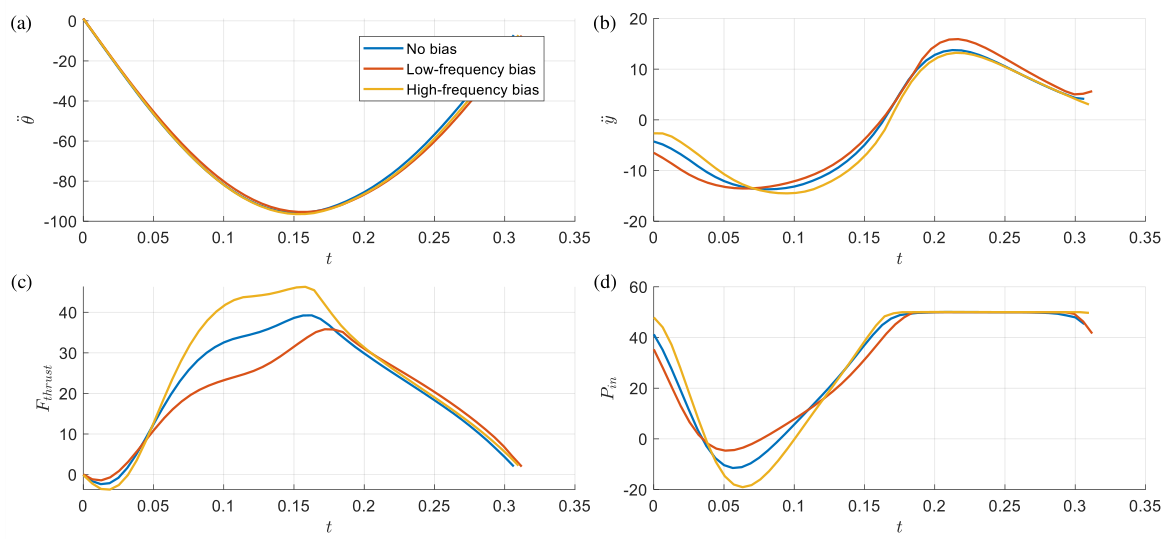
To further evaluate the sensitivity of the optimization results to the identified Morison coefficients, additional optimization tests are performed using different parameter-identification weighting strategies, as shown in
Figure 5. In the baseline identification process (see
Figure 3), the Morison coefficients are obtained from sinusoidal flapping datasets spanning five frequencies (
and
) with uniform weighting. To assess the influence of coefficient variation, two additional identification strategies are introduced: a low-frequency-biased weighting
and a high-frequency-biased weighting obtained by reversing the above distribution. The resulting coefficient sets are subsequently applied to the
thrust-maximization optimization case.
The comparison results indicate that variations in the identified Morison coefficients lead to noticeable differences in the detailed optimized kinematic profiles and quantitative thrust predictions, which is expected since the relative contributions of the added-mass and drag-related terms are modified by the identification process. Nevertheless, the overall optimization trends remain consistent across all identification strategies. In particular, all optimized solutions continue to exhibit strongly non-sinusoidal characteristics with localized redistribution of motion and acceleration, indicating that the proposed non-parameterized optimization framework consistently converges toward similar high-thrust motion patterns despite variations in the identified coefficients. Furthermore, although the predicted thrust levels vary, the corresponding input power remains effectively regulated within the prescribed admissible range for all identification strategies, demonstrating the robustness of the penalty-based optimization framework with respect to moderate coefficient variations. Since the optimized flapping period is also treated as a design variable, the resulting control trajectories possess different temporal evolution patterns, and therefore the present analysis focuses primarily on the robustness of the overall propulsion-performance trends and major kinematic characteristics rather than pointwise trajectory differences.
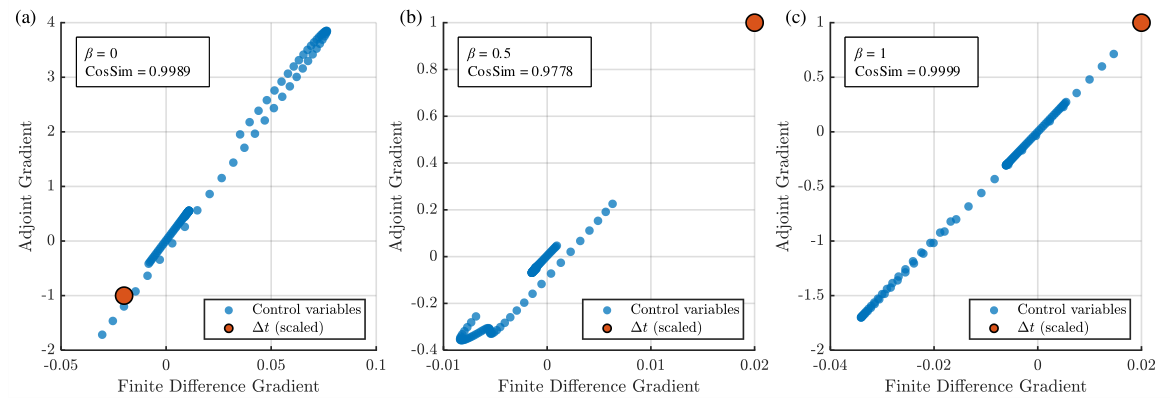
To further verify the correctness of the discrete adjoint implementation, additional gradient-validation tests are performed by comparing the adjoint-based gradients with independently computed finite-difference (FD) gradients under the three weighting conditions
,
, and
.
Figure 6 presents the corresponding scatter comparisons between the adjoint and FD gradients evaluated at the same initial design point. Since the gradient component associated with the time-step variable
exhibits a substantially different magnitude from the remaining control-related gradients, direct visualization would cause the
contribution to dominate the scatter distribution. Therefore, for visualization purposes only, the
gradients from both methods are normalized using
followed by
Here,
and
denote the adjoint and finite-difference gradient vectors, respectively. The subscript
represents the gradient associated with the time-step variable, while the subscript
denotes the gradients associated with the discrete control variables.
To quantitatively evaluate the consistency between the two gradient-evaluation approaches, the cosine similarity is additionally computed as
In this calculation, the
component is excluded in order to avoid the similarity metric being dominated by the large magnitude difference associated with the time-step gradient. The resulting cosine similarities are
,
, and
for
,
, and
, respectively. The scatter distributions exhibit a clear proportional relationship of the form
, indicating strong directional consistency between the adjoint and FD gradients. Although the
case shows slightly larger scatter than the other two cases, the overall agreement remains very strong, demonstrating that the discrete adjoint method correctly captures the dominant gradient directions of the optimization problem.
In summary, the gradient-validation results confirm the numerical consistency and correctness of the proposed discrete adjoint implementation. Furthermore, the results demonstrate that the proposed non-parametric discrete adjoint optimization framework converges robustly under instantaneous input power constraints and outperforms traditional sinusoidal-based approaches in terms of the thrust–energy trade-off. This advantage stems from the expanded design space enabled by the non-parametric formulation, which allows flexible redistribution of motion amplitude, phase, and timing over the flapping cycle, leading to localized actuation patterns that are not attainable with conventional parameterized methods. The corresponding CFD validation further indicates that the proposed framework is capable of capturing the dominant trends of thrust and power variation under different optimized kinematic patterns, although some highly oscillatory optimized motions may also introduce more complex vortex dynamics and flow-history effects that are not fully represented by the present Morison-based reduced-order model.