
Article

An Error-Adaptive Competition-Based Inverse Kinematics Approach for Bimanual Trajectory Tracking of Humanoid Upper-Limb Robots

School of Mechatronics Engineering, Harbin Institute of Technology, Harbin 150080, China
*
Author to whom correspondence should be addressed.
Biomimetics 2026, 11(4), 279; https://doi.org/10.3390/biomimetics11040279

Submission received: 19 March 2026 / Revised: 13 April 2026 / Accepted: 15 April 2026 / Published: 17 April 2026
(This article belongs to the Special Issue Bionic Intelligent Robots)

Abstract

Humanoid upper-limb robots are an important direction in biomimetic robotics, and inverse kinematics is a key technique for achieving human-like coordinated operation. However, existing inverse kinematics methods for bimanual trajectory tracking often suffer from high computational complexity and limited synchronization performance. To address this, this paper proposes an error-adaptive competition-based inverse kinematics (EAC-IK) approach for bimanual trajectory tracking of humanoid upper-limb robots. First, a unified modeling framework for the absolute tracking errors and synchronization errors of the two arms is established, and the end-effector task constraints are reformulated into a low-dimensional representation, thereby reducing the computational complexity of the original high-dimensional task mapping. Second, to enhance the coordination capability of bimanual operations, an error-adaptive competition mechanism is developed to regulate the weighting coefficients of the two arms online according to their error states. In addition, a virtual second-order command shaper is introduced at the joint level to reconstruct joint trajectories and suppress oscillations induced by input noise and the error-adaptive competition mechanism. Simulation and experimental results on a hyper-redundant humanoid upper-limb robot demonstrate that, compared with the zeroing neural-network-based inverse kinematics method, the proposed method achieves lower tracking and synchronization errors, as well as higher computational efficiency. In the circular trajectory-tracking experiment, the left-arm position and orientation tracking errors decrease from 1.60×10³m and 4.72×10³rad to 0.70×10³m and 0.95×10³rad, respectively, while the synchronization error decreases from 1.96×10³ to 1.30×10³. In addition, the average algorithm runtime decreases from 0.82ms to 0.63ms.
Keywords: humanoid upper-limb robot; inverse kinematics; motion planning; trajectory tracking humanoid upper-limb robot; inverse kinematics; motion planning; trajectory tracking
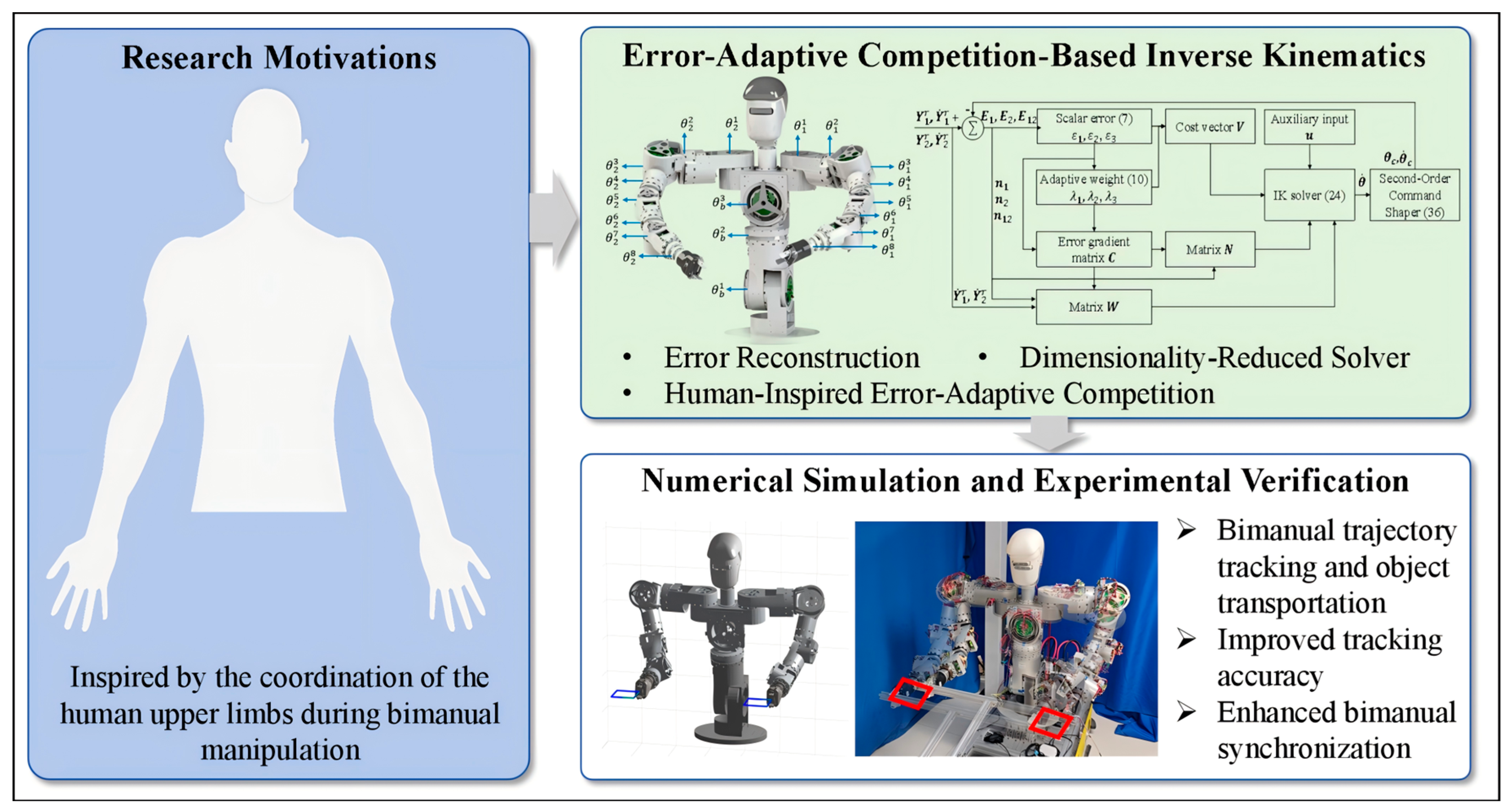
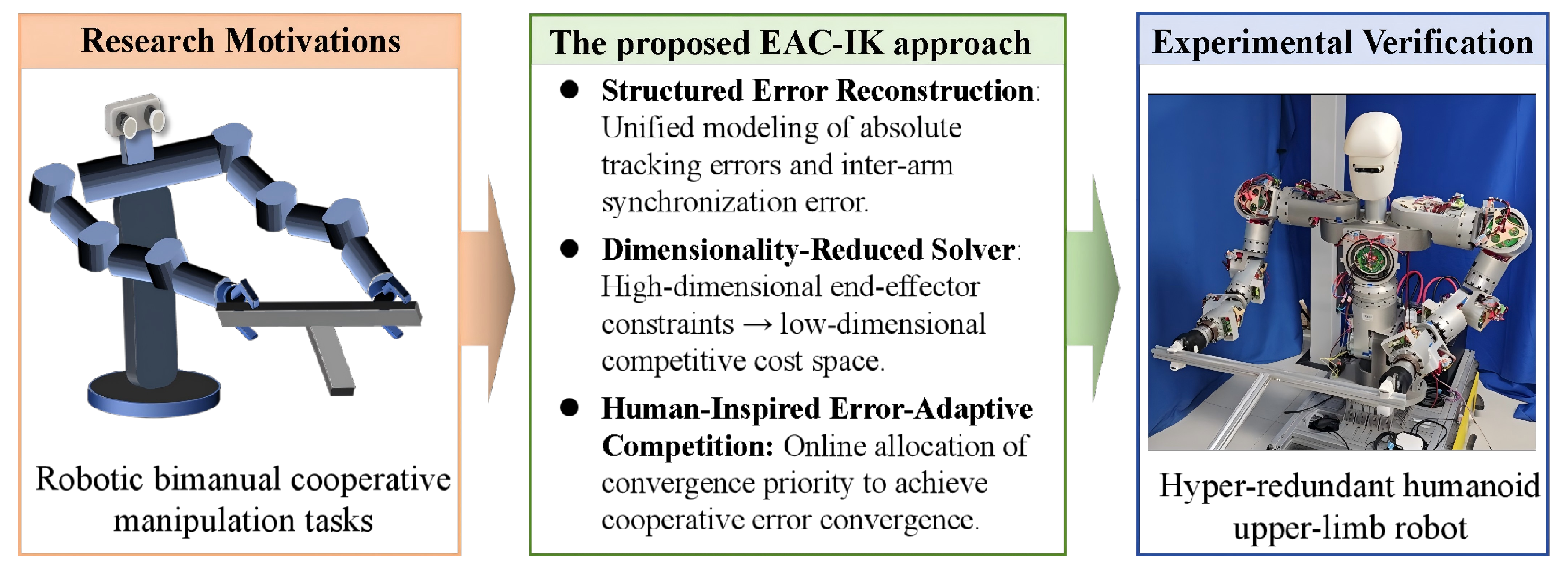
Graphical Abstract