

Unifying Environmental Stress Cracking and Mechano-Sorptive Creep Under the Umbrella of Mechano-Sorptive Phenomena



Abstract
1. Introduction
2. Commonalities in the Molecular Phenomena Underlying ESC and MSC
3. Evidence That ESC and MSC(R) Are Variants of the Same Underlying Phenomenon
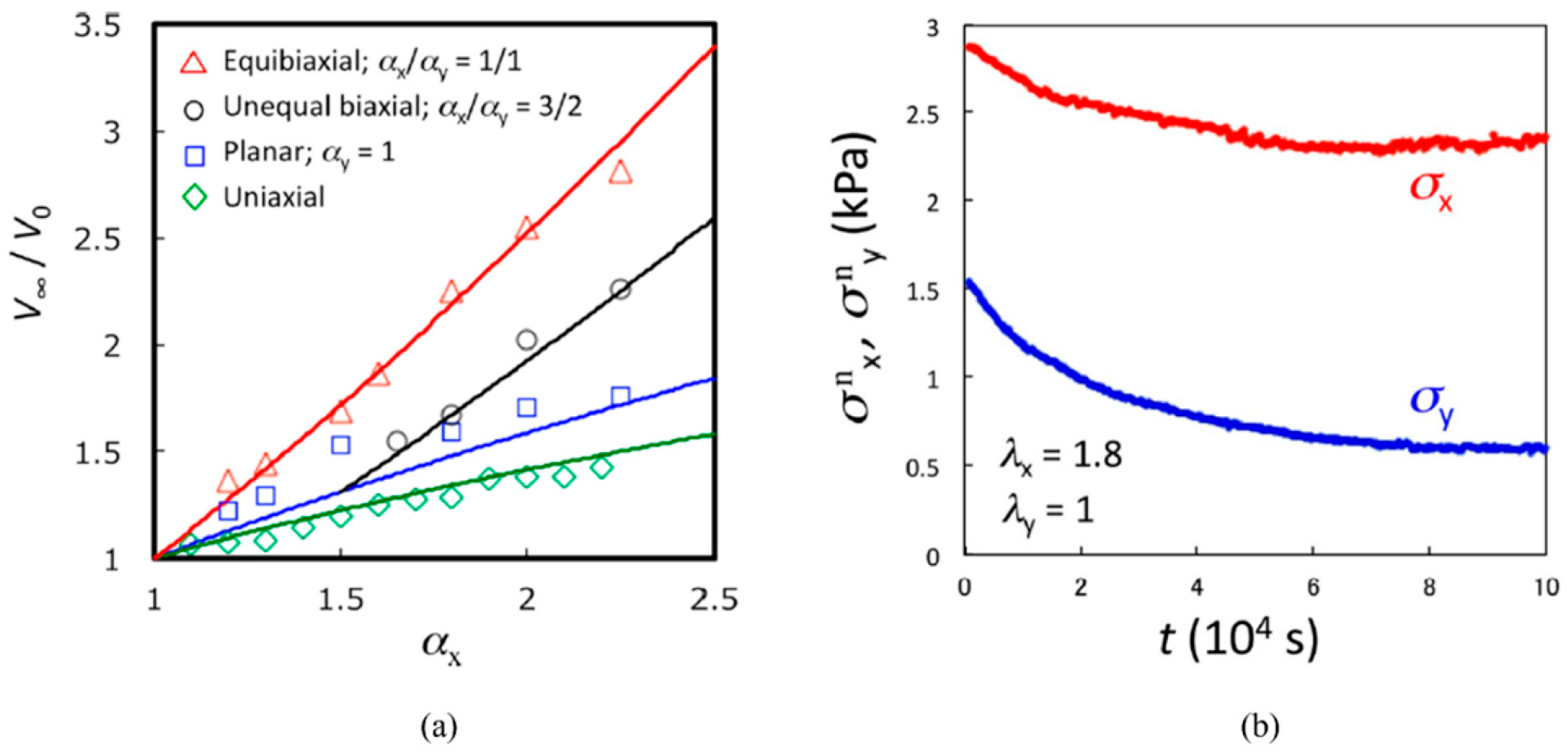
3.1. Swelling and Diffusion Responses Driven by Chemical Potential Gradients
3.2. Path-Independence of Loading and Swelling
3.3. Path Dependence in Sorption Isotherms
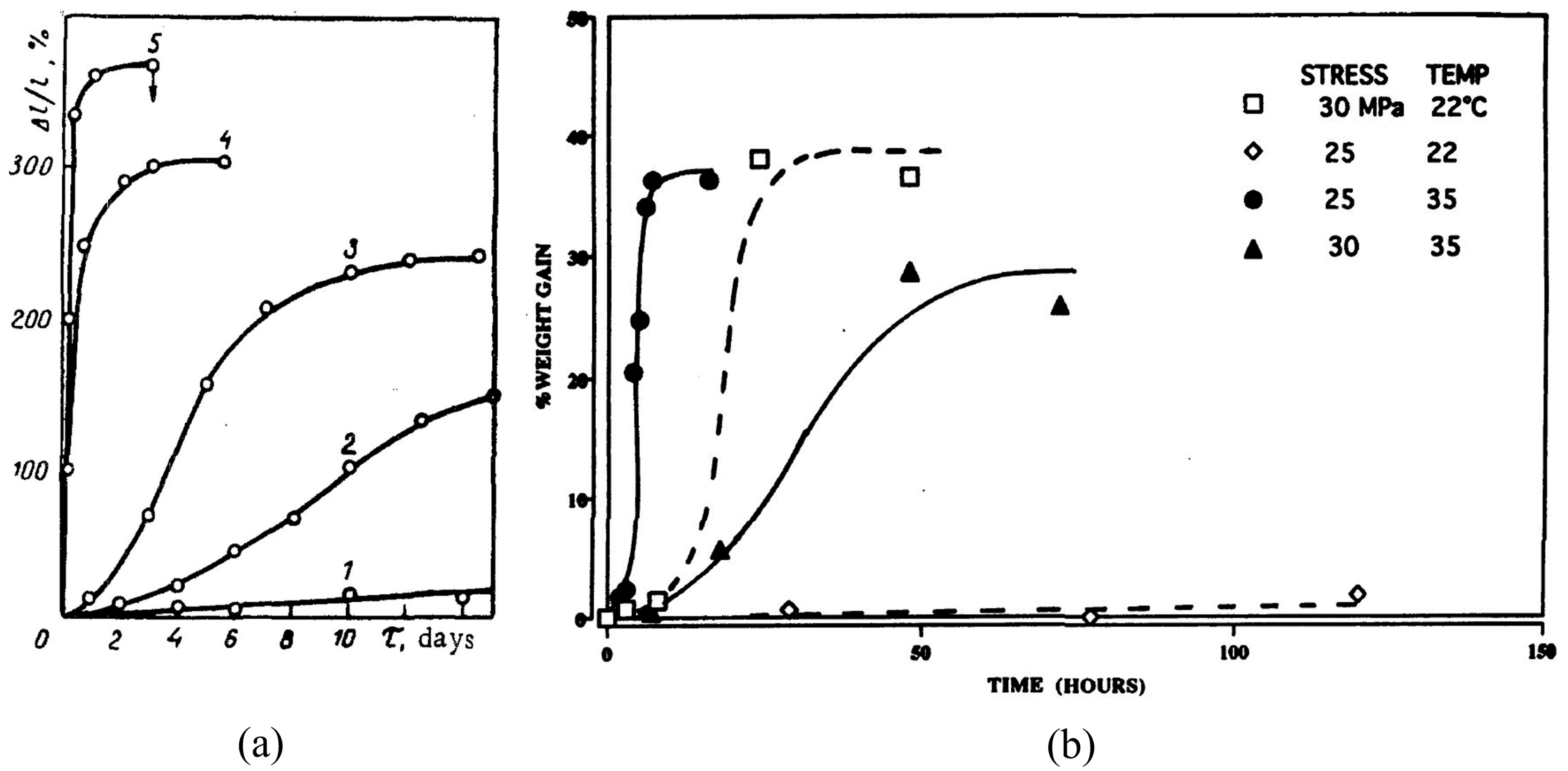
3.4. Experimental Studies Spanning the ESC–MSC Transition
4. Constitutive Models for MSP
4.1. Semicrystalline Polymers (SCPs)
- (a)
- Validity across the glass transition: To capture the viscoelastic, viscoplastic and fracture behavior across the glass transition as a function of mechanical stress, temperature, and crucially, the fluid concentration.
- (b)
- Volume change independence: The polymer–fluid system volume is not equal to the sum of the volumes of the dry polymer and the solvent during the dry-to-wet transition, in contrast to the case of a hydrogel whose free volume is already saturated.
- (c)
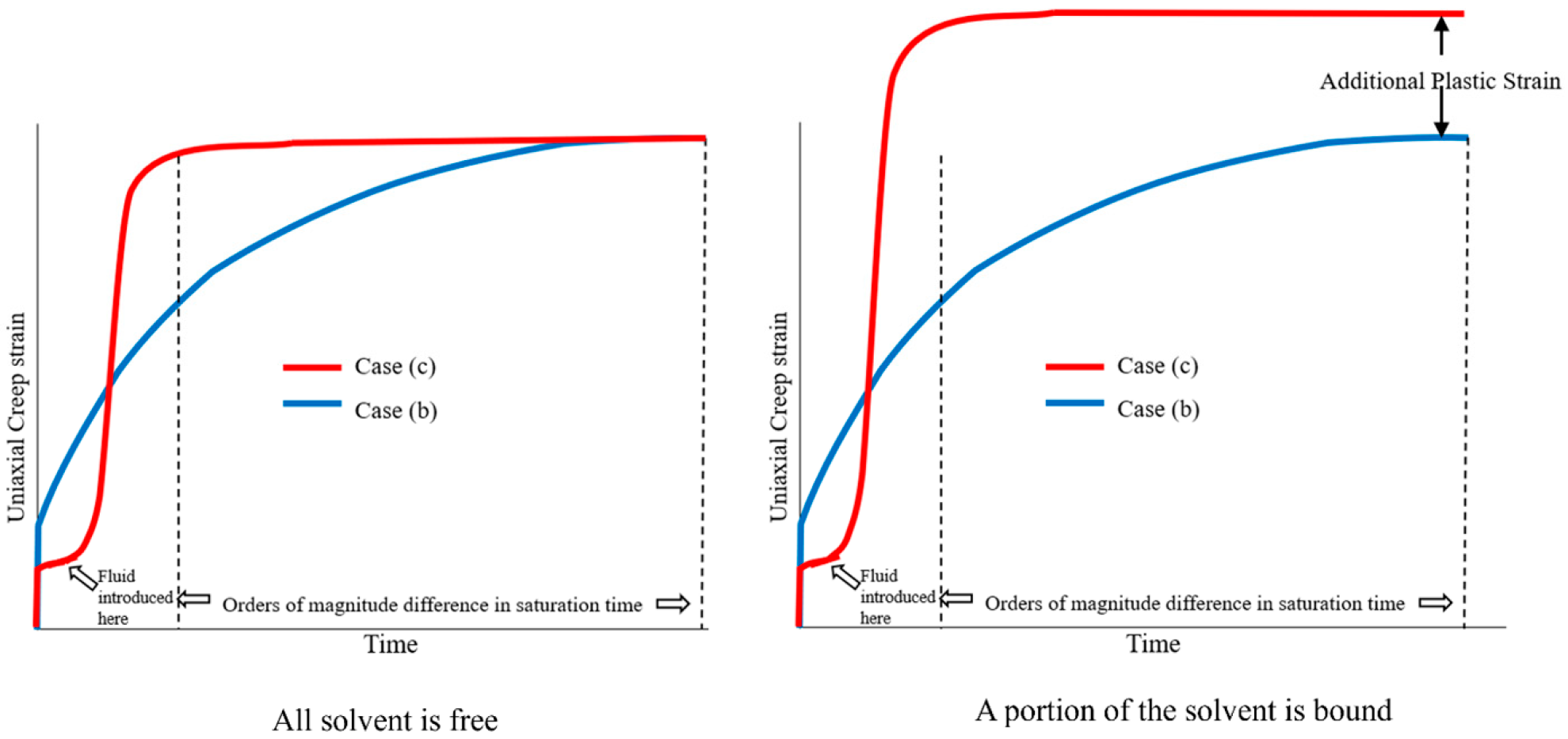
- Fluid concentration-dependent properties: Both viscous and elastic properties evolve strongly across the glass transition during the dry-to-wet transition of the polymer. The model should incorporate the effect of fluid sorption on viscoplasticity, damage and fracture. The model should also incorporate the appropriate plastic behavior to capture the irreversible part of MSC associated with bound solvent.
- (d)
- Built from a molecular basis so that the model parameters can be traced back to the fundamental physical and chemical descriptors of the polymer and fluid.
- (e)
- Fit into a computational framework capable of handling both fracture and large deformation to be able to seamlessly transition from an ESC-type brittle fracture to an ESY/MSCR-type ductile failure.
4.2. Constitutive Models Spanning the Glass Transition Across Temperatures
4.3. Poromechanical Constitutive Models
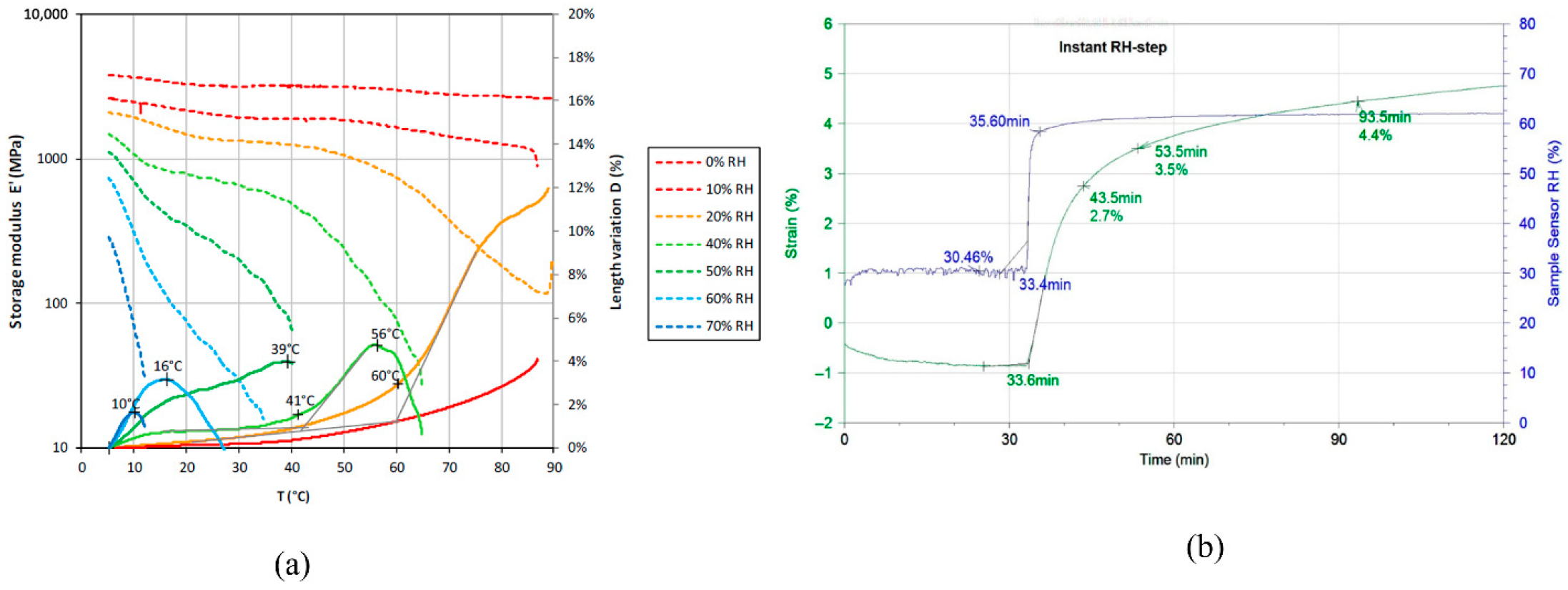
4.4. Constitutive Models Spanning the Glass Transition Across Fluid Concentrations
4.5. Visco-Elastoplastic Fracture Mechanics and Continuum Damage Mechanics for MSP
4.6. Mesoscale Approaches with a Molecular Basis for Viscoelasticity, Viscoplasticity and Fracture
- (a)
- The molecular-to-continuum kinematics bridging between the macroscopic deformation and the polymer chain segment dynamics and stretching;
- (b)
- Convection–diffusion equation representing polymer dynamics;
- (c)
- Averaging to determine model parameters from lower-scale simulations for, e.g., all-atom MD simulations.
5. Role of MSP in the Functionality and Synthesis of Biomimetic Materials
6. Conclusions
- •
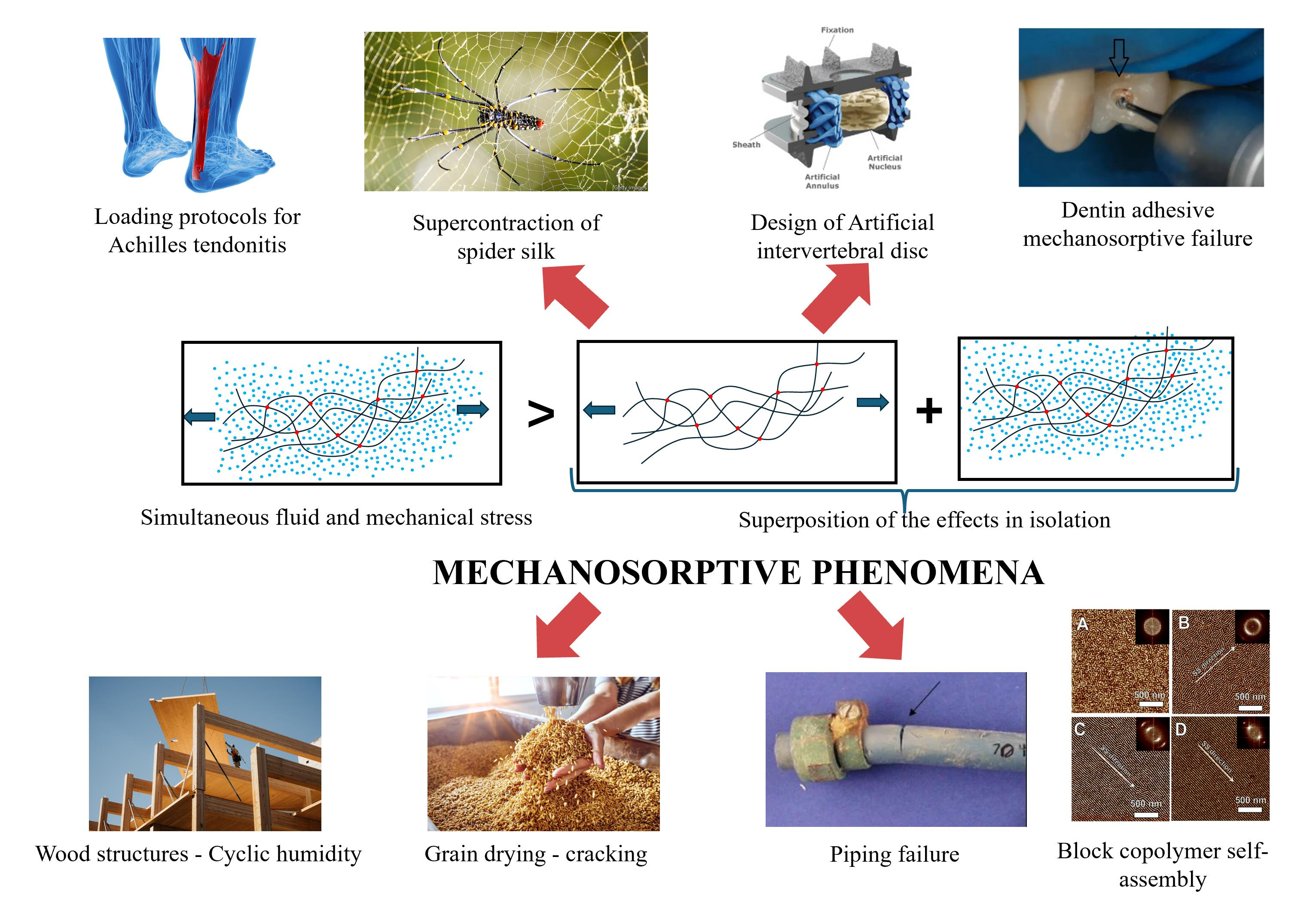
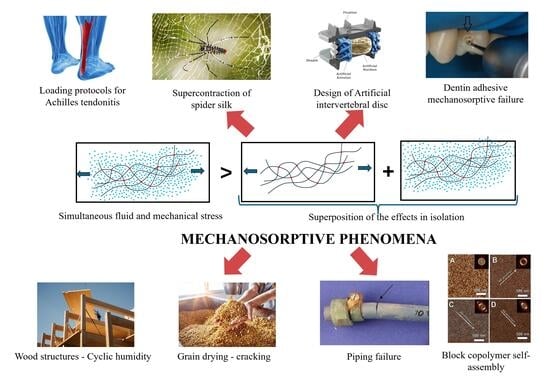
- For the first time, several seemingly disparate mechano-sorptive phenomena from a variety of applications have been brought together under a single review. The interrelationship between several terminologies used in the literature, including MSC, MSCR, ESY, SEDS, and ESC, has been explained.
- •
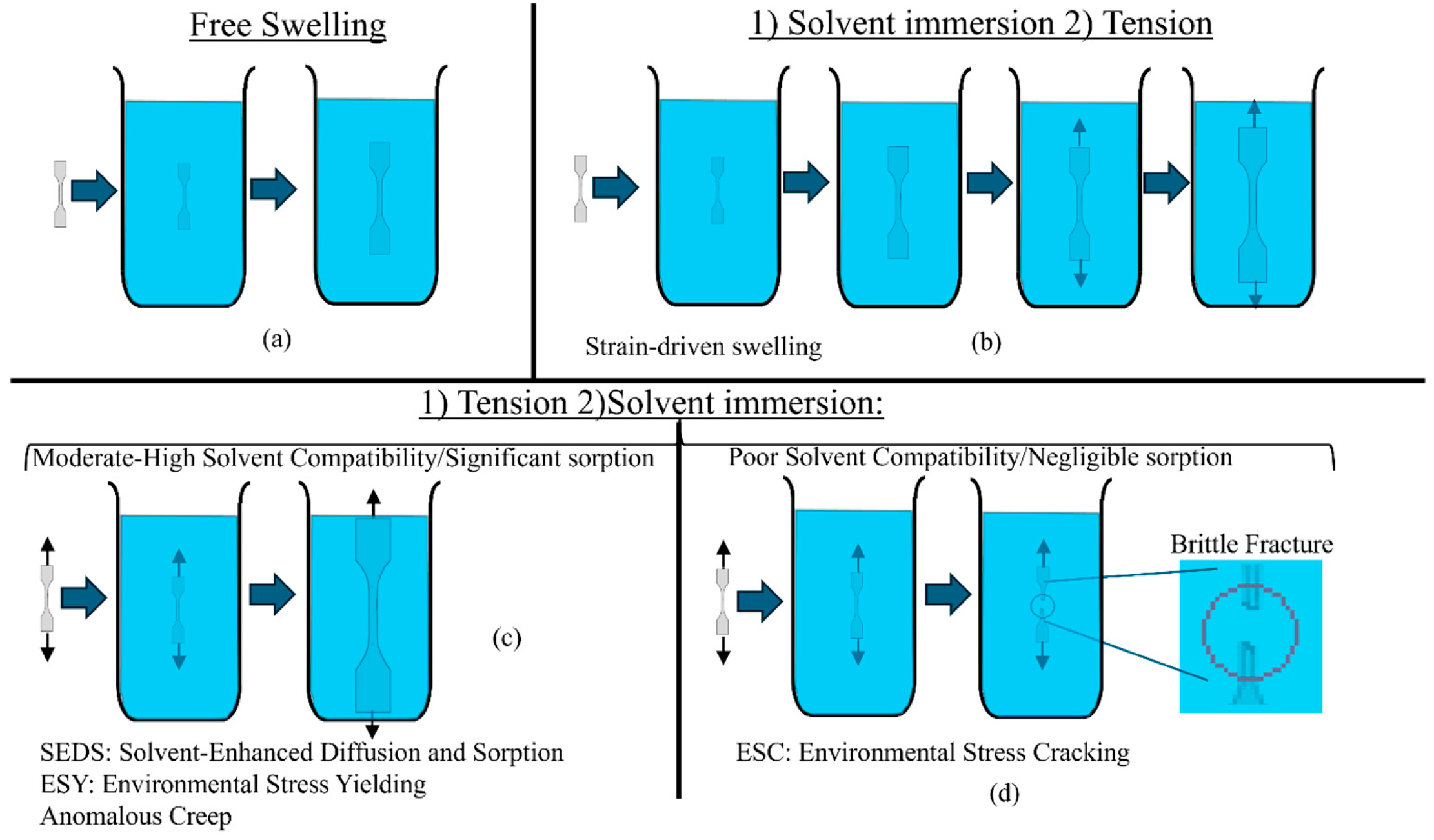
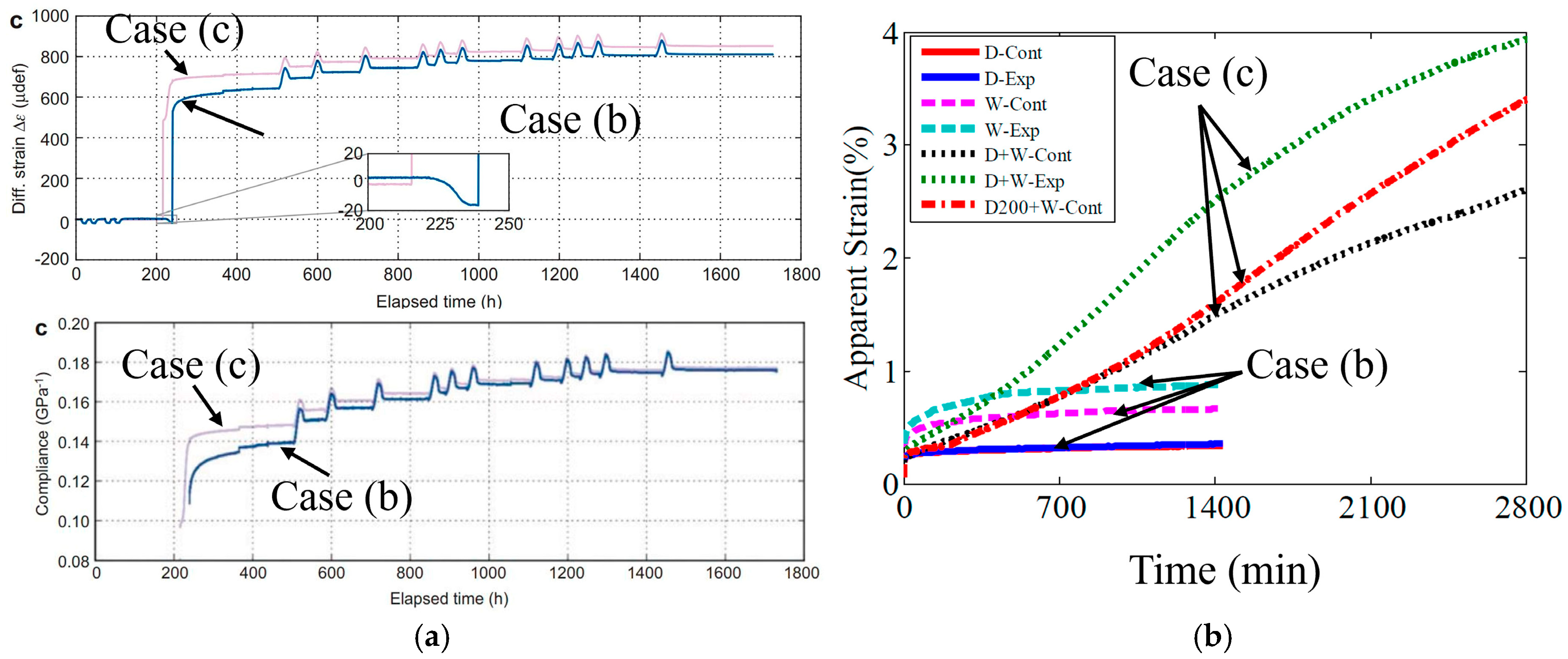
- MSCR and ESC have been identified as two extremes of the same underlying phenomenon with supporting evidence from a large body of studies from a variety of fields. Several experimental results that show responses resembling ESC and MSCR/ESY for the same polymer for different solvents or different sorption of the same solvent have been reproduced here to justify this conclusion.
- •
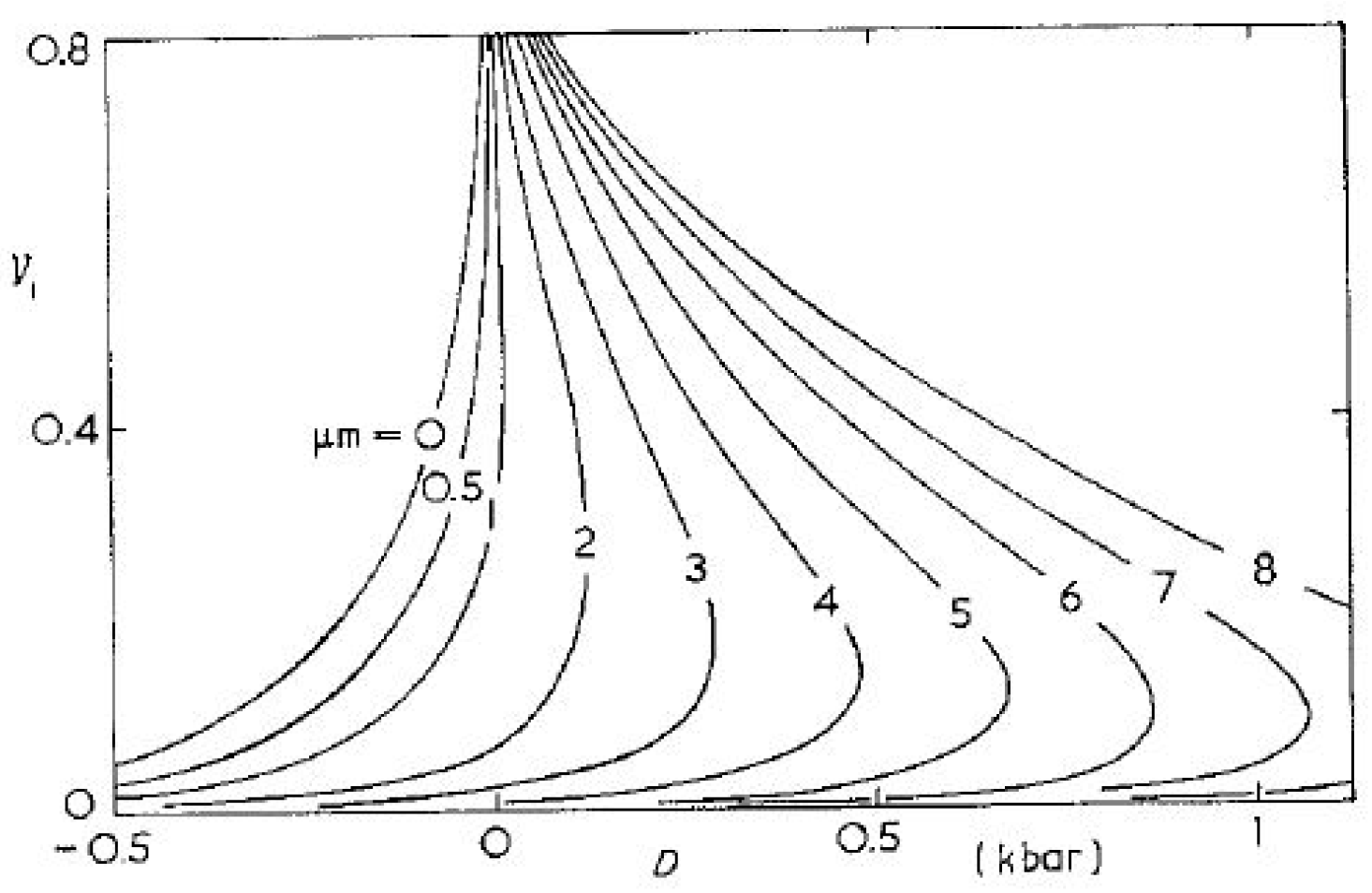
- For the first time, it has been hypothesized that the reversible parts of MSC, ESY or SEDS can be explained by the equilibrium swelling of polymer networks. Only the irreversible part of the MSC necessitates the rate of solvent sorption as a constitutive variable. Irreversibility can also arise from plastic yielding. Once proven, this hypothesis is expected to greatly simplify constitutive modeling of MSP.
- •
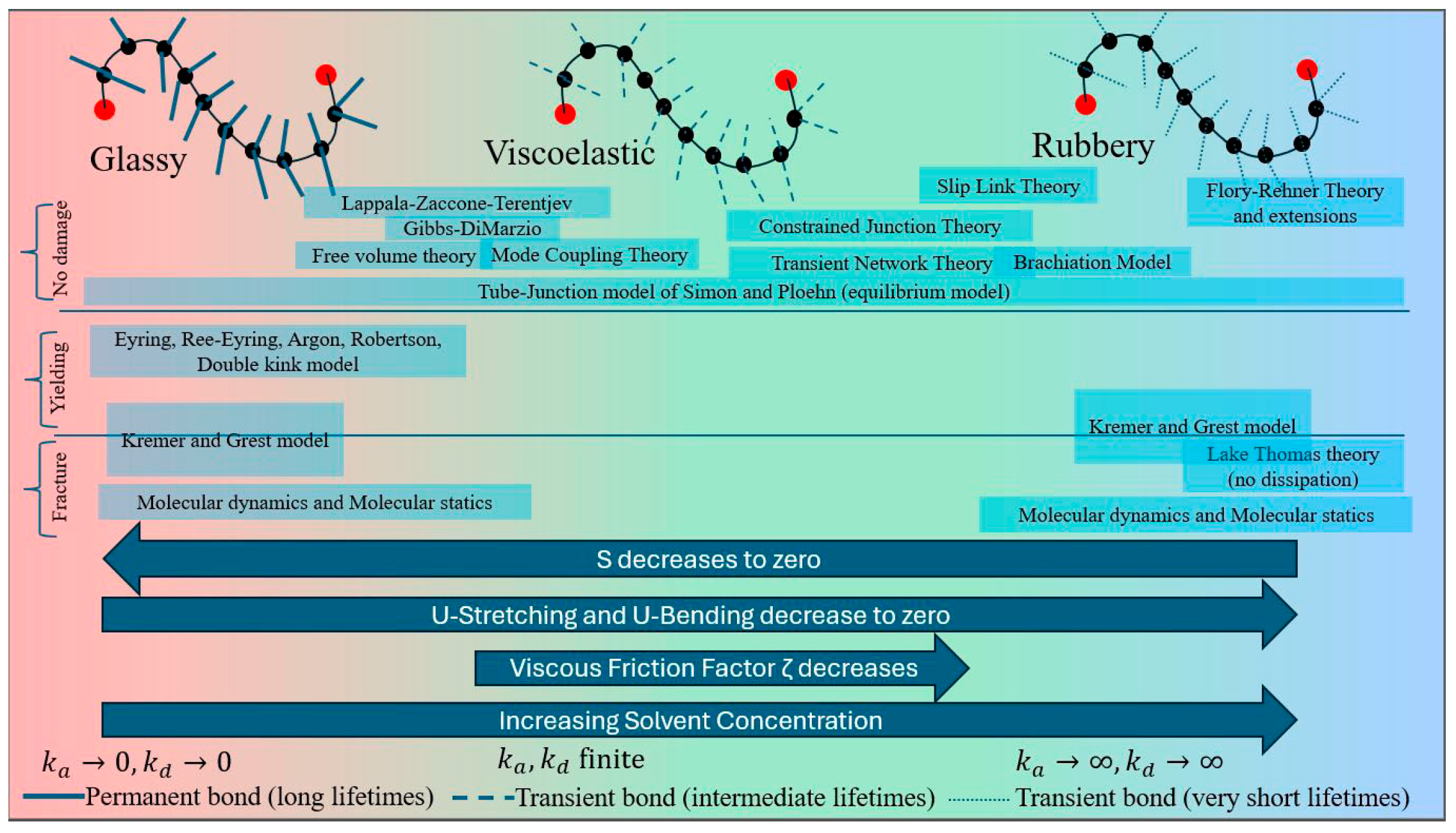
- A comprehensive review of the range of existing constitutive models in the glassy–viscoelastic–rubbery regime and yield-fracture regime for the study of MSP has been presented with their range of applicability across the entire spectrum of deformation and failure associated with MSP. Key features required in a constitutive model for MSP have been identified and a library of constitutive models available has been grouped accordingly. Experiments and molecular-level methods that can be used to characterize MSP and calibrate suitable material models have also been presented. In particular, the importance of solvent-sweep experiments for MSP characterization has been highlighted. The Tube-Junction theory of Simon and Ploehn and the Transient Network Theory proposed by Vernerey have been identified as the most promising constitutive models with a molecular basis to describe MSP.
- •
- Schapery’s theory of viscoelastic fracture mechanics, with the generalized J-integral, has been identified as a suitable model for MSP involving fracture, although it has not been explicitly used for this purpose. It has been described how this theory can be exploited to generate a macroscopic model, which can transition between a brittle ESC-like failure to a ductile MSCR-like failure.
- •
- Several biological and biomimetic materials for which MSP plays a key role in their functionality have been identified, and the specifics of how MSP regulates their behavior has been explained. The role of MSP in SVA-SS, one of the important methods for the synthesis of biomimetic materials, has been explained.
Author Contributions
Funding
Institutional Review Board Statement
Informed Consent Statement
Data Availability Statement
Acknowledgments
Conflicts of Interest
Abbreviations
| MSP | Mechano-sorptive phenomena |
| ESC | Environmental stress cracking |
| MSC | Mechano-sorptive creep |
| ESY | Environmental stress yielding |
| MSCR | Mechano-sorptive creep rupture |
| SEDS | Stress-enhanced diffusion and solubility/swelling |
| PTFE | Polytetrafluoroethylene (Teflon) |
| SCP | Semicrystalline polymer |
| ECM | Extracellular matrix |
| BCP | Block copolymer thin film |
| TNT | Transient Network Theory |
| SRM | Sticky Rouse model |
| PFM | Phase field method |
| PZ | Process zone |
| MCT | Mutable collagenous tissue |
| SVA-SS | Solvent vapor annealing assisted by soft shear |
References
- Spencer, P.; Wang, Y. Adhesive phase separation at the dentin interface under wet bonding conditions. J. Biomed. Mater. Res. 2002, 62, 447–456. [Google Scholar] [CrossRef]
- Rudakova, T.Y.; Zaikov, G.Y. Effect of an aggressive medium and mechanical stress on polymers. Review. Polym. Sci. USSR 1987, 29, 1–19. [Google Scholar] [CrossRef]
- Robeson, L.M. Environmental Stress Cracking: A Review; John Wiley and Sons Inc.: Hoboken, NJ, USA, 2013. [Google Scholar] [CrossRef]
- Almomani, A.; Mourad, A.H.I.; Deveci, S.; Wee, J.W.; Choi, B.H. Recent advances in slow crack growth modeling of polyethylene materials. Mater. Des. 2023, 227, 111720. [Google Scholar] [CrossRef]
- Mårtensson, A. Mechano-sorptive effects in wooden material. Wood Sci. Technol. 1994, 28, 437–449. [Google Scholar] [CrossRef]
- Fu, H.B. Effect of External Stress on the Transport of Fluids in Poly Aryl Ether Ether Ketone (PEEK); Michigan Technological University: Houghton, MI, USA, 1995. [Google Scholar]
- Wolf, C.J.; Fu, H.B. Stress-enhanced transport of toluene in poly aryl ether ether ketone (PEEK). J. Polym. Sci. B Polym. Phys. 1996, 34, 75–82. [Google Scholar] [CrossRef]
- Wolf, C.J.; Grayson, M.A. Solubility, diffusion and swelling of fluids in thermoplastic resin systems. Polymer 1993, 34, 746–751. [Google Scholar] [CrossRef]
- Wright, D.C. Environmental Stress Cracking of Plastics; iSmithers Rapra Publishing: Shawbury, UK, 1996. [Google Scholar]
- Demeuldre, M.; Hennebert, E.; Bonneel, M.; Lengerer, B.; Van Dyck, S.; Wattiez, R.; Ladurner, P.; Flammang, P. Mechanical adaptability of sea cucumber Cuvierian tubules involves a mutable collagenous tissue. J. Exp. Biol. 2017, 220, 2108–2119. [Google Scholar] [CrossRef]
- Tamori, M.; Ishida, K.; Matsuura, E.; Ogasawara, K.; Hanasaka, T.; Takehana, Y.; Motokawa, T.; Osawa, T. Ultrastructural changes associated with reversible stiffening in catch connective tissue of sea cucumbers. PLoS ONE 2016, 11, e0155673. [Google Scholar] [CrossRef]
- Carnevali, M.D.C.; Sugni, M.; Bonasoro, F.; Wilkie, I.C. Mutable collagenous tissue: A concept generator for biomimetic materials and devices. Mar. Drugs 2024, 22, 37. [Google Scholar] [CrossRef]
- Elices, M.; Plaza, G.R.; Pérez-Rigueiro, J.; Guinea, G.V. The hidden link between supercontraction and mechanical behavior of spider silks. J. Mech. Behav. Biomed. Mater. 2011, 4, 658–669. [Google Scholar] [CrossRef]
- Termonia, Y. Molecular modeling of spider silk elasticity. Macromolecules 1994, 27, 7378–7381. [Google Scholar] [CrossRef]
- Cohen, N.; Levin, M.; Eisenbach, C.D. On the origin of supercontraction in spider silk. Biomacromolecules 2021, 22, 993–1000. [Google Scholar] [CrossRef]
- Fazio, V.; Florio, G.; Pugno, N.M.; Puglisi, G. Modeling spider silk supercontraction as a hydration-driven solid–solid phase transition. J. Mech. Phys. Solids 2025, 195, 105959. [Google Scholar] [CrossRef]
- Cohen, N. The underlying mechanisms behind the hydration-induced and mechanical response of spider silk. J. Mech. Phys. Solids 2023, 172, 105141. [Google Scholar] [CrossRef]
- Li, J.; Li, S.; Huang, J.; Khan, A.Q.; An, B.; Zhou, X.; Liu, Z. Spider silk-inspired artificial fibers. Adv. Sci. 2022, 9, 2103965. [Google Scholar] [CrossRef]
- Qiang, Z.; Zhang, Y.; Groff, J.A.; Cavicchi, K.A.; Vogt, B.D. A generalized method for alignment of block copolymer films: Solvent vapor annealing with soft shear. Soft Matter 2014, 10, 6068–6076. [Google Scholar] [CrossRef]
- Shin, S.Y.; Jang, M.; Cheon, H.J.; Go, S.; Yoon, H.; Chang, M. Nanostructure-assisted solvent vapor annealing of conjugated polymer thin films for enhanced performance in volatile organic compound sensing. Sens. Actuators B Chem. 2022, 351, 130951. [Google Scholar] [CrossRef]
- Luo, M.; Scott, D.M.; Epps, T.H., III. Writing highly ordered macroscopic patterns in cylindrical block polymer thin films via raster solvent vapor annealing and soft shear. ACS Macro Lett. 2015, 4, 516–520. [Google Scholar] [CrossRef]
- Shelton, C.K.; Jones, R.L.; Epps, T.H., III. Kinetics of domain alignment in block polymer thin films during solvent vapor annealing with soft shear: An in situ small-angle neutron scattering investigation. Macromolecules 2017, 50, 5367–5376. [Google Scholar] [CrossRef]
- Hargreaves, A.S. The effect of the environment on the crack initiation toughness of dental poly(methyl methacrylate). J. Biomed. Mater. Res. 1981, 15, 757–768. [Google Scholar] [CrossRef]
- Singh, V.; Misra, A.; Parthasarathy, R.; Ye, Q.; Park, J.; Spencer, P. Mechanical properties of methacrylate-based model dentin adhesives: Effect of loading rate and moisture exposure. J. Biomed. Mater. Res. B Appl. Biomater. 2013, 101, 1437–1443. [Google Scholar] [CrossRef]
- Entwistle, K.M.; Zadoroshnyj, A. The recovery of mechano-sorptive creep strains. J. Mater. Sci. 2008, 43, 967–973. [Google Scholar] [CrossRef]
- Toratti, T. Mechano-sorptive creep rupture. Raken. Mek. 1992, 25, 3–11. [Google Scholar]
- Hearmon, R.F.S.; Paton, J.M. Moisture content changes and creep of wood. For. Prod. J. 1964, 14, 357–359. [Google Scholar]
- Hassani, M.M.; Wittel, F.K.; Hering, S.; Herrmann, H.J. Rheological Model for Wood. Comput. Methods Appl. Mech. Eng. 2015, 283, 1032–1060. [Google Scholar] [CrossRef]
- Stevanic, J.S.; Salmén, L. Molecular origin of mechano-sorptive creep in cellulosic fibres. Carbohydr. Polym. 2020, 230, 115615. [Google Scholar] [CrossRef] [PubMed]
- Frilette, V.J.; Hanle, J.; Mark, H. Rate of exchange of cellulose with heavy water. J. Am. Chem. Soc. 1948, 70, 25. [Google Scholar] [CrossRef]
- Reichel, S.; Kaliske, M. Hygro-mechanically coupled modelling of creep in wooden structures, Part I: Mechanics. Int. J. Solids Struct. 2015, 77, 28–44. [Google Scholar] [CrossRef]
- Reichel, S.; Kaliske, M. Hygro-mechanically coupled modelling of creep in wooden structures, Part II: Influence of moisture content. Int. J. Solids Struct. 2015, 77, 45–64. [Google Scholar] [CrossRef]
- Crank, J.; Park, G.S. Diffusion in Polymers; Academic Press: Cambridge, MA, USA, 1968. [Google Scholar]
- Flory, P.J. Principles of Polymer Chemistry; Cornell University: New York, NY, USA, 1953. [Google Scholar]
- Gent, A.N. Hypothetical mechanism of crazing in glassy plastics. J. Mater. Sci. 1970, 5, 925–932. [Google Scholar] [CrossRef]
- Soshko, A.I.; Saner, G.I.; Kalinin, N.G.; Tynnyi, A.N. Estimation of the durability of polymer materials in liquid media. Sov. Mater. Sci. 1967, 3, 532–534. [Google Scholar] [CrossRef]
- Wolf, C. Effect of External Stress on the Transport of Fluids in Thermoplastic Resin Systems. Michigan. 1994. Available online: https://apps.dtic.mil/sti/html/tr/ADA279993/ (accessed on 25 March 2026).
- Lin, Y.-H. Polymer Viscoelasticity: Basics, Molecular Theories, Experiments and Simulations; World Scientific: Singapore, 2010. [Google Scholar]
- Flory, P.J. Network structure and the elastic properties of vulcanized rubber. Chem. Rev. 1944, 35, 51–75. [Google Scholar] [CrossRef]
- Gee, G. The interaction between rubber and liquids. X. Some new experimental tests of a statistical thermodynamic theory of rubber-liquid systems. Trans. Faraday Soc. 1946, 42, 33–44. [Google Scholar] [CrossRef]
- Fujine, M.; Takigawa, T.; Urayama, K. Strain-driven swelling and accompanying stress reduction in polymer gels under biaxial stretching. Macromolecules 2015, 48, 3622–3628. [Google Scholar] [CrossRef]
- Lejcuś, K.; Śpitalniak, M.; Dabrowska, J. Swelling behaviour of superabsorbent polymers for soil amendment under different loads. Polymers 2018, 10, 271. [Google Scholar] [CrossRef]
- Krausz, A.S. The theory of non-steady state fracture propagation rate. Int. J. Fract. 1976, 12, 239–242. [Google Scholar] [CrossRef]
- Tobolsky, A.; Eyring, H. Mechanical properties of polymeric materials. J. Chem. Phys. 1943, 11, 125–134. [Google Scholar] [CrossRef]
- Treloar, L.R.G. The mechanics of rubber elasticity. Proc. R. Soc. Lond. A Math. Phys. Sci. 1976, 351, 301–330. [Google Scholar] [CrossRef]
- Treloar, L.R.G. The Physics of Rubber Elasticity; OUP Oxford: Oxford, UK, 1975. [Google Scholar]
- Fukumori, K.; Kurauchi, T.; Kamigaito, O. Swelling behaviour of rubber vulcanizates: 2. Effects of tensile strain on swelling. Polymer 1990, 31, 2361–2367. [Google Scholar] [CrossRef]
- Montero, C.; Gril, J.; Legeas, C.; Hunt, D.G.; Clair, B. Influence of hygromechanical history on the longitudinal mechanosorptive creep of wood. Holzforschung 2012, 66, 757–764. [Google Scholar] [CrossRef]
- Parthasarathy, R.; Misra, A.; Song, L.; Ye, Q.; Spencer, P. Structure-property relationships for wet dentin adhesive polymers. Biointerphases 2018, 13, 61001–61004. [Google Scholar] [CrossRef]
- Singh, V. Nonlinear Rate-Dependent Material Model with Damage and Plasticity from Granular Micromechanics Approach; University of Kansas: Lawrence, KS, USA, 2014. [Google Scholar]
- Armstrong, L.D.; Christensen, G.N. Influence of Moisture Changes on Deformation of Wood Under Stress. 1961. Available online: https://www.cabidigitallibrary.org/doi/full/10.5555/19610602674 (accessed on 25 March 2026).
- Urayama, K.; Takigawa, T. Volume of polymer gels coupled to deformation. Soft Matter 2012, 8, 8017–8029. [Google Scholar] [CrossRef]
- Pritchard, R.H.; Terentjev, E.M. Swelling and de-swelling of gels under external elastic deformation. Polymer 2013, 54, 6954–6960. [Google Scholar] [CrossRef]
- Ma, J.; Yin, D.; Sheng, Z.; Cheng, J.; Jia, Z.; Li, T.; Qu, S. Delayed tensile instabilities of hydrogels. J. Mech. Phys. Solids 2022, 168, 105052. [Google Scholar] [CrossRef]
- Drozdov, A.D.; Sommer-Larsen, P.; Christiansen, J.D.; Sanporean, C.G. Time-dependent response of hydrogels under constrained swelling. J. Appl. Phys. 2014, 115, 233517. [Google Scholar] [CrossRef]
- Pekarski, P.; Tkachenko, A.; Rabin, Y. Deformation-Induced Anomalous Swelling of Topologically Disordered Gels. Macromolecules 1994, 27, 7192–7196. [Google Scholar] [CrossRef]
- Xu, S.; Zhou, Z.; Liu, Z.; Sharma, P. Concurrent stiffening and softening in hydrogels under dehydration. Sci. Adv. 2023, 9, eade3240. [Google Scholar] [CrossRef]
- Rossi, M.; Nardinocchi, P.; Wallmersperger, T. Swelling and shrinking in prestressed polymer gels: An incremental stress-diffusion analysis. Proc. R. Soc. A Math. Phys. Eng. Sci. 2019, 475, 2230. [Google Scholar] [CrossRef] [PubMed]
- Takigawa, T.; Urayama, K.; Morino, Y.; Masuda, T. Simultaneous swelling and stress relaxation behavior of uniaxially stretched polymer gels. Polym. J. 1993, 25, 929–937. [Google Scholar] [CrossRef][Green Version]
- Arnold, J.C. The effects of diffusion on environmental stress crack initiation in PMMA. J. Mater. Sci. 1998, 33, 5193–5204. [Google Scholar] [CrossRef]
- Arnold, J.C.; Li, J.; Isaac, D.H. The effects of pre-immersion in hostile environments on the ESC behaviour of urethane-acrylic polymers. J. Mater. Process. Technol. 1996, 56, 126–135. [Google Scholar] [CrossRef]
- Arnold, J.C. The influence of liquid uptake on environmental stress cracking of glassy polymers. Mater. Sci. Eng. A 1995, 197, 119–124. [Google Scholar] [CrossRef]
- Schilling, M. Environmental Stress Cracking (ESC) and Slow Crack Growth (SCG) of PE-HD Induced by External Fluids; Bundesanstalt für Materialforschung und-prüfung (BAM): Berlin, Germany, 2020. [Google Scholar]
- Schilling, M.; Marschall, N.; Niebergall, U.; Wachtendorf, V.; Böhning, M. Characteristics of environmental stress cracking of PE-HD induced by biodiesel and diesel fuels. Polym. Test. 2024, 138, 108547. [Google Scholar] [CrossRef]
- Misra, A.; Singh, V. Micromechanical model for viscoelastic materials undergoing damage. Contin. Mech. Thermodyn. 2013, 25, 343–358. [Google Scholar] [CrossRef]
- Buckley, C.P.; Jones, D.C. Glass-rubber constitutive model for amorphous polymers near the glass transition. Polymer 1995, 36, 3301–3312. [Google Scholar] [CrossRef]
- Mascia, L.; Kouparitsas, Y.; Nocita, D.; Bao, X. Antiplasticization of polymer materials: Structural aspects and effects on mechanical and diffusion-controlled properties. Polymers 2020, 12, 769. [Google Scholar] [CrossRef]
- Chen, M. Sorption-Induced Deformation of Nanoporous Materials; ETH Zurich: Zürich, Switzerland, 2019. [Google Scholar]
- Chen, M.; Coasne, B.; Guyer, R.; Derome, D.; Carmeliet, J. Role of hydrogen bonding in hysteresis observed in sorption-induced swelling of soft nanoporous polymers. Nat. Commun. 2018, 9, 3507. [Google Scholar] [CrossRef] [PubMed]
- Salmén, L.; Larsson, P.A. On the origin of sorption hysteresis in cellulosic materials. Carbohydr. Polym. 2018, 182, 15–20. [Google Scholar] [CrossRef]
- Zou, Y.; Maillet, B.; Coussot, P.; Brochard, L. Sorption hysteresis in nanoporous swelling adsorbents. Phys. Rev. Res. 2025, 7, 13205. [Google Scholar] [CrossRef]
- Chen, M.; Coasne, B.; Derome, D.; Carmeliet, J. Coupling of sorption and deformation in soft nanoporous polymers: Molecular simulation and poromechanics. J. Mech. Phys. Solids 2020, 137, 103830. [Google Scholar] [CrossRef]
- Rudakova, T.E.; Zaikov, G.E. Stressed polymers in physically active media. Polym. Degrad. Stab. 1988, 21, 105–120. [Google Scholar] [CrossRef]
- Ward, A.L.; Lu, X.; Huang, Y.; Brown, N. The mechanism of slow crack growth in polyethylene by an environmental stress cracking agent. Polymer 1991, 32, 2172–2178. [Google Scholar] [CrossRef]
- Breen, J. Environmental stress cracking of PVC and PVC-CPE: Part I Crazing. J. Mater. Sci. 1993, 28, 3769–3776. [Google Scholar] [CrossRef]
- Breen, J. Environmental stress cracking of PVC and PVC-CPE: Part II Failure mechanisms. J. Mater. Sci. 1994, 29, 39–46. [Google Scholar] [CrossRef]
- Breen, J. Environmental stress cracking of PVC and PVC-CPE: Part III Crack growth. J. Mater. Sci. 1995, 30, 5833–5840. [Google Scholar] [CrossRef]
- Breen, J.; Van Dijk, D.J. Environmental stress cracking of PVC: Effects of natural gas with different amounts of benzene. J. Mater. Sci. 1991, 26, 5212–5220. [Google Scholar] [CrossRef]
- Al-Saidi, L.F.; Mortensen, K.; Almdal, K. Environmental stress cracking resistance. Behaviour of polycarbonate in different chemicals by determination of the time-dependence of stress at constant strains. Polym. Degrad. Stab. 2003, 82, 451–461. [Google Scholar] [CrossRef]
- Andena, L.; Rink, M.; Marano, C.; Briatico-Vangosa, F.; Castellani, L. Effect of processing on the environmental stress cracking resistance of high-impact polystyrene. Polym. Test. 2016, 54, 40–47. [Google Scholar] [CrossRef]
- Sharif, A.; Mohammadi, N.; Ghaffarian, S.R. Practical work of crack growth and environmental stress cracking resistance of semicrystalline polymers. J. Appl. Polym. Sci. 2008, 110, 2756–2762. [Google Scholar] [CrossRef]
- Olf, H.G.; Peterlin, A. Microscopy of isotactic polypropylene crazed and fractured in liquid nitrogen. Macromolecules 1973, 6, 470–472. [Google Scholar] [CrossRef]
- Kida, T.; Oku, T.; Hiejima, Y.; Nitta, K.H. Deformation mechanism of high-density polyethylene probed by in situ Raman spectroscopy. Polymer 2015, 58, 88–95. [Google Scholar] [CrossRef]
- Bartczak, Z.; Vozniak, A. WAXS/SAXS study of plastic deformation instabilities and lamellae fragmentation in polyethylene. Polymer 2019, 177, 160–177. [Google Scholar] [CrossRef]
- Cho, S.H.; Register, R.A. Role of Tie Molecules in Ductility and Chain Deformation of Polyethylene; Princeton University: Princeton, NJ, USA, 2022. [Google Scholar]
- Lustiger, A.; Ishikawa, N. An analytical technique for measuring relative tie-molecule concentration in polyethylene. J. Polym. Sci. B Polym. Phys. 1991, 29, 1047–1055. [Google Scholar] [CrossRef]
- Schultz, J. Polymer Materials Science; Prentice-Hall Press: Hoboken, NJ, USA, 1974. [Google Scholar]
- Lagarón, J.M.; Dixon, N.M.; Gerrard, D.L.; Reed, W.; Kip, B.J. Cold-drawn material as model material for the environmental stress cracking (ESC) phenomenon in polyethylene. a raman spectroscopy study of molecular stress induced by macroscopic strain in drawn polyethylenes and their relation to environmental stress cracking. Macromolecules 1998, 31, 5845–5852. [Google Scholar] [CrossRef]
- Contino, M.; Andena, L.; Rink, M. Environmental stress cracking of high-density polyethylene under plane stress conditions. Eng. Fract. Mech. 2021, 241, 107422. [Google Scholar] [CrossRef]
- Khaki, A.; Gerlach, C.; Leone, N.; Harings, J.; Ragaert, K.; Fiorio, R. Anchoring ties: Improving environmental stress crack resistance in HDPE with styrenic triblock copolymer. ACS Appl. Polym. Mater. 2024, 6, 14283–14289. [Google Scholar] [CrossRef]
- Kavyani, S.; Choi, P. Molecular dynamics study of the environmental stress cracking agent assisted cavitation in linear and branched polyethylene. Polymer 2023, 264, 125542. [Google Scholar] [CrossRef]
- Mirkhalaf, M.; Vadizadeh, R. Micro-mechanical modeling of semi-crystalline polymers: A review. Int. J. Solids Struct. 2024, 290, 112691. [Google Scholar] [CrossRef]
- Kim, H.S.; Kwon, T.; Park, C.B.; Sung, B.J. Temperature dependence of conformational relaxation of poly (ethylene oxide) melts. Polymers 2021, 13, 4049. [Google Scholar] [CrossRef]
- Plazek, D.J.; Bero, C.A.; Neumeister, S.; Floudas, G.; Fytas, G.; Ngai, K.L. Viscoelastic properties of amorphous polymers 3: Low molecular weight poly (methylphenylsiloxane). Colloid. Polym. Sci. 1994, 272, 1430–1438. [Google Scholar] [CrossRef]
- Sokolov, A.P.; Schweizer, K.S. Resolving the mystery of the chain friction mechanism in polymer liquids. Phys. Rev. Lett. 2009, 102, 248301. [Google Scholar] [CrossRef] [PubMed]
- Plazek, D.L.; Plazek, D.J. Viscoelastic behavior of atactic polypropylene. Macromolecules 1983, 16, 1469–1475. [Google Scholar] [CrossRef]
- Santangelo, P.G.; Ngai, K.L.; Roland, C.M. Temperature Dependence of Relaxation in Polypropylene and Poly(ethylene-co-propylene). Macromolecules 1996, 29, 3651–3653. [Google Scholar] [CrossRef]
- Ngai, K.L.; Plazek, D.J. Identification of different modes of molecular motion in polymers that cause thermorheological complexity. Rubber Chem. Technol. 1995, 68, 376–434. [Google Scholar] [CrossRef]
- Sokolov, A.P.; Hayashi, Y. Breakdown of time–temperature superposition: From experiment to the coupling model and beyond. J. Non. Cryst. Solids 2007, 353, 3838–3844. [Google Scholar] [CrossRef]
- Plazek, D.J. The temperature dependence of the viscoelastic softening and terminal dispersions of linear amorphous polymers. J. Polym. Sci. Polym. Phys. Ed. 1982, 20, 729–742. [Google Scholar] [CrossRef]
- Ding, Y.; Sokolov, A.P. Breakdown of time- temperature superposition principle and universality of chain dynamics in polymers. Macromolecules 2006, 39, 3322–3326. [Google Scholar] [CrossRef]
- Colby, R.H. Breakdown of time-temperature superposition in miscible polymer blends. Polymer 1989, 30, 1275–1278. [Google Scholar] [CrossRef]
- Plazek, D.J. Temperature dependence of the viscoelastic behavior of polystyrene. J. Phys. Chem. 1965, 69, 3480–3487. [Google Scholar] [CrossRef]
- Dorleans, V.; Delille, R.; Notta-Cuvier, D.; Lauro, F.; Michau, É. Time-temperature superposition in viscoelasticity and viscoplasticity for thermoplastics. Polym. Test. 2021, 101, 107287. [Google Scholar] [CrossRef]
- Phan, T.-N.; Nguyen, N.-H.; Do, T.T.; Nguyen, H.T.T.; Nguyen, M.L. Verification of time-temperature superposition principle for viscoplastic strains of asphalt mixtures obtained from creep-recovery tests in the low-strain regime. Road Mater. Pavement Des. 2025, 26, 958–995. [Google Scholar] [CrossRef]
- Das, S.; Chowdhury, S.R.; Roy, D. A constitutive model for thermoplastics based on two temperatures. Eur. J. Mech.-A/Solids 2018, 72, 440–451. [Google Scholar] [CrossRef]
- Srivastava, V.; Chester, S.A.; Ames, N.M.; Anand, L. A thermo-mechanically-coupled large-deformation theory for amorphous polymers in a temperature range which spans their glass transition. Int. J. Plast. 2010, 26, 1138–1182. [Google Scholar] [CrossRef]
- Dupaix, R.B.; Boyce, M.C. Constitutive modeling of the finite strain behavior of amorphous polymers in and above the glass transition. Mech. Mater. 2007, 39, 39–52. [Google Scholar] [CrossRef]
- Chen, K.; Schweizer, K.S. Microscopic constitutive equation theory for the nonlinear mechanical response of polymer glasses. Macromolecules 2008, 41, 5908–5918. [Google Scholar] [CrossRef]
- Liu, Y.; Gall, K.; Dunn, M.L.; Greenberg, A.R.; Diani, J. Thermomechanics of shape memory polymers: Uniaxial experiments and constitutive modeling. Int. J. Plast. 2006, 22, 279–313. [Google Scholar] [CrossRef]
- Gibbs, J.W. The Scientific Papers of J. Willard Gibbs; Dover Publications Press: New York, NY, USA, 1961. [Google Scholar]
- Biot, M.A. General theory of three-dimensional consolidation. J. Appl. Phys. 1941, 12, 155–164. [Google Scholar] [CrossRef]
- Biot, M.A. Theory of elasticity and consolidation for a porous anisotropic solid. J. Appl. Phys. 1955, 26, 182–185. [Google Scholar] [CrossRef]
- Biot, M.A. Theory of deformation of a porous viscoelastic anisotropic solid. J. Appl. Phys. 1956, 27, 459–467. [Google Scholar] [CrossRef]
- Coussy, O. Poromechanics; John Wiley & Sons: Hoboken, NJ, USA, 2004. [Google Scholar]
- Misra, A.; Parthasarathy, R.; Singh, V.; Spencer, P. Micro-poromechanics model of fluid-saturated chemically active fibrous media. ZAMM-J. Appl. Math. Mech./Z. Angew. Math. Mech. 2015, 95, 215–234. [Google Scholar] [CrossRef]
- Dormieux, L.; Molinari, A.; Kondo, D. Micromechanical approach to the behavior of poroelastic materials. J. Mech. Phys. Solids 2002, 50, 2203–2231. [Google Scholar] [CrossRef]
- Misra, A.; Marangos, O. Parametric studies of wave propagation through imperfect interfaces using micromechanics based effective stiffness. AIP Conf. Proc. 2008, 975, 1074–1081. [Google Scholar] [CrossRef]
- Rice, J.R.; Cleary, M.P. Some basic stress diffusion solutions for fluid-saturated elastic porous media with compressible constituents. Rev. Geophys. 1976, 14, 227–241. [Google Scholar] [CrossRef]
- Potier, K.; Ariskina, K.; Obliger, A.; Leyssale, J.-M. Molecular simulation of argon adsorption and diffusion in a microporous carbon with poroelastic couplings. Langmuir 2023, 39, 9384–9395. [Google Scholar] [CrossRef]
- Brochard, L.; Vandamme, M.; Pellenq, R.-M. Poromechanics of microporous media. J. Mech. Phys. Solids 2012, 60, 606–622. [Google Scholar] [CrossRef]
- Vandamme, M.; Brochard, L.; Lecampion, B.; Coussy, O. Adsorption and strain: The CO2-induced swelling of coal. J. Mech. Phys. Solids 2010, 58, 1489–1505. [Google Scholar] [CrossRef]
- Chen, M.; Coasne, B.; Guyer, R.; Derome, D.; Carmeliet, J. A Poromechanical Model for Sorption Hysteresis in Nanoporous Polymers. J. Phys. Chem. B 2020, 124, 8690–8703. [Google Scholar] [CrossRef] [PubMed]
- Cai, S.; Suo, Z. Mechanics and chemical thermodynamics of phase transition in temperature-sensitive hydrogels. J. Mech. Phys. Solids 2011, 59, 2259–2278. [Google Scholar] [CrossRef]
- Hu, Y.; Suo, Z. Viscoelasticity and poroelasticity in elastomeric gels. Acta Mech. Solida Sin. 2012, 25, 441–458. [Google Scholar] [CrossRef]
- Cai, S.; Suo, Z. Equations of state for ideal elastomeric gels. Europhys. Lett. 2012, 97, 34009. [Google Scholar] [CrossRef]
- Li, J.; Hu, Y.; Vlassak, J.J.; Suo, Z. Experimental determination of equations of state for ideal elastomeric gels. Soft Matter 2012, 8, 8121–8128. [Google Scholar] [CrossRef]
- Govindjee, S.; Simo, J.C. Coupled stress-diffusion: Case II. J. Mech. Phys. Solids 1993, 41, 863–887. [Google Scholar] [CrossRef]
- Weitsman, Y. Stress assisted diffusion in elastic and viscoelastic materials. J. Mech. Phys. Solids 1987, 35, 73–93. [Google Scholar] [CrossRef]
- Weitsman, Y. A continuum diffusion model for viscoelastic materials. J. Phys. Chem. 1990, 94, 961–968. [Google Scholar] [CrossRef]
- Kulasinski, K. Physical and Mechanical Aspects of Moisture Adsorption in Wood Biopolymers Investigated with Atomistic Simulations; Swiss Federal Institute of Technology Zurich: Zurich, Switzerland, 2015. [Google Scholar]
- Chen, M.; Zhang, C.; Ke, L.-L. How to Regulate Moisture-Induced Stresses in Composites: The Answer from Nanostructure of S2 Layer in Wood Cell Wall; Elsevier: Amsterdam, The Netherlands, 2024. [Google Scholar]
- Flory, P.J.; Rehner, J., Jr. Statistical mechanics of cross-linked polymer networks I. Rubberlike elasticity. J. Chem. Phys. 1943, 11, 512–520. [Google Scholar] [CrossRef]
- Bonnaillie, L.M.; Tomasula, P.M. Application of humidity-controlled dynamic mechanical analysis (DMA-RH) to moisture-sensitive edible casein films for use in food packaging. Polymers 2015, 7, 91–114. [Google Scholar] [CrossRef]
- Misra, A.; Singh, V. Thermomechanics-based nonlinear rate-dependent coupled damage-plasticity granular micromechanics model. Contin. Mech. Thermodyn. 2015, 27, 787–817. [Google Scholar] [CrossRef]
- Wee, J.W.; Choi, B.H. Numerical simulation of discontinuous slow crack growth of semi-elliptical surface crack in polyethylene based on crack layer theory. In Proceedings of the 75th Annual Technical Conference and Exhibition of the Society of Plastics Engineers, Anaheim, CA, USA, 8–10 May 2017; SPE ANTEC. pp. 2005–2008. [Google Scholar]
- Chudnovsky, A.; Shulkin, Y. Application of the crack layer theory to modeling of slow crack growth in polyethylene. Int. J. Fract. 1999, 97, 83–102. [Google Scholar] [CrossRef]
- Kamaludin, M.A.; Patel, Y.; Williams, J.G.; Blackman, B.R.K. A fracture mechanics approach to characterising the environmental stress cracking behaviour of thermoplastics. Theor. Appl. Fract. Mech. 2017, 92, 373–380. [Google Scholar] [CrossRef]
- Moskala, E.J. A fracture mechanics approach to environmental stress cracking in poly (ethyleneterephthalate). Polymer 1998, 39, 675–680. [Google Scholar] [CrossRef]
- Contino, M.; Andena, L.; La Valle, V.; Rink, M.; Marra, G.; Resta, S. A comparison between K and G approaches for a viscoelastic material: The case of environmental stress cracking of HDPE. Mech. Time Depend. Mater. 2020, 24, 381–394. [Google Scholar] [CrossRef]
- Andena, L.; Castellani, L.; Castiglioni, A.; Mendogni, A.; Rink, M.; Sacchetti, F. Determination of environmental stress cracking resistance of polymers: Effects of loading history and testing configuration. Eng. Fract. Mech. 2013, 101, 33–46. [Google Scholar] [CrossRef]
- Tonyali, K.; Brown, H.R. On the applicability of linear elastic fracture mechanics to environmental stress cracking of low-density polyethylene. J. Mater. Sci. 1986, 21, 3116–3124. [Google Scholar] [CrossRef]
- Messiha, M.; Frank, A.; Arbeiter, F.; Pinter, G. On the slow crack growth process and associated structure–property relationships in polyamide 12 grades. J. Appl. Polym. Sci. 2022, 139, 52357. [Google Scholar] [CrossRef]
- Barthel, E. The linear viscoelastic fracture theory applies to soft solids better when they areviscoelastic. Proc. R. Soc. A 2024, 480, 20230561. [Google Scholar] [CrossRef]
- de Gennes, P.-G. Soft adhesives. Langmuir 1996, 12, 4497–4500. [Google Scholar] [CrossRef]
- Schapery, R.A. A theory of crack initiation and growth in viscoelastic media: I. Theoretical development. Int. J. Fract. 1975, 11, 141–159. [Google Scholar] [CrossRef]
- Schapery, R.A. A theory of crack initiation and growth in viscoelastic media II. Approximate methods of analysis. Int. J. Fract. 1975, 11, 369–388. [Google Scholar] [CrossRef]
- Tay, A.; Barquins, M. Detachment of glass balls from smooth rubber under gravity. Int. J. Adhes. Adhes. 2006, 26, 371–377. [Google Scholar] [CrossRef]
- Mai, T.-T.; Okuno, K.; Tsunoda, K.; Urayama, K. Anisotropic stress-softening effect on fast dynamic crack in filler-reinforced elastomers. Mech. Mater. 2021, 155, 103786. [Google Scholar] [CrossRef]
- Ueberreiter, K. The Solution Process. In Diffusion in Polymers; Academic Press: New York, NY, USA, 1968; pp. 219–257. [Google Scholar]
- Rice, J.R. The mechanics of quasi-static crack growth. In Proceedings of the 8th U.S. National Congress of Applied Mechanics; ASME: New York, NY, USA, 1978. [Google Scholar]
- Zhang, H.; Zhou, Z.; Chudnovsky, A. Applying the crack-layer concept to modeling of slow crack growth in polyethylene. Int. J. Eng. Sci. 2014, 83, 42–56. [Google Scholar] [CrossRef]
- Näser, B.; Kaliske, M.; Dal, H.; Netzker, C. Fracture mechanical behaviour of visco-elastic materials: Application to the so-called dwell-effect. ZAMM-J. Appl. Math. Mech./Z. Angew. Math. Mech. Appl. Math. Mech. 2009, 89, 677–686. [Google Scholar] [CrossRef]
- Maugin, G.A. Eshelby stress in elastoplasticity and ductile fracture. Int. J. Plast. 1994, 10, 393–408. [Google Scholar] [CrossRef]
- Eshelby, J. The elastic energy-momentum tensor. J. Elast. 1975, 5, 321–335. [Google Scholar] [CrossRef]
- Schapery, R.A. Correspondence principles and a generalized J integral for large deformation and fracture analysis of viscoelastic media. Int. J. Fract. 1984, 25, 195–223. [Google Scholar] [CrossRef]
- Bargmann, S.; McBride, A.T.; Steinmann, P. Models of Solvent Penetration in Glassy Polymers with an Emphasis on Case II Diffusion. A Comparative Review. 2011. Available online: https://asmedigitalcollection.asme.org/appliedmechanicsreviews/article-abstract/64/1/010803/465561 (accessed on 25 March 2026).
- Song, Z.; Li, X.; Wu, K.; Cai, S. Nonequilibrium thermodynamic modeling of case II diffusion in glassy polymers. J. Mech. Phys. Solids 2023, 179, 105395. [Google Scholar] [CrossRef]
- Wilmers, J.; Bargmann, S. A continuum mechanical model for the description of solvent induced swelling in polymeric glasses: Thermomechanics coupled with diffusion. Eur. J. Mech.-A/Solids 2015, 53, 10–18. [Google Scholar] [CrossRef]
- Vijalapura, P.K.; Govindjee, S. Numerical simulation of coupled-stress case II diffusion in one dimension. J. Polym. Sci. B Polym. Phys. 2003, 41, 2091–2108. [Google Scholar] [CrossRef]
- Hong, W.; Wang, X. A phase-field model for systems with coupled large deformation and mass transport. J. Mech. Phys. Solids 2013, 61, 1281–1294. [Google Scholar] [CrossRef]
- O’Ceallaigh, C.; Sikora, K.; McPolin, D.; Harte, A.M. Modelling the hygro-mechanical creep behaviour of FRP reinforced timber elements. Constr. Build. Mater. 2020, 259, 119899. [Google Scholar] [CrossRef]
- Misra, A.; Singh, V. Nonlinear granular micromechanics model for multi-axial rate-dependent behavior. Int. J. Solids Struct. 2014, 51, 2272–2282. [Google Scholar] [CrossRef]
- Amiri, M.; Arcari, A.; Airoldi, L.; Naderi, M.; Iyyer, N. A continuum damage mechanics model for pit-to-crack transition in AA2024-T3. Corros. Sci. 2015, 98, 678–687. [Google Scholar] [CrossRef]
- Kachanov, L.M. Introduction to Continuum Damage Mechanics; Martinus Nijhoff Publishers Press: Dordrecht, The Netherlands, 1986. [Google Scholar] [CrossRef]
- Bolotin, V.V.; Shipkov, A.A. Mechanical aspects of corrosion fatigue and stress corrosion cracking. Int. J. Solids Struct. 2001, 38, 7297–7318. [Google Scholar] [CrossRef]
- Bastos, I.N.; Vasconcellos, J.F.V.; Gomes, J.A.C.P.; da Costa-Mattos, H.S. A continuum damage model for the stress corrosion cracking of austenitic stainless steel. J. Braz. Soc. Mech. Sci. Eng. 2005, 27, 186–191. [Google Scholar] [CrossRef]
- Yin, B.; Kaliske, M. Fracture simulation of viscoelastic polymers by the phase-field method. Comput. Mech. 2020, 65, 293–309. [Google Scholar] [CrossRef]
- Said, L.B.; Hentati, H.; Wali, M.; Ayadi, B.; Alhadri, M. Damage Investigation in PMMA Polymer: Experimental and Phase-Field Approaches. Polymers 2024, 16, 3304. [Google Scholar] [CrossRef]
- Ciambella, J.; Lancioni, G.; Stortini, N. A finite viscoelastic phase-field model for prediction of crack propagation speed in elastomers. Eur. J. Mech.-A/Solids 2025, 113, 105678. [Google Scholar] [CrossRef]
- Eid, E.; Gravouil, A.; Molnár, G. Influence of rate-dependent damage phase-field on the limiting crack-tip velocity in dynamic fracture. Eng. Fract. Mech. 2023, 292, 109620. [Google Scholar] [CrossRef]
- Arunachala, P.K.; Vajari, S.A.; Neuner, M.; Sim, J.S.; Zhao, R.; Linder, C. A multiscale anisotropic polymer network model coupled with phase field fracture. Int. J. Numer. Methods Eng. 2024, 125, e7488. [Google Scholar] [CrossRef]
- Mai, W.; Soghrati, S. A phase field model for simulating the stress corrosion cracking initiated from pits. Corros. Sci. 2017, 125, 87–98. [Google Scholar] [CrossRef]
- Nguyen, T.T.; Bolivar, J.; Shi, Y.; Réthoré, J.; King, A.; Fregonese, M.; Adrien, J.; Buffiere, J.Y.; Baietto, M.C. A phase field method for modeling anodic dissolution induced stress corrosion crack propagation. Corros. Sci. 2018, 132, 146–160. [Google Scholar] [CrossRef]
- Aurojyoti, P.; Rajagopal, A.; Reddy, K.S.S. Modeling fracture in polymeric material using phase field method based on critical stretch criterion. Int. J. Solids Struct. 2023, 270, 112216. [Google Scholar] [CrossRef]
- Huynh, G.D.; Abedi, R. Rate dependency and fragmentation response of phase field models with micro inertia and micro viscosity terms. J. Mech. Phys. Solids 2025, 196, 105971. [Google Scholar] [CrossRef]
- De Meo, D.; Diyaroglu, C.; Zhu, N.; Oterkus, E.; Siddiq, M.A. Modelling of stress-corrosion cracking by using peridynamics. Int. J. Hydrogen Energy 2016, 41, 6593–6609. [Google Scholar] [CrossRef]
- Rokkam, S.; Gunzburger, M.; Brothers, M.; Phan, N.; Goel, K. A nonlocal peridynamics modeling approach for corrosion damage and crack propagation. Theor. Appl. Fract. Mech. 2019, 101, 373–387. [Google Scholar] [CrossRef]
- Placidi, L.; Barchiesi, E.; Misra, A. A strain gradient variational approach to damage: A comparison with damage gradient models and numerical results. Math. Mech. Complex Syst. 2018, 6, 77–100. [Google Scholar] [CrossRef]
- Ding, K.; Lin, Z.; Bie, Y.; Wei, Y. The strain gradient viscoelasticity full field solutions for Mode-I and Mode-II crack problems. Eng. Fract. Mech. 2024, 301, 110016. [Google Scholar] [CrossRef]
- Narayan, S.; Anand, L. Fracture of amorphous polymers: A gradient-damage theory. J. Mech. Phys. Solids 2021, 146, 104164. [Google Scholar] [CrossRef]
- Jiang, Y.; Li, L.; Hu, Y. A physically-based nonlocal strain gradient theory for crosslinked polymers. Int. J. Mech. Sci. 2023, 245, 108094. [Google Scholar] [CrossRef]
- Mousavi, S.M.; Mulderrig, J.; Talamini, B.; Bouklas, N. Capturing the fractocohesive length scale through a gradient-enhanced damage model for elastomers. arXiv 2025, arXiv:2509.00313. [Google Scholar] [CrossRef]
- Reda, H.; Chazirakis, A.; Savva, N.; Ganghoffer, J.-F.; Harmandaris, V. Gradient of mechanical properties in polymer nanocomposites: From atomistic scale to the strain gradient effective continuum. Int. J. Solids Struct. 2022, 256, 111977. [Google Scholar] [CrossRef]
- Voyiadjis, G.Z.; Shojaei, A.; Mozaffari, N. Strain gradient plasticity for amorphous and crystalline polymers with application to micro-and nano-scale deformation analysis. Polymer 2014, 55, 4182–4198. [Google Scholar] [CrossRef]
- Chester, S.A. Mechanics of Amorphous Polymers and Polymer Gels Signature Redacted; Massachusetts Institute of Technology: Cambridge, MA, USA, 2011. [Google Scholar]
- Gusev, A.A.; Bernhard, T. Molecular Model for Linear Viscoelastic Properties of Entangled Polymer Networks. Macromolecules 2024, 57, 10152–10163. [Google Scholar] [CrossRef]
- Kremer, K.; Grest, G.S. Dynamics of entangled linear polymer melts: A molecular-dynamics simulation. J. Chem. Phys. 1990, 92, 5057–5086. [Google Scholar] [CrossRef]
- Vernerey, F.J.; Long, R.; Brighenti, R. A statistically-based continuum theory for polymers with transient networks. J. Mech. Phys. Solids 2017, 107, 1–20. [Google Scholar] [CrossRef]
- Wagner, R.J.; Hobbs, E.; Vernerey, F.J. A network model of transient polymers: Exploring the micromechanics of nonlinear viscoelasticity. Soft Matter 2021, 17, 8742–8757. [Google Scholar] [CrossRef]
- Yount, W.C.; Loveless, D.M.; Craig, S.L. Small-molecule dynamics and mechanisms underlying the macroscopic mechanical properties of coordinatively cross-linked polymer networks. J. Am. Chem. Soc. 2005, 127, 14488–14496. [Google Scholar] [CrossRef] [PubMed]
- Tanaka, F.; Edwards, S.F. Viscoelastic properties of physically crosslinked networks. 1. Transient network theory. Macromolecules 1992, 25, 1516–1523. [Google Scholar] [CrossRef]
- Green, M.S.; Tobolsky, A.V. A new approach to the theory of relaxing polymeric media. J. Chem. Phys. 1946, 14, 80–92. [Google Scholar] [CrossRef]
- Green, M.S.; Tobolsky, A.V. Viscoelastic properties of physically cross-linked networks-transient network theory. J. Chem. Phys. 1946, 14, 80–92. [Google Scholar] [CrossRef]
- Tanaka, F.; Edwards, S.F. Viscoelastic properties of physically crosslinked networks: Part 1. Non-linear stationary viscoelasticity. J. Nonnewton. Fluid Mech. 1992, 43, 247–271. [Google Scholar] [CrossRef]
- Cai, P.C.; Su, B.; Zou, L.; Webber, M.J.; Heilshorn, S.C.; Spakowitz, A.J. Rheological characterization and theoretical modeling establish molecular design rules for tailored dynamically associating polymers. ACS Cent. Sci. 2022, 8, 1318–1327. [Google Scholar] [CrossRef] [PubMed]
- Brereton, M.G.; Klein, P.G. Analysis of the rubber elasticity of polyethylene networks based on the slip link model of SF Edwards et al. Polymer 1988, 29, 970–974. [Google Scholar] [CrossRef]
- Schieber, J.D.; Neergaard, J.; Gupta, S. A full-chain, temporary network model with sliplinks, chain-length fluctuations, chain connectivity and chain stretching. J. Rheol. 2003, 47, 213–233. [Google Scholar]
- Aramoon, A.; Breitzman, T.D.; Woodward, C.; El-Awady, J.A. Coarse-grained molecular dynamics study of the curing and properties of highly cross-linked epoxy polymers. J. Phys. Chem. B 2016, 120, 9495–9505. [Google Scholar] [CrossRef]
- Xian, W.; Maiti, A.; Saab, A.P.; Li, Y. Understanding Viscoelasticity of an Entangled Silicone Copolymer via Coarse-Grained Molecular Dynamics Simulations. Macromolecules 2025, 58, 8943–8957. [Google Scholar] [CrossRef]
- Yagyu, H. Coarse-grained molecular dynamics simulation of the effects of strain rate on tensile stress of cross-linked rubber. Soft Mater. 2015, 13, 263–270. [Google Scholar] [CrossRef]
- Lake, G.J.; Thomas, A.G. The strength of highly elastic materials. Proc. R. Soc. Lond. A Math. Phys. Sci. 1967, 300, 108–119. [Google Scholar] [CrossRef]
- Wang, S.; Panyukov, S.; Rubinstein, M.; Craig, S.L. Quantitative adjustment to the molecular energy parameter in the Lake–Thomas theory of polymer fracture energy. Macromolecules 2019, 52, 2772–2777. [Google Scholar] [CrossRef]
- Wang, S.; Xian, W.; Hartquist, C.M.; Li, Y.; Zhao, X. The Loop-Opening Model for the Intrinsic Fracture Energy of Elastomers. Macromolecules 2025, 58, 6709–6717. [Google Scholar]
- Shen, T.; Vernerey, F.J. Rate-dependent fracture of transient networks. J. Mech. Phys. Solids 2020, 143, 104028. [Google Scholar] [CrossRef]
- Lamont, S.C.; Mulderrig, J.; Bouklas, N.; Vernerey, F.J. Rate-dependent damage mechanics of polymer networks with reversible bonds. Macromolecules 2021, 54, 10801–10813. [Google Scholar] [CrossRef]
- Vernerey, F.J.; Brighenti, R.; Long, R.; Shen, T. Statistical damage mechanics of polymer networks. Macromolecules 2018, 51, 6609–6622. [Google Scholar] [CrossRef]
- Miller, R.E.; Tadmor, E.B. The quasicontinuum method: Overview, applications and current directions. J. Comput.-Aided Mater. Des. 2002, 9, 203–239. [Google Scholar]
- Ghareeb, A.; Elbanna, A. Modeling fracture in rate-dependent polymer networks: A quasicontinuum approach. J. Appl. Mech. 2021, 88, 111007. [Google Scholar] [CrossRef]
- Janssen, L.M.C. Mode-coupling theory of the glass transition: A primer. Front. Phys. 2018, 6, 97. [Google Scholar] [CrossRef]
- Götze, W. Complex Dynamics of Glass-Forming Liquids: A Mode-Coupling Theory; Oxford University Press: Oxford, UK, 2009; Volume 143. [Google Scholar]
- Gibbs, J.H.; DiMarzio, E.A. Nature of the glass transition and the glassy state. J. Chem. Phys. 1958, 28, 373–383. [Google Scholar] [CrossRef]
- Misra, A.; Chang, C.S. Effective elastic moduli of heterogeneous granular solids. Int. J. Solids Struct. 1993, 30, 2547–2566. [Google Scholar] [CrossRef]
- Lemaitre, A.; Maloney, C. Sum rules for the quasi-static and visco-elastic response of disordered solids at zero temperature. J. Stat. Phys. 2006, 123, 415. [Google Scholar] [CrossRef]
- Simon, P.P.; Ploehn, H.J. Molecular-level modeling of the viscoelasticity of crosslinked polymers: Effect of time and temperature. J. Rheol. 1997, 41, 641–670. [Google Scholar] [CrossRef][Green Version]
- Alperstein, D.; Knani, D.; Borchmann, N.; Spekowius, M.; Hopmann, C. Prediction of environmental stress cracking in polycarbonate by molecular modeling. Polym. Adv. Technol. 2014, 25, 1433–1438. [Google Scholar] [CrossRef]
- Navi, P.; Pittet, V.; Plummer, C.J.G. Transient moisture effects on wood creep. Wood Sci. Technol. 2002, 36, 447–462. [Google Scholar] [CrossRef]
- Rottler, J. Fracture in glassy polymers: A molecular modeling perspective. J. Phys. Condens. Matter 2009, 21, 463101. [Google Scholar]
- Rottler, J.; Robbins, M.O. Yield conditions for deformation of amorphous polymer glasses. Phys. Rev. E 2001, 64, 51801. [Google Scholar] [CrossRef]
- Rottler, J.; Robbins, M.O. Growth, microstructure, and failure of crazes in glassy polymers. Phys. Rev. E 2003, 68, 11801. [Google Scholar] [CrossRef]
- Knauss, W.G. A review of fracture in viscoelastic materials. Int. J. Fract. 2015, 196, 99–146. [Google Scholar] [CrossRef]
- Singh, V.; Misra, A.; Marangos, O.; Park, J.; Ye, Q.; Kieweg, S.; Spencer, P. Anomalous creep in model dentin adhesive under changing moisture conditions. J. Dent. Res. 2011, 90, 1708. Available online: http://www.dentalresearch.org (accessed on 25 March 2026).
- Mai, Y.-W. On the environmental fracture of polymethylmethacrylate. J. Mater. Sci. 1975, 10, 943–954. [Google Scholar] [CrossRef]
- Ishiyama, C.; Sakuma, T.; Shimojo, M.; Higo, Y. Effects of humidity on environmental stress cracking behavior in poly (methyl methacrylate). J. Polym. Sci. B Polym. Phys. 2002, 40, 1–9. [Google Scholar]
- Saini, R.S.; Vaddamanu, S.K.; Dermawan, D.; Mosaddad, S.A.; Heboyan, A. Investigating the role of temperature and moisture on the degradation of 3D-printed polymethyl methacrylate dental materials through molecular dynamics simulations. Sci. Rep. 2024, 14, 26079. [Google Scholar] [CrossRef] [PubMed]
- Hargreaves, A.S. The effects of cyclic stress on dental polymethylmethacrylate: I. Thermal and environmental fluctuation. J. Oral Rehabil. 1983, 10, 75–85. [Google Scholar]
- Bubmann, T.; Shi, S.; Brueckner, A.; Menzel, T.; Ruckdäschel, H.; Schlarb, A.K.; Altstädt, V. Influence of sample wetting method on ESC-behavior of PMMA under dynamic fatigue crack propagation. Materials 2022, 15, 4114. [Google Scholar] [CrossRef]
- Chiravarambath, S.; Simha, N.K.; Namani, R.; Lewis, J.L. Poroviscoelastic Cartilage Properties in the Mouse from Indentation. 2009. Available online: https://asmedigitalcollection.asme.org/biomechanical/article-abstract/131/1/011004/440459 (accessed on 25 March 2026).
- Hoang, S.K.; Abousleiman, Y.N. Poroviscoelastic two-dimensional anisotropic solution with application to articular cartilage testing. J. Eng. Mech. 2009, 135, 367. [Google Scholar] [CrossRef]
- Nia, H.T.; Han, L.; Li, Y.; Ortiz, C.; Grodzinsky, A. Poroelasticity of cartilage at the nanoscale. Biophys. J. 2011, 101, 2304–2313. [Google Scholar] [CrossRef]
- McCutchen, C.W. Cartilage is poroelastic, not viscoelastic (including and exact theorem about strain energy and viscous loss, and an order of magnitude relation for equilibration time). J. Biomech. 1982, 15, 325–327. [Google Scholar] [CrossRef]
- Kollert, M.R.; Krämer, M.; Brisson, N.M.; Schemenz, V.; Tsitsilonis, S.; Qazi, T.H.; Fratzl, P.; Vogel, V.; Reichenbach, J.R.; Duda, G.N. Water and ions binding to extracellular matrix drives stress relaxation, aiding MRI detection of swelling-associated pathology. Nat. Biomed. Eng. 2025, 9, 772–786. [Google Scholar] [CrossRef]
- Zhang, Y.; Xu, Y.; Gao, J. The engineering and application of extracellular matrix hydrogels: A review. Biomater. Sci. 2023, 11, 3784–3799. [Google Scholar] [CrossRef]
- Lin, A.H.; Allan, A.N.; Zitnay, J.L.; Kessler, J.L.; Yu, S.M.; Weiss, J.A. Collagen denaturation is initiated upon tissue yield in both positional and energy-storing tendons. Acta Biomater. 2020, 118, 153–160. [Google Scholar] [CrossRef] [PubMed]
- Buckley, M.R.; Sarver, J.J.; Freedman, B.R.; Soslowsky, L.J. The dynamics of collagen uncrimping and lateral contraction in tendon and the effect of ionic concentration. J. Biomech. 2013, 46, 2242–2249. [Google Scholar] [CrossRef]
- Zitnay, J.L. Molecular Level Collagen Mechanical Damage in Tendons; The University of Utah: Salt Lake City, UT, USA, 2020. [Google Scholar]
- Gusachenko, I.; Tran, V.; Houssen, Y.G.; Allain, J.-M.; Schanne-Klein, M.-C. Polarization-resolved second-harmonic generation in tendon upon mechanical stretching. Biophys. J. 2012, 102, 2220–2229. [Google Scholar] [CrossRef] [PubMed]
- Zhou, D.; Liu, H.; Zheng, Z.; Wu, D. Design principles in mechanically adaptable biomaterials for repairing annulus fibrosus rupture: A review. Bioact. Mater. 2024, 31, 422–439. [Google Scholar] [CrossRef]
- Baar, K. Stress relaxation and targeted nutrition to treat patellar tendinopathy. Int. J. Sport Nutr. Exerc. Metab. 2019, 29, 453–457. [Google Scholar] [CrossRef]
- Sheng, N.; Lin, W.; Lin, J.; Feng, Y.; Wang, Y.; He, X.; He, Y.; Liang, R.; Li, Z.; Li, J.; et al. Cross-linking manipulation of waterborne biodegradable polyurethane for constructing mechanically adaptable tissue engineering scaffolds. Regen. Biomater. 2024, 11, rbae111. [Google Scholar] [CrossRef]
- Sadati, S.; Swann, M.J.; Chen, R.; Charmet, J.; Unnikrishnan, M.; Percival, S.L.; Isakov, D. Smart antimicrobial wound dressings based on mechanically and biologically tuneable hybrid films. J. Mater. Chem. B 2026, 14, 354–371. [Google Scholar] [CrossRef]
- Jang, D.; Wong, Y.-T.; Korley, L.T.J. A bio-inspired approach to engineering water-responsive, mechanically-adaptive materials. Mol. Syst. Des. Eng. 2025, 10, 264–278. [Google Scholar] [CrossRef]
- Akkineni, S.; Doerk, G.S.; Shi, C.; Jin, B.; Zhang, S.; Habelitz, S.; De Yoreo, J.J. Biomimetic Mineral Synthesis by Nanopatterned Supramolecular-Block Copolymer Templates. Nano Lett. 2023, 23, 4290–4297. [Google Scholar] [CrossRef] [PubMed]
- Dell’isola, F.; Misra, A. Principle of virtual work as foundational framework for metamaterial discovery and rational design. Comptes Rendus Mécanique 2023, 351, 65–89. [Google Scholar] [CrossRef]





| Reference | Polymer | Conditions Resulting in ESC-like Failure | Conditions Resulting in ESY/MSCR-like Failure |
|---|---|---|---|
| Ward et al. [74] | Polyethylene | Lower stress, Medium: Igepal | Higher stress, Medium: Igepal |
| Breen [75,76,77,78] | Polyvinyl chloride (PVC) and chlorinated polyethylene-modified PVC | Medium: n-hexane, n-decane and ethanol vapors | Medium: Benzene and toluene vapor |
| Arnold [62] | Thermoplastic toughened phenolic resin | Medium: Oil | Medium: Water |
| Arnold and colleagues [60] | PMMA | Medium: Methanol (short immersion time) | Medium: Methanol (long immersion time) |
| Arnold and colleagues [60] | PMMA | Water, ethylene glycol, 355TMH (poor solvent compatibility) | Not observed for these solvents |
| Schilling and colleagues [64] | HDPE | Medium: Arkopal | Medium: Diesel, biodiesel |
| Hargreaves [23] | PMMA | Medium: Vegetable oil | Medium: ethanol, sodium citrate solution, and hydrochloric acid |
| Al-Saidi [79] | Polycarbonate | Medium: Ethylene glycol monomethyl ether (good solvent, surface effects dominate) | Medium: Methanol (good solvent, bulk plasticization dominates) |
Disclaimer/Publisher’s Note: The statements, opinions and data contained in all publications are solely those of the individual author(s) and contributor(s) and not of MDPI and/or the editor(s). MDPI and/or the editor(s) disclaim responsibility for any injury to people or property resulting from any ideas, methods, instructions or products referred to in the content. |
© 2026 by the authors. Licensee MDPI, Basel, Switzerland. This article is an open access article distributed under the terms and conditions of the Creative Commons Attribution (CC BY) license.
Share and Cite
Yan, Y.; Misra, A.; Spencer, P.; Singh, V.; Parthasarathy, R. Unifying Environmental Stress Cracking and Mechano-Sorptive Creep Under the Umbrella of Mechano-Sorptive Phenomena. Biomimetics 2026, 11, 276. https://doi.org/10.3390/biomimetics11040276
Yan Y, Misra A, Spencer P, Singh V, Parthasarathy R. Unifying Environmental Stress Cracking and Mechano-Sorptive Creep Under the Umbrella of Mechano-Sorptive Phenomena. Biomimetics. 2026; 11(4):276. https://doi.org/10.3390/biomimetics11040276
Chicago/Turabian StyleYan, Yue, Anil Misra, Paulette Spencer, Viraj Singh, and Ranganathan Parthasarathy. 2026. "Unifying Environmental Stress Cracking and Mechano-Sorptive Creep Under the Umbrella of Mechano-Sorptive Phenomena" Biomimetics 11, no. 4: 276. https://doi.org/10.3390/biomimetics11040276
APA StyleYan, Y., Misra, A., Spencer, P., Singh, V., & Parthasarathy, R. (2026). Unifying Environmental Stress Cracking and Mechano-Sorptive Creep Under the Umbrella of Mechano-Sorptive Phenomena. Biomimetics, 11(4), 276. https://doi.org/10.3390/biomimetics11040276