

This is an early access version, the complete PDF, HTML, and XML versions will be available soon.
Review

Bio-Inspired Functional Surface Texturing by Vibration-Assisted Machining: From Tribological Interfaces to Electrochemical Biosensing

1
School of Mechanical Engineering, Yeungnam University, 280, Daehak-ro, Gyeongsan-si 38541, Gyeongsangbuk-do, Republic of Korea
2
Hubei Key Laboratory of Digital Textile Equipment, Wuhan Textile University, Wuhan 430071, China
3
Production Engineering and Mechanical Design Department, Faculty of Engineering, Minia University, El-Minia 61111, Egypt
4
Industrial Engineering Department, College of Engineering and Architecture, Umm Al-Qura University, Makkah 24382, Saudi Arabia
5
Faculty of Engineering & Quantity Surveying, INTI International University, Persiaran Perdana BBN Putra Nilai, Nilai 71800, Negeri Sembilan, Malaysia
*
Authors to whom correspondence should be addressed.
Biomimetics 2026, 11(10), 715; https://doi.org/10.3390/biomimetics11100715

Submission received: 13 September 2026 / Revised: 30 September 2026 / Accepted: 4 October 2026 / Published: 8 October 2026
(This article belongs to the Section Biomimetic Surfaces and Interfaces)

Abstract

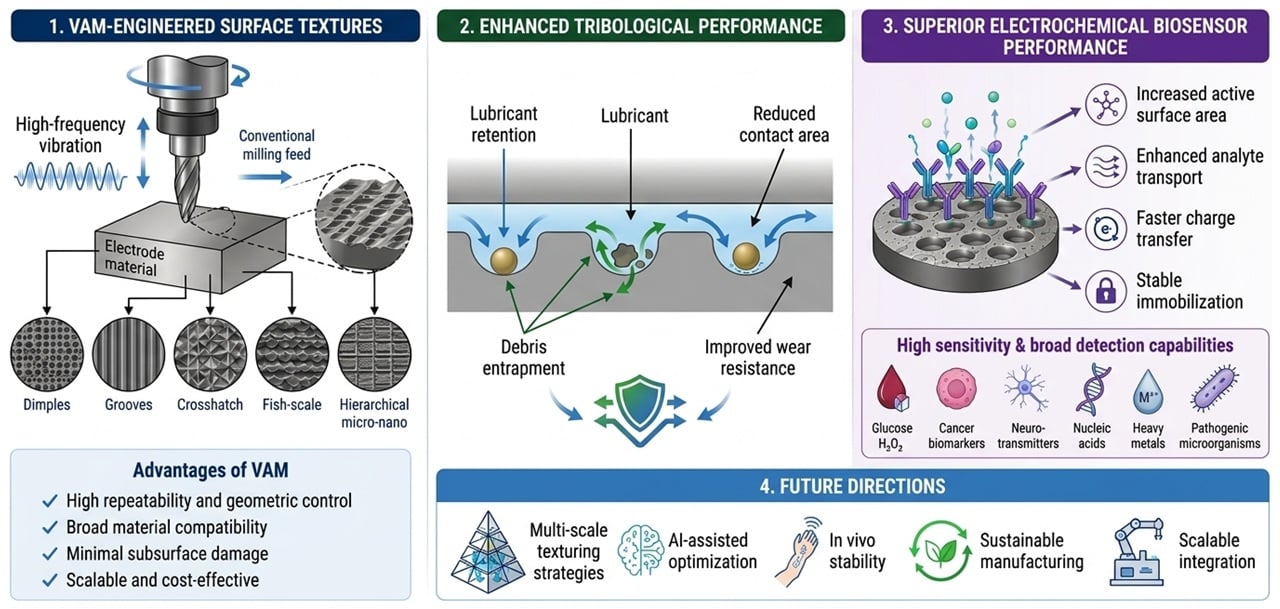
Biological surfaces have unique characteristics and properties due to the presence of well-organized micro- and nano-architectures. Fish scales, lotus leaves, shark skin, gecko feet, and insect wings are prime examples of how hierarchical and directional features can control the interfacial interactions which regulate the friction, wettability, fluid transport, adhesion, and fouling properties. However, translation of these surface textures onto engineered surfaces requires precision manufacturing methods which are capable of reproducing well-defined textures while also maintaining surface integrity. The present review examines vibration-assisted machining (VAM) as a precision manufacturing approach for producing functional and bio-inspired surface textures and discusses their potential use in tribological and electrochemical biosensing interfaces. VAM can generate deterministic dimples, grooves, crosshatch patterns, fish-scale structures, and hierarchical micro-textures through controlled tool–workpiece kinematics. Particular attention is given to the relationship between texture geometry and function, including lubricant retention, hydrodynamic pressure generation, contact-area reduction, debris entrapment, wettability, and fluid transport. These mechanisms are then coupled to electrochemical sensing where structured interfaces may increase the electrochemically active surface area, facilitate analyte transport and charge transfer, and provide more sites for bioreceptor immobilization. Hierarchical micro–nano-textures are especially attractive as they combine the mechanical functions of micro-scale structures with the interfacial and electrochemical advantages of nano-scale features. The present manuscript further discusses tribochemical stability, biofouling, physiological interfaces, and emerging biosensing applications. Finally, future opportunities are identified in quantitative bio-inspired texture design, AI-assisted inverse design, hierarchical functionalization, scalable manufacturing, and in vivo validation. This perspective positions VAM as a manufacturing bridge between biological surface design principles and multifunctional engineered interfaces for sensing and biomedical applications.
Keywords: vibration-assisted machining (VAM); biomimetics; bio-inspired surface; hierarchical textures; surface tribology; electrochemical biosensors; micro/nanostructures vibration-assisted machining (VAM); biomimetics; bio-inspired surface; hierarchical textures; surface tribology; electrochemical biosensors; micro/nanostructures
Graphical Abstract