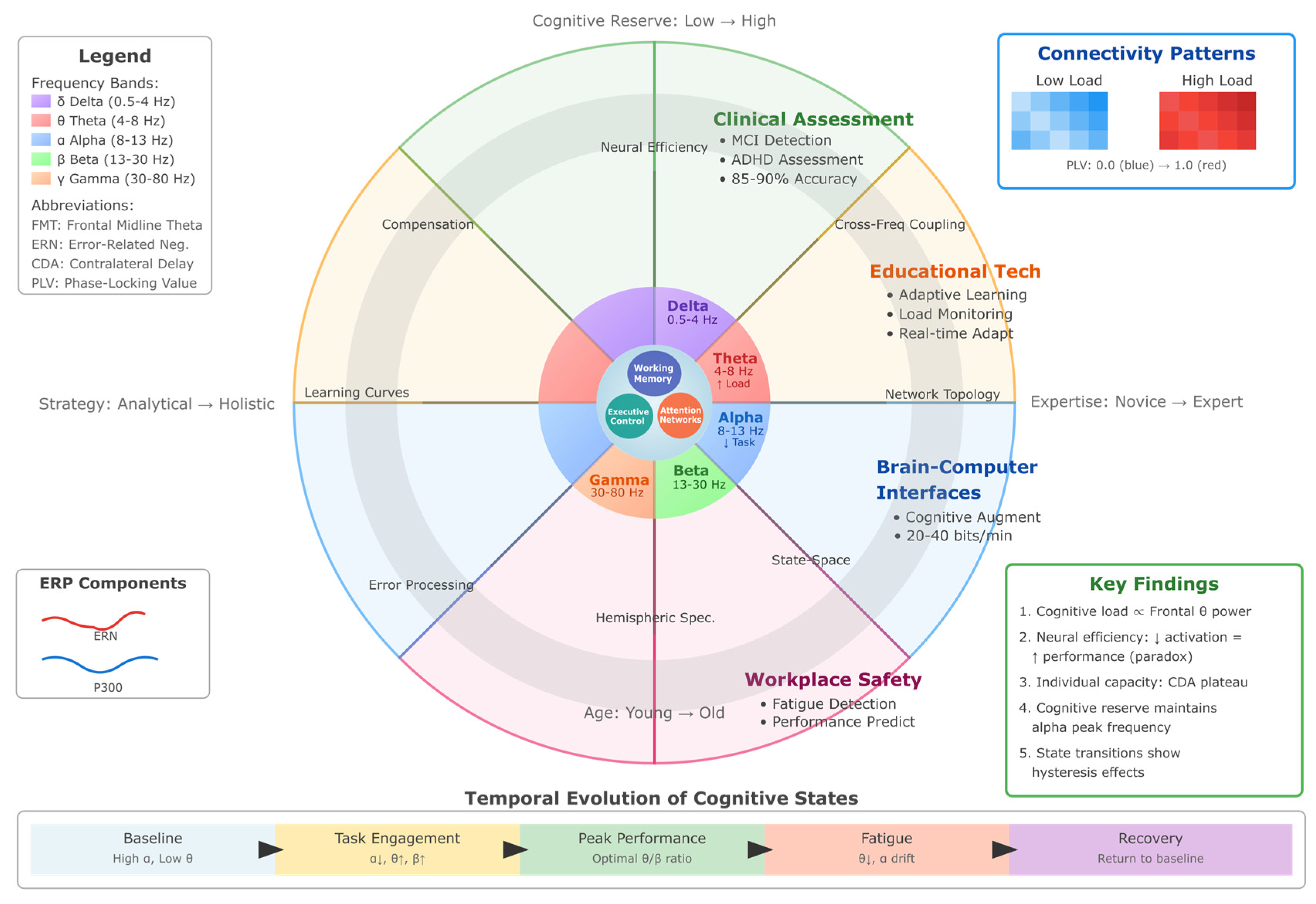

Mapping EEG Metrics to Human Affective and Cognitive Models: An Interdisciplinary Scoping Review from a Cognitive Neuroscience Perspective



Abstract
1. Introduction
1.1. Scope and Objectives of This Review
1.2. Materials and Methods
1.2.1. Review Design and Framework
1.2.2. Literature Search Strategy
- EEG terminology: “electroencephalography,” “EEG,” “neural oscillations,” “brain rhythms,” “frequency bands”;
- Affective terms: “emotion recognition,” “affective states,” “emotional processing,” “valence,” “arousal,” “frontal alpha asymmetry”;
- Cognitive terms: “cognitive load,” “working memory,” “attention,” “executive function,” “mental workload”;
- Methodological terms: “power spectral density,” “connectivity,” “machine learning,” “deep learning,” “brain–computer interface”;
- Application terms: “biomarkers,” “clinical applications,” “affective computing”.
1.2.3. Inclusion and Exclusion Criteria
1.2.4. Study Selection and Data Extraction
1.2.5. Synthesis Approach
1.2.6. Study Selection Results
1.2.7. Quality Considerations
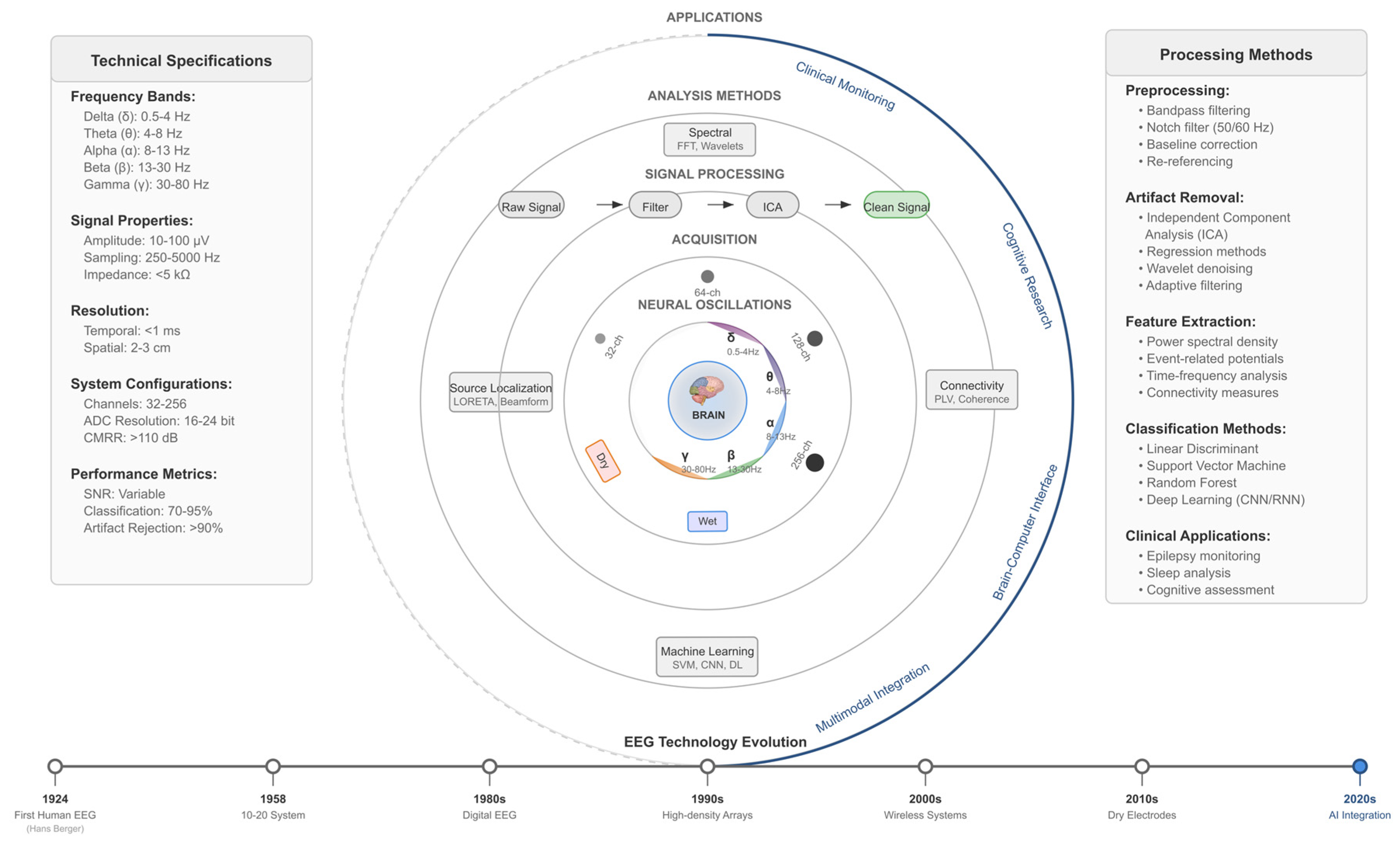
2. Overview of EEG Technology
2.1. Neurophysiological Foundations of EEG
Spatial Resolution Blind Spots for Affective Neuroscience
2.2. Signal Acquisition Systems and Recording Principles
2.3. Signal Processing and Artifact Management
Reproducibility Challenges and Standardization Solutions
- Standardized Preprocessing Pipelines: Adopt community-validated pipelines such as HAPPE (Harvard Automated Processing Pipeline for EEG), PREP (Preprocessing Pipeline), or ADJUST (Automatic EEG artifact Detection based on Joint Use of spatial and temporal features). These provide documented, version-controlled preprocessing workflows with validated parameters [134,135].
- Detailed Methodological Reporting: Follow COBIDAS EEG reporting guidelines specifying: (a) ICA algorithm name and version, (b) number of components retained, (c) criteria for artifact component identification (manual, semi-automated, or fully automated), (d) electrode configuration used for decomposition, (e) preprocessing steps applied before ICA (filtering, downsampling), and (f) handling of bridge electrodes and bad channels [136].
- Data and Code Sharing: Deposit preprocessed data and analysis scripts in repositories (OpenNeuro, EEGBASE, OSF) using BIDS (Brain Imaging Data Structure) format. This enables independent verification and identification of analysis-dependent effects [136].
- Ensemble Approaches: For critical analyses, compare results across multiple preprocessing variants (different ICA algorithms, artifact rejection thresholds) to assess robustness. Findings that replicate across reasonable preprocessing choices inspire greater confidence than those dependent on specific parameter selections.
- Multiverse Analysis: Explicitly model the “garden of forking paths” by reporting how results change across preprocessing decision space. This transparency allows readers to assess whether conclusions depend critically on arbitrary choices [137].
2.4. Analytical Methods and Feature Extraction
2.5. Source Localization and Spatial Analysis
2.6. Integration with Complementary Modalities
2.7. Contemporary Challenges and Future Directions
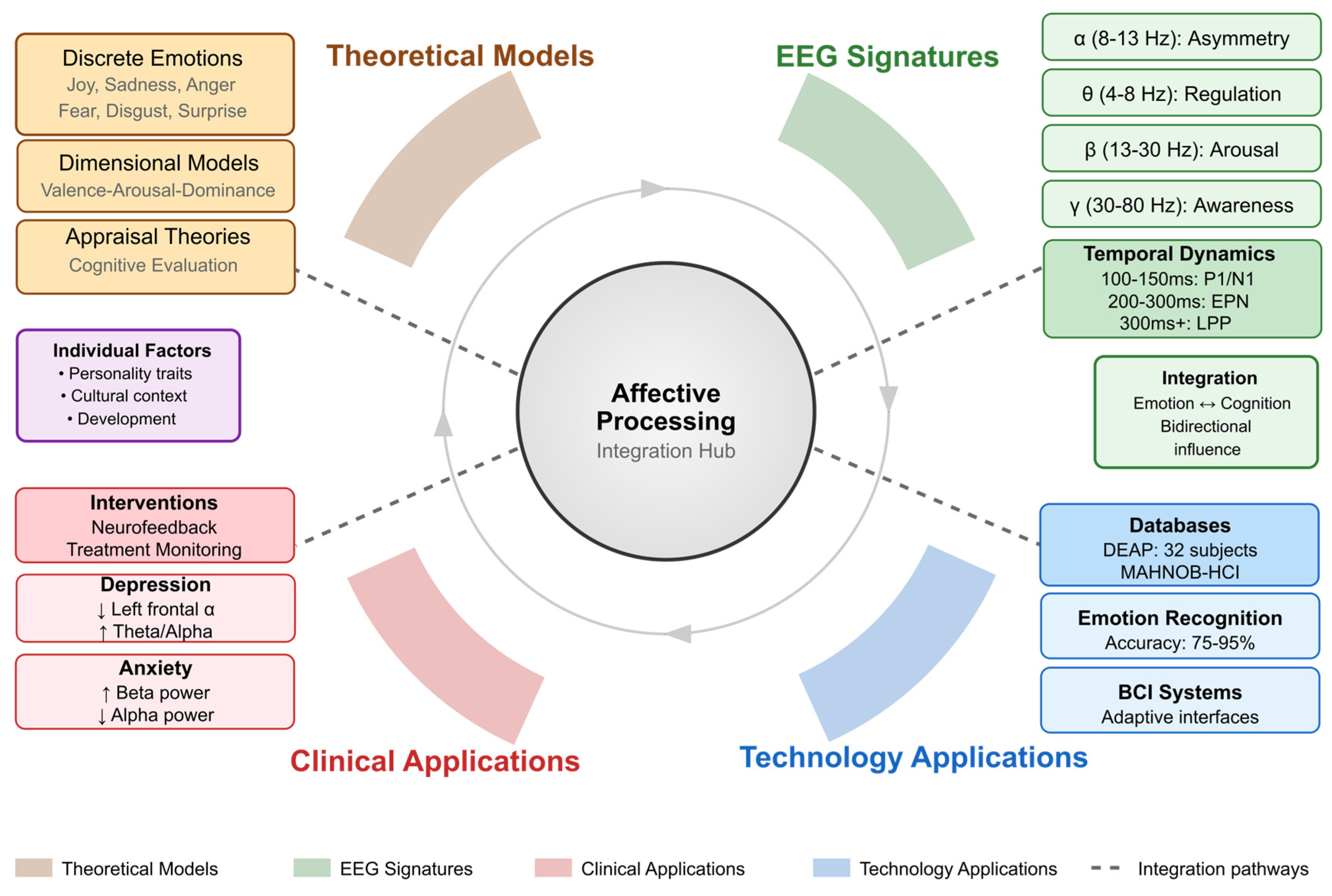
3. Human Affective Models: Neural Substrates and Theoretical Integration
3.1. Evolution of Emotion Theories in Neuroscience
3.2. Dimensional Frameworks and Neural Oscillations
Implementing Individualized Frequency Band Definitions
- Peak Alpha Frequency (PAF) During a resting state recording, compute power spectra from posterior electrodes (O1, O2, Oz, P3, P4, Pz). The PAF is identified as the frequency with maximum power within the 7–14 Hz range. Recording duration of 60 s of artifact-free eyes-closed EEG is generally sufficient for reliable PAF estimation, though longer recordings (2–3 min) may improve reliability for research applications where high precision is critical. For increased robustness, use center-of-gravity methods weighted by spectral power or fit Gaussian functions to the alpha peak [23,143,239].
- Relative Band Definition: Define individual alpha band as PAF ± 2 Hz (narrow) or PAF ± 4 Hz (broad), depending on analysis requirements. Similarly, adjust adjacent bands: individual theta = (PAF − 6 Hz) to (PAF − 2 Hz); individual beta = (PAF + 2 Hz) to (PAF + 15 Hz). This maintains consistent relationships to the dominant rhythm while accommodating individual differences [9,20,144,145].
- Clinical Feasibility Considerations: For repeated measures (treatment monitoring, neurofeedback), determine individualized bands during the initial baseline session and maintain consistent definitions across sessions. For diagnostic applications comparing patients to normative databases, use age-matched reference data accounting for developmental and degenerative frequency shifts [25,70,71,104].
- Automated Algorithms: Implement automated PAF detection algorithms with quality checks (minimum peak prominence, signal-to-noise thresholds) to ensure reliable estimation. For ambiguous cases with poorly defined peaks or multiple peaks, default to standardized bands while noting reduced sensitivity in interpretation [134,135,136,230].
3.3. Appraisal Processes and Temporal Dynamics
3.4. Individual Variability and Trait Markers
3.5. Clinical Implications and Affective Disorders
3.6. Affective Computing and Technological Applications
3.7. Integration of Affective and Cognitive Processes
3.8. Cultural and Social Dimensions
3.9. Methodological Considerations and Future Directions
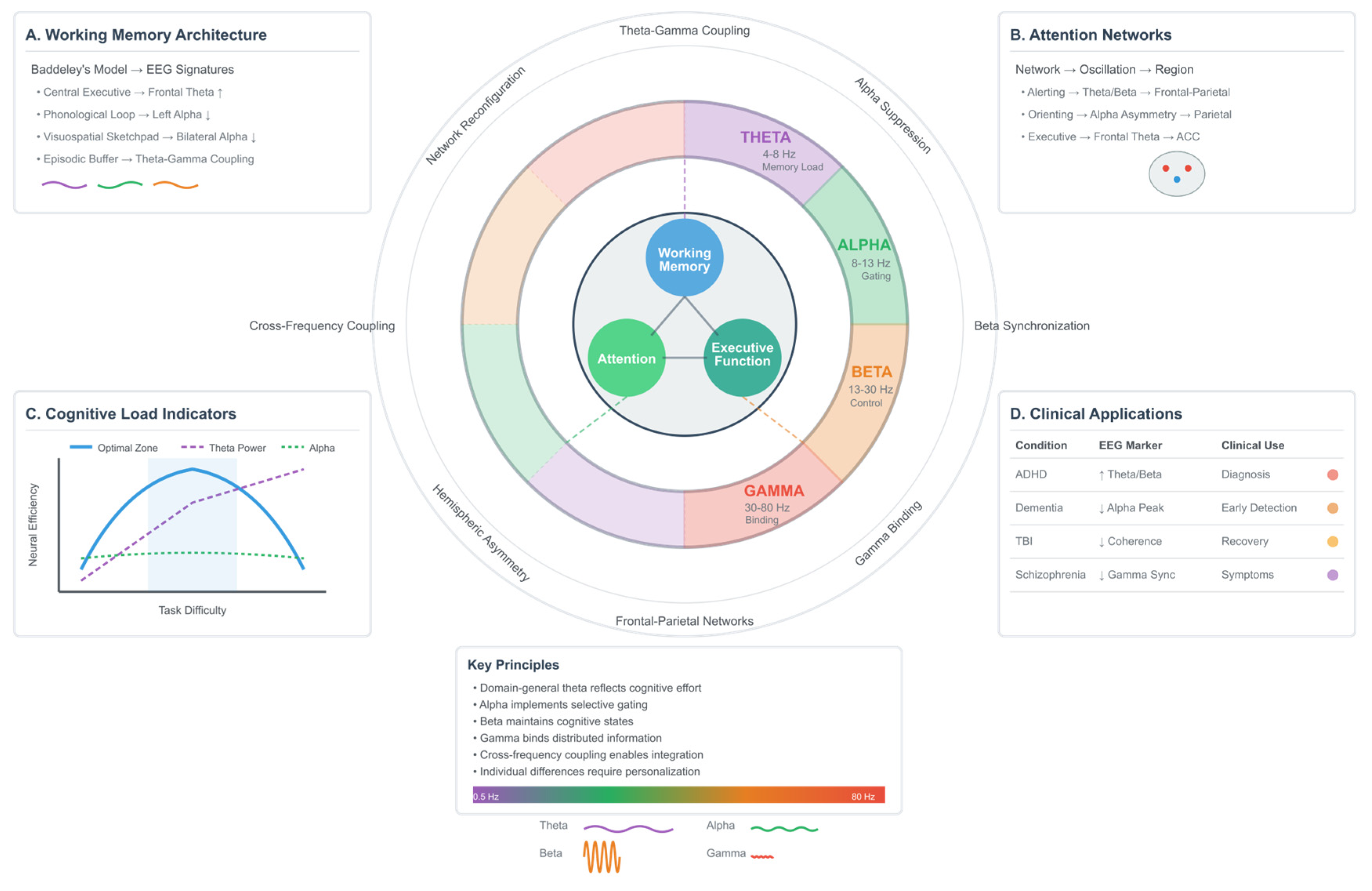
4. Machine Learning Techniques in Cognitive Model Development
4.1. Working Memory: Architecture and Neural Oscillations
4.2. Attention: Neural Mechanisms of Selection and Focus
4.2.1. Attention Networks and Oscillatory Control
4.2.2. Alpha Rhythms in Spatial Attention
4.2.3. Beta Oscillations and Top-Down Control
4.2.4. Gamma Synchronization and Feature Binding
4.3. Executive Function: Orchestrating Cognitive Control
4.4. Cognitive Load Theory and EEG Markers
4.5. Integration Across Cognitive Domains
4.6. Clinical Applications of Cognitive EEG Markers
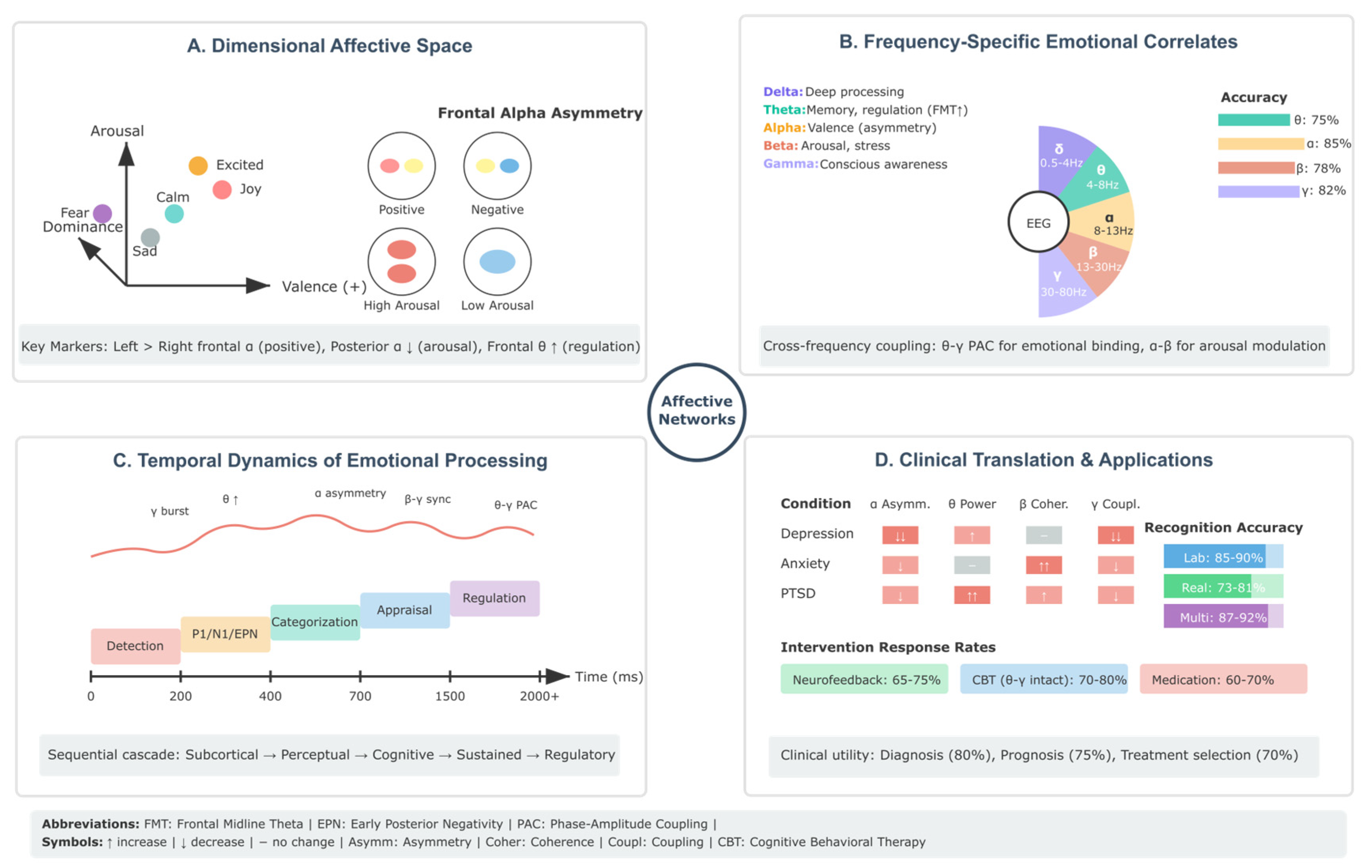
5. Mapping EEG Metrics to Affective States
5.1. Frequency-Specific Correlates of Emotional States
5.2. Network Dynamics and Connectivity Patterns
5.3. Machine Learning Approaches to Emotion Recognition
Subject-Dependent Versus Subject-Independent Classification: Clinical Implications
- Anatomical differences in skull thickness, cortical folding, and electrode–brain distances alter signal amplitude and spatial distribution;
- Individual alpha frequency variations (7–14 Hz range) cause frequency band misalignment;
- Personality traits and emotional regulation strategies produce distinct neural processing patterns;
- Previous experiences and cultural factors shape emotional responses to standardized stimuli.
- Personalized Calibration Protocols: Clinical systems requiring high accuracy (e.g., mental health monitoring, adaptive therapy) must incorporate initial calibration sessions collecting labeled emotional data from each individual. Transfer learning approaches reduce calibration requirements from 100+ trials to 20–30 trials per emotion category while maintaining 85–90% accuracy.
- Domain Adaptation Methods: Advanced machine learning techniques (domain adversarial training, optimal transport methods) explicitly model and minimize domain shift between individuals. These approaches achieve subject-independent accuracies of 80–85%, narrowing though not eliminating the performance gap.
- Hierarchical Modeling: Train models in two stages: (1) population-level model capturing universal emotion-related features, and (2) individual-level adaptations learning person-specific deviations. This balances generalization with personalization.
- Acceptable Accuracy Thresholds: Clinical utility depends on application context. Mental health screening tolerates moderate error rates (70–75% may suffice for flagging at-risk individuals requiring clinical follow-up), while safety-critical applications (detecting dangerous stress levels in pilots, surgeons) require 90%+ accuracy, necessitating personalized models.
- Multimodal Integration: Combining EEG with facial expression analysis, voice acoustics, and physiological measures (heart rate, skin conductance) improves subject-independent accuracy to 85–90%, providing robust emotion recognition without extensive calibration.
5.4. Empirical Case Studies
5.4.1. Case Study 1: Music-Induced Emotions
5.4.2. Case Study 2: Emotional Regulation in Clinical Populations
5.4.3. Case Study 3: Real-Time Emotion Detection in Virtual Reality
5.5. Individual Differences and Personalization
5.6. Integration with Peripheral Physiological Measures
5.7. Methodological Considerations and Best Practices
5.8. Clinical Applications and Therapeutic Implications
6. Mapping EEG to Cognitive Models
6.1. EEG Metrics for Cognitive Load Assessment
6.2. Neural Correlates of Cognitive Functions
Ecological Validity: Bridging Laboratory and Real-World Contexts
6.3. Working Memory Networks and Oscillatory Dynamics
6.4. Attention and Executive Control Signatures
6.5. Learning and Skill Acquisition Markers
6.6. Individual Differences and Cognitive Strategies
6.7. State-Space Modeling and Dynamic Trajectories
6.8. Cognitive Reserve and Compensation Mechanisms
6.9. Clinical Translation and Assessment Protocols
6.10. Integration with Technological Systems
7. Integration of Affective and Cognitive Models
7.1. Beyond the Dichotomy: Unified Processing Architecture
7.2. Neuroanatomical Convergence Zones
7.3. Temporal Dynamics of Integration
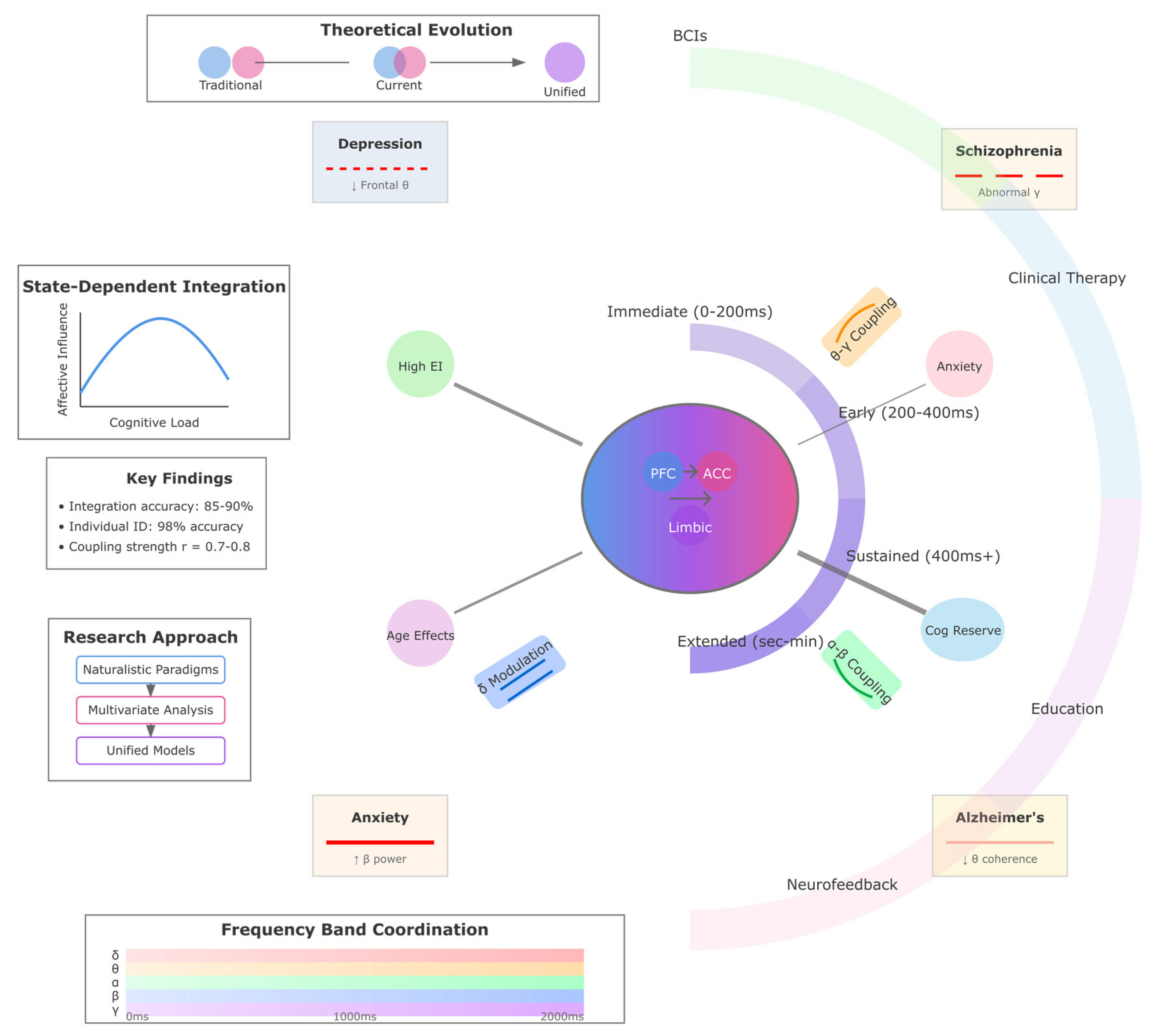
- Immediate (0–200 ms): automatic affective evaluation proceeds in parallel with sensory processing;
- Early (200–400 ms): cognitive appraisal modulates initial emotional responses;
- Sustained (400 ms+): executive control systems regulate ongoing affective states;
- Extended (seconds–minutes): mood states influence cognitive strategies and resource allocation.
7.4. Frequency-Band Coordination
- Theta–gamma coupling in frontal regions strengthens when integrating emotional valence with working memory content [624];
- Alpha–beta interactions in parietal areas regulate the gating of emotional information into conscious awareness [70];
- Delta-band modulation coordinates large-scale networks when switching between affective and cognitive processing modes [39].
7.5. State-Dependent Integration
7.6. Individual Variation in Integration Patterns
7.7. Clinical Significance of Disrupted Integration
7.8. Methodological Implications for Research
7.9. Technological Applications
7.10. Theoretical Implications and Future Frameworks
7.11. Emerging Research Directions
7.12. Conclusion: Toward Unified Models
8. Challenges and Limitations
8.1. Technical Constraints in EEG Acquisition and Signal Quality
8.2. Methodological Challenges in Signal Processing and Analysis
Statistical Power and Sample Size Considerations
- Minimum Sample Size Guidelines: For standard cognitive EEG experiments detecting established large effects, n = 30 minimum per group; for exploratory studies or moderate effects, n = 50–100; for individual differences analyses and machine learning applications, n = 100–500+, depending on complexity and feature dimensionality.
- Multi-Site Collaborations: Pool data across laboratories using standardized protocols (EEG-BIDS format, harmonized preprocessing) to achieve adequate power for robust biomarker identification and clinical validation.
- Pre-Registration and Bayesian Approaches: Combat publication bias through pre-registration specifying planned sample sizes, analyses, and stopping rules. Bayesian methods allow sequential designs that stop data collection when sufficient evidence accumulates, balancing efficiency with rigor.
- Effect Size Reporting: Always report effect sizes (Cohen’s d, partial η2, correlation coefficients) with confidence intervals, not just significance levels, enabling meta-analyses that aggregate evidence across studies.
8.3. Theoretical Gaps in Affective and Cognitive Modeling
8.4. Individual Differences and Generalizability Constraints
8.5. Integration Challenges Between Affective and Cognitive Domains
8.6. Limitations in Clinical Translation and Application
8.7. Computational and Statistical Limitations
8.8. Ethical and Practical Constraints
8.9. Future Challenges in Advancing the Field
8.10. Summary of Key Limitations
9. Future Directions—Technological Advances and Emerging Applications
9.1. Next-Generation EEG Technologies
9.2. Advanced Analytical Frameworks
9.3. Clinical Translation and Biomarker Development
9.4. Affective Computing and Human–Computer Interaction
9.5. Cognitive Enhancement and Optimization
9.6. Theoretical Advances and Integrative Models
9.7. Emerging Application Domains
9.8. Methodological Innovations
9.9. Convergence with Other Technologies
9.10. Synthesis and Vision for the Future
10. Ethical Considerations in EEG-Based Brain-Reading Technologies
11. Conclusions
Supplementary Materials
Author Contributions
Funding
Data Availability Statement
Acknowledgments
Conflicts of Interest
References
- Benwell, C.; Davila-Pérez, P.; Fried, P.; Jones, R.N.; Travison, T.; Santarnecchi, E.; Pascual-Leone, Á.; Shafi, M. EEG spectral power abnormalities and their relationship with cognitive dysfunction in patients with Alzheimer’s disease and type 2 diabetes. Neurobiol. Aging 2019, 85, 83–95. [Google Scholar] [CrossRef]
- Fang, F.; Potter, T.; Nguyen, T.; Zhang, Y. Dynamic reorganization of the cortical functional brain network in affective processing and cognitive reappraisal. Int. J. Neural Syst. 2020, 30, 2050051. [Google Scholar] [CrossRef]
- Krugliak, A.; Clarke, A. Towards real-world neuroscience using mobile EEG and augmented reality. Sci. Rep. 2022, 12, 2291. [Google Scholar] [CrossRef]
- Schreiner, T.; Doeller, C.F.; Jensen, O.; Rasch, B.; Staudigl, T. Theta Phase-Coordinated Memory Reactivation Reoccurs in a Slow-Oscillatory Rhythm during NREM Sleep. Cell Rep. 2018, 25, 296–301. [Google Scholar] [CrossRef]
- Da Silva, F.L. EEG: Origin and measurement. In EEG-fMRI: Physiological Basis, Technique, and Applications; Springer International Publishing: Berlin/Heidelberg, Germany, 2023; pp. 23–48. [Google Scholar] [CrossRef]
- Flanagan, K.; Saikia, M.J. Consumer-grade electroencephalogram and functional near-infrared spectroscopy neurofeedback technologies for mental health and wellbeing. Sensors 2023, 23, 8482. [Google Scholar] [CrossRef]
- Das, K.; Singh, V.K.; Pachori, R.B. Introduction to EEG signal recording and processing. In Artificial Intelligence Enabled Signal Processing Based Models for Neural Information Processing; CRC Press: Boca Raton, FL, USA, 2024; pp. 1–19. [Google Scholar] [CrossRef]
- World Health Organization. Ageing and Health. 2023. Available online: https://www.who.int/news-room/fact-sheets/detail/ageing-and-health (accessed on 14 August 2025).
- Perez, V.; Duque, A.; Hidalgo, V.; Salvador, A. EEG frequency bands in subjective cognitive decline: A systematic review of resting state studies. Biol. Psychol. 2024, 191, 108823. [Google Scholar] [CrossRef]
- Borhani, S.; Zhao, X.; Kelly, M.; Gottschalk, K.; Yuan, F.; Jicha, G.; Jiang, Y. Gauging working memory capacity from differential resting brain oscillations in older individuals with a wearable device. Front. Aging Neurosci. 2021, 13, 625006. [Google Scholar] [CrossRef]
- Dev, A.; Roy, N.; Islam, K.; Biswas, C.; Ahmed, H.U.; Amin, A.; Sarker, F.; Vaidyanathan, R.; Mamun, K.A. Exploration of EEG-based depression biomarkers identification techniques and their applications: A systematic review. IEEE Access 2022, 10, 16756–16781. [Google Scholar] [CrossRef]
- Gkintoni, E.; Vantarakis, A.; Gourzis, P. Neuroimaging Insights into the Public Health Burden of Neuropsychiatric Disorders: A Systematic Review of Electroencephalography-Based Cognitive Biomarkers. Medicina 2025, 61, 1003. [Google Scholar] [CrossRef]
- Pratihar, R.; Sankar, R. Advancements in Parkinson’s disease diagnosis: A comprehensive survey on biomarker integration and machine learning. Computers 2024, 13, 293. [Google Scholar] [CrossRef]
- Beyrouthy, T.; Mostafa, N.; Roshdy, A.; Karar, A.S.; Alkork, S. Review of EEG-based biometrics in 5G-IoT: Current trends and future prospects. Appl. Sci. 2024, 14, 534. [Google Scholar] [CrossRef]
- Arevalillo-Herráez, M.; Cobos, M.; Roger, S.; García-Pineda, M. Combining Inter-Subject Modeling with a Subject-Based Data Transformation to Improve Affect Recognition from EEG Signals. Sensors 2019, 19, 2999. [Google Scholar] [CrossRef]
- van Bree, S.; Levenstein, D.; Krause, M.R.; Voytek, B. Processes and measurements: A framework for understanding neural oscillations in field potentials. Trends Cogn. Sci. 2025, 29, 448–466. [Google Scholar] [CrossRef]
- Cariani, P.; Baker, J.M. Time is of the essence: Neural codes, synchronies, oscillations, architectures. Front. Comput. Neurosci. 2022, 16, 898829. [Google Scholar] [CrossRef]
- Gkintoni, E.; Aroutzidis, A.; Antonopoulou, H.; Halkiopoulos, C. From neural networks to emotional networks: A systematic review of EEG-based emotion recognition in cognitive neuroscience and real-world applications. Brain Sci. 2025, 15, 220. [Google Scholar] [CrossRef]
- Ibanez, A.; Kringelbach, M.L.; Deco, G. A synergetic turn in cognitive neuroscience of brain diseases. Trends Cogn. Sci. 2024, 28, 319–338. [Google Scholar] [CrossRef]
- Aydın, S. Cross-validated Adaboost Classification of Emotion Regulation Strategies Identified by Spectral Coherence in Resting-State. Neuroinformatics 2021, 19, 521–535. [Google Scholar] [CrossRef]
- Maffei, A.; Coccaro, A.; Jaspers-Fayer, F.; Goertzen, J.; Sessa, P.; Liotti, M. EEG alpha band functional connectivity reveals distinct cortical dynamics for overt and covert emotional face processing. Sci. Rep. 2023, 13, 10353. [Google Scholar] [CrossRef]
- Croce, P.; Quercia, A.; Costa, S.; Zappasodi, F. EEG microstates associated with intra- and inter-subject alpha variability. Sci. Rep. 2020, 10, 2469. [Google Scholar] [CrossRef]
- Barry, R.; De Blasio, F.; Fogarty, J.; Clarke, A. Natural alpha frequency components in resting EEG and their relation to arousal. Clin. Neurophysiol. 2019, 130, 1801–1812. [Google Scholar] [CrossRef]
- Shen, Y.W.; Lin, Y.P. Cross-day data diversity improves inter-individual emotion commonality of spatio-spectral EEG signatures using independent component analysis. IEEE Trans. Affect. Comput. 2023, 15, 210–222. [Google Scholar] [CrossRef]
- Uudeberg, T.; Päeske, L.; Hinrikus, H.; Lass, J.; Põld, T.; Bachmann, M. Individual stability of single-channel EEG measures over one year in healthy adults. Sci. Rep. 2025, 15, 28426. [Google Scholar] [CrossRef]
- Duffy, J.S.; Bellgrove, M.A.; Murphy, P.R.; O’Connell, R.G. Disentangling sources of variability in decision-making. Nat. Rev. Neurosci. 2025, 26, 247–262. [Google Scholar] [CrossRef]
- Gkintoni, E.; Antonopoulou, H.; Sortwell, A.; Halkiopoulos, C. Challenging Cognitive Load Theory: The Role of Educational Neuroscience and Artificial Intelligence in Redefining Learning Efficacy. Brain Sci. 2025, 15, 203. [Google Scholar] [CrossRef]
- Shiota, M.N. Basic and discrete emotion theories. In Emotion Theory: The Routledge Comprehensive Guide; Routledge: London, UK, 2024; pp. 310–330. [Google Scholar] [CrossRef]
- Horvat, M.; Jović, A.; Burnik, K. Investigation of relationships between discrete and dimensional emotion models in affective picture databases using unsupervised machine learning. Appl. Sci. 2022, 12, 7864. [Google Scholar] [CrossRef]
- Horvat, M.; Stojanović, A.; Kovačević, Ž. An overview of common emotion models in computer systems. In Proceedings of the 2022 45th Jubilee International Convention on Information, Communication and Electronic Technology (MIPRO), Opatija, Croatia, 23–27 May 2022; pp. 1008–1013. [Google Scholar] [CrossRef]
- Sander, D.; Nummenmaa, L. Reward and emotion: An affective neuroscience approach. Curr. Opin. Behav. Sci. 2021, 39, 161–167. [Google Scholar] [CrossRef]
- Iyer, K.K.; Au, T.R.; Angwin, A.J.; Copland, D.A.; Dissanayaka, N.N. Theta and gamma connectivity is linked with affective and cognitive symptoms in Parkinson’s disease. J. Affect. Disord. 2020, 277, 875–884. [Google Scholar] [CrossRef]
- Leicht, G.; Bjoerklund, J.; Vauth, S.; Mussmann, M.; Haaf, M.; Steinmann, S.; Rauh, J.; Mulert, C. Gamma-band synchronisation in a frontotemporal auditory information processing network. NeuroImage 2021, 239, 118307. [Google Scholar] [CrossRef]
- Hogenhuis, A.; Hortensius, R. Domain-specific and domain-general neural network engagement during human-robot interactions. Eur. J. Neurosci. 2022, 56, 5902–5916. [Google Scholar] [CrossRef]
- Chen, B.; Chen, C.P.; Zhang, T. GDDN: Graph domain disentanglement network for generalizable EEG emotion recognition. IEEE Trans. Affect. Comput. 2024, 15, 1739–1753. [Google Scholar] [CrossRef]
- Thornton, M.A. Deep neural network models of emotion understanding. Cogn. Emot. 2025, 1–20. [Google Scholar] [CrossRef]
- Smith, R.; Persich, M.; Lane, R.D.; Killgore, W.D.S. Higher emotional awareness is associated with greater domain-general reflective tendencies. Sci. Rep. 2022, 12, 3123. [Google Scholar] [CrossRef]
- Tahamata, V.M.; Fan, Y.; Wei, L.; Lin, Y.; Martinez, R.M.; Goh, K.K.; Chen, Y.; Chen, C. Domain-specific and domain-general functional brain alterations in type 2 diabetes mellitus: A task-based and functional connectivity meta-analysis. Brain Behav. 2025, 15, e70438. [Google Scholar] [CrossRef]
- Rahman, M.M.; Sarkar, A.K.; Hossain, M.A.; Hossain, M.S.; Islam, M.R.; Hossain, M.B.; Quinn, J.M.W.; Moni, M.A. Recognition of human emotions using EEG signals: A review. Comput. Biol. Med. 2021, 136, 104696. [Google Scholar] [CrossRef]
- Titone, S.; Samogin, J.; Peigneux, P.; Swinnen, S.P.; Mantini, D.; Albouy, G. Frequency-dependent connectivity in large-scale resting-state brain networks during sleep. Eur. J. Neurosci. 2024, 59, 686–702. [Google Scholar] [CrossRef]
- Morgan, K.K.; Hathaway, E.; Carson, M.; Fernandez-Corazza, M.; Shusterman, R.; Luu, P.; Tucker, D.M. Focal limbic sources create the large slow oscillations of the EEG in human deep sleep. Sleep Med. 2021, 85, 291–302. [Google Scholar] [CrossRef]
- Ghosh, S.; Biswas, D.; Rohan, N.R.; Vijayan, S.; Chakravarthy, V.S. Modeling of whole brain sleep electroencephalogram using deep oscillatory neural network. Front. Neuroinformatics 2025, 19, 1513374. [Google Scholar] [CrossRef]
- Li, Z.; Wang, J.; Tang, C.; Wang, P.; Ren, P.; Li, S.; Yi, L.; Liu, Q.; Sun, L.; Li, K.; et al. Coordinated NREM sleep oscillations among hippocampal subfields modulate synaptic plasticity in humans. Commun. Biol. 2024, 7, 1236. [Google Scholar] [CrossRef]
- Güntekin, B.; Hanoglu, L.; Aktürk, T.; Fide, E.; Emek-Savaş, D.D.; Rusen, E.; Yıldırım, E.; Yener, G. Impairment in recognition of emotional facial expressions in Alzheimer’s disease is represented by EEG theta and alpha responses. Psychophysiology 2019, 56, e13434. [Google Scholar] [CrossRef]
- Samogin, J.; Marino, M.; Porcaro, C.; Wenderoth, N.; Dupont, P.; Swinnen, S.; Mantini, D. Frequency-dependent functional connectivity in resting state networks. Hum. Brain Mapp. 2020, 41, 5187–5198. [Google Scholar] [CrossRef]
- Lundqvist, M.; Miller, E.K.; Nordmark, J.; Liljefors, J.; Herman, P. Beta: Bursts of cognition. Trends Cogn. Sci. 2024, 28, 662–676. [Google Scholar] [CrossRef]
- Echeverria-Altuna, I.; Quinn, A.J.; Zokaei, N.; Woolrich, M.W.; Nobre, A.C.; van Ede, F. Transient beta activity and cortico-muscular connectivity during sustained motor behaviour. Prog. Neurobiol. 2022, 214, 102281. [Google Scholar] [CrossRef]
- Barone, J.; Rossiter, H.E. Understanding the role of sensorimotor beta oscillations. Front. Syst. Neurosci. 2021, 15, 655886. [Google Scholar] [CrossRef]
- Ulloa, J.L. The control of movements via motor gamma oscillations. Front. Hum. Neurosci. 2022, 15, 787157. [Google Scholar] [CrossRef]
- Vecchio, F.; Miraglia, F.; Judica, E.; Cotelli, M.; Alù, F.; Rossini, P. Human brain networks: A graph theoretical analysis of cortical connectivity normative database from EEG data in healthy elderly subjects. GeroScience 2020, 42, 575–584. [Google Scholar] [CrossRef]
- Wu, K.; Gao, L.; Feng, Z.; Kakkos, I.; Li, C.; Sun, Y. Multimodal brain network analysis reveals divergent dysconnectivity patterns during mental fatigue: A concurrent EEG-fMRI study. Brain Res. Bull. 2025, 230, 111505. [Google Scholar] [CrossRef]
- Lou, Y.; Pi, R.; Sun, R.; Wu, J.; Wang, W.; Zhu, Z.; Dai, T.; Gong, W. Graph theory-based analysis of functional connectivity changes in brain networks underlying cognitive fatigue: An EEG study. PLoS ONE 2025, 20, e0329212. [Google Scholar] [CrossRef]
- Chiarion, G.; Sparacino, L.; Antonacci, Y.; Faes, L.; Mesin, L. Connectivity analysis in EEG data: A tutorial review of the state of the art and emerging trends. Bioengineering 2023, 10, 372. [Google Scholar] [CrossRef]
- Lu, J.; Jiang, P.; Wang, Y.; Li, M.; Zhu, Y.; Hu, K.; Zhou, X.; Wang, X. The relationship between neuromagnetic networks and cognitive impairment in self-limited epilepsy with centrotemporal spikes. Epilepsia Open 2025, 10, 842–854. [Google Scholar] [CrossRef]
- Mussigmann, T.; Bardel, B.; Lefaucheur, J. Resting-state electroencephalography (EEG) biomarkers of chronic neuropathic pain. NeuroImage 2022, 258, 119351. [Google Scholar] [CrossRef]
- Ma, W.; Zheng, Y.; Li, T.; Li, Z.; Li, Y.; Wang, L. A comprehensive review of deep learning in EEG-based emotion recognition: Classifications, trends, and practical implications. PeerJ Comput. Sci. 2024, 10, e2065. [Google Scholar] [CrossRef]
- Pathak, D.; Kashyap, R.; Rahamatkar, S. A study of deep learning approach for the classification of electroencephalogram (EEG) brain signals. In Artificial Intelligence and Machine Learning for EDGE Computing; Academic Press: Cambridge, MA, USA, 2022; pp. 133–144. [Google Scholar] [CrossRef]
- Sharma, R.; Meena, H.K. Emerging trends in EEG signal processing: A systematic review. SN Comput. Sci. 2024, 5, 415. [Google Scholar] [CrossRef]
- Khalfallah, S.; Peuch, W.; Tlija, M.; Bouallegue, K. Exploring the effectiveness of machine learning and deep learning techniques for EEG signal classification in neurological disorders. IEEE Access 2025, 13, 17002–17015. [Google Scholar] [CrossRef]
- Aggarwal, S.; Chugh, N. Review of machine learning techniques for EEG based brain computer interface. Arch. Comput. Methods Eng. 2022, 29, 3001–3020. [Google Scholar]
- Khan, P.; Kader, M.F.; Islam, S.R.; Rahman, A.B.; Kamal, M.S.; Toha, M.U.; Kwak, K.S. Machine learning and deep learning approaches for brain disease diagnosis: Principles and recent advances. IEEE Access 2021, 9, 37622–37655. [Google Scholar] [CrossRef]
- Prieto-Alcántara, M.; Ibáñez-Molina, A.; Crespo-Cobo, Y.; Molina, R.; Soriano, M.F.; Iglesias-Parro, S. Alpha and gamma EEG coherence during on-task and mind wandering states in schizophrenia. Clin. Neurophysiol. 2022, 146, 21–29. [Google Scholar] [CrossRef]
- Tanaka-Koshiyama, K.; Koshiyama, D.; Miyakoshi, M.; Joshi, Y.; Molina, J.L.; Sprock, J.; Braff, D.; Light, G. Abnormal Spontaneous Gamma Power Is Associated With Verbal Learning and Memory Dysfunction in Schizophrenia. Front. Psychiatry 2020, 11, 832. [Google Scholar] [CrossRef]
- Murty, D.V.; Manikandan, K.; Kumar, W.S.; Ramesh, R.G.; Purokayastha, S.; Nagendra, B.; Abhishek, M.L.; Balakrishnan, A.; Javali, M.; Rao, N.; et al. Stimulus-induced gamma rhythms are weaker in human elderly with mild cognitive impairment and Alzheimer’s disease. eLife 2021, 10, e61666. [Google Scholar] [CrossRef]
- Goodman, M.S.; Zomorrodi, R.; Kumar, S.; Barr, M.; Daskalakis, Z.; Blumberger, D.; Fischer, C.E.; Flint, A.; Mah, L.; Herrmann, N.; et al. Changes in Theta but not Alpha Modulation Are Associated with Impairment in Working Memory in Alzheimer’s Disease and Mild Cognitive Impairment. J. Alzheimer’s Dis. 2019, 68, 1085–1094. [Google Scholar] [CrossRef]
- Wolff, A.; Northoff, G. Temporal imprecision of phase coherence in schizophrenia and psychosis: Dynamic mechanisms and diagnostic marker. Mol. Psychiatry 2024, 29, 425–438. [Google Scholar] [CrossRef]
- Lundin, N.B.; Cowan, H.R.; Singh, D.K.; Moe, A.M. Lower cohesion and altered first-person pronoun usage in the spoken life narratives of individuals with schizophrenia. Schizophr. Res. 2023, 259, 140–149. [Google Scholar] [CrossRef]
- Hirano, Y.; Uhlhaas, P.J. Current findings and perspectives on aberrant neural oscillations in schizophrenia. Psychiatry Clin. Neurosci. 2021, 75, 358–368. [Google Scholar] [CrossRef]
- Tang, S.X.; Kriz, R.; Cho, S.; Park, S.J.; Harowitz, J.; Gur, R.E.; Bhati, M.T.; Wolf, D.H.; Sedoc, J.; Liberman, M.Y. Natural language processing methods are sensitive to sub-clinical linguistic differences in schizophrenia spectrum disorders. NPJ Schizophr. 2021, 7, 25. [Google Scholar] [CrossRef]
- Viviani, G.; Vallesi, A. EEG-neurofeedback and executive function enhancement in healthy adults: A systematic review. Psychophysiology 2021, 58, e13874. [Google Scholar] [CrossRef]
- Garcia Pimenta, M.; Brown, T.; Arns, M.; Enriquez-Geppert, S. Treatment efficacy and clinical effectiveness of EEG neurofeedback as a personalized and multimodal treatment in ADHD: A critical review. Neuropsychiatr. Dis. Treat. 2021, 17, 637–648. [Google Scholar] [CrossRef]
- Liu, W.; Zhang, C.; Wang, X.; Xu, J.; Chang, Y.; Ristaniemi, T.; Cong, F. Functional connectivity of major depression disorder using ongoing EEG during music perception. Clin. Neurophysiol. 2020, 131, 2413–2422. [Google Scholar] [CrossRef]
- Zhang, Y.; Chen, Z.S. Harnessing electroencephalography connectomes for cognitive and clinical neuroscience. Nat. Biomed. Eng. 2025, 9, 1186–1201. [Google Scholar] [CrossRef]
- Gkintoni, E.; Vassilopoulos, S.P.; Nikolaou, G.; Vantarakis, A. Neurotechnological approaches to cognitive rehabilitation in mild cognitive impairment: A systematic review of neuromodulation, EEG, virtual reality, and emerging AI applications. Brain Sci. 2025, 15, 582. [Google Scholar] [CrossRef]
- Arksey, H.; O’Malley, L. Scoping studies: Towards a methodological framework. Int. J. Soc. Res. Methodol. 2005, 8, 19–32. [Google Scholar] [CrossRef]
- Kohl, C.; Parviainen, T.; Jones, S.R. Neural mechanisms underlying human auditory evoked responses revealed by human neocortical neurosolver. Brain Topogr. 2022, 35, 19–35. [Google Scholar] [CrossRef]
- Onitsuka, T.; Tsuchimoto, R.; Oribe, N.; Spencer, K.M.; Hirano, Y. Neuronal imbalance of excitation and inhibition in schizophrenia: A scoping review of gamma-band ASSR findings. Psychiatry Clin. Neurosci. 2022, 76, 610–619. [Google Scholar] [CrossRef]
- Ye, H.; Chen, C.; Weiss, S.A.; Wang, S. Pathological and physiological high-frequency oscillations on electroencephalography in patients with epilepsy. Neurosci. Bull. 2024, 40, 609–620. [Google Scholar] [CrossRef]
- Attal, Y.; Schwartz, D. Assessment of subcortical source localization using deep brain activity imaging model with minimum norm operators: A MEG study. PLoS ONE 2013, 8, e59856. [Google Scholar] [CrossRef]
- Dalal, S.S.; Zumer, J.M.; Guggisberg, A.G.; Trumpis, M.; Wong, D.D.E.; Sekihara, K.; Nagarajan, S.S. MEG/EEG source reconstruction, statistical evaluation, and visualization with NUTMEG. Comput. Intell. Neurosci. 2011, 2011, 758973. [Google Scholar] [CrossRef]
- Phelps, E.A.; LeDoux, J.E. Contributions of the amygdala to emotion processing: From animal models to human behavior. Neuron 2005, 48, 175–187. [Google Scholar] [CrossRef]
- Lega, B.C.; Jacobs, J.; Kahana, M. Human hippocampal theta oscillations and the formation of episodic memories. Hippocampus 2012, 22, 748–761. [Google Scholar] [CrossRef]
- Keil, A.; Bradley, M.M.; Hauk, O.; Rockstroh, B.; Elbert, T.; Lang, P.J. Large-scale neural correlates of affective picture processing. Psychophysiology 2002, 39, 641–649. [Google Scholar] [CrossRef]
- Mulert, C.; Leicht, G.; Hepp, P.; Kirsch, V.; Karch, S.; Pogarell, O.; Reiser, M.F.; Hegerl, U.; Jäger, L.; Möller, H.J.; et al. Single-trial coupling of the gamma-band response and the corresponding BOLD signal. NeuroImage 2010, 49, 2238–2247. [Google Scholar] [CrossRef]
- Critchley, H.D.; Nagai, Y.; Gray, M.A.; Mathias, C.J. Dissecting axes of autonomic control in humans: Insights from neuroimaging. Auton. Neurosci. 2011, 161, 34–42. [Google Scholar] [CrossRef]
- Herrmann, C.S.; Strüber, D.; Helfrich, R.F.; Engel, A.K. EEG oscillations: From correlation to causality. Int. J. Psychophysiol. 2016, 103, 12–21. [Google Scholar]
- Prasad, R.; Tarai, S.; Bit, A. Investigation of frequency components embedded in EEG recordings underlying neuronal mechanism of cognitive control and attentional functions. Cogn. Neurodynamics 2023, 17, 1321–1344. [Google Scholar] [CrossRef]
- Ahmad, J.; Ellis, C.; Leech, R.; Voytek, B.; Garces, P.; Jones, E.; Buitelaar, J.; Loth, E.; dos Santos, F.P.; Amil, A.F.; et al. From mechanisms to markers: Novel noninvasive EEG proxy markers of the neural excitation and inhibition system in humans. Transl. Psychiatry 2022, 12, 467. [Google Scholar] [CrossRef]
- Zink, N.; Mückschel, M.; Beste, C. Resting-state EEG dynamics reveals differences in network organization and its fluctuation between frequency bands. Neuroscience 2021, 453, 43–56. [Google Scholar] [CrossRef]
- Pranjić, M.; Braun Janzen, T.; Vukšić, N.; Thaut, M. From sound to movement: Mapping the neural mechanisms of auditory-motor entrainment and synchronization. Brain Sci. 2024, 14, 1063. [Google Scholar] [CrossRef]
- Xia, R.; Chen, X.; Engel, T.A.; Moore, T. Common and distinct neural mechanisms of attention. Trends Cogn. Sci. 2024, 28, 554–567. [Google Scholar] [CrossRef]
- Donoghue, T.; Schaworonkow, N.; Voytek, B. Methodological considerations for studying neural oscillations. Eur. J. Neurosci. 2022, 55, 3502–3527. [Google Scholar] [CrossRef]
- Sun, X.; Li, Z. Use of electroencephalography (EEG) for comparing study of the external space perception of traditional and modern commercial districts. J. Asian Archit. Build. Eng. 2021, 20, 840–857. [Google Scholar] [CrossRef]
- Liu, Q.; Yang, L.; Zhang, Z.; Yang, H.; Zhang, Y.; Wu, J. The feature, performance, and prospect of advanced electrodes for electroencephalogram. Biosensors 2023, 13, 101. [Google Scholar] [CrossRef]
- He, C.; Chen, Y.Y.; Phang, C.R.; Stevenson, C.; Chen, I.P.; Jung, T.P.; Ko, L.W. Diversity and suitability of the state-of-the-art wearable and wireless EEG systems review. IEEE J. Biomed. Health Inform. 2023, 27, 3830–3843. [Google Scholar] [CrossRef]
- Mascia, A.; Collu, R.; Spanu, A.; Fraschini, M.; Barbaro, M.; Cosseddu, P. Wearable system based on ultra-thin Parylene C tattoo electrodes for EEG recording. Sensors 2023, 23, 766. [Google Scholar] [CrossRef]
- Vorontsova, D.; Menshikov, I.; Zubov, A.; Orlov, K.; Rikunov, P.; Zvereva, E.; Flitman, L.; Lanikin, A.; Sokolova, A.; Markov, S.; et al. Silent EEG-speech recognition using convolutional and recurrent neural network with 85% accuracy of 9 words classification. Sensors 2021, 21, 6744. [Google Scholar] [CrossRef]
- Kam, J.W.; Griffin, S.; Shen, A.; Patel, S.; Hinrichs, H.; Heinze, H.-J.; Deouell, L.Y.; Knight, R.T. Systematic comparison between a wireless EEG system with dry electrodes and a wired EEG system with wet electrodes. NeuroImage 2019, 184, 119–129. [Google Scholar]
- Bouguern, M.D.; Madikere Raghunatha Reddy, A.K.; Li, X.; Deng, S.; Laryea, H.; Zaghib, K. Engineering dry electrode manufacturing for sustainable lithium-ion batteries. Batteries 2024, 10, 39. [Google Scholar] [CrossRef]
- Sul, H.; Lee, D.; Manthiram, A. High-loading lithium-sulfur batteries with solvent-free dry-electrode processing. Small 2024, 20, e2400728. [Google Scholar] [CrossRef]
- Yang, L.; Liu, Q.; Zhang, Z.; Gan, L.; Zhang, Y.; Wu, J. Materials for dry electrodes for the electroencephalography: Advances, challenges, perspectives. Adv. Mater. Technol. 2022, 7, 2100612. [Google Scholar] [CrossRef]
- Lu, Y.; Zhao, C.Z.; Yuan, H.; Hu, J.K.; Huang, J.Q.; Zhang, Q. Dry electrode technology, the rising star in solid-state battery industrialization. Matter 2022, 5, 876–898. [Google Scholar] [CrossRef]
- Chowdhury, M.S.N.; Dutta, A.; Robison, M.K.; Blais, C.; Brewer, G.A.; Bliss, D.W. Deep Neural Network for Visual Stimulus-Based Reaction Time Estimation Using the Periodogram of Single-Trial EEG. Sensors 2020, 20, 6090. [Google Scholar] [CrossRef]
- Jurewicz, K.; Paluch, K.; Kublik, E.; Rogala, J.; Mikicin, M.; Wróbel, A. EEG-neurofeedback training of beta band (12–22 Hz) affects alpha and beta frequencies—A controlled study of a healthy population. Neuropsychologia 2018, 108, 13–24. [Google Scholar] [CrossRef]
- Blanco, J.A.; Vanleer, A.C.; Calibo, T.K.; Firebaugh, S.L. Single-Trial Cognitive Stress Classification Using Portable Wireless Electroencephalography. Sensors 2019, 19, 499. [Google Scholar] [CrossRef]
- Hashemi, S.S.; Callejas, A.; Siles, A.F.; Molina, A.R.; Martin-Rodriguez, L.; Rus, G. Feasibility of ultrasound elastography for meniscus viscoelastic assessment: Ex-vivo porcine validation and pilot human study. Mater. Des. 2025, 256, 114197. [Google Scholar] [CrossRef]
- Zanetti, R.; Arza, A.; Aminifar, A.; Atienza, D. Real-time EEG-based cognitive workload monitoring on wearable devices. IEEE Trans. Biomed. Eng. 2021, 69, 265–277. [Google Scholar] [CrossRef]
- Imtiaz, S.A. A systematic review of sensing technologies for wearable sleep staging. Sensors 2021, 21, 1562. [Google Scholar] [CrossRef]
- Marchand, C.; De Graaf, J.B.; Jarrassé, N. Measuring mental workload in assistive wearable devices: A review. J. Neuroeng. Rehabil. 2021, 18, 160. [Google Scholar] [CrossRef]
- Birrer, V.; Elgendi, M.; Lambercy, O.; Menon, C. Evaluating reliability in wearable devices for sleep staging. npj Digit. Med. 2024, 7, 74. [Google Scholar] [CrossRef]
- Giorgi, A.; Ronca, V.; Vozzi, A.; Sciaraffa, N.; di Florio, A.; Tamborra, L.; Simonetti, I.; Aricò, P.; Di Flumeri, G.; Rossi, D.; et al. Wearable technologies for mental workload, stress, and emotional state assessment during working-like tasks: A comparison with laboratory technologies. Sensors 2021, 21, 2332. [Google Scholar] [CrossRef]
- Amin, U.; Nascimento, F.A.; Karakis, I.; Schomer, D.; Benbadis, S.R. Normal variants and artifacts: Importance in EEG interpretation. Epileptic Disord. 2023, 25, 591–648. [Google Scholar] [CrossRef]
- Shaw, N.A. The gamma-band activity model of the near-death experience: A critique and a reinterpretation. F1000Research 2024, 13, 674. [Google Scholar] [CrossRef]
- Chmiel, J.; Malinowska, A. The neural correlates of chewing gum: A neuroimaging review of its effects on brain activity. Brain Sci. 2025, 15, 657. [Google Scholar] [CrossRef]
- Casarotto, S.; Hassan, G.; Rosanova, M.; Sarasso, S.; Derchi, C.; Trimarchi, P.D.; Viganò, A.; Russo, S.; Fecchio, M.; Devalle, G.; et al. Dissociations between spontaneous electroencephalographic features and the perturbational complexity index in the minimally conscious state. Eur. J. Neurosci. 2024, 59, 934–947. [Google Scholar] [CrossRef]
- Sharma, M.; Tiwari, J.; Acharya, U.R. Automatic Sleep-Stage Scoring in Healthy and Sleep Disorder Patients Using Optimal Wavelet Filter Bank Technique with EEG Signals. Int. J. Environ. Res. Public Health 2021, 18, 3087. [Google Scholar] [CrossRef]
- Mathe, M.; Mididoddi, P.; Krishna, B.T. Artifact removal methods in EEG recordings: A review. Proc. Eng. Technol. Innov. 2022, 20, 35–56. [Google Scholar] [CrossRef]
- Antony, M.J.; Sankaralingam, B.P.; Khan, S.; Almjally, A.; Almujally, N.A.; Mahendran, R.K. Brain-computer interface: The HOL-SSA decomposition and two-phase classification on the HGD EEG data. Diagnostics 2023, 13, 2852. [Google Scholar] [CrossRef]
- Masoudi, B. Wavelet-Attention deep model for pediatric ADHD diagnosis via EEG. Appl. Neuropsychol. Child 2025, 1–11. [Google Scholar] [CrossRef]
- Seok, D.; Lee, S.; Kim, M.; Cho, J.; Kim, C. Motion artifact removal techniques for wearable EEG and PPG sensor systems. Front. Electron. 2021, 2, 685513. [Google Scholar] [CrossRef]
- Versaci, M.; La Foresta, F. EEG data analysis techniques for precision removal and enhanced Alzheimer’s diagnosis: Focusing on fuzzy and intuitionistic fuzzy logic techniques. Signals 2024, 5, 343–381. [Google Scholar] [CrossRef]
- Brancaccio, A.; Tabarelli, D.; Zazio, A.; Bertazzoli, G.; Metsomaa, J.; Ziemann, U.; Bortoletto, M.; Belardinelli, P. Towards the definition of a standard in TMS-EEG data preprocessing. NeuroImage 2024, 301, 120874. [Google Scholar] [CrossRef]
- Macchi, B.; Felisi, M.M.J.; Muti, G.; Cicolari, D.; Parisotto, M.; Gennari, L.; Sartori, I.; Arosio, P.; Piano, M.; Colombo, P.E.; et al. Proof of concepts of resting state fMRI implementation for presurgical planning in a large general hospital. Phys. Medica 2025, 136, 105052. [Google Scholar] [CrossRef]
- Obeid, I. PiconeJ.Machine Learning Approaches to Automatic Interpretation of EEGs. In Signal Processing and Machine Learning for Biomedical Big Data; CRC Press: Boca Raton, FL, USA, 2018; pp. 271–300. [Google Scholar] [CrossRef]
- Fabietti, M.; Mahmud, M.; Lotfi, A.; Kaiser, M.S. ABOT: An open-source online benchmarking tool for machine learning-based artefact detection and removal methods from neuronal signals. Brain Inform. 2022, 9, 19. [Google Scholar] [CrossRef]
- Stalin, S.; Roy, V.; Shukla, P.K.; Zaguia, A.; Khan, M.M.; Shukla, P.K.; Jain, A. A machine learning-based big EEG data artifact detection and wavelet-based removal: An empirical approach. Math. Probl. Eng. 2021, 2021, 2942808. [Google Scholar] [CrossRef]
- Chedid, N.; Tabbal, J.; Kabbara, A.; Allouch, S.; Hassan, M. The development of an automated machine learning pipeline for the detection of Alzheimer’s disease. Sci. Rep. 2022, 12, 18137. [Google Scholar] [CrossRef]
- Kumar, R.R.; Priyadarshi, R. Denoising and segmentation in medical image analysis: A comprehensive review on machine learning and deep learning approaches. Multimed. Tools Appl. 2025, 84, 42215–42256. [Google Scholar] [CrossRef]
- Abbasi, H.; Orouskhani, M.; Asgari, S.; Zadeh, S.S. Automatic brain ischemic stroke segmentation with deep learning: A review. Neurosci. Inform. 2023, 3, 100145. [Google Scholar] [CrossRef]
- Shen, J.; Li, X.; Wang, Y.; Li, Y.; Bian, J.; Zhu, X.; He, X.; Li, J. Anti-motion interference electrocardiograph monitoring system: A review. IEEE Sens. J. 2024, 24, 15727–15747. [Google Scholar] [CrossRef]
- Huang, Q.; Ali, A.; Celik, A.; Setti, G.; Elmirghani, J.; Al-Harthi, N.; Salama, K.N.; Sen, S.; Fouda, M.E.; Eltawil, A.M. Human body communication transceivers. Nat. Rev. Electr. Eng. 2025, 2, 374–389. [Google Scholar] [CrossRef]
- Debbarma, S.; Bhadra, S. A lightweight flexible wireless electrooculogram monitoring system with printed gold electrodes. IEEE Sens. J. 2021, 21, 20931–20942. [Google Scholar] [CrossRef]
- Zhang, G.; Garrett, D.R.; Luck, S.J. Optimal filters for ERP research II: Recommended settings for seven common ERP components. Psychophysiology 2024, 61, e14530. [Google Scholar] [CrossRef]
- Bigdely-Shamlo, N.; Mullen, T.; Kothe, C.; Su, K.-M.; Robbins, K.A. The PREP pipeline: Standardized preprocessing for large-scale EEG analysis. Front. Neuroinformatics 2015, 9, 16. [Google Scholar] [CrossRef]
- Robbins, K.A.; Touryan, J.; Mullen, T.; Kothe, C.; Bigdely-Shamlo, N. How Sensitive Are EEG Results to Preprocessing Methods: A Benchmarking Study. IEEE Trans. Neural Syst. Rehabil. Eng. 2020, 28, 1081–1090. [Google Scholar] [CrossRef]
- Pernet, C.R.; Appelhoff, S.; Gorgolewski, K.J.; Flandin, G.; Phillips, C.; Delorme, A.; Oostenveld, R. EEG-BIDS, an extension to the brain imaging data structure for electroencephalography. Sci. Data 2019, 6, 103. [Google Scholar] [CrossRef]
- Steegen, S.; Tuerlinckx, F.; Gelman, A.; Vanpaemel, W. Increasing transparency through a multiverse analysis. Perspect. Psychol. Sci. 2016, 11, 702–712. [Google Scholar] [CrossRef]
- Pradhapan, P.; Velazquez, E.R.; Witteveen, J.A.; Tonoyan, Y.; Mihajlović, V. The Role of Features Types and Personalized Assessment in Detecting Affective State Using Dry Electrode EEG. Sensors 2020, 20, 6810. [Google Scholar] [CrossRef]
- Valentim, C.A.; Inacio, C.M.C., Jr.; David, S.A. Fractal methods and power spectral density as means to explore EEG patterns in patients undertaking mental tasks. Fractal Fract. 2021, 5, 225. [Google Scholar] [CrossRef]
- Redwan, S.M.; Uddin, M.P.; Ulhaq, A.; Sharif, M.I.; Krishnamoorthy, G. Power spectral density-based resting-state EEG classification of first-episode psychosis. Sci. Rep. 2024, 14, 15154. [Google Scholar] [CrossRef]
- Zhang, Q.; Hu, Y.; Dong, X.; Feng, X. Clinical significance of electroencephalography power spectrum density and functional connection analysis in neonates with hypoxic-ischemic encephalopathy. Int. J. Dev. Neurosci. 2021, 81, 142–150. [Google Scholar] [CrossRef]
- Ng, M.C.; Jing, J.; Westover, M.B. A primer on EEG spectrograms. J. Clin. Neurophysiol. 2022, 39, 177–183. [Google Scholar] [CrossRef]
- Rogala, J.; Kublik, E.; Krauz, R.; Wróbel, A. Resting-state EEG activity predicts frontoparietal network reconfiguration and improved attentional performance. Sci. Rep. 2020, 10, 5064. [Google Scholar] [CrossRef]
- Angelidis, A.; Hagenaars, M.; van Son, D.; van der Does, W.; Putman, P. Do not look away! Spontaneous frontal EEG theta/beta ratio as a marker for cognitive control over attention to mild and high threat. Biol. Psychol. 2018, 135, 8–17. [Google Scholar] [CrossRef]
- Wang, T.S.; Wang, S.S.; Wang, C.L.; Wong, S.B. Theta/beta ratio in EEG correlated with attentional capacity assessed by Conners Continuous Performance Test in children with ADHD. Front. Psychiatry 2024, 14, 1305397. [Google Scholar] [CrossRef]
- Son, D.V.; Blasio, F.D.D.; Fogarty, J.; Angelidis, A.; Barry, R.; Putman, P. Frontal EEG theta/beta ratio during mind wandering episodes. Biol. Psychol. 2019, 140, 19–27. [Google Scholar] [CrossRef]
- Cao, J.; Zhao, Y.; Shan, X.; Wei, H.; Guo, Y.; Chen, L.; Erkoyuncu, J.A.; Sarrigiannis, P.G. Brain functional and effective connectivity based on electroencephalography recordings: A review. Hum. Brain Mapp. 2022, 43, 860–879. [Google Scholar] [CrossRef]
- Guan, K.; Zhang, Z.; Chai, X.; Tian, Z.; Liu, T.; Niu, H. EEG-based dynamic functional connectivity analysis in mental workload tasks with different types of information. IEEE Trans. Neural Syst. Rehabil. Eng. 2022, 30, 632–642. [Google Scholar] [CrossRef]
- Klepl, D.; He, F.; Wu, M.; Blackburn, D.J.; Sarrigiannis, P. EEG-based graph neural network classification of Alzheimer’s disease: An empirical evaluation of functional connectivity methods. IEEE Trans. Neural Syst. Rehabil. Eng. 2022, 30, 2651–2660. [Google Scholar] [CrossRef]
- Babaeeghazvini, P.; Rueda-Delgado, L.M.; Gooijers, J.; Swinnen, S.P.; Daffertshofer, A. Brain structural and functional connectivity: A review of combined works of diffusion magnetic resonance imaging and electroencephalography. Front. Hum. Neurosci. 2021, 15, 721206. [Google Scholar] [CrossRef]
- Vecchio, F.; Miraglia, F.; Alù, F.; Menna, M.; Judica, E.; Cotelli, M.; Rossini, P.M. Classification of Alzheimer’s Disease with Respect to Physiological Aging with Innovative EEG Biomarkers in a Machine Learning Implementation. J. Alzheimer’s Dis. 2020, 75, 1253–1261. [Google Scholar] [CrossRef]
- Guo, Z.; Liu, K.; Li, J.; Zhu, H.; Chen, B.; Liu, X. Disrupted topological organization of functional brain networks in Alzheimer’s disease patients with depressive symptoms. BMC Psychiatry 2022, 22, 810. [Google Scholar] [CrossRef]
- Liu, C.; Li, L.; Pan, W.; Zhu, D.; Lian, S.; Liu, Y.; Ren, L.; Mao, P.; Ren, Y.; Ma, X. Altered topological properties of functional brain networks in patients with first episode, late-life depression before and after antidepressant treatment. Front. Aging Neurosci. 2023, 15, 1107320. [Google Scholar] [CrossRef]
- Ng, A.S.L.; Wang, J.; Ng, K.K.; Chong, J.S.X.; Qian, X.; Lim, J.K.W.; Tan, Y.J.; Yong, A.C.W.; Chander, R.J.; Hameed, S.; et al. Distinct network topology in Alzheimer’s disease and behavioral variant frontotemporal dementia. Alzheimer’s Res. Ther. 2021, 13, 13. [Google Scholar] [CrossRef]
- Fathian, A.; Jamali, Y.; Raoufy, M.R. The trend of disruption in the functional brain network topology of Alzheimer’s disease. Sci. Rep. 2022, 12, 14998. [Google Scholar] [CrossRef]
- Chu, T.; Li, J.; Zhang, Z.; Gong, P.; Che, K.; Li, Y.; Zhang, G.; Mao, N. Altered structural covariance of hippocampal subregions in patients with Alzheimer’s disease. Behav. Brain Res. 2021, 409, 113327. [Google Scholar] [CrossRef]
- Canolty, R.T.; Knight, R.T. The functional role of cross-frequency coupling. Trends Cogn. Sci. 2010, 14, 506–515. [Google Scholar] [CrossRef]
- Borderie, A.; Caclin, A.; Lachaux, J.-P.; Perrone-Bertollotti, M.; Hoyer, R.S.; Kahane, P.; Catenoix, H.; Tillmann, B.; Albouy, P. Cross-frequency coupling in cortico-hippocampal networks supports the maintenance of sequential auditory information in short-term memory. PLoS Biol. 2024, 22, e3002512. [Google Scholar] [CrossRef]
- Weissbart, H.; Martin, A.E. The structure and statistics of language jointly shape cross-frequency neural dynamics during spoken language comprehension. Nat. Commun. 2024, 15, 8850. [Google Scholar] [CrossRef]
- Abubaker, M.; Al Qasem, W.; Kvašňák, E. Working memory and cross-frequency coupling of neuronal oscillations. Front. Psychol. 2021, 12, 756661. [Google Scholar] [CrossRef]
- Galvão, F.; Alarcão, S.M.; Fonseca, M.J. Predicting exact valence and arousal values from EEG. Sensors 2021, 21, 3414. [Google Scholar] [CrossRef]
- Indra, J.; Shankar, R.K.; Priya, R.D. Speech emotion recognition using support vector machine and linear discriminant analysis. In International Conference on Intelligent Systems Design and Applications; Springer Nature: Cham, Switzerland, 2022; pp. 482–492. [Google Scholar] [CrossRef]
- Alhussan, A.A.; Talaat, F.M.; El-Kenawy, E.S.M.; Abdelhamid, A.A.; Ibrahim, A.; Khafaga, D.S.; Alnaggar, M. Facial expression recognition model depending on optimized support vector machine. Comput. Mater. Contin. 2023, 76, 499–515. [Google Scholar] [CrossRef]
- Daqrouq, K.; Balamesh, A.; Alrusaini, O.; Alkhateeb, A.; Balamash, A.S. Emotion modeling in speech signals: Discrete wavelet transform and machine learning tools for emotion recognition system. Appl. Comput. Intell. Soft Comput. 2024, 2024, 7184018. [Google Scholar] [CrossRef]
- Xia, Y.; Xu, F. Study on music emotion recognition based on the machine learning model clustering algorithm. Math. Probl. Eng. 2022, 2022, 9256586. [Google Scholar] [CrossRef]
- Guerrero, M.C.; Parada, J.S.; Espitia, H.E. EEG signal analysis using classification techniques: Logistic regression, artificial neural networks, support vector machines, and convolutional neural networks. Heliyon 2021, 7, e07258. [Google Scholar] [CrossRef]
- Chen, X.; Teng, X.; Chen, H.; Pan, Y.; Geyer, P. Toward reliable signals decoding for electroencephalogram: A benchmark study to EEGNeX. Biomed. Signal Process. Control 2024, 87, 105475. [Google Scholar] [CrossRef]
- Khushiyant Mathur, V.; Kumar, S.; Shokeen, V. REEGNet: A resource efficient EEGNet for EEG trail classification in healthcare. Intell. Decis. Technol. 2024, 18, 1463–1476. [Google Scholar] [CrossRef]
- Avilov, O.; Rimbert, S.; Popov, A.; Bougrain, L. Optimizing motor intention detection with deep learning: Towards management of intraoperative awareness. IEEE Trans. Biomed. Eng. 2021, 68, 3087–3097. [Google Scholar] [CrossRef]
- Paillard, J.; Hipp, J.F.; Engemann, D.A. GREEN: A lightweight architecture using learnable wavelets and Riemannian geometry for biomarker exploration with EEG signals. Patterns 2025, 6, 101182. [Google Scholar] [CrossRef]
- Wu, J.; Chen, Y.; Li, Z.; Li, F. Cognitive control is modulated by hierarchical complexity of task switching: An event-related potential study. Behav. Brain Res. 2022, 423, 114025. [Google Scholar] [CrossRef]
- Lu, W.; Liu, H.; Ma, H.; Tan, T.P.; Xia, L. Hybrid transfer learning strategy for cross-subject EEG emotion recognition. Front. Hum. Neurosci. 2023, 17, 1280241. [Google Scholar] [CrossRef]
- Feng, J.; Li, Y.; Huang, Z.; Chen, Y.; Lu, S.; Hu, R.; Hu, Q.; Chen, Y.; Wang, X.; Fan, Y.; et al. Heterogeneous transfer learning model for improving the classification performance of fNIRS signals in motor imagery among cross-subject stroke patients. Front. Hum. Neurosci. 2025, 19, 1555690. [Google Scholar] [CrossRef]
- Paromita, P.; Mundnich, K.; Nadarajan, A.; Booth, B.M.; Narayanan, S.S.; Chaspari, T. Modeling inter-individual differences in ambulatory-based multimodal signals via metric learning: A case study of personalized well-being estimation of healthcare workers. Front. Digit. Health 2023, 5, 1195795. [Google Scholar] [CrossRef]
- Schreiner, L.; Jordan, M.; Sieghartsleitner, S.; Kapeller, C.; Pretl, H.; Kamada, K.; Asman, P.; Ince, N.F.; Miller, K.J.; Guger, C. Mapping of the central sulcus using non-invasive ultra-high-density brain recordings. Sci. Rep. 2024, 14, 6527. [Google Scholar] [CrossRef]
- Conte, S.; Richards, J.E. Cortical source analysis of event-related potentials: A developmental approach. Dev. Cogn. Neurosci. 2022, 54, 101092. [Google Scholar] [CrossRef]
- Sun, R.; Sohrabpour, A.; Joseph, B.; Worrell, G.; He, B. Seizure sources can be imaged from scalp EEG by means of biophysically constrained deep neural networks. Adv. Sci. 2024, 11, 2405246. [Google Scholar] [CrossRef]
- Michel, C.M.; Brunet, D. EEG Source Imaging: A Practical Review of the Analysis Steps. Front. Neurol. 2019, 10, 325. [Google Scholar] [CrossRef]
- Carboni, M.; Brunet, D.; Seeber, M.; Michel, C.M.; Vulliemoz, S.; Vorderwülbecke, B.J. Linear distributed inverse solutions for interictal EEG source localisation. Clin. Neurophysiol. 2022, 133, 58–67. [Google Scholar] [CrossRef]
- Zeltser, A.; Ochneva, A.; Riabinina, D.; Zakurazhnaya, V.; Tsurina, A.; Golubeva, E.; Berdalin, A.; Andreyuk, D.; Leonteva, E.; Kostyuk, G.; et al. EEG techniques with brain activity localization, specifically LORETA, and its applicability in monitoring schizophrenia. J. Clin. Med. 2024, 13, 5108. [Google Scholar] [CrossRef]
- Noroozi, A.; Ravan, M.; Razavi, B. A robust eLORETA technique for localization of brain sources in the presence of forward model uncertainties. IEEE Trans. Biomed. Eng. 2022, 70, 800–811. [Google Scholar] [CrossRef]
- Qin, X.; Du, L.; Jiao, X.; Wang, J.; Tong, S.; Yuan, T.; Sun, J. Evaluation of brain source localization methods based on test–retest reliability with multiple session EEG data. IEEE Trans. Biomed. Eng. 2023, 70, 2080–2090. [Google Scholar] [CrossRef]
- Gomez-Tapia, C.; Bozic, B.; Longo, L. Evaluation of EEG pre-processing and source localization in ecological research. Front. Neuroimaging 2025, 4, 1479569. [Google Scholar] [CrossRef]
- Belardinelli, P.; Biabani, M.; Blumberger, D.M.; Bortoletto, M.; Casarotto, S.; David, O.; Desideri, D.; Etkin, A.; Ferrarelli, F.; Fitzgerald, P.B.; et al. Reproducibility in TMS–EEG studies: A call for data sharing, standard procedures and effective experimental control. Brain Stimul. 2019, 12, 787–790. [Google Scholar] [CrossRef]
- Metsomaa, J.; Song, Y.; Mutanen, T.P.; Gordon, P.C.; Ziemann, U.; Zrenner, C.; Hernandez-Pavon, J.C. Adapted beamforming: A robust and flexible approach for removing various types of artifacts from TMS-EEG data. Brain Topogr. 2024, 37, 659–683. [Google Scholar] [CrossRef]
- Cai, C.; Long, Y.; Ghosh, S.; Hashemi, A.; Gao, Y.; Diwakar, M.; Haufe, S.; Sekihara, K.; Wu, W.; Nagarajan, S.S. Bayesian adaptive beamformer for robust electromagnetic brain imaging of correlated sources in high spatial resolution. IEEE Trans. Med. Imaging 2023, 42, 2502–2512. [Google Scholar] [CrossRef]
- Kim, D.; Cauley, S.F.; Nayak, K.S.; Leahy, R.M.; Haldar, J.P. Region-optimized virtual (ROVir) coils: Localization and/or suppression of spatial regions using sensor-domain beamforming. Magn. Reson. Med. 2021, 86, 197–212. [Google Scholar] [CrossRef]
- Uji, M.; Cross, N.; Pomares, F.B.; Perrault, A.A.; Jegou, A.; Nguyen, A.; Aydin, U.; Lina, J.; Dang-Vu, T.T.; Grova, C. Data-driven beamforming technique to attenuate ballistocardiogram artefacts in electroencephalography–functional magnetic resonance imaging without detecting cardiac pulses in electrocardiography recordings. Hum. Brain Mapp. 2021, 42, 3993–4021. [Google Scholar] [CrossRef]
- Knösche, T.R.; Haueisen, J. EEG/MEG Source Reconstruction; Springer International Publishing: Berlin/Heidelberg, Germany, 2022. [Google Scholar] [CrossRef]
- Jones, M.R.; Rogers, T.J.; Worden, K.; Cross, E.J. A Bayesian methodology for localising acoustic emission sources in complex structures. Mech. Syst. Signal Process. 2022, 163, 108143. [Google Scholar] [CrossRef]
- Kejzlar, V.; Neufcourt, L.; Nazarewicz, W. Local Bayesian Dirichlet mixing of imperfect models. Sci. Rep. 2023, 13, 19600. [Google Scholar] [CrossRef]
- Ciccarelli, G.; Federico, G.; Mele, G.; Di Cecca, A.; Migliaccio, M.; Ilardi, C.R.; Alfano, V.; Salvatore, M.; Cavaliere, C. Simultaneous real-time EEG-fMRI neurofeedback: A systematic review. Front. Hum. Neurosci. 2023, 17, 1123014. [Google Scholar] [CrossRef]
- Scrivener, C.L. When is simultaneous recording necessary? A guide for researchers considering combined EEG-fMRI. Front. Neurosci. 2021, 15, 636424. [Google Scholar] [CrossRef]
- Sadjadi, S.M.; Ebrahimzadeh, E.; Shams, M.; Seraji, M.; Soltanian-Zadeh, H. Localization of epileptic foci based on simultaneous EEG-fMRI data. Front. Neurol. 2021, 12, 645594. [Google Scholar] [CrossRef]
- Han, B.; Shen, L.; Chen, Q. How can I combine data from fMRI, EEG, and intracranial EEG? In Intracranial EEG: A Guide for Cognitive Neuroscientists; Springer International Publishing: Berlin/Heidelberg, Germany, 2023; pp. 239–256. [Google Scholar] [CrossRef]
- Bullock, M.; Jackson, G.D.; Abbott, D.F. Artifact reduction in simultaneous EEG-fMRI: A systematic review of methods and contemporary usage. Front. Neurol. 2021, 12, 622719. [Google Scholar] [CrossRef]
- Baghdadi, G.; Hadaeghi, F.; Kamarajan, C. Multimodal approaches to investigating neural dynamics in cognition and related clinical conditions: Integrating EEG, MEG, and fMRI data. Front. Syst. Neurosci. 2025, 19, 1495018. [Google Scholar] [CrossRef]
- Murphy, P.R.; O’Connell, R.G.; O’Sullivan, M.; Robertson, I.H.; Balsters, J.H. Pupil diameter covaries with BOLD activity in human locus coeruleus. Hum. Brain Mapp. 2014, 35, 4140–4154. [Google Scholar] [CrossRef]
- Ahmadi, M.; Michalka, S.W.; Najafabadi, M.A.; Wünsche, B.C.; Billinghurst, M. EEG, pupil dilations, and other physiological measures of working memory load in the Sternberg task. Multimodal Technol. Interact. 2024, 8, 34. [Google Scholar] [CrossRef]
- Haro, S.; Rao, H.M.; Quatieri, T.F.; Smalt, C.J. EEG alpha and pupil diameter reflect endogenous auditory attention switching and listening effort. Eur. J. Neurosci. 2022, 55, 1262–1277. [Google Scholar] [CrossRef]
- Groot, J.M.; Boayue, N.M.; Csifcsák, G.; Boekel, W.; Huster, R.; Forstmann, B.U.; Mittner, M. Probing the neural signature of mind wandering with simultaneous fMRI-EEG and pupillometry. NeuroImage 2021, 224, 117412. [Google Scholar] [CrossRef]
- Strauch, C.; Wang, C.A.; Einhäuser, W.; Van der Stigchel, S.; Naber, M. Pupillometry as an integrated readout of distinct attentional networks. Trends Neurosci. 2022, 45, 635–647. [Google Scholar] [CrossRef]
- Fodor, Z.; Horváth, A.; Hidasi, Z.; Gouw, A.; Stam, C.; Csukly, G. EEG alpha and beta band functional connectivity and network structure mark hub overload in mild cognitive impairment during memory maintenance. Front. Aging Neurosci. 2021, 13, 680200. [Google Scholar] [CrossRef]
- Park, G.; Thayer, J.F. From the heart to the mind: Cardiac vagal tone modulates top-down and bottom-up visual perception and attention to emotional stimuli. Front. Psychol. 2014, 5, 278. [Google Scholar] [CrossRef]
- Lee, D.; Kwon, W.; Heo, J.; Park, J.Y. Associations between heart rate variability and brain activity during a working memory task: A preliminary electroencephalogram study on depression and anxiety disorder. Brain Sci. 2022, 12, 172. [Google Scholar] [CrossRef]
- Steinmann, S.; Tiedemann, K.J.; Kellner, S.; Wellen, C.M.; Haaf, M.; Mulert, C.; Rauh, J.; Leicht, G. Reduced frontocingulate theta connectivity during emotion regulation in major depressive disorder. J. Psychiatr. Res. 2024, 173, 245–253. [Google Scholar] [CrossRef]
- Cortese, M.D.; Vatrano, M.; Tonin, P.; Cerasa, A.; Riganello, F. Inhibitory control and brain-heart interaction: An HRV-EEG study. Brain Sci. 2022, 12, 740. [Google Scholar] [CrossRef]
- McAleer, J.; Stewart, L.; Shepard, R.; Sheena, M.; Kabir, S.; Swank, I.; Stange, J.P.; Leow, A.; Klumpp, H.; Ajilore, O. Differential effects of transcranial current type on heart rate variability during emotion regulation in internalizing psychopathologies. J. Affect. Disord. 2023, 327, 7–14. [Google Scholar] [CrossRef]
- Kreibig, S.D. Autonomic nervous system activity in emotion: A review. Biol. Psychol. 2010, 84, 394–421. [Google Scholar] [CrossRef]
- Critchley, H.D. Electrodermal responses: What happens in the brain. Neurosci. 2002, 8, 132–142. [Google Scholar] [CrossRef]
- Jelinčić, V.; Van Diest, I.; Torta, D.M.; von Leupoldt, A. The breathing brain: The potential of neural oscillations for the understanding of respiratory perception in health and disease. Psychophysiology 2022, 59, e13844. [Google Scholar] [CrossRef]
- Zhang, C.; Wang, Y.; Li, M.; Niu, P.; Li, S.; Hu, Z.; Shi, C.; Li, Y. Phase-amplitude coupling in theta and beta bands: A potential electrophysiological marker for obstructive sleep apnea. Nat. Sci. Sleep 2024, 16, 1469–1482. [Google Scholar] [CrossRef]
- Mofleh, R.; Kocsis, B. Delta-range coupling between prefrontal cortex and hippocampus supported by respiratory rhythmic input from the olfactory bulb in freely behaving rats. Sci. Rep. 2021, 11, 8100. [Google Scholar] [CrossRef]
- Guan, A.; Wang, S.; Huang, A.; Qiu, C.; Li, Y.; Li, X.; Wang, J.; Wang, Q.; Deng, B. The role of gamma oscillations in central nervous system diseases: Mechanism and treatment. Front. Cell. Neurosci. 2022, 16, 962957. [Google Scholar] [CrossRef]
- Butler, R.; Bernier, P.; Mierzwinski, G.W.; Descoteaux, M.; Gilbert, G.; Whittingstall, K. Cortical distance, not cancellation, dominates inter-subject EEG gamma rhythm amplitude. NeuroImage 2019, 192, 156–165. [Google Scholar] [CrossRef]
- Zhou, Y.; Song, X.; Song, Y.; Guo, J.; Han, G.; Liu, X.; He, F.; Ming, D. Acoustoelectric brain imaging with different conductivities and acoustic distributions. Front. Physiol. 2023, 14, 1241640. [Google Scholar] [CrossRef]
- Piastra, M.C.; Oostenveld, R.; Homölle, S.; Han, B.; Chen, Q.; Oostendorp, T. How to assess the accuracy of volume conduction models? A validation study with stereotactic EEG data. Front. Hum. Neurosci. 2024, 18, 1279183. [Google Scholar] [CrossRef]
- Marino, M.; Cordero-Grande, L.; Mantini, D.; Ferrazzi, G. Conductivity tensor imaging of the human brain using water mapping techniques. Front. Neurosci. 2021, 15, 694645. [Google Scholar] [CrossRef]
- Wang, Y.; Yang, X.; Zhang, X.; Wang, Y.; Pei, W. Implantable intracortical microelectrodes: Reviewing the present with a focus on the future. Microsyst. Nanoeng. 2023, 9, 7. [Google Scholar] [CrossRef]
- Robinson, A.K.; Venkatesh, P.; Boring, M.J.; Tarr, M.J.; Grover, P.; Behrmann, M. Very high density EEG elucidates spatiotemporal aspects of early visual processing. Sci. Rep. 2017, 7, 16248. [Google Scholar] [CrossRef]
- Soler, A.; Moctezuma, L.A.; Giraldo, E.; Molinas, M. Automated methodology for optimal selection of minimum electrode subsets for accurate EEG source estimation based on genetic algorithm optimization. Sci. Rep. 2022, 12, 11221. [Google Scholar] [CrossRef]
- Avigdor, T.; Abdallah, C.; von Ellenrieder, N.; Hedrich, T.; Rubino, A.; Russo, G.L.; Bernhardt, B.; Nobili, L.; Grova, C.; Frauscher, B. Fast oscillations > 40 Hz localize the epileptogenic zone: An electrical source imaging study using high-density electroencephalography. Clin. Neurophysiol. 2021, 132, 568–580. [Google Scholar] [CrossRef]
- Bhatia, S.; Ham, A.T.; Kutluay, E. High-density (HD) scalp EEG findings in “benign” childhood epilepsy with centrotemporal spikes (BCECTS). Clin. EEG Neurosci. 2024, 55, 248–251. [Google Scholar] [CrossRef]
- Cohen, M.X. A better way to define and describe Morlet wavelets for time-frequency analysis. NeuroImage 2019, 199, 81–86. [Google Scholar] [CrossRef]
- Bankhead, P. Developing image analysis methods for digital pathology. J. Pathol. 2022, 257, 391–402. [Google Scholar] [CrossRef]
- Gabard-Durnam, L.J.; Mendez Leal, A.S.; Wilkinson, C.L.; Levin, A.R. The Harvard Automated Processing Pipeline for Electroencephalography (HAPPE): Standardized Processing Software for Developmental and High-Artifact Data. Front. Neurosci. 2018, 12, 97. [Google Scholar] [CrossRef]
- Demuru, M.; Van Blooijs, D.; Zweiphenning, W.; Hermes, D.; Leijten, F.; Zijlmans, M.; RESPect Group. A practical workflow for organizing clinical intraoperative and long-term iEEG data in BIDS. Neuroinformatics 2022, 20, 727–736. [Google Scholar] [CrossRef]
- Hermes, D.; Cimbalnek, J. How can intracranial EEG data be published in a standardized format. In Intracranial EEG: A Guide for Cognitive Neuroscientists; Springer International Publishing: Berlin/Heidelberg, Germany, 2023; pp. 595–604. [Google Scholar] [CrossRef]
- Luke, R.; Oostenveld, R.; Cockx, H.; Niso, G.; Shader, M.J.; Orihuela-Espina, F.; Innes-Brown, H.; Tucker, S.; Boas, D.; Yücel, M.A.; et al. NIRS-BIDS: Brain imaging data structure extended to near-infrared spectroscopy. Sci. Data 2025, 12, 159. [Google Scholar] [CrossRef]
- Pernet, C.R.; Martinez-Cancino, R.; Truong, D.; Makeig, S.; Delorme, A. From BIDS-formatted EEG data to sensor-space group results: A fully reproducible workflow with EEGLAB and LIMO EEG. Front. Neurosci. 2021, 14, 610388. [Google Scholar] [CrossRef]
- Meir-Hasson, Y.; Kinreich, S.; Podlipsky, I.; Hendler, T.; Intrator, N. An EEG Finger-Print of fMRI deep regional activation. NeuroImage 2014, 102, 128–141. [Google Scholar] [CrossRef]
- John, Y.J.; Sawyer, K.S.; Srinivasan, K.; Müller, E.J.; Munn, B.R.; Shine, J.M. It’s about time: Linking dynamical systems with human neuroimaging to understand the brain. Netw. Neurosci. 2022, 6, 960–979. [Google Scholar] [CrossRef]
- Criscuolo, A.; Schwartze, M.; Kotz, S.A. Cognition through the lens of a body-brain dynamic system. Trends Neurosci. 2022, 45, 667–677. [Google Scholar] [CrossRef]
- Pinto, A.M.; Geenen, R.; Wager, T.D.; Lumley, M.A.; Häuser, W.; Kosek, E.; Ablin, J.N.; Amris, K.; Branco, J.; Buskila, D.; et al. Emotion regulation and the salience network: A hypothetical integrative model of fibromyalgia. Nat. Rev. Rheumatol. 2023, 19, 44–60. [Google Scholar] [CrossRef]
- Wang, Y.; Shangguan, C.; Li, S.; Zhang, W. Negative emotion differentiation promotes cognitive reappraisal: Evidence from electroencephalogram oscillations and phase-amplitude coupling. Hum. Brain Mapp. 2024, 45, e70092. [Google Scholar] [CrossRef]
- Poublan-Couzardot, A.; Talmi, D. Pain perception as hierarchical Bayesian inference: A test case for the theory of constructed emotion. Ann. N. Y. Acad. Sci. 2024, 1536, 42–59. [Google Scholar] [CrossRef]
- Fingelkurts, A.A.; Fingelkurts, A.A. Quantitative electroencephalogram (qEEG) as a natural and non-invasive window into living brain and mind in the functional continuum of healthy and pathological conditions. Appl. Sci. 2022, 12, 9560. [Google Scholar] [CrossRef]
- Sabu, P.; Stuldreher, I.V.; Kaneko, D.; Brouwer, A.M. A review on the role of affective stimuli in event-related frontal alpha asymmetry. Front. Comput. Sci. 2022, 4, 869123. [Google Scholar] [CrossRef]
- Barry, R.J.; Clarke, A.R.; Johnstone, S.J.; Magee, C.A.; Rushby, J.A. EEG differences between eyes-closed and eyes-open resting conditions. Clin. Neurophysiol. 2007, 118, 2765–2773. [Google Scholar] [CrossRef]
- Aftanas, L.I.; Reva, N.V.; Varlamov, A.A.; Pavlov, S.V.; Makhnev, V.P. Analysis of Evoked EEG Synchronization and Desynchronization in Conditions of Emotional Activation in Humans: Temporal and Topographic Characteristics. Neurosci. Behav. Physiol. 2004, 34, 859–867. [Google Scholar] [CrossRef]
- Han, H.; Seong, M.J.; Hyeon, J.; Joo, E.; Oh, J. Classification and automatic scoring of arousal intensity during sleep stages using machine learning. Sci. Rep. 2024, 14, 5983. [Google Scholar] [CrossRef]
- Moontaha, S.; Schumann, F.E.F.; Arnrich, B. Online learning for wearable EEG-based emotion classification. Sensors 2023, 23, 2387. [Google Scholar] [CrossRef]
- Basharpoor, S.; Heidari, F.; Molavi, P. EEG coherence in theta, alpha, and beta bands in frontal regions and executive functions. Appl. Neuropsychol. Adult 2021, 28, 310–317. [Google Scholar] [CrossRef]
- Yoon, S.H.; Oh, J.; Um, Y.H.; Seo, H.J.; Hong, S.C.; Kim, T.W.; Jeong, J.H. Differences in electroencephalography power and asymmetry at frontal region in young adults with attention-deficit/hyperactivity disorder: A quantitative electroencephalography study. Clin. Psychopharmacol. Neurosci. 2023, 22, 431. [Google Scholar] [CrossRef]
- Wyczesany, M.; Ligeza, T.S. Towards a constructionist approach to emotions: Verification of the three-dimensional model of affect with EEG-independent component analysis. Exp. Brain Res. 2014, 233, 723–733. [Google Scholar] [CrossRef]
- Wu, Y.C.; Chiu, L.W.; Lai, C.C.; Wu, B.F.; Lin, S.S. Recognizing, fast and slow: Complex emotion recognition with facial expression detection and remote physiological measurement. IEEE Trans. Affect. Comput. 2023, 14, 3177–3190. [Google Scholar] [CrossRef]
- Gannouni, S.; Aledaily, A.; Belwafi, K.; Aboalsamh, H. Emotion detection using electroencephalography signals and a zero-time windowing-based epoch estimation and relevant electrode identification. Sci. Rep. 2021, 11, 7071. [Google Scholar] [CrossRef]
- Schmuck, J.; Schnuerch, R.; Kirsten, H.; Shivani, V.; Gibbons, H. The influence of selective attention to specific emotions on the processing of faces as revealed by event-related brain potentials. Psychophysiology 2023, 60, e14325. [Google Scholar] [CrossRef]
- Booy, R.M.; Carolan, P.L. The role of selective attention in the positivity offset: Evidence from event related potentials. PLoS ONE 2021, 16, e0258640. [Google Scholar] [CrossRef]
- Xu, Q.; Ye, C.; Gu, S.; Hu, Z.; Lei, Y.; Li, X.; Huang, L.; Liu, Q. Negative and positive bias for emotional faces: Evidence from the attention and working memory paradigms. Neural Plast. 2021, 2021, 8851066. [Google Scholar] [CrossRef]
- Geng, H.; Xu, P.; Aleman, A.; Qin, S.; Luo, Y.J. Dynamic organization of large-scale functional brain networks supports interactions between emotion and executive control. Neurosci. Bull. 2024, 40, 981–991. [Google Scholar] [CrossRef]
- Sonkusare, S.; Qiong, D.; Zhao, Y.; Liu, W.; Yang, R.; Mandali, A.; Manssuer, L.; Zhang, C.; Cao, C.; Sun, B.; et al. Frequency dependent emotion differentiation and directional coupling in amygdala, orbitofrontal and medial prefrontal cortex network with intracranial recordings. Mol. Psychiatry 2023, 28, 1636–1646. [Google Scholar] [CrossRef]
- Nashiro, K.; Min, J.; Yoo, H.J.; Cho, C.; Bachman, S.L.; Dutt, S.; Thayer, J.F.; Lehrer, P.M.; Feng, T.; Mercer, N.; et al. Increasing coordination and responsivity of emotion-related brain regions with a heart rate variability biofeedback randomized trial. Cogn. Affect. Behav. Neurosci. 2023, 23, 66–83. [Google Scholar] [CrossRef]
- Ma, Y.; Peng, H.; Liu, H.; Gu, R.; Peng, X.; Wu, J. Alpha frontal asymmetry underlies individual differences in reactivity to acute psychosocial stress in males. Psychophysiology 2021, 58, e13893. [Google Scholar] [CrossRef]
- Edmunds, S.R.; Fogler, J.; Braverman, Y.; Gilbert, R.; Faja, S. Resting frontal alpha asymmetry as a predictor of executive and affective functioning in children with neurodevelopmental differences. Front. Psychol. 2023, 13, 1065598. [Google Scholar] [CrossRef]
- Biro, S.; Peltola, M.J.; Huffmeijer, R.; Alink, L.R.; Bakermans-Kranenburg, M.J.; van IJzendoorn, M.H. Frontal EEG asymmetry in infants observing separation and comforting events: The role of infants’ attachment relationship. Dev. Cogn. Neurosci. 2021, 48, 100941. [Google Scholar] [CrossRef]
- Kelley, N.J.; Hughes, M. Resting frontal EEG asymmetry and emotion regulation in older adults: The Midlife in the United States (MIDUS) study. Psychol. Aging 2019, 34, 341–347. [Google Scholar] [CrossRef]
- Kannadasan, K.; Shukla, J.; Veerasingam, S.; Begum, B.S.; Ramasubramanian, N. An EEG-based computational model for decoding emotional intelligence, personality, and emotions. IEEE Trans. Instrum. Meas. 2023, 73, 1–13. [Google Scholar] [CrossRef]
- Arslan, E.E.; Akşahin, M.F.; Yilmaz, M.; Ilgın, H.E. Towards emotionally intelligent virtual environments: Classifying emotions through a biosignal-based approach. Appl. Sci. 2024, 14, 8769. [Google Scholar] [CrossRef]
- Greco, C.; Matarazzo, O.; Cordasco, G.; Vinciarelli, A.; Callejas, Z.; Esposito, A. Discriminative power of EEG-based biomarkers in major depressive disorder: A systematic review. IEEE Access 2021, 9, 112850–112870. [Google Scholar] [CrossRef]
- Spironelli, C.; Fusina, F.; Bortolomasi, M.; Angrilli, A. EEG frontal asymmetry in dysthymia, major depressive disorder and euthymic bipolar disorder. Symmetry 2021, 13, 2414. [Google Scholar] [CrossRef]
- Halkiopoulos, C.; Gkintoni, E.; Aroutzidis, A.; Antonopoulou, H. Advances in neuroimaging and deep learning for emotion detection: A systematic review of cognitive neuroscience and algorithmic innovations. Diagnostics 2025, 15, 456. [Google Scholar] [CrossRef]
- Wang, J.; Liu, Q.; Tian, F.; Zhou, S.; Parra, M.A.; Wang, H.; Yu, X. Disrupted spatiotemporal complexity of resting-state electroencephalogram dynamics is associated with adaptive and maladaptive rumination in major depressive disorder. Front. Neurosci. 2022, 16, 829755. [Google Scholar] [CrossRef]
- Kazemi, R.; Rostami, R.; Nasiri, Z.; Hadipour, A.L.; Kiaee, N.; Coetzee, J.P.; Philips, A.; Brown, R.; Seenivasan, S.; Adamson, M.M. Electrophysiological and behavioral effects of unilateral and bilateral rTMS.; A randomized clinical trial on rumination and depression. J. Affect. Disord. 2022, 317, 360–372. [Google Scholar] [CrossRef]
- Chandler, D.A.; Roach, A.; Ellison, A.; Burton, E.H.; Jelsone-Swain, L. Symptoms of depression together with trait anxiety increase the ability to predict alpha power change between attention and resting states. Int. J. Psychophysiol. 2022, 182, 57–69. [Google Scholar] [CrossRef]
- Wang, H.; Mou, S.; Pei, X.; Zhang, X.; Shen, S.; Zhang, J.; Shen, X.; Shen, Z. The power spectrum and functional connectivity characteristics of resting-state EEG in patients with generalized anxiety disorder. Sci. Rep. 2025, 15, 5991. [Google Scholar] [CrossRef]
- Anaya, B.; Vallorani, A.M.; Pérez-Edgar, K. Individual dynamics of delta-beta coupling: Using a multilevel framework to examine inter- and intraindividual differences in relation to social anxiety and behavioral inhibition. J. Child Psychol. Psychiatry 2021, 62, 771–779. [Google Scholar] [CrossRef]
- de Kluiver, H.; Jansen, R.; Penninx, B.W.; Giltay, E.J.; Schoevers, R.A.; Milaneschi, Y. Metabolomics signatures of depression: The role of symptom profiles. Transl. Psychiatry 2023, 13, 198. [Google Scholar] [CrossRef]
- Micoulaud-Franchi, J.A.; Jeunet, C.; Pelissolo, A.; Ros, T. EEG neurofeedback for anxiety disorders and post-traumatic stress disorders: A blueprint for a promising brain-based therapy. Curr. Psychiatry Rep. 2021, 23, 84. [Google Scholar] [CrossRef]
- Khan, A.R. Facial emotion recognition using conventional machine learning and deep learning methods: Current achievements, analysis and remaining challenges. Information 2022, 13, 268. [Google Scholar] [CrossRef]
- Pal, S.; Mukhopadhyay, S.; Suryadevara, N. Development and progress in sensors and technologies for human emotion recognition. Sensors 2021, 21, 5554. [Google Scholar] [CrossRef]
- Wani, T.M.; Gunawan, T.S.; Qadri, S.A.A.; Kartiwi, M.; Ambikairajah, E. A comprehensive review of speech emotion recognition systems. IEEE Access 2021, 9, 47795–47814. [Google Scholar] [CrossRef]
- Houssein, E.H.; Hammad, A.; Ali, A.A. Human emotion recognition from EEG-based brain-computer interface using machine learning: A comprehensive review. Neural Comput. Appl. 2022, 34, 12527–12557. [Google Scholar] [CrossRef]
- Abbaschian, B.J.; Sierra-Sosa, D.; Elmaghraby, A. Deep learning techniques for speech emotion recognition, from databases to models. Sensors 2021, 21, 1249. [Google Scholar] [CrossRef]
- Mert, A. Modality encoded latent dataset for emotion recognition. Biomed. Signal Process. Control. 2023, 79, 104140. [Google Scholar] [CrossRef]
- Kalashami, M.P.; Pedram, M.M.; Sadr, H. EEG feature extraction and data augmentation in emotion recognition. Comput. Intell. Neurosci. 2022, 2022, 7028517. [Google Scholar] [CrossRef]
- Neverlien, E.C.; Lu, R.; Kumar, M.; Molinas, M. Decoding emotions from EEG responses elicited by videos using machine learning techniques on two datasets. In Proceedings of the 2023 45th Annual International Conference of the IEEE Engineering in Medicine & Biology Society (EMBC), Sydney, Australia, 24–28 July 2023; pp. 1–4. [Google Scholar] [CrossRef]
- Ahmed, M.Z.I.; Sinha, N.; Phadikar, S.; Ghaderpour, E. Automated feature extraction on AsMap for emotion classification using EEG. Sensors 2022, 22, 2346. [Google Scholar] [CrossRef]
- Halkiopoulos, C.; Gkintoni, E. The Role of Machine Learning in AR/VR-Based Cognitive Therapies: A Systematic Review for Mental Health Disorders. Electronics 2025, 14, 1110. [Google Scholar] [CrossRef]
- Gligorea, I.; Cioca, M.; Oancea, R.; Gorski, A.T.; Gorski, H.; Tudorache, P. Adaptive learning using artificial intelligence in e-learning: A literature review. Educ. Sci. 2023, 13, 1216. [Google Scholar] [CrossRef]
- Gkintoni, E.; Vassilopoulos, S.P.; Nikolaou, G. Brain-Inspired Multisensory Learning: A Systematic Review of Neuroplasticity and Cognitive Outcomes in Adult Multicultural and Second Language Acquisition. Biomimetics 2025, 10, 397. [Google Scholar] [CrossRef]
- Li, X.; Zhang, Y.; Tiwari, P.; Song, D.; Hu, B.; Yang, M.; Zhao, Z.; Kumar, N.A.; Marttinen, P. EEG based emotion recognition: A tutorial and review. ACM Comput. Surv. 2022, 55, 1–57. [Google Scholar] [CrossRef]
- Lv, D.; Sun, R.; Zhu, Q.; Zuo, J.; Qin, S.; Cheng, Y. Intentional or designed? The impact of stance attribution on cognitive processing of generative AI service failures. Brain Sci. 2024, 14, 1032. [Google Scholar] [CrossRef]
- Wang, J.; Wang, Z.; Liu, G. Recording brain activity while listening to music using wearable EEG devices combined with bidirectional long short-term memory networks. Alex. Eng. J. 2024, 109, 1–10. [Google Scholar] [CrossRef]
- Sedehi, J.F.; Dabanloo, N.J.; Maghooli, K.; Sheikhani, A. Develop an emotion recognition system using jointly connectivity between electroencephalogram and electrocardiogram signals. Heliyon 2025, 11, e41767. [Google Scholar] [CrossRef]
- Rolls, E.T. Emotion, motivation, decision-making, the orbitofrontal cortex, anterior cingulate cortex, and the amygdala. Brain Struct. Funct. 2023, 228, 1201–1257. [Google Scholar] [CrossRef]
- Duggirala, S.X.; Belyk, M.; Schwartze, M.; Kanske, P.; Kotz, S.A. Emotional salience but not valence impacts anterior cingulate cortex conflict processing. Cogn. Affect. Behav. Neurosci. 2022, 22, 1250–1263. [Google Scholar] [CrossRef]
- Chen, Y.Y.; Lindenmuth, M.; Lee, T.H.; Lee, J.; Casas, B.; Kim-Spoon, J. Neural signatures of cognitive control predict future adolescent substance use onset and frequency. Biol. Psychiatry Cogn. Neurosci. Neuroimaging 2025, 10, 513–521. [Google Scholar] [CrossRef]
- MacKay, C.E.; Desroches, A.S.; Smith, S.D. An event-related potential (ERP) examination of the neural responses to emotional and movement-related images. Cogn. Neurosci. 2024, 15, 1–11. [Google Scholar] [CrossRef]
- Wang, J.; Li, C.; Yu, X.; Zhao, Y.; Shan, E.; Xing, Y.; Li, X. Effect of emotional stimulus on response inhibition in people with mild cognitive impairment: An event-related potential study. Front. Neurosci. 2024, 18, 1357435. [Google Scholar] [CrossRef]
- Brahmi, M.; Jain, H.; Swami Sahni, P.; Sharma, G.; Soni, D.; Kumar, J. Affect-elicited N1 and P3b effects under attentional demands: Event-related potentials-based mass-univariate analysis in young adolescents with gender implications. Ann. Neurosci. 2025. [Google Scholar] [CrossRef]
- Firat, R.B. Individualistic Values Moderate Neural Responses to Social Exclusion Among African American Respondents: An FMRI Study. In Advances in Group Processes; Emerald Publishing Limited: Leeds, UK, 2022; pp. 155–186. [Google Scholar] [CrossRef]
- Gavazzi, G.; Noferini, C.; Benedetti, V.; Cotugno, M.; Giovannelli, F.; Caldara, R.; Mascalchi, M.; Viggiano, M.P. Cultural differences in inhibitory control: An ALE meta-analysis. Brain Sci. 2023, 13, 907. [Google Scholar] [CrossRef]
- Pugh, Z.H.; Huang, J.; Leshin, J.; Lindquist, K.A.; Nam, C.S. Culture and gender modulate dlPFC integration in the emotional brain: Evidence from dynamic causal modeling. Cogn. Neurodynamics 2023, 17, 153–168. [Google Scholar] [CrossRef]
- Silva-Passadouro, B.; Delgado-Sanchez, A.; Henshaw, J.; Lopez-Diaz, K.; Trujillo-Barreto, N.J.; Jones, A.K.; Sivan, M. Frontal alpha asymmetry: A potential biomarker of approach-withdrawal motivation towards pain. Front. Pain Res. 2022, 3, 962722. [Google Scholar] [CrossRef]
- Quadrelli, E.; Mermier, J.; Basset, G.; Bulf, H.; Turati, C. Infants’ neural processing of emotional faces after ostracism. Sci. Rep. Sci. Rep. 2025, 15, 28414. [Google Scholar] [CrossRef]
- Mills, L.; Driver, C.; McLoughlin, L.T.; Anijaerv, T.E.; Mitchell, J.; Lagopoulos, J.; Hermens, D.F. A systematic review and meta-analysis of electrophysiological studies of online social exclusion: Evidence for the neurobiological impacts of cyberbullying. Adolesc. Res. Rev. 2024, 9, 135–163. [Google Scholar] [CrossRef]
- Van Rijn, P.; Larrouy-Maestri, P. Modelling individual and cross-cultural variation in the mapping of emotions to speech prosody. Nat. Hum. Behav. 2023, 7, 386–396. [Google Scholar] [CrossRef]
- Quesque, F.; Coutrot, A.; Cox, S.; de Souza, L.C.; Baez, S.; Cardona, J.F.; Mulet-Perreault, H.; Flanagan, E.; Neely-Prado, A.; Clarens, M.F.; et al. Does culture shape our understanding of others’ thoughts and emotions? An investigation across 12 countries. Neuropsychology 2022, 36, 664. [Google Scholar] [CrossRef]
- Chen, P.H.A.; Qu, Y. Taking a computational cultural neuroscience approach to study parent–child similarities in diverse cultural contexts. Front. Hum. Neurosci. 2021, 15, 703999. [Google Scholar] [CrossRef]
- Saarimäki, H. Naturalistic stimuli in affective neuroimaging: A review. Front. Hum. Neurosci. 2021, 15, 675068. [Google Scholar] [CrossRef]
- Zhang, Y.; Kim, J.H.; Brang, D.; Liu, Z. Naturalistic stimuli: A paradigm for multiscale functional characterization of the human brain. Curr. Opin. Biomed. Eng. 2021, 19, 100298. [Google Scholar] [CrossRef]
- Lu, J.; Lin, C. Network models reveal high-dimensional social inferences in naturalistic settings beyond latent construct models. Commun. Psychol. 2025, 3, 98. [Google Scholar] [CrossRef]
- Chen, J.; Zhao, X.; Xiong, Z.; Liu, G. EEG-based micro-expression recognition: Flexible brain network reconfiguration supporting micro-expressions under positive emotion. Psychol. Res. Behav. Manag. 2025, 18, 781–796. [Google Scholar] [CrossRef]
- Saffaryazdi, N.; Wasim, S.T.; Dileep, K.; Nia, A.F.; Nanayakkara, S.; Broadbent, E.; Billinghurst, M. Using facial micro-expressions in combination with EEG and physiological signals for emotion recognition. Front. Psychol. 2022, 13, 864047. [Google Scholar] [CrossRef]
- Zhao, X.; Liu, Y.; Chen, T.; Wang, S.; Chen, J.; Wang, L.; Liu, G. Differences in brain activations between micro- and macro-expressions based on electroencephalography. Front. Neurosci. 2022, 16, 903448. [Google Scholar] [CrossRef]
- Dutta, T.; Bandyopadhyay, A. Emotion, Cognition and Silent Communication: Unsolved Mysteries; Springer Nature: Durham, NC, USA, 2024. [Google Scholar] [CrossRef]
- Kragel, P.A.; Hariri, A.R.; LaBar, K.S. The temporal dynamics of spontaneous emotional brain states and their implications for mental health. J. Cogn. Neurosci. 2022, 34, 715–728. [Google Scholar] [CrossRef]
- Clark, K.B. Neural field continuum limits and the structure–function partitioning of cognitive–emotional brain networks. Biology 2023, 12, 352. [Google Scholar] [CrossRef]
- Putze, F.; Jarvis, J.-P.; Schultz, T. Multimodal Recognition of Cognitive Workload for Multitasking in the Car. In Proceedings of the 2010 20th International Conference on Pattern Recognition, Istanbul, Turkey, 23–26 August 2010. [Google Scholar] [CrossRef]
- Menon, V.; D’Esposito, M. The role of PFC networks in cognitive control and executive function. Neuropsychopharmacology 2022, 47, 90–103. [Google Scholar] [CrossRef]
- Mundy, P.; Bullen, J. The bidirectional social-cognitive mechanisms of the social-attention symptoms of autism. Front. Psychiatry 2022, 12, 752274. [Google Scholar] [CrossRef]
- Delgado-Alonso, C.; Díez-Cirarda, M.; Pagán, J.; Pérez-Izquierdo, C.; Oliver-Mas, S.; Fernández-Romero, L.; Martínez-Petit, Á.; Valles-Salgado, M.; Gil-Moreno, M.J.; Yus, M.; et al. Unraveling brain fog in post-COVID syndrome: Relationship between subjective cognitive complaints and cognitive function, fatigue, and neuropsychiatric symptoms. Eur. J. Neurol. 2025, 32, e16084. [Google Scholar] [CrossRef]
- Pulvermüller, F.; Tomasello, R.; Henningsen-Schomers, M.R.; Wennekers, T. Biological constraints on neural network models of cognitive function. Nat. Rev. Neurosci. 2021, 22, 488–502. [Google Scholar] [CrossRef]
- Ptak, R.; Doganci, N.; Bourgeois, A. From action to cognition: Neural reuse, network theory and the emergence of higher cognitive functions. Brain Sci. 2021, 11, 1652. [Google Scholar] [CrossRef]
- Wang, X.J. Theory of the multiregional neocortex: Large-scale neural dynamics and distributed cognition. Annu. Rev. Neurosci. 2022, 45, 533–560. [Google Scholar] [CrossRef]
- Shao, F.; Shen, Z. How can artificial neural networks approximate the brain? Front. Psychol. 2023, 13, 970214. [Google Scholar] [CrossRef]
- Hitch, G.J.; Allen, R.J.; Baddeley, A.D. The multicomponent model of working memory fifty years on. Q. J. Exp. Psychol. 2025, 78, 222–239. [Google Scholar] [CrossRef]
- Shvartsman, M.; Shaul, S. Working memory profiles and their impact on early literacy and numeracy skills in kindergarten children. Child Youth Care Forum 2024, 53, 1141–1171. [Google Scholar] [CrossRef]
- Pavlov, Y.G.; Kotchoubey, B. Oscillatory brain activity and maintenance of verbal and visual working memory: A systematic review. Psychophysiology 2022, 59, e13735. [Google Scholar] [CrossRef]
- Rezayat, E.; Clark, K.; Dehaqani, M.R.A.; Noudoost, B. Dependence of working memory on coordinated activity across brain areas. Front. Syst. Neurosci. 2022, 15, 787316. [Google Scholar] [CrossRef]
- Abdalaziz, M.; Redding, Z.V.; Fiebelkorn, I.C. Rhythmic temporal coordination of neural activity prevents representational conflict during working memory. Curr. Biol. 2023, 33, 1855–1863.e3. [Google Scholar] [CrossRef]
- Chang, W.S.; Liang, W.K.; Li, D.H.; Muggleton, N.G.; Balachandran, P.; Huang, N.E.; Juan, C.H. The association between working memory precision and the nonlinear dynamics of frontal and parieto-occipital EEG activity. Sci. Rep. 2023, 13, 14252. [Google Scholar] [CrossRef]
- Pei, L.; Northoff, G.; Ouyang, G. Comparative analysis of multifaceted neural effects associated with varying endogenous cognitive load. Commun. Biol. 2023, 6, 795. [Google Scholar] [CrossRef]
- Guo, X.; Zhu, T.; Wu, C.; Bao, Z.; Liu, Y. Emotional Activity Is Negatively Associated with Cognitive Load in Multimedia Learning: A Case Study With EEG Signals. Front. Psychol. 2022, 13, 889427. [Google Scholar] [CrossRef]
- Fernández, A.; Pinal, D.; Díaz, F.; Zurrón, M. Working memory load modulates oscillatory activity and the distribution of fast frequencies across frontal theta phase during working memory maintenance. Neurobiol. Learn. Mem. 2021, 183, 107476. [Google Scholar] [CrossRef]
- Ratcliffe, O.; Shapiro, K.; Staresina, B.P. Fronto-medial theta coordinates posterior maintenance of working memory content. Curr. Biol. 2022, 32, 2121–2129.e3. [Google Scholar] [CrossRef]
- Ahn, J.S.; Heo, J.; Oh, J.; Lee, D.; Jhung, K.; Kim, J.J.; Park, J.Y. The functional interactions between cortical regions through theta-gamma coupling during resting-state and a visual working memory task. Brain Sci. 2022, 12, 274. [Google Scholar] [CrossRef]
- Rochart, R.; Liu, Q.; Fonteh, A.; Harrington, M.; Arakaki, X. Compromised behavior and gamma power during working memory in cognitively healthy individuals with abnormal CSF amyloid/tau. Front. Aging Neurosci. 2020, 12, 574214. [Google Scholar] [CrossRef]
- Diedrich, L.; Kolhoff, H.I.; Bergmann, C.; Bähr, M.; Antal, A. Boosting working memory in the elderly: Driving prefrontal theta-gamma coupling via repeated neuromodulation. GeroScience 2025, 47, 1425–1440. [Google Scholar] [CrossRef]
- Jensen, O. Distractor inhibition by alpha oscillations is controlled by an indirect mechanism governed by goal-relevant information. Commun. Psychol. 2024, 2, 36. [Google Scholar] [CrossRef]
- Liljefors, J.; Almeida, R.; Rane, G.; Lundström, J.N.; Herman, P.; Lundqvist, M. Distinct functions for beta and alpha bursts in gating of human working memory. Nat. Commun. 2024, 15, 8950. [Google Scholar] [CrossRef]
- Aliramezani, M.; Farrokhi, A.; Constantinidis, C.; Daliri, M.R. Delta-alpha/beta coupling as a signature of visual working memory in the prefrontal cortex. iScience 2024, 27, 110453. [Google Scholar] [CrossRef]
- Koller-Schlaud, K.; Querbach, J.; Behr, J.; Ströhle, A.; Rentzsch, J. Test-retest reliability of frontal and parietal alpha asymmetry during presentation of emotional face stimuli in healthy subjects. Neuropsychobiology 2020, 79, 428–436. [Google Scholar] [CrossRef]
- Jabès, A.; Klencklen, G.; Ruggeri, P.; Antonietti, J.P.; Banta Lavenex, P.; Lavenex, P. Age-related differences in resting-state EEG and allocentric spatial working memory performance. Front. Aging Neurosci. 2021, 13, 704362. [Google Scholar] [CrossRef]
- Zhang, D.W.; Moraidis, A.; Klingberg, T. Individually tuned theta HD-tACS improves spatial performance. Brain Stimul. 2022, 15, 1439–1447. [Google Scholar] [CrossRef]
- Li, Y.; Ma, M.; Shao, Y.; Wang, W. Enhanced effective connectivity from the middle frontal gyrus to the parietal lobe is associated with impaired mental rotation after total sleep deprivation: An EEG study. Front. Neurosci. 2022, 16, 910618. [Google Scholar] [CrossRef]
- Lundqvist, M.; Brincat, S.L.; Rose, J.; Warden, M.R.; Buschman, T.J.; Miller, E.K.; Herman, P. Working memory control dynamics follow principles of spatial computing. Nat. Commun. 2023, 14, 1429. [Google Scholar] [CrossRef]
- Borges, L.R.; Arantes, A.P.B.B.; Naves, E.L.M. Influence of binaural beats stimulation of gamma frequency over memory performance and EEG spectral density. Healthcare 2023, 11, 801. [Google Scholar] [CrossRef]
- Lundqvist, M.; Wutz, A. New methods for oscillation analyses push new theories of discrete cognition. Psychophysiology 2022, 59, e13827. [Google Scholar] [CrossRef]
- Moore, M.; Shafer, A.T.; Bakhtiari, R.; Dolcos, F.; Singhal, A. Integration of spatio-temporal dynamics in emotion-cognition interactions: A simultaneous fMRI-ERP investigation using the emotional oddball task. NeuroImage 2019, 202, 116078. [Google Scholar] [CrossRef]
- Jensen, O.; Mazaheri, A. Shaping functional architecture by oscillatory alpha activity. Front. Hum. Neurosci. 2010, 4, 186. [Google Scholar] [CrossRef]
- Klimesch, W. EEG alpha and theta oscillations reflect cognitive and memory performance: A review and analysis. Brain Res. Rev. 1999, 29, 169–195. [Google Scholar] [CrossRef]
- Oken, B.S.; Salinsky, M.C.; Elsas, S.M. Vigilance, alertness, or sustained attention: Physiological basis and measurement. Clin. Neurophysiol. 2006, 117, 1885–1901. [Google Scholar] [CrossRef]
- Makeig, S.; Jung, T.P. Tonic, phasic, and transient EEG correlates of auditory awareness in drowsiness. Cogn. Brain Res. 1996, 4, 15–25. [Google Scholar] [CrossRef]
- Gevins, A.; Smith, M.E. Neurophysiological measures of cognitive workload during human-computer interaction. Theor. Issues Ergon. Sci. 2003, 4, 113–131. [Google Scholar] [CrossRef]
- Klimesch, W.; Sauseng, P.; Hanslmayr, S. EEG alpha oscillations: The inhibition-timing hypothesis. Brain Res. Rev. 2007, 53, 63–88. [Google Scholar] [CrossRef]
- Engel, A.K.; Fries, P. Beta-band oscillations-signalling the status quo? Curr. Opin. Neurobiol. 2010, 20, 156–165. [Google Scholar] [CrossRef]
- Holm, A.; Lukander, K.; Korpela, J.; Sallinen, M.; Müller, K.M.I. Estimating brain load from the EEG. Sci. World J. 2009, 9, 639–651. [Google Scholar] [CrossRef]
- Iwakiri, M.; Takeo, Y.; Ikeda, T.; Hara, M.; Sugata, H. Lateralized alpha oscillatory activity in the inferior parietal lobule to the right hemisphere during left-side visual stimulation. Neuropsychologia 2024, 205, 109017. [Google Scholar] [CrossRef]
- Worden, M.S.; Foxe, J.J.; Wang, N.; Simpson, G.V. Anticipatory biasing of visuospatial attention indexed by retinotopically specific α-band electroencephalography increases over occipital cortex. J. Neurosci. 2000, 20, RC63. [Google Scholar] [CrossRef]
- Gomez Palacio Schjetnan, A.; Faraji, J.; Metz, G.A.; Tatsuno, M.; Luczak, A. Transcranial Direct Current Stimulation in Stroke Rehabilitation: A Review of Recent Advancements. Stroke Res. Treat. 2013, 2013, 170256. [Google Scholar] [CrossRef]
- Engelbregt, H.; Barmentlo, M.; Keeser, D.; Pogarell, O.; Deijen, J.B. Effects of binaural and monaural beat stimulation on attention and EEG. Exp. Brain Res. 2021, 239, 2781–2791. [Google Scholar] [CrossRef]
- Brown, T.; Kim, K.; Gehring, W.J.; Lustig, C.; Bohnen, N.I. Sensitivity to and control of distraction: Distractor-entrained oscillation and frontoparietal EEG gamma synchronization. Brain Sci. 2024, 14, 609. [Google Scholar] [CrossRef]
- Fries, P. Rhythmic attentional scanning. Neuron 2023, 111, 954–970. [Google Scholar] [CrossRef]
- McGill, M.B.; Kieffaber, P.D. Event-related theta and gamma band oscillatory dynamics during visuo-spatial sequence memory in younger and older adults. PLoS ONE 2024, 19, e0297995. [Google Scholar] [CrossRef]
- Mariscal, M.G.; Berry-Kravis, E.; Buxbaum, J.D.; Ethridge, L.E.; Filip-Dhima, R.; Foss-Feig, J.H.; Kolevzon, A.; Modi, M.E.; Mosconi, M.W.; Nelson, C.A. Shifted phase of EEG cross-frequency coupling in individuals with Phelan-McDermid syndrome. Mol. Autism 2021, 12, 29. [Google Scholar] [CrossRef]
- Trajkovic, J.; Veniero, D.; Hanslmayr, S.; Palva, S.; Cruz, G.; Romei, V.; Thut, G. Top-down and bottom-up interactions rely on nested brain oscillations to shape rhythmic visual attention sampling. PLOS Biol. 2025, 23, e3002688. [Google Scholar] [CrossRef]
- Eijlers, E.; Smidts, A.; Boksem, M.A.S. Implicit measurement of emotional experience and its dynamics. PLoS ONE 2019, 14, e0211496. [Google Scholar] [CrossRef]
- Kolk, S.M.; Rakic, P. Development of prefrontal cortex. Neuropsychopharmacology 2022, 47, 41–57. [Google Scholar] [CrossRef]
- Friedman, N.P.; Robbins, T.W. The role of prefrontal cortex in cognitive control and executive function. Neuropsychopharmacology 2022, 47, 72–89. [Google Scholar] [CrossRef]
- Gómez-Lombardi, A.; Costa, B.G.; Gutiérrez, P.P.; Carvajal, P.M.; Rivera, L.Z.; El-Deredy, W. The cognitive triad network-oscillation-behaviour links individual differences in EEG theta frequency with task performance and effective connectivity. Sci. Rep. 2024, 14, 21482. [Google Scholar] [CrossRef]
- Shine, J.M.; Lewis, L.D.; Garrett, D.D.; Hwang, K. The impact of the human thalamus on brain-wide information processing. Nat. Rev. Neurosci. 2023, 24, 416–430. [Google Scholar] [CrossRef]
- Dai, Z.-P.; Wen, Q.; Wu, P.; Zhang, Y.-N.; Fang, C.-L.; Dai, M.-Y.; Zhou, H.-L.; Wang, H.; Tang, H.; Zhang, S.-Q.; et al. γ neuromodulations: Unraveling biomarkers for neurological and psychiatric disorders. Mil. Med. Res. 2025, 12, 32. [Google Scholar] [CrossRef]
- Eisma, J.; Rawls, E.; Long, S.; Mach, R.; Lamm, C. Frontal midline theta differentiates separate cognitive control strategies while still generalizing the need for cognitive control. Sci. Rep. 2021, 11, 14641. [Google Scholar] [CrossRef]
- Lu, R. Linking the multiple-demand cognitive control system to human electrophysiological activity. Neuropsychologia 2025, 210, 109096. [Google Scholar] [CrossRef]
- Adamczyk, A.K.; Wyczesany, M. Theta-band connectivity within cognitive control brain networks suggests common neural mechanisms for cognitive and implicit emotional control. J. Cogn. Neurosci. 2023, 35, 1656–1669. [Google Scholar] [CrossRef]
- Senoussi, M.; Verbeke, P.; Desender, K.; De Loof, E.; Talsma, D.; Verguts, T. Theta oscillations shift towards optimal frequency for cognitive control. Nat. Hum. Behav. 2022, 6, 1000–1013. [Google Scholar] [CrossRef]
- Hervault, M.; Zanone, P.G.; Buisson, J.C.; Huys, R. Cortical sensorimotor activity in the execution and suppression of discrete and rhythmic movements. Sci. Rep. 2021, 11, 22364. [Google Scholar] [CrossRef]
- Dehaghani, N.S.; Zarei, M. Pre-stimulus activities affect subsequent visual processing: Empirical evidence and potential neural mechanisms. Brain Behav. 2025, 15, e3654. [Google Scholar] [CrossRef]
- Ding, Q.; Lin, T.; Cai, G.; Ou, Z.; Yao, S.; Zhu, H.; Lan, Y. Individual differences in beta-band oscillations predict motor-inhibitory control. Front. Neurosci. 2023, 17, 1131862. [Google Scholar] [CrossRef]
- Schutte, I.; Schutter, D.J.L.G.; Kenemans, J.L. Individual differences in the effects of salience and reward on impulse control and action selection. Int. J. Psychophysiol. 2023, 193, 112239. [Google Scholar] [CrossRef]
- Gkintoni, E.; Vassilopoulos, S.P.; Nikolaou, G.; Boutsinas, B. Digital and AI-Enhanced Cognitive Behavioral Therapy for Insomnia: Neurocognitive Mechanisms and Clinical Outcomes. J. Clin. Med. 2025, 14, 2265. [Google Scholar] [CrossRef]
- Siqi-Liu, A.; Egner, T.; Woldorff, M.G. Neural dynamics of context-sensitive adjustments in cognitive flexibility. J. Cogn. Neurosci. 2022, 34, 480–494. [Google Scholar] [CrossRef]
- Schmitz, F.; Krämer, R.J. Task switching: On the relation of cognitive flexibility with cognitive capacity. J. Intell. 2023, 11, 68. [Google Scholar] [CrossRef]
- Shirani, L.; Movahednejad, H.; Sharifi, M.; Mahmoudi, M. Improving load balancing in distributed software-defined networks with a bidirectional long short-term memory-based controller design. J. Supercomput. 2025, 81, 1137. [Google Scholar]
- Tasmi, T.; Parvez, M.; Uddin, J. Cognitive load measurement based on EEG signals. In Applied AI and Multimedia Technologies for Smart Manufacturing and CPS Applications; IGI Global: Hershey, PA, USA, 2023; pp. 246–255. [Google Scholar] [CrossRef]
- Sevcenko, N.; Ninaus, M.; Wortha, F.; Moeller, K.; Gerjets, P. Measuring cognitive load using in-game metrics of a serious simulation game. Front. Psychol. 2021, 12, 572437. [Google Scholar] [CrossRef]
- Biondi, F.N. Adopting stimulus detection tasks for cognitive workload assessment: Some considerations. Hum. Factors J. Hum. Factors Ergon. Soc. 2024, 66, 2561–2568. [Google Scholar] [CrossRef]
- Aktürk, T.; de Graaf, T.A.; Güntekin, B.; Hanoğlu, L.; Sack, A.T. Enhancing memory capacity by experimentally slowing theta frequency oscillations using combined EEG–tACS. Sci. Rep. 2022, 12, 14199. [Google Scholar] [CrossRef]
- Costers, L.; Van Schependom, J.; Laton, J.; Baijot, J.; Sjøgård, M.; Wens, V.; De Tiège, X.; Goldman, S.; D’HAeseleer, M.; D’HOoghe, M.B.; et al. The role of hippocampal theta oscillations in working memory impairment in multiple sclerosis. Hum. Brain Mapp. 2021, 42, 1376–1390. [Google Scholar] [CrossRef]
- Zawiślak-Fornagiel, K.; Ledwoń, D.; Bugdol, M.; Romaniszyn-Kania, P.; Małecki, A.; Gorzkowska, A.; Mitas, A.W. The increase of theta power and decrease of alpha/theta ratio as a manifestation of cognitive impairment in Parkinson’s disease. J. Clin. Med. 2023, 12, 1569. [Google Scholar] [CrossRef]
- Kaushik, P.; Shrivastava, P.K. Learning difficulty utilizing school-based cognitive behavioral intervention measured by EEG theta–alpha and theta–beta ratio during resting and cognitive task. Clin. EEG Neurosci. 2024, 55, 426–444. [Google Scholar] [CrossRef]
- Zhang, H.; Zhao, R.; Hu, X.; Guan, S.; Margulies, D.S.; Meng, C.; Biswal, B.B. Cortical connectivity gradients and local timescales during cognitive states are modulated by cognitive loads. Brain Struct. Funct. 2022, 227, 2701–2712. [Google Scholar] [CrossRef]
- Gupta, A.; Siddhad, G.; Pandey, V.; Roy, P.P.; Kim, B.G. Subject-specific cognitive workload classification using EEG-based functional connectivity and deep learning. Sensors 2021, 21, 6710. [Google Scholar] [CrossRef]
- Gu, H.; Chen, H.; Yao, Q.; He, W.; Wang, S.; Yang, C.; Li, J.; Liu, H.; Li, X.; Zhao, X.; et al. Efficiency of the brain network is associated with the mental workload with developed mental schema. Brain Sci. 2023, 13, 373. [Google Scholar] [CrossRef]
- Požar, R.; Kero, K.; Martin, T.; Giordani, B.; Kavcic, V. Task aftereffect reorganization of resting state functional brain networks in healthy aging and mild cognitive impairment. Front. Aging Neurosci. 2023, 14, 1061254. [Google Scholar] [CrossRef]
- Schubert, A.L.; Löffler, C.; Jungeblut, H.M.; Hülsemann, M.J. Trait characteristics of midfrontal theta connectivity as a neurocognitive measure of cognitive control and its relation to general cognitive abilities. J. Exp. Psychol. Gen. 2025, 154, 2201–2219. [Google Scholar] [CrossRef]
- Martínez-Molina, M.P.; Valdebenito-Oyarzo, G.; Soto-Icaza, P.; Zamorano, F.; Figueroa-Vargas, A.; Carvajal-Paredes, P.; Stecher, X.; Salinas, C.; Valero-Cabré, A.; Polania, R.; et al. Lateral prefrontal theta oscillations causally drive a computational mechanism underlying conflict expectation and adaptation. Nat. Commun. 2024, 15, 9858. [Google Scholar] [CrossRef]
- Cabral, J.; Fernandes, F.F.; Shemesh, N. Intrinsic macroscale oscillatory modes driving long range functional connectivity in female rat brains detected by ultrafast fMRI. Nat. Commun. 2023, 14, 375. [Google Scholar] [CrossRef]
- Benwell, C.S.; Coldea, A.; Harvey, M.; Thut, G. Low pre-stimulus EEG alpha power amplifies visual awareness but not visual sensitivity. Eur. J. Neurosci. 2022, 55, 3125–3140. [Google Scholar] [CrossRef]
- Krukow, P.; Jonak, K. Relationships between resting-state EEG functional networks organization and individual differences in mind wandering. Sci. Rep. 2022, 12, 21224. [Google Scholar] [CrossRef]
- Mai, X.; Zhang, W.; Hu, X.; Zhen, Z.; Xu, Z.; Zhang, J.; Liu, C. Using tDCS to Explore the Role of the Right Temporo-Parietal Junction in Theory of Mind and Cognitive Empathy. Front. Psychol. 2016, 7, 380. [Google Scholar] [CrossRef]
- Wilkinson, C.L.; Yankowitz, L.D.; Chao, J.Y.; Gutiérrez, R.; Rhoades, J.L.; Shinnar, S.; Purdon, P.L.; Nelson, C.A. Developmental trajectories of EEG aperiodic and periodic components in children 2–44 months of age. Nat. Commun. 2024, 15, 5788. [Google Scholar] [CrossRef]
- Kavčič, A.; Demšar, J.; Georgiev, D.; Bon, J.; Soltirovska-Šalamon, A. Age related changes and sex related differences of functional brain networks in childhood: A high-density EEG study. Clin. Neurophysiol. 2023, 150, 216–226. [Google Scholar] [CrossRef]
- Tran, T.T.; Rolle, C.E.; Gazzaley, A.; Voytek, B. Linked sources of neural noise contribute to age-related cognitive decline. J. Cogn. Neurosci. 2020, 32, 1813–1822. [Google Scholar] [CrossRef]
- Meghdadi, A.H.; Stevanović Karić, M.; McConnell, M.; Rupp, G.; Richard, C.; Hamilton, J.; Salat, D.; Berka, C. Resting state EEG biomarkers of cognitive decline associated with Alzheimer’s disease and mild cognitive impairment. PLoS ONE 2021, 16, e0244180. [Google Scholar] [CrossRef]
- Mowla, M.R.; Gonzalez-Morales, J.D.; Rico-Martinez, J.; Ulichnie, D.A.; Thompson, D.E. A Comparison of Classification Techniques to Predict Brain-Computer Interfaces Accuracy Using Classifier-Based Latency Estimation. Brain Sci. 2020, 10, 734. [Google Scholar] [CrossRef]
- Kiiski, H.; Rueda-Delgado, L.M.; Bennett, M.; Knight, R.; Rai, L.; Roddy, D.; Grogan, K.; Bramham, J.; Kelly, C.; Whelan, R. Functional EEG connectivity is a neuromarker for adult attention deficit hyperactivity disorder symptoms. Clin. Neurophysiol. 2020, 131, 330–342. [Google Scholar] [CrossRef]
- Enriquez-Geppert, S.; Krc, J.; van Dijk, H.; Debeus, R.J.; Arnold, L.E.; Arns, M. Theta/beta ratio neurofeedback effects on resting and task-related theta activity in children with ADHD. In Applied Psychophysiology and Biofeedback; Springer: Berlin/Heidelberg, Germany, 2024; pp. 1–19. [Google Scholar] [CrossRef]
- Lee, C.S.; Chen, T.T.; Gao, Q.; Hua, C.; Song, R.; Huang, X.P. The effects of theta/beta-based neurofeedback training on attention in children with attention deficit hyperactivity disorder: A systematic review and meta-analysis. Child Psychiatry Hum. Dev. 2023, 54, 1577–1606. [Google Scholar] [CrossRef]
- Donati, F.L.; Mayeli, A.; Couto, B.A.N.; Sharma, K.; Janssen, S.; Krafty, R.J.; Casali, A.G.; Ferrarelli, F. Prefrontal oscillatory slowing in early-course schizophrenia is associated with worse cognitive performance and negative symptoms: A transcranial magnetic stimulation–electroencephalography study. Biol. Psychiatry Cogn. Neurosci. Neuroimaging 2025, 10, 158–166. [Google Scholar] [CrossRef]
- Grueso, S.; Viejo-Sobera, R. Machine learning methods for predicting progression from mild cognitive impairment to Alzheimer’s disease dementia: A systematic review. Alzheimer’s Res. Ther. 2021, 13, 162. [Google Scholar] [CrossRef]
- Altham, C.; Zhang, H.; Pereira, E. Machine learning for the detection and diagnosis of cognitive impairment in Parkinson’s disease: A systematic review. PLoS ONE 2024, 19, e0303644. [Google Scholar] [CrossRef]
- Ulanov, M.; Shtyrov, Y. Oscillatory beta/alpha band modulations: A potential biomarker of functional language and motor recovery in chronic stroke? Front. Hum. Neurosci. 2022, 16, 940845. [Google Scholar] [CrossRef]
- Rodinskaia, D.; Radinski, C.; Labuhn, J. EEG coherence as a marker of functional connectivity disruption in Alzheimer’s disease. Aging Health Res. 2022, 2, 100098. [Google Scholar] [CrossRef]
- Bradley, H.; Smith, B.A.; Xiao, R. Associations between EEG power and coherence with cognition and early precursors of speech and language development across the first months of life. PLoS ONE 2024, 19, e0300382. [Google Scholar] [CrossRef]
- Liu, X.; Liu, S.; Li, M.; Su, F.; Chen, S.; Ke, Y.; Ming, D. Altered gamma oscillations and beta–gamma coupling in drug-naive first-episode major depressive disorder: Association with sp and cognitive disturbance. J. Affect. Disord. 2022, 316, 99–108. [Google Scholar] [CrossRef]
- Lu, Z.; Wang, H.; Gu, J.; Gao, F. Association between abnormal brain oscillations and cognitive performance in patients with bipolar disorder: Molecular mechanisms and clinical evidence. Synapse 2022, 76, e22247. [Google Scholar] [CrossRef]
- Roelfsema, P.R. Solving the binding problem: Assemblies form when neurons enhance their firing rate—They don’t need to oscillate or synchronize. Neuron 2023, 111, 1003–1019. [Google Scholar] [CrossRef]
- Lin, Y.; Huang, S.; Mao, J.; Li, M.; Haihambo, N.; Wang, F.; Liang, Y.; Chen, W.; Han, C. The neural oscillatory mechanism underlying human brain fingerprint recognition using a portable EEG acquisition device. NeuroImage 2024, 294, 120637. [Google Scholar] [CrossRef]
- Kargarnovin, S.; Hernandez, C.; Farahani, F.V.; Karwowski, W. Evidence of chaos in electroencephalogram signatures of human performance: A systematic review. Brain Sci. 2023, 13, 813. [Google Scholar] [CrossRef]
- Angioni, D.; Delrieu, J.; Hansson, O.; Fillit, H.; Aisen, P.; Cummings, J.; Sims, J.R.; Braunstein, J.B.; Sabbagh, M.; Bittner, T.; et al. Blood biomarkers from research use to clinical practice: What must be done? A report from the EU/US CTAD task force. J. Prev. Alzheimer’s Dis. 2022, 9, 569–579. [Google Scholar] [CrossRef]
- Salzman, T.; Sarquis-Adamson, Y.; Son, S.; Montero-Odasso, M.; Fraser, S. Associations of multidomain interventions with improvements in cognition in mild cognitive impairment: A systematic review and meta-analysis. JAMA Netw. Open 2022, 5, e226744. [Google Scholar] [CrossRef]
- Murty, D.V.; Manikandan, K.; Kumar, W.S.; Ramesh, R.G.; Purokayastha, S.; Javali, M.; Rao, N.; Ray, S. Gamma oscillations weaken with age in healthy elderly in human EEG. NeuroImage 2020, 215, 116826. [Google Scholar] [CrossRef]
- Fernandez-Ruiz, A.; Sirota, A.; Lopes-dos-Santos, V.; Dupret, D. Over and above frequency: Gamma oscillations as units of neural circuit operations. Neuron 2023, 111, 936–953. [Google Scholar] [CrossRef]
- Russell, J.A. A circumplex model of affect. J. Personal. Soc. Psychol. 1980, 39, 1161–1178. [Google Scholar] [CrossRef]
- Patnaik, S. Speech emotion recognition by using complex MFCC and deep sequential model. Multimedia Tools Appl. 2023, 82, 11897–11922. [Google Scholar] [CrossRef]
- Delle Grazie, M.; Anderson, C.J.; Schutz, M. Breaking with common practice: Exploring modernist musical emotion. Psychol. Music. 2025. [Google Scholar] [CrossRef]
- Erdmann, M.; von Berg, M.; Steffens, J. Development and evaluation of a mixed reality music visualization for a live performance based on music information retrieval. Front. Virtual Real. 2025, 6, 1552321. [Google Scholar] [CrossRef]
- Firth, J.; Standen, B.; Sumich, A.; Fino, E.; Heym, N. The neural correlates of reinforcement sensitivity theory: A systematic review of the frontal asymmetry and spectral power literature. Psychophysiology 2024, 61, e14594. [Google Scholar] [CrossRef]
- Stocker, B.; Moore, R.; Lockhart, T. EEG theta and alpha biomarkers during an avoid–avoid conflict task: Links to anxiety. Int. J. Psychophysiol. 2025, 215, 113237. [Google Scholar] [CrossRef]
- Winterling, S.L.; Shields, S.M.; Rose, M. Reduced memory-related ongoing oscillatory activity in healthy older adults. Neurobiol. Aging 2019, 79, 1–10. [Google Scholar] [CrossRef]
- Fusina, F.; Marino, M.; Spironelli, C.; Angrilli, A. Ventral attention network correlates with high traits of emotion dysregulation in community women: A resting-state EEG study. Front. Hum. Neurosci. 2022, 16, 895034. [Google Scholar] [CrossRef]
- Berretz, G.; Packheiser, J.; Wolf, O.; Ocklenburg, S. Acute stress increases left hemispheric activity measured via changes in frontal alpha asymmetries. iScience 2022, 25, 103841. [Google Scholar] [CrossRef]
- McLoughlin, G.; Gyurkovics, M.; Palmer, J.; Makeig, S. Midfrontal theta activity in psychiatric illness: An index of cognitive vulnerabilities across disorders. Biol. Psychiatry 2022, 91, 173–182. [Google Scholar] [CrossRef]
- Smith, E.E.; Tenke, C.; Deldin, P.; Trivedi, M.; Weissman, M.; Auerbach, R.; Bruder, G.; Pizzagalli, D.; Kayser, J. Frontal theta and posterior alpha in resting EEG: A critical examination of convergent and discriminant validity. Psychophysiology 2020, 57, e13483. [Google Scholar] [CrossRef]
- Abid, A.; Hamrick, H.C.; Mach, R.J.; Hager, N.M.; Judah, M.R. Emotion regulation strategies explain associations of theta and beta with positive affect. Psychophysiology 2025, 62, e14745. [Google Scholar] [CrossRef]
- Adamczyk, A.K.; Bramson, B.; Koch, S.B.; Wyczesany, M.; van Peer, J.M.; Roelofs, K. Lateral frontopolar theta-band activity supports flexible switching between emotion regulation strategies. Sci. Rep. 2025, 15, 10900. [Google Scholar] [CrossRef]
- Haaf, M.; Polomac, N.; Starcevic, A.; Lack, M.; Kellner, S.; Dohrmann, A.-L.; Fuger, U.; Steinmann, S.; Rauh, J.; Nolte, G.; et al. Frontal theta oscillations during emotion regulation in people with borderline personality disorder. BJPsych Open 2024, 10, e58. [Google Scholar] [CrossRef]
- Luther, L.; Horschig, J.M.; van Peer, J.M.; Roelofs, K.; Jensen, O.; Hagenaars, M.A. Oscillatory brain responses to emotional stimuli are effects related to events rather than states. Front. Hum. Neurosci. 2023, 16, 868549. [Google Scholar] [CrossRef]
- Mishra, S.; Srinivasan, N.; Tiwary, U.S. Dynamic functional connectivity of emotion processing in beta band with naturalistic emotion stimuli. Brain Sci. 2022, 12, 1106. [Google Scholar] [CrossRef]
- Betrouni, N.; Alazard, E.; Bayot, M.; Carey, G.; Derambure, P.; Defebvre, L.; Leentjens, A.F.; Delval, A.; Dujardin, K. Anxiety in Parkinson’s disease: A resting-state high density EEG study. Neurophysiol. Clin. 2022, 52, 202–211. [Google Scholar] [CrossRef]
- Ursino, M.; Pirazzini, G. Theta-gamma coupling as a ubiquitous brain mechanism: Implications for memory, attention, dreaming, imagination, and consciousness. Curr. Opin. Behav. Sci. 2024, 59, 101433. [Google Scholar] [CrossRef]
- Parker, D.; Hamm, J.P.; McDowell, J.; Keedy, S.; Gershon, E.; Ivleva, E.; Pearlson, G.; Keshavan, M.; Tamminga, C.; Sweeney, J.; et al. Auditory steady-state EEG response across the schizo-bipolar spectrum. Schizophr. Res. 2019, 209, 218–226. [Google Scholar] [CrossRef]
- Xiao, Q.; Zheng, X.; Wen, Y.; Yuan, Z.; Chen, Z.; Lan, Y.; Li, S.; Huang, X.; Zhong, H.; Xu, C.; et al. Individualized music induces theta-gamma phase-amplitude coupling in patients with disorders of consciousness. Front. Neurosci. 2024, 18, 1395627. [Google Scholar] [CrossRef]
- Garland, E.L. Mindful positive emotion regulation as a treatment for addiction: From hedonic pleasure to self-transcendent meaning. Curr. Opin. Behav. Sci. 2021, 39, 168–177. [Google Scholar] [CrossRef]
- Webb, C.A.; Israel, E.S.; Belleau, E.; Appleman, L.; Forbes, E.E.; Pizzagalli, D.A. Mind-wandering in adolescents predicts worse affect and is linked to aberrant default mode network-salience network connectivity. J. Am. Acad. Child Adolesc. Psychiatry 2021, 60, 377–387. [Google Scholar] [CrossRef]
- Zhang, B.; Liu, S.; Chen, S.; Liu, X.; Ke, Y.; Qi, S.; Wei, X.; Ming, D. Disrupted small-world architecture and altered default mode network topology of brain functional network in college students with subclinical depression. BMC Psychiatry 2025, 25, 193. [Google Scholar] [CrossRef]
- Zhou, Y.; Long, Y. Sex differences in human brain networks in normal and psychiatric populations from the perspective of small-world properties. Front. Psychiatry 2024, 15, 1456714. [Google Scholar] [CrossRef]
- Palomero-Gallagher, N.; Amunts, K. A short review on emotion processing: A lateralized network of neuronal networks. Anat. Embryol. 2022, 227, 673–684. [Google Scholar] [CrossRef]
- La Malva, P.; Di Crosta, A.; Prete, G.; Ceccato, I.; Gatti, M.; D’iNtino, E.; Tommasi, L.; Mammarella, N.; Palumbo, R.; Di Domenico, A. The effects of prefrontal tDCS and hf-tRNS on the processing of positive and negative emotions evoked by video clips in first- and third-person. Sci. Rep. 2024, 14, 8064. [Google Scholar] [CrossRef]
- Shen, J.; Zhang, Y.; Zhu, Z.; Cheng, Y.; Cai, B.; Zhao, Y.; Zhao, H. Joint modeling of human cortical structure: Genetic correlation network and composite-trait genetic correlation. NeuroImage 2024, 297, 120739. [Google Scholar] [CrossRef]
- Wang, M.Y.; Yuan, Z. EEG decoding of dynamic facial expressions of emotion: Evidence from SSVEP and causal cortical network dynamics. Neuroscience 2021, 459, 50–58. [Google Scholar] [CrossRef]
- Zhao, Y.; Wang, D.; Wang, X.; Chiu, S.C. Brain mechanisms underlying the influence of emotions on spatial decision-making: An EEG study. Front. Neurosci. 2022, 16, 989988. [Google Scholar] [CrossRef]
- Hüpen, P.; Schulte Holthausen, B.; Regenbogen, C.; Kellermann, T.; Jo, H.G.; Habel, U. Altered brain dynamics of facial emotion processing in schizophrenia: A combined EEG/fMRI study. Schizophrenia 2025, 11, 6. [Google Scholar] [CrossRef]
- Ul Hassan, I.; Ali, R.H.; Abideen, Z.; Ijaz, A.Z.; Khan, T.A. Towards effective emotion detection: A comprehensive machine learning approach on EEG signals. BioMedInformatics 2023, 3, 1083–1100. [Google Scholar] [CrossRef]
- Di Gruttola, F.; Malizia, A.P.; D’Arcangelo, S.; Lattanzi, N.; Ricciardi, E.; Orfei, M.D. The relation between consumers’ frontal alpha asymmetry, attitude, and investment decision. Front. Neurosci. 2021, 14, 577978. [Google Scholar] [CrossRef]
- Razaque, A.; Ben Haj Frej, M.; Almi’ani, M.; Alotaibi, M.; Alotaibi, B. Improved support vector machine enabled radial basis function and linear variants for remote sensing image classification. Sensors 2021, 21, 4431. [Google Scholar] [CrossRef]
- Rastegar, H.; Giveki, D.; Choubin, M. EEG signals classification using a new radial basis function neural network and jellyfish meta-heuristic algorithm. Evol. Intell. 2024, 17, 1197–1208. [Google Scholar] [CrossRef]
- Dabija, A.; Kluczek, M.; Zagajewski, B.; Raczko, E.; Kycko, M.; Al-Sulttani, A.H.; Tardà, A.; Pineda, L.; Corbera, J. Comparison of support vector machines and random forests for CORINE land cover mapping. Remote Sens. 2021, 13, 777. [Google Scholar] [CrossRef]
- Veltmeijer, E.A.; Gerritsen, C.; Hindriks, K.V. Automatic emotion recognition for groups: A review. IEEE Trans. Affect. Comput. 2021, 14, 89–107. [Google Scholar] [CrossRef]
- Saganowski, S.; Perz, B.; Polak, A.G.; Kazienko, P. Emotion recognition for everyday life using physiological signals from wearables: A systematic literature review. IEEE Trans. Affect. Comput. 2022, 14, 1876–1897. [Google Scholar] [CrossRef]
- Li, J.; Washington, P. A comparison of personalized and generalized approaches to emotion recognition using consumer wearable devices: Machine learning study. JMIR AI 2024, 3, e52171. [Google Scholar] [CrossRef]
- Robinson, C.; Cocchi, L.; Ito, T.; Hearne, L. Relational integration demands are tracked by temporally delayed neural representations in alpha and beta rhythms within higher-order cortical networks. Hum. Brain Mapp. 2025, 46, e70272. [Google Scholar] [CrossRef]
- Kaminska, A.; Arzounian, D.; Delattre, V.; Laschet, J.; Magny, J.-F.; Hovhannisyan, S.; Mokhtari, M.; Manresa, A.; Boissel, A.; Ouss, L.; et al. Auditory evoked delta brushes involve stimulus-specific cortical networks in preterm infants. iScience 2025, 28, 112313. [Google Scholar] [CrossRef]
- Mantegna, F.; Orpella, J.; Poeppel, D. Time-resolved hemispheric lateralization of audiomotor functional connectivity during covert speech production. Cell Rep. 2025, 44, 115137. [Google Scholar] [CrossRef]
- Terranova, S.; Botta, A.; Putzolu, M.; Bonassi, G.; Cosentino, C.; Mezzarobba, S.; Ravizzotti, E.; Lagravinese, G.; Pelosin, E.; Avanzino, L. The impact of emotion on temporal prediction ability in different timing contexts. Sci. Rep. 2025, 15, 9884. [Google Scholar] [CrossRef]
- De France, K.; Hancock, G.R.; Stack, D.M.; Serbin, L.A.; Hollenstein, T. The mental health implications of COVID-19 for adolescents: Follow-up of a four-wave longitudinal study during the pandemic. Am. Psychol. 2022, 77, 85. [Google Scholar] [CrossRef]
- Chen, J.; van de Vijver, I.; Canny, E.; Kenemans, J.L.; Baas, J.M. The neural correlates of emotion processing and reappraisal as reflected in EEG. Int. J. Psychophysiol. 2025, 207, 112467. [Google Scholar] [CrossRef]
- Liu, X.; Zhang, H.; Cui, Y.; Zhao, T.; Wang, B.; Xie, X.; Liang, S.; Sha, S.; Yan, Y.; Zhao, X.; et al. EEG-based major depressive disorder recognition by neural oscillation and asymmetry. Front. Neurosci. 2024, 18, 1362111. [Google Scholar] [CrossRef]
- Özçoban, M.A.; Tan, O. Electroencephalographic markers in major depressive disorder: Insights from absolute, relative power, and asymmetry analyses. Front. Psychiatry 2025, 15, 1480228. [Google Scholar] [CrossRef]
- Fitzgerald, P.J. Frontal alpha asymmetry and its modulation by monoaminergic neurotransmitters in depression. Clin. Psychopharmacol. Neurosci. 2024, 22, 405. [Google Scholar] [CrossRef]
- Kimmatkar, N.V.; Babu, B.V. Novel approach for emotion detection and stabilizing mental state by using machine learning techniques. Computers 2021, 10, 37. [Google Scholar] [CrossRef]
- Karnati, M.; Seal, A.; Bhattacharjee, D.; Yazidi, A.; Krejcar, O. Understanding deep learning techniques for recognition of human emotions using facial expressions: A comprehensive survey. IEEE Trans. Instrum. Meas. 2023, 72, 1–31. [Google Scholar] [CrossRef]
- Constâncio, A.S.; Tsunoda, D.F.; Silva, H.D.F.N.; Silveira, J.M.D.; Carvalho, D.R. Deception detection with machine learning: A systematic review and statistical analysis. PLoS ONE 2023, 18, e0281323. [Google Scholar] [CrossRef]
- Lin, W.; Li, C. Review of studies on emotion recognition and judgment based on physiological signals. Appl. Sci. 2023, 13, 2573. [Google Scholar] [CrossRef]
- Ahmad, Z.; Khan, N. A survey on physiological signal-based emotion recognition. Bioengineering 2022, 9, 688. [Google Scholar] [CrossRef]
- De Pascalis, V.; Vecchio, A. The influence of EEG oscillations, heart rate variability changes, and personality on self-pain and empathy for pain under placebo analgesia. Sci. Rep. 2022, 12, 6041. [Google Scholar] [CrossRef]
- Matz, S.C.; Hyon, R.; Baek, E.C.; Parkinson, C.; Cerf, M. Personality similarity predicts synchronous neural responses in fMRI and EEG data. Sci. Rep. 2022, 12, 14325. [Google Scholar] [CrossRef]
- Roshanaei, M.; Norouzi, H.; Onton, J.; Makeig, S.; Mohammadi, A. EEG-based functional and effective connectivity patterns during emotional episodes using graph theoretical analysis. Sci. Rep. 2025, 15, 2174. [Google Scholar] [CrossRef]
- Spoto, G.; Di Rosa, G.; Nicotera, A.G. The impact of genetics on cognition: Insights into cognitive disorders and single nucleotide polymorphisms. J. Pers. Med. 2024, 14, 156. [Google Scholar] [CrossRef]
- Tortora, F.; Hadipour, A.L.; Battaglia, S.; Falzone, A.; Avenanti, A.; Vicario, C.M. The role of serotonin in fear learning and memory: A systematic review of human studies. Brain Sci. 2023, 13, 1197. [Google Scholar] [CrossRef]
- Tripathi, S.; Imai, H.; Adachi, I. Behavioral (reaction time) and prefrontal cortex response revealed differences in grief vs. sadness perception. Sci. Rep. 2025, 15, 6356. [Google Scholar] [CrossRef]
- Marchesi, S.; Abubshait, A.; Kompatsiari, K.; Wu, Y.; Wykowska, A. Cultural differences in joint attention and engagement in mutual gaze with a robot face. Sci. Rep. 2023, 13, 11689. [Google Scholar] [CrossRef]
- Sato, W.; Uono, S.; Kochiyama, T. Benton facial recognition test scores for predicting fusiform gyrus activity during face perception. Sci. Rep. 2025, 15, 22507. [Google Scholar] [CrossRef]
- Liu, S.; Zhai, S.; Guo, D.; Chen, S.; He, Y.; Ke, Y.; Ming, D. Transcranial direct current stimulation over the left dorsolateral prefrontal cortex reduced attention bias toward negative facial expression: A pilot study in healthy subjects. Front. Neurosci. 2022, 16, 894798. [Google Scholar] [CrossRef]
- Soiné, A.; Walla, P. Sex-determined alteration of frontal electroencephalographic (EEG) activity in social presence. Life 2023, 13, 585. [Google Scholar] [CrossRef]
- Deng, X.; Zhang, S.; Chen, X.; Coplan, R.J.; Xiao, B.; Ding, X. Links between social avoidance and frontal alpha asymmetry during processing emotional facial stimuli: An exploratory study. Biol. Psychol. 2023, 178, 108516. [Google Scholar] [CrossRef]
- Dell’Acqua, C.; Ghiasi, S.; Benvenuti, S.M.; Greco, A.; Gentili, C.; Valenza, G. Increased functional connectivity within alpha and theta frequency bands in dysphoria: A resting-state EEG study. J. Affect. Disord. 2020, 281, 199–207. [Google Scholar] [CrossRef]
- Kawashima, T.; Shiratori, H.; Amano, K. The relationship between alpha power and heart rate variability commonly seen in various mental states. PLoS ONE 2024, 19, e0298961. [Google Scholar] [CrossRef]
- Mathew, J.; Galacgac, J.; Smith, M.L.; Du, P.; Cakmak, Y.O. The impact of alpha-neurofeedback training on gastric slow wave activity and heart rate variability in humans. Neurogastroenterol. Motil. 2025, 37, e15009. [Google Scholar] [CrossRef]
- Kobayashi, T.; Jadram, N.; Ninomiya, S.; Suzuki, K.; Sugaya, M. A pilot study on emotional equivalence between VR and real spaces using EEG and heart rate variability. Sensors 2025, 25, 4097. [Google Scholar] [CrossRef]
- Azzalini, D.; Rebollo, I.; Tallon-Baudry, C. Visceral Signals Shape Brain Dynamics and Cognition. Trends Cogn. Sci. 2019, 23, 488–509. [Google Scholar] [CrossRef]
- Candia-Rivera, D.; Faes, L.; Fallani, F.D.V.; Chavez, M. Measures and Models of Brain-Heart Interactions. In IEEE Reviews in Biomedical Engineering; IEEE: New York, NY, USA, 2025; pp. 1–17. [Google Scholar] [CrossRef]
- Park, H.-D.; Blanke, O. Heartbeat-evoked cortical responses: Underlying mechanisms, functional roles, and methodological considerations. NeuroImage 2019, 197, 502–511. [Google Scholar] [CrossRef]
- Hein, T.P.; Ruiz, M.H. State anxiety alters the neural oscillatory correlates of predictions and prediction errors during reward-based learning. NeuroImage 2022, 249, 118895. [Google Scholar] [CrossRef]
- Wiśniewska, M.; Piejka, A.; Wolak, T.; Scheele, D.; Okruszek, Ł. Loneliness—Not for the faint of heart? Effects of transient loneliness induction on neural and parasympathetic responses to affective stimuli. Soc. Neurosci. 2025, 1–14. [Google Scholar] [CrossRef]
- Ludwig, D. Functions of consciousness in emotional processing. Conscious. Cogn. 2025, 127, 103801. [Google Scholar] [CrossRef]
- Gao, W. A hierarchical model of early brain functional network development. Trends Cogn. Sci. 2025, 29, 855–868. [Google Scholar] [CrossRef]
- Cloos, L.; Ceulemans, E.; Kuppens, P. Development, validation, and comparison of self-report measures for positive and negative affect in intensive longitudinal research. Psychol. Assess. 2023, 35, 189–204. [Google Scholar] [CrossRef]
- Buchanan, K.; Aknin, L.B.; Lotun, S.; Sandstrom, G.M. Brief exposure to social media during the COVID-19 pandemic: Doom-scrolling has negative emotional consequences, but kindness-scrolling does not. PLoS ONE 2021, 16, e0257728. [Google Scholar] [CrossRef]
- Polo, E.M.; Farabbi, A.; Mollura, M.; Mainardi, L.; Barbieri, R. Understanding the role of emotion in decision-making process: Using machine learning to analyze physiological responses to visual, auditory, and combined stimulation. Front. Hum. Neurosci. 2024, 17, 1286621. [Google Scholar] [CrossRef]
- Alsharif, A.H.; Isa, S.M. Electroencephalography studies on marketing stimuli: A literature review and future research agenda. Int. J. Consum. Stud. 2025, 49, e70015. [Google Scholar] [CrossRef]
- Carr, T.H.; Arrington, C.M.; Fitzpatrick, S.M. Integrating cognition in the laboratory with cognition in the real world: The time cognition takes, task fidelity, and finding tasks when they are mixed together. Front. Psychol. 2023, 14, 1137698. [Google Scholar] [CrossRef]
- Wiechert, J.; Janzen, A.; Achtziger, A.; Fehr, T. Neural correlates of decisions in quasi-realistic, affective social interactions in individuals with violence-related socialization. Front. Behav. Neurosci. 2021, 15, 713311. [Google Scholar] [CrossRef]
- König, S.D.; Safo, S.; Miller, K.; Herman, A.B.; Darrow, D.P. Flexible multi-step hypothesis testing of human ECoG data using cluster-based permutation tests with GLMEs. NeuroImage 2024, 290, 120557. [Google Scholar] [CrossRef]
- Rousselet, G.A. Using cluster-based permutation tests to estimate MEG/EEG onsets: How bad is it? Eur. J. Neurosci. 2025, 61, e16618. [Google Scholar] [CrossRef]
- Manabe, T.; Dutta, A. Machine learning brain activation topography for individual skill classification: Need for leave-one-subject-out (LOSO) cross-validation. In Biomedical Robots and Devices in Healthcare; Academic Press: Cambridge, MA, USA, 2025. [Google Scholar] [CrossRef]
- Aljalal, M.; Aldosari, S.A.; Molinas, M.; Alturki, F.A. Selecting EEG channels and features using multi-objective optimization for accurate MCI detection: Validation using leave-one-subject-out strategy. Sci. Rep. 2024, 14, 12483, Erratum in Sci. Rep. 2024, 14, 13627. https://doi.org/10.1038/s41598-024-64545-z. [Google Scholar] [CrossRef]
- Vos, G.; van Eijk, L.; Sarnyai, Z.; Azghadi, M.R. Stabilizing machine learning for reproducible and explainable results: A novel validation approach to subject-specific insights. Comput. Methods Programs Biomed. 2025, 269, 108899. [Google Scholar] [CrossRef]
- Monni, A.; Collison, K.L.; Hill, K.E.; Oumeziane, B.A.; Foti, D. The novel frontal alpha asymmetry factor and its association with depression, anxiety, and personality traits. Psychophysiology 2022, 59, e14109. [Google Scholar] [CrossRef]
- Horato, N.; Quagliato, L.A.; Nardi, A.E. The relationship between emotional regulation and hemispheric lateralization in depression: A systematic review and a meta-analysis. Transl. Psychiatry 2022, 12, 162. [Google Scholar] [CrossRef]
- Schwartzmann, B.; Chatterjee, R.; Vaghei, Y.; Quilty, L.C.; Allen, T.A.; Arnott, S.R.; Atluri, S.; Blier, P.; Dhami, P.; Foster, J.A.; et al. Modulation of neural oscillations in escitalopram treatment: A Canadian biomarker integration network in depression study. Transl. Psychiatry 2024, 14, 432. [Google Scholar] [CrossRef]
- Liu, S.; Duan, M.; Sun, Y.; Wang, L.; An, L.; Ming, D. Neural responses to social decision-making in suicide attempters with mental disorders. BMC Psychiatry 2023, 23, 19. [Google Scholar] [CrossRef]
- Zhang, J.; Zamoscik, V.E.; Kirsch, P.; Gerchen, M.F. No evidence from a negative mood induction fMRI task for frontal functional asymmetry as a suitable neurofeedback target. Sci. Rep. 2023, 13, 17557. [Google Scholar] [CrossRef]
- Melnikov, M.Y. The current evidence levels for biofeedback and neurofeedback interventions in treating depression: A narrative review. Neural Plast. 2021, 2021, 8878857. [Google Scholar] [CrossRef]
- Teferi, M.; Gura, H.; Patel, M.; Casalvera, A.; Lynch, K.G.; Makhoul, W.; Deng, Z.-D.; Oathes, D.J.; Sheline, Y.I.; Balderston, N.L. Intermittent theta-burst stimulation to the right dorsolateral prefrontal cortex may increase potentiated startle in healthy individuals. Neuropsychopharmacology 2024, 49, 1619–1629. [Google Scholar] [CrossRef]
- Jiang, L.P.; Rao, R.P.N. Dynamic predictive coding: A model of hierarchical sequence learning and prediction in the neocortex. PLoS Comput. Biol. 2024, 20, e1011801. [Google Scholar] [CrossRef]
- Senkowski, D.; Engel, A.K. Multi-timescale neural dynamics for multisensory integration. Nat. Rev. Neurosci. 2024, 25, 625–642. [Google Scholar] [CrossRef]
- Naghibi, N.; Jahangiri, N.; Khosrowabadi, R.; Eickhoff, C.R.; Eickhoff, S.B.; Coull, J.T.; Tahmasian, M. Embodying time in the brain: A multi-dimensional neuroimaging meta-analysis of 95 duration processing studies. Neuropsychol. Rev. 2024, 34, 277–298. [Google Scholar] [CrossRef]
- Liu, Z. Effects of nonlinear dynamic online assessment model on language learners’ learning outcomes and cognitive load. Educ. Inf. Technol. 2024, 29, 24255–24284. [Google Scholar] [CrossRef]
- Chen, O.; Paas, F.; Sweller, J. A cognitive load theory approach to defining and measuring task complexity through element interactivity. Educ. Psychol. Rev. 2023, 35, 63. [Google Scholar] [CrossRef]
- Mumford, J.A.; Bissett, P.G.; Jones, H.M.; Shim, S.; Rios, J.A.H.; Poldrack, R.A. The response time paradox in functional magnetic resonance imaging analyses. Nat. Hum. Behav. 2024, 8, 349–360. [Google Scholar] [CrossRef]
- Zhou, Y.; Tolmie, A. Associations between gross and fine motor skills, physical activity, executive function, and academic achievement: Longitudinal findings from the UK. Brain Sci. 2024, 14, 121. [Google Scholar] [CrossRef]
- Latino, F.; Tafuri, F. Physical activity and cognitive functioning. Medicina 2024, 60, 216. [Google Scholar] [CrossRef]
- Sghirripa, S.; Graetz, L.; Merkin, A.; Rogasch, N.C.; Semmler, J.G.; Goldsworthy, M.R. Load-dependent modulation of alpha oscillations during working memory encoding and retention in young and older adults. Psychophysiology 2021, 58, e13719. [Google Scholar] [CrossRef]
- Li, Y.; Ding, Q.; Chen, J.; Huang, Y.; Yao, S.; Chen, Z.; Lan, Y.; Xu, G. Exploring the influence of left dorsolateral prefrontal cortex intermittent theta-burst stimulation on working memory load: An EEG study in healthy participants. CNS Neurosci. Ther. 2025, 31, e70486. [Google Scholar] [CrossRef]
- Pergher, V.; Libert, A.; Van Hulle, M.M. Effect of blur level and stimulus type on N-back task performance: An EEG study. Vis. Cogn. 2024, 32, 317–329. [Google Scholar] [CrossRef]
- Sharma, R. Automated human emotion recognition using hybrid approach based on sensitivity analysis on residual time-frequency plane with online learning algorithm. Biomed. Signal Process. Control 2023, 84, 104913. [Google Scholar] [CrossRef]
- Guo, J.; Xu, T.; Xie, L.; Liu, Z. Exploring an intelligent classification model for the recognition of automobile sounds based on EEG physiological signals. Mathematics 2024, 12, 1297. [Google Scholar] [CrossRef]
- Cavicchioli, M.; Ogliari, A.; Maffei, C.; Mucci, C.; Northoff, G.; Scalabrini, A. Neural responses to emotional stimuli across the dissociative spectrum: Common and specific mechanisms. Psychiatry Clin. Neurosci. 2023, 77, 315–329. [Google Scholar] [CrossRef]
- Kim, H. Neural subnetwork signatures distinguishing source and item memory retrieval: A meta-analysis of 66 fMRI studies. Imaging Neurosci. 2025, 3. [Google Scholar] [CrossRef]
- Schumer, M.C.; Chase, H.W.; Rozovsky, R. Prefrontal, parietal, and limbic condition-dependent differences in bipolar disorder: A large-scale meta-analysis of functional neuroimaging studies. Mol. Psychiatry 2023, 28, 2826–2838. [Google Scholar] [CrossRef]
- Grassini, S.; Segurini, G.V.; Koivisto, M. Watching nature videos promotes physiological restoration: Evidence from the modulation of alpha waves in electroencephalography. Front. Psychol. 2022, 13, 871143. [Google Scholar] [CrossRef]
- Celli, M.; Mazzonetto, I.; Zangrossi, A.; Bertoldo, A.; Cona, G.; Corbetta, M. One-year-later spontaneous EEG features predict visual exploratory human phenotypes. Commun. Biol. 2022, 5, 1361. [Google Scholar] [CrossRef]
- McDonnell, A.S.; LoTemplio, S.B.; Scott, E.E.; Strayer, D.L. Nature images are more visually engaging than urban images: Evidence from neural oscillations in the brain. Front. Hum. Neurosci. 2025, 19, 1575102. [Google Scholar] [CrossRef]
- Haartsen, R.; Charman, T.; Pasco, G.; Johnson, M.H.; Jones, E.J. Modulation of EEG theta by naturalistic social content is not altered in infants with family history of autism. Sci. Rep. 2022, 12, 20758. [Google Scholar] [CrossRef]
- Paitel, E.; Otteman, C.; Polking, M.C.; Licht, H.J.; Nielson, K.A. Functional and effective EEG connectivity patterns in Alzheimer’s disease and mild cognitive impairment: A systematic review. Front. Aging Neurosci. 2025, 17, 1496235. [Google Scholar] [CrossRef]
- Sousa, D.; Ferreira, A.; Pereira, H.C.; Amaral, J.; Crisóstomo, J.; Simões, M.; Martins, R.; Mouga, S.; Duque, F.; Oliveira, G.; et al. Specific dynamic facial expression evoked responses show distinct perceptual and attentional features in autism connected to social communication and GABA phenotypes. Sci. Rep. 2025, 15, 28399. [Google Scholar] [CrossRef]
- Wang, M.; Wei, S.; Zhang, Y.; Jia, M.; Teng, C.; Wang, W.; Xu, J. Event-related brain oscillations changes in major depressive disorder patients during emotional face recognition. Clin. EEG Neurosci. 2025, 56, 316–326. [Google Scholar] [CrossRef]
- Nummenmaa, L.; Glerean, E.; Viinikainen, M.; Jääskeläinen, I.P.; Hari, R.; Sams, M. Emotions promote social interaction by synchronizing brain activity across individuals. Proc. Natl. Acad. Sci. USA 2012, 109, 9599–9604. [Google Scholar] [CrossRef]
- Barrett, L.F.; Satpute, A.B. Historical pitfalls and new directions in the neuroscience of emotion. Neurosci. Lett. 2019, 693, 9–18. [Google Scholar] [CrossRef]
- Mauss, I.B.; Robinson, M.D. Measures of emotion: A review. Cogn. Emot. 2009, 23, 209–237. [Google Scholar] [CrossRef]
- Kragel, P.A.; LaBar, K.S. Decoding the nature of emotion in the brain. Trends Cogn. Sci. 2016, 20, 444–455. [Google Scholar] [CrossRef]
- Reiser, J.E.; Wascher, E.; Arnau, S. Recording mobile EEG in an outdoor environment reveals cognitive-motor interference dependent on movement complexity. Sci. Rep. 2019, 9, 13086. [Google Scholar] [CrossRef]
- Klug, M.; Gramann, K. Identifying key factors for improving ICA-based decomposition of EEG data in mobile and stationary experiments. Eur. J. Neurosci. 2021, 54, 8406–8420. [Google Scholar] [CrossRef]
- Luppi, A.I.; Rosas, F.E.; Mediano, P.A.; Menon, D.K.; Stamatakis, E.A. Information decomposition and the informational architecture of the brain. Trends Cogn. Sci. 2024, 28, 352–368. [Google Scholar] [CrossRef]
- Mu, C.; Dang, X.; Luo, X.J. Mendelian randomization analyses reveal causal relationships between brain functional networks and risk of psychiatric disorders. Nat. Hum. Behav. 2024, 8, 1417–1428. [Google Scholar] [CrossRef]
- Li, J.; Cao, D.; Li, W.; Sarnthein, J.; Jiang, T. Re-evaluating human MTL in working memory: Insights from intracranial recordings. Trends Cogn. Sci. 2024, 28, 1132–1144. [Google Scholar] [CrossRef]
- Fatić, S.M.; Stanojević, N.M.; Stokić, M.; Nenadović, V.; Jeličić, L.; Bilibajkić, R.; Gavrilović, A.; Maksimović, S.; Adamović, T.; Subotić, M. Electroencephalographic correlates of word and non-word listening in children with specific language impairment: An observational study. Medicine 2022, 101, e31840. [Google Scholar] [CrossRef]
- Wang, J.; Huo, S.; Wu, K.C.; Mo, J.; Wong, W.L.; Maurer, U. Behavioral and neurophysiological aspects of working memory impairment in children with dyslexia. Sci. Rep. 2022, 12, 16729. [Google Scholar] [CrossRef]
- Zheng, Y.; Kirk, I.; Waldie, K. Oscillatory features of German-English sentence processing: Evidence from an EEG study. Int. J. Biling. 2024, 29, 1335–1351. [Google Scholar] [CrossRef]
- Chen, X.; Li, Y.; Li, R.; Yuan, X.; Liu, M.; Zhang, W.; Li, Y. Multiple cross-frequency coupling analysis of resting-state EEG in patients with mild cognitive impairment and Alzheimer’s disease. Front. Aging Neurosci. 2023, 15, 1142085. [Google Scholar] [CrossRef]
- Yuan, X.; Tu, Z.; Li, R.; Pan, C.; Ma, J.; Liu, M.; Yang, D.; Yang, H.; Li, F.; Bie, Z.; et al. Cross-frequency neuromodulation: Leveraging theta-gamma coupling for cognitive rehabilitation in MCI patients. Front. Aging Neurosci. 2025, 17, 1541126. [Google Scholar] [CrossRef]
- Sheremet, A.; Qin, Y. Theta-gamma coupling: Nonlinearity as a universal cross-frequency coupling mechanism. Front. Behav. Neurosci. 2025, 19, 1553000. [Google Scholar] [CrossRef]
- Wang, H.; Shi, X.; Wang, C.; Qi, Y.; Gao, M.; Zhao, Y. Cross-frequency coupling between low frequency and gamma oscillations altered in cognitive biotype of depression. Front. Psychiatry 2025, 16, 1596191. [Google Scholar] [CrossRef]
- Qian, L.; Jia, C.; Wang, J.; Shi, L.; Wang, Z.; Wang, S. The dynamics of stimulus selection in the nucleus isthmi pars magnocellularis of avian midbrain network. Sci. Rep. 2025, 15, 2255. [Google Scholar] [CrossRef]
- Ćurić, S.; Andreou, C.; Nolte, G.; Steinmann, S.; Thiebes, S.; Polomac, N.; Haaf, M.; Rauh, J.; Leicht, G.; Mulert, C. Ketamine alters functional gamma and theta resting-state connectivity in healthy humans: Implications for schizophrenia treatment targeting the glutamate system. Front. Psychiatry 2021, 12, 671007. [Google Scholar] [CrossRef]
- Tyrtyshnaia, A.; Manzhulo, I.; Egoraeva, A.; Ivashkevich, D. Cognitive and affective dysregulation in neuropathic pain: Associated hippocampal remodeling and microglial activation. Int. J. Mol. Sci. 2025, 26, 6460. [Google Scholar] [CrossRef]
- Hassanin, O.; Al-Shargie, F.; Tariq, U.; Al-Nashash, H. Asymmetry of regional phase synchrony cortical networks under cognitive alertness and vigilance decrement states. IEEE Trans. Neural Syst. Rehabil. Eng. 2021, 29, 2378. [Google Scholar] [CrossRef]
- Liu, J.; Zhu, Y.; Chang, Z.; Parviainen, T.; Antfolk, C.; Hämäläinen, T.; Cong, F. Reconfiguration of cognitive control networks during a long-duration flanker task. IEEE Trans. Cogn. Dev. Syst. 2024, 16, 1364–1373. [Google Scholar] [CrossRef]
- Saberi, M.; Rieck, J.R.; Golafshan, S.; Grady, C.L.; Mišić, B.; Dunkley, B.T.; Khatibi, A. The brain selectively allocates energy to functional brain networks under cognitive control. Sci. Rep. 2024, 14, 32032. [Google Scholar] [CrossRef]
- Zhen, Y.; Liu, P.; Jiang, L.; Li, F.; Li, Y.; Liu, J.; Xu, P.; Lu, J.; Zhang, Z. EEG signatures and effects of mindfulness approaches in adolescents with nonsuicidal self-injury. Psychophysiology 2025, 62, e70085. [Google Scholar] [CrossRef]
- Antoniou, K. The ups and downs of bilingualism: A review of the literature on executive control using event-related potentials. Psychon. Bull. Rev. 2023, 30, 1187–1226. [Google Scholar] [CrossRef]
- Yordanova, J.; Gajewski, P.D.; Getzmann, S.; Kirov, R.; Falkenstein, M.; Kolev, V. Neural correlates of aging-related differences in proactive control in a dual task. Front. Aging Neurosci. 2021, 13, 682499. [Google Scholar] [CrossRef]
- Chen, Y.; Cao, B.; Xie, L.; Wu, J.; Li, F. Proactive and reactive control differ between task switching and response rule switching: Event-related potential evidence. Neuropsychologia 2022, 174, 108272. [Google Scholar] [CrossRef]
- McKewen, M.; Cooper, P.S.; Skippen, P.; Wong, A.S.; Michie, P.T.; Karayanidis, F. Dissociable theta networks underlie the switch and mixing costs during task switching. Hum. Brain Mapp. 2021, 42, 4643–4657. [Google Scholar] [CrossRef]
- Egner, T. Principles of cognitive control over task focus and task switching. Nat. Rev. Psychol. 2023, 2, 310–323. [Google Scholar] [CrossRef]
- Fang, W.; Jiang, X.; Chen, J.; Zhang, C.; Wang, L. Oscillatory control over representational geometry of sequence working memory in macaque frontal cortex. Curr. Biol. 2025, 35, 1482–1492. [Google Scholar] [CrossRef]
- Király, B.; Domonkos, A.; Jelitai, M.; Lopes-Dos-Santos, V.; Martínez-Bellver, S.; Kocsis, B.; Schlingloff, D.; Joshi, A.; Salib, M.; Fiáth, R.; et al. The medial septum controls hippocampal supra-theta oscillations. Nat. Commun. 2023, 14, 6159. [Google Scholar] [CrossRef]
- Jannati, A.; Oberman, L.M.; Rotenberg, A.; Pascual-Leone, A. Assessing the mechanisms of brain plasticity by transcranial magnetic stimulation. Neuropsychopharmacology 2023, 48, 191–208. [Google Scholar] [CrossRef]
- Zhao, J.; Wang, Y.; Hou, D.; Sun, S.; Négyesi, J.; Inada, H.; Shioiri, S.; Nagatomi, R. Commonality of neuronal coherence for motor skill acquisition and interlimb transfer. Sci. Rep. 2025, 15, 26276. [Google Scholar] [CrossRef]
- Bódizs, R.; Szalárdy, O.; Horváth, C.; Ujma, P.P.; Gombos, F.; Simor, P.; Pótári, A.; Zeising, M.; Steiger, A.; Dresler, M. A set of composite, non-redundant EEG measures of NREM sleep based on the power law scaling of the Fourier spectrum. Sci. Rep. 2021, 11, 2041. [Google Scholar] [CrossRef]
- Helson, P.; Lundqvist, D.; Svenningsson, P.; Vinding, M.C.; Kumar, A. Cortex-wide topography of 1/f-exponent in Parkinson’s disease. NPJ Park. Dis. 2023, 9, 109. [Google Scholar] [CrossRef]
- Dyck, S.; Klaes, C. Training-related changes in neural beta oscillations associated with implicit and explicit motor sequence learning. Sci. Rep. 2024, 14, 57285. [Google Scholar] [CrossRef]
- Lum, J.A.; Clark, G.M.; Barhoun, P.; Hill, A.T.; Hyde, C.; Wilson, P.H. Neural basis of implicit motor sequence learning: Modulation of cortical power. Psychophysiology 2023, 60, e14179. [Google Scholar] [CrossRef]
- Janacsek, K.; Shattuck, K.F.; Tagarelli, K.M.; Lum, J.A.G.; Turkeltaub, P.E.; Ullman, M.T. Sequence learning in the human brain: A functional neuroanatomical meta-analysis of serial reaction time studies. NeuroImage 2020, 207, 116387. [Google Scholar] [CrossRef]
- Hodapp, A.; Rabovsky, M. Error-based implicit learning in language: The effect of sentence context and constraint in a repetition paradigm. J. Cogn. Neurosci. 2024, 36, 865–879. [Google Scholar] [CrossRef]
- Berger, A.; Posner, M.I. Beyond infant’s looking: The neural basis for infant prediction errors. Perspect. Psychol. Sci. 2023, 18, 664–674. [Google Scholar] [CrossRef]
- Park, J.; Ho, R.L.M.; Wang, W.; Chiu, S.Y.; Shin, Y.S.; Coombes, S.A. Age-related changes in neural oscillations vary as a function of brain region and frequency band. Front. Aging Neurosci. 2025, 17, 1488811. [Google Scholar] [CrossRef]
- Nunez, M.D.; Fernandez, K.; Srinivasan, R.; Vandekerckhove, J. A tutorial on fitting joint models of M/EEG and behavior to understand cognition. Behav. Res. Methods 2024, 56, 6020–6050. [Google Scholar] [CrossRef]
- Hakim, N.; Awh, E.; Vogel, E.K.; Rosenberg, M.D. Inter-electrode correlations measured with EEG predict individual differences in cognitive ability. Curr. Biol. 2021, 31, 4828–4836.e3. [Google Scholar] [CrossRef]
- Bornkessel-Schlesewsky, I.; Sharrad, I.; Howlett, C.A.; Alday, P.M.; Corcoran, A.W.; Bellan, V.; Wilkinson, E.; Kliegl, R.; Lewis, R.L.; Small, S.L.; et al. Rapid adaptation of predictive models during language comprehension: Aperiodic EEG slope, individual alpha frequency and idea density modulate individual differences in real-time model updating. Front. Psychol. 2022, 13, 817516. [Google Scholar] [CrossRef]
- Lacko, D.; Čeněk, J.; Arıkan, A.; Dresler, T.; Galang, A.J.; Stachoň, Z.; Šašinková, A.; Tsai, J.-L.; Prošek, T.; Ugwitz, P.; et al. Investigating the geography of thought across 11 countries: Cross-cultural differences in analytic and holistic cognitive styles using simple perceptual tasks and reaction time modeling. J. Exp. Psychol. Gen. 2024, 154, 325–346. [Google Scholar] [CrossRef]
- Crivelli, D.; Allegretta, R.A.; Balconi, M. The “status quo bias” in response to external feedback in decision-makers. Adapt. Hum. Behav. Physiol. 2023, 9, 426–441. [Google Scholar] [CrossRef]
- Zhu, X.; Oh, Y.; Chesebrough, C.; Zhang, F.; Kounios, J. Pre-stimulus brain oscillations predict insight versus analytic problem-solving in an anagram task. Neuropsychologia 2021, 158, 108044. [Google Scholar] [CrossRef]
- Mazza, A.; Monte, O.D.; Schintu, S.; Colombo, S.; Michielli, N.; Sarasso, P.; Törlind, P.; Cantamessa, M.; Montagna, F.; Ricci, R. Beyond alpha-band: The neural correlate of creative thinking. Neuropsychologia 2023, 179, 108446. [Google Scholar] [CrossRef]
- Bilalic, M.; Langner, R.; Ulrich, R.; Grodd, W. Many Faces of Expertise: Fusiform Face Area in Chess Experts and Novices. J. Neurosci. 2011, 31, 10206–10214. [Google Scholar] [CrossRef]
- Bortolotti, A.; Candeloro, G.; Palumbo, R.; Sacco, P.L. Supercomplexity: Bridging the gap between aesthetics and cognition. Front. Neurosci. 2025, 19, 1552363. [Google Scholar] [CrossRef]
- Herholz, S.C.; Zatorre, R.J. Musical Training as a Framework for Brain Plasticity: Behavior, Function, and Structure. Neuron 2012, 76, 486–502. [Google Scholar] [CrossRef]
- Freeman, J.B.; Lin, C. A high-dimensional model of social impressions. Trends Cogn. Sci. 2025, 29, 471–485. [Google Scholar] [CrossRef]
- Bao, S.; Zheng, F.; Jiang, L.; Wang, Q.; Lyu, Y. TA-SSM net: Tri-directional attention and structured state-space model for enhanced MRI-based diagnosis of Alzheimer’s disease and mild cognitive impairment. BMC Med. Imaging 2025, 25, 309. [Google Scholar] [CrossRef]
- Srinivasan, A.; Srinivasan, A.; Riceberg, J.S.; Goodman, M.R.; Guise, K.G.; Shapiro, M.L. Hippocampal and medial prefrontal ensemble spiking represents episodes and rules in similar task spaces. Cell Rep. 2023, 42, 113296. [Google Scholar] [CrossRef]
- Liu, X.; Fei, X.; Liu, J. The cognitive critical brain: Modulation of criticality in perception-related cortical regions. NeuroImage 2025, 283, 120964. [Google Scholar] [CrossRef]
- Kay, K.; Bonnen, K.; Denison, R.N.; Arcaro, M.J.; Barack, D.L. Tasks and their role in visual neuroscience. Neuron 2023, 111, 1911–1930. [Google Scholar] [CrossRef]
- Meteier, Q.; Délèze, A.; Chappuis, S.; Witowska, J.; Wittmann, M.; Ogden, R.; Martin-Sölch, C. Effect of task nature during short digital deprivation on time perception and psychophysiological state. Sci. Rep. 2025, 15, 10469. [Google Scholar] [CrossRef]
- Poerio, G.L.; Karapanagiotidis, T. The default mode network and the complex dynamics of ongoing experience: An attractor-state perspective. Curr. Opin. Behav. Sci. 2025, 55, 101546. [Google Scholar] [CrossRef]
- Wendiggensen, P.; Beste, C. How intermittent brain states modulate neurophysiological processes in cognitive flexibility. J. Cogn. Neurosci. 2023, 35, 749–764. [Google Scholar] [CrossRef]
- Stern, Y.; Arenaza-Urquiljo, E.M.; Bartrés-Faz, D.; Belleville, S.; Cantillon, M.; Chetelat, G.; Ewers, M.; Franzmeier, N.; Kempermann, G.; Kremen, W.S.; et al. Whitepaper: Defining and investigating cognitive reserve, brain reserve, and brain maintenance. Alzheimer’s Dement. 2019, 16, 1305–1311. [Google Scholar] [CrossRef]
- Enriquez-Geppert, S.; Huster, R.J.; Herrmann, C.S. EEG-neurofeedback as a tool to modulate cognition and behavior: A review tutorial. Front. Hum. Neurosci. 2017, 11, 51. [Google Scholar] [CrossRef]
- Krause, B.; Cohen Kadosh, R. Not all brains are created equal: The relevance of individual differences in responsiveness to transcranial electrical stimulation. Front. Syst. Neurosci. 2014, 8, 25. [Google Scholar] [CrossRef]
- Jauny, G.; Eustache, F.; Hinault, T.T. M/EEG dynamics underlying reserve, resilience, and maintenance in aging: A review. Front. Psychol. 2022, 13, 861973. [Google Scholar] [CrossRef]
- Garcia, M.; Skolfield, J.K.; Wilches-Bernal, F.; Baldick, R. Co-optimization of ancillary services providing primary frequency control in the day-ahead market. IEEE Access 2025, 13, 3551254. [Google Scholar] [CrossRef]
- Zhang, W.; Chen, X.; Xu, K.; Xie, H.; Li, D.; Ding, S.; Sun, J. Effect of unilateral training and bilateral training on physical performance: A meta-analysis. Front. Physiol. 2023, 14, 1128250. [Google Scholar] [CrossRef]
- Naito, E.; Morita, T.; Hirose, S.; Kimura, N.; Okamoto, H.; Kamimukai, C.; Asada, M. Bimanual digit training improves right-hand dexterity in older adults by reactivating declined ipsilateral motor-cortical inhibition. Sci. Rep. 2021, 11, 22696. [Google Scholar] [CrossRef]
- Reuter-Lorenz, P.A.; Park, D.C. Cognitive aging and the life course: A new look at the scaffolding theory. Curr. Opin. Psychol. 2024, 54, 101781. [Google Scholar] [CrossRef]
- Li, Y.; Guo, S.; Chen, J.; Feng, L.; Bian, H.; Chen, Y.; Yang, H.; Lu, J. Lifespan music training experience changes duration and transition rates of EEG microstates related to working memory. Brain-Appar. Commun. A J. Bacomics 2025, 4, 2465539. [Google Scholar] [CrossRef]
- Taube, W.; Lauber, B. The ageing brain: Cortical overactivation—How does it evolve? J. Physiol. 2025, 603, 3309–3324. [Google Scholar] [CrossRef]
- Conroy, C.; Li, F.; Sprock, J.; Rabin, B.A.; Joshi, Y.B. A qualitative analysis of participant experience during an EEG-linked auditory targeted cognitive training exercise: Implications for implementation and protocol development. Psychiatry Res. 2024, 330, 116254. [Google Scholar] [CrossRef]
- Tost, A.; Bachiller, A.; Medina-Rivera, I.; Romero, S.; Serna, L.-Y.; Rojas-Martínez, M.; García-Cazorla, Á.; Mañanas, M.Á. Repetitive active and passive cognitive stimulations induce EEG changes in patients with Rett syndrome. Pediatr. Res. 2025, 97, 751–762. [Google Scholar] [CrossRef]
- Sung, C.-M.; Lee, T.-Y.; Chu, H.; Liu, D.; Lin, H.-C.; Pien, L.-C.; Jen, H.-J.; Lai, Y.-J.; Kang, X.L.; Chou, K.-R. Efficacy of multi-domain cognitive function training on cognitive function, working memory, attention, and coordination in older adults with mild cognitive impairment and mild dementia: A one-year prospective randomised controlled trial. J. Glob. Health 2023, 13, 04069. [Google Scholar] [CrossRef]
- Milosevich, E.T.; Moore, M.J.; Pendlebury, S.T.; Demeyere, N. Domain-specific cognitive impairment 6 months after stroke: The value of early cognitive screening. Int. J. Stroke 2024, 19, 331–341. [Google Scholar] [CrossRef]
- Rossini, P.M.; Miraglia, F.; Vecchio, F. Dementia diagnosis, MCI-to-dementia risk prediction, and the role of machine learning methods for feature extraction from integrated biomarkers, in particular for EEG. Alzheimer’s Dement. 2022, 18, 1736–1750. [Google Scholar] [CrossRef]
- Shah, M.; Shandilya, A.; Patel, K.; Mehta, M.; Sanghavi, J.; Pandya, A. Neuropsychological detection and prediction using machine learning algorithms: A comprehensive review. Intell. Med. 2024, 4, 177–187. [Google Scholar] [CrossRef]
- Schwartzmann, B.; Quilty, L.C.; Dhami, P.; Uher, R.; Allen, T.A.; Kloiber, S.; Lam, R.W.; Frey, B.N.; Milev, R.; Müller, D.J.; et al. Resting-state EEG delta and alpha power predict response to cognitive behavioral therapy in depression: A Canadian biomarker integration network for depression study. Sci. Rep. 2023, 13, 8418. [Google Scholar] [CrossRef]
- Meghdadi, A.H.; Salat, D.; Hamilton, J.; Hong, Y.; Boeve, B.F.; Louis, E.K.S.; Verma, A.; Berka, C. EEG and ERP biosignatures of mild cognitive impairment for longitudinal monitoring of early cognitive decline in Alzheimer’s disease. PLoS ONE 2024, 19, e0308137. [Google Scholar] [CrossRef]
- Andrade, S.M.; da Silva-Sauer, L.; de Carvalho, C.D.; de Araújo, E.L.M.; Lima, E.d.O.; Fernandes, F.M.L.; Moreira, K.L.d.A.F.; Camilo, M.E.; Andrade, L.M.M.d.S.; Borges, D.T.; et al. Identifying biomarkers for tDCS treatment response in Alzheimer’s disease patients: A machine learning approach using resting-state EEG classification. Front. Hum. Neurosci. 2023, 17, 1234168. [Google Scholar] [CrossRef]
- Beauchemin, N.; Charland, P.; Karran, A.; Boasen, J.; Tadson, B.; Sénécal, S.; Léger, P.M. Enhancing learning experiences: EEG-based passive BCI system adapts learning speed to cognitive load in real-time, with motivation as catalyst. Front. Hum. Neurosci. 2024, 18, 1416683. [Google Scholar] [CrossRef]
- Schütz, L.; Dehghani, S.; Sommersperger, M.; Faridpooya, K.; Navab, N. The impact of intraoperative optical coherence tomography on cognitive load in virtual reality vitreoretinal surgery training. Sci. Rep. 2025, 15, 24848. [Google Scholar] [CrossRef]
- Cores-Sarría, L.; Heiselberg, L.; Skovsgaard, M.; Bakker, B.N. Affective storytelling for video news: Introducing and testing Batman affective structure in the age of streaming. Journal. Stud. 2025, 26, 1108–1128. [Google Scholar] [CrossRef]
- Hulsey, D.; Zumwalt, K.; Mazzucato, L.; McCormick, D.A.; Jaramillo, S. Decision-making dynamics are predicted by arousal and uninstructed movements. Cell Rep. 2024, 43, 113709. [Google Scholar] [CrossRef]
- Kim, J.H.; Kim, Y.; Cho, Y.; Kim, T.K.; Jang, T.; Park, C.; Kang, S.K. Biosignal-based attention monitoring for evaluating train driver safety-relevant tasks. Transp. Res. Part F Traffic Psychol. Behav. 2025, 111, 1–13. [Google Scholar] [CrossRef]
- Mohammedi, M.; Mokrani, J.; Mouhoubi, A. An automated and highly efficient driver drowsiness detection and alert system using electroencephalography signals for safe driving. Multimed. Tools Appl. 2024, 83, 87299–87322. [Google Scholar] [CrossRef]
- Nair, A.; Patil, V.; Nair, R.; Shetty, A.; Cherian, M. A review on recent driver safety systems and its emerging solutions. Int. J. Comput. Appl. 2024, 46, 137–151. [Google Scholar] [CrossRef]
- Piszcz, A.; Rojek, I.; Mikołajewski, D. Impact of virtual reality on brain-computer interface performance in IoT control—Review of current state of knowledge. Appl. Sci. 2024, 14, 10541. [Google Scholar] [CrossRef]
- Stodt, B.; Neudek, D.; Martin, R.; Wascher, E.; Getzmann, S. Age-related differences in neural correlates of auditory spatial change detection in real and virtual environments. Eur. J. Neurosci. 2025, 61, e70141. [Google Scholar] [CrossRef]
- Nejati, V.; Majdi, R.; Salehinejad, M.A.; Nitsche, M.A. The role of dorsolateral and ventromedial prefrontal cortex in the processing of emotional dimensions. Sci. Rep. 2021, 11, 5371. [Google Scholar] [CrossRef]
- Vinck, M.; Uran, C.; Spyropoulos, G.; Onorato, I.; Broggini, A.C.; Schneider, M.; Canales-Johnson, A. Principles of large-scale neural interactions. Neuron 2023, 111, 987–1002. [Google Scholar] [CrossRef]
- Chowdary, M.K.; Anitha, J.; Hemanth, D.J. Emotion recognition from EEG signals using recurrent neural networks. Electronics 2022, 11, 2387. [Google Scholar] [CrossRef]
- Šimić, G.; Tkalčić, M.; Vukić, V.; Mulc, D.; Španić, E.; Šagud, M.; Olucha-Bordonau, F.E.; Vukšić, M.; Hof, P.R. Understanding emotions: Origins and roles of the amygdala. Biomolecules 2021, 11, 823. [Google Scholar] [CrossRef]
- Haber, S.N.; Liu, H.; Seidlitz, J.; Bullmore, E. Prefrontal connectomics: From anatomy to human imaging. Neuropsychopharmacology 2022, 47, 20–40. [Google Scholar] [CrossRef]
- Fusina, F.; Marino, M.; Angrilli, A. Heart rate and EEG gamma band connectivity in the ventral attention network during emotional movie stimulation in women with high emotion dysregulation. Front. Neurosci. 2025, 19, 1599349. [Google Scholar] [CrossRef]
- Friese, U.; Köster, M.; Hassler, U.; Martens, U.; Trujillo-Barreto, N.; Gruber, T. Successful memory encoding is associated with increased cross-frequency coupling between frontal theta and posterior gamma oscillations in human scalp-recorded EEG. NeuroImage 2013, 66, 642–647. [Google Scholar] [CrossRef]
- Uhlhaas, P.J.; Singer, W. Abnormal neural oscillations and synchrony in schizophrenia. Nat. Rev. Neurosci. 2010, 11, 100–113. [Google Scholar] [CrossRef]
- Reinhart, R.M.G.; Nguyen, J.A. Working memory revived in older adults by synchronizing rhythmic brain circuits. Nat. Neurosci. 2019, 22, 820–827. [Google Scholar] [CrossRef]
- Kasten, F.H.; Herrmann, C.S. Transcranial alternating current stimulation (tACS) enhances mental rotation performance during and after stimulation. Front. Hum. Neurosci. 2017, 11, 2. [Google Scholar] [CrossRef]
- Pi, Y.; Pscherer, C.; Mückschel, M.; Colzato, L.; Hommel, B.; Beste, C. Metacontrol-related aperiodic neural activity decreases but strategic adjustment thereof increases from childhood to adulthood. Sci. Rep. 2025, 15, 18349. [Google Scholar] [CrossRef]
- Yang, S.; Isa, S.M.; Yao, Y.; Xia, J.; Liu, D. Cognitive image, affective image, cultural dimensions, and conative image: A new conceptual framework. Front. Psychol. 2022, 13, 935814. [Google Scholar] [CrossRef]
- Pizzolante, M.; Bartolotta, S.; Sarcinella, E.D.; Chirico, A.; Gaggioli, A. Virtual vs. real: Exploring perceptual, cognitive, and affective dimensions in design product experiences. BMC Psychol. 2024, 12, 10. [Google Scholar] [CrossRef]
- Pinto, I.; Huertas, A. A comparative study of VR and AR heritage applications on visitor emotional experiences: A case study from a peripheral Spanish destination. Virtual Real. 2025, 29, 36. [Google Scholar] [CrossRef]
- Bhatt, P.; Sethi, A.; Tasgaonkar, V.; Shroff, J.; Pendharkar, I.; Desai, A.; Sinha, P.; Deshpande, A.; Joshi, G.; Rahate, A.; et al. Machine learning for cognitive behavioral analysis: Datasets, methods, paradigms, and research directions. Brain Inform. 2023, 10, 18. [Google Scholar] [CrossRef]
- Saffaryazdi, N.; Gunasekaran, T.S.; Loveys, K.; Broadbent, E.; Billinghurst, M. Empathetic conversational agents: Utilizing neural and physiological signals for enhanced empathetic interactions. Int. J. Hum.-Comput. Interact. 2025, 1–25. [Google Scholar] [CrossRef]
- Putica, A.; Agathos, J.; Felmingham, K. How insights from posttraumatic stress disorder can inform treatment of functional neurological disorder. Nat. Rev. Psychol. 2025, 4, 654–668. [Google Scholar] [CrossRef]
- Cole, R.H.; Elmalem, M.S.; Petrochilos, P. Prevalence of autistic traits in functional neurological disorder and relationship to alexithymia and psychiatric comorbidity. J. Neurol. Sci. 2023, 446, 120585. [Google Scholar] [CrossRef]
- Gallagher, S. Integration and causality in enactive approaches to psychiatry. Front. Psychiatry 2022, 13, 870122. [Google Scholar] [CrossRef]
- Soria-Urios, G.; Gonzalez-Moreno, J.; Satorres, E.; Meléndez, J.C. Effects of simple reminiscence on reminiscence functions in older adults with mild cognitive impairment due to Alzheimer’s disease. Clin. Gerontol. 2025, 48, 1026–1037. [Google Scholar] [CrossRef]
- Christakou, A.; Pavlou, M.; Stranjalis, G.; Sakellari, V. Clinical aspects of mental imagery in Alzheimer’s disease-related dementia: A review of cognitive, motor, and emotional interventions. Brain Sci. 2025, 15, 223. [Google Scholar] [CrossRef]
- Stangl, M.; Maoz, S.L.; Suthana, N. Mobile cognition: Imaging the human brain in the “real world. ” Nat. Rev. Neurosci. 2023, 24, 347–362. [Google Scholar] [CrossRef]
- Alzueta, E.; Melcón, M.; Jensen, O.; Capilla, A. The ‘Narcissus Effect’: Top-down alpha-beta band modulation of face-related brain areas during self-face processing. NeuroImage 2020, 213, 116754. [Google Scholar] [CrossRef]
- Asha, S.A.; Sudalaimani, C.; Devanand, P.; Alexander, G.; Sanjeev, V.T.; Ramshekhar, N.M. Analysis of EEG microstates as biomarkers in neuropsychological processes: Review. Comput. Biol. Med. 2024, 173, 108266. [Google Scholar] [CrossRef]
- Haydock, D.; Kadir, S.; Leech, R.; Nehaniv, C.L.; Antonova, E. EEG microstate syntax analysis: A review of methodological challenges and advances. NeuroImage 2025, 309, 121090. [Google Scholar] [CrossRef]
- Chikhi, S.; Matton, N.; Blanchet, S. EEG power spectral measures of cognitive workload: A meta-analysis. Psychophysiology 2022, 59, e14009. [Google Scholar] [CrossRef]
- Halkiopoulos, C.; Gkintoni, E. Leveraging AI in e-learning: Personalized learning and adaptive assessment through cognitive neuropsychology—A systematic analysis. Electronics 2024, 13, 3762. [Google Scholar] [CrossRef]
- Sottilare, R.A. Adaptive learning, training, and education. In Human-Computer Interaction in Various Application Domains; CRC Press: Boca Raton, FL, USA, 2024; pp. 144–172. [Google Scholar] [CrossRef]
- Xu, Y.; De la Paz, E.; Paul, A.; Mahato, K.; Sempionatto, J.R.; Tostado, N.; Lee, M.; Hota, G.; Lin, M.; Uppal, A.; et al. In-ear integrated sensor array for the continuous monitoring of brain activity and of lactate in sweat. Nat. Biomed. Eng. 2023, 7, 1307–1320. [Google Scholar] [CrossRef]
- Yousaf, M.; Farhan, M.; Saeed, Y.; Iqbal, M.J.; Ullah, F.; Srivastava, G. Enhancing driver attention and road safety through EEG-informed deep reinforcement learning and soft computing. Appl. Soft Comput. 2024, 167, 112320. [Google Scholar] [CrossRef]
- Cole, M.W. Cognitive flexibility as the shifting of brain network flows by flexible neural representations. Curr. Opin. Behav. Sci. 2024, 57, 101384. [Google Scholar] [CrossRef]
- Diachek, E.; Blank, I.; Siegelman, M.; Affourtit, J.; Fedorenko, E. The Domain-General Multiple Demand (MD) Network Does Not Support Core Aspects of Language Comprehension: A Large-Scale fMRI Investigation. J. Neurosci. 2020, 40, 4536–4550. [Google Scholar] [CrossRef]
- Migeot, J.A.; Duran-Aniotz, C.A.; Signorelli, C.M.; Piguet, O.; Ibáñez, A. A predictive coding framework of allostatic-interoceptive overload in frontotemporal dementia. Trends Neurosci. 2022, 45, 838–853. [Google Scholar] [CrossRef]
- Smith, R.; Badcock, P.; Friston, K.J. Recent advances in the application of predictive coding and active inference models within clinical neuroscience. Psychiatry Clin. Neurosci. 2021, 75, 3–13. [Google Scholar] [CrossRef]
- Petzschner, F.H.; Garfinkel, S.N.; Paulus, M.P.; Koch, C.; Khalsa, S.S. Computational models of interoception and body regulation. Trends Neurosci. 2021, 44, 63–76. [Google Scholar] [CrossRef]
- Candia-Rivera, D.; Catrambone, V.; Thayer, J.F.; Gentili, C.; Valenza, G. Cardiac sympathetic-vagal activity initiates a functional brain–body response to emotional arousal. Proc. Natl. Acad. Sci. USA 2022, 119, e2119599119. [Google Scholar] [CrossRef]
- Keutayeva, A.; Abibullaev, B. Data constraints and performance optimization for transformer-based models in EEG-based brain–computer interfaces: A survey. IEEE Access 2024, 12, 62628–62647. [Google Scholar] [CrossRef]
- Roshdy, A.; Karar, A.; Kork, S.A.; Beyrouthy, T.; Nait-Ali, A. Advancements in EEG emotion recognition: Leveraging multi-modal database integration. Appl. Sci. 2024, 14, 2487. [Google Scholar] [CrossRef]
- Samal, P.; Hashmi, M.F. Role of machine learning and deep learning techniques in EEG-based BCI emotion recognition system: A review. Artif. Intell. Rev. 2024, 57, 50. [Google Scholar] [CrossRef]
- Sadasivuni, S.; Bhanushali, S.P.; Banerjee, I.; Sanyal, A. In-sensor neural network for high energy efficiency analog-to-information conversion. Sci. Rep. 2022, 12, 18253. [Google Scholar] [CrossRef]
- Weber, T.D.; Moya, M.V.; Kılıç, K.; Mertz, J.; Economo, M.N. High-speed multiplane confocal microscopy for voltage imaging in densely labeled neuronal populations. Nat. Neurosci. 2023, 26, 1642–1650. [Google Scholar] [CrossRef]
- Coelli, S.; Calcagno, A.; Cassani, C.M.; Temporiti, F.; Reali, P.; Gatti, R.; Galli, M.; Bianchi, A.M. Selecting methods for a modular EEG pre-processing pipeline: An objective comparison. Biomed. Signal Process. Control 2024, 90, 105830. [Google Scholar] [CrossRef]
- Kyriaki, K.; Koukopoulos, D.; Fidas, C.A. A comprehensive survey of EEG preprocessing methods for cognitive load assessment. IEEE Access 2024, 12, 23466–23489. [Google Scholar] [CrossRef]
- Mastropietro, A.; Pirovano, I.; Marciano, A.; Porcelli, S.; Rizzo, G. Reliability of mental workload index assessed by EEG with different electrode configurations and signal pre-processing pipelines. Sensors 2023, 23, 1367. [Google Scholar] [CrossRef]
- Jacobsen, N.S.; Kristanto, D.; Welp, S.; Inceler, Y.C.; Debener, S. Preprocessing choices for P3 analyses with mobile EEG: A systematic literature review and interactive exploration. Psychophysiology 2025, 62, e14743. [Google Scholar] [CrossRef]
- Kessler, R.; Enge, A.; Skeide, M.A. How EEG preprocessing shapes decoding performance. Commun. Biol. 2025, 8, 1039. [Google Scholar] [CrossRef]
- Kreuzer, M.; Kochs, E.F.; Schneider, G.; Jordan, D. Non-stationarity of EEG during wakefulness and anaesthesia: Advantages of EEG permutation entropy monitoring. J. Clin. Monit. Comput. 2014, 28, 573–580. [Google Scholar] [CrossRef]
- Philip, J.T.; George, S.T. Visual P300 Mind-Speller Brain-Computer Interfaces: A Walk Through the Recent Developments with Special Focus on Classification Algorithms. Clin. EEG Neurosci. 2020, 51, 19–33. [Google Scholar] [CrossRef]
- Cai, T.; Zhao, G.; Zang, J.; Zong, C.; Zhang, Z.; Xue, C. Topological feature search method for multichannel EEG: Application in ADHD classification. Biomed. Signal Process. Control 2025, 100, 107153. [Google Scholar] [CrossRef]
- Tan, W.; Zhang, H.; Wang, Y.; Wen, W.; Chen, L.; Li, H.; Gao, X.; Zeng, N. SEDA-EEG: A semi-supervised emotion recognition network with domain adaptation for cross-subject EEG analysis. Neurocomputing 2025, 622, 129315. [Google Scholar] [CrossRef]
- Liang, Z.; Ye, W.; Liu, Q.; Zhang, L.; Huang, G.; Zhou, Y. NSSI-Net: A multi-concept GAN for non-suicidal self-injury detection using high-dimensional EEG in a semi-supervised framework. IEEE J. Biomed. Health Inform. 2025, 29, 5452–5464. [Google Scholar] [CrossRef]
- Sayilgan, E. Classifying EEG data from spinal cord injured patients using manifold learning methods for brain–computer interface-based rehabilitation. Neural Comput. Appl. 2025, 37, 13573–13596. [Google Scholar] [CrossRef]
- Lieberman, M.D. Synchrony and subjective experience: The neural correlates of the stream of consciousness. Trends Cogn. Sci. 2025, 29, 715–729. [Google Scholar] [CrossRef]
- Key, B.; Zalucki, O.; Brown, D.J. A first principles approach to subjective experience. Front. Syst. Neurosci. 2022, 16, 756224. [Google Scholar] [CrossRef]
- Whitmarsh, S.; Gitton, C.; Jousmäki, V.; Sackur, J.; Tallon-Baudry, C. Neuronal correlates of the subjective experience of attention. Eur. J. Neurosci. 2022, 55, 3465–3482. [Google Scholar] [CrossRef]
- Key, B.; Zalucki, O.; Brown, D.J. Neural design principles for subjective experience: Implications for insects. Front. Behav. Neurosci. 2021, 15, 658037. [Google Scholar] [CrossRef]
- Bagur, S.; Lefort, J.M.; Lacroix, M.M.; de Lavilléon, G.; Herry, C.; Chouvaeff, M.; Billand, C.; Geoffroy, H.; Benchenane, K. Breathing-driven prefrontal oscillations regulate maintenance of conditioned-fear evoked freezing independently of initiation. Nat. Commun. 2021, 12, 2605. [Google Scholar] [CrossRef]
- Valdés-Alemán, P.; Téllez-Alanís, B.; Platas-Neri, D.; Palacios-Hernández, B. Frontal alpha and parietal theta asymmetries associated with color-induced emotions. Brain Res. 2025, 1846, 149297. [Google Scholar] [CrossRef]
- Lacey, M.F.; Gable, P.A. Frontal asymmetry as a neural correlate of motivational conflict. Symmetry 2022, 14, 507. [Google Scholar] [CrossRef]
- Elimari, N.; Lafargue, G. Neural correlates of performance monitoring vary as a function of competition between automatic and controlled processes: An ERP study. Conscious. Cogn. 2023, 110, 103505. [Google Scholar] [CrossRef]
- Parr, J.V.; Gallicchio, G.; Wood, G. EEG correlates of verbal and conscious processing of motor control in sport and human movement: A systematic review. Int. Rev. Sport Exerc. Psychol. 2023, 16, 396–427. [Google Scholar] [CrossRef]
- Rodrigues, J.; Weiß, M.; Hewig, J.; Allen, J.J.B. EPOS: EEG processing open-source scripts. Front. Neurosci. 2021, 15, 660449. [Google Scholar] [CrossRef]
- Müller, G.; Salem, A.; Schöllhorn, W.I. Effects of complex whole-body movements on EEG activity: A scoping review. Front. Psychol. 2025, 16, 1547022. [Google Scholar] [CrossRef]
- Ness, T.; Langlois, V.J.; Novick, J.M.; Kim, A.E. Theta-band neural oscillations reflect cognitive control during language processing. J. Exp. Psychol. Gen. 2024, 153, 2279. [Google Scholar] [CrossRef]
- Capilla, A.; Arana, L.; García-Huéscar, M.; Melcón, M.; Gross, J.; Campo, P. The natural frequencies of the resting human brain: An MEG-based atlas. NeuroImage 2022, 258, 119373. [Google Scholar] [CrossRef]
- Turner, C.; Baylan, S.; Bracco, M.; Cruz, G.; Hanzal, S.; Keime, M.; Kuye, I.; McNeill, D.; Ng, Z.; van der Plas, M.; et al. Developmental changes in individual alpha frequency: Recording EEG data during public engagement events. Imaging Neurosci. 2023, 1, 1–14. [Google Scholar] [CrossRef]
- Finley, A.J.; Angus, D.J.; van Reekum, C.M.; Davidson, R.J.; Schaefer, S.M. Periodic and aperiodic contributions to theta-beta ratios across adulthood. Psychophysiology 2022, 59, e14113. [Google Scholar] [CrossRef]
- Merkin, A.; Sghirripa, S.; Graetz, L.; Smith, A.E.; Hordacre, B.; Harris, R.; Pitcher, J.; Semmler, J.; Rogasch, N.C.; Goldsworthy, M. Do age-related differences in aperiodic neural activity explain differences in resting EEG alpha? Neurobiol. Aging 2023, 121, 78–87. [Google Scholar] [CrossRef]
- Hosseini, S.; Puonti, O.; Treeby, B.; Hanson, L.G.; Thielscher, A. A head template for computational dose modelling for transcranial focused ultrasound stimulation. NeuroImage 2023, 277, 120227. [Google Scholar] [CrossRef]
- Legon, W.; Strohman, A. Low-intensity focused ultrasound for human neuromodulation. Nat. Rev. Methods Primers 2024, 4, 91. [Google Scholar] [CrossRef]
- Antonakakis, M.; Schrader, S.; Wollbrink, A.; Oostenveld, R.; Rampp, S.; Haueisen, J.; Wolters, C.H. The effect of stimulation type, head modeling, and combined EEG and MEG on the source reconstruction of the somatosensory P20/N20 component. Hum. Brain Mapp. 2019, 40, 5011–5028. [Google Scholar] [CrossRef]
- Vergallito, A.; Feroldi, S.; Pisoni, A.; Romero Lauro, L.J. Inter-individual variability in tDCS effects: A narrative review on the contribution of stable, variable, and contextual factors. Brain Sci. 2022, 12, 522. [Google Scholar] [CrossRef]
- Ramsay, I.S.; Lynn, P.A.; Schermitzler, B.; Sponheim, S.R. Individual alpha peak frequency is slower in schizophrenia and related to deficits in visual perception and cognition. Sci. Rep. 2021, 11, 17852, Erratum in Sci. Rep. 2021, 11, 20497. https://doi.org/10.1038/s41598-021-00055-6. [Google Scholar] [CrossRef]
- Zrenner, C.; Kozák, G.; Schaworonkow, N.; Metsomaa, J.; Baur, D.; Vetter, D.; Blumberger, D.M.; Ziemann, U.; Belardinelli, P. Corticospinal excitability is highest at the early rising phase of sensorimotor µ-rhythm. NeuroImage 2023, 266, 119805. [Google Scholar] [CrossRef]
- Zrenner, C.; Ziemann, U. Closed-loop brain stimulation. Biol. Psychiatry 2024, 95, 545–552. [Google Scholar] [CrossRef]
- Mohan, U.R.; Zhang, H.; Ermentrout, B.; Jacobs, J. The direction of theta and alpha travelling waves modulates human memory processing. Nat. Hum. Behav. 2024, 8, 1124–1135. [Google Scholar] [CrossRef]
- Baradits, M.; Kakuszi, B.; Bálint, S.; Fullajtár, M.; Mód, L.; Bitter, I.; Czobor, P. Alterations in resting-state gamma activity in patients with schizophrenia: A high-density EEG study. Eur. Arch. Psychiatry Clin. Neurosci. 2019, 269, 429–437. [Google Scholar] [CrossRef]
- Assunção, G.; Patrão, B.; Castelo-Branco, M.; Menezes, P. An overview of emotion in artificial intelligence. IEEE Trans. Artif. Intell. 2022, 3, 867–886. [Google Scholar] [CrossRef]
- Zhao, G.; Li, Y.; Xu, Q. From Emotion AI to Cognitive AI. Int. J. Netw. Dyn. Intell. 2022, 1, 65–72. [Google Scholar] [CrossRef]
- Siemens, G.; Marmolejo-Ramos, F.; Gabriel, F.; Medeiros, K.; Marrone, R.; Joksimovic, S.; de Laat, M. Human and artificial cognition. Comput. Educ. Artif. Intell. 2022, 3, 100107. [Google Scholar] [CrossRef]
- Chowdhury, S.; Budhwar, P.; Wood, G. Generative artificial intelligence in business: Towards a strategic human resource management framework. Br. J. Manag. 2024, 35, 1680–1691. [Google Scholar] [CrossRef]
- Vistorte, A.O.R.; Deroncele-Acosta, A.; Ayala, J.L.M.; Barrasa, A.; López-Granero, C.; Martí-González, M. Integrating artificial intelligence to assess emotions in learning environments: A systematic literature review. Front. Psychol. 2024, 15, 1387089. [Google Scholar] [CrossRef]
- Golesorkhi, M.; Gomez-Pilar, J.; Zilio, F.; Berberian, N.; Wolff, A.; Yagoub, M.C.; Northoff, G. The brain and its time: Intrinsic neural timescales are key for input processing. Commun. Biol. 2021, 4, 970. [Google Scholar] [CrossRef]
- Mahoney, H.L.; Schmidt, T.M. The cognitive impact of light: Illuminating ipRGC circuit mechanisms. Nat. Rev. Neurosci. 2024, 25, 159–175. [Google Scholar] [CrossRef]
- Koh, W.; Kwak, H.; Cheong, E.; Lee, C.J. GABA tone regulation and its cognitive functions in the brain. Nat. Rev. Neurosci. 2023, 24, 523–539. [Google Scholar] [CrossRef]
- Fombouchet, Y.; Pineau, S.; Perchec, C.; Lucenet, J.; Lannegrand, L. The development of emotion regulation in adolescence: What do we know and where to go next? Soc. Dev. 2023, 32, 1227–1242. [Google Scholar] [CrossRef]
- Riddle, J.; McFerren, A.; Frohlich, F. Causal role of cross-frequency coupling in distinct components of cognitive control. Prog. Neurobiol. 2021, 202, 102033. [Google Scholar] [CrossRef]
- Sacks, D.D.; Schwenn, P.E.; McLoughlin, L.T.; Lagopoulos, J.; Hermens, D.F. Phase–amplitude coupling, mental health and cognition: Implications for adolescence. Front. Hum. Neurosci. 2021, 15, 622313. [Google Scholar] [CrossRef]
- Roehri, N.; Bréchet, L.; Seeber, M.; Pascual-Leone, A.; Michel, C.M. Phase–amplitude coupling and phase synchronization between medial temporal, frontal and posterior brain regions support episodic autobiographical memory recall. Brain Topogr. 2022, 35, 191–206. [Google Scholar] [CrossRef]
- Sabio, J.; Williams, N.S.; McArthur, G.M.; Badcock, N.A. A scoping review on the use of consumer-grade EEG devices for research. PLoS ONE 2024, 19, e0291186. [Google Scholar] [CrossRef]
- Arias-Cabarcos, P.; Fallahi, M.; Habrich, T.; Schulze, K.; Becker, C.; Strufe, T. Performance and usability evaluation of brainwave authentication techniques with consumer devices. ACM Trans. Priv. Secur. 2023, 26, 1–36. [Google Scholar] [CrossRef]
- Xue, Z.; Zhang, Y.; Li, H.; Chen, H.; Shen, S.; Du, H. Instrumentation, measurement, and signal processing in electroencephalography-based brain–computer interfaces: Situations and prospects. IEEE Trans. Instrum. Meas. 2024, 73, 1–28. [Google Scholar] [CrossRef]
- Alcaide, R. Building neurotechnologies for everyday use: The story of Neurable. In Neural Interfaces; Academic Press: Cambridge, MA, USA, 2025. [Google Scholar] [CrossRef]
- Ghassemkhani, K.; Saroka, K.S.; Dotta, B.T. Evaluating EEG complexity and spectral signatures in Alzheimer’s disease and frontotemporal dementia: Evidence for rostrocaudal asymmetry. npj Aging 2025. [Google Scholar] [CrossRef]
- Stone, B.T.; Desrochers, P.C.; Nateghi, M.; Chitadze, L.; Yang, Y.; Cestero, G.I.; Bouzid, Z.; Chen, C.; Bull, R.; Bremner, J.D.; et al. Decoding depression: Event related potential dynamics and predictive neural signatures of depression severity. J. Affect. Disord. 2025, 391, 119893. [Google Scholar] [CrossRef]
- Hasslinger, J.; Meregalli, M.; Bölte, S. How standardized are “standard protocols”? Variations in protocol and performance evaluation for slow cortical potential neurofeedback: A systematic review. Front. Hum. Neurosci. 2022, 16, 887504. [Google Scholar] [CrossRef]
- Tosti, B.; Corrado, S.; Mancone, S.; Di Libero, T.; Rodio, A.; Andrade, A.; Diotaiuti, P. Integrated use of biofeedback and neurofeedback techniques in treating pathological conditions and improving performance: A narrative review. Front. Neurosci. 2024, 18, 1358481. [Google Scholar] [CrossRef]
- Tosti, B.; Corrado, S.; Mancone, S.; Di Libero, T.; Carissimo, C.; Cerro, G.; Rodio, A.; da Silva, V.F.; Coimbra, D.R.; Andrade, A.; et al. Neurofeedback training protocols in sports: A systematic review of recent advances in performance, anxiety, and emotional regulation. Brain Sci. 2024, 14, 1036. [Google Scholar] [CrossRef]
- Krause, F.; Linden, D.E.J.; Hermans, E.J. Getting stress-related disorders under control: The untapped potential of neurofeedback. Trends Neurosci. 2024, 47, 766–776. [Google Scholar] [CrossRef]
- Anuragi, A.; Sisodia, D.S.; Pachori, R.B. Mitigating the curse of dimensionality using feature projection techniques on electroencephalography datasets: An empirical review. Artif. Intell. Rev. 2024, 57, 75. [Google Scholar] [CrossRef]
- Śliwowski, M.; Martin, M.; Souloumiac, A.; Blanchart, P.; Aksenova, T. Impact of dataset size and long-term ECoG-based BCI usage on deep learning decoders performance. Front. Hum. Neurosci. 2023, 17, 1111645. [Google Scholar] [CrossRef]
- Sadegh-Zadeh, S.A.; Sadeghzadeh, N.; Soleimani, O.; Ghidary, S.S.; Movahedi, S.; Mousavi, S.Y. Comparative analysis of dimensionality reduction techniques for EEG-based emotional state classification. Am. J. Neurodegener. Dis. 2024, 13, 23. [Google Scholar] [CrossRef]
- Alslaity, A.; Orji, R. Machine learning techniques for emotion detection and sentiment analysis: Current state, challenges, and future directions. Behav. Inf. Technol. 2024, 43, 139–164. [Google Scholar] [CrossRef]
- Adak, A.; Pradhan, B.; Shukla, N.; Alamri, A. Unboxing Deep Learning Model of Food Delivery Service Reviews Using Explainable Artificial Intelligence (XAI) Technique. Foods 2022, 11, 2019. [Google Scholar] [CrossRef]
- Vietoris, V.; Berčík, J.; Veverka, M.; Chhetri, G.; Dvořák, M.; Korčok, M. Exploring the influence of health and nutritional benefits information on sensory evaluation of edible gels in seniors. Appl. Food Res. 2025, 5, 101217. [Google Scholar] [CrossRef]
- Jensen, K.M.; MacDonald, J.A. Towards thoughtful planning of ERP studies: How participants, trials, and effect magnitude interact to influence statistical power across seven ERP components. Psychophysiology 2023, 60, e14245. [Google Scholar] [CrossRef]
- Baker, D.H.; Vilidaite, G.; Lygo, F.A.; Smith, A.K.; Flack, T.R.; Gouws, A.D.; Andrews, T.J. Power contours: Optimising sample size and precision in experimental psychology and human neuroscience. Psychol. Methods 2021, 26, 295. [Google Scholar] [CrossRef]
- Gkintoni, E.; Vassilopoulos, S.P.; Nikolaou, G. Mindfulness-Based Cognitive Therapy in Clinical Practice: A Systematic Review of Neurocognitive Outcomes and Applications for Mental Health and Well-Being. J. Clin. Med. 2025, 14, 1703. [Google Scholar] [CrossRef]
- Miljevic, A.; Bailey, N.; Murphy, O.W.; Perera, M.P.; Fitzgerald, P. Alterations in EEG functional connectivity in individuals with depression: A systematic review. J. Affect. Disord. 2023, 328, 287–302. [Google Scholar] [CrossRef]
- Meyer, M.; Lamers, D.; Kayhan, E.; Hunnius, S.; Oostenveld, R. Enhancing reproducibility in developmental EEG research: BIDS, cluster-based permutation tests, and effect sizes. Dev. Cogn. Neurosci. 2021, 52, 101036. [Google Scholar] [CrossRef]
- Muhl, E. The challenge of wearable neurodevices for workplace monitoring: An EU legal perspective. Front. Hum. Dyn. 2024, 6, 1473893. [Google Scholar] [CrossRef]
- Muhl, E.; Andorno, R. Neurosurveillance in the workplace: Do employers have the right to monitor employees’ minds? Front. Hum. Dyn. 2023, 5, 1245619. [Google Scholar] [CrossRef]
- Magee, P.; Ienca, M.; Farahany, N. Beyond neural data: Cognitive biometrics and mental privacy. Neuron 2024, 112, 3017–3028. [Google Scholar] [CrossRef]
- Becerra, M.A.; Duque-Mejia, C.; Castro-Ospina, A.; Serna-Guarín, L.; Mejía, C.; Duque-Grisales, E. EEG-based biometric identification and emotion recognition: An overview. Computers 2025, 14, 299. [Google Scholar] [CrossRef]
- Gaudette, L.M.; Swift, A.M.; Horger, M.N.; Holmes, J.F. Pediatric sleep electrophysiology: Using polysomnography in developmental cognitive neuroscience. Dev. Cogn. Neurosci. 2025, 73, 101562. [Google Scholar] [CrossRef]
- Zamzami, M.; Ahmad, A.; Alamoudi, S.; Choudhry, H.; Hosawi, S.; Rabbani, G.; Shalaan, E.-S.; Arkook, B. A highly sensitive and specific gold electrode-based electrochemical immunosensor for rapid on-site detection of Salmonella enterica. Microchem. J. 2024, 199, 110190. [Google Scholar] [CrossRef]
- Roediger, J.; Dembek, T.A.; Achtzehn, J.; Busch, J.L.; Krämer, A.-P.; Faust, K.; Schneider, G.-H.; Krause, P.; Horn, A.; Kühn, A.A. Automated deep brain stimulation programming based on electrode location: A randomised, crossover trial using a data-driven algorithm. Lancet Digit. Health 2023, 5, e59–e70. [Google Scholar] [CrossRef]
- Warsito, I.F.; Komosar, M.; Bernhard, M.A.; Fiedler, P.; Haueisen, J. Flower electrodes for comfortable dry electroencephalography. Sci. Rep. 2023, 13, 16589. [Google Scholar] [CrossRef]
- Rehman, T.U.; Alruwaili, M.; Siddiqi, M.H.; Alhwaiti, Y.; Anwar, S.; Halim, Z.; Alam, M. Advancing EEG-based biometric identification through multi-modal data fusion and deep learning techniques. Complex Intell. Syst. 2025, 11, 398. [Google Scholar] [CrossRef]
- Unnisa, Z.; Tariq, A.; Din, I.U.; Shehzad, D.; Serhani, M.A.; Belkacem, A.N.; Sarwar, N. Threats and mitigation strategies for electroencephalography-based person authentication. Int. J. Telemed. Appl. 2025, 2025, 3946740. [Google Scholar] [CrossRef]
- Liu, H.; Qin, Y.; Chen, H.; Wu, J.; Ma, J.; Du, Z.; Wang, N.; Zou, J.; Lin, S.; Zhang, X.; et al. Artificial neuronal devices based on emerging materials: Neuronal dynamics and applications. Adv. Mater. 2023, 35, 2205047. [Google Scholar] [CrossRef]
- Kumar, S.; Wang, X.; Strachan, J.P.; Yang, Y.; Lu, W.D. Dynamical memristors for higher-complexity neuromorphic computing. Nat. Rev. Mater. 2022, 7, 575–591. [Google Scholar] [CrossRef]
- Zhou, Z.C.; Gordon-Fennell, A.; Piantadosi, S.C.; Ji, N.; Smith, S.L.; Bruchas, M.R.; Stuber, G.D. Deep-brain optical recording of neural dynamics during behavior. Neuron 2023, 111, 3716–3738. [Google Scholar] [CrossRef]
- Greatorex, H.; Richter, O.; Mastella, M.; Cotteret, M. A neuromorphic processor with on-chip learning for beyond-CMOS device integration. Nat. Commun. 2025, 16, 6424. [Google Scholar] [CrossRef]
- Yao, M.; Richter, O.; Zhao, G.; Qiao, N.; Xing, Y.; Wang, D.; Hu, T.; Fang, W.; Demirci, T.; De Marchi, M.; et al. Spike-based dynamic computing with asynchronous sensing-computing neuromorphic chip. Nat. Commun. 2024, 15, 4464. [Google Scholar] [CrossRef]
- Munn, B.R.; Müller, E.J.; Favre-Bulle, I.; Scott, E.; Lizier, J.T.; Breakspear, M.; Shine, J.M. Multiscale organization of neuronal activity unifies scale-dependent theories of brain function. Cell 2024, 187, 7303–7313. [Google Scholar] [CrossRef]
- Lin, A.; Witvliet, D.; Hernandez-Nunez, L.; Linderman, S.W.; Samuel, A.D.; Venkatachalam, V. Imaging whole-brain activity to understand behaviour. Nat. Rev. Phys. 2022, 4, 292–305. [Google Scholar] [CrossRef]
- Balestrini, M.; Kotsev, A.; Ponti, M.; Schade, S. Collaboration matters: Capacity building, up-scaling, spreading, and sustainability in citizen-generated data projects. Humanit. Soc. Sci. Commun. 2021, 8, 169. [Google Scholar] [CrossRef]
- Pantazis, C.B.; Yang, A.; Lara, E.; McDonough, J.A.; Blauwendraat, C.; Peng, L.; Oguro, H.; Kanaujiya, J.; Zou, J.; Sebesta, D.; et al. A reference human induced pluripotent stem cell line for large-scale collaborative studies. Cell Stem Cell 2022, 29, 1685–1702. [Google Scholar] [CrossRef]
- Brlík, V.; Šilarová, E.; Škorpilová, J.; Alonso, H.; Anton, M.; Aunins, A.; Benkö, Z.; Biver, G.; Busch, M.; Chodkiewicz, T.; et al. Long-term and large-scale multispecies dataset tracking population changes of common European breeding birds. Sci. Data 2021, 8, 21. [Google Scholar] [CrossRef]
- Liew, S.-L.; Lo, B.P.; Donnelly, M.R.; Zavaliangos-Petropulu, A.; Jeong, J.N.; Barisano, G.; Hutton, A.; Simon, J.P.; Juliano, J.M.; Suri, A.; et al. A large, curated, open-source stroke neuroimaging dataset to improve lesion segmentation algorithms. Sci. Data 2022, 9, 320. [Google Scholar] [CrossRef]
- Bick, A.G.; Metcalf, G.A.; Mayo, K.R.; Lichtenstein, L.; Rura, S.; Carroll, R.J.; Musick, A.; Linder, J.E.; Jordan, I.K.; Nagar, S.D.; et al. Genomic data in the All of Us Research Program. Nature 2024, 627, 340–346. [Google Scholar] [CrossRef]
- Ward, L.; Babinec, S.; Dufek, E.J.; Howey, D.A.; Viswanathan, V.; Aykol, M.; Beck, D.A.; Blaiszik, B.; Chen, B.-R.; Crabtree, G.; et al. Principles of the battery data genome. Joule 2022, 6, 2253–2271. [Google Scholar] [CrossRef]
- Westlin, C.; Theriault, J.E.; Katsumi, Y.; Nieto-Castanon, A.; Kucyi, A.; Ruf, S.F.; Brown, S.M.; Pavel, M.; Erdogmus, D.; Brooks, D.H.; et al. Improving the study of brain–behavior relationships by revisiting basic assumptions. Trends Cogn. Sci. 2023, 27, 246–257. [Google Scholar] [CrossRef]
- Leahy, O.; Hirsch, J.; Kontaris, E.; Gunasekara, N.; Tachtsidis, I. Environmental effects on inter-brain coupling: A systematic review. Front. Hum. Neurosci. 2025, 19, 1627457. [Google Scholar] [CrossRef]
- Yen, C.; Lin, C.L.; Chiang, M.C. Exploring the frontiers of neuroimaging: A review of recent advances in understanding brain functioning and disorders. Life 2023, 13, 1472. [Google Scholar] [CrossRef]
- Loosen, A.M.; Kato, A.; Gu, X. Revisiting the role of computational neuroimaging in the era of integrative neuroscience. Neuropsychopharmacology 2025, 50, 103–113. [Google Scholar] [CrossRef]
- Triana, A.M.; Saramäki, J.; Glerean, E.; Hayward, N.M.E.A. Neuroscience meets behavior: A systematic literature review on magnetic resonance imaging of the brain combined with real-world digital phenotyping. Hum. Brain Mapp. 2024, 45, e26620. [Google Scholar] [CrossRef]
- Datta, P.; Laha, M. Harnessing brainwaves: Advancing EEG-based interfaces for next-generation healthcare. In Design, Development, and Deployment of Cutting-Edge Medical Devices; IGI Global: Hershey, PA, USA, 2025; pp. 67–100. [Google Scholar] [CrossRef]
- Thwe, Y.; Jongsawat, N.; Watthananon, J.; Crisnapati, P.N.; Wirawan, I.M.A.; Pamungkas, Y. Review of applications in brain–computer interfaces using the EMOTIV Insight headset. In Proceedings of the 2024 IEEE Technology & Engineering Management Conference–Asia Pacific (TEMSCON-ASPAC), Denpasar, Indonesia, 25–27 September 2024; pp. 1–8. [Google Scholar] [CrossRef]
- Orovas, C.; Sapounidis, T.; Volioti, C.; Keramopoulos, E. EEG in education: A scoping review of hardware, software, and methodological aspects. Sensors 2024, 25, 182. [Google Scholar] [CrossRef]
- Antolínez, D.; Cisnal, A.; Martínez-Cagigal, V.; Santamaría-Vázquez, E.; Benavides, D.; Granja, J.; Fraile, J.C.; Hornero, R. Development and validation of an affordable wearable multichannel EEG system with active electrodes and innovative flexible headbands. IEEE Access 2025, 13, 83983–83995. [Google Scholar] [CrossRef]
- Bhavnani, S.; Parameshwaran, D.; Sharma, K.K.; Mukherjee, D.; Divan, G.; Patel, V.; Thiagarajan, T.C. The acceptability, feasibility, and utility of portable electroencephalography to study resting-state neurophysiology in rural communities. Front. Hum. Neurosci. 2022, 16, 802764. [Google Scholar] [CrossRef]
- Han, J.; Zhou, F.; Zhao, Z.; Zhang, D.; Chen, X.; Wang, L.; Zhao, T.; Ye, W.; Gu, X.; Fang, H.; et al. 24-hour simultaneous mPFC’s miniature 2-photon imaging, EEG-EMG, and video recording during natural behaviors. Sci. Data 2025, 12, 1226. [Google Scholar] [CrossRef]
- Hartmann, K.V.; Rubeis, G.; Primc, N. Healthy and happy? An ethical investigation of emotion recognition and regulation technologies (ERR) within ambient assisted living (AAL). Sci. Eng. Ethics 2024, 30, 2. [Google Scholar] [CrossRef]
- Efremov, A. The fear primacy hypothesis in the structure of emotional states: A systematic literature review. Psychol. Rep. 2025. [Google Scholar] [CrossRef]
- Shi, L. The integration of advanced AI-enabled emotion detection and adaptive learning systems for improved emotional regulation. J. Educ. Comput. Res. 2025, 63, 173–201. [Google Scholar] [CrossRef]
- Besson, C.; Baggish, A.L.; Monteventi, P.; Schmitt, L.; Stucky, F.; Gremeaux, V. Assessing the clinical reliability of short-term heart rate variability: Insights from controlled dual-environment and dual-position measurements. Sci. Rep. 2025, 15, 5611. [Google Scholar] [CrossRef]
- Egan, M.K.; Larsen, R.; Wirsich, J.; Sutton, B.P.; Sadaghiani, S. Safety and data quality of EEG recorded simultaneously with multi-band fMRI. PLoS ONE 2021, 16, e0238485. [Google Scholar] [CrossRef]
- Gallego-Rudolf, J.; Corsi-Cabrera, M.; Concha, L.; Ricardo-Garcell, J.; Pasaye-Alcaraz, E. Preservation of EEG spectral power features during simultaneous EEG-fMRI. Front. Neurosci. 2022, 16, 951321. [Google Scholar] [CrossRef]
- Grootjans, Y.; Harrewijn, A.; Fornari, L.; Janssen, T.; de Bruijn, E.R.; van Atteveldt, N.; Franken, I.H. Getting closer to social interactions using electroencephalography in developmental cognitive neuroscience. Dev. Cogn. Neurosci. 2024, 67, 101391. [Google Scholar] [CrossRef]
- Blanken, T.F.; Bathelt, J.; Deserno, M.K.; Voge, L.; Borsboom, D.; Douw, L. Connecting brain and behavior in clinical neuroscience: A network approach. Neurosci. Biobehav. Rev. 2021, 130, 81–90. [Google Scholar] [CrossRef]
- Cai, Y.; Li, X.; Li, J. Emotion recognition using different sensors, emotion models, methods and datasets: A comprehensive review. Sensors 2023, 23, 2455. [Google Scholar] [CrossRef]
- Liu, H.; Zhang, Y.; Li, Y.; Kong, X. Review on emotion recognition based on electroencephalography. Front. Comput. Neurosci. 2021, 15, 758212. [Google Scholar] [CrossRef]
- Mu, W.; Yin, B.; Huang, X.; Xu, J.; Du, Z. Environmental sound classification using temporal-frequency attention-based convolutional neural network. Sci. Rep. 2021, 11, 21552. [Google Scholar] [CrossRef]
- Gong, L.; Li, M.; Zhang, T.; Chen, W. EEG emotion recognition using attention-based convolutional transformer neural network. Biomed. Signal Process. Control. 2023, 84, 104835. [Google Scholar] [CrossRef]
- Altuwaijri, G.A.; Muhammad, G. Electroencephalogram-based motor imagery signals classification using a multi-branch convolutional neural network model with attention blocks. Bioengineering 2022, 9, 323. [Google Scholar] [CrossRef]
- Gill, T.S.; Zaidi, S.S.H.; Shirazi, M.A. Attention-based deep convolutional neural network for classification of generalized and focal epileptic seizures. Epilepsy Behav. 2024, 155, 109732. [Google Scholar] [CrossRef]
- Shahabi, M.S.; Shalbaf, A.; Nobakhsh, B.; Rostami, R.; Kazemi, R. Attention-based convolutional recurrent deep neural networks for the prediction of response to repetitive transcranial magnetic stimulation for major depressive disorder. Int. J. Neural Syst. 2023, 33, 2350007. [Google Scholar] [CrossRef]
- Wright, L.M.; De Marco, M.; Venneri, A. A graph theory approach to clarifying aging and disease-related changes in cognitive networks. Front. Aging Neurosci. 2021, 13, 676618. [Google Scholar] [CrossRef]
- Royer, J.; Bernhardt, B.C.; Larivière, S.; Gleichgerrcht, E.; Vorderwülbecke, B.J.; Vulliémoz, S.; Bonilha, L. Epilepsy and brain network hubs. Epilepsia 2022, 63, 537–550. [Google Scholar] [CrossRef]
- Seguin, C.; Sporns, O.; Zalesky, A. Brain network communication: Concepts, models and applications. Nat. Rev. Neurosci. 2023, 24, 557–574. [Google Scholar] [CrossRef]
- Deery, H.A.; Di Paolo, R.; Moran, C.; Egan, G.F.; Jamadar, S.D. The older adult brain is less modular, more integrated, and less efficient at rest: A systematic review of large-scale resting-state functional brain networks in aging. Psychophysiology 2023, 60, e14159. [Google Scholar] [CrossRef]
- Cosgrove, A.L.; Kenett, Y.N.; Beaty, R.E.; Diaz, M.T. Quantifying flexibility in thought: The resiliency of semantic networks differs across the lifespan. Cognition 2021, 211, 104631. [Google Scholar] [CrossRef]
- Zhang, H.; Meng, C.; Di, X.; Wu, X.; Biswal, B. Static and dynamic functional connectome reveals reconfiguration profiles of whole-brain network across cognitive states. Netw. Neurosci. 2023, 7, 1034–1050. [Google Scholar] [CrossRef]
- Patil, A.U.; Ghate, S.; Madathil, D.; Tzeng, O.J.; Huang, H.W.; Huang, C.M. Static and dynamic functional connectivity supports the configuration of brain networks associated with creative cognition. Sci. Rep. 2021, 11, 165. [Google Scholar] [CrossRef]
- Matar, E.; Ehgoetz Martens, K.A.; Phillips, J.R.; Wainstein, G.; Halliday, G.M.; Lewis, S.J.; Shine, J.M. Dynamic network impairments underlie cognitive fluctuations in Lewy body dementia. npj Park. Dis. 2022, 8, 16. [Google Scholar] [CrossRef]
- Paquola, C.; Amunts, K.; Evans, A.; Smallwood, J.; Bernhardt, B. Closing the mechanistic gap: The value of microarchitecture in understanding cognitive networks. Trends Cogn. Sci. 2022, 26, 873–886. [Google Scholar] [CrossRef]
- Rocha, R.P.; Koçillari, L.; Suweis, S.; De Filippo De Grazia, M.; de Schotten, M.T.; Zorzi, M.; Corbetta, M. Recovery of neural dynamics criticality in personalized whole-brain models of stroke. Nat. Commun. 2022, 13, 3683. [Google Scholar] [CrossRef]
- Michelini, G.; Norman, L.J.; Shaw, P.; Loo, S.K. Treatment biomarkers for ADHD: Taking stock and moving forward. Transl. Psychiatry 2022, 12, 444. [Google Scholar] [CrossRef]
- Abi-Dargham, A.; Moeller, S.J.; Ali, F.; DeLorenzo, C.; Domschke, K.; Horga, G.; Jutla, A.; Kotov, R.; Paulus, M.P.; Rubio, J.M.; et al. Candidate biomarkers in psychiatric disorders: State of the field. World Psychiatry 2023, 22, 236–262. [Google Scholar] [CrossRef]
- Romero Milà, B.; Remakanthakurup Sindhu, K.; Mytinger, J.R.; Shrey, D.W.; Lopour, B.A. EEG biomarkers for the diagnosis and treatment of infantile spasms. Front. Neurol. 2022, 13, 960454. [Google Scholar] [CrossRef]
- Bel-Bahar, T.S.; Khan, A.A.; Shaik, R.B.; Parvaz, M.A. A scoping review of electroencephalographic (EEG) markers for tracking neurophysiological changes and predicting outcomes in substance use disorder treatment. Front. Hum. Neurosci. 2022, 16, 995534. [Google Scholar] [CrossRef]
- Külkamp, W.; Ache-Dias, J.; Dal Pupo, J. Handgrip strength adjusted for body mass and stratified by age and sex: Normative data for healthy Brazilian adults based on a systematic review. Sport Sci. Health 2022, 18, 1149–1160. [Google Scholar] [CrossRef]
- Ko, J.; Park, U.; Kim, D.; Kang, S.W. Quantitative electroencephalogram standardization: A sex-and age-differentiated normative database. Front. Neurosci. 2021, 15, 766781. [Google Scholar] [CrossRef]
- O’Connell, M.E.; Kadlec, H.; Griffith, L.E.; Maimon, G.; Wolfson, C.; Taler, V.; Simard, M.; Tuokko, H.; Voll, S.; Kirkland, S.; et al. Methodological considerations when establishing reliable and valid normative data: Canadian Longitudinal Study on Aging (CLSA) neuropsychological battery. Clin. Neuropsychol. 2022, 36, 2168–2187. [Google Scholar] [CrossRef]
- Fiksinski, A.M.; Bearden, C.E.; Bassett, A.S.; Kahn, R.S.; Zinkstok, J.R.; Hooper, S.R.; Tempelaar, W.; Vorstman, J.A.S.; Breetvelt, E.J. A normative chart for cognitive development in a genetically selected population. Neuropsychopharmacology 2022, 47, 1379–1386. [Google Scholar] [CrossRef]
- Voss, S.; Zampieri, C.; Biskis, A.; Armijo, N.; Purcell, N.; Ouyang, B.; Liu, Y.; Berry-Kravis, E.; O’Keefe, J.A. Normative database of postural sway measures using inertial sensors in typically developing children and young adults. Gait Posture 2021, 90, 112–119. [Google Scholar] [CrossRef]
- Peeters, N.; Hanssen, B.; De Beukelaer, N.; Vandekerckhove, I.; Walhain, F.; Huyghe, E.; Dewit, T.; Feys, H.; Van Campenhout, A.; Broeck, C.V.D.; et al. A comprehensive normative reference database of muscle morphology in typically developing children aged 3–18 years: A cross-sectional ultrasound study. J. Anat. 2023, 242, 754–770. [Google Scholar] [CrossRef]
- Saif, M.G.M.; Sushkova, L. Clinical efficacy of neurofeedback protocols in treatment of Attention Deficit/Hyperactivity Disorder (ADHD): A systematic review. Psychiatry Res. Neuroimaging 2023, 335, 111723. [Google Scholar] [CrossRef]
- Westwood, S.J.; Aggensteiner, P.-M.; Kaiser, A.; Nagy, P.; Donno, F.; Merkl, D.; Balia, C.; Goujon, A.; Bousquet, E.; Capodiferro, A.M.; et al. Neurofeedback for attention-deficit/hyperactivity disorder: A systematic review and meta-analysis. JAMA Psychiatry 2025, 82, 118. [Google Scholar] [CrossRef]
- Guo, W.; He, Y.; Zhang, W.; Sun, Y.; Wang, J.; Liu, S.; Ming, D. A novel non-invasive brain stimulation technique: Temporally interfering electrical stimulation. Front. Neurosci. 2023, 17, 1092539. [Google Scholar] [CrossRef]
- Sprugnoli, G.; Rossi, S.; Rotenberg, A.; Pascual-Leone, A.; El-Fakhri, G.; Golby, A.J.; Santarnecchi, E. Personalised, image-guided, noninvasive brain stimulation in gliomas: Rationale, challenges and opportunities. EBioMedicine 2021, 70, 103514. [Google Scholar] [CrossRef]
- Desarkar, P.; Vicario, C.M.; Soltanlou, M. Non-invasive brain stimulation in research and therapy. Sci. Rep. 2024, 14, 29334. [Google Scholar] [CrossRef]
- De Matola, M.; Miniussi, C. Brain state forecasting for precise brain stimulation: Current approaches and future perspectives. NeuroImage 2025, 307, 121050. [Google Scholar] [CrossRef]
- Radončić, A. Harmonizing neurotherapeutics: The union of non-invasive brain stimulation, EEG, and artificial intelligence. In International Conference “New Technologies, Development and Applications”; Springer: Berlin/Heidelberg, Germany, 2024; pp. 549–555. [Google Scholar] [CrossRef]
- Kaklauskas, A.; Abraham, A.; Ubarte, I.; Kliukas, R.; Luksaite, V.; Binkyte-Veliene, A.; Vetloviene, I.; Kaklauskiene, L. A review of AI cloud and edge sensors, methods, and applications for the recognition of emotional, affective and physiological states. Sensors 2022, 22, 7824. [Google Scholar] [CrossRef]
- Hamzah, H.A.; Abdalla, K.K. EEG-based emotion recognition datasets for virtual environments: A survey. Appl. Comput. Intell. Soft Comput. 2024, 2024, 6091523. [Google Scholar] [CrossRef]
- Blanco-Ríos, M.A.; Candela-Leal, M.O.; Orozco-Romo, C.; Remis-Serna, P.; Vélez-Saboyá, C.S.; Lozoya-Santos, J.d.J.; Cebral-Loureda, M.; Ramírez-Moreno, M.A. Real-time EEG-based emotion recognition for neurohumanities: Perspectives from principal component analysis and tree-based algorithms. Front. Hum. Neurosci. 2024, 18, 1319574. [Google Scholar] [CrossRef]
- Wu, Y.; Mi, Q.; Gao, T. A comprehensive review of multimodal emotion recognition: Techniques, challenges, and future directions. Biomimetics 2025, 10, 418. [Google Scholar] [CrossRef]
- Chilver, M.R.; Keller, A.S.; Park, H.R.P.; Jamshidi, J.; Montalto, A.; Schofield, P.; Clark, C.; Harmon-Jones, E.; Williams, L.; Gatt, J. Electroencephalography profiles as a biomarker of wellbeing: A twin study. J. Psychiatr. Res. 2020, 126, 114–121. [Google Scholar] [CrossRef]
- Islam, M.M.; Nooruddin, S.; Karray, F.; Muhammad, G. Enhanced multimodal emotion recognition in healthcare analytics: A deep learning based model-level fusion approach. Biomed. Signal Process. Control 2024, 94, 106241. [Google Scholar] [CrossRef]
- Ramani, D.R.; Gowda, N.C.; Sreejith, S.; Tangade, S. Deep Bidirectional LSTM for Emotion Detection through Mobile Sensor Analysis. In Environmental Monitoring Using Artificial Intelligence; Portico: Doncaster, UK, 2025; pp. 201–223. [Google Scholar] [CrossRef]
- Yadav, G.; Bokhari, M.U.; Alzahrani, S.I.; Alam, S.; Shuaib, M. Emotion-aware ensemble learning (EAEL): Revolutionizing mental health diagnosis of corporate professionals via intelligent integration of multi-modal data sources and ensemble techniques. IEEE Access 2025, 13, 11494–11516. [Google Scholar] [CrossRef]
- Orban, M.; Elsamanty, M.; Guo, K.; Zhang, S.; Yang, H. A review of brain activity and EEG-based brain–computer interfaces for rehabilitation application. Bioengineering 2022, 9, 768. [Google Scholar] [CrossRef]
- Jin, W.; Zhu, X.; Qian, L.; Wu, C.; Yang, F.; Zhan, D.; Kang, Z.; Luo, K.; Meng, D.; Xu, G. Electroencephalogram-based adaptive closed-loop brain–computer interface in neurorehabilitation: A review. Front. Comput. Neurosci. 2024, 18, 1431815. [Google Scholar] [CrossRef]
- Pirasteh, A.; Shamseini Ghiyasvand, M.; Pouladian, M. EEG-based brain–computer interface methods with the aim of rehabilitating advanced stage ALS patients. Disabil. Rehabil. Assist. Technol. 2024, 19, 3183–3193. [Google Scholar] [CrossRef]
- Nwagu, C.; AlSlaity, A.; Orji, R. EEG-based brain–computer interactions in immersive virtual and augmented reality: A systematic review. Proc. ACM Hum.-Comput. Interact. 2023, 7, 1–33. [Google Scholar] [CrossRef]
- Värbu, K.; Muhammad, N.; Muhammad, Y. Past, present, and future of EEG-based BCI applications. Sensors 2022, 22, 3331. [Google Scholar] [CrossRef]
- Khuntia, P.K.; Manivannan, P.V. Review of neural interfaces: Means for establishing brain–machine communication. SN Comput. Sci. 2023, 4, 672. [Google Scholar] [CrossRef]
- Upadhyay, D.; Sharma, K.B.; Gupta, M.; Upadhyay, A.; Venu, N. Deep learning for channel prediction in non-stationary wireless fading environments. In Proceedings of the 2024 IEEE International Conference on Intelligent Signal Processing and Effective Communication Technologies (INSPECT), Gwalior, India, 7–8 December 2024; pp. 1–6. [Google Scholar] [CrossRef]
- Yang, Y.; Geng, S.; Zhang, B.; Zhang, J.; Wang, Z.; Zhang, Y.; Doermann, D. Long term 5G network traffic forecasting via modeling non-stationarity with deep learning. Commun. Eng. 2023, 2, 33. [Google Scholar] [CrossRef]
- Shi, Q.; Liu, Y.; Zhang, S.; Xu, S.; Lau, V.K. A unified channel estimation framework for stationary and non-stationary fading environments. IEEE Trans. Commun. 2021, 69, 4937–4952. [Google Scholar] [CrossRef]
- Patel, S.A.; Yildirim, A. Non-stationary neural signal to image conversion framework for image-based deep learning algorithms. Front. Neuroinformatics 2023, 17, 1081160. [Google Scholar] [CrossRef]
- Parsons, B.; Faubert, J. Enhancing learning in a perceptual-cognitive training paradigm using EEG-neurofeedback. Sci. Rep. 2021, 11, 4061. [Google Scholar] [CrossRef]
- Cheng, M.Y.; Yu, C.L.; An, X.; Wang, L.; Tsai, C.L.; Qi, F.; Wang, K.P. Evaluating EEG neurofeedback in sport psychology: A systematic review of RCT studies for insights into mechanisms and performance improvement. Front. Psychol. 2024, 15, 1331997. [Google Scholar] [CrossRef]
- Iqbal, M.U.; Shahab, M.A.; Choudhary, M.; Srinivasan, B.; Srinivasan, R. Electroencephalography (EEG)-based cognitive measures for evaluating the effectiveness of operator training. Process Saf. Environ. Prot. 2021, 150, 51–67. [Google Scholar] [CrossRef]
- Bhavnani, S.; Lockwood Estrin, G.; Haartsen, R.; Jensen, S.K.; Gliga, T.; Patel, V.; Johnson, M.H. EEG signatures of cognitive and social development of preschool children: A systematic review. PLoS ONE 2021, 16, e0247223. [Google Scholar] [CrossRef]
- Ji, X.; Sun, L.; Huang, K. The construction and implementation direction of personalized learning model based on cognitive diagnosis theory in the artificial intelligence era. Cogn. Syst. Res. 2025, 92, 101379. [Google Scholar] [CrossRef]
- Yeh, W.; Ju, Y.; Shaw, F.; Liu, Y. Comparative effectiveness of electroencephalogram-neurofeedback training of 3–45 frequency band on memory in healthy population: A network meta-analysis with systematic literature search. J. Neuroeng. Rehabil. 2025, 22, 94. [Google Scholar] [CrossRef]
- Rozengurt, R.; Doljenko, A.; Levy, D.A.; Mendelsohn, A. The role of post-learning EEG theta/beta ratio in long-term navigation performance. Neurobiol. Learn. Mem. 2025, 220, 108076. [Google Scholar] [CrossRef]
- Tariq, S.; Baruwal Chhetri, M.; Nepal, S.; Paris, C. Alert fatigue in security operations centres: Research challenges and opportunities. ACM Comput. Surv. 2025, 57, 1–38. [Google Scholar] [CrossRef]
- Ban, T.; Takahashi, T.; Ndichu, S.; Inoue, D. Breaking alert fatigue: AI-assisted SIEM framework for effective incident response. Appl. Sci. 2023, 13, 6610. [Google Scholar] [CrossRef]
- Subbiah, A.; Amirrudin, N.A.; Katim, N.I.A.; Hamidun, R.; Subramaniam, T.P.; Mahfoud, A. Mitigating microsleep-related accidents in commercial transport: An IoT-based detection and instant alert system for enhancing driver safety and road security. In Proceedings of the 2025 IEEE International Conference on Automatic Control and Intelligent Systems (I2CACIS), Kuala Lumpur, Malaysia, 27–28 June 2025; Volume 1, pp. 7–12. [Google Scholar]
- Ayas, S.; Donmez, B.; Tang, X. Drowsiness mitigation through driver state monitoring systems: A scoping review. Hum. Factors 2024, 66, 2218–2243. [Google Scholar] [CrossRef]
- Virk, J.S.; Singh, M.; Singh, M.; Panjwani, U.; Ray, K. A multimodal feature fusion framework for sleep-deprived fatigue detection to prevent accidents. Sensors 2023, 23, 4129. [Google Scholar] [CrossRef]
- Xie, N.; Zhang, X.L.; Lu, C. An exploratory framework for EEG-based monitoring of motivation and performance in athletic-like scenarios. Sci. Rep. 2025, 15, 26156. [Google Scholar] [CrossRef]
- Dargahi Nobari, K.; Bertram, T. A multimodal driver monitoring benchmark dataset for driver modeling in assisted driving automation. Sci. Data 2024, 11, 327. [Google Scholar] [CrossRef]
- Crook-Rumsey, M.; Daniels, S.J.C.; Abulikemu, S.; Lai, H.; Rapeaux, A.; Hadjipanayi, C.; Soreq, E.; Li, L.M.; Bashford, J.; Jeyasingh-Jacob, J.; et al. Multicohort cross-sectional study of cognitive and behavioural digital biomarkers in neurodegeneration: The Living Lab Study protocol. BMJ Open 2023, 13, e072094. [Google Scholar] [CrossRef]
- Ai, L.; Chen, H.; Qiu, Y.; Hao, Y.; Li, X.; Chen, M.; Wu, X.K. Joint fine-grained representation learning and masked relational modeling for EEG-based automatic sleep staging in fabric space. IEEE J. Biomed. Health Inform. 2025. Early Access. [Google Scholar] [CrossRef]
- Ren, B.; Guan, W.; Zhou, Q.; Wang, Z. EEG-based driver fatigue monitoring within a human–ship–environment system: Implications for ship braking safety. Sensors 2023, 23, 4644. [Google Scholar] [CrossRef]
- Juárez-Varón, D.; Mengual-Recuerda, A.; Capatina, A.; Cansado, M.N. Footwear consumer behavior: The influence of stimuli on emotions and decision making. J. Bus. Res. 2023, 164, 114016. [Google Scholar] [CrossRef]
- Feng, J.; Han, P.; Zheng, W.; Kamran, A. Identifying the factors affecting strategic decision-making ability to boost entrepreneurial performance: A hybrid structural equation modeling–artificial neural network approach. Front. Psychol. 2022, 13, 1038604. [Google Scholar] [CrossRef]
- Garg, P.; Raj, R.; Kumar, V.; Singh, S.; Pahuja, S.; Sehrawat, N. Elucidating the role of consumer decision-making style on consumers’ purchase intention: The mediating role of emotional advertising using PLS-SEM. J. Econ. Technol. 2023, 1, 108–118. [Google Scholar] [CrossRef]
- Rodríguez, V.J.C.; Antonovica, A.; Martín, D.L.S. Consumer neuroscience on branding and packaging: A review and future research agenda. Int. J. Consum. Stud. 2023, 47, 2790–2815. [Google Scholar] [CrossRef]
- Yusif, S.; Hafeez-Baig, A. Impact of stakeholder engagement strategies on managerial cognitive decision-making: The context of CSP and CSR. Soc. Responsib. J. 2024, 20, 1101–1121. [Google Scholar] [CrossRef]
- Cristofaro, M.; Giardino, P.L.; Malizia, A.P. Affect and cognition in managerial decision making: A systematic literature review of neuroscience evidence. Front. Psychol. 2022, 13, 762993. [Google Scholar] [CrossRef]
- Makanadar, A. Neuro-adaptive architecture: Buildings and city design that respond to human emotions, cognitive states. Res. Glob. 2024, 8, 100222. [Google Scholar] [CrossRef]
- Tan, H.; Zeng, X.; Ni, J.; Liang, K.; Xu, C.; Zhang, Y.; Wang, J.; Li, Z.; Yang, J.; Han, C.; et al. Intracranial EEG signals disentangle multi-areal neural dynamics of vicarious pain perception. Nat. Commun. 2024, 15, 5203. [Google Scholar] [CrossRef]
- Tottenham, N.; Vannucci, A. Attachment as prediction: Insights from cognitive and developmental neuroscience. Curr. Dir. Psychol. Sci. 2025, 34, 195–206. [Google Scholar] [CrossRef]
- Cano, S.; González, C.S.; Gil-Iranzo, R.M.; Albiol-Pérez, S. Affective communication for socially assistive robots (SARs) for children with autism spectrum disorder: A systematic review. Sensors 2021, 21, 5166. [Google Scholar] [CrossRef]
- Rubinow, D.R.; Schmidt, P.J. Differential sensitivity: Not more or less. Br. J. Psychiatry 2025, 226, 337–339. [Google Scholar] [CrossRef]
- Liu, J.; Zhu, Y.; Cong, F.; Björkman, A.; Malesevic, N.; Antfolk, C. Analysis of modulations of mental fatigue on intra-individual variability from single-trial event-related potentials. J. Neurosci. Methods 2024, 406, 110110. [Google Scholar] [CrossRef]
- Hu, S.; Xiang, X.; Huang, X.; Lu, Y.; Zhang, X.; Yao, D.; Valdes-Sosa, P.A. Lifespan brain age prediction based on multiple EEG oscillatory features and sparse group lasso. Front. Aging Neurosci. 2025, 17, 1559067. [Google Scholar] [CrossRef]
- Metzger, M.; Dukic, S.; McMackin, R.; Giglia, E.; Mitchell, M.; Bista, S.; Costello, E.; Peelo, C.; Tadjine, Y.; Sirenko, V.; et al. Distinct longitudinal changes in EEG measures reflecting functional network disruption in ALS cognitive phenotypes. Brain Topogr. 2025, 38, 3. [Google Scholar] [CrossRef]
- Mooraj, Z.; Salami, A.; Campbell, K.L.; Dahl, M.J.; Kosciessa, J.Q.; Nassar, M.R.; Werkle-Bergner, M.; Craik, F.I.; Lindenberger, U.; Mayr, U.; et al. Toward a functional future for the cognitive neuroscience of human aging. Neuron 2025, 113, 154–183. [Google Scholar] [CrossRef]
- Simfukwe, C.; An, S.S.A.; Youn, Y.C. Time–frequency domain analysis of quantitative electroencephalography as a biomarker for dementia. Diagnostics 2025, 15, 1509. [Google Scholar] [CrossRef]
- Emish, M.; Young, S.D. Remote wearable neuroimaging devices for health monitoring and neurophenotyping: A scoping review. Biomimetics 2024, 9, 237. [Google Scholar] [CrossRef]
- Freund, B.E.; Feyissa, A.M. EEG as an indispensable tool during and after the COVID-19 pandemic: A review of tribulations and successes. Front. Neurol. 2022, 13, 1087969. [Google Scholar] [CrossRef]
- Pap, I.A.; Oniga, S. A review of converging technologies in eHealth pertaining to artificial intelligence. Int. J. Environ. Res. Public Health 2022, 19, 11413. [Google Scholar] [CrossRef]
- Ramanarayanan, V. Multimodal technologies for remote assessment of neurological and mental health. J. Speech Lang. Hear. Res. 2024, 67, 4233–4245. [Google Scholar] [CrossRef]
- Garriga, R.; Mas, J.; Abraha, S.; Nolan, J.; Harrison, O.; Tadros, G.; Matic, A. Machine learning model to predict mental health crises from electronic health records. Nat. Med. 2022, 28, 1240–1248. [Google Scholar] [CrossRef]
- de Siqueira Rotenberg, L.; Borges-Junior, R.G.; Lafer, B.; Salvini, R.; da Silva, D.R. Exploring machine learning to predict depressive relapses of bipolar disorder patients. J. Affect. Disord. 2021, 295, 681–687. [Google Scholar] [CrossRef]
- Zhou, S.; Ma, Q.; Lou, Y.; Lv, X.; Tian, H.; Wei, J.; Zhang, K.; Zhu, G.; Chen, Q.; Si, T.; et al. Machine learning to predict clinical remission in depressed patients after acute phase selective serotonin reuptake inhibitor treatment. J. Affect. Disord. 2021, 287, 372–379. [Google Scholar] [CrossRef]
- Zhang, Z. Early warning model of adolescent mental health based on big data and machine learning. Soft Comput. 2024, 28, 811–828. [Google Scholar] [CrossRef]
- Zlatintsi, A.; Filntisis, P.P.; Garoufis, C.; Efthymiou, N.; Maragos, P.; Menychtas, A.; Maglogiannis, I.; Tsanakas, P.; Sounapoglou, T.; Kalisperakis, E.; et al. E-prevention: Advanced support system for monitoring and relapse prevention in patients with psychotic disorders analyzing long-term multimodal data from wearables and video captures. Sensors 2022, 22, 7544. [Google Scholar] [CrossRef]
- Lamichhane, B.; Zhou, J.; Sano, A. Psychotic relapse prediction in schizophrenia patients using a personalized mobile sensing-based supervised deep learning model. IEEE J. Biomed. Health Inform. 2023, 27, 3246–3257. [Google Scholar] [CrossRef]
- Mondellini, M.; Pirovano, I.; Colombo, V.; Arlati, S.; Sacco, M.; Rizzo, G.; Mastropietro, A. A multimodal approach exploiting EEG to investigate the effects of VR environment on mental workload. Int. J. Hum.–Comput. Interact. 2024, 40, 6566–6578. [Google Scholar] [CrossRef]
- Gramouseni, F.; Tzimourta, K.D.; Angelidis, P.; Giannakeas, N.; Tsipouras, M.G. Cognitive assessment based on electroencephalography analysis in virtual and augmented reality environments, using head-mounted displays: A systematic review. Big Data Cogn. Comput. 2023, 7, 163. [Google Scholar] [CrossRef]
- Choi, J.W.; Kwon, H.; Choi, J.; Kaongoen, N.; Hwang, C.; Kim, M.; Kim, B.H.; Jo, S. Neural applications using immersive virtual reality: A review on EEG studies. IEEE Trans. Neural Syst. Rehabil. Eng. 2023, 31, 1645–1658. [Google Scholar] [CrossRef]
- Jin, X.; Chai, S.; Tang, J.; Zhou, X.; Wang, K. Eye-Tracking in AR/VR: A Technological Review and Future Directions. IEEE Open J. Immersive Disp. 2024, 1, 146–154. [Google Scholar]
- Karthikeyan, G.; Aruna, P. User experience optimization in immersive technologies: Techniques, challenges, and opportunities. In Proceedings of the 2025 International Conference on Intelligent Computing and Control Systems (ICICCS), Erode, India, 19–21 March 2025; pp. 908–917. [Google Scholar] [CrossRef]
- Hatami, M.; Qu, Q.; Chen, Y.; Kholidy, H.; Blasch, E.; Ardiles-Cruz, E. A survey of the real-time metaverse: Challenges and opportunities. Future Internet 2024, 16, 379. [Google Scholar] [CrossRef]
- Ramya, R.; Ramamoorthy, S. AI in Communication Technology and Innovation of AR/VR in Communication. In Impact of Digitalization on Communication Dynamics; IGI Global Scientific Publishing: Hershey, PA, USA, 2025; pp. 1–28. [Google Scholar] [CrossRef]
- Kirthika, K.M.; Sangeetha, S.; Immanual, R.; Sanjana, N. Current state of AR and VR in healthcare. In Augmented Wellness: Exploring the Power of VR and AR in Healthcare; Springer Nature: Singapore, 2025; pp. 219–241. [Google Scholar] [CrossRef]
- Mathewson, K.E.; Kuziek, J.P.; Scanlon, J.E.; Robles, D. The moving wave: Applications of the mobile EEG approach to study human attention. Psychophysiology 2024, 61, e14603. [Google Scholar] [CrossRef]
- Song, S.; Nordin, A.D. Mobile electroencephalography for studying neural control of human locomotion. Front. Hum. Neurosci. 2021, 15, 749017. [Google Scholar] [CrossRef]
- Mustile, M.; Kourtis, D.; Ladouce, S.; Learmonth, G.; Edwards, M.G.; Donaldson, D.I.; Ietswaart, M. Mobile EEG reveals functionally dissociable dynamic processes supporting real-world ambulatory obstacle avoidance: Evidence for early proactive control. Eur. J. Neurosci. 2021, 54, 8106–8119. [Google Scholar] [CrossRef]
- Tsoi, L.; Burns, S.M.; Falk, E.B.; Tamir, D.I. The promises and pitfalls of functional magnetic resonance imaging hyperscanning for social interaction research. Soc. Personal. Psychol. Compass 2022, 16, e12707. [Google Scholar] [CrossRef]
- Lim, M.; Carollo, A.; Bizzego, A.; Chen, A.S.H.; Esposito, G. Culture, sex and social context influence brain-to-brain synchrony: An fNIRS hyperscanning study. BMC Psychol. 2024, 12, 184. [Google Scholar] [CrossRef]
- TenHouten, W.; Schussel, L.; Gritsch, M.F.; Kaplan, C.D. Hyperscanning and the future of neurosociology. Sociol. Methodol. 2023, 53, 139–157. [Google Scholar] [CrossRef]
- Acconito, C.; Rovelli, K.; Saquella, F.; Balconi, M. Cognitive and emotional engagement in negotiation: Insights from EEG and fNIRS hyperscanning. Exp. Brain Res. 2025, 243, 151. [Google Scholar] [CrossRef]
- Kalesinskas, L.; Gupta, S.; Khatri, P. Increasing reproducibility, robustness, and generalizability of biomarker selection from meta-analysis using Bayesian methodology. PLOS Comput. Biol. 2022, 18, e1010260. [Google Scholar] [CrossRef]
- Glaab, E.; Rauschenberger, A.; Banzi, R.; Gerardi, C.; Garcia, P.; Demotes, J. Biomarker discovery studies for patient stratification using machine learning analysis of omics data: A scoping review. BMJ Open 2021, 11, e053674. [Google Scholar] [CrossRef]
- Zhu, H.; Leung, S. MicroRNA biomarkers of type 2 diabetes: Evidence synthesis from meta-analyses and pathway modelling. Diabetologia 2023, 66, 203–216. [Google Scholar] [CrossRef]
- Yang, J.H.M.; Ward-Hartstonge, K.A.; Perry, D.J.; Blanchfield, J.L.; Posgai, A.L.; Wiedeman, A.E.; Diggins, K.; Rahman, A.; Tree, T.I.M.; Brusko, T.M.; et al. Guidelines for standardizing T-cell cytometry assays to link biomarkers, mechanisms, and disease outcomes in type 1 diabetes. Eur. J. Immunol. 2022, 52, 372–388. [Google Scholar] [CrossRef]
- Al-Jumaili, A.H.A.; Muniyandi, R.C.; Hasan, M.K.; Paw, J.K.S.; Singh, M.J. Big data analytics using cloud computing based frameworks for power management systems: Status, constraints, and future recommendations. Sensors 2023, 23, 2952. [Google Scholar] [CrossRef]
- Robertson, C.; Skein, M.; Wingfield, G.; Hunter, J.R.; Miller, T.; Hartmann, T. Acute electroencephalography responses during incremental exercise in those with mental illness. Front. Psychiatry 2023, 13, 1049700. [Google Scholar] [CrossRef]
- Gharibvand, V.; Kolamroudi, M.K.; Zeeshan, Q.; Çınar, Z.M.; Sahmani, S.; Asmael, M.; Safaei, B. Cloud-based manufacturing: A review of recent developments in architectures, technologies, infrastructures, platforms and associated challenges. Int. J. Adv. Manuf. Technol. 2024, 131, 93–123. [Google Scholar] [CrossRef]
- Islam, M.M.; Bhuiyan, Z.A. An integrated scalable framework for cloud and IoT-based green healthcare system. IEEE Access 2023, 11, 29146–29159. [Google Scholar] [CrossRef]
- Chinnasamy, P.; Albakri, A.; Khan, M.; Raja, A.A.; Kiran, A.; Babu, J.C. Smart contract-enabled secure sharing of health data for a mobile cloud-based e-health system. Appl. Sci. 2023, 13, 3970. [Google Scholar] [CrossRef]
- Hemamalini, V.; Mishra, A.K.; Tyagi, A.K.; Kakulapati, V. Artificial intelligence-blockchain-enabled-internet of things-based cloud applications for next-generation society. In Automated Secure Computing for Next-Generation Systems; Wiley: Hoboken, NJ, USA, 2024; pp. 65–82. [Google Scholar] [CrossRef]
- Martínez, R.M.; Liao, T.T.; Fan, Y.T.; Chen, Y.C.; Chen, C. Interaction effects of the 5-HTT and MAOA-uVNTR gene variants on pre-attentive EEG activity in response to threatening voices. Commun. Biol. 2022, 5, 340. [Google Scholar] [CrossRef]
- Deater-Deckard, K.; Hong, Y.; Bertrand, C.; Folker, A. Cognition and emotion: Family member similarity and intergenerational transmission. In Child Development at the Intersection of Emotion and Cognition, 2nd ed.; American Psychological Association: Washington, DC, USA, 2024; pp. 135–157. [Google Scholar] [CrossRef]
- Yanagida, N.; Yamaguchi, T.; Matsunari, Y. Evaluating the impact of reminiscence therapy on cognitive and emotional outcomes in dementia patients. J. Pers. Med. 2024, 14, 629. [Google Scholar] [CrossRef]
- Park, H.R.; Chilver, M.R.; Quidé, Y.; Montalto, A.; Schofield, P.R.; Williams, L.M.; Gatt, J.M. Heritability of cognitive and emotion processing during functional MRI in a twin sample. Hum. Brain Mapp. 2024, 45, e26557. [Google Scholar] [CrossRef]
- Pandi-Perumal, S.R.; Saravanan, K.M.; Paul, S.; Namasivayam, G.P.; Chidambaram, S.B. Waking up the sleep field: An overview on the implications of genetics and bioinformatics of sleep. Mol. Biotechnol. 2024, 66, 919–931. [Google Scholar] [CrossRef]
- Bruni, O.; Breda, M.; Mammarella, V.; Mogavero, M.P.; Ferri, R. Sleep and circadian disturbances in children with neurodevelopmental disorders. Nat. Rev. Neurol. 2025, 21, 103–120. [Google Scholar] [CrossRef]
- Liu, D.; Schwieter, J.W.; Liu, W.; Mu, L.; Liu, H. The COMT gene modulates the relationship between bilingual adaptation in executive function and decision-making: An EEG study. Cogn. Neurodynamics 2023, 17, 679–693. [Google Scholar] [CrossRef]
- Mukherjee, U.; Sehar, U.; Brownell, M.; Reddy, P.H. Mechanisms, consequences and role of interventions for sleep deprivation: Focus on mild cognitive impairment and Alzheimer’s disease in elderly. Ageing Res. Rev. 2024, 97, 102457. [Google Scholar] [CrossRef]
- Vilela, J.; Rasga, C.; Santos, J.X.; Martiniano, H.; Marques, A.R.; Oliveira, G.; Vicente, A.M. Bridging genetic insights with neuroimaging in autism spectrum disorder: A systematic review. Int. J. Mol. Sci. 2024, 25, 4938. [Google Scholar] [CrossRef]
- Vahabi, N.; Michailidis, G. Unsupervised multi-omics data integration methods: A comprehensive review. Front. Genet. 2022, 13, 854752. [Google Scholar] [CrossRef]
- Ballard, J.L.; Wang, Z.; Li, W.; Shen, L.; Long, Q. Deep learning-based approaches for multi-omics data integration and analysis. BioData Min. 2024, 17, 8. [Google Scholar] [CrossRef]
- Tanaka, M. From serendipity to precision: Integrating AI, multi-omics, and human-specific models for personalized neuropsychiatric care. Biomedicines 2025, 13, 167. [Google Scholar] [CrossRef]
- Huschner, F.; Głowacka-Walas, J.; Mills, J.D.; Klonowska, K.; Lasseter, K.; Asara, J.M.; Moavero, R.; Hertzberg, C.; Weschke, B.; Riney, K.; et al. Molecular EPISTOP, a comprehensive multi-omic analysis of blood from tuberous sclerosis complex infants age birth to two years. Nat. Commun. 2023, 14, 7664. [Google Scholar] [CrossRef]
- Brancato, V.; Esposito, G.; Coppola, L.; Cavaliere, C.; Mirabelli, P.; Scapicchio, C.; Borgheresi, R.; Neri, E.; Salvatore, M.; Aiello, M. Standardizing digital biobanks: Integrating imaging, genomic, and clinical data for precision medicine. J. Transl. Med. 2024, 22, 136. [Google Scholar] [CrossRef]
- Marengo, A.; Santamato, V. Quantum algorithms and complexity in healthcare applications: A systematic review with machine learning-optimized analysis. Front. Comput. Sci. 2025, 7, 1584114. [Google Scholar] [CrossRef]
- Behera, B.K.; Al-Kuwari, S.; Farouk, A. QSVM-QNN: Quantum support vector machine based quantum neural network learning algorithm for brain–computer interfacing systems. IEEE Trans. Artif. Intell. 2025. Early Access. [Google Scholar] [CrossRef]
- Saranya, S.; Menaka, R. A quantum-based machine learning approach for autism detection using common spatial patterns of EEG signals. IEEE Access 2025, 13, 15739–15750. [Google Scholar] [CrossRef]
- Aksoy, G.; Cattan, G.; Chakraborty, S.; Karabatak, M. Quantum machine-based decision support system for the detection of schizophrenia from EEG records. J. Med. Syst. 2024, 48, 29. [Google Scholar] [CrossRef]
- Mishra, R.; Mishra, D.; Jain, P.; Jain, N.K.; Neiwal, R.; Jain, M. Cognitive Analysis by Brain Signal processing with QML. In Real-World Applications of Quantum Computers and Machine Intelligence; IGI Global Scientific Publishing: Hershey, PA, USA, 2024. [Google Scholar] [CrossRef]
- Parčiauskaitė, V.; Voicikas, A.; Jurkuvėnas, V.; Tarailis, P.; Kraulaidis, M.; Pipinis, E.; Griškova-Bulanova, I. 40-Hz auditory steady-state responses and the complex information processing: An exploratory study in healthy young males. PLoS ONE 2019, 14, e0223127. [Google Scholar] [CrossRef]
- Choubey, C.; Dhanalakshmi, M.; Karunakaran, S.; Londhe, G.V.; Vimal, V.; Kirubakaran, M.K. Optimizing Bioimaging: Quantum Computing-Inspired Bald Eagle Search Optimization for Motor Imaging EEG Feature Selection. Clin. EEG Neurosci. 2025. [Google Scholar] [CrossRef]
- Akpinar, E.; Oduncuoglu, M. Hybrid classical and quantum computing for enhanced glioma tumor classification using TCGA data. Sci. Rep. 2025, 15, 5678. [Google Scholar] [CrossRef]
- Orka, N.A.; Awal, M.A.; Liò, P.; Pogrebna, G.; Ross, A.G.; Moni, M.A. Quantum deep learning in neuroinformatics: A systematic review. Artif. Intell. Rev. 2025, 58, 134. [Google Scholar] [CrossRef]
- Liao, K.; Yang, Z.; Tao, D.; Zhao, L.; Pires, N.; Dorao, C.A.; Stokke, B.T.; Roseng, L.E.; Liu, W.; Jiang, Z. Exploring the intersection of brain–computer interfaces and quantum sensing: A review of research progress and future trends. Adv. Quantum Technol. 2024, 7, 2300185. [Google Scholar] [CrossRef]
- Ullah, U.; Garcia-Zapirain, B. Quantum machine learning revolution in healthcare: A systematic review of emerging perspectives and applications. IEEE Access 2024, 12, 11423–11450. [Google Scholar] [CrossRef]
- Miller, C.T.; Gire, D.; Hoke, K.; Huk, A.C.; Kelley, D.; Leopold, D.A.; Smear, M.C.; Theunissen, F.; Yartsev, M.; Niell, C.M. Natural behavior is the language of the brain. Curr. Biol. 2022, 32, R482–R493. [Google Scholar] [CrossRef]
- Liu, M.; Amey, R.C.; Backer, R.A.; Simon, J.P.; Forbes, C.E. Behavioral studies using large-scale brain networks—Methods and validations. Front. Hum. Neurosci. 2022, 16, 875201. [Google Scholar] [CrossRef]
- Fecteau, S. Influencing human behavior with noninvasive brain stimulation: Direct human brain manipulation revisited. The Neuroscientist 2023, 29, 317–331. [Google Scholar] [CrossRef]
- Song, T.; Liu, S.; Zheng, W.; Zong, Y.; Cui, Z.; Li, Y.; Zhou, X. Variational instance-adaptive graph for EEG emotion recognition. IEEE Trans. Affect. Comput. 2021, 14, 343–356. [Google Scholar] [CrossRef]
- Ajmeria, R.; Mondal, M.; Banerjee, R.; Halder, T.; Deb, P.K.; Mishra, D.; Nayak, P.; Misra, S.; Pal, S.K.; Chakravarty, D. A critical survey of EEG-based BCI systems for applications in industrial internet of things. IEEE Commun. Surv. Tutor. 2022, 25, 184–212. [Google Scholar] [CrossRef]
- Abibullaev, B.; Keutayeva, A.; Zollanvari, A. Deep learning in EEG-based BCIs: A comprehensive review of transformer models, advantages, challenges, and applications. IEEE Access 2023, 11, 127271–127301. [Google Scholar] [CrossRef]



| Band | Frequency Range | Primary Functional Associations | Key Neural Mechanisms |
|---|---|---|---|
| Delta (δ) | 0.5–4 Hz | Deep sleep, unconsciousness, pathological states, motivational salience | Cortical–thalamic loops, slow-wave sleep generation |
| Theta (θ) | 4–8 Hz | Memory encoding, cognitive control, drowsiness, emotional processing | Hippocampal–cortical dialogue, working memory maintenance |
| Alpha (α) | 8–13 Hz | Relaxed wakefulness, attention, cortical inhibition, sensory gating | Thalamo–cortical rhythms, functional inhibition |
| Beta (β) | 13–30 Hz | Active thinking, motor planning, focus, anxiety, cognitive processing | Cortico-cortical communication, motor control |
| Gamma (γ) | >30 Hz | Perceptual binding, consciousness, attention, sensory processing | Local cortical circuits, feature integration |
Disclaimer/Publisher’s Note: The statements, opinions and data contained in all publications are solely those of the individual author(s) and contributor(s) and not of MDPI and/or the editor(s). MDPI and/or the editor(s) disclaim responsibility for any injury to people or property resulting from any ideas, methods, instructions or products referred to in the content. |
© 2025 by the authors. Licensee MDPI, Basel, Switzerland. This article is an open access article distributed under the terms and conditions of the Creative Commons Attribution (CC BY) license (https://creativecommons.org/licenses/by/4.0/).
Share and Cite
Gkintoni, E.; Halkiopoulos, C. Mapping EEG Metrics to Human Affective and Cognitive Models: An Interdisciplinary Scoping Review from a Cognitive Neuroscience Perspective. Biomimetics 2025, 10, 730. https://doi.org/10.3390/biomimetics10110730
Gkintoni E, Halkiopoulos C. Mapping EEG Metrics to Human Affective and Cognitive Models: An Interdisciplinary Scoping Review from a Cognitive Neuroscience Perspective. Biomimetics. 2025; 10(11):730. https://doi.org/10.3390/biomimetics10110730
Chicago/Turabian StyleGkintoni, Evgenia, and Constantinos Halkiopoulos. 2025. "Mapping EEG Metrics to Human Affective and Cognitive Models: An Interdisciplinary Scoping Review from a Cognitive Neuroscience Perspective" Biomimetics 10, no. 11: 730. https://doi.org/10.3390/biomimetics10110730
APA StyleGkintoni, E., & Halkiopoulos, C. (2025). Mapping EEG Metrics to Human Affective and Cognitive Models: An Interdisciplinary Scoping Review from a Cognitive Neuroscience Perspective. Biomimetics, 10(11), 730. https://doi.org/10.3390/biomimetics10110730