1. Introduction
Over the past decade, perceptions of environmental sustainability in business have shifted from being viewed as a costly obligation to a source of innovation and competitive advantage [
1]. Increasingly, stakeholders—including customers, employees, suppliers, and investors—are holding companies accountable for their sustainability practices [
2,
3,
4]. In response, sustainable product development has gained prominence, highlighting both the demand for new design tools and the growth of related academic literature [
5,
6,
7]. Traditionally, sustainable design tools have been applied at the end of the design process to evaluate environmental performance; however, as 70–80% of key design decisions occur at the front end of the design process, integrating these tools at the front end of innovation offers greater potential for embedding sustainability into product development [
1].
The front end of innovation is resource-intensive, requiring several iterations of problem exploration, brainstorming, and ideation prior to product development. To streamline this process, organizations often turn to data-driven reductionist tools such as Life Cycle Assessment (LCA), an evaluative tool that meticulously quantifies the environmental impact of a product’s life cycle across a diversity of impact categories, such as abiotic depletion potential, acidification potential, eutrophication potential, global warming potential, and others. Results of LCAs normally take the form of technical reports that identify “hotspots” of negative environmental performance that can be used to target specific areas to improve the efficiency or sustainability of a product or process across its life cycle [
8,
9]. While LCA tools provide excellent insight into incremental change, they offer limited support for truly disruptive innovation, which could have a larger impact on sustainability [
8,
9]. Furthermore, the extensive quantitative analysis required to produce an LCA report presents significant challenges for industry practitioners. Therefore, the degree of implementation within a corporate environment varies from completing internal reports, referencing competitors, or minimizing the categories of consideration, such as focusing solely on carbon or water implications [
10,
11,
12]. This approach can lead to shortcomings with rigor and accuracy during implementation [
10,
13,
14]. These constraints highlight the importance of design tools that not only provide useful environmental insights but also foster intrinsic motivation among practitioners [
15]. Intrinsic motivation is the desire to perform an action because of the interest, enjoyment, and satisfaction derived from the action itself, rather than external rewards. It is directly related to self-determination theory, which posits that those who are internally motivated following task participation are more likely to internalize the task and excel at implementation [
16]. Given the budgetary and timeline constraints of corporate innovation practices, this intrinsic motivation is critical to ensure practitioner commitment to environmentally sustainable innovation, prioritizing decisions at the front end of the design process that lead to a positive environmental impact.
One alternative approach that has gained traction for sustainable innovation is biomimicry [
1,
6,
17,
18,
19,
20,
21,
22,
23,
24,
25,
26,
27]. Biomimicry involves the conscious emulation of biological forms, processes, and systems to inform sustainable innovation. However, realizing innovative environmentally sustainable solutions requires a design process that exceeds the simplified mimicry or emulation of function alone. It requires an ethical commitment and recognition of humanity’s interdependence with nature [
28,
29]. While biomimetic practice often focuses solely on emulation, neglecting the ethical and relational dimensions, this limited approach risks producing shallow solutions that fail to deliver environmentally sustainable solutions—termed the “biomimetic promise”—without the practitioner’s conscious commitment to an ethos of respect and ecological integration in decision making [
26,
30]. To ensure a deeper level of biomimicry practice, the biomimicry life principles (LPs) tool, the guiding sustainable design tool of the practice [
28], is implemented at the front end of the design process to inform concept development and at the end of the process to evaluate the design solution against project and sustainability goals. The biomimicry LPs comprise a static list of design principles grounded in the understanding that life on Earth has evolved within specific biophysical constraints, referred to as Earth’s operating conditions, and has developed strategies to thrive under these conditions—adaptation. In the context of sustainability and ecological design, these principles guide the creation of systems, products, and processes that are aligned with the planet’s natural processes, thereby promoting long-term ecological resilience and viability.
As a sustainable design tool, biomimicry LPs provide qualitative, generative prompts that stimulate discussion throughout a product’s life cycle, as opposed to the more reductionist tool, LCA, which focuses on quantifiable metrics of environmental impact. Generative approaches have been shown to foster disruptive innovation [
8,
9], and unlike LCA, biomimicry LPs require minimal time and budgetary resources for implementation, as they comprise a static list of principles and do not require external consultation or extensive data collection and analysis to implement [
21,
28,
31]. This is particularly relevant in the context of industrial R&D, whose technical professionals often gravitate toward data-driven, evaluative approaches, suggesting that a tool like LCA would be more aligned with their preferences. However, despite its analytical rigor, the resource-intensive requirements of an LCA can hinder its practical implementation [
10,
11,
12]. In contrast, biomimicry LPs, learning from nature’s efficiency, adaptability, and closed-loop systems, can inform solutions that are ecologically regenerative and resource-efficient. By adhering to these principles, human-made products and systems can emulate ecological constraints that sustain life, fostering conditions conducive to both human and planetary well-being.
Given this potential, the relationship between nature-inspired innovation (sensu [
23]; including but not limited to biomimicry) and sustainability is the subject of considerable and ongoing research from diverse interdisciplinary perspectives. Indeed, Speck et al. [
26] observed an exponential increase in research studies including the terms “biomimetics and sustainability,” reflecting both the rapid growth of interest in this area and the complexity of its study, given the varied definitions of sustainability and the diversity of disciplines developing biomimicry tools and methods [
32]. This interdisciplinary landscape spans biology, engineering, design, and business, and has prompted the creation of tools to help navigate disciplinary boundaries [
33,
34]. Moreover, cross-sector collaboration introduces additional challenges, as market and economic forces shape innovation objectives and outcomes in nontrivial ways [
35,
36,
37,
38,
39], leading to highly varied applications and outcomes of biomimicry in practice. Within this broader context, our study is situated in a literature that investigates sustainable design tools from multiple perspectives, including creativity, innovation, practical application, academic versus corporate settings, validity and reliability of sustainable design outcomes, resource infrastructure required for use, and cultural conditions supporting success (see Faludi et al. [
40] for a review of sustainable design tools). All of these themes are directly relevant to the development, adoption, use, deployment, and outcomes of sustainable design tools, especially nature-inspired innovation (sensu Mead et al. [
23]), and many have explored biomimicry in particular, including authors from fields such as design, business, biology, and engineering [
5,
32,
34,
38,
39,
41].
It is beyond the scope of this study to review each of these deep literatures. Instead, we explicitly situate our contribution at several of these intersections, comparing two sustainable design tools, Life Cycle Assessment (LCA) and biomimicry Life Principles (LPs), evaluating them in an authentic corporate R&D setting with respect to several qualities that we and others have argued are necessary (though not sufficient) to support progress towards sustainable innovation objectives: creative potential, intrinsic motivation, and practical value. While prior work has directly or indirectly considered such qualities for the adoption or use of LCA [
41,
42,
43] and biomimicry tools [
21,
23,
31,
38], we believe this is the first study to directly contrast LCA and biomimicry LPs side by side in an authentic corporate setting. This comparison is especially timely given the growing demand for sustainable design tools that provide environmental value while also aligning with organizational constraints—requiring minimal training, budget, and workflow disruption [
31,
38,
44]. To date, the literature for successful implementation within this context has suggested that an initial low barrier to entry and clear return on investment is essential [
21,
44]. This includes flexible independent design tools that can be integrated into existing workflows without requiring extensive training or external collaborations and that do not disrupt established deadlines or budget constraints as to garnering leadership support [
38,
44]. To garner practitioners’ justification to adopt a new tool, there must be additional unique value beyond their current streamlined design processes. With the highest potential for sustainable innovation being at the front end of innovation, such additional value may include advancing the creativity of solutions and being a tool that is intrinsically motivating to use or can foster a whole-systems thinking approach [
35].
The objective of this study is to compare the creative potential, intrinsic motivation, and practical value of two sustainable design tools—a simplified LCA report and the biomimicry LPs tool—as applied by corporate R&D practitioners within a corporate setting to inform the early stages of a consumer product redesign. By doing so, we aim to advance a cross-disciplinary understanding of how sustainable design tools contribute to innovation and to encourage further research, bridging sustainability and biomimicry across sectors. Given the corporate setting and the above considerations, we hypothesize that the biomimicry LPs tool will increase the creativity [
45] of design concepts and the intrinsic motivation of R&D practitioners to apply bio-inspired sustainable design tools to promote sustainable design at the front end of innovation with a significantly lower investment of resources. This outcome would provide further justification for the broader adoption of biomimicry tools in corporate settings with minimal resource expenditure, paving the way for the broader integration of biomimicry in corporate settings to support environmentally sustainable innovation.
4. Discussion
In our study, both the biomimicry LPs and LCA yielded concepts of similar relevance and effectiveness, scoring highest in this category of creativity (C-CSDS), with a similar number of concepts solely focused on “Formulation,” identified as the environmental hotspot in need of redesign. This result provides a strong practical justification for biomimicry LPs as an alternative tool to LCA. In addition, the biomimicry LPs generated solutions that were significantly more novel and elegant, aligning with earlier findings highlighting biomimicry’s potential to increase ideation quality at the front end of innovation [
21,
31]. Further analysis showed that biomimicry LPs outperformed LCA in four of the five categories of creativity (C-CSDS)—Propulsion, Genesis, Problematization, and Elegance. The Propulsion and Genesis categories (loaded together as the Novelty factor) examine situational and future novelty, respectively. Situational novelty suggests that a solution is original and offers a new perspective on the problem/task at hand, while future novelty goes beyond the problem/task at hand to conceptualize a broader range of issues in a novel way. Elegance is defined as a solution that strikes the rater as beautiful, refined, and harmonious [
55]. The combination of these three categories is important for a product to be successful in the market because novelty and elegance increase consumers’ interest in the product itself and their willingness to pay for it [
59]. Finally, the Problematization category rates solutions according to how well they draw attention to problems relative to what already exists [
55]. The biomimicry LPs significantly outperformed the LCA tool in the Problematization category, demonstrating their potential to build awareness of overlooked issues within a product category. This ability to draw attention to challenges within existing solutions represents a valuable contribution to early-stage innovation and long-term impact. Practitioners’ open comments added to this finding, reporting that the “Biomimicry LPs tool could provide the basis for needed conversation with regulatory entities regarding current supply chain challenges and how to tackle the effective deployment of solutions for long-term projects,” whereas comments from LCA participants were focused more on the potential of the tool to “enable manufacturers to get the most ‘bang-for-the-buck’”. These comments provided insight into the types of mindset that these two tools evoke in participants, with the biomimicry LPs promoting a more whole-systems thinking mindset compared to the narrow-focus mindset promoted through the LCA tool.
Against this backdrop, it is noteworthy that the biomimicry LPs—a generative, low-resource tool—elicited marginally higher levels of intrinsic motivation across both the Interest/Enjoyment and the Value/Usefulness subscales. This finding was supported by open comments provided by the study participants who implemented the LCA report, who commented, “Although an LCA could really impact our business, a lot of time and dedicated specialized resources would be required, thus a barrier to implementation,” and “I think you could give an example of a more qualitative approach and people might see it as more immediately applicable to their work.” This outcome is particularly promising given initial concerns that a qualitative tool might not resonate with a technically oriented audience. Moreover, biomimicry LPs generated concepts of comparable relevance, but also resulted in significantly more novel and elegant solutions while fostering a systems-thinking mindset. These findings suggest that biomimicry LPs provide a viable pathway for embedding sustainability into early-stage innovation by offering a compelling combination of creative enhancement, cognitive engagement, motivational appeal, and practical feasibility. This was qualitatively supported in the current study via the practical assessment survey; however, this survey instrument was not quantitatively validated at the time of the study. Therefore, caution is advised when interpreting these results, as future research using a validated tool is required to draw firm conclusions.
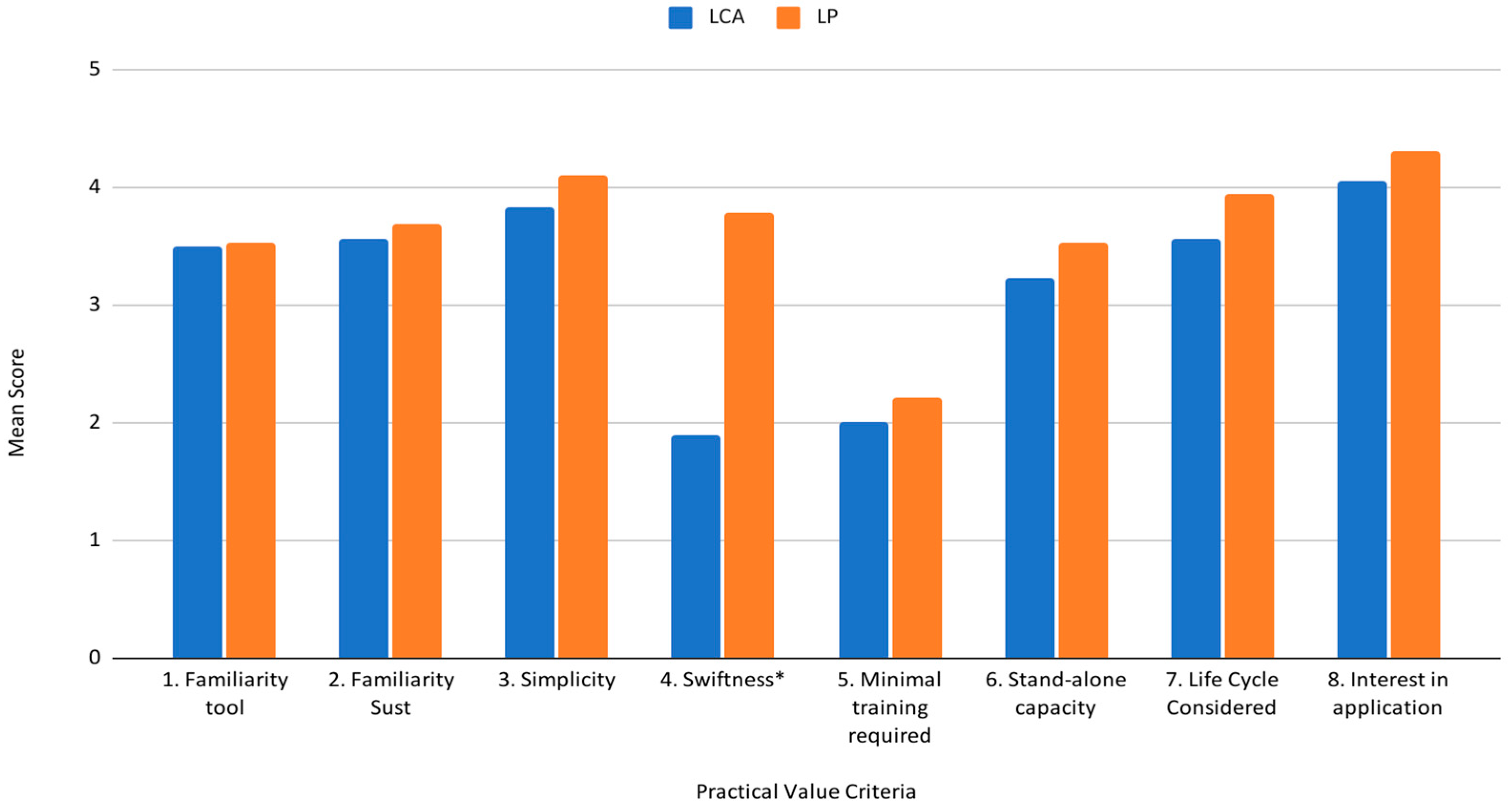
With that said, both tools scored highly across most categories of practical value, suggesting that both tools were perceived as useful at the front end of a product redesign project for environmental sustainability. Both tools were easy to use, even in a standalone capacity, and both considered a high degree of the life cycle of the product being redesigned. Both tools were perceived as requiring a degree of specific training; however, in the current study, practitioners were provided with only a one-hour training tutorial prior to the two-hour virtual workshop. Thus, one could argue that only minimal training is required for R&D practitioners to explore these tools. Finally, implementing the results of the LCA showed that it would require a substantial investment of time compared to the biomimicry LPs. Time is a constant constraint in a corporate R&D setting [
60], so the more streamlined the front end of the innovation process, the better. The participants’ open comments supported this, stating that “full implementation of an LCA would be too intensive, but implementing a basic report upfront as much as possible could act as a simplistic way for an innovation session, utilizing the mindset to identify better ways ‘in’ before fully defining a project”.