1. Introduction
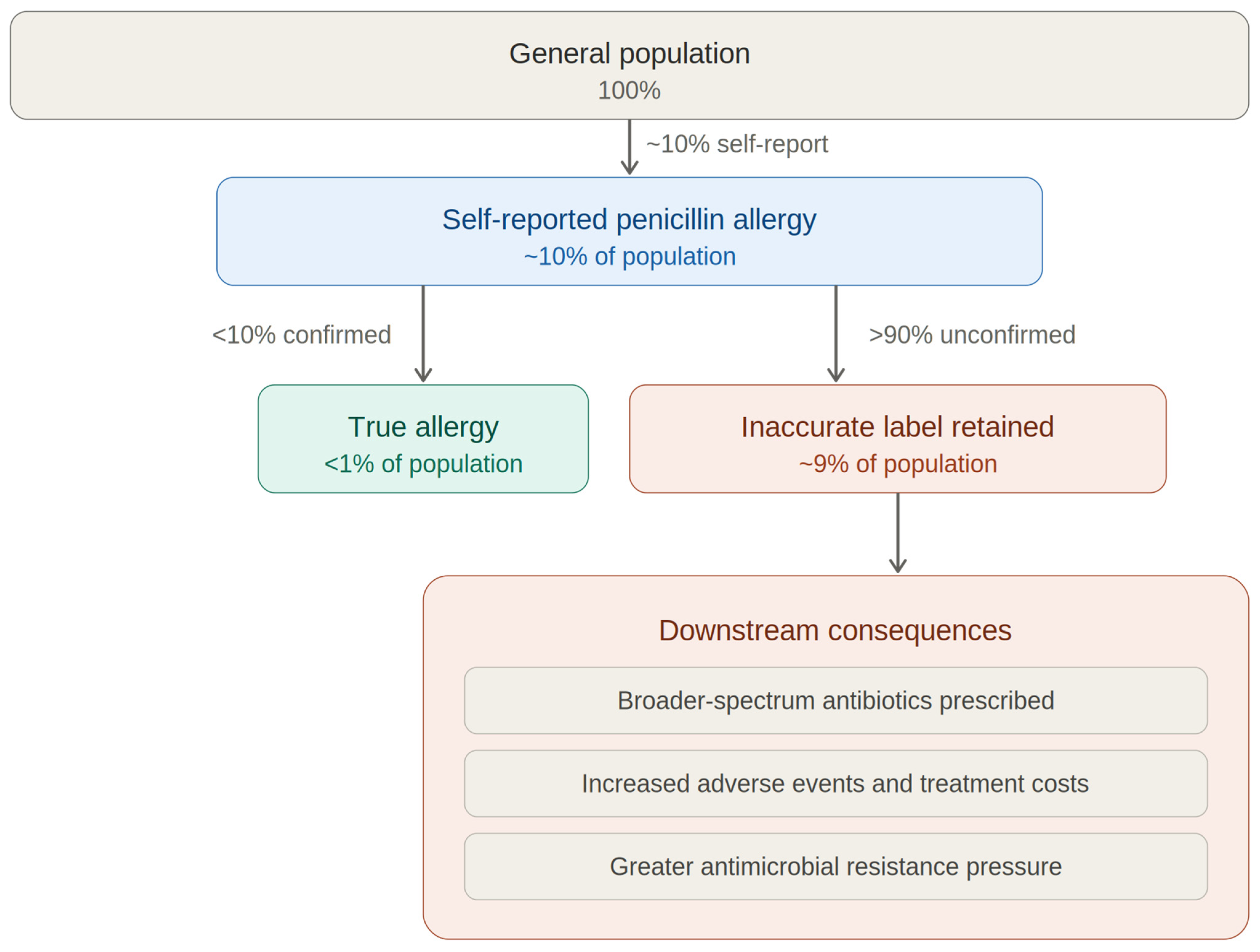
Antibiotic allergy is one of the most frequently reported adverse drug reactions worldwide. Penicillin allergy, in particular, is commonly documented: about 10% of the general population carries this label [
1]. However, when patients undergo formal evaluation—typically with skin testing and, where appropriate, oral challenge—more than 90% are found not to have a true immunoglobulin E (IgE)-mediated allergy [
1]. That mismatch between label and reality is not a minor documentation issue. It is a widespread and underrecognized clinical problem.
Its consequences extend well beyond the individual patient. Once an unverified allergy label enters the record, clinicians often avoid first-line beta-lactam therapy and instead prescribe broader-spectrum alternatives. The consequences are well documented: higher costs, more adverse drug events, and greater selective pressure for antimicrobial resistance [
2]. Even so, verification and delabeling remain largely concentrated within allergy subspecialty care. Most patients who carry questionable labels never reach formal reassessment.
Primary care sits at the center of this problem. It is usually the first setting in which allergy information is reported, recorded, and acted upon. Primary care physicians are therefore not only the initial recipients of these labels but also the clinicians most likely to see their downstream effects in routine prescribing decisions [
3]. Yet structured approaches to antibiotic allergy assessment in generalist practice remain uncommon, and many clinicians have neither the training nor the system support to revisit labels that have long been taken as fact.
In this narrative review, we consider antibiotic allergy mislabeling from the primary care perspective. We discuss how inaccurate labels are created and sustained, what clinical and economic harm they cause, and why primary care should play a larger role in reassessment. We also consider how risk stratification tools, international guideline frameworks, digital health tools, and patient education might help improve allergy documentation in everyday practice.
This narrative review was conducted in accordance with the Scale for the Assessment of Narrative Review Articles (SANRA) framework [
4]. A literature search was performed in PubMed/MEDLINE, Embase, and Google Scholar from database inception through March 2026 using search terms including “antibiotic allergy,” “penicillin allergy,” “drug allergy labeling,” “delabeling,” “primary care,” “clinical decision support,” and “antimicrobial stewardship,” combined with Boolean operators. Reference lists of retrieved articles, relevant society guidelines (AAAAI/ACAAI, EAACI, BSACI, ASCIA), and recent systematic reviews were hand-searched to identify additional publications. Articles were selected based on relevance to antibiotic allergy labeling in the primary care setting, with preference given to original research, practice parameters, and high-quality reviews.
2. The Problem with Self-Reported Antibiotic Allergy
Self-reported antibiotic allergy is inherently unreliable because patients and caregivers often use the word “allergy” to describe very different kinds of experiences. In practice, the term may refer to true IgE-mediated hypersensitivity, predictable adverse effects such as gastrointestinal upset, or symptoms that simply happened to appear during antibiotic treatment but were unrelated to the drug itself [
5]. Once these distinct phenomena are collapsed into a single label, clinical confusion becomes almost inevitable.
2.1. Pediatric Considerations
The problem takes a particular form in children. Antibiotics are frequently prescribed during acute infections, and those same illnesses—particularly viral ones—can produce rashes that are then attributed to the medication [
6]. A child receiving amoxicillin for pharyngitis may develop a diffuse maculopapular rash that is actually viral in origin, not drug-related. Still, in the absence of formal evaluation, the antibiotic is often blamed, and the label remains in place for years [
7]. Standardized testing has shown that most parent-reported penicillin allergies in children do not reflect true hypersensitivity [
8]. When these children undergo formal evaluation, the vast majority tolerate the implicated antibiotic without adverse reaction, and delabeling in this population carries significant public health benefits by restoring access to first-line agents during a period of high antibiotic need [
9].
Importantly, the evidence increasingly suggests that many low-risk pediatric patients can be safely evaluated through direct oral challenge without prior skin testing [
10,
11]. Delabeling programs in pediatric emergency departments and primary care clinics have demonstrated that structured history-taking combined with supervised oral provocation is both feasible and safe in carefully selected children [
12,
13]. International data further confirm that risk stratification approaches are applicable across diverse pediatric populations [
14].
2.2. Adult-Specific Challenges
Adults present a different set of challenges. The index reaction is often decades in the past, and the details are frequently incomplete or absent. Many adults cannot describe the nature, timing, or severity of the original event, and their medical records may offer little clarification [
3]. The allergy label may have been assigned during childhood and carried forward without reassessment through multiple transitions of care. In addition, adults are more likely to have complex medication histories and comorbidities that complicate both the interpretation of allergy histories and the logistics of challenge testing [
1].
2.3. Timing of Allergy Evaluation
The timing of evaluation matters more than is generally appreciated. IgE-mediated sensitization to beta-lactam antibiotics wanes over time; a systematic review and meta-analysis found that tolerance to drug challenge increases substantially with the interval since the original reaction [
15]. While this natural decline in sensitization means that many patients will test negative years later, it also means that the diagnostic window for confirming a true allergy narrows with time. Furthermore, patient recall deteriorates, and the clinical details necessary for accurate risk stratification become increasingly unreliable. Current guidelines recommend that allergy evaluation be performed ideally within four weeks to six months of the suspected reaction, when both immunological markers and patient memory are most informative [
16].
Delayed evaluation also risks missing clinically relevant phenotypes. Recent evidence suggests that penicillin allergy labels acquired during childhood Epstein–Barr virus infection may represent a distinct subset with persistent delayed hypersensitivity, complicating the assumption that all remote childhood reactions are low-risk [
17]. These findings reinforce the importance of timely and structured evaluation rather than indefinite deferral.
We have seen this pattern of deferred evaluation repeatedly in our own digital health setting. Through a pediatric health guidance mobile application with more than 3 million downloads in South Korea, caregivers frequently upload photographs of rashes that appear during antibiotic treatment and ask whether the child has developed a drug allergy. The submissions follow a consistent pattern: a rash occurs while the child is taking an antibiotic, and the drug is assumed to be the cause. That reasoning is understandable. It is also one of the main ways inaccurate labels become established [
6].
Several factors then make those labels difficult to undo. Patients and caregivers rarely seek reassessment once an allergy has been documented, in part because the label is perceived as protective rather than limiting. Many do not realize that carrying an unverified allergy label can lead to worse treatment options later [
18]. Clinicians, meanwhile, often accept reported allergies without verification, especially in busy settings shaped by time pressure and medicolegal caution. Electronic medical records offer limited support in this regard. In many systems, the allergy section is little more than a free-text field or checkbox, with no clear distinction between confirmed hypersensitivity and unverified patient report [
3]. Over time, a single uncertain story can harden into a durable clinical fact.
3. Consequences of Inaccurate Labeling
The effects of an unverified antibiotic allergy label are broad and clinically important. Once penicillin allergy is listed in the chart, clinicians often turn to alternative agents that are broader in spectrum, more costly, and sometimes less safe than the drugs they replace [
19]. Patients labeled as penicillin-allergic are more likely to receive substitutes such as fluoroquinolones, clindamycin, or vancomycin instead of first-line beta-lactam therapy [
2]. These alternatives are not benign. Depending on the agent, they may carry risks such as Clostridioides difficile infection, QT prolongation, or nephrotoxicity—harms that may be avoidable if the allergy label is inaccurate to begin with.
The stewardship implications are serious. When second-line or broad-spectrum antibiotics are used unnecessarily, the cumulative effect is greater antimicrobial selection pressure [
1]. At the population level, millions of patients with unverified allergy labels can meaningfully shape prescribing patterns and, in turn, resistance patterns in both community and hospital settings [
20,
21]. It is not surprising, then, that antibiotic allergy delabeling has become a priority within national antimicrobial stewardship efforts.
The financial burden also deserves attention. A systematic review found that self-reported penicillin allergy is associated with substantially higher antibiotic-related and hospitalization costs compared with the absence of such a label [
22]. Labeled patients may experience longer hospital stays, higher rates of treatment failure [
23], and a greater risk of surgical site infection [
19]. These are not isolated inefficiencies. They accumulate across healthcare systems and make the case for delabeling stronger not only clinically but also economically.
There is also a less measurable cost. Patients who believe they are allergic to penicillin or other common antibiotics may approach future treatment decisions with considerable anxiety, especially when a clinician questions the label or suggests allergy testing [
18]. For parents, the concern is often more emotionally charged. They may feel responsible for protecting their child from a medication they believe once caused harm, even if that belief rests on uncertain evidence. This part of the problem is easy to overlook, but it matters. Delabeling is not only about correcting the chart. It is also about changing a belief that may have been reinforced for years.
4. The Role of Primary Care Physicians
Primary care physicians are well positioned to address antibiotic allergy mislabeling, but in most systems their role remains underdeveloped. They are often the clinicians who first record the label, who encounter it repeatedly during routine prescribing, and who maintain the longest relationship with the patient over time [
3]. That continuity matters. It creates opportunities to revisit labels that were assigned years earlier, often on the basis of limited or uncertain information.
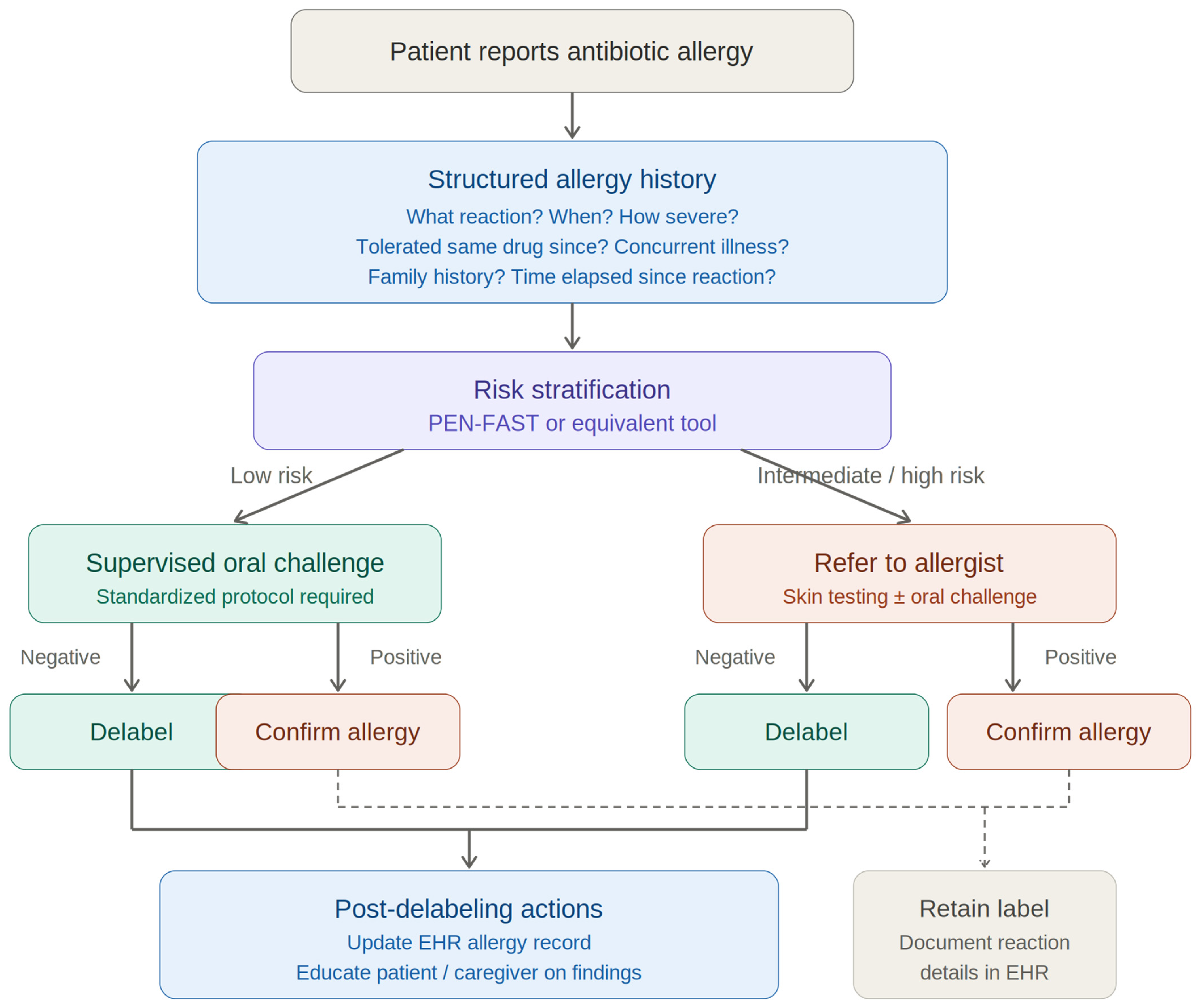
Importantly, reassessment in primary care does not always require complex testing. A careful history alone can often identify patients whose reported reactions are unlikely to reflect true hypersensitivity [
1]. The essential questions are straightforward: What exactly happened? When did it happen relative to drug exposure? How long ago was the event? Has the patient tolerated the same antibiotic, or a related one, since then [
24]? In many cases, that conversation reveals a different story from the one implied by the word “allergy.” The original event may have been a side effect, a viral rash, or an episode so remote that the details are no longer reliable.
4.1. Risk Stratification Tools for Non-Specialists
Structured risk stratification tools can help primary care physicians determine which patients are candidates for simplified reassessment and which should be referred for specialist evaluation. The PEN-FAST clinical decision rule, developed and validated in an Australian multicenter cohort, assigns points based on the penicillin allergy phenotype (e.g., anaphylaxis versus rash), time elapsed since the reaction, and whether the reaction was severe or treatment-requiring [
25]. Patients classified as low-risk by PEN-FAST have consistently demonstrated high rates of negative oral challenge, supporting its use as a triage tool outside allergy clinics [
25]. A separate Australian study proposed similar risk-stratification criteria and confirmed that patients meeting low-risk definitions could be safely evaluated in outpatient settings [
26].
What makes these tools particularly relevant for primary care is the growing evidence that non-allergist clinicians can apply them effectively. A prospective multicenter trial in Hong Kong compared penicillin allergy delabeling by allergists and non-allergists using standardized protocols; the two groups achieved comparable outcomes, suggesting that the task can be safely distributed beyond subspecialty care [
27]. Pharmacist-led programs using PEN-FAST have also reported feasible and effective delabeling in hospital settings [
28], and similar approaches have been piloted in emergency departments [
29]. In pediatric primary care, a clinic-based delabeling program demonstrated that structured history-taking by generalist clinicians could identify and delabel low-risk children without specialist involvement [
12].
4.2. International Guideline Perspectives
Major allergy and antimicrobial stewardship guidelines now address antibiotic allergy assessment in non-specialist settings, though they differ in scope and specificity.
Table 1 summarizes key recommendations from the British Society for Allergy and Clinical Immunology (BSACI) [
30], the American Academy of Allergy, Asthma and Immunology/American College of Allergy, Asthma and Immunology (AAAAI/ACAAI) [
31], the European Academy of Allergy and Clinical Immunology (EAACI) [
32], and the Australasian Society of Clinical Immunology and Allergy (ASCIA).
Several points of convergence are worth noting. All guidelines recognize that the majority of reported penicillin allergies are unconfirmed. All support structured history-taking as the first step. Most now include low-risk definitions that do not require skin testing before oral challenge, particularly in patients with remote, benign cutaneous reactions. However, the guidelines diverge on the extent to which oral challenge should be performed in primary care versus supervised allergy settings. The BSACI and ASCIA frameworks explicitly support trained non-specialists performing oral challenges, whereas some implementations of EAACI pathways reserve challenge testing for specialized teams [
30,
32]. The AAAAI/ACAAI practice parameter encourages antimicrobial stewardship-driven delabeling, with a strong recommendation against mandatory skin testing in children and a conditional recommendation for adults [
31].
It is important to note that no major guideline recommends routine oral challenge in primary care without appropriate infrastructure. The term “low-risk” refers to the patient’s allergy history, not to the setting in which challenge should occur. Primary care clinicians undertaking oral provocation should have access to standardized protocols, appropriate monitoring, and clear referral pathways for patients who do not meet low-risk criteria [
30,
31].
Figure 1 proposes an integrated assessment algorithm for use in primary care settings.
4.3. Oral Challenge in Primary Care: Evidence and Caution
For patients with clearly low-risk histories, direct oral provocation testing has been studied as a practical option outside specialist settings. A recent systematic review and meta-analysis of primary care-based penicillin allergy delabeling found that oral challenge in this setting was associated with low rates of serious adverse reactions, supporting its feasibility in appropriately selected populations [
33]. Individual studies from Canada [
34] and the United States [
35,
36] have similarly reported favorable safety profiles when challenges were limited to patients with remote, mild, or vaguely recalled reactions.
However, these findings must be interpreted with appropriate caution. Skin testing, while no longer considered mandatory for all low-risk patients by several guidelines, retains an important role in intermediate- and high-risk cases and may provide reassurance in settings where clinical experience with drug challenge is limited [
31]. The safety of oral challenge in primary care depends critically on patient selection, clinician training, and the availability of emergency response protocols. Broad recommendations for unsupervised challenge without these safeguards would be inappropriate and are not supported by the evidence reviewed here.
4.4. Barriers and Next Steps
Many primary care physicians feel they have not been adequately trained in drug allergy assessment and are uncertain about which patients can be safely challenged without specialist input [
18]. Routine consultations are already crowded. Standardized protocols are often missing from electronic health record systems. Medicolegal concerns remain a deterrent. In some settings, reimbursement structures also work against primary care involvement, especially when formal allergy testing is tied to specialist billing codes [
3].
Addressing these barriers will likely require targeted education during residency and continuing professional development, practical risk stratification tools designed for generalist use, and institutional support for structured allergy reassessment in primary care [
3,
25]. Because primary care accounts for such a large share of antibiotic prescribing in most countries, even modest progress at this level could have substantial effects.
5. Digital Health and Patient Education
5.1. Distinguishing Delabeling, Mislabeling Prevention, and Caregiver Education
Before discussing the role of digital tools, it is important to distinguish three related but conceptually distinct goals.
Delabeling refers to the formal removal of a previously documented allergy label after clinical reassessment confirms that the patient can tolerate the implicated drug [
37].
Prevention of mislabeling aims to stop inaccurate labels from being recorded in the first place—for example, by improving the quality of allergy documentation at the point of initial reporting.
Caregiver and patient education seeks to correct misconceptions about drug allergy so that families and patients can participate more effectively in the evaluation process [
38]. These goals overlap in practice but differ in their targets, timing, and the clinical infrastructure they require. A comprehensive approach to antibiotic allergy labeling should address all three, and digital health tools can contribute to each in different ways [
39].
5.2. Clinical Decision Support and Electronic Health Records
Clinical decision support (CDS) systems embedded in electronic health records represent one of the more promising avenues for integrating allergy reassessment into routine care. A validated mobile clinical decision support tool for drug allergy has demonstrated that structured algorithms can guide non-specialist clinicians through risk assessment with acceptable accuracy [
40]. In one hospital-based evaluation, the implementation of an allergy fact-checking CDS system increased appropriate delabeling from 12% to 60% of eligible patients, a substantial improvement achieved without additional specialist referrals [
41]. Similarly, a digital antibiotic allergy decision support tool improved beta-lactam allergy management by non-allergists in an inpatient setting, suggesting that well-designed systems can partially offset the shortage of allergy expertise [
42].
Beyond point-of-care decision support, natural language processing (NLP) approaches have begun to address a longstanding problem in allergy documentation: the persistence of inaccurate labels even after successful drug challenge. One study demonstrated that NLP algorithms could identify discrepancies between allergy challenge results and the allergy information retained in the electronic health record, enabling automated reconciliation [
43]. Such tools are still early in development, but they illustrate how computational methods may help maintain the accuracy of allergy records at scale.
5.3. Mobile Health and Caregiver-Facing Tools
Mobile health applications offer a different kind of opportunity. They are already used widely by caregivers of young children, a group in which antibiotic allergy mislabeling is particularly common [
44]. These tools capture what happens outside the clinic: symptoms as they appear, how families interpret them, and what kinds of decisions follow. Our experience with a pediatric health guidance application in South Korea suggests that the moment a rash appears during antibiotic treatment is precisely when caregivers are most receptive to guidance [
6]. If families receive timely, context-specific information before an inaccurate label is entered into the medical record, some misattribution may be prevented at the source. More broadly, mobile platforms that incorporate structured allergy history questionnaires, educational content, and connectivity to clinical records could serve as a bridge between community-level documentation and formal evaluation pathways [
39,
40].
5.4. Education as a Core Component
Education, however, is not a secondary issue. It is central to delabeling. Qualitative studies suggest that even after successful allergy testing, some patients remain reluctant to take penicillin-class antibiotics and may continue reporting the allergy in later clinical encounters [
18]. In other words, a negative test result does not automatically correct the patient’s internal model of what happened. Effective education must therefore do more than announce that testing was negative. It has to explain what a true drug allergy is, why the earlier event may not fit that definition, and why accurate labeling matters for future treatment [
5]. A multidisciplinary framework that integrates education into each stage of the delabeling process—from initial assessment through follow-up—may help ensure that corrected labels remain corrected over time [
38].
6. Conclusions
Most self-reported antibiotic allergy labels do not reflect true hypersensitivity, yet they remain embedded in medical records and continue to shape prescribing in ways that are clinically suboptimal and systemically costly. The consequences include avoidable use of broader-spectrum antibiotics, greater risk of adverse events, increased healthcare spending, and added pressure on antimicrobial resistance (
Figure 2).
Primary care should have a larger role in addressing this problem. It is the setting in which these labels are often first recorded, repeatedly encountered, and most plausibly revisited. Careful history-taking can identify many low-risk cases, and validated risk stratification tools such as PEN-FAST can help non-specialist clinicians determine which patients are candidates for simplified reassessment. International guidelines increasingly support structured delabeling pathways in primary care, though appropriate infrastructure, training, and referral mechanisms remain essential prerequisites.
Yet delabeling is not only a technical process. It is also a communication task. Patients and caregivers need to understand why an old label is being questioned and what is at stake if it remains unchallenged. Digital health tools may be especially helpful here, not because they replace clinical judgment but because they create opportunities to intervene earlier—before uncertainty becomes permanent documentation. Clinical decision support systems can guide non-specialist clinicians through allergy assessment, while mobile health platforms may help prevent mislabeling at the point where it most often originates.
A more coordinated strategy, combining primary care-led reassessment, patient education, and thoughtful use of digital tools, could substantially reduce the burden of antibiotic allergy mislabeling and strengthen antibiotic stewardship at the same time.
Funding
This research received no external funding.
Institutional Review Board Statement
Not applicable.
Informed Consent Statement
Not applicable.
Data Availability Statement
No new data were created or analyzed in this study.
Acknowledgments
Generative AI tools were used to assist in the preparation of this manuscript. Claude 4.7 (Anthropic) was used for drafting, structural organization, language editing, and figure preparation. Claude, together with Gemini 3.5 (Google) and ChatGPT 5.4 (OpenAI), was used to assist with literature search and organization. All AI-assisted output, including all references, was independently verified by the author against primary sources (CrossRef and PubMed). The author reviewed, verified, and takes full responsibility for all content, including the accuracy of references and scientific claims. No AI tool was used to generate data or scientific conclusions.
Conflicts of Interest
Sang Hyun Ahn is the Chief Medical Officer of Mobile Doctor Inc. and Medical Algorithm Director of MoDoc AI Inc. These affiliations did not influence the content or conclusions of this review.
References
- Shenoy, E.S.; Macy, E.; Rowe, T.; Blumenthal, K.G. Evaluation and Management of Penicillin Allergy: A Review. JAMA 2019, 321, 188–199. [Google Scholar] [CrossRef]
- Macy, E.; Contreras, R. Health Care Use and Serious Infection Prevalence Associated with Penicillin “Allergy” in Hospitalized Patients: A Cohort Study. J. Allergy Clin. Immunol. 2014, 133, 790–796. [Google Scholar] [CrossRef]
- Stone, C.A., Jr.; Trubiano, J.; Coleman, D.T.; Rukasin, C.R.F.; Phillips, E.J. The Challenge of De-Labeling Penicillin Allergy. Allergy 2020, 75, 273–288. [Google Scholar] [PubMed]
- Baethge, C.; Goldbeck-Wood, S.; Mertens, S. SANRA—A Scale for the Quality Assessment of Narrative Review Articles. Res. Integr. Peer Rev. 2019, 4, 5. [Google Scholar] [CrossRef]
- Blumenthal, K.G.; Peter, J.G.; Trubiano, J.A.; Phillips, E.J. Antibiotic Allergy. Lancet 2019, 393, 183–198. [Google Scholar] [CrossRef] [PubMed]
- Norton, A.E.; Konvinse, K.; Phillips, E.J.; Broyles, A.D. Antibiotic Allergy in Pediatrics. Pediatrics 2018, 141, e20172497. [Google Scholar] [CrossRef]
- Vyles, D.; Chiu, A.; Routes, J.; Castells, M.; Phillips, E.J.; Kibicho, J.; Brousseau, D.C. Antibiotic Use After Removal of Penicillin Allergy Label. Pediatrics 2018, 141, e20173466. [Google Scholar] [CrossRef] [PubMed]
- Mill, C.; Primeau, M.N.; Medoff, E.; Lejtenyi, C.; O’kEefe, A.; Netchiporouk, E.; Dery, A.; Ben-Shoshan, M. Assessing the Diagnostic Properties of a Graded Oral Provocation Challenge for the Diagnosis of Immediate and Nonimmediate Reactions to Amoxicillin in Children. JAMA Pediatr. 2016, 170, e160033. [Google Scholar] [CrossRef]
- Vyles, D.; Antoon, J.W.; Norton, A.; Stone, C.A.; Trubiano, J.; Radowicz, A.; Phillips, E.J. Children with Reported Penicillin Allergy: Public Health Impact and Safety of De-labeling. Ann. Allergy Asthma Immunol. 2020, 124, 558–565. [Google Scholar] [CrossRef]
- Nguyen, M.; Parashar, S.; Lee, B.R.; Dowling, P.; Aljubran, S. Twenty-year Comparison of Delabeling Pediatric Patients with Penicillin Allergy with and without Prior Skin Testing. Ann. Allergy Asthma Immunol. 2022, 129, 117–119. [Google Scholar]
- Felix, M.M.R.; Kuschnir, F.C.F. Direct Oral Provocation Test Is Safe and Effective in Diagnosing Beta-Lactam Allergy in Low-Risk Children. Front. Pharmacol. 2020, 11, 1223. [Google Scholar] [CrossRef]
- Chow, T.G.; Patel, G.; Mohammed, M.; Johnson, D.; Khan, D.A. Delabeling Penicillin Allergy in a Pediatric Primary Care Clinic. Ann. Allergy Asthma Immunol. 2023, 130, 667–669. [Google Scholar] [CrossRef]
- Hibberd, O.; Karageorgos, S.; Ranaweera, M.; Mullally, P.J.W.; Constantin, M.-V.; Byrne, A.; Barrett, M.J. De-Labelling Penicillin Allergies in the Paediatric Emergency Department. Antibiotics 2025, 14, 1222. [Google Scholar] [CrossRef]
- Alsulaiman, J.W.; Kheirallah, K.A.; Alrawashdeh, A.; Saleh, T.; Obeidat, M.; Alawneh, Y.J.; Abu Sanad, Z.; Amayreh, W.; Alawneh, R.J. Risk Stratification of Penicillin Allergy Labeled Children: A Cross-Sectional Study from Jordan. Ther. Clin. Risk Manag. 2024, 20, 505–514. [Google Scholar] [CrossRef]
- DesBiens, M.A.; Scalia, P.; Ravikumar, S.; Glick, A.; Newton, H.; Erinne, O.; Riblet, N. A Closer Look at Penicillin Allergy History: Systematic Review and Meta-Analysis of Tolerance to Drug Challenge. Am. J. Med. 2020, 133, 452–462.e4. [Google Scholar] [CrossRef]
- Brockow, K.; Wurpts, G.; Trautmann, A.; Pfützner, W.; Treudler, R.; Bircher, A.J.; Brehler, R.; Buhl, T.; Dickel, H.; Fuchs, T.; et al. Guideline for Allergological Diagnosis of Drug Hypersensitivity Reactions (S2k). Allergol. Sel. 2023, 7, 122–139. [Google Scholar] [CrossRef]
- Cox, F.; Holmes, N.; Waldron, J.L.; Trubiano, J.A. Rash Decisions: Unmasking a Risk Phenotype in Adults with Persistent Delayed Penicillin Allergy Sensitized During Historic EBV Infection. J. Allergy Clin. Immunol. Glob. 2024, 3, 100320. [Google Scholar] [CrossRef] [PubMed]
- Wanat, M.; Anthierens, S.; Butler, C.C.; Savic, L.; Savic, S.; Pavitt, S.H.; Sandoe, J.A.; Tonkin-Crine, S. Patient and Primary Care Physician Perceptions of Penicillin Allergy Testing and Subsequent Use of Penicillin-Containing Antibiotics: A Qualitative Study. J. Allergy Clin. Immunol. Pract. 2019, 7, 1888–1893.e1. [Google Scholar] [CrossRef] [PubMed]
- Blumenthal, K.G.; Ryan, E.E.; Li, Y.; Lee, H.; Kuhlen, J.L.; Shenoy, E.S. The Impact of a Reported Penicillin Allergy on Surgical Site Infection Risk. Clin. Infect. Dis. 2018, 66, 329–336. [Google Scholar] [CrossRef]
- Blumenthal, K.G.; Lu, N.; Zhang, Y.; Li, Y.; Walensky, R.P.; Choi, H.K. Risk of Meticillin Resistant Staphylococcus aureus and Clostridium difficile in Patients with a Documented Penicillin Allergy: Population Based Matched Cohort Study. BMJ 2018, 361, k2400. [Google Scholar] [CrossRef] [PubMed]
- West, R.M.; Smith, C.J.; Pavitt, S.H.; Butler, C.C.; Howard, P.; Bates, C.; Savic, S.; Wright, J.M.; Hewison, J.; Sandoe, J.A.T. ‘Warning: Allergic to Penicillin’: Association between Penicillin Allergy Status in 2.3 Million NHS General Practice Electronic Health Records, Antibiotic Prescribing and Health Outcomes. J. Antimicrob. Chemother. 2019, 74, 2075–2082. [Google Scholar] [CrossRef]
- Mattingly, T.J., II; Fulton, A.; Lumish, R.A.; Williams, A.M.C.; Yoon, S.; Yuen, M.; Heil, E.L. The Cost of Self-Reported Penicillin Allergy: A Systematic Review. J. Allergy Clin. Immunol. Pract. 2018, 6, 1649–1654.e4. [Google Scholar] [CrossRef]
- Macy, E. Penicillin Allergy: Optimizing Diagnostic Protocols, Public Health Implications, and Future Research Needs. Curr. Opin. Allergy Clin. Immunol. 2015, 15, 308–313. [Google Scholar] [CrossRef]
- Joint Task Force on Practice Parameters; American Academy of Allergy, Asthma and Immunology; American College of Allergy, Asthma and Immunology; Joint Council of Allergy, Asthma and Immunology. Drug Allergy: An Updated Practice Parameter. Ann. Allergy Asthma Immunol. 2010, 105, 259–273. [Google Scholar] [CrossRef] [PubMed]
- Trubiano, J.A.; Vogrin, S.; Chua, K.Y.L.; Bourke, J.; Yun, J.; Douglas, A.; Stone, C.A.; Yu, R.; Groenendijk, L.; Holmes, N.E.; et al. Development and Validation of a Penicillin Allergy Clinical Decision Rule. JAMA Intern. Med. 2020, 180, 745–752. [Google Scholar] [CrossRef] [PubMed]
- Stevenson, B.; Trevenen, M.; Klinken, E.; Smith, W.; Yuson, C.; Katelaris, C.; Perram, F.; Burton, P.; Yun, J.; Cai, F.; et al. Multicenter Australian Study to Determine Criteria for Low- and High-Risk Penicillin Testing in Outpatients. J. Allergy Clin. Immunol. Pract. 2020, 8, 681–689.e3. [Google Scholar] [CrossRef]
- Wong, J.C.Y.; Kan, A.K.C.; Chik, T.S.H.; Chu, M.Y.; Li, T.C.; Mak, H.W.; Chiang, V.; Li, P.H. Prospective, Multicenter, Head-to-Head Comparison Between Allergists Versus Nonallergists in Low-Risk Penicillin Allergy Delabeling (HK-DADI2). J. Allergy Clin. Immunol. Pract. 2024, 12, 1801–1808.e2. [Google Scholar] [CrossRef]
- Kamaliddin, C.; Driver, A.; Druken, R.; Rennert-May, E.; Rajakumar, I. Feasibility and Impact of Pharmacist-Led Penicillin Allergy Delabelling Using the PEN-FAST Scoring Tool. Antimicrob. Steward. Healthc. Epidemiol. 2026, 6, e49. [Google Scholar] [CrossRef]
- Tran, K.; Lund, J.; Sealy, C.; Langley, D.; Kisgen, J. PEN-FAST-ED: Utilizing the PEN-FAST Decision Tool to Guide Antibiotic Prescribing in the Emergency Department. Am. J. Emerg. Med. 2025, 90, 124–128. [Google Scholar] [CrossRef]
- Savic, L.; Ardern-Jones, M.; Avery, A.; Cook, T.; Denman, S.; Farooque, S.; Garcez, T.; Gold, R.; Jay, N.; Krishna, M.T.; et al. BSACI Guideline for the Set-Up of Penicillin Allergy De-Labelling Services by Non-Allergists Working in a Hospital Setting. Clin. Exp. Allergy 2022, 52, 1135–1141. [Google Scholar] [CrossRef]
- Khan, D.A.; Banerji, A.; Blumenthal, K.G.; Phillips, E.J.; Solensky, R.; White, A.A.; Bernstein, J.A.; Chu, D.K.; Ellis, A.K.; Golden, D.B.; et al. Drug Allergy: A 2022 Practice Parameter Update. J. Allergy Clin. Immunol. 2022, 150, 1333–1393. [Google Scholar] [CrossRef]
- Ryan, D.; Flokstra-de Blok, B.M.J.; Clark, E.; Gaudin, C.; Mamodaly, M.; Kocks, J.; van der Velde, J.L.; Angier, L.; Romberg, K.; Gawlik, R.; et al. Allergic and Hypersensitivity Conditions in Non-Specialist Care: Flow Diagrams to Support Clinical Practice. Allergy 2022, 77, 2618–2633. [Google Scholar] [CrossRef] [PubMed]
- Stul, F.; Heytens, S.; Ebo, D.G.; Sabato, V.; Piessens, V. Safe Penicillin Allergy Delabeling in Primary Care: A Systematic Review and Meta-Analysis. J. Allergy Clin. Immunol. Pract. 2024, 12, 2415–2426.e1. [Google Scholar] [CrossRef]
- Gateman, D.P.; Rumble, J.E.; Protudjer, J.L.; Kim, H. Amoxicillin Oral Provocation Challenge in a Primary Care Clinic: A Descriptive Analysis. CMAJ Open 2021, 9, E394–E399. [Google Scholar] [CrossRef] [PubMed]
- Mustafa, S.S.; Conn, K.; Ramsey, A. Comparing Direct Challenge to Penicillin Skin Testing for the Outpatient Evaluation of Penicillin Allergy: A Randomized Controlled Trial. J. Allergy Clin. Immunol. Pract. 2019, 7, 2163–2170. [Google Scholar] [CrossRef]
- Sundquist, B.K.; Bowen, B.J.; Otabor, U.; Celestin, J.; Sorum, P.C. Proactive Penicillin Allergy Testing in Primary Care Patients Labeled as Allergic: Outcomes and Barriers. Postgrad. Med. 2017, 129, 915–920. [Google Scholar] [CrossRef]
- Copaescu, A.M.; Li, L.; Blumenthal, K.G.; Trubiano, J.A. How to Define and Manage Low-Risk Drug Allergy Labels. J. Allergy Clin. Immunol. Pract. 2024, 12, 1095–1106. [Google Scholar] [CrossRef]
- Mitri, E.A.; Reynolds, G.K.; Copaescu, A.M.; Cox, F.; Waldron, J.L.; Peter, J.G.; Trubiano, J.A. State-of-the-Art Review: Antibiotic Allergy—A Multidisciplinary Approach to Delabeling. Clin. Infect. Dis. 2025, 81, e74–e92. [Google Scholar] [CrossRef]
- Powell, N.; Elkhalifa, S.; Guyer, A.; Garcez, T.; Sandoe, J.; Zhou, L. Addressing the Challenges of Penicillin Allergy Delabeling with EHR and Mobile Applications. J. Allergy Clin. Immunol. Pract. 2023, 11, 414–421. [Google Scholar] [CrossRef] [PubMed]
- Elkhalifa, S.; Bhana, R.; Blaga, A.; Joshi, S.; Svejda, M.; Kasilingam, V.; Garcez, T.; Calisti, G. Development and Validation of a Mobile Clinical Decision Support Tool for Drug Allergy (Drug Allergy App). J. Allergy Clin. Immunol. Pract. 2021, 9, 4410–4418.e4. [Google Scholar] [CrossRef]
- Van De Sijpe, G.; Gilissen, L.; Wets, D.; Breynaert, C.; Ieven, T.; De Munter, P.; Schrijvers, R.; Spriet, I. Evaluation of the Allergy Fact Checker, a CDS System for Non-Invasive Beta-Lactam Delabeling. npj Digit. Med. 2025, 8, 662. [Google Scholar] [CrossRef] [PubMed]
- Dunham, T.B.; Gardner, R.M.; Lippner, E.A.; Fasani, D.E.; Moir, E.; Halpern-Felsher, B.; Sundaram, V.; Liu, A.Y. Digital Antibiotic Allergy Decision Support Tool Improves Management of β-Lactam Allergies. J. Allergy Clin. Immunol. Pract. 2023, 11, 1243–1252.e6. [Google Scholar] [CrossRef] [PubMed]
- Lo, Y.-C.; Varghese, S.; Blackley, S.; Seger, D.L.; Blumenthal, K.G.; Goss, F.R.; Zhou, L. Reconciling Allergy Information in the EHR After Drug Challenge Using NLP. Front. Allergy 2022, 3, 904923. [Google Scholar] [CrossRef] [PubMed]
- Ventola, C.L. Mobile Devices and Apps for Health Care Professionals: Uses and Benefits. Pharm. Ther. 2014, 39, 356–364. [Google Scholar]
| Disclaimer/Publisher’s Note: The statements, opinions and data contained in all publications are solely those of the individual author(s) and contributor(s) and not of MDPI and/or the editor(s). MDPI and/or the editor(s) disclaim responsibility for any injury to people or property resulting from any ideas, methods, instructions or products referred to in the content. |