Article

A Model of Spaces and Access in the Construction of Asian and Asian American Identities: “Blood Only Takes You So Far”


by
Chadrhyn A. A. Pedraza
Educational Leadership and Administration, School of Teacher Preparation, Administration, and Leadership (TPAL), New Mexico State University, Las Cruces, NM 88003, USA
Genealogy 2025, 9(4), 141; https://doi.org/10.3390/genealogy9040141
Submission received: 21 September 2025 / Revised: 20 November 2025 / Accepted: 21 November 2025 / Published: 1 December 2025

Abstract

The lack of research on Asian and Asian American students attending Hispanic-Serving Institutions (HSIs) in the Southwest U.S. leaves this population vulnerable to marginalization by educational leaders who are not adequately prepared to support their unique needs. Considered both a numerical and racialized community in HSIs in addition to their position as the model minority, this study aimed to examine how navigating a predominantly Hispanic context shaped participants’ understanding and construction of the Asian/Asian American identity. Using a constructivist grounded theory approach, the study developed a model suggesting that Asian and Asian American students construct their identities through three interconnected spaces: expressions of Asian culture, relationships with other Asians, and physical features associated with Asian identities. Key findings include: participants’ navigation and negotiation of externally created narratives; personal interpretations of what it means to be Asian; the role of interactions within the HSI environment in shaping participants’ Asian identity construction; the consideration of access to identity spaces in participants’ personal interest, investment, and salience; and the contributions of cultural, relational, and racial spaces to identity construction.

1. Introduction

Neither race nor identity are fixed or inherent. Rather, they are continually made and remade through systems of power, historical processes, and meanings that emerge through social interactions. At the intersection of these forces are racialized identities, remade in ways that individuals neither choose nor escape (R. S. Chang 1993). The role of race in America and the process of racialization to ensure it is stratified is evident at every level of human interaction and throughout its history. Remarking upon the distinct ways race was considered (or not) by Americans and Italians, Morning (2011) stated, “The real difference between us lies in the ways we link race to biology—and to culture, and to social organization. Those links, moreover, are not only conceptual: they are institutional.” (p. 220). Indeed, Ray (2019), who sought to bridge the conversation between organizational theorists and race scholars, suggested a theory of racialized organizations which argued that race is built into the foundations, hierarchies, and everyday processes of organizations. Power is central to this process: it determines who defines racial categories, who is positioned as “normal” versus “other,” and whose narratives are legitimized or erased. This study examines how racialization dynamics shape the experiences of Asians and Asian Americans (AAA) in higher education institutions and how they influence research, practice and policy (Museus 2022; Pedraza 2023). It aims to explore AAA identity construction as a navigation of racialized positions within institutions and social contexts structured by racism and how participants’ agency in constructing their identities operates within, and not outside, of these racialized power structures.
To be racialized as Asian in the United States is to inherit a legacy of exclusion and stereotypes imposed by White-dominant institutions. Central to this are two dominant narratives that have historically defined AAA in the U.S.: the “model minority” and “perpetual foreigner”. Together these narratives have positioned Asians in American society in three distinct ways. First, they reproduce the yellow peril discourse which positions Asians as a “menace to the nation’s health, morals, technological superiority, and the well-being of Whites” (Li and Nicholson 2021, p. 4). Second, it doubly minoritizes AAA (Chu 2024), pushing them further into the interstices of identity and, in turn, undermining the process of identity construction and denying them the freedom to claim, negotiate, or re-imagine their identities. Third, it contributes to their racialized exclusion and a condition of hyper-visible invisibility in discourses on racism and racial justice, in American institutions.
Consequently, AAA higher education students risk further marginalization, a flattening of experiences, and cultural misunderstandings from peers, faculty, staff, and administrators at their institutions. Focusing on AAA attending Hispanic-serving institutions (HSIs) in the U.S. Southwest border region—a numerical minority in a context where 99% of both the surrounding community and student population identify as Hispanic—provides a unique opportunity to explore how socio-cultural contexts shape their ongoing negotiation and construction of their ethno-racialized identity. Drawing from constructivist grounded theory (Charmaz 2025), this study was guided by two central research questions: (1) through what process do AAA construct their identity? and (2) what role does context play in the construction of their identity? These questions frame an examination of how students who are both a numerical minority and racialized group in a predominantly Hispanic environment navigate critical questions about visibility, belonging, and identity formation for students of color who do not identify as Hispanic.

2. Review of the Literature

Over the last two centuries, efforts to articulate the processes through which humans have come to answer the ever elusive “Who are you?” has given rise to a proliferation of scholarship across academic disciplines, each with their own approach and conceptualization of what defines “identity” (Fearon 1999; Huddy 2001; McLean and Syed 2015; Vignoles et al. 2011). According to Gee (2000), identity has been ascribed a great many meanings, and its ubiquitous use in academic and ordinary settings (Fearon 1999; Stryker and Burke 2000) along with its “widespread use in popular culture” (Vignoles et al. 2011, p. 2), only add to its enigmatic nature. Hammack (2015) stated that identity “permeates our everyday conversations, our moment-to-moment cognitive processes of sense-making in a world increasingly characterized by human diversity” (p. 11). He adds that identity serves as a tool for the categorization of our increasingly complex and diverse social worlds. As such, when viewed from the perspective making sense of our positions and locations within society (Anthias 2002; Howard and Graham 2016; McLean and Syed 2015), identity itself cannot remain fixed or uniform, but rather can be shaped by interactions with and within our social contexts. Building on the notion that identity is informed by social contexts and interactions, it is essential to consider how race, specifically the racialization of certain groups, have profound implications for how individuals and communities understand themselves and are understood by others.

2.1. Race in the U.S.

The consensus regarding race as a social construct is widely shared among social science scholars (Pierce 2014), yet it remains a key component in discourse on identity in the U.S. Seemingly immutable, racial categories have in fact evolved from a static concept rooted in biological determinism to a fluid and socially constructed category that has carried enduring significance for how individuals and groups navigate their place within American society (Massey 2007; Omi and Winant 2015; Smedley 1999). Omi and Winant (2015) referred to this as “the instability of the race concept” (p. 307) and attributed this instability to the influence of sociohistorical priorities of the White-dominant group (Pedraza 2023). A review of the US Census Bureau survey revealed how race has been used to justify racialization and racial injustice (Omi and Winant 2015; Smedley and Smedley 2005; Wijeyesinghe and Jackson 2012) and maintained (Bonilla-Silva 1994; Feagin and Elias 2013; Guess 2006) by the dominant social structure in the U.S. over the last two centuries.
The evolution of racial categories used in the U.S. Census Bureau surveys and its collection methods shed light on how race has been redefined throughout American history and continues to evolve as social norms dictate how race is used to stratify American society. As stated in the 2010 Census Brief, Overview of Race and Hispanic Origin (Humes et al. 2010), “The race categories included in the census questionnaire generally reflect a social definition of race recognized in this country and are not an attempt to define race biologically, anthropologically, or genetically” (p. 2). In fact, up until the mid-20th century, one’s race or “color” as specified by the Census Bureau’s guidelines, were determined by the census collector and not the individual themselves (U.S. Census Bureau 2000). The ability to choose multiple races “depending on what that person considered himself/herself to be” (U.S. Census Bureau 2000, p. 4) was introduced in the 21st century; over two-hundred years after the first official census was collected in 1790, just after George Washington was elected President.
The first century of U.S. census collection saw little change in its categories which included: free White males 16 years and older, free White males under 16 years, free White females, all other free persons, and slaves (U.S. Census Bureau n.d.a). During the 1800 census, “Indian” and “free Blacks” were added (U.S. Census Bureau n.d.b) although it was not until the 1870 survey that other racial categories were considered (U.S. Census Bureau n.d.c; U.S. Census Bureau n.d.d). This included counting American Indians as a separate group and collection of data on the Chinese population. Different Asian groups were included on census surveys, with the Japanese population added in 1890 (U.S. Census Bureau n.d.e) and an “Other” category included to collect data on Filipinos, Koreans, and Asian Indians who were referred to as Hindu on the 1910 census (Pew Research Center 2020). Today, the Office of Management and Budget (Office of Management and Budget 2024) define Asians as, “Individuals with origins in any of the original peoples of Central or East Asia, Southeast Asia, or South Asia, including, for example, Chinese, Asian Indian, Filipino, Vietnamese, Korean, and Japanese” (p. 22191). According to Im (2025) the Asian population in the U.S has grown over 100% in the last two decades and comprises approximately 7% of the population. While the Census surveys demonstrate how racial categories in the U.S. have evolved over the last two centuries, it is through the narratives created by dominant society that have dictated the positioning of Asians in the U.S. which in turn has contributed to the complexities of constructing an Asian identity. It is here we are reminded by Powell (1997) of the power of race as a verb outside of its function as a noun.

2.2. Asians in the U.S.

According to Powell (1997), “race operates as a verb before it assumes significance as a noun” (p. 104). Race is not simply a category AAA inhabit, but an ongoing process of racialization that positions AAA within the hierarchies of power. The evolution of racial categories in the U.S. is one example of how race was enacted to stratify American society, yet equally important are the ways narratives created about racial groups have served to maintain their othered positions. Western society has maintained a dominant hold of Asians’ discursive positioning in U.S. history, obscuring their diverse and complex experiences. R. S. Chang (2013) referred to this process as the invention of the Asian American identity, constructed as a function of promoting and sustaining racial categorization. Representations of AAA have, in turn, changed dramatically over the centuries, influenced by political and economic priorities (Jo 2004). Early colonization and trade, for example, fueled a mania whereby Asians exoticized Asian goods and viewed them as symbols of sophistication while simultaneously objectifying Chinese women who were displayed as exhibitions of fascinating, yet inferior curiosity (E. Lee 2015). Later, an influx of immigrants from Asia compelled lawmakers to exact a series of exclusion laws which propelled the portrayal of Asians as a threat to the White labor force. By the middle of the 20th century, new reporters (U.S. News and World Report 1966; Petersen 1966) were heralding Asians’ success in achieving the American dream through hard work and assimilation (R. S. Chang 1993; Museus 2014; Poon et al. 2016; Takaki 1989). The stigmatization of Asians rose once again as the COVID-19 pandemic upended societies across the world. Viewed through the lens of the model minority during one moment in time, while at others a yellow peril, Asians must continue to reconcile contradictions imposed upon them by the dominant society with their own conceptions of what it means to be Asian (Pedraza 2023). This pattern of othering effectively silences the nuanced voices in Asian stories, which is particularly problematic in the field of higher education where they remain marginalized from discourse on race, identity, and college student development. The narratives described above, the model minority, perpetual foreigner, and yellow peril, are not merely stereotypes that affect how AAA see themselves, but are mechanisms of racism that structure access to resources, belonging, and even full citizenship. Thus identity construction must be considered through how it occurs within and against these racialized power relations. Ronald Takaki (1989) emphasized the importance of studying Asians through their own stories and experiences. He stated, “To answer our questions, we must not study Asian Americans primarily in terms of statistics and what was done to them. They are entitled to be viewed as subjects—as men and women with minds, wills, and voices” (p. 7). According to R. Chang (2000), the stories of AAA are a source of power he referred to as “verbal force” that can be used to combat misrepresentations of the population in educational policy, practice, and research.
Given their status as one of the fastest growing populations in the U.S. (Im 2025) and their continued marginalization, Asians occupy a paradoxical position in education policy, practice, and research (Museus 2014), where claims of their “overrepresentation” in postsecondary education (S. Lee 2006) contradicts their exclusion from discourse concerning students of color. As such, Museus et al. (2013) have argued higher educational leaders in research, policy, and practice are thus “ill-equipped to serve a rapidly growing segment of their student populations” (p. 1). One area in which research may serve to inform educational leaders in their efforts to support all students is through an examination of Asian student identity.

2.3. Asian Identity Development

For over half a century, researchers have worked to advance scholarship on postsecondary education experiences and impacts on student development and student outcomes to include gender, sexuality, spiritual, ethnic, moral, and racial identity. Renn and Reason (2013) categorize research under the following: environmental, cognitive, moral, psychosocial, or theoretical frameworks to aid in understanding persistence and retention. According to Ryoo and Ho (2013), “Identity formation continues to be salient when studying Asian American students in college” (p. 224). Unfortunately, earlier seminal works on the identity development of students are limited in addressing the multidimensional, diverse identities expressed by postsecondary education students today. Renn and Reason (2013) and Patton et al. (2016) have remarked upon how dated these theories now appear when viewed in the context of 21st-century issues. They also pointed out the challenges to applying these theories to students of color, noting that these theories were developed primarily based on the experiences of White male participants. Since then, authors have worked to develop theories that are more appropriate for understanding the unique experiences of students of color.
Ethnicity and racialization are inescapable when considering the experiences of AAA postsecondary education students, with a particular emphasis on those attending HSIs in the Southwest US, owing to a need to develop theory and frameworks to understand AAA student experiences. In response to this need, scholars of the AAA community have built upon such work to account for students’ experiences in postsecondary education. Existing research explores both ethnic and racial identities of students as well as examines race through a critical lens.
Critical Race Theory (CRT) and identity development stage models dominate examinations of AAA in higher education institutions. On the one hand, CRT, specifically Asian Critical Theory (AsianCrit), views AAA experiences from the perspective of racialization and discrimination and works to dispel misrepresentations of AA (Pak et al. 2014). Identity development models, on the other hand, examine how students negotiate conflicts between dominant social norms and their understanding of what it means to be Asian, often resulting in some form of resolution, by which students embrace their racial identity (Kim 1981). Both perspectives explore how racial identity is, in part, formed through an understanding of being “othered” through experiences with AAA students’ social world. In addition to the CRT and identity development perspectives, I offer another—that of the ethno-racial—to emphasize the complexities of the Asian identity.
Kim’s (1981) seminal work on AAA identity development over 30 years ago inspired scholars to expand her concepts and look for other ways to understand AA identity. Models aimed at understanding subethnic groups include South Asian American immigrant identity (Ibrahim et al. 1997), Pilipino American identity (Nadal 2004), and Southeast Asian identity (Museus et al. 2013). Models such as the Asian American Psychosocial Development Model (Maekawa Kodama et al. 2002) built upon Chickering’s (1969) seven vectors to explore racial identity within the context of postsecondary education (Museus 2014). Finally, Accapadi (2012) offered a non-linear, non-hierarchical perspective to AAA identity consciousness through her Point of Entry model. Identity models developed to understand how AAA come to understand and embrace or enact their ethno-racial identity have typically focused on development as a linear, unidirectional process (Wong 2013). A common theme throughout these models is their focus on Asian American racial identity development while attending predominantly White institutions. As the number of minority-serving institutions increases to serve the growing population of underrepresented racial minorities, an opportunity to explore both ethnic and racial identity in new social contexts has emerged.

2.4. The Case for Identity Construction

Throughout this work, you will note the use of the concept of identity construction over that of development or discovery. I chose to employ the idea of identity construction to emphasize the path by which participants form a sense of their Asian identity. According to Berzonsky (2011), “… people construct a theory about who they think [emphasis in original] they are and what they think [emphasis in original] they want.” This choice to emphasize “construction” does not imply that identity is freely chosen or occurs outside of racialized structure. Rather, “construction” acknowledges the active, ongoing negotiation required of racialized individuals who must navigate identities imposed on them by Western society while also claiming agency to define themselves. As AAA navigate the complexities of a diverse existence, they look for ways to understand who they are within their social construct. Vignoles et al. (2011) pointed to the ways both personal and social construction are interconnected whereby individuals negotiate the constructs imposed by their social contexts and their opposition to these constructions in their quest to challenge or transform them. This addresses R. S. Chang’s (1993) notion that the Asian identity is a Western construct rising from the American social context. He urged AAA to negotiate for themselves their construct of Asian to break free from the shackles of the Asian American monolith label.

2.5. Minority-Serving Institutions

Minority serving institutions (MSI) were established in response to the call of students of color for opportunities to receive a postsecondary education contributing to their cultural and community development (Gasman et al. 2014). The oldest MSIs, Historically Black Colleges and Universities (HBCU), were initially established to provide religious education to Black youth and training in basic skills to emancipated slaves (John and Stage 2014). Tribal Colleges and Universities (TCU), Asian American and Native American Pacific Islander-Serving Institutions (AANAPISI) and Hispanic-Serving Institutions are the latest addition to the family of MSIs serving students of color around the nation, with AANAPISIs having been authorized by the Higher Education Opportunity Act as recently as 2008 (The White House 2015). MSIs are not restricted from admitting and enrolling students who are not their target population but must serve a minimum percentage of their target student population to receive federal support. For example, HSIs, the location of interest for the study, must serve at least a 25% Hispanic student population.
Little research has been conducted at HSIs (Santiago 2006), and few examinations of non-Hispanic racial minorities attending these institutions exist to provide a foundation from which to understand the experiences of these students. A recent publication by Cuellar and Johnson-Ahorlu (2016) looked at perceptions of campus climate among Asian, Latino/a, and White students. Findings regarding Asian students revealed contradicting perspectives between the survey and focus group interviews where Asian students reported more discrimination and bias on the surveys but shared positive experiences during the focus groups. A combination of nascent explorations into AAA experiences at postsecondary education and the limitations of examinations of AA identity to PWIs warrants further inquiry into how AAA construct their identity outside of this social context.

2.6. Theoretical Positioning of Study Terminology

The arguments above point to the substantial role played by racialization in identity construction. However, they neglect how people of color must also navigate the negotiation of cultural values that may be vastly different from their own. Importantly, exploring how AAA construct their ethno-racial identity in HSI contexts is not an examination of identity separate from racism, but rather an investigation of how racism through institutional marginalization, racial stereotypes, and structural invisibility shapes the very processes through which individuals come to understand themselves. The construction process itself is evidence of how racism operates: that participants must actively negotiate, navigate, and construct identity reveals the burden placed on racialized individuals to make sense of positions imposed upon them. Thus, ethno-racialized identity will be used in this study to indicate the complexities of navigating and negotiating the narratives created through both ethnic/cultural and racial categories.
Throughout this paper, I use “Asian and Asian Americans” (AAA) as an inclusive term encompassing both U.S.-born Asian Americans and Asian immigrants, acknowledging the distinct yet interconnected experiences within these populations. Similarly, engaging with existing scholarship, policy discourse, and federal designations requires using established terminology while critically examining the implications of these categories (e.g., Minority Serving Institutions).

3. Theoretical Framework

Few studies have explored the experiences of Asians enrolled in HSIs in the southwest US and how these social contexts inform their ethno-racial identity construction. In doing so, understanding Asian identity has been limited to verifying existing knowledge of race as a social construct defined by societal norms and restricts this understanding to assumptions that the “dominant” social group is White in every context. As diversity increases across the U.S., research must begin to explore other avenues in which racialized groups, intersect and interact, particularly in higher education institutions. To view racial identity within the traditional confines of interactions between the “dominant” social group and people of color is to limit Asian to a single story (Adichie 2009). Pizzolato et al. (2013), emphasized how “Grounding our findings in the actual experiences of Asian Americans means breaking away from the East–West mentality to recognize the intersectionality and diversity of Asian American identities and experiences” (p. 137). Thus, grounded theory provided an opportunity to observe the process through which AAA construct their Asian identity while navigating the HSI context as compositional and racial minorities. In particular, grounded theory provided an opportunity to add to our understanding of how ethno-racial identity can be constructed through interactions with various social contexts.
Grounded theory has experienced three significant revisions since Glaser and Strauss’s original presentation of the method in 1967: Glaserian (or classic), Straussian, and constructivist grounded theory. Although debates within each variation center around areas such as the role of the literature review, coding analysis process, the emergence or forcing of data into categories, and researcher positionality, the central tenets first articulated by Glaser and Strauss (1967) remain. These include theoretical saturation, theoretical sensitivity, theoretical sampling, constant comparative analysis, and the writing of memos. I chose to pursue a constructivist grounded theory (CGT) method, as articulated by Charmaz (2025), to collect and analyze data for the study. Charmaz, a student of Glaser and Strauss, adheres to many of the guidelines and conceptualizations of these components. Charmaz (1990) argued that “grounded theorists build in special data-gathering questions, based on their assumptions and substantive interests” (p. 1165). CGT assumes an interactive process between the researcher and data, where a researcher’s experiences and knowledge in his or her field play a role in how they view data. Personal and professional experience increases insight into the meanings and interpretations associated with data analysis, along with knowledge gained from reading existing literature. She further suggested such experiences ground a researcher to field-specific concepts, but must not be attached to any single theory, framework, or concept, which then takes the study away from a grounded theory approach. What drew me to CGT was the concerted effort to acknowledge and prioritize the stories and voices of participants. As a hallmark of qualitative research and an essential component to advancing knowledge on AAA attending higher education institutions in the U.S., I could not ignore the unique voices and stories told by participants. Developing a systematic method to collect and analyze data (Suddaby 2006), provides a way for both novice and experts alike to “generate theory that will [emphasis in original] be relevant to their research” (Glaser and Strauss 1967, preface). Following this goal, the relevant, central concept of the current study is the construction of one’s Asian identity, a concept best suited for research within the social context in which it occurs (Omi and Winant 2015). In employing a grounded theory method, the study fits within Glaser and Strauss’ (1967) original goal of theory generation and advancing qualitative research and adds to the existing body of literature of the experiences of Asian students attending higher education institutions in the U.S. with a particular focus on how they construct their Asian identity and the role played by interactions within the HSI campus environment.

Researcher Positionality

During the seven months I served as the Interim Director of NMSU’s Asian Pacific Islander Program, I shared the responsibility of presenting information about our various Equity, Inclusion, and Diversity Program Offices during new student orientation sessions. Each time I addressed the room of soon-to-be Aggies, I felt the need to “qualify” myself as Asian as a way to offer my credentials for leading the program. My “qualifiers” would change with each presentation: I am Filipina, I am American Filipino, I am a Filipino American, my parents are Filipino. Regardless of the order in which I stated my identities, and to me they are indeed separate identities, there were always these unspoken questions: Am I Filipina? Am I American? I speak Taglish (Tagalog with an American English twist) and make some of the dishes, but am I “really” Filipino? I was born in Illinois, but am not White, therefore can I be American?
To say I am racially ambiguous is to assume you “cannot tell” what I am and that would be a less contentious existence to experience. Instead, racial categories are imposed on me. While living in Hawaii I was a “local girl” and in the Southwest I must be Latina/Hispanic, thus my lack of proficiency in the Spanish language angers or frustrates interlocutors. Other Filipinos are surprised when I identify as one, either through speaking Tagalog/Taglish or simply saying “Me too” after I have asked them if they are Filipino. The most common response is, “Are you mestiza?” My immigrant parents have attributed this “ambiguity” to the shape of my nose. What I do know, is that my racialized identity shapes the interactions I have with others. I include a memo in the supplemental data noting the challenges of having a traditionally Spanish-sounding last name and not appearing “Asian” to others when conducting research on Asians. However, even if I identify as Filipino/Asian how much of it is true? These questions plagued me long before I collected data for this but only as I gained consciousness of my racial positioning during my doctoral studies did I have the language to express them. These questions continue to plague me today, motivating me to gain a deeper understanding of who we are under this label and who we might be beyond it.

4. Methods

Asians and Asian Americans are the most understudied and misunderstood student population in postsecondary education (M. J. Chang 2008; Museus 2014; Taylor 2013). More problematic is the absence of literature exploring the experiences of AAA attending HSIs in the Southwest region of the US, whose presence is all but invisible as one of the smallest populations in their respective counties. This study aimed to advance knowledge regarding the ways AAA construct their identity as residents of a predominantly Hispanic context. It explored how access to cultural, relationship and race spaces inform participants construction of their AAA identity and how interactions within the HSI campus environment play a role in this construction. Lastly, this study offered a venue for Asian American students to share their stories in their voices.

4.1. IRB

The protocol for the study was submitted to New Mexico State University’s (NMSU) Institutional Review Board in the spring of 2017. It was approved in the same semester under IRB Approval No. 14892.

4.2. Participant Recruitment

As Guba and Lincoln (1994) noted “Human behavior, unlike that of physical objects, cannot be understood without reference to the meanings and purposes attached by human actors to their activities,” (p. 106). The process through which Asians construct their identity is grounded in the meanings interpreted through interactions with their social environment and those they assign to their identity. As noted by Charmaz (2025), there is a connection between symbolic interactionism and CGT in the ways individuals interpret, reinterpret, and assign meaning to objects. (Pedraza 2023) pointed out that racial identity can be considered an object that is imbued with meaning through interactions with the social environment. A key component to understanding the process of Asian identity construction was to ground data in participants specific experiences and with the location being an HIS then we recruited participants who attended HSIs. Thus, Asians attending Hispanic serving institutions in the southwest were the target population for the study.

4.2.1. Inclusion Criteria

  • Self-identify as Asian or Asian American
  • Immigrated to the US prior to applying and enrolling at one of the HSIs of interest
  • Currently enrolled undergraduate and graduate students or those who graduated within a year from the interview
  • Had attended the university for and completed at least one full semester
  • Enrolled and completed at least one full face-to-face semester course
  • At least 18 and one day at the time of the interview

4.2.2. Recruitment Procedures

Participant recruitment involved multiple strategies. Brief advertisement requests to student digital newsletter offices as well as the university’s media outlets. DBSU provided public access to such requests allowing for a greater participation from students in this institution. Requests sent to similar offices at USVMwent unanswered but I was able to make a brief announcement at the beginning of one course offered through the Asian studies minor at USVM. In addition, I sent messages to various social media pages of different student organizations. Finally, at the end of each interview I asked participants if they might be able to recommend potential participants for the study.

4.2.3. Informed Consent Process

Once contact had been initiated, I provided participants with a link to an electronic Informed Consent collected via Google forms and a brief demographic survey. The informed consent notified participants of the potential risks and their ability to withdraw from the study at any time without penalty and included information for the National Crisis Call Center and USVM’s Mental Health Crisis Line. Interviews were conducted in locations specified by the participant, but restricted from occurring in private domiciles, such as dorms or homes, and private offices to ensure safety and potential issues concerning Title IX guidelines. Plans were made to schedule conference rooms in respective college departments or enclosed study areas at the institutions’ library and tutoring centers. The informed consent was reviewed at the beginning of each interview.

4.2.4. Participants

Twenty-four participants were interviewed for the study and all were included in the final analysis of the data. Of the twenty-four, seventeen identified as female, six identified as male and one chose not to respond. This participant was provided a gender-neutral pseudonym and referred to using the pronouns they, their, them. Fourteen participants were either pursuing a master’s or a doctorate degree and ten were in a bachelor’s degree program. Participants’ self-reported average age range was 21–25 years old. Participants self-identified from different Asian ethnic groups, including six multiracial students and one identifying as Japanese-Korean. Request for Asian identity was open-ended allowing participants to self-identify. Erika, Grace, and Maya included American as part of their identity on the demographic questionnaire. During the interviews nearly all participants, with the exception of Dustin and Dave, referred to themselves as Asian American, including specific references to their ethnic identities (e.g., Japanese American). During the interviews six of the participants mentioned immigrating to the U.S. during childhood or adolescence, however only Dave and Davika identified as having international student status at DBSU. Michelle’s experience as an adoptee offered a unique and singular perspective to the study as she was adopted abroad and raised by White parents, along with her Vietnamese adopted brother in the northern U.S. Jason, who identified as Chinese on the demographic questionnaire later identified as Chinese and Filipino during the interview. Participants who identified as Asian and White referred to themselves as multiracial during the interviews and contributed complementing perspectives to those who were differently racialized (i.e., racialized as Mexican vs. Filipino). These reflections emphasized how White, western identity racial constructs could be imposed on them suggesting that access could be obtruded upon. In contrast, participants who identified as multiracial demonstrated a level of agency when discussing their ability to disclose their identity.
Original recruitment of participants focused on undergraduate students, however upon attending a DBSU Asian student organization meeting, it was clear that graduate students could offer additional perspectives to their campus experience. Thus, the IRB was amended and expanded to include graduate students. The graduate students offered perspectives situated within the philosophical and scholarly lens from which they view their explorations into identity. Doctoral and masters students had opportunities to choose and work closely with faculty and assess relationships from that standpoint, while also reflecting upon the values presented by their departments and fellow cohort members.
Where graduate students could offer more in-depth insight into the relationships between faculty, undergraduates offered a perspective considering engagement with the broader campus environment. In interacting daily with physical spaces beyond the classroom or department, undergraduates were able to discuss other areas of campus life. Additionally, with many on the cusp of graduation, they offered an opportunity to explore how their views of campus life evolved during their time. Two participants had graduated within months of being interviewed for the study and provided a chance to look back on their experiences through the ethno-racial lens. The varied experiences of participants to include those who moved to Sun Valley and Passage City contributed to the construction of the final model. A breakdown of participants’ gender, age, class status, and race can be found in Table 1.

4.3. Setting and Environment

This study was conducted in two separate but neighboring institutions, Desert Basin State University (DBSU) and the University of Veridian Mesa (USVM), located in Sun Valley and Passage City, respectively. These cities, including the Mexican municipality of Ciudad del Rio, comprise a unique geopolitical region, forming “one of the largest international cross border Metroplexes in the world and the largest metropolitan area on the border between the United States and Mexico” (Organisation for Economic Co-Operation and Development [OECD] 2010, p. 48).
Separated by political and geographical boundaries, DBSU and USVM share a common goal of increasing access for, enrollment of, and serving the Hispanic community, the majority population in this “Border-plex” (Organisation for Economic Co-Operation and Development [OECD] 2010, p. 48). Each institution has rightly earned its designation of Hispanic-Serving Institution in their efforts and success at enrolling well over the twenty-five percent full-time, Hispanic, undergraduate population minimum required by the U.S. government. At the time of data collection the counties in which Sun Valley and Passage City are located reported 60% and 80% of their total population identified as Hispanic, compared to the 1.3% in both locations identifying as Asian (U.S. Census Bureau 2017).
HSIs were first conceptualized in the 1980s when legislators recognized the need to support and increase quality in institutions serving high populations of Hispanic and Latino students (Santiago 2006). Specifically, these institutions are part of a grant program as a way “to expand educational opportunities for, and improve the attainment of, Hispanic students” (U.S. Department of Education n.d.). Defined by their enrollment ratios and not by their institutional mission (Santiago 2006), HSI are open to students of all racial and ethnic backgrounds. As such, both institutions enroll other students of color in much smaller percentages, creating a unique social context where the numerical majority is a racialized group. Of particular interest were Asian American students and how they construct their identity as a numerical minority in a predominantly Hispanic context. A review of U.S. Census Bureau data from 2017 showed Asians made up 1.3% of the population in the counties where DBSU and USVM are located and as stated earlier where AAA made up 1.3% and 0.9% of the population at DBSU and UVM, respectively (DBSU 2015; USVM 2015). Amidst an overall decline in enrollment at DBSU for all student racial categories and a steady decrease in the number of AAA who have enrolled at UVM since 2010, except for 2013 (USVM 2015), educational leaders at these institutions cannot afford to marginalize the now fastest-growing population in the U.S. (Taylor 2013). Considering the distinct racial and political environment of this region, I was presented with an opportunity to explore racialization beyond the Black-White binary (Wu 2002), a concept which R. Chang (2000) pointed out while conceptualizing Asian critical discourse in legal scholarship. He argued race relations in America must examine both interethnic and interracial relations and noted, “This expansion of the study of ‘Majority-Minority Relations’ to include ‘Minority-Minority Relations’ represents a necessary shift in the current paradigm of racial dynamics in the United States” (p. 46). I chose to explore DBSU and UVM to add to the body of literature concerning AAA identity. The following is a brief description of each institution.

4.3.1. Desert Basin University

DBSU is a four-year, land-grant institution that, over the last century, had experienced changes both to its treasured architectural design and student population (DBSU n.d.b). What once enrolled a class no larger than today’s average elementary or secondary classroom now boasts over 15,000 students from various states and nations (DBSU n.d.b). DBSU has grown much from its humble one-building agricultural beginnings to a sprawling campus with over 100 possible major choices spread over five colleges (DBSU n.d.b). However, while nearly half of the enrolled students identify as Hispanic, Asian Americans make up 1.3% of the student body population (DBSU 2015). Additionally, while the university offers a Chicano, American Indian, and Black student program, there is no such service for Asian American students as a group. Rather, there exists a Nepalese, Indian, and Chinese student organization as well as an institute aimed at educating the university community about Chinese traditions (DBSU n.d.a).

4.3.2. University of the South, Veridian Mesa

USVM’s beginnings are no less humble than that of DBSU. Established just over a century ago to educate students in metallurgy, it has grown from its 27-student cohort to a student body population of over 22,000. It now offers over 70 bachelor’s degrees (USVM n.d.c). Despite its large student body population, USVM serves only 220 Asian American students or 0.9% of the student population, compared to nearly 19,000 Hispanic students (USVM 2015). Similarly to DBSU, USVM also hosts a Black and Chicano student organization, in addition to a group specifically targeting students from Mexico (USVM n.d.b). USVM hosts student organizations for five specific national/ethnic groups: Bangladeshi, Bhutanese, Chinese, Indian, and Nepalese students. No pan-Asian organization existed at the time of the study. USVM does, however, offer a minor in Asian studies, recognizing the interests of students who may pursue careers in international business, government, or teaching (USVM n.d.a). UVM states the program is designed to broaden cultural studies through educating students in the “philosophies, histories, arts, and politics of Asian cultures” (USVM n.d.a).

4.4. Data Collection

Data sources for this study included transcripts from unstructured interviews, a review of institutional records, and memos of the research and data analysis process, which was a central component to grounded theory. Participants were interviewed during the spring of 2017. This study used unstructured interviews to gain insight into the experiences of Asian Americans and how they constructed their identity as students of HSIs. Corbin and Strauss (2015) add an unstructured interview allows participants to focus on those events and experiences most relevant and salient to them stating, “Participants are able to determine what subject to talk about, at what pace, in what order, and to what depth” (p. 38). Borrowing from an example provided by Corbin and Strauss (2015), I structured the initial interview question as follows:
Tell me about your experiences as an Asian American student attending DBSU/UVM. I’d like to hear your story in your own words and, should the need arise, I will ask additional questions for clarification or elaboration.
This was the initial question protocol and was asked at the beginning of each interview. As a grounded theory study, theoretical sampling necessitated I follow theoretical threads leading to additional topics that were explored as needed to substantiate emergent findings. Topics discussed by participants interviewed earlier in the study were referred to and discarded as needed through the data collection and analysis process. The interview protocol evolved during data collection, consistent with grounded theory’s iterative approach. Initially I used an aide memoire or agenda to guide the topics while maintaining flexibility (Zhang and Wildemuth 2009). As theoretical themes emerged, the protocol became more semi-structured incorporating questions that arose from earlier interviews. These included:
  • What does it mean to be Asian/Asian American to you?
  • Tell me about experiences serving as the “spokesperson” of the Asian community or of instances where you might have felt tokenized (defined for participants)
  • Tell me about your peer groups
These questions emerged as participants shared their experiences. However, participants who had not referred to these experiences in later interviews were asked these questions.
Additionally, at the start of the data collection process, I sent follow-up questions to some of these early participants to gain a deeper understanding of their perspectives as it pertained to topics discussed by AAA interviewed after them. I transcribed the interviews myself to further immerse in participants’ narratives and strengthen my familiarity with data. It allowed me to “relive” the interview and observe once again incidents and events I had made note of at that time. Furthermore, it offered a chance to gain a more intimate knowledge of the data, which was useful during the coding process.

4.4.1. Institutional Data

For this study, I started with the institutions’ mission and vision statements to gain an understanding of their goals regarding students, academics, and the campus environment. Analysis through skimming, reading, and interpretation (Bowen 2009) led to discoveries of other documentation as it related to the study. This spoke directly to theoretical sampling as I began to finesse my search through institutional documents. For example, websites provided both visual data in the form of images and text. Institutional reports describing enrollment and retention trends provided insight into overall student population trends and how students are categorized in terms of reporting requirements. Such data, according to Ravitch and Carl (2016), can aid in understanding the formal and organizational context of the study. Bowen (2009) has pointed out that document analysis is efficient and cost-effective, requiring “data selection, instead of data collection [emphasis in the original]” (p. 32). A review of institutional documents also aided in the crystallization of the study, where multiple data sources were used in support of ensuring the validity of a qualitative study.
While USVM (n.d.d) did not refer to diversity directly in their goals, DBSU (2015) noted efforts to be made to model “student, faculty, and staff diversity at all levels” (p. 3). As the study was focused on student experience, I looked to campus life webpages to look for opportunities for AAA to participate in organizations and events and observe how the universities modeled diversity.

4.4.2. Data Management

Interviews were downloaded onto a laptop equipped with a username and password separate from that for everyday use. Interviews were transcribed via Transana Standard (2015) version 3.00-Mac software. Transcriptions of interviews were saved using the participants’ pseudonym to ensure privacy and confidentiality and the spreadsheet containing identifiers protected with a password. All raw data (i.e., interview recordings) containing identification of participants has since been deleted and only de-identified transcripts, codes, memos, and logs remain.

4.5. Data Analysis

I began with initial coding as outlined by Charmaz (2025). According to Charmaz, initial coding involves sticking closely to the data. I engaged in line-by-line coding early in the process, where segments of the data were coded using participant’s words and through the preservation of actions. I recorded notes about theories and ideas along the way, which I used as research memos. As a substantive theory of access emerged, I pursued incident-by-incident coding to explore possible patterns in participants’ experiences. Open coding allowed for the opportunity to begin to see action in participant’s narratives. I often returned to line-by-line coding to ensure I did not miss data that could support the emerging theory. Examples of initial codes included “Correcting others’ pronunciation of name” and “Bonding over being Filipino.”
As new ideas emerged from the data analysis, I found myself frequently returning to interview transcripts to explore and observe these ideas in earlier interviews. Each time I returned to a participant’s narrative and reviewed a memo or institutional document, I found support for ideas and theories I had thought could aid in understanding participant experiences. The process of focused coding was cyclical and continued well into the writing of findings.
Charmaz (2006) described axial coding (Corbin and Strauss 2015) and theoretical coding (Glaser 1978) as possible third phases of coding. Each represents a method for increasing theoretical strength. Axial coding involves bringing back together the data that was fragmented during the initial coding phase (Charmaz 2025). Theoretical coding, instead, looks at codes developed during focused coding and attempts to specify relationships across those codes (Charmaz 2025). Charmaz (2006) does not explicitly advocate for either method. As such, I followed the process of theoretical coding more closely as it allowed me to look at the relationships between categories of data. In reviewing this, I found how each could contribute to the development of the identity construction model emerging from the data analysis process.
Data analysis involved multiple tools across different phases. Initial coding used a word processing software’s “Comments” feature. I then transferred codes and excerpts to a spreadsheet for organization and comparison. Later coding and analysis of the data utilized a computer-assisted qualitative data analysis software (CAQDAS) license that was made available through the university. As the sole coder for the study, I relied on the structured process of CGT data analysis as outlined by Charmaz (2006) and Corbin and Strauss (2015) along with research memos and annotations. To demonstrate the analytical process while protecting participant confidentiality, representative samples of my codebook, a theoretical saturation log for the concept of “access,” and research memos have been included in the Supplementary Materials. Due to the small population of Asian students at the university and within their respective programs, complete analytic materials contain contextual details that could compromise participant anonymity even with pseudonyms, and therefore are not included in their entirety. This approach aligns with ethical guidelines for protecting participants where contextual clues cannot always be fully anonymized.

5. Findings

Analysis of the data showed that participants’ construction of their Asian identity was a fluid and complex process informed by external narratives, personal interpretations, and social context. External narratives and personal interpretations informed the process in two primary ways. First, they established foundational understandings of what constitutes the Asian identity and was defined by three interrelated dimensions: expressions of ethnic knowledge and traditions (culture), embodiment of phenotypical traits (race), and connections to other Asians (relationships). Second, participants evaluated their own Asian identity construction in relation to their access to and positioning within these interrelated domains. Culture, race, and relationships thus served as symbolic spaces of interaction and engagement providing for participants’ active navigation and negotiation in this process. While access to these spaces were neither automatic nor guaranteed, participants’ demonstrated significant agency in the construction of their own Asian identity via opportunities, interest, and investment, or lack of, in engaging with these spaces. Social context further informed this process by influencing how interactions with Asian Americans, Asian immigrants, and non-Asians either expanded or constrained participants’ perceived access to these symbolic arenas. Moreover, social context involved those physical spaces in which participants could explore their Asian identity such as student organizations on campus. These interactions underscored that identity construction was neither static nor uniform, allowing participants to actively construct their own Asian identity. Together these components formed the Access to Asian Identity Spaces (AAIS) model.

5.1. Overview of the Access to Asian Identity Spaces Model

The Access to Asian Identity Spaces (AAIS) model emerged through a CGT constant comparative process where participants interviewed at various stages of the study informed both earlier and later theoretical sampling and development. The emergent theory proposes that participants construct their identity through a mutable, non-linear process which unfolds outside of predetermined and discrete stages. Rather than aligning solely with racial or cultural categories, their reflections on being Asian involved understanding themselves as racialized individuals with distinct cultural experiences, pointing to an integrated ethno-racial identity.
Building on these insights, the AAIS model conceptualizes identity construction as an active process shaped by participants’ engagement across the three interconnected spaces of culture, race, and relationships. It highlights how participants evaluate their positioning in relation to cultural expressions, racialized experiences, and relationships with other Asians. Participants described varying degrees of access and salience across these spaces, sometimes noting limited opportunities or uneven engagement, and at other times expressing a more balanced engagement fostered stronger affiliation and a clearer sense of Asian identity.
Participants’ articulations of identity spaces, while often referencing literal locations like student group meetings, represented more abstract, yet deeply meaningful, symbolic sites for exploring their Asian identity. These identity spaces were shaped through interactions with Asian Americans, Asian international students, and non-Asians, and emerged as central to the construction of Asian identity. Interactions with others frequently acted as guideposts for what it meant to “be Asian,” shaping expectations of belonging and behavior. These engagements revealed how social environments influenced external perceptions and labels of Asian identity, while participants’ own interpretations of their “Asian-ness” illuminated the dynamic and intentional nature of identity construction which were sometimes deliberate and desired, and at other times involuntary and externally imposed.
These spaces are not neutral arenas that exist apart from broader social forces. Rather, they are shaped through overlapping processes of racialization and culturally situated expectations that participants carry from their families, communities, and interactions with international Asians. “Racial space,” for example, emerges because participants have been racialized in particular ways; their physical features and identities acquire meaning through ideologies that cast Asians as perpetual foreigners, model minorities, or exotic others. At the same time, “cultural space” is not defined solely by racism but also by the cultural norms, obligations, and expectations participants have internalized such as expectations about academic success, family responsibility, appropriate behavior, or what it means to be a “good” AAA. These cultural pressures interact with racialized narratives, shaping which practices are affirmed, discouraged, or rendered invisible.
Similarly, “relational space” reflects both the dynamics of racism, which can produce solidarity among racialized groups or erect barriers between them, and the cultural scripts participants navigate in their interactions with peers, international students, and family members. Their movement through these spaces therefore captures how they negotiate not only racism but also the cultural pressures that inform their sense of belonging, responsibility, and identity. The model thus demonstrates that identity construction is shaped at the intersection of racialized structures and culturally embedded expectations, both of which participants must interpret, negotiate, and sometimes resist.
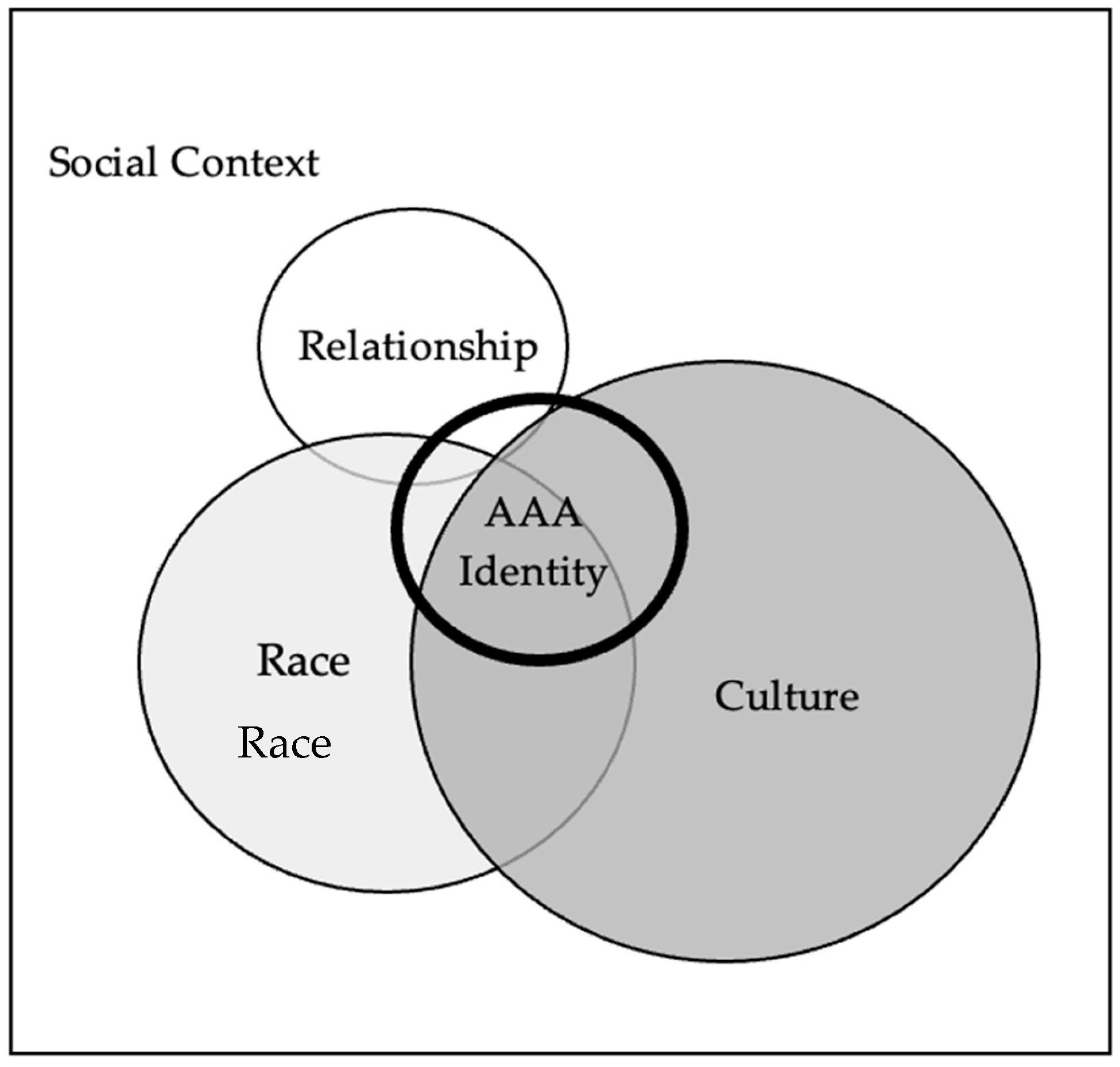
Figure 1 offers a simplified visualization of the AISA model, where the convergence of cultural, racial, and relational spaces at the center represents the participant’s Asian identity. Each space is represented in three dimensions: size (availability of opportunities to engage or explore Asian identity), degree of intersection (personal investment or negotiation across spaces), and transparency (level of personal interest in engaging with Asian identity). For example, the largest circle, culture, reflects abundant opportunities to express ethnic traditions, such as family celebrations or participation in cultural events throughout the academic year. The second largest circle, race, indicates frequent encounters with racialized experiences, including stereotypes like the perpetual foreigner, exotification, or being othered for not conforming to dominant racial expectations. The level of transparency of this space suggests that participants often engaged in critical reflection to challenge these imposed narratives. The smallest and most transparent circle, relationships, signifies limited opportunities and interest in connecting with other Asians outside of family members or well-established friendships, highlighting the variability in how relational ties contribute to identity formation.
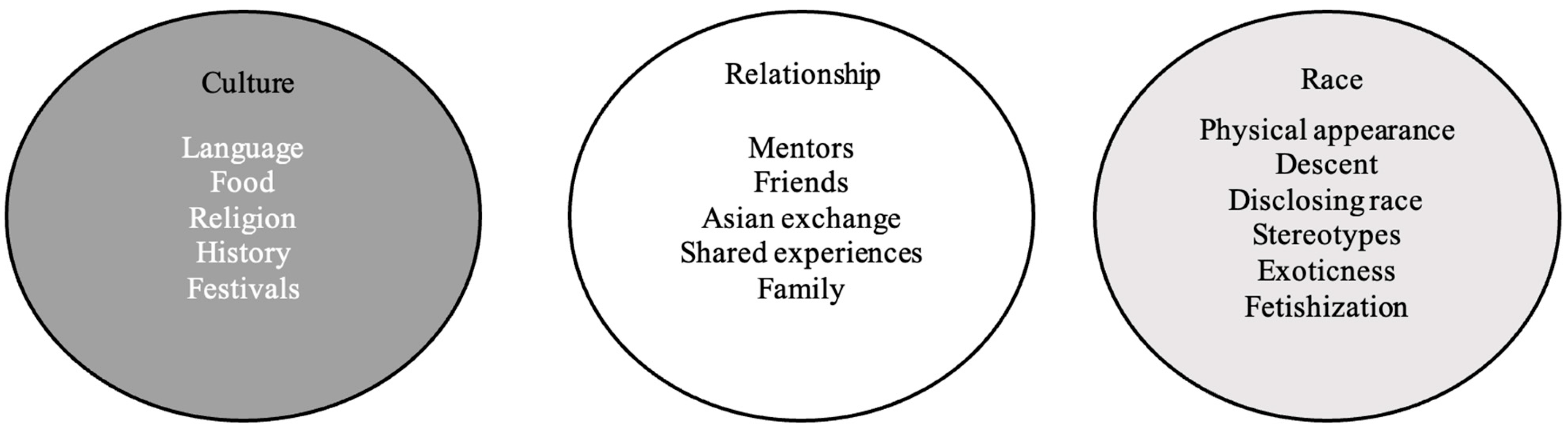
Figure 2 shows properties of identity, such as language, friendships, and disclosing Asian American race, anchored in their respective spatial elements; in particular, this illustration shows the various properties included in cultural, relationship, and racial space.

5.2. “Mythical Scripts”

Race surfaced as the first arena of access and negotiation and was a key indicator of how external narratives shaped participants’ construction of their identity. Grounded in stereotypes, participants were faced with comments centering their physical features before they were looked upon as fellow peers or students. Specifically, Lea pointed to the idea that “Asian is more like being East Asian”, and that “…being Asian is like you have to look like, I don’t know Lucy Liu.” Jesse spoke of the ways interactions differed around her multiracial identity. They stated, “I feel like I just drift through, and people don’t like exactly racially label me except like if I do disclose that I’m like mixed race.” Jesse recalled an event in high school called “Hug an Asian Day,” where they disclosed their Asian identity and her peer questioned it, “I was like, ‘Oh I’m Asian.’ He was like ‘Ha ha ha, wait no, really?’ ‘Yeah, I’m Asian.’ He’s like, I don’t believe you, I was like, ‘Why do you think I’m lying? Why?” For other multiracial participants, assumptions about their racial identity sometimes involved mis-labeling, as with Maggie who was often mistaken for Hispanic. She described instances where interlocutors grew frustrated because her physical appearance did not match their expectations,
It depends on how I’m read, phenotypically. It’s not always an act of choice. There’s always that question, I think when you’re half—with people who don’t necessarily look Asian with the concept of passing, and negotiating passing, and passive passing. Cause it’s not like I’m actively going like, “I’m going to look super Mexican today.”
Naomi pointed out a “double value” placed by others on her ethno-racial identity, once both races were revealed. She expressed feelings of being placed on a pedestal stating, “I don’t know if it’s different somewhere else? I feel like they treat me better, because they know that I’m not Hispanic. I’m not just like the regular.” She expressed feelings of discomfort in being placed in such a position and talked of how such experiences have motivated her to explore other parts of the world. Amelia recalled an incident where her racial space was intruded upon and made center stage by another individual.
There was this man who was like, you are so beautiful! Like what are you? So I told him I’m Asian and I’m Black. He had a group of people, and I’ve never felt this uncomfortable before about telling someone. But he went ahead and had people bet on what I was. It’s happened before, but it’s never been a group of like 16 people. And he’s like, “Hey guys, guys guess what this girl is?” It was like I don’t know, like I was being sold or something, like creeped me out a little.
The comparison to Asian physical traits also extended to participants who identified monoracially, as was the case with Lea, “You know I’ve been I’ve been called the epitome of ethnically ambiguous, depending on the region. You know depending on how people within a certain area were socialized and exposed to different race.” Interactions regarding race were not restricted to the possession of “typical” Asian features but to behavior as well. As Maya pointed out, “People, assume that because you’re Asian American that you act a certain way.”
Grace referred to these conceptions as “mythical scripts” and “how people are going to put their stories of what an Asian American is on me.” She went to add, “All we know is what’s been told to us about each other.” Behavior associated with their physical appearance involved the model minority stereotype, perpetual foreigner, and exotification. Margaret, for example, was left questioning her identity as an Asian, after a comment made by a classmate in high school regarding her intelligence,
That made me like wonder, whether I was Asian enough. Cause I don’t do well in school. Like I’m a slacker, procrastinator. And people always made comments that like I wasn’t smart enough to be Asian and stuff.
Other participants, such as Ji-a, highlighted the assumptions made by individuals regarding her ethnic identity. She recalled,
One summer I went to a teaching academy lecture and a humanities professor who was there, greeted me in Mandarin. I’d never met him before. He didn’t know me, I didn’t know him and he just kind of saw me, then greeted me in Mandarin.
Ji-a added how microaggressions at DBSU like the one she described were normal and “goes unchecked.” Racial identity also othered participants in ways that felt unsafe.
Geeta remarked upon the fixed state of racial space, where one cannot move away from racial identity, but has constant, inherent access. During our interview she talked of how heightened times of national security, her racial identity served as a space to dehumanize her,
Traveling was extremely difficult, at special screenings just based on your name, you had a special code. You had to go and then they dump your underwear and they would do it whatever! They just dumped your stuff. You did not have that dignity, your body, was—you know, we were nothing. It was robbed. It was a certain kind of pathologizing to a degree. And it’s like you were not only diseased but you were deadly.
She went on to add, “I’m afraid of being mistaken again. So there’s also that added layer of fear that I feel being here this close to the border. This whole idea of borders and you know that they rhetorically represent of keeping people out.” While racial space, as described by Ji-a and Geeta represented sites controlled by the perceptions of others it could also be opportunities to challenge preexisting notions of who Asians are and aid in building relationships with others as shared by Jesse.
Jesse spoke of the impact in sharing their multiracial identity and, while some experiences spoke to additional marginalization through other’s disbelief regarding their identity, there were opportunities to address misconceptions. Jesse recalled having their racial identity disclosed during a student organization meeting by a friend who sought to use Jesse’s Asian racial identity to explain why they had spoken out against stereotypes regarding the submissiveness of Japanese women. Jesse was then approached by the woman who had made the comment on Japanese women and was greeted with, “Ni hao.” Though upset by the incident, Jesse chose it as a learning opportunity,
I was feeling kind of shocked from that and a little bit upset that they did that? And they used that as like justification for why I called her out on her comment about Japanese people? And then on the other hand—like I was like “Ok, this, is a moment for me to educate” and be like, “Hey yes I am half Chinese I don’t think you should be asking people you think are Chinese if they’re Chinese or hello, in Mandarin cause that’s a little racist.”
Although Jesse described incidents where using their ethno-racial identity served as a platform for speaking out, they also found accessing racial space offered a chance to fit in with other Asians. Jesse noted,
Sometimes I feel like if in the social context like if I’m with other Asians that I don’t’ really know, I’m like well, I don’t want to like feel too much like an outsider, and I don’t want them to feel uncomfortable. I’ll be like, “My mom’s Chinese,” just so like you know I don’t feel like an outsider, they don’t feel uncomfortable.
Overall participants’ experiences navigating and negotiating their Asian racial identity suggests access to this space can be a deliberate act or one imposed upon them by others. However, participants’ racial identity alone as an externally viewed component of identity failed to account for how it contributed to the construction of their Asian identity as it became clear that through discussions of race and their reflections on conformity to Asian physical traits as dictated by others, participants also engaged in personal interpretations as to their culture and ethnic identity.

5.3. “Culture Wise I’m Nothing Like It”

Participants’ descriptions of their level of language or other cultural expressions provided the greatest insight into how culture constituted a space for Asian identity. While participants spoke of celebrating cultural events such as Lunar New Year or enjoying ethnic dishes, it was most often their unfamiliarity with aspects of their Asian culture that emphasized access to, or a lack of, this space. Michelle’s experiences are one of the strongest examples of accessing cultural space in the construction of the Asian identity. Born in China and brought to the U.S. by adoptive parents, she demonstrates how accessing racial space alone was inadequate to a constructing her Asian identity. Michelle recalled,
I am Asian American in appearance, but culture wise, I’m nothing I would say like it. Because the fact that I just never had that opportunity to really, deeply connect with it. So for me when I think of Asian American, I think of the people who actually do have like actual family, and roots in the respective cultures that they’re from. That they have the traditions that’s been passed down.
Michelle pointed out the dynamic of accessing cultural space in describing how those who have had that exposure can actively choose to distance themselves or own cultural traditions.
They can you know reject it ‘cause you know sometimes it’s, it’s not what they want to do anymore. But for me it wasn’t rejecting, it was just I was never introduced to it in the first place. So, I think nowadays when I think of Asian American, I think, of those who actually are, of Asian descent and have that connectivity. For me it’s’ just like, I don’t even know if I would be able to say I’m Asian American because of it. I just say I’m American.
Michelle’s time at DBSU, however, has helped her to connect with other Asians and Asian Americans, allowing her to explore that aspect of her identity. Brittany too has delved into spaces where she can learn more about the Japanese culture. She added another perspective to constructing Asian identity as part of cultural space. Brittany mentioned the ways second and third generations of Asians living in cultural enclaves may retain a greater connection to their ethnic identity separating them from the American hyphen, while other social contexts allow for full assimilation to Western society where race is the only aspect of Asian identity retained. Brittany pointed out Asian American is a balance of both race and culture.
I think about the extremes of like New York city living in Chinatown living in Koreatown, they really hold on to their culture they’re family life is very much similar to what they had when they were living in you know China or Korea and I don’t’ really see that as being Asian American in a sense that like you know the, the integration part is missing. I think the other extreme is like Asian Americans in Hawaii or California where they are fully integrated, fully acculturated and the only thing they hold is you know their blood line and they’re last name maybe, not even their first name. I think it’s like the happy medium, where they are proud of their heritage, they might practice some of it not all of it probably?
Michelle and Brittany’s experiences represent the ways participants considered connections and access to cultural space in constructing their Asian identity. Their narratives showed how cultural traditions and knowledge played a significant role in considering what Asian and by extension what Asian American means and how it fits within their overall construction of the Asian identity. Michelle and Brittany’s explanations exemplify the complex nature of accessing identity spaces and the degree to which access determines how Asians view themselves as such.
Maggie noted the ways she found it challenging to explain her identity as an Asian because of both the limited knowledge and exposure she had to the Chinese culture, but also her passing White identity. She recalled struggling to choose one identity over the other when completing forms, stating she had often “alternated” between choosing Asian and White before the U.S. Census allowed individuals to choose more than one racial category. The ethno-racial perspective revealed itself when she described her decision to study abroad in Europe versus in Asia,
I don’t have so much cultural knowledge. I mean I know how to order dim sum and things like that. I think that was one reason why studying abroad in Germany was easier was because I could just float into that society a lot easier than if I had studied abroad I think in like China. That would’ve been much more difficult because there would’ve been a stronger culture shock because I grew up here. And just the concept of, of White identity. I think it’s a little bit easier for mixed people to flow into that. But also, it’s cause I’m phenotyping because I think I look a lot Whiter than I do Asian.
Maggie’s experiences are similar to other multiracial participants in the study where the Asian identity was tied not only to their access to the cultural aspects of being Asian, but in how much they “looked” Asian. For some participants, access to culture was tied to their perceived possession of Asian characteristics such as language proficiency. Brittany’s experiences speak to the impacts of parents’ efforts to assimilate into U.S. society. She recounted how her parents’ decisions helped her to belong in the pre-dominantly White East Coast community in which she was raised. Although this facilitated the acceptance she received by the community, Elizabeth recognizes the importance of learning more about the Japanese culture, not only for herself, but for her daughter as well. She stressed the role of language in constructing the AAA identity,
I think that being an Asian American I know language is a part of it, but culture without the language. How much you practice also. I, I mean it’s hard to tease out. Like culture doesn’t exist without the different language base. You know it’s like you could be very Japanese, but don’t speak the language or you could very much understand concepts of being Asian but don’t speak the language.
This was also evident in Maggie’s experience moving away from Sun Valley during her undergraduate years and attending an institution on the West Coast. As a resident of Sun Valley, Maggie felt her mixed-race identity most often resulted in White or Hispanic passing, contributing to feelings of exclusion from other Asians, which changed while living in Riverbank.
I was just part of one of the group because it was all different Asians. We all had to speak English anyway, so I didn’t ever feel left out because of that. Because I think there’s a feeling of barriers when you feel like you should have access to language, and you don’t which is what I think a lot of people feel like here if you don’t speak Spanish. There’s that kind of feeling, of that barrier, where you know stuff is happening, but you can’t access it.
Language proficiency such as that described by Maggie were seen as a key to entering and navigating these spaces. Additionally, both Maggie and Rosalind’s connections with others represented the ways relationships opened pathways to cultural spaces. This framing highlights how access was conceptualized not just as an action, but as a condition or state of being that either enabled or constrained their ability to engage with their Asian identity. Participants’ experiences demonstrated how access could also be considered through the lens of privilege as they reflected on how they were denied or opportunities were fostered to engage with their ethnic and cultural traditions
Erika explained that her decision to enroll in an Asian studies course was to gain more knowledge about Asian history and culture. She shared how she had been denied access to cultural space such as language and how it had become a disservice to maintaining her Japanese identity. Recalling her youth, Erika shared,
My mom didn’t really push the Japanese culture on us. In fact, when I was growing up, the reason I don’t know Japanese is that they refused to speak to Japanese to us when we were kids. Because they didn’t want us to be confused when we went to kindergarten and everybody was speaking English. They thought they were doing something good for us.
Olivia had lived in a predominantly Korean and White community on the West Coast. For her, practicing the culture was unquestioned and insisted upon by her Korean mother. Olivia recalled moments where she sought to distance herself from the Korean aspect of her mixed-race identity. At one time, being Korean for Anne meant simply being born of the blood line. She recalled in her youth wanting to just “be White.” After moving to the Southwest and later attending DBSU, Olivia came to see the importance of her culture in understanding her overall identity. She noted a change in her perceptions toward the AAA identity and found herself embracing and celebrating the Korean culture,
I’m very close to my culture. My mom wanted me to be like a very Korean girl so I feel like, I’ve learned, “Oh I am a little more Korean,” but then, I would be like, “Eh no I’m going to be White,” and stuff like that. But I guess the more I look into it the more I’m like, “Ok I feel more in touch with my Korean,” ‘cause honestly that was what I was more exposed to when I was younger and now I am kind of like accepting it and embracing it and I feel like proud to say like, “Oh I am Korean,” I’m not full, but you know what I still am.
Erika and Olivia’s experiences pointed to the ways relationships played an important role in the exploration or maintenance of their Asian culture and by extension their identity.

5.4. “It’s Helped Me Become More Centered”

Michelle developed relationships with Asian international students and found opportunities to learn indirectly about the Chinese background through these connections. Though she did not initiate the conversations or questions she did note that daily and casual interactions in addition to meeting other Asian adoptees, helped in accepting her Asian identity.
It’s helped me kind of become more um centered I would say? Before when I came down here, I didn’t even know how to identify myself other than as American because I had no context to compare myself to. To come down here and have that experience of seeing other Asian adoptees down here as well just maybe like two or three um and actually just being able to like get to know different kinds of um Asian cultures it’s, it’s really helped, honestly like better understand where I come from? As well as just finally start being like ok this is who I am I’ve, I’ve started to accept it
Michelle’s journey to constructing her own identity was aided by these relationships serving to provide access to cultural knowledge and opportunities to explore that aspect of her identity. Where Michelle’s experiences highlighted how relationships with other Asians could help to accept her Asian identity, other participants, such as Rosalind found support in relationships with others. She talked about how her relationship with Grace created a supportive space where she could “always have access to Asian food because we can cook it, we can go out to eat it.” Rosalind, who along with Grace chartered an Asian student organization on campus, spoke of making efforts to establish relationships with people who might share similar experiences to those she had had since attending DBSU. Specifically, connecting with others helped to confirm not only that the behavior of other toward here were part of the Asian experience at DBSU, but also her Asian identity as whole as they could attend various cultural events together. She recalled how approaching Asians and handing out flyers for the Asian student group felt awkward as they targeted Asians. Rosalind noted that, while the act itself felt unnatural, it allowed others to come to their own decisions as to whether or not to attend. Rosalind recounted,
Rosalind:
It depends on how someone identifies and it also feels weird cause you’re picking out their features and looking at them, like “Oh that’s why, I want to approach you. “Or like what if they don’t identify as Asian and you’re just like making this assumption or what if like OK, yes, they do, now what?
Researcher:
Right, the now what. So where do you go forward with that?
Rosalind:
You create a group an Asian student group! And tell them to join. ‘Cause even them coming, like there’s a reason. Like that’s their choice. Versus, when you approach someone, it’s like you’re choosing to talk to them? But they may not choose not to talk back.
Rosalind also considered relationship space from the perspective of having access to someone with whom she could confide and process her experiences in moving to Sun Valley. She was aware of the lack of such space when attempting to connect with an AAA supervisor in her department.
Like my needs weren’t met. and it wasn’t even that I was looking for a parallel experience, but just the space to discuss it. and it was like shut down. … cause it’s like you would think that like if someone is confiding in you can talk about like Asian identity and asking like oh how do you identify and just being completely shut down.

5.5. “It’ll Be Super Defining”

Participants experiences with the HSI context illustrated how a predominantly Hispanic environment and the intercultural conflicts that sometimes arose contributed to their navigation and negotiation as they constructed their Asian identity. Camille recalled a time when she attempted to share cultural space with peers in the university’s Ambassador program. Out of the 20 attending the orientation for the program, Camille found she and only one other individual identified as a person of color. Her experience during this time demonstrate AAA participants need for safe spaces to talk about their cultural traditions, history, and practices because of the negative responses she received.
It was kind of weird cause I would talk about, like some of my experiences. Or I would say something that was like “Oh yeah I eat with chopsticks with all my meals every day,” and it was like little things like that that I do because I grew up in a Chinese household. But they just found them really funny and like, “Oh you eat with chopsticks! For every meal! Ha ha ha.” It was it was very it was a very weird experience.
P19’s experiences at an HSI included the accommodations he made in altering his name to suit the Southwest environment. He recalled the number of times his Japanese name was mispronounced and his decision to create a name, and thus a new identity that was “not problematic.” P19 stated, “I go by P19 because nobody could really pronounce my name correctly and you know that’s pretty offensive.” Pride in his Japanese heritage would not allow him to assume a Western identity by choosing to use a name such as “Jack.” This extended to his choice in using the generic pseudonym P19, a decision he recalled, could not be understood by members of his cohort when discussing ethics in research. P19 emphasized the challenges in participating in research as a numerical minority in an HSI. He found choosing an Asian name could effectively “out” him, had the focus of the study not been Asians, but also that choosing a Western pseudonym would take away from his cultural identity.
So we had this conversation in class. Like the Hispanic students didn’t get it, “Like what’s the big deal?” Because they don’t understand that you know in a lot of Asian culture I mean it’s important. Especially our family name is important and so it’s offensive to me that I have to change to a Western name just to hide myself. Do I defend myself or not, you know, that’s why it’s important that I’m Participant 19, um because it’s a neutral term. But like it was interesting because the Hispanic students in the classroom did not get it. Like what the big deal was.
P19 pointed out how living with a “different” name was part of the Southwestern life and having to choose when to correct mispronunciations of his name. “I’m like, fuck, yeah P19 isn’t really my real name so why, why, why keep correcting them because these people won’t change.” Dave described a different experience when interacting with the Hispanic majority on campus and represented access through agency in his active engagement with maintaining his culture and his openness in educating others with regards to the Filipino culture. Access through education of misinformation showed a desire to remain connected to his identity rather than simply accept the assumptions of others. He stated dismantling myths and assumptions of Asians is his way of representing the ethno-racial identity.
I had like an internal thing like, “Let me disprove some stereotypes for you.” ‘Cause I don’t like it when they immediately judge me by what they see. ‘Cause you do not know me specifically. So I use that as a conversation starter. I like hearing other people’s perspective about me, so I can correct them. I the question came up as like, “Do you eat dog?” I would frankly say, “Some of the countries they do and in where I grew up some of them did, but that doesn’t mean that I did.” What is it they say in statistics like, correlation does not mean causation. It’s exactly that. That’s why I like disproving myths cause it’s like what you’ve learned and what people have told you sometimes are not, they’re not real.
Participants, like Maggie noted how the southwest had its own type of diversity, making it more challenging to navigate and negotiate the predominantly Hispanic environment,
Like Southwest is considered diverse, but it’s Southwest diverse? Which means we have Native American, Mexican, and White and that’s what our concept of diversity is. Which isn’t bad! But like, I think because of that I’ve always, as I’ve gotten older I’ve been attempting to stretch more into this kind of Asian identity.
To explore how the institutions’ perceived diversity, I next reviewed the goals of the institutions. While USVM did not refer to diversity directly in their goals, DBSU again noted efforts to be made to model “student, faculty, and staff diversity at all levels.” As the study was focused on student experience I looked to campus life webpages to look for opportunities for AAA to participate in organizations and events and observe how the universities’ modeled diversity. I found the Chinese Institute at DBSU offered students the opportunity to learn Chinese and attend events and festivals honoring Chinese traditions. Participants remarked upon the limitations of having a Chinese-focused department on campus, neglecting to address the other ethnic backgrounds of participants. It is important to note that as of the writing of this manuscript, the Chinese Institute no longer exists at DBSU. However, the institution recently founded an Asian and Pacific Islander program as part of their Equity, Inclusion, and Diversity division. Other opportunities offered at the universities were student clubs celebrating various Asian countries and cultures such as the Chinese Student Association, Korean Student Association, Bangladesh Student Association, and even an Anime Club. Participants, however, found these groups to be focused on providing support for international students and not the experiences of AAA. Both universities offered an international students program, but again, only Davika, who was considered an international student, made use of and benefitted from these services.
The analysis of these documents pointed to the relative invisibility of participants on these campuses. All but one participant provided their perception of how AAA were viewed on campus. I did not follow up with the first interviewee of the study and the question of how the universities considered AAA was not yet part of the theoretical sampling process.
Grace, when comparing her experiences growing up on the West Coast and those at DBSU, described living among a different kind of “diversity” which created a bubble around her Korean identity. “I think I got thrown into the fire here. It’s where I really learned about race. And I think in the west, I was coddled and like bubbled by a different type of diversity that was there?” Her time at DBSU, emphasized her racial identity in ways she had not considered in the past, thus integrating the spaces of culture and race as she reconsidered the construction of her Asian identity,
The only thing I would say is that in the end, I think my experiences at DBSU have been thus far the most defining in impact -most defining for my racial identity. Because before, I think I’ve had more, I don’t know if this is right, but I had more of an ethnic identity that was like unquestioned. I was like I’m Korean. I was raised by my dad, my grandma, that was very strong and unquestioned within me, but I started questioning and being faced with things more here. So, so I think it’ll be super defining.
An unexpected finding in the study was the role of traveling abroad in providing spaces that offered participants a new perspective on their AAA identity. Whether it was a personal trip to meet family or through the exchange programs offered on campus, AAA participants found these experiences enlightening with regards to their Asian identity. In the case of Daniel and Jason, travel abroad effectively served to emphasize missing aspects of their Asian identity and brought to light the limited exposure to Asian identity spaces in their lived experiences. Naomi and Maggie both traveled to countries in Europe, which for them created spaces in which they could transcend the confines on their racial identities as they had experienced in Sun Valley.

5.6. The AAA Identity and HSI Context

Analysis of participants experiences living in the Southwest and attending an institution where AAA are virtually invisible in nearly all aspects of campus life revealed two findings. Emerging from one end of the spectrum were participants’ acceptance of their position as a numerical, racialized group. In this recognition lie a normalization of their marginalized position. Participants in this category acknowledged how they were not the minority and did not expect their Hispanic peers, who were the numerical majority at their respective institutions to relate or understand their ethno-racial background. Phrases such as “get used to it,” or “I’ve accepted that…” permeated participants’ experiences in having lived as an isolated population. Emerging from the other end were those individuals who found the HSI environment unsupportive and unacceptable to the treatment of AAA. They found that efforts toward achieving diversity did not include AAA, though it might mean providing services to Asian international students. Participants with these experiences found a stronger attachment to their AAA identity in confronting racism and isolation at their institutions.
Those who had grown accustomed to living as a numerical, racialized being, namely participants who had lived in the Southwest or pre-dominantly White areas normalized their marginalization and accepted the invisibility of AAA, attributing the lack of services and programs to their low population rates. For example, Margaret had moved to Sun Valley in elementary school and considered how her experiences might have been different had she moved to the city later in life,
In California, being White in my classroom was kind of like being in the minority. There were always like at least 10 Asian students in each class, I guess starting school in elementary school here was good. I think it felt much more different if I had moved when like I was like in high school or like college. I think I would have been way more uncomfortable? But I had gradually got used to it.
Maya also pointed to how she had grown to accept her isolation as the only AAA in her social contexts. Although Maya had moved to Sun Valley as an adult, she remarked upon how living in the Southwest acclimates AAA to their isolated status
I mean right away as an Asian American, at DBSU, you notice you’re like the only one. You’re pretty much the only one where ever you are. You know, um and, and I guess by now, I’m used to that? ‘Cause I’ve been here for 10 years?
Acceptance in their isolation followed with growing accustomed to being part of a population that makes up approximately 1.3% in each of the counties where the universities are located. Daniel had been raised in the Southwest and pointed out, “More often than not I’ve just accepted that I’m different.” His comment represents participants experiences with othering in this social context and their responses to being labeled as different from the both White American culture and the Hispanic majority community.
On the opposite spectrum were participants who found the HSI environment extremely unsupportive of AAA, whose efforts toward diversity did not include them. Confronting the racism aimed at their identities and lack of cultural sensitivity toward their ethnic traditions helped to strengthen these participants AAA identity. Incidences of cultural insensitivity permeated Ji-a’s experiences at DBSU. Recalling an incident in which a faculty member approached her and began speaking Mandarin, she pointed out how lack of exposure, interacting with, and cultural knowledge of AAA resulted in having to deal with micro aggressions on a daily basis. She pointed out
I don’t know how college students at other universities know not to say crazy shit like that. Like how do they know that?! Like did somebody tell them? Was that in the orientation? Like whatever they’re doing, DBSU also needs to do? [long pause] And like in an area where there’s a lot less exposure, because Asians are a numeric minority, like maybe there needs to be more sort of deliberate education about like what, what is an ok thing to say and what is problematic if they’re not picking that up from their personal relationships with Asian Americans
Upon reflecting on how these experiences impacted her construction of the AAA identity, Ji-a stated,
Yeah, I think like with my racial identity, it, it’s definitely become stronger. My, my ethnic identity has become stronger. I, I identify more as Korean than I think I did before? Yeah, I think it, it means a lot more to me. Like it’s something that I hold more dearly to me as a result of what I’ve experienced.
Participants’ experiences indicate how accessing identity spaces prior to attending, outside of the university, and at the HSI can impact the ways participants experiences the campus environment. Once a level of acclimation has been achieved to the isolation of AAA in the community, participants accept their marginalized position. This can impact the degree to which participants seek to access identity spaces at the university and view available spaces and support for their identity construction. As noted above, AAA are invisible on campus. Participants who had had opportunities to access identity spaces prior to attending the HSI present a different view of the university as described by Ji-a. Living a hyper-visible, invisibility created feelings of frustration as their racial identity was obtruded into by others claiming cultural access to the AAA identity and invisible due to the lack of representation and consideration by educational leaders of the institution.
Andy, interview number two, allowed for possibility of educational leaders’ consideration of AAA when they described the student body population’s role as “tools” in their claim of diverse campus environments. She introduced first the idea of AAA as tools in greater Western society.
I feel like we’re also there when it’s convenient? I feel like Asianness in America is used like as a tool to be like diversity, but also, like oh, what is it called, that uh, positive stereotype?
When asked to elaborate upon the use of AAA as tools for diversity at the university, Andy stated
‘Cause I feel like SWSU really likes pushing, “Oh, we’re a diverse campus, we have international students,” like it, our happy smiling promotional images, with one Asian person, one Black, one Latino person, and a bunch of White people. Like I, that’s kind of how I feel like they use it?
An earlier review of DBSU’s graduation and retention rate report revealed how AAA are positioned as non-minorities on campus.
The publication made a distinction between Hispanic, other underrepresented minority, and non-minorities when reporting cohort rates of graduation and retention of these respective student body populations. Fine print indicating which ethnic and racial groups were included in each category showed how AAA were listed as non-minorities along with White, non-resident, and unknown. A similar report could not be accessed at USVM. Andy’s conceptualization of AAA as tools was echoed by P19. P19 noted how international students were seen as “cash cows” for the university bringing in much needed revenue.
I think they think of us as cash cows. I think they have the general racists perspective of what they think us Asians are then treat all the same as if we’re the same. Exact, you know, cut from the cloth. Dehumanized numbers. You know, um I guess when they hear about Asian Americans and I don’t think they’re thinking about people from the Philippines or people from you know Indonesia, they’re probably thinking about Chinese, if they’re beyond that, maybe they’re thinking about Japanese. maybe they’re thinking about Indian, but they don’t think Indians are always with Asians. So I mean there’s all kinds of those sort of sort of sort of stereotypical I think I mean they don’t think about us its’ just not a thought.
AAA as tools, cash cows, models of excellence were expressed by both Maggie, Brittany and Naomi as well. Naomi pointed out how AAA are assets both in talent and academics. Maggie and Brittany both alluded to expectations of academic success without support and services from the university. This information and participants’ perceptions are problematic in AAA positioning within the university and is compounded by other participants observations on AAA general invisibility and insignificance at the university.
The invisibility of AAA at the HSIs were observed in the availability of clubs and organizations, lack of events and lectures targeting AAA, and also lack of representation in recruitment material. Images of Asians were most readily available on STEM College Department websites, where the status of individuals as international or American born were not readily apparent. Dave’s comment on representation reflects the absence of AAA on the university campus. He stated
I haven’t had any interactions with the university, like, “Hey Asian Americans,” or like, you know, like representing me. Or, “We want your thoughts!” Something like that. There’s no input output from the university to Asians. So that’s what I think it’s like, you know I can’t put in my two cents if there’s nothing to put it in. So, I don’t see a lot of representation. Cause number one we are underrepresent-underrepresented-especially in this institution! Especially in this institution and especially in the environment we are in? And the region that we are? It’s a Hispanic-serving institution. So I, that’s why I think we’ve become a second thought.
Other participants echoed these sentiments. Maya stated, “I think we’re insignificant to them to be honest to you. Otherwise, I think we would have more forums and lectures and discussions that include Asian American voices? You know.” Russell, like P19 also pointed to the tendency of the institution to focus on more well-known Asian countries, “I, I bet you, I bet you if you ask what is an Asian American, there will be certain groups that are included in that group? And other groups that are not included in that group.” Seo-ah noted the lack of scholarships available for AAA, reflecting Michelle’s comment,
So, I would just say like the lack of support in that [advising] and also just the lack of support just in just in everything? Really? Cause the way that they treat you sometimes on campus is not really nice in some areas. Like they just come up like you come up to them and they’re like, “Oh how are you today,” and then they’re just so nice to every other kid. And it’s like what am I doing to make you just mad at me?
Adding to the problematic nature of invisibility and insignificance were some participants acceptance of their absence in representation across the campus. Participants attributed their absence to a low student body population. Participants were surprised when I informed them that there were 209 of AAA. At the time I began to collect data, the American Indian population at DBSU was half that of AAA and they were granted a building. Participants also recognized the heavy American Indian population in the Southwest and acknowledge this as the reason why such a space was available, which also served to undermine and minimize the need for AAA space. There were few participants who found the university open and accepting of AAA, noting only the lack of scholarships available. Others noted our position as the “model minority” also prevented us from the need of such space as the university believes we have the inherent tools necessary to succeed.
Review of institutional documents combined with participants’ reflections on their position as AAA at their respective institutions offered support for how participants experienced the campus. Missing from discourse and other representation on campus, those who had had access to communities more actively supportive of AAA found the campus hostile. Those who had become accustomed to their marginalization normalized their minoritized status and found the university to be more accepting than those experiences they had had in elementary and secondary school.

5.7. “Blood Only Takes You So Far”

Taken together participants’ narratives indicate that their Asian identity was neither fixed nor uniform. Instead, participants engaged in an active negotiation and navigation of what being Asian meant to them. Most notable was Seo-ah’s evolution in considering her identity as accessing the best of both of American and Korean culture. Although there was a distancing of self from her Asian culture, she finds pride in accessing those parts which she embraces.
I mean, nothing’s really changed, if anything I’ve become more solid in the fact that I’m neither American nor Korean, you know. And for a while I tried to always to go towards the American side because you know that’s where all my friends were and that’s that’s where I wanted to be, but I’ve I’ve, I’ve, the older I get the more I realize how important it is to infuse the Korean side of me too, because there’s, if I could take a good from both sides, then… it’s better than just good from one side, right?
Seo-ah’s construction of her Asian identity represents how, while the Korean American identity can be adopted separately, there is pride in accessing parts of the Korean culture. Her experiences show how neither identity dictate who she is overall, but rather that her access to Asian identity spaces is a process she can choose to actively engage or not. Camille’s experiences focused on how her parents made an effort to emphasize their membership in American culture. Although she talked about how her father worked to make sure she was no different from any other American, it illustrates how being Asian American was a conscious decision and one that was not a given for Asians as a racialized group.
So growing up my parents always told me that, like if anybody asks if I’m Chinese or Taiwanese of whatever, I should always just respond and say I’m American? It was something that like my, my dad, especially was very adamant about?
Camille talked about how her father, though born in Taiwan, referred to himself as American. She explained how even he recognized that choosing to identify solely as American did not mean they would be viewed only as such.
I think he also gets the, impression that like even though we’re American, we’re not always seen as American? Because we’re Asian, people just assume we’re Asian and we’re not like actual, actually American. Right? Like real American.
Both Seo-ah and Camille pointed to the ways race and culture spaces informed their construction of the Asian identity with Camille demonstrating how relationships further contributed to this construction. Geeta’s reflections of her Asian identity transcending blood lines was a key piece in developing the AAIS model. Although she was among the last participants interviewed for the study, her observations inspired deeper analysis into experiences not only with the ethno-racial identity, but in how Asians begin to consider which spaces are access in an effort to construct their own Asian identity.
My mother would tell me you were born to an Indian stomach, you’re Indian. Your blood coursing through your veins, and then I remember the first time I told my mother that her heart was broken and that’s what she said, she’s like, “My heart is broken.” And I said, “You know. It’s. Blood only takes you so far.”
The voices of 24 AAA participants illustrate how the varied stories can combine to create a dynamic narrative of the AAA identity. Construction of the AAA identity is fluid, shifting as participants interact with various social contexts. Access to cultural, relationship, and racial space allows participants to consider opportunities or the right to use, learn, or benefit from aspects of the ethno-racial identity. Flexible in nature, the AAIS model considers the availability of, investment in, and level of personal interest in participants’ reflections of each spatial element.
Through the grounded theory method, I explored how participants’ notion of access implied an active process where participants created, participated, or negotiated cultural, relationship, and racial space. These elements emerged through participants discussion of various properties pertaining to the elements of identity space, such as language and food with regard to culture and disclosure with regard to racial space. Participants’ reflections on how ethnic and racial identity played an essential role in defining their concept of an AAA and its contribution to developing the spatial elements. In addition, their recounting of social situations involving their ethno-racial identity served to emphasize how participants recognized their othered position, distinguishing themselves from Asian international students who were perceived to have a deeper access to cultural space, and confronting racial prejudice in their social environments.
In developing a model focusing on the access of AAA identity spaces, I provided a framework that neither forced identity construction into a linear process or aimed to view participants exploration as a stage-like progression. As a fluid and dynamic process, access can be observed in various social contexts where space is neither only a physical and tangible area, but can reside in the mental, emotional, and social existence of AAA. The AAIS model is meant to be used as a guide to exploring how AAA have arrived at their current construction of the ethno-racial identity as well as to investigate how they might move forward in these efforts.

6. Limitations

The limitations of the study include a temporal gap between the collection of data and participant sampling and life experiences covered by the study. The rise in anti-Asian hate during the COVID-19 pandemic illustrated how the positioning of Asians in society could shift and reproduce the yellow peril narrative. According to Yip et al. (2021), the pandemic “reinvigorated old stereotypes, unleashed new manifestations of xenophobia, and contributed to unprecedented numbers of hate crimes targeting Asians and Asian Americans” (p. 579). The pathologizing of Asians and Asian Americans, while not new, could have provided new insights into the construction of identity.
Representation of ethnic origin, class status, and gender were not equal across participants. There was heavy participation of AAA from East Asian countries, which were also represented on campus by the Chinese Institute at DBSU, student organizations at both campuses, and course offerings specific to China and Japan. This could have impacted how interest and investment in access could be considered, as there were opportunities available for this population. While there was participation from students in South and Southeast Asian, they remain a small representation of the Asian American monolith and missing from this study were the voices of Central Asian groups. Although students from all Asian backgrounds were eligible to participate, the relative small student body provided a challenge and barrier to recruiting a more representative participant sample. Moreover, there was also the greater number of graduate students who participated in the study as well as those upper undergraduate classmen. This left the freshman and sophomore voice silent in exploring how AAA students attending HSIs constructed their identity. Finally, over half of the participant sample identified as female, leaving few opportunities to explore the intersection of the AA identity and gender in their experiences while attending an HSI.
When considering the complexities of navigating ethno-racial identities in a social world, the development of a model could be more easily generalized through a longitudinal study. As such, participants could describe only those experiences up until their current age. While the study included participants beyond the age of 40, the average age of AAA in the study was approximately between 21 and 24, giving a limited view of AAA identity construction. The limitations of the study indicate the need to delve into further research as well as the opportunities to apply the AAIS model to other social contexts.
As a flexible analytical framework, the AAIS model may be applied to diverse settings, including institutions outside the U.S. Southwest. The model’s emphasis on access to cultural, racial, and relational identity spaces allows for examination of how AAA students navigate identity construction as numerical and racialized minorities within contexts where other marginalized groups hold majority status.
The model may prove particularly relevant for understanding Asian American students at other historically or enrollment-defined minority-serving institutions (Leshner and Scherer 2021), such as Historically Black Colleges and Universities (HBCUs), Tribal Colleges and Universities (TCUs), and Asian American and Native American Pacific Islander-serving Institutions (AANAPISIs). While the specific manifestations of mythical scripts, cultural erasure, and institutional invisibility would vary by context, the underlying processes of navigation and negotiation would remain salient. Additionally, the model is applicable to any institutional context where AAA students experience racialization and marginalization, including Predominantly White Institutions (PWIs).
At PWIs or those with larger Asian American student populations and established Asian student organizations, AAA students might access cultural and relational spaces differently due to greater community resources. Yet, they would still navigate similar racial spaces structured by the model minority and perpetual foreigner stereotypes. The AAIS model’s flexibility enables researchers and practitioners to examine how institutional demographics, resources, regional contexts, and campus climates shape the relative availability, salience, and accessibility of different identity spaces.
This comparative approach aligns with grounded theory’s iterative nature. As Glaser and Strauss (1967) emphasized, theory generation is not a finite endpoint but rather a constant process where emergent theory does not end simply because the researcher has written their findings. They stated that “The published word is not the final one, but only a pause in the never-ending process of generating theory” (p. 40). The articulation of the AAIS model represents a grounded understanding of identity construction at HSIs in the Southwest borderlands, yet the data and analysis remain open to refinement. When applied to new institutional contexts, the model may reveal additional theoretical insights, particularly regarding how racism and racialization function differently across institutional types while maintaining common patterns in how racialized students navigate structural constraints. Future research should explore these variations to deepen our understanding of the complexities and strengths inherent in grounded theory approaches to identity construction.

7. Discussion

R. S. Chang (1993) stressed the importance of deconstructing the AAA identity so that we might be released from the binding constructs defined in terms of Western society. He stated, “As long as our identity is defined oppositionally or in contradistinction to others, we are still enslaved to a degree” (p. 1321). This study aimed to explore how AAA might construct their own identities as numerical, racial minorities in a predominantly Hispanic context in hopes of breaking free from the shackles of our otherness. It sought to offer AAA a platform from which to explore their identity and thus deconstruct what was and examine for themselves what is. I had hoped to offer AAA, who are all but invisible as students attending HSIs in the Southwest region of the US, an opportunity for their voices to be heard.
Participants’ reflections on their ethno-racial identities underscore the continued role race plays in shaping how individuals make meaning of their racialized experiences. Morning’s (2011) work highlighted a central paradox: although social scientists widely acknowledge race and racial categories as socially constructed, the concept remains popularly tethered to biological notions of difference. This tension surfaced in participants’ narratives. While they recognized that their Asian identities were racialized through familiar tropes—such as the model minority (e.g., presumed to be “good at math”), the perpetual foreigner (e.g., being addressed in various Asian languages), and exotification or fetishization, their efforts to understand these identities could still drift toward ideas of lineage, ancestry, or “blood.”
The widespread rise in commercial genealogy testing over the past two to three decades further illustrates society’s desire to anchor racial identity in biologically rooted histories. For instance, Geeta’s mother’s comment exemplify how individuals turn to ancestry to make sense of racial identity. Morning and Maneri (2022) argue that such practices are shaped by what they call a “global Du Boisian color line, shaped by colonial practices and the transatlantic slave trade, which established European whiteness as a universal standard” (p. 1639). This framework resonates with participants like Dustin, whose feelings about the “wrongness” of his own culture reflect the enduring association of “American” with White, European-dominant norms.
Morning’s (2011) broader scholarship further demonstrates that while scholars may critique biological essentialism, the general public continues to absorb genetically framed definitions of race—reinforced, for example, through school textbooks that transmit essentialist notions to new generations. A key critique of Morning and Maneri’s (2022) work suggests that its most significant impact may be outside academia, precisely because these public understandings remain so deeply entrenched. Song (2017) argued that race and racism cannot be fully decoupled in practice because individuals often encounter them as intertwined. Participants frequently narrated race and racism as inseparable, reflecting how lived experience in the U.S. makes the two feel mutually reinforcing. This experiential merging was evident in how many described their marginalization as “normal” or inevitable. Such normalization is itself a product of racism where the insidious power of racist structures lies in how they render themselves invisible or natural to those living within them. At HSIs, institutional racism often operates by making AAA students so numerically insignificant that their isolation appears to be a simple demographic fact rather than the result of institutional choices: the choice not to build culturally relevant support structures or not to include Asian perspectives in diversity initiatives. Conversely, participants who named and challenged these conditions demonstrated a critical consciousness that their marginalization was produced rather than predetermined.
Their interpretations, however, speak to the experiential intertwining of these constructs rather than the theoretical claim that race and racism are inherently bound. This distinction aligns with scholars who argue that decoupling the two is necessary for imagining alternative racial futures. Braveman and Dominguez (2021), for example, called for the abandoning of the term “race,” or at the very least using it “rarely and only inside quotation marks when necessary to make a point about its historical usage” (p. 6). To decouple race from racism is to recognize its role in the justification for violence against and marginalization of people of color throughout American history (Bhopal 2004). These perspectives demonstrate that racism is not an inherent feature of racial categories themselves but a contingent socio-political system built upon them. Decoupling race from racism, in this view, serves as a strategy for disrupting the logics that naturalize race as permanent or inevitable. Together, these debates about the relationship between race and racism underscore the importance of examining how individuals actively navigate the meanings imposed upon them. This turn toward agency provides a bridge to identity development scholarship, which similarly emphasizes the fluid and negotiated nature of racial and ethnic identity
Existing literature on identity development supports the fluid process of AAIS model. Kim and Shammas (2019), found that participants’ identity development involved a process where Asian immigrants’ ethnic identity were informed by seven internal and external environmental contexts. Of particular interest is their findings, which demonstrated how movement across the environmental contexts was not passive but that they could actively engage with these areas. As seen above, AAA participants could deliberately enter identity spaces as they worked to navigate and negotiate between externally created narratives and their personal interpretations of who Asians are. This was most clearly seen when multiracial participants disclosed their Asian identity in efforts to challenge misconceptions or build relationships with other Asian peers or faculty. Socialization, as noted by Atkin and Yoo (2021), played a critical role in how participants associated with their identity, which supported the ways relationships with family and other Asians informed participants understanding of what it means to be Asian. In cases where participants were not engaged in socialization, or in this case exposed to cultural traditions or had the ability to express cultural knowledge such as language proficiency, participants questioned their ability to claim the Asian identity for their own. This was observed in Erika’s denied access to the Japanese language by her mother and Michelle’s experiences as an adoptee. While their identities prior to attending their respective institutions were described as more nebulous, their reflections demonstrate whose interactions with other Asians and physical spaces on campus like Asian studies courses could support deeper connections with the Asian culture and therefore add to their Asian identity construction.
Anthias (2002), using the language of location and position in the process of developing one’s identity, argued that
Such a position is able to pay attention to spatial and contextual dimensions, treating the issues involved in terms of processes rather than possessive properties of individuals (as in ‘who are you?’ being replaced by ‘what and how have you?’) p. 494.
Participants in the current study identified three spatial and contextual sites where their identities could be negotiated and navigated—culture, race, and relationships—which arose from interactions with their social context. Anthias further emphasized that by recognizing the socially meaningful concepts of identity through the lens of spatial and contextual dimensions, we are more in tune with the concept of identity as a continuous process of reimagining and reforming the idea of oneself (Blumer 1986; Charmaz 2025). A key component to the process of interpretation and reinterpretation are the ways racialized spaces are informed by a society’s values toward group members. McLean and Syed (2015) referred to these as master narratives which inform people how to be “good” group members. Critical to their model of identity development is how group members might create alternative narratives that resist or reject the master narrative. This was evident in Grace’s shift from the salience of her ethnic identity to addressing her racialized identity at DBSU. Wallinger-Schorn (2011) spoke to the tensions in one’s own personal interpretation of their identity and the external narratives forcing them to conform to society’s, whether the Asian community or dominant U.S. Particularly, “This incongruent group identity needs to be accepted as fact of life and not condemned as an unstable subjectivity” (p. 34) The AAIS model allows for opportunities to embrace the incongruence of the Asian identity spaces as it emphasizes how Asians construct their own Asian identity. Walligner-Schorn added “…all Asian Americans have their own ideas about what role the Asian, Asian American, and the majority American cultures play in a ‘typical ‘Asian American’s life” (p. 34). Note her use of quotations around ‘typical’, denoting that typical too is subjective as there can be no typical Asian life, which was supported by the participants’ varied constructions of their Asian identity and the nuances in their lived experiences.
Smedley (1999) argued that racial identity has limited our ability to identify our authentic or true selves beyond physical traits. While the findings from this study are centered on ethno-racial identity, it offers Asians a platform for autonomous construction and highlights the agency they have in creating for themselves their own understanding of who they are as AAA. Charmaz (2025) pointed to the ways that symbolic interactionism complements grounded theory in its concepts surrounding the ways people assign meaning to objects. Were the objects discussed ethno-racial identity, we see how meaning has been interpreted, constructed, re-interpreted, and deconstructed only to be once again reconstructed through interactions with one another (Pedraza 2023). Smedley further argued, “The dilemma for the low-status races was, and still is, how to construct a positive identity for themselves in the light of the ‘racial’ identity imposed on them by the dominant society” (p. 695). The AAIS model demonstrates how individuals can create for themselves, within the socially constructed boundaries of race, an identity grounded in their experiences and understanding of who they are. These constructions, unlike the centuries-long restrictions of physical race, are changeable and no less authentic than previous versions.
Ronald Takaki (1989) stressed the importance of studying AAA through their own words and voices to humanize our existence and move beyond the monolith label hiding our diversity. The development of this model was not meant to essentialize the identity construction of Asians but rather when rooted in its fluidity, allowing for autonomy in how Asians construct their identity. Common themes of racialization, culture, and interactions and connections with other Asians are not static, but instead offer arenas where participants have the agency to choose to engage with each space. It serves to illustrate the mutability of our sense of self and that, regardless of the boundaries established by dominant American society, we can create for ourselves our own meaning of what it means to be Asian.

Supplementary Materials

The following supporting information can be downloaded at: https://www.mdpi.com/article/10.3390/genealogy9040141/s1.

Funding

This research received no external funding.

Institutional Review Board Statement

The study was conducted according to the guidelines of the Declaration of Helsinki, and approved by the Ethics Committee of New Mexico State University (Protocol Code 14892; date of approval 14 March 2017).

Informed Consent Statement

Informed consent was obtained from all subjects involved in the study.

Data Availability Statement

The original contributions presented in this study are included in the article/Supplementary Materials. Further inquiries can be directed to the corresponding author.

Conflicts of Interest

The authors declare no conflict of interest.

References

  1. Accapadi, Mamta M. 2012. Asian American identity consciousness: A polycultural model. In Asian Americans and Pacific Islanders in Higher Education: Research and Perspectives on Identity, Leadership, and Success. Washington, DC: NASPA-Student Affairs Administrators in Higher Education, pp. 57–94. [Google Scholar]
  2. Adichie, Chimamanda N. 2009. The Danger of a Single Story [Video]. TED Conferences. July. Available online: http://www.ted.com/talks/chimamanda_adichie_the_danger_of_a_single_story (accessed on 15 September 2016).
  3. Anthias, Floya. 2002. Where do I belong? Narrating collective identity and translocational positionality. Ethnicities 2: 491–514. [Google Scholar] [CrossRef]
  4. Atkin, Annabelle L., and Hyung Choi Yoo. 2021. Patterns of racial-ethnic socialization in Asian American families: Associations with racial-ethnic identity and social connectedness. Journal of Counseling Psychology 68: 17. [Google Scholar] [CrossRef]
  5. Berzonsky, Michael D. 2011. A social-cognitive perspective on identity construction. In Handbook of Identity Theory and Research. New York: Springer, pp. 55–76. [Google Scholar]
  6. Bhopal, Raj. 2004. Glossary of terms relating to ethnicity and race: For reflection and debate. Journal of Epidemiology & Community Health 58: 441–45. [Google Scholar]
  7. Blumer, Herbert. 1986. Symbolic Interactionism: Perspective and Method. Berkeley: University of California Press. [Google Scholar]
  8. Bonilla-Silva, Eduardo. 1994. Rethinking Racism: Toward a Structural Interpretation. (Center for Research on Social Organization, No. 526). Ann Arbor: University of Michigan. Available online: https://newuniversityinexileconsortium.org/wp-content/uploads/2022/02/Eduardo-Bonilla-Silva-Rethinking-Racism-Toward-a-Structural-Interpretation.pdf (accessed on 8 September 2016).
  9. Bowen, Glenn A. 2009. Document analysis as a qualitative research method. Qualitative Research Journal 9: 27–40. [Google Scholar] [CrossRef]
  10. Braveman, Paula, and Tyan Parker Dominguez. 2021. Abandon “race.” Focus on racism. Frontiers in Public Health 9: 689462. [Google Scholar] [CrossRef] [PubMed]
  11. Chang, Mitchell J. 2008. Asian evasion: A recipe for flawed resolutions. Diverse Issues in Higher Education 25: 26. [Google Scholar]
  12. Chang, Robert. 2000. Disoriented: Asian Americans, Law, and the Nation-State. New York: NYU Press. [Google Scholar]
  13. Chang, Robert S. 1993. Toward an Asian American legal scholarship: Critical race theory, post-structuralism, and narrative space. California Law Review 81: 1241–1323. [Google Scholar] [CrossRef]
  14. Chang, Robert S. 2013. The Invention of Asian Americans. UC Irvine Law Review 3: 947. [Google Scholar]
  15. Charmaz, Kathy. 1990. ‘Discovering’ chronic illness: Using grounded theory. Social Science & Medicine 30: 1161–72. [Google Scholar] [CrossRef]
  16. Charmaz, Kathy. 2006. Constructing Grounded Theory: A Practical Guide Through Qualitative Analysis. Thousand Oaks: Sage Publications. Available online: http://www.sxf.uevora.pt/wp-content/uploads/2013/03/Charmaz_2006.pdf (accessed on 4 April 2016).
  17. Charmaz, Kathy. 2025. Constructing Grounded Theory, 3rd ed. Thousand Oaks: SAGE Publications. [Google Scholar]
  18. Chickering, Arthur W. 1969. Education and Identity. San Francisco: Jossey-Bass. [Google Scholar]
  19. Chu, Yiting. 2024. Navigating double marginalization: Narratives of Asian (American) educators teaching and building solidarity. Race Ethnicity and Education, 1–21. [Google Scholar] [CrossRef]
  20. Corbin, Juliette, and Anselm Strauss. 2015. Basics of Qualitative Research: Techniques and Procedures for Developing Grounded Theory. Thousand Oaks: Sage Publications. [Google Scholar]
  21. Cuellar, Marcella, and Robin Nicole Johnson-Ahorlu. 2016. Examining the complexity of the campus racial climate at a Hispanic serving community college. Community College Review 44: 135–52. [Google Scholar] [CrossRef]
  22. Desert Basin State University. 2015. Fall 2015 Factbook. Available online: https://oia.nmsu.edu/nmsudata/index.html (accessed on 6 October 2016).
  23. Desert Basin State University. n.d.a. Department of Campus Activities. Available online: http://upc.nmsu.edu/charter/list.php (accessed on 6 October 2016).
  24. Desert Basin State University. n.d.b. Our Heritage. Available online: https://www.nmsu.edu/about/heritage.html (accessed on 6 October 2016).
  25. Feagin, Joe, and Sean Elias. 2013. Rethinking racial formation theory: A systemic racism critique. Ethnic and Racial Studies 36: 931–60. [Google Scholar] [CrossRef]
  26. Fearon, James D. 1999. What is Identity (As we Now Use the Word). Unpublished manuscript. Stanford: Department of Political Science, Stanford University. [Google Scholar]
  27. Gasman, Marybeth, Thai-Huy Nguyen, and Clifton F. Conrad. 2014. Lives intertwined: A primer on the history and emergence of minority serving institutions. Journal of Diversity in Higher Education 8: 120–38. [Google Scholar] [CrossRef]
  28. Gee, James P. 2000. Identity as an analytical lens for research in education. Review of Research in Education 25: 99–125. [Google Scholar] [PubMed]
  29. Glaser, Barney G. 1978. Theoretical Sensitivity: Advances in the Methodology of Grounded Theory. Mill Valley: Sociology Press. [Google Scholar]
  30. Glaser, Barney G., and Anselm L. Strauss. 1967. The Discovery of Grounded Theory: Strategies for Qualitative Research. New Brunswick: Aldine Transaction. Available online: http://www.sxf.uevora.pt/wp-content/uploads/2013/03/Glaser_1967.pdf (accessed on 4 April 2016).
  31. Guba, Egon G., and Yvonna S. Lincoln. 1994. Competing paradigms in qualitative research. In Handbook of Qualitative Research. Edited by Norman K. Denzin and Yvonna S. Lincoln. Thousand Oaks: Sage Publications, pp. 105–17. [Google Scholar]
  32. Guess, Theresa J. 2006. The social construction of Whiteness: Racism by intent, racism by consequence. Critical Sociology 32: 649–73. [Google Scholar] [CrossRef]
  33. Hammack, Phillip L. 2015. Theoretical foundations of identity. In The Oxford Handbook of Identity Development. New York: Oxford University Press, pp. 11–30. [Google Scholar]
  34. Howard, Peter, and Brian Graham. 2016. The Routledge Research Companion to Heritage and Identity. London: Routledge. [Google Scholar]
  35. Huddy, Leoni. 2001. From social to political identity: A critical examination of social identity theory. Political Psychology 22: 127–56. [Google Scholar] [CrossRef]
  36. Humes, Karen R., Nicholas A. Jones, and Roberto R. Ramirez. 2010. Overview of Race and Hispanic Origin. Washington, DC: U.S. Census Bureau. [Google Scholar]
  37. Ibrahim, Farah, Hifumi Ohnishi, and Daya S. Sandhu. 1997. Asian American Identity Development: A Culture Specific Model for South Asian Americans. Journal of Multicultural Counseling and Development 25: 34–50. [Google Scholar] [CrossRef]
  38. Im, Carolyn. 2025. Facts About Asians in the U.S. [Fact Sheet]. Pew Research Center. May 1. Available online: http://www.pewresearch.org/race-and-ethnicity/fact-sheet/asian-americans-in-the-u-s/ (accessed on 13 August 2025).
  39. Jo, Ji-Yeon O. 2004. Neglected voices in the multicultural America: Asian American racial politics and its implication for multicultural education. Multicultural Perspectives 6: 19–25. [Google Scholar] [CrossRef]
  40. John, Ginelle, and Frances K. Stage. 2014. Minority-Serving Institutions and the education of US underrepresented students. New Directions for Institutional Research 2013: 65–76. [Google Scholar] [CrossRef]
  41. Kim, Eunyoung, and Diane Shammas. 2019. Understanding transcultural identity: Ethnic identity development of Asian immigrant college students during their first two years at a predominantly White institution. Identity 19: 212–29. [Google Scholar] [CrossRef]
  42. Kim, Jean. 1981. Development of Asian American Identity: An Exploratory Study of Japanese American Women. Ph.D. dissertation. Available online: http://files.eric.ed.gov/fulltext/ED216085.pdf (accessed on 5 September 2016).
  43. Lee, Erika. 2015. The Making of Asian American: A History. New York: Simon & Schuster. [Google Scholar]
  44. Lee, Sharon. 2006. Over-represented and de-minoritized: The racialization of Asian Americans in higher education. InterActions: UCLA Journal of Education and Information 2: 1–16. [Google Scholar]
  45. Leshner, Alan I., and Layne A. Scherer. 2021. Mental Health, Substance Use, and Wellbeing in Higher Education: Supporting the Whole Student. Washington, DC: The National Academic Press. [Google Scholar]
  46. Li, Yao, and Harvey L. Nicholson, Jr. 2021. When “model minorities” become “yellow peril”—Othering and the racialization of Asian Americans in the COVID-19 pandemic. Sociology Compass 15: e12849. [Google Scholar] [CrossRef] [PubMed]
  47. Maekawa Kodama, Corinne, Marylu K. McEwen, Christopher T. H. Liang, and Sunny Lee. 2002. An Asian American perspective on psychosocial student development theory. New Directions for Student Services 2002: 45–60. [Google Scholar] [CrossRef]
  48. Massey, Douglas S. 2007. Categorically Unequal: The American Stratification System. New York: Russell Sage Foundation. [Google Scholar]
  49. McLean, Kate C., and Moin Syed. 2015. Personal, master, and alternative narratives: An integrative framework for understanding identity development in context. Human Development 58: 318–49. [Google Scholar] [CrossRef]
  50. Morning, Ann. 2011. The Nature of Race: How Scientists Think and Teach About Human Difference. Berkeley: University of California Press. [Google Scholar]
  51. Morning, Ann, and Marcello Maneri. 2022. An Ugly Word: Rethinking Race in Italy and the United States. New York: Russell Sage Foundation. [Google Scholar]
  52. Museus, Samuel D. 2014. Asian American students in higher education. In Key Issues on Diverse College Students. Edited by M. Gasman and N. Bowman III. New York: Routledge. [Google Scholar]
  53. Museus, Sameul D. 2022. Relative racialization and Asian American college student activism. Harvard Educational Review 92: 182–205. [Google Scholar] [CrossRef]
  54. Museus, Samuel, Dina C. Maramba, and Robert T. Teranishi, eds. 2013. The Misrepresented Minority: New Insights on Asian Americans and Pacific Islanders, and the Implications for Higher Education. Sterling: Stylus Publishing. [Google Scholar]
  55. Nadal, Kevin L. 2004. Pilipino American Identity Development Model. Journal of Multicultural Counseling and Development 32: 45–62. [Google Scholar] [CrossRef]
  56. Office of Management and Budget. 2024. Revisions to OMB’s Statistical Policy Directive No. 15: Standards for maintaining, collecting, and presenting federal data on race and ethnicity. Federal Register Notices 89: 22181–95. Available online: http://www.govinfo.gov/content/pkg/FR-2024-03-29/pdf/2024-06469.pdf (accessed on 26 August 2025).
  57. Omi, Michael, and Howard Winant. 2015. Racial Formation in the United States. New York: Routledge. [Google Scholar]
  58. Organisation for Economic Co-Operation and Development [OECD]. 2010. Higher Education in Regional and City Development: The Paso del Norte Region, Mexico, and the United States. Paris: OECD Publishing. Available online: http://www.oecd.org/mexico/45820961.pdf (accessed on 6 February 2017).
  59. Pak, Yoon K., Dina C. Maramba, and Xavier J. Hernandez. 2014. Asian Americans in Higher Education: Charting New Realities. ASHE Higher Education Report Series; San Francisco: Jossey-Bass, vol. 40, 1. [Google Scholar]
  60. Patton, Lori D., Kristen A. Renn, Florence M. Guido, and Stephen J. Quaye. 2016. Student Development in College. San Francisco: Jossey-Bass. [Google Scholar]
  61. Pedraza, Chadrhyn A. A. 2023. “There’s Something There in That Hyphen”: The Lived Experiences of Asian and Asian American Higher Education Students in the Southwest Borderlands of the United States. Genealogy 7: 22. [Google Scholar] [CrossRef]
  62. Petersen, William. 1966. Success story, Japanese American style. New York Times Magazine, January 9. Available online: http://www.elegantbrain.com/edu4/classes/readings/depository/A_A_S_reads/petersen_modelminority.pdf (accessed on 10 November 2015).
  63. Pew Research Center. 2020. What the Census Calls Us [Chart]. Pew Research Center. Available online: http://www.pewresearch.org/social-trends/feature/what-census-calls-us/ (accessed on 28 June 2025).
  64. Pierce, Jennifer L. 2014. Why teaching about race as a social construct still matters. Sociological Forum 29: 259–64. [Google Scholar] [CrossRef]
  65. Pizzolato, Jane E., Tu-Lien K. Nguyen, Marc P. Johnston, and Prema Chaudhari. 2013. Naming our identity: Diverse understandings of Asian Americanness and student development research. In The Misrepresented Minority: New Insights on Asian Americans and Pacific Islanders, and the Implications for Higher Education. Edited by Samuel D. Museus, Dina C. Maramba, Marc P. Johnston and Robert T. Teranishi. Sterling: Stylus Publishing LLC., pp. 124–39. [Google Scholar]
  66. Poon, OiYan, Dian Squire, Corinne Kodama, Ajani Byrd, Jason Chan, Lester Manzano, Sara Furr, and Devita Bishundat. 2016. A critical review of the model minority myth in selected literature on Asian Americans and Pacific Islanders in higher education. Review of Educational Research 86: 469–502. [Google Scholar] [CrossRef]
  67. Powell, John A. 1997. The racing of American society: Race functioning as a verb before signifying as a noun. Law & Inequality 15: 99–138. [Google Scholar]
  68. Ravitch, Sharon M., and Nichole M. Carl. 2016. Qualitative Research: Bridging the Conceptual, Theoretical, and Methodological. Thousand Oaks: Sage Publications. [Google Scholar]
  69. Ray, Victor. 2019. A theory of racialized organizations. American Sociological Review 84: 26–53. [Google Scholar] [CrossRef]
  70. Renn, Kristen A., and Robert D. Reason. 2013. College Students in the United States: Characteristics, Experiences, and Outcomes. San Francisco: Jossey-Bass. [Google Scholar]
  71. Ryoo, Jean J., and Rob Ho. 2013. Living the legacy of ’68. In The Misrepresented Minority: New Insights on Asian Americans and Pacific Islanders, and the Implications for Higher Education. Edited by Samuel D. Museus, Dina C. Maramba and Robert T. Teranishi. Sterling: Stylus Publishing LLC., pp. 213–26. [Google Scholar]
  72. Santiago, Deborah A. 2006. Inventing Hispanic-Serving Institutions (HSIs): The Basics. Available online: http://files.eric.ed.gov/fulltext/ED506052.pdf (accessed on 20 December 2016).
  73. Smedley, A. 1999. “Race” and the construction of human identity. American Anthropologist 100: 690–702. [Google Scholar] [CrossRef]
  74. Smedley, Audrey, and Brian D. Smedley. 2005. Race as biology is fiction, racism as a social problem is real: Anthropological and historical perspectives on the social construction of race. American Psychologist 60: 16–26. Available online: http://rws200jspencer.pbworks.com/w/file/fetch/104349117/Race%20as%20Biology%20Is%20Fiction.pdf (accessed on 24 February 2014). [CrossRef]
  75. Song, Miri. 2017. Why we still need to talk about race. In Why Do We Still Talk About Race? London: Routledge, pp. 135–49. [Google Scholar]
  76. Stryker, Sheldon, and Peter J. Burke. 2000. The past, present, and future of an identity theory. Social Psychology Quarterly 63: 284–97. [Google Scholar] [CrossRef]
  77. Suddaby, Roy. 2006. From the editors: What grounded theory is not. Academy of Management Journal 49: 633–42. [Google Scholar] [CrossRef]
  78. Takaki, Ronald. 1989. A History of Asian Americans: Strangers from a Different Shore. Boston: Back Bay Books. [Google Scholar]
  79. Taylor, Paul. 2013. The Rise of Asian Americans. Washington, DC: Pew Research Center. Available online: http://assets.pewresearch.org/wp-content/uploads/sites/3/2013/04/Asian-Americans-new-full-report-04-2013.pdf (accessed on 29 September 2016).
  80. The White House, Office of the Secretary Press Secretary. 2015. Fact Sheet: Asian American and Native American Pacific Islander Serving Institutions (AANAPISIs). May 12. Available online: https://obamawhitehouse.archives.gov/the-press-office/2015/05/12/fact-sheet-white-house-summit-asian-americans-and-pacific-islanders (accessed on 20 December 2016).
  81. University of the South, Veridian Mesa. 2015. The University of the South, Veridian Mesa 2014–2015 Fact Book. Available online: http://cierp2.utep.edu/pastfactbooks/UTEP%20Fact%20Book%202014-15.pdf (accessed on 6 October 2016).
  82. University of the South, Veridian Mesa. n.d.a. Asian Studies. Available online: http://academics.utep.edu/Default.aspx?alias=academics.utep.edu/asianstudies (accessed on 6 October 2016).
  83. University of the South, Veridian Mesa. n.d.b. Organizations Directory. Available online: http://minetracker.utep.edu/organizations (accessed on 6 October 2016).
  84. University of the South, Veridian Mesa. n.d.c. USVM History. Available online: http://libguides.utep.edu/utephistory (accessed on 6 October 2016).
  85. University of the South, Veridian Mesa. n.d.d. Vision, Mission, and Goals. Available online: https://www.utep.edu/about/utep-vision-mission-and-goals.html (accessed on 6 October 2016).
  86. U.S. Census Bureau. 2000. Factfinder for the Nation: History and Organization; Washington, DC: U.S. Census Bureau. Available online: http://www.census.gov/prod/2000pubs/cff-4.pdf (accessed on 5 January 2017).
  87. U.S. Census Bureau. 2017. Quickfacts: Sun Valley County and Passage City County. Available online: http://www.census.gov/quickfacts/fact/table/elpasocountytexas,doaanacountynewmexico,elpasocitytexas,NM/PST045217 (accessed on 5 January 2017).
  88. U.S. Census Bureau. n.d.a. 1790. Overview. Available online: http://www.census.gov/history/www/through_the_decades/overview/1790.html (accessed on 5 January 2017).
  89. U.S. Census Bureau. n.d.b. 1800. Overview. Available online: http://www.census.gov/history/www/through_the_decades/overview/1800.html (accessed on 5 January 2017).
  90. U.S. Census Bureau. n.d.c. 1850. Overview. Available online: http://www.census.gov/history/www/through_the_decades/overview/1850.html (accessed on 5 January 2017).
  91. U.S. Census Bureau. n.d.d. 1870. Overview. Available online: http://www.census.gov/history/www/through_the_decades/overview/1870.html (accessed on 5 January 2017).
  92. U.S. Census Bureau. n.d.e. 1890. Overview. Available online: http://www.census.gov/history/www/through_the_decades/overview/1890.html (accessed on 5 January 2017).
  93. U.S. Department of Education. n.d. Developing Hispanic-Serving Institutions program—Title V: Definition of Hispanic-Serving Institution. Available online: https://www.ed.gov/grants-and-programs/grants-special-populations/grants-hispanic-students/developing-hispanic-serving-institutions-program-title-v#eligibility (accessed on 20 December 2016).
  94. U.S. News and World Report. 1966. Success Story of one Minority Group in U.S. December 2. Available online: https://teaach.education.illinois.edu/docs/teaachcollegeofeducationlibraries/default-document-library/george-takei.pdf?sfvrsn=f385a5e2_1 (accessed on 10 November 2015).
  95. Vignoles, Vivian L., Seth J. Schwartz, and Koen Luyckx. 2011. Introduction: Toward an integrative view of identity. In Handbook of Identity Theory and Research. Edited by Seth J. Schwartz, Koen Luyckx and Vivian L. Vignoles. New York: Springer, pp. 1–30. [Google Scholar]
  96. Wallinger-Schorn, Brigitte. 2011. Cultural Hybridity. Cross/Cultures 143: 29. [Google Scholar]
  97. Wijeyesinghe, Charmaine L., and Bailey W. Jackson III, eds. 2012. New Perspectives on Racial Identity Development: Integrating Emerging Frameworks. New York: New York University Press. [Google Scholar]
  98. Wong, Alina. 2013. Racial identity construction among Chinese American and Filipino American undergraduates. In The Misrepresented Minority: New Insights on Asian Americans and Pacific Islanders, and the Implications for Higher Education. Edited by Samuel D. Museus, Dina C. Maramba and Robert T. Teranishi. Sterling: Stylus Publishing LLC., Chapter 4. pp. 86–105. [Google Scholar]
  99. Wu, Frank H. 2002. Yellow: Race in America Beyond Black and White. New York: Basic Books. [Google Scholar]
  100. Yip, Tiffany, Charissa S. Cheah, Lisa Kiang, and Gordon C. N. Hall. 2021. Rendered invisible: Are Asian Americans a model or a marginalized minority? American Psychologist 76: 575. [Google Scholar] [CrossRef]
  101. Zhang, Yan, and Barbara Wildemuth. 2009. Unstructured interview. In Applications of Social Research Methods to Questions in Information and Library Science. Edited by Barbara Wildemuth. Westport: Libraries Unlimited, pp. 222–31. [Google Scholar]
Figure 1. Figure 1 represents a simplified visual of the AAIS model.
Genealogy 09 00141 g001
Figure 2. Properties of Identity Space Elements.
Genealogy 09 00141 g002
Table 1. Participant Demographics.
PseudonymSelf-Reported Racial IdentityClass StatusGenderAge Range
BrittanyJapaneseMastersFemale26–30
CamilleTaiwaneseDoctoralFemale21–25
DanielKorean/White mixedMastersMale21–25
DaveFilipinoJuniorMale18–20
DavikaThaiJuniorFemale18–20
DustinVietnameseMastersMale26–30
ErikaJapanese American *SeniorFemale36–40
GeetaIndianDoctoralFemale36–40
GraceKorean AmericanDoctoralFemale31–35
JasonChineseSeniorMale21–25
JesseChinese *SeniorPrefer not to respond21–25
Ji-aKoreanDoctoralFemale36–40
LanaVietnameseJuniorFemale21–25
LeaFilipinoMastersFemale21–25
MaggieChinese *MastersFemale26–30
MargaretKoreanSeniorFemale21–25
MayaKorean and Japanese AmericanDoctoralFemale46–50
MichelleChineseSeniorFemale21–25
NaomiAfrican American/JapaneseSeniorFemale21–25
OliviaKorean *JuniorFemale21–25
Participant 19JapaneseDoctoralMale36–40
RosalindChineseDoctoralFemale26–30
RussellHappaDoctoralMale36–40
Seo-ahKoreanMastersFemale21–25
* Participants identified as Asian and White during the interview.
Disclaimer/Publisher’s Note: The statements, opinions and data contained in all publications are solely those of the individual author(s) and contributor(s) and not of MDPI and/or the editor(s). MDPI and/or the editor(s) disclaim responsibility for any injury to people or property resulting from any ideas, methods, instructions or products referred to in the content.