1. Introduction
In the United States, the COVID-19 pandemic temporarily revealed the public value of social reproductive care. The realities of the pandemic laid bare the indispensability of life-sustaining work to collective good, highlighted the prevailing care deficit among families in their daily struggle for affordable childcare, food security, eldercare, and healthcare (
Briggs 2017). The pandemic also spotlighted labor disparities that coerce poor women, immigrants, and people of color into providing low-wage care labor for affluent families while undermining the care they need to perform for their own families and kin (
Nadasen 2023;
Glenn 2010).
Marxist feminists have long highlighted capitalism’s focus on ‘productive’ labor as concealing the value of reproductive care labor, or what they call “social reproduction”, which is the unpaid or underpaid activities, particularly in families and households, through which human life, labor power, and social relations are produced, nurtured, and sustained across generations. Social reproductive care labor is shown instead as indispensable to and imbricated with capitalist production (
Fraser 2013;
Weeks 2011;
Bhattacharya 2017). Feminist care theorists such as Joan Tronto similarly highlight the political, social, and economic significance of what they present as “care” activities, defining care as “a species activity that includes everything that we do to maintain, continue, and repair our ‘world’ so that we can live in it as well as possible. That world includes our bodies, ourselves, and our environment, all of which… interweave in a complex, life-sustaining web.” (
Tronto 1993, p. 103). Both “care” and “social reproduction” are rightly presented as labor
activities, not as personal feelings or attitudes, and the two concepts capture the often missed, critical, collective significance of
social-
relational activities and
interdependent everyday practices of reproductivity among kin and related groups.
Through national policy, the American state has variably understood and acknowledged the public value of social reproductive care work, at times viewing it as a crucial policy goal worthy of support, or else more instrumentally and sometimes punitively, as labor to be harnessed in service of economic health or other national political ideals. Through the constitutional system of federalism, each of the individual fifty states comprising the United States has developed its own policy trajectories regarding social reproductive care, historically a state (not national)-level policy concern.
In addressing COVID and social reproductive care in the United States, the following article pursues theoretical, policy-genealogical, and empirical goals. It theoretically reworks the early “COVID moment,” from March 2020 to November 2020 as a policy opportunity moment during which states across the country developed policy responses that grappled with disruptions to human life and were compelled to make unusually explicit decisions about the relationship among work, markets, care, life, households and state responsibility. In so doing, states divergently acknowledged and/or discursively framed the social reproductive stakes posed by the immense health crisis. The article foregrounds this state-level policy moment within the genealogical evolution of national policy paradigms on the issue of social reproductive care, from the early 1900s and the beginnings of national policy attention to the late 20th century and the present policy orientation of marketized and privatized social reproductive care. The article then poses and empirically answers the question of why, despite the opportunity for foundational policy innovation, the pandemic did not transform the prevailing privatized care paradigm nor engender durable policy attention to programmatic supports for social reproductive care. To investigate, I look to states’ underlying regimes of COVID governance. Using both interpretive qualitative and statistical quantitative methods, I assemble and analyze an original dataset of stay-at-home orders (SAHOs) and reopening plans for all 50 states (over 150 documents),
1 also analyzing governors’ messaging and executive orders, to demonstrate patterns in state-level policy governance paradigms and in states’ approaches to social reproductive care.
The article demonstrates that states diverged in whether and how they viewed COVID as a social reproductive crisis, developing differential policy paradigms of crisis governance and adopting a range of normative conceptions regarding the family and state responsibility for social reproductive care. Rather than a departure from the inherited governing logic of privatized care, the article finds that states divergently complicated it. State-level policy variation patterned into clusters on a continuum, from what I term a “care-focused paradigm” that most substantially recognized care and human reproductive and productive interdependence at one end to a “market-restoration” paradigm on the other, that largely reproduced the inherited prioritization of productive work over privatized reproductive labor. I also find a third, hybrid type of governance, that I term “regulated hybrid” that modified the inherited approach by mixing care and market-restoration orientations. The article’s overarching argument is that states divergent public attention to social reproductive care involved in combating the COVID crisis was shaped by states’ political contexts and their varied embrace of the older neoliberal policy paradigm—its constitutive norms, assumptions, and ideation regarding family, work, and personal and state responsibility. The COVID moment did not disembed the rendition of market-focused prioritization of productive over reproductive labor, of privatized care as the dominant policy paradigm that eschews the public value of social reproductive care, nor did it significantly alter the coerciveness of the care labor market and its infrastructure; however, I argue, the COVID crisis dislodged some of the strength of the inherited governing logic, predominantly among Democratic-majority states but also, to some extent, among some Republican-governed ones, possibly making way for newer approaches to questions of care, social reproduction, and state responsibility to emerge in the future.
The first to investigate COVID-19 policy in terms of the genealogy of social reproductive care policy in the US, the article contributes to the literature on American political development (APD) that is focused on family,
2 and to public policy scholarship. Feminist care scholarship on the rise of neoliberalism in the US has emphasized the regressive impact of neoliberal ideologies of privatized care on the erosion of state support of care relations (
Briggs 2017;
Nadasen 2023;
Glenn 2010). This project builds on the three sets of literature (APD, public policy, and feminist care theory) as it investigates the ways by which the policy story of care governance unfolded historically and as states encountered the critical shock of the global pandemic.
2. Genealogy of Social Reproduction in American Public Policy
Scholars of political development and policy regimes emphasize that every policy is part of a larger regime of governance, encompassing institutional arrangements and distinct sets of underlying ideas and interests (
May and Jochim 2013). Policy paradigms are constituted by distinctive normative structures and assumptions about what counts as a policy problem (and what does not), whose experiences will be used to describe a situation, what kinds of solutions are deemed possible, and what sorts of policy successes may be sought (
Wilson 2000;
Stone 1988).
How a problem is identified, defined, and framed is inherently political, as public policy scholar Deborah Stone writes, “because groups, individuals, and government agencies deliberately and consciously design portrayals so as to promote their favored course of action.” (
Stone 1988, p. 106). The agenda-setting and issue-framing scholarship in American public policy has long attested to the political character of how and why certain experiences are framed as problems to be addressed, whereas others remain under-addressed, treated as ‘natural’ or ‘inevitable,’ perhaps regrettable but nevertheless outside the realm of policy (
Baumgartner and Jones 1993;
Edelman 1964;
Kingdon 1995;
Stone 1989).
Attention to social reproductive care has waxed and waned historically within dominant paradigms of American public policy, engendering changes in how reproductive labor is conceived and how systems of care and care infrastructures operate to coerce poor and racially diverse families. In the first two decades of the twentieth century, amidst widespread social tumult from industrialization, urbanization, immigration, and extensive human casualties from factory production, World War I, urban congestion, and the Spanish flu pandemic, Progressive reformers within the Republican and Democratic parties emphasized the need to conserve the “life, health, and strength” of the American people. Social reproduction in this era was understood as part of “human conservation” of the “American race,” defined in (white) racialist terms as a site for public responsibility. Republicans in their 1920 party platform asserted that “the supreme duty of the nation is the conservation of human resources through an enlightened measure of social and industrial justice.” (
Republican Party 1920). The emphasis on human resource conservation focused policy attention on the physical, corporeal care of white male workers and soldiers and the economic and material precarity in which they and their families lived.
The frame of human conservation also upheld pronatalist and eugenic policies focused on women’s reproductive labor, including proposals for mothers’ aid to widows to provide in-home care for their children, maternal and infant health care programs, ‘fitter family’ contests, institutionalization initiatives for “feeble-minded” women, and even irrigation programs (
Lovett 2007). Viewing native-born white women as mothers entrusted with the task of reproducing the “American race,” legislative reform also enacted a ban on ‘white slavery,’ or purported sex trafficking of white rural women into urban areas, as well as protective labor legislation for women workers, the latter framed as “provisions for decency, comfort and health…as should be accorded the mothers of the race.” (
Alphonso 2015, p. 605). At the same time, through vagrancy laws, exploitative labor contracts, and enforced apprenticeships, poor Black and brown women, children, and families of color were coerced into performing social reproductive care for more affluent families and formally or via discriminatory implementation were deprived of programmatic support for care of their kin. The implicit social reproductive unit (of public value) was that of a white, native-born, biological family that would conserve and reproduce social and industrial order through gendered familial roles, northern European descent, and “American” cultural and lived values. Public policy was oriented to reproduce this ideal, normalizing its vision of family reproductive care and coercion.
A wider, more structural, understanding of social reproduction, albeit still racially and gender confined, permeated the New Deal of the 1930s. National policies were newly established in the aftermath of the Great Depression, the global stock market crash that led to immense unemployment, economic breakdown, and social devastation across American society. These policies included national Social Security, Aid to Dependent Children (national ‘mother’s aid’ programs), Unemployment Insurance, as well as wages and hours industrial labor regulations and worker protections. Newly adopted as part of an “Economic Bill of Rights,” policy attention focused on building infrastructures to support the social reproduction of industrial labor families. Programmatic support did not extend to domestic workers or agricultural laborers, the sectors that employed most Black and Brown male and female workers, nor to poor single-mother and other families of color who, in many cases, continued to be excluded, via discriminatory implementation, from the new programs.
In the 1960s, largely due to massive civil rights and welfare rights movements, including the widespread labor organization of domestic workers, national social programs were expanded with the purpose of including the excluded, building new programs to support the economic and social reproductivity of poor people and families of color. Winning election in 1964 by a landslide, Democratic President Lyndon Johnson termed his ambitious domestic policy agenda the “Great Society,” a society that “rests on abundance and liberty for all…[one that] demands an end to poverty and racial injustice, to which we are totally committed in our time.” (
Johnson 1964). As per the Great Society paradigm, national state responsibility to family material and social security was vast, necessitating new and enhanced programmatic (material and institutional) supports for the social reproduction of a more socially pluralist and economically inclusive society. National policies at this time included “war on poverty” programs, Head Start programs and other elementary and secondary school programs, Medicare and Medicaid for expanded healthcare, civil rights and voting rights enforcement structures, as well as consumer protections and urban renewal programs. The expansion of national state machinery and forceful intervention of the federal government into erstwhile state government programs, many of which had long been explicitly or implicitly racialist and gendered, led to an outcry by some states of federal government overreach.
By the late 1970s, the tide had turned. Leading the political ascendance of conservativism, Republican President Ronald Reagan declared that “government is not the solution…government is the problem.” (
Reagan 1981). Reagan ushered in a neoliberal limited-government/anti-statist vision, elevating private markets and “restoring” families, communities, and church associations as civil society entities; professedly to reproduce ‘traditional’ American society with the two-parent, male-headed, nuclear family household as the “basic unit of American life.” (
Reagan 1984). The new social conservatism-infused neoliberal policy agenda formally reorganized responsibility for social reproduction away from the state, retrenching state programmatic supports and instead emphasizing private responsibility or “personal responsibility” of parents for care obligations; shifting social reproductive care solely onto households and families while elevating markets and religious institutions as crucial policy sites. The neoliberalist vision maintained a strict division between productive work and reproductive labor, the former viewed as an appropriate and crucial target of public policy with social reproductive care presented as “naturally” and “traditionally” private, normatively outside of state support. State supportive responsibility for everyday social reproductive labor in households was vilified as government overreach; however, more muscular public initiatives encouraging, regulating, and in some instances requiring marriage, breadwinning, and other heteronormative nuclear family norms were strongly supported. Democrats came to acquiesce in this Republican-led policy vision through the 1990s and 2000s. Socially conservative neoliberal policies that privatized care included initiatives to reduce taxes (Economic Recovery Tax Act of 1981; Economic Growth and Tax Relief Reconciliation Act of 2001), retrench welfare programs and require work from poor parents in order to receive assistance (Personal Responsibility and Work Opportunity Reconciliation Act [PRWORA] of 1996), support marriage and promote faith-based services (White House Office of Faith-Based and Community Initiatives, established by Executive Order 13199 in 2001),discourage extra-marital sexual relations (Defense of Marriage Act [DOMA] of 1996), curtail government support for reproductive and abortion services (Partial-Birth Abortion Ban Act of 2003), and increase regulation and surveillance of workers and labor organizations.
As historian Premilla Nadasen has highlighted, the shift to neoliberal governance entailed a fundamental policy transformation, namely the market commodification of social reproductive care and creation of a for-profit care economy that accumulates profits by providing (high-priced) care for consumption, while relying on and coercing low-wage, exploitative labor from primarily poor women, immigrants, and people of color who are themselves priced out of purchasing care for their own families (
Nadasen 2023). Political scientists have shown how state policies support the coercive stratification of the care economy, specifically by turning “work” into a coercive site for civic and political inclusion and family support (
Soss et al. 2011). National policies penalize families who are unable to privately cover the (unregulated) costs of care by punitively enforcing child custody payments, increasing child removals from poor families on grounds of parental ‘neglect,’ diminishing direct cash assistance to families in need, and placing rigid time limits on family assistance and social services; all of which actively discourage poor women and people of color from having children and from receiving support for social reproductive care. Trump’s first administration departed from neoliberal orthodoxy in significant ways—notably trade and economic nationalism—but did not displace the neoliberalist privatized organization of social reproduction. In the policy domains of social welfare, health, labor, and care policy, enduring policy reliance on private markets, work requirements, family personal responsibility, and conditional programmatic support combined with a more nationalist, punitive, and executive-centered politics on behalf of favored industries and constituencies (
Cooper 2017;
Lebow 2019;
Daguerre and Conlan 2020;
Keck and Clua-Losada 2021).
It was in this prevailing public policy context of privatized care (summarized in
Table 1) that COVID emerged as a public policy crisis. Beginning in March and through October 2020, the first-wave federal COVID-19 policy intervention unfolded across two broad phases: containment (March–May) and reopening and recovery (May–October) (
Alphonso et al. 2021), each with differences in public attention to social reproductive care. During the containment phase, Congress played a pivotal role. With strong bipartisan support and despite longstanding polarization, Congress enacted three key pieces of legislation: the Coronavirus Preparedness and Response Supplemental Appropriations Act on 6 March, the Families First Coronavirus Response Act on 18 March, and the CARES Act on 27 March. Early national legislation reflected a multi-layered, evolving understanding of the crisis. The first, the Coronavirus Preparedness Act, treated COVID primarily as an existential biomedical emergency, directing resources toward virus surveillance, vaccine research, medical supplies, and grants to state and local governments. The second, the Families First Act, had a more developed understanding of social reproduction. Recognizing that containment disrupted families’ ability to work, to provide care to children and family members, to access food, and to maintain household stability, the Act focused federal funding to support households—expanding Family and Medical Leave Act protections, creating temporary paid sick leave, enhancing federal support for unemployment insurance, school meals, and food stamps, among other things. The third, the CARES Act, broadened national policy intervention still further, now to pursue economic stabilization, combining worker supports with extensive assistance to businesses though PPP, and supporting financial markets, healthcare systems, and state governments.
At the national executive level, President Trump’s messaging rapidly moved national-level policy from emergency containment, when the virus first threatened public health, toward reopening and economic restoration, when restrictions themselves were framed as threats to livelihoods, employment, and individual freedom. During containment, the Trump administration declared a national emergency on 13 March, and, at the urging of states, invoked the Defense Production Act on March 18 to expand production of medical supplies, also issuing CDC mitigation guidance on March 16 (“Fifteen Days to Slow the Spread”). However, containment decisions and mitigation policy such as stay-at-home orders and business closures were left largely to states. Trump’s directives recognized COVID-19 as a biomedical emergency but treated social and familial disruptions, such as school closures, caregiving demands, and household burdens, as secondary consequences to be managed by families, states, and/or local institutions. During the reopening phase (May–October 2020), Trump elected to play a much more prominent role. Claiming a president’s power over reopening as “total”, Trump emphasized restoring economic activity, employment, and individual choice. The president’s shift moved the dominant policy narrative from collective containment toward economic recovery and biomedical innovation (vaccines). This transition again left it to private families, caregivers, and households to reconcile return to full-time employment with ongoing childcare, schooling, nutrition and health vulnerabilities, instead of fortifying federal responsibility for care infrastructural development to accompany the push toward economic normalcy.
At the subnational level, governors (state-level executives), operating under emergency declarations or disaster management powers, and often with little input from state legislators, assumed a central role in determining the nature and duration of public policy interventions. Democratic executives from East and West Coast states formed ‘regional councils’ to develop their own distinctive COVID policies; whereas, Republican governors, more or less closely followed Trump’s directives and messaging with some albeit limited variation. Subnational COVID policy paradigms combined different forms of crisis governance and politics, with different ideas of crisis, state responsibility, and social reproductive care, to which we now turn.
3. Subnational COVID Governance Paradigms—Care Governance, Regulated Hybrid, and Market Restoration
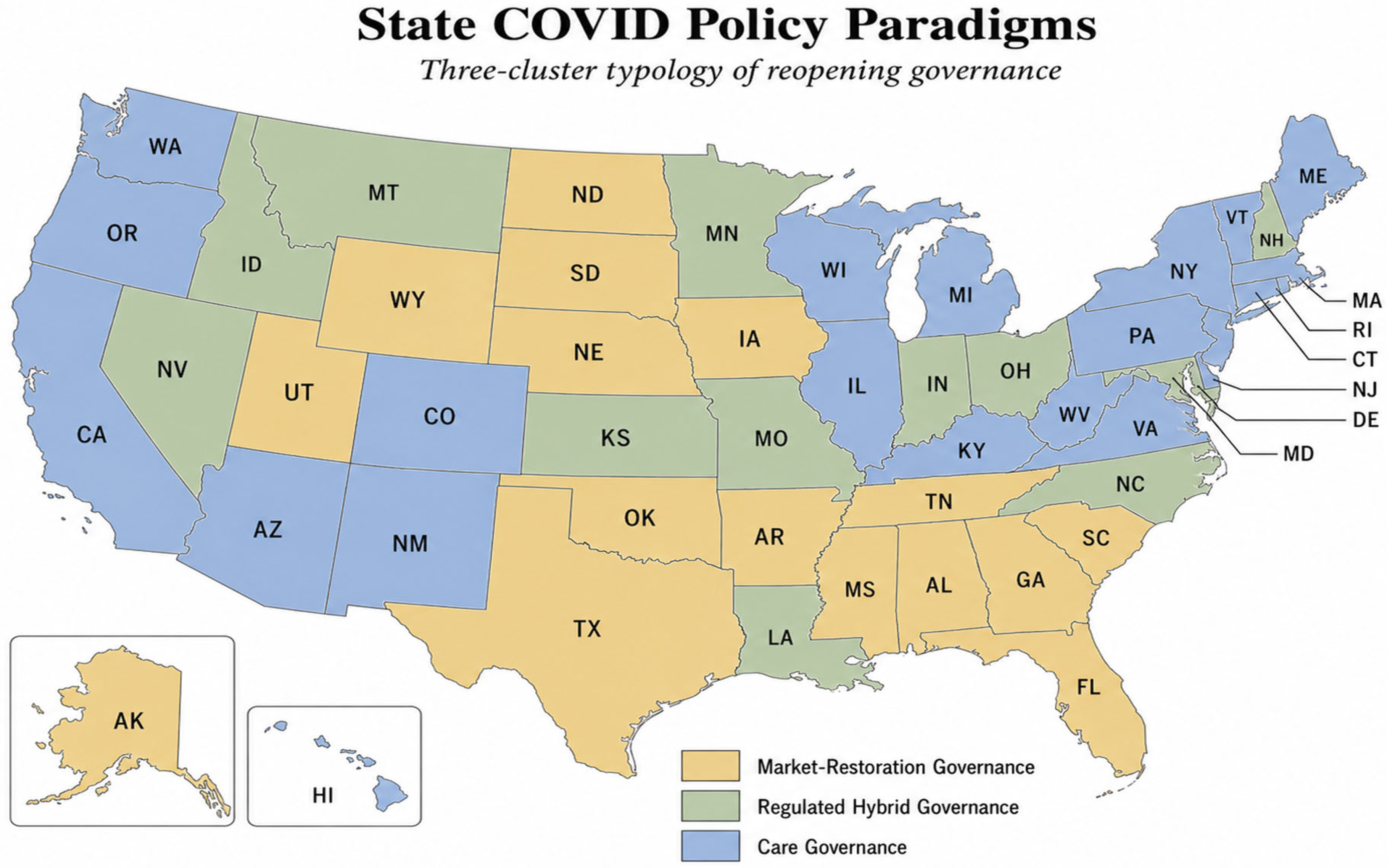
Assembling and analyzing all 50 states’ COVID governance regimes as contained in their policy documents on COVID closings, mitigation, and reopening plans, including executive orders and governors’ messages as well as response infrastructure documents (such as the formation and/or composition of taskforces), I find three interrelated COVID-response governance paradigms that may be termed: (a) market-restoration, (b) regulated hybrid and (c) care governance paradigms. The patterned clusters are statistically coherent (“fair” silhouette measure) as per a 2-step cluster analysis. State COVID policy paradigms may be more properly conceived as occurring on a continuum from “care governance” on the left of the ideological spectrum to “market-restoration” on the right with the regulated hybrid form of governance in the center. The profiles of states adopting each governance paradigm are summarized in
Table 2 and
Figure 1 (below).
The sixteen states that adopted the market governance paradigm were the most internally distinctive in their COVID policies. They had very limited statewide restrictions, with no shutdown and/or very short duration stay-at-home or shelter-in-place orders (SAHOs), and enforcement was either minimal or voluntary. In terms of reopening, governors from these states used limited to no public health benchmarks (i.e., health and capacity indicators such as positivity rates, hospital and testing capacity), adopting standards for reopening even below the CDC-recommended federal standards, and turning to business leaders and business associations as the dominant group in reopening planning. Fifteen of the sixteen states in this governance category either never closed or reopened early. Fourteen had no SAHO or one lasting less than one month. Twelve relied on voluntary or no enforcement, and eleven had business-dominated reopening planning.
Like President Trump, several state governors from market-restoration states, such as Texas’ Greg Abbott and Florida’s Ron DeSantis, elected to defer their governing authority during containment, devolving authority to local and municipal governments for imposing mitigation measures. In contrast, these governors, also like Trump, strongly affirmed their own statewide executive authority on the issue of reopening, its scope and timing. These states treated economic interruption and market disruptions as the central policy problem, viewing social and familial health and wellbeing as wholly dependent on the economy and endangered by containment measures. Republican Texas Lt. Governor Dan Patrick, for instance, told Fox News host Tucker Carlson that a failing economy was scarier than dying, and that senior citizens like him should be prepared to die rather than have the economy suffer.” (
Beckett 2020). The Lt. Governor warned, “…there are more important things than living. And that is saving this country for my children and my grandchildren and saving this country for all of us.” (
L. Brown 2020).
The twelve states in the regulated hybrid governance category exercised substantial statewide regulatory governance during containment. Eleven of the twelve states imposed a statewide SAHO that was mandatory and lasted one to two months, ten penalized both businesses and individuals and used recommended-level gating criteria and benchmarks, demonstrating an understanding of the health crisis as much more than solely a ‘private’ crisis involving personal responsibility and voluntary measures. However, unlike states using a care governing paradigm, these states did not exceed the federally recommended gating standards, their reopening planners were predominantly mixed between business and other actors rather than public health expert-dominant, and most reopened at an average point rather than late.
The twenty-two states that adopted care governance were the most public health-centered and precautionary in their COVID governance, substantially recognizing care and human social reproductive interdependence as matters of significant public responsibility. Eighteen of the twenty-two used higher-than-recommended gating criteria, none relied on voluntary or no enforcement, twenty-one states reopened at an average or later than average date, seven states maintained a SAHO for more than two months, and sixteen states had public health-dominated reopening planning. Governors from these states strongly tied reopening decisions to public health metrics such as mortality rates and hospitalizations. Andrew Cuomo of New York, for instance, maintained that there was a crucial policy distinction between economic loss and human loss of life: “Real death is real…Economic death is not death…the economy we can figure out.” Instead, he characterized the decision over reopening in terms of human lives, downplaying economic costs, as a “question [about]… how much is a human life worth? … [and] the cost of a human life…is priceless, period.” (
Falconer 2020).
In addition to biomedical care, states in the care governance and the regulated hybrid groups were also strongly statistically correlated with policy attention to social reproduction and equity governance, recognizing disparities in vulnerabilities and access across population groups.
4 In Michigan, Governor Gretchen Whitmer (D) noting that African Americans, who represented 13.6% of Michigan’s residents accounted for “a staggering” 40% of deaths from COVID-19, created the
Coronavirus Taskforce on Racial Disparities. A taskforce that would be “devoted to thoroughly studying and developing strategies to immediately address this troubling disparity and the historical and systemic inequities that underlie it.” (
Whitmer 2020). Similarly, Louisiana Governor Jon Bel Edwards (D-LA) created fifteen taskforces under the
Resilient Louisiana Commission. Echoing a vision akin to the Great Society, the Commission cited “Equity” as a Foundational Element in the Design of their
Comprehensive Game Plan for a More Resilient Louisiana, stating, “our state succeeds when opportunity, access, equity and gender inclusiveness are present,’” (
Resilient Louisiana Commission 2020, p. 10) adding that “economic inclusion and equity must be prioritized as a new Louisiana growth model…equity is not only a matter of social justice; it is an economic necessity.” (
Resilient Louisiana Commission 2020, p. 20). Fifteen of the twenty-two “care governance” states had a high equity focus with only one state in this group demonstrating a no/low equity focus. In contrast, ten of the sixteen market-restoration states had a low/no equity focus with only one state incorporating high equity policy attention. Two of the twelve states adopting regulated hybrid governance had a no/low equity focus, five had a high equity focus, and five had a limited equity focus.
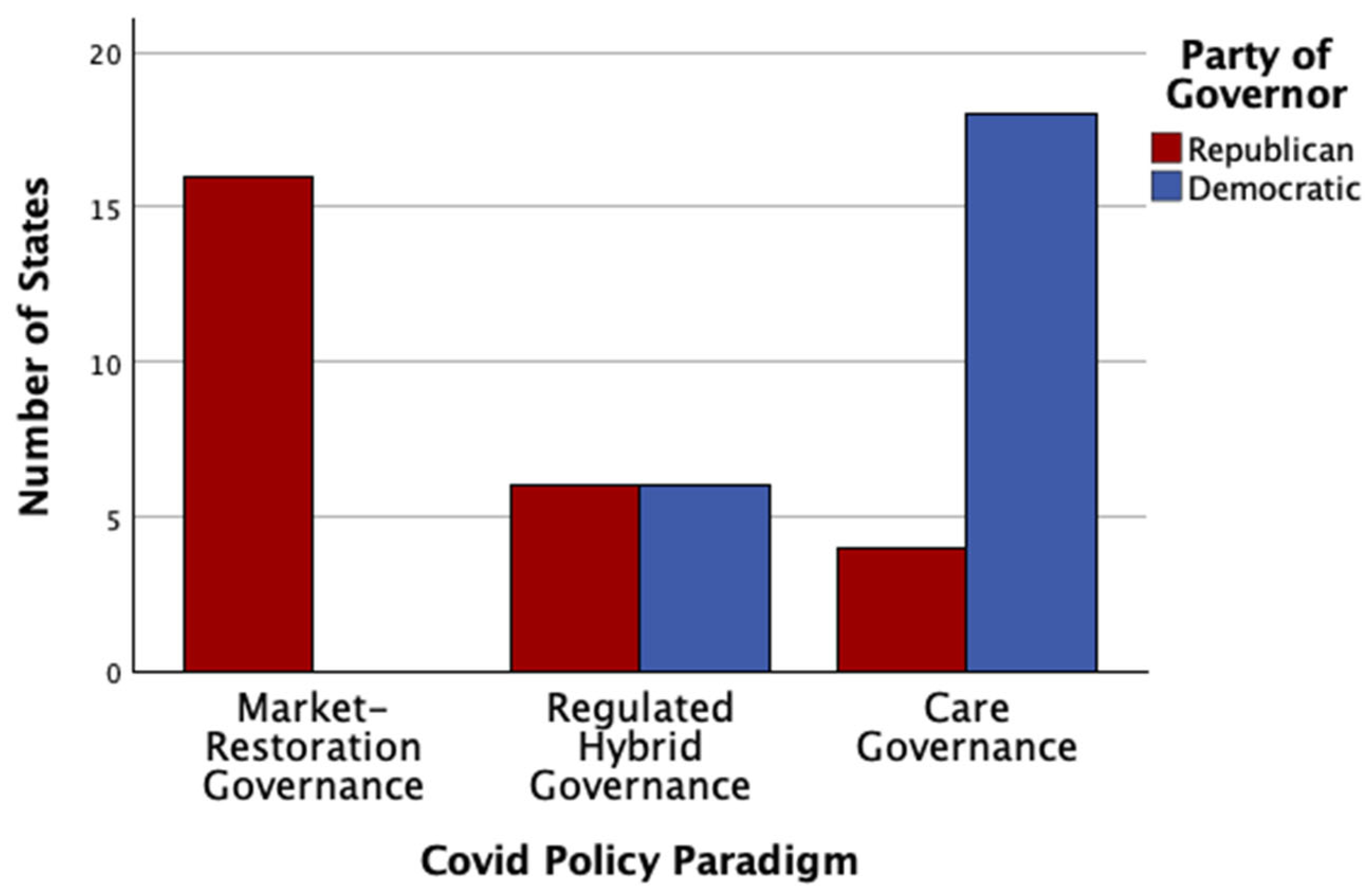
Importantly, states within each of the three COVID governance groups had distinct and internally coherent, partisan, political, and regional profiles. The governance paradigm adopted by a state and the party of its governor bear a clear statistical significance.
5 One hundred percent of all market-restoration states had Republican governors, and 82% of care governance states had Democratic governors (see
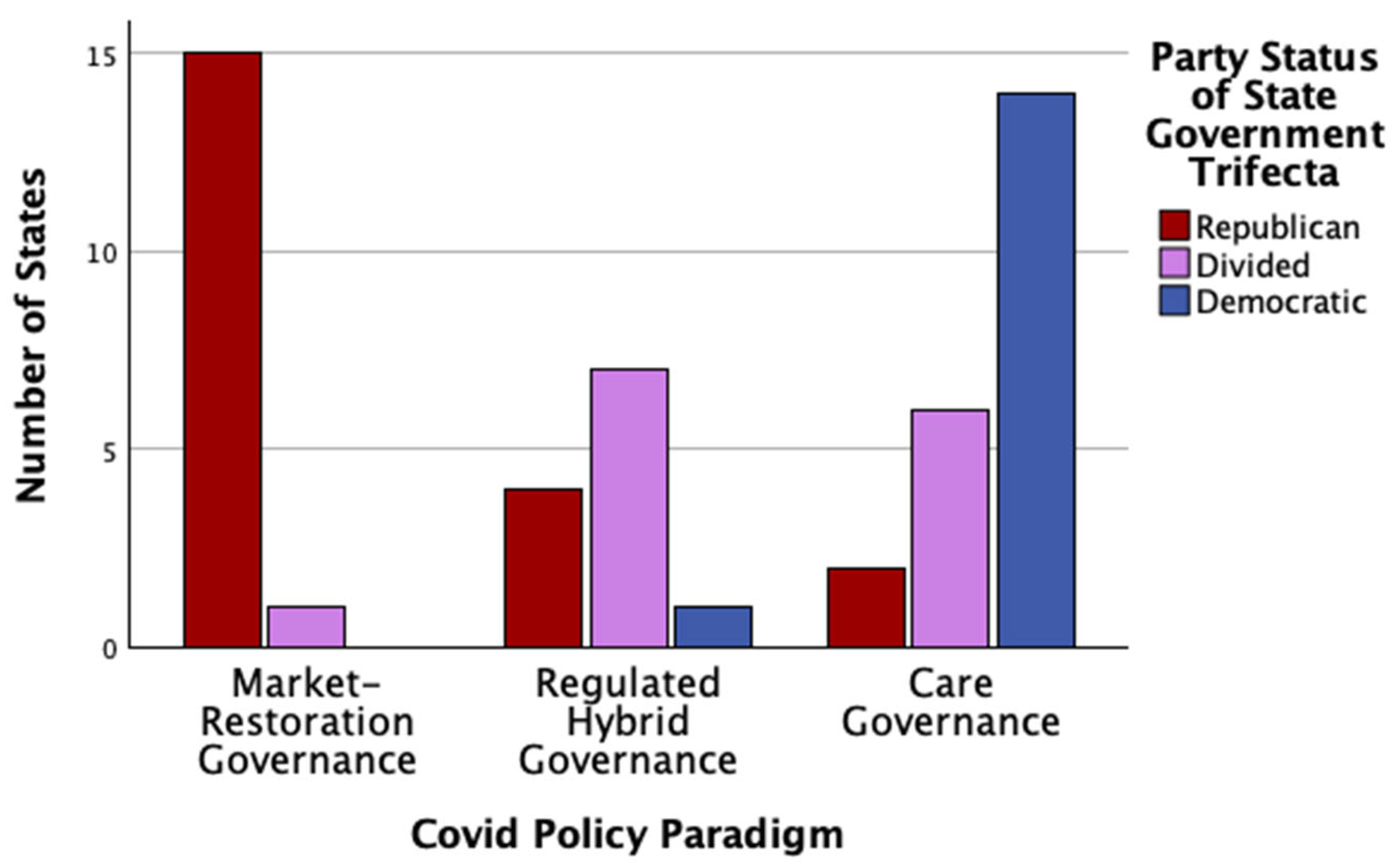
Figure 2). Unified or divided party control of the state government is even more strongly associated with COVID paradigm type (
Figure 3).
6 Fifteen of the sixteen market-restoration states had unified Republican control (state legislative chambers and governor) and only two unified Republican States (West Virginia and Arizona) adopted care governance. States with unified Democratic government almost exclusively adopted a care governance response to the COVID crisis. Divided government, where the party of the governor differed from the party in control of one or more of the state legislative chambers, more frequently produced bargaining and hybrid governance rather than a clear ideological response.
It is also noteworthy that states with Republican governors and unified Republican control were more varied in their COVID policy orientations than those with Democratic governors and/or with unified Democratic control. Whereas states with Democratic governors and Democratic unified government exclusively adopted care and/or regulated hybrid governance (and no Democratic state adopted the market-restoration approach), those with Republican governors and Republican unified government were spread across all three governance approaches. Column proportions tests identify a disproportionately high association of states with Democratic governors with care governance (in relation to those with Republican governors) but a similar statistically disproportionality of states with Republican governors across any of three paradigms is not found. Similarly, states with Democratic governors were statistically correlated with a high equity focus, but a similar significant correlation was not found for Republican governor states at any level of equity policy orientations, suggesting greater variation among Republican governors than among Democratic governors. Column proportions tests however do suggest a disproportionate, statistically significant, correlation between Republican unified government states and market-restoration governance in contrast to Democratic unified states.
Finally, I find a statistically significant association between the type of COVID governance and region.
7 The strongest regional pattern is in the South: nine of the sixteen market-restoration states were located in the South. Only four southern states adopted care governance paradigms, with the Northeast showing the opposite (care-centered) pattern, the West more mixed, and the Midwest largely adopting regulated hybrid governance (
Table 3).
4. Subnational COVID-19 Paradigms: Work, Care, and the Privatized Logic of Social Reproduction
Close textual analysis reveals that state-level policy variation, when arranged on a paradigm continuum from care to market-restoration governance with regulated hybrid governance in the middle, demonstrates differing degrees of alignment with the inherited neoliberalist market logic of privatized social reproductive care. The ideational persistence of the market-centered policy paradigm is evident in states’ conception of individuals as economic actors, in the policy supremacy of productive over reproductive labor, in the public value accorded to ‘personal responsibility’ and economic development over the state’s responsibility for care, and in ideas of the state’s responsibility to compel and police work.
Within the logic of a market-centric society, human beings are viewed as autonomous rational economic actors, foremost defined by their productive roles, such as workers, business owners, and consumers, and second, albeit importantly, by their reproductive roles as fathers, mothers, and neighbors, with productive and reproductive labor separated, into public and private spheres. Neoliberalism emphasized private property rights, personal responsibility, individual choice, and private markets (
Harvey 2007, p. 2). State coercion, however, was viewed as warranted and necessary to regulate and penalize those who detract from private markets and/or create market “inefficiencies.” (
Soss et al. 2008;
W. Brown 2005, p. 40). Like other aspects of human life, family life within the neoliberalist paradigm is the sum of individual choices, for which each person is personally (and morally) responsible. Social reproductive care is a foremost personal activity—an act of parental moral responsibility—insofar as individuals are assumed to autonomously make choices about social reproductive care for themselves and for those around them. “Encouraging responsibility”, in this framework, as George W. Bush asserted in his inaugural address, “…is a call to conscience. And though it requires sacrifice, it brings deeper fulfillment.” (
Bush 2001). “Dignity,” “fulfillment,” “hard work,” “hope” “resilience” and “sacrifice” were crucial in the neoliberalist lexicon of private social reproductive values, to be encouraged by state policy. Through the elevation of productive paid work (breadwinning) as a necessary personal and parental obligation, neoliberalist policies structurally incentivized and compelled ‘work’ and thus ‘personal responsibility’ from workers and undermined the need for collective programmatic supports, impacting the structural and material contexts in which vulnerable workers live and make choices.
Market-restoration states similarly organized and framed their COVID policy responses around personal responsibility. They did this in two ways: (i) as a means to limit government’s responsibility for containment and mitigation, exhorting people instead to voluntary compliance and neighborly assistance; and also, (ii) as a ground to strictly enforce ‘work’ as an obligation, compelling people back to work upon the reopening of the economy, regardless of ongoing public health or personal and familial, conditions. For instance, Governor Abbott (R-TX) in introducing the Texas Reopen Plan, “Texans Helping Texans,” emphasized individual responsibility as foremost to address needs of care, stating:
…it will take more than experts to win this battle for our families, for our community, and for this great state. We are each called upon to be Texans: to act responsibly as we re-engage in the economy, to continue following all health precautions and sanitizing guidelines, and to care for our vulnerable neighbors.
Similarly, Tennessee’s reopening plan,
Reopening Tennessee Responsibly, emphasized Tennessean’s “volunteer spirit”, declaring, “much of our state’s current success in this fight is because Tennesseans naturally choose to put each other first and voluntarily adopt safe, new habits.” (
Lee 2020, p. 2).
Market-restoration states nevertheless pursued active state coercion to compel workers back to work and to police distinct ‘outsider’ populations who were construed as threatening. States such as Texas and Florida deployed sharply punitive measures to regulate visitors traveling in from states such as the New York Tri-State Area and New Orleans area, requiring them to “mandatory” self-quarantine (wherein the individual “was responsible for all associated costs, including transportation, lodging, food and medical care,”), enforceable with fines and/or severe imprisonment (
Abbott 2020a;
DeSantis 2020). In Texas, Department of Public Safety (DPS) Special Agents were authorized “to conduct unannounced visits to designated quarantine locations to verify compliance by confirming the physical presence of (such) covered persons” and “any failure to comply with th[e] order to self-quarantine” was denoted as a “criminal offense punishable by a fine not to exceed
$1000, confinement in jail for a term not to exceed 180 days, or both.” (
Abbott 2020a, pp. 2–3).
Also, during reopening, market-restoration states required/asked employers to notify state offices if a worker did not report to work once a business was reopened, and all such workers, if they could not medically document concerns regarding their own vulnerability or need for continued quarantine due to personal or familial circumstances, could be investigated by state enforcement officers and have their unemployment benefits terminated (See, for example, (
Texas Workforce Commission 2020)). In Iowa, Governor Kim Reynolds (R-IA) issued a directive on 24 April 2020, that stated that any Iowan who refused to work, including those who did so out of fear of contracting the virus, would be considered a “voluntary quit” from their job and become ineligible for unemployment benefits. In a guidance memo, the Iowa Workforce Development (IWD) agency administrators urged, “…to get the economy going, in order for us to have a good recovery, we need employees to return to work when there’s an opportunity for them to do that.” (
Akin 2020). Similar edicts for strict labor market enforcement were issued in Florida, Georgia, South Carolina and Texas.
Reflecting the ongoing social conservativism imbricated within the market-centered logic of privatized care, many market-restoration states adopted strict abortion bans and restrictions on reproductive care as part of their COVID policy governance. Long before the 2022 overturning of the right to abortion by the U.S. Supreme Court, states such as Alabama, Arkansas, Florida, Iowa, Mississippi, Oklahoma, Tennessee and Texas, imposed direct abortion bans and curtailed reproductive health services during COVID by defining abortion as ‘elective’ or ‘non-essential’ medical care, curtailed to conserve medical capacity. Strict reproductive healthcare restrictions are especially noteworthy given the states’ reluctance to impose public health restrictions more generally. In contrast, these states classified church services as ‘essential activities’ to be exempt from any closure and SAHOs. Some regulated hybrid governance states, such as Ohio and Louisiana, similarly treated reproductive health care as ‘elective’, to be restricted/banned, and deemed religious services as “essential,” part of “critical infrastructure,” exempt from workforce and social gathering closures.
To be sure, care governance states did not establish a public system in support of social reproductive care that could displace the predominant market logic of privatized care. However, in their COVID-19 policy responses, care governance states substantially
qualified the inherited logic by acknowledging and, in some cases, integrating various ideas found in feminist care ethics (
Tronto 2013;
Engster 2007), such as the express policy recognition of the public value of social reproduction, the interdependence of productive and reproductive labor as coequal policy targets, the imbrication of public and private spheres, and the centrality of life and lived experiences over economics and market abstraction. For instance, in his proclamation imposing a statewide SAHO, Governor Jay Inslee of Washington, framed COVID as a threat to life, in addition to its more common framing as a risk to ‘health and safety’, stating “…the worldwide COVID-19 pandemic…continues to threaten the
life and health of our people as well as the economy of Washington State, and remains a public disaster affecting life, health, property and the public peace.” (
Inslee 2020, p. 2 (emphasis added)). In listing ‘essential activities’ exempt from SAHO limitations, these states highlighted various social reproductive activities in the home in much detail, such as “obtaining necessary supplies…for family or household members and pets…necessary to maintain safety, sanitation and essential maintenance of the home or residence” and “caring for a family member, friend, or pet in another household or residence.” (
Inslee 2020, §1(a)(1), (3), p. 3).
Themes of human interdependence and relationality are found in the reopening plans of several care governance states, where they emphasize collective safety, human protection, and social reproduction as
central objects of state policy attention. In Illinois’ Reopening Plan, “
Restoring Illinois: Protecting our Communities” Governor J.B. Pritzker (IL-D), for example, highlighted that, “at all times but especially during a public health crisis, protecting the health and safety of Illinoisans is among the most important functions of State government.” (
Pritzer 2020, p. 1). And Hawaii’s,
Beyond Recovery: Reopening Hawaii strategy was similarly guided by human life concerns—first on the prevention of suffering and also on individual empowerment, to “save lives and prevent suffering; empower individuals with Safe Practices; and reopen and reshape Hawaii “to be stronger and more resilient as a result of learning from and overcoming this challenge.” (
Office of the Governor, State of Hawaii 2020, p. 3).
In their reopening plans, care governance states were more apt to view workers by their social reproductive contexts and to support their reproductive health care despite restrictions to preserve medical and hospital capacity. Much like the labor-affirming New Deal and Great Society programs, these states targeted businesses and workplaces, rather than workers, for failing to comply with mitigation measures and/or uphold workers’ right to refuse unsafe employment, downplaying, however, the relational significance of employment itself. Business-regulatory measures imposed by states included punitive fines and closures on noncompliant businesses, and the establishment of online portals for workers and consumers to file complaints against establishments. Consumers in Maine, for instance, in order to “promote (business) …compliance and protect public health…[could] make a report about businesses and organizations operating in violation of checklist requirements and endangering public health.” (
Mills 2020). In Minnesota, Governor Tim Walz (D) issued an Emergency
Executive Order,
Protecting Workers from Unsafe Working Conditions and Retaliation during the COVID-19 Peacetime Emergency, which cast workers as people embedded in social relations, whose social reproductive lives were intertwined with their productive labor. This framing embedded employment within a relational society, where workers were integrated members of workplaces and households, and where infections could be transmitted across both contexts:
“…Workers whose jobs place them in regular proximity to co- workers or require regular engagement with the public are also at increased risk of COVID-19 exposure. Workers with an increased risk of exposure also have an increased risk of transmitting the virus to others, including patients, residents, family-members, co-workers, and the public. … Workers should not have to sacrifice their health and safety for economic security. It is important for workers to raise safety and health concerns freely and without fear of retaliation.”
Under these circumstances, Walz declared: “workers have the right to refuse to work under conditions that they, in good faith, reasonably believe present an imminent danger of death or serious physical harm. This includes a reasonable belief that they have been assigned to work in an unsafe or unhealthful manner with an infectious agent such as COVID-19.” (
Walz 2020, pp. 1–2). In care governance states such as Oregon, Washington, Viginia, Michigan and Pennsylvania, worker safety and protection were elevated as central policy goals, and workers who quit due to unsafe work conditions could not lose their unemployment benefits. Also, in clear contrast to market-restoration states, states like California, Connecticut, Massachusetts, New York, New Jersey, and Washington applied restrictive measures to all large gatherings with no exemptions for church and religious gatherings, while regarding reproductive healthcare, childcare, and caregiving, and health services as ‘essential services’ to be state-supported and kept open as part of their critical workforce infrastructure (For example, see: (
Inslee 2020, §§ 1–2;
Cuomo 2020;
Empire State Development 2020)).
COVID thus produced meaningful policy variation in whether states publicly recognized and protected social reproductive labor as essential to collective wellbeing; however that variation occurred within the broader institutional environment and inherited governing logic of privatized care, in which the material provision of care remained predominantly household- and market-based. Some states chose to develop newer responses and ideational scaffolding around the public value of care, whereas others were mixed, and some strictly adhered to elevating productive work over reproductive care in their policy consideration.
5. Conclusions
Understanding state responses to COVID-19 tells us something deeper about the nature of national social policy paradigms as a dynamic form of governance across states and sheds light on how these paradigms may persist or change to accommodate greater or lesser attention to the public value of social reproductive care. Scholars of American political development and public policy highlight the relative stability and durability of established regimes, whereby policymakers draw on dominant, prevailing norms and patterns to address even unprecedented crises, attempting to reproduce order within the prevailing paradigm.
8 Analysis of the COVID governance adopted across the fifty US states confirms and qualifies this picture.
The analysis presented here suggests that the early COVID policy moment produced a temporary unsettling of the dominant privatized (market) approach to social reproductive care. On the one hand, several aspects of the prevailing policy paradigm, in particular its market-first orientation and privatization of social reproductive care, its elevation of productive work as separate from and foremost above reproductive labor, and its inattention to inequitable structures and stratified access to household and kin care, were upheld by the Trump administration and most strongly by states with Republican governors and unified Republican control over state government that adopted a market-restoration COVID policy paradigm. However, the article also finds that a sizable number of states, predominantly led by Democratic governors with Democratic control of state legislatures but also some with Republican governors, adopted a substantially distinct alternative—one much more centered on care governance. States that adopted a care governance approach to COVID highlighted the interdependence of productive and social reproductive labor, viewing care as essential to sustaining life and resuming economic growth, while also understanding care as embedded in structural systems of coercive inequity and unequal vulnerability, necessitating active state programmatic support and policy attention. The article’s genealogical tracing of social reproductive care in American public policy suggests that this care-policy vision echoes earlier policy ideations, such as those found in the Great Society, but was also distinctive in that it was less focused on identity-based conceptions of social inclusion and more on life-sustaining care labor as imbricated with collective social, economic, and material health.
COVID care governance did not establish public responsibility for care, nor did it institutionalize a public system supporting families’ social reproductive labors that could displace the predominant embedment of privatized market care. On his election in 2020, following the defeat of Donald Trump, Joe Biden and the Democratic Congress committed $39 billion in supplemental childcare funding in the American Rescue Plan in 2021, expanding the Child Tax Credit to make the credit fully refundable, raising its value, and delivering advance monthly payments to families in support of their reproductive care labor. Yet these measures remained temporary. The expanded Child Tax Credit expired after 2021, and Congress did not enact the proposed extension, underscoring the difficulty of converting emergency recognition of social reproductive needs into durable public responsibility for care.
Whereas the “COVID moment” did not disembed markets-first, privatized care as the prevailing policy paradigm, it demonstrated that the hold of this paradigm was neither complete nor uniform. Impelled by conditions of crisis, several states across the country produced care governance policy models and, by so doing, made visible a policy repertoire through which, in a different national political environment, social reproductive labor may be recognized for its public value, as a legitimate object of policy concern and state responsibility.