Article

Patrilineal Genetic Ancestry of Moroccan Jews

1
Independent Researcher, 92100 Boulogne Billancourt, France
2
Avotaynu Research Partnership, Englewood, NJ 07631, USA
3
International Institute for Jewish Genealogy, Hod Hasharon 40083, Israel
4
Independent Researcher, 2623 NC Delft, The Netherlands
5
Gene by Gene, Ltd., Houston, TX 77008, USA
*
Authors to whom correspondence should be addressed.
Genealogy 2026, 10(2), 66; https://doi.org/10.3390/genealogy10020066
Submission received: 4 May 2026 / Revised: 26 May 2026 / Accepted: 28 May 2026 / Published: 31 May 2026

Abstract

This Y-chromosome study of Moroccan Jews, the largest conducted to date, analyzes the patrilineal origins of 288 men of genealogically verified Moroccan Jewish descent through the Avotaynu DNA Project, identifying 111 distinct founder lineages. The long-standing hypothesis of large-scale Berber Judaization has not previously been tested at full Y-chromosome resolution; our findings provide the first systematic evidence against it. Approximately 71% of founder lineages and 80% of individuals trace to haplogroups common in the Middle East. Only 4.5% of founder lineages are of autochthonous North African origin. Iberian-origin lineages account for 11% of Moroccan Jewish founder lineages reflecting sustained demographic and cultural exchange between Morocco and the Iberian Peninsula over many centuries. Split dates between Moroccan and Ashkenazi or Sephardic subclades cluster between the 5th and 8th centuries CE, suggesting that the ancestral lineages of contemporary Moroccan Jews were already present across the Mediterranean basin during late Antiquity and the early medieval period. Analysis of 190 distinct Moroccan Jewish surname roots identifies 29 polygenic and 30 monogenic surnames, and demonstrates that the linguistic origin of a surname, including surnames of Maghrebi morphology, does not necessarily reflect its bearer’s Y-chromosome ancestry. Unlike Ashkenazi Jews, Moroccan Jews show no evidence of a founder effect or genetic bottleneck, and display a remarkable patrilineal diversity. Among the individual lineages documented here are the first paleogenetic link between a contemporary Moroccan Jewish patriline and a victim of the 1348 Tàrrega pogrom, an Iberian/Ashkenazi split traceable to tenth-century al-Andalus, and an unexpected connection between a predominantly Moroccan Jewish lineage and the Saint Thomas Syrian Christian community of Kerala. Moroccan Jewish patrilineal heritage is overwhelmingly Middle Eastern in origin and has been preserved with remarkable continuity across two millennia of diaspora, persecution, and migration.

1. Introduction

1.1. Historical Background of Moroccan Jewry

Morocco, the westernmost territory of North Africa, marks the western end of the southern Mediterranean migration corridor. Archaeological and epigraphic evidence shows a Jewish presence in this region from Antiquity onward. This includes inscriptions from the synagogue at Volubilis (Corcos 1976; Zafrani 1972). The historical formation of Moroccan Jewry involved several distinct waves. The earliest Jewish settlers likely followed Roman trade routes westward across the Mediterranean basin (DellaPergola 2024). Later migrations occurred due to the increasingly hostile policies of the Visigothic and Byzantine empires, which displaced Jewish communities from the eastern Mediterranean and the Iberian Peninsula into the Maghreb (Hirschberg 1974; Chouraqui 1968; Stillman 1991). The Arab conquest in the seventh and eighth centuries CE further changed the region, opening westward migration routes from the Middle East and integrated North African Jewish communities into the wider Islamic Mediterranean world.
Two distinct subgroups have historically been recognized within Moroccan Jewry. The Toshavim (“residents”) are the Jewish communities established in Morocco prior to the Iberian expulsions. The Megorashim (“expelled ones”) are the Jews who arrived in Morocco between 1391 and 1497 following successive waves of forced conversion and expulsion from Castile, Aragon, and Portugal (Gerber 1992; Beinart 2002; J. Pérez 2007; Ray 2013; Kamen 1988). The cultural and liturgical distinction between these two groups persisted for centuries before progressive integration through intermarriage and the broader Sephardization of Moroccan Judaism (Schroeter and Chetrit 2006; Zafrani 1998).

1.2. Prior Genetic Studies

Genome-wide autosomal analyses have shown that Moroccan and Algerian Jews form a coherent genetic cluster distinct from both Ashkenazi Jews and from non-Jewish North African populations, consistent with a history of endogamy and limited intermarriage with surrounding populations (Campbell et al. 2012; Atzmon et al. 2010; Behar et al. 2004, 2010; Ostrer and Skorecki 2013). Matrilineally, Behar et al. (2008) demonstrated that North African Jews lack the typically North African mitochondrial haplogroups M1 and U6, indicating limited introgression of Berber populations.
Previous Y-chromosome studies based on short tandem repeats (STRs) placed Moroccan Jews (hereafter MJ) within the broader Sephardic and Middle Eastern patrilineal landscape (Lucotte et al. 1993; Hammer et al. 2000; Nebel et al. 2001). However, these studies had two major limitations. First, sample sizes for MJ were small. For example, the largest such study by Hammer et al. (2000) included only 25 MJ within a larger cohort of 45 North African Jews; Nebel et al. (2001) did not include a dedicated North African Jewish cohort. Second, STR-based typing offers limited phylogenetic resolution and cannot identify Jewish founder lineages defined by single-nucleotide polymorphisms (SNPs). The availability of targeted next-generation sequencing of the nonrecombinant portions of the Y chromosome (NRY) enables the cost-efficient identification of thousands of SNPs per individual and supports the construction of highly resolved phylogenetic trees, but this technology has not previously been widely applied to Moroccan Jewry.

1.3. The Berber-Judaization Hypothesis

A long-standing hypothesis, linked mainly to Slouschz (1908, 1927), suggests that many MJ descend from indigenous Berber populations who converted to Judaism, especially in late antiquity and the early medieval period. Hirschberg (1963) questioned this view on historical grounds. Beider (2017b) challenged it based on onomastics, showing that Berber origin is clear for only a few Jewish names from Morocco. Behar et al. (2008) provided maternal-line evidence that also weakened the hypothesis. Yet no systematic Y-chromosome study has addressed this question at the resolution achievable with NGS-based typing.

1.4. Aims of the Present Study

A component of the Avotaynu DNA Project: The Genetic Census of the Jewish People, this study has several aims. First, we characterize the diversity and distribution of Y-chromosome founder lineages among MJ and reconstruct their likely ancestral geographic origins. Second, we compare the patrilineal genetic profile of MJ with that of other Jewish communities originating in the Mediterranean Basin and its tributaries, especially Ashkenazim and other Sephardim (e.g., Jews who lived in medieval Iberia and their descendants). Third, we reconstruct the migration history of Jewish populations to Morocco by examining subclade divergence times. Fourth, we assess whether specific founder lineages can be linked to either Toshavim or Megorashim ancestry. Fifth, we examine the relationship between patrilineal genetic ancestry and the transmission of family surnames.

2. Results and Discussion

2.1. Cohort

A total of 288 men of genealogically verified patrilineal (father-to-son) MJ descent were included in this study. Of these, 190 were enrolled and tested directly through the Avotaynu DNA Project, while 98 tested independently through FamilyTreeDNA (FTDNA, a commercial genetic testing service) and joined the Avotaynu Project of their own accord. Targeted next-generation sequencing (Big Y-700, a comprehensive Y-chromosome sequencing method) was performed on 113 participants (39%); the remaining 175 participants were typed at 37 STR (short tandem repeat) markers (Table 1). To our knowledge, this is the largest Y-chromosome investigation of Moroccan Jewry conducted to date and the first to apply high-resolution NGS-based typing to a substantial proportion of the population.

2.2. Founder Lineage Diversity in Moroccan Jews

In this study, a (Jewish) founder lineage is defined as a Y-chromosome lineage in which the most recent common ancestor is inferred to have been Jewish, based on the predominance of Jewish descendants across geographically and culturally distinct communities, and for which no Jewish Y-DNA connection exists above that node.
As of 31 December 2025, the Avotaynu DNA Project database had identified 679 distinct SNP-based Y-chromosome Jewish founder lineages from among 12,637 project participants (which includes both Jews and non-Jews), including 3.078 BigY samples. Among the 288 MJ participants in the present study, 111 distinct Y-chromosome lineages were identified (Appendix A, Table A1; all Figures and Tables labeled “A” are located in the Appendix A at the end of the article). The distribution of these 111 lineages across other Jewish populations is as follows (some lineages may be listed in more than one category):
  • 25 lineages (representing (84 of 288 MJ participants, or 29%) are shared with Ashkenazim. This finding provides the first insight into the degree of overlap between MJ and other Jewish populations, serving as a starting point for comparison.
  • 58 lineages (181 participants (63%) are shared with other Sephardic communities of Iberian descent or contemporary Iberians. This result highlights the substantial genetic link between MJ and communities of Iberian descent.
  • 19 lineages (78 participants, 27%) are shared with both Ashkenazim and Sephardim/Iberians, further illustrating the interconnectedness among major Jewish diaspora populations.
  • 49 lineages (99 participants, 34%) are shared with neither Ashkenazim nor Sephardim/Iberians; these are either exclusive to MJ or shared solely with other Maghrebi Jewish communities (Algeria, Tunisia, Libya), emphasizing regional uniqueness.
  • Of the 13 lineages identified in the Chueta population by Ferragut et al. (2020), 4 are shared with MJ. A further NGS study of the Chueta from the Avotaynu study is forthcoming.
The proportion of lineages shared with other Jewish communities is broadly consistent with the conclusions of Hammer et al. (2000) and Nebel et al. (2001), who documented common Middle Eastern ancestry and endogamous patterns across geographically dispersed Jewish populations. The substantial overlap with Sephardic lineages is consistent with the historical proximity and cultural affinity between the Iberian and MJ populations, as well as with the arrival of the Megorashim and their integration into pre-existing Toshavim communities. The 49 lineages not shared with Ashkenazi or Sephardic populations may represent an older stratum of MJ ancestry, potentially traceable to the earliest waves of Jewish settlement in North Africa, although this interpretation warrants caution: the apparent exclusivity of these lineages may in part reflect the current size and composition of the database rather than true genetic isolation. The high ratio of lineages to participants (111 lineages among 288 men) suggests greater patrilineal diversity than that reported for Ashkenazi Jews, in whom a marked founder effect has been documented (Carmi et al. 2014; Waldman et al. 2022), consistent with the absence of a comparable bottleneck in Moroccan Jewish demographic history.

2.3. Ancestral Origins of Moroccan Jewish Lineages

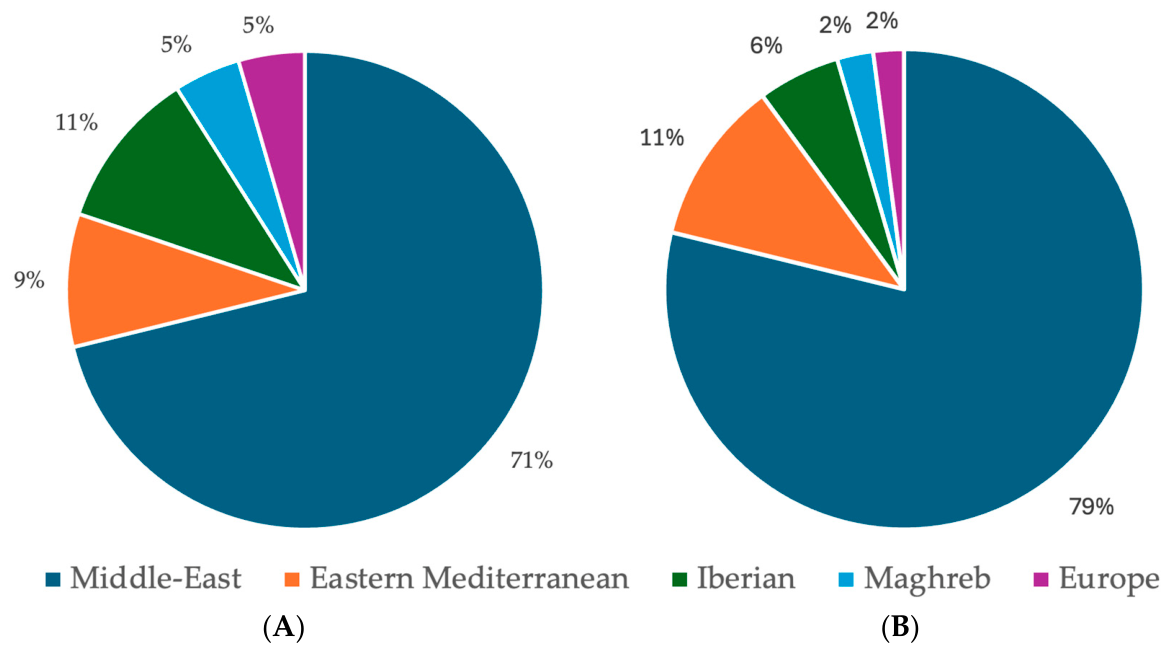
We have inferred probable ancestral origins of the MJ lineages under study by comparing them to non-Jewish parallel subclades in the FamilyTreeDNA database. (See our genetic characterization of each region in Section 3.5 below). Among the 111 Jewish founder lineages identified in our MJ cohort, 78 (71%) share characteristically Middle Eastern haplogroups (Semino et al. 2004; Mendez et al. 2011), 13 (11%) carry R1b-DF27 which is a strong indicator of Iberian origin (Solé-Morata et al. 2017b), 10 (9%) belong in an Eastern Mediterranean or undetermined haplogroup at this time, 5 (4.5%) originated elsewhere in Europe and 5 (4.5%) are E-M81, typically found in the Maghreb (Figure 1A). When ancestral regional origins are considered at the level of individuals rather than lineages (Figure 1B), the distribution shifts further toward Middle Eastern ancestry (~80%), reflecting the fact that older founder lineages have had more time to expand and tend to be larger.
For context, Bekada et al. (2013) compiled Y-chromosome haplogroup frequencies for a pooled sample of 760 Moroccan Muslim males (Arabs and Berbers) and found that approximately 74% of lineages were of North African origin (predominantly E-M81), 9% Middle Eastern, 13% sub-Saharan African, and 4% European, a distribution strikingly different from that observed in our MJ cohort, further highlighting the genetic distinctiveness of the Moroccan Jewish population from its non-Jewish neighbors.
Two features of the MJ ancestral-origin distribution merit emphasis. First, the proportion of Iberian-origin lineages (11%) demonstrates the longstanding migratory flows between Iberia and Morocco. Second, and most striking, only 4.5% of MJ lineages are autochthonous North African. This finding is the first systematic Y-chromosomal evidence against the long-standing hypothesis, most prominently associated with Slouschz (1908, 1927), of large-scale Berber Judaization. Combined with the maternal-line findings of Behar et al. (2008) and the onomastic conclusions of Beider (2017b), it provides convergent evidence that, when it occurred, the conversion of Berber populations to Judaism was limited rather than foundational. The European-origin lineages reflect events not fully understood, yet they occurred sufficiently far back in time to have been transmitted within Jewish families across many generations.

2.4. TMRCA Distribution and the Timing of Lineage Formation

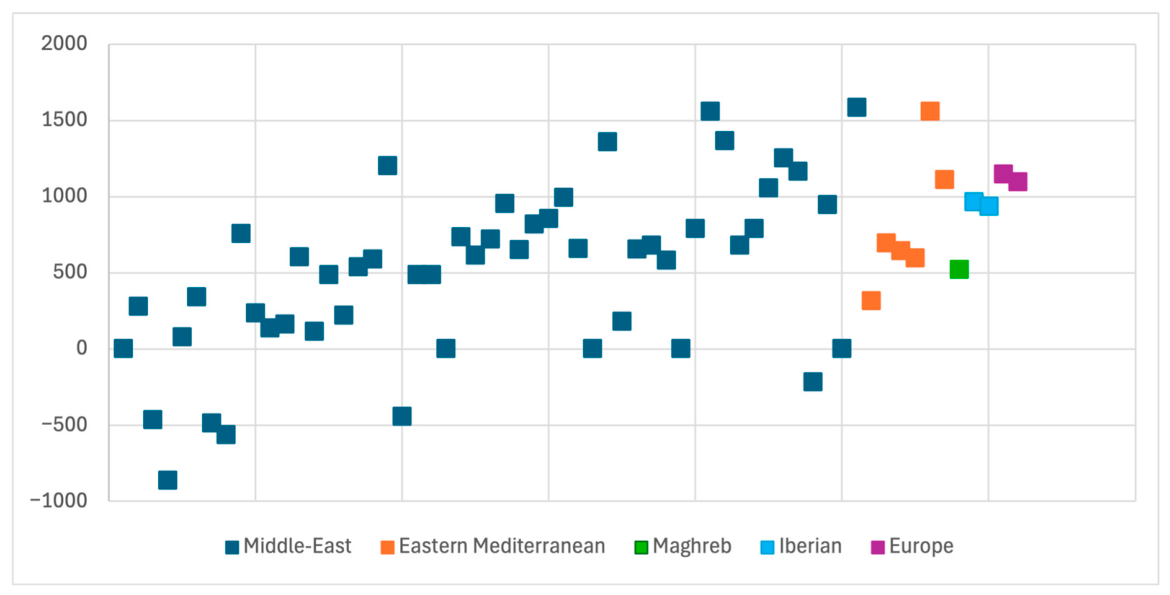
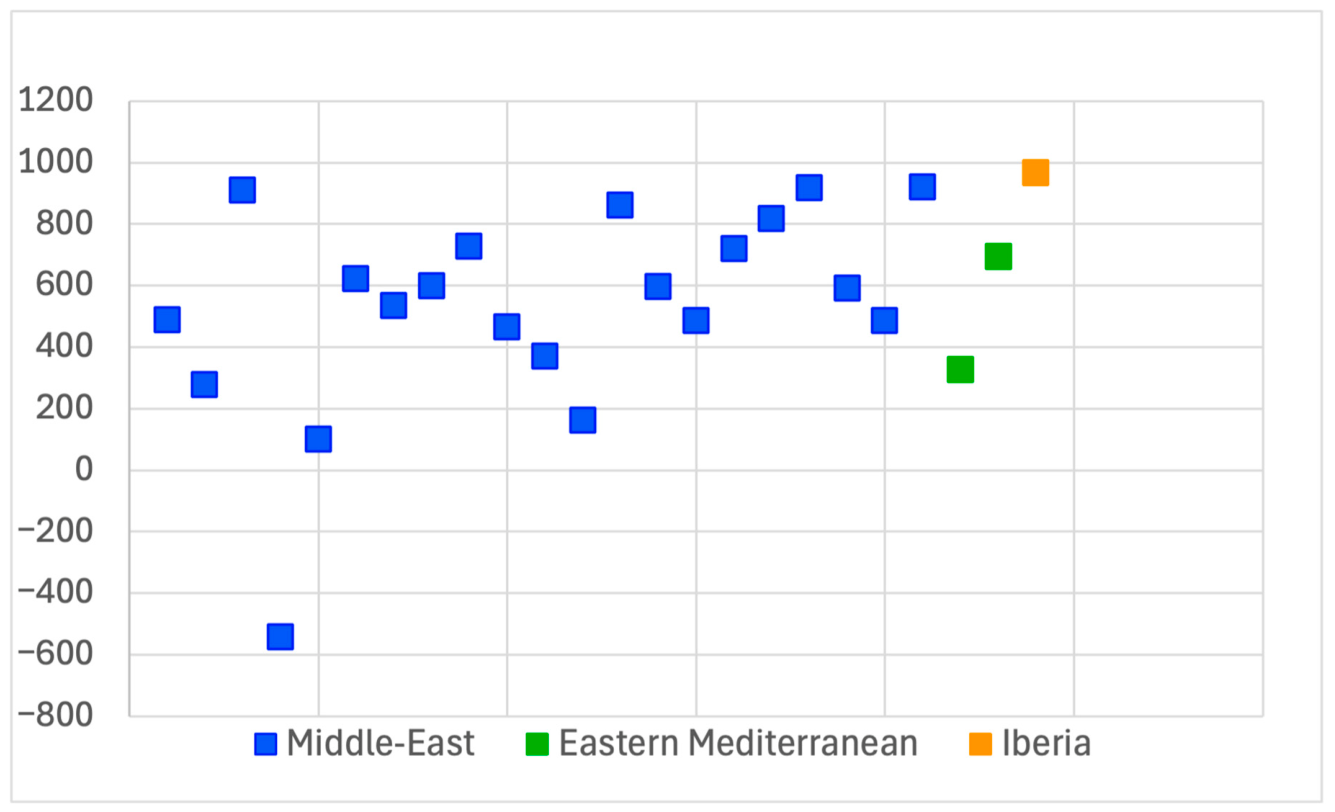
The time to the most recent common ancestor (TMRCA) of an MJ lineage was estimated when at least two descendants had undergone Big Y testing. TMRCA could be estimated for 62 of the 111 MJ founder lineages (Appendix A, Table A2; Figure 2). The median TMRCA across all estimable MJ founder lineages is 652 CE. The chronological ordering of lineages by ancestral origin is historically coherent:
  • Middle Eastern lineages (n = 51 estimable) range from approximately 800 BCE to 1500 CE, with TMRCAs clustering around the 5th–6th centuries CE; only Middle Eastern lineages yield pre-Common Era TMRCAs.
  • Eastern Mediterranean lineages (n = 6 estimable) yield TMRCAs of 314–900 CE, consistent with the flourishing of Jewish communities across the eastern Mediterranean from the 3rd century BCE onward (Tcherikover 1959).
  • The single estimable Maghrebi-origin lineage dates to approximately 500 CE.
  • Iberian-origin lineages (n = 2 estimable) yield TMRCAs of approximately 900–1000 CE, predating the 1492 expulsion by several centuries.
  • European-origin lineages (n = 2 estimable) yield TMRCAs after 1000 consistent with their integration into Jewish families in Europe during the medieval period.
Two observations follow. First, that non-Iberian, non-Middle Eastern lineages entered the Jewish gene pool well before the 1492 expulsion indicates that contemporary MJ patrilineal ancestry has been Jewish for centuries to millennia, not recently admixed from host populations. Second, the clustering of Middle Eastern TMRCAs around the 5th–6th centuries CE may reflect a period of demographic expansion within Jewish communities prior to the Arab conquest, a hypothesis worthy of further investigation as the dataset expands.

2.5. Priestly and Levite Lineages

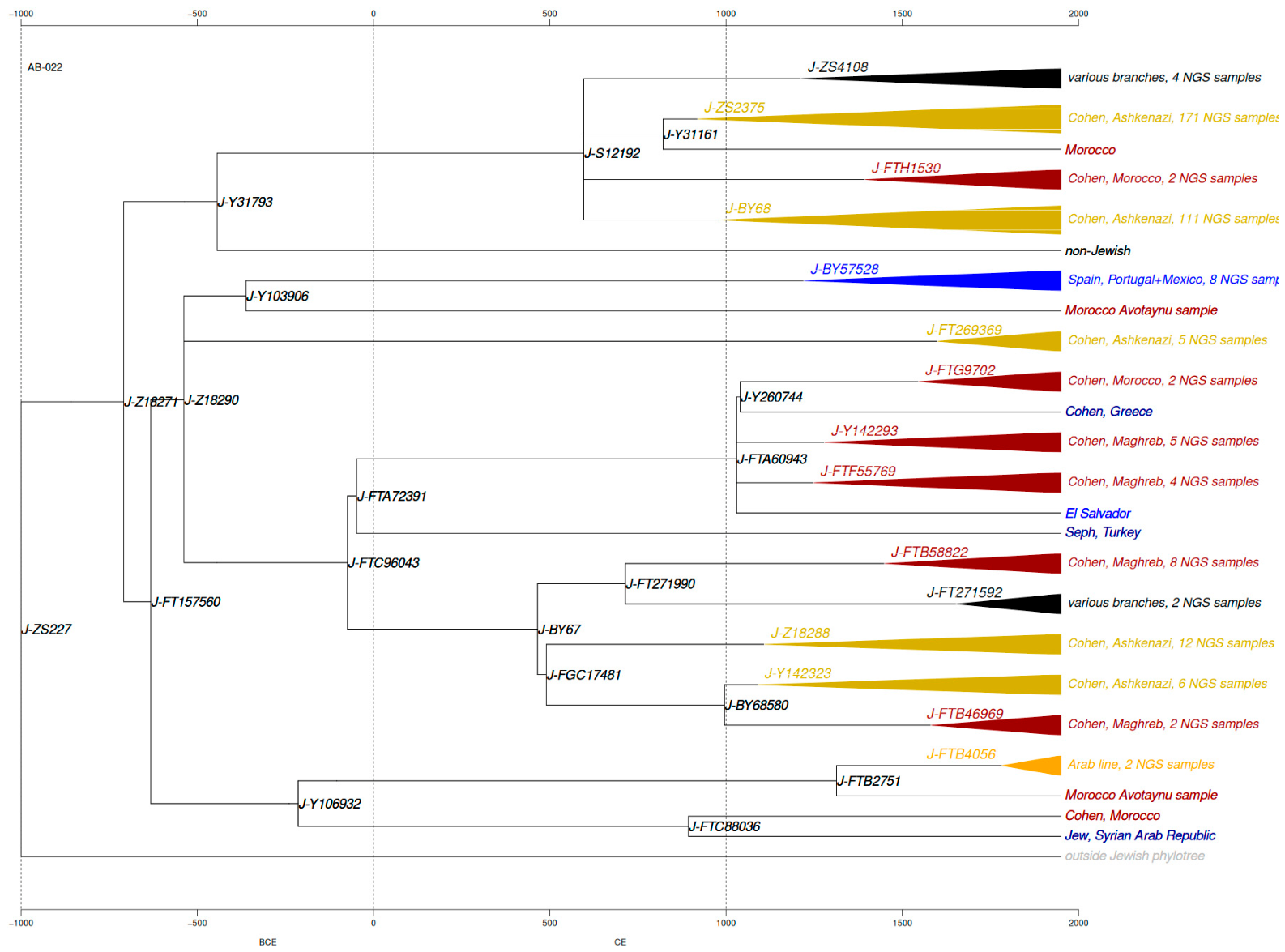
Two major Cohen lineages and one Levitic lineage are represented among MJ participants. The two Cohen lineages, AB-022 (J1-ZS222) and AB-047 (J2-FGC4992), correspond to the principal patrilineal lines documented in Cohen populations worldwide (Skorecki et al. 1997; Thomas et al. 1998; Hammer et al. 2009). AB-022 corresponds to the Cohen Modal Haplotype (CMH), first identified by Skorecki et al. (1997), and is broadly distributed across Jewish communities (Ashkenazim, Sephardim, Romaniote, Mizrahi, Yemenite, Karaite, and Mountain Jews), as well as among known Converso populations. The lineage originated around 860 BCE and, according to an upcoming Avotaynu study of 410 AB-022 samples, expanded into at least 44 subclades by the end of the Temple era. Eighteen MJ participants belong to AB-022, distributed across eight distinct subclades, indicating that at least eight different AB-022 Cohen ancestors emigrated to Morocco over the past two millennia (Figure 3).
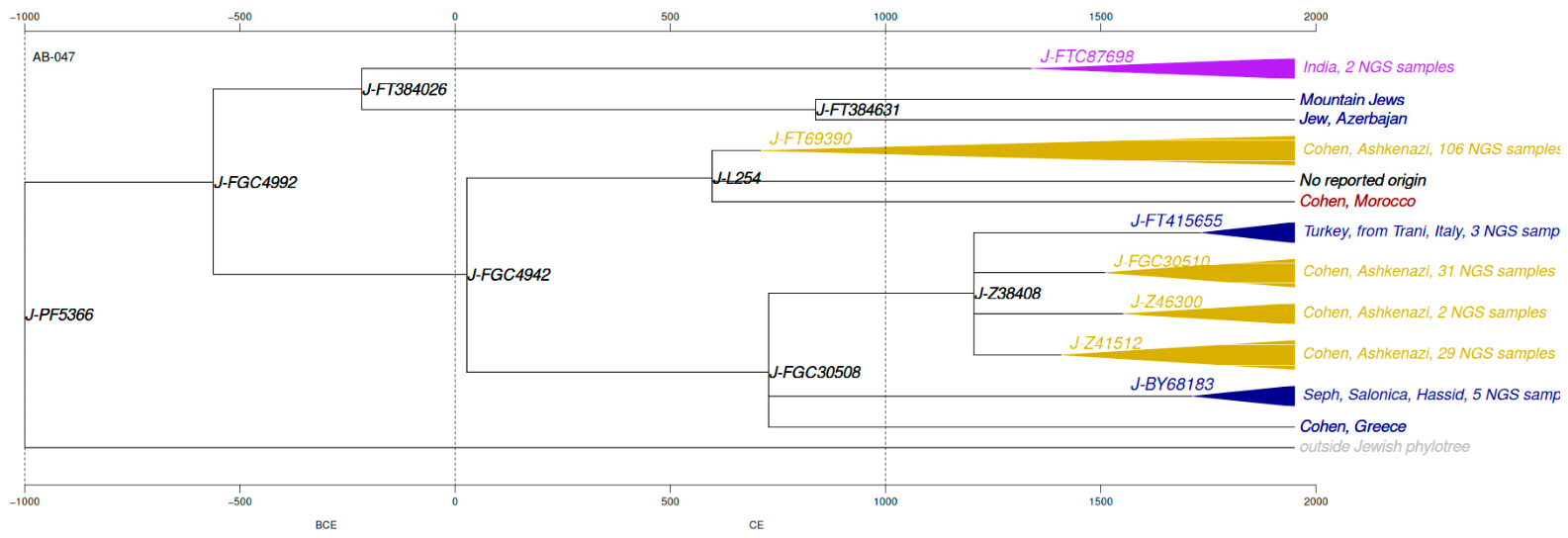
AB-022’s J2 counterpart, AB-047, was first described by Hammer et al. (2009) and, more recently, re-examined by the Avotaynu Project in an extensive NGS study of 447 AB-047 samples (Katz et al. 2025). Like AB-022, AB-047 was found by the Avotaynu study to span multiple Jewish communities, including MJ and originated in the Levant around 600 BCE. A single MJ participant belongs to AB-047, a MJ lineage that diverged from a Middle Eastern Cohen J2 line approximately 1200 years ago (Figure A1).
Of the 19 MJ participants belonging to a Cohen lineage, 12 bear the surname Cohen, 2 bear the surname Levy, 3 bear neither, and 2 are Moroccan Muslims who joined the Avotaynu Project with awareness of their Jewish patrilineal heritage. The presence of two Levy-surnamed individuals within AB-022 suggests historical disruptions in surname transmission or, in some cases, the deliberate concealment of priestly status. The two Muslim AB-022 participants likely reflect forced conversions to Islam, most notably under the Almohad dynasty (1147–1269 CE; Fenton 2019; Garcia-Arenal 1987). Five MJ participants bearing the surname Cohen belong to lineages (AB-212, AB-391, AB-758, AB-879) where a Cohen tradition is not prevalent, consistent with the finding of Hammer et al. (2009).
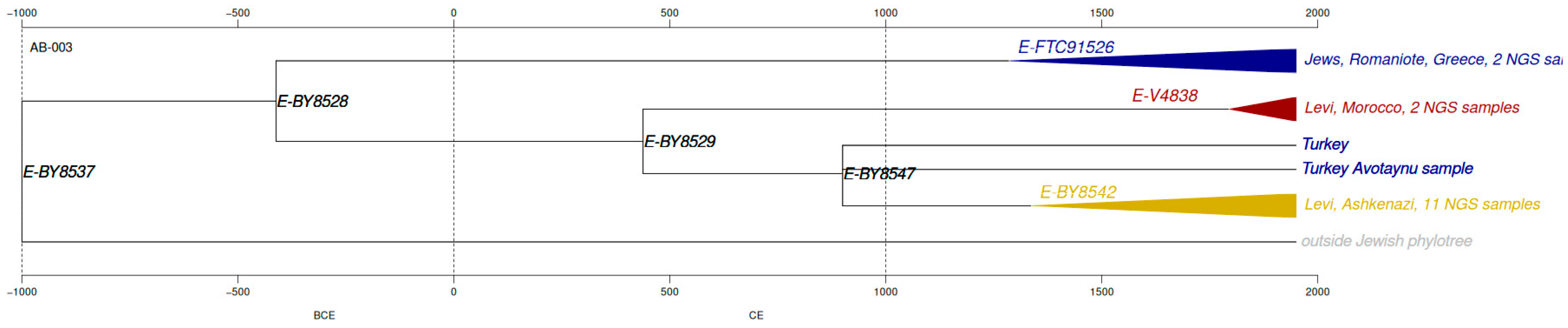
A single Levite lineage is represented among MJ participants: AB-003 (E-BY8528, Figure 4). The Avotaynu Project database contains 23 individuals belonging to AB-003, of whom 17 are Ashkenazi and 6 are of Sephardi descent (including one MJ, one Cape Verdean of MJ ancestry, two Greek, one Turkish, and one Peruvian). The TMRCA of the Jewish lineage is estimated at 419 BCE (95% CI: 1138 BCE–103 CE). Most descendants of the subclade E-BY8529 onward (TMRCA ~427 CE) bear the surname Levy or maintain a Levite tradition, suggesting continuous transmission of both the surname and the tradition since that time. The most extensively studied Levite lineage in the genetic literature is the Levite lineage R1a-Y2619 (AB-067 in the Avotaynu Project database), whose TMRCA is estimated at approximately 735 CE (95% CI: 512–926 CE) by Behar et al. (2017). Unlike AB-003, AB-067 has thus far been found only in the Ashkenazi population. AB-003 represents, to our knowledge, the first identified lineage to unite Ashkenazi and Sephardic Levy-surnamed individuals within a single phylogenetic clade, with a TMRCA predating the geographic separation of these communities and providing rare genetic evidence for an early consolidation of a shared Levite lineage across major Jewish diaspora groups.
Notably, 8 of the 10 Levy-surnamed MJ participants do not belong to AB-003: 2 carry the Cohen lineage AB-022, and 6 lineages belong to lineages with no observed Levite or Cohen affiliation in the broader database: AB-059, AB-250, AB-424, AB-722, AB-726. This pattern, also observed in the broader Jewish world (only AB-003, AB-067, and AB-413 currently evidence continuous Levite transmission), suggests that the Levite surname may often have been adopted alongside the Levite ritual function by individuals of non-Levite patrilineal origin, with both surname and function subsequently transmitted across generations.

2.6. Lineages of Particular Historical Significance

2.6.1. AB-101: A Tenth-Century Split Between Moroccan and Ashkenazi Jews

AB-101 belongs to haplogroup R1b-DF27, the predominant Y-chromosome clade of the Iberian Peninsula. Within the Avotaynu Project, AB-101 contains three STR-typed and two Big Y-typed participants. The lineage gave rise to two distinct subclades, one Moroccan and one Ashkenazi, whose divergence is estimated at approximately 966 CE (95% CI: 521–1299 CE; Figure A2). This was height of the Andalusian Golden Age under ʿAbd al-Raḥmān III, a period of remarkable Jewish cultural and commercial flourishing in al-Andalus (Gerber 1992). To our knowledge, AB-101 is the only Iberian-origin lineage identified in this study that unites an MJ and an Ashkenazi subclade within a single phylogenetic tree, with a divergence predating the 1492 expulsion by more than 5 centuries.

2.6.2. AB-140: A Link to the Worldwide Sephardi Diaspora and a Paleogenetic Link to the 1348 Tàrrega Pogrom

AB-140 belongs to haplogroup E1b-V12-CTS8411, with a TMRCA of approximately 1000 CE (95% CI: 487–1372 CE; Figure A3). Avotaynu DNA Project participants carry two different surnames from Morocco, alongside a much larger contingent of a dozen men recruited and tested by the Avotaynu DNA Project from known Jewish families in Curaçao, Suriname, Bosnia, Panama, Colombia, Tunisia, and Turkey. Haplogroup E-CTS9507 was recently identified in an individual (ROQ2) recovered from the Roquetes necropolis of Tàrrega (Catalonia, Spain), dated to the mid-fourteenth century and attributed to victims of the 1348 pogrom (Pallarés-Viña et al. 2026). This constitutes the first documented connection between a contemporary Moroccan Jewish patrilineal lineage and an ancient Iberian Jewish individual identified through paleogenetic analysis, providing independent genetic evidence for the lineage’s deep Iberian roots prior to the 1492 expulsion. This discovery confirms our findings that MJ and Iberian populations had been interconnected for many centuries.

2.6.3. AB-424: A Connection to the Saint Thomas Christians of Kerala

AB-424 (Q-YP1237) is one of the largest Moroccan Jewish lineages, with a TMRCA of approximately 820 CE (95% CI: 487–1372 CE; Figure A4) and seventeen distinct surnames represented among MJ participants. A particularly striking match is with an individual belonging to the Saint Thomas Syrian Christian community of Kerala, southwestern India, with a common ancestor estimated at approximately 680 CE (95% CI: 54–1140 CE). The Saint Thomas Christians, who number approximately 4.5 million today, trace their tradition to the first century CE and experienced significant growth through subsequent waves of migration from the Middle East, including a major migration in 345 CE and a second substantial migration in 823 CE (Cheriyan 1973; Britannica 1998). Given the predominantly North African distribution of AB-424 and its probable Middle Eastern origin, the most plausible reconstruction is that the Indian subclade and the Moroccan subclade descend from a Middle Eastern common ancestor, with one branch reaching Kerala through the documented Syrian migrations and the other reaching the Maghreb during or after the Arab conquest.

2.6.4. AB-707: A Berber-Origin Megorashim Trajectory

AB-707 (E1b-M81) is a small but unusually informative lineage as it descends from E-M81, the predominant Y-chromosome clade of indigenous North African populations. AB-007 is exclusively MJ; sibling non-Jewish clades in the FTDNA database are either North African Muslims or Iberians.
The TMRCA of the Jewish lineage is approximately 512 CE (95% CI: 450 BCE–1185 CE; Figure A5). The most plausible inference is that the founder of the lineage was a Berber who converted to Judaism in the Maghreb or Iberia, likely around the time of the Arab conquest. His descendants followed different paths: at least one branch reached Iberia and thereafter returned to Morocco, as suggested by an Iberian surname (Perez), Y-chromosome matches with contemporary Iberian Christians, and ketubot following the Castilian rite. AB-707 thus illustrates a Berber-origin lineage with a documented Megorashim episode in its history, a trajectory that combines autochthonous North African patrilineal origin with Iberian cultural and liturgical heritage.

2.7. Large Moroccan Jewish Lineages

Eight large MJ lineages, each with five or more distinct MJ surnames represented, account for 28.6% of participants in this study (Table 2). Detailed phylogenetic trees for these lineages are provided in Figure A6, Figure A7, Figure A8, Figure A9, Figure A10, Figure A11, Figure A12 and Figure A13 (Appendix A).
Three patterns emerge. First, these eight lineages are all of Middle Eastern or Eastern Mediterranean origin, with TMRCAs ranging from 450 BCE (AB-036) to 950 CE (AB-238); most coalesce between the 3rd and 8th centuries CE, consistent with established Mediterranean Jewish communities well before the Iberian expulsions at the end of the 15th century.
Second, surname diversity is high: AB-424 alone harbors seventeen distinct MJ surnames, and AB-542 contains the Iberian-derived surname Davila alongside the Berber-derived Boussidan, illustrating the mixed onomastic heritage of lineages that navigated multiple linguistic environments.
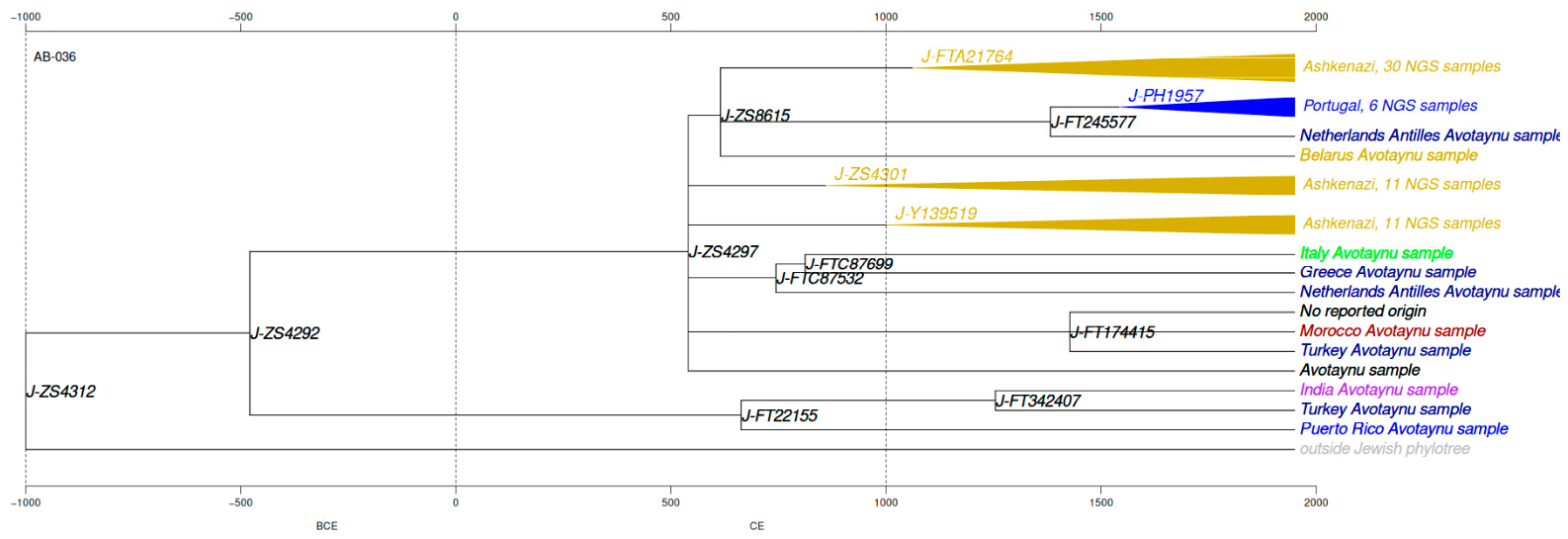
Third, several lineages confirm documented genealogies: the three MJ Toledano participants in AB-036 trace to Rabbi Daniel Toledano (b. Salonica 1560, arrived in Morocco 1610; Tal Toledano 2007), while a fourth Toledano from Turkey belongs to a distinct lineage, consistent with the toponymic origin of the surname (from Toledo, a major medieval Jewish center) and its independent adoption by unrelated Iberian families. Of note, AB-036 has also been identified in the 14th century Jewish cemetery of Erfurt, Germany (Waldman et al. 2022), providing a rare paleogenetic link between a contemporary Moroccan Jewish lineage and a medieval Ashkenazi community and confirming our findings of deep ancestral connection between MJ and Ashkenazim. A different kind of genealogical hypothesis emerges from AB-212. Among its MJ participants, two distinct surname clusters are represented: Elfassy and Cohen. While no documentary genealogical evidence has been established, the genetic data are consistent with the hypothesis that both clusters may descend from sub-branches originating with the RiF, Rabbi Itzhak Elfassy haCohen (1013–1103), one of the most influential Talmudic authorities of the medieval period (Jewish Encyclopedia n.d.). The TMRCA of AB-212, based on STR data, is estimated at 1320 CE (95% CI: 674–1759 CE), broadly consistent with this hypothesis. Furthermore, although Elfassy is a toponym that could in principle correspond to multiple independent lineages originating from Fez, its monogenic nature in the present dataset (Table A5) lends additional support to a single common patrilineal origin. This interpretation remains speculative and awaits confirmation through targeted genealogical research.

2.8. Shared Lineages and Migration Routes

Seventy-four of 111 MJ lineages (67%) are shared with at least one other Jewish population in the Avotaynu DNA Project database. Shared lineages provide direct evidence of the migration history connecting Moroccan Jewry to the broader Jewish diaspora.
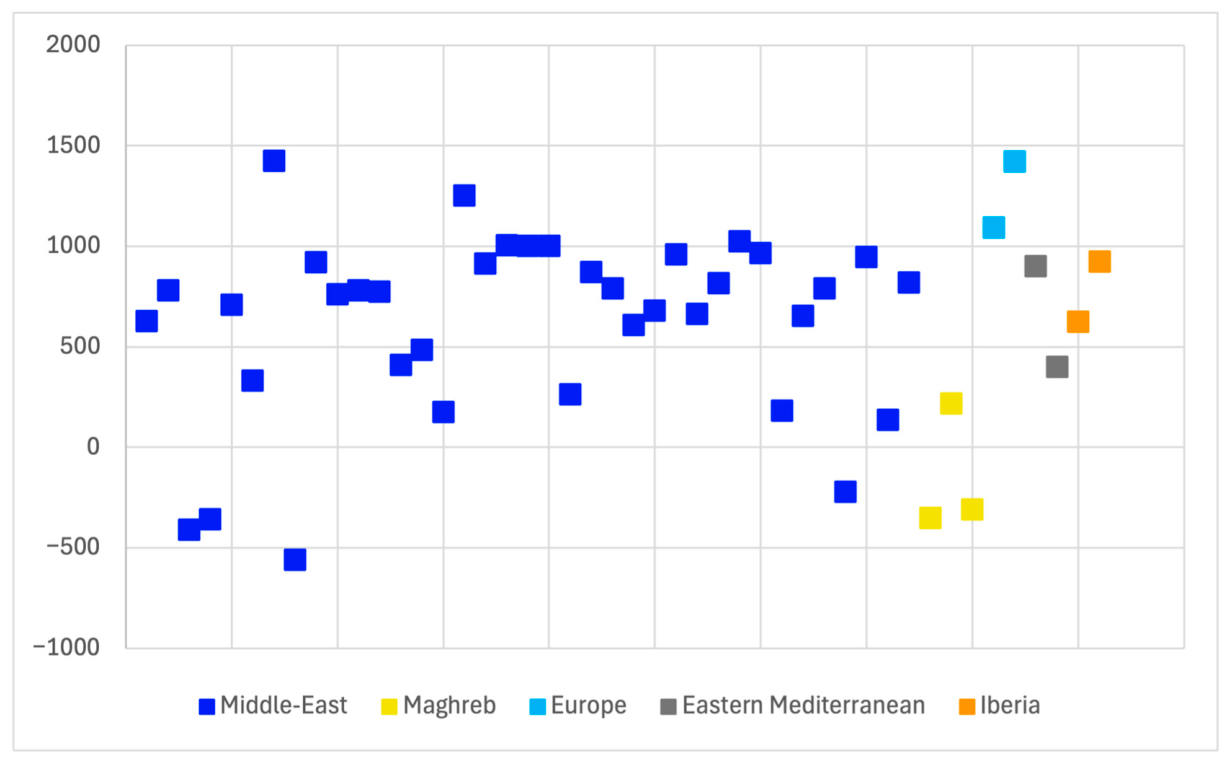
Twenty-five MJ lineages are shared with Ashkenazim, of which 19 (76%) are also shared with Sephardim or contemporary Iberians (Appendix A, Table A2). Of the 25 lineages shared with Ashkenazim, 22 (88%) are of Middle Eastern origin, two are of Eastern Mediterranean origin (AB-051, AB-153), and one is of Iberian origin (AB-101, discussed in Section 2.6.1). The median TMRCA between MJ and Ashkenazi subclades is 589 CE (range: 543 BCE–965 CE; Figure 5). The only TMRCA predating the Common Era is that of AB-022, the Cohen lineage discussed in Section 2.5.
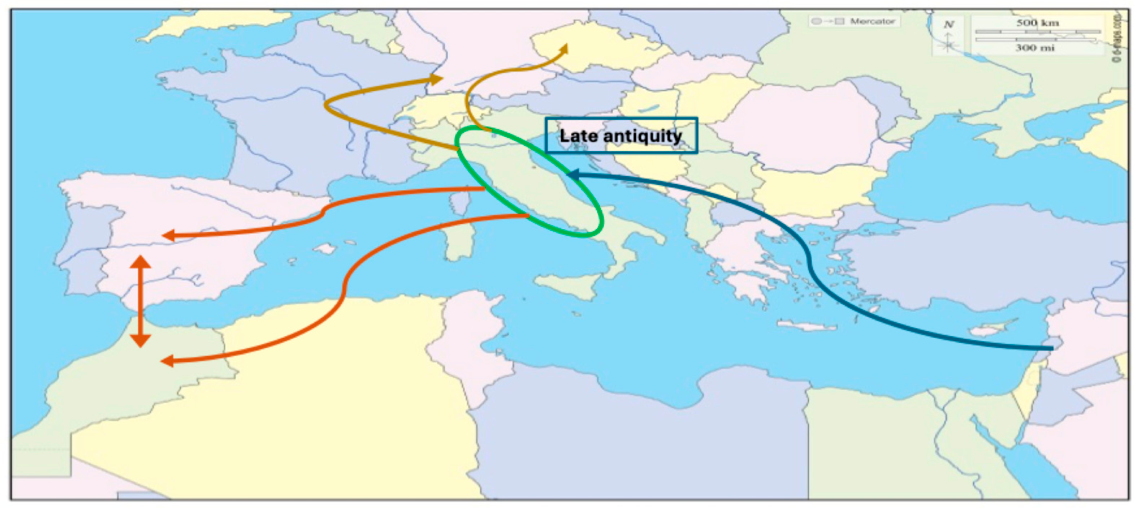
The geographic location of these splits cannot be determined directly from contemporary data, but three non-mutually exclusive hypotheses can be evaluated. The first hypothesis is that following the conflicts between the Romans and the Judeans during the 1st and 2nd centuries, CE, that some communities moved towards North Africa and others toward Europe. The second hypothesis, “the European Route”, suggests a presence on the Italian Peninsula during late antiquity (Botticini and Eckstein 2012; Figure 6) with dispersal into proto-Ashkenazi communities (Botticini and Eckstein 2012) and southward to North Africa and Iberia.
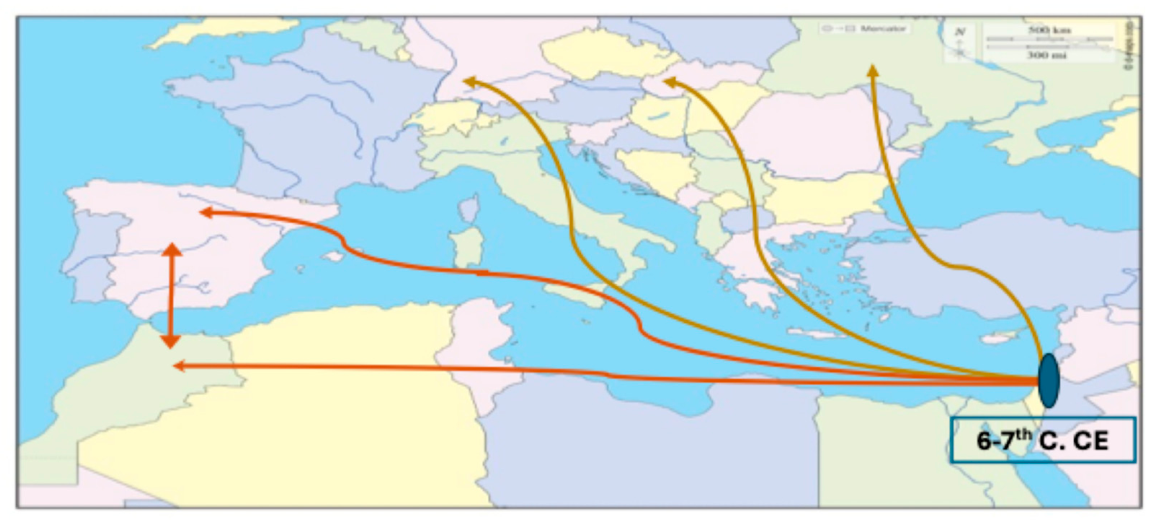
We propose a third hypothesis, a Middle Eastern route, that places the split in the Levant during the sixth and seventh centuries CE (Figure 7). During the fifth to early seventh centuries, Byzantine Palestine hosted a Jewish population estimated at close to 200,000, concentrated mainly in Galilee and the southern coastal plain (Avi-Yonah 1976; Irshai 2005). Relations with Byzantine authorities deteriorated, culminating in the Jewish alliance with the Sasanians during the Byzantine–Sasanian War (602–628 CE), the recapture of Jerusalem by Heraclius (628 CE), and the subsequent Arab conquest of Palestine (636–638 CE), each of which triggered new dispersals (Kaegi 2003). The Arab westward advance opened migration routes along the North African coast (Avni 2014; Lapin 2012; Greatrex and Lieu 2002; Kennedy 2007). A key phylogenetic observation supports this hypothesis: splits between MJ and Ashkenazi subclades are generally found in relatively small Ashkenazi branches rather than in the large ones (such as AB-067, AB-040, and AB-044), which expanded strongly between 700 and 1000 CE without connecting to Maghrebi branches. If most shared lineages had followed the European route, more splits within these large Ashkenazi branches would be expected. This hypothesis is consistent with findings from the medieval cemetery of Erfurt, Germany (Waldman et al. 2022), as well as with linguistic analysis describing mixed Yiddish and Slavic vocabulary among Jews in medieval Eastern Europe.
These three hypotheses are not mutually exclusive, and different lineages likely reflect distinct migration episodes via varying routes. AB-036 illustrates this directly: it harbors two distinct Ashkenazi subclades with split dates of approximately 521 CE and 615 CE, suggesting at least two independent migration events from the same ancestral lineage within a single century.
Lineages shared with Sephardim or contemporary Iberians but not with Ashkenazim show a later median TMRCA (778 CE), reflecting the closer geographic and historical proximity between MJ and Sephardic communities. Lineages with TMRCAs close to or just before 1492, notably AB-036, AB-096, and AB-708, are the most plausible candidates for direct Megorashim ancestry (Figure 8; Appendix A, Table A3).

2.9. Lineages of Maghrebi Origin

Five MJ lineages are of autochthonous Maghrebi origin: AB-247, AB-688, AB-701, AB-707, and AB-747. Four belong to haplogroup E-M81, the predominant Y-chromosome clade of indigenous North African populations. The small number of participants per lineage (one to three) contrasts sharply with the large Middle Eastern lineages, whose size reflects centuries of expansion within established Jewish communities, and is consistent with a relatively late and limited entry of Berber lineages into the Jewish gene pool.
Three of these five lineages (AB-701, AB-707, AB-747) are shared with Sephardic or contemporary Iberian populations, suggesting a back-and-forth trajectory: the lineages most likely originated in the Maghreb, migrated to the Iberian Peninsula during or following the Arab conquest of the early eighth century, the invading armies that reached al-Andalus in 711 CE included a significant Berber contingent, and returned to Morocco either following the pogroms of 1391 or the 1492 expulsion. AB-707, discussed in Section 2.6.4, illustrates this trajectory most clearly. An earlier hypothesis attributing the spread of E-M81 to Phoenician diffusion has been substantially weakened by recent whole Y-chromosome sequencing, which estimates the TMRCA of E-M183, the dominant subclade of E-M81, at approximately 2000–3000 years, more consistent with the Islamic expansion than with Phoenician trade (Solé-Morata et al. 2017a; Villaescusa et al. 2017).

2.10. Bidirectional Gene Flow with Surrounding Populations

The patrilineal exchange between Moroccan Jewish communities and surrounding populations was bidirectional, leaving genetic signatures in groups that converted out of Judaism (toward Catholicism in Iberia and toward Islam in Morocco) and in those that absorbed individuals from outside the Jewish community.
The Chuetas are descendants of Jews of Majorca who converted to Catholicism under duress between 1391 and 1435 (Ferragut et al. 2020). Of the 13 Chueta lineages identified by Ferragut et al. (2020), four are shared with MJ (AB-002, AB-030, AB-212, AB-542). Three are of Middle Eastern origin, and one (AB-542) is of Eastern Mediterranean origin; all are also shared with other Sephardic or Iberian populations. It is conceivable that at least some Chueta subclades originated in Morocco rather than in mainland Iberia. For AB-542, the Chueta–MJ common ancestor dates to approximately 624 CE, while the MJ branch coalesces around 1130 CE; for AB-212, the Chueta–MJ TMRCA of approximately 860 CE coincides with the period when the Emirate of Córdoba took control of Majorca (902 CE). Historical sources document multiple waves of Jewish migration from North Africa to Majorca, including Tagonese protection of Majorcan Jews from 1135 CE onward and the Almohad-era flight from Morocco and al-Andalus (Beinart 2002; I. Pérez 2005; Fenton 2019), with commercial ties attested by trilingual Judeo-Arabic, Catalan, and Hebrew manuscripts (Blasco Orellana 2003).
In Morocco, the Almohad dynasty (1147–1269 CE) imposed forced conversion to Islam under threat of death (Fenton 2019; Garcia-Arenal 1987). Most converts returned to Judaism following the Marinid restoration in 1269 CE, but some remained Muslim, forming the Bildiyyīn, crypto-Jews concentrated in Fez who maintained Jewish practices privately and endogamous marriage patterns to preserve their distinct identity (Garcia-Arenal 1987). Six MJ lineages are shared with Muslim participants in the Avotaynu DNA Project (AB-022, AB-070, AB-149, AB-444, AB-542, AB-658, Table A4). TMRCAs for AB-022 and AB-070 (both approximately 1188–1189 CE) are broadly consistent with the Almohad period, though wide confidence intervals preclude definitive assignment. The split time of approximately 1521 CE for AB-542, together with the Bildiyyīn surname of the Muslim participant, is more consistent with later conversions documented by Chetrit (2017). One AB-022 Muslim participant appears to descend from a Moroccan Jewish Cohen who converted to Islam between approximately 1890 and 1910 CE, representing one of the most recent instances of Jewish-to-Muslim conversion identified in this study.

2.11. Surnames and Lineages

We define a surname as monogenic when all tested bearers belong to a single Y-chromosome lineage, and polygenic when it appears in two or more genetically distinct lineages. Among the 190 distinct surname roots identified across the 288 MJ participants, at least 30 are monogenic and 29 are polygenic (Table A5 and Table A6). The remaining 131 are represented by a single individual in the present study and cannot be classified as monogenic or polygenic until additional bearers are identified. All classifications are conditional on current data and may be revised as new participants join the study.
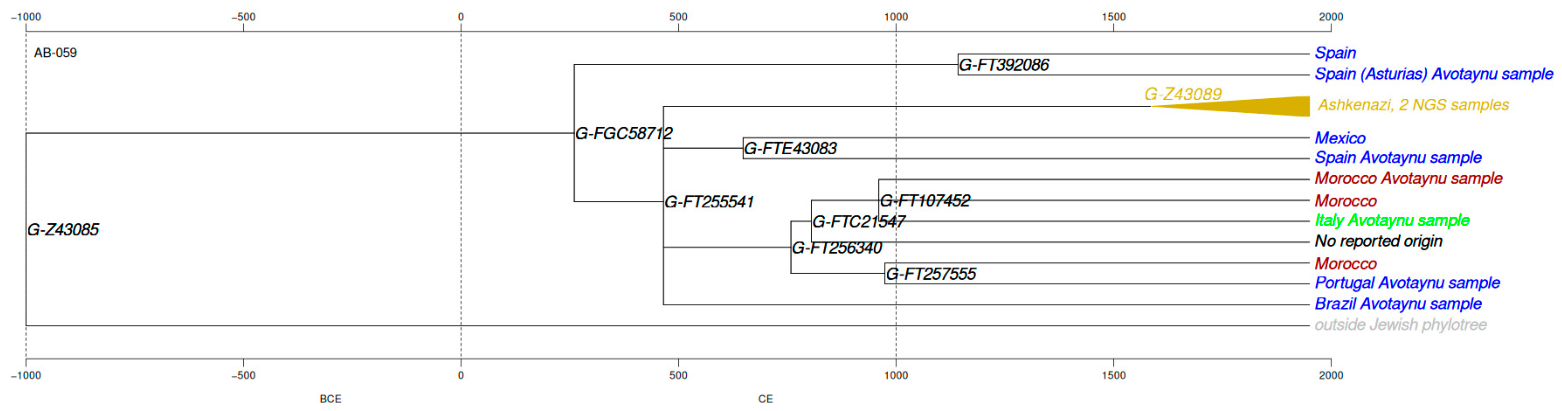
Three findings warrant emphasis. First, surnames of Maghrebi morphology do not necessarily reflect autochthonous North African patrilineal ancestry. The surname Ohayon, derived from the Arabic given name Hayyun via the Berber patronymic prefix ou- (Beider 2017a), is found in three lineages, including at least one of Iberian origin (R1b-DF27) whose common ancestor with a parallel Iberian branch dates to approximately 901 CE, predating the 1492 expulsion by several centuries and pointing to Megorashim or earlier Iberian ancestry beneath a North African surname. The surname Zrihen, etymologically related to the Arabic dirham via well-documented phonological shifts in Moroccan Arabic, is found in lineage AB-059, of Middle Eastern origin and broad Sephardic distribution; its bearers almost certainly passed through the Iberian Peninsula. These cases illustrate that combining onomastic and genetic approaches reveals histories that neither method could recover on its own.
Second, the priestly and Levite surnames Cohen and Levy are extensively decoupled from their genetically defined lineages. Among MJ participants, six lineages bear the Cohen surname (AB-022, AB-047, AB-212, AB-391, AB-758, AB-879), of which only AB-022 and AB-047 are found among Cohen lineages outside Moroccan Jewry. Of the ten Levy-surnamed MJ participants, one belongs to AB-003 (the only Levite lineage represented in MJ); two carry the Cohen lineage AB-022, and six belong to lineages with where neither Levy or Cohen traditions are predominant. As discussed in Section 2.5, this pattern is consistent with the historical adoption of the Levy surname alongside the Levite ritual function by individuals of non-Levite patrilineal origin, a phenomenon unlikely to be specific to MJ, given the absence of any Levite genetic cluster comparable in breadth to the CMH.
Third, common surnames frequently prove polygenic across multiple distinct origins. Bitton, the fifth most common surname in MJ cemeteries (Ouaknine 2025), is represented in three genetically distinct lineages: AB-149 (Middle Eastern origin), AB-367 (Iberian origin), and AB-726 (Northwestern European origin, R1b-U106, a clade predominantly associated with Germanic populations). The likely derivation from Judeo-Spanish vita (“life”; Laredo 2008) explains the surname’s independent adoption by unrelated Iberian families. AB-726 is itself a striking case: the lineage may reflect a conversion in Britain followed by departure following the 1290 Edict of Expulsion (Brace et al. 2022), subsequent integration into Iberian Jewish communities, and eventual migration to Morocco. Such cases demonstrate that surname sharing does not imply common patrilineal descent, a finding of broad relevance for genealogical research.

2.12. Megorashim or Toshavim?

One aim of this study was to assess whether specific lineages can be associated with Toshavim or Megorashim ancestry. For most MJ lineages, no confident assignment is possible: the long history of back-and-forth migration between Morocco and the Iberian Peninsula confounds straightforward inference, and many lineages span the relevant time horizon without a clear directional signal.
In a minority of cases, however, the genetic and onomastic evidence converges. Lineages belonging to haplogroup R1b-DF27, the predominant Y-chromosome clade of the Iberian Peninsula, are most plausibly of Megorashim origin, particularly when accompanied by Iberian-origin surnames. AB-101 (Section 2.6.1) and AB-367 are clear examples. Conversely, lineages with exclusively or predominantly MJ distribution, early TMRCAs, and absence of Sephardic or Iberian matches are most plausibly of Toshavim origin: AB-238 and AB-424 (Section 2.6.3) are the strongest examples. AB-707 (Section 2.6.4) illustrates the irreducible complexity of many cases: an autochthonous Berber patrilineal origin combined with Castilian-rite ketubot, an Iberian surname (Perez), and Y-chromosome matches to contemporary Iberian populations, all pointing to a Megorashim episode in the history of an originally non-Iberian lineage.
Until recently, the most reliable criterion for distinguishing Toshavim from Megorashim was the liturgical rite of the ketubot, Castilian for Megorashim, indigenous for Toshavim. Even this criterion has limits: the adoption of Judeo-Spanish (Haketia) as a vernacular in northern Moroccan cities such as Tetouan, Tangier, Larache, and Arzila has been misinterpreted as evidence of Megorashim origin in families that are in fact of Toshavim descent (Zafrani 1998). Ultimately, the Toshavim–Megorashim distinction is cultural and liturgical rather than genetic and has been progressively eroded by intermarriage and the broader Sephardization of Moroccan Judaism. Patrilineal genetic data illuminate specific lineages and migration trajectories, but communal identity rests on cultural memory, documentary evidence, and tradition rather than on Y-chromosome ancestry alone.

3. Materials and Methods

3.1. The Avotaynu DNA Project

Data presented in this study were collected through the Avotaynu DNA Project, launched in 2016 as a multidisciplinary collaboration involving FTDNA project administrators, anthropologists, archeologists, historians, and geneticists (Brown 2016). The project aims to develop an online knowledge base that enables genealogists to reconstruct family histories while providing historians and demographers with data to understand the historical development of Jewish populations (Brown and Waas 2026).

3.2. Participants

The cohort includes men whose families originated across the diverse regions and communities of Morocco, with no particular geographic or communal bias. Participants were either actively recruited based on documented Moroccan Jewish patrilineal ancestry or contacted the Avotaynu DNA Project after learning of the study. Inclusion required only established Moroccan Jewish patrilineal descent. Although we aimed to recruit one participant per surname, several surnames were represented by multiple individuals, either through deliberate recruitment or because participants who joined independently happened to share a surname already present in the study. This allowed us to classify surnames as monogenic or polygenic, a distinction that requires at least two individuals carrying the same surname. Nine Moroccan Muslim participants joined the project: eight through FamilyTreeDNA and one recruited because of his prominent Bildiyyīn surname. All participants consented to the potential publication of their ancestral surnames and DNA results in the context of a population study; no individually identifying information is disclosed. Only surnames estimated to have been in continuous use for at least 200 years are reported, as such surnames are shared by countless distantly related families and do not constitute identifying information.

3.3. Lineage Definition and Nomenclature

Our structure for organizing founding lineages results from the Avotaynu-affiliated study of haplogroup J1-Z640 and its dispersal among widespread populations throughout the Middle East. The findings included several ancient Ashkenazi and Sephardi subclades whose divergence preceded the beginning of Israelite identity following the Bronze Age collapse ca. 1200 BCE (Waas et al. 2019). This insight into the Bronze Age origins of different Jewish J-Z640 lineages inspired the development of the philosophy and nomenclature of the AB-lineage structure upon which this article relies.
Technically speaking, a lineage is defined by the Avotaynu DNA Project as a node in the Y-chromosome phylogenetic tree for which the most recent common ancestor was Jewish and for which the majority of descending subclades are Jewish, with no other Jewish Y-DNA connection above that node since the founding of Israelite identity in the Early Iron Age approximately 3,000 years ago. Each such node is assigned a unique, permanent three-digit Avotaynu identifier (AB-001, AB-002, …), introduced to provide stable, unambiguous identifiers for Jewish patrilineal lineages independent of the evolving FTDNA and ISOGG nomenclature systems (Brown 2016). This nomenclature is offered to all researchers without copyright and has been widely adopted by Jewish genealogists and FTDNA project managers as a global standard. Each lineage is also assigned to a Bronze Age clade or older, defined as the most recent ancestral node whose diversification is estimated to predate approximately 1000 BCE, providing a mid-level phylogenetic anchor between the broad haplogroup designation and the lineage-specific SNP.

3.4. DNA Analysis and Lineage Assignment

All Avotaynu samples were initially analyzed by FTDNA using 37 short tandem repeat (STR) markers and provisionally assigned to lineages based on comparisons with existing samples. Each new sample whose lineage assignment was ambiguous was sequenced via the Big Y-700 test (Davis et al. 2019) and incorporated into the FTDNA phylogenetic tree (McDonald 2021). This process either confirmed the existence of a previously unidentified Jewish lineage or demonstrated that the sample belonged to an existing lineage despite unusually high STR divergence.
Paternal lineage analysis was performed using the Big Y-700 whole Y-chromosome sequencing assay (FamilyTreeDNA, Houston, TX, USA). The Big Y-700 platform sequences the non-recombining region of the Y chromosome (NRY) to approximately 30–40× coverage, targeting more than 700 STR loci and identifying all detectable novel variants (NVs) and SNPs within the sequenced region. Raw FASTQ reads were processed through the FamilyTreeDNA bioinformatics pipeline and aligned to the GRCh38 reference genome. Haplogroup assignments were verified by comparing the ISOGG Y-DNA Haplogroup Tree (www.isogg.org/tree, accessed on 27 May 2026) to the YFull Phylogenetic Tree (www.yfull.com). Based on BigY results, a total of 111 distinct SNP-based AB-designated lineage groups were identified.
TMRCA values reported here were calculated by FTDNA as of 31 December 2025, and are publicly accessible online without a password at https://discover.familytreedna.com/y-dna/[SNP]/tree, where [SNP] is replaced by the SNP defining the lineage of interest. Phylogenetic reconstructions include samples collected directly through the Avotaynu DNA Project, samples contributed by independent FTDNA participants, and publicly available data from the FamilyTreeDNA phylogenetic tree from individuals who provided informed consent for public posting and use in population studies.

3.5. Geographic Origin Assignment

Commercially available NGS testing of the Y-chromosome is a relatively recent phenomenon; there remain many gaps in the phylogenetic tree. Therefore, lineages were assigned to probable regions of origin based on the geographic distribution of the haplogroups of their non-Jewish parallel clades. The classification used was: Middle Eastern (R1b-Z2103, R1a-Z93, J1, J2a, G, E1b (x-E1b-V13); Iberian (R1b-DF27); Eastern Mediterranean (E1b-V13, J2b-L283); Other European (R1b-L21, R1b-U106, R1b-U152, R1a-Z282, I1); North African (E1b-M81, E1b-PF2431, E1b-V65). The term Eastern Mediterranean as used here refers to lineages whose non-Jewish parallel clades are most prevalent in the Anatolian–Balkan corridor and the broader eastern Mediterranean basin, principally haplogroups E1b-V13 and J2b-L283 (Semino et al. 2004; Cruciani et al. 2007; Trombetta et al. 2015; Di Giacomo et al. 2004).

4. Conclusions

This study presents the largest patrilineal genetic analysis of Moroccan Jewry conducted to date, examining the Y chromosomes of 288 contemporary men of Moroccan Jewish descent and identifying 111 distinct lineages. Four findings warrant emphasis.
First, Moroccan Jewish patrilineal ancestry is overwhelmingly Middle Eastern, and many of these, such as AB-022, AB-036, AB-47 and AB-158 (Coryell et al. 2023), are demonstrably Levantine. Approximately 71% of lineages and 80% of individuals trace to haplogroups prevalent in the Middle East, with TMRCAs in some cases predating the Common Era. Non-Middle Eastern lineages, of Iberian, Eastern Mediterranean, or other European origin, entered the Jewish gene pool well before their carriers’ arrival in Morocco, attesting to ancient integration into Jewish communities rather than recent admixture.
Second, only 4.5% of the MJ lineages are autochthonous North African. This is the first systematic Y-chromosomal evidence against the long-standing hypothesis of large-scale Berber Judaization (Slouschz 1908, 1927), and converges with the maternal-line evidence of Behar et al. (2008) and the onomastic conclusions of Beider (2017a).
Third, the migration history of Moroccan Jewry consists of successive waves rather than a single founding event. Split dates between MJ and Ashkenazi or Sephardic subclades cluster in the sixth to eighth centuries CE, suggesting that many lineages were already widely distributed across the Mediterranean basin by that period. Iberian-origin lineages, at 11% of MJ lineages and slightly more than double the project-wide average, provide a clear genetic signature of the sustained demographic exchange between Morocco and the Iberian Peninsula over many centuries. Documented cases of back-and-forth movement between Morocco and Iberia predating 1492, the Chueta connection to Majorca, and Converso lineages traceable to the Americas further document the geographic reach of Moroccan Jewish patrilineal ancestry.
Fourth, the integration of genetic and onomastic analysis demonstrates that surname sharing does not necessarily imply common patrilineal descent: 29 of the surnames examined are polygenic, and surnames of Maghrebi morphology often have Iberian patrilineal origins. The Cohen and Levy traditions exhibit distinct dynamics: AB-022 and AB-047 trace continuous Cohen patrilineal descent across millennia, whereas the Levy surname is decoupled from a single Levite genetic lineage in most cases.
This study represents a snapshot of Moroccan Jewish patrilineal diversity as captured by the current cohort. Recruitment is ongoing, and both the lineage count and surname classifications will likely evolve as new participants join. However, the rate at which new lineages are being identified has slowed considerably over time, suggesting that while additional lineages undoubtedly remain to be discovered, the general profile presented here, 288 participants and 111 founder lineages, with a clear predominance of Middle Eastern ancestry and limited autochthonous Maghrebi contribution, is likely a reasonable approximation of the true patrilineal diversity of Moroccan Jewry.
Several limitations should be acknowledged. TMRCA estimates remain provisional and depend on the number of Big Y-tested individuals; some lineages could not be fully characterized due to an insufficient number of NGS samples. The relationship between the MJ patrilineal lineages and those of Mizrahi Jewish communities was not addressed and represents a natural direction for future work. All assignments reflect the state of the database as of 31 December 2025 and are subject to revision as the project expands.
Despite these limitations, the central conclusion is robust. Moroccan Jewish patrilineal heritage has been preserved with remarkable continuity across two millennia of diaspora, migration, and persecution. Two millennia of periodic forced conversions and pogroms left virtually no detectable trace in the Y-chromosome pool of contemporary Moroccan Jewish men. Unlike the Ashkenazi population, which underwent a severe medieval bottleneck (Carmi et al. 2014; Waldman et al. 2022), the Moroccan Jewish gene pool reflects long and relatively stable patrilineal continuity, shaped by successive waves of migration but never fundamentally disrupted. The Cohen and Levite lineages, traceable from ancient Israel to the present day, perhaps best embody this continuity, but they are far from alone among the lineages documented here. Morocco, the westernmost terminus of Jewish migration across the Mediterranean, concentrates within a limited territory a remarkable patrilineal diversity that reflects, in microcosm, the broader history of the Jewish people.


Author Contributions

Conceptualization, R.L.-T. and A.B.; methodology, R.L.-T., W.P., M.W. and A.B.; formal analysis, R.L.-T., W.P., G.R., M.S. and P.M.; investigation, R.L.-T., W.P., M.W., G.R., M.S., P.M. and A.B.; resources, G.R., M.S., P.M.; data curation, R.L.-T., W.P., G.R., M.S., P.M. and A.B.; writing—original draft preparation, R.L.-T.; writing—review and editing, R.L.-T., W.P., M.W., G.R., M.S., P.M. and A.B.; visualization, R.L.-T. and W.P.; project administration, R.L.-T., W.P. and A.B.; funding acquisition, A.B. All authors have read and agreed to the published version of the manuscript.
Funding

This research was funded by the Avotaynu Foundation.

Institutional Review Board Statement

The study was conducted in accordance with the Declaration of Helsinki, and the protocols used for various aspects of the study were approved by Rambam Medical Center Helsinki Committee #2616 on 18 July 2016, Colorado Multiple Institutional Review Board #18-1698 on 6 October 2017, NYU Winthrop Hospital Institutional Review Board #18309 on 28 April 2018, University of Haifa Committee to Evaluate Human Subject Research #327/18 on 23 September 2018, and WCG IRB #20261744 on 20 May 2026.

Informed Consent Statement

Informed consent was obtained from all subjects involved in the study.

Data Availability Statement

The original contributions presented in this study are included in the article. Further inquiries can be directed to the corresponding authors.

Acknowledgments

The authors warmly thank their project participants for entrusting them with their samples. Many thanks to the FTDNA customers who have contributed their DNA results, to genealogists who helped publicize our study within the Moroccan Jewish community, to Bennett Greenspan, founder of FamilyTreeDNA, and to the many scholars around the world who have offered encouragement. The authors acknowledge the use of Claude (Anthropic) in editing; the authors reviewed all output and remain solely responsible for all content.

Conflicts of Interest

The authors G.R., M.S. and P.M. are employed by the company Gene by Gene, Ltd. The remaining authors declare that the research was conducted in the absence of any commercial or financial relationships that could be construed as a potential conflict of interest.

Abbreviations

The following abbreviations are used in this manuscript:
MJMoroccan Jews
NGSNext-Generation Sequencing
STRShort Tandem Repeat
SNPSingle Nucleotide Polymorphism
TMRCATime to Most Recent Common Ancestor
FTDNAFamilyTreeDNA
CMHCohen Modal Haplotype
CIConfidence Interval
CE/BCECommon Era/Before the Common Era

Appendix A

The following information is central to the findings of this study but has been placed in Appendix A to preserve the flow of the main text. Appendix A contains detailed lineage tables and phylogenetic trees. Table A1 lists all 111 Moroccan Jewish Y-chromosome lineages identified in this study, with specific SNPs, Bronze Age clade, ancestral origins, date of start of founding lineage, sharing patterns with Ashkenazi, Sephardic/Iberian, and other Maghrebi Jewish populations, and the number of MJ individuals in each lineage. Table A2 and Table A3 provide TMRCA distributions for lineages shared with Ashkenazim and with Sephardim/Iberians, respectively. Table A4 summarizes lineages shared with Moroccan Muslim participants. Table A5 and Table A6 list all surname roots identified in this study, with their lineage affiliations and monogenic/polygenic classification. Figure A1, Figure A2, Figure A3, Figure A4, Figure A5, Figure A6, Figure A7, Figure A8, Figure A9, Figure A10, Figure A11, Figure A12 and Figure A13 provide phylogenetic trees and information in the order in which the corresponding lineages are discussed in the main text: AB-047 (Figure A1), AB-101 (Figure A2), AB-140 (Figure A3), AB-424 (Figure A4), AB-707 (Figure A5), AB-036 (Figure A6), AB-059 (Figure A7), AB-149 (Figure A8), AB-162 (Figure A9), AB-212 (Figure A10), AB-238 (Figure A11), AB-367 (Figure A12), and AB-542 (Figure A13).
Table A1. Y-chromosome lineages identified in Moroccan Jews (as of 31 December 2025).
AB-GroupHgBronze Age CladeSNPsAncestral OriginSource *MJ TMRCADate of Upstream SNP to the Founding Lineage **Shared withMJ in Lineage
AB-001E1bV22BY7500Middle-East 492 CE2601 BCEAJ, IB, Tunisia1
AB-002E1bV22CTS3116Middle-East 276 CE3090 BCEAJ, IB2
AB-003E1bV12BY8528Middle-East 467 BCE1589 BCEAJ, IB8
AB-022J1ZS227ZS222Middle-East 864 BCE2252 BCEAJ, IB, Algeria4
AB-027J1YSC76FGC22294Middle-East 78 CE2100 BCEAJ, IB1
AB-030J1Z18297ZS2606Middle-East 339 CE1002 BCEAJ, IB, Algeria, Tunisia, Libya1
AB-036J1Z18297ZS4292Middle-East 490 BCE3271 BCEAJ, IB, Algeria2
AB-047J2aL25FGC4992Middle-East 566 BCE6017 BCEAJ, IB4
AB-051J2bL283Y33795Eastern-Med. 314 CE1305 BCEAJ1
AB-053 *G2P303FT198165Middle-East 2395 BCE †_AJ11
AB-058G2L140FGC249Middle-East 754 CE1152 BCEAJ, IB1
AB-059G2L140FGC58712Middle-East 234 CE1388 BCEAJ, IB, Algeria, Tunisia3
AB-065 *QL245Y2200Middle-East 134 CE491 BCEAJ, IB3
AB-069 *R1bZ2103FGC21004Middle-East 161 CE948 BCEAJ, IB, Tunisia2
AB-070R1bZ2103FGC14628Middle-East 601 CE1814 BCEAJ, Tunisia1
AB-072R1bZ2103Y19847Middle-East 115 CE1786 BCEAJ, IB, Algeria2
AB-080R1bZ2103BY20206Middle-East 484 CE1939 BCEAJ, IB1
AB-092T1L208Y3836Middle-East 165 CE1118 BCEAJ, IB1
AB-096E1bV22FT303297Middle-East 477 CE3508 BCEAJ, IB2
AB-100 *G2PF3146BY157385Middle-East 976 CE67 CEAJ2
AB-101R1bDF27BY71074Iberia 965 CE1189 BCEAJ3
AB-114J2aM319Z39632Middle-East 588 CE1077 BCEAJ, IB Algeria5
AB-121 *G2Z6552FTE64653Middle-EastAvotaynu 1950 BCE †- 22
AB-123G2U1Z30718Middle-East 1200 CE358 BCE 1
AB-124G2P303FGC67771Middle-East 445 BCE1123 BCEIB1
AB-127G2Z6552Z39660Middle-East 485 CE598 BCEIB1
AB-134 *G2PF3146FGC2308Middle-East 2549 BCE †-Algeria, Tunisia8
AB-137J2aL25FT388150Middle-EastAvotaynu1148 BCE †-IB, Algeria2
AB-140E1bV12CTS9507Middle-East 1000 CE753 BCEIB, Tunisia1
AB-149R1bZ2103M12143Middle-East 487 CE270 CEAJ, IB1
AB-153J2bL283Z39660Eastern-Med. 693 CE496 BCEAJ, Tunisia4
AB-158E1bM84S16614Middle-East 652 CE779 BCEIB, Tunisia19
AB-159E1bM84FT240936Middle-EastAvotaynu650 BCE †-IB3
AB-162T1M184Y142466Middle-East 735 CE845 BCEIB1
AB-173J2bL283FT237906Eastern-Med.Avotaynu 292 BCE †- 1
AB-180J1L620FT344187Middle-EastAvotaynu615 CE2989 BCEIB1
AB-212QL245FT392621Middle-EastAvotaynu 718 CE239 BCEIB, Algeria, Tunisia1
AB-232G2L497FT240048EuropeAvotaynu1382 BCE †-IB,3
AB-235LM349BY20692Middle-EastAvotaynu 957 CE †-IB, Algeria, Tunisia1
AB-238J2aM67FT245501Middle-EastAvotaynu 952 CE349 BCEAlgeria, Tunisia3
AB-247E1bM81FTF87328MaghrebAvotaynu843 CE230 BCEAlgeria1
AB-250E1bCTS10880FTF13720Middle-EastAvotaynu 650 CE3704 BCEIB
AB-251G2L497FGC60020Europe 668 BCE †-IB3
AB-253J2aM67S15970Middle-East 818 CE1488 BCEIB, Algeria14
AB-261R1bDF27BY53945IberiaAvotaynu 694 CE †- 1
AB-275R2aM124FTC96253Middle-EastAvotaynu 2377 BCE †-Tunisia1
AB-285E1bV22FT191259Middle-EastAvotaynu854 CE1096 BCE 1
AB-289G2PF3146BY67619Middle-EastAvotaynu992 CE1610 BCEIB, Algeria2
AB-319J2bL283BY60963Middle-EastAvotaynu657 CE3163 BCEIB, Tunisia1
AB-321J1L24BY55942Middle-EastAvotaynu 1826 CE3070 BCEIB1
AB-345J1PT4869FT258271Middle-EastAvotaynu1266 CE876 BCEIB1
AB-356R1bDF27ZZ12_1Iberia 2590 BCE †-IB2
AB-361G2L30FT18827Middle-EastAvotaynu179 CE1163 BCEIB, Algeria1
AB-367R1bDF27FTF91042IberiaAvotaynu934 CE1463 BCEAlgeria1
AB-391 *R1bDF27?Iberia -- 4
AB-395G2L30BY37062Middle-EastAvotaynu653 CE78 CEIB, Tunisia1
AB-424QL245YP1237Middle-East 820CE530 BCEAlgeria, Tunisia3
AB-426J2aM92FTF8596Middle-EastAvotaynu 1376 BCE †- 6
AB-435E1bV22BY199237Middle-EastAvotaynu 1113 BCE †- 1
AB-444T1M184FTF9990Middle-EastAvotaynu580 CE1161 BCEAlgeria, Tunisia1
AB-458J2aM92FGC63017Middle-East 872 CE †-AJ, IB, Algeria3
AB-494GL140FTB86765Middle-EastAvotaynu 673 CE7225 BCETunisia, Libya3
AB-533R1bDF27FT67266IberiaAvotaynu 834 CE†-IB2
AB-542J2aL24FT309256Eastern-Med.Avotaynu642 CE1738 BCEIB, Tunisia1
AB-548E1bV22FT197517Middle-EastAvotaynu 790 CE3566 BCEIB1
AB-552J2aM319BY74378Middle-EastAvotaynu2687 BCE †- 1
AB-553J2bL283FTF13444Eastern-Med.Avotaynu1558 CE794 BCE 1
AB-581J2aL25FT355048Middle-EastAvotaynu2710 BCE †-Tunisia1
AB-593 *E1bV12CTS6667Middle-East --Algeria1
AB-599R1bZ2103FTF75955Middle-EastAvotaynu 1363 CE141 CEIB, Tunisia1
AB-621R1bDF27Z195Iberia 2642 BCE †- 2
AB-628R1bDF27FTE41925IberiaAvotaynu1599 CE †-IB1
AB-652J1FGC11FGC19544Middle-East 1112 CE †- 5
AB-658E1bV13FT115151Eastern-Med.Avotaynu 595 CE1432 BCEAlgeria, Tunisia8
AB-665T1M184FTC74390Middle-EastAvotaynu733 CE †- 2
AB-677J2aL26FT286033Middle-EastAvotaynu 5603 BCE †- 1
AB-678J2aM319FT384042Middle-EastAvotaynu678 CE856 BCE 3
AB-685J2aM67Y25842Middle-East 3215 BCE †- 1
AB-688E1bPF2431FTD95867MaghrebAvotaynu476 BCE †- 1
AB-690T1CTS6507FTF8631Middle-EastAvotaynu787 CE1612 BCEIB1
AB-698R1bZ2103FTC87719Middle-EastAvotaynu 1055 CE1904 BCE 1
AB-701E1bM81PF2546MaghrebAvotaynu 358 BCE †-IB2
AB-707E1bM81FTF89117MaghrebAvotaynu 522 CE212 CEIB5
AB-708 *R1bA8053FT174092EuropeAvotaynu1145 CE1585 BCEIB1
AB-712GL30FTB62856Middle-EastAvotaynu 627 CE †- 1
AB-716GU1FTG786Middle-EastAvotaynu2200 BCE †- 1
AB-717R1bZ2103Y40119Middle-East 2575 BCE †- 1
AB-719R1bDF27FGC78762Iberia 2519 BCE †- 3
AB-722T1 HU354Middle-East 1742 BCE †- 1
AB-726R1bZ2103FTE23453EuropeAvotaynu1093 CE604 CEIB3
AB-727E1bV13BY3880Eastern-Med.Avotaynu2231 BCE †- 1
AB-729R1bDF27BY71481IberiaAvotaynu1155 BCE †- 1
AB-739 *GL140FT385445Middle-EastAvotaynu1116 CE416 BCE 1
AB-740J2aM92FTB97281Middle-EastAvotaynu1250 CE1510 BCEAlgeria1
AB-741 *J2aL24BY79900Middle-EastAvotaynu1163 CE1203 BCE 1
AB-747E1bM81FTB34423MaghrebAvotaynu120 CE †-IB
AB-749E1bV13BY6056Eastern-Med.Avotaynu 865 BCE †- 4
AB-751J2aL26Y31951Middle-East 2693 BCE †- 19
AB-755R1bDF27Y26643Iberia 1435 BCE †- 1
AB-758J1Z18297ZS3758Middle-East 220 BCE2683 BCEIB4
AB-774GL30FTA73333Middle-EastAvotaynu942 CE †- 1
AB-775J2aL26BY188143Middle-EastAvotaynu946 CE545 CEIB1
AB-787J2bL283FTF8891Eastern-Med.Avotaynu1108 CE2078 BCE 2
AB-831J2bL283FT22667Eastern-Med.Avotaynu930 CE †-IB1
AB-870E1bM2FT261836Middle-EastAvotaynu3454 BCE †-
AB-879J1YSC76FT9678Middle-EastAvotaynu1940 BCE †- 1
AB-880J1YSC76BY93Middle-EastAvotaynu 316 BCE †-IB1
AB-913R1bDF27FT196566IberiaAvotaynu 32 CE †- 1
AB-915J1Z140FT106013EuropeAvotaynu 915 BCE †- 3
AB-917 *E1bCTS10880FTB41180Middle-EastAvotaynu1584 CE3581 BCEIB
AB-918GL140CTS11177Middle-East 1169 BCE †- 1
AJ = Ashkenazi Jew; Eastern-Med. = Eastern Mediterranean, Hg = Haplogroup; IB = Sephardic Jew and/or contemporary Iberian. † Lineage where only one participant had a NGS big Y tested. Although the age of the lineage could be determined, this age is not necessary that of the Jewish lineage (that could only be determined when the NGS big Y of at least two men of Jewish descent is available). * Lineage in which no NGS is available. ** Estimated date of the SNP immediately upstream of the lineage-defining SNP, representing the TMRCA shared between the Jewish lineage and its non-Jewish parallel clades. Branches AB-002, AB-030, AB-212, AB-542 are shared with Chuetas; Branches AB-022 and AB-162 are shared with Romaniotes; Branches AB-022, AB-058, AB-212 and AB-123 are shared with Mizrahi Jews; Branches AB-047 and AB-153 are shared with Indian Jews; Branches AB-022 and AB-533 are shared with Yemenite Jews; Branches AB-022 and AB-047 are shared with Mountain Jews; Branch AB-123 is shared with Bukharian Jews; Branch AB-022 is shared with Karaites.
Table A2. MJ lineages shared with present-day Ashkenazim (as of 31 December 2025).
AB-GroupSNPsSplit SNPTMRCA95% Confidence Interval
AB-001 *aE1b-V22-BY7500E-BY7500487 CE151 CE–766 CE
AB-002 *aE1b-V22-CTS3116E-CTS3116276 CE317 BCE–738 CE
AB-003 *aE1b-V12-BY8528E-BY8547908 CE546 CE–1192 CE
AB-022 *aJ1-ZS227-S12192J-Z18290543 BCE1086 BCE–91 CE
AB-027 *aJ1-YSC76-FGC22294-ZS6484FGC2229499 CE355 BCE–472 CE
AB-030 *aJ1-Z18297-ZS2606J-M4320626 CE206 CE–959 CE
AB-036 *aJ1-Z18297-ZS4292J-ZS4297521 CE179 CE–804 CE
AB-047 *aJ2a-L25-FGC4992J-L254580 CE293 CE–820 CE
AB-051J2b-L283-Y33795J-33797335 CE84 BCE–642 CE
AB-053 *G-M342-GG362___
AB-058 *aG-L140-CTS5990-FGC249G-FGC249754 CE445 CE–1006 CE
AB-059 *aG-L140-CTS5990-Z43085G-FT255541465 CE48 BCE–832 CE
AB-065 aQ-L245-Y2200Q-Y2197368 CE86 CE–663 CE
AB-069 aR1b-V88-FGC21004R-FGC21004161 CE285 BCE–526 CE
AB-070 *R1b-Z2103-FGC14595R-FGC14602864 CE564 CE–1108 CE
AB-072 *aR1b-Z2103-Y19847R-FT76726596 CE256 CE–875 CE
AB-080 *aR1b-Z2103-Z2108R-BY20206484 CE9 CE–859 CE
AB-092 *aT-Y3836T-FT271340718 CE172 CE–1054 CE
AB-096 *aE1b-V22-BY56101E-FT303420817 CE461 CE–1100 CE
AB-100G-PF3146-FGC6713G-BY157385916 CE428 CE–1279 CE
AB-101 *R1b-DF27-A5376R-BY71074965 CE521 CE–1298 CE
AB-114 *aJ2a-M319-Y20891J-Z39632589 CE245 CE–870 CE
AB-149 *aR1b-Z2103-M12143R-M12143487 CE142 BCE–962 CE
AB-153 *J2b-L283-Z39653J-Z39660693 CE255 CE–1035 CE
AB-458 *aJ2a-M92-FGC63035J-FGC63017920 CE355 CE–1267 CE
* AB-groups in which at least one North-African Jew participant of Avotaynu DNA project had a Big Y performed. a Lineage shared with both Ashkenazim and Sephardim.
Table A3. MJ lineages shared with present-day Sephardim or Iberians (as of 31 December 2025).
AB-GroupSNPsSplit SNPTMRCA95% Confidence Interval
AB-001 *E1b-V22-BY7500E-FTA64767625 CE298 BCE–1253 CE
AB-002 *E1b-V22-CTS3116E-CTS100778 CE203–1201 CE
AB-003 *E1b-V12-BY8528E-BY8528412 BCE1055 BCE–108 CE
AB-022 *J1-ZS227-ZS222J-Y103906360 BCE1165 BCE–267 CE
AB-027 *J1-YSC76-FGC22294J-FGC22292708 CE290–1037 CE
AB-030 *J1-Z18297-ZS2606J-ZS2606329 CE70 BCE–656 CE
AB-036 *J1-Z18297-ZS4292J-FT1744151425 CE1100–1657 CE
AB-047 *J2a-L25-FGC4992J-FGC4992561 BCE1011–177 BCE
AB-058 *G-L140-CTS5990-FGC249G-FTC7101920 CE324–1346 CE
AB-059 *G-L140-CTS5990-FGC58712G-FT256340759 CE293–1116 CE
AB-065Q-L245-Y2200Q-BZ72779 CE322–1129 CE
AB-069R1b-V88-FGC21004R-Y104234772 CE225–1178 CE
AB-072 *R1b-Z2103-Y19847R-Y19853409 CE42–712 CE
AB-080 *R1b-Z2103-BY20206R-BY20206484 CE8–859 CE
AB-092 *T-Y3836T-Y3836173 CE369 BCE–604 CE
AB-096 *E1b-V22-FT303297E-FT3436891252 CE749–1595 CE
AB-114 *J2a-M319-Z39632J-FT299924914 CE226–1390 CE
AB-124 *G-P303-FGC67771G-FTF871851004 CE359–1447 CE
AB-127 *G-Z6552-Z39660G-BY1152101001 CE580–1318 CE
AB-137 *J2a-L25- FT388150___
AB-140 *E1b-V12-CTS9507E-CTS95071000 CE487–1372 CE
AB-149 *R1b-Z2103-M12143R-M12140263 CE412 BCE–778 CE
AB-158 *E1b-M84- S10483E-BY95009869 CE611–1082 CE
AB-159 *E1b-M84-PF6748-FT240936___
AB-162 *T-PF7455-Y142466T-Y142466789 CE295–1164 CE
AB-180 *J1-L620-FT344187J-FT344187608 CE250 BCE–1204 CE
AB-212 *Q-L245-FT392621Q-FT392621679 CE230–1030 CE
AB-232 *G-L497-FT240048___
AB-235 *L-M349-BY20692L-BY20692958 CE421–1347 CE
AB-250 *E1b-CTS10880-FTF13720E-FTF13720662 CE62 BCE–1180 CE
AB-251 *G-L497-FGC60020___
AB-253 *J2a-M67-S15970J-S15970814 CE402–1134 CE
AB-289 *G-PF3146-BY67619G-BY676191023 CE506–1396 CE
AB-319 *J2b-L283-BY60963J-FT273762965 CE425–1356 CE
AB-321 *J1-ZS2518-BY55942___
AB-345 *J1-PF4869-FT258271___
AB-356 *R1b-DF27-ZZ12_1___
AB-361 *G-L30-FT18827G-FT18827180 CE556 BCE–737 CE
AB-395 *G-L30-BY37062G-BY37062653 CE82–1083 CE
AB-458 *J2a-M92-FGC63017___
AB-533 *R1b-DF27-FT67266R-FT67266901 CE414–1264 CE
AB-542 *J2a-L24-FT309256J-FT309256624 CE158–988 CE
AB-548 *E1b-V22-FT197517E-FT197517789 CE111–1271 CE
AB-599 *R1b-Z2103-FTF75955R-FTE81637136 CE799 BCE–815 CE
AB-628 *R1b-DF27-FTE41925R-C133904400 CE621 BCE–1103 CE
AB-690 *T-FTF8631T-FTF8631819 CE339–1182 CE
AB-701 *E1b-M81-PF2546BP27440-736–22 BCE
AB-707 *E1b-M81-FTF89117E-Y23468-369 BCE–674 CE
AB-708R1b-A8053-FT174092R-FT1745641420 CE1036–1683 CE
AB-726 *R1b-U106-FTE23453R-FTE234531093 CE645–1421 CE
AB-747 *E1b-M81-FTB34423E-MZ234-736–22 BCE
AB-758 *J1-Z18297-ZS3758J-ZS3758224 BCE1158 BCE–478 CE
AB-775 *J2a-L26- BY188143J-BY188143946 CE524–1267 CE
AB-831 *J2b-L283-FT22667J-FT22667923 CE263–1383 CE
AB-880 *J1-YSC76-FGC8224-BY93___
AB-917E1b-CTS10880-FTB41180___
* AB-groups in which at least one North-African Jew participant of Avotaynu DNA project had a Big Y performed.
Table A4. TMRCA of MJ and Muslim subclades in lineages shared with Muslim participants (all bearing Bildiyyīn surnames).
AB-GroupSNPsTMRCA95% Confidence IntervalMethod
AB-022J-FTB27511189699–1532NGS
AB-070R-FTB720811188662–1550NGS
AB-1491150300–1700STR (37 markers)
AB-444T-FTF999086010–1432NGS
AB-542J-FTC3891115211310–1680NGS
AB-658E-FT112447703130–1131NGS
Table A5. MJ monogenic surnames carried by at least two participants (followed by earliest known usage per Beider 2017b), identified in the Avotaynu Project (as of 31 December 2025).
SurnameSurname
Abitbol and variants (15th C.)Iluz/Zilous (early 19th C.)
Abecassis (18th C.)Lasry (18th C.)
Abisror (17–18th C.)Lugassy and variants (18th C.)
Albo (16th C.)Mamane and variants (18th C.)
Amiel (18th C.)Marrache and var. (17–18th C.)
Benattar and variants (18th C.)Massiah and variants (17th C.)
Benchabbat and variants (18th C.)Monsonego and variants (18th C.)
Benhamou (16th C.)Nahon (16th C.)
Benichou (17–18th C.)Pinto (16th C.)
Chelouche and variants (18th C.)Rebibo (19th C.)
Corcos (16th C.)Ribbi and variants (19th C.)
Elfassy/Cohen (Elfassy) (18th C.)Sequerra and variants (18th C.)
Elmosnino/Almoslino (16h C.)Suissa/Sussa (19th C.)
Gabay and variants (15 C.)Zini (19th C.)
Guigui and variants (17–18th C.)Zrihen (19th C.)
Table A6. MJ polygenic surnames carried by at least two participants identified in the Avotaynu Project (as of 31 December 2025).
Surname Surname
AbensurCohen b
Abenaim and variantsDahan
AmarElbaz
Moyal and variantsHaloua and variants
AmsellemLevy/Levi c
Assouline and variantsMalka a
Azoulay a and variantsOhayon
BenayounOhana
BendavidOuaknine and variants
Benchetrit and variantsPariente
BengioPerez and variants
Benlolo and variantsSebban and variants
Bensoussan and variantsTordjman and variants
BittonZafrany and variants
Boussidan
a Quasi-monogenic surname; b Recognized Cohen lineages, c Recognized Levite lineage.
Figure A1. Phylogenetic tree of AB-047.
Genealogy 10 00066 g0a1
Figure A2. Phylogenetic tree of AB-101.
Genealogy 10 00066 g0a2
Figure A3. Phylogenetic tree of AB-140.
Genealogy 10 00066 g0a3
Figure A4. Phylogenetic tree of AB-424.
Genealogy 10 00066 g0a4
Figure A5. Phylogenetic tree of AB-707.
Genealogy 10 00066 g0a5
Figure A6. Phylogenetic tree of AB-036.
Genealogy 10 00066 g0a6
Figure A7. Phylogenetic tree of AB-059.
Genealogy 10 00066 g0a7
Figure A8. Phylogenetic tree of AB-149.
Genealogy 10 00066 g0a8
Figure A9. Phylogenetic tree of AB-162.
Genealogy 10 00066 g0a9
Figure A10. Phylogenetic tree of AB-212.
Genealogy 10 00066 g0a10
Figure A11. Phylogenetic tree of AB-238.
Genealogy 10 00066 g0a11
Figure A12. Phylogenetic tree of AB-367.
Genealogy 10 00066 g0a12
Figure A13. Phylogenetic tree of AB-542.
Genealogy 10 00066 g0a13

References

  1. Atzmon, Gil, Li Hao, Itsik Pe’er, Christopher Velez, Alexander Pearlman, Pier Francesco Palamara, Bernice Morrow, Eitan Friedman, Carole Oddoux, Edward Burns, and et al. 2010. Abraham’s Children in the Genome Era: Major Jewish Diaspora Populations Comprise Distinct Genetic Clusters with Shared Middle Eastern Ancestry. American Journal of Human Genetics 86: 850–59. [Google Scholar] [CrossRef]
  2. Avi-Yonah, Michael. 1976. The Jews under Roman and Byzantine Rule. Jerusalem: Magnes Press. [Google Scholar]
  3. Avni, Gideon. 2014. The Byzantine–Islamic Transition in Palestine: An Archaeological Approach. Oxford: Oxford University Press. [Google Scholar]
  4. Behar, Doron M., Bayazit Yunusbayev, Mait Metspalu, Ene Metspalu, Saharon Rosset, Jüri Parik, Siiri Rootsi, Gyaneshwer Chaubey, Ildus Kutuev, Guennady Yudkovsky, and et al. 2010. The genome-wide structure of the Jewish people. Nature 466: 238–42. [Google Scholar] [CrossRef] [PubMed]
  5. Behar, Doron M., Daniel Garrigan, Matthew E. Kaplan, Zahra Mobasher, Dror Rosengarten, Tatiana M. Karafet, Lluis Quintana-Murci, Harry Ostrer, Karl Skorecki, and Michael F. Hammer. 2004. Contrasting Patterns of Y Chromosome Variation in Ashkenazi Jewish and Host Non-Jewish European Populations. Human Genetics 114: 354–65. [Google Scholar] [CrossRef]
  6. Behar, Doron M., Ene Metspalu, Toomas Kivisild, Saharon Rosset, Shay Tzur, Yarin Hadid, Gastón Achilli, Alessandro Torroni, and Richard Villems. 2008. Counting the Founders: The Matrilineal Genetic Ancestry of the Jewish Diaspora. PLoS ONE 3: e2062. [Google Scholar] [CrossRef] [PubMed]
  7. Behar, Doron M., Lauri Saag, Monika Karmin, Meir G. Gover, Jeffrey D. Wexler, Luisa Fernanda Sanchez, Elliott Greenspan, Alena Kushniarevich, Oleg Davydenko, Hovhannes Sahakyan, and et al. 2017. The Genetic Variation in the R1a Clade among the Ashkenazi Levites’ Y Chromosome. Scientific Reports 7: 14969. [Google Scholar] [CrossRef]
  8. Beider, Alexander. 2017a. A Dictionary of Jewish Surnames from the Maghreb, Gibraltar and Malta. New Haven: Avotaynu Inc. [Google Scholar]
  9. Beider, Alexander. 2017b. Jews of Berber Origin: Myth or Reality? Hamsa: Journal of Judaic and Islamic Studies 3: 38–61. [Google Scholar] [CrossRef]
  10. Beinart, Haim. 2002. The Expulsion of the Jews from Spain. Oxford: Littman Library of Jewish Civilization. [Google Scholar]
  11. Bekada, Asmahan, Rosa Fregel, Vicente M. Cabrera, José M. Larruga, José Pestano, Soraya Benhamamouch, and Ana M. González. 2013. Introducing the Algerian Mitochondrial DNA and Y-Chromosome Profiles into the North African Landscape. PLoS ONE 8: e56775. [Google Scholar] [CrossRef]
  12. Blasco Orellana, Meritxell. 2003. Manuscrito hebraicoaljamiado de la Biblioteca Nacional de Cataluña ‘Codex Soberanas’ (ms. nº 3090, siglo XIV). Barcelona: PPU. [Google Scholar]
  13. Botticini, Maristella, and Zvi Eckstein. 2012. The Chosen Few: How Education Shaped Jewish History, 70-1492. Princeton: Princeton University Press. [Google Scholar]
  14. Brace, Selima, Yoan Diekmann, Thomas Booth, Ruairidh Macleod, Adrian Timpson, Will Stephen, Giles Emery, Sophie Cabot, Mark G. Thomas, and Ian Barnes. 2022. Genomes from a medieval mass burial show Ashkenazi-associated hereditary diseases pre-date the 12th century. Current Biology 32: 4350–4359.e6. [Google Scholar] [CrossRef]
  15. Britannica. 1998. Thomas Christians. In Encyclopedia Britannica. Available online: https://www.britannica.com/topic/Thomas-Christians (accessed on 27 May 2026).
  16. Brown, Adam. 2016. Avotaynu DNA. Research into the Origins and Migrations of the Jewish People. Available online: https://avotaynuonline.com/avotaynu-foundation-dna-project/ (accessed on 1 January 2026).
  17. Brown, Adam, and Michael Waas. 2026. Reclaiming 3000 Years of Jewish Memory through Science, Jewish Genealogy: The IIJGS Journal, Issue 1, Winter 2026. Available online: https://scholar.google.com/citations?view_op=view_citation&hl=en&user=AVg9qdQAAAAJ&citation_for_view=AVg9qdQAAAAJ:ufrVoPGSRksC (accessed on 27 May 2026).
  18. Campbell, Christopher L., Pier F. Palamara, Maya Dubrovsky, Laura R. Botigué, Marc Fellous, Gil Atzmon, Carole Oddoux, Alexander Pearlman, Li Hao, Brenna M. Henn, and et al. 2012. North African Jewish and Non-Jewish Populations Form Distinctive, Orthogonal Clusters. Proceedings of the National Academy of Sciences 109: 13865–70. [Google Scholar] [CrossRef]
  19. Carmi, Shai, Ken Y. Hui, Ethan Kochav, Xinmin Liu, James Xue, Fillan Grady, Saurav Guha, Kinnari Upadhyay, Dan Ben-Avraham, Semanti Mukherjee, and et al. 2014. Sequencing an Ashkenazi Reference Panel Supports Population-Targeted Personal Genomics and Illuminates Jewish and European Origins. Nature Communications 5: 4835. [Google Scholar] [CrossRef] [PubMed]
  20. Cheriyan, C. V. 1973. A History of Christianity in Kerala, from the Mission of St. Thomas to the Arrival of Vasco Da Gama (A.D. 52–1498). Kottayam: Kerala Historical Society. [Google Scholar]
  21. Chetrit, Joseph. 2017. L’histoire mouvementée des Juifs de Fès. In Fès, l’âme du Maroc. Rabat: Mezian Benjelloun Foundation, vol. 3, pp. 1198–210. [Google Scholar]
  22. Chouraqui, André. 1968. Between East and West: A History of the Jews of North Africa. Philadelphia: Jewish Publication Society. [Google Scholar]
  23. Corcos, David. 1976. Studies in the History of the Jews of Morocco. Jerusalem: Rubin Mass. [Google Scholar]
  24. Coryell, Lea, Michael Waas, and Adam Brown. 2023. The Surprising Origins of the Coryell Family of Colonial New Jersey [AB-158], American Ancestors, Winter, Page 27. Available online: https://avotaynuonline.com/wp-content/uploads/2023/01/AB-158-Coryell-Article-NEHGS-Winter-2023.pdf (accessed on 27 May 2026).
  25. Cruciani, Fulvio, Roberta La Fratta, Beniamino Trombetta, Piero Santolamazza, Daniele Sellitto, Eliane Beraud Colomb, Jean-Michel Dugoujon, Federica Crivellaro, Tamara Benincasa, Roberto Pascone, and et al. 2007. Tracing Past Human Male Movements in Northern/Eastern Africa and Western Eurasia: New Clues from Y-Chromosomal Haplogroups E-M78 and J-M12. Molecular Biology and Evolution 24: 1300–11. [Google Scholar] [CrossRef]
  26. Davis, Caleb, Michael Sager, Göran Runfeldt, Elliott Greenspan, Arjan Bormans, Bennett Greenspan, and Connie Bormans. 2019. Big Y-700 White Paper. Available online: https://blog.familytreedna.com/wp-content/uploads/2018/06/big_y_700_white_paper_compressed.pdf (accessed on 1 January 2026).
  27. DellaPergola, Sergio. 2024. Notes toward a Demographic History of the Jews. Genealogy 8: 2. [Google Scholar] [CrossRef]
  28. Di Giacomo, Filippo, Francesca Luca, Laurentiu O. Popa, Nejat Akar, Nicholas P. Anagnou, J. Banyko, Radim Brdicka, Guido Barbujani, Franco Papola, G. Ciavarella, and et al. 2004. Y Chromosomal Haplogroup J as a Signature of the Post-Neolithic Colonization of Europe. Human Genetics 115: 357–371. [Google Scholar] [CrossRef]
  29. Fenton, Paul B. 2019. From Forced Conversion to Marranism. Crypto-Jews in Morocco and Their Fate. European Judaism 52: 31–42. [Google Scholar] [CrossRef]
  30. Ferragut, Jaume Forteza, Catina Ramon, José A. Castro, António Amorim, Laura Alvarez, and Antònia Picornell. 2020. Middle Eastern Genetic Legacy in the Paternal and Maternal Gene Pools of Chuetas. Scientific Reports 10: 21428. [Google Scholar] [CrossRef]
  31. Garcia-Arenal, Mercedes. 1987. Les Bildiyyīn de Fès, un groupe de néo-musulmans d’origine juive. Studia Islamica 66: 113–43. [Google Scholar] [CrossRef] [PubMed]
  32. Gerber, Jane S. 1992. The Jews of Spain: A History of the Sephardic Experience. New York: Free Press. [Google Scholar]
  33. Greatrex, Geoffrey, and Samuel N. C. Lieu. 2002. The Roman Eastern Frontier and the Persian Wars, Part II (363–630 AD). London: Routledge. [Google Scholar]
  34. Hammer, Michael F., Alan J. Redd, Elizabeth T. Wood, Mark R. Bonner, Hamid Jarjanazi, Tanya Karafet, Silvana Santachiara-Benerecetti, Ariella Oppenheim, Mark A. Jobling, Trefor Jenkins, and et al. 2000. Jewish and Middle Eastern Non-Jewish Populations Share a Common Pool of Y-Chromosome Biallelic Haplotypes. Proceedings of the National Academy of Sciences 97: 6769–74. [Google Scholar] [CrossRef] [PubMed]
  35. Hammer, Michael F., Doron M. Behar, Tatiana M. Karafet, Fernando L. Mendez, Brian Hallmark, Tamar Erez, Lev A. Zhivotovsky, Saharon Rosset, and Karl Skorecki. 2009. Extended Y Chromosome Haplotypes Resolve Multiple and Unique Lineages of the Jewish Priesthood. Human Genetics 126: 707–17. [Google Scholar] [CrossRef] [PubMed]
  36. Hirschberg, Haim Ze’ev. 1963. The Problem of the Judaized Berbers. The Journal of African History 4: 313–39. [Google Scholar] [CrossRef]
  37. Hirschberg, Haim Ze’ev. 1974. A History of the Jews in North Africa. 2 vols. Leiden: Brill. [Google Scholar]
  38. Irshai, Oded. 2005. Confrontation avec un empire chrétien: La culture juive dans le monde byzantin. In Les Cultures des Juifs: Une nouvelle Histoire. Edited by David Biale. Paris: Éditions de l’Éclat, pp. 191–210. [Google Scholar]
  39. Jewish Encyclopedia. n.d.Available online: https://www.jewishencyclopedia.com/articles/1191-alfasi-isaac-ben-jacob (accessed on 9 October 2025).
  40. Kaegi, Walter E. 2003. Heraclius: Emperor of Byzantium. Cambridge: Cambridge University Press. [Google Scholar]
  41. Kamen, Henry. 1988. The Mediterranean and the Expulsion of Spanish Jews in 1492. Past & Present 119: 30–55. [Google Scholar] [CrossRef]
  42. Katz, Debra, Adam Brown, Wim Penninx, Goran Runfeldt, Michael Sager, and Michael Waas. 2025. “Origin and Migration of the J2-FGC4992/FGC4975 Jewish Y-Chromosome Cohen Lineage and its Descendant Lineages (Avotaynu AB-047).” Avotaynu DNA. Available online: https://avotaynuonline.com/2025/08/origin-and-migration-of-the-j-fgc4992-fgc4975-jewish-y-chromosome-branch-and-its-descendant-lineages-draft/ (accessed on 11 August 2025).
  43. Kennedy, Hugh. 2007. The Great Arab Conquests: How the Spread of Islam Changed the World We Live In. Philadelphia: Da Capo Press. [Google Scholar]
  44. Lapin, Hayim. 2012. Rabbis as Romans: The Rabbinic Movement in Palestine, 100–400 CE. Oxford: Oxford University Press. [Google Scholar]
  45. Laredo, Abraham Isaac. 2008. Les noms des Juifs du Maroc. Madrid: Hebraica Ediciones. (Original work published 1978). [Google Scholar]
  46. Lucotte, Gérard, Pierre Smets, and Jacques Ruffié. 1993. Y-Chromosome-Specific Haplotype Diversity in Ashkenazic and Sephardic Jews. Human Biology 65: 835–40. [Google Scholar]
  47. McDonald, Iain. 2021. Improved Models of Coalescence Ages of Y-DNA Haplogroups. Genes 12: 862. [Google Scholar] [CrossRef] [PubMed]
  48. Mendez, Fernando L., Tatiana M. Karafet, Thomas Krahn, Harry Ostrer, Himla Soodyall, and Michael F. Hammer. 2011. Increased Resolution of Y Chromosome Haplogroup T Defines Relationships among Populations of the Near East, Europe, and Africa. Human Biology 83: 39–53. [Google Scholar] [CrossRef] [PubMed]
  49. Nebel, Almut, Dvora Filon, Bernd Brinkmann, Partha P. Majumder, Marina Faerman, and Ariella Oppenheim. 2001. The Y Chromosome Pool of Jews as Part of the Genetic Landscape of the Middle East. American Journal of Human Genetics 69: 1095–112. [Google Scholar] [CrossRef] [PubMed]
  50. Ostrer, Harry, and Karl Skorecki. 2013. The Population Genetics of the Jewish People. Human Genetics 132: 119–27. [Google Scholar] [CrossRef]
  51. Ouaknine, Yohanan. 2025. Yahasra: A Comprehensive Digital Archive of MJ Cemetery Records (1680–2024). Online Database. Available online: https://yahasra.org/ (accessed on 24 March 2026).
  52. Pallarés-Viña, Laura, Daniel R. Cuesta-Aguirre, M. Rosa Campoy-Caballero, Núria Armentano, Anna Colet, Assumpció Malgosa, and Cristina Santos. 2026. Uncovering a Medieval Pogrom: Genetic History of a Jewish Community in Catalonia (Spain). Genes 17: 358. [Google Scholar] [CrossRef]
  53. Pérez, Idan. 2005. Fonts per a L’estudi de la Comunitat Jueva de Mallorca. Regesta i Bibliografia. Catalonia Hebraica VI. Barcelona: PPU. ISBN 84-477-0892-6. [Google Scholar]
  54. Pérez, Joseph. 2007. History of a Tragedy: The Expulsion of the Jews from Spain. Translated by Lysa Hochroth. Urbana: University of Illinois Press. [Google Scholar]
  55. Ray, Jonathan. 2013. After Expulsion: 1492 and the Making of Sephardic Jewry. New York: NYU Press. [Google Scholar]
  56. Schroeter, Daniel J., and Joseph Chetrit. 2006. Emancipation and Its Discontents: Jews at the Formative Period of Colonial Rule in Morocco. Jewish Social Studies 13: 170–206. [Google Scholar] [CrossRef]
  57. Semino, Ornella, Chiara Magri, Giorgia Benuzzi, Alice A. Lin, Nadia Al-Zahery, Vincenza Battaglia, Liliana Maccioni, Costas Triantaphyllidis, Peidong Shen, Peter J. Oefner, and et al. 2004. Origin, Diffusion, and Differentiation of Y-Chromosome Haplogroups E and J: Inferences on the Neolithization of Europe and Later Migratory Events in the Mediterranean Area. American Journal of Human Genetics 74: 1023–34. [Google Scholar] [CrossRef]
  58. Skorecki, Karl, Sara Selig, Shraga Blazer, Robert Bradman, Neil Bradman, P. J. Waburton, Monica Ismajlowicz, and Michael F. Hammer. 1997. Y Chromosomes of Jewish Priests. Nature 385: 32. [Google Scholar] [CrossRef]
  59. Slouschz, Nahum. 1908. Hébræo-Phéniciens et Judéo-Berbères. Introduction à l’histoire des Juifs et du Judaïsme en Afrique. Paris: Ernest Leroux. [Google Scholar]
  60. Slouschz, Nahum. 1927. Travels in North Africa. Philadelphia: The Jewish Publication Society of America. [Google Scholar]
  61. Solé-Morata, Neus, Carla García-Fernández, Vadim Urasin, Asmahan Bekada, Karima Fadhlaoui-Zid, Pierre Zalloua, David Comas, and Francesc Calafell. 2017a. Whole Y-chromosome sequences reveal an extremely recent origin of the most common North African paternal lineage E-M183 (M81). Scientific Reports 7: 15941. [Google Scholar] [CrossRef]
  62. Solé-Morata, Neus, Patricia Villaescusa, Carla García-Fernández, Neus Font-Porterias, María José Illescas, Laura Valverde, Francesca Tassi, Silvia Ghirotto, Claude Férec, Karen Rouault, and et al. 2017b. Analysis of the R1b-DF27 haplogroup shows that a large fraction of Iberian Y-chromosome lineages originated recently in situ. Scientific Reports 7: 7341. [Google Scholar] [CrossRef] [PubMed] [PubMed Central]
  63. Stillman, Norman A. 1991. The Jews of Arab Lands in Modern Times. Philadelphia: Jewish Publication Society. [Google Scholar]
  64. Tal Toledano, Yaacov. 2007. Mishpeḥot Ṭoledano: Ilanot Yuḥasin ve-Toldot Bene ha-Mishpaḥah me-Emtsa ha-Meʾah ha-Shelosh-ʿEsreh ve-ʿAd Yameinu [The Toledano Families: Genealogical Trees and Family History from the Mid-13th Century to Present]. Ramat Gan: Yaacov Tal Toledano. (In Hebrew) [Google Scholar]
  65. Tcherikover, Victor. 1959. Hellenistic Civilization and the Jews. Translated by Shimon Applebaum. Philadelphia: Jewish Publication Society of America. [Google Scholar]
  66. Thomas, Mark G., Karl Skorecki, Haim Ben-Ami, Tudor Parfitt, Neil Bradman, and David B. Goldstein. 1998. Origins of Old Testament Priests. Nature 394: 138–40. [Google Scholar] [CrossRef] [PubMed]
  67. Trombetta, Beniamino, Fulvio Cruciani, Piero Santolamazza, Daniele Sellitto, and Rosaria Scozzari. 2015. Phylogeographic Refinement and Large Scale Genotyping of Human Y Chromosome Haplogroup E Provide New Insights into the Dispersal of Early Pastoralists in the African Continent. Genome Biology and Evolution 7: 1940–50. [Google Scholar] [CrossRef]
  68. Villaescusa, Patricia, María José Illescas, Laura Valverde, Miriam Baeta, Carolina Nuñez, Begoña Martínez-Jarreta, Maria Teresa Zarrabeitia, Francesc Calafell, and Marian M. de Pancorbo. 2017. Characterization of the Iberian Y chromosome haplogroup R-DF27 in Northern Spain. Forensic Science International: Genetics 27: 142–48. [Google Scholar] [CrossRef]
  69. Waas, Michael, Doron Yacobi, Leon Kull, Vadim Urasin, Gregory Magoon, Wim Penninx, Adam Brown, and Ines Nogueiro. 2019. Haplogroup J-Z640-Genetic Insight into the Levantine Bronze Age. Journal of Phylogenetics & Evolutionary Biology 7: 209. [Google Scholar]
  70. Waldman, Shamam, Daniel Backenroth, Éadaoin Harney, Stefan Flohr, Nadia C. Neff, Gina M. Buckley, Hila Fridman, Ali Akbari, Nadin Rohland, Swapan Mallick, and et al. 2022. Genome-wide Data from Medieval German Jews Show That the Ashkenazi Founder Event Pre-dated the 14th Century. Cell 185: 4703–4716.e16. [Google Scholar] [CrossRef] [PubMed]
  71. Zafrani, Haïm. 1972. Les Juifs du Maroc: Vie sociale, Économique et Religieuse. Études de Taqqanot et Responsa. Paris: Maisonneuve et Larose. [Google Scholar]
  72. Zafrani, Haïm. 1998. Deux Mille ans de vie Juive au Maroc: Histoire et Culture, Religion et Magie. Paris: Maisonneuve et Larose. [Google Scholar]
Figure 1. Ancestral origins of Moroccan Jewish Y-chromosome founder lineages, by lineage (A) and by individual ((B), N = 288).
Genealogy 10 00066 g001
Figure 2. TMRCA distribution of Moroccan Jewish founder lineages by ancestral origin. The Y axis represents dates, the X axis represents the numerical sequence of AB lineages.
Genealogy 10 00066 g002
Figure 3. Phylogenetic tree of AB-022 (Cohen lineage), with focus on Moroccan descendants.
Genealogy 10 00066 g003
Figure 4. Phylogenetic tree of AB-003 (Levite lineage).
Genealogy 10 00066 g004
Figure 5. TMRCA distribution of MJ–Ashkenazi shared lineages. The Y axis represents dates, the X axis represents the numerical sequence of AB lineages.
Genealogy 10 00066 g005
Figure 6. European Route Hypothesis (5–6th century CE).
Genealogy 10 00066 g006
Figure 7. Middle Eastern Route Hypothesis (6–7th century CE).
Genealogy 10 00066 g007
Figure 8. TMRCA distribution of MJ–Sephardic/contemporary Iberian shared lineages. The Y axis represents dates, the X axis represents the numerical sequence of AB lineages.
Genealogy 10 00066 g008
Table 1. Y-chromosome test distribution among Moroccan Jewish participants.
Test TypeTested by AvotaynuJoined AvotaynuTotal
STR (37 markers)12451175
Targeted NGS (Big-700)6647113
Total19098288
Table 2. Summary of large Moroccan Jewish lineages (≥5 distinct surnames).
Avotaynu IDFTDNA SNPHaplogroupTMRCA (CE)MJ SurnamesOriginShared with
AB-036J-ZS4292J1~450 BCE6Middle EastAshk., Seph., Italy
AB-059G-FGC58712G~250 CE7Middle EastAshk., Seph., Mizrahi
AB-149R-M12143R1b-Z2103~500 CE10Middle EastAshk., Ma’aminim, Bildiyin, Syria
AB-162T-Y142466T~700 CE8Middle EastGreece, Spain, Egypt, Turkey
AB-212Q-FT392621Q-L245~720 CE11Middle EastTunisian Jews, Chuetas
AB-238J-FT245501J2a-M67~950 CE5Middle EastAlgerian and Tunisian Jews
AB-424Q-YP1237Q-L245~820 CE17Middle EastSaint Thomas Christians
AB-542J-FT309256J2a-L24~700 CE12Eastern. Medi.Tunisian Jews Romaniote, Chuetas, Bildiyin
Ashk. = Ashkenazes; Eastern Medi. = Eastern Mediterranean; Seph. = Sepharadic Jews.
Disclaimer/Publisher’s Note: The statements, opinions and data contained in all publications are solely those of the individual author(s) and contributor(s) and not of MDPI and/or the editor(s). MDPI and/or the editor(s) disclaim responsibility for any injury to people or property resulting from any ideas, methods, instructions or products referred to in the content.