1. Introduction
1.1. Context and Problem Statement
Anthropogenic climate change continues to reshape ecological conditions and physical landscapes worldwide, intensifying pressure on societies to strengthen environmental governance and sustain livelihoods. Alongside technological and policy responses, scholars and practitioners increasingly examine how locally grounded knowledge systems can inform sustainability efforts, particularly where environmental stewardship is embedded in social institutions and normative obligations.
1.2. Rationale and Gap
Indigenous and customary approaches to environmental care offer a potentially valuable, yet unevenly integrated, resource for contemporary sustainability debates. In many postcolonial African contexts, communities developed governance systems that regulated land use, resource extraction, and human–environment relations over long periods (
Beekers and Gool 2012;
Nabudere 2004). However, research has not always specified the institutional mechanisms through which these systems produced compliance, accountability, and continuity across generations (
Sesay 2014;
Nabudere 2004). This article addresses that gap by examining traditional leadership as a locus of governance through which environmental norms were articulated, enforced, and legitimized.
1.3. Purpose and Research Questions
The study asks three related questions. First, what can contemporary communities and states learn from indigenous environmental governance systems that sustained livelihoods over centuries? Second, under what conditions might such practices be adapted within modern social and administrative arrangements without reducing them to symbolic recognition? Third, how might serious engagement with indigenous governance principles contribute to wider reconciliation efforts by treating indigenous institutions as sources of actionable policy insight rather than solely as cultural heritage? The overarching aim is to generate empirically grounded recommendations based on demonstrated community resourcefulness and institutional durability.
1.4. Focus on Chiefs and Traditional Leadership
Within Ghana, the chieftaincy institution remains a central site of customary authority and social regulation (
Boafo-Arthur 2003). Chiefs and elders have historically served as custodians of land and tradition, often operating through councils and other governance structures that shape communal norms (
Mawuko-Yevugah and Attipoe 2021;
Boateng and Afranie 2020;
Boafo-Arthur 2003). This paper, therefore, focuses on traditional leaders as key actors in the production of environmental responsibility and accountability, and as potential bridges between customary governance and contemporary sustainability initiatives.
1.5. Study Overview and Data Source
The analysis draws on qualitative data generated through a research project conducted between 2014 and 2016 in the Eastern and Greater Accra regions of Ghana. The broader study engaged 70 participants, including knowledge keepers, priests, chiefs, students, hunters, farmers, and other traditional custodians, to examine how indigenous philosophies and practices inform environmental sustainability. For the purposes of this article, we concentrate on the interview material from five chiefs and elders to explore how chieftaincy, as an institution, frames environmental obligations and how authority is exercised to sustain compliance with communal stewardship norms.
1.6. Chieftaincy in Ghana’s History
Customary land tenure in Ghana has historically been organized around communal ownership, with recognized customary trustees, including chiefs, earth priests, clan heads, and family heads, holding allodial title in trust for their communities (
Campion and Acheampong 2014). In much of southern Ghana, particularly in Akan-speaking areas, chiefs have increasingly exercised both jurisdictional authority over persons and proprietary authority over land and related resources, a pattern that has shaped contemporary debates about governance, accountability, and land administration (
Obeng-Odoom 2014). This trustee model positions chieftaincy not only as a cultural institution, but also as a governance mechanism through which community resource rights, obligations, and sanctions have historically been mediated.
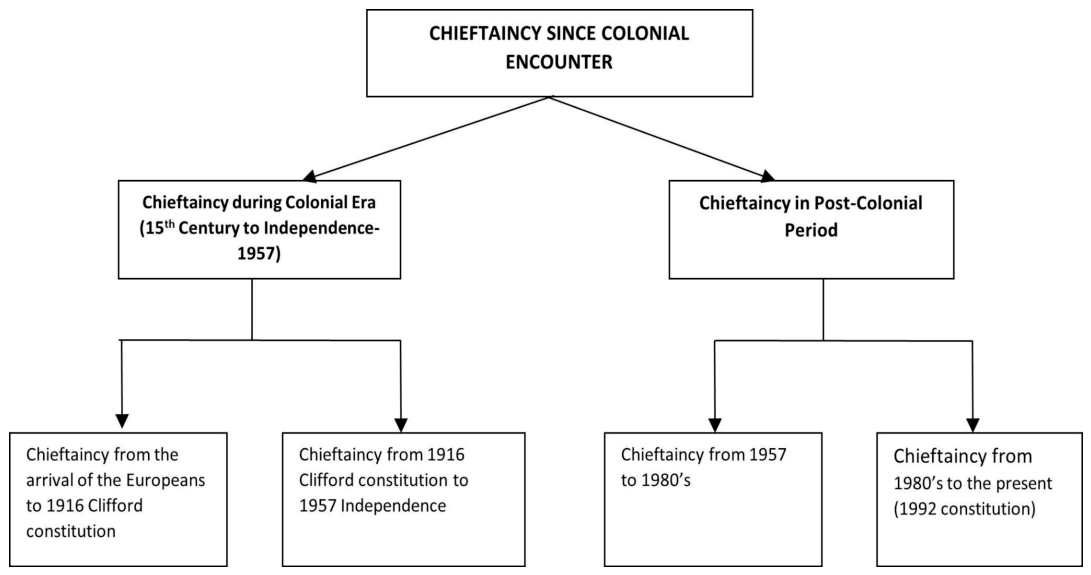
At the same time, the institution of chieftaincy has not remained static. Its authority, functions, and legitimacy have been repeatedly reconfigured through external political forces and internal social change, including the long arc of European contact beginning in the late fifteenth century and the later consolidation of colonial rule, followed by the post-independence state and its evolving legal and administrative overlays (see, for example, the broader historical timeline of coastal fortification and early European presence from 1482 onward). To clarify these shifts analytically, this article distinguishes two broad periods: (1) the colonial and late-colonial configuration of chieftaincy, from early European contact through the formal colonial era and culminating in independence in 1957, and (2) the postcolonial period, from 1957 to the present, in which chieftaincy continues to interact with statutory governance, changing political economies, and contemporary land pressures.
Figure 1 summarizes this periodization and the key institutional inflection points discussed in the sections that follow.
1.7. Periodization and Institutional Change Under Colonial and Postcolonial Governance
Within the colonial period, two sub-phases are commonly distinguished. The first extends from early Portuguese arrival through the introduction of constitutional government reforms associated with Governor Sir Hugh Clifford in 1916. The second begins with these constitutional arrangements and continues through the late-colonial transition to independence in 1957 (
Agbodeka 1972;
Baku 1991). The postcolonial period can likewise be separated into two phases. The first spans the early independence era from 1957 to the late 1980s, while the second covers chieftaincy within contemporary constitutional governance, particularly from the 1992 Constitution to the present.
During the first phase of the colonial era, chiefs retained substantial authority within their territories, including governance over inhabitants and significant influence over local resources. Colonial administrations frequently relied on traditional authorities to secure compliance and facilitate local administration. In this period, chiefs’ military, spiritual, political, and economic functions remained visible and operational, and authority was often exercised through relatively direct knowledge of, and control within, local jurisdictions.
In the second colonial phase, however, the authority and responsibilities of chiefs increasingly contracted. Constitutional reforms and the expanding influence of Christianity and Islam, alongside Western education and new administrative structures, contributed to a gradual displacement of chiefly authority. As British control consolidated, governance attention shifted toward legislative councils and assemblies constituted to advise the colonial executive. Subsequent constitutional arrangements in 1925, 1946, 1951, and 1954 further reoriented political authority away from traditional leadership and toward emergent elites and political actors favored by colonial administration (
Boafo-Arthur 1999,
2003;
Kludze 2000). These shifts occurred within the broader architecture of indirect rule, through which customary authority was selectively recognized but increasingly subordinated to colonial political priorities and administrative procedures.
By independence, chieftaincy entered the postcolonial era already constrained by these late-colonial transformations. Some accounts locate a critical rupture in the defeat of the Asante Kingdom and the failure of efforts to restore precolonial authority structures, often discussed in relation to Nana Yaa Asantewaa’s resistance and its aftermath (
Akyeampong and Obeng 1995;
Brempong 2000;
McCaskie 2007). British victory strengthened Western governance institutions and expanded the influence of educated elites whose proximity to colonial administrative systems positioned them as central intermediaries in the evolving political order (
Coleman 1954;
Gocking 2005). In this context, chieftaincy was increasingly narrowed in scope relative to its precolonial functions, particularly regarding resource control and judicial authority.
Over time, chiefs’ roles in adjudication and resource governance became more limited. The palace ceased to function as the principal judicial arena for many disputes, and chiefs’ authority over communal resources, particularly land, was increasingly reframed by statutory oversight and state-trusteeship logics (
Boafo-Arthur 1999,
2003;
Kludze 2000). In parallel, the spiritual legitimacy historically associated with chieftaincy weakened in many communities as Christianity, Islam, and other religious traditions expanded, and as aspects of indigenous spiritual practice were delegitimized within dominant religious discourses.
The second postcolonial phase, from the early 1990s to the present, reflects a mixed pattern of institutional recognition and intensified contestation. On one hand, chieftaincy has been incorporated into formal governance architecture through state institutions and advisory roles, including a designated ministerial portfolio, the strengthening of traditional councils, and the inclusion of chiefs and queen mothers within national advisory structures such as the Council of State. On the other hand, this period has also been marked by persistent challenges, including heightened chieftaincy succession disputes, conflicts over land and property, allegations of corruption and rent-seeking, and intensified tensions between chiefs and sections of their communities (
Boafo-Arthur 1999,
2003;
Gyapong 2006;
Kludze 2000).
Despite the historical contraction of chiefs’ formal powers within modern governance arrangements, many indigenous communities continue to accord chieftaincy high status and authority. This esteem is often grounded in cosmological understandings that position chiefs as legitimate human intermediaries between the community and the sacred order, with obligations extending beyond administrative leadership to moral guardianship and the custodianship of the land.
Across diverse African contexts, this institutional legitimacy is encoded and reproduced through oral traditions, including proverbs, music, and folk narratives that frame chiefs as sources of direction, arbitration, and collective order. In Asante Twi, the proverb
sε wo werε firi ɔhene kyinie a, wo yera bedwa ase conveys the directive and orienting function of chieftaincy, suggesting that social navigation depends on recognizing chiefly authority and the ordered space it symbolizes. Comparable formulations appear elsewhere. A Malawian proverb describes the chief as “like a rubbish heap; everything comes to him,” emphasizing centrality as a point of aggregation for social claims and disputes (
Harries 1942). A Nigerian proverb that portrays the chief as “a reward of God” similarly frames chieftaincy as divinely sanctioned authority rather than merely an administrative office. Taken together, these cultural forms position chiefs not only as political leaders but also as institutional custodians of land, property, and community order, thereby reinforcing the normative basis for articulating environmental responsibilities and resource governance.
1.8. The Chieftaincy Institution, Challenges, and Way Forward
The persistence of Indigenous peoples and cultural practices across Africa signals the durability of traditional governance systems, despite sustained political, economic, and social disruption. In many communities, the continued presence of traditional leaders serves as a living institutional reminder of intergenerational obligation, namely, responsibility to future generations and accountability to ancestral and spiritual authorities. At the same time, chieftaincy has faced sustained and intensifying pressures in many African contexts, particularly over the past two decades (
Boafo-Arthur 2003;
Nyamnjoh 2003;
Odotei and Awedoba 2006).
A central source of tension has been the increasingly explicit framing of modern democratic governance as a rival system rather than a complementary governance layer. In several West African settings, chieftaincy has been criticized as incompatible with democratic norms, often portrayed as opaque, hereditary, and insulated from public scrutiny (
Bamfo 2000;
Beall et al. 2005). These critiques frequently hinge on perceived differences in legitimacy, accountability, and decision-making procedure. Whereas democratic governance is typically justified through electoral authorization and codified legal-rational authority, chieftaincy is commonly grounded in customary law, lineage-based legitimacy, ritual sanction, and communal consent mechanisms that do not map neatly onto liberal democratic assumptions.
This paper treats these tensions as a governance design problem rather than a binary choice between “traditional” and “modern” authority. In practice, communities routinely navigate overlapping institutions, and the key empirical question is how authority, accountability, and decision rights are distributed across systems, especially in land and resource governance. To clarify the points of divergence that often structure policy debates,
Table 1 summarizes core philosophical and procedural differences commonly associated with democratic governance and chieftaincy, focusing on sources of legitimacy, mechanisms of accountability, and typical decision-making processes.
1.9. Colonial Reconfiguration and the Uneven Legacy of Indirect Rule
Fundamental differences in sources of authority and accountability help explain the enduring tension between chieftaincy institutions and modern state governance. Across the continent, traditional institutions have undergone major political and social transformations, some reflecting internal institutional evolution and others shaped by external intervention, particularly during the colonial period (
Keulder 2000). Drawing on Namibia,
Keulder (
2000) argues that traditional authority remains relevant in contemporary governance, in part, because chiefs historically exercised control over core survival functions, including land allocation, resource management, communal labour, and, in some contexts, law and order (p. 150). Ghana reflects a similar pattern of institutional durability. Although colonization reshaped chieftaincy and reduced chiefly influence within communities, the institution has persisted and continues to carry social and territorial significance (
Capps 2020;
Geschiere 1993).
At the same time, colonial impacts on traditional authority were uneven across contexts, particularly under indirect rule. In Namibia,
Keulder (
2000) notes that indirect rule often expanded the operational authority of traditional leaders by assigning coercive administrative functions. Chiefs became local lawmakers, tax collectors, police commissioners, and judges, and customary law could be repurposed to maintain colonial order, to the point that colonial governance was absorbed into what appeared customary (
Keulder 2000, p. 150). Ghana’s experience differed. While indirect rule increased the authority of some chiefs, it also undermined the legitimacy of others, particularly where chiefs became associated with colonial administration and were perceived as advancing imperial interests (
Crook 1987;
Firmin-Sellers 2000). In some settings, colonial authorities disregarded customary rules by appointing “warrant chiefs,” whose legitimacy was contested because communities experienced their authority as imposed rather than traditionally sanctioned (
Collins and Burns 2007;
Ranger et al. 1983).
Participants and historical accounts also point to internal institutional tensions that colonial governance could intensify, including conflicts between chiefs and chief priests or priestesses who were regarded as enforcers of communal spiritual law. When chiefs’ decisions aligned with colonial priorities but contradicted spiritual obligations, religious authorities could challenge chiefly legitimacy by invoking ancestral sanction. Indirect rule thus produced an enduring legacy of unequal authority, including an emergent privileged class of chiefs whose influence was strengthened by proximity to colonial and, later, state elites. This legacy continues to shape contemporary status hierarchies within chieftaincy, including the practical advantage conferred by English literacy and the continued importance of state recognition processes such as gazetting, which some scholars trace to administrative practices introduced under indirect rule (
Bob-Milliar 2009;
Mensah-Brown 1969;
Ray and Eizlini 2011).
1.10. Contemporary Constraints, Legitimacy Conflicts, and Land Reforms as Structural Pressure Points
Beyond colonial legacy, participants and scholars argue that modern governance architectures often limit the effective functioning of chieftaincy. A central point of friction concerns legitimacy. Chiefs are frequently portrayed as “undemocratic” because selection processes do not follow electoral models, and this framing is used to justify restricting the scope of customary authority (
Proctor 1968;
Rathbone 2000). These critiques often rest on a narrow definition of democratic legitimacy that equates representation exclusively with elections, thereby contributing to the view that hereditary or monarchical forms of governance are archaic (
Cook 2007).
However, treating chieftaincy as inherently incompatible with democratic governance raises conceptual and comparative questions. Several states that are widely regarded as stable democracies retain constitutional monarchies, suggesting that the presence of non-electoral authority is not, on its own, evidence of democratic failure. The central analytic issue is therefore not whether chieftaincy is “democratic” in an electoral sense, but how authority, accountability, and decision rights are distributed across overlapping institutions. Indeed, some scholars argue that constitutional monarchy arrangements that incorporate local cultural frameworks may offer governance models that protect cultural integrity while remaining compatible with global political and economic structures (
Bogdanor 1995;
Huntington 1993).
The symbolic reclassification of chieftaincy into a ceremonial institution was illustrated by an example raised by a participant regarding the 2012 Ghana general elections. Political candidates publicly acknowledged the authority of the Asantehene by signing an agreement to accept electoral outcomes. Yet, shortly after the election, legal challenges proceeded through the courts, and those who referenced the prior agreement were met with resistance on the grounds that only statutory institutions had legitimate adjudicatory authority. In the participant’s view, this sequence demonstrated the limited institutional standing of chieftaincy in formal governance, even when chiefs retain strong symbolic influence.
A second major structural pressure point involves land reform and the political economy of land. Scholars argue that land has been subject to shifting policy rationales and regulatory experimentation, reflecting its centrality to economic development, cultural identity, and environmental governance (
Atkins 1988;
Kerekes and Williamson 2010). Participants and the literature suggest that reforms can accelerate commodification dynamics, increasing the likelihood that land is allocated through market logic rather than through customary stewardship norms, and weakening land’s spiritual and moral status within Indigenous governance frameworks. Land tenure across Africa remains polarized between communal and individualized systems (
Obeng-Odoom 2012). In Ghana, both private and public land regimes operate concurrently, with scholarship estimating that approximately 78% of land is held under customary or private arrangements, about 20% under state control, and a smaller share held jointly (
Obeng-Odoom 2012). Constitutional definitions of public lands and subsequent reforms, including the Land Administration Project initiated in the early 2000s, sought to harmonize policy, restructure institutions, and improve monitoring and evaluation (
Kudom-Agyemang 2009;
LAP 2009;
Obeng-Odoom 2012,
2016). These reforms, introduced under both colonial and postcolonial governments, continue to shape the practical space within which chiefs exercise authority over land, resource management, and community-level stewardship.
1.11. Study Setting and Sites
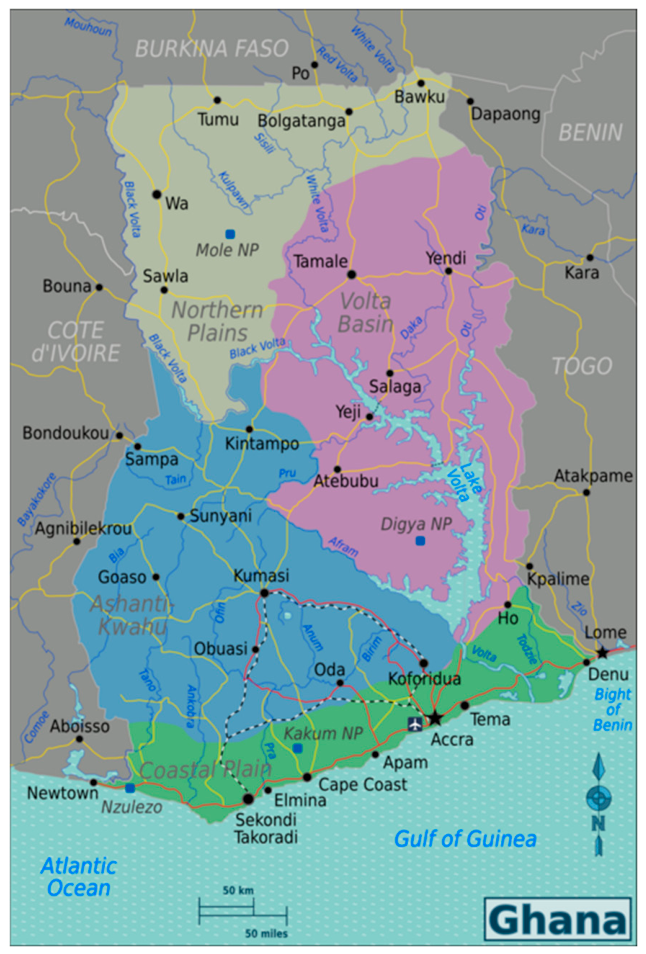
Ghana’s Indigenous communities have experienced sustained transformation in values, norms, and governance practices following the introduction and institutionalization of Western political economy and social systems. While modernization has expanded infrastructure and connected localities to broader national and global networks, participants and prior scholarship note that it has also reconfigured Indigenous social, political, and economic structures. In particular, industrial capitalism has accelerated a shift from communal governance and collective resource custodianship toward individualized property relations. Communal assets such as land, sacred groves, and culturally significant plants and animals, once governed as shared resources, have increasingly been treated as commodities that can be privately acquired and traded. These changes have widened socio-economic inequalities, altered local socialization processes, and shifted practical authority from chiefs and traditional leaders toward state appointees, elites, and actors with formal education or economic power. Participants described these shifts as consequential for environmental stewardship because they can weaken the customary respect for authority and intergenerational accountability that historically supported norms of communal responsibility and balanced human–environment relations (
Figure 2).
This study was conducted in two regions, Greater Accra and Eastern, selected to capture variation in the pace and intensity of socio-economic change, the structure of customary governance, and land and environmental pressures shaping Indigenous stewardship practices. The two regions also offered access to participants from multiple ethnolinguistic groups and enabled comparison between a rapidly urbanizing coastal capital region and an inland setting where customary life remains salient while undergoing gradual transition.
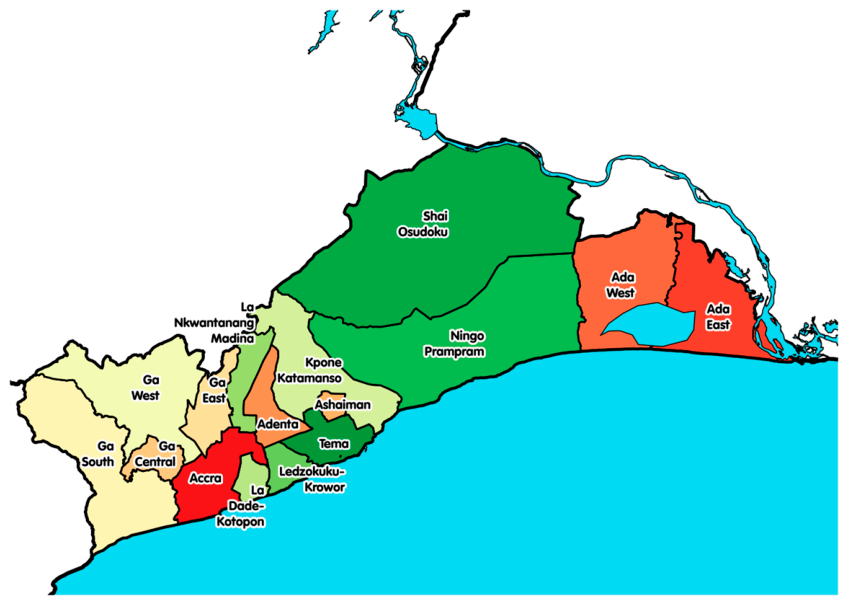
Greater Accra Region. Greater Accra is Ghana’s coastal capital region and home to Accra, the national capital and the country’s largest city. Accra’s urban population has been estimated at 1,658,937 (
Grant and Yankson 2003). The region includes Indigenous Ga and Ga-Adangbe communities, including localities such as Accra, Amamole, and Pantang. Migration has also made Greater Accra highly multi-ethnic, with representation from most of Ghana’s ethnolinguistic groups, and with Ga, Akan, and Ewe communities constituting major population groups in the capital area. This setting is analytically important for examining Indigenous environmental stewardship because rapid urban expansion, in-migration, and state and private development activity intensify competition over land and reshape customary tenure and authority. Participants described processes of displacement, contested land access, and the erosion or circumvention of customary rules governing land and ownership. Accra also faces persistent environmental challenges, increasing the practical relevance of understanding how Indigenous institutions interpret stewardship under conditions of high development pressure. Finally, the concentration of government ministries and departments in Accra supported access to secondary documentation for the macro-level context of governance (
Figure 3).
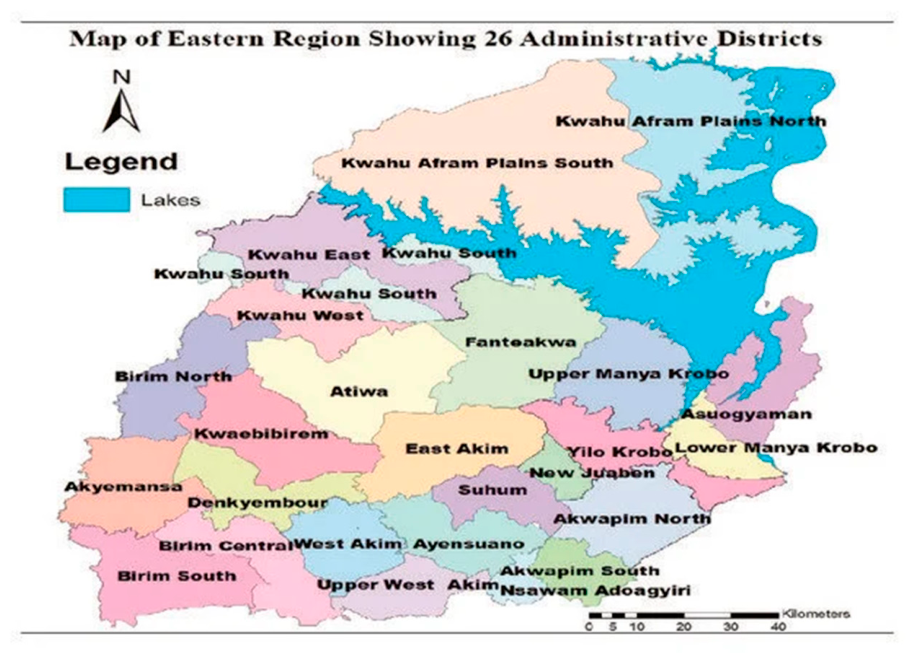
Eastern Region. The Eastern Region provides a contrasting cultural and governance landscape in which customary tenure and Indigenous philosophies remain visible in everyday life, while socio-economic transition proceeds at a slower pace than in the capital region. The study sites in this region were Aburi and Nsawam, communities situated within predominantly Akan areas where participants described continued adherence to Indigenous philosophies concerning life and the environment. Relative to Greater Accra, respondents framed the Eastern Region as a setting where “modern development” has expanded gradually but meaningfully, offering an analytically useful context for examining how stewardship norms and customary authority adapt during transition rather than under acute metropolitan pressures.
Demographically, the Eastern Region has been described as Ghana’s sixth largest region, with 2,596,013 inhabitants, representing approximately 10.7% of the national population, and covering about 19,323 square kilometres (approximately 8.1% of Ghana’s land area). The region shares boundaries with Central, Greater Accra, Ashanti, Brong Ahafo, and Volta Regions, and is governed through multiple administrative districts and municipalities (
GOG 2012). Inhabitants include four major ethnic groups, with Akans forming the largest share (52.1%), followed by Ga-Dangmes (18.9%), Ewes (15.9%), and Guans (7.2). Apart from the Ewes, these groups are described as Indigenous to the region (
GOG 2012). Christianity is the majority religion (80.2%), followed by Islam (6.1%) and African Traditional Religion (2.4%) (
GOG 2012). These characteristics support the study’s comparative logic by situating stewardship within an inland region that contains diverse Indigenous cultural groups and where customary governance remains salient, while also reflecting broader national changes in religion, education, and political economy.
Language accessibility further supported site selection. Across both regions, participants commonly spoke Twi, Ga, Ewe, and English (often alongside additional local dialects), enabling interviews to be conducted in languages familiar to participants and facilitating engagement across multiple ethnolinguistic communities (
Figure 4).
2. Results
Thematic analysis of interviews with chiefs, elders, and other community respondents identified five interrelated themes describing how traditional leadership is understood to support environmental stewardship and how contemporary governance conditions shape the viability of that role.
Theme 1: Traditional leadership is framed as an integrated mandate of governance, custodianship, and spiritual legitimacy
Participants described chieftaincy as a governance institution that combines political authority, custodianship of land and resources, and spiritual legitimacy. Chiefs were positioned as responsible for community wellbeing across spiritual, physical, emotional, and material domains, and as intermediaries linking the community to both sacred authority and external stakeholders.
“Someone who rules the land, religious priest, leader of a community, or ruler of a clan; they serve as middlemen between community members and the gods, as well as a link between the government and any other person who may have an interest in the community. They are responsible for the general wellbeing of all community members; this includes their spiritual, physical, emotional and material good. Traditional leaders have jurisdictions, and all the resources within that jurisdiction are under their control, so ultimately traditional rulers are the owners of the resources and should be the managers of the resources together with the council of elders”.
(File 00-TL-04, Text unit, lines 6–15)
A related emphasis concerned customary consent and legitimacy as distinct from statutory authority. Participants argued that even where resources are formally vested in the state, customary leaders retain practical decision authority locally through established consent processes.
“A Traditional leader is someone who has the traditional and spiritual charge to rule the land, religious priest, leader of a community, ruler of a clan etc. Traditional leaders have jurisdictions, and all the resources within that jurisdiction are under their control. So ultimately traditional rulers are the owners of the resources and should be the managers of the resources. In Ghana, even though by the constitution, resources are vested in the president, the word vested is not ownership, so ownership is still with traditional leaders. So it can be said that since nothing will get done without their consent, traditional leaders are moving forces in each community. They serve as middlemen between community members and the ancestors. They serve as a link between the government and any other person who may have an interest in the community. Together with the council of elders, they are responsible for the general wellbeing of all community members; this included their spiritual, physical, emotional and material good”.
(File 00-TL-03, Text line 4–13)
Theme 2: Land governance functions as the primary mechanism through which stewardship is enacted
Land tenure and allocation practices were described as the main channel through which stewardship becomes practical and enforceable. Participants emphasized land as communal, supervised, and regulated through local protocols, rather than treated as a commodity. Chiefs and elders were described as managing access through socially visible procedures that embed accountability and intergenerational continuity.
“In the past, land was seen as a communally owned resource and so even if your parents want to give you an area to construct a small house, other elders in the community would be brought into the know. There was no way you could say I have bought the land; you couldn’t buy a land. But there were two different ways of giving land out, we had a certain portion in the village that we gave to the poor, or a foreigner who has been living there for a while; we didn’t really sell land to the local people; they just paid small amounts to be shown the land and then a ‘tomi’ tree was planted as an indicator, and the person then tells his children, so it becomes their property for life”.
(File 00-TL-01, Text line 4–13)
This account demonstrates stewardship as process, including shared oversight, differentiated access pathways, and boundary marking. Participants treated these practices as mechanisms that align land use with communal norms and obligations.
Theme 3: Governance incoherence creates an accountability mismatch that undermines chiefly legitimacy
Participants repeatedly characterized contemporary governance as a misaligned arrangement in which chiefs remain socially accountable for local outcomes while lacking enforceable authority over many decisions affecting land and resources. Respondents argued that statutory systems and external actors can override customary expectations, leaving chiefs responsible without corresponding decision rights. Administrative restructuring was also described as destabilizing jurisdictional coherence and weakening community trust.
“Since I became a chief, I have been cooperating with the government, but all of a sudden we were told you are not under this assembly but the other, first we were under one district but all of a sudden it was changed and now we are under a different one, when this happens the populace question our integrity”.
(File 00-TL-02, Text unit line 77–80)
Participants also proposed a specific corrective principle, described as “first arrangement,” in which traditional authorities would hold primary standing in local resource governance and the state would play a secondary, enabling role.
“I believe strongly that if traditional leaders have first arrangements with the government having the second, things will be fine. When government is looked at as having the first arrangement, the resources will be degraded in the name of modernization. The problem begins when we think that legislation that are made in parliament surpass those at the local level. Just like district assemblies, chiefs should have the power to make bye-laws and whoever comes to develop that local resource should go by that bye-law. Chiefs need to see that the present system; is a continuation of the traditional system and not a replacement of the traditional system, otherwise they will always be there and the government will always come with a second plan and succeed in doing whatever they want”.
(File 00-II-16, Text line 40–51)
Theme 4: Political economy pressures and capacity constraints weaken legitimacy and elevate risks of misconduct
Participants linked some contemporary failures of stewardship to material constraints, uneven access to resources, and limited administrative capacity. Several respondents described financial precarity among many chiefs, rising pressures around land value, and the emergence of revenue-seeking behaviors that damage institutional legitimacy. This theme was articulated as a structural pathway rather than solely an account of individual moral failure.
“At first, chiefs were being paid, but now they are all not paid, and the lands on which they used to farm are all gone, so they are hungry. Money has become the main issue hindering their efforts. Most of them are not educated; their sources of daily bread are inadequate. Those who have aligned themselves with NGO’s in conservation, most of the times misuse the funds entrusted to them. They are corrupt and have started selling sacred lands. I think they need to be put on the single spine salary structure. Its greediness too, this leads to succession disputes, which is a major hindrance to efforts. Churches and other bodies demand too much from these chiefs so chiefs now sublimely support political parties as well so they can get some funding”.
(File 00-TL-03, Text line 18–27)
Capacity constraints, especially literacy and formal education, were described as limiting chiefs’ ability to engage statutory systems and negotiate with external actors, with downstream effects on land monetization pressures.
“Our role is being undermined because some of us are not literate. Though we can speak some little English, if the government can help us get some form of education, it will enable us to make meaningful contributions to our localities. Our dependence on the sale of land and it resources would be reduced”.
(File 00-TL-01, Text unit line 52–54)
Theme 5: Participants proposed practical pathways for strengthening stewardship through participation, resourcing, and local autonomy
Participants emphasized that strengthening traditional governance requires visible, participatory initiatives that translate authority into tangible community benefits. Chiefs were described as capable conveners who can mobilize residents and align stakeholders when they use culturally legitimate platforms and sustained community dialogue.
“We try to bring the community on board in two folds; sometimes we meet as a community to talk about the need to safeguard our environment and the need for our people not to use polluted sources so as to stay fit. On another score, the traditional leadership of these districts, Ga West and South have instituted the annual ‘Homowo’ (the name of the main festival of the Ga people) school, where we create a forum annually where we choose topical issues, and get resource persons to talk about them; so that at the end of the day, traditional leaders and other stakeholders in the development agenda share common thoughts, so that they can be abreast with common trends in development. This we have been doing for the past 7 years”.
(File 00-TL-02, Text line 30–39)
Respondents also framed predictable institutional resourcing for traditional councils as a governance lever that could support transparency, reduce incentives for informal revenue extraction, and strengthen collaboration with contemporary systems.
“If all traditional councils across Ghana could be identified and resourced such that every traditional council will be given some kind of resource to develop its traditional area, under the guidance and guise of the registrars and the presidents of the traditional councils, I think we will compel traditional authorities to cooperate with modern trends”.
(File 00-TL-02, Text line 39–42)
Finally, some participants argued that traditional governance should be financially self-regulated and less dependent on the state, drawing on earlier community development models based on communal labour, pooled contributions, and revenues from communal assets.
“…we have ways to bring our people together in the form of communal labor and communal contribution. Every person in the village helped. Now nobody wants to because they want to wait on the government. We used to have community-owned lands. We also rented to farmers and the products shared or use for the development of the whole community. We also had some properties and resources whose profit just went into projects that benefited the community.”
3. Discussion
This study examined how indigenous environmental stewardship in Ghana is mediated through traditional leadership, and how contemporary governance conditions shape the feasibility of that role. The findings position chieftaincy as a governance institution with three linked functions. First, chiefs are understood as jurisdictional authorities responsible for community wellbeing and custodianship of land and resources. Second, chiefs derive legitimacy through customary selection, intergenerational accountability, and spiritual sanction, with councils of elders providing an internal deliberative structure. Third, chiefs serve as boundary-spanners, connecting communities to the state and external actors. Taken together, these functions indicate that chieftaincy is not only ceremonial, but also a potential governance mechanism through which environmental norms become socially enforceable, especially where land allocation and oversight remain anchored in customary authority.
3.1. Chieftaincy as a Stewardship Institution Grounded in Jurisdiction, Consent, and Intergenerational Accountability
A central contribution of the findings is that stewardship is not presented as an abstract value, but as an institutional arrangement. Participants described chiefs as managers of resource use within defined jurisdictions, acting in consultation with councils of elders and within an accountability frame that reaches beyond immediate political cycles. In this account, the consent function is decisive. Participants argued that customary legitimacy enables chiefs to regulate access to land and resources in ways that embed social oversight, continuity, and obligation to future generations. This supports the proposition advanced in the introduction that indigenous governance systems often sustain stewardship through institutionalized accountability rather than through individual environmental attitudes alone.
3.2. Land Governance as the Practical Site Where Stewardship Is Enacted
Across accounts, land emerged as the primary governance domain through which stewardship becomes operational. Customary practices described by chiefs and elders emphasize supervised land allocation, collective visibility of decisions, and intergenerational continuity. These are governance mechanisms that shape behaviour by making land access conditional on adherence to recognized protocols rather than on private purchase alone. The implication is that customary land tenure can function as a stewardship technology, not because it is inherently sustainable, but because it can align resource use with community norms through oversight, consent, and local accountability.
3.3. Why Stewardship Erodes Under Contemporary Arrangements
Participants also described pathways through which stewardship weakens. The most analytically important mechanism is an accountability mismatch created by institutional incoherence. Chiefs remain socially answerable for outcomes on their lands while lacking enforceable decision rights over many land and development decisions. Administrative restructuring, shifting district alignments, and a perceived privileging of statutory authority over local norms intensify uncertainty and can damage the legitimacy of chiefdoms. This matters for environmental governance because legitimacy functions as a compliance resource. When legitimacy erodes, chiefs have fewer practical tools to mobilize collective action, regulate land use, or convene stakeholders around shared stewardship goals.
A second set of pressures relates to political economy and capability constraints. Participants linked financial precarity, limited resourcing, and uneven access to external funding with increased risks of rent-seeking and contested land transactions. They also described literacy and administrative capacity as enabling conditions for chiefs to engage state systems, negotiate with external actors, and reduce reliance on land sales as a revenue source. These findings suggest that some behaviors framed publicly as moral failure may reflect structural incentives produced by under-resourcing and governance ambiguity, particularly in contexts where land has become a primary monetizable asset.
3.4. Toward Integration as Governance Design, Not Symbolic Recognition
Participants did not propose a return to a precolonial governance order. Instead, their solutions describe integration as governance design. The “first arrangement” principle articulates a specific reordering of decision rights in which chiefs hold primary standing in local resource governance, with the state playing a secondary enabling role, especially where land is governed customarily. Complementary proposals include strengthening chiefs’ convening capacity through participatory community programming, resourcing traditional councils under transparent oversight, investing in literacy and administrative training, and supporting locally anchored financing models that reduce dependence on land sales and political patronage. In combination, these proposals reflect an institutional pathway: align authority with accountability, and then resource the institution to reduce perverse incentives and increase governance competence.
3.5. Policy Recommendations
Based on the mechanisms identified in the findings, policy implications can be stated as actionable design choices rather than broad calls for “empowerment.”
Clarify decision rights for land and environmental governance in customary areas. Establish formal coordination protocols that require documented customary consent for land and resource development decisions in customary jurisdictions. This reduces accountability mismatch and increases procedural legitimacy.
Enable enforceable local by-laws through structured co-production. Create pathways for traditional authorities, in collaboration with district assemblies and relevant agencies, to develop locally specific environmental by-laws that are consistent with statutory safeguards. This operationalizes the “first arrangement” principle while avoiding parallel and conflicting rules.
Resource traditional councils with transparent accountability conditions. Provide predictable institutional support for traditional councils tied to clear reporting requirements, conflict-of-interest rules, and community-facing development plans. This approach addresses under-resourcing while reducing incentives for informal revenue extraction.
Invest in capacity building for traditional leadership and council administration. Provide training in administrative procedures, land documentation, negotiation, and basic regulatory literacy. This strengthens chiefs’ ability to engage with state systems and external actors and may reduce dependence on land monetization.
Support community-based financing and participation mechanisms. Encourage locally governed development funds, communal labour mobilization where appropriate, and transparent revenue management for community-owned assets. Such mechanisms can rebuild collective responsibility and reduce the expectation that development is exclusively a state function.
Strengthen dispute resolution and succession governance to protect stewardship capacity. Environmental governance becomes fragile under leadership disputes and land conflict. Strengthening mediation capacity and clarifying succession procedures, in collaboration with statutory institutions, can reduce governance instability that undermines stewardship.
These recommendations should be treated as design hypotheses for implementation and evaluation rather than as universal prescriptions. Each requires adaptation to local governance conditions, land tenure arrangements, and community preferences.
4. Methods
4.1. Study Design
This study used a qualitative, interpretive design to examine how indigenous philosophies and customary governance institutions shape environmental stewardship and accountability in Ghana. The broader project explored community understandings of sustainability and the institutional mechanisms through which environmental norms are communicated and enforced. This article presents a focused analysis of traditional leadership perspectives within that larger dataset.
4.2. Study Setting and Rationale for Site Selection
The study was conducted in Ghana’s Greater Accra and Eastern Regions to capture variation in customary authority arrangements and environmental governance pressures. Greater Accra is Ghana’s coastal capital region, characterized by rapid urbanization, high in-migration, intensive land market activity, and the concentration of state institutions and development actors. These conditions heighten contestation over land access, jurisdiction, and the coordination of customary and statutory authority. The Eastern Region sites (Aburi and Nsawam) represent peri-urban and semi-rural Akan settings where customary land tenure and traditional governance remain visible in everyday decision-making, while urban expansion and changes in land values increasingly shape local resource pressures. This two-region design was therefore analytically purposive, enabling examination of stewardship and authority in both a metropolitan high-pressure governance context and an inland transitional context. Data were collected between 2014 and 2016 in selected indigenous communities across Ghana’s Eastern and Greater Accra Regions. These regions were selected to capture variation in ecological context, settlement patterns, and customary governance arrangements, while remaining feasible for repeated field engagement.
4.3. Participants and Sampling
The broader study engaged 70 participants purposively selected for their proximity to, and experience with, community environmental practices and customary governance. Participants included knowledge keepers, traditional priests, chiefs, students, hunters, farmers, and other customary custodians. Recruitment used purposive and snowball sampling, beginning with community entry protocols and referrals from local leaders and respected intermediaries. For the purposes of this article, the analytic subsample focuses on interviews with five traditional chiefs and elders. This focus was selected a priori for this manuscript because the chieftaincy institution serves as a key locus of governance for land custodianship, norm-setting, and enforcement within customary systems.
4.4. Data Collection
Data were collected through in-depth, semi-structured interviews. Interview guides explored (1) community meanings of environmental sustainability, (2) customary rules, sanctions, and obligations related to land and resource use, (3) the role of chiefs and councils in enforcement and dispute resolution, (4) the spiritual and moral foundations of stewardship, and (5) perceived changes in chieftaincy authority across colonial and postcolonial governance. Interviews were conducted in locations chosen to support privacy and participant comfort. Where needed, interviews were conducted in local languages with interpretation support, and the recordings were then translated for analysis. Field notes documented contextual observations, reflections on community entry, and emerging analytic insights. Interviews were audio-recorded with permission and transcribed verbatim.
4.5. Data Analysis
Analysis followed a reflexive thematic approach, moving iteratively between data, analytic memos, and developing interpretations. Transcripts were first read in full for familiarization, then coded inductively to capture meanings, practices, and institutional logics related to stewardship and accountability. The code set was subsequently refined through constant comparison across cases and across participant categories in the full dataset, with particular attention to (1) authority and legitimacy, (2) governance mechanisms, (3) sanctions and compliance, (4) spiritual-moral foundations of stewardship, and (5) institutional change over time. For this manuscript, we conducted a focused analytic pass on the five chiefs and elders to develop a coherent account of chieftaincy as an environmental governance mechanism. Candidate themes were reviewed for internal coherence, distinctiveness, and fit with the full dataset; they were then finalized through team discussion and memo-based adjudication. Illustrative excerpts were selected to represent themes and to preserve participant meaning, while minimizing identifying details.
4.6. Analytic Sub-Sample for This Manuscript
The broader study engaged 70 participants across multiple roles (for example, knowledge keepers, priests, chiefs, students, hunters, farmers, and other custodians). This manuscript presents a focused thematic analysis of interviews with five traditional chiefs and elders. This sub-sample was selected using criterion-based purposive selection because the manuscript’s research question centers on chieftaincy as an institutional mechanism for environmental stewardship and land governance. Inclusion criteria were: formal recognition as a traditional chief or elder, involvement in community governance functions relevant to land or resource management, and interviews containing substantive content on stewardship, authority, and governance change. The final sub-sample also reflects feasibility and consent constraints, as some chiefs approached were unwilling to participate. The purpose of this focused analysis is depth of institutional interpretation rather than statistical generalization.
4.7. Methodological Rigor
Credibility was supported through prolonged engagement across the 2014 to 2016 study period, triangulation of perspectives across participant roles in the full sample, and systematic memoing to document analytic decisions. To strengthen interpretive dependability, coding definitions and thematic summaries were reviewed within the research team and refined through discussion. Transferability was supported by describing the study context, participant roles, and the institutional features of chieftaincy relevant to environmental governance, enabling readers to assess applicability to other settings.
4.8. Ethics
The study followed standard ethical guidance for human subject research, including voluntary participation, informed consent, and confidentiality procedures, and received approval from the University of Toronto Office of Research Ethics (#28051). Participants were informed of the study purpose, the nature of participation, and their right to withdraw without consequence. Given the visibility of traditional leadership roles, additional care was taken to remove identifying information in reporting and to present excerpts in ways that protect participants and communities.
5. Limitations
This study has limitations that should be considered when interpreting the findings. The chief and elder sub-sample is small and not intended to represent all traditional areas or leadership perspectives in Ghana. Purposive and snowball recruitment may introduce selection effects. Interviews reflect participant accounts and were not systematically triangulated with administrative records, land litigation data, or funding documentation. Also, the study’s regional focus limits transferability to significantly different customary systems and ecological zones. The analysis in this manuscript centers on a small subsample of five chiefs and elders drawn from a larger study. This supports the depth of institutional interpretation but limits claims about prevalence across all Ghanaian traditional areas. Also, the data were collected in two regions, Eastern and Greater Accra, and therefore may not capture variation in stewardship mechanisms and governance relations across other regions and customary systems. Also, interviews reflect participants’ accounts and may emphasize normative expectations of chieftaincy alongside critiques of contemporary constraints. The study did not independently verify all claims through documentary analysis of land cases, funding flows, or formal administrative decisions. Finally, the study design does not permit causal inference regarding the relationship between traditional authority arrangements and environmental outcomes. The findings instead identify plausible governance mechanisms and constraints that warrant further mixed-methods evaluation linking institutional arrangements to measurable environmental and social indicators.
6. Implications for Future Research
Future research should test the governance design hypotheses raised here. Comparative work across regions and customary systems could map how consent processes, council structures, and land documentation practices vary and how these variations affect stewardship. Mixed-methods studies could link institutional coherence and resourcing to outcomes such as the frequency of land conflict, perceived legitimacy, compliance with environmental rules, and indicators of environmental degradation. Implementation research could evaluate co-produced by-law models and resourcing approaches for traditional councils to determine what combinations reduce perverse incentives while strengthening accountability.
7. Conclusions
This study demonstrates that chieftaincy remains meaningful for indigenous environmental stewardship in Ghana because it functions as a governance institution, not only as a cultural symbol. Participants described chiefs as custodians of land and wellbeing, operating through councils of elders and grounded in intergenerational accountability and spiritual legitimacy. Stewardship is enacted most concretely through land governance, where supervised allocation and consent-based oversight can embed accountability and continuity in resource use.
At the same time, the findings show that stewardship capacity erodes under contemporary governance conditions that separate accountability from authority. Governance incoherence, administrative restructuring, and statutory dominance in decision-making can weaken chiefly legitimacy and reduce compliance capacity. Financial precarity, uneven institutional resourcing, and literacy constraints further shape incentives and limit chiefs’ ability to engage modern governance systems without relying on land monetization.
A viable way forward lies in integrating governance design. Policies that clarify decision rights, co-produce enforceable local by-laws, resource traditional councils transparently, strengthen administrative capacity, and support community-based financing can align authority with accountability and reduce incentives that undermine stewardship. Treating traditional authority as a practical governance resource, rather than solely as heritage or ceremony, offers a credible pathway for culturally grounded, institutionally feasible community-based environmental governance.