Article

What Constitutes the Modern Multi-Ethnic Nation-State of China? An Analysis of How the Late Qing New Policies Shaped Modern Multi-Ethnic China

Department of X Cultural Studies, Graduate School of Kookmin University, Kookmin University, Seoul 02707, Republic of Korea
*
Author to whom correspondence should be addressed.
Genealogy 2026, 10(1), 21; https://doi.org/10.3390/genealogy10010021
Submission received: 30 June 2025 / Revised: 19 January 2026 / Accepted: 2 February 2026 / Published: 6 February 2026

Abstract

Situated within the field of modern Chinese political history, this study investigates the Late Qing New Policies (1901–1911) as a pivotal transition from a traditional tributary empire to a modern multi-ethnic nation-state. A critical limitation in current scholarship is the tendency to reduce these reforms to mere expedients for dynastic preservation, thereby overlooking the complex mechanisms by which they fundamentally reconstructed national identity and interethnic power structures amidst the “triple crisis” of territory, sovereignty, and nationality. To address this, the article employs a comprehensive historical analysis to explore how institutional restructuring in administration, military, and ideology catalyzed the transformation from imperial autocracy toward a “responsible government” framework. The research is distinguished by its innovative application of Anthony D. Smith’s theories of “ethnic” versus “civic” nationalism to deconstruct the “myth-symbol complex” of the Chinese nation, bridging the theoretical divide between the “New Qing History” paradigm and empirical modernization narratives. Findings demonstrate that while the Manchu leadership aimed to secure formal primacy, the practical implementation of reforms engendered a de facto Han-supported power structure, compelling the reconceptualization of the state as a “multi-ethnic constitutional monarchy” and establishing the institutional logic for the “Five Races Under One Union” model. Consequently, this study offers significant academic value by redefining the New Policies as the foundational phase of modern China, providing a crucial theoretical framework for understanding the continuity of China’s multi-ethnic statehood and national identity beyond the dynastic collapse.

1. Introduction

This study addresses the fundamental historical question of how the Qing Dynasty transitioned from a traditional tributary empire into the prototype of a modern multi-ethnic nation-state. Specifically, it investigates the Late Qing New Policies (1901–1911) to determine how these comprehensive institutional reforms reshaped the interethnic power structure and state identity. In this context, the study defines “modern China” not as a vague temporal continuity, but specifically as the rapid institutional metamorphosis initiated during the post-1900 New Policies era: the transition of the state apparatus from traditional imperial governance (centered on the dynastic court and local yamen) into a “responsible government” operating within a constitutional monarchy framework. This transformation was totalistic—fundamentally altering administrative departments, military organization, and socio-cultural norms—and created a modern state structure that was ultimately inherited in its entirety by the Republic of China.
While often viewed merely as passive measures for dynastic preservation, this research argues that the New Policies constituted a pivotal transitional phase that laid the essential groundwork for the construction of the modern Chinese polity. The study elucidates that the Qing leadership endeavored to transform the autocracy into a modern constitutional monarchy under mounting internal and external pressures. However, this process revealed a critical paradox: while Manchu elites sought to retain formal primacy through a “Manchu-led” constitutional framework, the practical implementation of reforms (such as the New Army and Provincial Assemblies) relied heavily on the Han bureaucratic class and emerging gentry, resulting in a de facto “Han-supported” power structure. By systematically examining the friction between the general modernization of state institutions and the specific management of ethnic relations, this research highlights how the resulting identity contest compelled the state to reconceive itself from a proprietary Manchu domain into a “multi-ethnic constitutional monarchy.” Consequently, although the reforms failed to save the dynasty, they successfully established the institutional logic and territorial legitimacy for the “Five Races Under One Union” model, thereby answering the historical inquiry of “What is China?” during its critical transition from imperial rule to a modern nation-state.

1.1. Historical Background and Research Significance of the Late Qing Reforms

From its very inception, the Qing Dynasty—led by a minority Manchu (Jurchen) ruling elite—faced the formidable task of governing a multi-ethnic empire dominated by the Han majority. The formation and consolidation of the Qing Dynasty constituted, in essence, a complex historical process in which a minority people originating from Northeast China gradually constructed and sustained a vast empire. The predecessor of the Qing was the Later Jin polity, established by Nurhaci, chieftain of the Jianzhou Jurchens, in the waning decades of the Ming dynasty. In the forty-fourth year of the Wanli reign (1616), Nurhaci proclaimed himself khan at Hetu Ala, adopting the dynastic title “Great Jin”, which historians refer to as Later Jin. His son Hong Taiji subsequently changed the dynastic title to “Great Qing” in the first year of the Chongde reign (1636), thereby marking the formal foundation of the Qing Dynasty. This transition signified not merely a change in nomenclature but also the evolution of the regime from a regional separatist power toward the embryonic form of a multi-ethnic empire (Y. Li 2015).
The fundamental institutional and military pillar of Qing rule was the Eight Banners system, created by Nurhaci. Originating in the hunting organizations of the Jurchens, the Eight Banners gradually developed into a socio-political structure that combined military, administrative, and civil functions. The Manchu Eight Banners initially provided the core strength of the Qing polity, but as expansion proceeded, the ruling elite systematically incorporated external forces. First, through conquest and intermarriage, the Qing court organized the Mongol Eight Banners, enabling Mongol cavalry to play a crucial role in imperial expansion and frontier defense. Second, large numbers of surrendered Han military officers and artisans were enrolled into the Han Eight Banners, which not only facilitated the Qing’s entry into the Central Plains and the pacification of China proper but also, to a certain degree, served as an intermediary between Manchu and Han cultural spheres. Through this process, the Qing ruling stratum ultimately evolved into a pluralistic political community centered on the Jianzhou Jurchens while integrating Mongols, Han Chinese, and other groups.
Confronted with the demographic reality of a Han population constituting the overwhelming majority, Qing rulers articulated the foundational principle of “primacy of the Manchus” (首崇满洲), thereby securing the privileged position of Manchu aristocracy at the core of political power. Yet, in tandem with this principle, the Qing court also adopted strategies of coalition and compromise to achieve effective governance over Han society. By preserving the civil service examination system (科举制度) and thereby incorporating Han literati into the bureaucratic hierarchy, and by institutionalizing the parallel appointment of Manchu and Han officials, the Qing maintained Manchu prerogatives while simultaneously integrating Han elites into the state apparatus. This dual approach ensured both the preservation of Manchu dominance and the practical functioning of a multi-ethnic imperial order. Accordingly, the Qing Dynasty’s institutional configuration reflected a careful balance between safeguarding the central position of Manchu rule and addressing the structural imperatives of governing a multi-ethnic empire.
As its national authority solidified, ethnic tensions centered on Manchu–Han relations grew ever more acute: the Manchu rulers, caught between “Sinicization” and “anti-Sinicization,” continually sought a balance between China’s universal values and its distinct ethnic character. By the mid- to late Qing, the relentless pressure from European powers accelerated the dynasty’s decline and eroded the legitimacy of the traditional “all-under-Heaven” tributary order. At this critical juncture, with Western influence deepening, urgent and indispensable reforms were imperative to preserve the state. The Late Qing Reforms, in the narrow sense, refer to the comprehensive modernization and political reforms implemented by the Qing Dynasty between 1901 and 1911 under severe internal and external pressures. In the broad sense, these reforms can be traced back to the Self-Strengthening Movement (1861–1895), particularly the series of reform measures following the 1898 Hundred Days’ Reform (戊戌變法). To understand the historical background of the Late Qing Reforms, one must begin with the Self-Strengthening Movement during the T’ung-chih Restoration period (R. Wang 2018; An 2016).
At the turn of the nineteenth to the twentieth century, the Qing Dynasty was engulfed in a dual crisis of domestic turmoil and foreign aggression. Internally, successive popular uprisings such as the Taiping Rebellion and the Boxer Movement severely undermined the traditional order of governance; externally, the encroachments of the imperialist powers relentlessly advanced, subjecting China’s sovereignty and territorial integrity to repeated violations.
However, during the T’ung-chih (Tongzhi) period (1862–1874), the Qing government resolved several critical issues concerning the survival of the regime. Hence, this movement has historically been termed the “T’ung-chih Restoration.” (Chi 2015) The achievements of the Self-Strengthening Movement period are primarily manifested in three aspects:
First, national unification was achieved. The Xiang-Huai Army Group, centered around Zeng Guofan, Hu Linyi, Zuo Zongtang, and Li Hongzhang, successfully suppressed the Taiping Rebellion and Nian Rebellion (撚軍) that had swept across half of China, achieving national unification, or at least stabilizing the ruling order in the short term. Resolving this existential crisis was the Qing Dynasty’s most pressing challenge; without resolving this problem, any discussion of “restoration” would be meaningless.
Second, the reaffirmation of ruling legitimacy was established. The suppression of the Taiping Heavenly Kingdom by the Xiang-Huai Army Group and their assumption of the main role in Qing national defense marked the final acceptance of Qing rule by Han Chinese scholar-officials (士大夫). This acceptance held significant importance for Qing governance. At the establishment of the Qing Dynasty, many Han scholar-officials, based on ethnic nationalist sentiments such as the Hua-Yi distinction (華夷之辨), refused to serve in the Qing court or cooperate with Qing rulers. The eventual importance of Han elites in defending the Qing Dynasty signified the initial success of the Qing’s nation-building efforts (N. Yang 2012).
Finally, the reconstruction of the financial system was accomplished. During the suppression of the Taiping Heavenly Kingdom, the Qing government effectively compensated for insufficient fiscal revenue through the collection of lijin (tax). Although the lijin system was heavily criticized for “harming merchants and the people” (病商病民), it indeed benefited the Qing government, whose financial system remained in traditional modes. The increase in revenue from lijin and maritime customs considerably alleviated the fiscal constraints that the Qing government faceddue to the defeat of the Taiping Heavenly Kingdom until the First Sino-Japanese War. With this improved financial status, Li Hongzhang, Zeng Guofan, Zuo Zongtang, and others could mobilize funds to establish military industries and civilian enterprises, build modern land and naval forces, and ultimately achieve victory in recovering Xinjiang.
The late 19th-century American sinologist Mary Clabaugh Wright provided a precise definition of “restoration”:
Not only a dynasty but a civilization that seemed to have collapsed was given, through the extraordinary efforts of a number of outstanding men in the 1860s, a new lease on life that was to last for another sixty years. This is the T’ung-chih Restoration.
The achievements of the T’ung-chih Restoration continued to receive considerable recognition until the defeat in the First Sino-Japanese War in 1895 during the Guangxu period, primarily because the Qing court repeatedly achieved significant progress during this period: the Self-Strengthening Movement began in 1861, the suppression of the Taiping Rebellion was completed in 1864, Zuo Zongtang recovered Xinjiang in 1876, and by 1880, Zeng Jize (曾紀澤) completed negotiations with Russia for the recovery of Yili in Xinjiang. During this period, Qing politics were relatively enlightened, the country gradually exhibited vitality, social production recovered, industry developed, and military strength increased. In particular, the Beiyang Fleet, the primary achievement of the Self-Strengthening Movement, once led Western nations to believe that the Qing court could control East Asian waters.
However, the Beiyang Fleet, as the emblematic achievement of the Self-Strengthening Movement, was annihilated in the First Sino-Japanese War, and the Wuwei Army (武衛軍), serving as the central military force, largely collapsed during the 1900 defense of Beijing. Some scholars believe that the signing of the Treaty of Shimonoseki and the Boxer Protocol substantially marked the end of the “T’ung-chih Restoration.” Subsequently, the Qing regime faced unprecedented dual crises: on the one hand, the threat of colonial rule by European powers and the emerging Japanese imperialism over China; on the other hand, a crisis of national identity within the traditional Chinese civilization sphere—Japan, once in a role approaching that of a Chinese tributary state, stripped the Qing of its last tributary state—Korea—occupied Taiwan, and even briefly seized the Liaodong Peninsula. Consequently, the “Great Unity under Heaven” political ideology and tributary system that the Qing had long relied upon completely collapsed, providing the direct historical background for the subsequent Late Qing Reforms.
At this perilous historical juncture, the Qing government was compelled to initiate a top-down systemic reform, namely the “Late Qing New Policies” (1901–1911). The stated objective of these reforms was to achieve a constitutional transformation and institutional renewal that would enable the transition from a traditional “dynastic polity” to a modern “nation-state.” Yet, as a multiethnic empire, the Qing inevitably confronted the intricate issues of ethnic relations, national identity, and political legitimacy in the course of its reform program (Ren 2022).
In response to mounting social demands, the court announced a policy of “preparatory constitutionalism” and in 1908 promulgated the Outline of the Constitution Compiled by Imperial Order (Qinding xianfa dagang). However, the constitutional framework was premised on the principle of “imperial grant” (qinding), which in essence sought to safeguard monarchical prerogatives rather than to implement genuine constitutionalism. The establishment of the “Imperial Clan Cabinet” further eroded confidence among constitutionalists and the broader elite, who regarded it as antithetical to representative governance. The political logic of preserving imperial authority thus stood in fundamental contradiction to the prevailing social demands for “equality of subjects” and “checks and balances.” This form of “instrumental constitutionalism” not only failed to enhance the regime’s legitimacy but in fact further undermined its credibility, accelerating the dynastic decline (Zhao and Guan 2017; X. Li 2011).
At the same time, the New Policies also aimed to alleviate ethnic tensions by advocating the “elimination of distinctions between Manchu and Han,” for instance by abolishing the dual administrative system separating bannermen and commoners, encouraging intermarriage, and introducing administrative restructuring in the frontier regions to strengthen central control. Nevertheless, the dynasty’s persistent adherence to the political tradition of “Manchu primacy,” reinforced through institutions such as the Imperial Clan Cabinet, entrenched elite monopolization of power and provoked disaffection among Han gentry and emergent social elites (Sun 2004).

1.2. The Concept of a Multi-Ethnic State Formed in the Late Qing Dynasty

During the late Qing period, the Qing Empire was confronted with a “triple crisis” of territory, sovereignty, and nationality. Against this profound historical backdrop, China’s transformation from a traditional multi-ethnic dynastic empire into a modern “nation-state” was not merely a change in political systems, but a reconstructive movement of national identity. This period stood in stark contrast to the governance model of the Chinese Empire over the preceding millennia: the traditional dynastic state was built upon the concepts of “Tianxia” (All under Heaven) and the “Hua-Yi distinction” (distinction between Chinese and barbarians), operating on a culturalist logic of “civilization and assimilation” rather than the governance model of a modern nation-state based on defined territorial boundaries and statutory sovereignty. Spruyt described pre-modern states as “capstone governments,” where ruling elites were superimposed over vertically segmented societies with limited direct state governance capacity—a description that precisely reflects the Qing Empire’s governance state prior to the Opium Wars (Spruyt 2002).
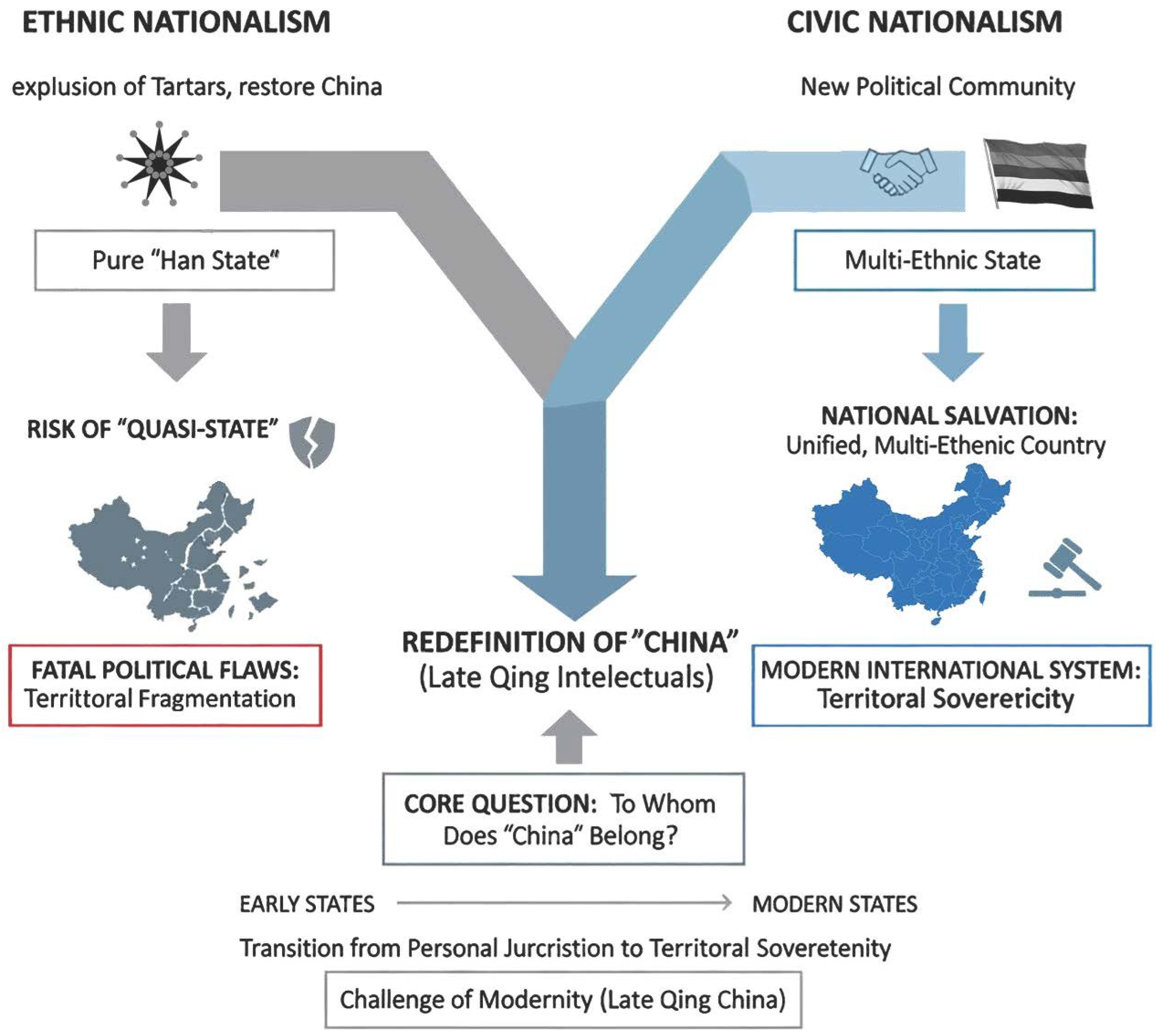
The theories of the renowned nationalism scholar Anthony D. Smith provide a precise interpretive framework for this historical process. Smith distinguished between two ideal models for constructing a nation-state: “ethnic nationalism,” based on pre-existing “ethnies,” and “civic nationalism,” which aims to create a new type of political community. The redefinition of the “China” concept by late Qing intellectuals and court officials in their quest for national salvation was, in essence, a contest and ultimate choice between these two paths. The core objective was to resolve the fundamental question of “to whom does ‘China’ belong?” and to establish a national identity adaptable to the modern international system (Smith 1983). Spruyt noted that the critical difference between modern states and early states lies in the fact that “authority attached to people, not to a defined geographical area… But by the Late Middle Ages, systems of law started to emerge that were demarcated by territorial parameters.” (Spruyt 2002). This transition from personal jurisdiction to the principle of territorial sovereignty was precisely the challenge of modernity facing late Qing China.
In the initial phase of this transformation, forces represented by the revolutionaries proposed the slogan “expel the Tartars and restore China,” which theoretically aligns more closely with what Smith described as the path of “ethnic nationalism.” This proposition attempted to construct a pure “Han state” with the Han people—a populous “ethnie” with a long history—at its core. Although this model could rapidly evoke the identity and cohesion of the majority ethnic group, its exclusivity revealed fatal political flaws when faced with the legacy of the vast, multi-ethnic Qing Empire. As astute thinkers like Yang Du and Liang Qichao pointed out, if the future state-building excluded non-Han groups—that is, if the state were to be named “Han”—then the non-Han communities in regions such as Mongolia, Tibet, and Xinjiang “would certainly not recognize it,” leading directly to the division and collapse of the national territory. Consequently, a state-building program based on a single ethnie could not serve as the political foundation for maintaining a unified, multi-ethnic country (D. D. Zhang 2025; Smith 1983). Spruyt referred to states that possess legal form but lack actual governance capacity and popular recognition as “quasi-states,” noting that many states built upon colonial legacies “lack the positive trappings of modern states.” (Spruyt 2002). If a single-ethnie state-building program led to territorial fragmentation, it would have exposed the nascent China to the risk of degenerating into a “quasi-state.” For a more intuitive understanding of the above content, please see Figure 1.
By contrast, traditional China’s governance model possessed a unique flexibility: the Qing managed different ethnic regions through pluralistic institutions (such as the League and Banner system in Mongolia, the politico-religious system in Tibet, and the Beg system in Xinjiang). This strategy of “governing according to custom” stood in sharp contrast to the homogenized governance of the modern nation-state. Modern nation-states need to “build their own distinctive political, economic, cultural, administrative institutions,” whereas the Qing’s pluralistic governance system lacked precisely these standardized state institutions (Y. Liu 2019).
The reality confronting late Qing thinkers and statesmen was that a multi-ethnic “state” (the Qing Empire) already existed, but a unified “national” identity capable of uniting all its subjects had not yet fully formed and was at risk of fragmentation. Their task was to infuse this existing state framework with a new, inclusive national spirit to resist the disintegrating forces from within (ethnic centrifugal tendencies) and without (imperialist aggression). Liang Qichao’s theory of the “Zhonghua Minzu” (Chinese Nation) was a monumental theoretical creation designed to accomplish this historical task. It sought to remold the legacy of an old empire through the theory of the modern “nation-state”, a state that would encompass the entire territory of the old empire. This clearly reflects the rational and arduous choice made by an ancient civilization for its survival under the pressures of the modern world system (D. D. Zhang 2025). Liu points out that the “nation-state as the most common pattern of modern political entity is the product of modern society, which ensuring the existence of the whole ethnic community and all individuals in it,” emphasizing that “industrialization is the decisive factor for the survival of modern nation and the creation of nation-state.” (Y. Liu 2019). The transformation of the late Qing was precisely a response to these imperatives of modernity.
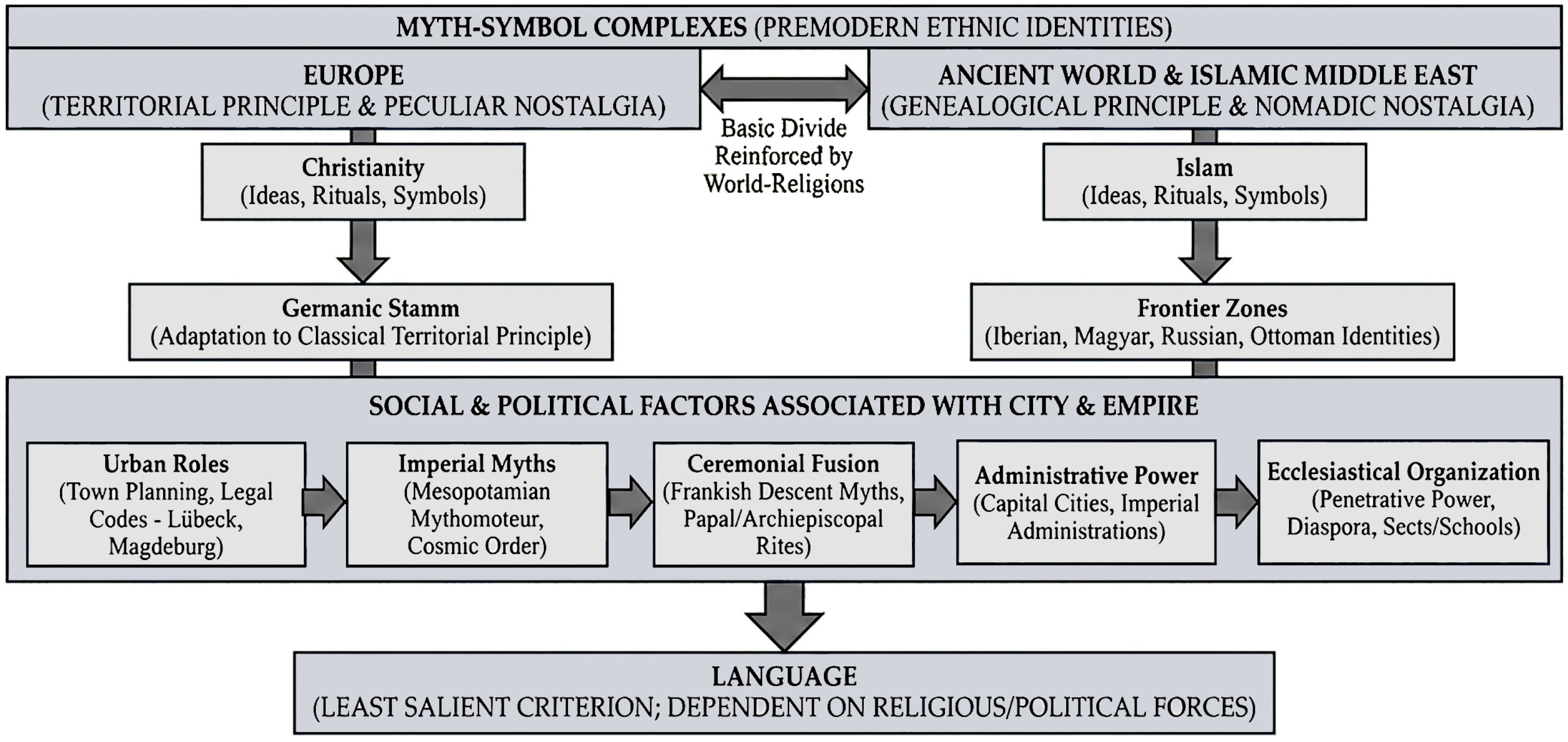
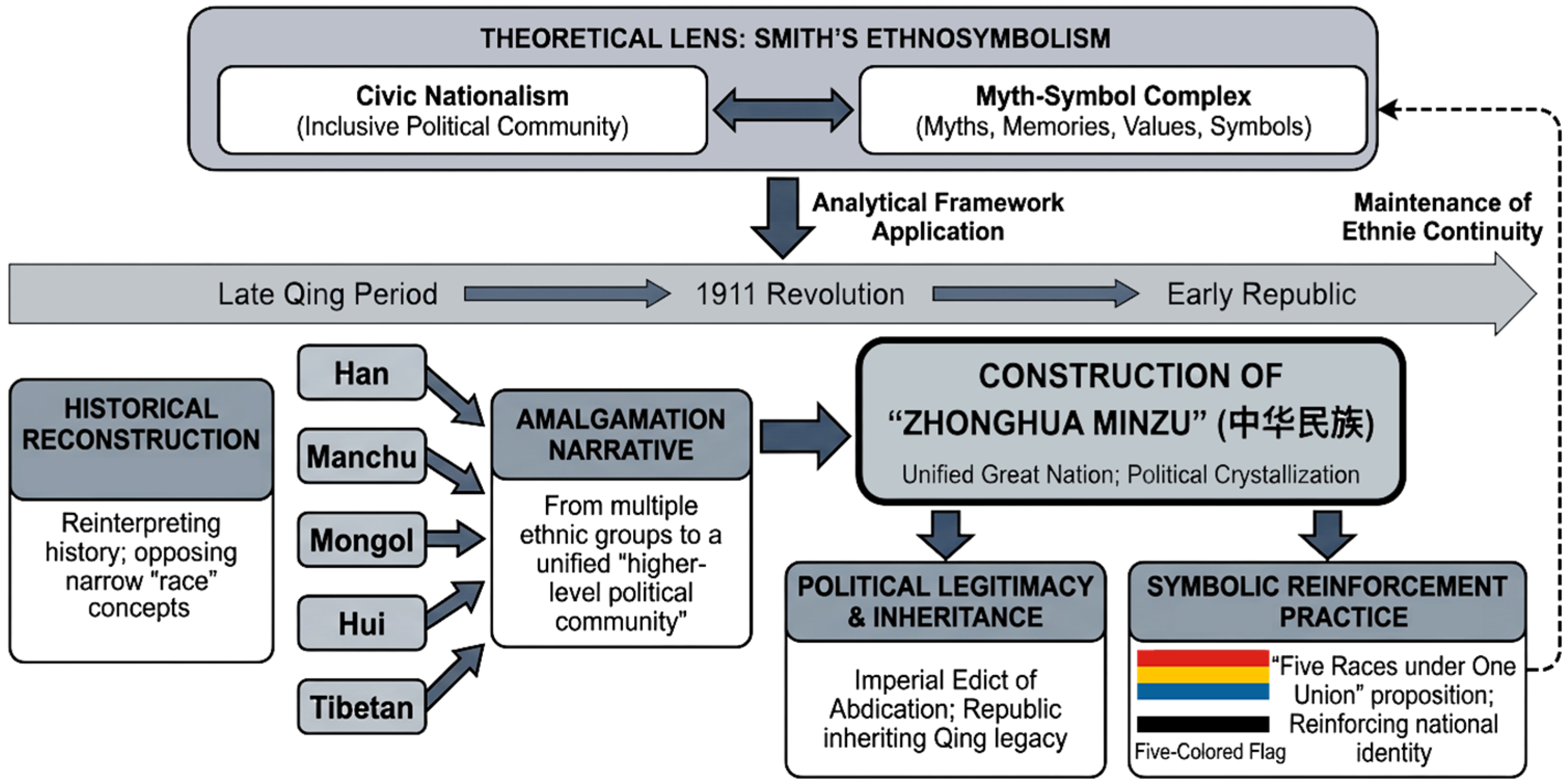
This endeavor highly corresponds with Smith’s concept of “civic nationalism.” Liang Qichao explicitly opposed equating “nation” with a narrow concept of “race,” advocating for the “unification of Han, Manchu, Mongol, Hui, Tibetan… into one great nation,” and naming this higher-level political community the “Zhonghua Minzu.” This principle was also inscribed in the Imperial Edict of the Abdication of the Qing Emperor, becoming a crucial basis for the Republic of China’s inheritance of the Qing’s political legacy. Smith emphasized the role of myths, memories, symbols, and values in maintaining the continuity of an ethnie, adopting the concept of a “myth-symbol complex” to analyze nation formation. During the late Qing period, Liang Qichao and others reconstructed the narrative of history by reinterpreting the concept of “Zhonghua Minzu,” proposing that “the present-day Zhonghua Minzu was not a single group from its inception, but was in fact formed by the amalgamation of numerous ethnic groups.” (Liang 2018, p. 78). This historical reconstruction is precisely the process of constructing a “myth-symbol complex” as described by Smith (Please refer to Figure 2). After the 1911 Revolution, the proposition of the “Five Races under One Union” and the creation of the five-colored flag were practices that reinforced national identity through symbolic means (D. D. Zhang 2025; Smith 1983, 1984). The construction of “Zhonghua Minzu” and the “Five Races under One Union” from the late Qing to the early Republic represented the practical application of this core cohesion and nationalist ideology. For a better understanding of the aforementioned content, please refer to Figure 3.
In summary, Anthony D. Smith’s theories provide profound analytical tools for understanding the formation of the multi-ethnic state concept in the late Qing Dynasty. His theory’s emphasis on the importance of pre-modern ethnic foundations, the constructive role of the “myth-symbol complex,” and the multi-dimensional process of national identity formation all find corresponding evidence in the historical practice of late Qing China. The concept of a multi-ethnic state that formed during this period was neither a simple transplantation of Western nation-state theory nor a continuation of the traditional dynastic state. Rather, it was a creative transformation that, on the foundation of Chinese civilization’s own characteristics, integrated traditional governance legacy with modern nation-state aspirations, thereby laying the theoretical groundwork for building China as a modern multi-ethnic state, united under the symbols of Chinese civilization. Spruyt argues that although factors such as globalization may weaken state autonomy, “the juridical notion of territorial sovereignty as a regulative device in international relations retains its influence.” (Spruyt 2002). What late Qing China pursued was precisely to establish the legal status of such a sovereign territorial state within the new world system. Safeguarding sovereignty and constructing an inclusive national identity constituted the core “vision” of late Qing China’s transformation toward a modern nation-state.

1.3. Research on the Late Qing in China and International

Domestic and international academic evaluations of the Late Qing Reforms exhibit significant pluralistic characteristics. Scholars who hold positive assessments argue that the New Policies represented a rational response and active exploration by the Qing government in confronting ruling crises, playing a crucial role in advancing China’s political modernization process. For instance, administrative reforms laid the institutional foundation for the subsequent establishment of modern political systems, while educational reforms effectively promoted the dissemination of new ideas and the establishment of modern educational systems, creating conditions for cultivating modernized talent.
Over the past three decades, scholarly debates concerning the historical nature of the Qing Dynasty and the formation of modern Chinese national consciousness have gradually crystallized into two interrelated but distinct trajectories under the broader theme of the “empire–nation-state” transition. The first, exemplified by the North American school of “New Qing History”, represents a paradigmatic shift. By subjecting the traditional “Sinicization thesis” to critical reassessment, it emphasizes the “Inner Asian” character and imperial qualities of the Qing, thereby provoking intense debates, both in China and internationally, over whether the Qing Dynasty should be considered part of “China” or rather an “external colonial empire.” The second trajectory is rooted in empirical studies of late Qing social transformations, with a focus on the role and limitations of reforms—ranging from the Self-Strengthening Movement to the New Policies (新政), including political, military, educational, and constitutional initiatives—in advancing China’s transition toward a modern nation-state. The core concerns of these two lines of inquiry diverge significantly: the former seeks to deconstruct the Sinicized, Central Plains–centered narrative of Qing history by reassessing the governance logic and identity formation of the early multiethnic empire, paying particular attention to the institutional arrangements and historical roles of non-Han groups such as the Manchu, Mongol, and Tibetan peoples; the latter examines how the mid- to late Qing Dynasty, deeply embedded in Confucian cultural frameworks, initiated modernization reforms in response to external shocks while striving to construct a new form of national identity. While the two approaches partially intersect on issues of frontier administration (e.g., Xinjiang, Tibet, and Manchu-Mongol affairs) and ethnic relations, their problematics, theoretical frameworks, and interpretive conclusions remain fundamentally different: New Qing History tends to conceptualize the Qing as a “colonial empire,” whereas studies of late Qing reform focus more on the continuity of Chinese state-building (D. Zhang 2024).
Representative scholars such as Evelyn S. Rawski, Pamela Kyle Crossley, and Mark C. Elliott have situated the Qing within a comparative framework of “world empires,” highlighting its structural and legitimating parallels with other early modern polities such as the Ottoman and Mughal empires. Their arguments underscore the centrality of the “Manchu element”: ruling elites maintained ethnic boundaries through the Banner system, resisted wholesale Sinicization, and exercised multilayered sovereignty—“Emperor–Khan–Chakravartin”—to govern diverse domains. Methodologically, this approach advocates an archival orientation that accords equal weight to multilingual sources, arguing that Manchu, Mongolian, and Tibetan documents reveal frontier governance logics fundamentally different from those found in Chinese-language materials. From this perspective, conclusions such as “the Lifanyuan (理藩院) functioned as an institution of colonial administration” are drawn, thereby rearticulating the Qing as a “pluralistic–composite empire.” (Ding and Elliott 2018; R. Wang 2018).
In China, discussions have evolved from sporadic responses in the early stages to more sustained dialogues and reassessments over the past decade. Although the 1996 “Ping-ti Ho (何炳棣)–Evelyn S. Rawski (罗友枝) controversy” attracted some attention, it had limited overall impact. Around 2010, however, structured debates began to take shape through workshops organized by institutions such as the Institute of Qing History at Renmin University of China. Chinese critiques of New Qing History have focused on three main points: first, empirical inaccuracies or misreadings (e.g., misinterpretations of the geographical scope of “Baishan Heishui1” (白山黑水), or the oversimplification of “Manchu–Han distinctions” (满漢畛域) as mere “racial segregation”); second, conceptual overgeneralization, whereby “Inner Asian” characteristics are abstracted into a transhistorical label of “de-Sinicization,” thereby overlooking the Qing’s deliberate political adoption of “Chinese orthodoxy” in its cultural and ritual practices; and third, the narrative risks of political metaphor, in which “imperial” attributes are implicitly conflated with “non-Chinese” designations, leaving the history and current conditions of China’s frontiers vulnerable to foreign political agendas and misinformation.
Cross-linguistic exchange has enriched the multidimensional study of Qing frontier governance and identity politics, yet it has also revealed risks of linguistic barriers and cultural misreadings. It is essential to guard against the a priori imposition of modern political positions upon historical materials, and in particular to resist the substitution of regional studies with separatist political narratives. Certain propagandistic discourses—for example, the wartime claim that “Manchuria and Mongolia are not part of China” (满蒙非中國), which provided a putative legal rationale for Japan’s invasion of China, and its subsequent ideological extensions—must be clearly identified as “political propaganda” inconsistent with scholarly integrity.
After the founding of the People’s Republic of China, due to certain political reasons, academic research on Late Qing civil service system reforms remained essentially stagnant, with the limited research outcomes often bearing strong ideological coloring, and some research results serving as footnotes to the political needs of the time. It was not until the 1990s, following China’s reform and opening-up policies, that relevant research on Late Qing civil service system reforms reappeared in mainland journals and monographs. Scholars and experts such as Liu Dixiang (劉迪香), Luo Zhitian (羅志田), Wei Qingyuan (韋慶遠), Gao Fang (高放), Chen Maotong (陳茂同), and Yang Xuewei (楊學為) have all contributed papers and monographs that involve historical descriptions of Late Qing civil service system reforms.
Currently, while Chinese academia lacks specialized academic monographs that focus specifically on ethnic relations during the Late Qing Reforms and the inheritance relationship between modern China and the Late Qing, numerous related studies contain important discussions of Late Qing ethnic relations and China’s modernization political reforms. Zhang Lianqi (張連起) systematically reviews the ten major changes and their positive effects produced by the Late Qing Reforms in fields such as economics, politics, education, and military affairs, arguing that the historical role of the Late Qing Reforms in advancing China’s modernization process should not be underestimated. Li Gang offers an objective, multidimensional analysis of the Late Qing Reform Movement. Bian Xiuquan discusses the prevalence of constitutional thought in the Late Qing and the constitutional activities it promoted, as well as its deepening and the impact it had on Late Qing legal revision and judicial system reforms, providing a historical perspective on the Late Qing constitutional reforms.
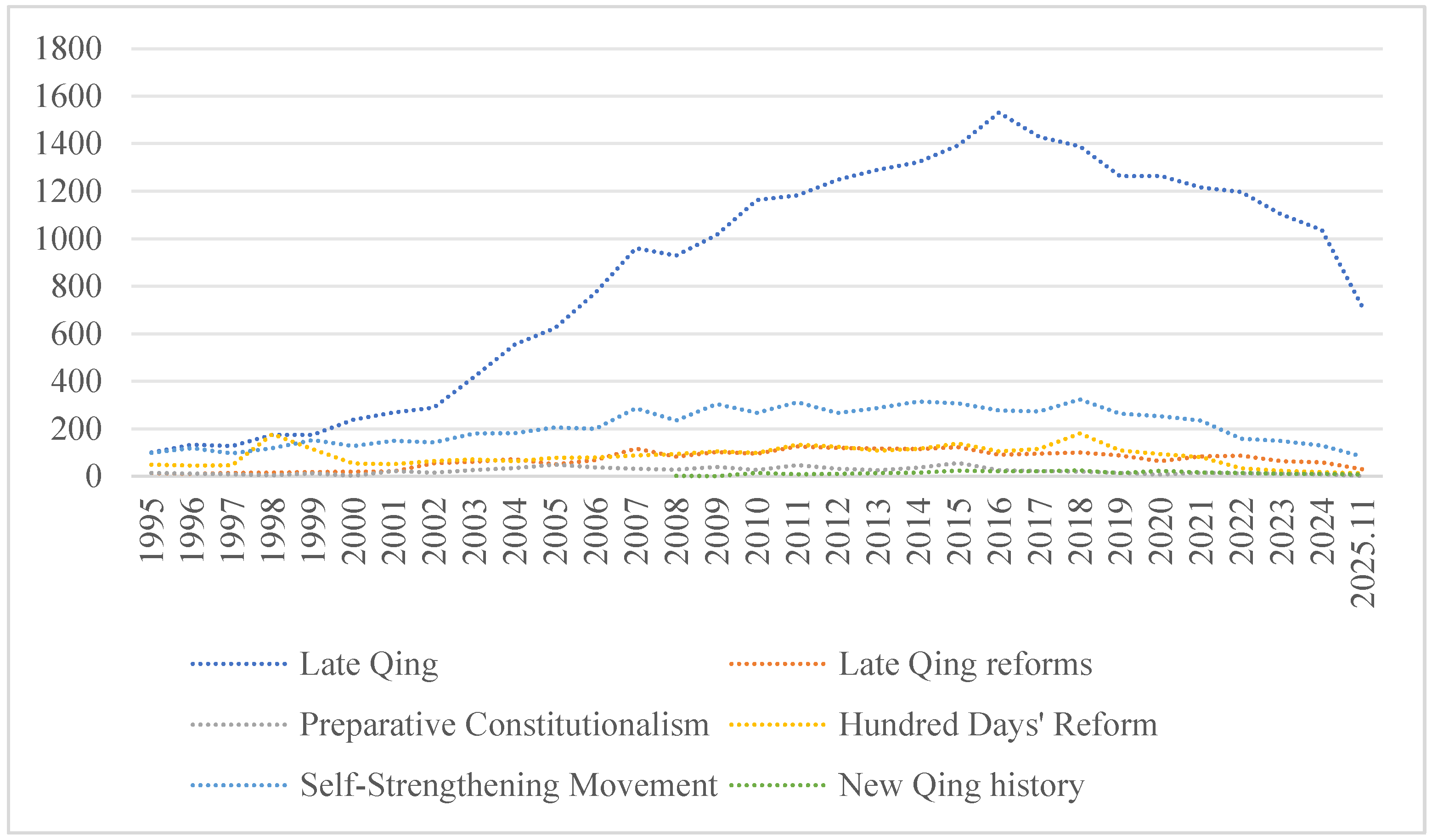
According to the statistical data derived from CNKI Chinese-language dissertations (Figure 4), research on Late Qing history has exhibited a marked upward trajectory over the past three decades. The number of published articles increased from 101 in 1995 to a peak of 1395 in 2015—an expansion by a factor of thirteen—thereby underscoring sustained scholarly engagement with this pivotal period of historical transformation. Although publication output has shown some decline since 2015, it has nevertheless remained at a relatively high level, with projections for 2025 still reaching 445 articles. This persistent academic interest indicates that the Late Qing, as a critical juncture in China’s transition from traditional imperial rule to a modern nation-state, continues to yield significant historical insights and theoretical value.
Within this broader trend, distinct developmental trajectories are discernible across subfields of inquiry. The Self-Strengthening Movement and the Hundred Days’ Reform, both traditionally prominent focal points, have consistently generated stable scholarly output. Notably, the Self-Strengthening Movement experienced a pronounced surge in academic attention in the late 1990s and early 2000s, attaining publication highs of 45 and 119 articles in 1997 and 1998, respectively. By contrast, studies on the Late Qing New Policies emerged later but demonstrated a striking rise in scholarly attention beginning in 2002, with annual publications increasing from 21 to 55, and reaching a peak of 117 in 2007. This trend reflects a renewed scholarly reappraisal of the Qing court’s systemic attempts at institutional reform. In comparison, research on the Constitutional Movement has remained more limited in scale, with annual output generally below fifty publications, suggesting that this specific political initiative has elicited relatively less sustained scholarly interest.
The “New Qing History,” as a relatively recent perspective of research and controversy, remained in a state of relative stagnation for an extended period following its initial emergence in 1981. Between 1993 and 2001, annual publications rarely exceeded one article, with most years producing none. After 2010, however, scholarship on this theme grew markedly, with 15 articles published in 2010 and 25 in 2015. This trend reflects the profound influence of international intellectual currents on domestic historiography, particularly with respect to the reassessment of the Qing Dynasty’s nature as a multiethnic empire and its Inner Asian dimensions. From this vantage point, the New Qing History emphasizes the multiethnic and multicultural characteristics of Qing rule, thereby offering novel analytical tools for exploring the historical roots of the modern multiethnic state. At the same time, it has sparked sustained scholarly debates concerning the construction of the “Chinese nation” and the state character of the Qing polity.
The research trajectories outlined above—especially the rising scholarly attention devoted to the Late Qing New Policies and to the New Qing History—provide an important foundation for understanding the formation of the modern multiethnic nation-state. The series of reforms undertaken during the Late Qing New Policies period—including land reclamation measures in frontier regions, the establishment of a modern education system, and legal institutional reforms—may be regarded as early attempts by the Qing court to address modern challenges and integrate diverse ethnic communities within the framework of a traditional empire. These reformist experiments and their historical consequences constitute a crucial dimension of the processes through which modern multiethnic China was formed. At the same time, the analytical emphasis within New Qing History on strategies of multiethnic governance and the structural features of empire has compelled the scholarly community to reconsider the historical evolution of the concept of “China” and the underlying logic of “Chinese nation” construction.
The international academic community has likewise accorded significant attention to the Late Qing New Policies. Since the last century, the institutional transformations of the late Qing period have emerged as one of the principal theoretical concerns among European and American scholars. Meribeth E. Cameron provides the earliest comprehensive English-language monograph on the Late Qing New Policies, presenting a systematic examination of various reform measures. Kung-chuan Hsiao offers an in-depth analysis of Kang Youwei’s vision for modernizing China’s administrative and personnel systems. Other works dedicate specialized chapters to the Late Qing New Policies. Wolfgang Franke compiles and analyzes criticisms of the imperial examination system by renowned scholars throughout the dynasties since its establishment, providing a systematic and concise historical narrative of the reform process and eventual abolition of the civil service examinations during the late Qing period. Norbert Meienberger, through a comprehensive investigation and analysis of the Qing government’s preparatory constitutional measures, demonstrates the sincerity of the Qing government’s reforms and presents a compelling refutation of those views that accused the constitutional reforms of lacking genuine intent and deliberate procrastination. John H. Fincher conducted a comprehensive and systematic study of the motivational mechanisms, operational models, effectiveness, and impact of China’s self-government movements in the early twentieth century across local, provincial, and central levels. He argues that the driving forces behind the late Qing self-government movement derived from both vigorous advocacy by the central government and active participation by local elites, with close interactive relationships existing between officially led self-government movements and grassroots-driven autonomous practices. Consequently, he provides a thorough examination of the Qing government’s reform policies while paying due attention to various self-government organizations. Through an analysis of the specific operations of representative institutions within the self-government movement, he profoundly elucidates the tremendous impact and far-reaching influence that the self-government movement exerted upon both central and local political institutions during the late Qing period.
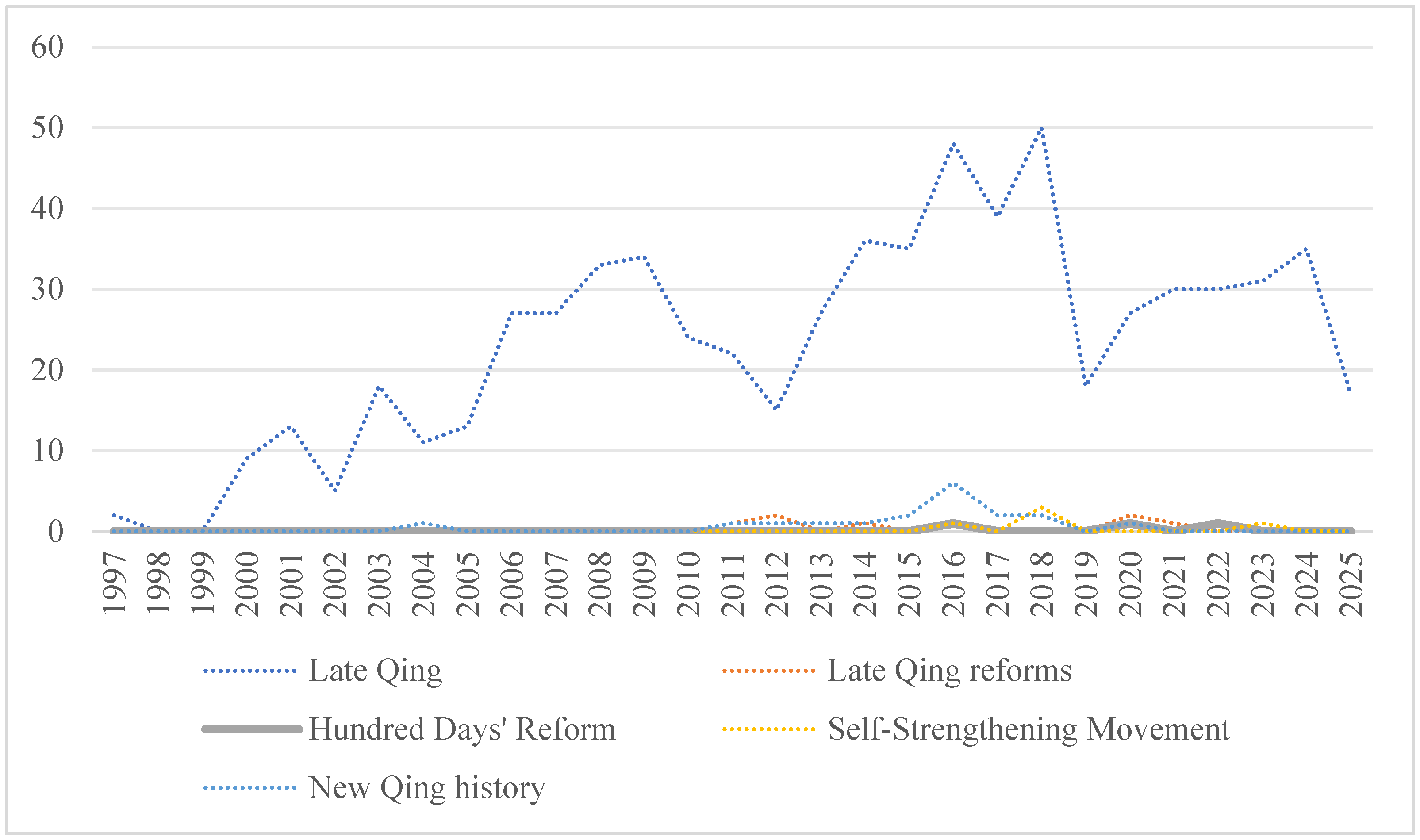
Based on the publication data from CNKI’s English international journals (encompassing select AHCI, SCI, SSCI, SCOPUS, and general journals) spanning nearly three decades (1995–2025), Figure 5 reveals several distinctive phases and trajectories in international scholarly engagement with “Late Qing” and its associated reform agendas. These trends not only reflect the academic community’s overarching attention to China’s modern transformation processes, but also furnish crucial insights for comprehending “how the Late Qing New Policies shaped modern multi-ethnic China.”
“Late Qing” as the principal research theme began appearing in international academic publications from 1997 onwards, entering a period of rapid expansion during the mid-to-late 2000s. The scholarship reached two notable peaks during 2006–2009 and 2014–2019, with annual publications exceeding 30 and even 60 papers respectively. The zenith was achieved in 2019 (61 papers), representing approximately a thirty-fold increase from 1997. Although publication volumes experienced some decline after 2020, recent years have sustained levels of approximately 30 papers, indicating that the “Late Qing” continues to be regarded as a pivotal historical juncture for understanding China’s modern state construction and modern transformation. This comprehensive attention trajectory signifies that the international academic community has established the “Late Qing” as a core analytical entry point in modern Chinese historical studies, forming a relatively stable research community and scholarly discourse.
In contrast to the comprehensive “Late Qing” scholarship, specific reform themes have received markedly insufficient attention within international academic circles. “Late Qing Reforms” did not appear until 2004, subsequently maintaining a consistently low-frequency presence, with annual publications predominantly ranging between 0–2 papers, failing to establish an independent research tradition. This indicates that while the New Policies possess paramount significance within Chinese academic narratives, their meaning within international contexts has largely been absorbed into the macro-narrative of the “Late Qing,” being discussed merely as supplementary topics. Concurrently, the “Self-Strengthening Movement” and “Hundred Days’ Reform” are virtually absent from English international journals, appearing sporadically in individual years with only 1–3 papers. This phenomenon underscores the international academic community’s inclination toward understanding the late Qing from macro-perspectives of political systems and state construction, rather than focusing on the specific successes and failures of particular reform initiatives.
A keyword search for “Late Qing” in Scopus yields 225 publications. Among these, “Arts and Humanities” (174 articles) and “Social Sciences” (118 articles) constitute the overwhelmingly dominant subject categories. This distribution indicates that the scholarly understanding of the Late Qing period primarily focuses on historical events, social transformations, and cultural phenomena. Traditionally, research on the Late Qing has been predominantly history-centric; however, it is now actively incorporating theories and methodologies from a diverse range of disciplines, including sociology, law, economics, political science, environmental science, archaeology, and anthropology. This trend is exemplified by studies in environmental history, literature that utilizes geoscientific data to analyze historical phenomena, and publications that integrate archaeological research to explore regional development predating the Late Qing. These studies encompass both macro-level examinations of China within a global context, such as international relations, legal modernization, and the construction of civic discourse, as well as micro-level investigations focusing on specific regions or social phenomena, including environmental changes in the Dongting Lake region, disaster governance in the North China Plain, pastoralism in the Gansu-Qinghai area, and the development of family businesses.
For Web of Science (WoS) publications, refining the search for Late Qing themes to “Arts & Humanities Citation Index (A&HCI)” or “Social Sciences Citation Index (SSCI)” results in a total of 1026 articles. While “late Qing” serves as the core search term, rapidly adding keywords reveals that “late Qing China” and “late Qing Dynasty” are the primary common expressions. “late Ming and early Qing” also accounts for a notable proportion, indicating that research often traces historical origins back to the late Ming and early Qing periods, emphasizing historical continuity and evolution. Notably, an analysis of the top 50 most-cited papers reveals a broad interdisciplinary approach, drawing upon theories and methodologies from history, literature, philosophy, political science, sociology, economics, religious studies, art history, and even the history of science and technology (e.g., cartography). This fosters richer research perspectives. Many studies are no longer confined to grand narratives but delve into the intricate details of Late Qing society through specific case studies, such as newspaper advertisements, particular literary works, the thought of certain intellectual schools, the dissemination of religion in specific regions, or distinct categories of artworks, thereby deriving broader insights from specific instances. Furthermore, a significant number of these papers address relations with neighboring countries like Joseon (Korea) and Japan, as well as East-West cultural exchanges, underscoring that Late Qing studies have moved beyond a singular China-centric perspective to emphasize regional interactions and comparative research within a global framework.
In contrast to the relatively marginal presence of Late Qing New Policies research, the “New Qing History” entered international academic discourse in 2004 and experienced a modest peak between 2008 and 2016, with annual publications reaching as many as six articles. Although the overall quantity of research remained limited, its intellectual influence has been considerable. By foregrounding the Qing Dynasty’s multiethnic and multicultural characteristics and highlighting its divergences from the traditions of earlier Central Plains dynasties, the New Qing History provoked intense debate concerning imperial legitimacy, frontier governance, and the historical definition of the “Chinese nation.” Unlike the marginalization of the New Policies in international scholarship, the theoretical interventions associated with New Qing History have compelled scholars to reconsider the pathways by which China transformed from a multiethnic empire into a modern nation-state, thereby offering new perspectives and methodological resources for understanding the historical foundations of the “modern multiethnic Chinese state.”
Taken as a whole, international research on the Late Qing over the past three decades has exhibited three salient characteristics. First, there is a high concentration of research around the Late Qing as a macro-historical theme, yet insufficient differentiation of subtopics. Second, specific reform agendas have generally remained at the periphery, characterized by low-frequency output. Third, the rise of multiethnic imperial narratives, particularly those advanced by the New Qing History, has progressively challenged the dominance of modernization-centered interpretations. With respect to the core question of what constitutes a “modern multiethnic China,” the Late Qing New Policies may not have attracted sustained direct attention in international scholarship, yet their historical significance has been implicitly absorbed into broader discourses of “Late Qing state-building” and “New Qing History.” In other words, the New Policies formed a crucial intermediary link that connected institutional modernization with the logic of ethnic integration, and thus represent an indispensable component of the empire-to-nation transition.
A comparison of Chinese- and English-language scholarship between 1995 and 2025 further reveals pronounced differences in research scale, focus, and methodological orientation. In terms of scale, Chinese-language scholarship has been extensive and steadily expanding, surpassing 1300 annual publications between 2015 and 2018, and giving rise to a robust scholarly community. English-language research, by contrast, began much later (with the first publications emerging only in 1997) and has remained comparatively modest, with annual output never exceeding 61 articles—roughly one percent of the Chinese total. Nevertheless, despite the disparity in quantity, English-language scholarship has exerted disproportionate influence in shaping global academic discourse.
In terms of research topics, Chinese-language scholarship has placed strong emphasis on concrete reforms and events such as the Late Qing New Policies, the Constitutional Movement, the Hundred Days’ Reform, and the Self-Strengthening Movement, producing large-scale and highly differentiated discussions that highlight their institutional logic and practical significance in the transition from imperial to modern statehood. In particular, scholarship on the New Policies has risen sharply since the 2000s, reaching a peak between 2007 and 2015, and demonstrating sustained interest in institutional modernization, frontier governance, and state-building. By contrast, English-language scholarship has paid only sporadic attention to these specific reforms, rarely exceeding a handful of articles per year, and has not yet developed into a stable field of inquiry. Instead, international studies have tended to situate the Late Qing within broader frameworks of imperial legitimacy, ethnic diversity, and global relations, with particular emphasis on the transformation from empire to nation-state. The perspective of the New Qing History, which has been consistently discussed in international scholarship since 2004, remains quantitatively modest but has generated far-reaching theoretical and discursive impact. Chinese scholarship, while gradually engaging with and absorbing this intellectual current after 2010, has continued to focus primarily on institutional reforms and the logic of state-building (Nie and Gao 2023).
Taken together, these trends reveal a clear complementarity between Chinese- and English-language scholarship. Chinese research provides abundant archival detail and in-depth analysis of the “New Policies–Constitutionalism–State-Building” trajectory, thereby elucidating the historical path of institutional modernization and the reconfiguration of centralized authority. English-language scholarship, by contrast, through frameworks such as the New Qing History, has emphasized the multiethnic nature of the Qing empire and situated the empire-to-nation transition within a comparative international perspective. The integration of these approaches deepens our understanding of the central question—what constitutes a modern multiethnic China. The Late Qing New Policies should thus be viewed not only as the starting point of institutional reform, but also as a key moment of imperial self-transformation within a multiethnic framework. They embodied both local explorations of institutional modernization and responses to the challenges of imperial legitimacy and ethnic integration, thereby laying crucial institutional and ideological foundations for the emergence of modern China as a unified multiethnic nation-state.

1.4. Research Significance

This study aims to delve into how the Late Qing New Policies (1901–1911), as a pivotal transitional phase, profoundly shaped the institutional form and the foundational ethnic relations of modern multi-ethnic China. By systematically examining the reform practices of the Late Qing New Policies in political, ethnic, and military spheres, and by integrating the latest scholarship from both domestic and international academe, particularly insights from “New Qing History” and traditional Late Qing historical research, this study seeks to elucidate the historical logic and unique characteristics of China’s evolution from a traditional empire to a modern multi-ethnic nation-state.
The core innovation of this research lies in filling a significant gap in the systematic correlational study of the Late Qing New Policies and the construction of modern China as a multi-ethnic nation-state. It transcends singular narratives that simplistically attribute the formation of the multi-ethnic nation-state solely to revolutionary movements or external factors. Instead, it explicitly argues that the Late Qing New Policies were not merely attempts at Qing court “self-salvation,” but rather a critical historical starting point for China’s transformation from a traditional empire to a multi-ethnic constitutional monarchy, providing a prototype for subsequent modern multi-ethnic state designs, such as the “Five Races Under One Union” (Wuzu Gonghe). By focusing on how the New Policies responded to internal and external crises, and how they shaped the embryonic form of modern China’s multi-ethnic nation-state amidst a complex interplay between “national salvation” and “self-preservation of power,” this study offers a crucial analytical perspective for understanding the formation of modern China’s national identity and political framework.
Furthermore, this research integrates theoretical resources from multiple disciplines, including history, political science, ethnology, and law, thereby creating new pathways for dialogue between Chinese and foreign scholarship. It critically absorbs the insights of “New Qing History” regarding the “Inner Asian quality” and imperial characteristics of the Qing Dynasty, while simultaneously maintaining a narrative of continuity in Chinese state-building. This approach avoids the simplistic equation of “imperial nature” with “de-Sinicization,” thereby deepening the understanding of the core question: “What constitutes modern multi-ethnic China?” For instance, analyses of the frontier representation system in Provincial Assemblies (Ziyiju), the reform of the Ministry of Colonial Affairs (Lifan Yuan), and the “queue-cutting movement” multi-dimensionally reveal the Qing court’s contradictory mindset regarding ethnic integration and the limitations of its “constitutional instrumentalism.”
This study also deeply reveals the inherent contradictions and complexities between the demands for ethnic equality and the maintenance of privileges by the ruling elite during the transition from a multi-ethnic empire to a modern nation-state. It analyzes the complex psychology of the Qing court in constitutional reform, oscillating between safeguarding imperial power and making compromises, as exemplified by events surrounding the Imperial Clan Cabinet and the Nineteen Articles of the Constitution. It also explores the tension between centralism and local centrifugal tendencies during the local autonomy movements. By investigating the logic behind the reforms’ failures, this study emphasizes that successful multi-ethnic nation-building must exchange institutional justice for the political identity of various ethnic groups, and that nation-building must proceed concurrently with political openness and social integration, thereby offering new interpretive pathways for the theoretical understanding of multi-ethnic state construction.
In summary, this research possesses not only significant historical implications but also profound contemporary relevance. Through an in-depth analysis of the Late Qing New Policies’ attempts in ethnic integration, frontier governance, and constitutional exploration, as well as their successes and failures, this study underscores the importance of institutional justice, political identity, and inclusive political participation for the long-term stability and peace of a multi-ethnic nation-state. For contemporary China, a deep reflection on the historical logic of the Late Qing New Policies can contribute to strengthening national unity, consolidating national identity, and providing valuable historical wisdom and practical guidance for ethnic governance and international interpretation in the context of the “Belt and Road Initiative”.


2. Political Reforms in the Late Qing New Policies

2.1. Central Government Reforms and the “Manchu Cabinet” Crisis in the Guangxu-Xuantong Period (1875–1911)

One of the central objectives of the Late Qing New Policies was to reshape central authority through political institutional reform, establishing a central government with enhanced modern governance efficacy and greater capacity to respond to both internal turmoil and external threats. In the narrow sense, the central government reforms of the Late Qing New Policies primarily refer to the comprehensive restructuring of the central government after 1901 during the late Guangxu emperor period. However, the provincialization of frontier territories between 1884 and 1885 (also during the Guangxu emperor period), which was premised on national defense considerations, constitutes political reform in the broader sense. However, during the implementation of these reforms, due to constraints imposed by conservative forces, exacerbation of Manchu-Han conflicts, and the lack of effective arrangements for power redistribution, these measures not only failed to consolidate Qing court rule but actually catalyzed the disintegration of the power structure, creating an enormous power vacuum that laid the groundwork for dramatic transformation in modern China’s political landscape (Zhang and Yan 2010).

2.1.1. Establishment of Provinces in Frontier Areas (1884–1885)

After the Taiping Civil War ended in 1861, China soon faced severe border crises in both the northwest and southeast. In 1871, Yakub Beg of Yettishar (阿古柏), affiliated with the Khanate of Kokand, invaded Xinjiang, while Russia simultaneously took the opportunity to occupy the Ili region. In 1872, Japan initiated the so-called “Ryukyu Disposition” and briefly invaded Taiwan in 1874. This series of events prompted the Qing government to reassess and strengthen governance and integration of its frontier regions. These efforts culminated in the border-province reforms, undertaken within the broader intellectual and strategic debate between maritime defense and frontier defense.
On 30 September, Guangxu 10 (17 November 1884), the Qing government formally issued an imperial edict, appointing Liu Jintang as the first Governor (巡撫) of Gansu- Xinjiang and announcing the establishment of Xinjiang Province. This initiative marked a fundamental shift in the Qing court’s governance policy towards Xinjiang, representing a pivotal transition in late Qing frontier administration from the traditional “rule by custom” of the pluralistic imperial tusi system to modern multi-ethnic integrated governance (Xiao et al. 2025). The provincialization was not merely a simple adjustment of administrative divisions but a substantive attempt by the Qing court, in response to frontier crises, to incorporate Xinjiang and Taiwan from a peripheral tributary region into a centralized modern state system (Xie 2024).
It should be noted that the present-day administrative division of Xinjiang is not Xinjiang Province, but rather the Xinjiang Uyghur Autonomous Region. Taiwan Province, established in 1947 by the Republic of China following Japan’s defeat in World War II and the subsequent retrocession of Taiwan, has undergone significant administrative restructuring. Notably, as the provincial government is a constitutional institution that cannot be abolished without constitutional amendment, the designation “Taiwan Provincial Government” remains in nominal existence.
While the Qing Dynasty’s establishment of Xinjiang Province abolished the Bey (伯克) system and allowed Han Chinese officials to serve at various levels, many inequalities in ethnic relations persisted, and central government control remained relatively weak, particularly during the Republic of China Era (ROC Xinjiang Warlordism era2: 1931–1944, Ili Three Districts regime3: 1944–1949) when the province existed nominally but lacked substantive administrative authority.
In contrast, the Xinjiang Uyghur Autonomous Region system was intended fully to embody the concept of ethnic equality, abolishing historically discriminatory or derogatory place names, such as changing “Dihua (Enlightenment and education)” to “Urumqi”4 and “Zhenxi (Guarding the Western Regions)” to “Barkol”5. Furthermore, the Qing Dynasty’s concept of “Five Major Ethnic Groups” blurred distinct identities, as Uyghurs in Xinjiang were previously crudely categorized as part of the Hui (Muslim) group. The formal designation and acceptance of the Uyghur6 as a distinct ethnic category occurred during the Ethnic Classification project conducted by the State Ethnic Affairs Commission of the PRC between 1949 to 19547.
The proposal for Xinjiang’s provincialization was not an impromptu decision but emerged from over half a century of deliberation and evolution. As early as the Daoguang era, Gong Zizhen (1792–1841) proposed the “Discussion on Establishing Provinces in the Western Regions” (《西域置行省议》), advocating for the implementation of the commandery-county system (郡县制), but it was not adopted. During the Tongzhi era, the invasion by Yaqub Beg in 1865 and Russia’s occupation of Ili (伊犁) in 1871 triggered severe frontier crises, prompting the Qing court to re-evaluate its governance strategy for Xinjiang. Following the reconquest of Xinjiang, Zuo Zongtang formally proposed the establishment of a province and the reform of the administrative system to the commandery-county system in his “Memorial on Overall Planning by Imperial Edict” (《遵旨統籌全局折》) in 1877, arguing that only by establishing an administrative system unified with the interior could a foundation for lasting peace and stability be secured. In 1882, after consulting with Tan Zhonglin the Governor-General of Shaanxi-Gansu, Liu Jintang established the “Gansu Xinjiang Province” (甘肃新疆省) model based on strategic considerations of internal and external interdependence. Although this plan established a Governor (巡撫) to oversee the entire military and political affairs of Xinjiang, it remained subject to the control of the Governor-General of Shaanxi-Gansu. This institutional design of “separate yet not separate, integrated yet not integrated” granted Xinjiang an independent administrative status while strengthening its geopolitical ties with the northwest interior (Xie 2024; F. Li 2024).
Similar to the process of establishing Xinjiang as a province, the provincialization of Taiwan was by no means accomplished overnight, but rather underwent extensive deliberation and experimentation spanning over a century and a half. As early as the second year of the Qianlong reign (1737), Wu Jin, an Academician of the Grand Secretariat and Vice Minister of Rites, proposed establishing the position of Provincial Governor (巡撫), citing Taiwan’s status as “isolated overseas, conducive to harboring treachery.” However, this proposal was rejected by the Qing court due to concerns over the dispersion of authority. It was not until the outbreak of the Sino-French War in the tenth year of the Guangxu reign (1884), when French forces blockaded the Taiwan Strait and captured Jilong, placing Taiwan in an existential crisis, that the Qing court engaged in critical reflection. Taiwan was formally established as a province in 1885 (the eleventh year of Guangxu), with an imperial edict declaring: “Taiwan serves as the gateway to the Southern Seas and is of critical importance. It is appropriate to adapt to changing circumstances to ensure effective control. The Fujian Provincial Governor shall be redesignated as the Taiwan Provincial Governor and shall maintain permanent residence there.” Liu Mingchuan, the first Provincial Governor, pragmatically submitted a memorial stating that “Taiwan cannot yet be readily transformed into a province,” ultimately establishing the full designation “Fujian-Taiwan Province” (福建台灣省). However, despite the Taiwan issue’s significant political and military importance to contemporary China and its close relation to the provincialization reforms of frontier regions in the late Qing Dynasty, Taiwan existed as a province for only about a decade due to its cession after the defeat in the First Sino-Japanese War of 1895. Consequently, the topics of its provincial establishment and defense are afforded very limited space in this study (Y. Zhou 2016; Jia 2016).
The core of Xinjiang’s provincialization lay in abolishing the existing tusi autonomy system and comprehensively implementing the traditional commandery-county system to strengthen central authority. The Qing government proceeded to dismantle the old military garrison system centered on generals and military governors (都統), and in 1887, ordered the “complete abolition of all Bey (伯克) titles” (所有伯克名目全行裁汰), thoroughly eliminating the Bey (Bey) system of Uyghur feudal lords and the Jasagh (札萨克) system of the Mongols. This was replaced by a four-tiered administrative structure consistent with the interior: dao (Circuit (administrative division)), fu (prefecture) or ting (department), zhou (sub-prefecture), and xian (county). The entire province was divided into four dao: Zhendi, Aksu, Kashgar, and Yita, under which were 6 fu (府), 10 ting, 3 zhou, and 23 xian. This transformation altered the previous situation where officials governing military affairs were numerous, while officials governing civilian affairs were few, allowing central government decrees to be transmitted down through administrative layers. However, the initial phase of this transition was not without resistance. Although the Qing court established a Governor (巡撫), it retained the position of the General of Ili, leading to long-term power struggles between the Governor and the General and delayed integration of border defense forces. It was not until the late Qing Dynasty that the Governor gradually achieved unified command over the military forces of the entire province (except Ili) (Xie 2024; F. Li 2024).
In the process of shaping a modern multi-ethnic nation, language and education policies became a crucial component of the new administration following provincialization. To bridge the gap between officials and common people, the Qing government endeavored to shift its national governance model from a Manchu-centric “Qing-ification” to a “Sino-ification”. Following provincialization, Zuo Zongtang and Liu Jintang vigorously established numerous charitable schools (义塾) and systematically promoted Chinese language education, intending to replace the existing purely religious or Eight Banners elite education. This process accelerated during the late Qing New Policies period (after 1901). By 1910, Xinjiang had established 597 primary educational institutions, with Chinese-language schools even accounting for up to 70% in some southern Xinjiang counties (such as Shufu County). Despite the limitations in understanding the differences between Islamic and Confucian cultures at the time, objectively, this educational reform fostered the construction of multi-zone cities as social spaces for different ethnic groups, laying a preliminary foundation for a national identity within a modern multi-ethnic state (Jing and Si-ma-yi 2024).

2.1.2. Establishment of New Institutions: Ministry of Foreign Affairs, Ministry of War, and Others (1901–1906)

During the Late Qing New Policies period, in response to the predicament of domestic troubles and foreign aggression, the Qing government successively established a series of new institutions from 1901 to 1906, aimed at enhancing national governance capacity through functional specialization and modernization reforms. Among these, the establishment of the Ministry of Foreign Affairs (外務部) in 1901 marked the beginning of the New Policies and represented a significant attempt by the Qing court to modernize its diplomatic sphere. The Ministry of Foreign Affairs replaced the traditional “Zongli Yamen” (總理各國事務衙門), and according to the Regulations of the Ministry of Foreign Affairs (《外務部章程》, 1901), it was positioned at the head of the six ministries, with its organizational structure and operational methods clearly modeled after Western foreign ministries, becoming China’s first central institution with the rudimentary framework of a modern bureaucratic system (Veritable Records of the Guangxu Reign from the Donghua Archives 《光緒朝東華錄》). This reform not only reflected the Qing court’s response to the complex international situation but also received positive evaluation from various foreign legations in China. Additionally, the Ministry of Commerce, established in 1903 (later renamed the Ministry of Agriculture, Industry and Commerce), aimed to revitalize industry and promote economic development, demonstrating the Qing government’s recognition of the importance of economic foundations. The establishment of the Metropolitan Police Board (巡警部) in 1905 (later renamed the Ministry of Civil Affairs) drew upon Yuan Shikai’s experience with modern police systems in Tianjin, attempting to strengthen social control through the establishment of a modern police system. The establishment of these new institutions reflected the Qing court’s efforts to promote functional specialization and modernization of state functions under external pressure (Qu 2020).
The Ministry of War (陸軍部) established in 1906 represented one of the most strategically significant measures in the official system reforms, aimed at unifying national military command authority and changing the previous chaotic situation of multi-headed management by the Board of Defense (兵部), the Commission for Army Reorganization (China’s Bureau of Military Training, established in 1903 under Yuan Shikai’s leadership), and other entities. According to records in The Veritable Records of Emperor Dezong of the Qing (《清德宗實錄》, Volume 565), the regulations of the Ministry of War clearly stipulated that “all new armies throughout the nation shall be placed under the jurisdiction of this ministry,” attempting to strengthen control over military forces through central authority (X. Li 1993).
The establishment of these new institutions marked the Qing government’s transition from the traditional “six ministries” system toward modern functional departments, reflecting the Qing court’s borrowing from Western administrative models. However, the operation of new institutions was constrained by local forces and an unequal distribution of power between Manchus and Han.

2.1.3. The Constitutional Movement in 1906

The Constitutional Movement (立宪运动) constituted one of the central components of the Late Qing New Policies, aimed at rebuilding central authority and alleviating social issues through constitutional reform. Confronted with the severe situation of internal troubles and external threats, the Qing government began to consider political institutional reform under the strong advocacy of the constitutionalists. In 1905, the Qing court dispatched five high ministers to conduct overseas political investigations. Upon their return, Zaize and others submitted the Memorial Requesting Constitutionalism, explicitly proposing three major benefits of constitutionalism: “perpetual security of the imperial throne”, “gradual alleviation of foreign troubles,” and “prevention of internal rebellions,” thus providing theoretical justification for the Qing court’s acceptance of constitutionalism.
Against this background, on 1 September 1906, the Qing government formally announced the “preparatory imitation of constitutional government,” marking China’s first historical attempt at transformation from traditional imperial rule to modern constitutional monarchy. To advance the constitutional process, the Qing court established the Commission for Political Investigation (考察政治館) (later renamed the Commission for Constitutional Compilation), serving as the central institution for researching and implementing constitutionalism, responsible for formulating specific constitutional plans and implementation procedures (Cui 2021).
In 1907, the Qing government further announced the establishment of the Advisory Council (資政院) at the central level as a prototype of the future parliament, and Provincial Assemblies (諮議局) at the local level as prototypes of provincial parliaments, preliminarily constructing the framework of constitutional politics. The Principles of the Constitution (《欽定憲法大綱》) and the Schedule of Annual Preparatory Affairs (《逐年籌備事宜清單》) promulgated in 1908 detailed the nine-year preparatory constitutional steps, clarifying the timetable for political reform from central to local levels. Provincial Assemblies were successively established in various provinces in 1909, and the Advisory Council convened its first regular session in 1910, preliminarily establishing the institutional framework of constitutional politics. However, while this series of reform measures formally demonstrated efforts toward political modernization, their fundamental purpose remained the preservation of Manchu ruling authority, laying the groundwork for subsequent political conflicts (S. Wang 2024; Qiu 2021).
The development of the Constitutional Movement greatly stimulated enthusiasm for political participation among various social sectors, particularly in establishing Provincial Assemblies, which offered a wholly new political platform for local elites. Although the voter qualification restrictions for Provincial Assemblies were extremely stringent, their electoral processes and the extensive participation of the gentry class still released enormous political energy. Provincial Assemblies rapidly became centers of public opinion and important platforms for voicing local interests, gathering large numbers of new-style intellectuals and local elites who expressed political demands and promoted reform processes through these legitimate channels. However, the activities of Provincial Assemblies also exceeded the Qing court’s expectations and control, becoming important venues for criticizing government policies and questioning imperial clan autocracy.
More importantly, multiple large-scale petitions for the “immediate convening of parliament” (1909–1910) initiated by Provincial Assemblies from various provinces and constitutionalist leaders Zhang Jian, Tang Hualong, Tan Yankai, Pu Dianjun, and others generated nationwide attention. These petition activities expressed strong dissatisfaction with the Qing court’s constitutional progress, demanding a substantial shortening of the preparatory period and the immediate establishment of a responsible cabinet government. Faced with mounting public pressure, the Qing government initially adopted a suppressive attitude, but, under the sustained impact of petition movements, it was ultimately forced to compromise, promising to shorten the nine-year preparatory period to five years and establish parliament in 1913. However, this concession did not appease the intense emotions of constitutionalists but further stimulated their political expectations (Tang 2015).
Extensive coverage of petition movements and sharp criticism of the Qing court’s perfunctory attitude by media outlets such as Shun Pao (《申報》) and Ta Kung Pao (《大公報》) reflected society’s strong attention to constitutional reform and skepticism about the government’s sincerity. The enormous gap between constitutional promises and actual actions gradually transformed the Advisory Council and Provincial Assemblies into focal points of opposition voices, accelerating political mobilization and the erosion of the Qing court’s legitimate authority.

2.1.4. Establishment of the Advisory Council in 1908

The promulgation of the Principles of the Constitution in 1908 marked the formal launch of constitutional reforms, with the establishment of the Advisory Council serving as a crucial step in this process. As a transitional institution, the Advisory Council was designed as a central-level consultative body, intended to simulate Western parliamentary models while preserving the core principle of imperial supremacy. Its establishment was also driven by pressure from local elites and intellectuals who demanded accelerated constitutional progress; these groups pushed for the establishment of a national assembly through petition movements, forcing the Qing court to expedite reforms.
As a temporary parliamentary institution, the Advisory Council was divided into an Upper House and a Lower House. The Upper House consisted of members appointed by the emperor, including central government officials, nobles, and representatives of ethnic minorities; members of the Lower House were elected by Provincial Assemblies from various provinces. According to the Principles of the Constitution, the Advisory Council’s primary function was to serve as an advisory body to the emperor, discussing and reviewing important national laws, budgets, and taxation matters. However, its resolutions were only recommendations and could not directly influence national policy. This limitation reflected the Qing government’s contradictory mentality in attempting to introduce modern parliamentary systems while maintaining imperial authority.
Structurally, the Upper House of the Advisory Council specifically incorporated representatives from frontier ethnic minorities. According to research from Bandeira, E. M (Bandeira 2020), the Mongolian region included Inner Mongolia’s six leagues (Zhelimu, Zhuosotu, Zhaowuda, Xilin Gol, Ulan Chabu, Ikh Zhao) and Outer Mongolia’s four leagues (Tüsheet Khan, Setsen Khan, Sain Noyan, Zasagt Khan), each electing one representative for a total of twelve, all classified as “imperially appointed councilors” rather than elected representatives, nominated by the Lifan Yuan and approved by the emperor. Tibet was represented by one delegate (typically of Mongol ethnicity), recommended by the Tibetan Resident and appointed by the Qing court. The Hui regions (including Xinjiang and other Muslim areas) also had one representative (such as the Turfan Prince Yeming Hezhu). Additionally, Xinjiang, as a special frontier province, possessed two seats in the Lower House (though vacant due to lack of elections) and seats in the Upper House (including Mongol Banner representatives). These arrangements reflected the Qing government’s efforts to incorporate frontier ethnic minorities into the central political system through appointment mechanisms. However, representatives were predominantly from traditional upper classes (princes and living Buddhas) and failed to adequately reflect the concerns of ordinary ethnic minorities (Bandeira 2020). Table 1 presents the specific distribution of ethnic minority representatives in the Advisory Council.
The Qing court’s core motivations for incorporating minority representatives exhibited multifaceted and complex dimensions. Confronting external threats from Russian and British powers instigating Mongol-Tibetan independence (such as Russia’s allowance of Buryat Mongols’ political participation), the Qing court attempted to “win hearts and minds” through granting frontier elites parliamentary seats, thereby strengthening their “parliamentary loyalty” to the central government as a replacement for traditional feudal allegiance relationships. This initiative aimed to incorporate frontier regions within the “constitutional” framework, thereby declaring to the international community the Qing Empire’s legitimate sovereignty over Mongolia, Tibet, and Xinjiang. Simultaneously, facing intensifying Manchu-Han tensions and Banner livelihood crises (such as incidents in Fengtian and Hangzhou garrison districts where Banner people committed suicide to secure rights and benefits), the Qing court promoted constitutional reforms and incorporated Banner councilors, attempting to “dissolve Manchu-Han distinctions” and alleviate ethnic contradictions through political participation (Chi 2001).
The minority representatives in the Late Qing Provincial Advisory Councils and Imperial Advisory Council exhibited highly elitist characteristics, severely excluding ordinary citizens from political participation. The Mongol-Tibetan-Muslim representatives in the Imperial Advisory Council comprised exclusively traditional ruling classes, including Mongol Torghut Prince Palta (Бaлт), Turpan King Yeming Hezuo (叶明和卓), and other royal nobles, all nominated by the Ministry of Dependencies or Tibetan Resident-General and appointed by the emperor. These representatives were essentially vested interests within traditional frontier structures—Mongol representatives were uniformly royal nobles, Tibetan representatives frequently comprised Mongol lamas or kalons, while ordinary herders, serfs, and Muslim civilians were completely excluded. Banner councilors in provincial advisory councils similarly embodied elite monopolization characteristics, primarily encompassing hereditary nobles, civil and military officials, and examination degree holders from the Manchu, Mongol, and Chinese martial Eight Banners. Their backgrounds encompassed incumbent officials (such as Hanlin Academy Scholar Xijun, Lecturer Xi Yanqing), hereditary nobility, beneficiaries of modern education, and public welfare enthusiasts, with incumbent officials constituting the highest proportion. Even Banner gentry participating in livelihood proposals, such as Fujian councilor Chun’an, remained essentially within the gentry stratum, failing to address fundamental interests of ordinary Banner people. This highly elitist representative composition resulted in severe imbalance in reform class representativeness (Lyu 2014).
However, profound disagreements existed within the Qing court regarding frontier ethnic positioning, exposing fundamental contradictions between “sovereignty integration” and “ethnic unity.” The perspective represented by Yang Du advocated “assimilation before empowerment,” arguing that Mongol-Tibetan scripts were backward and populations suffered from “unopened” (popular enlightenment), direct political participation would obstruct constitutional progress due to “Manchu-Han problems” and “unequal rights and obligations,” even proposing “abolishing the Eight Banners.” Such “civilizational hierarchy” prejudices, exemplified by Xinjiang Provincial Treasurer Wang Shunan’s perception of frontier populations as “savage barbarians” and proposal to manage Xinjiang by imitating India as a “colony”8 exposed the Qing court’s profound colonial mentality. Although constitutionalists (such as Liang Qichao) and certain reformers (such as Gu Zhongxiu) advocated incorporating Mongol-Tibetan nobility or opening political participation pathways for Banner people to “stabilize hearts and secure frontiers,” their fundamental motivation remained imperial stability maintenance rather than genuine democratic equality. This complexity of political motivations and internal ideological conflicts determined that frontier representation functioned primarily as a stability-maintenance instrument rather than substantive democratic practice (Bandeira 2020).
The Late Qing Provincial Advisory Council frontier representation system encountered severe institutional obstacles in practice. The “Provincial Advisory Council Regulations” (《咨议局章程》) promulgated by the Qing court established stringent voter qualifications, including male gender, age above 25, and requirements for engagement in public welfare enterprises, modern education, traditional scholarly degrees, high official positions, or substantial assets (exceeding $5000). However, these standards proved “incompatible” within educationally and economically underdeveloped frontier regions. Using Xinjiang as an example, 1909 government reports indicated that no individual met the “modern secondary school graduation” requirement, traditional examination quotas were scarce and predominantly Han Chinese, local military officers were disqualified for “educational insufficiency,” while the few wealthy merchants were uniformly Han Chinese, unable to represent diverse ethnic groups. Consequently, Xinjiang’s originally designated 30-seat Provincial Advisory Council became virtually defunct due to “absence of qualified voters,” compelling the government to appoint 31 Han Chinese or Manchu officials as representatives without conducting elections. Beijing’s Eight Banners also experienced situations where insufficient candidates were elected in preliminary elections due to “unwillingness to participate.” This highlighted the limitations of applying interior standards to frontier regions and the underlying “civilizational hierarchy” prejudices (Bandeira 2020).
Concurrently, severe linguistic and cultural barriers further undermined minority elite representational authority. Provincial Advisory Councils employed Chinese as the official language, yet most minority representatives lacked Chinese proficiency or required translators due to age factors. For instance, Zhejiang Provincial Advisory Council Banner councilor Muergen Tu, due to “linguistic difficulties,” could not effectively preside over or participate in debates, even being compelled to request Han councilor Shen Junru to assume temporary speaker duties. Outer Mongolian representatives in Imperial Advisory Council sessions, possessing only Mongolian language skills with poor translation quality and unfamiliarity with modern parliamentary procedures, resulted in unclear proposal articulation, with Guofeng Bao (《國風報》) criticizing them as “mostly ignorant of what the Imperial Advisory Council represents,” severely impacting their participation levels and influence (Lyu 2014).
Furthermore, minority representatives’ proposal participation remained marginalized with minimal influence. During the 1910 Imperial Advisory Council sessions, economic and educational proposals submitted by Mongol representatives failed to achieve passage. At the local level, Mongol-Tibetan regions lacked Provincial Advisory Councils, Xinjiang’s Provincial Advisory Council remained virtually defunct due to aforementioned reasons, and frontier populations lacked substantive political participation channels. Even in garrison provinces, due to limited numbers of “designated quota councilors,” Banner councilors wielded relatively modest influence. This failure of representative integration ultimately culminated in Outer Mongolia’s declaration of independence in 1911 following the rejection of their appeals in the Imperial Advisory Council, confirming the counterproductive nature of the Qing court’s stability-maintenance strategy (B. Zhang 2018).
The Late Qing Provincial Advisory Council frontier representation system possessed progressive symbolic significance to a certain extent. Its legal attempt to transcend the “Chinese-barbarian distinction” marked the first instance in modern Chinese governance where frontier ethnic groups’ political subjectivity was legally acknowledged, providing a preliminary institutional framework for ethnic equality and multi-ethnic co-governance within the Chinese nation. However, the fundamental deficiency of this system lay in its constitutional refusal of equality, essentially packaging frontier minority aristocratic privileges as modern representative governance, becoming a product of feudal and colonial remnants.
The Provincial Advisory Council system in Han Chinese territories, as a crucial component of the Qing court’s constitutional reforms, received relatively more comprehensive implementation. Unlike the symbolic seat arrangements in frontier regions, Provincial Advisory Councils in Han Chinese provinces genuinely became important platforms for local political life. According to the provisions of the “Provincial Advisory Council Regulations” (《咨議局章程》) and “Provincial Advisory Council Electoral Regulations” (《咨議局議員選舉章程》), each province established Provincial Advisory Councils with certain administrative and fiscal supervisory functions. Although voter qualifications remained stringent, within Han Chinese territories, qualifying gentry, modern school graduates, intellectuals, and merchant groups constituted a voter base of considerable scale and political participation enthusiasm. Provincial elections, despite issues of bribery and fraud during the process, were fundamentally successful, generating relatively active local councilor communities (S. Wang 2024).
The personnel composition of Han Chinese Provincial Advisory Councils exhibited pronounced elitist characteristics, with councilors predominantly drawn from traditional gentry strata, emerging intellectual elites, merchant classes, and retired officials. Although these councilors played significant roles in political participation, due to insufficient social representativeness, vast populations of peasants, workers, and urban poor were excluded, preventing Advisory Council agendas and decisions from genuinely reflecting broad popular interests. For instance, one of the core functions of Han Chinese Provincial Advisory Councils was local fiscal supervision, directly challenging traditional fiscal control authority of local governors-general and governors. Local councilors particularly focused on budgetary reasonableness, especially demanding review and reduction of expenditures considered under governors’ personal control. Through budgetary oversight and questioning of public expenditures, Han Chinese Provincial Advisory Councils became political platforms promoting local self-governance, educational reform, and industrial development agendas. Particularly in economically developed provinces such as Jiangsu and Zhili, Advisory Council debates not only reflected local gentry classes’ intense modernization aspirations but also demonstrated local political vitality (Kang and Lin 2019).
However, since Advisory Council resolutions possessed merely advisory nature with local governor generals retaining veto power, actual influence remained extremely limited. Nevertheless, local councilors actively participated in public affairs discussions through Advisory Councils, utilizing this platform to express political demands to the Qing central government, particularly during 1909–1910 when local elites launched large-scale parliamentary petition movements through Advisory Council platforms, demanding accelerated political reforms from the Qing court. Although this movement failed to compel substantive concessions from the Qing court, it intensified contradictions between the Qing court and constitutionalists, becoming a crucial catalyst for the outbreak of the 1911 Revolution.
Examining the divergent practices of Provincial Advisory Councils in Han Chinese territories versus frontier regions reveals the profound contradictions within Late Qing constitutional reforms. Firstly, regardless of whether considering the relatively “successful” elections in Han Chinese territories or the nominalized representative systems in frontier regions, the Provincial Advisory Council system consistently failed to achieve genuine representativeness and democratic character. It essentially constituted a political strategy whereby the Qing government, when confronting political crises, attempted to consolidate imperial authority and maintain imperial unity through limited absorption of local elite groups to secure support. This rendered Provincial Advisory Councils perpetually unable to transcend the constraints of imperial supremacy frameworks during actual operations, preventing them from becoming authentic power institutions. The political participation fervor generated by this institutional design ultimately became one of the crucial factors contributing to the collapse of Qing governmental authority.
The failure of the Late Qing Provincial Advisory Council system not only illuminated the fundamental reasons underlying the Qing court’s inability to achieve genuine political reform, but also provided invaluable historical experience and lessons for subsequent Chinese political reforms. Particularly within the contradictions between form and substance, instrumentality and values, order and participation, the Late Qing Provincial Advisory Council system furnished profound historical reflection for constitutional explorations within China’s modernization processes.

2.1.5. Reforms of the Lifan Yuan in 1906

The Lifan Yuan (“理藩院”; also called “Board for the Administration of Outlying Regions” or “Ministry of Lifan”), serving as the central institution of the Qing Dynasty for administering frontier minority affairs, was established in 1638 (the third year of the Chongde era), initially designated as the “Mongolia Yamen (蒙古衙門)” before being renamed to Lifan Yuan. Its primary responsibilities encompassed the management of political, military, religious, and commercial affairs with frontier ethnic regions, including Mongolia, Tibet, Xinjiang, and Qinghai (Y. Zhang 2019).
New Qing History scholar Evelyn Sakakida Rawski translated the Qing Lifan Yuan into English as “Court of Colonial Affairs,” advocating that the Qing exercised “colonial rule” over Mongolia, Tibet, and Xinjiang. Through scholarly examination, Zhong Han (鐘焓) demonstrated that the original Manchu designation for the Lifan Yuan was “tulergi golo be dasara jurgan” (Department that manages the Qing Dynasty states), encompassing functions such as presiding over Mongol assemblies and receiving envoys from tributary states like the Kazakhs, thus not constituting a colonial administrative institution. The “Regulations of the Lifan Yuan (理藩院則例)” stipulated that the begs of the Muslim territories should “be assigned ranks according to the official system of the interior,” demonstrating that frontier officials had been incorporated into the unified state bureaucratic system (Z. Wang 2018).
During the Late Qing New Policies period, the Lifan Yuan reforms, beyond the 1906 administrative reforms that renamed it the “Ministry of Lifan” (理藩部), primarily centered on functional expansion, institutional restructuring, and policy innovation, embodying the transformation from the traditional tributary system to modern administrative management. In terms of functional expansion, the Lifan Yuan’s traditional responsibilities evolved from merely handling tributary and investiture affairs to encompass broader ethnic affairs management, including administration, education, judiciary, and economic development in frontier regions. The “return of native chieftains to regular administration (Gaitu Guiliu)” policy was promoted in regions such as Xinjiang, attempting to transform traditional tribal systems into the prefecture-county system to strengthen central authority.
Following the establishment of the Republic of China in 1912, the Ministry of Lifan (理藩部) continued its operations for a brief period. By 1913, with the formation of the Beiyang government, the functions of the Ministry of Lifan were succeeded by the Mongolian and Tibetan Affairs Office within the Ministry of the Interior, which subsequently underwent institutional transformations into the Mongolian and Tibetan Affairs Bureau, the Mongolian and Tibetan Academy (蒙藏院), and the Mongolian and Tibetan Affairs Committee (蒙藏委員會). During this period, the Mongolian and Tibetan Affairs Committee perpetuated the administrative assimilation and centralization approaches of the late Qing Lifan Yuan reforms in frontier governance, while simultaneously confronting the risks of warlordism and ethnic fragmentation in the early Republican era, endeavoring to maintain national unity through institutional mechanisms (Y. Zhao 2002).

2.1.6. The Imperial Clan Cabinet and the Imbalance of Manchu-Han Power in 1911

In accordance with the truncated preparatory constitutional process, the Qing court promulgated the New Cabinet System (新訂內閣官制) on 8 May 1911, formally abolishing the centuries-old Grand Council system and replacing it with a new “responsible cabinet.” This measure was a significant milestone in the late Qing administrative reforms and the preparatory constitutional process, marking a crucial step forward in the Qing court’s political modernization. On the same day, the Qing court appointed the first responsible cabinet: Prince Yikuang (Royal, formerly the Chief Grand Councilor) as Prime Minister, with Na Tong (Manchu) and Xu Shichang (Han) as Vice Prime Ministers. The ten departmental ministers serving as state ministers included Liang Dunyan (Foreign Affairs, Han), Shanqi (Civil Administration, Royal), Zai Ze (Finance, Royal), Yin Chang (Army, Manchu), Zai Xun (Navy, Royal), Shao Chang (Justice, Royal), Pu Lun (Agriculture, Industry and Commerce, Royal), Sheng Xuanhuai (Posts and Communications, Han), and Shou Qi (Lifan Yuan, Royal) (Zhang and Yan 2010).
However, this seemingly modernized cabinet composition revealed extremely serious problems of power imbalance. Among the thirteen cabinet members in total, Manchus occupied nine positions (including seven from the imperial clan), while Han Chinese held merely four positions. Moreover, although Xu Shichang served as Vice Prime Minister, his influence remained limited; Han cabinet members such as Liang Dunyan and Sheng Xuanhuai were also marginalized in the actual distribution of power. More critically, key departments controlling military and fiscal core powers were almost entirely monopolized by the imperial clan. This extremely unbalanced personnel arrangement transformed the so-called “responsible cabinet” into a de facto “imperial clan cabinet” serving Manchu aristocratic interests, or what nationalists severely condemned as a “Manchu cabinet” that oppressed the Han Chinese. This obvious Manchu-dominated structure infuriated Han elites, particularly constitutionalists and provincial governors, who believed the Qing court had violated the principles of constitutional equality and that reform was merely a tool for Manchu nobles to consolidate power.

2.1.7. The Nineteen Articles of the Constitution and Yuan Shikai’s Cabinet in 1911: The Symbolic Completion of Reforms

On 30 October 1911, merely twenty days after the outbreak of the Wuchang (Wuhan) Uprising, the Qing court issued four consecutive edicts in the name of Emperor Xuantong: a “penitential edict” acknowledging political mistakes; approval of the Advisory Council’s petition to abolish the “Imperial Clan Cabinet,” formally dissolving this controversial political institution; a promise to draft a constitution and grant amnesty to political prisoners (including members of the Hundred Days’ Reform and revolutionaries); and an order for the Advisory Council to urgently draft a constitution. This series of emergency measures reflected the Qing court’s political desperation and final struggle under revolutionary pressure, as it attempted to restore lost political legitimacy through radical constitutional reforms (S. He 1998).
On 3 November 1911, the Advisory Council drafted and adopted the Nineteen Articles of the Constitution (《憲法重大信條十九條》), abbreviated as the Nineteen Articles (《十九信條》), within merely three days. The Qing court promulgated it on the same day and took an oath at the Imperial Ancestral Temple. This hastily formulated quasi-constitutional document was extremely radical in content, almost completely overturning the traditional autocratic monarchical system. The Nineteen Articles explicitly stipulated that “the emperor’s power shall be limited to what is prescribed by the constitution” (Article 3), strictly confining imperial authority within the constitutional framework; “the constitution shall be drafted and decided by the Advisory Council and promulgated by the emperor” (Article 5), establishing the legislature’s dominant role in lawmaking; “the army and navy shall be directly commanded by the emperor, but for domestic deployment, special conditions decided by the National Assembly must be followed, and troops cannot be mobilized otherwise” (Article 10), imposing strict limitations on the monarch’s military power. Most importantly, Article 8 stipulated that “the Prime Minister shall be elected by the National Assembly and appointed by the emperor; other state ministers shall be recommended by the Prime Minister and appointed by the emperor. Members of the imperial clan shall not serve as Prime Minister, other state ministers, or provincial administrative heads.” This marked the end of the Imperial Clan Cabinet and signified that the Qing Dynasty had at least institutionally accepted the principles of parliamentary supremacy, responsible cabinet government, and constitutional monarchy with a figurehead ruler (Peng 2019).
While dissolving the “Imperial Clan Cabinet,” the Qing court faced the stark reality of a power vacuum and was forced to reinstate Yuan Shikai. On 30 October 1911, the Qing court appointed Yuan Shikai as Prime Minister of the Cabinet; on 8 November, the Advisory Council formally “elected” Yuan Shikai as Prime Minister according to the Nineteen Articles; on 16 November, Yuan Shikai officially formed a responsible cabinet in Beijing. The composition of the new cabinet reflected a fundamental transformation in the power structure: prominent Han officials such as Liang Dunyan (Foreign Affairs), Zhao Bingjun (Civil Administration), Yan Xiu (Finance), Wang Shizhen (Army), Sa Zhenbing (Navy), Shen Jiaben (Justice), Zhang Jian (Agriculture, Industry and Commerce), and Yang Shiqi (Posts and Communications) entered the cabinet, marking the formal takeover of central administrative power by Han Chinese power brokers who had dominated the modernization of the late Qing military.
The historical significance of the Nineteen Articles was extremely complex. From an institutional perspective, it represented a complete transformation of China’s traditional political system toward modern constitutional politics, granting parliament powers that even exceeded those of parliamentary systems in any constitutional monarchy of that era. However, from the perspective of political reality, the Nineteen Articles was essentially the Qing court’s political surrender document in the face of the revolutionary torrent—a political testament that came too late.

2.2. The Separatist Tendencies of Local Self-Government After Taiping Heavenly Kingdom

Following the 1851 Taiping Rebellion, the Qing court’s existing Eight Banners and Army of the Green Standard systems lost their combat effectiveness due to institutional rigidity and severe corruption, compelling the imperial court to rely upon local military forces organized by Han Chinese bureaucrats such as Zeng Guofan and Li Hongzhang to maintain governance and achieve the Tongzhi Restoration. However, these regional armies gradually escaped direct central control in matters of recruitment, provisioning, and personnel appointments following the conclusion of the Tongzhi Restoration and subsequent defeats in foreign wars, with power increasingly concentrated in the hands of local governors-general and governors, forming military groups possessing semi-private characteristics. This process not only reflected the decline of the Qing court’s central military mobilization capacity, but also constituted a sharp contradiction with the centralized New Policies objectives pursued during the same period. Consequently, beyond central governmental institutional reforms, in response to the rise of regional forces, the central government attempted to revitalize its authority through the New Policies, yet due to the absence of effective fiscal, military, and administrative support, this instead accelerated centrifugal tendencies among local forces, becoming the source of subsequent warlord fragmentation during the Xinhai Revolution and the Republic of China period.

2.2.1. The Southeastern Mutual Protection Incident in 1900

During the Boxer Rebellion of 1900, Empress Dowager Cixi hastily declared war against the foreign powers amid the rising tide of the Boxer movement and issued edicts commanding provincial governors-general to resist. However, the governors-general controlling the prosperous southeastern regions—including Liu Kunyi, Governor-General of Liangjiang (兩江總督); Zhang Zhidong, Governor-General of Huguang (湖廣總督); Li Hongzhang, Governor-General of Liangguang (兩廣總督); and Yuan Shikai, Governor of Shandong (山東巡撫)—regarded this declaration of war as a “false edict”or “chaotic command” issued under coercion by the Boxer “rebellion” (拳亂), rather than a legitimate “imperial decree,” and therefore refused to carry it out. These governors-general signed the Southeast Protection Agreement (《東南保護約款》), also known as the Sino-Foreign Mutual Protection Regulations (《中外互保章程》), stipulating that foreign powers would not invade the Yangtze River valley and southeastern provinces, while the governors-general would assume responsibility for protecting the lives and property of foreigners and maintaining local order (Yang and Wang 2016).
The Southeastern Mutual Protection incident constituted an open, collective, and successfully organized act of defiance, with local governors-general openly violating the central government’s supreme political decrees. Under the justification of “protecting territory and pacifying the people” and “safeguarding the nation’s fundamental interests,” the governors-general not only resisted the Qing court’s core decisions but also directly concluded agreements with foreign powers. This behavior clearly reflected the precipitous decline of central authority—particularly Manchu imperial power—and the significant rise of local power holders represented by Han Chinese governors-general. This incident represents an experimental practice of power decentralization by local forces during a national crisis, based on considerations of their own and local interests. Although the Qing government subsequently adopted a conciliatory policy and did not immediately pursue accountability, the impact of this incident on the centralized system was profound (Lu 2025).

2.2.2. Establishment of Provincial Consultative Councils and Expansion of Gentry Power in 1908

A profound historical continuity exists between the establishment of Provincial Consultative Councils during the late Qing New Policies and the 1900 “Southeast Mutual Protection” (東南互保) incident.
The successful practice of “Southeast Mutual Protection” offered the Qing court a vital lesson: cooperation with local Han elites was essential for national stability. In 1908, the Qing government promulgated the Regulations for Provincial Consultative Councils (《各省咨議局章程》) and the Election Rules for Consultative Council Members (《咨議局議員選舉章程》), establishing consultative councils at the provincial level the following year as provincial deliberative institutions. The Consultative Councils were positioned as “venues for gathering public opinion” (採取輿論之地) and endowed with functions that included deliberating on local governmental affairs, reviewing budgets and final accounts, and supervising administration. Consultative Council members were primarily elected, restricted to those possessing assets of five thousand yuan or imperial examination degrees, encompassing traditional scholar-gentry, emerging merchant elites, and intellectuals with modern educational backgrounds. In Hunan, for instance, among 82 council members, jinshi and juren degree holders comprised over 70%, with figures like Tan Yankai (譚延闿) and other degree-holders from prominent local families holding dominant positions. In Yunnan, among 68 council members, students who had studied in Japan, including Gu Shigao (顧視高) and Duan Yuqing (段宇清), formed the backbone. This “limited democracy” unexpectedly opened channels for local elite political participation and activated their capacity for political mobilization (Z. Zhou 2022; Xiong 1997).
The expansion of gentry power inevitably conflicted with the traditional political order, forming a structure resembling “federal politics.” This official-gentry contestation made mutual discussion the new norm in local politics, highlighting profound tensions between emerging political forces and traditional authority.

3. China Social and Cultural Transformations in the Context of the Late Qing Reforms

3.1. The Debate over the Concept of China:The Debate Between Constitutionalists and Revolutionaries

During the period of political transformation in the late Qing Dynasty, constitutionalists and revolutionaries engaged in intense theoretical debates regarding the future direction of the nation. The core of these debates centered on fundamental disagreements over theories of nation-building, which profoundly influenced the political construction of modern multi-ethnic China.
Constitutionalists and revolutionaries held fundamentally different positions on the construction of national identity. Liang Qichao, the representative figure of the constitutionalists, influenced by the ethnic theories of German scholar Johann Gottfried Herder, proposed a national concept centered on cultural assimilation. Liang argued that “a nation is formed by those united through common bloodlines, common language, common religion, and common customs,” emphasizing that cultural identification should transcend ethnic purity. He further proposed the concept of “Zhonghua Minzu” (the Chinese nation), advocating for the unification of a multi-ethnic state through cultural integration (Zheng 2022). In 1901, Liang Qichao published his essay “A General Discussion of Chinese History” (Zhongguo shi xulun), in which he first proposed the concept of “Zhongguo minzu” (Chinese ethnos/nation). Subsequently, in 1902, he formally introduced the term “Zhonghua Minzu” (Chinese nation/nationality) in “On the General Trends of Change in China’s Academic Thought” (論中國學術思想變遷之大事). By 1905, in his essay “Observations on the Chinese Nation in History” (Lishi shang Zhongguo minzu zhi guancha), Liang Qichao thoroughly analyzed the diversity and hybridity of the Chinese nation from the perspective of historical evolution (Shi 2022).
In stark contrast, the revolutionaries, represented by Sun Yat-sen, emphasized the decisive role of blood lineage and ethnic identity in nation-building. Sun explicitly proposed the concept of “racial revolution,” believing that “expelling the Tartars and restoring China” was the inevitable path to national rejuvenation. Wang Zhaoming (汪精衛) further elaborated this viewpoint, arguing that “although the Manchu and Han ethnic groups have certain cultural intersections, they are fundamentally two different nations, and the Manchus cannot be completely assimilated into the Han.” (Zheng 2022).
The Nation’s People (《民族的國民》) served as a core document for the revolutionaries in articulating nationalism and criticizing Qing rule, specifically emphasizing the ethnic distinction between Manchus and Han and the impossibility of assimilation, thereby providing theoretical justification for the nationalist “anti-Manchu” revolution. Wang Jingwei, in particular, disagreed with Liang Qichao’s advocacy of a “great nationalism” that purportedly united “Han, Manchu, Mongol, Hui, Miao, and Tibetan” peoples, dismissing such claims as “akin to delusive babble.” He emphasized, “Other ethnic groups within the nation have long been assimilated by us.” Therefore, he argued, it was merely necessary to “employ nationalism against the Manchus; once the Manchus are eradicated, the Mongols will follow suit and submit, and drawing them in through the power of assimilation will be exceedingly easy (執民族主義以對滿洲,滿洲既夷,蒙古隨而傾服,以同化力吸則之,至易易也)” (Zheng 2022).
Regarding the revolutionary uprisings and the potential ramifications of the impending Xinhai Revolution, a fierce debate ensued between two opposing views: the argument that “revolution leads to partition” versus the argument that “revolution prevents partition.”
Representing the Constitutionalists, Liang Qichao and Yang Du advanced the “revolution leads to partition” thesis. They warned that a revolution would precipitate internal turmoil, thereby inviting foreign intervention and ultimately resulting in the “partition” of China. Liang Qichao anxiously noted:
“Those who loudly advocate for raising a revolutionary army today will, at best, bring about their own destruction and, at worst, the destruction of China. It will not harm the Manchus in the slightest but will merely grant foreign powers a monumental opportunity.”
They argued that through gradual reform under a constitutional monarchy, the nation could achieve self-strengthening, thereby averting foreign interference in domestic affairs or civil war.
Yang Du further asserted:
“To speak of a constitution, it is appropriate to adhere to the existing constitutional monarchy, promoting equality between the Manchus and the Han and assimilating the Mongols and the Hui, so as to implement a strategy of national unity… Once Russia enters Mongolia and the Hui regions, Britain will inevitably enter Tibet, and France will inevitably enter Yunnan and Guangdong; thus, the territory of the Han people will also become untenable. Internal factionalism will lead directly to the consequence of external partition.”
They believed that a constitutional monarchy could maintain political stability while achieving ethnic integration. The revolutionaries countered with the “Revolution Prevents Partition Theory,” arguing that only by overthrowing Qing rule could China truly avoid further weakening and partition by foreign powers. Wang Jingwei retorted: “The success of revolution will bring independence and dignity to China, not division and foreign interference.” They firmly believed that the very existence of Manchu rule was the root of China’s weakness and that national dignity could only be restored through revolution. Sun Yat-sen also emphasized, “The establishment of republican government is not merely a change in political system, but an awakening of the national spirit.”
This debate essentially epitomized two divergent models of state-building in the late Qing era. On one hand, the constitutionalists proposed reforming the existing political framework—seeking to reconstruct both national modernization and cultural identity through institutional refinement and cultural synthesis. On the other, the revolutionaries called for a national-political uprising to inaugurate an entirely new republican government and a unified Greater Han nation-state, with the ultimate aim of securing national independence and prosperity.

3.2. The Braid-Cutting Movement

Since the Qing court’s forcible implementation of the “hair-cutting and dress-changing” policy in the second year of the Shunzhi reign (1645), the practice of shaving the front of the head and wearing the Manchu queue hairstyle (剃髮留辮) transcended the realm of mere custom and became a core symbolic marker of Manchu aristocratic political authority and subject loyalty. Under the pretext of “demonstrating loyalty through hair-cutting,” the Qing government promulgated the draconian decree of “Keep your head and cut your hair, or keep your hair and lose your head,” thereby elevating hairstyle from a matter of bodily appearance to a test of political fidelity. This compelled Han Chinese and other ethnic male subjects to adopt the Manchu hairstyle, transforming the queue from a personal coiffure into a visible emblem of political subjugation. Although long-term enforcement eventually normalized the practice to some degree in daily life, its inherent nature as a mechanism of ethnic oppression neither dissipated nor weakened but, rather, became entrenched over time. From the outset of Dorgon’s queue edict, cutting off the braid was consistently interpreted as a symbolic act of Han resistance to Manchu domination (X. Wang 2017).
In the aftermath of the Opium War, the Qing Dynasty’s repeated military defeats and the exposure of its waning national strength under the impact of Western modern civilization prompted renewed scrutiny of this hairstyle system, which for over two centuries had functioned as an instrument of ethnic oppression. With the precipitous decline of Qing imperial prestige, the braid’s function as a symbol of rule increasingly hollowed out. Following the Sino-Japanese War of 1894–95, overseas Chinese communities—seeking to adapt to local social conventions—took the lead in initiating the movement to cut the queue. This movement was not merely a matter of altering appearance; it represented an explicit public protest against the Qing court’s impotence and political inaction (Su and Li 2013). At a deeper level, this act of protest constituted a challenge to the legitimacy of the Manchu rulers as the representatives of “China,” while simultaneously seeking a new form of national identity that was decoupled from Qing rule.
In 1900, Zhang Taiyan publicly cut his queue in Shanghai, becoming the focus of national attention. From 1902 onward, many students returning from Japan immediately cut their queues upon arriving in Beijing; simultaneously, young students in domestic new-style schools followed suit, with this practice being particularly prevalent in the Jiangnan region. Although the government had not yet explicitly prohibited queue-cutting, local examination halls still feared legal violations. At one point, they even required examinees to wear false hair to maintain the queue system, demonstrating the sluggishness and powerlessness of Qing rule.
The queue-cutting movement first achieved breakthroughs in the Qing Dynasty’s military and police systems. In 1905, the newly established New Army adopted Western-style military uniforms, and officers and soldiers cut their queues to facilitate wearing military caps; Tianjin police also shortened their queues by one-third to accommodate law enforcement needs. The following year, although the Board of Military Training issued orders strictly prohibiting queue-cutting in the military and requiring remaining long queues to be coiled inside caps, actual enforcement proved minimal, and the practice of queue-cutting in the military continued to flourish (Su and Li 2013).
In October 1910, following the first regular session of the Advisory Council, councilors Luo Jie and Zhou Zhenlin successively proposed the motions Queue Cutting and Clothing Change for World Harmony (《剪辮易服與世界大同》) and Queue Cutting and Ceremonial Dress Reform (《剪除辮發改良禮服》), with the rationale clearly stating that queues “impede movement” and “ceremonial dress must be reformed to create a splendid new appearance.” Once this motion was passed, it sparked a tremendous response among the general population, with the queue-cutting movement displaying “explosive momentum.” Although the Advisory Council’s resolution was approved, the court remained hesitant, merely offering evasions such as “temporary postponement” and “tacit approval without promotion.” This episode carried a dual symbolic significance. First, it indicated that the demand for cutting the queue was formally articulated through constitutional institutions established by the Qing court itself. Second, the vehement opposition and deliberate procrastination by the highest echelon of the Qing leadership—most notably the Prince Regent Zaifeng and certain conservative Manchu aristocrats—laid bare the inherent limitations of both the “New Policies” and the constitutionalist project: a fundamental refusal to undertake genuine political reform or symbolic transformation. This indicates that the Qing court ultimately could not relinquish the symbolic markers of minority rule on which its Manchu regime depended, and therefore was unable to adapt to the requirements of constructing a modern nation-state (Su and Li 2013).
It was not until the seventh day after the Wuchang Uprising (17 October 1911) that the Qing court responded by “permitting officials and subjects to freely cut hair.” Still, they emphasized that it was “non-compulsory,” essentially an expedient measure to salvage their rule.
The historical significance of the queue-cutting movement lay not merely in the alteration of hairstyle but, more importantly, in its embodiment of China’s transitional attempt to move from a model of “cultural-assimilationist” multi-ethnic governance toward a modern system of national governance predicated on ethnic equality. The Qing court’s trajectory—from prohibiting haircutting under coercion to grudgingly acquiescing under duress—reflected the systemic predicament of a traditional autocracy confronting the imperatives of constructing a modern multi-ethnic nation-state. The movement to cut the queue thus represented not simply a contestation between “tradition and modernity” in matters of custom, but rather a historically intricate process entangled with ethnic antagonisms and grievances, political symbolism, state-building, and the broader transformation toward modernity. The ultimate significance of the Queue-Cutting Movement lies in the fact that it marked China’s attempt to transition from a traditional model of “cultural-assimilation–based” multiethnic governance to a modern model of multiethnic state governance grounded in ethnic equality. It sought to break, within the Qing Dynasty, the long-standing compulsory assimilation and obedience imposed by the Manchu ruling group on the Han and other ethnic groups, and to establish equal status among all ethnicities under a new national framework.

4. The Shaping of the Modern Chinese Military System Through Late Qing Military Reforms

4.1. From Local Militia to Defense and Training Armies: The Military Transformation of Han Armed Forces

As the Qing regime transitioned from a tribal-based structure to a centralized state apparatus, the mobilization and reorganization of Han Chinese manpower and armed forces became a pivotal component in constructing the Qing state machinery. The Han contingents within the Eight Banners system emerged as a distinct formation—drawn from the former servants and slaves of the Manchu aristocracy—while the Green Standard Army functioned as their principal expansion.
This force was further buttressed by locally raised Tuanlian and Xiangyong, which acted as supplemental manpower to the Green Standard troops. Although Tuanlian (“团练,” Chinese term for localised village militias) and Xiangyong (“乡勇,” also called “Yongying,” meaning Village Warriors or Brave Camp) are often jointly referred to as the local armed forces of the Qing Dynasty. While they share functional overlaps, they differ fundamentally in nature. Qing scholar Ge Shijun clearly distinguished between them: “’Tuan’ (团) requires unity in momentum and righteousness; ‘lian’ (练) demands proficiency in advance, retreat, and combat techniques; ‘xiang’ (乡) draws from local residents; ‘yong’ (勇) selects robust men.” (Huang 1996).
Tuanlian were local self-defense organizations based on the baojia [The Baojia system, whose conceptual origins date back to the pre-qin period under shang yang’s reforms, was officially established in china during the song dynasty as a military-administrative household registration system. over successive dynasties it evolved into a foundational rural political institution. structurally, ten households formed a jia (甲), and ten jia formed a bao (保). the leaders of bao’s were vested with powers to maintain local order, collect taxes, and organize public-welfare projects.] (保甲) system, whose function was to “investigate bandits and suppress rebellious elements during peacetime; provide contingent rescue and defensive operations during emergencies,” serving as temporary security organizations to fill garrison gaps in frontier regions. In contrast, Xiangyong or Yongying (勇营) possessed stronger professional characteristics, undertaking quasi-regular military combat missions as temporary auxiliary forces to the Green Standard Army, with disbandment following post-conflict demobilization. As exemplified by the Xiangxiang militia: “recruiting elite forces from all quarters, engaging in daily training, those deployed for garrison duty and combat operations when alerts arise are called lianyong (练勇).” (Huang 1996).
The tuanlian system originated from frontier governance in the early Qing period. In the fiftieth year of the Kangxi reign (1711), Hezhou in Gansu “selected able-bodied men and established tuanlian, extensively preparing bows, arrows, and firearms” to defend against the Dzungar Khanate. During the Jiaqing period (1796–1820), the White Lotus Rebellion prompted the expansion of the tuanlian system from frontier regions to the interior, marking the commencement of the “frontierization of interior regions” process (Huang 1996).
This functional differentiation reflected the Qing court’s ambivalent attitude toward local armed forces: while relying on their combat capabilities as supplements to regular forces, they simultaneously feared their potential departure from central control. As pointed out by Chen (Chen 2021), “Tuanlian, as an organizational form of local armed forces, experienced rapid development in confronting the Taiping Rebellion (1851–1864).” This historical event catalyzed the phenomenon of “gentry militarization,” wherein local Confucian elites transitioned from traditional scholarly roles to military leadership. Xiong Zhiyong notes that “Gentry transformed from traditional scholarly roles to military leadership, particularly during the Taiping Rebellion, when local gentry became important forces for Qing pacification through organizing tuanlian and Yongying.” (Xiong 1997).
Yongying originally possessed the temporary characteristic of “recruitment according to circumstances, disbandment upon completion.” Therefore, the dissolution of Yongying was placed on the agenda following the suppression of peasant uprisings such as the Taiping Rebellion. However, due to the decline of the traditional Han Green Standard Army, the Qing court was compelled to retain portions of already-trained Yongying as “Defense Armies” (防軍) for internal suppression and external warfare, sometimes referred to as “FangYong” (“防勇,” meaning Brave Defense). Simultaneously, it selected elite forces from the Green Standard Army to reorganize “Training Armies” (練軍) modeled after Xiang Army formations. Together, these constituted the primary national defense forces of the late Qing period. Henceforth, Yongying acquired the legal status of formal military forces, becoming an important component of late Qing military strength—the Training and Defense Armies (Huang 1996).
Examining the evolutionary trajectory from Tuanlian and Xiangyong to Defense Armies reveals the following characteristics of this militarization transformation: first, local armed forces gradually developed from temporary self-defense organizations into permanent national defense forces; second, the gentry class acquired unprecedented political influence through military organization, altering traditional power structures; third, the “soldiers belonging to generals” private army system, while enhancing military effectiveness, also established institutional foundations for subsequent warlord fragmentation; finally, this military organizational model based on kinship and regional ties reflected characteristics of traditional Chinese social structure and demonstrated the complexity of modern military institutional reform (Chen 2021; Xiong 1997).

4.2. Reorganization of the New Army

The First Sino-Japanese War (1895) completely shattered the Qing court’s last illusions about the effectiveness of traditional armies. Prior to the war, the Qing forces still consisted primarily of Defense Armies and Training Armies. Although at the equipment level, they had “transitioned from the combined use of cold and hot weapons to primarily relying on hot weapons,” organizationally, “the battalion system still followed the old brave battalion system” (營制仍沿勇營舊制), with chaotic command structures and rigid tactical concepts. In stark contrast, the Japanese army’s adoption of German-style drill methods and modern equipment fully exposed the structural deficiencies of the Qing forces.
Following the First Sino-Japanese War, Yuan Shikai reorganized the “Dingwu Army” established in 1895 into the “Newly Established Army” and restructured it into five branches: infantry, cavalry, artillery, engineers, and supply troops, marking the official birth of China’s new-style army.
After the 1898 Coup d’état, Ronglu reorganized the existing modernized Beiyang troops to consolidate central military authority, bringing them under his direct control. This development led to the establishment of the Five Wuwei Armies: the Wuwei Front Army under Nie Shicheng; the Wuwei Rear Army under Dong Fuxiang; the Wuwei Left Army under Song Qing; the Wuwei Right Army under Yuan Shikai; and the Wuwei Central Army under Ronglu’s personal command (Z. Li 2020).
During the Boxer Rebellion in 1900, except for Yuan Shikai’s Wuwei Right Army, which was preserved because it did not engage in combat with the allied forces, the main forces of the other contingents were either annihilated or severely damaged in the conflict.In the wake of the total collapse of the Wuwei Army system, Yuan Shikai, who had employed his “preserve the peace and protect the people” strategy during the Boxer Rebellion, emerged as the key figure in the reorganization of the New Army. Using the Right Wuwei Army as a base, Yuan Shikai further incorporated the Jiangnan Self-Strengthening Army (江南自強軍), gradually establishing a new army system centered around the Six Towns of the Beiyang Army (北洋六鎮). This reorganization reflected the Qing court’s strategic shift in military modernization: moving from a decentralized Wuwei Army model to a centralized and unified New Army structure (X. Li 1993).
To unify military training across the nation, the Qing court established the Training Office (練兵處) in 1903, with Yikuang (奕劻) overseeing its operations and Yuan Shikai exercising real power. The Training Office issued the Army Camp Regulations (陸軍營制餉章), standardizing the structure of the New Army. Accordingly, the military district was comprised of 12 infantry regiments, 3 artillery regiments, and 1 engineering and logistics regiment, totaling 12,512 soldiers. This standardized structure eliminated the traditional disarray caused by independent forces operating without coordination and laid the institutional foundation for the creation of a unified, modern military system.

4.3. The Debate over National Defense Routes: Maritime Defense vs. Frontier Defense (海防与塞防之争)

In the 1870s, despite the conclusion of the Taiping Rebellion that had swept across half of China, the late Qing government still faced severe national defense challenges. In 1874, Japan exploited the “Ryukyuan Shipwreck Incident” (琉球漂民事件) to invade Taiwan, reigniting alarms in the southeastern maritime frontier. Simultaneously, the Central Asian warlord Yaqub Beg, with Russian support, occupied a large part of Xinjiang and established a separatist regime (1864–1877), leaving the northwestern frontier in peril. Faced with a dual land and sea threat—Japanese encroachment in the southeast and Russian encirclement in the northwest—and coupled with an empty national treasury after the suppression of the Taiping Rebellion, the question of where to prioritize limited defense funds ultimately sparked the Qing court’s famous debate between coastal defense and frontier defense around 1874–1875 (Yan and Wang 2025a; Yuan and Yang 2022).
At the core of this debate was the issue of resource allocation priorities under the Qing Dynasty’s financial distress, which consequently led to the formation of two distinct political factions. The “Coastal Defense Faction”, led by Li Hongzhang, the Governor-General of Zhili, advocated for strategic contraction, strenuously arguing for “coastal defense priority”. Li Hongzhang contended that threats from the sea were more urgent as they directly targeted the capital region; whereas Xinjiang was remote, its land barren, and its reconquest would be hugely expensive with uncertain prospects, proving difficult to hold even if successful. He posited that “the non-recovery of Xinjiang does not harm the vital energy of the body; but if the maritime frontier is left undefended, the grave concern at the heart will become even more thorny” (新疆不复, 于肢体之元气无伤; 海疆不防, 则腹心之大患愈棘). He proposed postponing the western expedition and diverting all limited frontier defense funds to establish a modern navy to address the immediate crisis. This view garnered support from a number of officials, including Bao Yuanshen, the Governor of Shanxi (Yan and Wang 2025b).
In contrast, the “Frontier Defense Faction”, represented by Zuo Zongtang, the Governor-General of Shaanxi-Gansu, firmly advocated for territorial integrity and the simultaneous importance of both maritime and land defense. Zuo Zongtang, approaching the issue from a grand geopolitical strategic perspective, refuted the “Xinjiang is useless” argument, emphasizing Xinjiang’s indispensable role as a protective barrier in the national security framework. He put forward the famous assertion that “recovering Xinjiang is to protect Mongolia, and protecting Mongolia is to defend the capital”. He pointed out that if Xinjiang were lost, the Mongol tribes would lose their protective screen, and northern provinces such as Shaanxi, Gansu, and Shanxi would be directly exposed to threats, rendering the security of the capital impossible. He further analyzed that, compared to maritime nations, land-bordering Russia posed a greater convenience and persistence for aggression, representing a “threat to the very heart”. Therefore, he strongly argued for “coastal defense in the east, frontier defense in the west; both are of equal importance” (东则海防, 西则塞防, 二者并重), but never at the cost of sacrificing northwestern frontier defense to unilaterally strengthen coastal defense (Yan and Wang 2025a, 2025b).
The debate intensified during the court deliberation in 1875. At the critical juncture of decision-making, the stance of Grand Secretary and Grand Councilor Wenxiang (文祥) played a decisive role. He astutely perceived that if separatist forces in Xinjiang were allowed to grow, once they breached the frontier, not only would Shaanxi and Gansu be imperiled, but the various Mongol tribes might also be destabilized, thereby destroying the “backbone” barrier of the capital. Should incidents then arise at sea, the Qing government would be trapped in a desperate situation of being “attacked from both front and rear”. Therefore, Wenxiang overruled all dissenting opinions, firmly supporting Zuo Zongtang’s proposal, believing that “a large army should be immediately dispatched beyond the passes to first resolve the urgent crisis in Xinjiang, and only after frontier defense is fundamentally stable should serious plans for coastal defense be made.” Ultimately, the Qing court adopted a national defense strategy that equally emphasized “coastal defense” and “frontier defense”. In May 1875, Zuo Zongtang was appointed Imperial Commissioner (欽差大臣) to oversee military affairs in Xinjiang, while Li Hongzhang and Shen Baozhen were concurrently tasked with managing coastal defenses in Beiyang (North China Sea) and Nanyang (South China Sea) respectively (Yan and Wang 2025a).
This strategic decision profoundly influenced the formation of modern China’s territory. After Zuo Zongtang successfully recovered Xinjiang in 1877, the Qing government, based on the principles of “coastal defense” and “frontier defense”, promoted the provincialization of both Xinjiang and Taiwan. However, this debate and its outcome also exposed the fundamental dilemma of the late Qing Dynasty’s national power: attempting to maintain two major strategic directions—land and sea—despite insufficient financial resources ultimately led to collapse on both fronts. During the First Sino-Japanese War of 1894–1895, the Beiyang Fleet was completely destroyed, and the Qing government was forced to sign the Treaty of Shimonoseki, ceding Taiwan and the Penghu Islands to Japan, marking the failure of maritime defense. Although Zuo Zongtang successfully recovered Xinjiang, the Northeast and Xinjiang regions suffered from long-term defense vacuums and were permeated by Japan and Russia. The declaration of independence by Outer Mongolia in 1911 with Russian support, and Japan’s Mukden Incident in 1931 leading to the occupation of all of Northeast China, were continuations of the failure of frontier defense (Yan and Wang 2025a).
While Zuo Zongtang’s achievement in recovering Xinjiang is commendable, it cannot obscure the Qing government’s overall failure in national defense strategy. This debate over defense routes was not only an important strategic discussion within the late Qing ruling elite during its modernization transition but also influenced the subsequent national defense routes of modern China. From a historical perspective, as a large land-sea composite nation, China needs to coordinate land and sea security. Modern China’s national defense strategy has evolved into “integrated land-sea coordination”, rather than a simple “land power priority”. As national interests expand towards the oceans, the importance of sea power is increasingly prominent.

5. The 1911 Revolution and the Legacy of the Late Qing Reforms

5.1. Former Qing Officials in the 1911 Revolution

The outbreak of the 1911 Revolution (Xinhai Revolution) presented Qing officials with an unprecedented political dilemma. The bureaucratic elite, long permeated by loyalty to the emperor, exhibited significant differentiation under revolutionary pressure. This differentiation was closely correlated with regional characteristics and the reform achievements of the Late Qing Reforms.
In regions where the revolution was peaceful, such as Jiangsu, official retention rates exceeded 50%. Jiangsu Governor Cheng Dequan (程德全) declared restoration through the “constitutional independence model” (奉憲獨立), with his proclamation to pacify the people by deliberately avoiding revolutionary terminology like “Wuchang Uprising” and instead emphasizing “committing no harm wherever they went”, reflecting the compromising strategy of old bureaucrats. This form of “collusion between gentry and old bureaucrats,” exemplified by the power transition in Tongzhou under Zhang Jian’s (張謇) supervision, aimed to achieve a relatively stable power transition with the goal of “avoiding warfare.” In provinces that remained non-independent during the Xinhai Revolution (North China, Northwest, and Northeast regions), the total retention rate of former Qing officials was 83.5%, with Henan Province achieving a retention rate of 95%, indicating relatively stable Qing control in northern regions. In contrast, areas experiencing intense conflict, such as Shaanxi and Sichuan, witnessed Qing official retention rates of merely 14%, with many officials fleeing or being killed due to revolutionary violence, reflecting the complete collapse of Qing grassroots control in southern regions (Du 2022; Wu 1992).
Although the Xinhai Revolution marked the end of the imperial system, it did not completely sever the institutional foundation of the Late Qing bureaucratic system. In the early Republic of China, the central government adopted a “dual-track personnel system,” demonstrating extensive absorption of former Qing officials. The retention rate of former Qing officials in various departments of the Beijing Government was approximately 40%, with specialized technical departments such as justice and foreign affairs exceeding 60%. For example, the Ministry of Foreign Affairs continued to employ former Qing diplomatic officials such as Liu Shixun (劉式訓) and Liu Yulin (劉玉麟), while the Ministry of Justice retained 87.5% of its judicial officers, highlighting the irreplaceable nature of professional expertise (Huiru Zhao 2022).
The conciliatory transformation of the old bureaucracy during the revolution not only signified the Republic’s inheritance of the imperial political legacy, but also served as a crucial nexus by which modern Chinese statehood maintained continuity amid upheaval.

5.2. Constitutional Monarchy Within the Republic

The preferential treatment conditions for the Qing emperor following his abdication after the 1911 Revolution created a unique political configuration in modern Chinese history—within the framework of Asia’s first republic, the “Rump Qing Imperial Court” (遜清小朝廷) was preserved with monarchical symbolism. This arrangement was neither a complete constitutional monarchy nor a thorough republican revolution, but rather a special political compromise in China’s modern state transformation. The Articles of Favourable Treatment of the Great Qing Emperor after His Abdication (《清室優待條件》), as the core of this political structure, was, as Li Shuhua and Li Zongdong observed, “neither fish nor fowl, incongruous and unclassifiable, absolutely unique in history ancient and modern, domestic and foreign.” This institutional design embodied both the traditional Chinese political wisdom emphasizing gradual transition and shock reduction, while exposing the inherent contradictions of compromise between old and new systems. An in-depth analysis of this historical phenomenon reveals its buffering role in multi-ethnic state construction, its inclusive treatment of elements from the old regime, and its inevitable absorption by revolutionary currents (Teng 2018).
The Articles of Favourable Treatment treated the abdicated Qing imperial family with “the courtesy of foreign monarchs,” preserving their imperial titles, private property, and ancestral worship rights, essentially representing a creative transformation of China’s ancient “Two crownings and three respects” (二王三恪) system. The core logic of this system—exchanging courteous treatment of the former dynasty for peaceful transition and territorial integration—was given modern legal form during the late Qing and early Republican periods.
The central political value of the preferential treatment conditions for the Qing emperor’s abdication lay in achieving the dual objectives of sovereign continuity and stable power transition. Article One of the Articles of Favourable Treatment stipulated: “After the abdication of the Great Qing Emperor, his imperial title shall remain, and the Republic of China shall treat him with the courtesy accorded to foreign monarchs.” This clause carried profound political implications. On the one hand, it legally severed Puyi’s relationship with domestic ruling authority by positioning him as a “foreign monarch,” confirming the Republic of China’s sole legitimate sovereignty over Chinese territory; on the other hand, through the continuity of diplomatic protocol, it avoided potential conservative backlash that might have resulted from the complete negation of the Qing house.
The “dual-head system” created by the preferential treatment conditions appeared absurd on the surface but served important transitional functions. When Yin Chang, as a Republican official, met with Puyi wearing “Western formal dress, bowing first, then suddenly kneeling and kowtowing, saying ‘I now represent myself as your humble servant paying respects to Your Majesty,’” this contradictory behavior precisely reflected the recognition of a buffer period during sovereign transfer. Through such ceremonial arrangements, former Qing officials could gradually adapt to their new identity, ensuring bureaucratic system stability and avoiding administrative collapse similar to that following the Russian Revolution, which resulted from the complete abolition of old institutions.
The most strategically valuable achievement of the Qing abdication arrangement was its role in integrating the empire’s frontiers, thereby preventing the disintegration crisis of the vast empire by safeguarding the rights of minorities. The Imperial Edict of the Abdication of the Qing Emperor issued by Empress Dowager Longyu explicitly declared: “The complete territory of the five peoples—Manchu, Han, Mongol, Hui, and Tibetan—shall together form the great Republic of China.” As Zhang Yongle pointed out, this enabled the Republic to inherit “the sovereign legacy of the Qing Dynasty,” particularly obtaining legitimate ruling authority over Mongolian and Tibetan regions. Through the Articles Concerning the Treatment of Manchu, Mongolian, Hui, and Tibetan Peoples, hereditary titles of various ethnic nobles, religious beliefs, and original titles to private property were protected, eliminating frontier aristocrats’ fears of revolution. Sang Bing emphasized that Yuan Shikai’s insistence during negotiations on “absolutely not using the word abdication” and maintaining Qing house dignity represented political wisdom in preserving frontier peoples’ identification with the center.
The Rump Qing Imperial Court formed a unique quasi-constitutional monarchical configuration within the Forbidden City, preserving remnants of the former Qing system while undertaking limited modernization attempts. Articles Three, Six, and Seven of the Articles of Favourable Treatment stipulated that Puyi would “temporarily reside in the palace,” palace service personnel would “remain as usual,” and “original private property would receive special protection from the Republic of China.” This enabled the Qing house to retain institutions such as the Imperial Household Department (內務府), Imperial Clan Court (宗人府), and Bureau of Punishment (慎刑司); continue using the Xuantong reign title within the Forbidden City; issue “imperial edicts”; and even impose punishments on criminal palace personnel, creating a Vatican-like “state within a state” landscape, historically known as the “retired Qing imperial small court.” (C. Liu 2022).
The small court’s survival depended on Republican government support, while the Republican government also needed Qing house cooperation to maintain political stability. However, actual operations were extremely complex: financially, according to the agreement, the Republic was required to provide 4 million taels annually (later changed to 4 million silver dollars), but the actual disbursement rates from 1912 to 1924 were only 38.5%, with arrears reaching 31.98 million taels. Politically, Yuan Shikai, Feng Guozhang, Xu Shichang, and others had all borrowed from the Qing house, reducing the imperial family to politicians’ “ATM”; spatially, the Republican government confined the Qing house to the Forbidden City’s inner palace and took over the outer court. This spatial division symbolized the changing power balance between imperial and popular sovereignty.
Under the influence of Puyi’s last tutor, Reginald Johnston, the small court undertook symbolically significant modernization reforms: in 1922, Puyi’s queue-cutting sparked imitation by over a thousand palace personnel, abolishing the Manchu hairstyle tradition that had persisted for over two centuries; the court introduced Western cuisine and adopted modern technologies like telephones and automobiles. While these reforms did not change the small court’s essential nature, they demonstrated the traditional monarchy’s adaptive adjustments in response to the impact of modernization.
However, this symbolic arrangement also gave rise to long-term hazards. Although Yuan Shikai incorporated the Articles of Favourable Treatment into the constitution in 1914 to make them permanent, the 1922 proposal by Li Xieyang and 37 other legislators to cancel preferential treatment, as well as Feng Yuxiang’s ultimate expulsion of Puyi in 1924, all demonstrated the fragility of this political compromise.
The Rump Qing Imperial Court’s institutional structure contained inherent contradictions, determining its transitional nature. Legally, it recognized republicanism while preserving imperial symbolism; spatially, former Qing institutions within the Forbidden City opposed the republican system outside the palace; financially, the Republican government’s annual expenditure of vast sums supporting the former dynasty’s imperial family generated controversy. These defects hindered long-term maintenance.
Political adventures by the Qing house itself further accelerated the abolition of preferential treatment conditions. In 1917, Puyi’s restoration under Zhang Xun’s support seriously violated the agreement “not to conflict with the national polity.” Subsequently, the Imperial Household Department’s long-term bribery of warlords and collusion with external forces damaged the Qing house’s political reputation. In 1924, Feng Yuxiang launched a coup, promulgating the Revised Articles of Favourable Treatment for the Qing House, abolishing Puyi’s imperial title, expelling the Qing house from the palace, and dividing Qing house property, marking the transformation of the legitimate “Rump Qing Imperial Court” into the “exiled Qing imperial government.”

5.3. The Legitimacy Crisis of the Republic of China Government

Following the abdication of the Qing Emperor, the Imperial Edict of Abdication (《退位詔書》) proclaimed that “the complete territories of the five peoples—Manchu, Han, Mongol, Hui, and Tibetan—shall remain united as one great Republic of China” and “the governing authority shall be entrusted to the entire nation, establishing a republican constitutional polity,” thereby authorizing Yuan Shikai to “exercise full powers in organizing the republican government.” Xu Zhaoyun emphasized: “Through the Qing Emperor’s abdication edict, which confirmed the transfer of all territories to the Republic of China, the legal foundation for China’s territorial continuity from the Qing Empire was established.” (Y. Li 2015).
This move was interpreted by some legal and political scholars as a “peaceful transfer of sovereignty,” attempting to construct sovereign continuity between the Qing court and the Republic. However, this “abdication” model contained fundamental jurisprudential flaws. Firstly, the essential conflict between political systems meant that monarchical autocracy and democratic republicanism had “absolutely no legal relationship of power transfer.” Sun Yat-sen had solemnly declared: “A republican government cannot be organized through appointment by the Qing Emperor,” as this would amount to acknowledging the supremacy of monarchical power over popular sovereignty. Secondly, the revolutionaries believed that the provisional government in the south had been established before the Qing Emperor’s abdication; therefore, the founding of the Republic was essentially revolutionary rather than a peaceful transfer, contrary to the views held by traditional Han elites within the Beiyang government. The Senate explicitly stated that “the Republic of China was founded upon the Wuchang Uprising,” emphasizing that revolutionary action constituted the source of legal orthodoxy (Sang 2018).
Therefore, although the early Republic established a constitutional framework, the effectiveness of institutional operation was poor, with the construction of legal orthodoxy hampered by the rupture between revolutionary narrative and constitutional practice. The conflict of dual legal orthodoxies manifested in the Provisional Constitution (臨時約法), which proclaimed, “sovereignty resides with the people,” while the imperial edict implied “sovereignty resides with the monarch.” This jurisprudential contradiction enabled Yuan Shikai’s government to frequently exercise autocratic power under the guise of “legitimacy.”
In traditional China, “legitimacy” constituted a core ideological resource for the central authority to maintain governance. In the early Republic, politicians did not completely abandon this concept but instead attempted to absorb the Qing Dynasty’s “great unity” ideology to compensate for legitimacy deficits: “Early Republican politicians ultimately drew upon the essence of the ‘great unity’ thought, which served as one of the pillars of traditional dynastic ‘legitimacy.’” Yang Nianqun further pointed out: “The legitimacy of establishing a new government should not break with traditional ‘legitimacy’ factors; rather, it should absorb their rational elements while maintaining a continuity of historical evolution.” (N. Yang 2012).
The legitimacy crisis of the Republican government was indeed a continuation of the unfinished path of nation-state construction that began in the late Qing period. Although the Qing Emperor’s abdication maintained territorial integrity through the declaration of “complete territories of the five peoples as one great Republic of China,” it failed to resolve the structural contradiction between “traditional legitimacy crisis” and “modern legitimacy deficiency.” Ultimately, the regime moved toward the complete collapse of ruling legitimacy amid “suspended sovereignty, centrifugal ethnicity, and torn legal orthodoxy,” laying the groundwork for the Republic’s frontier crises.

5.4. The Frontier Disintegration Crisis

The 1911 Revolution, as a political upheaval that ended over two millennia of imperial rule, exerted a profound and contradictory influence on the construction of modern multi-ethnic China. On one hand, the revolution replaced the traditional imperial lineage with a modern republican system, initiating China’s political modernization process. On the other hand, the intense “Expel the Manchu” nationalist mobilization during the early revolutionary period, while dismantling the political legitimacy of the Qing court, simultaneously severed the traditional ties that bound frontier ethnic groups to the central government—namely, the “Manchu-Mongol Alliance” and the traditional imperial system. This resulted in China facing a severe crisis of territorial disintegration during the dynastic transition. The frontier crisis and its handling during this era were not only crucial for the survival of the Republican regime but also profoundly shaped the formation of modern China’s territorial integrity and ethnic relations (Zhuo 2011).
On the eve of the Xinhai Revolution, revolutionary factions vigorously promoted the idea of a single-ethnic nation-state to build political legitimacy among Han Chinese populace. Zhang Taiyan, in his “Explanation of the Republic of China” (《中華民國解》), advocated that “the name of China should be distinguished from the four barbarian regions” (中國之名, 別於四裔而為言). He argued that China should be centered on the “Han”, even putting forth the radical view that:
“the two prefectures of Vietnam and Korea must be restored; Burma, a single department, is secondary; while the three wild territories of Tibet, the Muslim regions, and Mongolia should be allowed to come and go as they please” (越南、朝鮮二郡必當恢復者也;緬甸一司則稍次也;西藏、回部、蒙古三荒服則任其去來也).
While this nationalist discourse, based on bloodline and culture, effectively mobilized revolutionary forces in the eighteen inland provinces, it simultaneously triggered immense political panic and centrifugal tendencies in the frontier regions (P. Liu 2022, Debate on the Thought of “Jintie Doctrine” and “Democratic State”—On the theory of Jintie Doctrine and the Interpretation of the Republic of China).
In the initial stages of the revolution, this racial revolutionary fervor led to intense ethnic conflicts. After the Wuchang Uprising, revolutionary armies issued orders containing radical slogans such as “Expel the Manchu slaves”, leading to violent incidents against Manchu populations in some areas. This exclusion, based on ethnic identity, not only intensified the Manchu-Han antagonism but also generated extreme distrust among the upper elites of various ethnic groups, including the Mongols, Hui, and Tibetans, towards the new regime. This apprehension was most evident during the North-South Peace Talks (December 1911 to February 1912), when Mongolian princes jointly cabled the Southern government representative, Wu Tingfang, questioning: “Will the Republic be constituted solely by the eighteen provinces? Or will it be jointly constituted by the Manchu, Mongols, Tibetans, and Hui?” (共和國將僅以十八行省組織之乎?抑將合滿蒙藏回共組織之乎?). This direct query pointed to the core contradiction of the revolutionary nation-building plan: could a new regime, established under the dominance of “Expel the Manchu” rhetoric, accommodate and guarantee the political status and interests of other ethnic groups? (Fang 2011).
The separation crisis in Outer Mongolia (present-day Mongolia) was the most typical and far-reaching. Russian Empire exploited the impact of the late Qing New Policies on the interests of Outer Mongolian princes, conducting long-term infiltration and providing weapons and diplomatic support. On 1 December 1911, under the direct instigation of Tsarist Russia, the feudal upper class of Outer Mongolia, led by Jebtsundamba (哲布尊丹巴/Жaвзaндaмбa), declared “independence” in Urga (庫倫) (present-day Ulaanbaatar), establishing the “Great Mongol State” and expelling Sanduo, the Qing Imperial Resident (駐庫倫辦事大臣). This event marked the emergence of a serious political vacuum in China’s northern frontier (Mongolian Revolution of 1911). Not only did Tsarist Russia instigate Outer Mongolian independence, but it also seized the opportunity to directly appropriate Chinese territory. Russian forces occupied approximately 170,000 square kilometers of the Tannu Uriankhai region (present-day Tuva Republic, Russia) in northwestern Outer Mongolia. In January 1912, Russia further orchestrated the occupation of Hulunbuir by Shengfu (勝福), the Erut (額魯特) chieftain of Hulunbuir, with Russian military assistance, leading to its declaration of “independence” (Q. Zhang 2019; Yu 1981). Although the Republic of China subsequently attempted to assert sovereignty over Outer Mongolia through diplomatic and military means (e.g., the Sino-Russian Declaration, 1913, and the Treaty of Kyakhta, 1915) and to recover Outer Mongolia (1919–1921), ultimately, powerful Soviet interference led to Outer Mongolia’s de facto and de jure independence (Sino-Soviet Treaty of Friendship and Alliance, 1945).
Concurrently, Tsarist Russia, Japan, and Outer Mongolia incited Inner Mongolian princes, such as Gungsangnorbu (貢桑諾爾布), Prince of Kharachin (喀喇沁郡王), and Udai (乌泰), Prince of Jerim League (哲里木盟郡王), to plan rebellions, aiming to separate the entire Mongolian region from China’s territory (Zhuo 2011; Fang 2011). However, as Inner Mongolia was far from the Siberian Railway and bordered China’s core regions, directly threatening political centers like Beijing, the Beiyang Government attached great importance to it and allowed no compromise. Regarding Udai’s rebellion in Inner Mongolia in 1912, the Fengtian Governor Zhao Erxun immediately dispatched heavy troops, and Wu Junsheng led his forces to swiftly suppress the uprising. The rebellion was quelled in just over a month, demonstrating the central government’s high regard for and effective control over Inner Mongolia. In 1913, due to the Chinese Civil War (Second Revolution), Outer Mongolia seized the opportunity to invade Inner Mongolia, leading to the Year of the Ox Unrest (牛年之亂/Taвaн зaмын бaйлдaaн). However, this invasion ultimately failed due to military strikes following the end of the Chinese civil war and Sino-Russian diplomatic negotiations.
The Tibetan region also experienced a severe political crisis. Following the outbreak of the Xinhai Revolution, the Sichuan Army stationed in Tibet mutinied, plunging the region into chaos. From early January to March 1912, with the support of British colonial powers, the 13th Dalai Lama issued proclamations such as the “Proclamation to the People” (《告民眾書》), explicitly demanding the “complete expulsion of Chinese”. This political movement, known as the Xinhai Lhasa turmoil (第一次驅漢事件), led to the expulsion and withdrawal of approximately 2000 Sichuan Army officers and soldiers stationed in Tibet, and also affected ordinary Han Chinese merchants and residents living there. The ties between the local Tibetan government and the central government were almost completely severed (Y. Li 2011; Pei 2015). From then until the Peaceful Liberation of Tibet in 1951, Tibet nominally belonged to China but was in a state of de facto semi-independence. In January 1913, Tibet and Outer Mongolia even signed the “Mongol-Tibetan Treaty”, mutually recognizing each other’s “independent” status, an event that fully exposed the severity of China’s frontier crisis at the time. Great Britain also convened the Simla Conference a tripartite meeting involving China, Britain, and Tibet, from October 1913 to April 1914. During this conference, the illegal “Simla Convention” was concocted, attempting to divide Tibet into “Inner Tibet” and “Outer Tibet” and promote an “autonomy” plan. It also unilaterally demarcated the “McMahon Line”, illegally encroaching upon approximately 90,000 square kilometers of Chinese territory in South Tibet (Zhuo 2011), leading to a prolonged abnormal relationship between the local Tibetan government and the central government and causing the ongoing Sino-Indian border dispute.
The revolutionary wave of the 1911 Revolution also reached Xinjiang, where revolutionaries successively instigated the “Dihua Uprising” and the “Ili Uprising”. In the process of overthrowing Qing rule, the revolutionaries, from the perspective of ethnic relations, dedicated themselves to “eliminating ethnic estrangement inherited from the Manchu Qing” and actively sought the support of ethnic minority groups such as the Uyghurs, Kazakhs, and Hui. For instance, through public opinion platforms like the Yili Vernacular Newspaper (《伊犁白話報》), revolutionaries actively proclaimed that the people of all ethnic groups in Xinjiang “must not be arbitrarily bullied” (絕不能任意欺凌) and called upon everyone to “jointly create republican happiness” (同造共和幸福). This emerging republican political ideology played a progressive role in eliminating racial distinctions to a certain extent. However, Xinjiang at this time also faced severe external interference and infiltration. Russian Empire, for example, exploited China’s political instability, not only violating agreements by deploying troops to Ili, Kashgar, and Altay, but also orchestrating the “Qira Village Incident” (策勒村事件) and continuously increasing troops in border regions, thereby subjecting Xinjiang to a frontier crisis (Haixia Zhao 2013; Xu and Qu 2009).
More surreptitious yet far-reaching was the infiltration of “Pan-Turkism” ideology from Russia and the Ottoman Empire into Xinjiang. During the late Qing period, the Ottoman Empire primarily infiltrated Xinjiang through religious missions, pilgrimages, and trade channels. For example, in 1901, Abdul Hamid II appointed Hasan Enver Pasha (哈桑·恩維爾·杰拉萊丁) to lead a religious mission (Nasihat Heyeti, meaning “Advisory Council”) to various parts of Xinjiang to comfort and win over Muslim leaders. In 1903, Molla Musa Seyrami (毛拉木沙·塞拉米), a former secretary (mirza) of Yaqub Beg’s (阿古柏) regime, authored a historical book on Yaqub Beg’s rule, initially titled Ta’rikh i Amniye (“History of Peace”). Later, upon revision and publication, its title was changed to Tarikh-i Haymidi (“History of Haymidi”), with “Haymidi” being a transliteration of Hamid II. The author declared in its preface that the book was dedicated to Abdul Hamid II (Tian 2018, 2020).
By the Republican era, Pan-Turkism infiltration evolved into more direct educational intervention. For example, in early 1914, Ahemet Kamal (阿合買提·卡馬爾), a Turk sent by Turkey’s “Committee of Union and Progress” (統一與進步黨), founded the “Aybibzadeh Normal School” (艾比布札德師範學校) in Artush (阿圖什). The textbooks used at the time originated from Turkey, requiring students to refer to the Ottoman Sultan as their leader, teaching only Turkish songs, and openly propagating Pan-Turkist ideology and viewpoints. Additionally, in 1916, a Turk named Yakub (牙可甫) established industries and schools in Shache (莎车), and Ismail Haji (伊思馬依爾阿吉), another Turk, opened a primary school in Hotan, among other initiatives. Tian Weijiang argues that it was precisely through this process that the theory of a so-called “common Turkic ancestry,” constructed by Turkish elites, subtly spread among the Turkic-speaking ethnic groups in Xinjiang who were then striving to reshape their own history and culture. This significantly influenced a group of young Xinjiang elites who were less experienced in the world and eager to pursue new knowledge and ideas, directly fostering the emergence of Xinjiang nationalist separatist thought. Masud Sabri (麥斯武德), who served as Chairman of Xinjiang Province during the Republican period, was a representative figure of this trend (Tian 2018, 2020).
Under the continuous proliferation and fermentation of “Dual Pan-Ideologies” (Pan-Turkism and Pan-Islamism), Xinjiang soon experienced ideological confusion, which further gave rise to substantive separatist regimes, such as the “First East Turkestan Republic” (東突厥斯坦伊斯蘭共和國) in 1933 and the “Second East Turkestan Republic” (東突厥斯坦共和國) in 1944. Pan-Turkic thought greatly eroded the identification of Xinjiang’s Turkic-speaking ethnic groups with the Chinese national political system and mainstream culture. A portion of these ideologies evolved in the 21st century into extremist terrorist organizations, even aligning with international terrorist groups like ISIS (e.g., the Turkistan Islamic Party), becoming a root cause of terrorist activities in China’s Xinjiang (Tian 2018).
Confronted with the harsh reality of frontier separatist tendencies and the crisis of disintegration, the new Republican regime quickly recognized that a purely “Han nation-state” theory could not maintain the vast territory inherited from the Qing Dynasty. Revolutionary leaders like Sun Yat-sen (孙中山) swiftly abandoned the narrow “Expel the Manchu” slogan and instead established “Five Races Under One Union” (五族共和) as the fundamental principle of nation-building (Zhuo 2011). On 1 January 1912, Sun Yat-sen solemnly emphasized in his “Provisional President’s Inaugural Declaration”:
“The foundation of a state lies in its people. To unite the lands of Han, Manchu, Mongol, Hui, and Tibetan into one nation is to unite the peoples of Han, Manchu, Mongol, Hui, and Tibetan into one entity. This is called the unification of nationalities.”
This declaration signified a major adjustment in the revolutionary nation-building policy, shifting from a single-ethnic nation concept to the construction of a multi-ethnic republican state, providing a new theoretical basis for maintaining the unity of a multi-ethnic nation. The Provisional Constitution of the Republic of China, promulgated in March 1912, explicitly stipulated:
“The people of the Republic of China shall be equal, without distinction of race, class, or religion.”
This constitutional document legally established the principle of ethnic equality, providing institutional guarantees for the political participation of all ethnic groups within the new system. This discursive transformation was not merely an adjustment of political strategy but also reflected a rational recognition of China’s historical reality as a multi-ethnic state. In August 1912, facing the Mongolian separation crisis, the Republican government promulgated the “Regulations on the Treatment of Mongolia” (《蒙古待遇條例》), explicitly stating “not to treat Mongolia as a vassal state” (不以藩屬待蒙古), retaining the original administrative powers of Mongolian princes, and allowing them to inherit their hereditary noble titles as before, thus incorporating them into the republican political system while acknowledging their traditional status. Concurrently, the Republican government established institutions such as military governors and generals in frontier regions and appointed officials to strengthen jurisdiction over these areas, attempting to strike a balance between maintaining traditional authority and establishing modern administration (Fang 2011).
The Republican government’s design of the parliamentary system included quotas for members from frontier regions such as Mongolia, Tibet, and Qinghai. The “Organic Law of the National Assembly” explicitly stipulated 27 seats for Mongolia, 10 for Tibet, and 3 for Qinghai in the Senate, with the House of Representatives also allocating seats proportionally to population. This aimed to integrate frontier elites into the modern state system through political participation, granting them political representation and a voice within the new framework. During this period, social organizations such as the “National Unity Association of the Republic of China” (中華民國民族大同會), the “United Association for Five-Ethnic Republic” (五大民族共和聯合會), and the “Five-Ethnic National Advancement Association” (五族國民合進會) were successively established, attempting to break down the boundaries between “Han, Manchu, Mongol, Hui, and Tibetan” and promote inter-ethnic exchange and integration. Although these non-governmental organizations had limited influence, they represented societal exploration and efforts towards the construction of a multi-ethnic state (T. Yang 2014).
The frontier crisis and its responses during the Xinhai Revolution period revealed a fundamental contradiction in the process of modern Chinese state-building: how to strike a balance between nationalist mobilization and the maintenance of a multi-ethnic state. The shift from “Greater Han Chauvinism” to “Five Races Under One Union” was both a political adjustment by the revolutionaries in the face of grim realities and a reflection of the complexity and protracted nature of multi-ethnic state construction. This historical process not only shaped the territorial configuration of modern China but also provided important historical experiences and lessons for the evolution of Chinese ethnic relations.

6. Conclusions

The Late Qing reform constituted a significant institutional reform practice undertaken by the late Qing ruling group in response to profound internal and external crises, aimed at preserving their rule while attempting to transform the traditional dynastic state into a modern multi-ethnic nation-state. Its core objective was to promote the fundamental transformation of the traditional Chinese dynasty into a modern multi-ethnic state through the implementation of a constitutional monarchy, adjustments to ethnic policies, and the modernization of its military. Although the New Policies failed to fully achieve their goals due to the fall of the Qing Dynasty, their historical significance in shaping modern China lies in their unprecedented institutional innovations and restructuring of power structures, which laid a crucial foundation for the formation of modern China’s multi-ethnic national identity and basic state framework. This study systematically analyzes the reform practices of the Late Qing New Policies in the political, ethnic, and military spheres, exploring how they substantially promoted China’s transition attempt from a traditional dynasty to a modern constitutional monarchy within the complex interplay between the traditional “Manchu-dominated, Han-assisted” power structure and modern nationalist ideologies, ultimately providing key shaping factors and historical prerequisites for the modern multi-ethnic state framework of the Republic of China (Beiyang Government).
In conclusion, the core historical value of the Late Qing New Policies lies in their systematic constitutional monarchy reforms, ethnic policy adjustments, and military modernization, representing the first attempt to transform traditional China into a modern multi-ethnic state. The failure of the New Policies to establish a constitutional monarchy under the Chinese Empire revealed the limitations of traditional Chinese political forces in transitioning to a constitutional monarchy during the late Qing period. However, the New Policies’ comprehensive efforts in constructing modern governmental institutions, along with their formulation and implementation of new ethnic concepts, laid an important foundation for the formation of modern China’s national identity and political framework. This historical process clearly demonstrates that the final establishment of modern China’s multi-ethnic state form was not merely the product of revolutionary movements or external factors, but rather a complex historical result of the active agency, strategic promotion, and sustained reform efforts undertaken by late Qing social elites in response to national governance crises—an attempt to answer the fundamental question of what modern China should become. The historical experience of the Late Qing New Policies not only provides a core analytical perspective for understanding the essential characteristics of China’s modern state transformation, but also provides enduring theoretical insights and practical relevance—particularly through its exploratory efforts in multi-ethnic integration and national sovereignty construction—for contemporary governance and identity formation in multi-ethnic state.

Author Contributions

Conceptualization, C.X.; Methodology, C.X.; Software, Y.Z.; Validation, C.X. and D.S.; Formal analysis, C.X., Y.Z. and D.S.; Investigation, C.X.; Resources, C.X. and Y.Z.; Data curation, Y.Z.; Writing—original draft, C.X.; Writing—review & editing, C.X., Y.Z. and D.S.; Visualization, C.X. and Y.Z.; Supervision, D.S.; Project administration, D.S. All authors have read and agreed to the published version of the manuscript.

Funding

This research received no external funding.

Institutional Review Board Statement

Not applicable.

Informed Consent Statement

Not applicable.

Data Availability Statement

The original contributions presented in this study are included in the article. Further inquiries can be directed to the corresponding author.

Conflicts of Interest

The authors declare no conflict of interest.

Notes

1
Baishan Heishui: Literal meaning “white mountains and black river.” This refers to the Changbai Mountains (literally “Ever-White Mountains”) and the Heilongjiang River (literally “Black Dragon River”), collectively denoting China’s Northeast region.
2
Between 1912 and 1933, during the administrations of Yang Zengxin and Jin Shuren, the provincial leadership of Xinjiang largely adhered to the directives of the central government while maintaining a considerable degree of de facto autonomy. However, the outbreak of the Kumul Rebellion in 1931 precipitated a period of widespread civil war and social disorder throughout the region. In April 1933, a coup d’état in Dihua (present-day Ürümqi) resulted in the ousting of Jin Shuren. Following this event, Sheng Shicai seized power, thereby establishing what was effectively a separatist autonomous regime. This era of de facto separatism concluded in September 1944, when Sheng Shicai was transferred from his position in Xinjiang.
3
On 7 November 1944, with support from the Soviet Union, East Turkestani independence advocates initiated a rebellion in the three northern districts of Xinjiang: Ili, Tacheng, and Altay. This movement culminated in the establishment of the Second East Turkestan Republic, an event historically referred to as the “Ili Rebellion” or the “Three Districts Revolution.” Subsequently, on 27 June 1946, the “Provisional Government of the East Turkestan Republic” was peacefully restructured to form the Ili Special District Council under the Xinjiang Provincial Coalition Government. Although the formal title of the republic was abolished, its core governing entity was preserved. Following the collapse of the Xinjiang Provincial Coalition Government, the Xinjiang Peace and Democracy Protection League was established on 1 August 1948, assuming the administrative functions of the Ili-based regime.
4
There are diverse scholarly views regarding the meaning of the name “Urumqi.” One major perspective, based on the Imperially Commissioned Unified Guide to the Western Regions (钦定西域同文志) compiled by the Qing court, states that “in the Hui language (Turkic Chagatai), Urumqi refers to combat,” as the Dzungar and Hui tribes “once fought here, hence the name.” Another perspective maintains that “Urumqi” originates from the Oirat dialect of Mongolian, meaning “beautiful pasture.”
5
Barkol is widely believed to be named after Barkol Lake, deriving from the Turkic for “Tiger Lake.” However, alternative etymologies suggest it may be a transliteration of the Mongolian for ‘tiger’s foreclaw’—referencing the rugged landscape—or a term originating from the ancient Yuezhi language.
6
The formal designation of the Uyghur (維吾爾) ethnic group dates back to the Republic of China era. In early 1935, yielding to appeals from the local elite, Xinjiang authorities issued a joint directive replacing the exonym “Chanzu” (Turbaned Heads) with “Uyghur.” Although administrative compliance was documented—exemplified by a decree posted in Bachu County on January 14—contemporary political constraints prevented the designation from achieving widespread currency at the time.
7
During this period, the Yugurs—who share a common ancestry with the Uyghurs but are adherents of Tibetan Buddhism—were officially identified as a distinct ethnic group. In 1953, following consultations with the Yugur people, the government officially adopted “Yugu (裕固)” as their standardized ethnonym. This name was selected for its phonetic resemblance to their historical autonym, “Yoghor (尧乎尔)”, while simultaneously conveying the auspicious meaning of “prosperity and solidity” in Mandarin.
8
Wang Shunan published in Shenbao in 1909 stating: “Xinjiang should emulate the British Indian precedent, managed through the Crown Colony model… If indigenous peoples were suddenly granted autonomous rights, order would inevitably collapse”.

References

  1. An, Shaofan. 2016. Analysis of Political Succession and Manchu-Han Relations in the Late Qing and Early Republic: Centered on the “Edict of Abdication of the Qing Emperor”. Guandong Xuekan 5: 25–33. [Google Scholar] [CrossRef]
  2. Bandeira, Egas Moniz. 2020. Late Qing parliamentarism and the borderlands of the Qing Empire—Mongolia, Tibet, and Xinjiang (1906–1911). Journal of Eurasian Studies 11: 15–29. [Google Scholar] [CrossRef]
  3. Chen, Jun. 2021. Research on Local Militias (Tuanlian) in the Early Qing Dynasty. The Qing History Journal 5: 69–83. [Google Scholar]
  4. Chi, Yunfei. 2001. Problem of Manchu-Han Integration in the Last Ten Years of Qing Dynasty. Modern Chinese History Studies 5: 21–44, 315–316. [Google Scholar]
  5. Chi, Yunfei. 2015. A Re-examination of the “Tongzhi Restoration” in the Late Qing Dynasty. History Teaching 7: 3–5. [Google Scholar]
  6. Cui, Xuesen. 2021. The Struggle for Constituent Power in the Late Qing Dynasty. Journal of Dalian University 2: 32–37. [Google Scholar]
  7. Ding, Yizhuang, and Mark Elliott. 2018. How to write Chinese history in the twenty-first century: The impact of the “New Qing History” studies and Chinese responses. Chinese Studies in History 51: 70–95. [Google Scholar] [CrossRef]
  8. Du, Peihong. 2022. On the Personnel Change of County Officials Before and After the Revolution of 1911. Journal of Historical Science 5: 46–59. [Google Scholar]
  9. Fang, Sumei. 2011. The Revolution of 1911 and the New Changes of the Ethnic Relations in China. Journal of Yunnan University of Nationalities 5: 176–84. [Google Scholar] [CrossRef]
  10. He, Shanchuan. 1998. On Yuan Shikai’s Cabinet and the Modernization of State Polity in the Late Qing Dynasty. Journal of Jiangsu Normal University 4: 91–94. [Google Scholar]
  11. Huang, Xijia. 1996. The Interpenetration of Green Standard and Brave Battalions: The Military Systems of Defense and Training Armies. History Teaching 3: 13–17. [Google Scholar]
  12. Jia, Xiaoye. 2016. Front and Behind the Scenes of Taiwan Province’s Establishment in the Qing Dynasty. Journal of Historical Science 7: 88–98. [Google Scholar]
  13. Jia, Xiaoye. 2024. The Revolutionary Partition Theory and the Revolution of 1911. Historical Research 10: 121–45, 91. [Google Scholar]
  14. Jing, Yufang, and Zuliyati Si-ma-yi. 2024. Research on Chinese Language Education in the Governance of Xinjiang during the Qing Dynasty. Guizhou Ethnic Studies 5: 133–38. [Google Scholar] [CrossRef]
  15. Kang, Xinping, and Song Lin. 2019. An Analysis of the Educational System Reform in Tibet by Zhang Yintang in the Late Qing Dynasty. Journal of Southwest Petroleum University 2: 88–94. [Google Scholar]
  16. Li, Fang. 2024. A Review of Studies on the Establishment of Xinjiang Province in the Late Qing Dynasty over the Past Two Decades. Journal of Xinjiang University 6: 26–33. [Google Scholar] [CrossRef]
  17. Li, Xuefeng. 2011. Zaifeng and the Preparatory Constitutionalism. A Collection of Essays on the Ming and Qing Dynasties, 38–48. [Google Scholar]
  18. Li, Xuetong. 1993. A Study on the Formation Process of the Six Northern Army Towns. Historical Archives 3: 111–114. [Google Scholar]
  19. Li, Yangfan. 2015. The Concept of the “Chinese Empire” and Its World Order: A Misinterpreted Tianxia Order. The Journal of International Studies 36: 28–48. [Google Scholar]
  20. Li, Yongjun. 2011. On the Proposal to Establish Tibet as a Province in the Late Qing and Early Republican Period. Journal of South-Central University for Nationalities 5: 70–74. [Google Scholar] [CrossRef]
  21. Li, Zhengjun. 2020. The New Army in Late Qing Dynasty and the Military Transformation of China in Modern Times. Doctoral dissertation, Hunan University, Changsha, China. Available online: https://kns.cnki.net/KCMS/detail/detail.aspx?dbname=CDFDLAST2022&filename=1021525437.nh (accessed on 20 January 2026).
  22. Liang, Qichao. 1989. Observations on the Chinese Nation in History. Complete Works of Liang Qichao. Beijing: Renmin University of China Press, vol. 5, pp. 76–94. [Google Scholar]
  23. Liu, Can. 2022. Royal Institutions under the Republic: A Study of the ‘Shengjing Imperial Household Department’ in the Republic of China. The Qing History Journal 6: 123–38. [Google Scholar]
  24. Liu, Pengfei. 2022. Debate on the Thought of “Jintie Doctrine” and “Democratic State”: On the Theory of Jintie Doctrine and the Interpretation of the Republic of China. Journal of Teachers College for Nationalities Qinghai Normal University 1: 15–20. [Google Scholar] [CrossRef]
  25. Liu, Ye. 2019. The Basic Situation of Modern Nation-State. Journal of Political Science and International Relations 2: 86–92. [Google Scholar] [CrossRef]
  26. Lu, Jun. 2025. Historical Explanation Logic of the “Southeast Mutual Protection”. History Teaching in Middle Schools 2: 26–28. [Google Scholar]
  27. Lyu, Bailiang. 2014. Bannermen’s Participation in Late Qing Provincial Assemblies. The Qing History Journal 1: 138–49. [Google Scholar]
  28. Nie, Xin, and Yining Gao. 2023. The Bicameralism in Late Qing Constitutional Reform. Journal of Sichuan University 2: 143–54, 98. [Google Scholar]
  29. Pei, Rudi. 2015. A Comparative Analysis of Two “Expulsion of Han Chinese” Events in Tibet during the Republic of China Period. China Tibetology 3: 324–32. [Google Scholar]
  30. Peng, Jian. 2019. A New Study of The Nineteen Creeds. Journal of Sun Yat-sen University 4: 50–61. [Google Scholar] [CrossRef]
  31. Qiu, Xiaoli. 2021. The Advisory Council in the Constitutional Movement of the Late Qing Dynasty. Yanhuang Geography 11: 13–16. [Google Scholar]
  32. Qu, Hui. 2020. Defend the Confucian Idea: The Controversy Between the Reform Group and the Conservative Group in Yangwu and Wuxu Movement. Journal of North China University of Technology 3: 95–101, 133. [Google Scholar]
  33. Ren, Jiantao. 2022. The Turn to the Nation-State of the Chinese Empire: From “Family-State” to the State. Social Science Front 4: 192–208. [Google Scholar]
  34. Sang, Bing. 2018. Regime Change and Succession of Legal Legitimacy: The North-South Contention Surrounding the Abdication of the Qing Emperor. History Teaching 9: 71. [Google Scholar]
  35. Shi, Shuo. 2022. A Centenary Review of Liang Qichao’s Three-Point Argumentation about the Chinese Nation. Thinking 2: 50–58. [Google Scholar]
  36. Smith, Anthony D. 1983. Nationalism and classical social theory. The British Journal of Sociology 34: 19–38. [Google Scholar] [CrossRef]
  37. Smith, Anthony D. 1984. Review of Ethnic persistence and national transformation, by John A. Armstrong and Ernest A. Gellner. The British Journal of Sociology 35: 452–61. [Google Scholar] [CrossRef]
  38. Spruyt, Hendrik. 2002. The origins, development, and possible decline of the modern state. Annual Review Political Science 5: 127–49. [Google Scholar] [CrossRef]
  39. Su, Quanyou, and Yibo Li. 2013. The Late Qing Dynasty Government’s Crisis Response to Braids Revolution. Journal of Guangdong University of Technology 5: 49–54, 88–89. [Google Scholar]
  40. Sun, Hongnian. 2004. An Analysis of the Bureau of Mongolian and Tibetan Affairs and the Theory of Borderland Administration at the Beginning of Republic of China. China’s Borderland History and Geography Studies 1: 32–44, 149. [Google Scholar]
  41. Tang, Jing. 2015. A Survey of the Interaction Between Radical Thoughts and the Bills of Fast Speed Motion to Open Parliament In late Qing. Guizhou Culture and History 2: 51–57. [Google Scholar] [CrossRef]
  42. Teng, Deyong. 2018. The Abdicated Qing Imperial Family and the Incorporation of The Articles of Favorable Treatment of the Great Qing Emperor after His Abdication into the Constitution. Social Sciences of Beijing 4: 14–22. [Google Scholar] [CrossRef]
  43. Tian, Weijiang. 2018. The Rise of “Pan-Turkism” in Modern Turkey and Its Influence on Xinjiang Region. The Western Regions Studies 3: 1–7. [Google Scholar] [CrossRef]
  44. Tian, Weijiang. 2020. Spread of ‘Pan-Turkism and Pan-Islamism’ in Modern Times. Tribune of Social Sciences in Xinjiang 6: 87–92. [Google Scholar]
  45. Wang, Rongzu. 2018. Why Does the Concept of “China” Become a Problem—Discussions with Prof. Elliott on the “New Qing History” and Related Problems. Exploration and Free Views 6: 58–62, 142. [Google Scholar]
  46. Wang, Shizhu. 2024. The Power Paradox in the Transformation of Traditional Countries: Based on the Power Difference between the “Advisory Parliament” and the “Counseling Bureau”. ECUPL Journal 3: 167–79. [Google Scholar]
  47. Wang, Xiaodong. 2017. The Analysis of the Movement of Cutting Pigtails in the Late Qing Dynasty. Lantai World 9: 92–96. [Google Scholar] [CrossRef]
  48. Wang, Zhitong. 2018. Edward J.M. Rhoads’ Manchus and Han and “New Qing History”: A New Perspective. Historiography Quarterly 1: 45–55, 158. [Google Scholar]
  49. Wu, Yin. 1992. Analysis of the Attitude of Jiangsu Local Officials toward the 1911 Revolution from the “Public Notice for Pacifying the People”. Journal of Nanjing Normal University 3: 84–90. [Google Scholar]
  50. Xiao, Congrong, Yan Zhang, and Dongkwon Seong. 2025. Analysis of the Multinational Policies of the Han-Zhao State in Ancient China. Genealogy 9: 57. [Google Scholar] [CrossRef]
  51. Xie, Yawei. 2024. Research on the Differentiated Administrative Governance of Xinjiang by the Central Government in the Early and Middle Qing Dynasty. Master’s Thesis, Guangxi University for Nationalities, Nanning, China. Available online: https://kns.cnki.net/KCMS/detail/detail.aspx?dbname=CMFD202502&filename=1024848605.nh (accessed on 20 January 2026).
  52. Xiong, Zhiyong. 1997. Brief Discussion on the Gentry Militarization Effect During the Xianfeng-Tongzhi Period. Guizhou Social Sciences 6: 87–92. [Google Scholar]
  53. Xu, Lili, and Pengfei Qu. 2009. A Study of the Ethnic Problems in Kashi Area in Xinjiang in the Period of the Republic of China. Journal of Yunnan Normal University 6: 38–49. [Google Scholar]
  54. Yan, Qing, and Min Wang. 2025a. A Study on the Relationship between Wen Xiang and the Political Decision-Making behind the Late Qing Dynasty’s Strategy of Dual Emphasis on Coastal and Frontier Defense. Forward Position 5: 39–49. [Google Scholar] [CrossRef]
  55. Yan, Qing, and Min Wang. 2025b. The Evolution of National Defense Strategy in the Late Qing Dynasty under Great Changes (1862–1885). Martial Historical Facts 4: 56–65. [Google Scholar]
  56. Yang, Nianqun. 2012. The Abdication of the Qing Emperor and the Deficiency of Ruling Legitimacy in the Early Republic. History Teaching 11: 11. [Google Scholar]
  57. Yang, Pengcheng, and Penghui Wang. 2016. From “the Officials and People Together” to Part Company Each Going His Own Way: See the Destruction of Qing Dynasty from the Relationship between Hunan Consultative Bureau and the Governor. Journal of Xiangtan University 4: 140–45, 51. [Google Scholar] [CrossRef]
  58. Yang, Tianhong. 2014. The Abdication of the Qing Emperor and the “Union of Five Races”: The Problem of “Legitimacy” in the Transfer of Sovereignty to the Republic of China. Modern Chinese History Studies 2: 4–28, 160. [Google Scholar]
  59. Yu, Shengwu. 1981. Tsarist Russia and the Revolution of 1911. Modern Chinese History Studies 3: 234–55. [Google Scholar]
  60. Yuan, Xiaoyan, and Xueyue Yang. 2022. A Review of the Research on the Debate Between Coastal and Frontier Defense in China in the Past Sixty Years. Journal of Ningxia Normal University 3: 99–106. [Google Scholar]
  61. Zhang, Bo. 2018. Institutions Prevailed Over People: The Advisory Parliament’s Boost to the Petition Movement in the Late Qing Dynasty. Journal of Modern Chinese History 2: 251–65, 306. [Google Scholar]
  62. Zhang, Dan Dan. 2025. Critique of intellectual resources and theoretical evolutions in the construction of a unified multi-ethnic state around the 1911 Revolution. Journal of Hubei University 6: 188–93. [Google Scholar] [CrossRef]
  63. Zhang, Deming. 2024. Perspectives, Characteristics, and Limitations of Translated Works on Overseas Late Qing History Research in the New Era. Historiography Bimonthly 1: 101–13, 59. [Google Scholar]
  64. Zhang, Jiangang, and Wushan Yan. 2010. The End of “Preparatory Constitutionalism” in the Late Qing Dynasty: The Emergence of the Imperial Clan Cabinet. The People’s Congress of China 20: 49–50. [Google Scholar]
  65. Zhang, Qing. 2019. Brief Analysis of Reasons Why Outer Mongolia Broke away from China at the End of Qing Dynasty and the Beginning of Republic of China. Journal of Wuhan Metallurgical Manager’s Institute 2: 93–94. [Google Scholar]
  66. Zhang, Yongjiang. 2019. Rites and Politics: The Cultural Governance of the Non-Han Ethnic Groups by the Board of Rites and the Lifanyuan in the Qing Dynasty. The Qing History Journal 1: 17–29. [Google Scholar]
  67. Zhao, Haixia. 2013. On the Revolution of Ethnic Relations in Xinjiang. Journal of Yichun College 10: 61–64. [Google Scholar]
  68. Zhao, Huiru. 2022. Research on the Former Qing Officials in Various Ministries of the Cabinet of the Beijing Government (1912–1916). Master’s Thesis, Central China Normal University, Wuhan, China. [Google Scholar]
  69. Zhao, Kunsheng, and Jun Guan. 2017. A Study of Constitutional Thought at the End of Qing Dynasty. Journal of Shanxi Datong University 5: 29–31. [Google Scholar]
  70. Zhao, Yuntian. 2002. “Administrative Reforms for Mongolia” in the Late Qing Reform. Ethno-National Studies 5: 83–90, 109. [Google Scholar]
  71. Zheng, Dahua. 2022. On the Divergences and Controversy Between Revolutionaries and Constitutionalists in the Late Qing Dynasty on the Theory of “National State Building”. Ethno-National Studies 3: 124–37, 42. [Google Scholar]
  72. Zhou, Yuqing. 2016. Review of Study on “Liu Mingchuan and Taiwan” in the New Century. Journal of Beijing Institute of Education 5: 31–4, 62. [Google Scholar] [CrossRef]
  73. Zhou, Zhiyong. 2022. Extension of Gentry Power: Tan Yankai and Hunan Consultative Bureau in the Late Qing Dynasty. Journal of Historical Science 12: 66–74. [Google Scholar]
  74. Zhuo, Haibo. 2011. A Summary Review of the Recent Studies on the Revolution of 1911 and Ethnic Problems. Journal of Yunnan University of Nationalities 5: 162–69. [Google Scholar] [CrossRef]
Figure 1. The debate over the path to establishing modern China during the late Qing.
Genealogy 10 00021 g001
Figure 2. Theoretical model of the “myth-symbol complex” based on Anthony D. Smith’s Ethnic Persistence and National Transformation (p. 454).
Genealogy 10 00021 g002
Figure 3. Theoretical Construction of “Zhonghua Minzu” through Civic Nationalism and Myth-Symbol Complexes.
Genealogy 10 00021 g003
Figure 4. Annual Publication Chinese Data on Late Qing Studies in CNKI.
Genealogy 10 00021 g004
Figure 5. Annual Publication Data of Late Qing-Related English Papers in CNKI.
Genealogy 10 00021 g005
Table 1. Specific distribution of ethnic minority representatives of the Advisory Council.
RegionUpper House (Imperially Appointed)Lower House (Elected by the People)Remarks
Mongolia
(The Mongol region, which historically encompassed the territories of present-day Mongolia, China’s Inner Mongolia, and Russia’s Tuva Republic, among others, was then part of China’s territory)
120One representative each from the Six Leagues of Inner Mongolia and the Four Leagues of Outer Mongolia, all of whom were princes and nobles.
Tibet10The representative was a Tibetan noble, classified among the ‘Outer Vassal Princes and Hereditary Nobles’ within the Qing-selected councilors; however, the specific name is not clearly recorded in extant historical sources, possibly due to absence from meetings caused by transportation difficulties.
Hui Region (Xinjiang)10From 1910 to 1912, Siddiq, appointed by the Baicheng Hui Auxiliary Company, served as a member of the Advisory Council representing the Outer Vassal Princes and Hereditary Nobles in the Hui Region.
Xinjiang (overall)1–2 (Mongols)2 (Vacant)Seats in the Lower House were vacant due to the lack of an electoral base; the Upper House included representatives of the Mongol Eight Banners, distinct from the Hui Region representatives.
Disclaimer/Publisher’s Note: The statements, opinions and data contained in all publications are solely those of the individual author(s) and contributor(s) and not of MDPI and/or the editor(s). MDPI and/or the editor(s) disclaim responsibility for any injury to people or property resulting from any ideas, methods, instructions or products referred to in the content.