

Aquatic Competencies and Drowning Prevention in Children 2–4 Years: A Systematic Review


Abstract
1. Introduction
- What effect do aquatic competencies have on drowning incidents in children 2–4 years of age?
- What effect do aquatic competencies have on the injury severity incurred by such incidents among children 2–4 years of age?
- What are considered key aquatic competencies, for children aged 2–4 years, in relation to drowning prevention and what evidence is there supporting this?
- Is there evidence to support children in the given age group being able to acquire these competencies?
2. Methodology
2.1. Definition of Key Terms
2.1.1. Drowning
2.1.2. Aquatic Competency
3. Results
3.1. Aquatic Competencies and the Reduction of Drowning Events
3.2. Aquatic Competencies and the Reduction of Injury Severuty in Drowning Events
3.3. Aquatic Competencies and Acquisition of Skills
3.4. Quality Assessment
4. Discussion
- Do children 2–4 years display the neurodevelopmental readiness and are capable of acquiring aquatic competencies?
- What aquatic competencies can 2–4 years acquire satisfactorily?
- Do these aquatic competencies provide any protection or reduce the burden of drowning in the given age group (either as a sole prevention technic or in conjunction with other primary and secondary prevention measures know to have effectiveness in the age group), both in terms of death reduction and a reduction in injury severity in non-fatal events?
Limitations
5. Conclusions
Supplementary Materials
Author Contributions
Funding
Acknowledgments
Conflicts of Interest
References
- Leavy, J.; Crawford, G.; Franklin, R.; Denehy, M.; Jancey, J. Drowning. In The International Encyclopedia of Public Health, 2nd ed.; Oxford, Academic Press: Cambridge, MA, USA, 2017; pp. 361–365. [Google Scholar]
- Royal Life Saving. Royal Life Saving Society—Australia (2018) Royal Life Saving National Drowning Report 2018; Royal Life Saving: Sydney, Australia, 2018. [Google Scholar]
- Franklin, R.C.; Peden, A.E.; Hamilton, E.B.; Bisignano, C.; Castle, C.D.; Dingels, Z.V.; Hay, S.I.; Liu, Z.; Mokdad, A.H.; Roberts, N.L.; et al. The burden of unintentional drowning: Global, regional and national estimates of mortality from the Global Burden of Disease 2017 Study. Inj. Prev. 2020. [Google Scholar] [CrossRef]
- Borse, N.; Sleet, D. CDC childhood injury report: Patterns of unintentional injuries among 0-to 19-year olds in the united states, 2000–2006. Fam. Community Health J. Health Promot. 2009, 32, 189. [Google Scholar] [CrossRef]
- Wang, S.; Li, Y.; Chi, G.; Xiao, S.; Ozanne-Smith, J.; Stevenson, M.; Phillips, M. Injury-related fatalities in China: An under-recognised public-health problem. Lancet 2008, 372, 1765–1773. [Google Scholar] [CrossRef]
- Peden, M. World Report on Child Injury Prevention; World Health Organization: Geneva, Switzerland, 2008. [Google Scholar]
- World Health Organization. Preventing Drowning: An Implementation Guide; World Health Organization: Geneva, Switzerland, 2017. [Google Scholar]
- Weiss, J. Committee on Injury, Violence, and Poison Prevention. Prevention of drowning. Pediatrics 2010, 126, e253–e262. [Google Scholar]
- Peden, A.E.; Franklin, R.C.; Pearn, J.H. Unintentional fatal child drowning in the bath: A 12-year Australian review (2002–2014). J. Paediatr. Child Health 2018, 54, 153–159. [Google Scholar] [CrossRef] [PubMed]
- Quan, L.; Cummings, P. Characteristics of drowning by different age groups. Inj. Prev. 2003, 9, 163–168. [Google Scholar] [CrossRef] [PubMed]
- Pearn, J.; Nixon, J. Bathtub immersion accidents involving children. Med. J. Aust. 1977, 1, 211–213. [Google Scholar] [CrossRef] [PubMed]
- Brenner, R.; Trumble, A.; Smith, G.; Kessler, E.; Overpeck, M. Where children drown, United states, 1995. Pediatrics 2001, 108, 85–89. [Google Scholar] [CrossRef]
- Contreras-Vidal, J.L.; Grossberg, S.; Bullock, D. A neural model of cerebellar learning for arm movement control: Cortico-spino-cerebellar dynamics. Learn. Mem. 1997, 3, 475–502. [Google Scholar] [CrossRef] [PubMed]
- Franklin, R.C.; Scarr, J.P.; Pearn, J.H. Reducing drowning deaths: The continued challenge of immersion fatalities in Australia. Med. J. Aust. 2010, 192, 123–126. [Google Scholar] [CrossRef]
- Franklin, R.C.; Peden, A.E.; Hodges, S.; Lloyd, N.; Larsen, P.; O’Connor, C.; Scarr, J. Learning to Swim—What influences success? Int. J. Aquat. Res. Educ. 2015, 9, 220–240. [Google Scholar] [CrossRef]
- Kuhtz-Buschbeck, J.P.; Stolze, H.; Jöhnk, K.; Boczek-Funcke, A.; Illert, M. Development of prehension movements in children: A kinematic study. Exp. Brain Res. 1998, 122, 424–432. [Google Scholar] [CrossRef] [PubMed]
- Peden, A.E.; Franklin, R.C. Causes of distraction leading to supervision lapses in cases of fatal drowning of children 0–4 years in Australia: A 15-year review. J. Paediatr. Child Health 2020, 56, 450–456. [Google Scholar] [CrossRef] [PubMed]
- Denny, S.A.; Quan, L.; Gilchrist, J.; McCallin, T.; Shenoi, R.; Yusuf, S.; Hoffman, B.; Weiss, J. Prevention of drowning. Pediatrics 2019, 143, e20190850. [Google Scholar] [CrossRef]
- Thompson, D.C.; Rivara, F. Pool fencing for preventing drowning of children. Cochrane Database Syst. Rev. 1998. [Google Scholar] [CrossRef]
- Wallis, B.A.; Watt, K.; Franklin, R.C.; Taylor, M.; Nixon, J.W.; Kimble, R.M. Interventions associated with drowning prevention in children and adolescents: Systematic literature review. Inj. Prev. 2015, 21, 195–204. [Google Scholar] [CrossRef]
- Committee on Sports Medicine and Fitness. Swimming programs for infants and toddlers. Pediatrics 2000, 105, 868–870. [Google Scholar] [CrossRef]
- Button, C. Aquatic locomotion: Forgotten fundamental movement skills? N. Z. Phys. Educ. 2016, 49, 8. [Google Scholar]
- Linnan, M.; Scarr, J.; Giersing, M. Toward a world where children do not drown. JAMA Pediatr. 2013, 167, 110–111. [Google Scholar] [CrossRef]
- Moran, K. Will they sink or swim? New Zealand youth water safety knowledge and skills. Int. J. Aqua. Res. Educ. 2008, 2, 4. [Google Scholar] [CrossRef]
- Barnett, A. Movement Assessment Battery for Children; Psychological Corporation: London, UK, 1992. [Google Scholar]
- Patel, D.R.; Soares, N.; Wells, K. Neurodevelopmental readiness of children for participation in sports. Trans. Pediatr. 2017, 6, 167. [Google Scholar] [CrossRef] [PubMed]
- Lloyd, R.S.; Oliver, J.L.; Faigenbaum, A.D.; Howard, R.; Croix, M.B.; Williams, C.A.; Best, T.M.; Alvar, B.A.; Micheli, L.J.; Thomas, D.P.; et al. Long-term athletic development-part 1: A pathway for all youth. J. Strength Cond. Res. 2015, 29, 1439–1450. [Google Scholar] [CrossRef] [PubMed]
- Lloyd, R.S.; Oliver, J.L.; Faigenbaum, A.D.; Howard, R.; Croix, M.B.; Williams, C.A.; Best, T.M.; Alvar, B.A.; Micheli, L.J.; Thomas, D.P.; et al. Long-term athletic development, part 2: Barriers to success and potential solutions. J. Strength Cond. Res. 2015, 29, 1451–1464. [Google Scholar] [CrossRef] [PubMed]
- Baranowski, T.; Bar-Or, O.; Blair, S.; Corbin, C.; Dowda, M.; Freedson, P.; Pate, R.; Plowman, S.; Sallis, J.; Saunders, R.; et al. Guidelines for school and community programs to promote lifelong physical activity among young people. Morb. Mortal. Wkl. Rep. 1997, 50, 1–36. [Google Scholar]
- Ewing, M.W.; Seefeldt, V.S.; Brown, T.P. Role of Organized Sport in the Education and Health of American Children and Youth; Michigan State University Institute for the Study of Youth Sports: East Lansing, MI, USA, 1996. [Google Scholar]
- Beitel, P.A.; Kuhlman, J.S. Relationships among age, sex, and depth of sport experience with initial open-task performance by 4-to 9-year-old children. Percept. Mot. Sk. 1992, 74, 387–396. [Google Scholar] [CrossRef]
- Smoll, F.L.; Smith, R.E. Children and Youth in Sport: A Biopsychosocial Perspective; Brown and Benchmark, Inc.: Madison, WI, USA, 1996. [Google Scholar]
- Jorgensen, R.; Grootenboer, P. Early years swimming as new sites for early mathematical learning. In Proceedings of the Annual Mathematics Education Research Group of Australasia Conference, Adelaide, Australia, 3–7 July 2011. [Google Scholar]
- Zelazo, P.; Weiss, M. Infant swimming behaviors: Cognitive control and the influence of experience. J. Cognit. Dev. 2006, 7, 1–25. [Google Scholar] [CrossRef]
- Langendorfer, S.; Quan, L.; Pia, F.; Fielding, R.; Wernicki, P.; Markenson, D. Scientific review: Minimum age for swim lessons. Int. J. Aquat. Res. Educ. 2009, 3, 12. [Google Scholar] [CrossRef]
- Sigmundsson, H.; Hopkins, B. Baby swimming: Exploring the effects of early intervention on subsequent motor abilities. Child Care Health Dev. 2010, 36, 428–430. [Google Scholar] [CrossRef]
- Counsell, C. Formulating questions and locating primary studies for inclusion in systematic reviews. Ann. Intern. Med. 1997, 127, 380–387. [Google Scholar] [CrossRef]
- Pawson, R.; Greenhalgh, T.; Harvey, G.; Walshe, K. Realist review—A new method of systematic review designed for complex policy interventions. J. Health Serv. Res. Policy 2005, 10, 21–34. [Google Scholar] [CrossRef]
- Liberati, A.; Altman, D.; Tetzlaff, J.; Mulrow, C.; Gøtzsche, P.; Ioannidis, J.; Clarke, M.; Devereaux, P.J.; Kleijnen, J.; Moher, D. The PRISMA statement for reporting systematic reviews and meta-analyses of studies that evaluate health care interventions: Explanation and elaboration. PLoS Med. 2009, 6, e1000100. [Google Scholar] [CrossRef] [PubMed]
- Moher, D.; Liberati, A.; Tetzlaff, J.; Altman, D.G. Preferred reporting items for systematic reviews and meta-analyses: The PRISMA statement. Ann. Intern. Med. 2009, 151, 264–269. [Google Scholar] [CrossRef] [PubMed]
- Letts, L.; Wilkins, S.; Law, M.; Stewart, D.; Bosch, J.; Westmorland, M. Guidelines for Critical Review Form: Qualitative Studies (Version 2.0); McMaster University Occupational Therapy Evidence-Based Practice Research Group: Hamilton, ON, Canada, 2007. [Google Scholar]
- National Health and Medical Research Council. How to Review the Evidence: Systematic Identification and Review of Scientific Literature. 1999. Available online: http://www.nhmrc.gov.au/_files_nhmrc_/publications/attachments/cp65.pdf (accessed on 1 May 2019).
- National Health and Medical Research Council. NHMRC Additional Levels of Evidence and Grades for Recommendations for Developers of Guidelines. 2009. Available online: http://www.nhmrc.gov.au/_files_nhmrc/files/guidlines/developers/nhmrc_levels_grades_evidence_120423.pdf (accessed on 1 May 2019).
- Van Beeck, E.F.; Branche, C.M.; Szpilman, D.; Modell, J.H.; Bierens, J.J.L.M. A new definition of drowning: Towards documentation and prevention of a global public health problem. Bull. World Health Organ. 2005, 83, 853–856. [Google Scholar] [PubMed]
- Bhalla, K.; Harrison, J.; Abraham, J.; Borse, N.N.; Lyons, R.; Boufous, S.; Aharonson-Daniel, L.; Global Burden of Disease Injury Expert Group. Data sources for improving estimates of the global burden of injuries: Call for contributors. PLoS Med. 2009, 6, e1000001. [Google Scholar] [CrossRef] [PubMed]
- Global Burden of Disease Injury Expert Group. GBD Injury Expert Group. Available online: http://sites.google.com/site/gbdinjuryexpertgroup/Home/literature-review (accessed on 1 May 2019).
- Moran, K.; Stallman, R.; Kjendlie, P.; Dahl, D.; Blitvich, J.; Petrass, L.; McElroy, G.; Goya, T.; Teramoto, K.; Matsui, A.; et al. Can you swim? An exploration of measuring real and perceived water competency. Int. J. Aquat. Res. Educ. 2012, 6, 4. [Google Scholar] [CrossRef]
- Hogg, N.; Kilpatrick, J.; Ruddock, P. The Teaching of Swimming: An Australian Approach; Landmark Educational Supplies: Drouyn, VI, Australian, 1983. [Google Scholar]
- Langendorfer, S.; Bruya, L. Aquatic Readiness: Developing Water Competencies in Young Children; Human Kinetics: Champaign, IL, USA, 1985. [Google Scholar]
- Brenner, R.; Moran, K.; Stallman, R.; Gilchrist, J.; McVan, J. Swimming abilities, water safety education and drowning prevention. In Handbook on Drowning: Prevention, Rescue and Treatment; Bierens, J.J.L.M., Ed.; Springer: Berlin/Heidelberg, Germany, 2006; pp. 112–117. [Google Scholar]
- Olaisen, R.H.; Flocke, S.; Love, T. Learning to swim: Role of gender, age and practice in Latino children, ages 3–14. Inj. Prev. 2018, 24, 129–134. [Google Scholar] [CrossRef]
- Anderson, D.I.; Rodriguez, A. Is There an Optimal Age for Learning to Swim? J. Mot. Learn. Dev. 2014, 2, 80–89. [Google Scholar] [CrossRef]
- Bugeja, L.; Franklin, R.C. An analysis of stratagems to reduce drowning deaths of young children in private swimming pools and spas in Victoria, Australia. Int. J. Inj. Control Saf. Promot. 2013, 20, 282–294. [Google Scholar] [CrossRef]
- Costa, A.; Marinho, D.; Rocha, H.; Silva, A.; Barbosa, T.; Ferreira, S.; Martins, M. Deep and shallow water effects on developing preschoolers’ aquatic skills. J. Hum. Kinet. 2012, 32, 211–219. [Google Scholar] [CrossRef]
- Brenner, R.A.; Taneja, G.S.; Haynie, D.L.; Trumble, A.C.; Qian, C.; Klinger, R.M.; Klebanoff, M.A. Association between swimming lessons and drowning in childhood: A case-control study. Arch. Pediatr. Adolesc. Med. 2009, 163, 203–210. [Google Scholar] [CrossRef]
- Yang, L.; Nong, Q.Q.; Li, C.L.; Feng, Q.M.; Lo, S.K. Risk factors for childhood drowning in rural regions of a developing country: A case–control study. Inj. Prev. 2007, 13, 178–182. [Google Scholar] [CrossRef] [PubMed]
- Parker, H.E.; Blanksby, B.A. Starting age and aquatic skill learning in young children: Mastery of prerequisite water confidence and basic aquatic locomotion skills. Aust. J. Sci. Med. Sport 1997, 29, 83–87. [Google Scholar]
- Asher, K.N.; Rivara, F.P.; Felix, D.; Vance, L.; Dunne, R. Water safety training as a potential means of reducing risk of young children’s drowning. Inj. Prev. 1995, 1, 228–233. [Google Scholar] [CrossRef] [PubMed]
- Blanksby, B.A.; Parker, H.E.; Bradley, S.; Ong, V. Children’s readiness for learning front crawl swimming. Aust. J. Sci. Med. Sport 1995, 27, 34–37. [Google Scholar] [PubMed]
- Rodgers, G.B. Factors contributing to child drownings and near-drownings in residential swimming pools. Hum. Factors 1989, 31, 123–132. [Google Scholar] [CrossRef]
- Erbaugh, S.J. Effects of aquatic training on swimming skill development of preschool children. Percept. Mot. Skills 1986, 62, 439–446. [Google Scholar] [CrossRef]
- McGraw, M.B. Swimming behavior of the human infant. J. Pediatr. 1939, 19, 485–490. [Google Scholar] [CrossRef]
- Rieser, J.J.; Pick, H.L.; Ashmead, D.H.; Garing, A.E. Calibration of human locomotion and models of perceptual-motor organization. J. Exp. Psychol. Hum. Percept. Perform. 1995, 21, 480. [Google Scholar] [CrossRef]
- Seefeldt, V. The concept of readiness applied to motor skills acquisition. In Children in Sports, 2nd ed.; Magill, R.A., Ash, M.J., Smoll, F.L., Eds.; Human Kinetics: Champaign, IL, USA, 1982; pp. 31–37. [Google Scholar]
- Seefeldt, V.; Haubenstricker, J. Patterns, phases, or stages: An analytical model for the study of developmental movement. In The Development of Movement Control and Coordination; Kelso, J.A.S., Clark, J.E., Eds.; John Wiley and Sons: New York, NY, USA, 1982; pp. 309–318. [Google Scholar]
- Stryer, B.K.; Tofler, I.R.; Lapchick, R. A developmental overview of child and youth sports in society. Child Adolesc. Psychiatr. Clin. 1998, 7, 697–724. [Google Scholar] [CrossRef]
- Capute, A.J.; Accardo, P.J. A neurodevelopmental perspective on the continuum of developmental disabilities. In Developmental Disabilities in Infancy and Childhood, 3rd ed.; Capute, A.J., Accardo, P.J., Eds.; Paul H. Brooks Publishing: Baltimore, MD, USA, 2008; pp. 3–25. [Google Scholar]
- Cheron, G.; Cebolla, A.; Leurs, F.; Bengoetxea, A.; Dan, B. Development and motor control: From the first step on. In Motor Control and Learning; Springer: Boston, MA, USA, 2006; pp. 127–139. [Google Scholar]
- Haddon, W. On the escape of tigers: An ecologic note. Am. J. Pub. Health 1970, 60, 2229–2234. [Google Scholar] [CrossRef]
- Franklin, R.; Scarr, J. A framework for prevention. In Drowning; Springer: Heidelberg/Berlin, Germany, 2014; pp. 153–163. [Google Scholar]
- Haddon, W. Options for the prevention of motor vehicle crash injury. Isr. Med. J. 1980, 16, 45–65. [Google Scholar]
- Leavy, J.E.; Crawford, G.; Leaversuch, F.; Nimmo, L.; McCausland, K.; Jancey, J. A review of drowning prevention interventions for children and young people in high, low and middle income countries. J. Community Health 2016, 41, 424–441. [Google Scholar] [CrossRef] [PubMed]
- Butterfield, S.A.; Loovis, E.M. Influence of age, sex, balance, and sport participation on development of throwing by children in grades K-8. Percept. Mot. Skills 1993, 76, 459–464. [Google Scholar] [CrossRef] [PubMed]
- Gagnon, A. ‘Sink and Swim’ Baby Lessons Branded Dangerous and Traumatic. Kidspot, 2017. Available online: https://www.kidspot.com.au/parenting/real-life/in-the-news/sink-and-swim-baby-swim-lessons-branded-dangerous-and-traumatic/news-story/b3ef9ad7750e7b10bbdcc25d71bb3b53 (accessed on 21 May 2020).
- Canadian Red Cross. Drown-Proofing Toddlers. Canadian Red Cross, 2020. Available online: https://www.redcross.ca/training-and-certification/swimming-and-water-safety-tips-and-resources/swimming-boating-and-water-safety-tips/drown-proofing-toddlers (accessed on 21 May 2020).
- Royal Life Saving Society—Western Australia. Prevent Toddler Drowning. Royal Life Saving Society—Australia, 2020. Available online: https://royallifesavingwa.com.au/programs/keep-watch/about-toddler-drowning/prevent-toddler-drowning (accessed on 21 May 2020).
- Willcox-Pidgeon, S.M.; Peden, A.E.; Scarr, J. Exploring children’s participation in commercial swimming lessons through the social determinants of health. Health Promot. J. Aust. 2020, 1–10. [Google Scholar] [CrossRef]
- Peden, A.E.; Franklin, R.C.; Pearn, J.H. The prevention of child drowning: The causal factors and social determinants impacting fatalities in portable pools. Health Promot. J. Aust. 2020, 31, 184–191. [Google Scholar] [CrossRef]
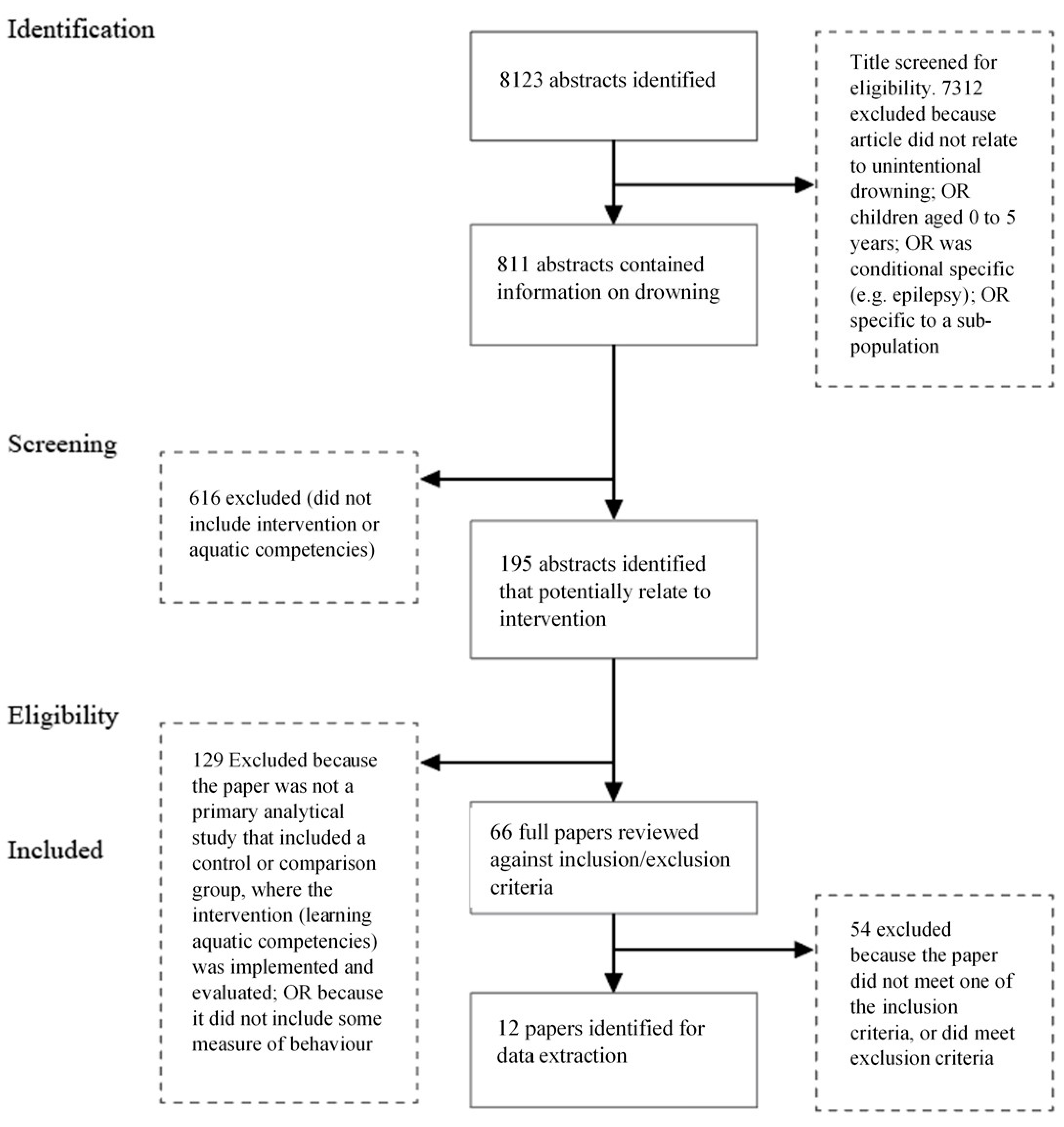

|
|
|
| Author | Year | Country | Age Explored | Total Number of Participants | Study Design | Level of Evidence 1 |
|---|---|---|---|---|---|---|
| Olaisen et al. [51] | 2018 | USA | 3–14 Years | 149 | Case Series | IV |
| Anderson and Rodriguez [52] | 2014 | USA | 3–8 Years | 272 | Retrospective case series | IV |
| Bugeja and Franklin [53] | 2013 | Australia | 0–4 Years | 80 | Retrospective case series | IV |
| Costa et al. [54] | 2012 | Portugal | 4 Years | 98 | Case–control population-based | III-2 |
| Brenner et al. [55] | 2009 | USA | 1–19 years | 301 | Case–control population-based | III-2 |
| Yang et al. [56] | 2007 | China | 1–14 Years | 399 | Case–control population-based | III-2 |
| Parker and Blanksby [57] | 1997 | Australia | 2–7 Years | 264 | Retrospective case series | IV |
| Asher et al. [58] | 1995 | USA | 24–42 months | 109 | Randomized trial no control | III-3 |
| Blanksby et al. [59] | 1995 | Australia | 3–9 Years | 326 | Retrospective case series | IV |
| Rodgers [60] | 1989 | USA | 0–59 months | 140 | Case-control population-based | IV |
| Erbaugh [61] | 1986 | USA | 2.5–5.5 Years | 126 | Case–control population-based | III-2 |
| McGraw [62] | 1939 | USA | 0–30 months | 42 | Case Series | IV |
| Author | Cohort | Measures | Results |
|---|---|---|---|
| Asher et al. [58] | 24–42 months, n = 109 | Three skills sets: Out of water safety behavior Swimming ability In-water safety skills Measured were assessed by independent blinded observers (instructors) for both the swimming ability and water safety skills. Parents undertook a self-report survey child development and demographics. | Evidence swimming lessons improve water competencies in children 2–3 years. Deck behavior did not improve p < 0.03.1 Significant improvement was found in water recovery (p < 0.001.2) Significant improvement could be attributed to water familiarity gained by participants Swimming was recommended as part of a comprehensive approach to water safety. Water safety instruction does not increase risk of drowning |
| Brenner et al. [55] | 1–4 Years, n = 195 | Exposure Swimming ability Swimming lesson participation (formal and informal) Self-report survey by parents reporting on child development, household characteristics, medical conditions and psycho-social characteristics. How measure assessed by fatal drowning | Children participated in formal swimming lessons less likely to drown (OR 0.12; 95% CI 0.01–0.97) 3 No significant associations were observed between informal swimming instruction and drowning in age group Limited by small sample numbers. Incentive payment. |
| Bugeja and Franklin [53] | 0–4 Years, n = 80 | Outcome fatal drowning. Limited to coroner’s death investigation records Water familiarization defined as participation in formal swimming lessons. | Water familiarization evidence was limited as there was a high frequency of unknowns (n = 58, 72.5%). 22 deaths information unavailable, 13 children had some previous water experience, 5 children participated in formal swimming lessons, 9 children no experience with water. Level of caregiver supervision was shown to be greater for children who had participated in swimming lessons. |
| Rodgers [60] | 0–59 Months, n = 140 | Child swimming ability by age via two surveys; 1. Children who had experienced a backyard pool drowning 2. Households owning residential swimming pools. Outcome fatal drowning. | While not statistically significant, swimming ability showed a reduction in the risk of an incident, increasing as the child ages. |
| Yang et al. [56] | 1–4 years, n = 192 | Attendance at swimming lessons? (Y/N) via a semi structured questionnaire, controls were age- and gender-matched. Child and caregiver behavioral characteristics. Outcome fatal drowning. | A child who did not attend swimming lessons was more likely to drown (OR 1.8; 95% CI 1.1 to 5.5) 2 Significant risk factors: poor health of caregiver (OR 3.1; 95% CI 1.9 to 5.8), not using flotation devices (OR 2.3; 95% CI 1.4 to 4.5) and no proper swimming lessons (OR 1.8; 95% CI 1.1 to 5.5). Swimming lessons may protect children 1–4 years of age. |
| Aquatic Competency 1 | Anderson and Rodriguez [52] | Asher et al. [58] | Blanksby et al. [59] | Brenner et al. [55] | Bugeja and Franklin [53] | Costa et al. [54] | Erbaugh [61] | McGraw [62] | Olaisen et al. [51] | Parker and Blanksby [57] |
|---|---|---|---|---|---|---|---|---|---|---|
| Deck Behavior | X | X | ||||||||
| Entry | X | X | X | X | X | X | ||||
| Exit | X | X | ||||||||
| Water Familiarization | X | X | X | X | X | X | X | X | X | X |
| Submersion | X | X | X | X | X | X | X | |||
| Submersion only | X | X | X | X | X | X | ||||
| Swim Underwater | X | X | ||||||||
| Retrieve Object | X | X | X | |||||||
| Breath Control | X | X | X | X | X | X | ||||
| Body Position | X | X | X | X | X | X | ||||
| Buoyancy/Flotation | X | X | X | X | X | X | X | |||
| Vertical | X | X | X | X | ||||||
| Horizontal: Front | X | X | X | X | X | X | ||||
| Horizontal: Back | X | X | X | X | X | X | ||||
| Propulsion | X | X | X | X | ||||||
| Kicking—Front | X | X | X | X | X | X | X | |||
| Kicking—Back | X | X | X | X | X | X | ||||
| Locomotion: Front | X | X | X | X | X | X | X | |||
| Locomotion: Back | X | X | X | X | ||||||
| Endurance | X | X | X | |||||||
| Water Safety Skills | X | X | X | X | X | |||||
| Recovery to edge | X | X | X | X | ||||||
| Treading Water | X | X |
| Author | Cohort | Competencies Achieved |
|---|---|---|
| Anderson and Rodriguez [52] | 3 years ( = 3.4), n = 95 4 years ( = 4.4), n = 71 | Children aged 3 to 4 years were able to reach level 1 competency. This included: jump into water, put head in water without goggles, pencil jump from pool deck, tread water for 1 min, swim underwater for 16 feet, swim underwater and retrieve rings from depth of 6 feet, swim 38 feet in prone, lifting head up to breathe. The younger the starting age, the younger the age at which the child reached level 1 proficiency. |
| Asher et al. [58] | 24–42 months, n = 109 | All three skill sets were achievable in 24–42 month children: 1. Out of water safety behavior. 2. Swimming ability included eight items, and these were “…face underwater, recover from prone, roll back to front, propulsive kicking, beginner stroke, independently enter and exit pool, jump into pool independently…”. 3. In-water safety skills included “…water recovery ability to stand up when dropped from above water and ability to jump in and swim to edge of pool…”. |
| Blanksby et al. [59] | 2–4 years, n = 123 | Children could obtain level 2 by 4 years: Level 1: Water/teacher confidence, be totally happy in the water, buoyancy—able to kick with kickboard by sell with or without bubble, submerging—complete submersion on own without hesitation, blowing bubbles—blow bubbles with whole face in water. Level 2: Back float—stretched body, front float—stretched body, kicking with board (10 m)—back and front, on front incorporating breathing—lifting head up and down, while keeping shoulders in water, swim 5 m—preferably lifting head once for breath, torpedo—reasonably straight legs. |
| Brenner et al. [55] | 1–4 years, n = 195 | Formal swimming Lessons n = 37 Liked water n = 153 Comfortable in water n = 150 Comfortable submerging whole head n = 70 Float on back 10 s n = 25 Swim on stomach 15 feet n = 16 Jump in a pool/swim 5 feet/back to wall n = 16 |
| Costa et al. [54] | 4.39 years ( ±0.49 years), n = 98 | Combined movements 56.6% of time achieved Glides 81.3% of the time achieved Breath control 100% of time achieved Skills of significant predictors included: body position at ventral gliding (Sk5, r = 0.467), body position at dorsal gliding (Sk6, r = 0.441), leg kick with breath control at dorsal body position with flutter boards (Sk11, r = 0.417) and without any flutter device (Sk12, r = 0.413). All 17 skills outlined in study were possible to be acquired by the 4 year old children at various levels. |
| Erbaugh [61] | 2.5–5.5 years, n = 126 | Locomotion front, n = 126 Locomotion back, n = 126 Kicking, n = 126 Entry: Jump, n = 126 Diving, n = 126 Ring puck up, n = 126 |
| McGraw [62] | 0–30 months, n = 42 | Submerged in prone position without support, n = 42 Submerged in supine position without support, n = 42 |
| Olaisen et al. [51] | 3–5 years, n = 44 | Average-unadjusted skill acquisition improvement was 12.3 skills (95% CI ranging from 10.0 to 13.0) (see supplementary one for full list of skills) |
| Parker and Blanksby [57] | 2 years, n = 14 3 years, n = 57 4 years, n = 77 | Children could obtain Level 2 by 4 years: Level 1: Water/teacher confidence, be totally happy in the water, buoyancy—able to kick with kickboard by sell with or without bubble, submerging—complete submersion on own without hesitation, blowing bubbles—blow bubbles with whole face in water. Level 2: Back float—stretched body, front float—stretched body, kicking with board (10 m)—back and front, on front incorporating breathing—lifting head up and down, while keeping shoulders in water, swim 5 m—preferably lifting head once for breath, torpedo—reasonably straight legs |
| Host | Vehicle (Agent or Vector) | Environment | |
|---|---|---|---|
| Pre-event (Primary) | Teach children 2–4 years to swim | Do not leave attractant objects in pool after use | Fence the pool with 4-sided fencing |
| Limit access from house to yard | |||
| Teach parent about water safety | Empty wading pool after use | Ensure gate is self-closing and not propped open | |
| Event (Secondary) | Never leave child in water alone or in the care of a sibling | Provide child with approved flotation device | Install pool/gate alarm |
| Sign with CPR instructions | |||
| Post-Event (Tertiary) | Learn CPR | Healthcare and social resources for rehabilitation | Parent and child education on water safety devices |
© 2020 by the authors. Licensee MDPI, Basel, Switzerland. This article is an open access article distributed under the terms and conditions of the Creative Commons Attribution (CC BY) license (http://creativecommons.org/licenses/by/4.0/).
Share and Cite
Taylor, D.H.; Franklin, R.C.; Peden, A.E. Aquatic Competencies and Drowning Prevention in Children 2–4 Years: A Systematic Review. Safety 2020, 6, 31. https://doi.org/10.3390/safety6020031
Taylor DH, Franklin RC, Peden AE. Aquatic Competencies and Drowning Prevention in Children 2–4 Years: A Systematic Review. Safety. 2020; 6(2):31. https://doi.org/10.3390/safety6020031
Chicago/Turabian StyleTaylor, Danielle H., Richard C. Franklin, and Amy E. Peden. 2020. "Aquatic Competencies and Drowning Prevention in Children 2–4 Years: A Systematic Review" Safety 6, no. 2: 31. https://doi.org/10.3390/safety6020031
APA StyleTaylor, D. H., Franklin, R. C., & Peden, A. E. (2020). Aquatic Competencies and Drowning Prevention in Children 2–4 Years: A Systematic Review. Safety, 6(2), 31. https://doi.org/10.3390/safety6020031

