Article

Land Cover and Temporal Effects on Dog-Vehicle Collisions in Lithuania

1
Institute of Biosciences, Life Sciences Center, Vilnius University, Saulėtekio Ave. 7, 10257 Vilnius, Lithuania
2
Department of Biodiversity, Institute of Life Sciences and Technology, Daugavpils University, Parādes St. 1, 5401 Daugavpils, Latvia
*
Author to whom correspondence should be addressed.
Safety 2026, 12(2), 51; https://doi.org/10.3390/safety12020051

Submission received: 19 January 2026 / Revised: 13 March 2026 / Accepted: 30 March 2026 / Published: 13 April 2026

Abstract

Animal-vehicle collisions (AVCs) are an increasing concern globally, yet domesticated animals, particularly dogs, remain understudied. We investigated spatial and temporal patterns of dog-vehicle collisions (DVCs) in Lithuania. Landscape variables such as distance to buildings, forests, meadows, and arable land, as well as land cover composition within a 500 m radius, were analyzed using GIS and compared to randomly generated pseudo-absence points. Temporal patterns were analyzed monthly, daily, and hourly. There was a significant difference in the number of DVCs occurring at sunrise and sunset. Moreover, DVCs were more frequent on weekends, peaking on Fridays and Sundays. Spatially, DVCs were significantly more likely to occur closer to built-up areas and meadows, and farther from forests and arable land, compared to random pseudo-absences, indicating a strong association with human-modified habitats. These findings indicate that DVCs are more influenced by human-modified landscapes and dog activity patterns, particularly around dawn and dusk.

1. Introduction

Roads are essential elements of modern transportation systems, yet they also influence nearby wildlife populations [1,2,3]. Consequently, it is important to consider these ecological impacts when optimizing road alignment [4].
In recent decades, the number of animal-vehicle collisions (AVCs) worldwide has been steadily increasing. This is thought to be mainly due to the increasing intensity of motor vehicle traffic and the expansion of road networks [5,6,7,8,9,10]. Based on the published research results, it can be concluded that the frequency of collisions between animals and vehicles on roads is determined both by human factors, such as traffic intensity, land use structure in roadside areas, driver attentiveness and understanding of traffic and environmental conditions, as well as natural factors such as terrain, distribution of roadside habitats, weather conditions, roadside vegetation, time of day and year, etc. [11,12,13].
Every year, AVCs cause the death of millions of animals belonging to various taxonomic groups [14,15,16,17]. In addition, animal–vehicle collisions not only account for substantial wildlife mortality but also endanger human life, causing fatalities, injuries, and significant associated social and economic burdens [10,12,15]. Therefore, overall, AVC is considered a serious road safety, environmental, and socioeconomic problem that needs to be addressed.
Although many animals are killed each year due to the expansion of transport systems and networks, we know little about the number and extent of animal deaths on roads or which species may be disproportionately affected. Recent studies have shown that collisions between animals and vehicles, involving both wild and domestic animals, depend on temporal and spatial factors [18,19].
Currently, there are many scientific articles published in the scientific press that examine various aspects of the damage caused by AVC, its causes, and potential prevention measures [20]. Taking into account the different characteristics of different types of wildlife, it is necessary to identify the sources of AVC (e.g., wild or domestic animals) and the patterns of such collisions in order to implement effective road accident prevention measures in a specific area [16].
In order to reduce the number of collisions between cars and animals, as well as the damage caused by them, various preventive measures and installations are being developed, tested, and implemented around the world. These include speed limits, warning signs, underground and over ground animal crossings, various fencing, animal deterrent and driver warning systems, etc. [21,22]. However, their effectiveness depends greatly on specific conditions [21,22,23,24]. This is because AVC patterns can vary, for example, on a daily and seasonal basis, depending on the behavioral characteristics of the species involved in AVC (e.g., due to feeding, migration, or breeding) [25,26,27]. As the comprehensive implementation of animal–vehicle collision mitigation strategies across full road networks is constrained by economic and logistical limitations, it is logical to separate collision cases according to individual characteristics and address the problem by focusing efforts on priority animal groups. Therefore, in order to develop and maximize the effectiveness of mitigation measures, it is necessary to identify and quantify the species affected by AVC, as well as the spatial and temporal distribution of collision sites.
Based on data from articles published in scientific journals, all collisions with animals can be divided into collisions between cars and wild animals and collisions between cars and domestic animals [8]. Most published articles focus their research on AVCs involving wild animals, while there are significantly fewer scientific studies examining AVCs involving domestic animals; therefore, there are also significantly more unanswered questions in this area. Domestic animals are involved in many traffic accidents and, due to their size, pose a danger to humans [28]. Despite this, few studies take domestic animals into account. This could be explained by the fact that AVCs with wild animals account for the majority of collisions overall [29], but the situation is fundamentally different in urban environments, where domestic animals account for the majority of animal fatalities [30].
The aim of our study is to investigate the role of dogs, a group of domestic animals that has been little studied so far, in overall AVC statistics. In order to describe their spatial and temporal (daily, weekly, and monthly) distribution and to investigate various factors that may determine such patterns, we analysed collisions included in the Lithuanian traffic police collision register.

2. Materials and Methods

The Republic of Lithuania is approximately 65,000 km2, situated on the eastern shore of the Baltic Sea, with a population of 2,885,891 in 2024 and a population density of 44.21 inhabitants per km2 [31]. Agricultural fields and highly fragmented forests dominate the landscape, covering respectively 44.0% and 33.0% of the territory [32,33,34].
In Lithuania, there are two functional categories of roads: roads of national importance and local roads. National importance roads consist of: (1) main roads, with the length of 1750.71 km and an annual average daily traffic (AADT) rate from around 10,000 vehicles/day in 2014 to more than 11,000 vehicles a day in 2021; (2) national roads, with the length of 4927.68 km and an AADT from 2300 vehicles/day in 2014 to more than 2500 vehicles/day in 2021; and (3) regional roads, with the length of 14,559.24 km and an AADT from 400 vehicles/day in 2014 to 500 vehicles/day in 2021. The length of local roads is 60,887 km [35].
For the spatial analysis of dog-vehicle collisions, four land cover types and object groups were selected, including built-up areas, pastures, arable land, forest and road fences. Distances from the roadkill to the nearest land cover type were calculated using the spatial dataset of georeferenced base cadaster (GRPK) for 2023, and to the nearest road fence using the spatial dataset of KTVIS National road data [36]. The distribution of different land cover types in 2023 did not differ significantly from the range of land cover values observed between 2014 and 2021 (Crawford and Howell single t-tests; all p > 0.05).
The records of road accidents with domestic animals (1216 records) in Lithuania from 2014 to 2021 were extracted from the Lithuanian Road Police Database. Since the largest portion of the recorded accidents was with dogs (929 cases), only the dog-vehicle collisions (DVCs) were used in the analysis. The DVCs accounted for 76.4% of road accidents with domestic animals and 3.2% of road accidents with all animals during the study period. The frequencies of DVCs across the different road categories were 120 on main roads, 238 on national roads, and 571 on regional roads. The same DVC frequencies were maintained while generating random pseudo-absence data using ArcGIS Pro 3.6.2 (ESRI). All but one accident record with the dogs included data on the time of the accident, location coordinates and participants.
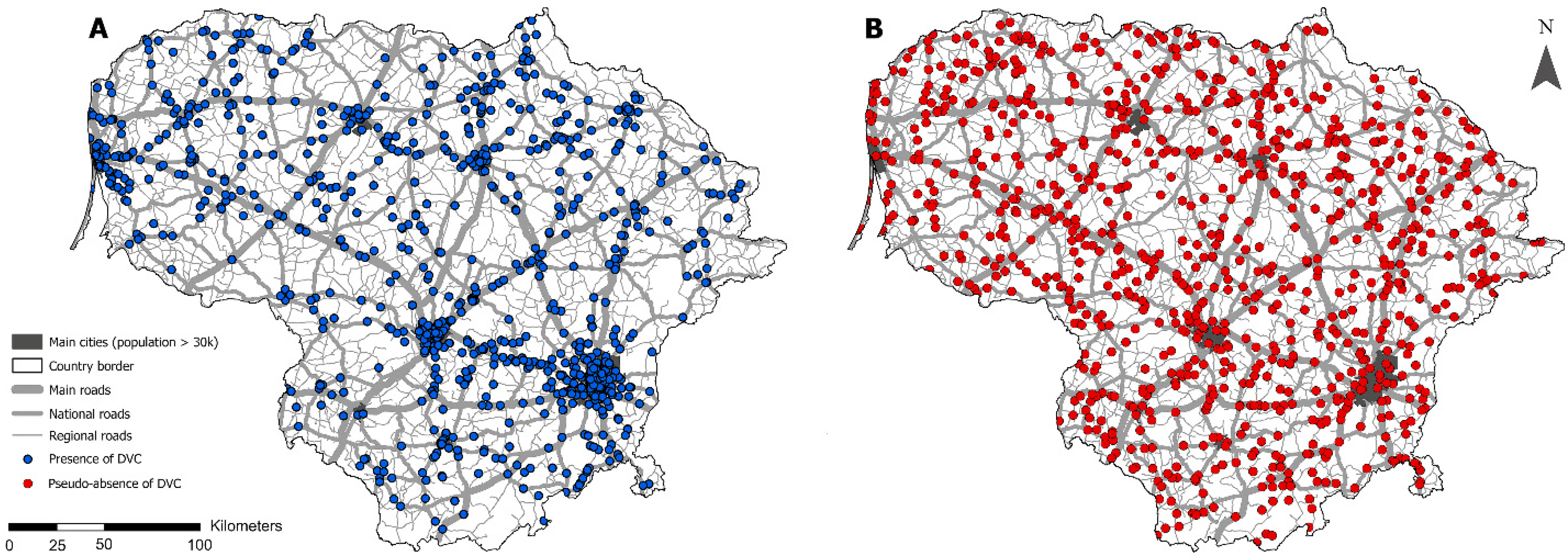
We analysed temporal deviance of DVC frequencies using chi-square goodness-of-fit tests. Compared DVCs’ numbers at sunrise hours vs. sunset hours using the Wilcoxon signed-rank test. We compared eight landscape characteristics, such as nearest distances (m) to (i) buildings, (ii) forests, (iii) meadows, (iv) arable land, and areas (ha) of major landscape covers such as: (v) forests, (vi) meadows, (vii) arable land, and (viii) built-up areas, within a 500 m radius from the truly observed DVCs points (n = 929, Figure 1A) vs. the same landscape metrics calculated from randomly generated points “pseudo-absence of DVCs” (n = 929, Figure 1B) using Mann-Whitney U-tests with Bonferroni correction (padj) for multiple (n = 8) comparisons. All tests were two-tailed and the results were considered significant if p < 0.05. The analyses were performed using Past 4.07b [37].

3. Results

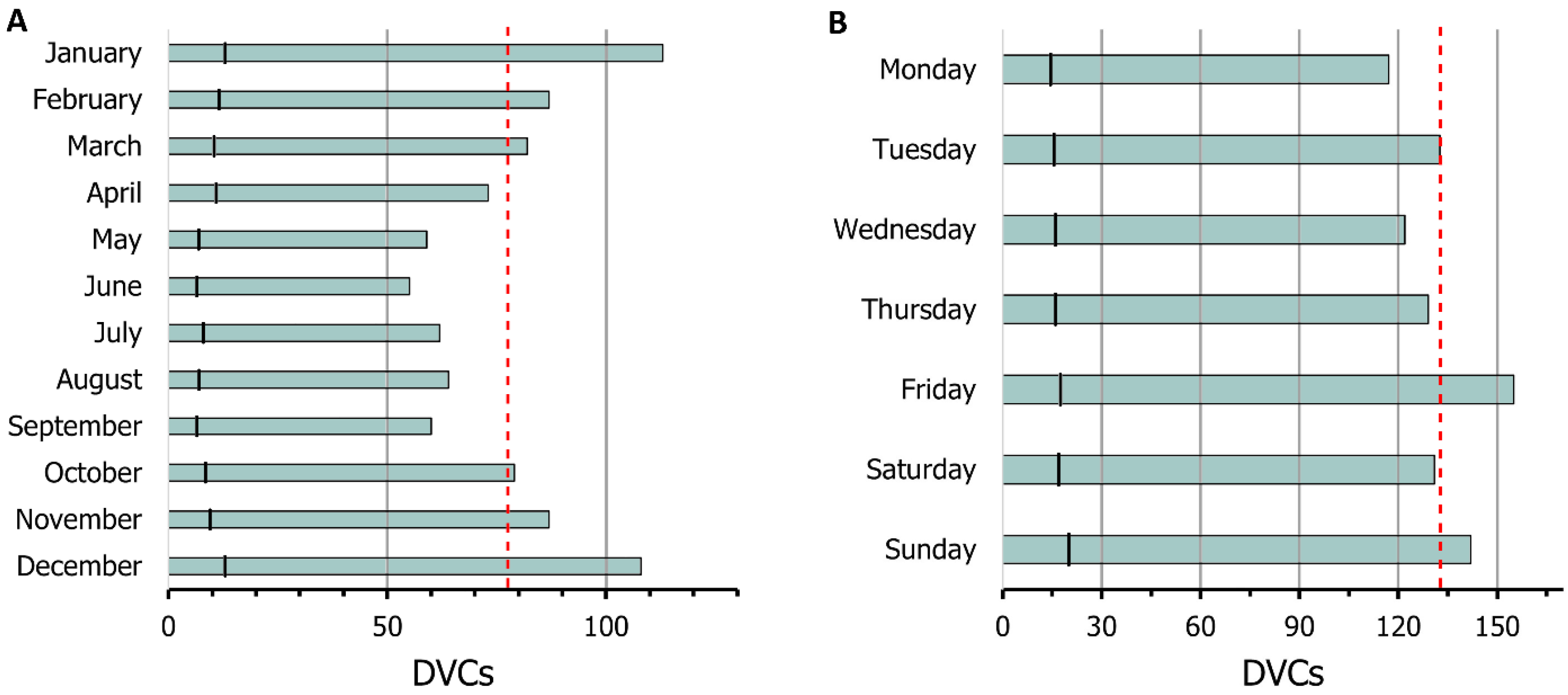
The average number of DVCs in Lithuania during 2014–2021 was 116 per year (n = 8). The lowest frequency of DVCs was recorded in 2017 (96) and the highest in 2019 (178). The frequency of DVCs on different types of roads was not uniform (obs. vs. exp., χ2 = 171.06, df = 3, p < 0.001), with the highest FO (41.87%) on local roads. The monthly distribution of DVCs (pooled for eight years) was not uniform (χ2 = 51.6, df = 11, p < 0.0001) and peaked during the winter (Figure 2A). Most DVCs were registered in January and December (113 and 108, respectively) and the lowest frequencies were observed in May and June (59 and 55, respectively). The daily distribution of DVCs (pooled for eight years) did not significantly deviate from the uniform pattern (χ2 = 7.2, df = 6, p = 0.299), however, more DVCs than the daily eight-year pooled average (132.7) were observed on Fridays (155) and Sundays (142) (Figure 2B).
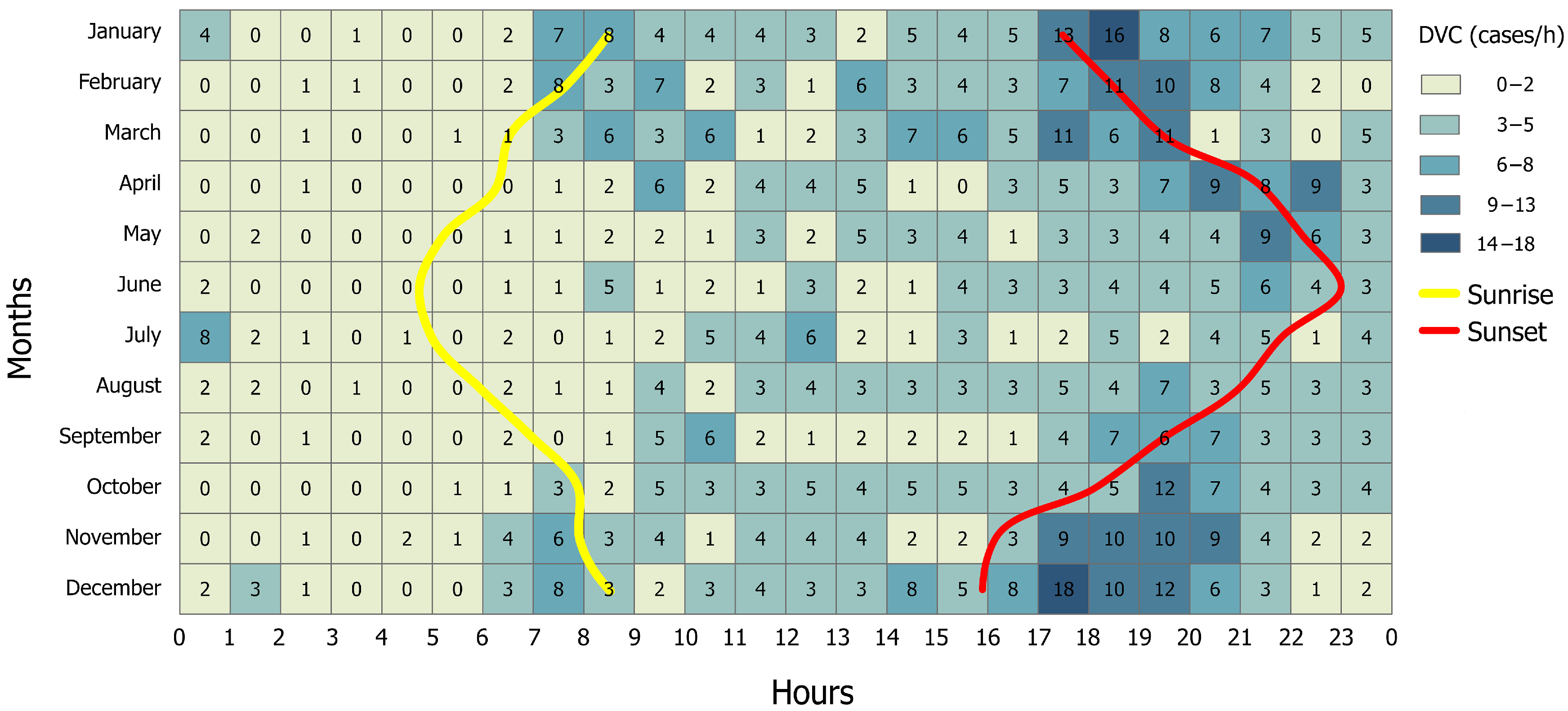
Hourly distribution of DVCs (pooled for eight years) was not uniform (χ2 = 385.8, df = 23, p < 0.0001) (Figure 3). Closer examination of the data showed that the DVCs were concentrated in a 5-h period (5 pm to 10 pm) (42% of the total accidents; Figure 3). The number of DVCs occurring during the sunrise and the sunset differed significantly (Wilcoxon signed-rank test: z = 2.7541, p = 0.006). The median number of DVCs during the sunrise was 1.5 (25th–75th percentiles: 0–5.25), while during the sunset it was 5.5 (25th–75th percentiles: 4–10.25) (Figure 3).
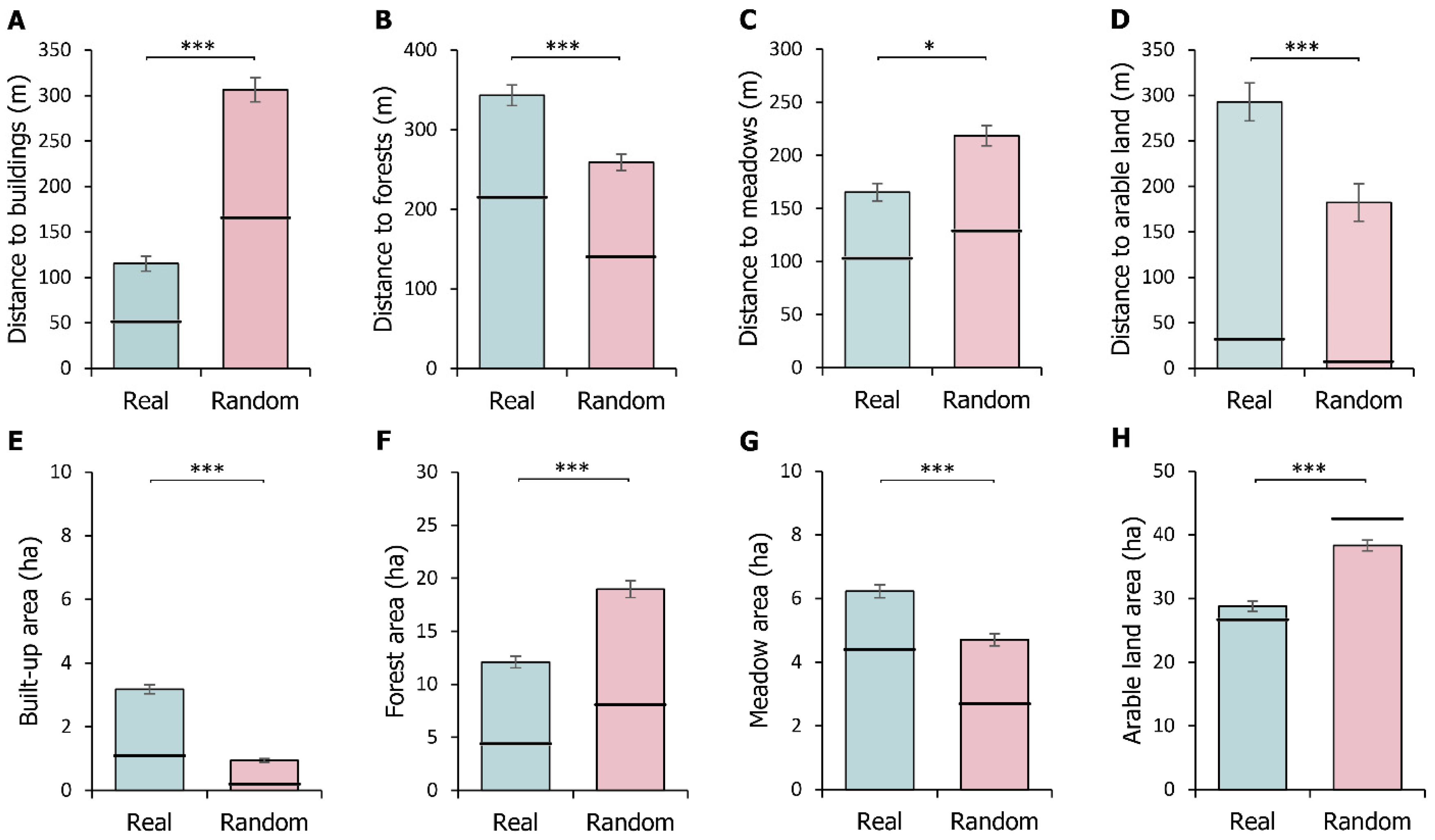
Actual DVCs locations tended to have lower distances to buildings and meadows and higher distances to forests and arable land. The median nearest distance to buildings in real DVC occurrences (50.7 m) was significantly lower than in the random pseudo-absences (166.6 m) (Mann-Whitney test, z = 16.628, padj < 0.001) Figure 4A. The median distance to forests in real DVC occurrences (215.2 m) was significantly higher than in the random pseudo-absences (140.9 m) (Mann-Whitney test, z = 6.1993, padj < 0.001) Figure 4B. The median distance to meadows in real DVC occurrences (103.2 m) was significantly lower than the median distance in the random pseudo-absences (128.9 m) (Mann-Whitney test, z = 3.0702, padj < 0.05) Figure 4C. The median distance to arable land in real DVC occurrences (32.2 m) was significantly higher than that one in the random pseudo-absences (7 m) (Mann-Whitney test, z = 9.623, padj < 0.001) Figure 4D.
The areas of main land cover types within a radius of 500 m differed between the actual DVC locations and the randomly generated pseudo-absence of DVC locations. The median built-up area in real DVC occurrences (1.1 ha) was significantly higher than the median built-up area in the random pseudo-absences (0.2 ha) (Mann-Whitney test, z = 16.278, padj < 0.001) Figure 4E. The median forest area in real DVC occurrences (4.3 ha) was significantly lower than the median forest area in the random pseudo-absences (8.1 ha) (Mann-Whitney test, z = 5.7476, padj < 0.001) Figure 4F. The median meadow area in real DVC occurrences (4.4 ha) was significantly higher than the median meadow area in the random pseudo-absences (2.7 ha) (Mann-Whitney test, z = 7.1271, padj < 0.001) Figure 4G. The median area of arable land in real DVC occurrences (26.7 ha) was significantly lower than the median area of arable land in the random pseudo-absences (42.6 ha) (Mann-Whitney test, z = 8.3046, padj < 0.001) Figure 4H.

4. Discussion

Our investigation shows that domestic dogs significantly prevailed among other domestic animals involved in AVCs. However, they make up only a little more than 3% of all AVCs, including wild animals. A similar pattern was found in some other countries, e.g., Belgium [29], Slovakia [38], although in some regions, domestic dogs in AVCs may comprise the major part of all cases, especially in highly urbanized environments [16]. Many veterinary clinics around the world confirm that a significant part of domestic dog injuries are caused by road traffic accidents, even among purebred dogs, which could require high care from their owners [39,40,41,42].

4.1. Spatial and Traffic Interrelation Patterns

DVCs were registered on all road categories. However, there was a clear increasing trend in DVCs on local roads (low-traffic roads) compared to magistral and regional roads (high-traffic roads). The influence of traffic intensity on the frequency of animal-vehicle collisions is rather controversially discussed in scientific literature, and such data on domestic dogs are very scarce. In southern Spain, dog-vehicle collisions were found to be positively associated with road traffic intensity [16]. It is worth noting that the road network and human population density in southern Spain are much higher than in Lithuania. Thus, dog-vehicle collision patterns could differ significantly.
Positive relationships between traffic intensity and AVCs were mainly reported with respect to wildlife. In the Czech Republic, however, traffic intensity was not the main cause of collisions between wild ungulates and vehicles throughout the year or across various road types, and the correlations were mainly negative [43]. However, in a broader geographical context, conclusions regarding the influence of traffic intensity on AVC occurrences may be the opposite [44]. Comparing the risks of DVCs and AVCs based on traffic intensity can be misleading because domestic dogs and wild animals may exhibit different behaviours near roads. For example, wild animals cross roads to reach suitable habitats or other resources [45,46], whereas dogs are more likely to end up on roads by accident.
We found that DVCs are more expected to happen in the vicinity of rural or urban areas. This tendency is also supported by our finding that real DVCs were significantly closer to buildings and farther from forested areas than randomly generated DVCs (Figure 4). It is reasonable because domestic dogs primarily occur in human settlements; however, such a DVC pattern may indicate insufficient care for domestic dogs by humans. According to our unpublished observations, free-ranging dogs may be spotted around villages. Free-ranging dogs were considered among the major causes of domestic animal collisions with vehicles in Texas [47].

4.2. Temporal Patterns

The highest number of DVCs was recorded during the colder months, specifically from October to March, with the peak occurring in November and December. A similar seasonal pattern was observed in Southern Spain, which was attributed to the coinciding intensive hunting season [16]. In our case, such an interpretation seems questionable because real DVCs tend to occur closer to anthropogenic land cover types than to semi-natural and natural ones, which are the main hunting areas in Lithuania.
The seasonal pattern of DVCs is challenging to explain in connection with the breeding season. Domestic dogs do not exhibit seasonal breeding patterns, whether they are living freely or under human control [47]. We do not have data on whether the DVCs cases involved controlled purebred dogs or free-ranging dogs. However, the data collection method, which registered these incidents as insurance events, suggests that many cases likely involved large, free-ranging dogs, particularly in rural areas. Males are constantly capable of reproducing, whereas females come into oestrus every seven months [48,49]. In some regions, free-ranging females may synchronize their breeding with a favorable period of the year [50].
When analyzing the circadian distribution of DVCs, we found that these events were clearly related to sunset. This pattern may also partially explain the seasonal distribution of DVCs: in the cold season, the dark period of the day is longer, so the probability of collision with vehicles also grows. Free-ranging dog activity was found to be bimodal and related to the dark hours [51]. Our unpublished observations using camera traps in a location near the magistral road also confirm this pattern: free-ranging dogs were mainly captured by camera traps during the dark hours.
The notably weaker relationship between DVCs and sunrise time may indicate lower activity levels in both free-ranging and owner-controlled dogs during morning hours. On the other hand, this could also be attributed to the shorter duration of darkness in the morning, which results in less overall dog activity and less traffic during those hours. In contrast, the dark period in the evening is generally longer and consequently has a higher cumulative traffic amount, particularly during the colder months. It seems that the duration of the dark period may play a direct or indirect role in the circadian distribution of DVCs.
In summary, our study is a first attempt to evaluate the situation with DVCs in Lithuania. In some respects, results may differ from those in other countries, which is reasonable given the completely different road network conditions, traffic intensities, human population densities, and cultural practices regarding dog ownership. In this regard, the data from the Lithuanian Road Police Database have certain limitations. This includes possible underreporting of DVCs and a lack of time- and site-specific traffic volume information. There is also a lack of information on well-controlled family dogs and free-ranging dogs, including details of their age and gender. Further studies incorporating more comprehensive reporting, detailed traffic volume data, and multi-scale spatial information would enable more robust modelling and a better understanding of DVC patterns.

5. Conclusions

This study provides the first nationwide, multi-year assessment of dog-vehicle collisions (DVCs) in Lithuania and offers several insights into their spatial and temporal dynamics. We show that DVCs are concentrated near built-up areas and open habitats such as meadows and occur disproportionally during winter and evening hours (between 5:00 pm and 10:00 pm). These patterns differ considerably from those typically observed in wildlife vehicle collisions, indicating that DVCs are mainly influenced by human-related factors.
The key findings of this work demonstrate that DVC risk is closely related to how dogs are managed within human-dominated landscapes. These findings suggest shifting the focus in policy implications from traditional, wildlife-oriented mitigation measures to actions that target human behaviour. Implications for policy would include strengthening responsible dog ownership practices, reducing the free-ranging dogs, and implementing targeted awareness campaigns during high-risk time periods.
Additionally, our results suggest the importance of distinguishing between owned and stray dogs in future research and integrating behavioural data to refine prevention strategies. This study identifies the human-related causes underlying DVCS and provides a foundation for more effective, socially informed approaches to improve road safety and animal welfare.

Author Contributions

Conceptualization, A.S. and G.I.; Methodology, A.S., G.T. and J.V.; Software, J.V.; Validation, A.S. and G.T.; Formal Analysis, A.S. and G.T.; Investigation, J.V. and A.S.; Resources, V.V.; Data Curation, J.V. and A.S.; Writing—Original Draft Preparation G.I., A.U., A.S. and G.T.; Writing—Review & Editing, V.V. and L.M.; Visualization, G.T.; Supervision, A.S. and G.I. All authors have read and agreed to the published version of the manuscript.

Funding

This research received no external funding.

Institutional Review Board Statement

Not applicable.

Informed Consent Statement

Not applicable.

Data Availability Statement

The datasets presented in this article are not readily available due to restrictions outlined in the Animal–Vehicle Collision Data Usage Agreement between Lithuania’s Police Department and Vilnius University, which prohibit sharing the data with third parties.

Conflicts of Interest

The authors declare no conflict of interest.

References

  1. Davey, N.; Dunstall, S.; Halgamuge, S. Optimal road design through ecologically sensitive areas considering animal migration dynamics. Transp. Res. C 2017, 77, 478–494. [Google Scholar] [CrossRef]
  2. Friedrich, J. Integrating neglected ecological impacts of road transport into corporate management. Ecol. Indic. 2015, 54, 197–202. [Google Scholar] [CrossRef]
  3. Jaarsma, C.F.; van Langevelde, F.; Botma, H. Flattened fauna and mitigation. Transp. Res. D 2006, 11, 264–276. [Google Scholar] [CrossRef]
  4. Hill, J.; DeVault, T.; Belant, J. Comparative influence of anthropogenic landscape pressures on cause-specific mortality of mammals. Perspect. Ecol. Conserv. 2022, 20, 38–44. [Google Scholar] [CrossRef]
  5. Coffin, A.W. From roadkill to road ecology: A review of the ecological effects of roads. J. Transp. Geogr. 2007, 15, 396–405. [Google Scholar] [CrossRef]
  6. Rowden, P.; Steinhardt, D.; Sheehan, M. Road crashes involving animals. Accid. Anal. Prev. 2008, 40, 1865–1871. [Google Scholar] [CrossRef]
  7. Laurance, W.F.; Clements, G.R.; Sloan, S.; O’Connell, C.S.; Mueller, N.D.; Goosem, M.; Venter, O.; Edwards, D.P.; Phalan, B.; Balmford, A.; et al. A global strategy for road building. Nature 2014, 513, 229–232. [Google Scholar] [CrossRef]
  8. Wilkins, D.C.; Kockelman, K.M.; Jiang, N. Animal-vehicle collisions in Texas. Accid. Anal. Prev. 2019, 131, 157–170. [Google Scholar] [CrossRef]
  9. Delgado, J.D.; Humia, J.D.; Pereiras, A.R.; Rosal, A.; del Valle Palenzuela, M.; Morelli, F.; Sánchez, J.R. The spatial distribution of animal casualties within a road corridor. Transp. Res. D 2019, 67, 119–130. [Google Scholar] [CrossRef]
  10. Galinskaitė, L.; Ulevičius, A.; Valskys, V.; Samas, A.; Busher, P.E.; Ignatavičius, G. The influence of landscape structure on wildlife–vehicle collisions. ISPRS Int. J. Geo-Inf. 2022, 11, 63. [Google Scholar] [CrossRef]
  11. Seiler, A. Ecological Effects of Roads: A Review; Swedish University of Agricultural Sciences: Riddarhyttan, Sweden, 2001; pp. 1–87. [Google Scholar]
  12. Heigl, F.; Stretz, C.R.; Steiner, W.; Suppan, F.; Bauer, T.; Laaha, G.; Zaller, J.G. Comparing road-kill datasets from hunters and citizen scientists. Remote Sens. 2016, 8, 832. [Google Scholar] [CrossRef]
  13. Balčiauskas, L.; Stratford, J.; Balčiauskienė, L.; Kučas, A. Importance of professional roadkill data in assessing diversity of mammal roadkills. Transp. Res. D 2020, 87, 102493. [Google Scholar] [CrossRef]
  14. Trombulak, S.C.; Frissell, C.A. Ecological effects of roads on terrestrial and aquatic communities. Conserv. Biol. 2000, 14, 18–30. [Google Scholar] [CrossRef]
  15. Erritzoe, J.; Mazgajski, T.D.; Rejt, Ł. Bird casualties on European roads—A review. Acta Ornithol. 2003, 38, 77–93. [Google Scholar] [CrossRef]
  16. Canal, D.; Martín, B.; De Lucas, M.; Ferrer, M. Dogs are the main species involved in animal-vehicle collisions in southern Spain. PLoS ONE 2018, 13, e0203693. [Google Scholar] [CrossRef] [PubMed]
  17. Belkacem, M.; Rai, A.; Menzer, N.; Bara, M.; Mouni, L. First report on animal-vehicle collisions impact on wild and domestic animals in northern Algeria. Int. J. Environ. Stud. 2023, 81, 1256–1275. [Google Scholar] [CrossRef]
  18. Naidenko, S.; Chistopolova, M.; Hernandez-Blanco, J.A.; Erofeeva, M.; Rozhnov, V. The effect of highway on mammals. Transp. Res. D 2021, 94, 102808. [Google Scholar] [CrossRef]
  19. Grilo, C.; Bissonette, J.A.; Santos-Reis, M. Spatial–temporal patterns in Mediterranean carnivore road casualties. Biol. Conserv. 2009, 142, 301–313. [Google Scholar] [CrossRef]
  20. Said, M.M.; Mohd, M.S.; Faye, I.; Husain, N.A.; Kamaruddin, T.T.; Dol, S.S. Review of current animal-vehicle collision studies. J. Soc. Automot. Eng. Malays. 2021, 5, 64–71. [Google Scholar] [CrossRef]
  21. Sullivan, T.L.; Williams, A.F.; Messmer, T.A.; Hellinga, L.A.; Kyrychenko, S.Y. Temporary warning signs reducing deer collisions. Wildl. Soc. Bull. 2004, 32, 907–915. [Google Scholar] [CrossRef]
  22. van der Grift, E.A.; van der Ree, R.; Fahrig, L.; Findley, S.; Houlahan, J.; Jaeger, J.A.G.; Klar, N.; Madrinan, L.F.; Olson, L. Evaluating the effectiveness of mitigation measures. Biodivers. Conserv. 2013, 22, 425–448. [Google Scholar] [CrossRef]
  23. Nandutu, I.; Atemkeng, M.; Okouma, P. Intelligent systems to mitigate wildlife–vehicle collisions. Sensors 2022, 22, 2478. [Google Scholar] [CrossRef]
  24. Balčiauskas, L.; Kučas, A.; Balčiauskienė, L. A Review of Wildlife–Vehicle Collisions: A Multidisciplinary Path to Sustainable Transportation and Wildlife Protection. Sustainability 2025, 17, 4644. [Google Scholar] [CrossRef]
  25. Sullivan, J.M. Trends and characteristics of animal-vehicle collisions. J. Saf. Res. 2011, 42, 9–16. [Google Scholar] [CrossRef]
  26. Bartonička, T.; Andrášik, R.; Duľa, M.; Sedoník, J.; Bíl, M. Identification of local factors causing clustering of animal-vehicle collisions. J. Wildl. Manag. 2018, 82, 940–947. [Google Scholar] [CrossRef]
  27. Ignatavičius, G.; Ulevičius, A.; Valskys, V.; Trakimas, G.; Galinskaitė, L.; Busher, P.E. Temporal patterns of ungulate-vehicle collisions in a sparsely populated country. Eur. J. Wildl. Res. 2020, 66, 58. [Google Scholar] [CrossRef]
  28. Carvalho-Roel, C.F.; Iannini-Custódio, A.E.; Marçal Júnior, O. Do roadkill aggregations of wild and domestic mammals overlap? Rev. Biol. Trop. 2019, 67, 47–60. [Google Scholar] [CrossRef]
  29. Morelle, K.; Lehaire, F.; Lejeune, P. Spatio-temporal patterns of wildlife-vehicle collisions. Nat. Conserv. 2013, 5, 53–73. [Google Scholar] [CrossRef]
  30. Schwartz, A.L.; Williams, H.F.; Chadwick, E.; Thomas, R.J.; Perkins, S.E. Roadkill scavenging behaviour in an urban environment. J. Urban Ecol. 2018, 4, juy006. [Google Scholar] [CrossRef]
  31. European Commission, Eurostat. Lithuania; Publication Office of the European Union: Luxembourg, 2024; Available online: https://european-union.europa.eu/principles-countries-history/eu-countries/lithuania_en#:~:text=Population:%202%20890%20664 (accessed on 25 March 2026).
  32. Kučas, A.; Trakimas, G.; Balčiauskas, L.; Vaitkus, G. Multi-scale analysis of forest fragmentation in Lithuania. Baltic For. 2011, 17, 128–135. Available online: https://balticforestry.lammc.lt/bf/PDF_Articles/2011-17[1]/Kucas_2011%2017(1)_128_135.pdf (accessed on 25 March 2026).
  33. State Data Agency. Environment, Agriculture and Energy in Lithuania (Edition 22). 2022. Available online: https://osp.stat.gov.lt/lietuvos-aplinka-zemes-ukis-ir-energetika-2022/zemes-ukis/bendroji-informacija (accessed on 12 July 2025).
  34. State Forest Service, Ministry of Environment. Lithuanian Statistical Yearbook of Forestry. 2021. Available online: https://osp.stat.gov.lt/en/lietuvos-aplinka-zemes-ukis-ir-energetika-2022/aplinka/miskai (accessed on 25 March 2026).
  35. VIA Lietuva(a). Vidutinis Metinis Paros Eismo Intesyvumas. Available online: https://lakd.lt/eismo-intensyvumas (accessed on 12 July 2025).
  36. VIA Lietuva(b). Tvoros Nuo Laukinių Gyvunų ir Varliagyvių. Available online: https://gis.ktvis.lt/webappbuilder/apps/35/ (accessed on 12 July 2025).
  37. Hammer, Ø.; Harper, D.A.; Ryan, P.D. PAST: Paleontological Statistics Software Package for Education and Data Analysis. Palaeontol. Electron. 2001, 4, 1–9. Available online: https://palaeo-electronica.org/2001_1/past/past.pdf (accessed on 25 March 2026).
  38. Hell, P.; Plavý, R.; Slamečka, J.; Gašparík, J. Losses of mammals (Mammalia) and birds (Aves) on roads in the Slovak part of the Danube Basin. Eur. J. Wildl. Res. 2005, 51, 35–40. [Google Scholar] [CrossRef]
  39. Adams, V.J.; Evans, K.M.; Sampson, J.; Wood, J.L.N. Methods and mortality results of a health survey of purebred dogs in the UK. J. Small Anim. Pract. 2010, 51, 512–524. [Google Scholar] [CrossRef]
  40. O’Neill, D.G.; Church, P.D.; McGreevy, P.C.; Thomson, D.C.; Brodbelt, D.G. Longevity and mortality of owned dogs. Vet. J. 2013, 198, 638–643. [Google Scholar] [CrossRef]
  41. Harris, G.L.; Brodbelt, D.; Church, D.; Humm, K.; McGreevy, P.D.; Thomson, P.C.; O’Neill, D. Epidemiology, clinical management, and outcomes of dogs involved in road traffic accidents. J. Vet. Emerg. Crit. Care 2018, 28, 140–148. [Google Scholar] [CrossRef]
  42. Klainbart, S.; Bibring, U.; Strich, D.; Chai, O.; Bdolah-Abram, T.; Aroch, I.; Kelmer, E. Retrospective evaluation of 140 dogs involved in road traffic accidents. Vet. Rec. 2018, 182, 196. [Google Scholar] [CrossRef]
  43. Gunson, K.E.; Mountrakis, G.; Quackenbush, L.J. Spatial wildlife-vehicle collision models: A review. J. Environ. Manag. 2011, 92, 1074–1082. [Google Scholar] [CrossRef]
  44. Hill, J.E.; DeVault, T.L.; Belant, J.L. A review of ecological factors promoting road use by mammals. Mammal Rev. 2021, 51, 214–227. [Google Scholar] [CrossRef]
  45. Smith, D.J.; Van Der Ree, R.; Rosell, C. Wildlife crossing structures. In Handbook of Road Ecology; van der Ree, R., Smith, D.J., Grilo, C., Eds.; Wiley Balckwell: Chichester, UK, 2015; pp. 172–183. [Google Scholar] [CrossRef]
  46. Kušta, T.; Keken, Z.; Ježek, M.; Holá, M.; Šmíd, P. The effect of traffic intensity on ungulate-vehicle collision probability. Saf. Sci. 2017, 91, 105–113. [Google Scholar] [CrossRef]
  47. Lord, K.; Feinstein, M.; Smith, B.; Coppinger, R. Variation in reproductive traits of Canis. Behav. Process. 2013, 92, 131–142. [Google Scholar] [CrossRef]
  48. Haase, E. Comparison of reproductive biological parameters in male wolves and domestic dogs. Z. Säugetierkd. 2000, 65, 257–270. [Google Scholar]
  49. Boitani, L.; Ciucci, P.; Ortolani, A. Behaviour and social ecology of free-ranging dogs. In Behavioral Biology of Dogs; Jensen, P., Ed.; Cromwell Press: Trowbridge, UK, 2007; pp. 147–165. [Google Scholar]
  50. Pal, S.K. Population ecology of free-ranging urban dogs. Acta Theriol. 2001, 46, 69–78. [Google Scholar] [CrossRef]
  51. Griss, S.; Riemer, S.; Warembourg, C.; Sousa, F.M.; Wera, E.; Berger-Gonzalez, M.; Alvarez, D.; Bulu, P.M.; Hernández, A.L.; Roquel, P.; et al. If they could choose: How would dogs spend their days? Activity patterns in four populations of domestic dogs. Appl. Anim. Behav. Sci. 2021, 243, 105449. [Google Scholar] [CrossRef]
Figure 1. Dog road kills (DVCs) in the territory of Lithuania: (A) real occurrences of DVCs over the period 2014–2021, and (B) randomly generated pseudo-absence of DVCs.
Safety 12 00051 g001
Figure 2. (A) Monthly, and (B) daily distribution of number of dog-vehicle collisions (DVCs), pooled for 8 years. Dashed reference lines indicate eight-year monthly (77.4) and daily (132.7) numbers. Thick vertical lines on horizontal bars indicate yearly median DVCs.
Safety 12 00051 g002
Figure 3. Distribution of dog-vehicle collisions (n = 928) throughout the day during different months over the period 2014–2021. The yellow and red lines indicate a sunrise and a sunset (respectively).
Safety 12 00051 g003
Figure 4. An average (±SE) nearest distance (m) to (A) buildings, (B) forests, (C) meadows, (D) arable land, and the area of (E) built-up area, (F) forest area, (G) meadow area, (H) arable land in DVCs locations (Real) and in randomly generated pseudo-absence of DVCs locations (Random). Asteriks indicate Bonferroni adjusted p-values: * padj < 0.05, *** padj < 0.001. Thick horizontal lines indicate medians.
Safety 12 00051 g004
Disclaimer/Publisher’s Note: The statements, opinions and data contained in all publications are solely those of the individual author(s) and contributor(s) and not of MDPI and/or the editor(s). MDPI and/or the editor(s) disclaim responsibility for any injury to people or property resulting from any ideas, methods, instructions or products referred to in the content.