
Towards a Worker-Centered Framework for Categorizing Procedural Adaptations


Abstract
1. Introduction
2. Methods
2.1. Research Setting
2.2. Participants
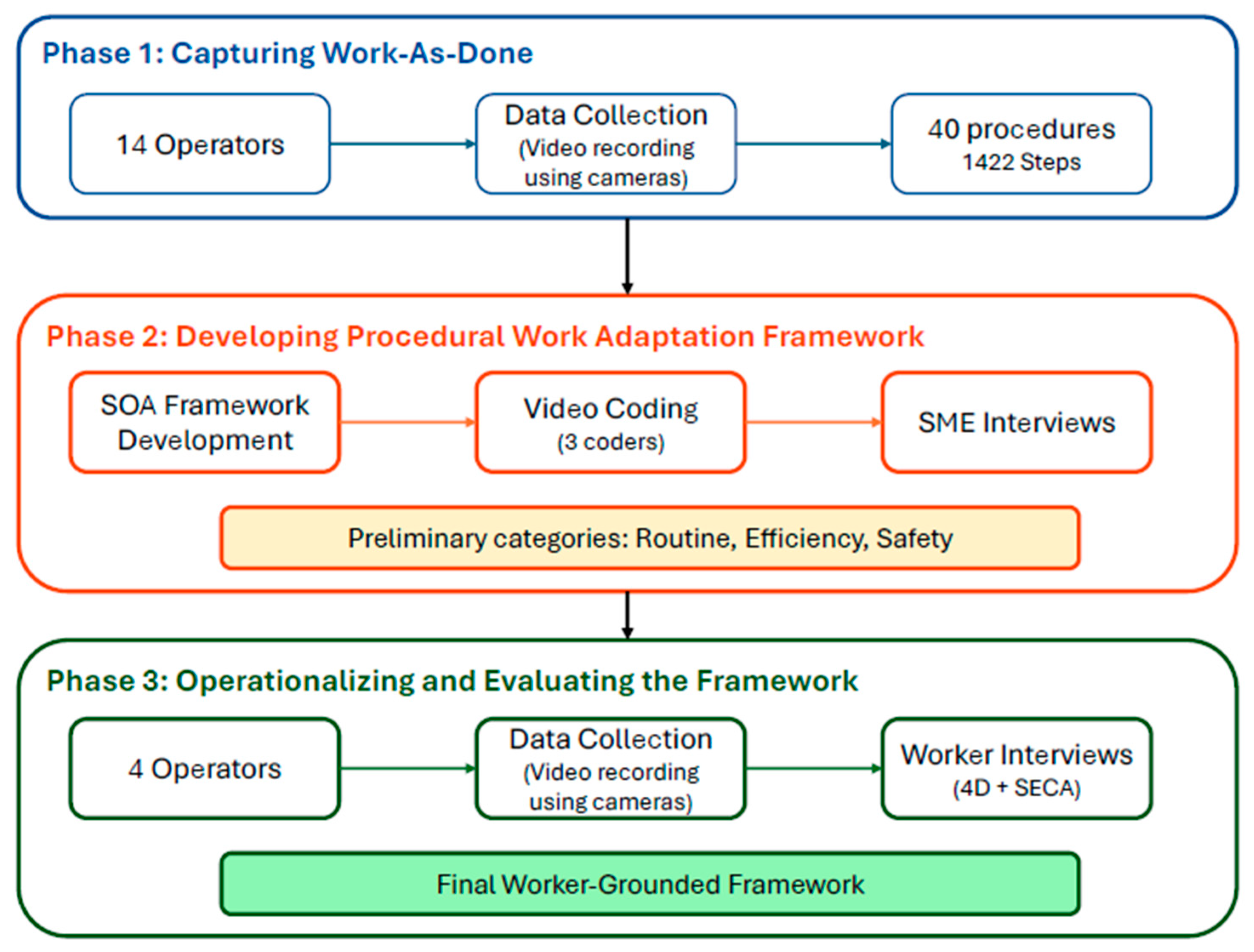
2.3. Three-Phase Research Design
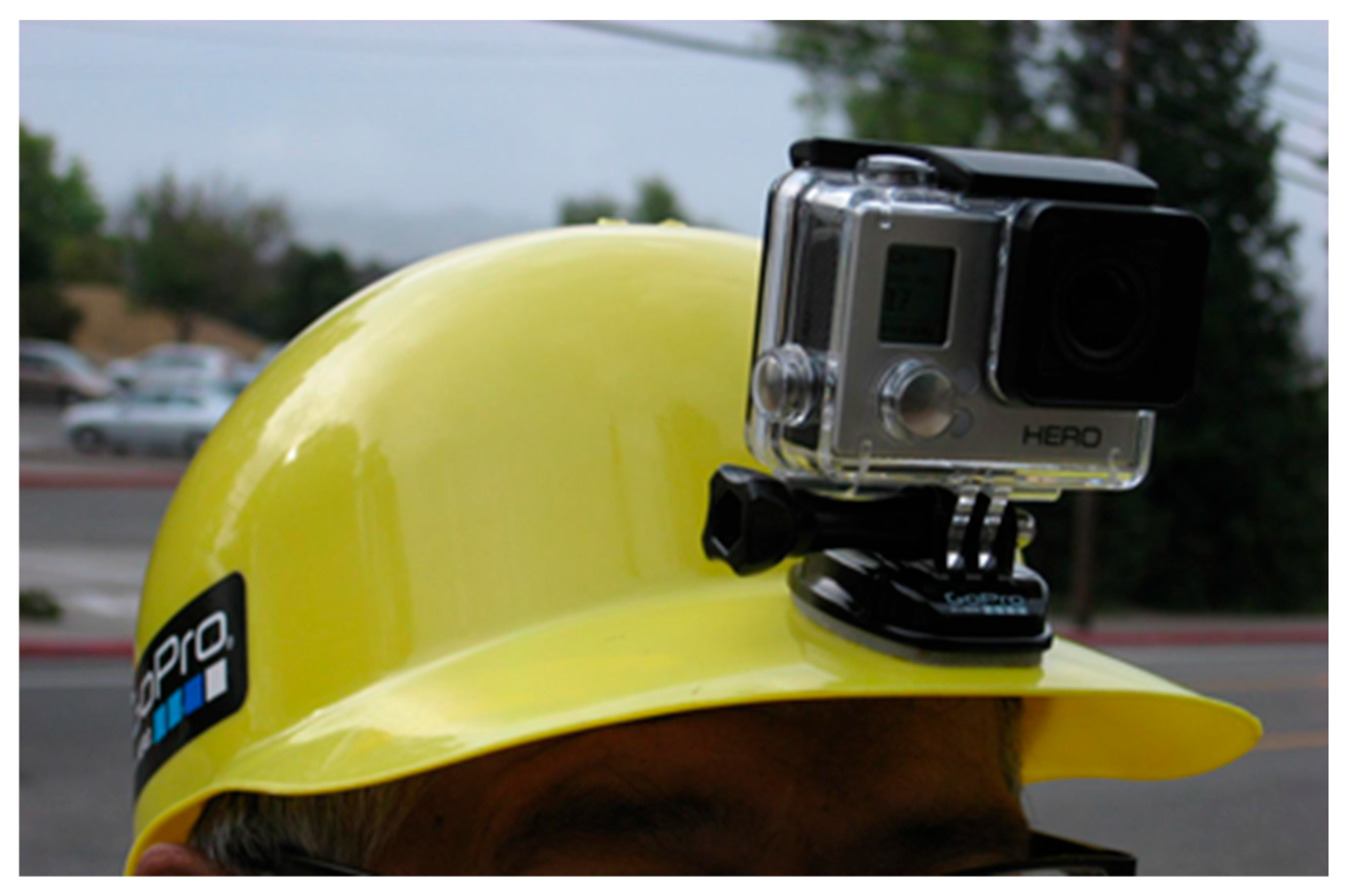
2.3.1. Phase 1: Capturing Work-As-Done
2.3.2. Phase 2: Developing a Procedural Work Adaptation Framework
- Skip: Whether procedural steps were omitted entirely or added beyond prescribed requirements;
- Order: Whether steps were performed in a different sequence than prescribed;
- Action: Whether steps were executed using different methods, tools, or techniques than specified.
Coder Training and Reliability
Coding Procedures
Consensus and Validation
2.3.3. Phase 3: Operationalizing and Evaluating the Framework
2.3.4. Analytic Process: From Observations to Framework Categories
Phase 1 Analysis: Capturing Work-As-Done
Phase 2 Analysis: Preliminary Category Development
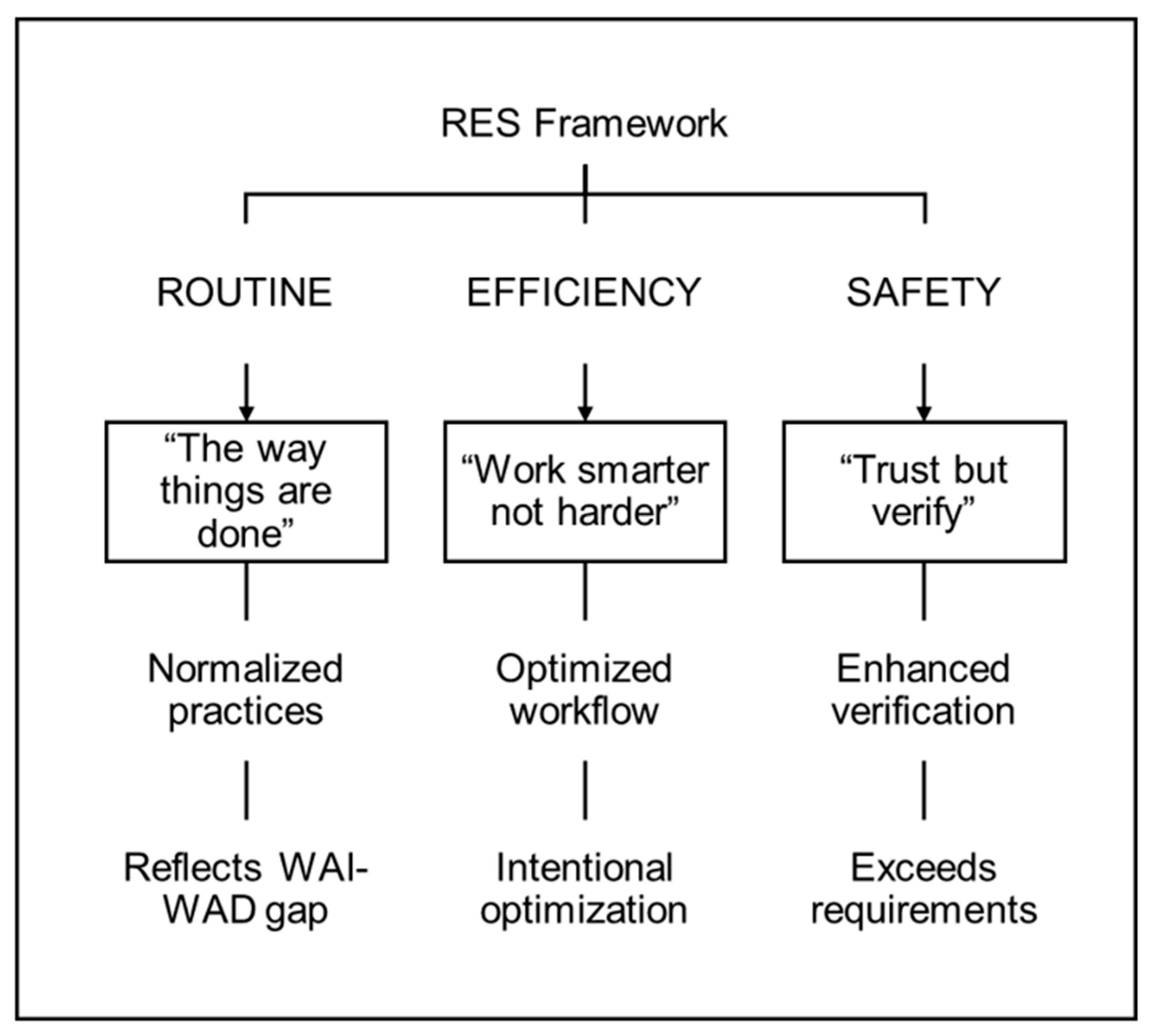
- Some variations were described as “the way things are actually done” or “how everyone does it”—reflecting normalized practices that had become standard despite differing from written procedures
- Other variations were characterized as “working more efficiently” or “smarter ways to do it”—indicating deliberate optimizations aimed at improving workflow
- A third pattern involved variations described as “extra safety checks” or “making sure”—representing worker-initiated enhancements beyond prescribed requirements
Phase 3 Analysis: Worker Validation and Category Refinement
Convergent Evaluation and Category Refinement
- Behavioral patterns (Phase 1): Systematic documentation of what workers actually did differently than prescribed
- Expert interpretation (Phase 2): SME explanations of why variations occurred and what functions they served
- Worker accounts (Phase 3): Practitioners’ own reasoning about their adaptive practices
3. Results
3.1. Category 1: Routine Adaptations “The Way Things Are Done”
3.2. Category 2: Efficiency Adaptations “Work Smarter Not Harder”
3.3. Category 3: Safety Adaptations “Trust but Verify”
4. Discussion
4.1. Development and Justification of the Three-Category Framework
4.2. Theoretical Insights
4.3. Workers as Sources of Situated Knowledge
4.4. Flexibility as a Safety Feature
4.5. Methodological Approach
4.6. Practical Implications
- If multiple workers independently develop the same routine adaptation, this signals practical problems in the prescribed sequence.
- If workers consistently resequence steps for efficiency without compromising safety, procedures could explicitly allow that flexibility.
- If workers routinely add safety adaptations like verification checks, procedures may have gaps needing attention.
4.7. Limitations and Future Research
- Whether the three categories adequately capture adaptation patterns in other high-risk domains (healthcare, aviation, nuclear operations)
- Whether additional adaptation types emerge in different operational contexts
- How organizational culture and safety climate influence the prevalence and acceptance of different adaptation types
- Whether the framework applies to non-proceduralized or less-structured work environments
5. Conclusions
Author Contributions
Funding
Institutional Review Board Statement
Informed Consent Statement
Data Availability Statement
Conflicts of Interest
Abbreviations
| WAI | Work-As-Imagined |
| WAD | Work-As-Done |
| RES | Routine–Efficiency–Safety |
| SOA | Skip–Order–Action |
| SME | Subject Matter Expert |
| SECA | Structured Exploration of Complex Adaptations |
| CSB | U.S. Chemical Safety and Hazard Investigation Board |
| IOGP | International Association of Oil & Gas Producers |
References
- Reason, J. Human Error; Cambridge University Press: Cambridge, UK, 1990. [Google Scholar]
- Dekker, S. The Field Guide to Understanding ‘Human Error’, 3rd ed.; CRC Press: Boca Raton, FL, USA, 2014. [Google Scholar] [CrossRef]
- Rasmussen, J. Skills, rules, and knowledge; signals, signs, and symbols, and other distinctions in human performance models. IEEE Trans. Syst. Man Cybern. 1983, 13, 257–266. [Google Scholar] [CrossRef]
- Woods, D.D.; Hollnagel, E. Joint Cognitive Systems: Patterns in Cognitive Systems Engineering, 1st ed.; CRC Press: Boca Raton, FL, USA, 2006. [Google Scholar] [CrossRef]
- Leveson, N.G. Engineering a Safer World: Systems Thinking Applied to Safety; MIT Press: Cambridge, MA, USA, 2012. [Google Scholar] [CrossRef]
- Lundberg, J.; Rollenhagen, C.; Hollnagel, E. What-You-Look-For-Is-What-You-Find—The consequences of underlying accident models in eight accident investigation manuals. Saf. Sci. 2009, 47, 1297–1311. [Google Scholar] [CrossRef]
- Patriarca, R.; Di Gravio, G.; Woltjer, R.; Costantino, F.; Praetorius, G.; Ferreira, P.; Hollnagel, E. Framing the FRAM: A literature review on the functional resonance analysis method. Saf. Sci. 2020, 129, 104827. [Google Scholar] [CrossRef]
- Hollnagel, E. Safety-I and Safety-II: The Past and Future of Safety Management; CRC Press: Boca Raton, FL, USA, 2014. [Google Scholar] [CrossRef]
- Wears, R.; Sutcliffe, K. Still Not Safe: Patient Safety and the Middle-Managing of American Medicine; Oxford University Press: Oxford, UK, 2019. [Google Scholar] [CrossRef]
- Le Coze, J.-C. What have we learned about learning from accidents? Post-disasters reflections. Saf. Sci. 2013, 51, 441–453. [Google Scholar] [CrossRef]
- Baybutt, P. Insights into process safety incidents from an analysis of CSB investigations. J. Loss Prev. Process Ind. 2016, 43, 537–548. [Google Scholar] [CrossRef]
- Halim, S.Z.; Janardanan, S.; Flechas, T.; Mannan, M.S. In search of causes behind offshore incidents: Fire in offshore oil and gas facilities. J. Loss Prev. Process Ind. 2018, 54, 254–265. [Google Scholar] [CrossRef]
- U.S. Chemical Safety and Hazard Investigation Board. Investigation Report: Refinery Explosion and Fire; Report No. 2005-04-I-TX; CSB: Washington, DC, USA, 2007. Available online: https://www.csb.gov/file.aspx?DocumentId=5596 (accessed on 18 November 2024).
- Iflaifel, M.; Lim, R.H.; Crowley, C.; Greco, F.; Ryan, K.; Iedema, R. Modelling the use of variable rate intravenous insulin infusions in hospitals by comparing Work as Done with Work as Imagined. Res. Soc. Adm. Pharm. 2022, 18, 2786–2795. [Google Scholar] [CrossRef]
- Sanford, N.; Lavelle, M.; Markiewicz, O.; Reedy, G.; Rafferty, A.M.; Darzi, A.; Anderson, J.E. Understanding complex work using an extension of the resilience CARE model: An ethnographic study. BMC Health Serv. Res. 2022, 22, 1126. [Google Scholar] [CrossRef]
- Jefferies, C.M.; Asher Balkin, E.; Groom, L.; Rayo, M.F. Developing Systemic Contributors and Adaptations Diagramming (SCAD): Systemic insights, multiple pragmatic implementations. Proc. Hum. Factors Ergon. Soc. Annu. Meet. 2022, 66, 75–79. [Google Scholar] [CrossRef]
- Carvalho, P.V.R.D.; Righi, A.W.; Huber, G.J.; Lemos, C.D.F.; Jatoba, A.; Gomes, J.O. Reflections on work as done (WAD) and work as imagined (WAI) in an emergency response organization: A study on firefighters training exercises. Appl. Ergon. 2018, 68, 28–41. [Google Scholar] [CrossRef]
- Mendoza, A.; Liu, S.-N.C.; Smith, A.; Hendricks, J.W.; Peres, S.C.; Sasangohar, F. The realities of procedure deviance: A qualitative examination of divergent work-as-done and work-as-imagined perspectives. Int. J. Ind. Ergon. 2024, 100, 103564. [Google Scholar] [CrossRef]
- Dekker, S. Failure to adapt or adaptations that fail: Contrasting models on procedures and safety. Appl. Ergon. 2003, 34, 233–238. [Google Scholar] [CrossRef]
- Bourrier, M. Trapping Safety into Rules: How Desirable or Avoidable is Proceduralization? 1st ed.; Bieder, C., Ed.; CRC Press: Boca Raton, FL, USA, 2013. [Google Scholar] [CrossRef]
- Leplat, J. About implementation of safety rules. Saf. Sci. 1998, 29, 189–204. [Google Scholar] [CrossRef]
- Rankin, A.; Lundberg, J.; Woltjer, R.; Rollenhagen, C.; Hollnagel, E. Resilience in Everyday Operations: A Framework for Analyzing Adaptations in High-Risk Work. J. Cogn. Eng. Decis. Mak. 2014, 8, 78–97. [Google Scholar] [CrossRef]
- Gil, M. Rule breaking in organizations: An integrative review. Acad. Manag. Ann. 2025; in press. [Google Scholar] [CrossRef]
- Havinga, J.; Dekker, S.; Rae, A. Everyday work investigations for safety. Theor. Issues Ergon. Sci. 2017, 19, 213–228. [Google Scholar] [CrossRef]
- Tucker, A.L.; Edmondson, A.C. Why Hospitals Don’t Learn from Failures: Organizational and Psychological Dynamics that Inhibit System Change. Calif. Manage. Rev. 2003, 45, 55–72. [Google Scholar] [CrossRef]
- Ramanujam, R.; Rousseau, D.M. The challenges are organizational not just clinical. J. Organ. Behav. 2006, 27, 811–827. [Google Scholar] [CrossRef]
- Hollnagel, E. Safety-II in Practice: Developing the Resilience Potentials; Routledge: London, UK, 2017. [Google Scholar] [CrossRef]
- Carthey, J.; de Leval, M.R.; Reason, J.T. The human factor in cardiac surgery: Errors and near misses in a high technology medical domain. Ann. Thorac. Surg. 2001, 72, 300–305. [Google Scholar] [CrossRef] [PubMed]
- Vogus, T.J.; Sutcliffe, K.M. Organizational mindfulness and mindful organizing: A reconciliation and path forward. Acad. Manag. Learn. Educ. 2012, 11, 722–735. [Google Scholar] [CrossRef]
- Rae, A.; Provan, D.; Aboelssaad, H.; Alexander, R. A manifesto for reality-based safety science. Saf. Sci. 2020, 126, 104654. [Google Scholar] [CrossRef]
- Provan, D.J.; Woods, D.D.; Dekker, S.W.A.; Rae, A.J. Safety II professionals: How resilience engineering can transform safety practice. Reliab. Eng. Syst. Saf. 2020, 195, 106740. [Google Scholar] [CrossRef]
- Cooper, M.D. The emperor has no clothes: A critique of Safety-II. Saf. Sci. 2022, 152, 105047. [Google Scholar] [CrossRef]
- Lawton, R.; Taylor, N.; Clay-Williams, R.; Braithwaite, J. Positive deviance: A different approach to achieving patient safety. BMJ Qual. Saf. 2014, 23, 880–883. [Google Scholar] [CrossRef] [PubMed]
- Bradley, E.H.; Curry, L.A.; Ramanadhan, S.; Rowe, L.; Nembhard, I.M.; Krumholz, H.M. Research in action: Using positive deviance to improve quality of health care. Implement. Sci. 2009, 4, 25. [Google Scholar] [CrossRef] [PubMed]
- Pascale, R.; Sternin, J.; Sternin, M. The Power of Positive Deviance: How Unlikely Innovators Solve the World’s Toughest Problems; Harvard Business Press: Boston, MA, USA, 2010. [Google Scholar]
- Woods, D.D. Four concepts for resilience and the implications for the future of resilience engineering. Reliab. Eng. Syst. Saf. 2015, 141, 5–9. [Google Scholar] [CrossRef]
- Hollnagel, E.; Woods, D.D.; Leveson, N. (Eds.) Resilience Engineering: Concepts and Precepts, 1st ed.; CRC Press: Boca Raton, FL, USA, 2006. [Google Scholar] [CrossRef]
- Dekker, S.A.; Hollnagel, E.; Woods, D.D.; Cook, R. Resilience Engineering: New Directions for Measuring and Maintaining Safety in Complex Systems; Final Report; Lund University, School of Aviation: Lund, Sweden, 2008. [Google Scholar]
- Hoffman, R.R.; Woods, D.D. Beyond Simon’s Slice: Five Fundamental Trade-Offs that Bound the Performance of Macrocognitive Work Systems. IEEE Intell. Syst. 2011, 26, 67–71. [Google Scholar] [CrossRef]
- Peres, S.C.; Quddus, N.A.; Kannan, P.; Ahmed, L.; Ritchey, P.; Johnson, W.B.; Rahmani, S.; Mannan, M.S. A summary and synthesis of procedural regulations and standards—Informing a procedures writer’s guide. J. Loss Prev. Process Ind. 2016, 44, 726–734. [Google Scholar] [CrossRef]
- Bullemer, P.; Laberge, J.; Tolsma, K.; Reising, D. Effective operator display design. Chem. Eng. Prog. 2008, 104, 52–59. [Google Scholar]
- Furniss, D.; Sujan, M.; Henderson, J.; Embrey, D. A Human Factors Review of Road Tanker Offloading across Multiple Organizations: Simple, Complicated and Complex Problems. In Proceedings of the 29th European Safety and Reliability Conference (ESREL 2019), Hannover, Germany, 22–26 September 2019. [Google Scholar] [CrossRef]
- Ashraf, A.M.; Sasangohar, F.; Peres, S.C. Beyond Compliance: Investigating Work-as-Done in Procedural Work with the Systematic Skip-Order-Action (SOA) Framework. Preprint, 2025; submitted. [Google Scholar] [CrossRef]
- ELAN, Version 6.0; Max Planck Institute for Psycholinguistics: Nijmegen, The Netherlands, 2020. Available online: https://archive.mpi.nl/tla/elan (accessed on 26 January 2026).
- Patriarca, R.; Leonhardt, J.; Licu, A. Introducing the Structured Exploration of Complex Adaptations to Learn from Operations in an Air Navigation Service Provider. In Proceedings of the 32nd European Safety and Reliability Conference (ESREL 2022), Dublin, Ireland, 28 August–1 September 2022; Leva, M.C., Patelli, E., Podofillini, L., Wilson, S., Eds.; Research Publishing: Singapore, 2022; pp. 33–40. [Google Scholar] [CrossRef]
- Lyth, J. An Introduction to 4D’s; Learning Teams Inc.: Seattle, WA, USA, 2022. [Google Scholar]
- Klein, G.; Moon, B.; Hoffman, R.R. Making Sense of Sensemaking 2: A Macrocognitive Model. IEEE Intell. Syst. 2006, 21, 88–92. [Google Scholar] [CrossRef]
- International Association of Oil & Gas Producers. Bridging the Gap Between Work-as-Imagined and Work-as-Done; Report No. 620; IOGP: London, UK, 2018; Available online: https://www.iogp.org/ (accessed on 18 November 2024).
- Wahl, A.; Kongsvik, T.; Antonsen, S. Balancing Safety I and Safety II: Learning to manage performance variability at sea using simulator-based training. Reliab. Eng. Syst. Saf. 2020, 195, 106698. [Google Scholar] [CrossRef]
- Herington, M.J.; van de Fliert, E. Positive deviance in theory and practice: A conceptual review. Deviant Behav. 2017, 39, 664–678. [Google Scholar] [CrossRef]
- Sternin, J. Positive deviance: A new paradigm for addressing today’s problems today. In Globalization and Corporate Citizenship: The Alternative Gaze, 1st ed.; McIntosh, M., Ed.; Routledge: London, UK, 2016; p. 6. [Google Scholar] [CrossRef]
- Sujan, M. An organisation without a memory: A qualitative study of hospital staff perceptions on reporting and organisational learning for patient safety. Reliab. Eng. Syst. Saf. 2015, 144, 45–52. [Google Scholar] [CrossRef]
- Weick, K.E.; Sutcliffe, K.M. Sustaining sustained performance. In Managing the Unexpected: Sustained Performance in a Complex World, 3rd ed.; Wiley: Hoboken, NJ, USA, 2015; pp. 148–162. [Google Scholar] [CrossRef]
- Alexander, C.; Ishikawa, S.; Silverstein, M. A Pattern Language: Towns, Buildings, Construction; Oxford University Press: Oxford, UK, 1977. [Google Scholar]
- OSHA. Recommended Practices for Safety and Health Programs; U.S. Department of Labor, Occupational Safety and Health Administration: Washington, DC, USA, 2016. Available online: https://www.osha.gov/safety-management (accessed on 26 January 2026).
- McCambridge, J.; Witton, J.; Elbourne, D.R. Systematic review of the Hawthorne effect: New concepts are needed to study research participation effects. J. Clin. Epidemiol. 2014, 67, 267–277. [Google Scholar] [CrossRef]
- Ashraf, A.M.; Perali, P.; Jei, H.-G.; Hendricks, J.W.; Manzini, T.; Nasr, V.; Peres, S.C.; Sasangohar, F.; Zahabi, M.; Murphy, R. Investigating a Real-Time Adaptive Procedure System. Preprint 2025. [Google Scholar] [CrossRef]



| Dimension | Description |
|---|---|
| Definitions | Procedural variations that have become normalized standard practice within work groups through collective experience and informal training |
| Behavioral Manifestation | Steps performed differently than written, steps omitted, or informal practices added; variations are consistent across workers and stable over time |
| Underlying Mechanism | Reflect collective knowledge about practical task demands, equipment behavior, and operational constraints not captured in formal procedures; transmitted through workplace socialization and normalized through repeated practice across work group members |
| Organizational Function | Represent work-as-actually-done that enables task completion under real operational conditions; reveal gaps between idealized procedures and practical requirements |
| Representative Examples |
|
| Worker Description | “The way things are done”, practices workers learn from colleagues and trainers as the accepted method despite differences from written procedures |
| Dimension | Description |
|---|---|
| Definitions | Optimization strategies that maintain safety while improving workflow and resource utilization |
| Behavioral Manifestation | Steps completed as prescribed but in different sequence, or steps combined and performed in parallel; timing and coordination adjusted to optimize performance |
| Underlying Mechanism | Reflect worker knowledge of task dependencies, resource constraints, and workflow optimization opportunities; demonstrate understanding of which procedural requirements are order-dependent versus order-independent |
| Organizational Function | Enable workers to manage multiple concurrent demands and time pressures while maintaining safety and quality standards; optimize use of waiting periods and available resources |
| Representative Examples |
|
| Worker Description | “Work smarter not harder”, strategic modifications that improve efficiency without compromising safety or quality outcomes |
| Dimension | Description |
|---|---|
| Definitions | Risk-conscious adaptations that exceed prescribed safety requirements through additional verification, redundant checks, or proactive risk mitigation |
| Behavioral Manifestation | Steps added beyond procedural requirements; additional verification or inspection steps; redundant safety checks; proactive hazard identification measures |
| Underlying Mechanism | Reflect worker risk assessment based on experience, situational factors, and consequences of potential failures; demonstrate worker ownership of safety outcomes beyond compliance |
| Organizational Function | Provide additional safety margins through worker-initiated verification; compensate for perceived procedural gaps or equipment reliability concerns; serve as informal defense-in-depth |
| Representative Examples |
|
| Worker Description | “Trust but verify”, adding verification steps to ensure safety even when formal procedures may be adequate; exceeding minimum requirements through additional precautions |
Disclaimer/Publisher’s Note: The statements, opinions and data contained in all publications are solely those of the individual author(s) and contributor(s) and not of MDPI and/or the editor(s). MDPI and/or the editor(s) disclaim responsibility for any injury to people or property resulting from any ideas, methods, instructions or products referred to in the content. |
© 2026 by the authors. Licensee MDPI, Basel, Switzerland. This article is an open access article distributed under the terms and conditions of the Creative Commons Attribution (CC BY) license.
Share and Cite
Mohammed Ashraf, A.; Peres, S.C.; Sasangohar, F. Towards a Worker-Centered Framework for Categorizing Procedural Adaptations. Safety 2026, 12, 28. https://doi.org/10.3390/safety12010028
Mohammed Ashraf A, Peres SC, Sasangohar F. Towards a Worker-Centered Framework for Categorizing Procedural Adaptations. Safety. 2026; 12(1):28. https://doi.org/10.3390/safety12010028
Chicago/Turabian StyleMohammed Ashraf, Atif, S. Camille Peres, and Farzan Sasangohar. 2026. "Towards a Worker-Centered Framework for Categorizing Procedural Adaptations" Safety 12, no. 1: 28. https://doi.org/10.3390/safety12010028
APA StyleMohammed Ashraf, A., Peres, S. C., & Sasangohar, F. (2026). Towards a Worker-Centered Framework for Categorizing Procedural Adaptations. Safety, 12(1), 28. https://doi.org/10.3390/safety12010028