

You are currently viewing a new version of our website. To view the old version click .
Safety
  • Article
  • Open Access

9 December 2025

A Biomechanical Analysis of Posture and Effort During Computer Activities: The Role of Furniture


,
,
,
,
and
1
Departamento de Automatización y Control Industrial, Escuela Politécnica Nacional, Quito 170525, Ecuador
2
Department of Mechanical Engineering, Escuela Politécnica Nacional, Quito 170525, Ecuador
3
Instituto de Biomecánica de Valencia (IBV), Universitat Politècnica de València, 46022 Valencia, Spain
4
Department of Mechanical Engineering, Universidad Carlos III de Madrid, 28903 Madrid, Spain

Abstract

The ergonomic risks associated with posture in conventional office workstations have been extensively studied, but there is limited research available on these risks in the context of home-based work environments. Most available studies rely solely on questionnaire-based statistical analyses, leaving a gap in understanding the specific conditions of home-based work environments. This study focuses on evaluating the effects of workstation conditions on posture and muscular efforts across three anatomical segments: head-neck, trunk-upper trapezius, and arm-deltoid. The analysis is conducted by simulating workstation setups commonly associated with academic activities performed by students during the COVID-19 pandemic. The conditions examined in this study include inadequate desk height, the use of chairs without armrests, and the use of laptops. Eighteen volunteers, comprising nine women and nine men, participated in experiments conducted under scenarios designed using a 2 k statistical approach. In all experiments, participants completed questionnaires, and text-writing activities were performed to evaluate the effects of these conditions. This research introduces a new non-invasive technique for ergonomic assessment that integrates photogrammetry and surface electromyography (sEMG) to simultaneously evaluate posture and muscular effort. The developed methodology allows precise, contactless analysis of ergonomic conditions and can be adapted for various professional and academic teleworking environments. Significant effects were observed in the posture (°) of the trunk and head, with both small and large effects identified at significance levels of p < 0.001 under the furniture conditions studied. In terms of EMG activity, moderate effects were observed at p < 0.01 levels between table height and upper trapezius activation, while small effects were detected at p < 0.05 levels between the use of chairs without armrests and neck. Similarly, small to moderate effects were observed in the arm-deltoid segment under the same furniture conditions. These findings reveal information about the posture and muscular effort patterns associated with the studied tasks, offering knowledge that can be referenced for similar tasks in other technical fields where telematics activities are performed.

1. Introduction

The COVID-19 pandemic accelerated the transformation of global work practices and led to a significant increase in remote work as a preventive measure against viral transmission.
This sudden transition to remote work also affected academia, compelling faculty and research staff to quickly adapt to virtual modes of operation [1]. Both academic staff and students were required to modify their physical spaces, furniture, and available digital resources, often without prior experience or adequate preparation for working from home.

1.1. Justification

These teleworking conditions have not been thoroughly studied using techniques that quantify posture and effort over time, despite the wealth of information available on ergonomic risks in office environments, which often link posture with musculoskeletal problems. Existing research in this area has used primarily activity and participation techniques based on surveys and qualitative assessments. In addition, a high percentage has been observed in activities in the fields of education, training, and library science that suggest ergonomic studies [2,3]. However, most of these studies have focused on face-to-face work environments, and there is a notable lack of research evaluating posture in work-at-home scenarios.
Although existing research has identified ergonomic risks in office settings, few studies have integrated postural and muscle activity data to characterize the specific demands of telework. This study expands upon previous work by combining photogrammetry and surface electromyography (sEMG) under realistic home-based workstation conditions. Unlike previous surveys or observational studies, this approach provides quantitative evidence of how table height, arm support, and device configuration jointly influence posture and muscular effort, offering actionable insights for remote work ergonomics.

1.2. Previous Furniture Research

The evaluation of posture in occupational offices has been studied in previous research. For example, a study on posture and musculoskeletal pain in office workers emphasized the importance of proper ergonomics to prevent injuries [4]. Similarly, studies that examine the relationship between posture and work performance have found significant correlations between ergonomic posture and productivity. [5]. Studies on postural variability, combined with office activities such as sitting and standing (e.g., “sit-stand tables”), have provided ergonomic recommendations on the effects of posture on the neck, trunk, and upper arm when working on computer desks [6]. Although ergonomic guidelines for chair design are often not met in existing office environments, there has been growing support for using chairs that mitigate the adverse effects associated with prolonged sitting [5]. While specific studies have focused on the design of wheelchairs, little attention has been given to the ergonomics of common office furniture, largely due to the lack of fundamental human parameters [7].
Studies on office workers have highlighted the influence of increased effort and altered posture during keyboard and mouse activities, with analyses focusing on variables such as speed and acceleration [8,9,10]. Another study further suggests that the posture and muscular effort in the trapezius muscle are more influenced by the tasks performed than by the type of chair used [11]. The use of a laptop presents different ergonomic challenges compared to desktop computers [12,13], with the positioning of the screen identified as a key factor affecting posture [14].
Research also indicates a greater risk of musculoskeletal disorders (MSDs) in children compared to adults, particularly in activities involving text reading, which were analyzed for neck and trapezius muscle [15]. Furthermore, desk height has been shown to serve as an indicator of perceived exertion rate (RPE), with higher levels of perceived exertion observed in individuals with neck injuries [16]. Research on the relationship between furniture and its effects on posture and muscular effort in office and telework spaces is vital for improving furniture design and informing ergonomic recommendations for remote work setups [17,18].

1.3. Previous Musculoskeletal Disorders Research

Understanding the impact of telework on musculoskeletal health is increasingly important in today’s sedentary office environments. These settings, particularly in remote work settings, often involve prolonged static postures and extensive computer use, which can significantly affect the physical well-being and productivity of teleworkers [19]. In general, the development of musculoskeletal disorders in computer-based work environments is associated with sustained static head and neck postures, as well as repetitive shoulder flexion and arm hyperextension during computer-related activities such as typing [20].
Forced postures often result in increased muscular effort, particularly in the neck, shoulders, and arms. This elevated stress can lead to reduced activation and function of other muscle groups, such as the back and abdominal muscles [21].These excessive muscular demands manifest as tension syndromes affecting the neck and thoracic outlet. Research has demonstrated a correlation between increased trunk posture and elevated neck muscle effort in older workers (aged 50-60) engaged in computer-based tasks [22].
A study conducted by Du et al. (2022) examined the effects of different furniture configurations and computing devices on musculoskeletal health in telework scenarios. The experimental setups included a standard dining table and chair with three types of devices: desktop computer, laptop, and tablet, among others. Three-dimensional joint angles for the neck, shoulder, and lower back were measured during different time sessions while performing a reading and writing task lasting up to 30 min. Flexion-extension angles and inclination angles were used to characterize the work posture [23].

1.4. Previous Research on Techniques

New techniques within biomechanics have been sought to evaluate posture and effort as primary indicators in the assessment of ergonomic risks in the occupational health field and thus improve correct ergonomic conditions and identify furniture factors or the nature of the tasks performed, which affect both physical health and work productivity. In this context, it is necessary to understand the impact of postures adopted for prolonged periods while sitting in facilities that have not been designed to perform telework activities.
In this way, biomechanics has already implemented techniques based on video analysis or photogrammetry for posture studies [24,25] and electromyography techniques for effort studies [25,26,27]. Muscle activities are scaled and standardized, such as the percentage of maximum voluntary contraction (MVC) and/or a ratio taken from the Chamoux criterion to assess the physical load of dynamic task activity [28,29,30], to describe the background (P10), mean (P50) and maximum (P90) effort of the normalization in frequency of amplitude probability distribution (APDF) [12,14,26,31,32]. Although it is not clear whether studies of physical exposures during computer use in the laboratory and field are comparable [33].
In this specific context of academic work and to the best of our knowledge, the existing literature on posture evaluation is limited. This creates a gap in our understanding of how the transition to remote work has affected the posture and musculoskeletal health of academic staff. There are significant gaps in our current understanding, particularly in the assessment of posture in the context of remote work among academic personnel during the COVID-19 pandemic.
Furthermore, it is essential to identify the actual challenges in order to recommend changes in the technical specifications of office furniture used in virtual activities to designers and manufacturers. It is also pertinent to suggest to local standardization bodies the study and updating of relevant regulations.

1.5. The Present Study

The proposed research aims to determine the effects of furniture on the biomechanics of posture and effort through the analysis of movement and muscular activity under laboratory-replicated scenarios involving computer and laptop activities performed by students at home. The study allows for the identification of the influence of workspace variability on the quantified variables. A new technique for ergonomic assessment has been developed in this research, providing a non-invasive methodology for evaluating the subject. Based on the findings, recommendations can be made for furniture design that ensures proper ergonomic postures, thereby fostering a comfortable, safe, and productive workspace.
The procedures and methodology employed in the referenced work present research potential in other related fields, such as the analysis of industrial, sports, surgical, and transportation activities, among others.

2. Methodology

2.1. Participants

A group of 18 healthy, voluntary participants (9 women and 9 men), aged between 19 and 32 years, participated in the tests. All participants provided informed consent according to the protocol established for the PIGR-22-05 research project, a collaborative effort between the Escuela Politécnica Nacional (EPN) and the Universitat Politècnica de València (UPV).

2.2. Tests

All participants were subjected to an initial ergonomic baseline scenario (P0: PER). Subsequently, they participated in four scenarios involving adjustable chair height and three with variable table height, armrest utilization, and device type (laptop vs. desktop), as detailed in Table 1. Scenario assignment for each participant followed a 2 k factorial design experiment. 2 k is a statistical approach used to consider k scenarios, each with a low and high level. In this case, it was applied to compare the ergonomic scenario P0 with the other six remaining scenarios (P1 to P7), where there is a high ergonomic risk. The tasks involved completing questionnaires and text transcription, with each task being performed for five minutes according to a pre-established experimental protocol.
Table 1. Description of test scenarios.
  • P1. High Desk Position (PA1), relative to P0, the chair is adjusted so that the elbows are 10 cm below the desk.
  • P2. No Arm Support (PA2), relative to P0, with the screen in reference T0, the workspace on the desk is limited to simulate a 50 cm space, such that there is not enough room to rest the wrists or forearms. The keyboard is moved to the edge of the desk, and the armrests are lowered to prevent their use.
  • P3. Laptop Position (PA3), relative to P0, the desktop computer is replaced by the laptop, adjusting the workspace to the user’s preference, while ensuring at least 10 cm of space between the edge of the desk and the edge of the laptop.
  • P4. High Desk Position (PA1) with no arm support (PA2), relative to P0, the chair is lowered so that the elbows are 10 cm below the desk (the desk height is adjusted if necessary), in addition to the configurations described in PA1 and PA2.
  • P5. High Desk Position (PA1) with laptop (PA3), relative to P0, the chair is lowered so that the elbows are 10 cm below the desk (the desk height is adjusted if necessary), in addition to the configurations described in PA1 and PA3.
  • P6. No Arm Support (PA2) with laptop (PA3), relative to P0, the configurations described in PA2 and PA3 are applied.
  • P7. High Desk Position (PA1) with an arm support (PA2) and Laptop (PA3), relative to P0, the chair is lowered so that the elbows are 10 cm below the desk (the desk height is adjusted if necessary), in addition to the configurations described in PA1, PA2, and PA3.

3. Experimental Design

3.1. Posture Analysis

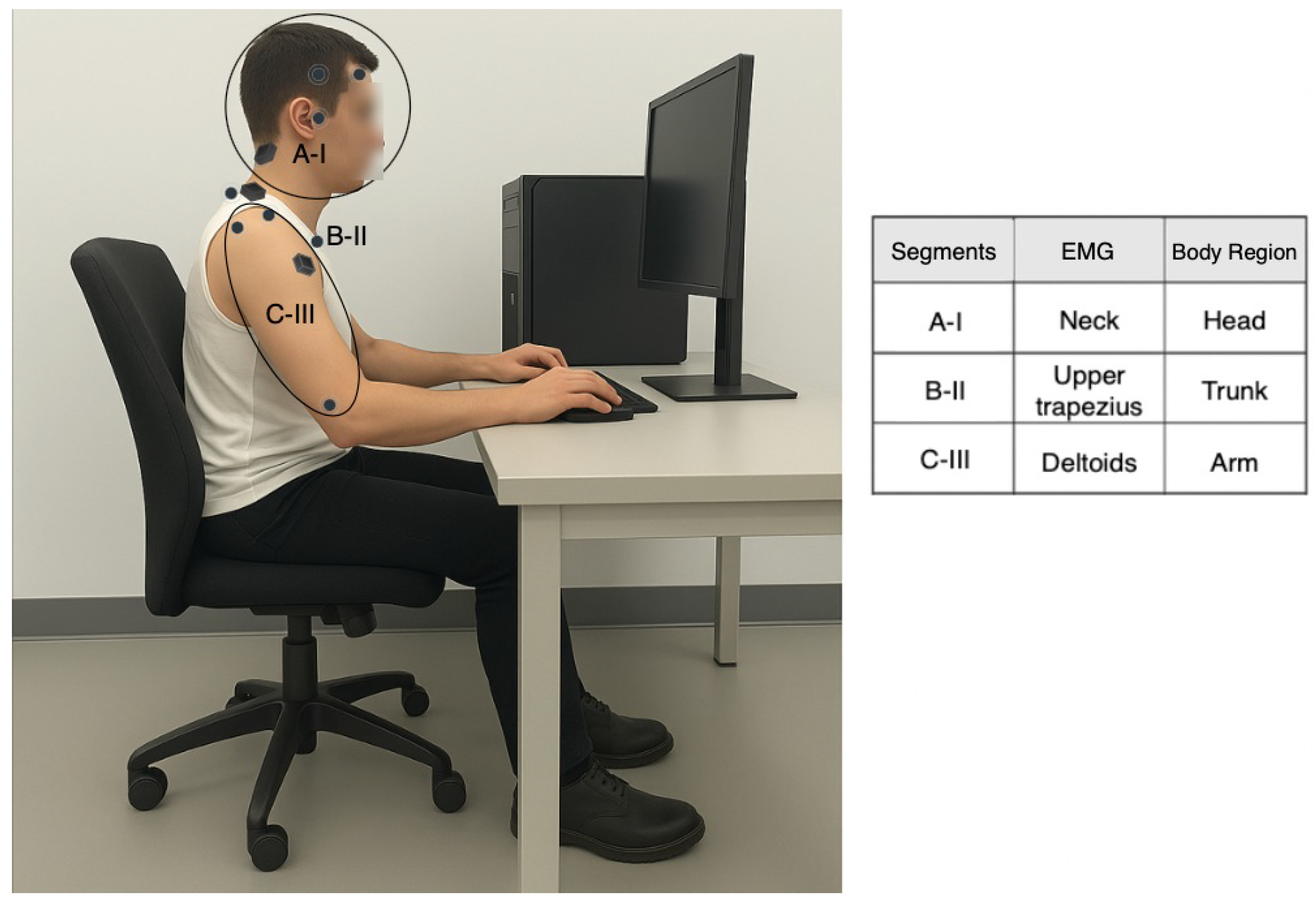
A technical operator equipped each participant as shown in Figure 1, using a headband with four technical markers for the head (segment I), three technical markers for the trunk (segment II), three anatomical markers for the arm (segment III), and three reference anatomical markers (two on the ear and one on the C7 vertebra). Movements were recorded using a photogrammetry system at 30 fps, tracking markers placed on the head, trunk, and right arm. The angular positions are calculated based on algorithms of the instantaneous helical axis technique, which uses the virtual solid technique with finite and infinitesimal displacements [34]. Finding the Rodrigues vector that defines the rotation of the virtual displacement [35], the angular position in time is calculated to be normalized by the amplitude probability distribution (APDF) techniques [36].
Figure 1. Experimental setup for posture and muscle activity recording. (Author’s adaptation of the original experimental photo).

3.2. Stress Analysis

The technical operator was also instrumented with electromyography (EMG) sensors (EMG-Delsys Trigno Avanti) set at a sampling frequency of 1778 Hz, placed in the mid-region of the muscle fibers in areas A: Neck, B: Upper Trapezius, and C: Deltoid (as the Figure 1 shows). The Figure 1 shows the participant seated in front of the workstation, the motion capture cameras, and surface electromyography (sEMG) electrodes placement. Reference markers were positioned on key anatomical landmarks to estimate joint angles during computer tasks. Muscle activity was recorded as an effort associated with the posture of the anatomical segments. From the electromyography (EMG) recording, it is rectified and filtered using the root mean square (RMS) method. The temporal signal of EMG-RMS is calibrated for each subject prior to resting activity and the maximum activity of each muscle during cyclic activity: for the neck, starting from the neutral position with a rightward turn, and for the upper limbs, starting from a free vertical posture with a horizontal elevation of 90 degrees. The oscillations are segmented and overlapped, normalizing them in terms of percentage (%) of time to find an average that describes the resting activity and reference for each muscle. In this way, the telework activity is defined in terms of muscle activity or relative cost, characterized from zero [30].

3.3. Data Processing

The data processing of functional variables and the ANOVA analysis are developed with algorithms in the MATLAB R2019b software, and for the ANOVA variance analysis in numerical variables, we worked in the Statgraphics Centurión v18 software. The posture and effort variables are normalized as a function of the amplitude probability distribution (APDF), which scales the probability from 0–100% with respect to the frequency in which the posture and effort are maintained in a static condition (10% percentile), and dynamic (10–90% percentile). Percentiles below 10% and above 90% are considered biases, according to the criteria proposed by the authors. The APDF curves of posture and effort define a numerical descriptive (P10, P50, P90 and range) and functional patterns, through the mean and band limits in the ergonomic scenario.
The influence of furniture-related factors on both numerical and functional posture and effort variables is assessed using ANOVA. Anthropometric parameters are normalized (parameter value minus the mean, divided by the standard deviation) and utilized as covariates in the analysis of posture and effort. For the analysis of the effects of anthropometric parameters, the crossing and interaction of the factors are taken into account: sex, age, head mass, neck length and shoulder length. Similarly, the analysis of furniture factor effects considered the interaction between table height, use of the chair and armrests, computer and laptop.

Statistical Assumptions

Prior to conducting the ANOVA tests, assumptions of normality and homogeneity of variances were verified. Normality of residuals was assessed using the Shapiro Wilk test, and homogeneity of variances using Levene’s test. For all tests, a significance level of α = 0.05 was adopted. When significant main effects were found, post hoc pairwise comparisons with Bonferroni correction were applied to identify differences between experimental conditions. The statistical results are reported as F ( d f 1 , d f 2 ) , p-values, and partial eta squared ( η 2 p ) as an indicator of effect size. All statistical analyses were performed in Statgraphics.

4. Results

4.1. Descriptive Analysis of Posture and Efforts

The posture (°) and effort (%EMG) are described in reference to the ergonomic scenarios of a sample of 18 participants by means of indicators of the mean and standard deviation (Std), in percentiles of background effort and static posture (P10), effort and average posture (P50), peak effort and dynamic posture (P90), and ranges between the P90-P10 percentiles.
Regarding the postures of the anatomical segments (head, trunk, and arm), it was found that there is more mobility in the sagittal plane than in the coronal and transverse planes. In the sagittal plane, for the head and trunk, it was found that there is a greater postural change in the sagittal plane with a posture of flexion and rotation to the right of the arm in the axial or transverse plane. In the Table 2 the posture of the head is described; a postural improvement in flexion is observed, which is in the order of 5° in maximum flexion and 7° in the near-erect posture, this with respect to the P50 position, that is, in a range of 35% to 45% of the average flexion. In the coronal and transverse planes, limited mobility is observed, around a range of 3° for the trunk (B-II segment) and between 4–7° for the neck (A-I segment). Conversely, the arm (C-III segment) shows greater mobility across the three main planes with a range of motion of 11–15°. In the static posture (P10) a greater flexion is observed: around 21° for the head and 5° for the trunk. These findings, consistent with prolonged postures, suggest potential temporomandibular joint (TMJ) effects [14]. Regarding the efforts of the anatomical segments (neck, upper trapezius and deltoid), the analysis revealed that there is greater effort in the deltoid and upper trapezius than in the neck. Under static conditions (P10), the deltoid and trapezius exhibited 8% electromyographic (EMG) activation, followed by the neck at 5% EMG. During dynamic activity (P90), the activation of the deltoid increased to 19% EMG, followed by the trapezius at 18% EMG and the neck at 12% EMG. These indicators of efforts identify that the deltoid and the upper trapezius suffer higher muscular activity in static posture than the neck. Furthermore, the change from static to dynamic activity (P90) resulted in a 1.5-fold increase in effort in the neck (A-I segment) and deltoid (C-III segment), and a 1.2-fold increase in the upper trapezius (B-II segment).
Table 2. Descriptive ergonomic scenario X ¯ ( σ ) of posture and effort at percentiles P10, P50, P90, and range.

4.2. Anatomical Postures (Head, Trunk and Arm) for Furniture Purposes (High Table, Chair Without Armrests and Laptop)

Regarding the studies of furniture factors, 72 samples of a 2 k statistical design are established in the critical scenarios related to high tables, chairs without armrests, laptops, and also participants. Interactions between participant characteristics and furniture were not considered.
Table 3, Table 4 and Table 5, summarize posture outcomes by anatomical segment and condition: Table 3 (head flexion and arm kinematics), Table 4 (trunk postures), and Table 5 (head postures under monitor/chair configurations). For each measure, descriptive percentiles (P10, P50, P90) are reported along with significance levels.
Table 3. Mean postural angles (°) of head flexion and arm kinematics across furniture configurations. The table reports P10 (static), P50 (median), and P90 (dynamic) percentiles and ranges derived from photogrammetry. Smaller angles indicate more neutral postures.
Table 4. Trunk postures (°) across workstation configurations. Percentiles P10 (static), P50 (median), and P90 (dynamic) are provided for trunk lateral flexion, flexion/extension, and axial rotation obtained by photogrammetry. Lower values reflect more neutral trunk alignment.
Table 5. Head postures (°) under device and chair configurations. The table details P10, P50, and P90 percentiles for head flexion and axial rotation when using a monitor versus a laptop, with and without armrests. Lower flexion angles indicate closer-to-neutral head posture.
(a) High table, the effects of posture are significant in the anatomical segments (head, trunk, and arm). The detailed postural differences among furniture configurations are presented in Table 3 (head and trunk angles) and Table 4 (arm elevation angles). ( F ( 1 , 34 ) = 9.21 , p = 0.004 , ( η 2 p ) = 0.21 ) . Bonferroni post hoc comparisons indicated that head flexion decreased compared to the control configuration ( p = 0.002 ) . In the arm, posture effects are observed in the three main planes, in the head to the flexo-extension (FE) posture and in the trunk to the lateral flexion (FL) posture. Higher tables are expected to provide a more upright posture with less neck flexion and possibly more arm abduction and some more flexion. The percentages are analyzed with respect to the maximum parameters of the table with the correct height ( 2 × constant × 100 / percentile ).
Analysis of head posture (Table 3) reveals that the implementation of an ergonomically appropriate table height results in a maximum head flexion of 25° (43% of the static P10 posture). Postural improvements are observed at the P50 and P90 percentiles, with head flexion decreasing to 20° (34%) and 13° (23%), respectively. A statistically significant difference (p < 0.001) of approximately 5° in head flexion was observed between the ergonomically correct and elevated table heights. The elevated table height induced a reduction in head flexion across all percentiles, specifically P10 (34%), P50 (26%), and P90 (16%), compared to the ergonomically correct table height at P10.
I. Head Analysis of head posture (Table 3) reveals that the implementation of an appropriate table height results in a maximum head flexion of 25° (43% of the static P10 posture). Postural improvements are observed at the P50 and P90 percentiles, with head flexion decreasing to 34% (20°) and 23% (13°), respectively. A difference of approximately 5° was found between the correct and the high of the table with high significance (p < 0.001), the high table causes the head to reduce its flexion with percentiles P10 (34%), P50 (26%), P90 (16%) compared to the correct table height in P10;
II. Trunk (Table 4), The lateral flexion to the right of the trunk presents just about 3° of range of motion between the percentiles P10 to P90 of the correct table height scenario; however, in the analysis of variance between correct and high table height, a small level of significance (p < 0.05) is observed in the dynamic percentile P90, where a static posture of P10 to P50 prevails and changes to dynamic from P50 to P90;
III. Arm (Table 3), shows greater postural activity that extends the arm around 13° in the sagittal direction (FE), 12° of adduction in the coronal direction (FL), and in supination (RA) to 19°, Its influence has high (p < 0.001), moderate (p < 0.01) and small (p < 0.05) effects in relation to the normal and high height table, the differences are significant in both cases for the middle position P50 of FE and the extreme P90 of FL, in the rotation effects were found in the range of motion, these effects do not translate into significant changes in muscle activity.
(b) Chair without armrests, the effects on posture are significant in the anatomical segments (head and arm) (Table 3 and Table 5), with levels of significance that are small (p < 0.05), moderate (p < 0.01) and high (p < 0.001). In the arm, the effects of posture are observed in the three main planes. This is because when the keyboard is brought closer to the edge, the arm will be closer to the trunk, which implies less flexion and rotation when typing and using the mouse, respectively. In the head, the posture of flexo-extension (FE) and axial rotation (RA) is affected. That is, having the screen and keyboard closer together means more neck flexion when looking at the keyboard or screen in the case of laptops. The chair with armrests improves the flexion posture of the head. The conditions of correct support and lack of support are associated with different positions of the neck and arms. Thus, in the configuration with support, space is left between the keyboard and the edge of the table, which implies that the keyboard and the screen are further away from the edge of the table. The chair without armrests showed a significant effect on trunk inclination ( F ( 2 , 33 ) = 6.87 , p = 0.003 , ( η 2 p ) = 0.19 ) . Post hoc comparisons confirmed greater trunk inclination compared with the control condition ( p = 0.015 ) .
I. Head (Table 5), the use of a chair with armrests presents a maximum flexion of 55% of head inclination (20°) with respect to the static posture P10 (likely when looking at the keyboard); there is an improvement in posture in the percentiles P50 (average posture) and P90 (upright posture) with 46% (16°) and 31% (31°) respectively. A highly significant difference (p < 0.001) of 0.5° to 5° was found with the use of the chair with and without armrest support; the highest difference is in static posture P10, the chair without armrests causes the head to increase its flexion with percentiles P10 (62%), P50 (49%), P90 (31%) with respect to the chair with armrests in P10;
III. Arm (Table 4), presents a greater postural activity that extends the arm to type with a position around 18° in the sagittal direction (FE), 10° of adduction in the coronal direction (FL), and in supination (RA) at 23° due to the rotation of the arm, its influence has high (p < 0.001), moderate (p < 0.01) and small (p < 0.05) effects in relation to the chair with and without armrest support. The high effects are in the RA movement in the percentiles P50, P90 and its range, that is, when the arm rotates in supination, while moderate effects are shown when extending the arm in the P50, and there is a small effect in P90 when the arm is flexed. This posture pattern justifies the increase in neck muscle activity and the decrease in deltoid muscle activity. Arm elevation showed a significant effect of chair configuration, F ( 2 , 33 ) = 5.12 , p = 0.010 , ( η 2 p ) = 0.14 ; Bonferroni tests revealed higher arm elevation without armrests compared with with-armrest conditions ( p = 0.018 ) .
(c) Laptop, the effects of posture are significant in the anatomical segments (head and trunk) (Table 4 and Table 5), Laptop use produced a significant main effect on head and arm posture ( F ( 2 , 33 ) = 5.12 , p = 0.010 , ( η 2 p ) = 0.14 ) . Post hoc tests revealed higher arm elevation during laptop use compared to the desktop condition (p = 0.018). In the head and trunk, the effects of posture are observed in flexion-extension (FE) and axial rotation (AR). Using a laptop affects the posture of the neck (increasing flexion by having the screen lower) and the position of the arm (by using a smaller keyboard and possibly the touchpad mouse), which brings the arm closer to the trunk. Therefore, greater muscle activity in the neck and less in the deltoid is expected. The use of a monitor is expected to provide a more upright posture with less flexion of the neck and trunk. Additionally, laptop configuration inherently reduces screen height relative to eye level, promoting cervical flexion. This reinforces the need to elevate the device using supports or stands to align the visual display with a neutral neck posture.
I. Head Table 5, the use of the monitor presents a maximum flexion of 28% of head inclination (20°) with respect to the static posture P10; there is an improvement in posture in the percentiles P50 and P90 with 18% (14°) and 8% (6°) respectively. A highly significant difference (p < 0.001) of 4° to 11° was found between the use of a monitor and laptop, the highest difference is in the dynamic posture P90. The use of a laptop causes the head to increase its flexion with percentiles P10 (33%), P50 (29%), P90 (23%) with respect to the use of a monitor in the P10. In the axial rotation of the neck to the left, a difference of around 1° to 2° was found between the use of a monitor and a laptop, this small difference has a high effect on the muscular activity of the neck.
II. Trunk Table 4, in flexion, a difference of around 3° to 4° was found between the use of a monitor and a laptop, while in axial rotation a difference of around 1° was found. This small difference has a high effect on flexion and a moderate effect on trunk rotation. The movement of the head is expected to result in significant changes in the muscular activity of the neck and upper trapezius. The main effect of device configuration on trunk flexion was significant, F ( 2 , 33 ) = 6.87 , p = 0.003 , ( η 2 p ) = 0.19 . Post hoc analyses (Bonferroni) indicated greater trunk flexion with the laptop than with the monitor condition ( p = 0.015 ) .

4.3. Anatomical Stresses (Neck, Upper Trapezius, and Deltoid) Due to Furniture (High Table, Chair Without Armrests, and Laptop)

Table 6 shows the effects of furniture in its critical configurations on the functional variable of stress throughout the teleworking activity, represented in the P10, P50, and P90 percentiles.
Table 6. Surface EMG activity (%MVC) of neck extensors and shoulder muscles across furniture configurations. Reported values include P10 (static), P50 (median), P90 (dynamic), and ranges. Higher %MVC indicates greater muscular effort. Abbreviations: %MVC, percentage of maximum voluntary contractions.
III. Upper trapezius
(a) High table, the effects on stress are significant in muscle activity (Table 6), with a moderate level of significance (p < 0.01). The ANOVA showed a significant main effect of table height on upper trapezius activity, F ( 2 , 33 ) = 12.83 , p = 0.001 , ( η 2 p ) = 0.27 . Bonferroni comparisons indicated higher activation at the high table compared with the ergonomic height ( p = 0.001 ) .
The difference between the correct (ergonomic) table height and the high table is in the order of 6 to 22% EMG, that is 18 to 43% and in its range, 16% EMG. The differences are very large with respect to the mean value P50, in static posture, the effort level increases by 14% with a high level of (p = 0.004), maintaining itself up to P50 and in dynamic posture, it changes by 10% with a level of (p = 0.001). This shows that the excess height of the table increases the level of static muscle effort in the upper trapezius by more than 43%, compared to a well-adjusted table. On the other hand, the high table decreases the activity of the neck at all three levels (P10, P50 and P90), because the neck is flexed less to look at the keyboard. The same happens in the deltoid, probably due to greater support of the arm when handling the mouse. In any case, the positive effect on the neck and deltoid is not significant, while it is negative in the upper trapezius with a large and very significant effect.
(b) Chair without armrests, the effects of stress are significant in the muscles (deltoids and neck); I. Neck: Table 6 shows a significant effect on the variability of the chair with support (ergonomic) and without support throughout the telework activity. Without arm support there is clearly more effort with the table without support in the median (p = 0.012, 27% difference) and in the maximum effort (p = 0.012, 103% effect). The effect of arm support on neck activity was significant, F ( 1 , 34 ) = 6.14 , p = 0.018 , ( η 2 p ) = 0.15 . Bonferroni post hoc tests showed higher neck activation without armrests compared to conditions with arm support ( p = 0.021 ) .
IV. Deltoid Muscle, in Table 6 there are also differences in the deltoid muscle, but in the sense of decreasing effort when supporting, probably because there is less flexion of the arm. As one can see when analyzing the postures, these differences are due to the differences in the configuration of the positions, which determine that the unsupported position also has more neck flexion but less arm flexion. When comparing the configurations with and without support, while keeping all other factors equal, it is observed that there are hardly any differences in the case of the upper trapezius, although there are differences in the case of the neck and the deltoid.
(c) Laptop, the effects of efforts are significant on the deltoid muscle. Laptop use affects arm posture (increasing flexion by having the screen lower and using a smaller keyboard and possibly the touchpad), which brings the arm closer to the torso. Therefore, greater muscle activity in the deltoid is expected. Regarding the neck, there is indeed much more average activity, although no differences are seen in the P10. This is because the task is static, and the P50 should already represent the static effort.
Effect sizes across all significant outcomes ranged from moderate to large ( ( η 2 p ) = 0.14 0.27 ) , supporting the robustness and practical relevance of the findings.

5. Discussion

This study evaluated the impact of furniture on posture and muscle exertion during simulated telework tasks. The main findings identify how different ergonomic configurations affect both the postures adopted and the level of muscle exertion in various anatomical segments. It was confirmed that high tables generate significant increases in upper trapezius exertion, with increases of 45% in static activities and 88% in dynamic activities. While they slightly improve neck and trunk flexion, the positive effects are marginal compared to the increase in muscle exertion. This aligns with previous work that highlights that poorly adjusted tables intensify loads on the neck and shoulders [8,16]. The lack of armrests significantly affects the neck, increasing its exertion by 111% (P50) and generating less ergonomic postures. In addition, the deltoid also experiences greater load. Previous studies had already associated these conditions with an increase in muscle tension, but this work incorporates electromyography data that reinforce the importance of support for the forearms [13,14].
The use of laptops, compared to desktop computers, causes greater neck flexion due to the low position of the screen, increasing exertion in the cervical muscles. This agrees with previous studies that document less ergonomic postures when using laptops and highlights the impact of this configuration when combined with other unfavorable factors [12]. Combinations of unfavorable configurations, such as high tables and laptops without arm support, exacerbate both muscle exertion and non-ergonomic postures. This finding reinforces previous studies that suggest cumulative effects in suboptimal configurations but provides a more detailed and quantitative analysis of these effects in telework.
On the other hand, the results obtained underscore the need to develop specific recommendations for the design of telework spaces. For example, the inclusion of height-adjustable tables could mitigate excessive muscle exertion, while laptops should be complemented with elevating bases and external keyboards to optimize the working position. Likewise, furniture manufacturers should prioritize the design of chairs with adequate arm support, ensuring more ergonomic postures.
In addition, for tablet users, it is recommended to avoid prolonged use with the device placed directly on the lap, as this posture increases neck flexion and visual strain. Instead, the screen should be elevated to eye level using stands or supports, maintaining a viewing angle between 10° and 20° below the horizontal line of sight. The use of an external keyboard or stylus is also suggested to improve upper limb comfort and reduce wrist extension.
The statistical analyses confirmed the robustness of the observed effects. All ANOVA models met the assumptions of normality and homogeneity (Shapiro Wilk and Levene’s tests, p > 0.05 ), indicating that the dataset satisfied the prerequisites for parametric inference. The effect sizes were predominantly moderate to large ( η 2 p = 0.14 0.27 ) , suggesting that the differences identified across furniture configurations are not only statistically significant but also practically meaningful. This reinforces the interpretation that ergonomic design variables such as table height, arm support, and device type produce consistent and measurable biomechanical responses.
Finally, more training in ergonomics is required for telework users, especially those who adopted this modality in an improvised manner during the pandemic. These measures would not only improve comfort and safety but could also prevent long-term musculoskeletal problems.
In contrast to earlier ergonomic studies that relied on subjective reports or simulated office tasks, the present work provides a detailed biomechanical assessment integrating kinematic and muscular effort data. This synthesis offers a more comprehensive understanding of how ergonomic factors interact under telework conditions. Specifically, the observed differences in trapezius and deltoid activation corroborate previous findings on the sensitivity of these muscles to workstation configuration, while the magnitude of these effects adds new quantitative context for ergonomic design standards.
Despite these contributions, this study has certain limitations. The experimental setup relied on an optical motion capture system and controlled laboratory conditions, which may not fully represent the variability of home-based environments. The sample size was moderate, and participants were exposed to short-duration tasks; thus, extrapolation to long-term telework scenarios should be made cautiously. Additionally, environmental factors such as lighting, room layout, and furniture materials were not analyzed but may influence posture and muscle load.
Translating these findings into home applications requires pragmatic solutions. Although optical motion capture offers high precision, similar posture monitoring could be achieved with low-cost camera systems, wearable inertial sensors, or even mobile applications that estimate posture angles. For practical implementation, users could adjust workstation height using simplified anthropometric rules such as aligning the table height with elbow level when arms are bent at approximately 90° to minimize shoulder and neck effort. Manufacturers of adjustable desks should consider including simple visual guides or digital prompts to assist users in finding optimal table heights based on body dimensions.
Future studies should investigate how ergonomic recommendations can be adapted dynamically using feedback from accessible technologies (e.g., webcams or smart devices). Integrating such feedback mechanisms could democratize ergonomic assessment, extending the methodological rigor of laboratory biomechanics to everyday telework contexts. This translational step is crucial for ensuring that the benefits of quantitative ergonomics reach a wider population of remote workers.

6. Conclusions

The experimental results demonstrated statistically significant correlations between unfavorable ergonomic configurations—such as high table height, absence of forearm support, and laptop use—and increased muscle effort and poor posture, particularly in the neck, shoulders, and deltoid regions.
High table configurations significantly increased upper trapezius effort, while the lack of forearm support elevated neck and deltoid activation.
The significant main effects, supported by moderate to large effect sizes ( ( η 2 p ) = 0.14 0.27 ) , confirm that furniture configuration directly influences both postural alignment and muscle effort.
Laptop use was associated with greater cervical flexion and higher effort levels in the neck, due to the low screen position and compact keyboard design, compared to desktop computers.
This work corroborates the importance of having adjustable and adequate furniture, as well as ergonomics training, to minimize the risk of musculoskeletal discomfort in telework scenarios.

Supplementary Materials

The following supporting information can be downloaded at: https://www.mdpi.com/article/10.3390/safety11040122/s1, Table S1: Summary of statistical results for posture and muscle activity variables across experimental conditions.

Author Contributions

Conceptualization, I.Z.-O., W.V.-T. and A.P.-D.P.; methodology, I.Z.-O., W.V.-T. and S.S.-C.; software W.V.-T.; validation, I.Z.-O., W.V.-T. and A.P.-D.P.; formal analysis, I.Z.-O., W.V.-T., A.P.-D.P., M.F.T.-G. and D.D.l.C.-G.; investigation, © resources, I.Z.-O. and W.V.-T.; writing—original draft preparation, M.F.T.-G. and D.D.l.C.-G.; writing—review and editing, I.Z.-O., W.V.-T., A.P.-D.P., M.F.T.-G. and D.D.l.C.-G.; visualization, I.Z.-O., W.V.-T., A.P.-D.P., M.F.T.-G. and D.D.l.C.-G.; supervision, I.Z.-O., W.V.-T., A.P.-D.P., M.F.T.-G. and D.D.l.C.-G. project administration, I.Z.-O., W.V.-T., A.P.-D.P. and S.S.-C.; funding acquisition, I.Z.-O. and W.V.-T. All authors have read and agreed to the published version of the manuscript.

Funding

This research received assistance from various academic institutions, including the Departamento de Automatización y Control Industrial (https://daci.epn.edu.ec, accessed on 5 November 2025), Department of Mechanical Engineering, (https://fim.epn.edu.ec, accessed on 5 November 2025) at the Escuela Politécnica Nacional, (https://epn.edu.ec/, accessed on 5 November 2025) at the Universitat Politècnica de València, España, (https://www.upv.es, accessed on 5 November 2025), Universidad Carlos III de Madrid, España (https://www.uc3m.es, accessed on 5 November 2025).

Institutional Review Board Statement

The experimental procedure is carried out according to the recommendations of the endorsement of the ethics committee issued in the approval document 003-020.

Data Availability Statement

Data are contained within the article.

Acknowledgments

The authors express their gratitude to the Bioengineering Laboratory of the Escuela Politecnica Nacional for their provision of equipment and installations in support of this study.

Conflicts of Interest

The authors declare no conflicts of interest.

Abbreviations

The following abbreviations are used in this manuscript:
MSDMusculoskeletal Disorder
RPEPerceived exertion rate
ANOVAAnalysis of Variance
MVCMaximum voluntary contraction
TMJTemporomandibular joint
EMGElectromyographic
APDFAmplitude probability distribution function
RMSRoot mean square
RSIRepetitive strain injuries
sEMGSurface electromyography

References

  1. Romeo, M.; Yepes-Baldó, M.; Soria, M.Á.; Jayme, M. Impact of the COVID-19 pandemic on higher education: Characterizing the psychosocial context of the positive and negative affective states using classification and regression trees. Front. Psychol. 2021, 12, 714397. [Google Scholar] [CrossRef]
  2. Dingel, J.; Neiman, B. How many Jobs can be done at home? J. Public Econ. 2020, 189, 104235. [Google Scholar] [CrossRef]
  3. Sostero, M.; Milasi, S.; Hurley, J.; Fernandez-Macías, E.; Bisello, M. Teleworkability and the COVID-19 crisis: A new digital divide? In JRC Working Papers Series on Labour, Education and Technology; Technical Report JRC121193; Publications Office of the European Union: Luxembourg, 2020. [Google Scholar]
  4. Intolo, P.; Shalokhon, B.; Wongwech, G.; Wisiasut, P.; Nanthavanij, S.; Baxter, D.G. Analysis of neck and shoulder postures, and muscle activities relative to perceived pain during laptop computer use at a low-height table, sofa and bed. Work 2019, 63, 361–367. [Google Scholar] [CrossRef]
  5. Kuster, R.P.; Bauer, C.M.; Gossweiler, L.; Baumgartner, D. Active sitting with backrest support: Is it feasible? Ergonomics 2018, 61, 1685–1695. [Google Scholar] [CrossRef]
  6. Barbieri, D.F.; Srinivasan, D.; Mathiassen, S.E.; Oliveira, A.B. Variation in upper extremity, neck and trunk postures when performing computer work at a sit-stand station. Appl. Ergon. 2019, 75, 120–128. [Google Scholar] [CrossRef] [PubMed]
  7. Liu, Y.; Hu, W.; Kasal, A.; Erdil, Y.Z. The State of the Art of Biomechanics Applied in Ergonomic Furniture Design. Appl. Sci. 2023, 13, 12120. [Google Scholar] [CrossRef]
  8. Liu, B.S.; Huang, K.N.; Chen, H.J.; Yang, K.C. Ergonomic evaluation of new wrist rest on using computer mouse. In Proceedings of the 2016 International Conference on Advanced Materials for Science and Engineering (ICAMSE), Tainan, Taiwan, 12–13 November 2016; pp. 59–61. [Google Scholar]
  9. Bruno Garza, J.; Eijckelhof, B.; Johnson, P.; Raina, S.; Rynell, P.; Huysmans, M.; Van Dieën, J.; Van der Beek, A.; Blatter, B.; Dennerlein, J. Observed differences in upper extremity forces, muscle efforts, postures, velocities and accelerations across computer activities in a field study of office workers. Ergonomics 2012, 55, 670–681. [Google Scholar] [CrossRef] [PubMed]
  10. Garza, J.L.B.; Catalano, P.J.; Katz, J.N.; Huysmans, M.A.; Dennerlein, J.T. Developing a framework for predicting upper extremity muscle activities, postures, velocities, and accelerations during computer use: The effect of keyboard use, mouse use, and individual factors on physical exposures. J. Occup. Environ. Hyg. 2012, 9, 691–698. [Google Scholar] [CrossRef]
  11. Ellegast, R.; Hamburger, R.; Keller, K.; Krause, F.; Groenesteijn, L.; Vink, P.; Berger, H. Effects of using dynamic office chairs on posture and EMG in standardized office tasks. In Proceedings of the Ergonomics and Health Aspects of Work with Computers: International Conference, EHAWC 2007, Held as Part of HCI International 2007, Beijing, China, 22–27 July 2007; Springer: Berlin/Heidelberg, Germany, 2007; pp. 34–42. [Google Scholar]
  12. Villanueva, M.B.G.; Jonai, H.; Saito, S. Ergonomic aspects of portable personal computers with flat panel displays (PC-FPDs): Evaluation of posture, muscle activities, discomfort and performance. Ind. Health 1998, 36, 282–289. [Google Scholar] [CrossRef] [PubMed]
  13. Jonai, H.; Villanueva, M.B.G.; Takata, A.; Sotoyama, M.; Saito, S. Effects of the liquid crystal display tilt angle of a notebook computer on posture, muscle activities and somatic complaints. Int. J. Ind. Ergon. 2002, 29, 219–229. [Google Scholar] [CrossRef]
  14. Villanueva, M.B.G.; Jonai, H.; Sotoyama, M.; Hisanaga, N.; Takeuchi, Y.; Saito, S. Sitting posture and neck and shoulder muscle activities at different screen height settings of the visual display terminal. Ind. Health 1997, 35, 330–336. [Google Scholar] [CrossRef] [PubMed]
  15. Greig, A.M.; Straker, L.M.; Briggs, A.M. Cervical erector spinae and upper trapezius muscle activity in children using different information technologies. Physiotherapy 2005, 91, 119–126. [Google Scholar] [CrossRef]
  16. Kang, B.R.; Her, J.G.; Lee, J.S.; Ko, T.S.; You, Y.Y. Effects of the computer desk level on the musculoskeletal discomfort of neck and upper extremities and EMG activities in patients with spinal cord injuries. Occup. Ther. Int. 2019, 2019, 3026150. [Google Scholar] [CrossRef]
  17. de Biomecánica Ocupacional, G.; Page, Á.; Molina, C.G. Guía de Recomendaciones Para el Diseño de Mobiliario ergonómico; Instituto de Biomecánica de Valencia: Valencia, Spain, 1992. [Google Scholar]
  18. Porcar Seder, R. Aplicación del Análisis Multivariante a la Obtención de Criterios de Diseño para Mobiliario de Oficina. Ph.D. Thesis, Universitat Politècnica de València, Valencia, Spain, 2000. [Google Scholar]
  19. Rohlmann, A.; Wilke, H.; Graichen, F.; Bergmann, G. Loads acting on the spine when seated on an office chair with a tilting back. Biomed. Tech. 2002, 47, 91–96. [Google Scholar] [CrossRef]
  20. Kroemer, K. Cumulative trauma disorders: Their recognition and ergonomics measures to avoid them. Appl. Ergon. 1989, 20, 274–280. [Google Scholar] [CrossRef]
  21. Diebschlag, W.; Heidinger, F. Ergonomische Sitzgestaltung zur Prävention sitzhaltungsbedingter Wirbelsäulenschädigungen. Arbeitsmed. Sozialmed. Präventivmed. (ASP) 1990, 25, 123–126. [Google Scholar]
  22. Kamil, N.S.M.; Dawal, S.Z.M. Effect of postural angle on back muscle activities in aging female workers performing computer tasks. J. Phys. Ther. Sci. 2015, 27, 1967–1970. [Google Scholar] [CrossRef] [PubMed]
  23. Du, T.; Iwakiri, K.; Sotoyama, M.; Tokizawa, K. Computer and furniture affecting musculoskeletal problems and work performance in work from home during COVID-19 pandemic. J. Occup. Environ. Med. 2022, 64, 964–969. [Google Scholar] [CrossRef]
  24. Carayon, P. Human Factors and Ergonomics in Health Care and Patient Safety. In Handbook of Human Factors and Ergonomics in Health Care and Patient Safety, 2nd ed.; Carayon, P., Ed.; CRC Press, Taylor & Francis Group: Boca Raton, FL, USA, 2013; pp. 3–18. [Google Scholar]
  25. Hubaut, R.; Guichard, R.; Greenfield, J.; Blandeau, M. Validation of an embedded motion-capture and EMG setup for the analysis of musculoskeletal disorder risks during manhole cover handling. Sensors 2022, 22, 436. [Google Scholar] [CrossRef]
  26. Garcia Molina, C.V. Técnicas Instrumentales para la Evaluación del Riesgo de Lesión Musculo-Esquelética en el Puesto de Trabajo. Ph.D. Thesis, Universitat Politècnica de València, Valencia, Spain, 1999. [Google Scholar]
  27. Salvendy, G. Handbook of Human Factors and Ergonomics; John Wiley&Sons: Hoboken, NJ, USA, 2006. [Google Scholar]
  28. Bao, S.; Mathiassen, S.E.; Winkel, J. Normalizing upper trapezius EMG amplitude: Comparison of different procedures. J. Electromyogr. Kinesiol. 1995, 5, 251–257. [Google Scholar] [CrossRef]
  29. Mathiassen, S.; Winkel, J.; Hägg, G. Normalization of surface EMG amplitude from the upper trapezius muscle in ergonomic studies—A review. J. Electromyogr. Kinesiol. 1995, 5, 197–226. [Google Scholar] [CrossRef] [PubMed]
  30. Villar-Fernández, M. Posturas de Trabajo: Evaluación del Riesgo; Instituto Nacional de Seguridad e Higiene en el Trabajo: Madrid, Spain, 2015. [Google Scholar]
  31. Village, J.; Frazer, M.; Cohen, M.; Leyland, A.; Park, I.; Yassi, A. Electromyography as a measure of peak and cumulative workload in intermediate care and its relationship to musculoskeletal injury: An exploratory ergonomic study. Appl. Ergon. 2005, 36, 609–618. [Google Scholar] [CrossRef] [PubMed]
  32. Village, J.; Trask, C. Ergonomic analysis of postural and muscular loads to diagnostic sonographers. Int. J. Ind. Ergon. 2007, 37, 781–789. [Google Scholar] [CrossRef]
  33. Asundi, K.; Johnson, P.; Dennerlein, J. Effect of sampling strategies on variance in exposure intensity metrics of typing force and wrist postural dynamics during computer work. In Proceedings of the Seventh International Conference on Prevention of Work-Related Musculoskeletal Disorders, Angers, France, 29 August–2 September 2010; Volume 29, p. 282. [Google Scholar]
  34. Page, A.; De Rosario, H.; Mata, V.; Hoyos, J.V.; Porcar, R. Effect of marker cluster design on the accuracy of human movement analysis using stereophotogrammetry. Med. Biol. Eng. Comput. 2006, 44, 1113–1119. [Google Scholar] [CrossRef]
  35. Huang, C. On definitions of pitches and the finite screw system for displacing a line. In Proceedings of the a Symposium Commemorating the Legacy, Works and Life of Sir Robert Stawell Ball upon the 100th Anniversary of A Treatise on the Theory of Screws, Cambridge, UK, 9–12 July 2000; University of Cambridge: Cambridge, UK, 2000. [Google Scholar]
  36. Toro, W.V. Modelado Biomecánico del Cuello Basado en la Imagen Cinemática de la Función Articular para su Aplicación en Tecnologías para la Salud y el Bienestar del ser Humano. Ph.D. Thesis, Universitat Politècnica de València, València, Spain, 2021. [Google Scholar]
Disclaimer/Publisher’s Note: The statements, opinions and data contained in all publications are solely those of the individual author(s) and contributor(s) and not of MDPI and/or the editor(s). MDPI and/or the editor(s) disclaim responsibility for any injury to people or property resulting from any ideas, methods, instructions or products referred to in the content.

Article Metrics

Citations

Article Access Statistics

Multiple requests from the same IP address are counted as one view.

