
Render-Rank-Refine: Accurate 6D Indoor Localization via Circular Rendering


Abstract
1. Introduction

2. Related Work
2.1. Image Retrieval-Based Localization
2.2. Learned Local Feature Matching
2.3. Rendering and View Synthesis Methods
2.4. Hybrid Geometry-Learning Approaches
3. Methodology
3.1. Problem Definition
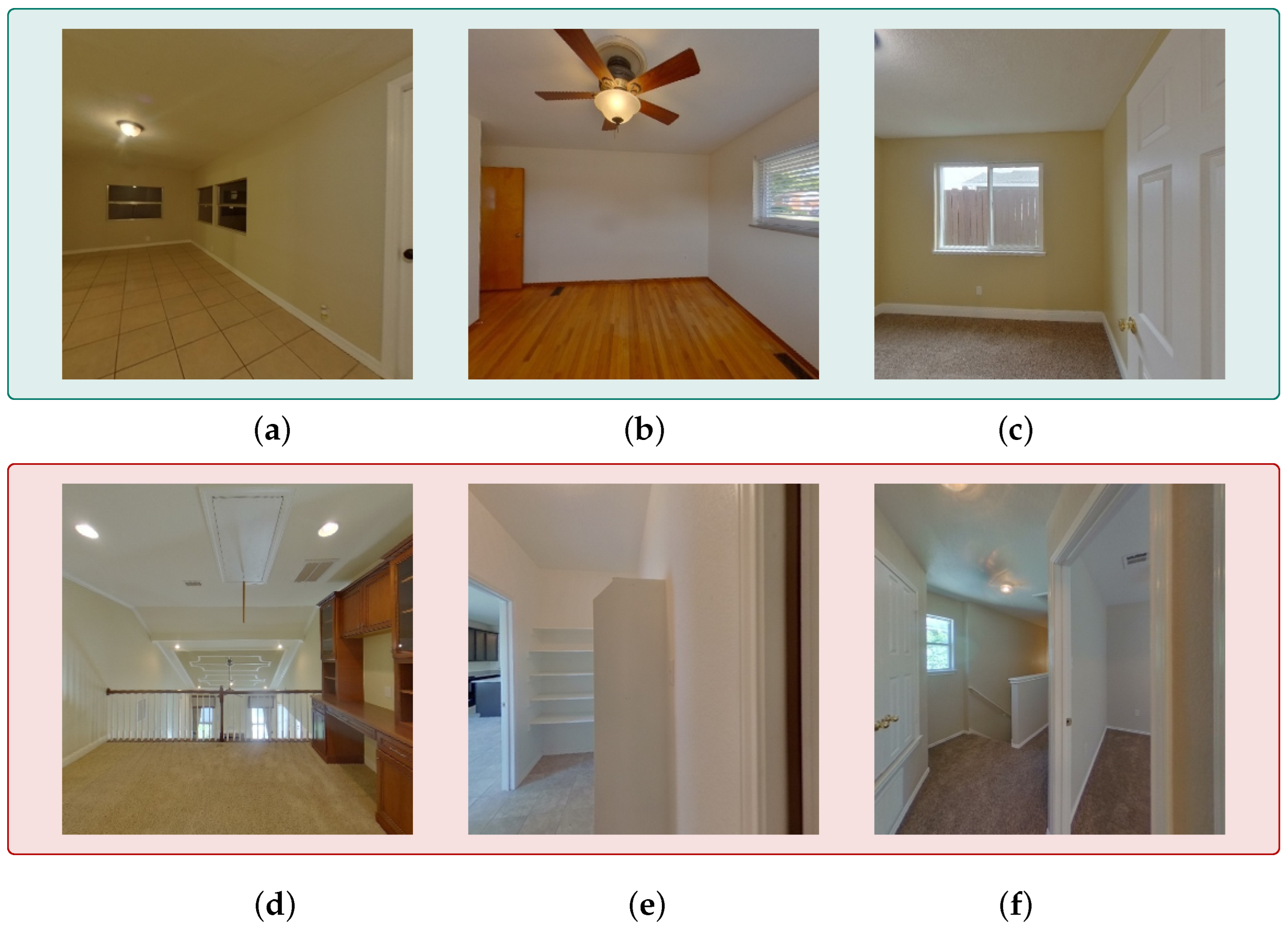
3.2. Quantifying Layout Ambiguity
3.3. Theoretical Motivation: A Bayesian View
- Phase 1—Retrieval as the PriorWe first use semantic mesh segmentation and viewport matching to rapidly narrow the search space from potentially thousands of poses to a small, high-recall set . The retrieval scores assigned to these candidates are proportional to and thus act as an empirical prior. To construct the empirical prior , the retrieval correlation scores are passed through a softmax, which provides a monotonic and normalized mapping from raw similarity values to probabilities. Monotonicity ensures that if a candidate pose has a higher retrieval score than another , then its prior probability will also be higher, preserving the ranking produced by the retrieval stage. Normalization is necessary for the Bayesian update in Equation (5), where this probability-weighted prior is combined with the descriptor-based likelihood to form the final posterior.
- Phase 2—Descriptor Matching as the LikelihoodWe then introduce an independent source of evidence by computing rotation-invariant circular descriptors for both the query and each candidate rendering . The cosine similarity between and measures how consistent the global layout is between the two views, regardless of in-plane rotation. We model this as a likelihood term:The use of ensures that all likelihood weights are positive and that stronger matches are amplified in a smooth and monotonic manner [38]. This follows the standard practice in MAP estimation and log-linear or energy-based models [39], where compatibility scores are exponentiated to produce unnormalized likelihoods prior to the final posterior normalization. We keep this likelihood unnormalized to preserve independence across candidates. Applying a full softmax at this stage would force the candidates to compete and tie each weight to all others. Instead, normalization is performed only in the posterior (Equation (5)), after combining the retrieval prior and the descriptor-based likelihood.The final posterior probability for each candidate pose is thenThis Bayesian update ensures that candidates supported by both the high-recall retrieval prior and the ambiguity-resolving descriptor likelihood rise to the top. Importantly, it allows correct poses that were initially ranked low due to retrieval bias to overtake incorrect top-1 candidates. Because the posterior is proportional to the product of the retrieval prior and the descriptor-based likelihood, a candidate with a modest prior but a substantially larger likelihood can accumulate more posterior mass than an incorrectly retrieved top-1 candidate. This Bayesian update enables low-ranked but geometrically consistent poses to overtake retrieval-biased hypotheses; a behavior that correlation-only refinement cannot provide. In high-ambiguity layouts, this principled combination helps improve accuracy without additional geometric solvers or per-scene retraining.
3.4. Rotation Invariance via Group Theory
3.5. Algorithm Pipeline
- Stage 1: InitializationAt query time, we begin by semantically segmenting the 3D room mesh and then render a set of panoramic viewports on a uniform 1.2 m × 1.2 m grid, requiring far fewer samples than LaLaLoc’s [23] layout based approach. Inspired by the basal pipeline in [9], each rendered panorama and the input perspective image are passed through pretrained backbones: EfficientNet-S [40] for the query images and DenseNet [41] for the panoramas, to produce dense feature maps.
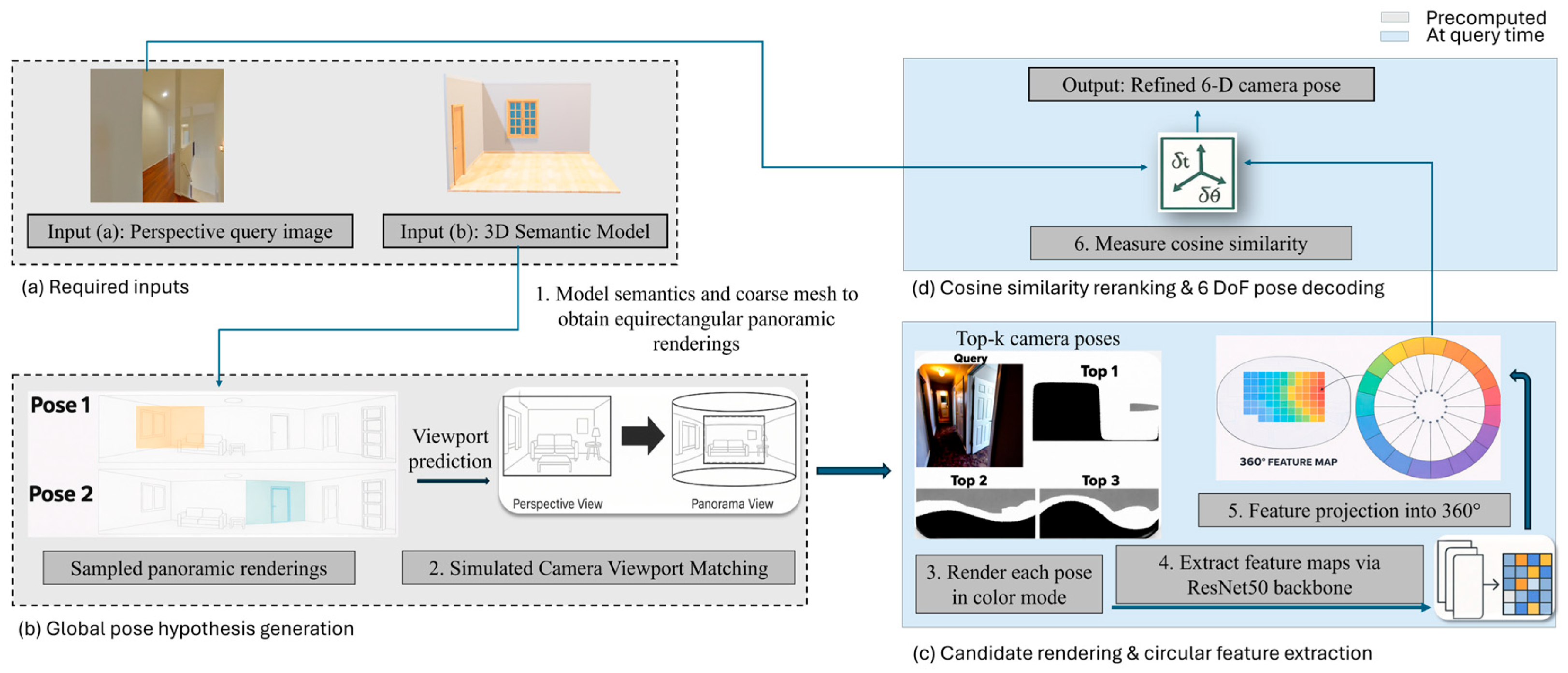
- Stage 2: Initial Pose EstimationWe compute depth-wise correlations between the query’s features and each panorama’s features, yielding a similarity score for every candidate viewport. A lightweight MLP takes the top-k scoring candidates and directly regresses their 6-DoF poses. All training and evaluation follow the standard ZInD split [12]. This coarse retrieval stage (Figure 2 steps (a) and (b)) efficiently narrows the search from thousands of potential views to a few high-confidence hypotheses and does not require 2D floorplans or low-level annotations as in LASER [10].
- Stage 3: Circular Feature ExtractionWe compute rotation-invariant circular descriptors for the query (and later, for each candidate viewport):
- Extract a dense feature map from a pretrained ResNet-50 [11] backbone.
- Transform into polar coordinates, sampling M rings and N points per ring ( and ).
- Apply average and max pooling per ring to form D-dimensional vectors (). Average pooling captures the global structural layout, while max pooling preserves the strong geometric edges. Using them both retains complementary spatial cues essential for disambiguating repetitive scenes.
- Concatenate across rings and L2-normalize.
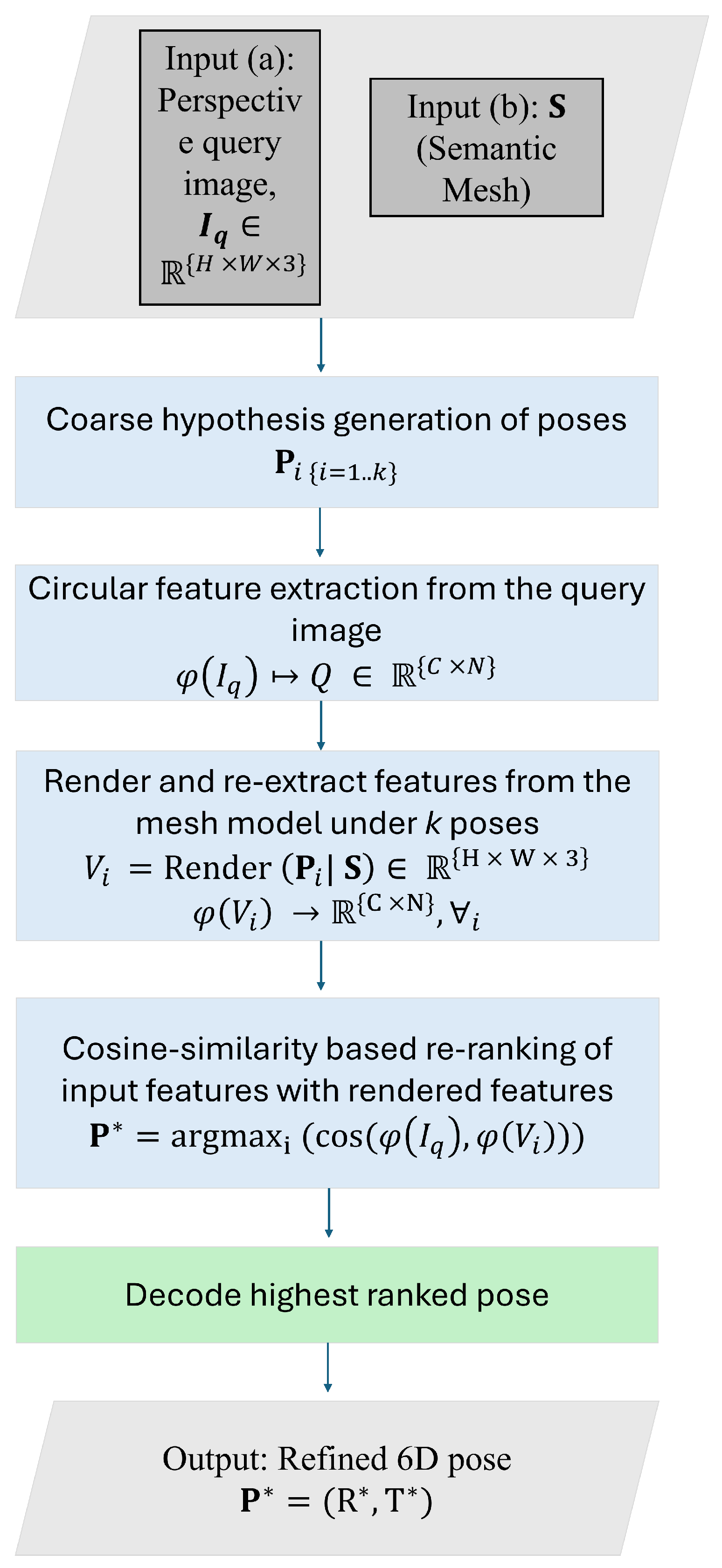
This stage corresponds to Figure 2 step (c) and produces a compact, rotation-agnostic signature that captures global layout, crucial for disambiguating visually similar scenes. - Stage 4: Pose Re-rankingFinally, as can be seen in Figure 2 step (d), each candidate from Stage 1 is re-rendered and encoded into a circular descriptor. Cosine similarity to the query descriptor is computed, and candidates are re-ranked. Unlike SPVLoc’s correlation-based refinement, which assumes top-1 correctness, our Bayesian combination allows lower-ranked but correct candidates to surface. This avoids failure modes where initial retrieval bias dominates refinement.
4. Experimental Evaluation
4.1. Baselines
4.2. Dataset
4.3. Model Training
4.4. Inference Results
5. Discussion and Limitation
6. Conclusions
Author Contributions
Funding
Institutional Review Board Statement
Informed Consent Statement
Data Availability Statement
Acknowledgments
Conflicts of Interest
References
- Taira, H.; Okutomi, M.; Sattler, T.; Cimpoi, M.; Pollefeys, M.; Sivic, J.; Pajdla, T.; Torii, A. InLoc: Indoor Visual Localization with Dense Matching and View Synthesis. In Proceedings of the IEEE/CVF Conference on Computer Vision and Pattern Recognition (CVPR), Salt Lake City, UT, USA, 18–23 June 2018. [Google Scholar]
- Wang, S.; Fidler, S.; Urtasun, R. Lost Shopping! Monocular Localization in Large Indoor Spaces. In Proceedings of the IEEE International Conference on Computer Vision (ICCV), Santiago, Chile, 7–13 December 2015. [Google Scholar]
- Acharya, D.; Ramezani, M.; Khoshelham, K.; Winter, S. BIM-Tracker: A model-based visual tracking approach for indoor localisation using a 3D building model. ISPRS J. Photogramm. Remote Sens. 2019, 150, 157–171. [Google Scholar] [CrossRef]
- Chen, X.; Fan, G.; Roberts, E.; Steven, H.J. A Transfer Learning-Based Smart Homecare Assistive Technology to Support Activities of Daily Living for People with Mild Dementia. In Proceedings of the 2023 IEEE 23rd International Conference on Bioinformatics and Bioengineering (BIBE), Virtual, 4–6 December 2023; pp. 359–363. [Google Scholar] [CrossRef]
- Triggs, B.; McLauchlan, P.F.; Hartley, R.I.; Fitzgibbon, A.W. Bundle adjustment—A modern synthesis. In Proceedings of the International Workshop on Vision Algorithms, Corfu, Greece, 21–22 September 1999; Springer: Berlin/Heidelberg, Germany, 1999; pp. 298–372. [Google Scholar]
- Snavely, N.; Seitz, S.; Szeliski, R. Photo tourism: Exploring photo collections in 3D. ACM Trans. Graph. 2006, 25, 835–846. [Google Scholar] [CrossRef]
- Kendall, A.; Grimes, M.; Cipolla, R. PoseNet: A Convolutional Network for Real-Time 6-DOF Camera Relocalization. arXiv 2016, arXiv:1505.07427. [Google Scholar]
- Zheng, J.; Zhang, J.; Li, J.; Tang, R.; Gao, S.; Zhou, Z. Structured3D: A Large Photo-realistic Dataset for Structured 3D Modeling. In Proceedings of the European Conference on Computer Vision (ECCV), Virtual, 23–28 August 2020. [Google Scholar]
- Gard, N.; Hilsmann, A.; Eisert, P. SPVLoc: Semantic Panoramic Viewport Matching for 6D Camera Localization in Unseen Environments. In Proceedings of the Computer Vision—ECCV 2024: 18th European Conference on Computer Vision, Milan, Italy, 29 September–4 October 2024; pp. 398–415. [Google Scholar] [CrossRef]
- Min, Z.; Khosravan, N.; Bessinger, Z.; Narayana, M.; Kang, S.B.; Dunn, E.; Boyadzhiev, I. LASER: LAtent SpacE Rendering for 2D Visual Localization. arXiv 2023, arXiv:2204.00157. [Google Scholar] [CrossRef]
- He, K.; Zhang, X.; Ren, S.; Sun, J. Deep Residual Learning for Image Recognition. In Proceedings of the 2016 IEEE Conference on Computer Vision and Pattern Recognition (CVPR), Las Vegas, NV, USA, 27–30 June 2016; pp. 770–778. [Google Scholar] [CrossRef]
- Cruz, S.; Hutchcroft, W.; Li, Y.; Khosravan, N.; Boyadzhiev, I.; Kang, S.B. Zillow Indoor Dataset: Annotated Floor Plans With 360º Panoramas and 3D Room Layouts. In Proceedings of the IEEE/CVF Conference on Computer Vision and Pattern Recognition (CVPR), Virtual, 20–25 June 2021; pp. 2133–2143. [Google Scholar]
- Torii, A.; Sivic, J.; Pajdla, T.; Okutomi, M. Visual Place Recognition with Repetitive Structures. In Proceedings of the 2013 IEEE Conference on Computer Vision and Pattern Recognition, Portland, OR, USA, 23–28 June 2013; pp. 883–890. [Google Scholar] [CrossRef]
- Hausler, S.; Garg, S.; Xu, M.; Milford, M.; Fischer, T. Patch-NetVLAD: Multi-Scale Fusion of Locally-Global Descriptors for Place Recognition. In Proceedings of the 2021 IEEE/CVF Conference on Computer Vision and Pattern Recognition (CVPR), Virtual, 19–25 June 2021; pp. 14136–14147. [Google Scholar] [CrossRef]
- Sarlin, P.E.; Cadena, C.; Siegwart, R.; Dymczyk, M. From Coarse to Fine: Robust Hierarchical Localization at Large Scale. In Proceedings of the 2019 IEEE/CVF Conference on Computer Vision and Pattern Recognition (CVPR), Long Beach, CA, USA, 16–20 June 2019; pp. 12708–12717. [Google Scholar] [CrossRef]
- Lowe, D.G. Distinctive image features from scale-invariant keypoints. Int. J. Comput. Vis. 2004, 60, 91–110. [Google Scholar] [CrossRef]
- Bay, H.; Ess, A.; Tuytelaars, T.; Van Gool, L. Speeded-Up Robust Features (SURF). Comput. Vis. Image Underst. 2008, 110, 346–359. [Google Scholar] [CrossRef]
- Rublee, E.; Rabaud, V.; Konolige, K.; Bradski, G. ORB: An efficient alternative to SIFT or SURF. In Proceedings of the 2011 International Conference on Computer Vision, Barcelona, Spain, 6–13 November 2011; pp. 2564–2571. [Google Scholar] [CrossRef]
- Leutenegger, S.; Chli, M.; Siegwart, R.Y. BRISK: Binary Robust invariant scalable keypoints. In Proceedings of the 2011 International Conference on Computer Vision, Barcelona, Spain, 6–13 November 2011; pp. 2548–2555. [Google Scholar] [CrossRef]
- Luo, Z.; Zhou, L.; Bai, X.; Chen, H.; Zhang, J.; Yao, Y.; Li, S.; Fang, T.; Quan, L. ASLFeat: Learning Local Features of Accurate Shape and Localization. In Proceedings of the 2020 IEEE/CVF Conference on Computer Vision and Pattern Recognition (CVPR), Virtual, 14–19 June 2020; pp. 6588–6597. [Google Scholar] [CrossRef]
- Fischler, M.A.; Bolles, R.C. Random Sample Consensus: A Paradigm for Model Fitting with Applications to Image Analysis and Automated Cartography. In Readings in Computer Vision; Fischler, M.A., Firschein, O., Eds.; Morgan Kaufmann: San Francisco, CA, USA, 1987; pp. 726–740. [Google Scholar] [CrossRef]
- Lepetit, V.; Moreno-Noguer, F.; Fua, P. EPnP: An accurate O(n) solution to the PnP problem. Int. J. Comput. Vis. 2009, 81, 155–166. [Google Scholar] [CrossRef]
- Howard-Jenkins, H.; Ruiz-Sarmiento, J.R.; Prisacariu, V.A. Lalaloc: Latent layout localisation in dynamic, unvisited environments. In Proceedings of the IEEE/CVF International Conference on Computer Vision, Virtual, 11–17 October 2021; pp. 10107–10116. [Google Scholar]
- Howard-Jenkins, H.; Prisacariu, V.A. Lalaloc++: Global floor plan comprehension for layout localisation in unvisited environments. In Proceedings of the European Conference on Computer Vision, Tel Aviv, Israel, 23–27 October 2022; Springer: Berlin/Heidelberg, Germany, 2022; pp. 693–709. [Google Scholar]
- Salas-Moreno, R.F.; Newcombe, R.A.; Strasdat, H.; Kelly, P.H.; Davison, A.J. Slam++: Simultaneous localisation and mapping at the level of objects. In Proceedings of the IEEE Conference on Computer Vision and Pattern Recognition, Portland, OR, USA, 23–28 June 2013; pp. 1352–1359. [Google Scholar]
- Engel, J.; Schöps, T.; Cremers, D. LSD-SLAM: Large-scale direct monocular SLAM. In Proceedings of the European Conference on Computer Vision, Zurich, Switzerland, 6–12 September 2014; Springer: Berlin/Heidelberg, Germany, 2014; pp. 834–849. [Google Scholar]
- Mur-Artal, R.; Montiel, J.M.M.; Tardós, J.D. ORB-SLAM: A Versatile and Accurate Monocular SLAM System. IEEE Trans. Robot. 2015, 31, 1147–1163. [Google Scholar] [CrossRef]
- Mur-Artal, R.; Tardos, J.D. ORB-SLAM2: An Open-Source SLAM System for Monocular, Stereo, and RGB-D Cameras. IEEE Trans. Robot. 2017, 33, 1255–1262. [Google Scholar] [CrossRef]
- Whelan, T.; Salas-Moreno, R.F.; Glocker, B.; Davison, A.J.; Leutenegger, S. ElasticFusion: Real-time dense SLAM and light source estimation. Int. J. Robot. Res. 2016, 35, 1697–1716. [Google Scholar] [CrossRef]
- McCormac, J.; Handa, A.; Davison, A.; Leutenegger, S. SemanticFusion: Dense 3D semantic mapping with convolutional neural networks. In Proceedings of the 2017 IEEE International Conference on Robotics and Automation (ICRA), Singapore, 29 May–3 June 2017; pp. 4628–4635. [Google Scholar] [CrossRef]
- Mildenhall, B.; Srinivasan, P.P.; Tancik, M.; Barron, J.T.; Ramamoorthi, R.; Ng, R. NeRF: Representing Scenes as Neural Radiance Fields for View Synthesis. arXiv 2020, arXiv:2003.08934. [Google Scholar] [CrossRef]
- Dai, A.; Ritchie, D.; Bokeloh, M.; Reed, S.; Sturm, J.; Nießner, M. ScanComplete: Large-Scale Scene Completion and Semantic Segmentation for 3D Scans. In Proceedings of the 2018 IEEE/CVF Conference on Computer Vision and Pattern Recognition, Salt Lake City, UT, USA, 18–22 June 2018; pp. 4578–4587. [Google Scholar] [CrossRef]
- Brahmbhatt, S.; Gu, J.; Bansal, K.; Darrell, T.; Hwang, J.; Adelson, E.H. Geometry-Aware Learning of Maps for Camera Localization. In Proceedings of the 2018 IEEE/CVF Conference on Computer Vision and Pattern Recognition, Salt Lake City, UT, USA, 18–22 June 2018. [Google Scholar]
- Clark, R.; Wang, S.; Wen, H.; Handa, A.; Nieuwenhuis, D.; Davison, A.; Leutenegger, S. VidLoc: A Deep Spatio-Temporal Model for 6-DoF Video-Clip Relocalization. In Proceedings of the 2017 IEEE Conference on Computer Vision and Pattern Recognition (CVPR), Honolulu, HI, USA, 21–26 July 2017. [Google Scholar]
- Tateno, K.; Tombari, F.; Laina, I.; Navab, N. Cnn-slam: Real-time dense monocular slam with learned depth prediction. In Proceedings of the IEEE Conference on Computer Vision and Pattern Recognition, Honolulu, HI, USA, 21–26 July 2017; pp. 6243–6252. [Google Scholar]
- Brachmann, E.; Krull, A.; Nowozin, S.; Shotton, J.; Michel, F.; Gumhold, S.; Rother, C. DSAC — Differentiable RANSAC for Camera Localization. In Proceedings of the 2017 IEEE Conference on Computer Vision and Pattern Recognition (CVPR), Honolulu, HI, USA, 21–26 July 2017; pp. 2492–2500. [Google Scholar] [CrossRef]
- Forster, C.; Pizzoli, M.; Scaramuzza, D. SVO: Fast semi-direct monocular visual odometry. In Proceedings of the 2014 IEEE International Conference on Robotics and Automation (ICRA), Hong Kong, China, 31 May–7 June 2014; pp. 15–22. [Google Scholar] [CrossRef]
- Bengio, Y.; Courville, A.; Vincent, P. Representation Learning: A Review and New Perspectives. arXiv 2014, arXiv:1206.5538. [Google Scholar] [CrossRef] [PubMed]
- Bishop, C.M.; Nasrabadi, N.M. Pattern Recognition and Machine Learning; Springer: Berlin/Heidelberg, Germany, 2006; Volume 4. [Google Scholar]
- Tan, M.; Le, Q.V. EfficientNet: Rethinking Model Scaling for Convolutional Neural Networks. arXiv 2020, arXiv:1905.11946. [Google Scholar] [CrossRef]
- Huang, G.; Liu, Z.; van der Maaten, L.; Weinberger, K.Q. Densely Connected Convolutional Networks. arXiv 2018, arXiv:1608.06993. [Google Scholar]
- Qi, C.R.; Yi, L.; Su, H.; Guibas, L.J. PointNet++: Deep Hierarchical Feature Learning on Point Sets in a Metric Space. CoRR 2017, arXiv:1706.02413. [Google Scholar]
- Wang, Y.; Sun, Y.; Liu, Z.; Sarma, S.E.; Bronstein, M.M.; Solomon, J.M. Dynamic Graph CNN for Learning on Point Clouds. CoRR 2018, arXiv:1801.07829. [Google Scholar] [CrossRef]
- Zhou, Q.Y.; Park, J.; Koltun, V. Open3D: A Modern Library for 3D Data Processing. arXiv 2018, arXiv:1801.09847. [Google Scholar] [CrossRef]
- Askar, C.; Sternberg, H. Use of Smartphone Lidar Technology for Low-Cost 3D Building Documentation with iPhone 13 Pro: A Comparative Analysis of Mobile Scanning Applications. Geomatics 2023, 3, 563–579. [Google Scholar] [CrossRef]
- Huang, Z.; Yu, Y.; Xu, J.; Ni, F.; Le, X. PF-Net: Point Fractal Network for 3D Point Cloud Completion. arXiv 2020, arXiv:2003.00410. [Google Scholar] [CrossRef]



| Method | <10 cm (%) | <50 cm (%) | <1 m (%) |
|---|---|---|---|
| LASER (from [9]) | 8.69 | 67.01 | 80.90 |
| SPVLoc | 12.25 | 59.49 | 98.21 |
| SPVLoc–Refined | 22.07 | 73.80 | 98.21 |
| Ours | 12.86 | 63.42 | 99.14 |
| Ours–Refined | 21.82 | 73.62 | 99.14 |
| Method | Terr (cm) | Rerr (°) | ||||||
|---|---|---|---|---|---|---|---|---|
| Min | Max | Mean | Median | Min | Max | Mean | Median | |
| Baseline | 0.406 | 2089.24 | 149.93 | 32.38 | 0.040 | 179.99 | 38.91 | 3.57 |
| Baseline–refined | 1.210 | 2069.46 | 131.73 | 18.47 | 0.046 | 179.99 | 36.33 | 2.97 |
| Ours | 0.406 | 2089.24 | 116.54 | 29.17 | 0.040 | 179.99 | 35.98 | 3.44 |
| Ours–refined | 0.406 | 2069.47 | 103.07 | 19.41 | 0.027 | 179.99 | 30.20 | 2.56 |
| Method | Scene Sampling Time (s) | Inference QPS |
|---|---|---|
| PFNet [46] | 48.95 ± 38.95 | 5.06 |
| LASER [10] | 0.97 ± 1.09 | 8.31 |
| Baseline [9] | 1.66 ± 1.06 | 28.63 |
| Ours | 0.72 ± 0.65 | 25.79 |
| Ours (refined) | 0.70 ± 0.63 | 26.39 |
Disclaimer/Publisher’s Note: The statements, opinions and data contained in all publications are solely those of the individual author(s) and contributor(s) and not of MDPI and/or the editor(s). MDPI and/or the editor(s) disclaim responsibility for any injury to people or property resulting from any ideas, methods, instructions or products referred to in the content. |
© 2025 by the authors. Licensee MDPI, Basel, Switzerland. This article is an open access article distributed under the terms and conditions of the Creative Commons Attribution (CC BY) license.
Share and Cite
Monawwar, H.; Fan, G. Render-Rank-Refine: Accurate 6D Indoor Localization via Circular Rendering. J. Imaging 2026, 12, 10. https://doi.org/10.3390/jimaging12010010
Monawwar H, Fan G. Render-Rank-Refine: Accurate 6D Indoor Localization via Circular Rendering. Journal of Imaging. 2026; 12(1):10. https://doi.org/10.3390/jimaging12010010
Chicago/Turabian StyleMonawwar, Haya, and Guoliang Fan. 2026. "Render-Rank-Refine: Accurate 6D Indoor Localization via Circular Rendering" Journal of Imaging 12, no. 1: 10. https://doi.org/10.3390/jimaging12010010
APA StyleMonawwar, H., & Fan, G. (2026). Render-Rank-Refine: Accurate 6D Indoor Localization via Circular Rendering. Journal of Imaging, 12(1), 10. https://doi.org/10.3390/jimaging12010010