
Article

HFM: A Hybrid Feature Model Based on Conditional Auto Encoders for Zero-Shot Learning
1
Faculty of Science and Technology, Norwegian University of Life Science (NMBU), 1430 Ås, Norway
2
Department of Computer Science, Norwegian University of Science and Technology, 2819 Gjøvik, Norway
*
Author to whom correspondence should be addressed.
J. Imaging 2022, 8(6), 171; https://doi.org/10.3390/jimaging8060171

Submission received: 26 March 2022 / Revised: 4 June 2022 / Accepted: 9 June 2022 / Published: 16 June 2022
(This article belongs to the Special Issue Unsupervised Deep Learning and Its Applications in Imaging Processing)

Abstract

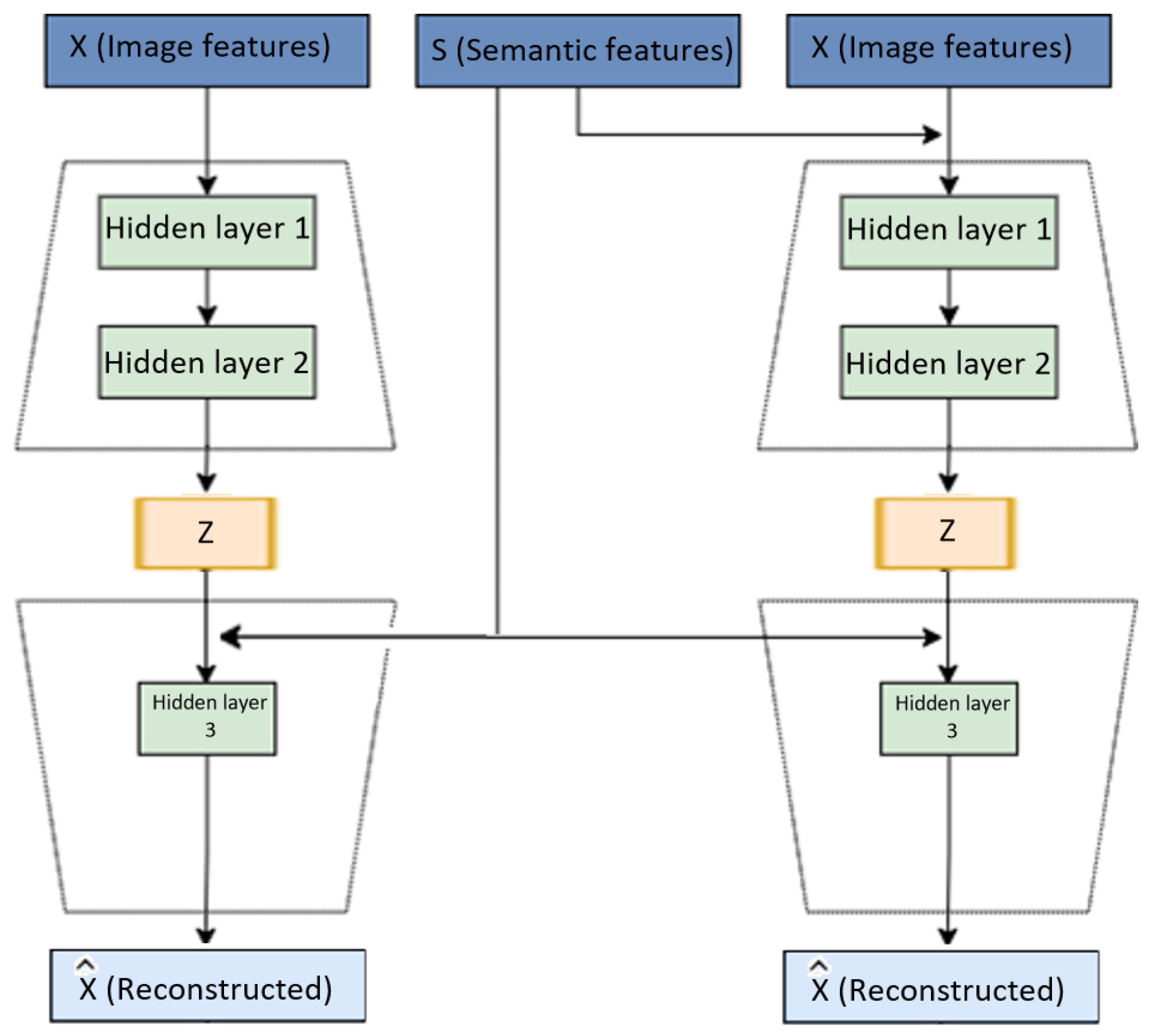
Zero-Shot Learning (ZSL) is related to training machine learning models capable of classifying or predicting classes (labels) that are not involved in the training set (unseen classes). A well-known problem in Deep Learning (DL) is the requirement for large amount of training data. Zero-Shot learning is a straightforward approach that can be applied to overcome this problem. We propose a Hybrid Feature Model (HFM) based on conditional autoencoders for training a classical machine learning model on pseudo training data generated by two conditional autoencoders (given the semantic space as a condition): (a) the first autoencoder is trained with the visual space concatenated with the semantic space and (b) the second autoencoder is trained with the visual space as an input. Then, the decoders of both autoencoders are fed by the test data of the unseen classes to generate pseudo training data. To classify the unseen classes, the pseudo training data are combined to train a support vector machine. Tests on four different benchmark datasets show that the proposed method shows promising results compared to the current state-of-the-art when it comes to settings for both standard Zero-Shot Learning (ZSL) and Generalized Zero-Shot Learning (GZSL).
Keywords: Zero-Shot Learning (ZSL); semantic space; conditional autoencoders; generative models; computer vision Zero-Shot Learning (ZSL); semantic space; conditional autoencoders; generative models; computer vision