
Article

An Object Detection Method Based on Frequency-Band Enhancement and Multi-Scale Fusion
1
School of Electrical and Control Engineering, North China University of Technology, Beijing 100144, China
2
School of Computer Science and Technology, Kashi University, Kashi 844000, China
3
School of Artificial Intelligence and Computer Science, North China University of Technology, Beijing 100144, China
*
Author to whom correspondence should be addressed.
J. Imaging 2026, 12(9), 447; https://doi.org/10.3390/jimaging12090447

Submission received: 26 June 2026 / Revised: 4 August 2026 / Accepted: 20 August 2026 / Published: 16 September 2026

Abstract

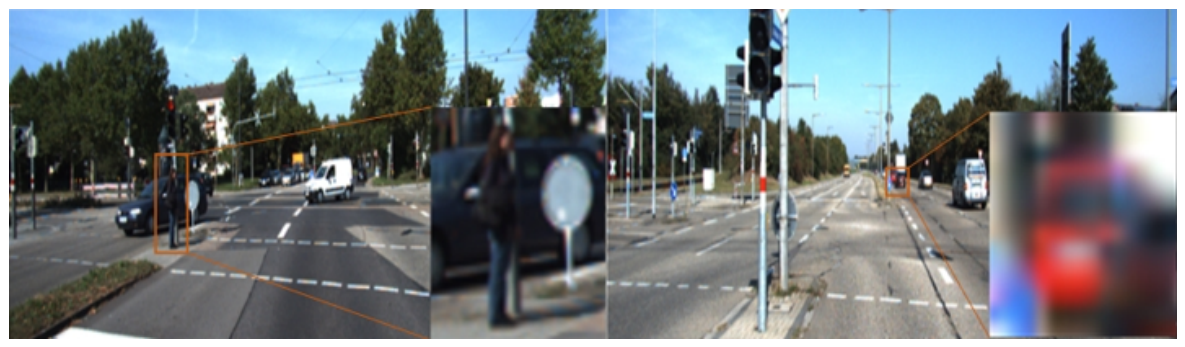
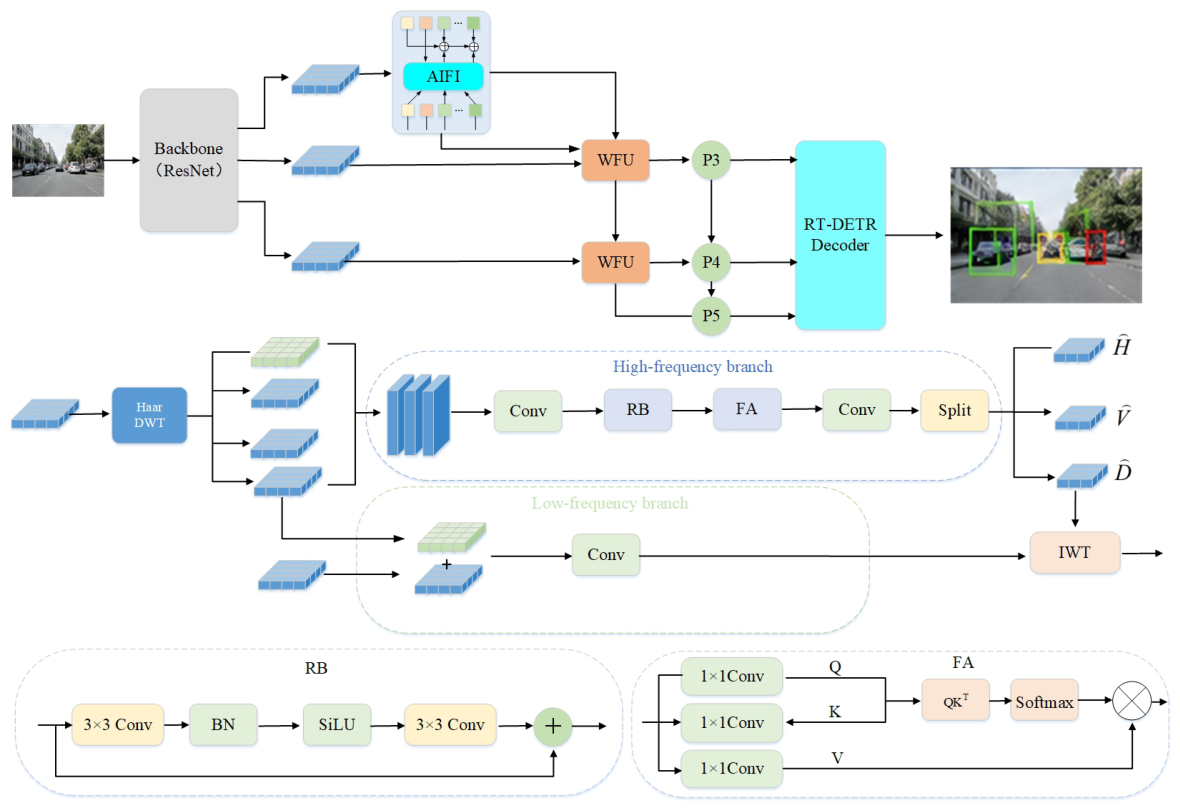
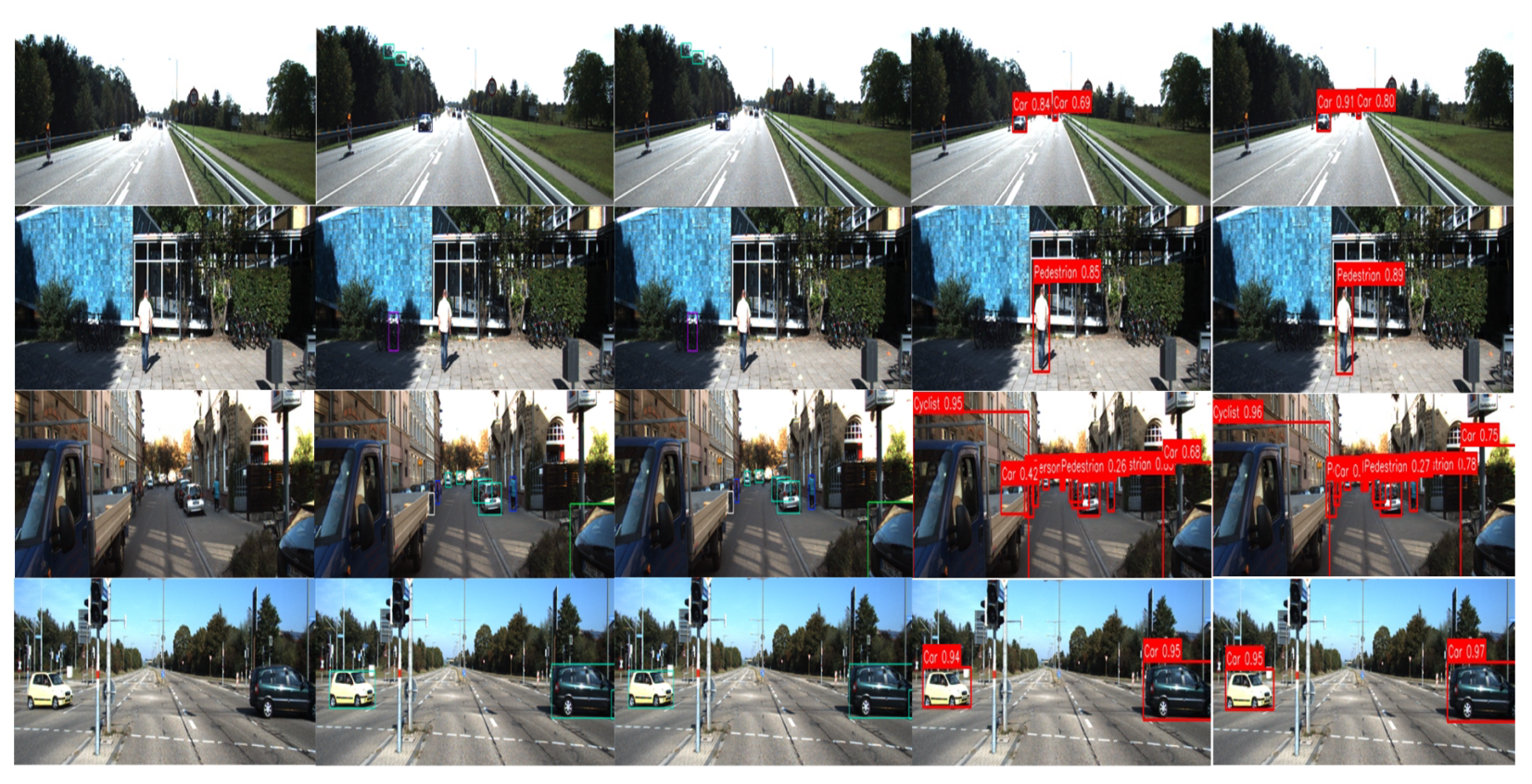
Although Transformer-based real-time object detectors have achieved promising performance in autonomous driving scenarios, their ability to detect small objects remains limited. This limitation primarily arises because small objects occupy only a few pixels in an image and contain weak edge and texture information, which can be further degraded during feature extraction and multiscale feature propagation. To address these issues, this study proposes a wavelet-based frequency-aware feature enhancement method using RT-DETR as the baseline network. First, a Wavelet Frequency Unit is introduced into the feature fusion stage of the RT-DETR neck. The unit employs the Haar wavelet transform to decompose the input features into low- and high-frequency subbands, thereby decoupling information across different frequency components. Second, residual enhancement and a frequency attention mechanism are applied to strengthen edge and texture details in the high-frequency branch. Finally, the low-frequency subband is fused with low-resolution features across scales, followed by feature reconstruction using the inverse wavelet transform. This design improves the representation of small objects in the feature space. Tests on KITTI and BDD100K verify the method. On KITTI, it obtains 95.5% mAP@0.5 and 69.7% mAP@0.5:0.95, exceeding the RT-DETR baseline by 1.8 and 1.1 percentage points. APs and ARs rise by 2.7 and 2.3 percentage points. On the selected BDD100K subset, the corresponding mAP@0.5 and mAP@0.5:0.95 values are 51.7% and 29.7%.
Keywords: object detection; RT-DETR; wavelet transform; feature fusion; autonomous driving object detection; RT-DETR; wavelet transform; feature fusion; autonomous driving