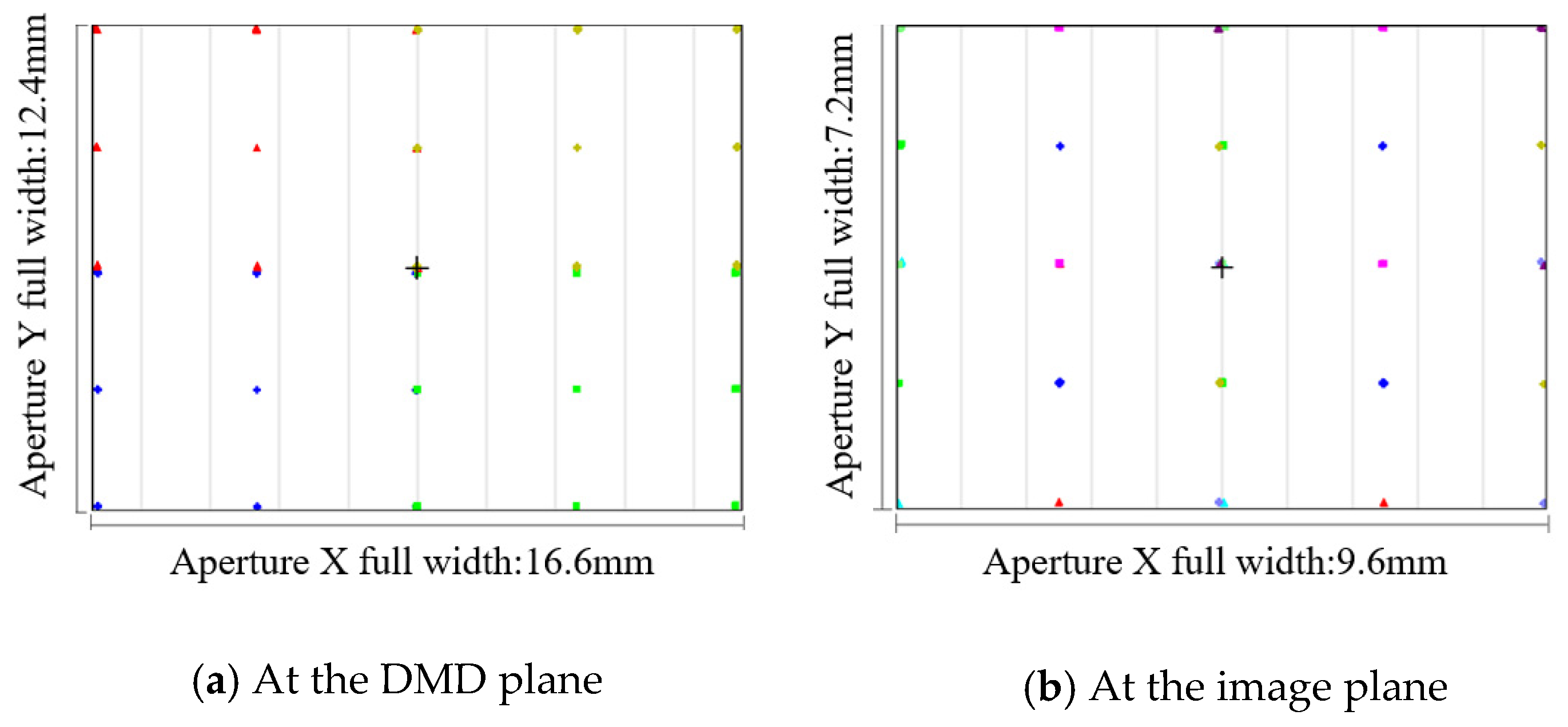
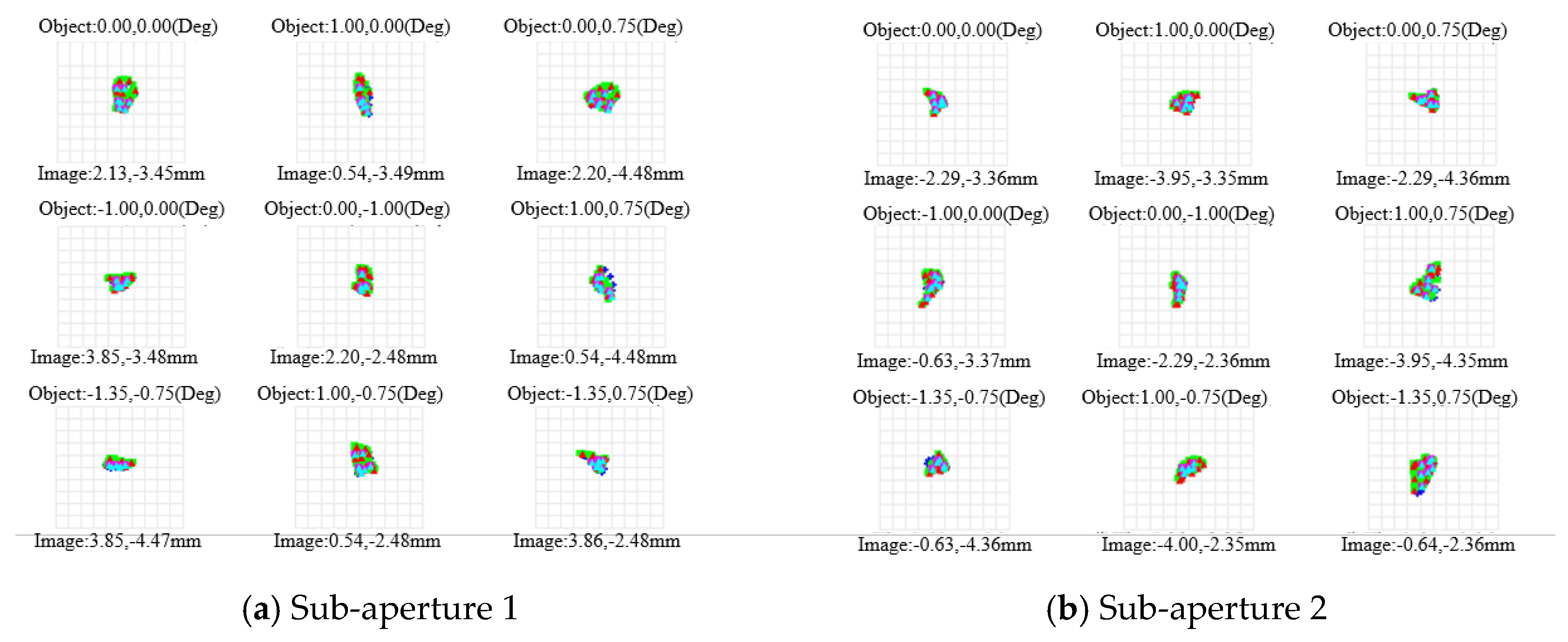
1. Introduction
Polarization detection is an emerging sensing technique that exploits differences in the polarization properties of scattered light, background light, and target light. It provides key advantages, including visibility through clouds and fog, target enhancement, and discrimination between real and false objects [
1]. Simultaneous polarization imaging acquires all polarization states in a single exposure, ensuring identical illumination and radiation conditions across channels. This makes it highly suitable for rapidly changing targets and has made it the mainstream approach in polarization detection [
2].
To satisfy both simultaneous imaging and miniaturization, polarization imaging systems are mainly divided into focal-plane segmented systems and aperture-divided systems. Focal-plane segmentation is structurally simple but suffers from instantaneous field-of-view mismatch, which is difficult to correct in post-processing. Aperture-divided systems use one focal plane array and projection optics to map multiple polarization-direction images from the same field of view onto different detector regions, enabling simultaneous multi-direction acquisition without field-of-view mismatch. Its main drawback is reduced spatial resolution, which can be compensated by computational super-resolution methods.
In an aperture-divided system design, Pezzaniti and Chenault (2005) developed a mid-wave infrared detector using a relay lens to project four identical images onto one focal plane [
3]. Moultrie et al. (2007) developed a low-light polarization imager that simultaneously acquires four sub-images on a single CCD [
4]. Leon et al. (2007) designed a 632.8 nm aperture-divided imager that outputs DOP, DOLP, DOCP, and ellipticity from a single exposure [
5]. He Hucheng et al. (2014) derived the relationship between system eccentricity and front/rear focal lengths using paraxial imaging theory, and applied the PW method for initial structural design [
6,
7]. Xujie Huang (2017) designed an MWIR aperture-divided imaging polarimeter (f = 68 mm, F/2, FOV 4° × 3.2°) consisting of a co-aperture Galilean telescope, four sub-aperture double-Gauss objectives, and a co-aperture Cooke triplet relay lens [
8]. Wang Qi et al. (2018) designed an infrared aperture-divided polarization imager using combined common-aperture and sub-aperture strategies (3.7–4.8 μm, f = 200 mm, F/4, half-field angle 2°) [
9]. Liu Zunbei et al. (2021) proposed an aperture-divided ultraviolet multiband imaging system with a front aperture-division and rear image-combination architecture, covering 240–280 nm, 308 nm, 300–360 nm, and 390 nm [
10].
Most of the above designs are transmissive aperture-divided systems. However, in infrared bands with high material absorption, transmissive structures cannot adequately meet wideband high-throughput requirements. Therefore, reflective polarization detection systems are urgently needed. Compared with [
9], it is more compact and provides a broader spectral range. In recent years, DMD-based computational imaging and polarization super-resolution have also attracted increasing attention. Xu et al. proposed a polarization super-resolution imaging method based on deep compressed sensing by introducing a DMD into the polarization imaging system [
11].Comparison with previous aperture-segmented polarimeters is shown in
Table 1.
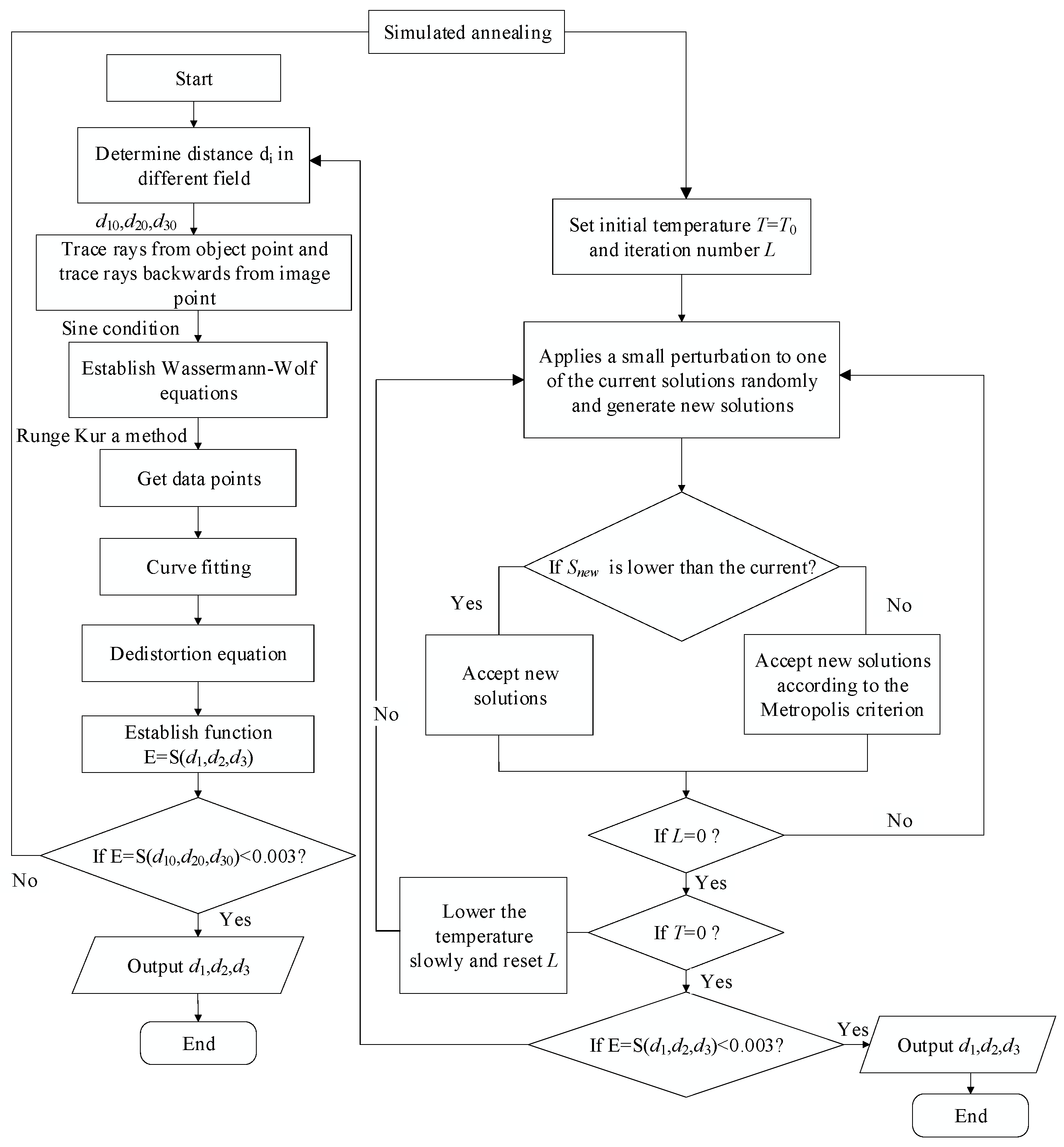
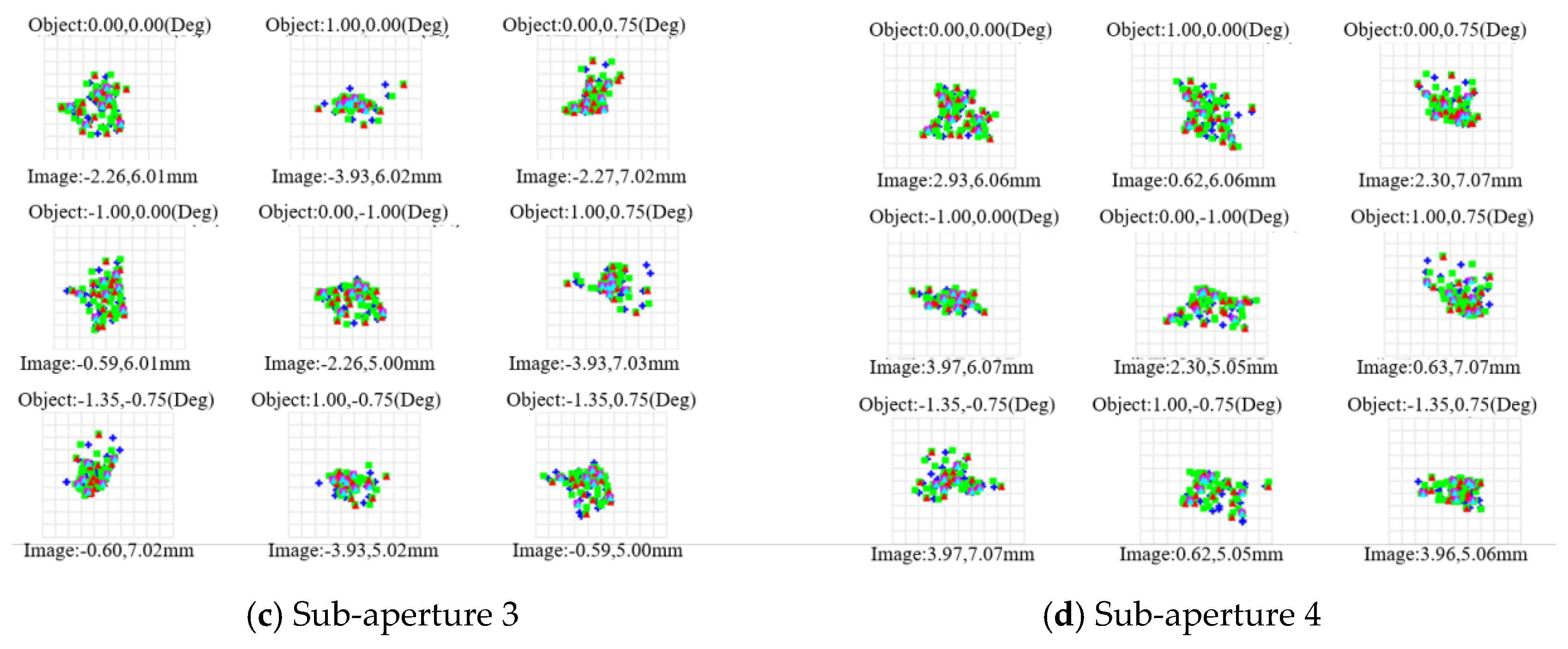
This paper presents the design principles and methodology of an aperture-divided off-axis simultaneous polarization super-resolution imaging optical system. The system adopts a fully reflective secondary imaging architecture with wide operating bandwidth, no central obscuration, high energy utilization, and good miniaturization potential. It can simultaneously acquire MWIR and LWIR information in four polarization directions, improving target-background discrimination and feature extraction in low-contrast and strong-interference environments (e.g., haze and smoke). The unobscured reflective configuration improves optical efficiency and supports lightweight implementation for airborne and spaceborne applications. The main trade-off is that higher spatial resolution comes at the cost of temporal resolution. Based on Wassermann–Wolf theory and Seidel aberration theory, this work develops initial aberration-correction principles and global optimization methods, and finally presents the design and image-quality evaluation of a large-aperture off-axis fully reflective super-resolution imaging system with a DMD.
Mathematically, the DMD binary coding process can be expressed as
where x denotes the high-resolution scene vector, y is the low-resolution measurement vector, Φ is the binary observation matrix generated by the DMD micromirror patterns, and n represents measurement noise. For Bernoulli coding, each element of Φ satisfies
,
,
.
To guarantee stable compressed-sensing reconstruction, the observation matrix should satisfy the restricted isometry property (RIP), namely
where δk is the restricted isometry constant. This condition indicates that the DMD-generated binary observation matrix approximately preserves the energy of sparse signals, thereby bridging the optical coding hardware and the subsequent OMP-based reconstruction algorithm.
2. Aperture-Divided Off-Axis Simultaneous Polarization Super-Resolution Imaging System Working Principle
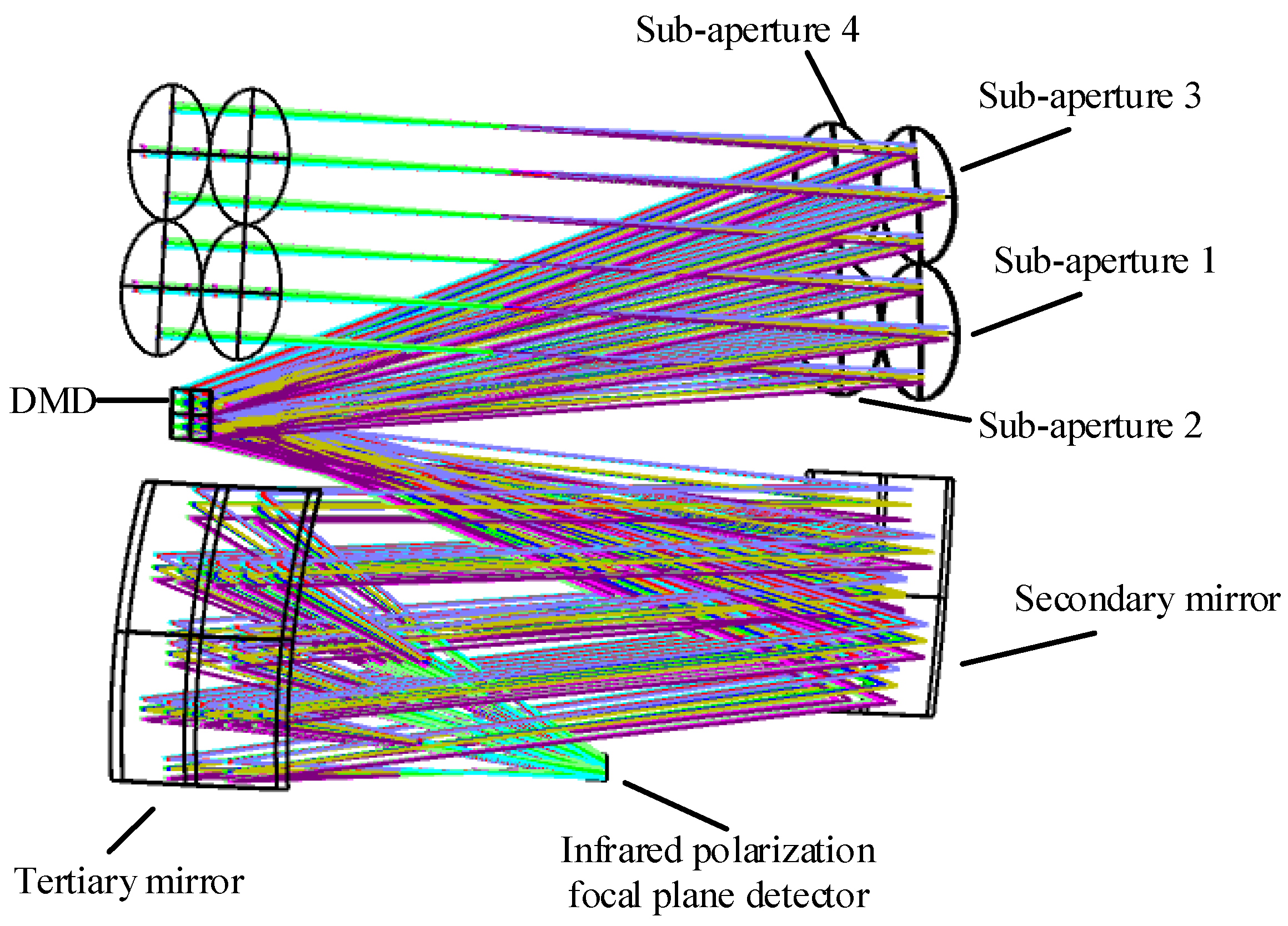
Based on the principle of simultaneous polarization super-resolution imaging and the theory of compressed sensing, a wide-band simultaneous polarization super-resolution imaging system is developed. The key components of the system include: a split-aperture off-axis reflective free-form optical system, a DMD, an infrared polarization focal plane detector, and a computational super-resolution reconstruction unit. A schematic of the system is shown in
Figure 1.
Each component in
Figure 1 is designed to enable high-resolution polarization imaging: the split-aperture off-axis reflective free-form optical system captures multi-aperture light; the DMD encodes the intermediate image with a block-based compressed sensing pattern; the infrared polarization focal plane detector measures multi-frame low-resolution images; the computational reconstruction unit combines these to achieve d-fold super-resolution, improving spatial resolution and enabling detailed polarization state analysis.
In this work, “super-resolution” refers to the recovery of a higher-resolution image from compressed low-resolution measurements using DMD-based coded sampling and compressed-sensing reconstruction, rather than the development of a dedicated deep-learning super-resolution algorithm.
The aperture-divided off-axis simultaneous polarization super-resolution imaging optical system consists of two main subsystems: a telescope objective system and a relay reflection system. Light from a distant scene passes through the four sub-pupils of the telescope objective system and is imaged onto four equal areas of the intermediate image plane. The DMD is employed to encode the light intensity at the intermediate image plane [
12,
13]. After encoding, the four beams of light are reflected by the DMD and projected onto the four regions of the infrared polarization focal plane detector, following uniform passage through the relay reflection system.
In each of the four regions of the focal plane, polarization is analyzed by attaching a broadband polarization grating oriented in different directions: I
(0), I
(45), I
(90), and I
(135). The DMD encoding is performed sequentially for each polarization state, generating multi-frame low-resolution intensity images. These images are then processed through sub-pixel reconstruction, and the image processor outputs super-resolution polarization images for each polarization direction. Finally, the Stokes parameters of the target are computed from the reconstructed super-resolution images [
14,
15,
16].
The Stokes vector
is a set of four parameters that fully describe the polarization state. Where I represents the total light intensity, Q represents the intensity difference between 0° and 90° polarization, U represents the intensity difference between 45° and 135° polarization, and V represents the intensity difference between right-handed circular polarization and left-handed circular polarization. In common DoFP (Division of Focal Plane) or polarizer imaging systems, only the intensity in the four linear polarization directions of 0°, 45°, 90°, and 135° can be measured, so I, Q, U can be obtained, but V cannot be directly obtained. Therefore, by constructing Stokes components through intensity difference and sum, the Stokes vector representation of the polarization state can ultimately be obtained.
where S0 denotes the total intensity; S1 represents the intensity difference between 0° and 90°; S2 represents the intensity difference between 45° and 135° and if S3 only measures linear polarization, take 0. Based on the reconstructed Stokes parameters, the degree of linear polarization (DoLP) and the angle of polarization (AoP) can be calculated as
In order to evaluate the polarimetric performance of the system, the polarimetric accuracy can be defined as the deviation between the reconstructed and reference DoLP values, namely ΔDoLP = |DoLP_rec − DoLP_ref|. The angular error can be defined as the deviation between the reconstructed and reference AoP values, namely ΔAoP = |AoP_rec − AoP_ref|. The polarimetric sensitivity can be characterized by the minimum detectable change in DoLP or AoP under a given signal-to-noise ratio. These metrics provide the basis for subsequent experimental calibration and polarimetric performance evaluation. Since the present work focuses on optical design and simulation-based feasibility evaluation, quantitative measurement of these polarimetric metrics using calibrated experimental data will be carried out in future prototype tests.
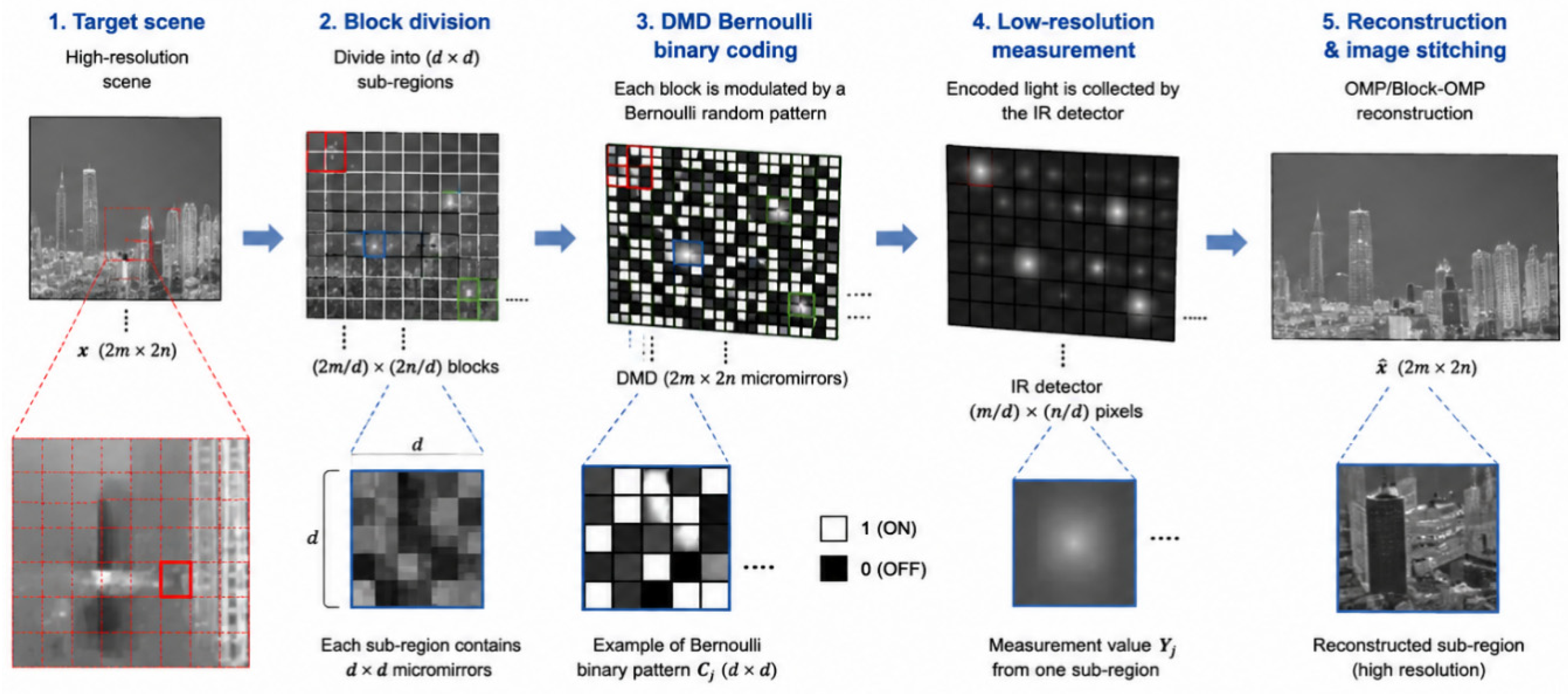
The encoding principle of this system is centered on the compressed sensing theory, and it achieves super-resolution effects by relying on the sparsity characteristic of signals. Considering the super-resolution requirement of this study for area-array detectors, a “block-based” compressed sensing strategy is specifically adopted. The specific process is as follows: first, the target scene is divided into multiple sub-regions and projected onto the DMD. Each sub-region consists of d × d micromirrors, and the DMD completes the encoding and sampling of these sub-regions simultaneously. Next, the low-resolution area-array detector captures the encoded image information, with each pixel of the detector corresponding to one sub-region in a one-to-one manner. Subsequently, a reconstruction algorithm is used to process the collected image data, realizing high-resolution restoration of each sub-region. Finally, all the reconstructed sub-region images are stitched together to form a complete target scene image, achieving d-fold super-resolution image reconstruction.
In this work, the sparsity assumption refers to the fact that the target scene can be represented as a sparse vector in a transform domain Ψ (e.g., wavelet or DCT basis), where only k ≪ N coefficients are non-zero. The system further assumes block-wise sparsity, meaning that each d × d sub-region is sparse independently. Accurate reconstruction requires that the sparsity level k satisfies k < m/log(N), ensuring stable recovery under the OMP framework. The low-resolution detector refers to an infrared focal plane array (FPA). Its effective spatial resolution is intentionally reduced through block-wise optical mapping in the relay imaging system, such that each detector pixel integrates the light intensity from a d × d micromirror sub-region on the DMD.
In the DMD encoding process of this system, the Bernoulli encoding strategy is one of the core implementation methods. Based on the Bernoulli random distribution, this strategy assigns several sets of binary encoding states to the d × d micromirror units in each sub-region on the DMD. The probability that a micromirror is in the “on” state is set to p (usually 0.5 to ensure the randomness and uniformity of encoding), and the probability of being in the “off” state is 1-p. Its random binary encoding characteristic can ensure that the observation matrix Φ satisfies the “Restricted Isometry Property (RIP)” required by compressed sensing, effectively reducing the correlation between encoded signals, thereby guaranteeing the quality of image reconstruction.
For the selection of the reconstruction algorithm, the system adopts the Orthogonal Matching Pursuit (OMP) algorithm [
17]. In essence, this algorithm solves the optimization problem of l1-norm minimization. By approximating the l1-norm to the l0-norm and combining it with the improved Block Orthogonal Matching Pursuit (Block OMP) algorithm, the reconstruction accuracy is improved. The specific process is as follows: first, the DMD with 2 m × 2 n pixels is divided into (2 m/d) × (2 n/d) blocks. The same coding pattern Cj is applied to each block, and the light intensity Yj is captured. A set of observation vectors Y is obtained through matrix transformation. Then, with the observation vector Y, the observation matrix Φ (sensing matrix), the sparse transformation matrix Ψ, and the signal sparsity level k as inputs, the OMP algorithm is initiated. The key index is determined by calculating the inner product between the residual and the columns of the observation matrix; the index set is updated, and the least squares solution is obtained. The residual is updated iteratively until the termination condition t > k is met. Finally, the reconstructed sub-block images are combined to form the final image with a resolution of 2 m × 2 n.
In practical experiments, factors such as coating quality, surface figure accuracy, and assembly precision have a pronounced impact on the polarization measurement accuracy of the optical system. Therefore, we typically employ polarization calibration to comprehensively mitigate the effects of distortion, coating, surface figure, and assembly on the Stokes parameters.
Since the proposed system is an off-axis reflective optical system incorporating a DMD, polarization aberrations should also be considered in addition to conventional scalar image-quality metrics. Multiple oblique reflections, coating-induced phase retardance, unequal reflectance for s- and p-polarized components, and the micromirror tilt of the DMD may introduce diattenuation, retardance, and Stokes-parameter crosstalk [
18]. These effects may further influence the accuracy of DoLP and AoP reconstruction, especially in a broadband MWIR–LWIR system. Therefore, MTF, spot size, and grid distortion can only verify the geometric and radiometric imaging feasibility of the optical system, but they cannot fully characterize the final polarimetric accuracy. In future prototype development, a vector polarization ray-tracing model based on Jones/Mueller calculus will be established to evaluate the polarization aberrations introduced by the reflective mirrors and the DMD. The calibration method reported in Ref. [
14] will also be used as an important reference for suppressing polarization aberration and correcting Stokes-parameter errors.
5. Simulation Experiments
The reconstruction algorithm in compressed sensing is essentially an optimization problem; more specifically, it involves solving an
-norm minimization problem. The
norm is used to approximate the
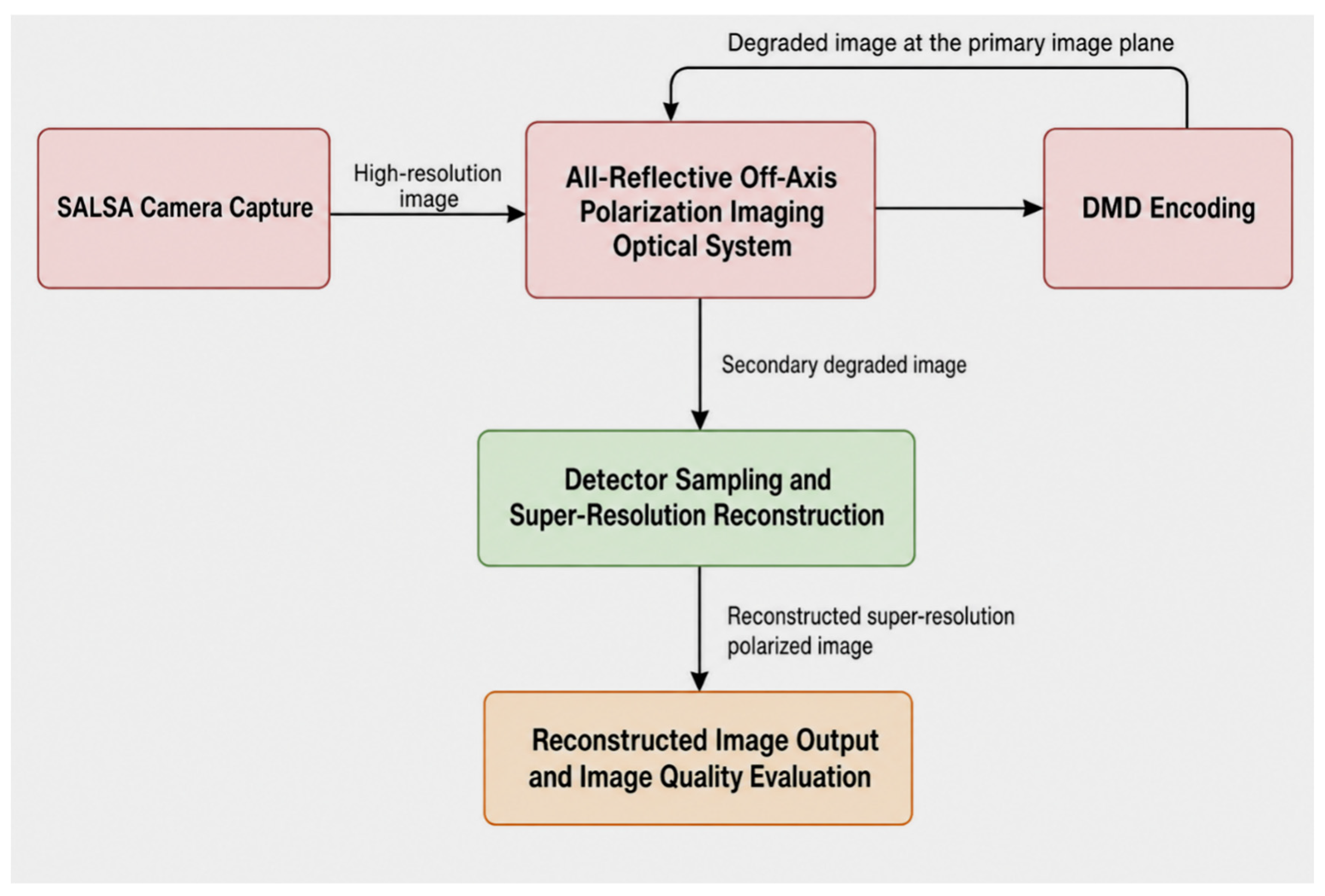
norm. In this paper, an improved block OMP algorithm is adopted for reconstruction. Based on the off-axis sub-aperture polarization super-resolution imaging optical system, super-resolution reconstruction simulations based on compressed sensing were carried out, and the simulation workflow is shown in
Figure 12.
The simulation workflow is as follows: first, high-resolution polarization scene images are imported into the Zemax database. Since high-resolution infrared polarization images are difficult to obtain and the main evaluation target is resolution enhancement, four visible-light polarization images of the same scene, captured by a SALSA polarization camera at 0°, 45°, 90°, and 135°, are used as inputs. Next, Zemax image simulation is used to generate the primary degraded image at the first image plane after the target passes through the telescope objective. Then, block-based sampling and encoding are performed at the DMD according to device resolution (1536 × 1152 micromirrors; 768 × 576 per sub-aperture; detector resolution 192 × 144, i.e., 4 micromirrors correspond to 1 detector pixel). In MATLAB 2020, the compressed encoding process is simulated by applying block-wise measurement matrices to the primary degraded image; during reconstruction, each block is restored separately, stitched together, and corrected for edge effects (the measurement matrix is expanded from multiple 4 × 4 random Gaussian matrices). The encoded image then passes through the relay reflective system, undergoing secondary degradation and downsampling; optical simulation yields degraded images of 192 × 144 for each sub-aperture. Steps of encoding and secondary degradation are repeated for all four sub-apertures to obtain multiple encoded, downsampled detector images. Finally, taking sub-aperture 1 as an example, OMP reconstructs the 192 × 144 image to 768 × 576, achieving 4× super-resolution, and the final image quality is evaluated using PSNR and SSIM.
Because this optical system has multiple apertures, Zemax’s DDE function is used to reduce workload by linking MATLAB code with a running Zemax session and reading data directly from Zemax. For full-system simulation, the Zemax file of the designed all-reflective broadband polarization imaging optical system is opened in advance for MATLAB calls. Through this Zemax–MATLAB linkage, four original polarization scene images at 0°, 45°, 90°, and 135°are imported. After degradation through the optical system, four downsampled low-resolution images are obtained, and super-resolution reconstruction is then performed on these low-resolution images. Finally, four reconstructed images with resolutions four times higher than that of the detector are obtained, and the reconstruction performance is evaluated using SSIM and PSNR, as shown in
Table 6.
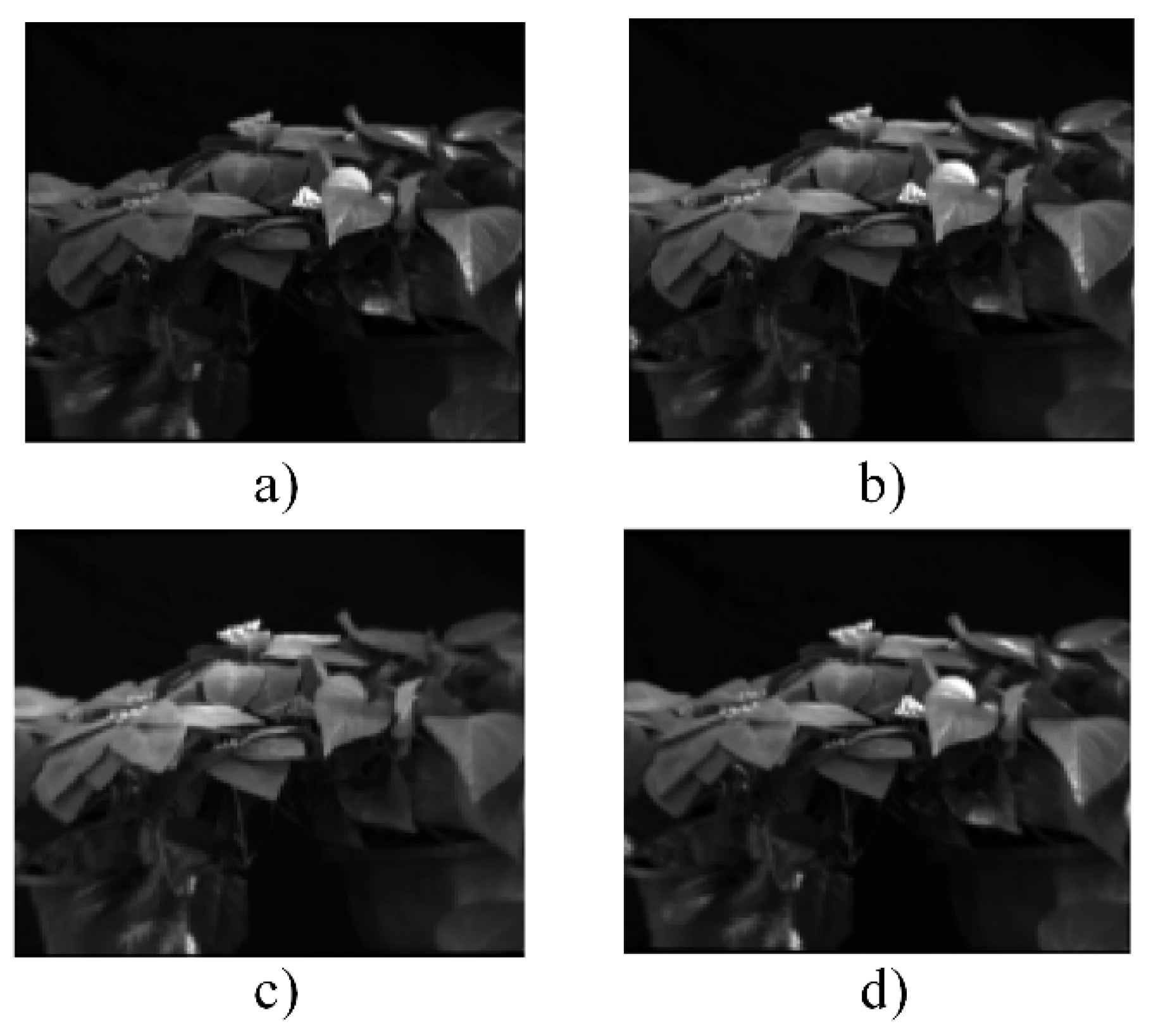
The low-resolution image is shown in
Figure 13.
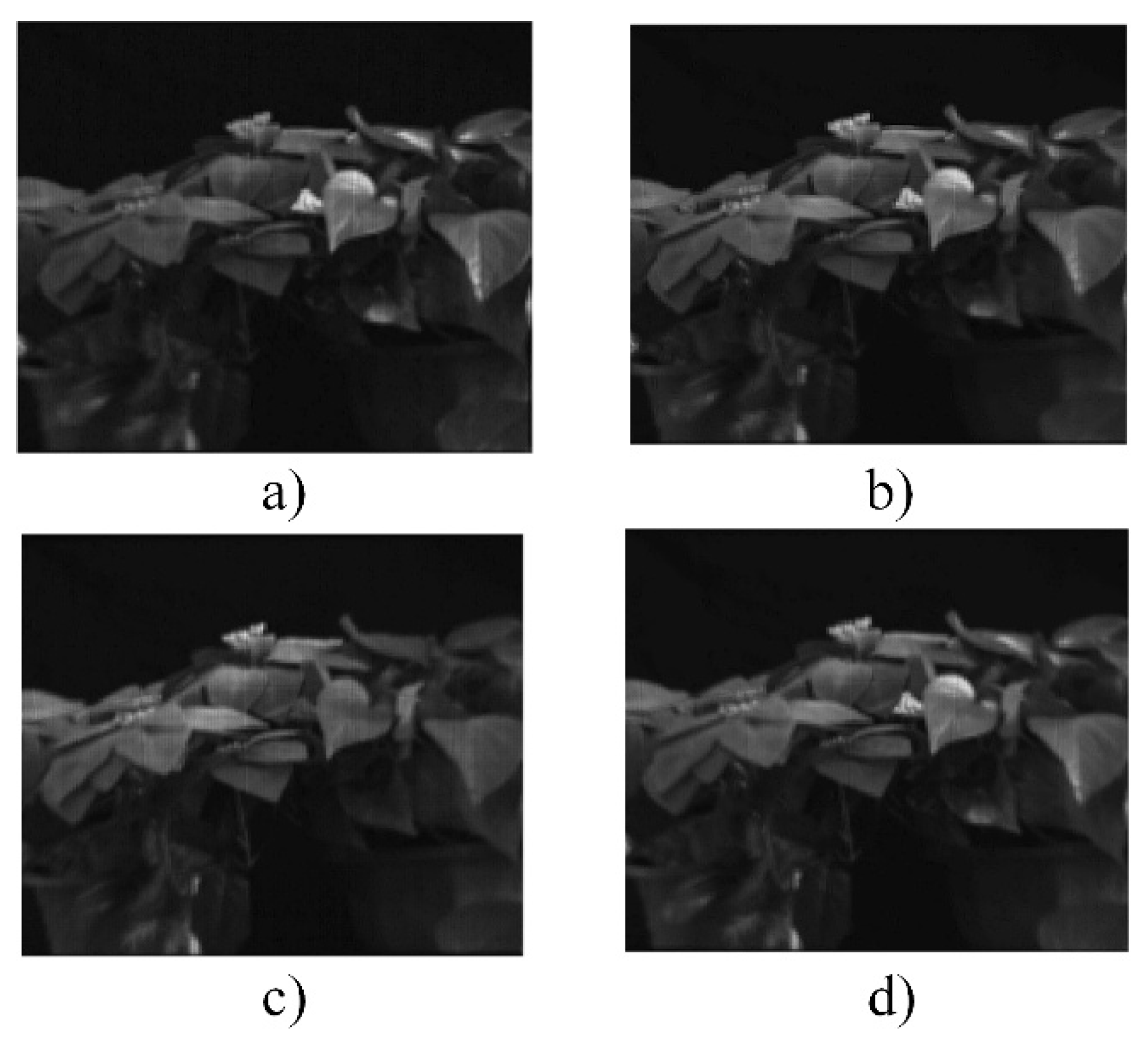
The reconstruction results are shown in
Figure 14.
According to Equation (1), the reconstructed polarization images at 0°, 45°, 90°, and 135° were further combined to obtain the super-resolved Stokes images S0, S1, and S2, where S3 was set to zero for linear polarization-only measurement.
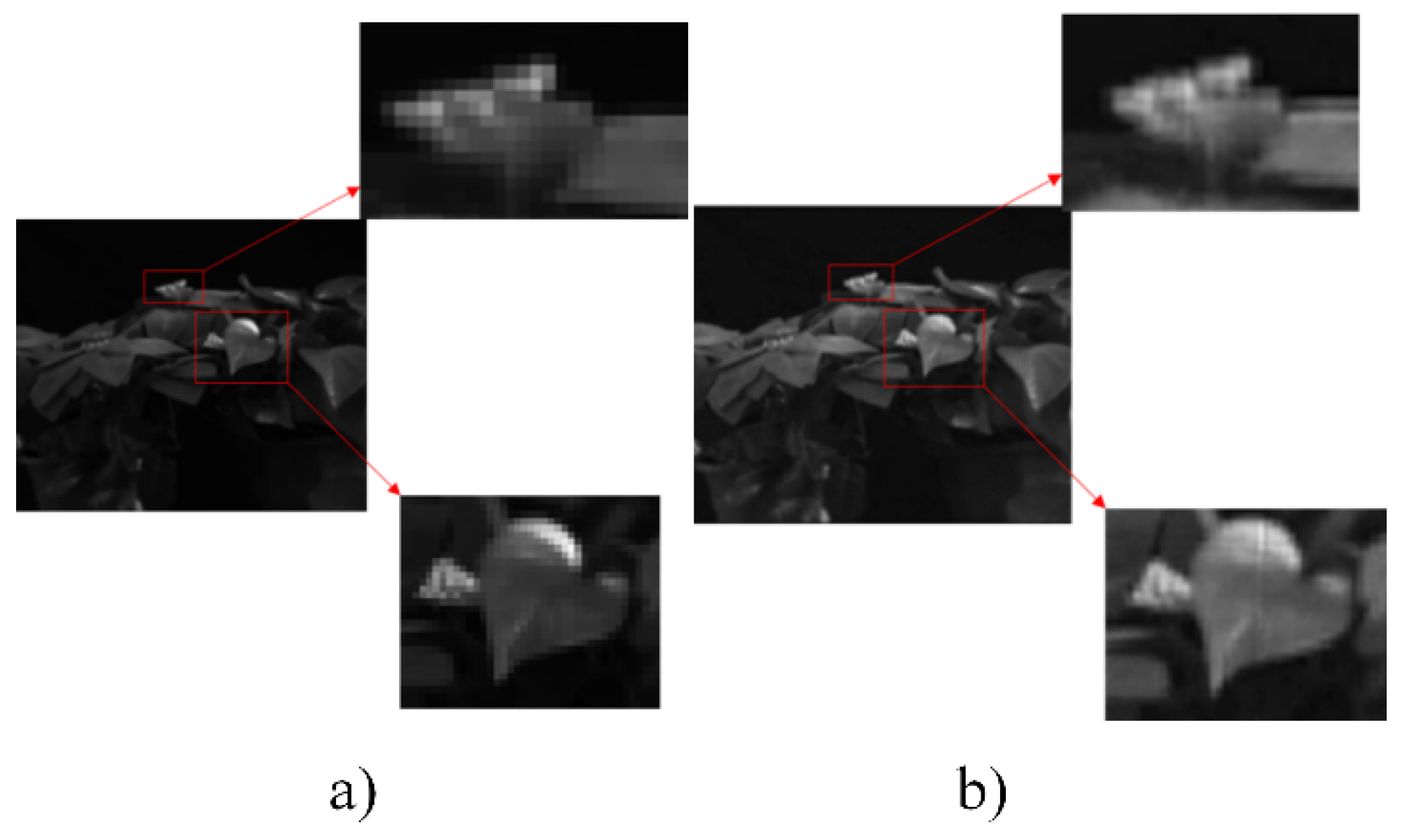
A comparison between the low-resolution images and the reconstructed high-resolution images shows that the low-resolution images suffer from a pronounced mosaic effect, as shown in
Figure 15. For example, in the low-resolution images, the flower core is almost indistinguishable, whereas in the reconstructed images, clear structural layers between the stamens can be identified. In the large-leaf regions, the leaf edges in the low-resolution images are severely blurred, while the reconstructed images show significantly improved edge detail and overall fineness. These results verify the effectiveness of the compressed-sensing-based super-resolution reconstruction method proposed in this paper and demonstrate a clear resolution enhancement for low-resolution images.
6. Conclusions
This paper proposes an aperture-divided off-axis polarization-sensitive super-resolution imaging system, realized using an aperture-divided reflective freeform optical system and a DMD encoder. The system offers several advantages, including applicability across various optical wavelengths, simultaneous imaging of multiple polarization states, single-detector operation, high resolution, and ease of miniaturization. Additionally, the design principles and methods for an aperture-divided off-axis reflective freeform optical system incorporating a DMD have been studied and developed. The classical W-W theory in Optical Principles is further developed to derive a reflective W-W differential equation suitable for reflective systems, capable of eliminating various aberrations. Additionally, by integrating Seidel’s aberration theory, the solution to the W-W equation is iteratively adjusted to satisfy the boundary conditions for distortion elimination, resulting in an optical initial structure that simultaneously corrects spherical aberration, coma, astigmatism, and distortion. A merit function for image quality is established to strictly control the position of the chief ray’s intersection points at the intermediate and final image planes for each sub-aperture across all fields of view. This effectively suppresses the mismatch errors during the super-resolution reconstruction process at the optical level. The design of an aperture-divided off-axis reflective super-resolution imaging optical system with four sub-apertures has been completed. Each mirror surface is designed as an X-Y polynomial freeform surface. The system features a large relative aperture (F# = 2.5) and a compact structure. At both the intermediate image plane (DMD) and the final image plane, the image quality for each sub-aperture and field of view is near the diffraction limit, meeting the imaging quality requirements for each polarization channel. The design principles and methods proposed fill the gap in the theoretical framework for wide-band simultaneous polarization super-resolution imaging optical systems. This approach addresses the issues of low design efficiency and poor reliability commonly encountered when applying traditional design methods to such specialized systems. For the practical manufacturing of this specialized optical system, tolerance analysis is a crucial step. Therefore, the next step is to develop a tolerance model for the system, taking into account the current capabilities in freeform surface fabrication. This will involve allocating tolerance values for the curvature radius, polynomial coefficients, mirror spacing, eccentricity, and tilt about the x-axis, in preparation for the realization of the actual system. Because the DMD encodes each polarization channel sequentially, improved spatial super-resolution is achieved at the cost of reduced temporal resolution. In addition, maintaining optomechanical alignment and thermal stability over the broad 3–14 μm MWIR–LWIR band remains an important practical challenge for system implementation. It should be noted that the present work focuses on optical design, aberration correction, and simulation-based feasibility evaluation. Prototype fabrication, real-scene imaging experiments, experimental polarization calibration, reconstruction validation using measured data, and real polarimetric tests are beyond the scope of the present study and will be carried out in future work.